SOMATOM Sessions 
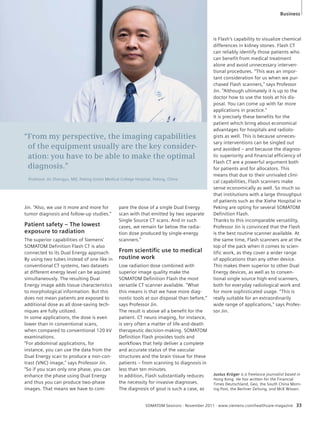
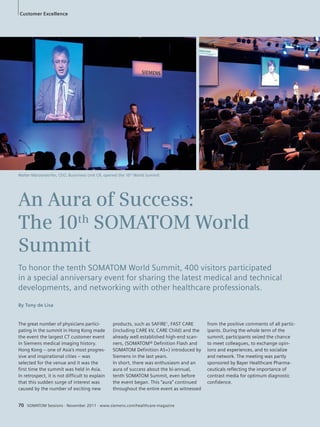
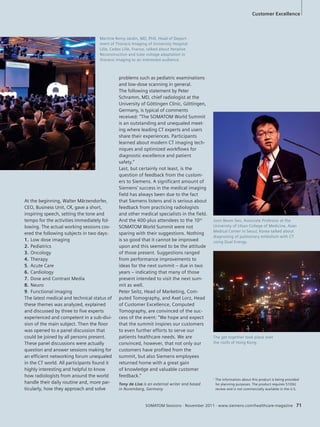
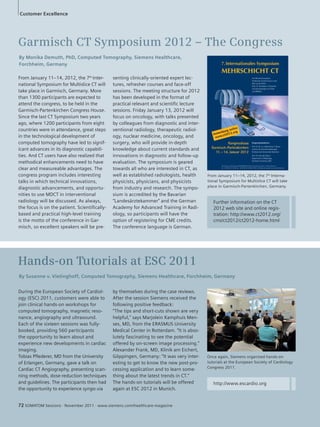
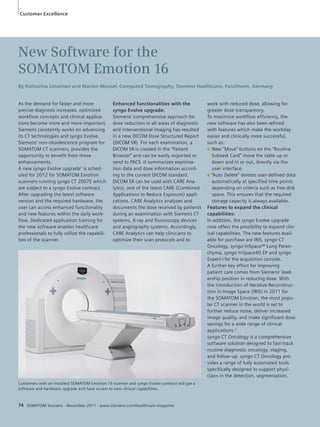
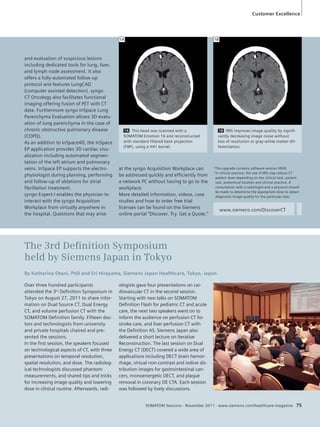
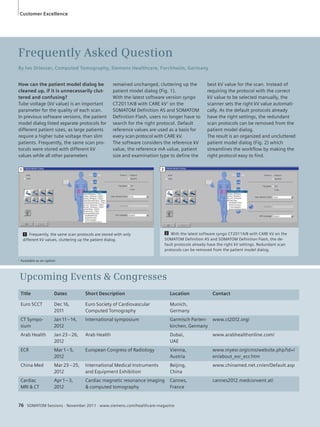
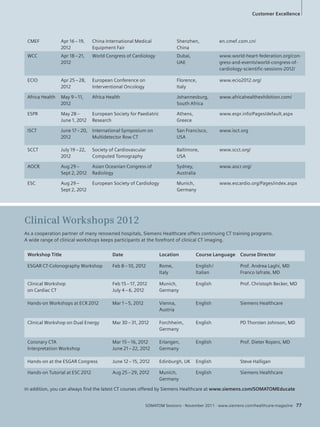
Answers for life in Computed Tomography 
Issue Number 29 / November 2011 
International Edition 
Cover Story 
A Critical “Edge” 
When Seconds Count 
Page 6 
News 
syngo.via: New Clinical 
Opportunities with 
Brand New CT Software 
Applications 
Page 12 
Business 
Value Added Max 
Page 26 
Clinical 
Results 
Flash Scanning 
of Coronary 
CTA with just 0.3 mSv 
Page 38 
Science 
From Mannheim to 
Shanghai: a Viable 
Model for Future 
International Research 
Collaborations 
Page 68 
29 
International Edition November 2011 29 SOMATOM Sessions
Editorial 
2 “With the introduction of two 
completely new systems at this 
year’s RSNA conference, we 
have shown our strength in 
innovation and that we listen 
carefully to our customers.” 
Walter Märzendorfer, Chief Executive Officer, Business Unit Computed Tomography and Radiation 
Oncology, Siemens Healthcare, Forchheim, Germany 
Cover page: Courtesy of German Heart Center, Departments of Cardiology and Radiology, Munich, Germany 
SOMATOM Sessions · November 2011 · www.siemens.com/healthcare-magazine
Editorial 
Dear Reader, 
In all healthcare systems around the 
world, hospitals and clinics are facing the 
challenge of minimizing spiraling costs 
without compromising on patient care. 
Our vision, to create CT innovations that 
lift clinical practice to the next level of 
excellence and enable wide access to 
better patient care, has to meet those 
challenges. By working closely with the 
physicians and physicists who use our 
systems in clinical routine, we are con-vinced 
that this balance can be achieved. 
The outcome are products, that meet 
today’s demands in modern patient 
care, and add innovations that help con-trol 
costs and make your CT operations 
economically sound. 
The latest result of our extensive 
research and development in this direc-tion 
is the SOMATOM® Perspective1, 
which is presented at this year’s RSNA 
conference. This new 128-slice Single 
Source CT scanner showcases a wide 
range of CT technologies at an afford-able 
price, and is also suitable for 
smaller clinics. It scans an adult thorax 
in about 3 seconds and supports our 
state-of-the-art iterative reconstruction 
SAFIRE2 at a speedy 15 images/second. 
At the same time, its all-new eMode 
allows you to operate the scanner in an 
outstanding patient-friendly and finan-cially 
efficient way. This thoughtful bal-ance 
will help you to manage your 
financial performance – which is why 
we call it the business class in CT. 
For added benefits in workflow optimiza-tion, 
we have enhanced syngo.via3 with 
a wide range of applications designed to 
streamline your clinical efficiency. These 
will help you to assess chronic obstructive 
pulmonary disease and offer you dedi-cated 
TAVI workflows – to name just two 
examples. In addition, we carefully lis-tened 
to your feedback and implemented 
many of your suggestions to make our 
paradigm-changing thin-client solution 
more intuitive than ever. 
But we also remain focused on innova-tions 
powered by high-end technology, 
such as the SOMATOM Definition Edge4 – 
a completely new and extremely fast 
single source scanner developed for high-resolution, 
low noise imaging. Its core 
technology is the unique Stellar Detec-tor, 
4 the first fully-integrated detector in 
the industry, featuring the highest rou-tine 
spatial resolution and dose-opti-mized 
Dual Energy applications. The 
SOMATOM Definition Edge is ideal for 
clinics introducing premium CT services, 
as well as institutions that want to main-tain 
a leading edge in their offerings. For 
utmost performance, the Stellar Detector 
will also be available on our flagship 
scanner, the Dual Source SOMATOM 
Definition Flash.1 Its unique scan speed 
and temporal resolution will be brought 
to a new level with ultra-high spatial 
resolution, for finer and sharper image 
details than ever. 
The Stellar Detector also marks another 
step in our endeavor to reduce dose in 
CT. Its capability to minimize noise makes 
it highly suited for your efforts to scan 
with the lowest possible dose, at levels 
that were thought unachieveable just a 
few years ago. As such, it perfectly blends 
with our raw data-based iterative recon-struction 
SAFIRE, two unique tools to 
help you implement the ALARA principle 
in your institution – for best possible 
patient care. 
By working closely with our customers, 
we have recognized future trends and 
brought cutting-edge technology and 
cost-effective solutions to the present. 
See for yourself how close we are to 
achieving our vision in this issue of 
SOMATOM Sessions. 
Feedback in the form of criticisms or 
suggestions will be gladly received. 
Sincerely, 
Peter Seitz, 
Vice President Marketing, 
Computed Tomography, 
Siemens Healthcare, 
Forchheim, Germany 
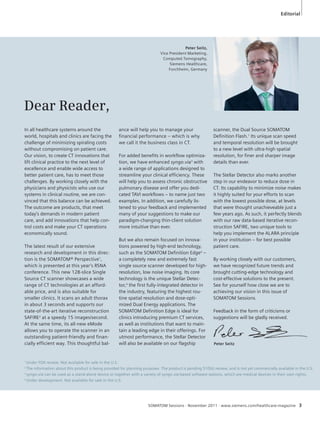
Peter Seitz 
1 Under FDA review. Not available for sale in the U.S. 
2 The information about this product is being provided for planning purposes. The product is pending 510(k) review, and is not yet commercially available in the U.S. 
3 syngo.via can be used as a stand-alone device or together with a variety of syngo.via-based software options, which are medical devices in their own rights. 
4 Under development. Not available for sale in the U.S. 
SOMATOM Sessions · November 2011 · www.siemens.com/healthcare-magazine 3
Content 
Cover Story 
Cover Story 
6 A Critical “Edge” When Seconds 
Count 
News 
12 syngo.via2: New Clinical Opportuni-ties 
with Brand new CT Software 
Applications 
15 Significant Dose Reduction with 
SAFIRE3 at Wexford General Hospital, 
Ireland 
16 Boosting Cardiovascular Reading 
with syngo.via at this Year’s CTA 
Academy 
17 Stroke Management – Education 
and Information Exchange Online 
18 International CT Image Contest 
2011 
20 Iterative Reconstruction is Now 
Available for SOMATOM Emotion 
and Sensation 
22 FAST CARE Meets DSCT 
23 High-End CT is on the Move 
24 CT Examinations Tailored Precisely 
to Individual Patient Needs 
6 When it comes to diagnosing 
critical injuries like in acute care 
or cardiology settings, 
radiologists need fast, high-quality 
CT images at a low dose. 
Siemens listened to radiologists’ 
needs and developed a 
revolutionary new detector 
generation: the Stellar Detector.1 
Two renowned imaging experts, 
the radilogist Savvas Nicolaou, 
MD and the cardiologist Jörg 
Hausleiter, MD share their 
expectations and potential 
applications for the new detector 
technology. 
4 SOMATOM Sessions · November 2011 · www.siemens.com/healthcare-magazine 
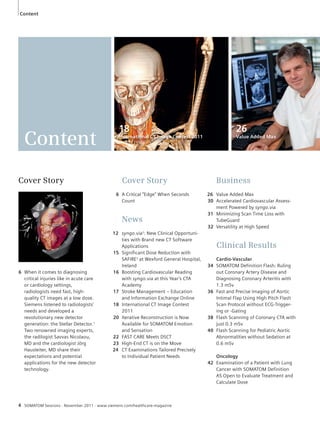
26 
Value Added Max 
18 
International CT Image Contest 2011 
Business 
26 Value Added Max 
30 Accelerated Cardiovascular Assess-ment 
Powered by syngo.via 
31 Minimizing Scan Time Loss with 
TubeGuard 
32 Versatility at High Speed 
Clinical Results 
Cardio-Vascular 
34 SOMATOM Definition Flash: Ruling 
out Coronary Artery Disease and 
Diagnosing Coronary Arteritis with 
1.3 mSv 
36 Fast and Precise Imaging of Aortic 
Intimal Flap Using High Pitch Flash 
Scan Protocol without ECG-Trigger-ing 
or -Gating 
38 Flash Scanning of Coronary CTA with 
just 0.3 mSv 
40 Flash Scanning for Pediatric Aortic 
Abnormalities without Sedation at 
0.6 mSv 
Oncology 
42 Examination of a Patient with Lung 
Cancer with SOMATOM Definition 
AS Open to Evaluate Treatment and 
Calculate Dose 
Content
Science 
60 The First Single Source Dual Energy 
Scan Mode with Optimized Dose 
62 iTRIM – a New Method for Improving 
Temporal Resolution in Cardiac 
Computed Tomography 
64 Stellar Detector Performance in 
Computed Tomography 
67 Pediatric Imaging in the Spotlight 
68 From Mannheim to Shanghai: a 
Viable Model for Future Interna-tional 
Research Collaborations 
Customer 
Excellence 
70 An Aura of Success: The 10th 
SOMATOM World Summit 
SOMATOM Sessions · November 2011 · www.siemens.com/healthcare-magazine 5 
44 Low Dose Pediatric Flash CT Scan-ning 
with IRIS4 – A Follow-up Study 
after Neuroblastoma Relapse 
46 Dose Reduction Combining CARE 
Dose4D, CARE kV and SAFIRE 
Techniques 
48 Lung Ventilation Imaging with Dual 
Energy Xenon CT in Single Breath 
Technique 
Neurology 
50 SOMATOM Definition AS 40: VPCT 
Pre- and Post-Recanalization of the 
Internal Carotid Artery 
52 Dual Energy CT Myelography Used to 
Detect Spontaneous Spinal Cerebro-spinal 
Fluid Leaks 
Acute Care 
54 SOMATOM Definition Flash: Low 
Dose Chest Follow-up Scanning 
with IRIS 
56 SOMATOM Definition Flash: 
Metal Artifact Reduction with 
Mono Energetic Dual Energy 
Imaging in a Critical Trauma Case 
58 Flash CT Pulmonary Angiography in 
a Freely Breathing Patient 
72 Garmisch CT Symposium 2012 – 
The Congress 
72 Hands-on Tutorials at ESC 2011 
73 FAST CARE Boosted with Expert 
Advice 
73 Keep Track of Developments with 
Clinical Webinars 
74 New Software for the SOMATOM 
Emotion 16 
75 The 3rd Definition Symposium held 
by Siemens Japan in Tokyo 
76 Frequently Asked Question 
76 Upcoming Events & Congresses 
77 Clinical Workshops 2012 
78 Subscription 
79 Imprint 
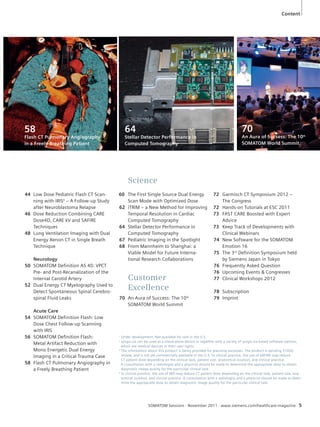
58 
Flash CT Pulmonary Angiography 
in a Freely Breathing Patient 
70 
An Aura of Sucsess: The 10th 
SOMATOM World Summit 
64 
Stellar Detector Performance in 
Computed Tomography 
Content 
1 Under development. Not available for sale in the U.S. 
2 syngo.via can be used as a stand-alone device or together with a variety of syngo.via-based software options, 
which are medical devices in their own rights. 
3 The information about this product is being provided for planning purposes. The product is pending 510(k) 
review, and is not yet commercially available in the U.S. In clinical practice, the use of SAFIRE may reduce 
CT patient dose depending on the clinical task, patient size, anatomical location, and clinical practice. 
A consultation with a radiologist and a physicist should be made to determine the appropriate dose to obtain 
diagnostic image quality for the particular clinical task. 
4 In clinical practice, the use of IRIS may reduce CT patient dose depending on the clinical task, patient size, ana-tomical 
location, and clinical practice. A consultation with a radiologist and a physicist should be made to deter-mine 
the appropriate dose to obtain diagnostic image quality for the particular clinical task.
Cover Story 
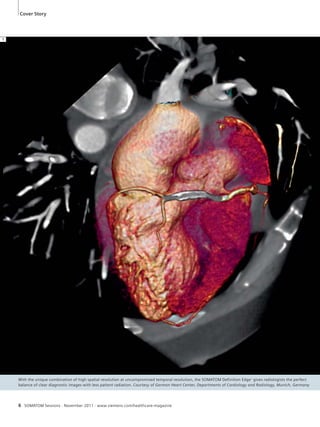
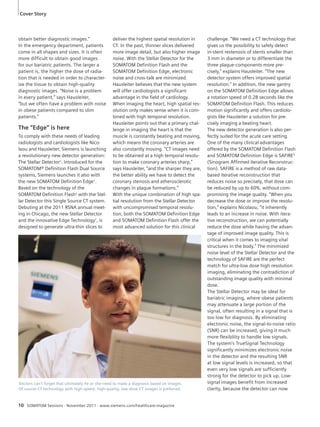
With the unique combination of high spatial resolution at uncompromised temporal resolution, the SOMATOM Definition Edge1 gives radiologists the perfect 
balance of clear diagnostic images with less patient radiation. Courtesy of German Heart Center, Departments of Cardiology and Radiology, Munich, Germany 
6 SOMATOM Sessions · November 2011 · www.siemens.com/healthcare-magazine 
1
Cover Story 
A Critical “Edge” 
When Seconds Count 
When it comes to diagnosing critical injuries like in acute care or cardiology 
settings, radiologists need fast, high-quality CT images at a low dose. Siemens 
listened to radiologists’ needs and developed a revolutionary new detector 
generation: the Stellar Detector1. Two renowned imaging experts, the radiolo-gist 
Savvas Nicolaou, MD and the cardiologist Jörg Hausleiter, MD share their 
expectations and potential applications for the new detector technology. 
SOMATOM Sessions · November 2011 · www.siemens.com/healthcare-magazine 7 
Surrounded by cold deep ocean waters 
famous for whale spotting, Vancouver, 
British Columbia, located on Canada’s 
western coast, is a cosmopolitan haven 
for adventure seekers and foodies alike. 
The city’s sleek skyscrapers compete with 
the jagged mountain peaks beyond, 
creating an interesting juxtaposition 
of nature and urban culture. Situated in 
the heart of this vibrant metropolis is 
Vancouver General Hospital. Home to 
one of the largest research institutes in 
Canada, Vancouver General is a teaching 
hospital as well as a busy level 1 trauma 
center, where seconds can often mean 
the difference between life and death. 
At Vancouver General, radiologists use 
CT images to provide information that 
is critical to making a proper diagnosis 
in an acute care setting. CT images are 
used for a variety of clinical scenarios in 
the emergency department, such as 
identifying blocks in the coronary arter-ies 
or rips in the bowel, or finding small, 
subtle fractures in the spine, that if undis-covered, 
could result in patient paralysis. 
“In a trauma setting, you want to obtain 
the best image quality possible, because 
we often have to make decisions very 
quickly about catastrophic injuries,” says 
Savvas Nicolaou, MD, Director of Emer-gency/ 
Trauma imaging at Vancouver 
General Hospital. 
A diagnostic necessity 
According to Nicolaou, there has been 
an explosion in the utilization of CT 
imaging in the acute care setting, and 
CT use has increased eight-fold in recent 
years. Trauma physicians work together 
with radiologists “to make the right 
diagnoses and clinical decisions to pro-vide 
the best and safest care to our 
patients,” explains Nicolaou. 
At the German Heart Center in Munich, 
Jörg Hausleiter, MD, also relies on CT 
images to provide critical information 
about patients who present with chest 
pain or have a history of coronary heart 
disease. The recent 2011 WHO report 
states that cardio vascular diseases 
(CVDs) are the leading causes of death 
By Amy K. Erickson 
“Modern CT tech-nology 
allows me 
to differentiate 
between patients 
who need to be 
treated with coro-nary 
stent place-ment 
and those 
patients who 
don’t need it.” 
1 Under development. Not available for sale in the U.S. 
Jörg Hausleiter, MD, 
German Heart Center, Munich, Germany
and disability in the world. A large pro-portion 
of CVDs is preventable but obe-sity 
and diabetes mellitus with athero-sclerosis 
- that are often linked to CVD 
- makes CT imaging a challenge in that 
population. CT imaging “allows me to 
differentiate between patients who 
need to be treated with coronary stent 
placement and those patients who don’t 
need it,” says Hausleiter. 
Advances in CT imaging provide radiolo-gists 
with more opportunities than 
ever before to image unstable trauma 
patients. “We have the ability to put 
people who are actively bleeding, whose 
blood pressures are greatly decreased, 
who are in a critical situation, into the 
CT scanner and use the high-speed 
acquisition technology to quickly tell the 
trauma surgeon whether a patient has 
a large hematoma that is crushing the 
brain that needs to be evacuated 
urgently or if they have a tear in the 
thoracic aorta that is actively bleeding 
in their chest,” says Nicolaou. 
However, one of the biggest hot button 
issues in radiology today is the desire 
to minimize the radiation dose. Even in 
the acute setting where high quality 
images undoubtedly save lives, dose 
8 SOMATOM Sessions · November 2011 · www.siemens.com/healthcare-magazine 
reduction is at the forefront of patient 
care. “For example, if you have a 
23-year-old woman with chest pain, you 
need to do a CT scan to exclude aortic 
dissection, a pulmonary embolism, or a 
coronary artery stenosis (i.e. the Triple- 
Rule-Out Exam),” explains Nicolaou. 
“However, we want to minimize the 
radiation dose to that young woman 
because the breasts, thyroid, and other 
organs are very sensitive to the effects 
of radiation.” He acknowledges that 
there is a lot of pressure to do low-dose 
imaging from within the radiology com-munity 
and from physicians and patients 
as well. “The challenge is to do it with-out 
compromising image integrity, so 
we can provide the appropriate diagno-ses 
for our patients,” says Nicolaou. 
Quick response in the 
“golden hour” 
For patients in Vancouver, Munich and 
everywhere in between, trauma is the 
the leading cause of death under the 
age of 45. With fast and precise imaging 
radiologists can offer a therapeutic 
advantage to patients by providing 
an accurate diagnosis within the critical 
“golden hour,” the time period after an 
insult during which there is the highest 
likelihood that medical treatment will 
prevent death. “For instance in acute 
stroke, the findings on the CT are very 
subtle and hard to detect in the early 
stages,” says Nicolaou. “High-speed 
acquisition is critical in stroke imaging 
so we can very quickly tell our neurology 
colleagues to administer the drugs to 
dissolve the clots.” 
CT can also be used to look at ischemia 
of the bowel and to look for acute blood 
in the abdomen. “We also need to iden-tify 
traumatic tears of the bowel within 
minutes so that the surgeons can make 
the appropriate interventions,” explains 
Nicolaou. CT also comes into play when 
looking at subtle fractures in the cervical 
spine. In addition, CT can be used in an 
acute setting to characterize the compo-sition 
of kidney stones, which can deter-mine 
the course treatment, such as hav-ing 
the stones broken down by an 
ultrasound machine, or dissolved with 
medical therapy” Nicolaou remarks. Dual 
“In a trauma setting, you want to 
obtain the best image quality 
possible, because we often have 
to make decisions very quickly 
about catastrophic in juries.” 
Savvas Nicolaou, MD, 
Vancouver General Hospital, Vancouver, Canada
Cover Story 
SOMATOM Sessions · November 2011 · www.siemens.com/healthcare-magazine 9 
Energy information can add the respec-tive 
tissue information to the morphol-ogy 
to support this decision. 
Chest imaging and beyond 
One of the most common and critically 
important issues of CT images in an 
acute setting is for chest injuries and 
cardiac emergencies. At the German 
Heart Center, Hausleiter relies on CT 
images to identify any narrowing or ath-erosclerotic 
plaques in a patient’s coro-nary 
arteries. “The normal coronary 
artery is only 3 millimeters in diameter, 
so we are talking about very, very tiny 
structures,” says Hausleiter. “We often 
want to assess the coronary arteries to 
see if there is any narrowing or stenosis 
and to detect atherosclerotic plaques.” 
Once the coronary arteries are imaged, 
cardiologists like Hausleiter can deter-mine 
whether a patient needs to be 
rushed to the cath lab to have a stent 
inserted or if the patient can be medi-cally 
managed and safely discharged. 
Other causes of chest pain can include a 
thrombotic clot within a coronary artery, 
a pulmonary embolism, or pneumonia 
in the lung. 
Whether it is imaging a motorcycle acci-dent 
victim or an individual with chest 
pain, radiologists and cardiologists need 
CT technology that maintains image 
quality while minimizing the dose. “As 
a radiologist, you can’t forget that ulti-mately 
you need to make a diagnosis 
based on the images,” says Nicolaou. 
“I need detector technology that is 
highly efficient, while providing excel-lent 
clinical images. I also need to obtain 
diagnostic images at a low radiation 
dose. It is incumbent upon us as radiolo-gists 
to minimize the dose, since we are 
using CT at such a rapid pace to optimize 
patient care.” 
From a cardiology standpoint, Hausleiter 
points out that over time, stents can re-narrow 
and the stenosis can come back. 
“In this case, we need to assess the inside 
of the stent, and this requires a high spa-tial 
resolution,” he says. “The higher the 
spatial resolution, the higher our capa-bility 
to detect these changes.” 
Radiologists also need to benefit from a 
detector that provides an extremely high 
dynamic range of data preventing 
potential artifacts in the image. “Cur-rently 
it is very difficult to be able to 
identify and utilize information at very 
low contrast levels,” says Nicolaou. He 
notes that in a trauma setting, patients 
often come in with numerous tubes and 
access lines. “A lot of artifacts can occur 
when you image patients with these 
extra tubes, which can preclude you 
from obtaining good diagnostic images,” 
says Nicolaou. “However, if we have a 
detector that can take care of the noise 
and get rid of the artifacts, then we can 
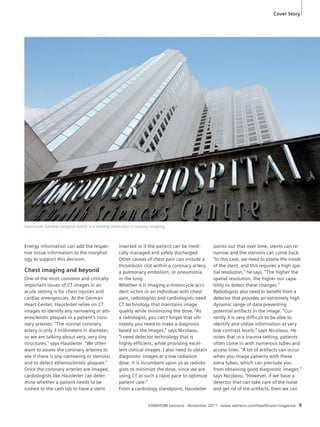
Vancouver General Hospital (VGH) is a leading institution in trauma imaging.
Cover Story 
obtain better diagnostic images.” 
In the emergency department, patients 
come in all shapes and sizes. It is often 
more difficult to obtain good images 
for our bariatric patients. The larger a 
patient is, the higher the dose of radia-tion 
that is needed in order to character-ize 
the tissue to obtain high-quality 
diagnostic images. “Noise is a problem 
in every patient,” says Hausleiter, 
“but we often have a problem with noise 
in obese patients compared to slim 
patients.” 
The “Edge” is here 
To comply with these needs of leading 
radiologists and cardiologists like Nico-laou 
and Hausleiter, Siemens is launching 
a revolutionary new detector generation: 
The Stellar Detector1. Introduced for the 
SOMATOM® Definition Flash Dual Source 
systems, Siemens launches it also with 
the new SOMATOM Definition Edge1. 
Based on the technology of the 
SOMATOM Definition Flash2 with the Stel-lar 
Detector this Single Source CT system. 
Debuting at the 2011 RSNA annual meet-ing 
in Chicago, the new Stellar Detector 
and the innovative Edge Technology1, is 
designed to generate ultra-thin slices to 
deliver the highest spatial resolution in 
CT. In the past, thinner slices delivered 
more image detail, but also higher image 
noise. With the Stellar Detector for the 
SOMATOM Definition Flash and the 
SOMATOM Definition Edge, electronic 
noise and cross-talk are minimized. 
Hausleiter believes that the new system 
will offer cardiologists a significant 
advantage in the field of cardiology. 
When imaging the heart, high spatial res-olution 
only makes sense when it is com-bined 
with high temporal resolution. 
Hausleiter points out that a primary chal-lenge 
in imaging the heart is that the 
muscle is constantly beating and moving, 
which means the coronary arteries are 
also constantly moving. “CT images need 
to be obtained at a high temporal resolu-tion 
to make coronary arteries sharp,” 
says Hausleiter, “and the sharper they are, 
the better ability we have to detect the 
coronary stenosis and atherosclerotic 
changes in plaque formations.” 
With the unique combination of high spa-tial 
resolution from the Stellar Detector 
with uncompromised temporal resolu-tion, 
both the SOMATOM Definition Edge 
and SOMATOM Definition Flash offer the 
most advanced solution for this clinical 
10 SOMATOM Sessions · November 2011 · www.siemens.com/healthcare-magazine 
challenge. “We need a CT technology that 
gives us the possibility to safely detect 
in-stent restenosis of stents smaller than 
3 mm in diameter or to differentiate the 
three plaque-components more pre-cisely,” 
explains Hausleiter. “The new 
detector system offers improved spatial 
resolution.” In addition, the new gantry 
on the SOMATOM Definition Edge allows 
a rotation speed of 0.28 seconds like the 
SOMATOM Definition Flash. This reduces 
motion significantly and offers cardiolo-gists 
like Hausleiter a solution for pre-cisely 
imaging a beating heart. 
The new detector generation is also per-fectly 
suited for the acute care setting. 
One of the many clinical advantages 
offered by the SOMATOM Definition Flash 
and SOMATOM Definition Edge is SAFIRE3 
(Sinogram Affirmed Iterative Reconstruc-tion). 
SAFIRE is a method of raw data-based 
iterative reconstruction that 
reduces noise so precisely, that dose can 
be reduced by up to 60%, without com-promising 
the image quality. “When you 
decrease the dose or improve the resolu-tion,” 
explains Nicolaou, “it inherently 
leads to an increase in noise. With itera-tive 
reconstruction, we can potentially 
reduce the dose while having the advan-tage 
of improved image quality. This is 
critical when it comes to imaging vital 
structures in the body.” The minimized 
noise level of the Stellar Detector and the 
technology of SAFIRE are the perfect 
match for ultra-low dose high resolution 
imaging, eliminating the contradiction of 
outstanding image quality with minimal 
dose. 
The Stellar Detector may be ideal for 
bariatric imaging, where obese patients 
may attenuate a large portion of the 
signal, often resulting in a signal that is 
too low for diagnosis. By eliminating 
electronic noise, the signal-to-noise ratio 
(SNR) can be increased, giving it much 
more flexibility to handle low signals. 
The system’s TrueSignal Technology 
significantly minimizes electronic noise 
in the detector and the resulting SNR 
at low signal levels is increased, so that 
even very low signals are sufficiently 
strong for the detector to pick up. Low-signal 
images benefit from increased 
clarity, because the detector can now 
Doctors can’t forget that ultimately he or she need to make a diagnosis based on images. 
Of course CT technology with high-speed, high-quality, low-dose CT images is preferred.
Cover Story 
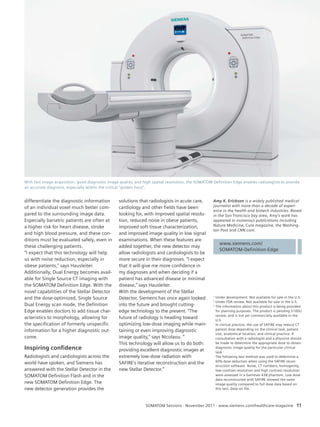
With fast image acquisition, good diagnostic image quality, and high spatial resolution, the SOMATOM Definition Edge enables radiologists to provide 
an accurate diagnosis, especially within the critical “golden hour”. 
www.siemens.com/ 
SOMATOM-Definition-Edge 
SOMATOM Sessions · November 2011 · www.siemens.com/healthcare-magazine 11 
differentiate the diagnostic information 
of an individual voxel much better com-pared 
to the surrounding image data. 
Especially bariatric patients are often at 
a higher risk for heart disease, stroke 
and high blood pressure, and these con-ditions 
must be evaluated safely, even in 
these challenging patients. 
“I expect that this technology will help 
us with noise reduction, especially in 
obese patients,” says Hausleiter. 
Additionally, Dual Energy becomes avail-able 
for Single Source CT imaging with 
the SOMATOM Definition Edge. With the 
novel capabilities of the Stellar Detector 
and the dose-optimized, Single Source 
Dual Energy scan mode, the Definition 
Edge enables doctors to add tissue char-acteristics 
to morphology, allowing for 
the specification of formerly unspecific 
information for a higher diagnostic out-come. 
Inspiring confi dence 
Radiologists and cardiologists across the 
world have spoken, and Siemens has 
answered with the Stellar Detector in the 
SOMATOM Definition Flash and in the 
new SOMATOM Definition Edge. The 
new detector generation provides the 
solutions that radiologists in acute care, 
cardiology and other fields have been 
looking for, with improved spatial resolu-tion, 
reduced noise in obese patients, 
improved soft tissue characterization, 
and improved image quality in low signal 
examinations. When these features are 
added together, the new detector may 
allow radiologists and cardiologists to be 
more secure in their diagnoses. “I expect 
that it will give me more confidence in 
my diagnoses and when deciding if a 
patient has advanced disease or minimal 
disease,” says Hausleiter. 
With the development of the Stellar 
Detector, Siemens has once again looked 
into the future and brought cutting-edge 
technology to the present. “The 
future of radiology is heading toward 
optimizing low-dose imaging while main-taining 
or even improving diagnostic 
image quality,” says Nicolaou. “ 
This technology will allow us to do both: 
providing excellent diagnostic images at 
extremely low-dose radiation with 
SAFIRE’s iterative reconstruction and the 
new Stellar Detector.” 
Amy K. Erickson is a widely published medical 
journalist with more than a decade of experi-ence 
in the health and biotech industries. Based 
in the San Francisco bay area, Amy’s work has 
appeared in numerous publications including 
Nature Medicine, Cure magazine, the Washing-ton 
Post and CNN.com. 
1 Under development. Not available for sale in the U.S. 
2 Under FDA review. Not available for sale in the U.S. 
3 The information about this product is being provided 
for planning purposes. The product is pending 510(k) 
review, and is not yet commercially available in the 
U.S. 
In clinical practice, the use of SAFIRE may reduce CT 
patient dose depending on the clinical task, patient 
size, anatomical location, and clinical practice. A 
consultation with a radiologist and a physicist should 
be made to determine the appropriate dose to obtain 
diagnostic image quality for the particular clinical 
task. 
The following test method was used to determine a 
60% dose reduction when using the SAFIRE recon-struction 
software. Noise, CT numbers, homogenity, 
low-contrast resolution and high contrast resolution 
were assessed in a Gammex 438 phantom. Low dose 
data reconstructed with SAFIRE showed the same 
image quality compared to full dose data based on 
this test. Data on file.
News 
syngo.via: 
New Clinical Opportunities with Brand 
new CT Software Applications1 
By Susanne Hölzer, Philip Stenner, PhD, Jochen Dormeier, MD, Karin Barthel 
Computed Tomography, Siemens Healthcare, Forchheim, Germany 
With the launch of a new syngo.via1 ver-sion 
at the RSNA 2011, Siemens is open-ing 
a new era for routine diagnostics in 
CT imaging. With four additional CT 
workflows, six freshened-up Dual Energy 
applications, and many other additional 
helpful features and applications, even 
for other imaging modalities, it is 
designed to further diagnostic speed and 
accuracy. 
Dual Energy – Going beyond 
visualization 
The SOMATOM® Definition Flash has 
brought Dual Energy examination into 
routine clinical practice and has shown 
the diagnostic benefits of going beyond 
visualization. 
With the new version the basic function-ality 
of syngo.via has been enriched with 
well-established features such as Opti-mum 
Contrast for automatically calculat-ing 
contrast-optimized images and a new 
Dual Energy applications now 
available on syngo.via: 
■ syngo.CT DE Lung Analysis 
■ syngo.CT DE Heart PBV 
■ syngo.CT DE Calculi 
Characterization 
■ syngo.CT DE Brain Hemorrhage 
■ syngo.CT DE Virtual Unenhanced 
■ syngo.CT DE Direct Angio 
functionality for generating monoener-getic 
images at a range of 40-190 keV to 
optimize the image quality. Furthermore 
the assessment of kidney stones is facili-tated 
with the new syngo.CT DE Calculi 
Characterization. The Siemens’ unique 
“Kidney Stone Navigator” makes it easy to 
navigate through findings without scroll-ing 
through the whole volume. Another 
new application – syngo.CT DE Lung 
Analysis – utilizes Siemens’ unique Dual 
Source Dual Energy data for simultane- 
1 2 
12 SOMATOM Sessions · November 2011 · www.siemens.com/healthcare-magazine 
ous assessment of both pulmonary func-tion 
and of the lung vessels. After the 
evaluation all diagnostic information is 
being displayed in one view, allowing 
pulmonary embolism to be ruled out. 
Cardiovascular CT – accuracy 
for TAVI planning and boosted 
sensitivity in triple rule-out 
examinations 
Aortic stenosis is one of the most com-mon 
forms of cardiovascular valve disor-der. 
It is conventionally treated by replac-ing 
the aortic valve with an artifi cial 
valve through invasive open chest sur-gery. 
However, patients affected usually 
suffer from several co-morbidities and 
are therefore denied surgery. Since a 
couple of years, these patients may 
undergo a minimally invasive replace-ment 
of the aortic valve, known as trans-catheter 
aortic valve implantation (TAVI). 
Crucial for a successful TAVI procedure 
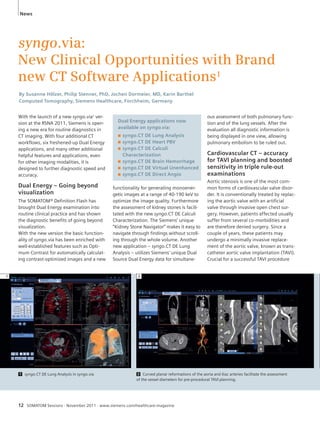
1 syngo.CT DE Lung Analysis in syngo.via 2 Curved planar reformations of the aorta and iliac arteries facilitate the assessment 
of the vessel diameters for pre-procedural TAVI planning.
News 
“syngo.via combines all evaluation tools in one 
single workfl ow. This is a real advantage because 
we need less time to evaluate all anatomic 
structures relevant for the TAVI procedure.” 
Tobias Pfl ederer, MD, University of Erlangen-Nuremberg, Erlangen, Germany 
3 The automated detection of pulmonary filling defects in syngo.CT 
PE CAD3 allows for a safer evaluation of triple rule-out cases.[2] 
References 
[1] T. Pflederer, S. Achenbach, Journal of Cardiovascular 
Computed Tomography (2010) 4, 355–364 
[2] Blackmon et al., European Radiology, January 2011. 
4 For an evaluation of local vessel or tissue enhancement, syngo.CT Dynamic 
Angio2 displays ROI-specific time attenuation curves, as well as curve and statis-tical 
parameters, such as time to peak and peak enhancement. 
is accurate pre-procedural planning, 
where the access path for the catheter is 
assessed and the optimum device type 
and size are determined. 
From now on, the post-processing pow-ers 
of syngo.CT Vascular Analysis and 
syngo.CT Cardiac Function will be com-bined 
to form a dedicated workfl ow for 
streamlined CT TAVI planning. 
In the fi rst step of this workfl ow, the 
smallest possibly detected diameter of 
the iliac arteries is localized with a single 
click in syngo.CT Vascular Analysis. 
Quantifi cation is easily performed with 
the Stenosis Measurement Tool. The 
cardiologist can now determine the 
optimum access route for the catheter. 
Calcifi cation removal helps radiologists 
to visualize calcifi cations in the entire 
aorta. 
An accurate assessment of the aortic 
annulus is crucial for selecting the cor-rect 
implant. syngo.CT Cardiac Function 
displays the aortic valve plane with a 
single click, allowing the short and long 
axes of the aortic annulus to be mea-sured 
more quickly. The length of the 
device is determined by the distances of 
the coronary ostia, which are obtained in 
a matter of seconds. Finally, the angula-tion 
for the C-arm guided intervention is 
calculated and can be transferred to the 
cath lab. Predicting the optimal angula-tion 
with CT has been proven to help 
reducing the amount of contrast agent 
4 
3 
applied in the cath lab by 48%.[1] This 
streamlined workfl ow leads to sounder 
decisions in TAVI planning. 
Patients exhibiting chest pain in the 
emergency department often undergo a 
triple rule-out examination to distinguish 
between coronary artery disease, aortic 
dissections, or pulmonary embolisms. 
The new syngo.via version introduces 
the new application syngo.CT PE CAD3 
which automatically detects pulmonary 
fi lling defects and which may be particu-larly 
helpful if no Dual Source Dual 
Energy data is available. Combined with 
the CT Coronary and CT Vascular tasks, 
the workfl ow CT Chest Pain + PE CAD3 
boosts sensitivity[2] in challenging triple 
rule-out cases. Improved automated pre-processing 
in syngo.CT Coronary Analysis 
is benefi cial for such cases. In addition to 
the main coronaries, major coronary 
branches and saphenous vein grafts are 
now also automatically segmented and 
labeled. 
Dynamic Vessel 
Evaluation redefi ned 
A great step forward in terms of dynamic 
vessel evaluation has been made by 
introducing the new application syngo. 
CT Dynamic Angio.2 For stroke patients 
or patients showing transient ischemic 
attack symptoms, syngo.CT Dynamic 
Angio2 helps to inspect time-resolved CT 
images reconstructed from dynamic 
studies. It provides a temporal maximum 
intensity projection (tMIP) and a tempo-ral 
average volume (tAVG) for enhanced 
vessel and soft tissue visualization. For 
evaluating local vessel or tissue enhance-ment, 
syngo.CT Dynamic Angio displays 
ROI-specifi c time attenuation curves, as 
well as curve and statistical parameters, 
such as time to peak and peak enhance-ment. 
For a phase-specifi c evaluation, 
for example of the arterial or venous 
phase, the Twin Slider can restrict calcu-lation 
of new CT volumes to any user-defi 
ned time range within the dynamic 
1 syngo.via can be used as a stand-alone device or together with a variety of 
syngo.via-based software options, which are medical devices 
2 The information about this product is being provided for planning purposes. 
The product requires 510(k) review and is not commercially available in the U.S. 
3 The product is not commercially available in the U.S.
scan. This means that the application 
may also be used for examining the liver, 
or abdominal aortic stent patency and 
endovascular leakage. 
Oncology – fully featured and 
even more applications 
The new syngo.via version enhances the 
CT Oncology Engine and CT Oncology 
Engine Pro packages, as well as adding 
promising new applications for diagnosis 
and therapy. Radiologists can now select 
whether the time-saving automated 
segmentation algorithms for lung and 
liver lesions and lymph nodes utilize 
RECIST 1.0 or 1.1, thanks to added func-tionality 
for current oncological stan-dards. 
Choi criteria are also evaluated 
and displayed in the report for each 
lesion. This additional clinical informa-tion 
helps the radiologist to differentiate 
between progressive disease (PD), stable 
disease (SD), complete response (CR) 
and partial response (PR). 
To facilitate diagnosis of cases with mul-tiple 
prior examinations, syngo.PET&CT 
Onco Multi-Timepoint supports simulta-neous 
visualization of up to eight time-points 
and synchronous scrolling 
through all datasets. Especially in cases 
with many prior examinations and multi-modality 
acquisitions such as PET/CT, 
radiologists will benefi t from keeping 
track of the complete patient history 
visually, and the ability to compare these 
data with the current examination. 
Even more automation is provided 
through the improvements in our sec-ond 
reader tools syngo.CT Colonography 
PEV and syngo.CT Lung CAD – both part 
of the CT Oncology Engine Pro. These 
tools now provide automated detection 
of lung nodules or colon polyps with 
revised algorithms.3 
In addition, syngo.CT Lung CAD now not 
only detects solitary pulmonary nodules 
but also partial-solid nodules3 and 
ground-glass nodules (GGN).3 Lung CAD 
fi ndings are sorted by size in syngo.via’s 
fi ndings navigator.3 
The syngo.CT Colonography Advanced 
package features the new Stool Removal 
function, allowing the radiologist to 
remove residual stool from the visualiza-tion 
in the 3D endoluminal view and 
multi-planar reconstruction (MPR). By 
toggling quickly between Stool Removal 
and the standard display, physicians can 
5 syngo.CT 
Coronary 
Analysis now 
provides zero-click 
tracking 
and labeling 
of the main 
coronaries 
(RCA, LM, CX), 
major coronary 
branches, and 
saphenous 
vein grafts. 
6 The CT 
Oncology 
Engine now 
supports 
RECIST 1.1 and 
Choi criteria 
which add 
valuable clini-cal 
information 
for correct 
diagnosis by 
the radiologist. 
7 syngo.CT 
Pulmo 3D is the 
new syngo.via 
application for 
assessment 
and therapy 
monitoring of 
COPD. Users 
can define 
default visual-ization 
options, 
such as the 
emphysema 
index display, 
according to 
their preferred 
workflow. 
5 
6 
7
News 
www.siemens.com/syngo.via 
detect potential polyps which might be 
hidden in residual stool cavities. 
Two new applications are optional to the 
CT Oncology Engine. Using the syngo.RT 
Interface, physicians can register CT or 
multi-modality datasets such as PET/CT 
with a radiotherapy planning CT. 
Segmented lesions, e.g. PET hotspots, 
can be copied from the diagnostic datas-ets 
to the planning CT and be exported 
as DICOM RT1 structure sets. This allows 
accurate functional diagnostic imaging 
and morphological image processing to 
be used during radiotherapy planning. 
syngo.CT Pulmo 3D focuses on clinical 
assessment and monitoring treatment of 
chronic obstructive pulmonary disease 
(COPD). Based on the user’s preference, 
the application provides different auto-mated 
3D quantifi cations for assessment 
of emphysema and lung airways utiliz-ing 
non-enhanced CT chest scans. Using 
Signifi cant Dose Reduction with SAFIRE 
at Wexford General Hospital, Ireland 
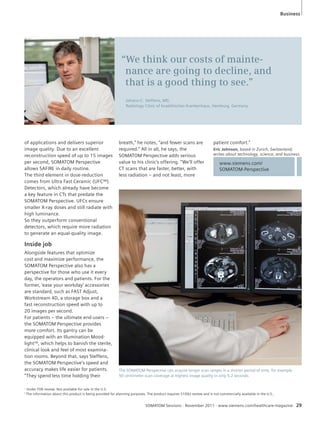
By Tony de Lisa and Tiago Campos* 
*Computed Tomography, Siemens Healthcare, Forchheim Germany 
Wexford General Hospital serves a popu-lation 
in excess of 135,000 in County 
Wexford, Ireland. Recently replaced their 
10-year-old 4-slice system was replaced 
with the SOMATOM Defi nition AS 64 
with the FAST CARE platform. 
The CT team in Wexford has always 
been dose conscious and the dose 
reduction techniques available with the 
new system (especially SAFIRE1,2) have 
greatly assisted them in achieving sub-stantial 
reduction in dose. SAFIRE (Sino-gram 
Affi rmed Iterative Reconstruction) 
is the 1st raw data-based iterative recon-struction 
technique that allows up to 
60% reduction in dose while preserving 
image quality as can be seen in the com-parison 
shown in Fig. 1. 
Liz D’Arcy, CT Clinical Specialist, com-mented: 
“From day one, the CT team at 
Wexford decided to test the capabilities 
of SAFIRE in terms of image quality, 
workfl ow, and dose reduction. Our 
immediate fi nding was that the fast 
reconstruction speed and the ease of use 
meant no effect on throughput or work-fl 
ow when compared to FBP. Our next 
step was to select an image quality 
acceptable to our consultant radiologists 
while continuing to reduce the dose.” 
Neurological head scans are often 
regarded as a benchmark for diagnostic 
value in CT. The consultant radiologists 
have been very pleased with both the 
“We have seen a very impressive reduction in dose. 
With SAFIRE we are achieving a very impressive 
dose reduction of up to 75% dose reduction in 
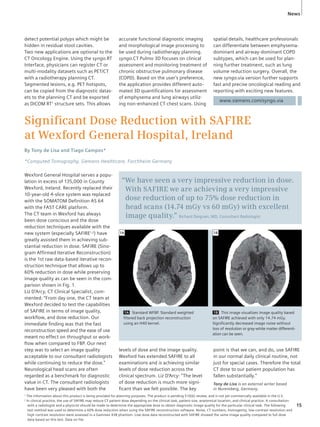
head scans (14.74 mGy vs 60 mGy) with excellent 
image quality.” Richard Deignan, MD, Consultant Radiologist 
1A Standard WFBP. Standard weighted 
filtered back projection reconstruction 
using an H40 kernel. 
1B This image visualizes image quality based 
on SAFIRE achieved with only 14.74 mGy. 
Significantly decreased image noise without 
loss of resolution or gray-white matter differenti-ation 
can be seen. 
1A 1B 
levels of dose and the image quality. 
Wexford has extended SAFIRE to all 
examinations and is achieving similar 
levels of dose reduction across the 
clinical spectrum. Liz D’Arcy: “The level 
of dose reduction is much more signi-ficant 
than we felt possible. The key 
spatial details, healthcare professionals 
can differentiate between emphysema-dominant 
and airway-dominant COPD 
subtypes, which can be used for plan-ning 
further treatment, such as lung 
volume reduction surgery. Overall, the 
new syngo.via version further supports 
fast and precise oncological reading and 
reporting with exciting new features. 
point is that we can, and do, use SAFIRE 
in our normal daily clinical routine, not 
just for special cases. Therefore the total 
CT dose to our patient population has 
fallen substantially.” 
Tony de Lisa is an external writer based 
in Nuremberg, Germany. 
1 The information about this product is being provided for planning purposes. The product is pending 510(k) review, and is not yet commercially available in the U.S. 
2 In clinical practice, the use of SAFIRE may reduce CT patient dose depending on the clinical task, patient size, anatomical location, and clinical practice. A consultation-with 
a radiologist and a physicist should be made to determine the appropriate dose to obtain diagnostic image quality for the particular clinical task. The following 
test method was used to determine a 60% dose reduction when using the SAFIRE reconstruction software. Noise, CT numbers, homogenity, low-contrast resolution and 
high contrast resolution were assessed in a Gammex 438 phantom. Low dose data reconstructed with SAFIRE showed the same image quality compared to full dose 
data based on this test. Data on file. 
15
News 
Boosting Cardiovascular 
Reading with syngo.via at 
this Year’s CTA Academy 
At SCCT 2011, syngo.via facilitated the evalua-tion 
of cCTA and invasive angiography data sets. 
Philip Stenner, PhD, Computed Tomography, Siemens Healthcare, Forchheim, Germany 
Based on last year’s huge success, the 
Society of Cardiovascular Computed 
Tomography (SCCT) has again organized 
a CTA Academy to train cardiovascular 
reading in 2011. The program is aimed 
at both radiologists and cardiologists, 
and provides a unique opportunity to 
practice the evaluation of coronary CT 
Angiography (cCTA) data sets with an 
international expert faculty. This year’s 
Academy comprises five courses, of 
which the most recent was held at the 
annual meeting of the SCCT in Denver, 
CO, USA. Stephan Achenbach, MD, from 
the Department of Cardiology at the Uni-versity 
of Gießen, Germany, and John 
Lesser, MD, from the Minneapolis Heart 
Institute in Minneapolis, MN, USA, 
teamed up to teach this two-day course 
and offered expert hands-on training for 
the 20 cardiologists taking part. 
To assess the cCTAs and invasive angiog-raphy 
images, 11 workplaces had been 
equipped with syngo.via clients pro-vided. 
In addition to the basic reading 
functionalities, the CT Cardio-Vascular 
Engine enabled the participants to eval-uate 
the cases with advanced function-alities 
such as automatically generated 
center lines, curved planar reformations 
(CPR), and the image sharpening filter. 
To make full use of syngo.via’s dual 
monitor support, all workplaces were 
equipped with two monitors and the pre-senter’s 
screen was shown with a dual-projector 
set-up. The participants 
improved their cardiovascular reading 
skills by evaluating 50 cCTA data sets, 
“I have to say that the 
advanced functions, 
such as the curved 
planar reconstructions, 
are extremely stable 
and the results are really 
good and reliable.” 
Stephan Achenbach, MD, Department of 
Cardiology, University of Gießen, Germany 
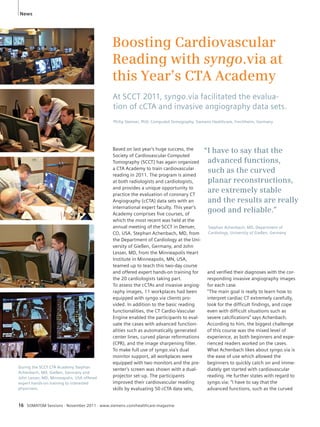
During the SCCT CTA Academy Stephan 
Achenbach, MD, Gießen, Germany and 
John Lesser, MD, Minneapolis, USA offered 
expert hands-on training to interested 
physicians. 
and verified their diagnoses with the cor-responding 
invasive angiography images 
for each case. 
“The main goal is really to learn how to 
interpret cardiac CT extremely carefully, 
look for the difficult findings, and cope 
even with difficult situations such as 
severe calcifications” says Achenbach. 
According to him, the biggest challenge 
of this course was the mixed level of 
experience, as both beginners and expe-rienced 
readers worked on the cases. 
What Achenbach likes about syngo.via is 
the ease of use which allowed the 
beginners to quickly catch on and imme-diately 
get started with cardiovascular 
reading. He further states with regard to 
syngo.via: “I have to say that the 
advanced functions, such as the curved 
16 SOMATOM Sessions · November 2011 · www.siemens.com/healthcare-magazine
“I am typically not a big advocate of curved 
planar reformations (CPR), but this work-station 
actually does a really good job of 
www.siemens.com/ct-cardiology 
Stroke Management – Education and 
Information Exchange Online 
By Monika Demuth, PhD, Computed Tomography, Siemens Healthcare, Forchheim, Germany 
News 
SOMATOM Sessions · November 2011 · www.siemens.com/healthcare-magazine 17 
planar reconstructions, are extremely 
stable now and the results are really 
good and reliable.” 
Quynh Truong, MD MPH, from the 
Division of Cardiology at Massachusetts 
General Hospital in Boston, MA, USA, 
who also helped the participants with 
reading the cases, believes this course 
to be a good opportunity to gain experi-ence. 
Since the volume of CT scans 
being performed is fairly low at some 
participants’ institutions, it is important 
to practice on CT and cath correlations 
in order to maintain the required compe-tency 
level. 
One of the participants, Cristiana Scridon, 
MD, from the Indian River Medical Cen-ter 
in Vero Beach, Fl, USA, already 
Siemens Healthcare has recently launched 
a new CT stroke management online 
resource for healthcare professionals. 
Here, a platform is provided for introduc-ing 
and discussing new diagnostic oppor-tunities 
to save brain and quality of life, 
synergized with information on the lat-est 
Siemens CT scanners and post-pro-cessing 
solutions. 
After a stroke, the brain loses as many 
neurons as it does in almost 3.6 years 
of normal aging[1] each hour it remains 
untreated. Therefore, the need for faster 
diagnosis and faster treatment is central 
to effective stroke management. Thanks 
to a dynamic brain perfusion coverage, 
Siemens Computed Tomography has 
clearly improved the stroke workflow 
and added value to stroke management. 
The new information platform for stroke 
management has been published to share 
these approaches and clinical outcomes. 
Peter Schramm, MD, from the certified 
stroke unit at the University of Göttingen, 
Germany, for example, shares his work-flow 
from the arrival of a stroke patient 
attended a previous CTA Academy. Her 
main goal was to learn from the experts 
and refresh her skills in cardiovascular 
reading. With regard to syngo.via, she 
states that “Practically everything works 
very well and it’s very smooth. The mea-surements 
go easily, and the adjustment 
of the image is easy to make. So it’s great.” 
Will she be coming again? – “Absolutely 
every year!” 
outlining the CPRs.” 
Quynh Truong, MD MPH, Division of Cardiology, Massachusetts General Hospital, 
Boston, MA, USA 
Siemens has 
launched a 
CT stroke 
management 
website for 
healthcare 
professionals. 
References 
[1] Time is brain-quantified. Saver JL. Stroke. 
2006 Jan;37(1):263-6. 
in the emergency department until 
the decision for further treatment. In his 
institution, the door-to-needle time is 
less than 20 minutes. Furthermore, lead-ing 
stroke specialists share their experi-ence 
and protocols in webinars and pre-sentations 
on the platform. Trial versions 
for Siemens latest software solutions are 
available for testing developments in 
stroke imaging in actual clinical practice. 
This educational website was launched 
to improve the knowledge of stroke 
diagnosis with extended brain coverage 
and is designed to integrate the experi-ences 
of physicians worldwide. The online 
resource can be visited via the following 
link. 
www.siemens.com/ 
CT-stroke- management
News 
International CT Image Contest 2011 
By Tiago Campos, Computed Tomography, Siemens Healthcare, Forchheim, Germany 
In 2009, Siemens Healthcare surprised 
the healthcare industry with an original 
idea that was well received by the world-wide 
radiology community, the Interna-tional 
CT Image Contest, encouraging 
radiologists to reduce dose by using CT 
hardware and software efficiently. 
Participants submitted their best clinical 
images achieved at a very low radiation 
dose according to the contest philoso-phy 
“Highest diagnostic image quality 
at the lowest possible radiation dose” 
and shared best practice throughout 
the industry. 
The 2010 International CT Image Con-test 
was an extraordinary success, with 
around 300 submissions from over 30 
different countries. On Facebook, the 
contest attracted over 1,500 fans and 
page views at the Siemens Low Dose 
website reached 17,000 between 
November 2009 and May 2010 alone. 
Continuing the success 
This year’s contest even beat last year’s 
success with massive 627 
submissions from 43 different countries 
from all 5 continents, showing that low 
dose practices have no borders. Siemens 
customers who work with a SOMATOM 
Spirit, Emotion, Sensation, Definition, 
Definition AS or Definition Flash were 
given the opportunity to compete for 
the title of the best image in seven cate-gories. 
The submissions were evaluated 
by an international jury consisting of 
acknowledged experts in the following 
categories: Cardiac, Vascular, Dual 
Energy, Pediatrics, Trauma, Neuro and 
areas of clinical routine including Thorax, 
18 SOMATOM Sessions · November 2011 · www.siemens.com/healthcare-magazine 
Abdomen Pelvis and Extremities. During 
the entry phase, members of the jury 
chose an image each month for the “Pick 
of the Month” (Figs. 1–3) which ran 
from March through September. After 
entry deadline, a winning image of the 
highest quality at the lowest radiation 
dose was chosen from each category. 
The winners were announced in a cere-mony 
at this year’s RSNA in Chicago.1 
To see all of more than the 600 cases 
from 40 different countries featured in 
this year’s Image Contest, or to become 
a fan on Facebook, visit the following 
websites. 
www.siemens.com/image-contest 
www.facebook.com/imagecontest 
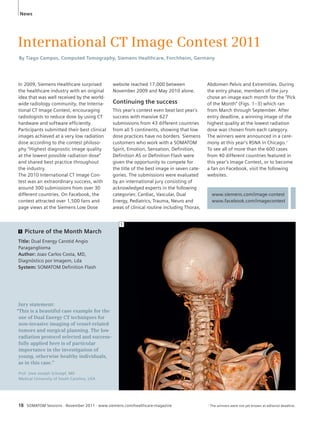
1 Picture of the Month March 
Title: Dual Energy Carotid Angio 
Paraganglioma 
Author: Joao Carlos Costa, MD, 
Diagnóstico por Imagem, Lda 
System: SOMATOM Definition Flash 
Jury statement: 
“This is a beautiful case example for the 
use of Dual Energy CT techniques for 
non-invasive imaging of vessel-related 
tumors and surgical planning. The low 
radiation protocol selected and success-fully 
applied here is of particular 
importance in the investigation of 
young, otherwise healthy individuals, 
as in this case.” 
Prof. Uwe Joseph Schoepf, MD 
Medical University of South Carolina, USA 
1 
1 The winners were not yet known at editorial deadline.
News 
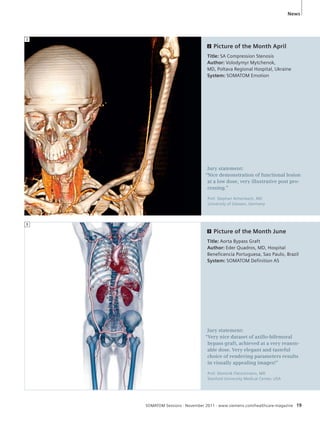
2 Picture of the Month April 
Title: SA Compression Stenosis 
Author: Volodymyr Mytchenok, 
MD, Poltava Regional Hospital, Ukraine 
System: SOMATOM Emotion 
Jury statement: 
“Nice demonstration of functional lesion 
at a low dose, very illustrative post pro-cessing.” 
Prof. Stephan Achenbach, MD 
University of Giessen, Germany 
SOMATOM Sessions · November 2011 · www.siemens.com/healthcare-magazine 19 
2 
3 Picture of the Month June 
Title: Aorta Bypass Graft 
Author: Eder Quadros, MD, Hospital 
Beneficencia Portuguesa, Sao Paulo, Brazil 
System: SOMATOM Definition AS 
Jury statement: 
“Very nice dataset of axillo-bifemoral 
bypass graft, achieved at a very reason-able 
dose. Very elegant and tasteful 
choice of rendering parameters results 
in visually appealing images!” 
Prof. Dominik Fleischmann, MD 
Stanford University Medical Center, USA 
3
News 
Iterative Reconstruction is 
Now Available for SOMATOM 
Emotion and Sensation 
By Tiago Campos*, Sebastian Vogt, PhD** 
*Computed Tomography, Siemens Healthcare, Germany 
**Siemens Medical Solutions USA, Malvern PA, USA 
Siemens has recently added IRIS (Itera-tive 
Reconstruction in Image Space) to 
its new SOMATOM Emotion 16 scanners, 
as well as existing SOMATOM Emotion 
16 (2007), SOMATOM Sensation 40, 64, 
and Open systems. Retrofitting this key 
technology into such a vast installed 
base emphasizes Siemens’ commitment 
to reducing patient dose by updating 
legacy systems for even better patient 
care. 
IRIS is available for these systems for 
delivery since September 2011. One of 
the largest and most diverse academic 
medical centers in the United States, the 
Ohio State University Medical Center 
(OSUMC) was among the first sites world-wide 
to evaluate IRIS on the SOMATOM 
Emotion. Professor Richard D. White, MD, 
and his team of radiologists welcomed 
the opportunity of upgrading the 
OSUMC’s installed base of SOMATOM 
Emotion 16, SOMATOM Sensation 64, 
SOMATOM Definition AS 64, and 
SOMATOM Definition AS+ scanners with 
iterative reconstruction. 
1A 1B 
20 SOMATOM Sessions · November 2011 · www.siemens.com/healthcare-magazine 
“This represented another important and 
greatly appreciated form of collabora-tion 
with Siemens through investigative 
interest, positive return-on-investment 
implications, and image quality gains, 
and clinical growth potential with 
market differentiating technologies for 
OSUMC”, remarks Professor White. 
Although IRIS was not directly installed 
at OSUMC during the pilot phase, the 
datasets were reconstructed remotely 
to assess the feasibility of IRIS compared 
with weighted filtered back projection 
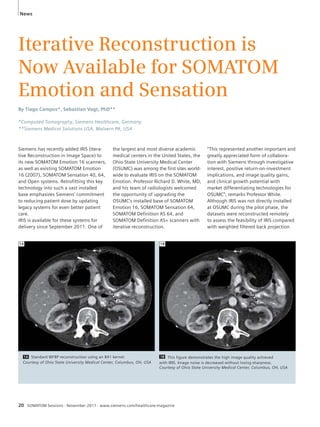
1A Standard WFBP reconstruction using an B41 kernel. 
Courtesy of Ohio State University Medical Center, Columbus, OH, USA 
1B This figure demonstrates the high image quality achieved 
with IRIS. Image noise is decreased without losing sharpness. 
Courtesy of Ohio State University Medical Center, Columbus, OH, USA
News 
References 
[1] May MS, Wüst W, Brand M, Stahl C, All-mendinger 
T, Schmidt B, Uder M, Lell MM. Dose 
reduction in abdominal computed tomography: 
intraindividual comparison of image quality of 
full-dose standard and half-dose iterative recon-structions 
with dual-source computed tomogra-phy. 
Invest Radiol. 2011 Jul; 46(7):465-70 
2A 2B 
2A Standard WFBP reconstruction using a B40 kernel. 
Courtesy of Ohio State University Medical Center, Columbus, OH, USA 
2B This figure demonstrates the high image quality achieved with 
IRIS. An improved image noise and better delineation of the liver lesion 
can be achieved compared to Fig. 2A. 
Courtesy of Ohio State University Medical Center, Columbus, OH, USA 
SOMATOM Sessions · November 2011 · www.siemens.com/healthcare-magazine 21 
(WFBP). Dozens of datasets were 
assessed from routine examinations of 
the head, thorax and abdomen. Experts 
then analyzed the image quality based 
on image noise, image quality, dose 
effectiveness, and lesion conspicuity. 
OSUMC’s team gave positive feedback in 
all areas of the evaluation, highlighting 
noise reduction, edge recovery, impres-sive 
detail and sharpness among the 
prominent benefits of IRIS. Professor 
White concluded that “across the board 
in this pilot project, there was unequivo-cal 
gain in image quality thanks to the 
application of IRIS. Artifact and noise 
were consistently reduced, while low 
contrast and edge definition were 
enhanced, leading to improved visual-ization 
of pathology. It is exciting to 
realize that this can be achieved with 
significant dose reduction. This is a tre-mendous 
advancement!” 
At the time of editorial deadline, OSUMC 
were already preparing for the installa-tion 
of IRIS. 
The Friedrich-Alexander-University of 
Erlangen-Nuremberg in Germany has 
also evaluated IRIS. The university cur-rently 
has a SOMATOM Definition Flash, 
a SOMATOM Definition AS+, and a 
SOMATOM Sensation 64. Prof. Michael 
Lell, MD, was an early adopter of itera-tive 
reconstruction when it was initially 
released on the SOMATOM Definition 
Flash in 2009, and has also worked with 
the latest iterative reconstruction method 
– SAFIRE1 (Sinogram Affirmed Iterative 
Reconstruction). Although Prof. Michael 
Lell, MD and his team were already 
familiar with IRIS, the pilot study pro-vided 
a good opportunity to assess its 
performance against the SOMATOM 
Definition systems. 
Following the same approach as 
OSUMC, datasets were reconstructed 
remotely and compared with conven-tional 
WFBP. Multiple patient datasets 
were reconstructed, focusing on spe-cific 
examinations, such as cardiac, 
and routine examinations of the head, 
thorax and abdomen. Once again, 
experts rated the images based on 
image noise, image quality, dose effec-tiveness, 
and lesion conspicuity. 
Lell and his team commented that “we 
highly appreciate that iterative recon-struction, 
which is fully integrated in our 
clinical workflow with the SOMATOM 
Definition scanners, is now available for 
existing CT systems like our SOMATOM 
Sensation. The excellent results with IRIS 
significantly reduce dose while main-taining 
image quality and lesion conspi-cuity.”[ 
1] 
With the successful launch of IRIS for 
the SOMATOM Emotion 16 (2007), 
SOMATOM Sensation 40, 64, and Open, 
Siemens, continues its commitment to 
reducing radiation exposure for all rou-tine 
CT examinations below 2.4 mSv. 
“Bringing IRIS to the SOMATOM Emotion 
and Sensation offers low dose to the 
widest possible patient population,” says 
Peter Seitz, Head of Marketing, Com-puted 
Tomography, Siemens Healthcare. 
1 The information about this product is being provided 
for planning purposes. The product requires 510(k) 
review and is not commercially available in the U.S.
News 
FAST CARE Meets DSCT 
Technology platform FAST CARE is now also compatible with the 
Dual Source scanner SOMATOM Defi nition, giving CT users the opportunity 
to leverage untapped potential in patient-centric productivity. 
By Ingrid Horn, PhD 
Over 5001 SOMATOM Definition scanners 
have been installed globally since 2006, 
and are located in both community and 
university hospitals. Besides its utiliza-tion 
in diagnostic imaging centers, the 
scanner is deployed primarily in cardiol-ogy 
departments and emergency cen-ters. 
A convincing technical concept is at 
the root of many modern success stories 
in the field. This one is called Dual 
Source. Simultaneous scanning with two 
X-ray tubes convinces in the case of car-diac 
CT, for example, providing high 
diagnostic accuracy irrespective of heart 
rate, without the use of beta blockers 
and with a radiation dose 50 percent 
lower than the norm. Combined with the 
Dual Energy principle, tissue and depos-its 
can be characterized chemically by 
selecting different voltages for the two 
X-ray tubes. The device proves particu-larly 
efficient in emergency cases, facili-tating 
a comprehensive, reliable diagno-sis 
in a single examination procedure, 
irrespective of the patient’s constitution 
and condition. 
The benefits of Dual Source Technology 
can now be combined with those of the 
FAST CARE platform. The Fully Assisting 
Scanner Technologies (FAST) make time-consuming 
and complex procedures 
faster as well as far more intuitive. This 
ensures that the results remain reliably 
reproducible even in the event of a rota-tional 
workforce. FAST Planning simpli-fies 
the preparation of scan and recon 
ranges. Be it heart, lungs, spinal column 
or brain – one click suffices to automati-cally 
adjust the optimal scan range on 
the basis of anatomical landmarks. This 
not only eases the workflow at the scan-ner, 
but prevents inaccurate setting of 
scan ranges and higher reproducibility of 
similar examinations. FAST Cardio Wiz-ard 
gives users a step-by-step guide to 
cardiac scanning. The program provides 
guidance on the optimal choice of 
parameters and settings and allows 
22 SOMATOM Sessions · November 2011 · www.siemens.com/healthcare-magazine 
establishing individual quality standards. 
FAST Spine facilitates a fully automated 
preparation for reconstructions of the 
spinal column. The program identifies 
and marks each vertebra and disc within 
the scan range automatically, and 
alignes the reconstruction layers ana-tomically 
correct along the curvature of 
the spine. FAST Adjust guarantees safe 
scan parameter adjustment to the 
patient’s habitus, even by less experi-enced 
personnel. 
The CARE software package reduces radi-ation 
dose considerably. Several publica-tions 
have already scientifically proven 
that a potential reduction of up to 50 
percent is possible. This is due principally 
to CARE kV. The program sets the appro-priate 
kV for the selected examination 
type and thus optimizes radiation dose in 
line with pertinent diagnostic issues and 
the patient’s anatomy. Other programs, 
including the CARE Dose Configurator, 
support this optimization process and 
make it transparent for users. Together 
with FAST CARE. SAFIRE2 was introduced, 
joining the latest generation of iterative 
image reconstruction. Departments 
equipped with the SOMATOM Definition 
can retrofit their device with FAST CARE. 
Everyone – the hospital enterprise, per-sonnel 
and patients – benefits from the 
advantages of this upgrade. 
Ingrid Horn, PhD, studied biology and bio-chemistry. 
She is an expert in science communi-cations 
and an experienced medical writer. 
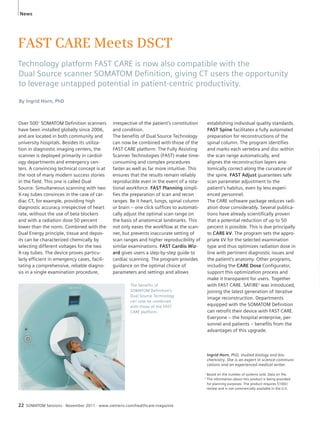
The benefits of 
SOMATOM Definition's 
Dual Source Technology 
can now be combined 
with those of the FAST 
CARE platform. 
1 Based on the number of systems sold. Data on file. 
2 The information about this product is being provided 
for planning purposes. The product requires 510(k) 
review and is not commercially available in the U.S.
News 
High-End CT is on the Move 
With the introduction of the SOMATOM Defi nition AS in 2007, Siemens 
began a unprecedented success story. Now, Siemens is moving onto the 
next chapter of this success story with new sliding gantry confi gurations 
for the SOMATOM Defi nition AS. 
By Jan Freund, Computed Tomography, Siemens Healthcare, Forchheim, Germany 
SOMATOM Sessions · November 2011 · www.siemens.com/healthcare-magazine 23 
Following its release in 2007, the 
SOMATOM Definition AS – the world’s 
first adaptive scanner – was already in a 
class of its own. As the first CT scanner 
offering true 128-slice acquisition, it 
pushed the boundaries of CT imaging, 
providing new diagnostic options, 
including high-speed and high-resolu-tion 
examinations, as well as 3D-guided 
CT interventions. 
In 2010, FAST CARE was introduced on 
the SOMATOM Definition AS, making it 
the ideal choice to increase patient-centric 
productivity. Being fully onsite 
upgradeable from 20 up to 128 slices, 
customers could tailor the system per-fectly 
to their environment, and for 
example grow from routine to cardiac 
or acute care imaging. 
With over 1,500 systems installed, the 
SOMATOM Definition AS resembles 
the fastest ramp up in the history of 
Siemens CT. Clearly, the philosophy of 
offering “one CT for all” has shown to 
be the right answer to CT users’ require-ments. 
In 2011, Siemens continues to evolve 
this success by adding a sliding gantry 
option to the SOMATOM Definition AS. 
Mounting a CT scanner on rails for 
moving it to a specific clinical area, such 
as acute care or between radiology and 
radiation therapy planning (RTP) depart-ments 
is not a new idea. But the previ-ous 
scanner generation considered 
midrange or even entry-level today. Now 
also the latest high-end CT scanner 
generation is back on rails. Customers 
have already benefited from the highest 
standards of flexibility with the 
SOMATOM Definition AS and the sliding 
gantry now allows the scanner to 
literally move in line with their clinical 
needs. 
The benefits are obvious: Clinical set-ups 
and processes can be designed much 
more efficiently. In acute care, the 
patient does not have to be transferred 
to the scanner anymore – the scanner 
can be moved to the patient. Further-more, 
institutions with RTP departments 
that do not utilize the full capacity of the 
system due to low patient volume can 
share resources with conventional radi-ology. 
The SOMATOM Definition AS sliding 
gantry will be available as a single-room 
and all AS scanner solution at the end of 
2011 for all scanner configurations. 
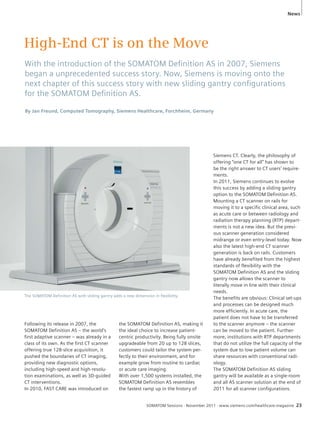
The SOMATOM Definition AS with sliding gantry adds a new dimension in flexibility.
News 
CT Examinations Tailored Precisely 
to Individual Patient Needs 
Individual patient characteristics and the clinical question need to be 
considered when choosing parameters and settings for a CT examination. 
The latest scientifi c papers[1-4] clearly demonstrate that SOMATOM 
scanners ensure CT scans are tailored to individual patient needs. 
By Heidrun Endt, MD, Computed Tomography, Siemens Healthcare, Forchheim, Germany. 
In the past few years, many new tech-nologies 
have been introduced in 
computed tomography for increasingly 
automatic and individual settings of 
CT scan procedures. 
CARE kV – tube voltage 
tailored for each examination 
CARE kV is one of these new technolo-gies. 
With CARE kV the tube voltage is 
adjusted automatically depending on 
the clinical question on a per-patient 
basis. Researchers from Zurich, Switzer-land, 
conducted a study for body CT 
Angiography (CTA) examinations using 
CARE kV on a SOMATOM Definition 
AS 64.[1] In the study 40 patients were 
examined and the reference setting for 
the tube voltage was set to 120 kV. 
CARE kV suggested the tube voltage for 
each scan based on the examination 
type and the topogram. This produced 
the following kV settings: 80 kV 
(1 patient), 100 kV (23 patients), 120 kV 
(15 patients), and 140 kV (1 patient). 
When changing the kV, the tube current 
must also be adjusted. As CARE kV works 
in combination with CARE Dose4D, this 
could be achieved simultaneously and 
automatically.Throughout the study 
image quality was maintained, and apply-ing 
CARE kV led to an overall dose reduc-tion 
of 25.1% in the entire patient popu-lation, 
compared to a standard 120 kV 
protocol. The mean CTDIvol decreased 
from 10.6 mGy to 7.9 mGy. For the 
subgroup of 24 patients where the tube 
voltage was reduced to either 80 kV or 
1 Fig. 1 shows a CT Angiography examination with the SOMATOM Definition AS 64 in an 
82-year-old patient after endovascular aortic aneurysm repair. The scan was obtained using 
CARE kV and 120 kV was chosen as reference kV setting. As the patient had a low body mass index 
of 19 kg/m² CARE kV proposed 80 kV for this examination. The scan could be carried out with a 
CTDIvol of 2.88 mGy and 2.7 mSv effective dose. Courtesy of University Hospital Zurich, Switzerland 
1 
24 SOMATOM Sessions · November 2011 · www.siemens.com/healthcare-magazine
100 kV, the dose reduction was 39.3%. 
The authors conclude that they “[…] 
could demonstrate the beneficial effect 
of this technique for body CTA […].”[1] 
SAFIRE1 – designed to reduce 
radiation dose for every patient 
Radiation dose should always be consid-ered 
when performing a CT examination, 
as the benefit to potential risk ratio should 
be as high as possible. Iterative recon-struction 
algorithms such as IRIS and 
SAFIRE1 are powerful tools for reducing 
dose and following the ALARA (As Low 
As Reasonably Achievable) principle. An 
international group of researchers evalu-ated 
the potential of SAFIRE for coronary 
CTA examinations at the Medical Univer-sity 
of South Carolina (MUSC).[2] In this 
study 65 patients were examined with a 
SOMATOM Definition Flash. The exami-nations 
were obtained with the protocols 
established at MUSC. The first recon-struction 
used the conventional method 
of filtered back projection (FBP). After-wards, 
a second reconstruction with 
SAFIRE was performed using data from 
one tube of the Dual Source system, 
corresponding to a 50% reduction 
in radiation dose. When applying new 
reconstruction algorithms the diag-nostic 
accuracy must be taken into 
account. Both reconstructions and 
coronary catheter angiography exami-nations 
were used for the assessment 
of diagnostic accuracy. 
The results show that “[...] the applica-tion 
of this algorithm resulted in incre-mentally 
improved diagnostic accuracy 
for stenosis detection”,[2] despite the 
lower dose that was used. The obese 
patient population of this study had a 
mean body mass index of 32.4 kg / m2. 
2 Fig. 2A shows a coronary CT Angiog-raphy 
examination with the SOMATOM 
Definition Flash from the study conducted 
at MUSC. The reconstruction was done 
using FBP. For image 2B data from one 
tube of the Dual Source system were 
used corresponding to a 50% reduction in 
dose. With SAFIRE image quality is main-tained 
could be reduced allowing for a more 
precise diagnosis. 
Courtesy of Medical University of 
South Carolina, USA 
References 
in Fig. 2B and blooming artifacts 
[1] Winklehner A et al. Automated Attenuation- 
Based Tube Potential Selection for Thoracoab-dominal 
Computed Tomography Angiography: 
Improved Dose Effectiveness. Invest Radiol. 
2011 Jul 1. [Epub ahead of print] 
[2] Moscariello A et al. Coronary CT angiography: 
image quality, diagnostic accuracy, and potential 
for radiation dose reduction using a novel itera-tive 
image reconstruction technique-comparison 
with traditional filtered back projection. Eur 
Radiol. 2011 Oct;21(10):2130-8. Epub 2011 
May 25. 
[3] Winklehner A et al. Raw data-based iterative 
reconstruction in body CTA: evaluation of radia-tion 
dose saving potential. Eur Radiol. 2011 Aug 
6. [Epub ahead of print] 
[4] Wuest W et al. Dual source multidetector CT-angiography 
before Transcatheter Aortic Valve 
Implantation (TAVI) using a high-pitch spiral 
acquisition mode. Eur Radiol. 2011 Aug 17. 
[Epub ahead of print] 
The CT scans were acquired in either ret-rospectively- 
gated mode or prospectively-triggered 
mode. The effective dose was 
6.4 mSv for FBP, and 3.2 mSv for recon-structions 
with SAFIRE. Overall, the 
authors conclude that the results indi-cate 
“[…] the potential for substantial 
radiation dose savings […], which likely 
exceed the 50% margin set forth in this 
current investigation.”[2] 
At the University Hospital in Zurich,[3] 25 
patients underwent a body CTA exami-nation 
on a SOMATOM Definition Flash. 
The data were reconstructed twice: once 
using FBP and once with SAFIRE. As 
above, only data acquired with one of 
the two tubes were analyzed for the 
SAFIRE reconstructions. By comparing 
two reconstructions of the examination 
with different reconstruction tech-niques, 
the researchers could determine 
diagnostic accuracy. A key finding of the 
study includes the following statement: 
“In body CTA a dose reduction of >50% 
might be possible when using raw data-based 
iterative reconstructions, while 
image quality can be maintained.”[3] 
TAVI planning – less contrast 
agent for multimorbid patients 
Transcatheter aortic valve implantation 
(TAVI) is an emerging technique and pro-vides 
an alternative for patients who 
need a replacement of the aortic valve 
but cannot be referred to open surgery 
because of other pre-existing diseases. 
Whether a patient is suitable for TAVI 
needs to be decided based on the anat-omy 
of the aortic root and the vessels 
used to gain access for the procedure. 
The amount of contrast agent is an 
important issue as many multimorbid 
patients suffer from an impaired renal 
function. An interdisciplinary group of 
researchers from Erlangen examined the 
potential of CT scans in 42 patients 
using the high-pitch mode on the 
SOMATOM Definition Flash with 40 ml 
of contrast agent.[4] The mean radiation 
dose for these examinations was 4.5 mSv. 
The conclusion highlights the benefits: 
“High-pitch spiral DSCTA [Dual Source CT 
Angiography] can be used to assess the 
entire aorta and iliac arteries in TAVI 
candidates with a low volume of con-trast 
agent while preserving diagnostic 
image quality.”[4] 
These scientific papers prove the bene-fits 
of innovative CT technology in con-tributing 
to individualized patient care. 
2B 
SOMATOM Sessions · November 2011 · www.siemens.com/healthcare-magazine 25 
2A 
1The information about this product is being provided 
for planning purposes. The product requires 510(k) 
review and is not commercially available in the U.S.
Business 
Value Added Max 
About to debut in Hamburg, a scanner for an optimized return on 
investment: Get ready for the new SOMATOM Perspective.1 
By Eric Johnson 
26 SOMATOM Sessions · November 2011 · www.siemens.com/healthcare-magazine 
What a difference a few years make. 
Since he began practicing radiology 
in 1994, Johann-C. Steffens, MD, has 
watched an astonishing improvement in 
computed tomography. The speed at 
which images are generated, the num-ber 
of images per scan, the resolution 
of those images, their orientations, the 
elimination of artifacts – all of these 
have progressed far beyond what could 
have been imagined at the time. “Based 
on experience, I’m sure CT performance 
will continue to improve,” he says, “but 
it has already reached a level that was 
still in our dreams only a few years ago.” 
Soon those dreams will become reality 
for Steffens, when his Radiology Clinic in 
Hamburg (see sidebar) takes delivery of 
Siemens’ SOMATOM® Perspective1. This 
CT promises not only the latest innova-tions 
that deliver speed, quality, and 
efficient workflow to the people in 
scrubs and gowns – the radiologists, 
operators, and patients. It also offers 
incentives to those in business suits – 
the business and financial managers of 
radiology practices. The magic word 
starts with an “e”, for efficiency. 
Savings in your hands 
Steffens is quick to point out that cost 
consciousness has soared in recent 
years. Even in relatively prosperous 
Germany, he notes that “spending is 
getting tighter and tighter, reimburse-ments 
are shrinking and shrinking.” At 
his own clinic, the budgeting pencil is 
always kept sharp. “More than ever 
before,” he says, “we are really keen 
Johann-C. Steffens, MD, Radiology Clinic in Hamburg, Germany, has watched an astonishing 
improvement in computed tomography during the past few years.
Business 
to assess costs and benefits of every-thing 
we do.” 
Of course, Steffens is not alone. Witness 
a recent letter to the New England Jour-nal 
of Medicine (2010; 363:888-891) 
by a trio of professors from Stanford 
University’s School of Medicine. Physi-cians’ 
have a “near-universal ignorance 
of actual costs associated with the deliv-ery 
of medical care,” contended Homero 
Rivas, John M. Morton, and Thomas M. 
Krummel. “This lack of cost awareness 
affects all other components of the 
price equation, rendering us incapable 
of understanding the true economic 
value of medical care.” 
With that kind of writing on the wall, 
it might seem a no-brainer to guess 
what Steffens chose to do about his cur-rent 
CT, an Emotion 16 from Siemens 
that he describes as “very good, pretty 
much faultless.” But rather than decid-ing 
to cut spending, instead he opted 
to cut a check. By bringing in a brand-new 
SOMATOM Perspective (which will 
be his fourth scanner from Siemens), 
he expects to sink the clinic’s total 
cost of ownership (TCO) in computed 
tomography. 
Economy is so central to the new scan-ner 
that it is built right into its dash-board. 
The so-called eMode allows oper-ation 
of the scanner in an outstanding 
patient-friendly and financially-efficient 
way – with a single click. An analysis of 
the scan is made in real time and the 
system is instantly fine-tuned to provide 
the exact scan the user wants, while 
simultaneously reducing wear and tear 
on the system. Coupled with this is 
a new ‘service plus’ approach from 
Siemens: for customers who run the 
SOMATOM Perspective in eMode for 
more than 80 percent of its operating 
time the institution will be rewarded 
with eMode Service Benefits such as 
maintenance scheduling out of core 
working time or even a reduction of ser-vice 
fees for the next contracted year. 
“We think our costs of maintenance are 
going to decline,” says Steffens, “and 
that is a good thing to see.” 
By bringing in a brand-new SOMATOM Perspective, Johann-C. Steffens, MD, expects to sink the 
clinic’s total cost of ownership in computed tomography. 
The new SOMATOM Perspective CT scanner 
Options Benefit 
Interleaved Volume 
Reconstruction (IVR) 
128 slices to improve spatial resolution 
eMode 
eMode Service Benefits 
Efficient scanner usage with automated 
parameter setting 
Consequent eMode usage will be 
rewarded with valuable eMode Service 
Benefits 
SAFIRE2 (Iterative Reconstruc-tion) 
Dose reduction and superior image 
quality 
iTRIM Improved temporal resolution for 
cardiac imaging 
Lower waste heat and electricity Cuts electric and air-conditioning bills 
Illumination MoodlightTM Comfortable scanning environment 
Small footprint, 18.5 m2 Easy installation in one day. Leaves 
more valuable, clinical space available 
Ultra Fast Ceramic (UFC™) 
Detector 
Better images from less radiation 
1 Under FDA review. Not available for sale in the U.S. 
2 The information about this product is being provided for planning purposes. The product requires 510(k) review and is not commercially available in the U.S. 27
Business 
Israelitisches Krankenhaus 
Together with three other physicians 
and ten support staff, Johann-C. 
Steffens, MD. Treats some 10,000 
patients each year at the Radiology 
Clinic of the Israelitsches Kranken-haus 
small operation in a metro area of 
some 4 million residents, about half 
of its patients come from the hospi-tal, 
which specializes in gastroenter-ology, 
ambulant cases of all types. Run as a 
private practice since 2004, the clinic 
uses computer tomography for intra-cranial, 
and extremities examinations. 
And there will be other efficiencies and 
savings. Thanks to eMode's automated 
approach to scanning, scan parameters 
will be automatically adjusted with a 
clear focus on efficient scanner usage. 
Operating costs will also be reduced. 
The SOMATOM Perspective’s1 small 
size – a footprint of 18.5 square meters 
– takes up less clinical space, and allows 
it to be fully installed in just one day. 
It consumes less power and radiates less 
in Hamburg, Germany. A relatively 
while the other half comprises 
cervical, thoracic, abdominal, 
heat than most scanners, which in turn 
cuts bills for electricity and air-condi-tioning. 
A look at the technology 
In the SOMATOM Perspective, cost-consciousness 
is combined with a full 
palette of features. It incorporates 
Siemens technologies that provide 
speed and quality at low-dosage. 
The SOMATOM Perspective can be 
28 SOMATOM Sessions · November 2011 · www.siemens.com/healthcare-magazine 
equipped with Siemens’ innovative 
iTRIM to increase temporal resolution 
as low as 195 milliseconds for cardiac 
imaging, thereby reducing motion 
artifacts. This novel iterative image 
reconstruction algorithm improves 
the overall image quality and reduces 
image noise for obtaining accurate 
diagnosis in demanding situations, 
for example, in rapidly beating hearts. 
Then there is the Interleaved Volume 
Reconstruction (IVR) to detect even the 
smallest diagnostic detail by using the 
information of 128 slices, which for 
Steffens’s clinic will be a major step up 
from its current 16-slice model. Thanks 
to this and iTRIM, the SOMATOM 
Perspective is suited for any clinical field 
including cardiac studies. In addition, 
the scanner can acquire longer scan 
ranges in a shorter period of time, 
for example 50 centimeter scan cover-age 
at highest image quality in only 
5.2 seconds. 
Dose reduction, also a key feature, 
comes to the SOMATOM Perspective as 
a trifecta. One element of this is CARE 
Dose4D™ that adapts the X-ray tube 
current for the entire scan range, aim-ing 
for constant image quality for all 
organs, patient shapes, and sizes – all in 
real time. It overcomes the most com-mon 
challenges in CT imaging that arise 
because: a) the applied dose in antero 
posterior and lateral positions need to 
be different; b) each slice needs differ-ent 
dose values; and c) patients are 
quite heterogeneous (young/elderly, 
small/large), so the applied dose must 
vary according to the individual patient. 
The second element of dose reduction 
is the use of Iterative Reconstruction 
(IR). Until recently, to use IR with CT 
imaging in conventional clinical medi-cine 
was too time-consuming: the com-puter 
took too long to reconstruct the 
images. With SAFIRE2 (Sinogram 
Affirmed Iterative Reconstruction), 
Siemens introduced the industry’s first 
raw data-based iterative reconstruction 
algorithm. SAFIRE achieves up to 60 
percent dose reduction for a wide range
Business 
“We think our costs of mainte-nance 
are going to decline, and 
that is a good thing to see.” 
Johann-C. Steffens, MD, 
Radiology Clinic of Israelitisches Krankenhaus, Hamburg, Germany 
www.siemens.com/ 
SOMATOM-Perspective 
SOMATOM Sessions · November 2011 · www.siemens.com/healthcare-magazine 29 
of applications and delivers superior 
image quality. Due to an excellent 
reconstruction speed of up to 15 images 
per second, SOMATOM Perspective 
allows SAFIRE in daily routine. 
The third element in dose-reduction 
comes from Ultra Fast Ceramic (UFC™) 
Detectors, which already have become 
a key feature in CTs that predate the 
SOMATOM Perspective. UFCs ensure 
smaller X-ray doses and still radiate with 
high luminance. 
So they outperform conventional 
detectors, which require more radiation 
to generate an equal-quality image. 
Inside job 
Alongside features that optimize 
cost and maximize performance, the 
SOMATOM Perspective also has a 
perspective for those who use it every 
day, the operators and patients. For the 
former, ‘ease your workday’ accessories 
are standard, such as FAST Adjust, 
Workstream 4D, a storage box and a 
fast reconstruction speed with up to 
20 images per second. 
For patients – the ultimate end-users – 
the SOMATOM Perspective provides 
more comfort. Its gantry can be 
equipped with an Illumination Mood-lightTM, 
which helps to banish the sterile, 
clinical look and feel of most examina-tion 
rooms. Beyond that, says Steffens, 
the SOMATOM Perspective’s speed and 
accuracy makes life easier for patients. 
“They spend less time holding their 
breath,” he notes, “and fewer scans are 
required.” All in all, he says, the 
SOMATOM Perspective adds serious 
value to his clinic’s offering. “We’ll offer 
CT scans that are faster, better, with 
less radiation – and not least, more 
patient comfort.” 
Eric Johnson, based in Zurich, Switzerland, 
writes about technology, science, and business. 
The SOMATOM Perspective can acquire longer scan ranges in a shorter period of time, for example 
50 centimeter scan coverage at highest image quality in only 5.2 seconds. 
1 Under FDA review. Not available for sale in the U.S. 
2 The information about this product is being provided for planning purposes. The product requires 510(k) review and is not commercially available in the U.S..
Accelerated Cardiovascular 
Assessment Powered by syngo.via 
SOMATOM Defi nition Flash and syngo.via1 ensure fast workfl ows 
and effi cient image management for cardiovascular reading. 
By Ruth Wissler, MD 
Specialists at the Cardiology Department 
of Aarhus University Hospital, Skejby, 
Denmark and the Department of Radiol-ogy, 
University of Brescia, Italy, appreci-ate 
the user-friendly and efficient read-ing 
system in their daily cardiac imaging 
and therapy routines. The Cardiology 
Department at Aarhus University Hospi-tal 
has seven angio suites and performs 
between 2,500 and 3,000 cardiovascular 
readings per year with the SOMATOM 
Definition Flash. A five-license configura-tion 
allows simultaneous access to 
syngo.via in the scanner and the PACS 
reading room for streamlined cardiovas-cular 
evaluations. 
With a three-license syngo.via configura-tion 
and the SOMATOM Definition Flash, 
the Department of Radiology at the Uni-versity 
of Brescia performs at least 20 to 
25 vascular, coronary and oncological 
scans per day. 
With accelerated automated pre-process-ing, 
syngo.via reduces the time needed 
for full cardiac assessment or aortic 
stent planning. As soon as a cardiac case 
is opened, automatically pre-processed 
images are displayed, and the coronary 
vessels, the functional parameters, and 
the prepared calcium score can be evalu-ated 
immediately. 
Robust functional assessment 
Morten Bøttcher, MD, PhD, (Cardiology 
Department at Aarhus University Hospi-tal), 
particularly appreciates the quick 
overall cardiac assessment, the accurate 
detection of ventricular borders, and the 
Business 
precise visualization and rapid quantifi-cation 
of calcified coronary lesions. “For 
functional imaging the important thing 
is to detect the (ventricular) borders. 
And syngo.via does that really well,” 
says Bøttcher. 
The combination of SOMATOM CT’s 
MinDose functionality and the syngo.CT 
Cardiac Function represent a highly dose-saving 
symbiosis for assessing complete 
global and local cardiac function. 
Fast planning and placement 
of aortic prosthesis 
“With syngo.via, aortic stent planning is 
a matter of seconds,“ says Roberto 
Maroldi, MD, Head of the Department of 
Radiology at the University of Brescia. 
The automatic pre-processing features 
remove table and rib cage and thus 
ensure that the case is ready for review 
when opened. The automatic segmenta-tion, 
labeling, and calculation of curved 
planar reformatted images2 of the aorta, 
runoffs and renal arteries help to imme-diately 
assess the status of the general 
vessels. The stent planning template 
guides the user through all measure-ments 
necessary for planning of Abdom-inal 
Aortic Aneurism (AAA) stents. 
The specialists’ experience with the 
SOMATOM Definition Flash scanner and 
syngo.via at Aarhus University Hospital 
Skejby, Denmark and the Department of 
Radiology, University of Brescia, Italy 
confirm the unique symbiosis of scanner 
and software in modern diagnostic 
imaging and therapy. 
“For functional imaging the 
important thing is to detect the 
(ventricular) borders. And 
syngo.via does that really well.” 
Morten Bøttcher, MD, PhD, Aarhus University Hospital, Skejby, Denmark 
“syngo.via is an excellent tool for 
planning placement of prosthesis 
for abdominal aneurysms.” 
Roberto Maroldi, MD, Dept. of Radiology, University of Brescia, Italy 
Ruth Wissler, MD, studied veterinary and 
human medicine. She is an expert in science 
communications and medical writing. 
1 syngo.via can be used as a stand-alone device or together with a variety of syngo.via-based software options, which are medical devices in their own rights. 
2 Available with syngo.CT Vascular Analysis – Autotracer
Minimizing Scan Time Loss 
with TubeGuard 
cussed the danger to seri-ously 
injured or sick 
patients where time is 
critical. 
Rejecting the inevitability 
of such breakdowns, 
Siemens scientists and 
engineers have designed 
the Guardian Program 
including TubeGuard for all 
systems of the SOMATOM 
Definition family, a remote 
service that continuously 
(24/7) monitors ten 
important functions of the 
STRATON X-ray tube and 
warns days in advance of 
possible breakdowns. 
A tube replacement can 
then be scheduled at a 
time convenient for the 
hospital – if necessary at 
two or three a.m. – causing 
little or no interruption to 
the radiology routine the 
next morning. 
Siemens’ promise: 
With the Guardian Pro-gram 
™ including Tube- 
Guard, Siemens will predict nearly all 
potential tube failures on time. Should it 
fail a fair compensation policy (as deter-mined 
in the users’ home country) takes 
effect to minimize any scan-time loss 
incurred. The local Siemens representa-tive 
will provide more details. 
Workfl ow assurance: 
“I was very impressed when Siemens 
contacted me recommending a tube 
replacement based on proactive real-time 
system monitoring with the Siemens 
Guardian Program™ including Tube- 
Guard,” said Terakado Hideji, MD, Chief 
Radiologist, Jichi Medical University 
By Tony de Lisa 
Business 
If there is any tube malfunction in a SOMATOM 
Definition scanner (Fig. 1A), TubeGuard, included 
in the Guardian Program, can detect it proac-tively 
(Fig. 1B) and tube replacement can then be 
scheduled at a time convenient for the hospital. 
SOMATOM Sessions · November 2011 · www.siemens.com/healthcare-magazine 31 
Normally, an automobile owner is not 
aware that his dealer has checked the 
profile of his auto’s tires at every major 
service visit. This simple control, that 
requires only a few minutes to complete, 
actually delivers a lot of information: 
are the tires presently safe to use, how 
much longer before new tires are 
required (based upon use and driving 
habits) and what danger points – such 
as split side-walls – can be observed 
that indicate the possibility – even prob-ability 
– of a blow-out. An intelligent 
driver understands that tires are con-sumable 
items that are subject to wear 
and tear and therefore, have a maximum 
life expectancy. Three factors primarily 
effect these results, i.e. the quality of 
the tire manufacture in the first place. 
the driving habits of the auto owner 
over time and mileage. 
At this point, the normal reader would 
suggest that comparing tires to X-ray 
tubes – such as Siemens’ STRATON® – is 
banal. But is it really? Why not take a 
three minute diversion from your daily 
routine and re-read the previous para-graph 
substituting the word, “X-ray 
tube” for “tire.” 
This information begs the question, 
“Who would not insist on having this 
inspection done regularly?” 
At this point, our “tire/tube” comparison 
ends. With a flat tire, one mounts the 
spare tire and resumes driving to the 
next dealer. But the financial and organi-zational 
results of a CT X-ray tube break-down 
are enormous in comparison. Just 
consider a radiology department that 
does 50 CT scans per day. There a tube 
breakdown can mean a financial loss 
that runs into the thousands. One hospi-tal 
director informs us that “Everything 
must be re-scheduled (in event of a 
breakdown) including the arrival of a 
helicopter.” And we have not yet dis- 
Hospital, Shimotsuke-shi, Tochigi-ken, 
Japan. “This new cutting-edge service 
enables us to plan the tube replacement 
at a convenient time based on our 
clinical workflow. As patients and 
staff are scheduled accordingly, patient 
satisfaction can also be significantly 
increased.” 
1B 
Tony de Lisa is an external writer and based 
in Nuremberg, Germany. 
1A
Business 
Versatility at High Speed 
SOMATOM Defi nition Flash CT scanners are a quantum leap 
in terms of diagnostic capabilities and patient-safety. At the same time, 
they offer a uniquely wide range of applications, from sophisticated 
scientifi c use to routine work. 
By Justus Krüger 
The PUMC Hospital in Peking is among 
the best and largest medical institutions 
in China. The hospital was founded in 
1921 by the Rockefeller Foundation and 
is known internationally as the Peking 
Union Medical College Hospital (PUMC). 
It has a long tradition of excellence and 
of serving the public benefit: as a teach-ing 
institution, as an outstanding centre 
of scientific research, and as a clinic for 
the general public. It houses 1,800 hos-pital 
beds; every day, more than 12,000 
outpatients go through its gates near 
Dongdan in the Wangfujing area in 
downtown Peking. With this throughput 
of truly enormous proportions, it is not 
surprising that the patients not only 
come from the Chinese capital alone. 
Nor are they exclusively Chinese. 
Attracting patients from abroad 
“Ours is a university hospital, and our 
prime considerations are of course 
social factors,” says Professor Jin 
Zhengyu, MD, who knows the hospital – 
and the city of Peking – like the back of 
his hand. He was born and raised in the 
Chinese capital, and he studied at the 
PUMC. “What we do here is provide 
solutions for population-based prob-lems.” 
Yet, the fact that the Xiehe Hos-pital 
has a reputation as a technically 
sophisticated centre of medical excel-lence 
attracts patients from far beyond 
the boundaries of the city and even 
from abroad. 
Professor Jin is the Director of the Radi-ology 
Department at PUMC Hospital, 
as well as the doctoral supervisor and 
32 SOMATOM Sessions · November 2011 · www.siemens.com/healthcare-magazine 
complete scan of the heart for instance 
only takes quarter of a second with the 
Flash Spiral. And still with the Flash, 
scans can be made at all heart rates 
without using beta-blockers. Addition-ally, 
patients do not need to hold their 
breath during lung scans. 
“This improves the imaging quality,” 
says Professor Jin, “because patients are 
not able to hold their breath. In such a 
case, you would get a poor imaging 
result with a slower scanner.” For the 
same reason – the exceptional scanning 
speed – young infants do not need to 
be sedated when scanned, without 
compromising the image quality. The 
high speed of Flash Spiral CT also means 
a low dose of radiation of below one 
millisievert in cardiac CT. This is of great 
benefit for CT heart examinations in 
younger individuals that are yet still of a 
lower risk of cardiac disease. 
In all these respects – lung scans with-out 
holding the breath, heart scans at 
all heart rates without the use of beta 
blockers, the capability to perform a 
scan on infants without sedation, and 
radiation levels below one millisievert in 
daily practice – the SOMATOM Defini-tion 
Flash is the only CT to deliver. 
A further unique feature of the 
SOMATOM Definition Flash CT is its 
capacity in dynamic imaging whole 
organ perfusion. Covering an area of up 
to 48 centimeters the Flash offers the 
longest 4D scan range in the market. 
“We use the Adaptive 4D Spiral for a 
variety of areas, such as liver-, kidney-and 
pancreas-perfusion,” says Professor 
Vice Chairman of the Chinese Society of 
Radiology. “People come to our hospital 
from many different countries,” he says. 
“Not only from Asia, but also from all 
over the world.” Part of the global pull 
exercised by the hospital is its state-of-the- 
art radiology department. 
It goes without saying, that the PUMC 
Hospital and its radiology department 
use the best medical equipment avail-able. 
Part of this is a set of six Siemens 
CT scanner, including three SOMATOM 
Definition Flash CTs. Professor Jin is 
so convinced of the benefits of Flash 
CT that his hospital has just ordered 
another one. 
The optimal diagnosis 
The reason why Professor Jin and his 
hospital opted for no less than four 
Flash CTs is that they offer a variety of 
advantages over all other CT scanners. 
They are superior in virtually every 
respect, ranging from their diagnostic 
versatility and speed to image accuracy, 
radiation levels and patient comfort. 
“These two aspects – accuracy and 
patient comfort – are really the same 
thing,” says Professor Jin. “From my per-spective, 
of course, the imaging capabil-ities 
of the equipment usually are the 
key consideration: you have to be able 
to make the optimal diagnosis. Whether 
it’s comfortable or not is a second con-sideration. 
But in this case, accuracy 
and patient comfort are internally con-nected.” 
This is largely due to the scan speed of 
the renowned Flash Spiral mode. A
Business 
“From my perspective, the imaging capabilities 
of the equipment usually are the key consider-ation: 
you have to be able to make the optimal 
Professor Jin Zhengyu, MD, Peking Union Medical College Hospital, Peking, China 
pare the dose of a single Dual Energy 
scan with that emitted by two separate 
Single Source CT scans. And in such 
cases, we remain far below the radia-tion 
dose produced by single-energy 
scanners.” 
From scientifi c use to medical 
routine work 
Low radiation dose combined with 
superior image quality make the 
SOMATOM Definition Flash the most 
versatile CT scanner available. “What 
this means is that we have more diag-nostic 
tools at our disposal than before,” 
says Professor Jin. 
The result is above all a benefit for the 
patient. CT neuro imaging, for instance, 
is very often a matter of life-and-death 
therapeutic decision-making. SOMATOM 
Definition Flash provides tools and 
workflows that help deliver a complete 
and accurate status of the vascular 
structures and the brain tissue for these 
patients – from scanning to diagnosis in 
less than ten minutes. 
In addition, Flash substantially reduces 
the necessity for invasive diagnoses. 
The diagnosis of gout is such a case, as 
is Flash’s capability to visualize chemical 
differences in kidney stones. Flash CT 
can reliably identify those patients who 
can benefit from medical treatment 
alone and avoid unnecessary interven-tional 
procedures. “This was an impor-tant 
consideration for us when we pur-chased 
Flash scanners,” says Professor 
Jin. “Although ultimately it is up to the 
doctor how to use the tools at his dis-posal. 
You can come up with far more 
applications in practice.” 
It is precisely these benefits for the 
patient which bring about economical 
advantages for hospitals and radiolo-gists 
as well. This is because unneces-sary 
interventions can be singled out 
and avoided – and because the diagnos-tic 
superiority and financial efficiency of 
Flash CT are a powerful argument both 
for patients and for allocators. This 
means that due to their unrivaled clini-cal 
capabilities, Flash scanners make 
sense economically as well. So much so 
that institutions with a large throughput 
of patients such as the Xiehe Hospital in 
Peking are opting for several SOMATOM 
Definition Flash. 
Thanks to this incomparable versatility, 
Professor Jin is convinced that the Flash 
is the best routine scanner available. At 
the same time, Flash scanners are at the 
top of the pack when it comes to scien-tific 
work, as they cover a wider range 
of applications than any other device. 
This makes them superior to other Dual 
Energy devices, as well as to conven-tional 
single source high-end scanners, 
both for everyday radiological work and 
for more sophisticated usage. “This is 
really suitable for an extraordinarily 
wide range of applications,” says Profes-sor 
Jin. 
SOMATOM Sessions · November 2011 · www.siemens.com/healthcare-magazine 33 
diagnosis.” 
Jin. “Also, we use it more and more for 
tumor diagnosis and follow-up studies.” 
Patient safety – The lowest 
exposure to radiation 
The superior capabilities of Siemens’ 
SOMATOM Definition Flash CT is also 
connected to its Dual Energy approach. 
By using two tubes instead of one like in 
conventional CT systems, two datasets 
at different energy level can be aquired 
simultaneously. The resulting Dual 
Energy image adds tissue characteristics 
to morphological information. But this 
does not mean patients are exposed to 
additional dose as all dose-saving tech-niques 
are fully utilized. 
In some applications, the dose is even 
lower than in conventional scans, 
when compared to conventional 120 kV 
examinations. 
“For abdominal applications, for 
instance, you can use the data from the 
Dual Energy scan to produce a non-con-trast 
(VNC) image,” says Professor Jin. 
“So if you scan only one phase, you can 
enhance the phase using Dual Energy 
and thus you can produce two-phase 
images. That means we have to com- 
Justus Krüger is a freelance journalist based in 
Hong Kong. He has written for the Financial 
Times Deutschland, Geo, the South China Morn-ing 
Post, the Berliner Zeitung, and McK Wissen.
Clinical Results Cardio-Vascular 
Case 1 
SOMATOM Defi nition Flash: Ruling out 
Coronary Artery Disease and Diagnosing 
Coronary Arteritis with 1.3 mSv 
By J. Matthias Kerl, MD, Martin Beeres, MD, Boris Schell, MD, Thomas J. Vogl, MD, Ralf W. Bauer, MD 
Department of Diagnostic and Interventional Radiology, Clinic of the Goethe University, Frankfurt, Germany 
HISTORY 
A 52-year-old male patient with an inter-mediate 
coronary risk profile (cigarette 
smoking and hypercholesterolemia) was 
referred to the Department of Radiology 
on account of two collapses in the past 
two weeks. Cardiac enzyme-levels were 
normal. The patient reported transient 
typical chest pain. The coronary CT Angi-ography 
(cCTA) was performed with a 
prospective triggered sequence tech-nique 
with a mean heart rate of 65 bpm. 
DIAGNOSIS 
During cCTA, coronary artery disease 
was excluded as a reason for the atypical 
chest pain. However, a soft tissue mass 
was found in the area of the bifurcation 
1 2 
1 VRT of the left coronary artery shows the soft tissue mass 
surrounding the vessel (arrow). 
2 VRT of the right coronary artery shows the soft tissue mass 
surrounding the vessel (arrow). 
34 SOMATOM Sessions · November 2011 · www.siemens.com/healthcare-magazine 
of the left coronary artery which also 
enclosed the proximal and mid part of 
the left anterior descending coronary 
artery and the circumflex coronary 
artery. Additionally, this same soft tissue 
entity was seen in the mid part of the 
right coronary artery. After performing 
curved multiplanar reformations, it was 
suspected that these soft tissue masses
Cardio-Vascular Clinical Results 
EXAMINATION PROTOCOL 
Scanner SOMATOM Definition Flash 
Scan area Heart 
Scan length 17 cm 
Scan direction Cranio-caudal 
Scan time 8 s 
Tube voltage 100 kV with CARE kV 
Tube current 280 mAs 
Dose modulation CARE Dose4D 
CTDIvol 5.90 mGy 
DLP 81 mGy cm 
Rotation time 0.28 s 
Pitch Sequence 
Slice collimation 128 x 0.6 mm 
Slice width 0.75 mm 
Spatial resolution 0.33 mm 
Reconstruction increment 0.4 mm 
Reconstruction kernel B26f 
Contrast 
Volume 80 ml 
Flow rate 5 ml/s 
Start delay Test Bolus 
3 4 
3 Curved multiplanar reformations of the bifurcation of the left 
coronary artery demonstrate enclosure of the coronary artery (arrow). 
4 MIP of the bifurcation of the left coronary artery visualizing the 
narrowing of the left coronary artery and the surrounding soft tissues. 
SOMATOM Sessions · November 2011 · www.siemens.com/healthcare-magazine 35 
not only enclosed the coronary arteries 
but also infiltrated them. Based on the 
findings in the cCTA, a biopsy of these 
masses was performed. The pathological 
result was a coronary arteritis. 
COMMENTS 
Coronary CT Angiography is a well-established 
method to rule out coronary 
artery disease. The ongoing CT tech-nique 
development, with doses below 
1.5 mSv for a complete diagnostic coro-nary 
CT Angiography, has helped to 
implement cardiac CT in the clinical rou-tine. 
In this case, the cardiac CT allowed 
the visualization of the soft tissue masses 
surrounding the coronary arteries as 
well as establishing the coronary arterial 
morphology.
Clinical Results Cardio-Vascular 
Case 2 
Fast and Precise Imaging of Aortic Intimal 
Flap Using High Pitch Flash Scan Protocol 
without ECG-Triggering or -Gating 
By Garrett Rowe, MD, Joseph U. Schoepf, MD 
Department of Radiology and Radiologic Science, Medical University of South Carolina, Charlston, SC, USA 
HISTORY 
A 55-year-old female patient, with status 
post aortic arch replacement via redo 
sternotomy, suffered a complicated post-operative 
course which included distal 
embolism with right foot ischemia and 
significant renal failure. An aortic CTA 
scan was performed prior and after a tho-racoabdominal 
aneurysm repair, in which 
an interval descending thoracic aortic 
graft was placed extending from the 
proximal descending thoracic aorta to 
just cranial to the renal arteries. 
DIAGNOSIS 
Prior to the thoracoabdominal aneurysm 
repair, the aortic CTA scan showed evi-dence 
of a new intimal flap in the proxi-mal 
descending thoracic aorta with 
extensive surrounding intramural hema-toma 
of the aortic arch, a small anterior 
mediastinal hematoma (Fig. 1) and a 
small pseudoaneurysm adjacent to the 
aortic root (Fig. 2). The descending tho-racoabdominal 
aortic aneurysm with a 
maximum diameter of 5.2 cm at the level 
of the diaphragmatic hiatus and the 
extensive formation of wall-adherent 
thrombus remained (Fig. 1). Other 
unchanged findings also included aneu-rysmal 
dilatation of the innominate 
artery, subclavian arteries and common 
iliac arteries, and the tight stenosis of the 
celiac axis at its origin (Fig. 3) with adja-cent 
wall-adherent thrombus. The renal 
arteries were normal in caliber with there 
being three right renal arteries and a sin-gle 
left artery. Of note, the distal most 
right renal artery originated off the right 
common iliac artery (Fig. 3). 
EXAMINATION PROTOCOL 
Scanner SOMATOM Definition Flash Scanner SOMATOM Definition Flash 
Study date Jan 11, 2011 Study date Feb 22, 2011 
Scan area Thorax Abdomen Scan area Thorax Abdomen 
Scan length 519 mm Scan length 552 mm 
Scan direction Cranio-caudal Scan direction Cranio-caudal 
Scan time 1.2 s Scan time 2.08 s 
Tube voltage 120 kV / 120 kV Tube voltage 120 kV / 120 kV 
Tube current 320 mAs Tube current 131 mAs 
Dose modulation CARE Dose4D Dose modulation CARE Dose4D 
CTDIvol 5.5 mGy CTDIvol 7.30 mGy 
DLP 312 mGy cm DLP 446 mGy cm 
Rotation time 0.28 s Rotation time 0.28 s 
Pitch 3.2 Pitch 1.95 
Slice collimation 128 x 0.6 mm Slice collimation 128 x 0.6 mm 
Slice width 1.5 mm Slice width 1.5 mm 
Reconstruction kernel B30f Reconstruction kernel B30f 
36 SOMATOM Sessions · November 2011 · www.siemens.com/healthcare-magazine
1 An intimal flap in the proximal descend-ing 
thoracic aorta (solid arrow) with exten-sive 
surrounding intramural hematoma of 
the aortic arch (arrow head), and the 
descending thoracoabdominal aortic aneu-rysm 
with extensive formation of wall-adherent 
thrombus (dashed arrow). 
4 Abdominal aortic aneurysm after repair. 
2 A small pseudo-aneurysm adjacent to 
the aortic root (arrow). 
5 A remaining small pseudo-aneurysm 
adjacent to the aortic root (arrow). 
Cardio-Vascular Clinical Results 
3 A tight stenosis of the celiac axis at its 
origin (arrow). Three right renal arteries 
with the most distal originate off the right 
common iliac artery (arrow head). 
6 The re-implanted celiac axis and the 
superior mesenteric arteries. 
1 
4 
2 
5 
3 
6 
After the interval repair of the descend-ing 
thoracic aorta dissection, the follow 
up aortic CTA scan revealed no evidence 
of complication. The pararenal abdominal 
aortic aneurysm was without significant 
interval change and its maximum diame-ter 
was reduced to 3.7 cm (Fig. 4). The 
ascending thoracic aorta and aortic arch 
repair were unchanged with a small 
pseudoaneurysm again noted (Fig. 5). 
The celiac axis and the superior mesen-teric 
arteries appeared to have been reim-planted 
(Fig. 6). 
COMMENTS 
Aortic CTA scanning is routinely applied 
to demonstrate vascular changes and 
to help in surgical planning. Previously, 
one of the challenges was the “blurring” 
or “double contour” effect due to motion 
artifacts caused by the aortic pulsation 
which often presented difficulties in visu-alizing 
the intimal flaps, especially in the 
ascending aorta and aortic arch. This was 
improved when the ECG-gated spiral 
scanning was introduced. However, it 
had to be performed at the costs of slower 
scanning and associated higher radiation 
dose. A new scanner with a new scan-ning 
technique improved that – the 
SOMATOM Definition Flash scanner and 
its Flash scanning protocols. In this case it 
provided the possibility of scanning at a 
pitch of 3.2 (43 cm/s), meaning the 
acquisition time is dramatically shortened 
and therefore the temporal resolution is 
highly increased. This makes the ECG-triggering 
and -gating unnecessary. In 
combination with the excellent high con-trast 
resolution provided with the scan-ner, 
a fast and precise imaging of the aor-tic 
intimal flap is made possible as shown 
in this case. 
SOMATOM Sessions · November 2011 · www.siemens.com/healthcare-magazine 37
Clinical Results Cardio-Vascular 
Case 3 
Flash Scanning of Coronary 
CTA with just 0.3 mSv 
By Kai Sun, MD, Rui Juan Han, MD, Li Jun Ma, MD, Wang Gang, MD, Li Gang Li, MD 
Department of Radiology, Baotou Central Hospital, Inner Mongolia, P. R. China 
HISTORY 
A 53-year-old male patient, a former 
smoker with a history of diabetes, was 
admitted to the hospital with paroxysmal 
chest distress. ECG revealed a sinus 
rhythm with no significant ST-T changes. 
Coronary CTA was performed to rule out 
cardiac disease. 
DIAGNOSIS 
Curved reformation of the obtuse mar-ginal 
artery demonstrated a severe steno-sis 
in the proximal segment. 
COMMENTS 
The second generation of Dual Source CT, 
the SOMATOM Definition Flash, provides 
an ultra-fast scanning mode (Flash Spiral 
mode) using a pitch of 3.4 for coronary 
CTA examinations. Due to the wider 
detector width of 38.4 mm, it is now pos-sible 
to examine the entire heart (128 
mm) within one cardiac cycle in a time 
period of 207 ms. Moreover, the radia-tion 
dose has been significantly reduced. 
There have been reports of coronary CTAs 
with an effective dose of less than 1 mSv. 
In this case, the Flash mode was applied 
using 80 kV to further reduce the effec-tive 
dose to just 0.3 mSv. The acquired 
image quality was excellent to establish 
the relevant diagnosis. 
1A 
1 VRT (Fig. 1A) and MIP image (Fig. 1B) show the obtuse marginal artery with severe stenosis 
(arrows) in the proximal segment. 
38 SOMATOM Sessions · November 2011 · www.siemens.com/healthcare-magazine
Cardio-Vascular Clinical Results 
SOMATOM Sessions · November 2011 · www.siemens.com/healthcare-magazine 39 
EXAMINATION PROTOCOL 
Scanner SOMATOM Definition Flash 
Scan area Heart Pitch 3.4 
Heart rate 60 bpm Slice collimation 128 x 0.6 mm 
Scan length 128 mm Slice width 0.75 mm 
Scan direction Cranio-caudal Spatial resolution 0.33 mm 
Scan time 0.2 s Reconstruction increment 0.4 mm 
Tube voltage 80 kV / 80 kV Reconstruction kernel B26f 
Tube current 312 mAs Contrast 
Dose modulation CARE Dose4D Volume 60 ml 
CTDIvol 1.43 mGy Flow rate 5 ml/s 
DLP 22 mGy cm Start delay 8 s 
Effective dose 0.3 mSv 
Rotation time 0.28 s 
1B
Clinical Results Cardio-Vascular 
Case 4 
Flash Scanning for Pediatric 
Aortic Abnormalities without 
Sedation at 0.6 mSv 
By Mannudeep K. Kalra, MD, Brian Ghoshhajra, MD, MBA 
Department of Radiology, Massachusetts General Hospital, Boston, USA 
HISTORY 
A 5-year-old girl was presented with a 
history of nausea upon exertion. Echo-cardiography 
revealed a right sided aortic 
arch. The patient was referred to cardio 
vascular CT examination to assess the 
presence of a vascular ring as a cause of 
her exertional nausea. 
DIAGNOSIS 
Cardiac and aortic CT Angiography (CTA) 
confirmed the right sided aortic arch. In 
addition, an aberrant retro-esophageal 
left subclavian artery with a 2.3 cm 
Kommerell’s diverticulum at its origin 
was displayed. The presence of a small 
patent ductus arteriosus connecting the 
diverticulum and the proximal left pul-monary 
artery indicated a complete vas-cular 
ring. The cardiac morphology as 
well as the origin and course of the cor-onary 
arteries showed no abnormality. 
COMMENTS 
The cardiovascular CTA was performed 
with Flash scanning mode triggered by 
ECG to acquire the entire scan range in 
0.43 seconds. The child laughed during 
scanning, despite instructions to hold her 
breath and lie still. Her heart rate during 
scanning varied between 93 and 104 
bpm. Despite these distractions, CTA 
helped clinch the diagnosis without the 
need of sedation. 
CARE kV and CARE Dose4D™ techniques 
applied in the exam helped select the 
appropriate kV and mAs settings auto-matically 
to achieve the lowest possible 
radiation dose of 0.6 mSv. 
40 SOMATOM Sessions · November 2011 · www.siemens.com/healthcare-magazine 
Dose reduction for this child started with 
acquisition of just one AP Topogram at 
80 kV and lowest possible tube current 
of 20 mAs. The same low dose setting 
was also applied to the pre-monitoring 
and monitoring scans using bolus track-ing 
technique. 
EXAMINATION PROTOCOL 
Scanner SOMATOM Definition Flash 
Scan area Thorax 
Scan length 132 mm 
Scan direction Cranio-caudal 
Scan time 0.43 s 
Tube voltage 80 kV with CARE kV 
Tube current 200 mAs 
Dose modulation CARE Dose4D 
CTDIvol 0.80 mGy 
DLP 15 mGy cm 
Rotation time 0.28 s 
Pitch 3.4 
Slice collimation 128 x 0.6 mm 
Slice width 0.75 mm 
Spatial resolution 0.33 mm 
Reconstruction increment 0.4 mm 
Reconstruction kernel B26f 
Contrast 
Volume 40 ml 
Flow rate 2.8 ml/s 
Start delay 12 s with bolus tracking technique
1A 1B 
1 Lowest possible radiation dose was used as shown in the patient protocol (Fig. 1A) for acquiring monitoring scans (Fig. 1B) in bolus tracking. 
2 MPR image shows right-sided aortic arch (arrow, Fig. 2A). MIP (Fig. 2B) and VRT (Fig. 2C) images show a Kommerell‘s diverticulum (arrow) at 
the origin of the retroesophageal left subclavian artery. Please also note that there is a complete vascular ring as evidenced by additional presence 
of a small patent ductus arteriosus (arrowhead, Fig. 2C-2D) between the diverticulum and the left pulmonary artery. 
SOMATOM Sessions · November 2011 · www.siemens.com/healthcare-magazine 41 
2A 
2C 
2B 
2D
Clinical Results Oncology 
Case 5 
Examination of a Patient with Lung Can-cer 
with SOMATOM Defi nition AS Open to 
Evaluate Treatment and Calculate Dose 
By Jean Meyskens, MD, Katrien Geboers, MD, Sally Gysbrechts, Medical Physics, MSc, Iwan Scheelen, Medical Physics, MSc 
Department of Radiation Oncology, AZ Turnhout, Turnhout, Belgium 
HISTORY 
A 75-year-old male patient, with known 
restrictive lung disease, was diagnosed 
with squamous cell carcinoma cT1 pN0 M0 
in December 2010. The CT exam showed 
a coin lesion in the upper lobe of the left 
lung. The patient was considered medi-cally 
inoperable and was therefore sub-mitted 
for radiation therapy. 
DIAGNOSIS 
Virtual simulation of the treatment was 
done with both arms up on a lung board. 
CT scanning was performed using the 
Anzai system (CT Respiratory Gating 
System). An average MidVent (Middle of 
Ventilation) and 20% phase-based CT 
images were reconstructed (Fig. 1). Vir-tual 
simulation of the treatment isocen-ter 
was based on the MidVent image. 
The average CT image (Fig. 2)1 was used 
for dose calculation in the treatment 
planning system. The GTV (Gross Target 
Volume) of the lesion and the organs 
at risk were contoured on the MidVent 
image (Fig. 3). The breathing-correlated 
motion of the lesion was defined by the 
20% phases, and an ITV (Internal Target 
Volume) was constructed. 
After evaluation of the target volume and 
organs at risk, the patient was considered 
a good candidate for stereotactic radio-therapy 
with 3 fractions of 18 Gy admin-istered 
with an interval of at least 40 hrs 
(in this case treatment on Wednesday, 
Friday, and Monday). The treatment was 
given with coplanar intensity modulated 
photon beams on a Siemens ARTISTE 
linear accelerator with MV CBCT (Mega 
Voltage Cone Beam CT) guidance. The 
average CT image was used as the refer-ence 
CT image to directly correct the 
patient position before the beginning 
of treatment. 
The patient subsequently suffered no 
side effects due to the radiotherapy. 
EXAMINATION PROTOCOL 
Scanner SOMATOM Definition AS Open 
Scan mode Thorax Resp Gating 
Scan area Thorax 
Scan length 270 mm 
Scan direction Caudo-cranial 
Scan time 80 s 
Tube voltage 120 kV 
Tube current 40 mAs 
Rotation time 0.5 s 
Slice collimation 16 x 1.2 mm 
Slice width 3 mm 
Reconstruction increment 1.5 mm 
Reconstruction kernel B30f 
CTDIvol 29.16 mGy 
DLP 826 mGy cm 
42 SOMATOM Sessions · November 2011 · www.siemens.com/healthcare-magazine 
COMMENTS 
Without respiratory correlated CT images, 
standard margins for tumor motion have 
to be used, resulting in a larger target 
volume. In this case, the target volume 
would be too close to the chest wall to 
apply a stereotactic dose. An alternative 
would have been to apply a lower biolo-gical 
equivalent dose at a longer overall 
treatment time, which would have not 
been not optimal for this patient. 
With the help of the respiratory-gated 
CT imaging, the treatment plan can be 
individually optimized. 
1 Using the TSpace View functionality.
Oncology Clinical Results 
SOMATOM Sessions · November 2011 · www.siemens.com/healthcare-magazine 43 
1A 
MidVent 
2 
1B 
3 
1C 
1 CT images reconstructed at the middle of the ventilation (Fig. 1A), –20% (Fig. 1B) and 20% (Fig. 1C) demonstrate the motion of the lesion (arrow) on grid. 
3 Dose and volume were calculated for stereotactic radiotherapy. 
Average 
2 An average CT image was used for dose calculation. 
–20 % 20 %
Clinical Results Oncology 
Case 6 
Low Dose Pediatric Flash CT Scanning 
with IRIS – A Follow-up Study after 
Neuroblastoma Relapse 
By Harald Seifarth, MD, Ruth Lim, MD 
Department of Pediatric Radiology, Massachusetts General Hospital, Boston, MA, USA 
HISTORY 
A 5-year-old boy, with known stage IV 
Neuroblastoma, underwent tumor resec-tion 
with left-sided nephrectomy and 
lymphadenectomy 14 months ago, fol-lowed 
by radiotherapy. He suffered from 
intermittent abdominal pain which had 
progressed over the past 2 weeks. A CT 
exam was ordered for restaging. 
EXAMINATION PROTOCOL 
DIAGNOSIS 
Relapse of Neuroblastoma with new soft 
tissue masses in the retroperitoneum, dis-placing 
and compressing the inferior 
vena cava, was diagnosed. 
COMMENTS 
As the patient was very ill, the Flash scan-ning 
protocol was used which enabled a 
very short scan time of 0.73 s to cover the 
entire abdomen and pelvis. The use of an 
80 kV protocol in combination with IRIS 
(Iterative Reconstruction in Image Space) 
allowed a very low dose scan, resulting in 
Scanner SOMATOM Definition Flash Scanner Vendor A 
Scan area Abdomen Pelvis Scan area Abdomen Pelvis 
Scan length 298 mm Scan length 270 mm 
Scan direction Cranio-caudal Scan direction Cranio-caudal 
Scan time 0.73 s Scan time 5.9 s 
Tube voltage 80 kV / 80 kV Tube voltage 100 kV 
Tube current 56 mAs CTDIvol 4.32 mGy 
Dose modulation CARE Dose4D DLP 212.31 mGy cm 
CTDIvol 0.89 mGy Rotation time 0.5 s 
DLP 33 mGy cm Slice width 2.5 mm 
Rotation time 0.28 s Reconstruction increment 2.5 mm 
Pitch 3.0 
Slice collimation 128 x 0.6 mm 
Slice width 3 mm 
Reconstruction increment 3 mm 
Reconstruction kernel I30f / B30f 
44 SOMATOM Sessions · November 2011 · www.siemens.com/healthcare-magazine 
a DLP of 33 mGy cm. While comparing the 
previous CT scans performed 14 months 
ago on another scanner (from “Vendor A”) 
with a DLP of 212 mGy cm (Fig. 1), it was 
observed that despite the lower radiation 
dose (15.6% of the baseline scan DLP), 
the images acquired with the present scan 
on SOMATOM Definition Flash (Fig. 2) 
were excellent for diagnosis. 
The baseline scan was acquired in 5.9 s 
and the patient was mildly sedated to 
avoid motion artifacts. Using the Flash 
scanning protocol, sedation was not nec-essary 
due to the short acquisition time.
Oncology Clinical Results 
Baseline CT Scan (Vendor A) Follow-up CT Scan (SOMATOM Defi nition Flash) 
1 Images acquired on a scanner from “Vendor A” with a DLP of 
212 mGy cm. Fig. 1A demonstrated a left-sided supra-renal soft 
tissue mass, Figs. 1B and 1C were reconstructed for comparison 
with Figs. 2B and 2C. 
2 Images acquired on the SOMATOM Definition Flash with a DLP of 
33 mGy cm. Figs. 2B and 2C revealed soft tissue masses in the retroperi-toneum 
displacing and compressing the inferior vena cava. Fig. 2A was 
reconstructed for comparison with Fig. 1A. 
SOMATOM Sessions · November 2011 · www.siemens.com/healthcare-magazine 45 
1A 
1B 
1C 
2A 
2B 
2C
Clinical Results Oncology 
Case 7 
Dose Reduction Combining CARE Dose4D, 
CARE kV and SAFIRE Techniques 
By Richard Deignan, MD, Liz D’Arcy, DCR 
CT Department, Wexford General Hospital, Wexford, Ireland 
HISTORY 
An elderly male patient was diagnosed 
with laryngeal carcinoma and treated 
with radiotherapy in 2002. He was 
admitted to the hospital with symptoms 
of hoarseness, progressive dysphasia, 
anorexia and weight loss over a period 
of eight weeks. 
DIAGNOSIS 
A thorax and abdomen contrast CT scan 
was performed, which demonstrated an 
ill-defined soft tissue mass in the supra- 
sternal region, anterior to the sternum 
(Fig. 1A) with asymmetrical thickening 
of the major pectoral muscle (Fig. 1B). 
In the clinical exam, bilateral enlarged 
axillary lymph nodes, measuring as large 
as 3 cm in diameter, were found (Fig. 2). 
An ill-defined and slightly enhanced 
mass in the sub-carinal area was shown 
(Fig. 3), as well as diffuse abnormal soft 
tissue infiltration in the mediastinum 
(Fig. 4). 
A malignant process was suspected and 
a biopsy followed. This showed features 
1A 1B 
46 SOMATOM Sessions · November 2011 · www.siemens.com/healthcare-magazine 
of a high grade lymphoma, most likely 
a diffuse large B-cell lymphoma. 
COMMENTS 
To achieve optimal image quality with 
the lowest possible dose, various CT 
techniques have been established. 
CARE Dose4D modulates the tube 
current (mA) automatically based on 
the diameter of various body regions to 
produce constant image quality over 
the entire scan range. CARE kV uses 
1 Sagittal MPR demonstrates an ill-defined soft tissue mass in the supra sternal region, anterior to the sternum (Fig. 1A). 
Axial image shows asymmetrical thickening of the major pectoral muscle (Fig. 1B).
Oncology Clinical Results 
2 Coronal MPR 
image displays 
bilateral 
enlarged axillary 
lymph nodes. 
3 Coronal MPR 
image shows an 
ill-defined and 
slightly enhanced 
mass in the sub-carinal 
area. 
4 Sagittal MPR 
image demon-strates 
diffuse 
abnormal soft tis-sue 
infiltration in 
the mediastinum. 
SOMATOM Sessions · November 2011 · www.siemens.com/healthcare-magazine 47 
information gathered by the topogram 
to optimize kV and mAs settings so that 
a user-selected contrast-to-noise ratio is 
maintained. SAFIRE1 is Siemens’ raw 
data-based iterative reconstruction tech-nique. 
In this case, CT scanning was per-formed 
with a combination of CARE 
Dose4D, and CARE kV and then recon-structed 
with the use of SAFIRE to remove 
noise and possible artifacts from the low 
dose scan. This enabled an individual-ized 
low dose scan with only 2.4 mSv for 
the entire thorax and abdomen. 
EXAMINATION PROTOCOL 
Scanner SOMATOM Definition AS 64 
Scan area Thorax Abdomen 
Scan length 476 mm 
Scan direction Cranio-caudal 
Scan time 15 s 
Tube voltage 100 kV with CARE kV 
Tube current 78 mAs 
Dose modulation CARE Dose4D 
CTDIvol 3.48 mGy 
DLP 170 mGy cm 
Rotation time 0.5 s 
Slice collimation 64 x 0.6 mm 
Slice width 5 mm 
Reconstruction 
I30f 
kernel 
Contrast 2 phase injection 
Phase 1 70 ml at 3 ml/s and 
40 ml saline flush 
Phase 2 30 ml at 2 ml/s and 
25 ml saline flush 
Start delay 70 s 
2 
3 
4 
1 The information about this product is being provided 
for planning purposes. The product is pending 510(k) 
review, and is not yet commercially available in the U.S. 
In clinical practice, the use of SAFIRE may reduce CT 
patient dose depending on the clinical task, patient 
size, anatomical location, and clinical practice. A con-sultation 
with a radiologist and a physicist should be 
made to determine the appropriate dose to obtain diag-nostic 
image quality for the particular clinical task. 
The following test method was used to determine a 
60% dose reduction when using the SAFIRE reconstruc-tion 
software. Noise, CT numbers, homogenity, low-contrast 
resolution and high contrast resolution were 
assessed in a Gammex 438 phantom. Low dose data 
reconstructed with SAFIRE showed the same image 
quality compared to full dose data based on this test. 
Data on file.
Clinical Results Oncology 
Case 8 
Lung Ventilation Imaging with 
Dual Energy Xenon CT in Single 
Breath Technique 
By Prof. Norinari Honda, MD, Hisami Yanagita 
Department of Radiology, Saitama Medical Center, Saitama Medical University, Kawagoe, Japan 
HISTORY 
A 75-year-old male patient was referred 
to the radiology department for detailed 
imaging, after a mass was seen on his 
chest radiography. He is an ex-smoker 
with 53 pack years who quit two years 
ago. He has been taking anti-hyperten-sive 
medication for the past 20 years. 
The lung auscultation sounded normal 
and superficial lymph nodes were not 
palpable. Focal neurological deficits 
were not found. A Dual Energy xenon 
ventilation CT scan using single breath 
technique and a lung perfusion scintig-raphy 
by SPECT examination were 
ordered for detailed examination of the 
lung mass and lung function. Brain MRI 
was ordered to detect occult brain 
metastases. 
DIAGNOSIS 
The lung perfusion scintigraphy and 
SPECT showed a defect corresponding to 
the mass. Perfusion of the other areas of 
the lung was homogeneous and normal. 
The ratio of the sum of the pixel counts 
of the left upper lobe to that of the 
whole lung was 0.86. On unenhanced 
CT, the lung mass measured 6 cm at its 
greatest diameter. Enlarged lymph 
nodes, pleural nodules and pulmonary 
nodes other than the mass were not 
48 SOMATOM Sessions · November 2011 · www.siemens.com/healthcare-magazine 
EXAMINATION PROTOCOL 
Scanner 
SOMATOM 
Definition Flash 
Scan mode Dual Energy 
Scan area Thorax 
Scan length 348 mm 
Scan direction Cranio-caudal 
Scan time 5 s 
Tube voltage 80 kV / 100 kV 
Tube current 190 mAs / 81 mAs 
Dose modulation CARE Dose4D 
CTDIvol 6.60 mGy 
DLP 247 mGy cm 
Rotation time 0.33 s 
Slice collimation 40 x 0.6 mm 
Slice width 1.5 mm 
Reconstruction 
0.7 mm 
increment 
Reconstruction 
kernel 
D30f 
noted. Dual Energy Xenon CT showed 
a ventilation defect corresponding to 
the mass. And the ratio of the sum of 
the pixel values of the xenon images 
covering the left upper lobe to that of 
the whole lung was 0.83, which was in 
accordance with the scintigraphy results. 
The patient was diagnosed with 
T2b M0 N0 (UICC 7th edition) primary 
lung cancer (poorly differentiated squa-mous 
cell carcinoma) and was scheduled 
for left upper lobectomy. MRI revealed 
an occlusion of the right intracranial 
internal carotid artery. Brain perfusion 
SPECT revealed hypoperfusion of the 
right frontal and parietal lobe. 
COMMENTS 
Xenon ventilation mapping using Dual 
Energy CT single breath technique[1] 
depicted the ventilation defect at the 
mass and also showed normal ventila-tion 
in other portions of the lungs. Risk 
of peri-operative cerebral infarction was 
estimated as high due to the presence 
of the right carotid artery occlusion. The 
patient underwent a left upper lobec-tomy. 
Metastases were absent in the 
intra-operative pathological examination. 
Post-operative pathological analysis of 
the sampled nodes revealed metastases 
in one out of fourteen dissected lymph 
nodes. The patient was staged as 
pT2b N1 M0. He recovered uneventfully. 
[1] N. Honda et al, Radiology 2011 in press
Oncology Clinical Results 
1–2 Coronal 
(Fig. 1) and 
sagittal MPR 
(Fig. 2) 
showed the 
mass in the 
left upper 
lobe. 
3–4 Xenon 
ventilation 
mapping by 
Dual Energy 
CT depicted 
the ventilation 
defect at the 
mass and also 
showed nor-mal 
ventila-tion 
in other 
portions of the 
lungs. 
5–6 Xenon 
ventilation 
mapping by 
Dual Energy 
(Fig. 5) in 
comparison to 
SPECT (Fig. 6) 
– both showed 
a defect corre-sponding 
to 
the mass. 
1 2 
3 4 
5 6 
SOMATOM Sessions · November 2011 · www.siemens.com/healthcare-magazine 49
Clinical Results Neurology 
Case 9 
SOMATOM Defi nition AS 40: 
VPCT Pre- and Post-Recanalization 
of the Internal Carotid Artery 
By PD Georg Mühlenbruch, MD, Prof. Martin Wiesmann, MD 
Department of Diagnostic and Interventional Neuroradiology, University Hospital Aachen, RWTH-Aachen, Germany 
HISTORY 
An 81-year-old male patient arrived in 
the emergency room of the university 
hospital, approximately ½ hour after the 
onset of acute left hemiparesis. His car-diovascular 
risk factors included hyper-tension 
and obesity. 
DIAGNOSIS 
A non-enhanced sequential CT scan was 
immediately performed and demon- 
strated no evidence of an early ischemia 
(Fig. 1). The subsequently performed Vol-ume 
Perfusion CT (VPCT) clearly showed 
a delayed and reduced blood perfusion in 
the entire right frontal cerebral circula-tion. 
The blood volume in the corre-sponding 
area was maintained with the 
exception of the right putamen and the 
right caudate nucleus (Fig. 2). These mis-matched 
findings indicated an acute 
reversible ischemia of the subtotal right 
frontal cerebral circulation. In the area of 
the right putamen and the right caudate 
1 2A 2B 2C 
2D 
50 SOMATOM Sessions · November 2011 · www.siemens.com/healthcare-magazine 
nucleus, decreased blood volume could 
be seen, suggesting a partial irreversible 
impairment. The additionally performed 
carotid CT Angiography presented a prox-imal 
occlusion of the right internal 
carotid artery (ICA) (Fig. 4). A lengthy ICA 
occlusion was suspected and it was 
decided to perform an interventional 
recanalization. A thrombus, which 
occluded the ICA from its origin to the 
petrous segment, was mechanically 
extracted using a 6x30 mm SOLITAIRE 
retriever. Next, a stent PTA (percutaneous 
Neurology Clinical Results 
1 Non-enhanced CT image showed no 
evidence of an early ischemia. 
2 VPCT images showed the extent of “tissue at risk” (Fig. 2A), the reduced blood flow 
(Fig. 2B), the maintained blood volume (Fig. 2C) and the delayed time to peak (Fig. 2D) 
in the right hemisphere.
Neurology Clinical Results 
SOMATOM Sessions · November 2011 · www.siemens.com/healthcare-magazine 51 
transluminal angioplasty) using a 7x30 
mm Carotid WALLSTENT was performed. 
The final angiographic control demon-strated 
a complete recanalization (Fig. 5) 
with no further occlusion of the intracra-nial 
cerebral arteries. Immediately after 
the intervention, a VPCT was repeated 
and this showed a symmetrical and timely 
restored cerebral perfusion (Fig. 3). 
15 minutes after extubation, the patient 
was able to move his left side again with-out 
restrictions. The patient was released 
5 days later. 
COMMENTS 
When an acute stroke occurs, time is 
brain. As shown in this case, a combina-tion 
of non-enhanced CT, Perfusion CT 
and CT Angiography allows quick and 
comprehensive imaging which supports 
optimal treatment selection to the benefit 
of the patient. The non-enhanced CT is 
primarily applied to rule out hemorrhagic 
stroke and to detect early signs of isch-emia. 
The Perfusion CT displays type and 
extent of the ischemic process as well as 
the quality of the collateral flow. CT Angi-ography 
provides information concerning 
vascular pathology which improves the 
3 Follow up VPCT showed the symmetrically and timely restored blood perfusion of the 
right hemisphere. 
3 
5 Post stenting angiography demon-strated 
the re-canalized ICA with residual 
vasospasm after mechanical thrombectomy. 
5 
4 VRT fused with Coronal MPR image 
showed the occluded right ICA. 
E XAMINATION PROTOCOL 4 
Scanner 
SOMATOM 
Definition AS 40 
Scan mode VPCT 
Scan area Head 
Scan length 56 mm 
Scan direction Caudo-cranial 
Scan time 53 s 
Tube voltage 80 kV 
Tube current 180 mAs 
Rotation time 0.33 s 
Slice collimation 16 x 1.2 mm 
Slice width 10 mm 
Spatial resolution 0.33 mm 
CTDIvol 74.83 mGy 
DLP 2697 mGy cm 
Effective dose 5.6 mSv 
Contrast 
Volume 40 ml contrast 
Volume 20 ml NaCl 
Flow rate 6 ml/s 
planning of potential interventions. The 
scanning protocols and the evaluation 
procedures are designed to run automati-cally 
to facilitate a fast and smooth work-flow.
1 Contrast-enhanced head MRI image 
revealed bilateral dural thickening. 
2 Axial CT image showed bilateral CSF 
leaks at the cervicothoracic junction extend-ing 
into the paraspinal (C6–7) soft tissue 
(arrows). 
1 
2 
Clinical Results Neurology 
Case 10 
Dual Energy CT Myelography 
Used to Detect Spontaneous Spinal 
Cerebrospinal Fluid Leaks 
By Qiao-wei Zhang, MD, Prof. Shi-zheng Zhang, MD 
Department of Radiology, Sir Run Run Shaw Institute of Clinical Medicine of Zhejiang University, 
Sir Run Run Shaw Hospital, School of Medicine, Zhejiang University, Hangzhou, P.R. China 
HISTORY 
A 35-year-old female patient was 
referred to the Department of Radiology 
complaining of headaches and neck 
stiffness for the past 17 days. The head-aches 
were relatively mild in the supine 
position and became severe in an 
upright position. She denied any history 
of recent trauma and had received two 
weeks of conservative treatment in the 
local hospital with no relief. Neurologi-cal 
exams were normal at admission. 
Contrast-enhanced cerebral MRI showed 
bilateral dural thickening (Fig. 1). The 
lumbar puncture revealed a low cerebro-spinal 
fluid (CSF) pressure of 40 mmH2O 
in lateral decubitus position. 10 ml 
Omnipaque (300 mg J/ml) was then 
injected and a Dual Energy CT myelogra-phy 
(DECTM) of the entire spine was 
performed. 
In accordance with the DECTM results, 
targeted epidural blood patch followed 
and the patient was discharged 3 days 
later with total pain relief. 
DIAGNOSIS 
The DECTM images showed bilateral CSF 
leaks at the cervicothoracic junction 
extending into the paraspinal soft tis-sues. 
The contrast media and the bones 
could be easily distinguished by DECT 
images. Both the virtual non-contrast 
(VNC) image and the iodine map were 
generated to display the precise point of 
leakage and both showed consistent 
results. 
COMMENTS 
Spontaneous intracranial hypotension 
(SIH) is an increasingly recognized cause 
in cases of newly occurent, daily persis-tent 
headaches. This is due to low CSF 
volume, usually secondary to an occult 
spinal leak. The most common present-ing 
symptom is orthostatic headaches. 
DECTM has been shown to be the 
method of choice to accurately define 
the location and extent of the CSF leak. 
The visual demonstration of DECTM is 
superior to the traditional CTM and 
therefore can improve diagnostic confi-dence 
and better the communication 
between patients and physicians. 
52 SOMATOM Sessions · November 2011 · www.siemens.com/healthcare-magazine
Neurology Clinical Results 
EXAMINATION PROTOCOL 
Scanner SOMATOM Definition Flash 
Scan area Spine Slice collimation 40 x 0.6 mm for thoracic & lumbar segments 
Scan length 221 mm for cervical segment Slice width 1 mm 
Scan direction Cranio-caudal Reconstruction increment 0.7 mm 
Scan time 10 s Reconstruction kernel D26f 
Tube voltage 100 kV / 140 kV Contrast 
Tube current 150 mAs / 92 mAs Volume 10 ml 
Dose modulation CARE Dose4D Flow rate Manual injection 
CTDIvol 12.65 mGy Start delay 30 min 
DLP 304 mGy cm 
Rotation time 0.5 s 
Pitch 0.9 
3A 3B 3C 
32 x 0.6 mm for cervical segment 
3 CT myelogram demonstrated an extensive retrospinal CSF collection (Fig. 3A, arrows) at the C1–2 level. In 100 kV & 140 kV mixed image, 
the DECTM iodine map (Fig. 3B), presented clearly the iodine in blue (arrows) and the cortical bone in red. The virtual non-contrast image 
(Fig. 3C) showed the complete removal of the contrast. Please note that retrospinal fluid collection at the C1–2 level does not necessarily indi-cate 
the site of the CSF leak but a result of a large-volume CSF leak originating from the lower cervical spine. 
4A 4B 4C 
4 Cervical CTM images demonstrated the accumulation of extra-arachnoid contrast material along the bilateral root sleeve. In the iodine map 
image (Fig. 4A), the iodine is marked in blue and the cortical bone in red. In standard VRT reconstruction (Fig. 4B – anterior view and Fig. 4C – 
posterior view, transparent mode), the iodine leak along the nerve root was shown in 3D with the vertebrae removed. 
SOMATOM Sessions · November 2011 · www.siemens.com/healthcare-magazine 53
Clinical Results Acute Care 
Case 11 
SOMATOM Defi nition Flash: Low Dose 
Chest Follow-up Scanning with IRIS 
By Dany Jasinowodolinski, MD, Arthur Borgonovi, MD 
Hospital do Coração, São Paulo, Brazil 
HISTORY 
A 62-year-old female patient, a former 
smoker with a prior history of coronary 
artery bypass grafting and a CT exam in 
2010, returned to the hospital for a fol-low- 
up, complaining about anterior chest 
wall pain adjacent to the surgical scar. 
Her cardiac status was good, and her 
physical exam was normal. 
DIAGNOSIS 
Both CT exams revealed no significant 
findings, with the exception of a small 
calcified granuloma in the right upper 
lung lobe (Fig. 1) which showed no 
evidence of change in size or density 
(Fig. 2 and 3). 
COMMENTS 
The prior exam was performed on a 
SOMATOM Sensation 64 scanner with 
a low dose (2.5 mSv) chest protocol. 
When the follow-up exam was requested, 
a new SOMATOM Definition Flash Scan-ner 
equipped with Iterative Reconstruc-tion 
in Image Space (IRIS) technique was 
available. A further reduction of the 
effective dose down to 1 mSv, while 
retaining the high image quality for diag-nosis 
was possible. Furthermore IRIS has 
an improved signal to noise ratio result-ing 
in reduced image noise. These findings 
encouraged a routine implementation 
of low dose scanning with good image 
quality in the department. 
1 Prior CT exam showed a small calcified granuloma in the right upper lobe (arrow). 
1 
54 SOMATOM Sessions · November 2011 · www.siemens.com/healthcare-magazine
Acute Care Clinical Results 
SOMATOM Sessions · November 2011 · www.siemens.com/healthcare-magazine 55 
EXAMINATION PROTOCOL 
Scanner SOMATOM Sensation 64 SOMATOM Definition Flash 
Scan area Thorax Thorax 
Scan length 351 mm 351 mm 
Scan direction Caudo-cranial Caudo-cranial 
Scan time 6 s 3 s 
Tube voltage 120 kV 120 kV 
Tube current 58 mAs 27 mAs 
Dose modulation CARE Dose4D CARE Dose4D 
CTDIvol 4.44 mGy 1.86 mGy 
DLP 176 mGy cm 72 mGy cm 
Rotation time 0.5 s 0.5 s 
Slice collimation 64 x 0.6 mm 128 x 0.6 mm 
Slice width 3 mm 1 mm 
Reconstruction kernel B60 I50 
2 The follow-up CT exam revealed no evidence of change in the 
small calcified granuloma (arrow). 
3 The presentation of 3D image fused with MPR image 
affirms the results shown in Fig. 2. 
2 3
Clinical Results Acute Care 
Case 12 
SOMATOM Defi nition Flash: 
Metal Artifact Reduction with 
Mono Energetic Dual Energy 
Imaging in a Critical Trauma Case 
By Florian Fintelmann, MD, Laura Avery, MD, Rajiv Gupta, MD PhD 
Department of Radiology, Massachusetts General Hospital, Boston, MA, USA 
HISTORY 
A young male arrived in the emergency 
department with a sudden onset of 
severe right-sided eye pain while using a 
weed whacker. A nail was protruding 
from the right orbit, and CT was ordered 
to evaluate intracranial injury. Imaging 
was performed on a 64-slice CT, and sub-sequently 
on the 2x128-slice Siemens 
Dual Source CT scanner – the SOMATOM 
Definition Flash. 
DIAGNOSIS 
The volume rendered image acquired at 
120 kV on a conventional CT demon-strated 
a nail lodged in the inferior/ 
medial right orbit, penetrating the right 
lamina papyracea and extending through 
the right ethmoid air cells into the left 
sphenoid sinus. However, the relation-ship 
of the nail to the optic nerve and the 
internal carotid artery was unclear due to 
extensive streak artifact surrounding the 
tip of the nail (Fig. 1). Mono energetic CT 
image at 190 keV (Fig. 2) demonstrated 
that the tip of the nail terminated inferior 
to the left optic groove (solid arrow) and 
abut the left anterior clinoid process supe-rior 
to the internal carotid artery (dashed 
arrow). No intracranial hemorrhage was 
seen. 
COMMENTS 
Dual Energy CT allows the simulation of 
high-kV mono energetic images. In our 
case, the monochromatic CT image was 
derived from a Dual Energy acquisition 
with tube A at 80 kV and tube B at 140 kV. 
The advantage lies in the reduction of 
streak artifacts surrounding metallic for-eign 
bodies. Our patient was spared open 
surgery, once injury to optic nerve and 
internal carotid artery had been ruled 
out. In summary, Dual Energy CT is help-ful 
in delineating the exact relationship 
of metallic foreign bodies to vital struc-tures. 
EXAMINATION PROTOCOL 
Scanner SOMATOM Definition Flash 
Scan area DE Head 
Scan length 191 mm 
Scan direction Cranio-caudal 
Scan time 8 s 
Tube voltage A/B 80 kV / 140 kV 
Tube current 400 eff. mAs / 200 eff. mAs 
Dose modulation CARE Dose4D 
CTDIvol 34.65 mGy 
DLP 718 mGy cm 
Rotation time 0.5 s 
Slice collimation 32 x 0.6 mm 
Slice width 1 mm 
Reconstruction kernel D45f 
Postprocessing syngo Dual Energy 
56 SOMATOM Sessions · November 2011 · www.siemens.com/healthcare-magazine
Acute Care Clinical Results 
1A 1B 
1 MPR (Fig. 1A) and VRT images (Fig. 1B) from conventional CT scanning show extensive metal artifacts along the course and surrounding the 
tip of the nail. 
2A 2B 
2 Mono energetic images acquired by Dual Energy scanning (Fig. 2A MPR and Fig. 2B VRT) with significantly reduced metal artifacts demon-strate 
clearly that the tip of the nail terminates inferior to the left optic groove (solid arrow) and abuts the left anterior clinoid process superior 
SOMATOM Sessions · November 2011 · www.siemens.com/healthcare-magazine 57 
to the internal carotid artery (dashed arrow).
Clinical Results Acute Care 
Case 13 
Flash CT Pulmonary Angiography 
in a Freely Breathing Patient 
By Ralf W. Bauer, MD, Martin Beeres, MD, Boris Schell, MD, Prof. Thomas J. Vogl, MD, J. Matthias Kerl, MD 
Clinic of the Goethe University, Department of Diagnostic and Interventional Radiology, 
Johann Wolfgang von Goethe University, Frankfurt, Germany 
HISTORY 
A 58-year-old female patient with dys-pnea, 
deep vein thrombosis and signs of 
right heart strain in echocardiography, 
was referred to CT pulmonary angiogra-phy 
(CTPA) with suspected pulmonary 
embolism (PE). CTPA was conducted in 
Dual Source high-pitch mode without the 
use of a breathing command and with 
only 40 ml of contrast medium. 
DIAGNOSIS 
The CT pulmonary angiography showed 
a partially occlusive massive bilateral 
pulmonary embolism and signs of right 
heart strain. Consolidations in the upper 
left lobe, as indicative for an infarct pneu-monia, 
were present. The high-pitch 
mode enabled motion-free imaging of 
the pulmonary structures, even while 
the patient was breathing. No double 
contours of the diaphragm or pulmonary 
vessels were seen. The pulmonary arter-ies 
showed excellent enhancement to the 
periphery, at 100 kV with an effective 
dose of as low as 1.96 mSv. 
COMMENTS 
During CTPA, regular Single Source CT 
scanners require at least a short period of 
breath-hold to ensure motion-free imag-ing 
of the pulmonary anatomy. However, 
breath-hold is associated with changes in 
hemodynamics of the intrathoracic venous 
system induced by Valsalva’s maneuver. 
Despite adequate bolus timing, this may 
lead to a loss of contrast enhancement 
within the pulmonary arteries even 
though the aorta is perfectly enhanced 
and contrast medium is still flowing in 
through the superior vena cava. As shown 
in the present case, with a pitch of 3.0, 
patient motion can be virtually frozen. 
This allows CTPA to be performed in a 
freely breathing patient and, avoids 
breath-hold induced interruptions of the 
contrast column. Further, this technique 
allows the use of significantly lower 
amounts of contrast medium. Where usu-ally 
80–120 ml are necessary for CTPAs, 
for this scan, excellent PA enhancement 
with only 40 ml was achieved. This is pos-sible 
due to the fact that a snapshot of 
the pulmonary arteries is virtually made 
at the moment of maximum enhance-ment 
using the Flash mode. 
1 Bilateral 
severe 
emboli can 
be shown 
in para-cor-onal 
VRT. 
58 SOMATOM Sessions · November 2011 · www.siemens.com/healthcare-magazine 
2 Bilat-eral 
severe 
emboli can 
be shown 
in coronal 
MIP as 
well. 
1 2
Acute Care Clinical Results 
4 An enlarged 
right ventricle 
and atrium 
with clearly 
definable AV 
valves can be 
revealed (RV/LV 
ratio of 1.2). 
3 4 
5 6 
SOMATOM Sessions · November 2011 · www.siemens.com/healthcare-magazine 59 
2A 
3 With opti-mal 
bolus tim-ing, 
excellent 
contrast 
enhancement 
can be shown 
in the pulmo-nary 
arteries: 
note almost 
contrast-free 
aorta. 
6 Coronal ref-ormation 
at 
the same level 
as in Fig. 5 but 
in venous 
phase in inspi-ratory 
breath 
hold: Note 
comparable 
image quality. 
5 Coronal 
reformation of 
CTPA in lung 
window: note 
motion-free 
delineation of 
the diaphragm, 
pulmonary 
vessels and 
infarction in 
the left upper 
lobe, although 
the patient 
was breathing. 
E XAMINATION PROTOCOL 
Scanner SOMATOM Definition Flash 
Scan area Thorax Pitch 3.0 
Scan length 273 mm Slice collimation 128 x 0.6 mm 
Scan direction Cranio-caudal Slice width 1.0 mm 
Scan time 0.68 s Reconstruction increment 0.5 mm 
Tube voltage 100 kV Reconstruction kernel B26f 
Tube current 180 reference mAs Contrast 
Dose modulation CARE Dose4D Volume 40 ml 
CTDIvol 4.06 mGy Flow rate 4 ml/s 
DLP 140 mGy cm Start delay bolus tracking 
Rotation time 0.28 s
Science 
The First Single Source Dual Energy Scan 
Mode with Optimized Dose 
When the SOMATOM Defi nition was introduced in 2005, Siemens Healthcare 
Computed Tomography unveiled the concept of Dual Energy, based on unique 
Dual Source Technology. Since then, attempts have been made to utilize 
Dual Energy in Single Source CT, but due to technical limitations they were 
never suitable for clinical practice, mainly due to unreasonably high dose. 
Siemens now tackles this with the SOMATOM Defi nition Edge.1 
By Jan Freund, Computed Tomography, Siemens Healthcare, Forchheim, Germany 
Dual Energy has opened the door to a 
new world of characterization, visualiz-ing 
the chemical composition of mate-rial. 
In a Dual Energy CT scan, the region 
of interest is acquired at two different 
energy (or kV) levels to combine further 
tissue information with morphology 
data. The selected kV value determines 
the average energy level of the photons 
in the X-ray beam used for the examina-tion. 
Changing the tube voltage alters 
the photon energy level and the attenu-ation 
of the X-ray beam in the scanned 
tissue. 
Dual Energy CT exploits this effect: Scan-ning 
the same region at two different 
voltages delivers two datasets showing 
different attenuation levels. Depending 
on the clinical question, these datasets 
are processed using specific software 
algorithms in the syngo® Dual Energy 
application. In the resulting images, the 
difference in attenuation between mate-rials 
can be used to classify the chemical 
composition of the scanned tissue. 
However, to produce a final Dual Energy 
image, the two datasets must be ana-tomically 
aligned. Dual Source images 
can easily be aligned for the final images, 
as both images are scanned at the same 
time and anatomical position. Aligning 
1 Single Source Dual Energy scan reveals the chemical composition of a kidney stone. 
1 
60 SOMATOM Sessions · November 2011 · www.siemens.com/healthcare-magazine
Science 
SOMATOM Sessions · November 2011 · www.siemens.com/healthcare-magazine 61 
single source scans is much more com-plicated, 
and despite efforts to solve this 
problem, technical limitations have pre-vented 
potential solutions from being 
used in clinical practice. 
One suggestion for solving the difficul-ties 
of aligning single source images 
is to acquire two different energy levels 
by changing the tube voltage several 
times during one rotation. This approach 
comes with several drawbacks. Firstly, 
only half the number of projections or 
fewer is available for each image. Sec-ondly, 
this approach is only feasible at 
very slow rotation speeds. These two 
restrictions significantly reduce image 
quality. Finally, the most crucial limita-tion 
is that rapidly changing the tube 
voltage requires setting the current to a 
fixed value. And to penetrate large body 
regions this value has to be very high. 
This exposes patients to a higher dose 
than necessary and is contrary to the 
“ALARA (As Low As Reasonably Achiev-able) 
principle. Siemens has never per-ceived 
fast kV-switching as a potential 
solution due to the high dose associated 
with it. 
A new dose optimized 
technique in Single Source 
Dual Energy scanning 
Despite such challenges, Siemens now 
introduces a dose-optimized Single 
Source Dual Energy scan mode with the 
SOMATOM Definition Edge, finally mak-ing 
this technology accessible for a 
larger number of institutions. This scan 
mode consists of two consecutive spiral 
scans, each acquiring a different energy 
level. A scan range of 30 centimeters 
can be covered with both energy levels 
in 15 seconds. The first spiral scan is car-ried 
out with a pitch of 0.6, followed 
immediately by a spiral scan with a pitch 
of 1.2 at the second energy level. Both 
datasets are perfectly aligned using a 
dedicated non-rigid image registration 
method. To avoid doubling the dose 
administered to the patient, the spirals 
are set at approximately half of the total 
value. Both spirals combined produce 
the necessary signal level to deliver a 
diagnostic Dual Energy image. With this 
Single Source Dual Energy scan mode, 
the entire range of dose-saving tech-niques 
can be applied, including modu-lating 
the tube current in real time using 
CARE Dose4D™, and reducing image 
noise and accordingly, radiation dose, 
with SAFIRE.2 
The image quality of the new Single 
Source Dual Energy scan mode delivers 
impressive results: A scientific study pre-sented 
at this year’s RSNA demonstrates 
that the image quality of Single Source 
CT scans for kidney stone evaluation was 
considered similar to that of the Dual 
Source scans for all patients.[1] As the 
study was performed using a SOMATOM 
Definition AS+, not only the SOMATOM 
Definition Edge benefits from the new 
scan mode; the entire SOMATOM Defini-tion 
AS Family can access this innovative 
examination method. 
The Stellar Detector detects 
very low signals 
Unique to the SOMATOM Definition 
Edge, the Stellar Detector1 provides an 
exclusive benefit: Its revolutionary 
TrueSignal Technology is designed to 
minimize electronic noise with the first 
fully-integrated detector elements in the 
industry. This makes the detector espe-cially 
suitable for low-signal imaging, as 
the signal-to-noise ratio is significantly 
increased. With both spiral sets at much 
lower dose levels than regular spirals, 
this is of even greater importance, as it 
increases the ability of the CT scanner 
to detect very low signals. The Stellar 
Detector covers an extended dynamic 
range. This new feature is called 
HiDynamics. It is designed to increase 
the sensitivity of the detector for visual-izing 
finer structures especially for the 
low kV dataset. 
The first Single Source Dual Energy 
applications that will be available are 
syngo.CT DE Calculi Characterization, 
syngo.DE Gout and syngo.DE Monoener-getic2. 
The characterization of kidney 
stones with syngo.CT DE Calculi Charac-terization 
is a good example of how 
tissue characterization can support phy-sicians 
in determining appropriate treat-ment. 
Depending on the type of kidney 
stone, treatment can vary from medica-tion 
only to an invasive procedure. A 
Dual Energy scan can add the tissue 
information to the morphology to aid 
this decision process. Gout is the most 
widespread form of crystal arthropathy 
and a common inflammatory joint dis-ease. 
But diagnosis can prove difficult as 
there are various forms of arthritis with 
similar symptoms. Using syngo.DE Gout, 
the disease can be detected in regions 
that are often overlooked and distin-guished 
from similar illnesses. Finally, 
syngo.DE Monoenergetic reconstructs 
images as if they were acquired at a 
specific energy level between 40 keV 
and 190 keV. This means that radiolo-gists 
can reduce metal artifacts, such as 
clamps in spine images. 
Single Source Dual Energy is available 
for the SOMATOM Definition AS family 
and will be available for SOMATOM 
Definition Edge with its release in mid- 
2012. 
References 
[1] Leng S, et al. Renal Stone Composition Differen-tiation 
using Two Consecutive CT Scans and a 
Non-Rigid Registration Algorithm (abstr). In: 
Radiological Society of North America scientific 
assembly and annual meeting program. Oak 
Brook, Ill: Radiological Society of North America, 
2011 
1 Under development. Not available for sale in the U.S. 
2 The information about this product is being provided for planning purposes. The product requires 510(k) review and is not commercially available in the U.S.
Science 
iTRIM – a New Method for 
Improving Temporal Resolution in 
Cardiac Computed Tomography 
Iterative techniques can be used to increase temporal resolution, 
a key parameter in cardiac imaging. On Siemens’ SOMATOM Perspective,1 
iTRIM is used to obtain an effective temporal resolution as low as 
195 milliseconds. 
By Harald Schöndube, PhD*, Sebastian Vogt, PhD**, Thomas Allmendinger, PhD*, Stefan Ulzheimer, PhD* 
*Computed Tomography, Siemens Healthcare, Forchheim, Germany 
**Siemens Medical Solutions USA, Malvern, PA, USA 
High temporal resolution is one of the 
most important parameters in cardiac 
imaging. Utilizing conventional cardiac 
image reconstruction algorithms, the 
highest achievable temporal resolution 
in the isocenter of a CT image is deter-mined 
by the time the scanner needs to 
acquire 180º of CT projections,[1] i.e. a 
half-rotation of a single source scanner. 
High-end Single Source CT scanners thus 
owe their good cardiac imaging perfor-mance 
and high temporal resolution to 
sophisticated and expensive scanner 
hardware that allows the acquisition 
system to be rotated faster. 
As an alternative to sophisticated hard-ware 
designs, image reconstruction 
algorithms can be used to improve tem-poral 
resolution. A long-known method 
of improving the temporal resolution 
in slower scanners is multi-segment 
image reconstruction, utilizing data from 
more than one cardiac cycle. Taking data 
from up to two heart beats (bi-segment 
62 SOMATOM Sessions · November 2011 · www.siemens.com/healthcare-magazine 
approaches) is still a reasonable option 
for improving temporal resolution. For 
multi-segment approaches that use data 
from more than two heart cycles, the 
disadvantages clearly outweigh the ben-efits. 
Disadvantages are a sub-optimum 
dose efficiency, higher overall scan times, 
and unreliable performance, since even 
slight motion irregularities between 
heartbeats can cause image artifacts. 
Siemens has therefore developed iTRIM 
(Iterative Temporal Resolution Improve- 
1 For each image pixel, a local histogram is generated, which is virtually 
unaffected by the presence of motion artifacts and which functions as a con-straint 
during the iterations in iTRIM. 
N 
–1000 0 HU 
1
Science 
WFBP iTRIM 
2 Axial images using conventional cardiac WFBP (left column) and iTRIM (right column). 
The effective temporal resolution is increased by 20%, completely eliminating motion artifacts 
in the right coronary artery.[4] Raw dataset courtesy of Shanghai Jiangong Hospital, Shang-hai, 
SOMATOM Sessions · November 2011 · www.siemens.com/healthcare-magazine 63 
ment Method), which is designed to fur-ther 
reduce the temporal resolution of 
cardiac CT images on systems not 
offering the highest possible rotation 
speeds.[4] This novel iterative image 
reconstruction algorithm improves the 
temporal resolution by 20%, effectively 
reducing motion artifacts in CT images 
while maintaining a very good overall 
image quality and low image noise. 
iTRIM is based on the observation that 
the presence of motion artifacts does 
not significantly change the histogram 
of a CT image. This information is used 
to reconstruct an image from less than 
half a turn of data.[2] First, a partial car-diac 
scan is performed with weighted 
filtered back projection (WFBP), resulting 
in a temporal resolution equivalent to 
180º of CT data. For each pixel, the sys-tem 
then computes a histogram within a 
quadratic region centered on the pixel, 
as shown in Fig. 1. An iterative recon-struction 
algorithm is then started, using 
only a subset of the full 180° cardiac 
dataset. The size of this subset (e.g. 
140°) is adapted to the target temporal 
resolution. In order to expedite conver-gence, 
a normal WFBP image is used as 
a start image for this iterative algorithm. 
The iterative loop then consists of two 
steps: Firstly, the image is updated with 
the projection data subset defined above 
using the SART (Simultaneous Algebraic 
Reconstruction Technique) iterative 
reconstruction framework.[3] After each 
SART iteration, an additional step is per-formed 
in which the HU value of each 
pixel is adjusted according to the respec-tive 
histogram of the lower temporal 
resolution image: Pixels with an HU 
value close to a maximum of the histo-gram 
are left unchanged. Pixels with an 
HU value far from any maximum are 
adjusted slightly towards the closest 
maximum. 
After the iteration has finished, a motion 
detection technique is used in the final 
step. The iTRIM image from the final iter-ation 
of the iterative reconstruction is 
combined with the conventional 180º 
WFBP image. In regions that exhibit 
motion, the iTRIM image is used as the 
final image, whereas in static regions 
the WFBP image is used. 
Fig. 2 shows image examples of a car-diac 
dataset, reconstructed with the typ-ical 
cardiac WFBP, in direct comparison 
to an iTRIM reconstruction of the same 
dataset. The reduction in motion artifacts 
using the iTRIM algorithm is clearly visi-ble, 
while maintaining the same noise 
level and overall image quality (Fig. 2). 
As scientifically validated,[4] the temporal 
resolution of the iTRIM reconstruction 
technique can enhance the temporal res-olution 
by 20%. On Siemens’ SOMATOM 
Perspective1 with a rotation time of 
480 ms, this yields an equivalent rota-tion 
speed of 390 ms and an effective 
temporal resolution of 195 ms, far 
superior to the temporal resolution of 
240 ms of the corresponding standard 
cardiac WFBP reconstruction. 
In summary, iTRIM is designed to 
improve image quality in cardiac imag- 
References 
[1] Ohnesorge B et al. Multi-slice and Dual-source 
CT in Cardiac Imaging, Springer Verlag, Berlin, 
second ed. (2007). 
[2] Kunze H et al. Iterative extended field of view 
reconstruction, in Medical Imaging: Physics of 
Medical Imaging, Hsieh J and Flynn M J (eds.), 
Proc. SPIE 6510(1), 65105X (2007). 
[3] Kak, AC and Slaney M Principles of Computer-ized 
Tomographic Imaging, IEEE Press (1998), 
(http://www.slaney.org/pct/pct-toc.html). 
[4] Schöndube H et al. Evaluation of a novel CT 
image reconstruction algorithm with enhanced 
temporal resolution, Proc. SPIE 7961, 79611N 
(2011). 
People’s Republic of China 
ing for systems not offering the highest 
rotation speeds by providing a superior 
temporal resolution compared to con-ventionally 
reconstructed CT images, 
while maintaining the same overall 
image impression. 
2A 
2B 
2C 
2D 
1 Under FDA review. Not available for sale in the U.S.
Science 
Stellar Detector Performance 
in Computed Tomography 
The fi rst fully-integrated detector in the CT industry sets a new reference 
in image quality with HiDynamics, TrueSignal and Ultra Fast Ceramics. 
By Stefan Ulzheimer, PhD, Siemens Healthcare, Computed Tomography, Forchheim, Germany 
Siemens has continually evolved its 
technology for the most critical compo-nents 
in the CT scanner, including the 
X-ray tube, detector array and efficient 
image reconstruction algorithms. Back 
in 2002, Siemens introduced a revolu-tionary 
concept for a new X-ray tube. 
The STRATON® tube’s compact design 
led to the development of fast rotation 
speeds and Dual Source Technology. 
STRATON X-ray tubes have a high power 
output, small focal spot sizes and virtu-ally 
no cooling delays, thanks to unique 
technology that cools the anode directly. 
Siemens has also improved its image 
reconstruction methods continuously. 
While other vendors still use single-slice 
techniques which require compromises 
between image quality and speed, 
Siemens has developed SureViewTM for 
the first generation of multi-slice detec-tors, 
offering optimal dose utilization 
and excellent image quality at arbitrary 
pitch values. Such extensive research 
and development has fueled the latest 
generation of iterative reconstruction 
approaches, which include IRIS, and 
SAFIRE1 – Siemens´ raw-data-based 
iterative reconstruction application avail-able 
commercially. 
High absorption, fast decay 
and low afterglow 
CT scanner detectors convert the attenu-ated 
X-ray beam into a digital signal that 
can be processed by computers. To 
achieve very high dose efficiency, the 
detector’s capacity for X-ray absorption 
must be as high as possible. After 
decades of using Xenon gas detectors in 
CT, Siemens introduced the first solid-state 
detector in 1999 (Fig. 1). Based on 
the proprietary scintillator material, 
Ultra Fast Ceramics (UFC™), the detector 
offered high X-ray absorption, short 
decay times, and extremely low after-glow. 
The UFC layer used in Siemens CT 
scanners converts almost 100% of the 
X-rays into visible light, whereas Xenon 
detectors can only convert between 60% 
and 90% of the X-ray into a usable sig-nal. 
A direct comparison of Xenon detec-tors 
and UFC-based detectors indicated 
an increase of 23% in dose efficiency.[1] 
Decay time and afterglow are two other 
important properties of scintillator 
materials that characterize the light out-put 
of the scintillator after the X-rays are 
switched off. Decay refers to the short-term 
behavior of the signal directly after 
the X-ray is switched off and afterglow 
is the longer-term composition of the 
signal output due to luminescence. UFC 
100% 
Detector performance 
Time 
■ Siemens 
Xenon 
■ Siemens UFC 
■ Vendor A 
Xenon 
Solid State 
■ Vendor A 
Scintillator I 
Full electronic 
integration 
■ Vendor A 
Scintillator II 
Gas 
1st generation 2nd generation 3rd generation 
? 
■ 
Siemens Stellar 
Detector 
1 First generation detectors 
still used Xenon gas under high 
pressure to convert the incom-ing 
X-rays into electric current. 
Second-generation detectors 
use solid-state ceramic scintil-lators 
to convert X-rays into 
light, photodiodes to convert 
the light into current, and 
analog-to-digital converters 
(ADC) to digitize the signal. 
The Stellar Detector2 is the first 
third-generation detector that 
combines the photodiode and 
the ADC in one Application- 
Specific Integrated Circuit 
(ASIC), dramatically reducing 
electronic noise, power con-sumption, 
and heat dissipation. 
1 
1 The information about this product is being provided for planning purposes. The product requires 510(k) review and is not commercially available in the U.S. 
2 Under development. Not available for sale in the U.S.
Science 
has set an industry standard with a con-sistent 
decay time of 2.5 microseconds, 
and an afterglow below 10-4 after 1 mil-lisecond 
and 10-5 after 10 milliseconds. 
Until recently, other vendors still had to 
use afterglow correction mechanisms[2] 
since long decay time and high after-glow 
can completely ruin spatial resolu-tion. 
Siemens has continued this trend 
of innovation by developing the first 
fully-integrated detector, which is 
designed to dramatically reduce elec-tronic 
noise, extend the dynamic range 
and increase spatial resolution in combi-nation 
with new reconstruction meth-ods. 
Revolutionary new 
detector design 
Detector performance is not only mea-sured 
by fast and high X-ray absorption, 
short decay times, and low afterglow; 
low electronic noise levels and a high 
dynamic range are also key to designing 
effective detectors. With the new Stellar 
Detector,2 Siemens is pioneering the first 
fully-integrated CT detector. Conventional 
solid-state detectors consist of a scintilla-tor 
layer that converts the incoming 
X-rays into visible light, a photodiode 
array that converts the visible light into 
an electric current and an analog-to-digi-tal 
converter (ADC) which digitizes the 
signal on a separate electronic board 
(Fig. 2). The number of electronic com-ponents 
and relatively long conducting 
paths increase power consumption, and 
add to the electronic noise produced by 
the detector. In the Stellar Detector, 
Siemens has combined the photodiode 
and the ADC in one application-specific 
integrated circuit (ASIC) for the first 
time in the history of CT, reducing the 
path of the signal. Fig. 3A shows a 
schematic of the new Stellar Detector 
configuration. The light from the UFC 
scintillator reaches the back-illuminated 
photodiode on top of the CMOS wafer, 
which houses the ADC. A digital signal 
is then produced on the other side of 
the wafer. This geometry consists of a 
3D package of electronic circuits in a 
through-silicon via (TSV); a high perfor-mance 
technique for creating vertical 
connections that pass completely 
through the silicon wafer. Fig. 3B shows 
the complete configuration of the 
compact Stellar Detector array with the 
ADC positioned entirely underneath the 
photodiode array. This small module 
replaces all the boards and electronic 
components shown in Fig. 2. 
Stellar Detectors transfer the digitized 
signal without any losses and the elec-tronic 
noise produced by the detector is 
reduced by a factor of two (TrueSignal 
Technology). The new ASIC consumes 
85% less power and dissipates less heat, 
further reducing electronic noise. Fig. 4 
shows the reduced noise produced by 
the new Stellar Detector compared 
to a conventional second-generation 
detector. 
2 Prototype configuration of a second-generation detector module includes anti-scatter 
collimator, scintillator layer, photodiode array and a separate electronic board with ADCs. 
2 
3A 3B 
Light 
SiO2 
Back-illuminated photodiode 
SiO2 
Through-silicon via Fully digital signal (20 bit) 10110100101010101110 
CMOS wafer (ADC) 
Stud bump 
Ceramics substrate 
3 Schematic drawing shows the configuration of the new Stellar Detector. The light from the UFC scintillator reaches the back-illuminated pho-todiode 
on top of the CMOS wafer that contains the ADC. The digital signal is then produced on the other side of the wafer (Fig. 3A). A picture of 
the compact Stellar Detector array with the ADC positioned entirely underneath the photodiode array (Fig. 3B). 
SOMATOM Sessions · November 2011 · www.siemens.com/healthcare-magazine 65
Low electronic noise and 
high dynamics 
In clinical CT, the attenuation of the mea-sured 
object varies dramatically and so do 
the signal levels at the detector. The 
dynamic range describes the range of the 
input signal levels that can be reliably mea-sured 
simultaneously without saturation.2 
HiDynamics has an exceptionally high 
dynamic range of 120 dB, 15% more than 
conventional detector systems, eliminating 
the need to modify amplification and 
avoiding detector saturation. Combined 
with the noise reduction provided by 
TrueSignal, Stellar Detectors can measure 
smaller signals over a wider dynamic range 
which directly enhances CT image quality 
(Fig. 5). Applications with extremely low 
signal levels at the detector benefit espe-cially 
from HiDynamics and True Signal, 
such as scanning large patients and low-dose 
scans, as well as the low-kV datasets 
of Dual Energy examinations. 
Model-based and detector-optimized 
reconstruction 
With SAFIRE1 (Sinogram Affirmed Itera-tive 
Reconstruction), Siemens introduced 
the first model-based and raw data-based 
iterative reconstruction application capa-ble 
of reducing noise and artifacts, suited 
for a broad range of applications in clini-cal 
routine. SAFIRE can thus model the 
Stellar Detector precisely, including the 
cross talk between detector elements, 
detector aperture, detector grid, and the 
focal spot of the STRATON X-ray tube, 
reconstructing true 0.5 mm slices and 
unmatched spatial resolution in routine 
clinical protocols with excellent dose effi-ciency 
(Fig. 6). 
SOMATOM Defi nition Edge3 
and SOMATOM Defi nition Flash4 
now equipped with next-genera-tion 
detector technology 
Siemens high-end scanners are now 
equipped with the latest Stellar Detector1 
in Single Source and Dual Source configu-rations. 
Noise · Tube current @ 120 kV 
Detector Noise Measured in a 40 cm Water Phantom 
0 100 200 300 400 500 
Tube current / mA 
Typical 2nd generation 
Detector 
Stellar detector 
Ideal detector without 
any electronic noise 
2000 
1500 
1000 
500 
0 
4 Reduced noise of the new Stellar Detector3 measured with a 40 cm water phantom and 
compared to a conventional second-generation detector. Stellar produces almost no electronic 
noise (green line), benefiting low dose applications and large patient scans where signals are 
very low. 
5A 5B 
5 Simulation of a hip phantom with resolution insert, conventional detector technology and 
the new Stellar Detector. Using conventional technology, low signal levels in projections with 
high attenuation cause streak noise patterns in clinical images (left). With the Stellar Detector 
and TrueSignal Technology these unwanted noise patterns are eliminated (right). 
6A 6B 
6 A foot has been scanned and reconstructed with conventional technology (Fig. 6A) and 
Stellar technology with optimized SAFIRE model-based reconstruction (Fig. 6B). 
4 
References 
[1] Fuchs TOJ et al. Direct comparison of a xenon and 
a solid-state CT detector system: measurements 
under working conditions. IEEE Trans Med Imaging. 
2000 Sep;19(9):941-8. 
[2] Hsieh J, Gurmen OE, King KF. Investigation of 
a solid-state detector for advanced computed 
tomography. IEEE Trans Med Imaging. 2000 
Sep;19(9):930-40. 
Science 
1 The information about this product is being provided for planning purposes. 
The product requires 510(k) review and is not commercially available in the U.S. 
2 Data on file. 
3 Under development. Not available for sale in the U.S. 
4 Under FDA review. Not available for sale in the U.S. 
66 SOMATOM Sessions · November 2011 · www.siemens.com/healthcare-magazine
Science 
Pediatric Imaging in the Spotlight 
In May 2011, more than 1000 delegates attended IPR, the “International 
Paediatric Radiology Congress”. Siemens Computed Tomography highlighted 
the latest innovations for individualized patient care, which were very well 
received by the community. 
By Heidrun Endt, MD, Computed Tomography, Siemens Healthcare, Forchheim, Germany. 
Kelly Han,MD, Marylin Siegel,MD, and Michael Lell, MD, 
(from left to right) presented their experiences with 
the SOMATOM Definition Flash in pediatric CT imaging 
during the Siemens symposium at IPR. 
Marylin Siegel, MD, gave insight into CARE kV and 
how the technology is applied in her institution. 
References 
[1] Han BK et al. Accuracy and safety of high-pitch 
computed tomography imaging in young chil-dren 
with complex congenital heart disease. 
Am J Cardiol. 2011 May 15;107(10):1541-6. 
[2] Siegel MJ et al. Radiation dose and image qual-ity 
in pediatric CT: effect of technical factors and 
phantom size and shape. Radiology. 2004 
Nov;233(2):515-22. 
[3] Lell MM et al. High-pitch spiral computed 
tomography: effect on image quality and radia-tion 
dose in pediatric chest computed tomogra-phy. 
Invest Radiol. 2011 Feb;46(2):116-23. 
SOMATOM Sessions · November 2011 · www.siemens.com/healthcare-magazine 67 
Societies focusing on pediatric radiol-ogy 
joined to organize the IPR 2011 in 
London. Experts from all over the world 
attended to present and discuss the lat-est 
research results in the field. The con-gress 
addressed all modalities relevant to 
pediatric radiology, so computed tomog-raphy 
was also part of the program. 
Studies carried out on SOMATOM scan-ners 
were covered in the scientific 
sessions, and in addition, Siemens CT 
presented its product portfolio on the 
exhibition floor, where visitors could 
view the latest technologies leading to 
individualized dose management for 
every patient. During the Siemens sym-posium 
“SOMATOM Definition Flash: 
changing paradigms in pediatric CT 
imaging”, three experts in the field of 
pediatric radiology reported on how 
these technologies are applied in their 
respective institutions. 
High-pitch CT Angiography 
in children 
Children with congenital heart disease 
were examined at the Minneapolis Heart 
Institute in Minnesota, USA, Kelly Han, 
MD, demonstrated how the high-pitch 
mode of the SOMATOM Definition Flash 
eliminates the need for general anesthe-sia 
for most of the patients, and how the 
dose can be lowered in these examina-tions. 
One study[1] about the results has 
already been published, and further 
studies will follow. In addition, a very 
interesting collection of cases was pre-sented 
showing different anomalies and 
pathologies. 
CARE kV and CARE Child 
Marilyn Siegel, MD, from the Mallinck-rodt 
Institute of Radiology USA, sup-ported 
the clinical evaluation phase of 
CARE kV and CARE Child, the latest fea-tures 
contributing to dose reduction in 
pediatric CT imaging. In her presenta-tion, 
she provided in-depth technical 
background information about the 
adjustment of tube voltage[2] and how 
CARE kV leads to optimized tube voltage 
settings for each examination, taking 
the individual patient and the clinical 
task into consideration. CT images from 
various cases were shown, proving the 
benefit that the technologies bring. 
CARE Child and 
Flash Spiral CT imaging 
The Radiology Department of the Uni-versity 
Hospital Erlangen, Germany, was 
also one of the first institutions to have 
access to the latest technologies. Michael 
Lell, MD, presented cases scanned with 
a tube voltage setting of 70 kV, which is 
now possible with CARE Child. In addi-tion, 
he shared his experiences with the 
high-pitch mode: results of a study[3] were 
presented in which even the youngest 
patients could be scanned without seda-tion 
or breath-hold. Information about 
the workflow, scan parameter settings, 
and contrast media protocols provided 
a best-practice reference for this scan 
mode. The symposium was very well 
received, and the three presentations 
clearly showed that these new technolo-gies 
can benefit the youngest patients 
in clinical routine. 
www.ipr2011.org/
Science 
From Mannheim to Shanghai: a Viable Model for 
Future International Research Collaborations 
As China’s scientifi c community strives for more international participation, 
Siemens Healthcare is looking at the emerging possibilities for cross-boarder 
collaborations between top institutes. 
By Bo Liu, PhD*, Christianne Leidecker, PhD**, Ulrike Haberland** 
*Healthcare Sector, Siemens Ltd. China, Shanghai, China 
**Computed Tomography, Siemens Healthcare, Forchheim, Germany 
In China, the healthcare system is rapidly 
developing and high-end CT systems are 
already commonplace. At the same time, 
Chinese radiologists are entering the 
research arena with enthusiasm, innova-tions 
and impressive results. Seven years 
ago, Siemens founded a dedicated team 
to support CT research in China. This 
global CT research collaboration team 
offers the Chinese partners direct access 
to the technical knowledge, education, 
and advice from leading international 
researchers that Chinese radiologists 
need to meet their scientific goals. 
An excellent example for this interna-tional 
clinical research collaboration is a 
current project between the Shanghai 
Pulmonary Hospital and the University 
Medical Center Mannheim. 
The Shanghai Pulmonary Hospital, which 
is affiliated to the Tongji University 
Medical School, is a famous hospital ded-icated 
to lung disease. It has over 1000 
inpatient beds, and annually they treat 
more than 20,000 new lung cancer 
patients. Jingyun Shi, MD, the vice presi-dent 
of the radiology department of 
Shanghai Pulmonary Hospital, planned 
for years to be able to employ the latest 
imaging technology for diagnosing 
patients with lung cancer. CT perfusion 
examinations promise to improve biolog-ical 
tumor characterization and therefore 
allow patients with lung cancer to be 
treated on an individual basis in the era 
of personalized medicine. 
In 2010 the hospital purchased the new 
SOMATOM Definition AS+ with the capa-bility 
for whole tumor perfusion using 
Adaptive 4D Spiral Technology. With the 
“The global research collabora-tion 
initiation of a research collaboration 
between the University Medical Center 
Mannheim, Heidelberg University, and 
Tongji University’s Shanghai Pulmonary 
1A 1B 1C 
gives us great opportunity 
to work with top research 
scientists and radiologists in 
the world, which enables us to 
exchange new ideas. This col-laboration 
not only benefits 
the research in China, but also 
gives us more confidence in 
solving clinical problems.” 
Prof. Jingyun Shi, MD, Shanghai 
Pulmonary Hospital, Shanghai, China 
68 SOMATOM Sessions · November 2011 · www.siemens.com/healthcare-magazine
Project meeting at 
the University Medical 
Center Mannheim, 
Germany 
From left to right: 
Prof. Jingyun Shi, MD, 
Prof. Christian Fink, MD, 
Thomas Henzler, MD 
“By initiating the cooperation 
between Mannheim, Shanghai 
and Siemens we all went 
beyond borders on a scientific 
and personal level. Bringing 
together highly motivated 
researchers from China, high 
volume data from a large spe-cialized 
hospital for pulmonary 
diseases, the latest scanner 
technology, and European 
research experience provides 
new opportunities for radiol-ogy 
research worldwide.” 
Thomas Henzler, MD, University Medical 
Center Mannheim, Mannheim, Germany 
“We see this project with Shang - 
hai Pulmonary Hospital as a 
role model for future research 
collaborations in a globalized 
world. Gaining further insights 
of the clinical value of perfusion 
CT only is possible with evi-dence 
from large volume stud-ies, 
which could not have been 
achieved this way in Europe.” 
Prof. Christian Fink, MD, University Medical 
Center Mannheim, Mannheim, Germany 
Shi will spend six months at the Institute 
of Clinical Radiology and Nuclear Medi-cine 
of the University Medical Center 
Mannheim to analyze the data with sup-port 
from Fink and Henzler and prepare 
a scientific publication which is aimed 
for release in 2012. 
SOMATOM Sessions · November 2011 · www.siemens.com/healthcare-magazine 69 
Hospital in the field of thoracic oncology. 
Prof. Shi was able to get in contact with 
colleagues from the University Medical 
Center Mannheim during a scientific 
meeting organized by both institutions 
in Shanghai. 
Professor Christian Fink, MD, associate 
chair and section chief of cardiothoracic 
imaging of the Institute of Clinical Radi-ology 
and Nuclear Medicine at the Uni-versity 
Medical Center Mannheim and 
his colleague Thomas Henzler, MD, both 
experienced chest radiologists and 
researchers, realized the value of collab-oration 
with the Shanghai Pulmonary 
Hospital. They were not only able to 
transfer their experience to an emerging 
scientific community in China, but also 
expand the current knowledge of lung 
cancer perfusion CT from small feasibility 
studies to a high volume clinical study. 
The latter may finally prove the clinical 
impact of this technique for diagnosing 
patients with lung cancer. The protocol 
of the collaborative research project was 
finalized with the help of local Siemens 
support at both ends of the collabora-tion. 
This included organizing the recruit-ment 
of local patients, scanning proto-col, 
contrast media application protocol, 
patient consent, institutional review 
board approval and data collection by 
Prof. Shi with the help of the local CT 
collaboration scientist, Liu Bo, PhD, 
Siemens Ltd. China. A dedicated CT tech-nician 
was assigned to run the research 
protocol on every patient recruited to 
ensure data consistency. With the bulk of 
the study design and preparations taken 
care of remotely, the next phase was to 
plan the first patient exams. For this, 
the whole group met in Shanghai for 
further optimization of the protocol ini-tial 
patient examinations of the clinical 
study. 
The result of the detailed preparation of 
the project from Mannheim and Shang-hai 
resulted in a very successful start to 
the project. From March to August 2011, 
Prof. Shi had already collected CT perfu-sion 
data of over 200 patients with lung 
cancer for the study. After another inter-national 
scientific meeting on lung can-cer 
in Shanghai in September 2011, Prof. 
1D 1E 
1 Fig. 1A: Patient’s topogram. 
Fig. 1B: Maximum intensity projection 
(MIP) of the upper thorax. The tumor 
volume is delineated in green, and the 
arterial region of interest in red. In the 
lower right segment the respective time 
attenuation curves are shown in white 
(mean tumor enhancement) and red 
(arterial input function). 
Figs. 1C–1E: Whole tumor perfusion 
image of the flow-extraction product 
(permeability) fused with the MIP in 
axial, sagittal, and coronal view.
Customer Excellence 
Walter Märzendorfer, CEO, Busniness Unit CR, opened the 10th World Summit. 
An Aura of Success: 
The 10th SOMATOM World 
Summit 
To honor the tenth SOMATOM World Summit, 400 visitors participated 
in a special anniversary event for sharing the latest medical and technical 
developments, and networking with other healthcare professionals. 
The great number of physicians partici-pating 
in the summit in Hong Kong made 
the event the largest CT customer event 
in Siemens medical imaging history. 
Hong Kong – one of Asia’s most progres-sive 
and inspirational cities – was 
selected for the venue and it was the 
first time the summit was held in Asia. 
In retrospect, it is not difficult to explain 
that this sudden surge of interest was 
caused by the number of exciting new 
products, such as SAFIRE1, FAST CARE 
(including CARE kV, CARE Child) and the 
already well established high-end scan-ners, 
(SOMATOM® Definition Flash and 
SOMATOM Definition AS+) introduced by 
Siemens in the last years. 
In short, there was enthusiasm and an 
aura of success about the bi-annual, 
tenth SOMATOM Summit, even before 
the event began. This “aura” continued 
throughout the entire event as witnessed 
70 SOMATOM Sessions · November 20101 · www.siemens.com/healthcare-magazine 
from the positive comments of all partic-ipants. 
During the whole term of the 
summit, participants seized the chance 
to meet colleagues, to exchange opin-ions 
and experiences, and to socialize 
and network. The meeting was partly 
sponsored by Bayer Healthcare Pharma-ceuticals 
reflecting the importance of 
contrast media for optimum diagnostic 
confidence. 
By Tony de Lisa
problems such as pediatric examinations 
and low-dose scanning in general. 
The following statement by Peter 
Schramm, MD, chief radiologist at the 
University of Göttingen Clinic, Göttingen, 
Germany, is typical of comments 
received: “The SOMATOM World Summit 
is an outstanding and unequaled meet-ing 
where leading CT experts and users 
share their experiences. Participants 
learned about modern CT imaging tech-niques 
and optimized workflows for 
diagnostic excellence and patient 
safety.” 
Last, but certainly not least, is the 
question of feedback from the custom-ers 
to Siemens. A significant amount of 
Siemens’ success in the medical imaging 
field has always been due to the fact 
that Siemens listens and is serious about 
feedback from practicing radiologists 
and other medical specialists in the field. 
And the 400-plus attendees to the 10th 
SOMATOM World Summit were not 
sparing with their suggestions. Nothing 
is so good that it cannot be improved 
upon and this seemed to be the attitude 
of those present. Suggestions ranged 
from performance improvements to 
ideas for the next summit – due in two 
years – indicating that many of those 
present intended to visit the next sum-mit 
Joon Beom Seo, Associate Professor at the 
University of Ulsan College of Medicine, Asan 
Medical Center in Seoul, Korea talked about 
diagnosing of pulmonary embolism with CT 
using Dual Energy. 
SOMATOM Sessions · November 2011 · www.siemens.com/healthcare-magazine 71 
as well. 
Peter Seitz, Head of Marketing, Com-puted 
Tomography, and Axel Lorz, Head 
of Customer Excellence, Computed 
Tomography, are convinced of the suc-cess 
of the event: “We hope and expect 
that the summit inspires our customers 
to even further efforts to serve our 
patients healthcare needs. We are 
convinced, however, that not only our 
customers have profited from the 
summit, but also Siemens employees 
returned home with a great gain 
of knowledge and valuable customer 
feedback.” 
At the beginning, Walter Märzendorfer, 
CEO, Business Unit, CR, gave a short, 
inspiring speech, setting the tone and 
tempo for the activities immediately fol-lowing. 
The actual working sessions cov-ered 
the following subjects in two days: 
1. Low dose imaging 
2. Pediatrics 
3. Oncology 
4. Therapy 
5. Acute Care 
6. Cardiology 
7. Dose and Contrast Media 
8. Neuro 
9. Functional imaging 
The latest medical and technical status of 
these themes was analyzed, explained 
and discussed by three to five experts 
experienced and competent in a sub-divi-sion 
of the main subject. Then the floor 
was opened to a panel discussion that 
could be joined by all persons present. 
These panel discussions were actually 
question and answer sessions making for 
an efficient networking forum unequaled 
in the CT world. All participants found it 
highly interesting and helpful to know 
how radiologists from around the world 
handle their daily routine and, more par-ticularly, 
how they approach and solve 
Customer Excellence 
Martine Remy-Jardin, MD, PhD, Head of Depart-ment 
of Thoracic Imaging of University Hospital 
Lille, Cedex Lille, France, talked about Iterative 
Reconstruction and tube voltage adaptation in 
thoracic imaging to an interested audience. 
The get together took place over 
the roofs of Hong Kong. 
1 The information about this product is being provided 
for planning purposes. The product requires 510(k) 
review and is not commercially available in the U.S. 
Tony de Lisa is an external writer and based 
in Nuremberg, Germany
Customer Excellence 
Garmisch CT Symposium 2012 – The Congress 
By Monika Demuth, PhD, Computed Tomography, Siemens Healthcare, 
Forchheim, Germany 
From January 11–14, 2012, the 7th Inter-national 
Symposium for Multislice CT will 
take place in Garmisch, Germany. More 
than 1300 participants are expected to 
attend the congress, to be held in the 
Garmisch-Partenkirchen Congress House. 
Since the last CT Symposium two years 
ago, where 1200 participants from eight 
countries were in attendance, great steps 
in the technological development of 
computed tomography have led to signif-icant 
advances in its diagnostic capabili-ties. 
And CT users have also realized that 
methodical enhancements need to have 
clear and measureable advantages. The 
congress program includes interesting 
talks in which technical innovations, 
diagnostic advancements, and opportu-nities 
to use MDCT in interventional 
radiology will be discussed. As always, 
the focus is on the patient. Scientifically-based 
and practical high-level training 
is the motto of the conference in Gar-misch, 
so excellent speakers will be pre- 
During the European Society of Cardiol-ogy 
(ESC) 2011, customers were able to 
join clinical hands-on workshops for 
computed tomography, magnetic reso-nance, 
angiography and ultrasound. 
Each of the sixteen sessions was fully-booked, 
providing 560 participants 
the opportunity to learn about and 
experience new developments in cardiac 
imaging. 
Tobias Pflederer, MD from the University 
of Erlangen, Germany, gave a talk on 
Cardiac CT Angiography, presenting scan-ning 
methods, dose-reduction techniques 
and guidelines. The participants then had 
the opportunity to experience syngo.via 
senting clinically-oriented expert lec-tures, 
refresher courses and face-off 
sessions. The meeting structure for 2012 
has been developed in the format of 
practical relevant and scientific lecture 
sessions. Friday January 13, 2012 will 
focus on oncology, with talks presented 
by colleagues from diagnostic and inter-ventional 
radiology, therapeutic radiol-ogy, 
nuclear medicine, oncology, and 
surgery, who will provide in-depth 
knowledge about current standards and 
innovations in diagnostic and follow-up 
evaluation. The symposium is geared 
towards all who are interested in CT, as 
well as established radiologists, health 
physicists, physicians, and physicists 
from industry and research. The sympo-sium 
is accredited by the Bavarian 
“Landesärztekammer” and the German 
Academy for Advanced Training in Radi-ology, 
so participants will have the 
option of registering for CME credits. 
The conference language is German. 
Hands-on Tutorials at ESC 2011 
From January 11–14, 2012, the 7th Interna-tional 
Symposium for Multislice CT will take 
place in Garmisch-Partenkirchen, Germany. 
By Susanne v. Vietinghoff, Computed Tomography, Siemens Healthcare, Forchheim, Germany 
Once again, Siemens organized hands-on 
tutorials at the European Society of Cardiology 
Congress 2011. 
by themselves during the case reviews. 
After the session Siemens received the 
following positive feedback: 
“The tips and short-cuts shown are very 
helpful,” says Marjolein Kamphuis Men-ses, 
MD, from the ERASMUS University 
Medical Center in Rotterdam. “It is abso-lutely 
fascinating to see the potential 
offered by on-screen image processing.” 
Alexander Frank, MD, Klinik am Eichert, 
Göppingen, Germany: “It was very inter-esting 
to get to know the new post-pro-cessing 
application and to learn some-thing 
about the latest trends in CT.” 
The hands-on tutorials will be offered 
again at ESC 2012 in Munich. 
Further information on the CT 
2012 web site and online regis-tration: 
http://www.ct2012.org/ 
cms/ct2012/ct2012-home.html 
http://www.escardio.org 
72 SOMATOM Sessions · November 2011 · www.siemens.com/healthcare-magazine
Customer Excellence 
FAST CARE Boosted with Expert Advice 
By Heidrun Endt, MD, Computed Tomography, Siemens Healthcare, Forchheim, Germany 
By Susanne v. Vietinghoff, Computed Tomography, Siemens Healthcare, Forchheim, Germany 
Siemens Healthcare offers live clinical webi-nars, 
where latest news in medical imaging can 
be followed. 
The three new flyers from the 
series provide expert advice 
about CARE Dose4D, CARE kV 
and pediatric CT imaging 
with syngo CT 2011. 
With FAST CARE, new and innovative 
features for dose reduction, such as 
CARE kV and CARE Child, are brought 
into clinical practice. Three new fl yers 
out of a series provide expert advice 
from Siemens Research and Develop-ment 
Department on how to use these 
technologies to the fullest extent. 
“How to scan with CARE kV”: 
CARE kV makes automated tube voltage 
adjustment possible, and CARE Child 
even allows scanning at 70 kV. This fl yer 
includes information about the prerequi-sites 
and workfl ow, and information 
about the technology of tube voltage 
adaption. 
“How to scan with CARE Dose4D”: 
CARE Dose4D adjusts the tube current 
automatically for the individual patient 
and examination. This fl yer provides 
information about the settings and how 
they can be customized to match the 
Keep Track of Developments 
with Clinical Webinars 
For every healthcare professional who is 
interested in being connected with lead-ing 
clinicians all over the world, Siemens 
Healthcare offers live clinical webinars, 
where the latest news in medical imag-ing 
can be followed. 
Many clinical webinars have already 
been held since the launch of the fi rst 
session in December 2010 on ‘Low dose 
in cardiac CT imaging’. Past webinar top-ics 
include ‘MR: emergencies in neuro 
imaging’, ‘Multi-modality reading in 
oncology’ and ‘CT: stroke management’. 
Each month, a new clinical modality will 
be in the spotlight, including a discus-sion 
of topics relevant to the fi eld. 
clinical needs of the institution based on 
the technology implemented in the 
latest scanner software syngo CT 2011. 
“How to scan children with FAST CARE”: 
The new dose management features will 
be especially benefi cial to the youngest 
patients due to their increased sensitiv-ity 
to radiation dosage. To meet special 
requirements in pediatric CT imaging, 
this fl yer summarizes tips and tricks for 
scanning children with FAST CARE. 
Copies of all the fl yers from this series 
can be ordered via the Customer 
Information Portal, Siemens Internet. 
The next webinars will cover the follow-ing 
topics: 
■ The role of MRI in breast imaging 
■ TAVI planning using advanced 
visualization 
On January 19, 2012 at 3:30 p.m. CET 
Martine Remy-Jardin, MD, will talk about 
CT-based diagnosis of lung disease. 
Each webinar will be recorded and made 
available online for viewing at a later date. 
The clinical webinars are free of charge. 
www.siemens.com/clinical-webinars 
T 
s 
a 
a 
w 
www.siemens.com/CT-infoportal 
Training & Education, Order your 
training materials 
SOMATOM Sessions · November 2011 · www.siemens.com/healthcare-magazine 73
Customer Excellence 
New Software for the 
SOMATOM Emotion 16 
By Katharina Linseisen and Marion Meusel, Computed Tomography, Siemens Healthcare, Forchheim, Germany 
As the demand for faster and more 
precise diagnosis increases, optimized 
workflow concepts and clinical applica-tions 
become more and more important. 
Siemens constantly works on advancing 
its CT technologies and syngo Evolve, 
Siemens’ non-obsolescence program for 
SOMATOM CT scanners, provides the 
opportunity to benefit from these 
enhancements. 
A new syngo Evolve upgrade1 is sched-uled 
for 2012 for SOMATOM Emotion 
scanners running syngo CT 2007E which 
are subject to a syngo Evolve contract. 
After upgrading the latest software 
version and the required hardware, the 
user can access enhanced functionality 
and new features within the daily work-flow. 
Dedicated application training for 
the new software enables healthcare 
professionals to fully utilize the capabili-ties 
of the scanner. 
Enhanced functionalities with the 
syngo Evolve upgrade: 
Siemens’ comprehensive approach for 
dose reduction in all areas of diagnostic 
and interventional imaging has resulted 
in a new DICOM Dose Structured Report 
(DICOM SR). For each examination, a 
DICOM SR is created in the “Patient 
Browser” and can be easily exported or 
send to PACS. It summarizes examina-tion 
data and dose information accord-ing 
to the current DICOM standard. 
DICOM SR can be used with CARE Ana-lytics, 
one of the latest CARE (Combined 
Applications to Reduce Exposure) appli-cations. 
CARE Analytics analyzes and 
documents the dose received by patients 
during an examination with Siemens CT 
systems, X-ray and fluoroscopy devices 
and angiography systems. Accordingly, 
CARE Analytics can help clinicians to 
optimize their scan protocols and to 
74 SOMATOM Sessions · November 2011 · www.siemens.com/healthcare-magazine 
work with reduced dose, allowing for 
greater dose transparency. 
To maximize workflow efficiency, the 
new software has also been refined 
with features which make the workday 
easier and clinically more successful, 
such as: 
■ New “Move” buttons on the “Routine 
Subtask Card” move the table up or 
down and in or out, directly via the 
user interface. 
■ “Auto Delete” deletes user-defined data 
automatically at specified time points 
depending on criteria such as free disk 
space. This ensures that the required 
storage capacity is always available. 
Features to expand the clinical 
capabilities: 
In addition, the syngo Evolve upgrade 
now offers the possibility to expand clin-ical 
capabilities. The new features avail-able 
for purchase are IRIS, syngo CT 
Oncology, syngo InSpace™ Lung Paren-chyma, 
syngo InSpace4D EP and syngo 
Expert-i for the acquisition console. 
A further key effort for improving 
patient care comes from Siemens’ lead-ership 
position in reducing dose. With 
the introduction of Iterative Reconstruc-tion 
in Image Space (IRIS) in 2011 for 
the SOMATOM Emotion, the most popu-lar 
CT scanner in the world is set to 
further reduce noise, deliver increased 
image quality, and make significant dose 
savings for a wide range of clinical 
applications.2 
syngo CT Oncology is a comprehensive 
software solution designed to fast-track 
routine diagnostic oncology, staging, 
and follow-up. syngo CT Oncology pro-vides 
a range of fully automated tools 
specifically designed to support physi-cians 
in the detection, segmentation, 
Customers with an installed SOMATOM Emotion 16 scanner and syngo Evolve contract will get a 
software and hardware upgrade and have access to new clinical capabilities.
Customer Excellence 
1A 1B 
1A This head was scanned with a 
SOMATOM Emotion 16 and reconstructed 
with standard filtered back projection 
(FBP), using a H41 kernel. 
The 3rd Defi nition Symposium 
held by Siemens Japan in Tokyo 
By Katharina Otani, PhD and Eri Hirayama, Siemens Japan Healthcare, Tokyo, Japan 
SOMATOM Sessions · November 2011 · www.siemens.com/healthcare-magazine 75 
and evaluation of suspicious lesions 
including dedicated tools for lung, liver, 
and lymph node assessment. It also 
offers a fully-automated follow-up 
protocol and features LungCAD 
(computer assisted detection). syngo 
CT Oncology also facilitates functional 
imaging offering fusion of PET with CT 
data. Furthermore syngo InSpace Lung 
Parenchyma Evaluation allows 3D evalu-ation 
of lung parenchyma in the case of 
chronic obstructive pulmonary disease 
(COPD). 
As an addition to InSpace4D, the InSpace 
EP application provides 3D cardiac visu-alization 
including automated segmen-tation 
of the left atrium and pulmonary 
veins. InSpace EP supports the electro-physiologist 
during planning, performing 
and follow-up of ablations for atrial 
fibrillation treatment. 
syngo Expert-i enables the physician to 
interact with the syngo Acquisition 
Workplace from virtually anywhere in 
the hospital. Questions that may arise 
at the syngo Acquisition Workplace can 
be addressed quickly and efficiently from 
a network PC without having to go to the 
workplace. 
More detailed information, videos, case 
studies and how to order free trial 
licenses can be found on the Siemens 
online portal “Discover. Try. Get a Quote.” 
1B IRIS improves image quality by signifi-cantly 
decreasing image noise without 
loss of resolution or gray-white matter dif-ferentiation. 
1 This upgrade contains software version VB40. 
2 In clinical practice, the use of IRIS may reduce CT 
patient dose depending on the clinical task, patient 
size, anatomical location and clinical practice. A 
consultation with a radiologist and a physicist should 
be made to determine the appropriate dose to obtain 
diagnostic image quality for the particular task. 
www.siemens.com/DiscoverCT 
Over three hundred participants 
attended the 3rd Definition Symposium in 
Tokyo on August 27, 2011 to share infor-mation 
on Dual Source CT, Dual Energy 
CT, and volume perfusion CT with the 
SOMATOM Definition family. Fifteen doc-tors 
and technologists from university 
and private hospitals chaired and pre-sented 
the sessions. 
In the first session, the speakers focused 
on technological aspects of CT, with three 
presentations on temporal resolution, 
spatial resolution, and dose. The radiolog-ical 
technologists discussed phantom 
measurements, and shared tips and tricks 
for increasing image quality and lowering 
dose in clinical routine. Afterwards, radi-ologists 
gave four presentations on car-diovascular 
CT in the second session. 
Starting with two talks on SOMATOM 
Definition Flash for pediatric CT and acute 
care, the next two speakers went on to 
inform the audience on perfusion CT for 
stroke care, and liver perfusion CT with 
the Definition AS. Siemens Japan also 
delivered a short lecture on Iterative 
Reconstruction. The last session on Dual 
Energy CT (DECT) covered a wide area of 
applications including DECT brain hemor-rhage, 
virtual non-contrast and iodine dis-tribution 
images for gastrointestinal can-cers, 
monoenergetic DECT, and plaque 
removal in coronary DE CTA. Each session 
was followed by lively discussions.
Customer Excellence 
How can the patient model dialog be 
cleaned up, if it is unnecessarily clut-tered 
and confusing? 
Tube voltage (kV value) is an important 
parameter for the quality of each scan. 
In previous software versions, the patient 
model dialog listed separate protocols for 
different patient sizes, as large patients 
require a higher tube voltage than slim 
patients. Frequently, the same scan pro-tocols 
were stored with different kV 
values while all other parameters 
remained unchanged, cluttering up the 
patient model dialog (Fig. 1). 
With the latest software version syngo 
CT2011A/B with CARE kV1 on the 
SOMATOM Definition AS and SOMATOM 
Definition Flash, users no longer have to 
search for the right protocol. Default 
reference values are used as a basis for 
every scan protocol with CARE kV. 
The software considers the reference kV 
value, the reference mA value, patient 
size and examination type to define the 
1 2 
1 Frequently, the same scan protocols are stored with only 
different kV values, cluttering up the patient dialog. 
2 With the latest software syngo CT2011A/B with CARE kV on the 
SOMATOM Definition AS and SOMATOM Definition Flash, the de-fault 
76 SOMATOM Sessions · November 2011 · www.siemens.com/healthcare-magazine 
best kV value for the scan. Instead of 
requiring the protocol with the correct 
kV value to be selected manually, the 
scanner sets the right kV value automati-cally. 
As the default protocols already 
have the right settings, the redundant 
scan protocols can be removed from the 
patient model dialog. 
The result is an organized and uncluttered 
patient model dialog (Fig. 2) which 
streamlines the workflow by making the 
right protocol easy to find. 
Frequently Asked Question 
By Ivo Driesser, Computed Tomography, Siemens Healthcare, Forchheim, Germany 
Title Dates Short Description Location Contact 
Euro SCCT Dec 16, 
2011 
Euro Society of Cardiovascular 
Computed Tomography 
Munich, 
Germany 
CT Sympo-sium 
Jan 11 – 14, 
2012 
International symposium Garmisch Parten-kirchen, 
Germany 
www.ct2012.org/ 
Arab Health Jan 23 – 26, 
2012 
Arab Health Dubai, 
UAE 
www.arabhealthonline.com/ 
ECR Mar 1 – 5, 
2012 
European Congress of Radiology Vienna, 
Austria 
www.myesr.org/cms/website.php?id=/ 
en/about_esr_ecr.htm 
China Med Mar 23 – 25, 
2012 
International Medical Instruments 
and Equipment Exhibition 
Beijing, 
China 
www.chinamed.net.cn/en/Default.asp 
Cardiac 
MRI & CT 
Apr 1 – 3, 
2012 
Cardiac magnetic resonance imaging 
& computed tomography 
Cannes, 
France 
cannes2012.medconvent.at/ 
Upcoming Events & Congresses 
protocols already have the right kV settings. Redundant scan 
protocols can be removed from the patient model dialog. 
1 Available as an option
Customer ExcellenLicfee 
CMEF Apr 16 – 19, 
2012 
China International Medical 
Equipment Fair 
Shenzhen, 
China 
en.cmef.com.cn/ 
WCC Apr 18 – 21, 
2012 
World Congress of Cardiology Dubai, 
UAE 
Excellence 
www.world-heart-federation.org/con-gress- 
and-events/world-congress-of-cardiology- 
scientific-sessions-2012/ 
ECIO Apr 25 – 28, 
2012 
European Conference on 
Interventional Oncology 
Florence, 
Italy 
www.ecio2012.org/ 
Africa Health May 9 – 11, 
2012 
Africa Health Johannesburg, 
South Africa 
www.africahealthexhibition.com/ 
ESPR May 28 – 
June 1, 2012 
European Society for Paediatric 
Research 
Athens, 
Greece 
www.espr.info/Pages/default.aspx 
ISCT June 17 – 20, 
2012 
International Symposium on 
Multidetector Row CT 
San Francisco, 
USA 
www.isct.org 
SCCT July 19 – 22, 
2012 
Society of Cardiovascular 
Computed Tomography 
Baltimore, 
USA 
www.scct.org/ 
AOCR Aug 29 – 
Sept 2, 2012 
Asian Oceanian Congress of 
Radiology 
Sydney, 
Australia 
www.aocr.org/ 
ESC Aug 29 – 
Sept 2, 2012 
European Society of Cardiology Munich, 
Germany 
www.escardio.org/Pages/index.aspx 
Clinical Workshops 2012 
As a cooperation partner of many renowned hospitals, Siemens Healthcare offers continuing CT training programs. 
A wide range of clinical workshops keeps participants at the forefront of clinical CT imaging. 
Workshop Title Date Location Course Language Course Director 
ESGAR CT-Colonography Workshop Feb 8 – 10, 2012 Rome, 
Italy 
English / 
Italian 
Prof. Andrea Laghi, MD 
Franco Iafrate, MD 
SOMATOM Sessions · November 2011 · www.siemens.com/healthcare-magazine 77 
Clinical Workshop 
on Cardiac CT 
Feb 15 – 17, 2012 
July 4 – 6, 2012 
Munich, 
Germany 
English Prof. Christoph Becker, MD 
Hands-on Workshops at ECR 2012 Mar 1 – 5, 2012 Vienna, 
Austria 
English Siemens Healthcare 
Clinical Workshop on Dual Energy Mar 30 – 31, 2012 Forchheim, 
Germany 
English PD Thorsten Johnson, MD 
Coronary CTA 
Interpretation Workshop 
Mar 15 – 16, 2012 
June 21 – 22, 2012 
Erlangen, 
Germany 
English Prof. Dieter Ropers, MD 
Hands-on at the ESGAR Congress June 12 – 15, 2012 Edinburgh, UK English Steve Halligan 
Hands-on Tutorial at ESC 2012 Aug 25 – 29, 2012 Munich, 
Germany 
English Siemens Healthcare 
In addition, you can always fi nd the latest CT courses offered by Siemens Healthcare at www.siemens.com/SOMATOMEducate
Subscription 
Siemens Healthcare Publications 
Our publications offer the latest information and background for every healthcare 
fi eld. From the hospital director to the radiological assistant – here, you can quickly 
fi nd information relevant to your needs. 
Medical Solutions 
Innovations and trends 
in healthcare. The 
magazine is designed 
especially for members 
of hospital manage-ment, 
administration 
personnel, and heads of 
medical departments. 
MAGNETOM Flash 
Everything from the 
world of magnetic reso-nance 
imaging. The 
magazine presents case 
reports, technology, 
product news, and how-to 
articles. It is primarily 
designed for physicians, 
physicists, and medical 
technical personnel. 
AXIOM Innovations 
Everything from the 
worlds of interventional 
radiology, cardiology, 
fluoroscopy, and radiog-raphy. 
For current and past issues and to order the magazines, please visit www.siemens.com/healthcare-magazine. 
78 SOMATOM Sessions · November 2011 · www.siemens.com/healthcare-magazine 
This semiannual 
magazine is primarily 
designed for physicians, 
physicists, researchers, 
and medical technical 
personnel. 
eNews 
Register for the 
global Siemens 
Healthcare 
Newsletter at 
www.siemens. 
com/healthcare-eNews 
to re-ceive 
monthly 
updates on 
topics that inter-est 
you. 
IMAGING Life 
Everything from the 
world of molecular imag-ing 
innovations. This bi-annual 
magazine presents 
clinical case reports, cus-tomer 
experiences, and 
product news, and is pri-marily 
designed for phy-sicians, 
hospital manage-ment 
and researches. 
SOMATOM Sessions Online 
This website is a digital equivalent to the existing print 
magazine, including news from the world of computed 
tomography. With its reports and case studies, it is primarily 
designed for physicians, physicists, and medical technical 
personnel. www.siemens.com/SOMATOM-Sessions
SOMATOM Sessions is also available on the internet: www.siemens.com/SOMATOM-Sessions 
Note in accordance with § 33 Para.1 of the German Federal Data Protection Law: 
Despatch is made using an address file which is maintained with the aid of an 
automated data processing system. 
SOMATOM Sessions with a total circulation of 35,000 copies is sent free of charge 
to Siemens Computed Tomography customers, qualified physicians and radiology 
departments throughout the world. It includes reports in the English language 
on Computed Tomography: diagnostic and therapeutic methods and their applica-tion 
as well as results and experience gained with corresponding systems and 
solutions. It introduces from case to case new principles and procedures and dis-cusses 
their clinical potential. 
The statements and views of the authors in the individual contributions do not 
necessarily reflect the opinion of the publisher. 
The information presented in these articles and case reports is for illustration only 
and is not intended to be relied upon by the reader for instruction as to the prac-tice 
of medicine. Any health care practitioner reading this information is remind-ed 
that they must use their own learning, training and expertise in dealing with 
their individual patients. This material does not substitute for that duty and is not 
intended by Siemens Medical Solutions to be used for any purpose in that regard. 
The drugs and doses mentioned herein are consistent with the approval labeling 
for uses and/or indications of the drug. The treating physician bears the sole 
responsibility for the diagnosis and treatment of patients, including drugs and 
doses prescribed in connection with such use. The Operating Instructions must 
always be strictly followed when operating the CT System. The sources for the 
technical data are the corresponding data sheets. Results may vary. 
Partial reproduction in printed form of individual contributions is permitted, pro-vided 
the customary bibliographical data such as author’s name and title of the 
Imprint 
contribution as well as year, issue number and pages of SOMATOM Sessions are 
named, but the editors request that two copies be sent to them. The written consent 
of the authors and publisher is required for the complete reprinting of an article. 
We welcome your questions and comments about the editorial content of 
SOMATOM Sessions. Manuscripts as well as suggestions, proposals and informa-tion 
are always welcome; they are carefully examined and submitted to the edito-rial 
board for attention. SOMATOM Sessions is not responsible for loss, damage, 
or any other injury to unsolicited manuscripts or other materials. We reserve the 
right to edit for clarity, accuracy, and space. Include your name, address, and 
phone number and send to the editors, address above. 
SOMATOM Sessions · November 2011 · www.siemens.com/healthcare-magazine 79 
SOMATOM Sessions – IMPRINT 
© 2011 by Siemens AG, 
Berlin and Munich 
All Rights Reserved 
Publisher: 
Siemens AG 
Medical Solutions 
Computed Tomography & Radiation Oncology 
Siemensstraße 1, 91301 Forchheim, Germany 
Chief Editors: 
Monika Demuth, PhD 
(monika.demuth@siemens.com) 
Stefan Ulzheimer, PhD 
(stefan.ulzheimer@siemens.com) 
Clinical Editor: 
Xiaoyan Chen, MD 
(xiao_yan.chen@siemens.com) 
Project Management: Sandra Kolb 
Responsible for Contents: Peter Seitz 
Editorial Board: 
Xiaoyan Chen, MD, Monika Demuth, PhD, 
Heidrun Endt, MD, Andreas Fischer, Tanja 
Gassert, Julia Hölscher, Sandra Kolb, Axel Lorz, 
Peter Seitz, Stefan Ulzheimer, PhD 
Authors of this issue: 
Laura Avery, MD, Massachusetts General 
Hospital, Boston, MA, USA 
Ralf W. Bauer, MD, Clinic of the Goethe 
University, Frankfurt, Germany 
Martin Beeres, MD, Clinic of the Goethe 
University, Frankfurt, Germany 
Arthur Borgonovi, MD, Hospital do Coração, 
São Paulo, Brazil 
Liz D‘Arcy, DCR, Wexford General Hospital, 
Wexford, Ireland 
Richard Deignan, MD, Wexford General 
Hospital, Wexford, Ireland 
Florian Fintelmann, MD, Massachusetts General 
Hospital, Boston, MA, USA 
Wang Gang, MD, Baotou Central Hospital, 
Inner Mongolia, P. R. China 
Katrien Geboers, MD, AZ Turnhout, Belgium 
Rajiv Gupta, MD PhD, Massachusetts General 
Hospital, Boston, MA, USA 
Sally Gysbrechts, AZ Turnhout, Belgium 
Brian Ghoshhajra, MD, MBA, Massachusetts 
General Hospital, Boston, USA 
Rui Juan Han, MD, Baotou Central Hospital, 
Inner Mongolia, P. R. China 
Prof. Norinari Honda, MD, Saitama Medical 
University, Kawagoe, Japan 
Dany Jasinowodolinski, MD, Hospital do 
Coração, São Paulo, Brazil 
Mannudeep K. Kalra, MD, Massachusetts 
General Hospital, Boston, USA 
J. Matthias Kerl, MD, Clinic of the Goethe 
University, Frankfurt, Germany 
Li Gang Li, MD, Baotou Central Hospital, Inner 
Mongolia, P. R. China 
Ruth Lim, MD, Massachusetts General Hospital, 
Boston, MA, USA 
Li Jun Ma, MD, Baotou Central Hospital, Inner 
Mongolia, P. R. China 
Jean Meyskens, MD, AZ Turnhout, Belgium 
PD Georg Mühlenbruch, MD University Hospital 
Aachen, Germany 
Garrett Rowe, MD Medical University of South 
Carolina, Charlston, SC, USA 
Iwan Scheelen, AZ Turnhout, Belgium 
Boris Schell, MD, Clinic of the Goethe 
University, Frankfurt, Germany 
Joseph U. Schoepf, MD, Medical University of 
South Carolina, Charlston, SC, USA 
Harald Seifarth, MD, Massachusetts General 
Hospital, Boston, MA, USA 
Kai Sun, MD, Baotou Central Hospital, Inner 
Mongolia, P. R. China 
Thomas J. Vogl, MD, Clinic of the Goethe 
University, Frankfurt, Germany 
Prof. Martin Wiesmann, MD, University Hospital 
Aachen, Germany 
Hisami Yanagita,Saitama Medical University, 
Kawagoe, Japan 
Qiao-wei Zhang, MD, Zhejiang University, 
Hangzhou, P.R. China 
Shi-zheng Zhang, MD, Zhejiang University, 
Hangzhou, P.R. China 
Tony De Lisa, external writer, Germany; 
Amy K. Erickson, Medical editor, San Francisco 
bay area, USA; Ingrid Horn, Scientific writer, 
Germany; Eric Johnson, external journalist, 
Germany; Justus Krüger, Freelance Journalist, 
Hong Kong,China; Ruth Wissler, Spirit Link 
Medical, Erlangen, Germany 
Thomas Allmendinger, PhD; Karin Barthel; 
Florian Belohlavek; Tiago Campos; Monika 
Demuth, PhD; Jochen Dormeier, MD; Ivo 
Driesser; Heidrun Endt, MD; Jan Freund; 
Ulrike Haberland; Eri Hirayama; Susanne 
Hölzer; Christianne Leidecker, PhD; Katharina 
Linseisen; Bo Liu, PhD; Marion Meusel; 
Katharina Otani, PhD; Harald Schöndube, PhD; 
Philip Stenner, PhD; Stefan Ulzheimer, PhD; 
Susanne von Vietinghoff; Sebastian Vogt; 
Photo Credits: 
Simon Hayter / Aurora; Stefan Sahm; Thomas 
Meyer (Ostkreuz); Christian Weiss 
Production and PrePress: 
Norbert Moser, Kerstin Putzer, 
Siemens AG, Healtchare Sector 
Desing and Editorial Consulting: 
Independent Medien-Design, Munich, Germany 
In cooperation with Primafila AG, Zurich, 
Switzerland 
Managing Editor: Christa Krick 
Photo Editor: Anja Kellner 
Layout: Andreas Brunner, Claudia Diem, 
Mathias Frisch, Melina Lopez-Ruiz 
All at: Widenmayer straße 16, 80538 Munich, 
Germany 
The entire editorial staff here at Siemens 
Healthcare extends their appreciation to all 
the experts, radiologists, scholars, physicians 
and technicians, who donated their time and 
energy – without payment – in order to share 
their expertise with the readers of SOMATOM 
Sessions. 
SOMATOM Sessions 
$QVZHUVIRUOLIHLQRPSXWHG7RPRJUDSK 
,VVXH1XPEHU-XQH 
6WDQIRUG(GLWLRQ _-XQHWK²WK 
Cover Story 
,WHUDWLYH5HFRQVWUXFWLRQV 
*RHV0DLQVWUHDP 
3DJH 
News 
)$67$5(+LWV 
WKH%XOO·V(H 
3DJH 
Business 
VQJRYLDZLWKWKH 
620$720'HÀQLWLRQ 
)ODVK´$7HFKQLFDO 
5HYROXWLRQµ 
3DJH 
Clinical 
Results 
1HZN93URWRFRO 
(QVXUHV/RZ5DGLDWLRQ 
'RVHLQ3HGLDWULF 
3DWLHQWVZLWKRQJHQLWDO 
+HDUW'LVHDVH 
3DJH 
Science 
$5(N9²+RZWR2SWL 
PL]H,QGLYLGXDOL]HG'RVH 
3DJH 
28 
'LGRXPLVVRQHRIWKHSULRULVVXHV 
3OHDVHYLVLWZZZVLHPHQVFRP620$7206HVVLRQVDQGRUGHURXUIUHHFRS 
3OHDVHHQWHURXUEXVLQHVVDGGUHVV 
,QVWLWXWLRQ 
'HSDUWPHQW 
)XQFWLRQ 
7LWOH 
1DPH 
6WUHHW 
3RVWDORGH 
LW 
6WDWH 
RXQWU 
HV,FRQVHQWWRWKHDERYHLQIRUPDWLRQEHLQJXVHG 
IRUIXWXUHFRQWDFWUHJDUGLQJSURGXFWXSGDWHVDQGRWKHU 
LPSRUWDQWQHZVIURP6LHPHQV 
3OHDVHSULQWFOHDUO 
Subscription 
XQVXEVFULEHIURPLQIRVHUYLFH 
6WDXSWRGDWHZLWKWKHODWHVWLQIRUPDWLRQ 
5HJLVWHUIRU 
WKHPRQWKOKHDOWKFDUHHQHZVOHWWHU 
(PDLO 
3OHDVHLQFOXGHPHLQRXUPDLOLQJOLVWIRUWKH 
IROORZLQJ6LHPHQV+HDOWKFDUHFXVWRPHUPDJD]LQHV
0HGLFDO6ROXWLRQV 
0$*1(720)ODVK 
620$7206HVVLRQV 
$;,20,QQRYDWLRQV

Somatom session 29

  • 1.
    SOMATOM Sessions Answersfor life in Computed Tomography Issue Number 29 / November 2011 International Edition Cover Story A Critical “Edge” When Seconds Count Page 6 News syngo.via: New Clinical Opportunities with Brand New CT Software Applications Page 12 Business Value Added Max Page 26 Clinical Results Flash Scanning of Coronary CTA with just 0.3 mSv Page 38 Science From Mannheim to Shanghai: a Viable Model for Future International Research Collaborations Page 68 29 International Edition November 2011 29 SOMATOM Sessions
  • 2.
    Editorial 2 “Withthe introduction of two completely new systems at this year’s RSNA conference, we have shown our strength in innovation and that we listen carefully to our customers.” Walter Märzendorfer, Chief Executive Officer, Business Unit Computed Tomography and Radiation Oncology, Siemens Healthcare, Forchheim, Germany Cover page: Courtesy of German Heart Center, Departments of Cardiology and Radiology, Munich, Germany SOMATOM Sessions · November 2011 · www.siemens.com/healthcare-magazine
  • 3.
    Editorial Dear Reader, In all healthcare systems around the world, hospitals and clinics are facing the challenge of minimizing spiraling costs without compromising on patient care. Our vision, to create CT innovations that lift clinical practice to the next level of excellence and enable wide access to better patient care, has to meet those challenges. By working closely with the physicians and physicists who use our systems in clinical routine, we are con-vinced that this balance can be achieved. The outcome are products, that meet today’s demands in modern patient care, and add innovations that help con-trol costs and make your CT operations economically sound. The latest result of our extensive research and development in this direc-tion is the SOMATOM® Perspective1, which is presented at this year’s RSNA conference. This new 128-slice Single Source CT scanner showcases a wide range of CT technologies at an afford-able price, and is also suitable for smaller clinics. It scans an adult thorax in about 3 seconds and supports our state-of-the-art iterative reconstruction SAFIRE2 at a speedy 15 images/second. At the same time, its all-new eMode allows you to operate the scanner in an outstanding patient-friendly and finan-cially efficient way. This thoughtful bal-ance will help you to manage your financial performance – which is why we call it the business class in CT. For added benefits in workflow optimiza-tion, we have enhanced syngo.via3 with a wide range of applications designed to streamline your clinical efficiency. These will help you to assess chronic obstructive pulmonary disease and offer you dedi-cated TAVI workflows – to name just two examples. In addition, we carefully lis-tened to your feedback and implemented many of your suggestions to make our paradigm-changing thin-client solution more intuitive than ever. But we also remain focused on innova-tions powered by high-end technology, such as the SOMATOM Definition Edge4 – a completely new and extremely fast single source scanner developed for high-resolution, low noise imaging. Its core technology is the unique Stellar Detec-tor, 4 the first fully-integrated detector in the industry, featuring the highest rou-tine spatial resolution and dose-opti-mized Dual Energy applications. The SOMATOM Definition Edge is ideal for clinics introducing premium CT services, as well as institutions that want to main-tain a leading edge in their offerings. For utmost performance, the Stellar Detector will also be available on our flagship scanner, the Dual Source SOMATOM Definition Flash.1 Its unique scan speed and temporal resolution will be brought to a new level with ultra-high spatial resolution, for finer and sharper image details than ever. The Stellar Detector also marks another step in our endeavor to reduce dose in CT. Its capability to minimize noise makes it highly suited for your efforts to scan with the lowest possible dose, at levels that were thought unachieveable just a few years ago. As such, it perfectly blends with our raw data-based iterative recon-struction SAFIRE, two unique tools to help you implement the ALARA principle in your institution – for best possible patient care. By working closely with our customers, we have recognized future trends and brought cutting-edge technology and cost-effective solutions to the present. See for yourself how close we are to achieving our vision in this issue of SOMATOM Sessions. Feedback in the form of criticisms or suggestions will be gladly received. Sincerely, Peter Seitz, Vice President Marketing, Computed Tomography, Siemens Healthcare, Forchheim, Germany Peter Seitz 1 Under FDA review. Not available for sale in the U.S. 2 The information about this product is being provided for planning purposes. The product is pending 510(k) review, and is not yet commercially available in the U.S. 3 syngo.via can be used as a stand-alone device or together with a variety of syngo.via-based software options, which are medical devices in their own rights. 4 Under development. Not available for sale in the U.S. SOMATOM Sessions · November 2011 · www.siemens.com/healthcare-magazine 3
  • 4.
    Content Cover Story Cover Story 6 A Critical “Edge” When Seconds Count News 12 syngo.via2: New Clinical Opportuni-ties with Brand new CT Software Applications 15 Significant Dose Reduction with SAFIRE3 at Wexford General Hospital, Ireland 16 Boosting Cardiovascular Reading with syngo.via at this Year’s CTA Academy 17 Stroke Management – Education and Information Exchange Online 18 International CT Image Contest 2011 20 Iterative Reconstruction is Now Available for SOMATOM Emotion and Sensation 22 FAST CARE Meets DSCT 23 High-End CT is on the Move 24 CT Examinations Tailored Precisely to Individual Patient Needs 6 When it comes to diagnosing critical injuries like in acute care or cardiology settings, radiologists need fast, high-quality CT images at a low dose. Siemens listened to radiologists’ needs and developed a revolutionary new detector generation: the Stellar Detector.1 Two renowned imaging experts, the radilogist Savvas Nicolaou, MD and the cardiologist Jörg Hausleiter, MD share their expectations and potential applications for the new detector technology. 4 SOMATOM Sessions · November 2011 · www.siemens.com/healthcare-magazine 26 Value Added Max 18 International CT Image Contest 2011 Business 26 Value Added Max 30 Accelerated Cardiovascular Assess-ment Powered by syngo.via 31 Minimizing Scan Time Loss with TubeGuard 32 Versatility at High Speed Clinical Results Cardio-Vascular 34 SOMATOM Definition Flash: Ruling out Coronary Artery Disease and Diagnosing Coronary Arteritis with 1.3 mSv 36 Fast and Precise Imaging of Aortic Intimal Flap Using High Pitch Flash Scan Protocol without ECG-Trigger-ing or -Gating 38 Flash Scanning of Coronary CTA with just 0.3 mSv 40 Flash Scanning for Pediatric Aortic Abnormalities without Sedation at 0.6 mSv Oncology 42 Examination of a Patient with Lung Cancer with SOMATOM Definition AS Open to Evaluate Treatment and Calculate Dose Content
  • 5.
    Science 60 TheFirst Single Source Dual Energy Scan Mode with Optimized Dose 62 iTRIM – a New Method for Improving Temporal Resolution in Cardiac Computed Tomography 64 Stellar Detector Performance in Computed Tomography 67 Pediatric Imaging in the Spotlight 68 From Mannheim to Shanghai: a Viable Model for Future Interna-tional Research Collaborations Customer Excellence 70 An Aura of Success: The 10th SOMATOM World Summit SOMATOM Sessions · November 2011 · www.siemens.com/healthcare-magazine 5 44 Low Dose Pediatric Flash CT Scan-ning with IRIS4 – A Follow-up Study after Neuroblastoma Relapse 46 Dose Reduction Combining CARE Dose4D, CARE kV and SAFIRE Techniques 48 Lung Ventilation Imaging with Dual Energy Xenon CT in Single Breath Technique Neurology 50 SOMATOM Definition AS 40: VPCT Pre- and Post-Recanalization of the Internal Carotid Artery 52 Dual Energy CT Myelography Used to Detect Spontaneous Spinal Cerebro-spinal Fluid Leaks Acute Care 54 SOMATOM Definition Flash: Low Dose Chest Follow-up Scanning with IRIS 56 SOMATOM Definition Flash: Metal Artifact Reduction with Mono Energetic Dual Energy Imaging in a Critical Trauma Case 58 Flash CT Pulmonary Angiography in a Freely Breathing Patient 72 Garmisch CT Symposium 2012 – The Congress 72 Hands-on Tutorials at ESC 2011 73 FAST CARE Boosted with Expert Advice 73 Keep Track of Developments with Clinical Webinars 74 New Software for the SOMATOM Emotion 16 75 The 3rd Definition Symposium held by Siemens Japan in Tokyo 76 Frequently Asked Question 76 Upcoming Events & Congresses 77 Clinical Workshops 2012 78 Subscription 79 Imprint 58 Flash CT Pulmonary Angiography in a Freely Breathing Patient 70 An Aura of Sucsess: The 10th SOMATOM World Summit 64 Stellar Detector Performance in Computed Tomography Content 1 Under development. Not available for sale in the U.S. 2 syngo.via can be used as a stand-alone device or together with a variety of syngo.via-based software options, which are medical devices in their own rights. 3 The information about this product is being provided for planning purposes. The product is pending 510(k) review, and is not yet commercially available in the U.S. In clinical practice, the use of SAFIRE may reduce CT patient dose depending on the clinical task, patient size, anatomical location, and clinical practice. A consultation with a radiologist and a physicist should be made to determine the appropriate dose to obtain diagnostic image quality for the particular clinical task. 4 In clinical practice, the use of IRIS may reduce CT patient dose depending on the clinical task, patient size, ana-tomical location, and clinical practice. A consultation with a radiologist and a physicist should be made to deter-mine the appropriate dose to obtain diagnostic image quality for the particular clinical task.
  • 6.
    Cover Story Withthe unique combination of high spatial resolution at uncompromised temporal resolution, the SOMATOM Definition Edge1 gives radiologists the perfect balance of clear diagnostic images with less patient radiation. Courtesy of German Heart Center, Departments of Cardiology and Radiology, Munich, Germany 6 SOMATOM Sessions · November 2011 · www.siemens.com/healthcare-magazine 1
  • 7.
    Cover Story ACritical “Edge” When Seconds Count When it comes to diagnosing critical injuries like in acute care or cardiology settings, radiologists need fast, high-quality CT images at a low dose. Siemens listened to radiologists’ needs and developed a revolutionary new detector generation: the Stellar Detector1. Two renowned imaging experts, the radiolo-gist Savvas Nicolaou, MD and the cardiologist Jörg Hausleiter, MD share their expectations and potential applications for the new detector technology. SOMATOM Sessions · November 2011 · www.siemens.com/healthcare-magazine 7 Surrounded by cold deep ocean waters famous for whale spotting, Vancouver, British Columbia, located on Canada’s western coast, is a cosmopolitan haven for adventure seekers and foodies alike. The city’s sleek skyscrapers compete with the jagged mountain peaks beyond, creating an interesting juxtaposition of nature and urban culture. Situated in the heart of this vibrant metropolis is Vancouver General Hospital. Home to one of the largest research institutes in Canada, Vancouver General is a teaching hospital as well as a busy level 1 trauma center, where seconds can often mean the difference between life and death. At Vancouver General, radiologists use CT images to provide information that is critical to making a proper diagnosis in an acute care setting. CT images are used for a variety of clinical scenarios in the emergency department, such as identifying blocks in the coronary arter-ies or rips in the bowel, or finding small, subtle fractures in the spine, that if undis-covered, could result in patient paralysis. “In a trauma setting, you want to obtain the best image quality possible, because we often have to make decisions very quickly about catastrophic injuries,” says Savvas Nicolaou, MD, Director of Emer-gency/ Trauma imaging at Vancouver General Hospital. A diagnostic necessity According to Nicolaou, there has been an explosion in the utilization of CT imaging in the acute care setting, and CT use has increased eight-fold in recent years. Trauma physicians work together with radiologists “to make the right diagnoses and clinical decisions to pro-vide the best and safest care to our patients,” explains Nicolaou. At the German Heart Center in Munich, Jörg Hausleiter, MD, also relies on CT images to provide critical information about patients who present with chest pain or have a history of coronary heart disease. The recent 2011 WHO report states that cardio vascular diseases (CVDs) are the leading causes of death By Amy K. Erickson “Modern CT tech-nology allows me to differentiate between patients who need to be treated with coro-nary stent place-ment and those patients who don’t need it.” 1 Under development. Not available for sale in the U.S. Jörg Hausleiter, MD, German Heart Center, Munich, Germany
  • 8.
    and disability inthe world. A large pro-portion of CVDs is preventable but obe-sity and diabetes mellitus with athero-sclerosis - that are often linked to CVD - makes CT imaging a challenge in that population. CT imaging “allows me to differentiate between patients who need to be treated with coronary stent placement and those patients who don’t need it,” says Hausleiter. Advances in CT imaging provide radiolo-gists with more opportunities than ever before to image unstable trauma patients. “We have the ability to put people who are actively bleeding, whose blood pressures are greatly decreased, who are in a critical situation, into the CT scanner and use the high-speed acquisition technology to quickly tell the trauma surgeon whether a patient has a large hematoma that is crushing the brain that needs to be evacuated urgently or if they have a tear in the thoracic aorta that is actively bleeding in their chest,” says Nicolaou. However, one of the biggest hot button issues in radiology today is the desire to minimize the radiation dose. Even in the acute setting where high quality images undoubtedly save lives, dose 8 SOMATOM Sessions · November 2011 · www.siemens.com/healthcare-magazine reduction is at the forefront of patient care. “For example, if you have a 23-year-old woman with chest pain, you need to do a CT scan to exclude aortic dissection, a pulmonary embolism, or a coronary artery stenosis (i.e. the Triple- Rule-Out Exam),” explains Nicolaou. “However, we want to minimize the radiation dose to that young woman because the breasts, thyroid, and other organs are very sensitive to the effects of radiation.” He acknowledges that there is a lot of pressure to do low-dose imaging from within the radiology com-munity and from physicians and patients as well. “The challenge is to do it with-out compromising image integrity, so we can provide the appropriate diagno-ses for our patients,” says Nicolaou. Quick response in the “golden hour” For patients in Vancouver, Munich and everywhere in between, trauma is the the leading cause of death under the age of 45. With fast and precise imaging radiologists can offer a therapeutic advantage to patients by providing an accurate diagnosis within the critical “golden hour,” the time period after an insult during which there is the highest likelihood that medical treatment will prevent death. “For instance in acute stroke, the findings on the CT are very subtle and hard to detect in the early stages,” says Nicolaou. “High-speed acquisition is critical in stroke imaging so we can very quickly tell our neurology colleagues to administer the drugs to dissolve the clots.” CT can also be used to look at ischemia of the bowel and to look for acute blood in the abdomen. “We also need to iden-tify traumatic tears of the bowel within minutes so that the surgeons can make the appropriate interventions,” explains Nicolaou. CT also comes into play when looking at subtle fractures in the cervical spine. In addition, CT can be used in an acute setting to characterize the compo-sition of kidney stones, which can deter-mine the course treatment, such as hav-ing the stones broken down by an ultrasound machine, or dissolved with medical therapy” Nicolaou remarks. Dual “In a trauma setting, you want to obtain the best image quality possible, because we often have to make decisions very quickly about catastrophic in juries.” Savvas Nicolaou, MD, Vancouver General Hospital, Vancouver, Canada
  • 9.
    Cover Story SOMATOMSessions · November 2011 · www.siemens.com/healthcare-magazine 9 Energy information can add the respec-tive tissue information to the morphol-ogy to support this decision. Chest imaging and beyond One of the most common and critically important issues of CT images in an acute setting is for chest injuries and cardiac emergencies. At the German Heart Center, Hausleiter relies on CT images to identify any narrowing or ath-erosclerotic plaques in a patient’s coro-nary arteries. “The normal coronary artery is only 3 millimeters in diameter, so we are talking about very, very tiny structures,” says Hausleiter. “We often want to assess the coronary arteries to see if there is any narrowing or stenosis and to detect atherosclerotic plaques.” Once the coronary arteries are imaged, cardiologists like Hausleiter can deter-mine whether a patient needs to be rushed to the cath lab to have a stent inserted or if the patient can be medi-cally managed and safely discharged. Other causes of chest pain can include a thrombotic clot within a coronary artery, a pulmonary embolism, or pneumonia in the lung. Whether it is imaging a motorcycle acci-dent victim or an individual with chest pain, radiologists and cardiologists need CT technology that maintains image quality while minimizing the dose. “As a radiologist, you can’t forget that ulti-mately you need to make a diagnosis based on the images,” says Nicolaou. “I need detector technology that is highly efficient, while providing excel-lent clinical images. I also need to obtain diagnostic images at a low radiation dose. It is incumbent upon us as radiolo-gists to minimize the dose, since we are using CT at such a rapid pace to optimize patient care.” From a cardiology standpoint, Hausleiter points out that over time, stents can re-narrow and the stenosis can come back. “In this case, we need to assess the inside of the stent, and this requires a high spa-tial resolution,” he says. “The higher the spatial resolution, the higher our capa-bility to detect these changes.” Radiologists also need to benefit from a detector that provides an extremely high dynamic range of data preventing potential artifacts in the image. “Cur-rently it is very difficult to be able to identify and utilize information at very low contrast levels,” says Nicolaou. He notes that in a trauma setting, patients often come in with numerous tubes and access lines. “A lot of artifacts can occur when you image patients with these extra tubes, which can preclude you from obtaining good diagnostic images,” says Nicolaou. “However, if we have a detector that can take care of the noise and get rid of the artifacts, then we can Vancouver General Hospital (VGH) is a leading institution in trauma imaging.
  • 10.
    Cover Story obtainbetter diagnostic images.” In the emergency department, patients come in all shapes and sizes. It is often more difficult to obtain good images for our bariatric patients. The larger a patient is, the higher the dose of radia-tion that is needed in order to character-ize the tissue to obtain high-quality diagnostic images. “Noise is a problem in every patient,” says Hausleiter, “but we often have a problem with noise in obese patients compared to slim patients.” The “Edge” is here To comply with these needs of leading radiologists and cardiologists like Nico-laou and Hausleiter, Siemens is launching a revolutionary new detector generation: The Stellar Detector1. Introduced for the SOMATOM® Definition Flash Dual Source systems, Siemens launches it also with the new SOMATOM Definition Edge1. Based on the technology of the SOMATOM Definition Flash2 with the Stel-lar Detector this Single Source CT system. Debuting at the 2011 RSNA annual meet-ing in Chicago, the new Stellar Detector and the innovative Edge Technology1, is designed to generate ultra-thin slices to deliver the highest spatial resolution in CT. In the past, thinner slices delivered more image detail, but also higher image noise. With the Stellar Detector for the SOMATOM Definition Flash and the SOMATOM Definition Edge, electronic noise and cross-talk are minimized. Hausleiter believes that the new system will offer cardiologists a significant advantage in the field of cardiology. When imaging the heart, high spatial res-olution only makes sense when it is com-bined with high temporal resolution. Hausleiter points out that a primary chal-lenge in imaging the heart is that the muscle is constantly beating and moving, which means the coronary arteries are also constantly moving. “CT images need to be obtained at a high temporal resolu-tion to make coronary arteries sharp,” says Hausleiter, “and the sharper they are, the better ability we have to detect the coronary stenosis and atherosclerotic changes in plaque formations.” With the unique combination of high spa-tial resolution from the Stellar Detector with uncompromised temporal resolu-tion, both the SOMATOM Definition Edge and SOMATOM Definition Flash offer the most advanced solution for this clinical 10 SOMATOM Sessions · November 2011 · www.siemens.com/healthcare-magazine challenge. “We need a CT technology that gives us the possibility to safely detect in-stent restenosis of stents smaller than 3 mm in diameter or to differentiate the three plaque-components more pre-cisely,” explains Hausleiter. “The new detector system offers improved spatial resolution.” In addition, the new gantry on the SOMATOM Definition Edge allows a rotation speed of 0.28 seconds like the SOMATOM Definition Flash. This reduces motion significantly and offers cardiolo-gists like Hausleiter a solution for pre-cisely imaging a beating heart. The new detector generation is also per-fectly suited for the acute care setting. One of the many clinical advantages offered by the SOMATOM Definition Flash and SOMATOM Definition Edge is SAFIRE3 (Sinogram Affirmed Iterative Reconstruc-tion). SAFIRE is a method of raw data-based iterative reconstruction that reduces noise so precisely, that dose can be reduced by up to 60%, without com-promising the image quality. “When you decrease the dose or improve the resolu-tion,” explains Nicolaou, “it inherently leads to an increase in noise. With itera-tive reconstruction, we can potentially reduce the dose while having the advan-tage of improved image quality. This is critical when it comes to imaging vital structures in the body.” The minimized noise level of the Stellar Detector and the technology of SAFIRE are the perfect match for ultra-low dose high resolution imaging, eliminating the contradiction of outstanding image quality with minimal dose. The Stellar Detector may be ideal for bariatric imaging, where obese patients may attenuate a large portion of the signal, often resulting in a signal that is too low for diagnosis. By eliminating electronic noise, the signal-to-noise ratio (SNR) can be increased, giving it much more flexibility to handle low signals. The system’s TrueSignal Technology significantly minimizes electronic noise in the detector and the resulting SNR at low signal levels is increased, so that even very low signals are sufficiently strong for the detector to pick up. Low-signal images benefit from increased clarity, because the detector can now Doctors can’t forget that ultimately he or she need to make a diagnosis based on images. Of course CT technology with high-speed, high-quality, low-dose CT images is preferred.
  • 11.
    Cover Story Withfast image acquisition, good diagnostic image quality, and high spatial resolution, the SOMATOM Definition Edge enables radiologists to provide an accurate diagnosis, especially within the critical “golden hour”. www.siemens.com/ SOMATOM-Definition-Edge SOMATOM Sessions · November 2011 · www.siemens.com/healthcare-magazine 11 differentiate the diagnostic information of an individual voxel much better com-pared to the surrounding image data. Especially bariatric patients are often at a higher risk for heart disease, stroke and high blood pressure, and these con-ditions must be evaluated safely, even in these challenging patients. “I expect that this technology will help us with noise reduction, especially in obese patients,” says Hausleiter. Additionally, Dual Energy becomes avail-able for Single Source CT imaging with the SOMATOM Definition Edge. With the novel capabilities of the Stellar Detector and the dose-optimized, Single Source Dual Energy scan mode, the Definition Edge enables doctors to add tissue char-acteristics to morphology, allowing for the specification of formerly unspecific information for a higher diagnostic out-come. Inspiring confi dence Radiologists and cardiologists across the world have spoken, and Siemens has answered with the Stellar Detector in the SOMATOM Definition Flash and in the new SOMATOM Definition Edge. The new detector generation provides the solutions that radiologists in acute care, cardiology and other fields have been looking for, with improved spatial resolu-tion, reduced noise in obese patients, improved soft tissue characterization, and improved image quality in low signal examinations. When these features are added together, the new detector may allow radiologists and cardiologists to be more secure in their diagnoses. “I expect that it will give me more confidence in my diagnoses and when deciding if a patient has advanced disease or minimal disease,” says Hausleiter. With the development of the Stellar Detector, Siemens has once again looked into the future and brought cutting-edge technology to the present. “The future of radiology is heading toward optimizing low-dose imaging while main-taining or even improving diagnostic image quality,” says Nicolaou. “ This technology will allow us to do both: providing excellent diagnostic images at extremely low-dose radiation with SAFIRE’s iterative reconstruction and the new Stellar Detector.” Amy K. Erickson is a widely published medical journalist with more than a decade of experi-ence in the health and biotech industries. Based in the San Francisco bay area, Amy’s work has appeared in numerous publications including Nature Medicine, Cure magazine, the Washing-ton Post and CNN.com. 1 Under development. Not available for sale in the U.S. 2 Under FDA review. Not available for sale in the U.S. 3 The information about this product is being provided for planning purposes. The product is pending 510(k) review, and is not yet commercially available in the U.S. In clinical practice, the use of SAFIRE may reduce CT patient dose depending on the clinical task, patient size, anatomical location, and clinical practice. A consultation with a radiologist and a physicist should be made to determine the appropriate dose to obtain diagnostic image quality for the particular clinical task. The following test method was used to determine a 60% dose reduction when using the SAFIRE recon-struction software. Noise, CT numbers, homogenity, low-contrast resolution and high contrast resolution were assessed in a Gammex 438 phantom. Low dose data reconstructed with SAFIRE showed the same image quality compared to full dose data based on this test. Data on file.
  • 12.
    News syngo.via: NewClinical Opportunities with Brand new CT Software Applications1 By Susanne Hölzer, Philip Stenner, PhD, Jochen Dormeier, MD, Karin Barthel Computed Tomography, Siemens Healthcare, Forchheim, Germany With the launch of a new syngo.via1 ver-sion at the RSNA 2011, Siemens is open-ing a new era for routine diagnostics in CT imaging. With four additional CT workflows, six freshened-up Dual Energy applications, and many other additional helpful features and applications, even for other imaging modalities, it is designed to further diagnostic speed and accuracy. Dual Energy – Going beyond visualization The SOMATOM® Definition Flash has brought Dual Energy examination into routine clinical practice and has shown the diagnostic benefits of going beyond visualization. With the new version the basic function-ality of syngo.via has been enriched with well-established features such as Opti-mum Contrast for automatically calculat-ing contrast-optimized images and a new Dual Energy applications now available on syngo.via: ■ syngo.CT DE Lung Analysis ■ syngo.CT DE Heart PBV ■ syngo.CT DE Calculi Characterization ■ syngo.CT DE Brain Hemorrhage ■ syngo.CT DE Virtual Unenhanced ■ syngo.CT DE Direct Angio functionality for generating monoener-getic images at a range of 40-190 keV to optimize the image quality. Furthermore the assessment of kidney stones is facili-tated with the new syngo.CT DE Calculi Characterization. The Siemens’ unique “Kidney Stone Navigator” makes it easy to navigate through findings without scroll-ing through the whole volume. Another new application – syngo.CT DE Lung Analysis – utilizes Siemens’ unique Dual Source Dual Energy data for simultane- 1 2 12 SOMATOM Sessions · November 2011 · www.siemens.com/healthcare-magazine ous assessment of both pulmonary func-tion and of the lung vessels. After the evaluation all diagnostic information is being displayed in one view, allowing pulmonary embolism to be ruled out. Cardiovascular CT – accuracy for TAVI planning and boosted sensitivity in triple rule-out examinations Aortic stenosis is one of the most com-mon forms of cardiovascular valve disor-der. It is conventionally treated by replac-ing the aortic valve with an artifi cial valve through invasive open chest sur-gery. However, patients affected usually suffer from several co-morbidities and are therefore denied surgery. Since a couple of years, these patients may undergo a minimally invasive replace-ment of the aortic valve, known as trans-catheter aortic valve implantation (TAVI). Crucial for a successful TAVI procedure 1 syngo.CT DE Lung Analysis in syngo.via 2 Curved planar reformations of the aorta and iliac arteries facilitate the assessment of the vessel diameters for pre-procedural TAVI planning.
  • 13.
    News “syngo.via combinesall evaluation tools in one single workfl ow. This is a real advantage because we need less time to evaluate all anatomic structures relevant for the TAVI procedure.” Tobias Pfl ederer, MD, University of Erlangen-Nuremberg, Erlangen, Germany 3 The automated detection of pulmonary filling defects in syngo.CT PE CAD3 allows for a safer evaluation of triple rule-out cases.[2] References [1] T. Pflederer, S. Achenbach, Journal of Cardiovascular Computed Tomography (2010) 4, 355–364 [2] Blackmon et al., European Radiology, January 2011. 4 For an evaluation of local vessel or tissue enhancement, syngo.CT Dynamic Angio2 displays ROI-specific time attenuation curves, as well as curve and statis-tical parameters, such as time to peak and peak enhancement. is accurate pre-procedural planning, where the access path for the catheter is assessed and the optimum device type and size are determined. From now on, the post-processing pow-ers of syngo.CT Vascular Analysis and syngo.CT Cardiac Function will be com-bined to form a dedicated workfl ow for streamlined CT TAVI planning. In the fi rst step of this workfl ow, the smallest possibly detected diameter of the iliac arteries is localized with a single click in syngo.CT Vascular Analysis. Quantifi cation is easily performed with the Stenosis Measurement Tool. The cardiologist can now determine the optimum access route for the catheter. Calcifi cation removal helps radiologists to visualize calcifi cations in the entire aorta. An accurate assessment of the aortic annulus is crucial for selecting the cor-rect implant. syngo.CT Cardiac Function displays the aortic valve plane with a single click, allowing the short and long axes of the aortic annulus to be mea-sured more quickly. The length of the device is determined by the distances of the coronary ostia, which are obtained in a matter of seconds. Finally, the angula-tion for the C-arm guided intervention is calculated and can be transferred to the cath lab. Predicting the optimal angula-tion with CT has been proven to help reducing the amount of contrast agent 4 3 applied in the cath lab by 48%.[1] This streamlined workfl ow leads to sounder decisions in TAVI planning. Patients exhibiting chest pain in the emergency department often undergo a triple rule-out examination to distinguish between coronary artery disease, aortic dissections, or pulmonary embolisms. The new syngo.via version introduces the new application syngo.CT PE CAD3 which automatically detects pulmonary fi lling defects and which may be particu-larly helpful if no Dual Source Dual Energy data is available. Combined with the CT Coronary and CT Vascular tasks, the workfl ow CT Chest Pain + PE CAD3 boosts sensitivity[2] in challenging triple rule-out cases. Improved automated pre-processing in syngo.CT Coronary Analysis is benefi cial for such cases. In addition to the main coronaries, major coronary branches and saphenous vein grafts are now also automatically segmented and labeled. Dynamic Vessel Evaluation redefi ned A great step forward in terms of dynamic vessel evaluation has been made by introducing the new application syngo. CT Dynamic Angio.2 For stroke patients or patients showing transient ischemic attack symptoms, syngo.CT Dynamic Angio2 helps to inspect time-resolved CT images reconstructed from dynamic studies. It provides a temporal maximum intensity projection (tMIP) and a tempo-ral average volume (tAVG) for enhanced vessel and soft tissue visualization. For evaluating local vessel or tissue enhance-ment, syngo.CT Dynamic Angio displays ROI-specifi c time attenuation curves, as well as curve and statistical parameters, such as time to peak and peak enhance-ment. For a phase-specifi c evaluation, for example of the arterial or venous phase, the Twin Slider can restrict calcu-lation of new CT volumes to any user-defi ned time range within the dynamic 1 syngo.via can be used as a stand-alone device or together with a variety of syngo.via-based software options, which are medical devices 2 The information about this product is being provided for planning purposes. The product requires 510(k) review and is not commercially available in the U.S. 3 The product is not commercially available in the U.S.
  • 14.
    scan. This meansthat the application may also be used for examining the liver, or abdominal aortic stent patency and endovascular leakage. Oncology – fully featured and even more applications The new syngo.via version enhances the CT Oncology Engine and CT Oncology Engine Pro packages, as well as adding promising new applications for diagnosis and therapy. Radiologists can now select whether the time-saving automated segmentation algorithms for lung and liver lesions and lymph nodes utilize RECIST 1.0 or 1.1, thanks to added func-tionality for current oncological stan-dards. Choi criteria are also evaluated and displayed in the report for each lesion. This additional clinical informa-tion helps the radiologist to differentiate between progressive disease (PD), stable disease (SD), complete response (CR) and partial response (PR). To facilitate diagnosis of cases with mul-tiple prior examinations, syngo.PET&CT Onco Multi-Timepoint supports simulta-neous visualization of up to eight time-points and synchronous scrolling through all datasets. Especially in cases with many prior examinations and multi-modality acquisitions such as PET/CT, radiologists will benefi t from keeping track of the complete patient history visually, and the ability to compare these data with the current examination. Even more automation is provided through the improvements in our sec-ond reader tools syngo.CT Colonography PEV and syngo.CT Lung CAD – both part of the CT Oncology Engine Pro. These tools now provide automated detection of lung nodules or colon polyps with revised algorithms.3 In addition, syngo.CT Lung CAD now not only detects solitary pulmonary nodules but also partial-solid nodules3 and ground-glass nodules (GGN).3 Lung CAD fi ndings are sorted by size in syngo.via’s fi ndings navigator.3 The syngo.CT Colonography Advanced package features the new Stool Removal function, allowing the radiologist to remove residual stool from the visualiza-tion in the 3D endoluminal view and multi-planar reconstruction (MPR). By toggling quickly between Stool Removal and the standard display, physicians can 5 syngo.CT Coronary Analysis now provides zero-click tracking and labeling of the main coronaries (RCA, LM, CX), major coronary branches, and saphenous vein grafts. 6 The CT Oncology Engine now supports RECIST 1.1 and Choi criteria which add valuable clini-cal information for correct diagnosis by the radiologist. 7 syngo.CT Pulmo 3D is the new syngo.via application for assessment and therapy monitoring of COPD. Users can define default visual-ization options, such as the emphysema index display, according to their preferred workflow. 5 6 7
  • 15.
    News www.siemens.com/syngo.via detectpotential polyps which might be hidden in residual stool cavities. Two new applications are optional to the CT Oncology Engine. Using the syngo.RT Interface, physicians can register CT or multi-modality datasets such as PET/CT with a radiotherapy planning CT. Segmented lesions, e.g. PET hotspots, can be copied from the diagnostic datas-ets to the planning CT and be exported as DICOM RT1 structure sets. This allows accurate functional diagnostic imaging and morphological image processing to be used during radiotherapy planning. syngo.CT Pulmo 3D focuses on clinical assessment and monitoring treatment of chronic obstructive pulmonary disease (COPD). Based on the user’s preference, the application provides different auto-mated 3D quantifi cations for assessment of emphysema and lung airways utiliz-ing non-enhanced CT chest scans. Using Signifi cant Dose Reduction with SAFIRE at Wexford General Hospital, Ireland By Tony de Lisa and Tiago Campos* *Computed Tomography, Siemens Healthcare, Forchheim Germany Wexford General Hospital serves a popu-lation in excess of 135,000 in County Wexford, Ireland. Recently replaced their 10-year-old 4-slice system was replaced with the SOMATOM Defi nition AS 64 with the FAST CARE platform. The CT team in Wexford has always been dose conscious and the dose reduction techniques available with the new system (especially SAFIRE1,2) have greatly assisted them in achieving sub-stantial reduction in dose. SAFIRE (Sino-gram Affi rmed Iterative Reconstruction) is the 1st raw data-based iterative recon-struction technique that allows up to 60% reduction in dose while preserving image quality as can be seen in the com-parison shown in Fig. 1. Liz D’Arcy, CT Clinical Specialist, com-mented: “From day one, the CT team at Wexford decided to test the capabilities of SAFIRE in terms of image quality, workfl ow, and dose reduction. Our immediate fi nding was that the fast reconstruction speed and the ease of use meant no effect on throughput or work-fl ow when compared to FBP. Our next step was to select an image quality acceptable to our consultant radiologists while continuing to reduce the dose.” Neurological head scans are often regarded as a benchmark for diagnostic value in CT. The consultant radiologists have been very pleased with both the “We have seen a very impressive reduction in dose. With SAFIRE we are achieving a very impressive dose reduction of up to 75% dose reduction in head scans (14.74 mGy vs 60 mGy) with excellent image quality.” Richard Deignan, MD, Consultant Radiologist 1A Standard WFBP. Standard weighted filtered back projection reconstruction using an H40 kernel. 1B This image visualizes image quality based on SAFIRE achieved with only 14.74 mGy. Significantly decreased image noise without loss of resolution or gray-white matter differenti-ation can be seen. 1A 1B levels of dose and the image quality. Wexford has extended SAFIRE to all examinations and is achieving similar levels of dose reduction across the clinical spectrum. Liz D’Arcy: “The level of dose reduction is much more signi-ficant than we felt possible. The key spatial details, healthcare professionals can differentiate between emphysema-dominant and airway-dominant COPD subtypes, which can be used for plan-ning further treatment, such as lung volume reduction surgery. Overall, the new syngo.via version further supports fast and precise oncological reading and reporting with exciting new features. point is that we can, and do, use SAFIRE in our normal daily clinical routine, not just for special cases. Therefore the total CT dose to our patient population has fallen substantially.” Tony de Lisa is an external writer based in Nuremberg, Germany. 1 The information about this product is being provided for planning purposes. The product is pending 510(k) review, and is not yet commercially available in the U.S. 2 In clinical practice, the use of SAFIRE may reduce CT patient dose depending on the clinical task, patient size, anatomical location, and clinical practice. A consultation-with a radiologist and a physicist should be made to determine the appropriate dose to obtain diagnostic image quality for the particular clinical task. The following test method was used to determine a 60% dose reduction when using the SAFIRE reconstruction software. Noise, CT numbers, homogenity, low-contrast resolution and high contrast resolution were assessed in a Gammex 438 phantom. Low dose data reconstructed with SAFIRE showed the same image quality compared to full dose data based on this test. Data on file. 15
  • 16.
    News Boosting Cardiovascular Reading with syngo.via at this Year’s CTA Academy At SCCT 2011, syngo.via facilitated the evalua-tion of cCTA and invasive angiography data sets. Philip Stenner, PhD, Computed Tomography, Siemens Healthcare, Forchheim, Germany Based on last year’s huge success, the Society of Cardiovascular Computed Tomography (SCCT) has again organized a CTA Academy to train cardiovascular reading in 2011. The program is aimed at both radiologists and cardiologists, and provides a unique opportunity to practice the evaluation of coronary CT Angiography (cCTA) data sets with an international expert faculty. This year’s Academy comprises five courses, of which the most recent was held at the annual meeting of the SCCT in Denver, CO, USA. Stephan Achenbach, MD, from the Department of Cardiology at the Uni-versity of Gießen, Germany, and John Lesser, MD, from the Minneapolis Heart Institute in Minneapolis, MN, USA, teamed up to teach this two-day course and offered expert hands-on training for the 20 cardiologists taking part. To assess the cCTAs and invasive angiog-raphy images, 11 workplaces had been equipped with syngo.via clients pro-vided. In addition to the basic reading functionalities, the CT Cardio-Vascular Engine enabled the participants to eval-uate the cases with advanced function-alities such as automatically generated center lines, curved planar reformations (CPR), and the image sharpening filter. To make full use of syngo.via’s dual monitor support, all workplaces were equipped with two monitors and the pre-senter’s screen was shown with a dual-projector set-up. The participants improved their cardiovascular reading skills by evaluating 50 cCTA data sets, “I have to say that the advanced functions, such as the curved planar reconstructions, are extremely stable and the results are really good and reliable.” Stephan Achenbach, MD, Department of Cardiology, University of Gießen, Germany During the SCCT CTA Academy Stephan Achenbach, MD, Gießen, Germany and John Lesser, MD, Minneapolis, USA offered expert hands-on training to interested physicians. and verified their diagnoses with the cor-responding invasive angiography images for each case. “The main goal is really to learn how to interpret cardiac CT extremely carefully, look for the difficult findings, and cope even with difficult situations such as severe calcifications” says Achenbach. According to him, the biggest challenge of this course was the mixed level of experience, as both beginners and expe-rienced readers worked on the cases. What Achenbach likes about syngo.via is the ease of use which allowed the beginners to quickly catch on and imme-diately get started with cardiovascular reading. He further states with regard to syngo.via: “I have to say that the advanced functions, such as the curved 16 SOMATOM Sessions · November 2011 · www.siemens.com/healthcare-magazine
  • 17.
    “I am typicallynot a big advocate of curved planar reformations (CPR), but this work-station actually does a really good job of www.siemens.com/ct-cardiology Stroke Management – Education and Information Exchange Online By Monika Demuth, PhD, Computed Tomography, Siemens Healthcare, Forchheim, Germany News SOMATOM Sessions · November 2011 · www.siemens.com/healthcare-magazine 17 planar reconstructions, are extremely stable now and the results are really good and reliable.” Quynh Truong, MD MPH, from the Division of Cardiology at Massachusetts General Hospital in Boston, MA, USA, who also helped the participants with reading the cases, believes this course to be a good opportunity to gain experi-ence. Since the volume of CT scans being performed is fairly low at some participants’ institutions, it is important to practice on CT and cath correlations in order to maintain the required compe-tency level. One of the participants, Cristiana Scridon, MD, from the Indian River Medical Cen-ter in Vero Beach, Fl, USA, already Siemens Healthcare has recently launched a new CT stroke management online resource for healthcare professionals. Here, a platform is provided for introduc-ing and discussing new diagnostic oppor-tunities to save brain and quality of life, synergized with information on the lat-est Siemens CT scanners and post-pro-cessing solutions. After a stroke, the brain loses as many neurons as it does in almost 3.6 years of normal aging[1] each hour it remains untreated. Therefore, the need for faster diagnosis and faster treatment is central to effective stroke management. Thanks to a dynamic brain perfusion coverage, Siemens Computed Tomography has clearly improved the stroke workflow and added value to stroke management. The new information platform for stroke management has been published to share these approaches and clinical outcomes. Peter Schramm, MD, from the certified stroke unit at the University of Göttingen, Germany, for example, shares his work-flow from the arrival of a stroke patient attended a previous CTA Academy. Her main goal was to learn from the experts and refresh her skills in cardiovascular reading. With regard to syngo.via, she states that “Practically everything works very well and it’s very smooth. The mea-surements go easily, and the adjustment of the image is easy to make. So it’s great.” Will she be coming again? – “Absolutely every year!” outlining the CPRs.” Quynh Truong, MD MPH, Division of Cardiology, Massachusetts General Hospital, Boston, MA, USA Siemens has launched a CT stroke management website for healthcare professionals. References [1] Time is brain-quantified. Saver JL. Stroke. 2006 Jan;37(1):263-6. in the emergency department until the decision for further treatment. In his institution, the door-to-needle time is less than 20 minutes. Furthermore, lead-ing stroke specialists share their experi-ence and protocols in webinars and pre-sentations on the platform. Trial versions for Siemens latest software solutions are available for testing developments in stroke imaging in actual clinical practice. This educational website was launched to improve the knowledge of stroke diagnosis with extended brain coverage and is designed to integrate the experi-ences of physicians worldwide. The online resource can be visited via the following link. www.siemens.com/ CT-stroke- management
  • 18.
    News International CTImage Contest 2011 By Tiago Campos, Computed Tomography, Siemens Healthcare, Forchheim, Germany In 2009, Siemens Healthcare surprised the healthcare industry with an original idea that was well received by the world-wide radiology community, the Interna-tional CT Image Contest, encouraging radiologists to reduce dose by using CT hardware and software efficiently. Participants submitted their best clinical images achieved at a very low radiation dose according to the contest philoso-phy “Highest diagnostic image quality at the lowest possible radiation dose” and shared best practice throughout the industry. The 2010 International CT Image Con-test was an extraordinary success, with around 300 submissions from over 30 different countries. On Facebook, the contest attracted over 1,500 fans and page views at the Siemens Low Dose website reached 17,000 between November 2009 and May 2010 alone. Continuing the success This year’s contest even beat last year’s success with massive 627 submissions from 43 different countries from all 5 continents, showing that low dose practices have no borders. Siemens customers who work with a SOMATOM Spirit, Emotion, Sensation, Definition, Definition AS or Definition Flash were given the opportunity to compete for the title of the best image in seven cate-gories. The submissions were evaluated by an international jury consisting of acknowledged experts in the following categories: Cardiac, Vascular, Dual Energy, Pediatrics, Trauma, Neuro and areas of clinical routine including Thorax, 18 SOMATOM Sessions · November 2011 · www.siemens.com/healthcare-magazine Abdomen Pelvis and Extremities. During the entry phase, members of the jury chose an image each month for the “Pick of the Month” (Figs. 1–3) which ran from March through September. After entry deadline, a winning image of the highest quality at the lowest radiation dose was chosen from each category. The winners were announced in a cere-mony at this year’s RSNA in Chicago.1 To see all of more than the 600 cases from 40 different countries featured in this year’s Image Contest, or to become a fan on Facebook, visit the following websites. www.siemens.com/image-contest www.facebook.com/imagecontest 1 Picture of the Month March Title: Dual Energy Carotid Angio Paraganglioma Author: Joao Carlos Costa, MD, Diagnóstico por Imagem, Lda System: SOMATOM Definition Flash Jury statement: “This is a beautiful case example for the use of Dual Energy CT techniques for non-invasive imaging of vessel-related tumors and surgical planning. The low radiation protocol selected and success-fully applied here is of particular importance in the investigation of young, otherwise healthy individuals, as in this case.” Prof. Uwe Joseph Schoepf, MD Medical University of South Carolina, USA 1 1 The winners were not yet known at editorial deadline.
  • 19.
    News 2 Pictureof the Month April Title: SA Compression Stenosis Author: Volodymyr Mytchenok, MD, Poltava Regional Hospital, Ukraine System: SOMATOM Emotion Jury statement: “Nice demonstration of functional lesion at a low dose, very illustrative post pro-cessing.” Prof. Stephan Achenbach, MD University of Giessen, Germany SOMATOM Sessions · November 2011 · www.siemens.com/healthcare-magazine 19 2 3 Picture of the Month June Title: Aorta Bypass Graft Author: Eder Quadros, MD, Hospital Beneficencia Portuguesa, Sao Paulo, Brazil System: SOMATOM Definition AS Jury statement: “Very nice dataset of axillo-bifemoral bypass graft, achieved at a very reason-able dose. Very elegant and tasteful choice of rendering parameters results in visually appealing images!” Prof. Dominik Fleischmann, MD Stanford University Medical Center, USA 3
  • 20.
    News Iterative Reconstructionis Now Available for SOMATOM Emotion and Sensation By Tiago Campos*, Sebastian Vogt, PhD** *Computed Tomography, Siemens Healthcare, Germany **Siemens Medical Solutions USA, Malvern PA, USA Siemens has recently added IRIS (Itera-tive Reconstruction in Image Space) to its new SOMATOM Emotion 16 scanners, as well as existing SOMATOM Emotion 16 (2007), SOMATOM Sensation 40, 64, and Open systems. Retrofitting this key technology into such a vast installed base emphasizes Siemens’ commitment to reducing patient dose by updating legacy systems for even better patient care. IRIS is available for these systems for delivery since September 2011. One of the largest and most diverse academic medical centers in the United States, the Ohio State University Medical Center (OSUMC) was among the first sites world-wide to evaluate IRIS on the SOMATOM Emotion. Professor Richard D. White, MD, and his team of radiologists welcomed the opportunity of upgrading the OSUMC’s installed base of SOMATOM Emotion 16, SOMATOM Sensation 64, SOMATOM Definition AS 64, and SOMATOM Definition AS+ scanners with iterative reconstruction. 1A 1B 20 SOMATOM Sessions · November 2011 · www.siemens.com/healthcare-magazine “This represented another important and greatly appreciated form of collabora-tion with Siemens through investigative interest, positive return-on-investment implications, and image quality gains, and clinical growth potential with market differentiating technologies for OSUMC”, remarks Professor White. Although IRIS was not directly installed at OSUMC during the pilot phase, the datasets were reconstructed remotely to assess the feasibility of IRIS compared with weighted filtered back projection 1A Standard WFBP reconstruction using an B41 kernel. Courtesy of Ohio State University Medical Center, Columbus, OH, USA 1B This figure demonstrates the high image quality achieved with IRIS. Image noise is decreased without losing sharpness. Courtesy of Ohio State University Medical Center, Columbus, OH, USA
  • 21.
    News References [1]May MS, Wüst W, Brand M, Stahl C, All-mendinger T, Schmidt B, Uder M, Lell MM. Dose reduction in abdominal computed tomography: intraindividual comparison of image quality of full-dose standard and half-dose iterative recon-structions with dual-source computed tomogra-phy. Invest Radiol. 2011 Jul; 46(7):465-70 2A 2B 2A Standard WFBP reconstruction using a B40 kernel. Courtesy of Ohio State University Medical Center, Columbus, OH, USA 2B This figure demonstrates the high image quality achieved with IRIS. An improved image noise and better delineation of the liver lesion can be achieved compared to Fig. 2A. Courtesy of Ohio State University Medical Center, Columbus, OH, USA SOMATOM Sessions · November 2011 · www.siemens.com/healthcare-magazine 21 (WFBP). Dozens of datasets were assessed from routine examinations of the head, thorax and abdomen. Experts then analyzed the image quality based on image noise, image quality, dose effectiveness, and lesion conspicuity. OSUMC’s team gave positive feedback in all areas of the evaluation, highlighting noise reduction, edge recovery, impres-sive detail and sharpness among the prominent benefits of IRIS. Professor White concluded that “across the board in this pilot project, there was unequivo-cal gain in image quality thanks to the application of IRIS. Artifact and noise were consistently reduced, while low contrast and edge definition were enhanced, leading to improved visual-ization of pathology. It is exciting to realize that this can be achieved with significant dose reduction. This is a tre-mendous advancement!” At the time of editorial deadline, OSUMC were already preparing for the installa-tion of IRIS. The Friedrich-Alexander-University of Erlangen-Nuremberg in Germany has also evaluated IRIS. The university cur-rently has a SOMATOM Definition Flash, a SOMATOM Definition AS+, and a SOMATOM Sensation 64. Prof. Michael Lell, MD, was an early adopter of itera-tive reconstruction when it was initially released on the SOMATOM Definition Flash in 2009, and has also worked with the latest iterative reconstruction method – SAFIRE1 (Sinogram Affirmed Iterative Reconstruction). Although Prof. Michael Lell, MD and his team were already familiar with IRIS, the pilot study pro-vided a good opportunity to assess its performance against the SOMATOM Definition systems. Following the same approach as OSUMC, datasets were reconstructed remotely and compared with conven-tional WFBP. Multiple patient datasets were reconstructed, focusing on spe-cific examinations, such as cardiac, and routine examinations of the head, thorax and abdomen. Once again, experts rated the images based on image noise, image quality, dose effec-tiveness, and lesion conspicuity. Lell and his team commented that “we highly appreciate that iterative recon-struction, which is fully integrated in our clinical workflow with the SOMATOM Definition scanners, is now available for existing CT systems like our SOMATOM Sensation. The excellent results with IRIS significantly reduce dose while main-taining image quality and lesion conspi-cuity.”[ 1] With the successful launch of IRIS for the SOMATOM Emotion 16 (2007), SOMATOM Sensation 40, 64, and Open, Siemens, continues its commitment to reducing radiation exposure for all rou-tine CT examinations below 2.4 mSv. “Bringing IRIS to the SOMATOM Emotion and Sensation offers low dose to the widest possible patient population,” says Peter Seitz, Head of Marketing, Com-puted Tomography, Siemens Healthcare. 1 The information about this product is being provided for planning purposes. The product requires 510(k) review and is not commercially available in the U.S.
  • 22.
    News FAST CAREMeets DSCT Technology platform FAST CARE is now also compatible with the Dual Source scanner SOMATOM Defi nition, giving CT users the opportunity to leverage untapped potential in patient-centric productivity. By Ingrid Horn, PhD Over 5001 SOMATOM Definition scanners have been installed globally since 2006, and are located in both community and university hospitals. Besides its utiliza-tion in diagnostic imaging centers, the scanner is deployed primarily in cardiol-ogy departments and emergency cen-ters. A convincing technical concept is at the root of many modern success stories in the field. This one is called Dual Source. Simultaneous scanning with two X-ray tubes convinces in the case of car-diac CT, for example, providing high diagnostic accuracy irrespective of heart rate, without the use of beta blockers and with a radiation dose 50 percent lower than the norm. Combined with the Dual Energy principle, tissue and depos-its can be characterized chemically by selecting different voltages for the two X-ray tubes. The device proves particu-larly efficient in emergency cases, facili-tating a comprehensive, reliable diagno-sis in a single examination procedure, irrespective of the patient’s constitution and condition. The benefits of Dual Source Technology can now be combined with those of the FAST CARE platform. The Fully Assisting Scanner Technologies (FAST) make time-consuming and complex procedures faster as well as far more intuitive. This ensures that the results remain reliably reproducible even in the event of a rota-tional workforce. FAST Planning simpli-fies the preparation of scan and recon ranges. Be it heart, lungs, spinal column or brain – one click suffices to automati-cally adjust the optimal scan range on the basis of anatomical landmarks. This not only eases the workflow at the scan-ner, but prevents inaccurate setting of scan ranges and higher reproducibility of similar examinations. FAST Cardio Wiz-ard gives users a step-by-step guide to cardiac scanning. The program provides guidance on the optimal choice of parameters and settings and allows 22 SOMATOM Sessions · November 2011 · www.siemens.com/healthcare-magazine establishing individual quality standards. FAST Spine facilitates a fully automated preparation for reconstructions of the spinal column. The program identifies and marks each vertebra and disc within the scan range automatically, and alignes the reconstruction layers ana-tomically correct along the curvature of the spine. FAST Adjust guarantees safe scan parameter adjustment to the patient’s habitus, even by less experi-enced personnel. The CARE software package reduces radi-ation dose considerably. Several publica-tions have already scientifically proven that a potential reduction of up to 50 percent is possible. This is due principally to CARE kV. The program sets the appro-priate kV for the selected examination type and thus optimizes radiation dose in line with pertinent diagnostic issues and the patient’s anatomy. Other programs, including the CARE Dose Configurator, support this optimization process and make it transparent for users. Together with FAST CARE. SAFIRE2 was introduced, joining the latest generation of iterative image reconstruction. Departments equipped with the SOMATOM Definition can retrofit their device with FAST CARE. Everyone – the hospital enterprise, per-sonnel and patients – benefits from the advantages of this upgrade. Ingrid Horn, PhD, studied biology and bio-chemistry. She is an expert in science communi-cations and an experienced medical writer. The benefits of SOMATOM Definition's Dual Source Technology can now be combined with those of the FAST CARE platform. 1 Based on the number of systems sold. Data on file. 2 The information about this product is being provided for planning purposes. The product requires 510(k) review and is not commercially available in the U.S.
  • 23.
    News High-End CTis on the Move With the introduction of the SOMATOM Defi nition AS in 2007, Siemens began a unprecedented success story. Now, Siemens is moving onto the next chapter of this success story with new sliding gantry confi gurations for the SOMATOM Defi nition AS. By Jan Freund, Computed Tomography, Siemens Healthcare, Forchheim, Germany SOMATOM Sessions · November 2011 · www.siemens.com/healthcare-magazine 23 Following its release in 2007, the SOMATOM Definition AS – the world’s first adaptive scanner – was already in a class of its own. As the first CT scanner offering true 128-slice acquisition, it pushed the boundaries of CT imaging, providing new diagnostic options, including high-speed and high-resolu-tion examinations, as well as 3D-guided CT interventions. In 2010, FAST CARE was introduced on the SOMATOM Definition AS, making it the ideal choice to increase patient-centric productivity. Being fully onsite upgradeable from 20 up to 128 slices, customers could tailor the system per-fectly to their environment, and for example grow from routine to cardiac or acute care imaging. With over 1,500 systems installed, the SOMATOM Definition AS resembles the fastest ramp up in the history of Siemens CT. Clearly, the philosophy of offering “one CT for all” has shown to be the right answer to CT users’ require-ments. In 2011, Siemens continues to evolve this success by adding a sliding gantry option to the SOMATOM Definition AS. Mounting a CT scanner on rails for moving it to a specific clinical area, such as acute care or between radiology and radiation therapy planning (RTP) depart-ments is not a new idea. But the previ-ous scanner generation considered midrange or even entry-level today. Now also the latest high-end CT scanner generation is back on rails. Customers have already benefited from the highest standards of flexibility with the SOMATOM Definition AS and the sliding gantry now allows the scanner to literally move in line with their clinical needs. The benefits are obvious: Clinical set-ups and processes can be designed much more efficiently. In acute care, the patient does not have to be transferred to the scanner anymore – the scanner can be moved to the patient. Further-more, institutions with RTP departments that do not utilize the full capacity of the system due to low patient volume can share resources with conventional radi-ology. The SOMATOM Definition AS sliding gantry will be available as a single-room and all AS scanner solution at the end of 2011 for all scanner configurations. The SOMATOM Definition AS with sliding gantry adds a new dimension in flexibility.
  • 24.
    News CT ExaminationsTailored Precisely to Individual Patient Needs Individual patient characteristics and the clinical question need to be considered when choosing parameters and settings for a CT examination. The latest scientifi c papers[1-4] clearly demonstrate that SOMATOM scanners ensure CT scans are tailored to individual patient needs. By Heidrun Endt, MD, Computed Tomography, Siemens Healthcare, Forchheim, Germany. In the past few years, many new tech-nologies have been introduced in computed tomography for increasingly automatic and individual settings of CT scan procedures. CARE kV – tube voltage tailored for each examination CARE kV is one of these new technolo-gies. With CARE kV the tube voltage is adjusted automatically depending on the clinical question on a per-patient basis. Researchers from Zurich, Switzer-land, conducted a study for body CT Angiography (CTA) examinations using CARE kV on a SOMATOM Definition AS 64.[1] In the study 40 patients were examined and the reference setting for the tube voltage was set to 120 kV. CARE kV suggested the tube voltage for each scan based on the examination type and the topogram. This produced the following kV settings: 80 kV (1 patient), 100 kV (23 patients), 120 kV (15 patients), and 140 kV (1 patient). When changing the kV, the tube current must also be adjusted. As CARE kV works in combination with CARE Dose4D, this could be achieved simultaneously and automatically.Throughout the study image quality was maintained, and apply-ing CARE kV led to an overall dose reduc-tion of 25.1% in the entire patient popu-lation, compared to a standard 120 kV protocol. The mean CTDIvol decreased from 10.6 mGy to 7.9 mGy. For the subgroup of 24 patients where the tube voltage was reduced to either 80 kV or 1 Fig. 1 shows a CT Angiography examination with the SOMATOM Definition AS 64 in an 82-year-old patient after endovascular aortic aneurysm repair. The scan was obtained using CARE kV and 120 kV was chosen as reference kV setting. As the patient had a low body mass index of 19 kg/m² CARE kV proposed 80 kV for this examination. The scan could be carried out with a CTDIvol of 2.88 mGy and 2.7 mSv effective dose. Courtesy of University Hospital Zurich, Switzerland 1 24 SOMATOM Sessions · November 2011 · www.siemens.com/healthcare-magazine
  • 25.
    100 kV, thedose reduction was 39.3%. The authors conclude that they “[…] could demonstrate the beneficial effect of this technique for body CTA […].”[1] SAFIRE1 – designed to reduce radiation dose for every patient Radiation dose should always be consid-ered when performing a CT examination, as the benefit to potential risk ratio should be as high as possible. Iterative recon-struction algorithms such as IRIS and SAFIRE1 are powerful tools for reducing dose and following the ALARA (As Low As Reasonably Achievable) principle. An international group of researchers evalu-ated the potential of SAFIRE for coronary CTA examinations at the Medical Univer-sity of South Carolina (MUSC).[2] In this study 65 patients were examined with a SOMATOM Definition Flash. The exami-nations were obtained with the protocols established at MUSC. The first recon-struction used the conventional method of filtered back projection (FBP). After-wards, a second reconstruction with SAFIRE was performed using data from one tube of the Dual Source system, corresponding to a 50% reduction in radiation dose. When applying new reconstruction algorithms the diag-nostic accuracy must be taken into account. Both reconstructions and coronary catheter angiography exami-nations were used for the assessment of diagnostic accuracy. The results show that “[...] the applica-tion of this algorithm resulted in incre-mentally improved diagnostic accuracy for stenosis detection”,[2] despite the lower dose that was used. The obese patient population of this study had a mean body mass index of 32.4 kg / m2. 2 Fig. 2A shows a coronary CT Angiog-raphy examination with the SOMATOM Definition Flash from the study conducted at MUSC. The reconstruction was done using FBP. For image 2B data from one tube of the Dual Source system were used corresponding to a 50% reduction in dose. With SAFIRE image quality is main-tained could be reduced allowing for a more precise diagnosis. Courtesy of Medical University of South Carolina, USA References in Fig. 2B and blooming artifacts [1] Winklehner A et al. Automated Attenuation- Based Tube Potential Selection for Thoracoab-dominal Computed Tomography Angiography: Improved Dose Effectiveness. Invest Radiol. 2011 Jul 1. [Epub ahead of print] [2] Moscariello A et al. Coronary CT angiography: image quality, diagnostic accuracy, and potential for radiation dose reduction using a novel itera-tive image reconstruction technique-comparison with traditional filtered back projection. Eur Radiol. 2011 Oct;21(10):2130-8. Epub 2011 May 25. [3] Winklehner A et al. Raw data-based iterative reconstruction in body CTA: evaluation of radia-tion dose saving potential. Eur Radiol. 2011 Aug 6. [Epub ahead of print] [4] Wuest W et al. Dual source multidetector CT-angiography before Transcatheter Aortic Valve Implantation (TAVI) using a high-pitch spiral acquisition mode. Eur Radiol. 2011 Aug 17. [Epub ahead of print] The CT scans were acquired in either ret-rospectively- gated mode or prospectively-triggered mode. The effective dose was 6.4 mSv for FBP, and 3.2 mSv for recon-structions with SAFIRE. Overall, the authors conclude that the results indi-cate “[…] the potential for substantial radiation dose savings […], which likely exceed the 50% margin set forth in this current investigation.”[2] At the University Hospital in Zurich,[3] 25 patients underwent a body CTA exami-nation on a SOMATOM Definition Flash. The data were reconstructed twice: once using FBP and once with SAFIRE. As above, only data acquired with one of the two tubes were analyzed for the SAFIRE reconstructions. By comparing two reconstructions of the examination with different reconstruction tech-niques, the researchers could determine diagnostic accuracy. A key finding of the study includes the following statement: “In body CTA a dose reduction of >50% might be possible when using raw data-based iterative reconstructions, while image quality can be maintained.”[3] TAVI planning – less contrast agent for multimorbid patients Transcatheter aortic valve implantation (TAVI) is an emerging technique and pro-vides an alternative for patients who need a replacement of the aortic valve but cannot be referred to open surgery because of other pre-existing diseases. Whether a patient is suitable for TAVI needs to be decided based on the anat-omy of the aortic root and the vessels used to gain access for the procedure. The amount of contrast agent is an important issue as many multimorbid patients suffer from an impaired renal function. An interdisciplinary group of researchers from Erlangen examined the potential of CT scans in 42 patients using the high-pitch mode on the SOMATOM Definition Flash with 40 ml of contrast agent.[4] The mean radiation dose for these examinations was 4.5 mSv. The conclusion highlights the benefits: “High-pitch spiral DSCTA [Dual Source CT Angiography] can be used to assess the entire aorta and iliac arteries in TAVI candidates with a low volume of con-trast agent while preserving diagnostic image quality.”[4] These scientific papers prove the bene-fits of innovative CT technology in con-tributing to individualized patient care. 2B SOMATOM Sessions · November 2011 · www.siemens.com/healthcare-magazine 25 2A 1The information about this product is being provided for planning purposes. The product requires 510(k) review and is not commercially available in the U.S.
  • 26.
    Business Value AddedMax About to debut in Hamburg, a scanner for an optimized return on investment: Get ready for the new SOMATOM Perspective.1 By Eric Johnson 26 SOMATOM Sessions · November 2011 · www.siemens.com/healthcare-magazine What a difference a few years make. Since he began practicing radiology in 1994, Johann-C. Steffens, MD, has watched an astonishing improvement in computed tomography. The speed at which images are generated, the num-ber of images per scan, the resolution of those images, their orientations, the elimination of artifacts – all of these have progressed far beyond what could have been imagined at the time. “Based on experience, I’m sure CT performance will continue to improve,” he says, “but it has already reached a level that was still in our dreams only a few years ago.” Soon those dreams will become reality for Steffens, when his Radiology Clinic in Hamburg (see sidebar) takes delivery of Siemens’ SOMATOM® Perspective1. This CT promises not only the latest innova-tions that deliver speed, quality, and efficient workflow to the people in scrubs and gowns – the radiologists, operators, and patients. It also offers incentives to those in business suits – the business and financial managers of radiology practices. The magic word starts with an “e”, for efficiency. Savings in your hands Steffens is quick to point out that cost consciousness has soared in recent years. Even in relatively prosperous Germany, he notes that “spending is getting tighter and tighter, reimburse-ments are shrinking and shrinking.” At his own clinic, the budgeting pencil is always kept sharp. “More than ever before,” he says, “we are really keen Johann-C. Steffens, MD, Radiology Clinic in Hamburg, Germany, has watched an astonishing improvement in computed tomography during the past few years.
  • 27.
    Business to assesscosts and benefits of every-thing we do.” Of course, Steffens is not alone. Witness a recent letter to the New England Jour-nal of Medicine (2010; 363:888-891) by a trio of professors from Stanford University’s School of Medicine. Physi-cians’ have a “near-universal ignorance of actual costs associated with the deliv-ery of medical care,” contended Homero Rivas, John M. Morton, and Thomas M. Krummel. “This lack of cost awareness affects all other components of the price equation, rendering us incapable of understanding the true economic value of medical care.” With that kind of writing on the wall, it might seem a no-brainer to guess what Steffens chose to do about his cur-rent CT, an Emotion 16 from Siemens that he describes as “very good, pretty much faultless.” But rather than decid-ing to cut spending, instead he opted to cut a check. By bringing in a brand-new SOMATOM Perspective (which will be his fourth scanner from Siemens), he expects to sink the clinic’s total cost of ownership (TCO) in computed tomography. Economy is so central to the new scan-ner that it is built right into its dash-board. The so-called eMode allows oper-ation of the scanner in an outstanding patient-friendly and financially-efficient way – with a single click. An analysis of the scan is made in real time and the system is instantly fine-tuned to provide the exact scan the user wants, while simultaneously reducing wear and tear on the system. Coupled with this is a new ‘service plus’ approach from Siemens: for customers who run the SOMATOM Perspective in eMode for more than 80 percent of its operating time the institution will be rewarded with eMode Service Benefits such as maintenance scheduling out of core working time or even a reduction of ser-vice fees for the next contracted year. “We think our costs of maintenance are going to decline,” says Steffens, “and that is a good thing to see.” By bringing in a brand-new SOMATOM Perspective, Johann-C. Steffens, MD, expects to sink the clinic’s total cost of ownership in computed tomography. The new SOMATOM Perspective CT scanner Options Benefit Interleaved Volume Reconstruction (IVR) 128 slices to improve spatial resolution eMode eMode Service Benefits Efficient scanner usage with automated parameter setting Consequent eMode usage will be rewarded with valuable eMode Service Benefits SAFIRE2 (Iterative Reconstruc-tion) Dose reduction and superior image quality iTRIM Improved temporal resolution for cardiac imaging Lower waste heat and electricity Cuts electric and air-conditioning bills Illumination MoodlightTM Comfortable scanning environment Small footprint, 18.5 m2 Easy installation in one day. Leaves more valuable, clinical space available Ultra Fast Ceramic (UFC™) Detector Better images from less radiation 1 Under FDA review. Not available for sale in the U.S. 2 The information about this product is being provided for planning purposes. The product requires 510(k) review and is not commercially available in the U.S. 27
  • 28.
    Business Israelitisches Krankenhaus Together with three other physicians and ten support staff, Johann-C. Steffens, MD. Treats some 10,000 patients each year at the Radiology Clinic of the Israelitsches Kranken-haus small operation in a metro area of some 4 million residents, about half of its patients come from the hospi-tal, which specializes in gastroenter-ology, ambulant cases of all types. Run as a private practice since 2004, the clinic uses computer tomography for intra-cranial, and extremities examinations. And there will be other efficiencies and savings. Thanks to eMode's automated approach to scanning, scan parameters will be automatically adjusted with a clear focus on efficient scanner usage. Operating costs will also be reduced. The SOMATOM Perspective’s1 small size – a footprint of 18.5 square meters – takes up less clinical space, and allows it to be fully installed in just one day. It consumes less power and radiates less in Hamburg, Germany. A relatively while the other half comprises cervical, thoracic, abdominal, heat than most scanners, which in turn cuts bills for electricity and air-condi-tioning. A look at the technology In the SOMATOM Perspective, cost-consciousness is combined with a full palette of features. It incorporates Siemens technologies that provide speed and quality at low-dosage. The SOMATOM Perspective can be 28 SOMATOM Sessions · November 2011 · www.siemens.com/healthcare-magazine equipped with Siemens’ innovative iTRIM to increase temporal resolution as low as 195 milliseconds for cardiac imaging, thereby reducing motion artifacts. This novel iterative image reconstruction algorithm improves the overall image quality and reduces image noise for obtaining accurate diagnosis in demanding situations, for example, in rapidly beating hearts. Then there is the Interleaved Volume Reconstruction (IVR) to detect even the smallest diagnostic detail by using the information of 128 slices, which for Steffens’s clinic will be a major step up from its current 16-slice model. Thanks to this and iTRIM, the SOMATOM Perspective is suited for any clinical field including cardiac studies. In addition, the scanner can acquire longer scan ranges in a shorter period of time, for example 50 centimeter scan cover-age at highest image quality in only 5.2 seconds. Dose reduction, also a key feature, comes to the SOMATOM Perspective as a trifecta. One element of this is CARE Dose4D™ that adapts the X-ray tube current for the entire scan range, aim-ing for constant image quality for all organs, patient shapes, and sizes – all in real time. It overcomes the most com-mon challenges in CT imaging that arise because: a) the applied dose in antero posterior and lateral positions need to be different; b) each slice needs differ-ent dose values; and c) patients are quite heterogeneous (young/elderly, small/large), so the applied dose must vary according to the individual patient. The second element of dose reduction is the use of Iterative Reconstruction (IR). Until recently, to use IR with CT imaging in conventional clinical medi-cine was too time-consuming: the com-puter took too long to reconstruct the images. With SAFIRE2 (Sinogram Affirmed Iterative Reconstruction), Siemens introduced the industry’s first raw data-based iterative reconstruction algorithm. SAFIRE achieves up to 60 percent dose reduction for a wide range
  • 29.
    Business “We thinkour costs of mainte-nance are going to decline, and that is a good thing to see.” Johann-C. Steffens, MD, Radiology Clinic of Israelitisches Krankenhaus, Hamburg, Germany www.siemens.com/ SOMATOM-Perspective SOMATOM Sessions · November 2011 · www.siemens.com/healthcare-magazine 29 of applications and delivers superior image quality. Due to an excellent reconstruction speed of up to 15 images per second, SOMATOM Perspective allows SAFIRE in daily routine. The third element in dose-reduction comes from Ultra Fast Ceramic (UFC™) Detectors, which already have become a key feature in CTs that predate the SOMATOM Perspective. UFCs ensure smaller X-ray doses and still radiate with high luminance. So they outperform conventional detectors, which require more radiation to generate an equal-quality image. Inside job Alongside features that optimize cost and maximize performance, the SOMATOM Perspective also has a perspective for those who use it every day, the operators and patients. For the former, ‘ease your workday’ accessories are standard, such as FAST Adjust, Workstream 4D, a storage box and a fast reconstruction speed with up to 20 images per second. For patients – the ultimate end-users – the SOMATOM Perspective provides more comfort. Its gantry can be equipped with an Illumination Mood-lightTM, which helps to banish the sterile, clinical look and feel of most examina-tion rooms. Beyond that, says Steffens, the SOMATOM Perspective’s speed and accuracy makes life easier for patients. “They spend less time holding their breath,” he notes, “and fewer scans are required.” All in all, he says, the SOMATOM Perspective adds serious value to his clinic’s offering. “We’ll offer CT scans that are faster, better, with less radiation – and not least, more patient comfort.” Eric Johnson, based in Zurich, Switzerland, writes about technology, science, and business. The SOMATOM Perspective can acquire longer scan ranges in a shorter period of time, for example 50 centimeter scan coverage at highest image quality in only 5.2 seconds. 1 Under FDA review. Not available for sale in the U.S. 2 The information about this product is being provided for planning purposes. The product requires 510(k) review and is not commercially available in the U.S..
  • 30.
    Accelerated Cardiovascular AssessmentPowered by syngo.via SOMATOM Defi nition Flash and syngo.via1 ensure fast workfl ows and effi cient image management for cardiovascular reading. By Ruth Wissler, MD Specialists at the Cardiology Department of Aarhus University Hospital, Skejby, Denmark and the Department of Radiol-ogy, University of Brescia, Italy, appreci-ate the user-friendly and efficient read-ing system in their daily cardiac imaging and therapy routines. The Cardiology Department at Aarhus University Hospi-tal has seven angio suites and performs between 2,500 and 3,000 cardiovascular readings per year with the SOMATOM Definition Flash. A five-license configura-tion allows simultaneous access to syngo.via in the scanner and the PACS reading room for streamlined cardiovas-cular evaluations. With a three-license syngo.via configura-tion and the SOMATOM Definition Flash, the Department of Radiology at the Uni-versity of Brescia performs at least 20 to 25 vascular, coronary and oncological scans per day. With accelerated automated pre-process-ing, syngo.via reduces the time needed for full cardiac assessment or aortic stent planning. As soon as a cardiac case is opened, automatically pre-processed images are displayed, and the coronary vessels, the functional parameters, and the prepared calcium score can be evalu-ated immediately. Robust functional assessment Morten Bøttcher, MD, PhD, (Cardiology Department at Aarhus University Hospi-tal), particularly appreciates the quick overall cardiac assessment, the accurate detection of ventricular borders, and the Business precise visualization and rapid quantifi-cation of calcified coronary lesions. “For functional imaging the important thing is to detect the (ventricular) borders. And syngo.via does that really well,” says Bøttcher. The combination of SOMATOM CT’s MinDose functionality and the syngo.CT Cardiac Function represent a highly dose-saving symbiosis for assessing complete global and local cardiac function. Fast planning and placement of aortic prosthesis “With syngo.via, aortic stent planning is a matter of seconds,“ says Roberto Maroldi, MD, Head of the Department of Radiology at the University of Brescia. The automatic pre-processing features remove table and rib cage and thus ensure that the case is ready for review when opened. The automatic segmenta-tion, labeling, and calculation of curved planar reformatted images2 of the aorta, runoffs and renal arteries help to imme-diately assess the status of the general vessels. The stent planning template guides the user through all measure-ments necessary for planning of Abdom-inal Aortic Aneurism (AAA) stents. The specialists’ experience with the SOMATOM Definition Flash scanner and syngo.via at Aarhus University Hospital Skejby, Denmark and the Department of Radiology, University of Brescia, Italy confirm the unique symbiosis of scanner and software in modern diagnostic imaging and therapy. “For functional imaging the important thing is to detect the (ventricular) borders. And syngo.via does that really well.” Morten Bøttcher, MD, PhD, Aarhus University Hospital, Skejby, Denmark “syngo.via is an excellent tool for planning placement of prosthesis for abdominal aneurysms.” Roberto Maroldi, MD, Dept. of Radiology, University of Brescia, Italy Ruth Wissler, MD, studied veterinary and human medicine. She is an expert in science communications and medical writing. 1 syngo.via can be used as a stand-alone device or together with a variety of syngo.via-based software options, which are medical devices in their own rights. 2 Available with syngo.CT Vascular Analysis – Autotracer
  • 31.
    Minimizing Scan TimeLoss with TubeGuard cussed the danger to seri-ously injured or sick patients where time is critical. Rejecting the inevitability of such breakdowns, Siemens scientists and engineers have designed the Guardian Program including TubeGuard for all systems of the SOMATOM Definition family, a remote service that continuously (24/7) monitors ten important functions of the STRATON X-ray tube and warns days in advance of possible breakdowns. A tube replacement can then be scheduled at a time convenient for the hospital – if necessary at two or three a.m. – causing little or no interruption to the radiology routine the next morning. Siemens’ promise: With the Guardian Pro-gram ™ including Tube- Guard, Siemens will predict nearly all potential tube failures on time. Should it fail a fair compensation policy (as deter-mined in the users’ home country) takes effect to minimize any scan-time loss incurred. The local Siemens representa-tive will provide more details. Workfl ow assurance: “I was very impressed when Siemens contacted me recommending a tube replacement based on proactive real-time system monitoring with the Siemens Guardian Program™ including Tube- Guard,” said Terakado Hideji, MD, Chief Radiologist, Jichi Medical University By Tony de Lisa Business If there is any tube malfunction in a SOMATOM Definition scanner (Fig. 1A), TubeGuard, included in the Guardian Program, can detect it proac-tively (Fig. 1B) and tube replacement can then be scheduled at a time convenient for the hospital. SOMATOM Sessions · November 2011 · www.siemens.com/healthcare-magazine 31 Normally, an automobile owner is not aware that his dealer has checked the profile of his auto’s tires at every major service visit. This simple control, that requires only a few minutes to complete, actually delivers a lot of information: are the tires presently safe to use, how much longer before new tires are required (based upon use and driving habits) and what danger points – such as split side-walls – can be observed that indicate the possibility – even prob-ability – of a blow-out. An intelligent driver understands that tires are con-sumable items that are subject to wear and tear and therefore, have a maximum life expectancy. Three factors primarily effect these results, i.e. the quality of the tire manufacture in the first place. the driving habits of the auto owner over time and mileage. At this point, the normal reader would suggest that comparing tires to X-ray tubes – such as Siemens’ STRATON® – is banal. But is it really? Why not take a three minute diversion from your daily routine and re-read the previous para-graph substituting the word, “X-ray tube” for “tire.” This information begs the question, “Who would not insist on having this inspection done regularly?” At this point, our “tire/tube” comparison ends. With a flat tire, one mounts the spare tire and resumes driving to the next dealer. But the financial and organi-zational results of a CT X-ray tube break-down are enormous in comparison. Just consider a radiology department that does 50 CT scans per day. There a tube breakdown can mean a financial loss that runs into the thousands. One hospi-tal director informs us that “Everything must be re-scheduled (in event of a breakdown) including the arrival of a helicopter.” And we have not yet dis- Hospital, Shimotsuke-shi, Tochigi-ken, Japan. “This new cutting-edge service enables us to plan the tube replacement at a convenient time based on our clinical workflow. As patients and staff are scheduled accordingly, patient satisfaction can also be significantly increased.” 1B Tony de Lisa is an external writer and based in Nuremberg, Germany. 1A
  • 32.
    Business Versatility atHigh Speed SOMATOM Defi nition Flash CT scanners are a quantum leap in terms of diagnostic capabilities and patient-safety. At the same time, they offer a uniquely wide range of applications, from sophisticated scientifi c use to routine work. By Justus Krüger The PUMC Hospital in Peking is among the best and largest medical institutions in China. The hospital was founded in 1921 by the Rockefeller Foundation and is known internationally as the Peking Union Medical College Hospital (PUMC). It has a long tradition of excellence and of serving the public benefit: as a teach-ing institution, as an outstanding centre of scientific research, and as a clinic for the general public. It houses 1,800 hos-pital beds; every day, more than 12,000 outpatients go through its gates near Dongdan in the Wangfujing area in downtown Peking. With this throughput of truly enormous proportions, it is not surprising that the patients not only come from the Chinese capital alone. Nor are they exclusively Chinese. Attracting patients from abroad “Ours is a university hospital, and our prime considerations are of course social factors,” says Professor Jin Zhengyu, MD, who knows the hospital – and the city of Peking – like the back of his hand. He was born and raised in the Chinese capital, and he studied at the PUMC. “What we do here is provide solutions for population-based prob-lems.” Yet, the fact that the Xiehe Hos-pital has a reputation as a technically sophisticated centre of medical excel-lence attracts patients from far beyond the boundaries of the city and even from abroad. Professor Jin is the Director of the Radi-ology Department at PUMC Hospital, as well as the doctoral supervisor and 32 SOMATOM Sessions · November 2011 · www.siemens.com/healthcare-magazine complete scan of the heart for instance only takes quarter of a second with the Flash Spiral. And still with the Flash, scans can be made at all heart rates without using beta-blockers. Addition-ally, patients do not need to hold their breath during lung scans. “This improves the imaging quality,” says Professor Jin, “because patients are not able to hold their breath. In such a case, you would get a poor imaging result with a slower scanner.” For the same reason – the exceptional scanning speed – young infants do not need to be sedated when scanned, without compromising the image quality. The high speed of Flash Spiral CT also means a low dose of radiation of below one millisievert in cardiac CT. This is of great benefit for CT heart examinations in younger individuals that are yet still of a lower risk of cardiac disease. In all these respects – lung scans with-out holding the breath, heart scans at all heart rates without the use of beta blockers, the capability to perform a scan on infants without sedation, and radiation levels below one millisievert in daily practice – the SOMATOM Defini-tion Flash is the only CT to deliver. A further unique feature of the SOMATOM Definition Flash CT is its capacity in dynamic imaging whole organ perfusion. Covering an area of up to 48 centimeters the Flash offers the longest 4D scan range in the market. “We use the Adaptive 4D Spiral for a variety of areas, such as liver-, kidney-and pancreas-perfusion,” says Professor Vice Chairman of the Chinese Society of Radiology. “People come to our hospital from many different countries,” he says. “Not only from Asia, but also from all over the world.” Part of the global pull exercised by the hospital is its state-of-the- art radiology department. It goes without saying, that the PUMC Hospital and its radiology department use the best medical equipment avail-able. Part of this is a set of six Siemens CT scanner, including three SOMATOM Definition Flash CTs. Professor Jin is so convinced of the benefits of Flash CT that his hospital has just ordered another one. The optimal diagnosis The reason why Professor Jin and his hospital opted for no less than four Flash CTs is that they offer a variety of advantages over all other CT scanners. They are superior in virtually every respect, ranging from their diagnostic versatility and speed to image accuracy, radiation levels and patient comfort. “These two aspects – accuracy and patient comfort – are really the same thing,” says Professor Jin. “From my per-spective, of course, the imaging capabil-ities of the equipment usually are the key consideration: you have to be able to make the optimal diagnosis. Whether it’s comfortable or not is a second con-sideration. But in this case, accuracy and patient comfort are internally con-nected.” This is largely due to the scan speed of the renowned Flash Spiral mode. A
  • 33.
    Business “From myperspective, the imaging capabilities of the equipment usually are the key consider-ation: you have to be able to make the optimal Professor Jin Zhengyu, MD, Peking Union Medical College Hospital, Peking, China pare the dose of a single Dual Energy scan with that emitted by two separate Single Source CT scans. And in such cases, we remain far below the radia-tion dose produced by single-energy scanners.” From scientifi c use to medical routine work Low radiation dose combined with superior image quality make the SOMATOM Definition Flash the most versatile CT scanner available. “What this means is that we have more diag-nostic tools at our disposal than before,” says Professor Jin. The result is above all a benefit for the patient. CT neuro imaging, for instance, is very often a matter of life-and-death therapeutic decision-making. SOMATOM Definition Flash provides tools and workflows that help deliver a complete and accurate status of the vascular structures and the brain tissue for these patients – from scanning to diagnosis in less than ten minutes. In addition, Flash substantially reduces the necessity for invasive diagnoses. The diagnosis of gout is such a case, as is Flash’s capability to visualize chemical differences in kidney stones. Flash CT can reliably identify those patients who can benefit from medical treatment alone and avoid unnecessary interven-tional procedures. “This was an impor-tant consideration for us when we pur-chased Flash scanners,” says Professor Jin. “Although ultimately it is up to the doctor how to use the tools at his dis-posal. You can come up with far more applications in practice.” It is precisely these benefits for the patient which bring about economical advantages for hospitals and radiolo-gists as well. This is because unneces-sary interventions can be singled out and avoided – and because the diagnos-tic superiority and financial efficiency of Flash CT are a powerful argument both for patients and for allocators. This means that due to their unrivaled clini-cal capabilities, Flash scanners make sense economically as well. So much so that institutions with a large throughput of patients such as the Xiehe Hospital in Peking are opting for several SOMATOM Definition Flash. Thanks to this incomparable versatility, Professor Jin is convinced that the Flash is the best routine scanner available. At the same time, Flash scanners are at the top of the pack when it comes to scien-tific work, as they cover a wider range of applications than any other device. This makes them superior to other Dual Energy devices, as well as to conven-tional single source high-end scanners, both for everyday radiological work and for more sophisticated usage. “This is really suitable for an extraordinarily wide range of applications,” says Profes-sor Jin. SOMATOM Sessions · November 2011 · www.siemens.com/healthcare-magazine 33 diagnosis.” Jin. “Also, we use it more and more for tumor diagnosis and follow-up studies.” Patient safety – The lowest exposure to radiation The superior capabilities of Siemens’ SOMATOM Definition Flash CT is also connected to its Dual Energy approach. By using two tubes instead of one like in conventional CT systems, two datasets at different energy level can be aquired simultaneously. The resulting Dual Energy image adds tissue characteristics to morphological information. But this does not mean patients are exposed to additional dose as all dose-saving tech-niques are fully utilized. In some applications, the dose is even lower than in conventional scans, when compared to conventional 120 kV examinations. “For abdominal applications, for instance, you can use the data from the Dual Energy scan to produce a non-con-trast (VNC) image,” says Professor Jin. “So if you scan only one phase, you can enhance the phase using Dual Energy and thus you can produce two-phase images. That means we have to com- Justus Krüger is a freelance journalist based in Hong Kong. He has written for the Financial Times Deutschland, Geo, the South China Morn-ing Post, the Berliner Zeitung, and McK Wissen.
  • 34.
    Clinical Results Cardio-Vascular Case 1 SOMATOM Defi nition Flash: Ruling out Coronary Artery Disease and Diagnosing Coronary Arteritis with 1.3 mSv By J. Matthias Kerl, MD, Martin Beeres, MD, Boris Schell, MD, Thomas J. Vogl, MD, Ralf W. Bauer, MD Department of Diagnostic and Interventional Radiology, Clinic of the Goethe University, Frankfurt, Germany HISTORY A 52-year-old male patient with an inter-mediate coronary risk profile (cigarette smoking and hypercholesterolemia) was referred to the Department of Radiology on account of two collapses in the past two weeks. Cardiac enzyme-levels were normal. The patient reported transient typical chest pain. The coronary CT Angi-ography (cCTA) was performed with a prospective triggered sequence tech-nique with a mean heart rate of 65 bpm. DIAGNOSIS During cCTA, coronary artery disease was excluded as a reason for the atypical chest pain. However, a soft tissue mass was found in the area of the bifurcation 1 2 1 VRT of the left coronary artery shows the soft tissue mass surrounding the vessel (arrow). 2 VRT of the right coronary artery shows the soft tissue mass surrounding the vessel (arrow). 34 SOMATOM Sessions · November 2011 · www.siemens.com/healthcare-magazine of the left coronary artery which also enclosed the proximal and mid part of the left anterior descending coronary artery and the circumflex coronary artery. Additionally, this same soft tissue entity was seen in the mid part of the right coronary artery. After performing curved multiplanar reformations, it was suspected that these soft tissue masses
  • 35.
    Cardio-Vascular Clinical Results EXAMINATION PROTOCOL Scanner SOMATOM Definition Flash Scan area Heart Scan length 17 cm Scan direction Cranio-caudal Scan time 8 s Tube voltage 100 kV with CARE kV Tube current 280 mAs Dose modulation CARE Dose4D CTDIvol 5.90 mGy DLP 81 mGy cm Rotation time 0.28 s Pitch Sequence Slice collimation 128 x 0.6 mm Slice width 0.75 mm Spatial resolution 0.33 mm Reconstruction increment 0.4 mm Reconstruction kernel B26f Contrast Volume 80 ml Flow rate 5 ml/s Start delay Test Bolus 3 4 3 Curved multiplanar reformations of the bifurcation of the left coronary artery demonstrate enclosure of the coronary artery (arrow). 4 MIP of the bifurcation of the left coronary artery visualizing the narrowing of the left coronary artery and the surrounding soft tissues. SOMATOM Sessions · November 2011 · www.siemens.com/healthcare-magazine 35 not only enclosed the coronary arteries but also infiltrated them. Based on the findings in the cCTA, a biopsy of these masses was performed. The pathological result was a coronary arteritis. COMMENTS Coronary CT Angiography is a well-established method to rule out coronary artery disease. The ongoing CT tech-nique development, with doses below 1.5 mSv for a complete diagnostic coro-nary CT Angiography, has helped to implement cardiac CT in the clinical rou-tine. In this case, the cardiac CT allowed the visualization of the soft tissue masses surrounding the coronary arteries as well as establishing the coronary arterial morphology.
  • 36.
    Clinical Results Cardio-Vascular Case 2 Fast and Precise Imaging of Aortic Intimal Flap Using High Pitch Flash Scan Protocol without ECG-Triggering or -Gating By Garrett Rowe, MD, Joseph U. Schoepf, MD Department of Radiology and Radiologic Science, Medical University of South Carolina, Charlston, SC, USA HISTORY A 55-year-old female patient, with status post aortic arch replacement via redo sternotomy, suffered a complicated post-operative course which included distal embolism with right foot ischemia and significant renal failure. An aortic CTA scan was performed prior and after a tho-racoabdominal aneurysm repair, in which an interval descending thoracic aortic graft was placed extending from the proximal descending thoracic aorta to just cranial to the renal arteries. DIAGNOSIS Prior to the thoracoabdominal aneurysm repair, the aortic CTA scan showed evi-dence of a new intimal flap in the proxi-mal descending thoracic aorta with extensive surrounding intramural hema-toma of the aortic arch, a small anterior mediastinal hematoma (Fig. 1) and a small pseudoaneurysm adjacent to the aortic root (Fig. 2). The descending tho-racoabdominal aortic aneurysm with a maximum diameter of 5.2 cm at the level of the diaphragmatic hiatus and the extensive formation of wall-adherent thrombus remained (Fig. 1). Other unchanged findings also included aneu-rysmal dilatation of the innominate artery, subclavian arteries and common iliac arteries, and the tight stenosis of the celiac axis at its origin (Fig. 3) with adja-cent wall-adherent thrombus. The renal arteries were normal in caliber with there being three right renal arteries and a sin-gle left artery. Of note, the distal most right renal artery originated off the right common iliac artery (Fig. 3). EXAMINATION PROTOCOL Scanner SOMATOM Definition Flash Scanner SOMATOM Definition Flash Study date Jan 11, 2011 Study date Feb 22, 2011 Scan area Thorax Abdomen Scan area Thorax Abdomen Scan length 519 mm Scan length 552 mm Scan direction Cranio-caudal Scan direction Cranio-caudal Scan time 1.2 s Scan time 2.08 s Tube voltage 120 kV / 120 kV Tube voltage 120 kV / 120 kV Tube current 320 mAs Tube current 131 mAs Dose modulation CARE Dose4D Dose modulation CARE Dose4D CTDIvol 5.5 mGy CTDIvol 7.30 mGy DLP 312 mGy cm DLP 446 mGy cm Rotation time 0.28 s Rotation time 0.28 s Pitch 3.2 Pitch 1.95 Slice collimation 128 x 0.6 mm Slice collimation 128 x 0.6 mm Slice width 1.5 mm Slice width 1.5 mm Reconstruction kernel B30f Reconstruction kernel B30f 36 SOMATOM Sessions · November 2011 · www.siemens.com/healthcare-magazine
  • 37.
    1 An intimalflap in the proximal descend-ing thoracic aorta (solid arrow) with exten-sive surrounding intramural hematoma of the aortic arch (arrow head), and the descending thoracoabdominal aortic aneu-rysm with extensive formation of wall-adherent thrombus (dashed arrow). 4 Abdominal aortic aneurysm after repair. 2 A small pseudo-aneurysm adjacent to the aortic root (arrow). 5 A remaining small pseudo-aneurysm adjacent to the aortic root (arrow). Cardio-Vascular Clinical Results 3 A tight stenosis of the celiac axis at its origin (arrow). Three right renal arteries with the most distal originate off the right common iliac artery (arrow head). 6 The re-implanted celiac axis and the superior mesenteric arteries. 1 4 2 5 3 6 After the interval repair of the descend-ing thoracic aorta dissection, the follow up aortic CTA scan revealed no evidence of complication. The pararenal abdominal aortic aneurysm was without significant interval change and its maximum diame-ter was reduced to 3.7 cm (Fig. 4). The ascending thoracic aorta and aortic arch repair were unchanged with a small pseudoaneurysm again noted (Fig. 5). The celiac axis and the superior mesen-teric arteries appeared to have been reim-planted (Fig. 6). COMMENTS Aortic CTA scanning is routinely applied to demonstrate vascular changes and to help in surgical planning. Previously, one of the challenges was the “blurring” or “double contour” effect due to motion artifacts caused by the aortic pulsation which often presented difficulties in visu-alizing the intimal flaps, especially in the ascending aorta and aortic arch. This was improved when the ECG-gated spiral scanning was introduced. However, it had to be performed at the costs of slower scanning and associated higher radiation dose. A new scanner with a new scan-ning technique improved that – the SOMATOM Definition Flash scanner and its Flash scanning protocols. In this case it provided the possibility of scanning at a pitch of 3.2 (43 cm/s), meaning the acquisition time is dramatically shortened and therefore the temporal resolution is highly increased. This makes the ECG-triggering and -gating unnecessary. In combination with the excellent high con-trast resolution provided with the scan-ner, a fast and precise imaging of the aor-tic intimal flap is made possible as shown in this case. SOMATOM Sessions · November 2011 · www.siemens.com/healthcare-magazine 37
  • 38.
    Clinical Results Cardio-Vascular Case 3 Flash Scanning of Coronary CTA with just 0.3 mSv By Kai Sun, MD, Rui Juan Han, MD, Li Jun Ma, MD, Wang Gang, MD, Li Gang Li, MD Department of Radiology, Baotou Central Hospital, Inner Mongolia, P. R. China HISTORY A 53-year-old male patient, a former smoker with a history of diabetes, was admitted to the hospital with paroxysmal chest distress. ECG revealed a sinus rhythm with no significant ST-T changes. Coronary CTA was performed to rule out cardiac disease. DIAGNOSIS Curved reformation of the obtuse mar-ginal artery demonstrated a severe steno-sis in the proximal segment. COMMENTS The second generation of Dual Source CT, the SOMATOM Definition Flash, provides an ultra-fast scanning mode (Flash Spiral mode) using a pitch of 3.4 for coronary CTA examinations. Due to the wider detector width of 38.4 mm, it is now pos-sible to examine the entire heart (128 mm) within one cardiac cycle in a time period of 207 ms. Moreover, the radia-tion dose has been significantly reduced. There have been reports of coronary CTAs with an effective dose of less than 1 mSv. In this case, the Flash mode was applied using 80 kV to further reduce the effec-tive dose to just 0.3 mSv. The acquired image quality was excellent to establish the relevant diagnosis. 1A 1 VRT (Fig. 1A) and MIP image (Fig. 1B) show the obtuse marginal artery with severe stenosis (arrows) in the proximal segment. 38 SOMATOM Sessions · November 2011 · www.siemens.com/healthcare-magazine
  • 39.
    Cardio-Vascular Clinical Results SOMATOM Sessions · November 2011 · www.siemens.com/healthcare-magazine 39 EXAMINATION PROTOCOL Scanner SOMATOM Definition Flash Scan area Heart Pitch 3.4 Heart rate 60 bpm Slice collimation 128 x 0.6 mm Scan length 128 mm Slice width 0.75 mm Scan direction Cranio-caudal Spatial resolution 0.33 mm Scan time 0.2 s Reconstruction increment 0.4 mm Tube voltage 80 kV / 80 kV Reconstruction kernel B26f Tube current 312 mAs Contrast Dose modulation CARE Dose4D Volume 60 ml CTDIvol 1.43 mGy Flow rate 5 ml/s DLP 22 mGy cm Start delay 8 s Effective dose 0.3 mSv Rotation time 0.28 s 1B
  • 40.
    Clinical Results Cardio-Vascular Case 4 Flash Scanning for Pediatric Aortic Abnormalities without Sedation at 0.6 mSv By Mannudeep K. Kalra, MD, Brian Ghoshhajra, MD, MBA Department of Radiology, Massachusetts General Hospital, Boston, USA HISTORY A 5-year-old girl was presented with a history of nausea upon exertion. Echo-cardiography revealed a right sided aortic arch. The patient was referred to cardio vascular CT examination to assess the presence of a vascular ring as a cause of her exertional nausea. DIAGNOSIS Cardiac and aortic CT Angiography (CTA) confirmed the right sided aortic arch. In addition, an aberrant retro-esophageal left subclavian artery with a 2.3 cm Kommerell’s diverticulum at its origin was displayed. The presence of a small patent ductus arteriosus connecting the diverticulum and the proximal left pul-monary artery indicated a complete vas-cular ring. The cardiac morphology as well as the origin and course of the cor-onary arteries showed no abnormality. COMMENTS The cardiovascular CTA was performed with Flash scanning mode triggered by ECG to acquire the entire scan range in 0.43 seconds. The child laughed during scanning, despite instructions to hold her breath and lie still. Her heart rate during scanning varied between 93 and 104 bpm. Despite these distractions, CTA helped clinch the diagnosis without the need of sedation. CARE kV and CARE Dose4D™ techniques applied in the exam helped select the appropriate kV and mAs settings auto-matically to achieve the lowest possible radiation dose of 0.6 mSv. 40 SOMATOM Sessions · November 2011 · www.siemens.com/healthcare-magazine Dose reduction for this child started with acquisition of just one AP Topogram at 80 kV and lowest possible tube current of 20 mAs. The same low dose setting was also applied to the pre-monitoring and monitoring scans using bolus track-ing technique. EXAMINATION PROTOCOL Scanner SOMATOM Definition Flash Scan area Thorax Scan length 132 mm Scan direction Cranio-caudal Scan time 0.43 s Tube voltage 80 kV with CARE kV Tube current 200 mAs Dose modulation CARE Dose4D CTDIvol 0.80 mGy DLP 15 mGy cm Rotation time 0.28 s Pitch 3.4 Slice collimation 128 x 0.6 mm Slice width 0.75 mm Spatial resolution 0.33 mm Reconstruction increment 0.4 mm Reconstruction kernel B26f Contrast Volume 40 ml Flow rate 2.8 ml/s Start delay 12 s with bolus tracking technique
  • 41.
    1A 1B 1Lowest possible radiation dose was used as shown in the patient protocol (Fig. 1A) for acquiring monitoring scans (Fig. 1B) in bolus tracking. 2 MPR image shows right-sided aortic arch (arrow, Fig. 2A). MIP (Fig. 2B) and VRT (Fig. 2C) images show a Kommerell‘s diverticulum (arrow) at the origin of the retroesophageal left subclavian artery. Please also note that there is a complete vascular ring as evidenced by additional presence of a small patent ductus arteriosus (arrowhead, Fig. 2C-2D) between the diverticulum and the left pulmonary artery. SOMATOM Sessions · November 2011 · www.siemens.com/healthcare-magazine 41 2A 2C 2B 2D
  • 42.
    Clinical Results Oncology Case 5 Examination of a Patient with Lung Can-cer with SOMATOM Defi nition AS Open to Evaluate Treatment and Calculate Dose By Jean Meyskens, MD, Katrien Geboers, MD, Sally Gysbrechts, Medical Physics, MSc, Iwan Scheelen, Medical Physics, MSc Department of Radiation Oncology, AZ Turnhout, Turnhout, Belgium HISTORY A 75-year-old male patient, with known restrictive lung disease, was diagnosed with squamous cell carcinoma cT1 pN0 M0 in December 2010. The CT exam showed a coin lesion in the upper lobe of the left lung. The patient was considered medi-cally inoperable and was therefore sub-mitted for radiation therapy. DIAGNOSIS Virtual simulation of the treatment was done with both arms up on a lung board. CT scanning was performed using the Anzai system (CT Respiratory Gating System). An average MidVent (Middle of Ventilation) and 20% phase-based CT images were reconstructed (Fig. 1). Vir-tual simulation of the treatment isocen-ter was based on the MidVent image. The average CT image (Fig. 2)1 was used for dose calculation in the treatment planning system. The GTV (Gross Target Volume) of the lesion and the organs at risk were contoured on the MidVent image (Fig. 3). The breathing-correlated motion of the lesion was defined by the 20% phases, and an ITV (Internal Target Volume) was constructed. After evaluation of the target volume and organs at risk, the patient was considered a good candidate for stereotactic radio-therapy with 3 fractions of 18 Gy admin-istered with an interval of at least 40 hrs (in this case treatment on Wednesday, Friday, and Monday). The treatment was given with coplanar intensity modulated photon beams on a Siemens ARTISTE linear accelerator with MV CBCT (Mega Voltage Cone Beam CT) guidance. The average CT image was used as the refer-ence CT image to directly correct the patient position before the beginning of treatment. The patient subsequently suffered no side effects due to the radiotherapy. EXAMINATION PROTOCOL Scanner SOMATOM Definition AS Open Scan mode Thorax Resp Gating Scan area Thorax Scan length 270 mm Scan direction Caudo-cranial Scan time 80 s Tube voltage 120 kV Tube current 40 mAs Rotation time 0.5 s Slice collimation 16 x 1.2 mm Slice width 3 mm Reconstruction increment 1.5 mm Reconstruction kernel B30f CTDIvol 29.16 mGy DLP 826 mGy cm 42 SOMATOM Sessions · November 2011 · www.siemens.com/healthcare-magazine COMMENTS Without respiratory correlated CT images, standard margins for tumor motion have to be used, resulting in a larger target volume. In this case, the target volume would be too close to the chest wall to apply a stereotactic dose. An alternative would have been to apply a lower biolo-gical equivalent dose at a longer overall treatment time, which would have not been not optimal for this patient. With the help of the respiratory-gated CT imaging, the treatment plan can be individually optimized. 1 Using the TSpace View functionality.
  • 43.
    Oncology Clinical Results SOMATOM Sessions · November 2011 · www.siemens.com/healthcare-magazine 43 1A MidVent 2 1B 3 1C 1 CT images reconstructed at the middle of the ventilation (Fig. 1A), –20% (Fig. 1B) and 20% (Fig. 1C) demonstrate the motion of the lesion (arrow) on grid. 3 Dose and volume were calculated for stereotactic radiotherapy. Average 2 An average CT image was used for dose calculation. –20 % 20 %
  • 44.
    Clinical Results Oncology Case 6 Low Dose Pediatric Flash CT Scanning with IRIS – A Follow-up Study after Neuroblastoma Relapse By Harald Seifarth, MD, Ruth Lim, MD Department of Pediatric Radiology, Massachusetts General Hospital, Boston, MA, USA HISTORY A 5-year-old boy, with known stage IV Neuroblastoma, underwent tumor resec-tion with left-sided nephrectomy and lymphadenectomy 14 months ago, fol-lowed by radiotherapy. He suffered from intermittent abdominal pain which had progressed over the past 2 weeks. A CT exam was ordered for restaging. EXAMINATION PROTOCOL DIAGNOSIS Relapse of Neuroblastoma with new soft tissue masses in the retroperitoneum, dis-placing and compressing the inferior vena cava, was diagnosed. COMMENTS As the patient was very ill, the Flash scan-ning protocol was used which enabled a very short scan time of 0.73 s to cover the entire abdomen and pelvis. The use of an 80 kV protocol in combination with IRIS (Iterative Reconstruction in Image Space) allowed a very low dose scan, resulting in Scanner SOMATOM Definition Flash Scanner Vendor A Scan area Abdomen Pelvis Scan area Abdomen Pelvis Scan length 298 mm Scan length 270 mm Scan direction Cranio-caudal Scan direction Cranio-caudal Scan time 0.73 s Scan time 5.9 s Tube voltage 80 kV / 80 kV Tube voltage 100 kV Tube current 56 mAs CTDIvol 4.32 mGy Dose modulation CARE Dose4D DLP 212.31 mGy cm CTDIvol 0.89 mGy Rotation time 0.5 s DLP 33 mGy cm Slice width 2.5 mm Rotation time 0.28 s Reconstruction increment 2.5 mm Pitch 3.0 Slice collimation 128 x 0.6 mm Slice width 3 mm Reconstruction increment 3 mm Reconstruction kernel I30f / B30f 44 SOMATOM Sessions · November 2011 · www.siemens.com/healthcare-magazine a DLP of 33 mGy cm. While comparing the previous CT scans performed 14 months ago on another scanner (from “Vendor A”) with a DLP of 212 mGy cm (Fig. 1), it was observed that despite the lower radiation dose (15.6% of the baseline scan DLP), the images acquired with the present scan on SOMATOM Definition Flash (Fig. 2) were excellent for diagnosis. The baseline scan was acquired in 5.9 s and the patient was mildly sedated to avoid motion artifacts. Using the Flash scanning protocol, sedation was not nec-essary due to the short acquisition time.
  • 45.
    Oncology Clinical Results Baseline CT Scan (Vendor A) Follow-up CT Scan (SOMATOM Defi nition Flash) 1 Images acquired on a scanner from “Vendor A” with a DLP of 212 mGy cm. Fig. 1A demonstrated a left-sided supra-renal soft tissue mass, Figs. 1B and 1C were reconstructed for comparison with Figs. 2B and 2C. 2 Images acquired on the SOMATOM Definition Flash with a DLP of 33 mGy cm. Figs. 2B and 2C revealed soft tissue masses in the retroperi-toneum displacing and compressing the inferior vena cava. Fig. 2A was reconstructed for comparison with Fig. 1A. SOMATOM Sessions · November 2011 · www.siemens.com/healthcare-magazine 45 1A 1B 1C 2A 2B 2C
  • 46.
    Clinical Results Oncology Case 7 Dose Reduction Combining CARE Dose4D, CARE kV and SAFIRE Techniques By Richard Deignan, MD, Liz D’Arcy, DCR CT Department, Wexford General Hospital, Wexford, Ireland HISTORY An elderly male patient was diagnosed with laryngeal carcinoma and treated with radiotherapy in 2002. He was admitted to the hospital with symptoms of hoarseness, progressive dysphasia, anorexia and weight loss over a period of eight weeks. DIAGNOSIS A thorax and abdomen contrast CT scan was performed, which demonstrated an ill-defined soft tissue mass in the supra- sternal region, anterior to the sternum (Fig. 1A) with asymmetrical thickening of the major pectoral muscle (Fig. 1B). In the clinical exam, bilateral enlarged axillary lymph nodes, measuring as large as 3 cm in diameter, were found (Fig. 2). An ill-defined and slightly enhanced mass in the sub-carinal area was shown (Fig. 3), as well as diffuse abnormal soft tissue infiltration in the mediastinum (Fig. 4). A malignant process was suspected and a biopsy followed. This showed features 1A 1B 46 SOMATOM Sessions · November 2011 · www.siemens.com/healthcare-magazine of a high grade lymphoma, most likely a diffuse large B-cell lymphoma. COMMENTS To achieve optimal image quality with the lowest possible dose, various CT techniques have been established. CARE Dose4D modulates the tube current (mA) automatically based on the diameter of various body regions to produce constant image quality over the entire scan range. CARE kV uses 1 Sagittal MPR demonstrates an ill-defined soft tissue mass in the supra sternal region, anterior to the sternum (Fig. 1A). Axial image shows asymmetrical thickening of the major pectoral muscle (Fig. 1B).
  • 47.
    Oncology Clinical Results 2 Coronal MPR image displays bilateral enlarged axillary lymph nodes. 3 Coronal MPR image shows an ill-defined and slightly enhanced mass in the sub-carinal area. 4 Sagittal MPR image demon-strates diffuse abnormal soft tis-sue infiltration in the mediastinum. SOMATOM Sessions · November 2011 · www.siemens.com/healthcare-magazine 47 information gathered by the topogram to optimize kV and mAs settings so that a user-selected contrast-to-noise ratio is maintained. SAFIRE1 is Siemens’ raw data-based iterative reconstruction tech-nique. In this case, CT scanning was per-formed with a combination of CARE Dose4D, and CARE kV and then recon-structed with the use of SAFIRE to remove noise and possible artifacts from the low dose scan. This enabled an individual-ized low dose scan with only 2.4 mSv for the entire thorax and abdomen. EXAMINATION PROTOCOL Scanner SOMATOM Definition AS 64 Scan area Thorax Abdomen Scan length 476 mm Scan direction Cranio-caudal Scan time 15 s Tube voltage 100 kV with CARE kV Tube current 78 mAs Dose modulation CARE Dose4D CTDIvol 3.48 mGy DLP 170 mGy cm Rotation time 0.5 s Slice collimation 64 x 0.6 mm Slice width 5 mm Reconstruction I30f kernel Contrast 2 phase injection Phase 1 70 ml at 3 ml/s and 40 ml saline flush Phase 2 30 ml at 2 ml/s and 25 ml saline flush Start delay 70 s 2 3 4 1 The information about this product is being provided for planning purposes. The product is pending 510(k) review, and is not yet commercially available in the U.S. In clinical practice, the use of SAFIRE may reduce CT patient dose depending on the clinical task, patient size, anatomical location, and clinical practice. A con-sultation with a radiologist and a physicist should be made to determine the appropriate dose to obtain diag-nostic image quality for the particular clinical task. The following test method was used to determine a 60% dose reduction when using the SAFIRE reconstruc-tion software. Noise, CT numbers, homogenity, low-contrast resolution and high contrast resolution were assessed in a Gammex 438 phantom. Low dose data reconstructed with SAFIRE showed the same image quality compared to full dose data based on this test. Data on file.
  • 48.
    Clinical Results Oncology Case 8 Lung Ventilation Imaging with Dual Energy Xenon CT in Single Breath Technique By Prof. Norinari Honda, MD, Hisami Yanagita Department of Radiology, Saitama Medical Center, Saitama Medical University, Kawagoe, Japan HISTORY A 75-year-old male patient was referred to the radiology department for detailed imaging, after a mass was seen on his chest radiography. He is an ex-smoker with 53 pack years who quit two years ago. He has been taking anti-hyperten-sive medication for the past 20 years. The lung auscultation sounded normal and superficial lymph nodes were not palpable. Focal neurological deficits were not found. A Dual Energy xenon ventilation CT scan using single breath technique and a lung perfusion scintig-raphy by SPECT examination were ordered for detailed examination of the lung mass and lung function. Brain MRI was ordered to detect occult brain metastases. DIAGNOSIS The lung perfusion scintigraphy and SPECT showed a defect corresponding to the mass. Perfusion of the other areas of the lung was homogeneous and normal. The ratio of the sum of the pixel counts of the left upper lobe to that of the whole lung was 0.86. On unenhanced CT, the lung mass measured 6 cm at its greatest diameter. Enlarged lymph nodes, pleural nodules and pulmonary nodes other than the mass were not 48 SOMATOM Sessions · November 2011 · www.siemens.com/healthcare-magazine EXAMINATION PROTOCOL Scanner SOMATOM Definition Flash Scan mode Dual Energy Scan area Thorax Scan length 348 mm Scan direction Cranio-caudal Scan time 5 s Tube voltage 80 kV / 100 kV Tube current 190 mAs / 81 mAs Dose modulation CARE Dose4D CTDIvol 6.60 mGy DLP 247 mGy cm Rotation time 0.33 s Slice collimation 40 x 0.6 mm Slice width 1.5 mm Reconstruction 0.7 mm increment Reconstruction kernel D30f noted. Dual Energy Xenon CT showed a ventilation defect corresponding to the mass. And the ratio of the sum of the pixel values of the xenon images covering the left upper lobe to that of the whole lung was 0.83, which was in accordance with the scintigraphy results. The patient was diagnosed with T2b M0 N0 (UICC 7th edition) primary lung cancer (poorly differentiated squa-mous cell carcinoma) and was scheduled for left upper lobectomy. MRI revealed an occlusion of the right intracranial internal carotid artery. Brain perfusion SPECT revealed hypoperfusion of the right frontal and parietal lobe. COMMENTS Xenon ventilation mapping using Dual Energy CT single breath technique[1] depicted the ventilation defect at the mass and also showed normal ventila-tion in other portions of the lungs. Risk of peri-operative cerebral infarction was estimated as high due to the presence of the right carotid artery occlusion. The patient underwent a left upper lobec-tomy. Metastases were absent in the intra-operative pathological examination. Post-operative pathological analysis of the sampled nodes revealed metastases in one out of fourteen dissected lymph nodes. The patient was staged as pT2b N1 M0. He recovered uneventfully. [1] N. Honda et al, Radiology 2011 in press
  • 49.
    Oncology Clinical Results 1–2 Coronal (Fig. 1) and sagittal MPR (Fig. 2) showed the mass in the left upper lobe. 3–4 Xenon ventilation mapping by Dual Energy CT depicted the ventilation defect at the mass and also showed nor-mal ventila-tion in other portions of the lungs. 5–6 Xenon ventilation mapping by Dual Energy (Fig. 5) in comparison to SPECT (Fig. 6) – both showed a defect corre-sponding to the mass. 1 2 3 4 5 6 SOMATOM Sessions · November 2011 · www.siemens.com/healthcare-magazine 49
  • 50.
    Clinical Results Neurology Case 9 SOMATOM Defi nition AS 40: VPCT Pre- and Post-Recanalization of the Internal Carotid Artery By PD Georg Mühlenbruch, MD, Prof. Martin Wiesmann, MD Department of Diagnostic and Interventional Neuroradiology, University Hospital Aachen, RWTH-Aachen, Germany HISTORY An 81-year-old male patient arrived in the emergency room of the university hospital, approximately ½ hour after the onset of acute left hemiparesis. His car-diovascular risk factors included hyper-tension and obesity. DIAGNOSIS A non-enhanced sequential CT scan was immediately performed and demon- strated no evidence of an early ischemia (Fig. 1). The subsequently performed Vol-ume Perfusion CT (VPCT) clearly showed a delayed and reduced blood perfusion in the entire right frontal cerebral circula-tion. The blood volume in the corre-sponding area was maintained with the exception of the right putamen and the right caudate nucleus (Fig. 2). These mis-matched findings indicated an acute reversible ischemia of the subtotal right frontal cerebral circulation. In the area of the right putamen and the right caudate 1 2A 2B 2C 2D 50 SOMATOM Sessions · November 2011 · www.siemens.com/healthcare-magazine nucleus, decreased blood volume could be seen, suggesting a partial irreversible impairment. The additionally performed carotid CT Angiography presented a prox-imal occlusion of the right internal carotid artery (ICA) (Fig. 4). A lengthy ICA occlusion was suspected and it was decided to perform an interventional recanalization. A thrombus, which occluded the ICA from its origin to the petrous segment, was mechanically extracted using a 6x30 mm SOLITAIRE retriever. Next, a stent PTA (percutaneous Neurology Clinical Results 1 Non-enhanced CT image showed no evidence of an early ischemia. 2 VPCT images showed the extent of “tissue at risk” (Fig. 2A), the reduced blood flow (Fig. 2B), the maintained blood volume (Fig. 2C) and the delayed time to peak (Fig. 2D) in the right hemisphere.
  • 51.
    Neurology Clinical Results SOMATOM Sessions · November 2011 · www.siemens.com/healthcare-magazine 51 transluminal angioplasty) using a 7x30 mm Carotid WALLSTENT was performed. The final angiographic control demon-strated a complete recanalization (Fig. 5) with no further occlusion of the intracra-nial cerebral arteries. Immediately after the intervention, a VPCT was repeated and this showed a symmetrical and timely restored cerebral perfusion (Fig. 3). 15 minutes after extubation, the patient was able to move his left side again with-out restrictions. The patient was released 5 days later. COMMENTS When an acute stroke occurs, time is brain. As shown in this case, a combina-tion of non-enhanced CT, Perfusion CT and CT Angiography allows quick and comprehensive imaging which supports optimal treatment selection to the benefit of the patient. The non-enhanced CT is primarily applied to rule out hemorrhagic stroke and to detect early signs of isch-emia. The Perfusion CT displays type and extent of the ischemic process as well as the quality of the collateral flow. CT Angi-ography provides information concerning vascular pathology which improves the 3 Follow up VPCT showed the symmetrically and timely restored blood perfusion of the right hemisphere. 3 5 Post stenting angiography demon-strated the re-canalized ICA with residual vasospasm after mechanical thrombectomy. 5 4 VRT fused with Coronal MPR image showed the occluded right ICA. E XAMINATION PROTOCOL 4 Scanner SOMATOM Definition AS 40 Scan mode VPCT Scan area Head Scan length 56 mm Scan direction Caudo-cranial Scan time 53 s Tube voltage 80 kV Tube current 180 mAs Rotation time 0.33 s Slice collimation 16 x 1.2 mm Slice width 10 mm Spatial resolution 0.33 mm CTDIvol 74.83 mGy DLP 2697 mGy cm Effective dose 5.6 mSv Contrast Volume 40 ml contrast Volume 20 ml NaCl Flow rate 6 ml/s planning of potential interventions. The scanning protocols and the evaluation procedures are designed to run automati-cally to facilitate a fast and smooth work-flow.
  • 52.
    1 Contrast-enhanced headMRI image revealed bilateral dural thickening. 2 Axial CT image showed bilateral CSF leaks at the cervicothoracic junction extend-ing into the paraspinal (C6–7) soft tissue (arrows). 1 2 Clinical Results Neurology Case 10 Dual Energy CT Myelography Used to Detect Spontaneous Spinal Cerebrospinal Fluid Leaks By Qiao-wei Zhang, MD, Prof. Shi-zheng Zhang, MD Department of Radiology, Sir Run Run Shaw Institute of Clinical Medicine of Zhejiang University, Sir Run Run Shaw Hospital, School of Medicine, Zhejiang University, Hangzhou, P.R. China HISTORY A 35-year-old female patient was referred to the Department of Radiology complaining of headaches and neck stiffness for the past 17 days. The head-aches were relatively mild in the supine position and became severe in an upright position. She denied any history of recent trauma and had received two weeks of conservative treatment in the local hospital with no relief. Neurologi-cal exams were normal at admission. Contrast-enhanced cerebral MRI showed bilateral dural thickening (Fig. 1). The lumbar puncture revealed a low cerebro-spinal fluid (CSF) pressure of 40 mmH2O in lateral decubitus position. 10 ml Omnipaque (300 mg J/ml) was then injected and a Dual Energy CT myelogra-phy (DECTM) of the entire spine was performed. In accordance with the DECTM results, targeted epidural blood patch followed and the patient was discharged 3 days later with total pain relief. DIAGNOSIS The DECTM images showed bilateral CSF leaks at the cervicothoracic junction extending into the paraspinal soft tis-sues. The contrast media and the bones could be easily distinguished by DECT images. Both the virtual non-contrast (VNC) image and the iodine map were generated to display the precise point of leakage and both showed consistent results. COMMENTS Spontaneous intracranial hypotension (SIH) is an increasingly recognized cause in cases of newly occurent, daily persis-tent headaches. This is due to low CSF volume, usually secondary to an occult spinal leak. The most common present-ing symptom is orthostatic headaches. DECTM has been shown to be the method of choice to accurately define the location and extent of the CSF leak. The visual demonstration of DECTM is superior to the traditional CTM and therefore can improve diagnostic confi-dence and better the communication between patients and physicians. 52 SOMATOM Sessions · November 2011 · www.siemens.com/healthcare-magazine
  • 53.
    Neurology Clinical Results EXAMINATION PROTOCOL Scanner SOMATOM Definition Flash Scan area Spine Slice collimation 40 x 0.6 mm for thoracic & lumbar segments Scan length 221 mm for cervical segment Slice width 1 mm Scan direction Cranio-caudal Reconstruction increment 0.7 mm Scan time 10 s Reconstruction kernel D26f Tube voltage 100 kV / 140 kV Contrast Tube current 150 mAs / 92 mAs Volume 10 ml Dose modulation CARE Dose4D Flow rate Manual injection CTDIvol 12.65 mGy Start delay 30 min DLP 304 mGy cm Rotation time 0.5 s Pitch 0.9 3A 3B 3C 32 x 0.6 mm for cervical segment 3 CT myelogram demonstrated an extensive retrospinal CSF collection (Fig. 3A, arrows) at the C1–2 level. In 100 kV & 140 kV mixed image, the DECTM iodine map (Fig. 3B), presented clearly the iodine in blue (arrows) and the cortical bone in red. The virtual non-contrast image (Fig. 3C) showed the complete removal of the contrast. Please note that retrospinal fluid collection at the C1–2 level does not necessarily indi-cate the site of the CSF leak but a result of a large-volume CSF leak originating from the lower cervical spine. 4A 4B 4C 4 Cervical CTM images demonstrated the accumulation of extra-arachnoid contrast material along the bilateral root sleeve. In the iodine map image (Fig. 4A), the iodine is marked in blue and the cortical bone in red. In standard VRT reconstruction (Fig. 4B – anterior view and Fig. 4C – posterior view, transparent mode), the iodine leak along the nerve root was shown in 3D with the vertebrae removed. SOMATOM Sessions · November 2011 · www.siemens.com/healthcare-magazine 53
  • 54.
    Clinical Results AcuteCare Case 11 SOMATOM Defi nition Flash: Low Dose Chest Follow-up Scanning with IRIS By Dany Jasinowodolinski, MD, Arthur Borgonovi, MD Hospital do Coração, São Paulo, Brazil HISTORY A 62-year-old female patient, a former smoker with a prior history of coronary artery bypass grafting and a CT exam in 2010, returned to the hospital for a fol-low- up, complaining about anterior chest wall pain adjacent to the surgical scar. Her cardiac status was good, and her physical exam was normal. DIAGNOSIS Both CT exams revealed no significant findings, with the exception of a small calcified granuloma in the right upper lung lobe (Fig. 1) which showed no evidence of change in size or density (Fig. 2 and 3). COMMENTS The prior exam was performed on a SOMATOM Sensation 64 scanner with a low dose (2.5 mSv) chest protocol. When the follow-up exam was requested, a new SOMATOM Definition Flash Scan-ner equipped with Iterative Reconstruc-tion in Image Space (IRIS) technique was available. A further reduction of the effective dose down to 1 mSv, while retaining the high image quality for diag-nosis was possible. Furthermore IRIS has an improved signal to noise ratio result-ing in reduced image noise. These findings encouraged a routine implementation of low dose scanning with good image quality in the department. 1 Prior CT exam showed a small calcified granuloma in the right upper lobe (arrow). 1 54 SOMATOM Sessions · November 2011 · www.siemens.com/healthcare-magazine
  • 55.
    Acute Care ClinicalResults SOMATOM Sessions · November 2011 · www.siemens.com/healthcare-magazine 55 EXAMINATION PROTOCOL Scanner SOMATOM Sensation 64 SOMATOM Definition Flash Scan area Thorax Thorax Scan length 351 mm 351 mm Scan direction Caudo-cranial Caudo-cranial Scan time 6 s 3 s Tube voltage 120 kV 120 kV Tube current 58 mAs 27 mAs Dose modulation CARE Dose4D CARE Dose4D CTDIvol 4.44 mGy 1.86 mGy DLP 176 mGy cm 72 mGy cm Rotation time 0.5 s 0.5 s Slice collimation 64 x 0.6 mm 128 x 0.6 mm Slice width 3 mm 1 mm Reconstruction kernel B60 I50 2 The follow-up CT exam revealed no evidence of change in the small calcified granuloma (arrow). 3 The presentation of 3D image fused with MPR image affirms the results shown in Fig. 2. 2 3
  • 56.
    Clinical Results AcuteCare Case 12 SOMATOM Defi nition Flash: Metal Artifact Reduction with Mono Energetic Dual Energy Imaging in a Critical Trauma Case By Florian Fintelmann, MD, Laura Avery, MD, Rajiv Gupta, MD PhD Department of Radiology, Massachusetts General Hospital, Boston, MA, USA HISTORY A young male arrived in the emergency department with a sudden onset of severe right-sided eye pain while using a weed whacker. A nail was protruding from the right orbit, and CT was ordered to evaluate intracranial injury. Imaging was performed on a 64-slice CT, and sub-sequently on the 2x128-slice Siemens Dual Source CT scanner – the SOMATOM Definition Flash. DIAGNOSIS The volume rendered image acquired at 120 kV on a conventional CT demon-strated a nail lodged in the inferior/ medial right orbit, penetrating the right lamina papyracea and extending through the right ethmoid air cells into the left sphenoid sinus. However, the relation-ship of the nail to the optic nerve and the internal carotid artery was unclear due to extensive streak artifact surrounding the tip of the nail (Fig. 1). Mono energetic CT image at 190 keV (Fig. 2) demonstrated that the tip of the nail terminated inferior to the left optic groove (solid arrow) and abut the left anterior clinoid process supe-rior to the internal carotid artery (dashed arrow). No intracranial hemorrhage was seen. COMMENTS Dual Energy CT allows the simulation of high-kV mono energetic images. In our case, the monochromatic CT image was derived from a Dual Energy acquisition with tube A at 80 kV and tube B at 140 kV. The advantage lies in the reduction of streak artifacts surrounding metallic for-eign bodies. Our patient was spared open surgery, once injury to optic nerve and internal carotid artery had been ruled out. In summary, Dual Energy CT is help-ful in delineating the exact relationship of metallic foreign bodies to vital struc-tures. EXAMINATION PROTOCOL Scanner SOMATOM Definition Flash Scan area DE Head Scan length 191 mm Scan direction Cranio-caudal Scan time 8 s Tube voltage A/B 80 kV / 140 kV Tube current 400 eff. mAs / 200 eff. mAs Dose modulation CARE Dose4D CTDIvol 34.65 mGy DLP 718 mGy cm Rotation time 0.5 s Slice collimation 32 x 0.6 mm Slice width 1 mm Reconstruction kernel D45f Postprocessing syngo Dual Energy 56 SOMATOM Sessions · November 2011 · www.siemens.com/healthcare-magazine
  • 57.
    Acute Care ClinicalResults 1A 1B 1 MPR (Fig. 1A) and VRT images (Fig. 1B) from conventional CT scanning show extensive metal artifacts along the course and surrounding the tip of the nail. 2A 2B 2 Mono energetic images acquired by Dual Energy scanning (Fig. 2A MPR and Fig. 2B VRT) with significantly reduced metal artifacts demon-strate clearly that the tip of the nail terminates inferior to the left optic groove (solid arrow) and abuts the left anterior clinoid process superior SOMATOM Sessions · November 2011 · www.siemens.com/healthcare-magazine 57 to the internal carotid artery (dashed arrow).
  • 58.
    Clinical Results AcuteCare Case 13 Flash CT Pulmonary Angiography in a Freely Breathing Patient By Ralf W. Bauer, MD, Martin Beeres, MD, Boris Schell, MD, Prof. Thomas J. Vogl, MD, J. Matthias Kerl, MD Clinic of the Goethe University, Department of Diagnostic and Interventional Radiology, Johann Wolfgang von Goethe University, Frankfurt, Germany HISTORY A 58-year-old female patient with dys-pnea, deep vein thrombosis and signs of right heart strain in echocardiography, was referred to CT pulmonary angiogra-phy (CTPA) with suspected pulmonary embolism (PE). CTPA was conducted in Dual Source high-pitch mode without the use of a breathing command and with only 40 ml of contrast medium. DIAGNOSIS The CT pulmonary angiography showed a partially occlusive massive bilateral pulmonary embolism and signs of right heart strain. Consolidations in the upper left lobe, as indicative for an infarct pneu-monia, were present. The high-pitch mode enabled motion-free imaging of the pulmonary structures, even while the patient was breathing. No double contours of the diaphragm or pulmonary vessels were seen. The pulmonary arter-ies showed excellent enhancement to the periphery, at 100 kV with an effective dose of as low as 1.96 mSv. COMMENTS During CTPA, regular Single Source CT scanners require at least a short period of breath-hold to ensure motion-free imag-ing of the pulmonary anatomy. However, breath-hold is associated with changes in hemodynamics of the intrathoracic venous system induced by Valsalva’s maneuver. Despite adequate bolus timing, this may lead to a loss of contrast enhancement within the pulmonary arteries even though the aorta is perfectly enhanced and contrast medium is still flowing in through the superior vena cava. As shown in the present case, with a pitch of 3.0, patient motion can be virtually frozen. This allows CTPA to be performed in a freely breathing patient and, avoids breath-hold induced interruptions of the contrast column. Further, this technique allows the use of significantly lower amounts of contrast medium. Where usu-ally 80–120 ml are necessary for CTPAs, for this scan, excellent PA enhancement with only 40 ml was achieved. This is pos-sible due to the fact that a snapshot of the pulmonary arteries is virtually made at the moment of maximum enhance-ment using the Flash mode. 1 Bilateral severe emboli can be shown in para-cor-onal VRT. 58 SOMATOM Sessions · November 2011 · www.siemens.com/healthcare-magazine 2 Bilat-eral severe emboli can be shown in coronal MIP as well. 1 2
  • 59.
    Acute Care ClinicalResults 4 An enlarged right ventricle and atrium with clearly definable AV valves can be revealed (RV/LV ratio of 1.2). 3 4 5 6 SOMATOM Sessions · November 2011 · www.siemens.com/healthcare-magazine 59 2A 3 With opti-mal bolus tim-ing, excellent contrast enhancement can be shown in the pulmo-nary arteries: note almost contrast-free aorta. 6 Coronal ref-ormation at the same level as in Fig. 5 but in venous phase in inspi-ratory breath hold: Note comparable image quality. 5 Coronal reformation of CTPA in lung window: note motion-free delineation of the diaphragm, pulmonary vessels and infarction in the left upper lobe, although the patient was breathing. E XAMINATION PROTOCOL Scanner SOMATOM Definition Flash Scan area Thorax Pitch 3.0 Scan length 273 mm Slice collimation 128 x 0.6 mm Scan direction Cranio-caudal Slice width 1.0 mm Scan time 0.68 s Reconstruction increment 0.5 mm Tube voltage 100 kV Reconstruction kernel B26f Tube current 180 reference mAs Contrast Dose modulation CARE Dose4D Volume 40 ml CTDIvol 4.06 mGy Flow rate 4 ml/s DLP 140 mGy cm Start delay bolus tracking Rotation time 0.28 s
  • 60.
    Science The FirstSingle Source Dual Energy Scan Mode with Optimized Dose When the SOMATOM Defi nition was introduced in 2005, Siemens Healthcare Computed Tomography unveiled the concept of Dual Energy, based on unique Dual Source Technology. Since then, attempts have been made to utilize Dual Energy in Single Source CT, but due to technical limitations they were never suitable for clinical practice, mainly due to unreasonably high dose. Siemens now tackles this with the SOMATOM Defi nition Edge.1 By Jan Freund, Computed Tomography, Siemens Healthcare, Forchheim, Germany Dual Energy has opened the door to a new world of characterization, visualiz-ing the chemical composition of mate-rial. In a Dual Energy CT scan, the region of interest is acquired at two different energy (or kV) levels to combine further tissue information with morphology data. The selected kV value determines the average energy level of the photons in the X-ray beam used for the examina-tion. Changing the tube voltage alters the photon energy level and the attenu-ation of the X-ray beam in the scanned tissue. Dual Energy CT exploits this effect: Scan-ning the same region at two different voltages delivers two datasets showing different attenuation levels. Depending on the clinical question, these datasets are processed using specific software algorithms in the syngo® Dual Energy application. In the resulting images, the difference in attenuation between mate-rials can be used to classify the chemical composition of the scanned tissue. However, to produce a final Dual Energy image, the two datasets must be ana-tomically aligned. Dual Source images can easily be aligned for the final images, as both images are scanned at the same time and anatomical position. Aligning 1 Single Source Dual Energy scan reveals the chemical composition of a kidney stone. 1 60 SOMATOM Sessions · November 2011 · www.siemens.com/healthcare-magazine
  • 61.
    Science SOMATOM Sessions· November 2011 · www.siemens.com/healthcare-magazine 61 single source scans is much more com-plicated, and despite efforts to solve this problem, technical limitations have pre-vented potential solutions from being used in clinical practice. One suggestion for solving the difficul-ties of aligning single source images is to acquire two different energy levels by changing the tube voltage several times during one rotation. This approach comes with several drawbacks. Firstly, only half the number of projections or fewer is available for each image. Sec-ondly, this approach is only feasible at very slow rotation speeds. These two restrictions significantly reduce image quality. Finally, the most crucial limita-tion is that rapidly changing the tube voltage requires setting the current to a fixed value. And to penetrate large body regions this value has to be very high. This exposes patients to a higher dose than necessary and is contrary to the “ALARA (As Low As Reasonably Achiev-able) principle. Siemens has never per-ceived fast kV-switching as a potential solution due to the high dose associated with it. A new dose optimized technique in Single Source Dual Energy scanning Despite such challenges, Siemens now introduces a dose-optimized Single Source Dual Energy scan mode with the SOMATOM Definition Edge, finally mak-ing this technology accessible for a larger number of institutions. This scan mode consists of two consecutive spiral scans, each acquiring a different energy level. A scan range of 30 centimeters can be covered with both energy levels in 15 seconds. The first spiral scan is car-ried out with a pitch of 0.6, followed immediately by a spiral scan with a pitch of 1.2 at the second energy level. Both datasets are perfectly aligned using a dedicated non-rigid image registration method. To avoid doubling the dose administered to the patient, the spirals are set at approximately half of the total value. Both spirals combined produce the necessary signal level to deliver a diagnostic Dual Energy image. With this Single Source Dual Energy scan mode, the entire range of dose-saving tech-niques can be applied, including modu-lating the tube current in real time using CARE Dose4D™, and reducing image noise and accordingly, radiation dose, with SAFIRE.2 The image quality of the new Single Source Dual Energy scan mode delivers impressive results: A scientific study pre-sented at this year’s RSNA demonstrates that the image quality of Single Source CT scans for kidney stone evaluation was considered similar to that of the Dual Source scans for all patients.[1] As the study was performed using a SOMATOM Definition AS+, not only the SOMATOM Definition Edge benefits from the new scan mode; the entire SOMATOM Defini-tion AS Family can access this innovative examination method. The Stellar Detector detects very low signals Unique to the SOMATOM Definition Edge, the Stellar Detector1 provides an exclusive benefit: Its revolutionary TrueSignal Technology is designed to minimize electronic noise with the first fully-integrated detector elements in the industry. This makes the detector espe-cially suitable for low-signal imaging, as the signal-to-noise ratio is significantly increased. With both spiral sets at much lower dose levels than regular spirals, this is of even greater importance, as it increases the ability of the CT scanner to detect very low signals. The Stellar Detector covers an extended dynamic range. This new feature is called HiDynamics. It is designed to increase the sensitivity of the detector for visual-izing finer structures especially for the low kV dataset. The first Single Source Dual Energy applications that will be available are syngo.CT DE Calculi Characterization, syngo.DE Gout and syngo.DE Monoener-getic2. The characterization of kidney stones with syngo.CT DE Calculi Charac-terization is a good example of how tissue characterization can support phy-sicians in determining appropriate treat-ment. Depending on the type of kidney stone, treatment can vary from medica-tion only to an invasive procedure. A Dual Energy scan can add the tissue information to the morphology to aid this decision process. Gout is the most widespread form of crystal arthropathy and a common inflammatory joint dis-ease. But diagnosis can prove difficult as there are various forms of arthritis with similar symptoms. Using syngo.DE Gout, the disease can be detected in regions that are often overlooked and distin-guished from similar illnesses. Finally, syngo.DE Monoenergetic reconstructs images as if they were acquired at a specific energy level between 40 keV and 190 keV. This means that radiolo-gists can reduce metal artifacts, such as clamps in spine images. Single Source Dual Energy is available for the SOMATOM Definition AS family and will be available for SOMATOM Definition Edge with its release in mid- 2012. References [1] Leng S, et al. Renal Stone Composition Differen-tiation using Two Consecutive CT Scans and a Non-Rigid Registration Algorithm (abstr). In: Radiological Society of North America scientific assembly and annual meeting program. Oak Brook, Ill: Radiological Society of North America, 2011 1 Under development. Not available for sale in the U.S. 2 The information about this product is being provided for planning purposes. The product requires 510(k) review and is not commercially available in the U.S.
  • 62.
    Science iTRIM –a New Method for Improving Temporal Resolution in Cardiac Computed Tomography Iterative techniques can be used to increase temporal resolution, a key parameter in cardiac imaging. On Siemens’ SOMATOM Perspective,1 iTRIM is used to obtain an effective temporal resolution as low as 195 milliseconds. By Harald Schöndube, PhD*, Sebastian Vogt, PhD**, Thomas Allmendinger, PhD*, Stefan Ulzheimer, PhD* *Computed Tomography, Siemens Healthcare, Forchheim, Germany **Siemens Medical Solutions USA, Malvern, PA, USA High temporal resolution is one of the most important parameters in cardiac imaging. Utilizing conventional cardiac image reconstruction algorithms, the highest achievable temporal resolution in the isocenter of a CT image is deter-mined by the time the scanner needs to acquire 180º of CT projections,[1] i.e. a half-rotation of a single source scanner. High-end Single Source CT scanners thus owe their good cardiac imaging perfor-mance and high temporal resolution to sophisticated and expensive scanner hardware that allows the acquisition system to be rotated faster. As an alternative to sophisticated hard-ware designs, image reconstruction algorithms can be used to improve tem-poral resolution. A long-known method of improving the temporal resolution in slower scanners is multi-segment image reconstruction, utilizing data from more than one cardiac cycle. Taking data from up to two heart beats (bi-segment 62 SOMATOM Sessions · November 2011 · www.siemens.com/healthcare-magazine approaches) is still a reasonable option for improving temporal resolution. For multi-segment approaches that use data from more than two heart cycles, the disadvantages clearly outweigh the ben-efits. Disadvantages are a sub-optimum dose efficiency, higher overall scan times, and unreliable performance, since even slight motion irregularities between heartbeats can cause image artifacts. Siemens has therefore developed iTRIM (Iterative Temporal Resolution Improve- 1 For each image pixel, a local histogram is generated, which is virtually unaffected by the presence of motion artifacts and which functions as a con-straint during the iterations in iTRIM. N –1000 0 HU 1
  • 63.
    Science WFBP iTRIM 2 Axial images using conventional cardiac WFBP (left column) and iTRIM (right column). The effective temporal resolution is increased by 20%, completely eliminating motion artifacts in the right coronary artery.[4] Raw dataset courtesy of Shanghai Jiangong Hospital, Shang-hai, SOMATOM Sessions · November 2011 · www.siemens.com/healthcare-magazine 63 ment Method), which is designed to fur-ther reduce the temporal resolution of cardiac CT images on systems not offering the highest possible rotation speeds.[4] This novel iterative image reconstruction algorithm improves the temporal resolution by 20%, effectively reducing motion artifacts in CT images while maintaining a very good overall image quality and low image noise. iTRIM is based on the observation that the presence of motion artifacts does not significantly change the histogram of a CT image. This information is used to reconstruct an image from less than half a turn of data.[2] First, a partial car-diac scan is performed with weighted filtered back projection (WFBP), resulting in a temporal resolution equivalent to 180º of CT data. For each pixel, the sys-tem then computes a histogram within a quadratic region centered on the pixel, as shown in Fig. 1. An iterative recon-struction algorithm is then started, using only a subset of the full 180° cardiac dataset. The size of this subset (e.g. 140°) is adapted to the target temporal resolution. In order to expedite conver-gence, a normal WFBP image is used as a start image for this iterative algorithm. The iterative loop then consists of two steps: Firstly, the image is updated with the projection data subset defined above using the SART (Simultaneous Algebraic Reconstruction Technique) iterative reconstruction framework.[3] After each SART iteration, an additional step is per-formed in which the HU value of each pixel is adjusted according to the respec-tive histogram of the lower temporal resolution image: Pixels with an HU value close to a maximum of the histo-gram are left unchanged. Pixels with an HU value far from any maximum are adjusted slightly towards the closest maximum. After the iteration has finished, a motion detection technique is used in the final step. The iTRIM image from the final iter-ation of the iterative reconstruction is combined with the conventional 180º WFBP image. In regions that exhibit motion, the iTRIM image is used as the final image, whereas in static regions the WFBP image is used. Fig. 2 shows image examples of a car-diac dataset, reconstructed with the typ-ical cardiac WFBP, in direct comparison to an iTRIM reconstruction of the same dataset. The reduction in motion artifacts using the iTRIM algorithm is clearly visi-ble, while maintaining the same noise level and overall image quality (Fig. 2). As scientifically validated,[4] the temporal resolution of the iTRIM reconstruction technique can enhance the temporal res-olution by 20%. On Siemens’ SOMATOM Perspective1 with a rotation time of 480 ms, this yields an equivalent rota-tion speed of 390 ms and an effective temporal resolution of 195 ms, far superior to the temporal resolution of 240 ms of the corresponding standard cardiac WFBP reconstruction. In summary, iTRIM is designed to improve image quality in cardiac imag- References [1] Ohnesorge B et al. Multi-slice and Dual-source CT in Cardiac Imaging, Springer Verlag, Berlin, second ed. (2007). [2] Kunze H et al. Iterative extended field of view reconstruction, in Medical Imaging: Physics of Medical Imaging, Hsieh J and Flynn M J (eds.), Proc. SPIE 6510(1), 65105X (2007). [3] Kak, AC and Slaney M Principles of Computer-ized Tomographic Imaging, IEEE Press (1998), (http://www.slaney.org/pct/pct-toc.html). [4] Schöndube H et al. Evaluation of a novel CT image reconstruction algorithm with enhanced temporal resolution, Proc. SPIE 7961, 79611N (2011). People’s Republic of China ing for systems not offering the highest rotation speeds by providing a superior temporal resolution compared to con-ventionally reconstructed CT images, while maintaining the same overall image impression. 2A 2B 2C 2D 1 Under FDA review. Not available for sale in the U.S.
  • 64.
    Science Stellar DetectorPerformance in Computed Tomography The fi rst fully-integrated detector in the CT industry sets a new reference in image quality with HiDynamics, TrueSignal and Ultra Fast Ceramics. By Stefan Ulzheimer, PhD, Siemens Healthcare, Computed Tomography, Forchheim, Germany Siemens has continually evolved its technology for the most critical compo-nents in the CT scanner, including the X-ray tube, detector array and efficient image reconstruction algorithms. Back in 2002, Siemens introduced a revolu-tionary concept for a new X-ray tube. The STRATON® tube’s compact design led to the development of fast rotation speeds and Dual Source Technology. STRATON X-ray tubes have a high power output, small focal spot sizes and virtu-ally no cooling delays, thanks to unique technology that cools the anode directly. Siemens has also improved its image reconstruction methods continuously. While other vendors still use single-slice techniques which require compromises between image quality and speed, Siemens has developed SureViewTM for the first generation of multi-slice detec-tors, offering optimal dose utilization and excellent image quality at arbitrary pitch values. Such extensive research and development has fueled the latest generation of iterative reconstruction approaches, which include IRIS, and SAFIRE1 – Siemens´ raw-data-based iterative reconstruction application avail-able commercially. High absorption, fast decay and low afterglow CT scanner detectors convert the attenu-ated X-ray beam into a digital signal that can be processed by computers. To achieve very high dose efficiency, the detector’s capacity for X-ray absorption must be as high as possible. After decades of using Xenon gas detectors in CT, Siemens introduced the first solid-state detector in 1999 (Fig. 1). Based on the proprietary scintillator material, Ultra Fast Ceramics (UFC™), the detector offered high X-ray absorption, short decay times, and extremely low after-glow. The UFC layer used in Siemens CT scanners converts almost 100% of the X-rays into visible light, whereas Xenon detectors can only convert between 60% and 90% of the X-ray into a usable sig-nal. A direct comparison of Xenon detec-tors and UFC-based detectors indicated an increase of 23% in dose efficiency.[1] Decay time and afterglow are two other important properties of scintillator materials that characterize the light out-put of the scintillator after the X-rays are switched off. Decay refers to the short-term behavior of the signal directly after the X-ray is switched off and afterglow is the longer-term composition of the signal output due to luminescence. UFC 100% Detector performance Time ■ Siemens Xenon ■ Siemens UFC ■ Vendor A Xenon Solid State ■ Vendor A Scintillator I Full electronic integration ■ Vendor A Scintillator II Gas 1st generation 2nd generation 3rd generation ? ■ Siemens Stellar Detector 1 First generation detectors still used Xenon gas under high pressure to convert the incom-ing X-rays into electric current. Second-generation detectors use solid-state ceramic scintil-lators to convert X-rays into light, photodiodes to convert the light into current, and analog-to-digital converters (ADC) to digitize the signal. The Stellar Detector2 is the first third-generation detector that combines the photodiode and the ADC in one Application- Specific Integrated Circuit (ASIC), dramatically reducing electronic noise, power con-sumption, and heat dissipation. 1 1 The information about this product is being provided for planning purposes. The product requires 510(k) review and is not commercially available in the U.S. 2 Under development. Not available for sale in the U.S.
  • 65.
    Science has setan industry standard with a con-sistent decay time of 2.5 microseconds, and an afterglow below 10-4 after 1 mil-lisecond and 10-5 after 10 milliseconds. Until recently, other vendors still had to use afterglow correction mechanisms[2] since long decay time and high after-glow can completely ruin spatial resolu-tion. Siemens has continued this trend of innovation by developing the first fully-integrated detector, which is designed to dramatically reduce elec-tronic noise, extend the dynamic range and increase spatial resolution in combi-nation with new reconstruction meth-ods. Revolutionary new detector design Detector performance is not only mea-sured by fast and high X-ray absorption, short decay times, and low afterglow; low electronic noise levels and a high dynamic range are also key to designing effective detectors. With the new Stellar Detector,2 Siemens is pioneering the first fully-integrated CT detector. Conventional solid-state detectors consist of a scintilla-tor layer that converts the incoming X-rays into visible light, a photodiode array that converts the visible light into an electric current and an analog-to-digi-tal converter (ADC) which digitizes the signal on a separate electronic board (Fig. 2). The number of electronic com-ponents and relatively long conducting paths increase power consumption, and add to the electronic noise produced by the detector. In the Stellar Detector, Siemens has combined the photodiode and the ADC in one application-specific integrated circuit (ASIC) for the first time in the history of CT, reducing the path of the signal. Fig. 3A shows a schematic of the new Stellar Detector configuration. The light from the UFC scintillator reaches the back-illuminated photodiode on top of the CMOS wafer, which houses the ADC. A digital signal is then produced on the other side of the wafer. This geometry consists of a 3D package of electronic circuits in a through-silicon via (TSV); a high perfor-mance technique for creating vertical connections that pass completely through the silicon wafer. Fig. 3B shows the complete configuration of the compact Stellar Detector array with the ADC positioned entirely underneath the photodiode array. This small module replaces all the boards and electronic components shown in Fig. 2. Stellar Detectors transfer the digitized signal without any losses and the elec-tronic noise produced by the detector is reduced by a factor of two (TrueSignal Technology). The new ASIC consumes 85% less power and dissipates less heat, further reducing electronic noise. Fig. 4 shows the reduced noise produced by the new Stellar Detector compared to a conventional second-generation detector. 2 Prototype configuration of a second-generation detector module includes anti-scatter collimator, scintillator layer, photodiode array and a separate electronic board with ADCs. 2 3A 3B Light SiO2 Back-illuminated photodiode SiO2 Through-silicon via Fully digital signal (20 bit) 10110100101010101110 CMOS wafer (ADC) Stud bump Ceramics substrate 3 Schematic drawing shows the configuration of the new Stellar Detector. The light from the UFC scintillator reaches the back-illuminated pho-todiode on top of the CMOS wafer that contains the ADC. The digital signal is then produced on the other side of the wafer (Fig. 3A). A picture of the compact Stellar Detector array with the ADC positioned entirely underneath the photodiode array (Fig. 3B). SOMATOM Sessions · November 2011 · www.siemens.com/healthcare-magazine 65
  • 66.
    Low electronic noiseand high dynamics In clinical CT, the attenuation of the mea-sured object varies dramatically and so do the signal levels at the detector. The dynamic range describes the range of the input signal levels that can be reliably mea-sured simultaneously without saturation.2 HiDynamics has an exceptionally high dynamic range of 120 dB, 15% more than conventional detector systems, eliminating the need to modify amplification and avoiding detector saturation. Combined with the noise reduction provided by TrueSignal, Stellar Detectors can measure smaller signals over a wider dynamic range which directly enhances CT image quality (Fig. 5). Applications with extremely low signal levels at the detector benefit espe-cially from HiDynamics and True Signal, such as scanning large patients and low-dose scans, as well as the low-kV datasets of Dual Energy examinations. Model-based and detector-optimized reconstruction With SAFIRE1 (Sinogram Affirmed Itera-tive Reconstruction), Siemens introduced the first model-based and raw data-based iterative reconstruction application capa-ble of reducing noise and artifacts, suited for a broad range of applications in clini-cal routine. SAFIRE can thus model the Stellar Detector precisely, including the cross talk between detector elements, detector aperture, detector grid, and the focal spot of the STRATON X-ray tube, reconstructing true 0.5 mm slices and unmatched spatial resolution in routine clinical protocols with excellent dose effi-ciency (Fig. 6). SOMATOM Defi nition Edge3 and SOMATOM Defi nition Flash4 now equipped with next-genera-tion detector technology Siemens high-end scanners are now equipped with the latest Stellar Detector1 in Single Source and Dual Source configu-rations. Noise · Tube current @ 120 kV Detector Noise Measured in a 40 cm Water Phantom 0 100 200 300 400 500 Tube current / mA Typical 2nd generation Detector Stellar detector Ideal detector without any electronic noise 2000 1500 1000 500 0 4 Reduced noise of the new Stellar Detector3 measured with a 40 cm water phantom and compared to a conventional second-generation detector. Stellar produces almost no electronic noise (green line), benefiting low dose applications and large patient scans where signals are very low. 5A 5B 5 Simulation of a hip phantom with resolution insert, conventional detector technology and the new Stellar Detector. Using conventional technology, low signal levels in projections with high attenuation cause streak noise patterns in clinical images (left). With the Stellar Detector and TrueSignal Technology these unwanted noise patterns are eliminated (right). 6A 6B 6 A foot has been scanned and reconstructed with conventional technology (Fig. 6A) and Stellar technology with optimized SAFIRE model-based reconstruction (Fig. 6B). 4 References [1] Fuchs TOJ et al. Direct comparison of a xenon and a solid-state CT detector system: measurements under working conditions. IEEE Trans Med Imaging. 2000 Sep;19(9):941-8. [2] Hsieh J, Gurmen OE, King KF. Investigation of a solid-state detector for advanced computed tomography. IEEE Trans Med Imaging. 2000 Sep;19(9):930-40. Science 1 The information about this product is being provided for planning purposes. The product requires 510(k) review and is not commercially available in the U.S. 2 Data on file. 3 Under development. Not available for sale in the U.S. 4 Under FDA review. Not available for sale in the U.S. 66 SOMATOM Sessions · November 2011 · www.siemens.com/healthcare-magazine
  • 67.
    Science Pediatric Imagingin the Spotlight In May 2011, more than 1000 delegates attended IPR, the “International Paediatric Radiology Congress”. Siemens Computed Tomography highlighted the latest innovations for individualized patient care, which were very well received by the community. By Heidrun Endt, MD, Computed Tomography, Siemens Healthcare, Forchheim, Germany. Kelly Han,MD, Marylin Siegel,MD, and Michael Lell, MD, (from left to right) presented their experiences with the SOMATOM Definition Flash in pediatric CT imaging during the Siemens symposium at IPR. Marylin Siegel, MD, gave insight into CARE kV and how the technology is applied in her institution. References [1] Han BK et al. Accuracy and safety of high-pitch computed tomography imaging in young chil-dren with complex congenital heart disease. Am J Cardiol. 2011 May 15;107(10):1541-6. [2] Siegel MJ et al. Radiation dose and image qual-ity in pediatric CT: effect of technical factors and phantom size and shape. Radiology. 2004 Nov;233(2):515-22. [3] Lell MM et al. High-pitch spiral computed tomography: effect on image quality and radia-tion dose in pediatric chest computed tomogra-phy. Invest Radiol. 2011 Feb;46(2):116-23. SOMATOM Sessions · November 2011 · www.siemens.com/healthcare-magazine 67 Societies focusing on pediatric radiol-ogy joined to organize the IPR 2011 in London. Experts from all over the world attended to present and discuss the lat-est research results in the field. The con-gress addressed all modalities relevant to pediatric radiology, so computed tomog-raphy was also part of the program. Studies carried out on SOMATOM scan-ners were covered in the scientific sessions, and in addition, Siemens CT presented its product portfolio on the exhibition floor, where visitors could view the latest technologies leading to individualized dose management for every patient. During the Siemens sym-posium “SOMATOM Definition Flash: changing paradigms in pediatric CT imaging”, three experts in the field of pediatric radiology reported on how these technologies are applied in their respective institutions. High-pitch CT Angiography in children Children with congenital heart disease were examined at the Minneapolis Heart Institute in Minnesota, USA, Kelly Han, MD, demonstrated how the high-pitch mode of the SOMATOM Definition Flash eliminates the need for general anesthe-sia for most of the patients, and how the dose can be lowered in these examina-tions. One study[1] about the results has already been published, and further studies will follow. In addition, a very interesting collection of cases was pre-sented showing different anomalies and pathologies. CARE kV and CARE Child Marilyn Siegel, MD, from the Mallinck-rodt Institute of Radiology USA, sup-ported the clinical evaluation phase of CARE kV and CARE Child, the latest fea-tures contributing to dose reduction in pediatric CT imaging. In her presenta-tion, she provided in-depth technical background information about the adjustment of tube voltage[2] and how CARE kV leads to optimized tube voltage settings for each examination, taking the individual patient and the clinical task into consideration. CT images from various cases were shown, proving the benefit that the technologies bring. CARE Child and Flash Spiral CT imaging The Radiology Department of the Uni-versity Hospital Erlangen, Germany, was also one of the first institutions to have access to the latest technologies. Michael Lell, MD, presented cases scanned with a tube voltage setting of 70 kV, which is now possible with CARE Child. In addi-tion, he shared his experiences with the high-pitch mode: results of a study[3] were presented in which even the youngest patients could be scanned without seda-tion or breath-hold. Information about the workflow, scan parameter settings, and contrast media protocols provided a best-practice reference for this scan mode. The symposium was very well received, and the three presentations clearly showed that these new technolo-gies can benefit the youngest patients in clinical routine. www.ipr2011.org/
  • 68.
    Science From Mannheimto Shanghai: a Viable Model for Future International Research Collaborations As China’s scientifi c community strives for more international participation, Siemens Healthcare is looking at the emerging possibilities for cross-boarder collaborations between top institutes. By Bo Liu, PhD*, Christianne Leidecker, PhD**, Ulrike Haberland** *Healthcare Sector, Siemens Ltd. China, Shanghai, China **Computed Tomography, Siemens Healthcare, Forchheim, Germany In China, the healthcare system is rapidly developing and high-end CT systems are already commonplace. At the same time, Chinese radiologists are entering the research arena with enthusiasm, innova-tions and impressive results. Seven years ago, Siemens founded a dedicated team to support CT research in China. This global CT research collaboration team offers the Chinese partners direct access to the technical knowledge, education, and advice from leading international researchers that Chinese radiologists need to meet their scientific goals. An excellent example for this interna-tional clinical research collaboration is a current project between the Shanghai Pulmonary Hospital and the University Medical Center Mannheim. The Shanghai Pulmonary Hospital, which is affiliated to the Tongji University Medical School, is a famous hospital ded-icated to lung disease. It has over 1000 inpatient beds, and annually they treat more than 20,000 new lung cancer patients. Jingyun Shi, MD, the vice presi-dent of the radiology department of Shanghai Pulmonary Hospital, planned for years to be able to employ the latest imaging technology for diagnosing patients with lung cancer. CT perfusion examinations promise to improve biolog-ical tumor characterization and therefore allow patients with lung cancer to be treated on an individual basis in the era of personalized medicine. In 2010 the hospital purchased the new SOMATOM Definition AS+ with the capa-bility for whole tumor perfusion using Adaptive 4D Spiral Technology. With the “The global research collabora-tion initiation of a research collaboration between the University Medical Center Mannheim, Heidelberg University, and Tongji University’s Shanghai Pulmonary 1A 1B 1C gives us great opportunity to work with top research scientists and radiologists in the world, which enables us to exchange new ideas. This col-laboration not only benefits the research in China, but also gives us more confidence in solving clinical problems.” Prof. Jingyun Shi, MD, Shanghai Pulmonary Hospital, Shanghai, China 68 SOMATOM Sessions · November 2011 · www.siemens.com/healthcare-magazine
  • 69.
    Project meeting at the University Medical Center Mannheim, Germany From left to right: Prof. Jingyun Shi, MD, Prof. Christian Fink, MD, Thomas Henzler, MD “By initiating the cooperation between Mannheim, Shanghai and Siemens we all went beyond borders on a scientific and personal level. Bringing together highly motivated researchers from China, high volume data from a large spe-cialized hospital for pulmonary diseases, the latest scanner technology, and European research experience provides new opportunities for radiol-ogy research worldwide.” Thomas Henzler, MD, University Medical Center Mannheim, Mannheim, Germany “We see this project with Shang - hai Pulmonary Hospital as a role model for future research collaborations in a globalized world. Gaining further insights of the clinical value of perfusion CT only is possible with evi-dence from large volume stud-ies, which could not have been achieved this way in Europe.” Prof. Christian Fink, MD, University Medical Center Mannheim, Mannheim, Germany Shi will spend six months at the Institute of Clinical Radiology and Nuclear Medi-cine of the University Medical Center Mannheim to analyze the data with sup-port from Fink and Henzler and prepare a scientific publication which is aimed for release in 2012. SOMATOM Sessions · November 2011 · www.siemens.com/healthcare-magazine 69 Hospital in the field of thoracic oncology. Prof. Shi was able to get in contact with colleagues from the University Medical Center Mannheim during a scientific meeting organized by both institutions in Shanghai. Professor Christian Fink, MD, associate chair and section chief of cardiothoracic imaging of the Institute of Clinical Radi-ology and Nuclear Medicine at the Uni-versity Medical Center Mannheim and his colleague Thomas Henzler, MD, both experienced chest radiologists and researchers, realized the value of collab-oration with the Shanghai Pulmonary Hospital. They were not only able to transfer their experience to an emerging scientific community in China, but also expand the current knowledge of lung cancer perfusion CT from small feasibility studies to a high volume clinical study. The latter may finally prove the clinical impact of this technique for diagnosing patients with lung cancer. The protocol of the collaborative research project was finalized with the help of local Siemens support at both ends of the collabora-tion. This included organizing the recruit-ment of local patients, scanning proto-col, contrast media application protocol, patient consent, institutional review board approval and data collection by Prof. Shi with the help of the local CT collaboration scientist, Liu Bo, PhD, Siemens Ltd. China. A dedicated CT tech-nician was assigned to run the research protocol on every patient recruited to ensure data consistency. With the bulk of the study design and preparations taken care of remotely, the next phase was to plan the first patient exams. For this, the whole group met in Shanghai for further optimization of the protocol ini-tial patient examinations of the clinical study. The result of the detailed preparation of the project from Mannheim and Shang-hai resulted in a very successful start to the project. From March to August 2011, Prof. Shi had already collected CT perfu-sion data of over 200 patients with lung cancer for the study. After another inter-national scientific meeting on lung can-cer in Shanghai in September 2011, Prof. 1D 1E 1 Fig. 1A: Patient’s topogram. Fig. 1B: Maximum intensity projection (MIP) of the upper thorax. The tumor volume is delineated in green, and the arterial region of interest in red. In the lower right segment the respective time attenuation curves are shown in white (mean tumor enhancement) and red (arterial input function). Figs. 1C–1E: Whole tumor perfusion image of the flow-extraction product (permeability) fused with the MIP in axial, sagittal, and coronal view.
  • 70.
    Customer Excellence WalterMärzendorfer, CEO, Busniness Unit CR, opened the 10th World Summit. An Aura of Success: The 10th SOMATOM World Summit To honor the tenth SOMATOM World Summit, 400 visitors participated in a special anniversary event for sharing the latest medical and technical developments, and networking with other healthcare professionals. The great number of physicians partici-pating in the summit in Hong Kong made the event the largest CT customer event in Siemens medical imaging history. Hong Kong – one of Asia’s most progres-sive and inspirational cities – was selected for the venue and it was the first time the summit was held in Asia. In retrospect, it is not difficult to explain that this sudden surge of interest was caused by the number of exciting new products, such as SAFIRE1, FAST CARE (including CARE kV, CARE Child) and the already well established high-end scan-ners, (SOMATOM® Definition Flash and SOMATOM Definition AS+) introduced by Siemens in the last years. In short, there was enthusiasm and an aura of success about the bi-annual, tenth SOMATOM Summit, even before the event began. This “aura” continued throughout the entire event as witnessed 70 SOMATOM Sessions · November 20101 · www.siemens.com/healthcare-magazine from the positive comments of all partic-ipants. During the whole term of the summit, participants seized the chance to meet colleagues, to exchange opin-ions and experiences, and to socialize and network. The meeting was partly sponsored by Bayer Healthcare Pharma-ceuticals reflecting the importance of contrast media for optimum diagnostic confidence. By Tony de Lisa
  • 71.
    problems such aspediatric examinations and low-dose scanning in general. The following statement by Peter Schramm, MD, chief radiologist at the University of Göttingen Clinic, Göttingen, Germany, is typical of comments received: “The SOMATOM World Summit is an outstanding and unequaled meet-ing where leading CT experts and users share their experiences. Participants learned about modern CT imaging tech-niques and optimized workflows for diagnostic excellence and patient safety.” Last, but certainly not least, is the question of feedback from the custom-ers to Siemens. A significant amount of Siemens’ success in the medical imaging field has always been due to the fact that Siemens listens and is serious about feedback from practicing radiologists and other medical specialists in the field. And the 400-plus attendees to the 10th SOMATOM World Summit were not sparing with their suggestions. Nothing is so good that it cannot be improved upon and this seemed to be the attitude of those present. Suggestions ranged from performance improvements to ideas for the next summit – due in two years – indicating that many of those present intended to visit the next sum-mit Joon Beom Seo, Associate Professor at the University of Ulsan College of Medicine, Asan Medical Center in Seoul, Korea talked about diagnosing of pulmonary embolism with CT using Dual Energy. SOMATOM Sessions · November 2011 · www.siemens.com/healthcare-magazine 71 as well. Peter Seitz, Head of Marketing, Com-puted Tomography, and Axel Lorz, Head of Customer Excellence, Computed Tomography, are convinced of the suc-cess of the event: “We hope and expect that the summit inspires our customers to even further efforts to serve our patients healthcare needs. We are convinced, however, that not only our customers have profited from the summit, but also Siemens employees returned home with a great gain of knowledge and valuable customer feedback.” At the beginning, Walter Märzendorfer, CEO, Business Unit, CR, gave a short, inspiring speech, setting the tone and tempo for the activities immediately fol-lowing. The actual working sessions cov-ered the following subjects in two days: 1. Low dose imaging 2. Pediatrics 3. Oncology 4. Therapy 5. Acute Care 6. Cardiology 7. Dose and Contrast Media 8. Neuro 9. Functional imaging The latest medical and technical status of these themes was analyzed, explained and discussed by three to five experts experienced and competent in a sub-divi-sion of the main subject. Then the floor was opened to a panel discussion that could be joined by all persons present. These panel discussions were actually question and answer sessions making for an efficient networking forum unequaled in the CT world. All participants found it highly interesting and helpful to know how radiologists from around the world handle their daily routine and, more par-ticularly, how they approach and solve Customer Excellence Martine Remy-Jardin, MD, PhD, Head of Depart-ment of Thoracic Imaging of University Hospital Lille, Cedex Lille, France, talked about Iterative Reconstruction and tube voltage adaptation in thoracic imaging to an interested audience. The get together took place over the roofs of Hong Kong. 1 The information about this product is being provided for planning purposes. The product requires 510(k) review and is not commercially available in the U.S. Tony de Lisa is an external writer and based in Nuremberg, Germany
  • 72.
    Customer Excellence GarmischCT Symposium 2012 – The Congress By Monika Demuth, PhD, Computed Tomography, Siemens Healthcare, Forchheim, Germany From January 11–14, 2012, the 7th Inter-national Symposium for Multislice CT will take place in Garmisch, Germany. More than 1300 participants are expected to attend the congress, to be held in the Garmisch-Partenkirchen Congress House. Since the last CT Symposium two years ago, where 1200 participants from eight countries were in attendance, great steps in the technological development of computed tomography have led to signif-icant advances in its diagnostic capabili-ties. And CT users have also realized that methodical enhancements need to have clear and measureable advantages. The congress program includes interesting talks in which technical innovations, diagnostic advancements, and opportu-nities to use MDCT in interventional radiology will be discussed. As always, the focus is on the patient. Scientifically-based and practical high-level training is the motto of the conference in Gar-misch, so excellent speakers will be pre- During the European Society of Cardiol-ogy (ESC) 2011, customers were able to join clinical hands-on workshops for computed tomography, magnetic reso-nance, angiography and ultrasound. Each of the sixteen sessions was fully-booked, providing 560 participants the opportunity to learn about and experience new developments in cardiac imaging. Tobias Pflederer, MD from the University of Erlangen, Germany, gave a talk on Cardiac CT Angiography, presenting scan-ning methods, dose-reduction techniques and guidelines. The participants then had the opportunity to experience syngo.via senting clinically-oriented expert lec-tures, refresher courses and face-off sessions. The meeting structure for 2012 has been developed in the format of practical relevant and scientific lecture sessions. Friday January 13, 2012 will focus on oncology, with talks presented by colleagues from diagnostic and inter-ventional radiology, therapeutic radiol-ogy, nuclear medicine, oncology, and surgery, who will provide in-depth knowledge about current standards and innovations in diagnostic and follow-up evaluation. The symposium is geared towards all who are interested in CT, as well as established radiologists, health physicists, physicians, and physicists from industry and research. The sympo-sium is accredited by the Bavarian “Landesärztekammer” and the German Academy for Advanced Training in Radi-ology, so participants will have the option of registering for CME credits. The conference language is German. Hands-on Tutorials at ESC 2011 From January 11–14, 2012, the 7th Interna-tional Symposium for Multislice CT will take place in Garmisch-Partenkirchen, Germany. By Susanne v. Vietinghoff, Computed Tomography, Siemens Healthcare, Forchheim, Germany Once again, Siemens organized hands-on tutorials at the European Society of Cardiology Congress 2011. by themselves during the case reviews. After the session Siemens received the following positive feedback: “The tips and short-cuts shown are very helpful,” says Marjolein Kamphuis Men-ses, MD, from the ERASMUS University Medical Center in Rotterdam. “It is abso-lutely fascinating to see the potential offered by on-screen image processing.” Alexander Frank, MD, Klinik am Eichert, Göppingen, Germany: “It was very inter-esting to get to know the new post-pro-cessing application and to learn some-thing about the latest trends in CT.” The hands-on tutorials will be offered again at ESC 2012 in Munich. Further information on the CT 2012 web site and online regis-tration: http://www.ct2012.org/ cms/ct2012/ct2012-home.html http://www.escardio.org 72 SOMATOM Sessions · November 2011 · www.siemens.com/healthcare-magazine
  • 73.
    Customer Excellence FASTCARE Boosted with Expert Advice By Heidrun Endt, MD, Computed Tomography, Siemens Healthcare, Forchheim, Germany By Susanne v. Vietinghoff, Computed Tomography, Siemens Healthcare, Forchheim, Germany Siemens Healthcare offers live clinical webi-nars, where latest news in medical imaging can be followed. The three new flyers from the series provide expert advice about CARE Dose4D, CARE kV and pediatric CT imaging with syngo CT 2011. With FAST CARE, new and innovative features for dose reduction, such as CARE kV and CARE Child, are brought into clinical practice. Three new fl yers out of a series provide expert advice from Siemens Research and Develop-ment Department on how to use these technologies to the fullest extent. “How to scan with CARE kV”: CARE kV makes automated tube voltage adjustment possible, and CARE Child even allows scanning at 70 kV. This fl yer includes information about the prerequi-sites and workfl ow, and information about the technology of tube voltage adaption. “How to scan with CARE Dose4D”: CARE Dose4D adjusts the tube current automatically for the individual patient and examination. This fl yer provides information about the settings and how they can be customized to match the Keep Track of Developments with Clinical Webinars For every healthcare professional who is interested in being connected with lead-ing clinicians all over the world, Siemens Healthcare offers live clinical webinars, where the latest news in medical imag-ing can be followed. Many clinical webinars have already been held since the launch of the fi rst session in December 2010 on ‘Low dose in cardiac CT imaging’. Past webinar top-ics include ‘MR: emergencies in neuro imaging’, ‘Multi-modality reading in oncology’ and ‘CT: stroke management’. Each month, a new clinical modality will be in the spotlight, including a discus-sion of topics relevant to the fi eld. clinical needs of the institution based on the technology implemented in the latest scanner software syngo CT 2011. “How to scan children with FAST CARE”: The new dose management features will be especially benefi cial to the youngest patients due to their increased sensitiv-ity to radiation dosage. To meet special requirements in pediatric CT imaging, this fl yer summarizes tips and tricks for scanning children with FAST CARE. Copies of all the fl yers from this series can be ordered via the Customer Information Portal, Siemens Internet. The next webinars will cover the follow-ing topics: ■ The role of MRI in breast imaging ■ TAVI planning using advanced visualization On January 19, 2012 at 3:30 p.m. CET Martine Remy-Jardin, MD, will talk about CT-based diagnosis of lung disease. Each webinar will be recorded and made available online for viewing at a later date. The clinical webinars are free of charge. www.siemens.com/clinical-webinars T s a a w www.siemens.com/CT-infoportal Training & Education, Order your training materials SOMATOM Sessions · November 2011 · www.siemens.com/healthcare-magazine 73
  • 74.
    Customer Excellence NewSoftware for the SOMATOM Emotion 16 By Katharina Linseisen and Marion Meusel, Computed Tomography, Siemens Healthcare, Forchheim, Germany As the demand for faster and more precise diagnosis increases, optimized workflow concepts and clinical applica-tions become more and more important. Siemens constantly works on advancing its CT technologies and syngo Evolve, Siemens’ non-obsolescence program for SOMATOM CT scanners, provides the opportunity to benefit from these enhancements. A new syngo Evolve upgrade1 is sched-uled for 2012 for SOMATOM Emotion scanners running syngo CT 2007E which are subject to a syngo Evolve contract. After upgrading the latest software version and the required hardware, the user can access enhanced functionality and new features within the daily work-flow. Dedicated application training for the new software enables healthcare professionals to fully utilize the capabili-ties of the scanner. Enhanced functionalities with the syngo Evolve upgrade: Siemens’ comprehensive approach for dose reduction in all areas of diagnostic and interventional imaging has resulted in a new DICOM Dose Structured Report (DICOM SR). For each examination, a DICOM SR is created in the “Patient Browser” and can be easily exported or send to PACS. It summarizes examina-tion data and dose information accord-ing to the current DICOM standard. DICOM SR can be used with CARE Ana-lytics, one of the latest CARE (Combined Applications to Reduce Exposure) appli-cations. CARE Analytics analyzes and documents the dose received by patients during an examination with Siemens CT systems, X-ray and fluoroscopy devices and angiography systems. Accordingly, CARE Analytics can help clinicians to optimize their scan protocols and to 74 SOMATOM Sessions · November 2011 · www.siemens.com/healthcare-magazine work with reduced dose, allowing for greater dose transparency. To maximize workflow efficiency, the new software has also been refined with features which make the workday easier and clinically more successful, such as: ■ New “Move” buttons on the “Routine Subtask Card” move the table up or down and in or out, directly via the user interface. ■ “Auto Delete” deletes user-defined data automatically at specified time points depending on criteria such as free disk space. This ensures that the required storage capacity is always available. Features to expand the clinical capabilities: In addition, the syngo Evolve upgrade now offers the possibility to expand clin-ical capabilities. The new features avail-able for purchase are IRIS, syngo CT Oncology, syngo InSpace™ Lung Paren-chyma, syngo InSpace4D EP and syngo Expert-i for the acquisition console. A further key effort for improving patient care comes from Siemens’ lead-ership position in reducing dose. With the introduction of Iterative Reconstruc-tion in Image Space (IRIS) in 2011 for the SOMATOM Emotion, the most popu-lar CT scanner in the world is set to further reduce noise, deliver increased image quality, and make significant dose savings for a wide range of clinical applications.2 syngo CT Oncology is a comprehensive software solution designed to fast-track routine diagnostic oncology, staging, and follow-up. syngo CT Oncology pro-vides a range of fully automated tools specifically designed to support physi-cians in the detection, segmentation, Customers with an installed SOMATOM Emotion 16 scanner and syngo Evolve contract will get a software and hardware upgrade and have access to new clinical capabilities.
  • 75.
    Customer Excellence 1A1B 1A This head was scanned with a SOMATOM Emotion 16 and reconstructed with standard filtered back projection (FBP), using a H41 kernel. The 3rd Defi nition Symposium held by Siemens Japan in Tokyo By Katharina Otani, PhD and Eri Hirayama, Siemens Japan Healthcare, Tokyo, Japan SOMATOM Sessions · November 2011 · www.siemens.com/healthcare-magazine 75 and evaluation of suspicious lesions including dedicated tools for lung, liver, and lymph node assessment. It also offers a fully-automated follow-up protocol and features LungCAD (computer assisted detection). syngo CT Oncology also facilitates functional imaging offering fusion of PET with CT data. Furthermore syngo InSpace Lung Parenchyma Evaluation allows 3D evalu-ation of lung parenchyma in the case of chronic obstructive pulmonary disease (COPD). As an addition to InSpace4D, the InSpace EP application provides 3D cardiac visu-alization including automated segmen-tation of the left atrium and pulmonary veins. InSpace EP supports the electro-physiologist during planning, performing and follow-up of ablations for atrial fibrillation treatment. syngo Expert-i enables the physician to interact with the syngo Acquisition Workplace from virtually anywhere in the hospital. Questions that may arise at the syngo Acquisition Workplace can be addressed quickly and efficiently from a network PC without having to go to the workplace. More detailed information, videos, case studies and how to order free trial licenses can be found on the Siemens online portal “Discover. Try. Get a Quote.” 1B IRIS improves image quality by signifi-cantly decreasing image noise without loss of resolution or gray-white matter dif-ferentiation. 1 This upgrade contains software version VB40. 2 In clinical practice, the use of IRIS may reduce CT patient dose depending on the clinical task, patient size, anatomical location and clinical practice. A consultation with a radiologist and a physicist should be made to determine the appropriate dose to obtain diagnostic image quality for the particular task. www.siemens.com/DiscoverCT Over three hundred participants attended the 3rd Definition Symposium in Tokyo on August 27, 2011 to share infor-mation on Dual Source CT, Dual Energy CT, and volume perfusion CT with the SOMATOM Definition family. Fifteen doc-tors and technologists from university and private hospitals chaired and pre-sented the sessions. In the first session, the speakers focused on technological aspects of CT, with three presentations on temporal resolution, spatial resolution, and dose. The radiolog-ical technologists discussed phantom measurements, and shared tips and tricks for increasing image quality and lowering dose in clinical routine. Afterwards, radi-ologists gave four presentations on car-diovascular CT in the second session. Starting with two talks on SOMATOM Definition Flash for pediatric CT and acute care, the next two speakers went on to inform the audience on perfusion CT for stroke care, and liver perfusion CT with the Definition AS. Siemens Japan also delivered a short lecture on Iterative Reconstruction. The last session on Dual Energy CT (DECT) covered a wide area of applications including DECT brain hemor-rhage, virtual non-contrast and iodine dis-tribution images for gastrointestinal can-cers, monoenergetic DECT, and plaque removal in coronary DE CTA. Each session was followed by lively discussions.
  • 76.
    Customer Excellence Howcan the patient model dialog be cleaned up, if it is unnecessarily clut-tered and confusing? Tube voltage (kV value) is an important parameter for the quality of each scan. In previous software versions, the patient model dialog listed separate protocols for different patient sizes, as large patients require a higher tube voltage than slim patients. Frequently, the same scan pro-tocols were stored with different kV values while all other parameters remained unchanged, cluttering up the patient model dialog (Fig. 1). With the latest software version syngo CT2011A/B with CARE kV1 on the SOMATOM Definition AS and SOMATOM Definition Flash, users no longer have to search for the right protocol. Default reference values are used as a basis for every scan protocol with CARE kV. The software considers the reference kV value, the reference mA value, patient size and examination type to define the 1 2 1 Frequently, the same scan protocols are stored with only different kV values, cluttering up the patient dialog. 2 With the latest software syngo CT2011A/B with CARE kV on the SOMATOM Definition AS and SOMATOM Definition Flash, the de-fault 76 SOMATOM Sessions · November 2011 · www.siemens.com/healthcare-magazine best kV value for the scan. Instead of requiring the protocol with the correct kV value to be selected manually, the scanner sets the right kV value automati-cally. As the default protocols already have the right settings, the redundant scan protocols can be removed from the patient model dialog. The result is an organized and uncluttered patient model dialog (Fig. 2) which streamlines the workflow by making the right protocol easy to find. Frequently Asked Question By Ivo Driesser, Computed Tomography, Siemens Healthcare, Forchheim, Germany Title Dates Short Description Location Contact Euro SCCT Dec 16, 2011 Euro Society of Cardiovascular Computed Tomography Munich, Germany CT Sympo-sium Jan 11 – 14, 2012 International symposium Garmisch Parten-kirchen, Germany www.ct2012.org/ Arab Health Jan 23 – 26, 2012 Arab Health Dubai, UAE www.arabhealthonline.com/ ECR Mar 1 – 5, 2012 European Congress of Radiology Vienna, Austria www.myesr.org/cms/website.php?id=/ en/about_esr_ecr.htm China Med Mar 23 – 25, 2012 International Medical Instruments and Equipment Exhibition Beijing, China www.chinamed.net.cn/en/Default.asp Cardiac MRI & CT Apr 1 – 3, 2012 Cardiac magnetic resonance imaging & computed tomography Cannes, France cannes2012.medconvent.at/ Upcoming Events & Congresses protocols already have the right kV settings. Redundant scan protocols can be removed from the patient model dialog. 1 Available as an option
  • 77.
    Customer ExcellenLicfee CMEFApr 16 – 19, 2012 China International Medical Equipment Fair Shenzhen, China en.cmef.com.cn/ WCC Apr 18 – 21, 2012 World Congress of Cardiology Dubai, UAE Excellence www.world-heart-federation.org/con-gress- and-events/world-congress-of-cardiology- scientific-sessions-2012/ ECIO Apr 25 – 28, 2012 European Conference on Interventional Oncology Florence, Italy www.ecio2012.org/ Africa Health May 9 – 11, 2012 Africa Health Johannesburg, South Africa www.africahealthexhibition.com/ ESPR May 28 – June 1, 2012 European Society for Paediatric Research Athens, Greece www.espr.info/Pages/default.aspx ISCT June 17 – 20, 2012 International Symposium on Multidetector Row CT San Francisco, USA www.isct.org SCCT July 19 – 22, 2012 Society of Cardiovascular Computed Tomography Baltimore, USA www.scct.org/ AOCR Aug 29 – Sept 2, 2012 Asian Oceanian Congress of Radiology Sydney, Australia www.aocr.org/ ESC Aug 29 – Sept 2, 2012 European Society of Cardiology Munich, Germany www.escardio.org/Pages/index.aspx Clinical Workshops 2012 As a cooperation partner of many renowned hospitals, Siemens Healthcare offers continuing CT training programs. A wide range of clinical workshops keeps participants at the forefront of clinical CT imaging. Workshop Title Date Location Course Language Course Director ESGAR CT-Colonography Workshop Feb 8 – 10, 2012 Rome, Italy English / Italian Prof. Andrea Laghi, MD Franco Iafrate, MD SOMATOM Sessions · November 2011 · www.siemens.com/healthcare-magazine 77 Clinical Workshop on Cardiac CT Feb 15 – 17, 2012 July 4 – 6, 2012 Munich, Germany English Prof. Christoph Becker, MD Hands-on Workshops at ECR 2012 Mar 1 – 5, 2012 Vienna, Austria English Siemens Healthcare Clinical Workshop on Dual Energy Mar 30 – 31, 2012 Forchheim, Germany English PD Thorsten Johnson, MD Coronary CTA Interpretation Workshop Mar 15 – 16, 2012 June 21 – 22, 2012 Erlangen, Germany English Prof. Dieter Ropers, MD Hands-on at the ESGAR Congress June 12 – 15, 2012 Edinburgh, UK English Steve Halligan Hands-on Tutorial at ESC 2012 Aug 25 – 29, 2012 Munich, Germany English Siemens Healthcare In addition, you can always fi nd the latest CT courses offered by Siemens Healthcare at www.siemens.com/SOMATOMEducate
  • 78.
    Subscription Siemens HealthcarePublications Our publications offer the latest information and background for every healthcare fi eld. From the hospital director to the radiological assistant – here, you can quickly fi nd information relevant to your needs. Medical Solutions Innovations and trends in healthcare. The magazine is designed especially for members of hospital manage-ment, administration personnel, and heads of medical departments. MAGNETOM Flash Everything from the world of magnetic reso-nance imaging. The magazine presents case reports, technology, product news, and how-to articles. It is primarily designed for physicians, physicists, and medical technical personnel. AXIOM Innovations Everything from the worlds of interventional radiology, cardiology, fluoroscopy, and radiog-raphy. For current and past issues and to order the magazines, please visit www.siemens.com/healthcare-magazine. 78 SOMATOM Sessions · November 2011 · www.siemens.com/healthcare-magazine This semiannual magazine is primarily designed for physicians, physicists, researchers, and medical technical personnel. eNews Register for the global Siemens Healthcare Newsletter at www.siemens. com/healthcare-eNews to re-ceive monthly updates on topics that inter-est you. IMAGING Life Everything from the world of molecular imag-ing innovations. This bi-annual magazine presents clinical case reports, cus-tomer experiences, and product news, and is pri-marily designed for phy-sicians, hospital manage-ment and researches. SOMATOM Sessions Online This website is a digital equivalent to the existing print magazine, including news from the world of computed tomography. With its reports and case studies, it is primarily designed for physicians, physicists, and medical technical personnel. www.siemens.com/SOMATOM-Sessions
  • 79.
    SOMATOM Sessions isalso available on the internet: www.siemens.com/SOMATOM-Sessions Note in accordance with § 33 Para.1 of the German Federal Data Protection Law: Despatch is made using an address file which is maintained with the aid of an automated data processing system. SOMATOM Sessions with a total circulation of 35,000 copies is sent free of charge to Siemens Computed Tomography customers, qualified physicians and radiology departments throughout the world. It includes reports in the English language on Computed Tomography: diagnostic and therapeutic methods and their applica-tion as well as results and experience gained with corresponding systems and solutions. It introduces from case to case new principles and procedures and dis-cusses their clinical potential. The statements and views of the authors in the individual contributions do not necessarily reflect the opinion of the publisher. The information presented in these articles and case reports is for illustration only and is not intended to be relied upon by the reader for instruction as to the prac-tice of medicine. Any health care practitioner reading this information is remind-ed that they must use their own learning, training and expertise in dealing with their individual patients. This material does not substitute for that duty and is not intended by Siemens Medical Solutions to be used for any purpose in that regard. The drugs and doses mentioned herein are consistent with the approval labeling for uses and/or indications of the drug. The treating physician bears the sole responsibility for the diagnosis and treatment of patients, including drugs and doses prescribed in connection with such use. The Operating Instructions must always be strictly followed when operating the CT System. The sources for the technical data are the corresponding data sheets. Results may vary. Partial reproduction in printed form of individual contributions is permitted, pro-vided the customary bibliographical data such as author’s name and title of the Imprint contribution as well as year, issue number and pages of SOMATOM Sessions are named, but the editors request that two copies be sent to them. The written consent of the authors and publisher is required for the complete reprinting of an article. We welcome your questions and comments about the editorial content of SOMATOM Sessions. Manuscripts as well as suggestions, proposals and informa-tion are always welcome; they are carefully examined and submitted to the edito-rial board for attention. SOMATOM Sessions is not responsible for loss, damage, or any other injury to unsolicited manuscripts or other materials. We reserve the right to edit for clarity, accuracy, and space. Include your name, address, and phone number and send to the editors, address above. SOMATOM Sessions · November 2011 · www.siemens.com/healthcare-magazine 79 SOMATOM Sessions – IMPRINT © 2011 by Siemens AG, Berlin and Munich All Rights Reserved Publisher: Siemens AG Medical Solutions Computed Tomography & Radiation Oncology Siemensstraße 1, 91301 Forchheim, Germany Chief Editors: Monika Demuth, PhD (monika.demuth@siemens.com) Stefan Ulzheimer, PhD (stefan.ulzheimer@siemens.com) Clinical Editor: Xiaoyan Chen, MD (xiao_yan.chen@siemens.com) Project Management: Sandra Kolb Responsible for Contents: Peter Seitz Editorial Board: Xiaoyan Chen, MD, Monika Demuth, PhD, Heidrun Endt, MD, Andreas Fischer, Tanja Gassert, Julia Hölscher, Sandra Kolb, Axel Lorz, Peter Seitz, Stefan Ulzheimer, PhD Authors of this issue: Laura Avery, MD, Massachusetts General Hospital, Boston, MA, USA Ralf W. Bauer, MD, Clinic of the Goethe University, Frankfurt, Germany Martin Beeres, MD, Clinic of the Goethe University, Frankfurt, Germany Arthur Borgonovi, MD, Hospital do Coração, São Paulo, Brazil Liz D‘Arcy, DCR, Wexford General Hospital, Wexford, Ireland Richard Deignan, MD, Wexford General Hospital, Wexford, Ireland Florian Fintelmann, MD, Massachusetts General Hospital, Boston, MA, USA Wang Gang, MD, Baotou Central Hospital, Inner Mongolia, P. R. China Katrien Geboers, MD, AZ Turnhout, Belgium Rajiv Gupta, MD PhD, Massachusetts General Hospital, Boston, MA, USA Sally Gysbrechts, AZ Turnhout, Belgium Brian Ghoshhajra, MD, MBA, Massachusetts General Hospital, Boston, USA Rui Juan Han, MD, Baotou Central Hospital, Inner Mongolia, P. R. China Prof. Norinari Honda, MD, Saitama Medical University, Kawagoe, Japan Dany Jasinowodolinski, MD, Hospital do Coração, São Paulo, Brazil Mannudeep K. Kalra, MD, Massachusetts General Hospital, Boston, USA J. Matthias Kerl, MD, Clinic of the Goethe University, Frankfurt, Germany Li Gang Li, MD, Baotou Central Hospital, Inner Mongolia, P. R. China Ruth Lim, MD, Massachusetts General Hospital, Boston, MA, USA Li Jun Ma, MD, Baotou Central Hospital, Inner Mongolia, P. R. China Jean Meyskens, MD, AZ Turnhout, Belgium PD Georg Mühlenbruch, MD University Hospital Aachen, Germany Garrett Rowe, MD Medical University of South Carolina, Charlston, SC, USA Iwan Scheelen, AZ Turnhout, Belgium Boris Schell, MD, Clinic of the Goethe University, Frankfurt, Germany Joseph U. Schoepf, MD, Medical University of South Carolina, Charlston, SC, USA Harald Seifarth, MD, Massachusetts General Hospital, Boston, MA, USA Kai Sun, MD, Baotou Central Hospital, Inner Mongolia, P. R. China Thomas J. Vogl, MD, Clinic of the Goethe University, Frankfurt, Germany Prof. Martin Wiesmann, MD, University Hospital Aachen, Germany Hisami Yanagita,Saitama Medical University, Kawagoe, Japan Qiao-wei Zhang, MD, Zhejiang University, Hangzhou, P.R. China Shi-zheng Zhang, MD, Zhejiang University, Hangzhou, P.R. China Tony De Lisa, external writer, Germany; Amy K. Erickson, Medical editor, San Francisco bay area, USA; Ingrid Horn, Scientific writer, Germany; Eric Johnson, external journalist, Germany; Justus Krüger, Freelance Journalist, Hong Kong,China; Ruth Wissler, Spirit Link Medical, Erlangen, Germany Thomas Allmendinger, PhD; Karin Barthel; Florian Belohlavek; Tiago Campos; Monika Demuth, PhD; Jochen Dormeier, MD; Ivo Driesser; Heidrun Endt, MD; Jan Freund; Ulrike Haberland; Eri Hirayama; Susanne Hölzer; Christianne Leidecker, PhD; Katharina Linseisen; Bo Liu, PhD; Marion Meusel; Katharina Otani, PhD; Harald Schöndube, PhD; Philip Stenner, PhD; Stefan Ulzheimer, PhD; Susanne von Vietinghoff; Sebastian Vogt; Photo Credits: Simon Hayter / Aurora; Stefan Sahm; Thomas Meyer (Ostkreuz); Christian Weiss Production and PrePress: Norbert Moser, Kerstin Putzer, Siemens AG, Healtchare Sector Desing and Editorial Consulting: Independent Medien-Design, Munich, Germany In cooperation with Primafila AG, Zurich, Switzerland Managing Editor: Christa Krick Photo Editor: Anja Kellner Layout: Andreas Brunner, Claudia Diem, Mathias Frisch, Melina Lopez-Ruiz All at: Widenmayer straße 16, 80538 Munich, Germany The entire editorial staff here at Siemens Healthcare extends their appreciation to all the experts, radiologists, scholars, physicians and technicians, who donated their time and energy – without payment – in order to share their expertise with the readers of SOMATOM Sessions. SOMATOM Sessions $QVZHUVIRUOLIHLQRPSXWHG7RPRJUDSK ,VVXH1XPEHU-XQH 6WDQIRUG(GLWLRQ _-XQHWK²WK Cover Story ,WHUDWLYH5HFRQVWUXFWLRQV *RHV0DLQVWUHDP 3DJH News )$67$5(+LWV WKH%XOO·V(H 3DJH Business VQJRYLDZLWKWKH 620$720'HÀQLWLRQ )ODVK´$7HFKQLFDO 5HYROXWLRQµ 3DJH Clinical Results 1HZN93URWRFRO (QVXUHV/RZ5DGLDWLRQ 'RVHLQ3HGLDWULF 3DWLHQWVZLWKRQJHQLWDO +HDUW'LVHDVH 3DJH Science $5(N9²+RZWR2SWL PL]H,QGLYLGXDOL]HG'RVH 3DJH 28 'LGRXPLVVRQHRIWKHSULRULVVXHV 3OHDVHYLVLWZZZVLHPHQVFRP620$7206HVVLRQVDQGRUGHURXUIUHHFRS 3OHDVHHQWHURXUEXVLQHVVDGGUHVV ,QVWLWXWLRQ 'HSDUWPHQW )XQFWLRQ 7LWOH 1DPH 6WUHHW 3RVWDORGH LW 6WDWH RXQWU HV,FRQVHQWWRWKHDERYHLQIRUPDWLRQEHLQJXVHG IRUIXWXUHFRQWDFWUHJDUGLQJSURGXFWXSGDWHVDQGRWKHU LPSRUWDQWQHZVIURP6LHPHQV 3OHDVHSULQWFOHDUO Subscription XQVXEVFULEHIURPLQIRVHUYLFH 6WDXSWRGDWHZLWKWKHODWHVWLQIRUPDWLRQ 5HJLVWHUIRU WKHPRQWKOKHDOWKFDUHHQHZVOHWWHU (PDLO 3OHDVHLQFOXGHPHLQRXUPDLOLQJOLVWIRUWKH IROORZLQJ6LHPHQV+HDOWKFDUHFXVWRPHUPDJD]LQHV
  • 80.