MAGNETOM Flash 
The Magazine of MR 
Issue Number 2/2011 
Pediatric Imaging 
How I do it 
Techniques in 
Pediatric MRI 
Page 6 
Fetal Imaging 
Page 95 
Clinical 
MR Urography 
Page 31 
Neuro-Infections 
in Childhood – 
MR Imaging Patterns 
Page 60 
MRI of the Lung 
Page 74
Editorial 
2 Matthias Lichy, MD 
Editor-in-Chief 
Dear MAGNETOM user, 
This special issue of the MAGNETOM Flash 
magazine is devoted to pediatric* MRI. But 
why this clear focus on our youngest patients? 
Because we all know that children are not 
small adults – they suffer from different types 
of disease than adults, they are much more 
sensitive to radiation effects (a deciding factor 
in strengthening the role of MRI in pediatric 
radiology) and also demonstrate a different 
physiology as well as behavior. This has a direct 
impact on the way we image them and on 
the way we care for them during an examina-tion. 
Nevertheless, the numerous debates about 
all the various and complex aspects of pediat-ric 
MRI mean that this issue of MAGNETOM 
Flash cannot aim to provide a complete over-view 
of even one specialized field-of-interest 
in pediatric radiology. What you will find 
within these pages, however, is a wide range 
of highly interesting clinical cases, practical 
tips and tricks for your routine work, and an 
insight into developments in clinical applica-tions. 
It is clear that pediatric MRI is more than 
just imaging in smaller dimensions. 
From a purely MR technology point of view, 
it is important to note that innovations espe- Matthias Lichy, MD 
MAGNETOM Flash · 2/2011 · www.siemens.com/magnetom-world 
cially within the last ten years, together 
with the overall quality of current MR tech-nology 
applied to the imaging of adults, also 
benefit the pediatric radiologist: his use of 
MRI has become more efficient and new clini-cal 
applications have opened up in his daily 
work. Of course, MR applications have to be 
adopted to meet the demands of children, 
but what is perhaps the most important par-allel 
to general radiology is that only by work-ing 
together, industry and clinical experts, 
can we bring MR technology successfully into 
daily clinical usage. And we do this because 
we are convinced that the applications of MRI 
have already had, and will continue to have, 
an increasingly important impact on the care 
of your youngest patients. 
I hope you will find the articles in this special 
issue not only interesting, but also inspiring, 
and that they provide you with new ideas on 
the usage of MRI in pediatric radiology. 
*MR scanning has not been established as safe for imaging fetuses and infants under two years of age. The responsible physician 
must evaluate the benefit of the MRI examination in comparison to other imaging procedures.
Editorial 
Editorial Board 
We appreciate your comments. 
Please contact us at magnetomworld.med@siemens.com 
Antje Hellwich 
Associate Editor 
Milind Dhamankar, M.D. 
Sr. Director, MR Product 
Marketing, Malvern, PA, USA 
Review Board 
Dr. Sunil Kumar S.L. 
Senior Manager Applications, 
Canada 
Okan Ekinci, MD, Center of Clinical Competence – Cardiology 
Jens-Christoph Georgi, PhD, Global Marketing Manager Biograph mMR 
Christian Geppert, PhD, Application Development Breast Applications 
Wilhelm Horger, Application Development Oncology 
Jürgen Kampmeier, PhD, MR/PET 
Berthold Kiefer, PhD, Oncological and Interventional Applications 
Lars Lauer, PhD, Orthopedic Applications 
Heiko Meyer, PhD, Neuro Applications 
Edgar Müller, Cardiovascular Applications 
Silke Quick, Global Marketing Manager Women’s Health 
Ignacio Vallines, PhD, Global Marketing Manager Neurology and Orthopedics 
Heike Weh, Clinical Data Manager 
Christiane Bernhardt 
Head Outbound Marketing 
Erlangen, Germany 
Wellesley Were 
MR Business Development 
Manager Australia and New 
Zealand 
Gary R. McNeal, MS (BME) 
Advanced Application Specialist, 
Cardiovascular MR Imaging 
Hoffman Estates, IL, USA 
Michelle Kessler 
US Installed Base Manager 
Malvern, PA, USA 
Peter Kreisler, PhD 
Collaborations & Applications, 
Erlangen, Germany 
MAGNETOM Flash · 2/2011 · www.siemens.com/magnetom-world 3
Content 
Further clinical information 
4 MAGNETOM Flash · 2/2011 · www.siemens.com/magnetom-world 
How I do it 
6 Techniques in Pediatric MRI – 
Tips for Imaging Children 
Glenn Cahoon 
Clinical Oncology 
18 MRI: New Developments 
in Bone Tumor Imaging 
Markus Uhl, et al. 
Clinical 
Orthopedic Imaging 
22 Case Report: Transient 
Patellar Dislocation 
Claudia C. Cotes, et al. 
Clinical 
Abdominal Imaging 
26 Case Series: Body Trunk Imaging 
of Infl ammatory Disease in 
Childhood and Adolescence 
G. Schneider, A. Bücker 
31 Pediatric MR Urography 
Richard A. Jones, et al. 
39 Pediatric MR Urography 
G. Hadjidekov, et al. 
6 
Pediatric imaging 
22 
Patellar dislocation 
Content 
Visit the MAGNETOM 
World Internet pages at 
www.siemens.com/ 
magnetom-world 
for further clinical 
information and talks 
by international 
experts.
Content 
60 
Neuro-infections 
Clinical Thorax 
74 Case Report: MRI of the Lung 
in a Young Child with Abscess 
Pneumonia Caused by H1N1 
Infection 
Monika Eichinger, et al. 
80 Case Report: Virtual MR 
Broncoscopy in the Fetus 
Heron Werner, et al. 
Clinical Cardiology 
84 Pediatric Congenital Heart MR 
Imaging at 3T and 1.5T Systems 
Pamela K. Woodard, et al. 
92 Case Report: ASD (Ostium 
Secundum Defect) 
Harnoor Singh, et al. 
How I do it 
95 Fetal Imaging: How I do it 
Aaron J. Flammang 
108 
Fetal imaging 
Clinical 
Fetal Imaging 
100 Case Series: Fetal MR Imaging 
of the Brain at 3T 
Jacques F. Schneider 
104 Case Report: Intracranial Lipoma 
Confi dently Diagnosed Antenatally 
using the Dixon Technique 
Sally Agnew, A. Michelle Fink 
106 Case Series: Fetal MRI of Triplets 
for Evaluation of the Urinary Tract 
A. Zahiri, et al. 
108 Case Series: MR Imaging of the 
Fetus in Vietnam 
Nguyen Thi Thu Trang, et al. 
MAGNETOM Flash · 2/2011 · www.siemens.com/magnetom-world 5 
31 
Kidney function 
44 Case Report: Ectopic Ureter: 
Magnetic Resonance Urography 
Sally Harman, Padma Rao 
Image Gallery 
46 Pediatric Imaging in Daily 
Routine with MAGNETOM ESSENZA – 
a Pictorial Essay 
Han Yan Qiao 
Clinical Neurology 
60 Neuro-Infections in Childhood – 
MR Imaging Patterns 
Birgit Ertl-Wagner 
66 Case Report: Chiari II Malformation 
Raghuram K. Rao, et al. 
How I do it 
68 Optimized Examination Technique 
Reduces Examination Time for Chil-dren 
with Retinoblastoma by Half 
Anton S. Quinsten, et al. 
The information presented in MAGNETOM Flash is for illustration only and is not intended to be relied upon by the reader for instruction as to the practice of medicine. 
Any health care practitioner reading this information is reminded that they must use their own learning, training and expertise in dealing with their individual patients. This 
material does not substitute for that duty and is not intended by Siemens Medical Solutions to be used for any purpose in that regard. The treating physician bears the sole 
responsibility for the diagnosis and treatment of patients, including drugs and doses prescribed in connection with such use. The Operating Instructions must always be strictly 
followed when operating the MR System. The source for the technical data is the corresponding data sheets. 
MR scanning has not been established as safe for imaging fetuses and infants under two years of age. The responsible physician must evaluate the benefit of the MRI 
examination in comparison to other imaging procedures.
How-I-do-it 
1 Longer TR and TE times are generally required when imaging very young children. The high water content in neonatal brains, coupled with the lack 
of fatty myelin results in a reduction in contrast-to-noise ratio (CNR) and grey/white matter differentiation. Restore pulses on T2w imaging can improve CSF 
contrast and allow shorter TR times to reduce scan time. 
Techniques in Pediatric MRI – 
Tips for Imaging Children 
Glenn Cahoon 
Royal Children’s Hospital, Melbourne, Australia 
Magnetic resonance imaging (MRI) exam-inations 
of children require a particular 
set of skills and expertise in order to suc-cessfully 
obtain diagnostic images with 
minimal distress to the patients and their 
family. There have been many develop-ments 
in MRI in recent years, which 
have lead to a dramatic increase in the 
number and types of referrals we are now 
seeing for pediatric MR examinations. 
This paper provides an overview of the 
challenges that pediatric patients raise 
in the MR setting, and some of the 
different techniques that may be 
employed to overcome these difficulties. 
While some technical modifications 
are described, the focus is on practical 
recommendations that can assist young 
children to comply with the MR proce-dure, 
and minimize the use of anesthe-sia 
with this vulnerable population. 
Pediatric MR imaging can be considered 
a series of subspecialties. Each area, 
neurology, cardiac, MSK, oncology, all 
6 MAGNETOM Flash · 2/2011 · www.siemens.com/magnetom-world 
have their own subtle nuances that alter 
as patients mature. In our facility we rou-tinely 
scan patients from the early fetal* 
stages right through to young (and not so 
young) adults with complex congenital 
conditions. Each of these fields, and 
stages of development requires their own 
specialized skills, knowledge, and equip-ment 
to be performed appropriately, 
however, there is a number of common 
challenges and techniques that apply to 
imaging pediatric patients. 
1A 1B
How-I-do-it 
MAGNETOM Flash · 2/2011 · www.siemens.com/magnetom-world 7 
Challenges of 
scanning children 
Safety 
MRI of children poses a number of spe-cific 
safety issues with patient heating 
being the primary concern. Neonates 
and infants in particular have immature 
thermoregulation mechanisms, and 
higher core body temperatures making 
them particularly sensitive to RF heating 
effects [1]. These mechanisms are fur-ther 
affected by sedation and anesthesia 
common in pediatric imaging [2], or 
when babies are swaddled for imaging 
[1]. Children also have a greater surface 
area to weight ratio than adults. This 
means for a given weight we often need 
to expose a greater surface area of the 
patients to the RF field. This can lead to 
increased heating in children, and 
decrease their ability to dissipate this 
heat. There is intrinsic uncertainty in 
current specific absorption rate (SAR) 
predictions based on extrapolated data 
from phantom models [3] particularly 
due to factors such as body shape, size, 
composition, and position within the MR 
scanner. While definitive data on safety 
risks are not yet available, close monitor-ing 
of children, particularly critically ill 
or compromised infants, is desirable 
when using higher field strengths and 
high SAR scan techniques [1]. 
Anesthesia is an important safety con-sideration 
in pediatric MRI. While serious 
complications such as death are rare, 
there are significantly higher rates of 
morbidity, particularly amongst neonates, 
when compared to adult anesthesia [2]. 
Aside from adverse events there are a 
number of common side effects includ-ing 
nausea, vomiting, drowsiness and 
agitation upon awakening, which affect 
about one third of pediatric patients [2]. 
The challenge of monitoring patients in 
the MR environment coupled with the 
reduced ability for the patient to commu-nicate 
adverse events creates significant 
additional risks [4]. If sedation is required, 
the associated risks need to be taken 
into account when deciding to image 
young children. 
Anatomy 
Normal structures in children are smaller 
than in the average adult. This creates 
a challenge both in terms of the available 
signal, and the limits of our scan resolu-tion. 
Anatomy is further complicated by 
congenital anomalies and malformations 
as well as developmental changes [5]. 
At birth we are about 75% water and we 
dry out as we age to about 55–65% 
water for an average adult. This is best 
appreciated in the neonatal brain. The 
high water content, and lack of fatty 
myelin, requires an increase in TE on 
T2-weighted imaging to around 150– 
160 ms to improve contrast. With so 
much of the available hydrogen in loosely 
bound water, there often is not much 
to influence relaxation. The use of fast 
recovery (restore) pulses at the end of 
the echo train improves the signal-to-noise 
ratio (SNR) while allowing for 
shorter TRs to be used (Fig. 1). 
T1 contrast can be particularly flat requir-ing 
an increase in TR to around 1,200 ms 
at 1.5 Tesla. The use of inversion recovery 
techniques, and magnetization prepared 
3D imaging such as MPRAGE, are evident 
at many institutions, particularly at 
higher field strengths [5]. 
Pathology 
Children are notoriously poor reporters 
of symptomatology, and their often 
vague and non-specific symptoms can 
belie the seriousness of their condition. 
Clinical examination is often very diffi-cult, 
so MRI requests are seldom specific. 
There are many transient appearances 
on MR images that can be considered 
normal at some stages of development 
and abnormal at others. Recognizing the 
appearance of normal from abnormal 
development on MR images and deter-mining 
the optimal sequences and factors 
to best display them presents a challenge 
to technologists with little pediatric 
experience. 
An awareness of the conditions that 
are commonly found in the pediatric 
population is necessary to tailor scans 
appropriately. 
Physiology 
Pulse rate, blood flow, and respiration 
rates are considerably faster in children, 
with normal heart rates that can be in 
excess of 140 bpm and respiratory rates 
of 40/min [5]. Children typically find it 
difficult to satisfactorily hold their breath, 
creating significant challenges in cardiac, 
2 
2 Coronal PD-weighted image of an osteo-chondral defect (OCD) of the distal phalynx of the 
right toe.
How-I-do-it 
chest and abdominal imaging. Increased 
flow rates lead to artifacts from blood 
vessels and cerebrospinal fluid (CSF) 
pulsations, creating difficulties with 
spine and Time-of-Flight (TOF) vessel 
imaging [5]. Differences and evolution 
in pediatric physiology may also lead 
wto changes in the mechanism of injury, 
or the types of injuries that occur in 
children, such as growth plate injuries 
and osteo-chondral defects (OCD) [6]. 
Behavioral 
Sedation or anesthetic is commonly 
required for younger children or those 
with significant behavioral problems. 
Factors such as temperament, stress, 
pain, and illness play an important role 
in patient compliance, creating difficul-ties 
in establishing definitive age limits 
for identifying which children will require 
these procedures [7]. Encouraging chil-dren 
to co-operate for an MRI examina-tion 
and identifying those who cannot 
are arguably the most significant chal-lenges 
in pediatric MRI. 
Techniques in scanning 
children without sedation 
Preparation 
At our institution we begin scanning 
without sedation from about five years 
of age, although some positive out-comes 
have been obtained with patients 
as young as three years. Adequate prep-aration 
of children for the MRI procedure 
has been vital in achieving these results. 
Our facility employs the services of edu-cational 
play therapists who use a range 
of resources to assist children to comply 
with the procedure, such as brochures, 
MRI toys and storybooks, discussions with 
parents, and, most importantly, the 
‘mock MRI’ procedure. 
Simulation 
The ‘mock MRI’ procedure involves chil-dren 
undergoing a simulated scan with 
the assistance of a play therapist prior 
to the actual diagnostic scan. It acts as 
both a screening tool, to assist in identi-fying 
children who are likely to be able 
to comply with the MRI procedure, 
and also helps to prepare these children, 
by familiarizing them with the environ-ment, 
sounds, and equipment, while 
teaching them skills (such as breathing, 
relaxation, or distraction) to cope with 
the actual procedure (Fig. 2). Use of 
the ‘mock’ magnet has led to a marked 
reduction in the numbers of patients 
who have required anesthetic [7] and 
reduced the time required for the diag-nostic 
scan [8]. Several pediatric facili-ties 
in various countries have introduced 
a mock procedure in their facilities in 
recent years [9]. 
Communication 
Specialist staff and equipment are clearly 
helpful in assisting children to comply 
with an MR scan. However, for technolo-gists, 
an awareness of how to talk to chil-dren 
and adolescents at different stages 
of development and the use of psycho-logical 
techniques, such as distraction and 
relaxation, can be the critical factor deter-mining 
whether a young person is will-ing, 
or able, to carry out the procedure. 
Many children are withdrawn or uncom-municative 
when nervous about a medi-cal 
procedure, and taking the time to 
help the child to feel safe and secure in 
the environment is important. Compli-ance 
with preschool children may be 
facilitated by engaging in pretend play, 
where the child can be encouraged to 
frame the experience in familiar and non-threatening 
ways [10]. Nonverbal com-munication 
comprises a significant pro-portion 
of a child’s interaction with the 
world at this stage, and young children 
can pick up on their parents’ anxiety or 
the technologist’s impatience through 
nonverbal clues. They may not under-stand 
these feelings and can interpret 
them as anger or fear of the examination. 
Professionals who work with children 
typically take steps to ensure that both 
their verbal communication and body 
3 Mock MRI simulator – this procedure identifies patients that are able to comply with 
the requirements of an MRI examination, as well as prepare them for the clinical scan, 
saving unnecessary appointments and valuable scanner time. 
8 MAGNETOM Flash · 2/2011 · www.siemens.com/magnetom-world 
3
language are reassuring and convey calm-ness 
and confidence (Table 1). Positive 
reinforcement, where the child is praised 
for their efforts at each step, can be very 
helpful. 
School age children are able to engage 
more actively in the procedure, and may 
respond well to efforts to increase their 
perceived control. Medical examinations 
often take the locus of control away 
from the patient, and this is particularly 
true in pediatrics where someone else 
usually makes the decisions for the 
patient. Empowering children by offer-ing 
some choice in how they can have 
the scan can be helpful. This is particu-larly 
important during adolescence; a 
period of rapid social and physical 
changes [10], when increased autonomy 
is important, yet can be hampered by 
serious illness. Adolescents are less likely 
than children or adults to blindly follow 
instructions, and may be reluctant to 
accept or comply with the scan in the 
absence of a flexible approach, where the 
technologist is sensitive to their concerns. 
Distraction and relaxation 
Distraction can be a powerful tool for 
reducing anxiety and increasing patient 
compliance. Distraction techniques 
can be either active or passive. Passive 
techniques such as audiovisual aids are 
useful during the scan when patients are 
required to lie still in the bore. Having 
a point of interest (such as a parent or 
video screen) is helpful in maintaining 
the patient in one position. Active tech-niques 
which require patient participa-tion 
such as relaxation breathing, guided 
imagery, or complex puzzle tasks, are 
useful in relaxing children before MRI or 
performing interventions such as intra-venous 
cannulation and general anes-thetic 
(GA) inductions. 
Successful use of 
intravenous (IV) contrast 
IV cannulation is a major cause of anxi-ety 
in young patients presenting for 
MRI examination. Limiting the use of IV 
contrast in pediatric examinations can 
often mean the difference between a 
successful awake scan and a rebook for 
sedation. This requires the support of 
the radiologists to make decisions regard-ing 
whether the benefits of contrast are 
worth the potential distress to the patient. 
Where contrast is necessary, it is often 
helpful to separate the procedures of 
IV placement and the MR exam by either 
placing the cannula before the examina-tion 
or offering a break between the 
pre and post contrast scans. Many 
children respond well to being able to 
How-I-do-it 
choose an IV site. Active distraction 
techniques can be helpful, and there are 
several aids available to assist with the 
pain, such as local anesthetic creams, 
ice, or nitrous oxide. 
Protocols and sequences 
Protocol based scanning can be difficult 
in presenting pediatric patients, as the 
required sequences differ dramatically 
depending upon pathology, patient age, 
compliance, and the clinical questions 
being asked. It is often necessary for the 
technologist or radiologist to screen the 
examination as it progresses and tailor 
the sequences for the patient and pathol-ogy. 
A wide field-of-view scan can be 
helpful to obtain an overview to screen 
for other pathologies, particularly in 
children who are difficult to examine 
clinically. Children can be unpredictable 
in how long they will remain still, so it 
is important to prioritize sequences with 
the highest diagnostic yield such as T2, 
FLAIR, and diffusion. Scanning in multi-ple 
planes or using 3D sequences can 
help delineate disorders as well as mini-mize 
the chance of pathology being 
missed through partial voluming or inter-slice 
gap. 
Often it is necessary to modify a proto-col 
or sequence when imaging children 
of different sizes or capabilities. It is 
important to strike a balance between 
optimum image resolution and scan time. 
MAGNETOM Flash · 2/2011 · www.siemens.com/magnetom-world 9 
Table 1: Communicating with children 
Engage with the child Get down on their level Use simple language Maintain eye contact 
Frame the experience Help them verbalize Involve the child’s past Smile 
their experience experiences / play 
Empower the child Offer limited choices Praise good behavior Be positive “I know you can do this”
How-I-do-it 
4A 4B 
4C 4D 
10 MAGNETOM Flash · 2/2011 · www.siemens.com/magnetom-world 
4 Images of a 3-month-old child with a lipomatous tether of the 
spinal cord. The patient was scanned awake in a bean bag restraint 
(4A) using the 4-channel flex array (4B) positioned flat beneath. 
The high SNR afforded by this coil allowed high resolution thin slice 
imaging and the addition of iPAT to reduce scan time. Siemens Tim 
architecture allows flexibility to use coils in a number of orienta-tions, 
or in combination with other coils, vital for imaging pediatric 
anatomy.
When modifying pulse sequences, the 
following suggestions may be helpful: 
■ Select pulse sequences that closely 
match the FOV required and the coil 
being used. The less changes you need 
to make to a sequence, the less chance 
for error. 
■ Concentrate on maintaining voxel size 
and signal-to-noise when changing 
field-of-view or matrix size, and consider 
using interpolation to maintain signal 
and resolution. The day optimizing 
throughput (Dot) engines on the newer 
Siemens scanners can be used to auto-mate 
many of these decisions. 
■ Utilize recovery pulses, where avail-able, 
to achieve reduction in TR times 
and to collect the images in multiple 
concatenations. When combined with 
interleaving this dramatically reduces 
the chance of crosstalk when using 
minimal slice gaps. 
■ Use the shortest TE that will maintain 
image contrast to boost signal and 
reduce image blur. 
How-I-do-it 
Scanning techniques 
Coil selection 
Novel uses of MR coils are possible and 
often necessary in pediatric imaging. 
Choosing a coil that closely matches the 
FOV you are imaging is important in 
extracting the maximum signal from your 
patients. Use of multichannel arrays is 
desirable when available to take advantage 
of parallel imaging techniques (Fig. 4). 
Volume imaging 
3D imaging can be utilized in all areas of 
the body. The use of 3D sequences per-mits 
reformatting, which can be helpful 
5 Volume imaging: Reformatting of 3D imaging is useful in the investigation of complex congenital conditions. The curved reformat of 
the T1-weighted MPRAGE sequence allows appreciation of the disorganised left cerebral cortex, and helped in identification of a region of 
polymicrogyria which was the seizure focus in this 12-year-old girl. 
MAGNETOM Flash · 2/2011 · www.siemens.com/magnetom-world 11 
5A 5B
How-I-do-it 
6A 6B 
6C 6D 
6E 6F 
6 Motion correction – syngo BLADE can be used to provide a limited study in uncooperative patients (6A, 6B), but is particularly useful in 
imaging posterior fossa lesions in pediatric patients where complex and high flow from CSF and vascular structures cause artifacts that may 
obscure some lesions (6C, 6D). High parallel imaging factors can also be utilised with multiple excitations to average out motion artifacts 
(6E None, 6F PAT3). 
12 MAGNETOM Flash · 2/2011 · www.siemens.com/magnetom-world
in reviewing and diagnosing complex 
congenital conditions, and may reduce 
the number of 2D sequences performed. 
It allows for high resolution, no gap 
imaging which can be used to accurately 
measure lesion size, and monitor changes 
in follow up imaging (Fig. 5). 
BLADE 
Rotating k-space techniques are utilised 
in pediatric MR imaging to reduce arti-facts 
from physiological motion in the 
brain, as well as other body areas such 
as the shoulder, chest, abdomen, and 
pelvis. It is particularly useful with 
younger patients scanned at 3T where 
complex and turbulent flow artifacts can 
mask pathology [11]. Recent studies 
show improvement in lesion conspicuity 
in the posterior fossa through reduction 
in pulsation artifacts [12]. Disadvan-tages 
of BLADE include increased scan 
time, altered image contrast, increased 
SAR, and reduction in sensitivity to some 
pathology, particularly haemorrhage 
[13]. Motion reduction with propeller 
sequences can be utilized to obtain lim-ited 
diagnostic information in moving 
patients; however, their limitations 
restrict widespread use for correcting 
voluntary patient motion in pediatric 
patients (Fig. 6). 
Parallel imaging 
The advent of parallel imaging tech-niques 
and multiple element, phased 
array coils has transformed pediatric 
imaging in recent years, providing a 
boost in either signal or speed. Parallel 
imaging techniques combine signals 
from several coil elements to produce an 
image with increased SNR, or allow par-tial 
sampling to reduce scan time. The 
use of parallel image acceleration and 
multiple acquisitions can be used to aver-age 
motion artifacts in pediatric imag-ing. 
Parallel imaging techniques can also 
be exploited to reduce the duration of 
breathhold imaging, allowing dynamic 
capture of fast moving pediatric 
anatomy. Parallel imaging also reduces 
inhomogeneity artifacts such as seen in 
diffusion-weighted imaging [14]. 
Time resolved angiography 
When imaging arterio-venous malforma-tions 
and vascular shunts it is important 
for treatment and management to iden-tify 
feeder vessels as well as the direction 
of blood flow. Rapid heart rates and high 
flow rates in children often make imag-ing 
of complex vasculature difficult with 
traditional MR angiography techniques. 
Time resolved contrast-enhanced MR 
angiography (MRA) techniques can pro-vide 
anatomical as well as functional 
assessment of these vascular conditions 
[14]. 
High fi eld strength 
imaging (3T) 
Higher field strengths offer the opportu-nity 
to address many of the difficulties 
encountered with pediatric MR imaging. 
The increased SNR allows for smaller vox-els 
and increased resolution, or reduced 
averages for increased speed. Parallel 
imaging factors can be increased further 
reducing scan time. Prolonged T1 times 
facilitate better background suppression 
for MRA and improved visualization of 
paramagnetic contrast agents [5]. The 
advantages offered by higher field 
strengths have lead to the viability of 
several new techniques in pediatric MRI. 
Unfortunately, higher field strengths 
can also present a number of challenges. 
The increased field strength leads to 
greater RF deposition, resulting in 
increased heating (SAR), which can cause 
sequence limitation in pediatric imag-ing. 
B1-field inhomogeneities, chemical 
shift, motion artifacts and susceptibility 
artifacts are more pronounced at higher 
field strengths. However, there are a 
number of new techniques, which offer 
potential to mitigate against these diffi-culties. 
Prolonged T1 relaxation at higher 
field strengths creates challenges in 
image contrast, particularly in the neo-natal 
brain [5]. 
How-I-do-it 
Emerging techniques 
in pediatric MRI 
SWI 
Susceptibility-weighted imaging is being 
increasingly utilized in pediatric patients 
for imaging trauma, vascular disease such 
as haemorrhage, telangiectasia, and cav-ernous 
and venous angiomas, tumors and 
epilepsy imaging, as well as investigating 
metabolic disorders (Figs. 7, 8). The use 
of the phase images can be used to differ-entiate 
calcification from haemhorrage in 
lesions [15]. 
Parallel transmit technology 
The use of multiple coil elements to 
transmit part of the RF pulse results in 
shorter pulse durations, reductions in 
SAR, and corrections of patient-related 
inhomogeneities [16]. This addresses 
some major challenges of pediatric MRI, 
particularly at higher field strengths. 
Diffusion Tensor Imaging 
DTI has provided insights into connectiv-ity 
and plasticity in the developing brain. 
It is now entering the clinical realm in 
the assessment of traumatic brain injury, 
epilepsy and white matter disease [14]. 
Arterial Spin Labeling 
ASL provides functional information of 
blood perfusion by magnetically tagging 
inflowing blood upstream from the region 
of interest. Persistence of the ‘tag’ limits 
its use in adults; however, this is of less 
concern in pediatric patients, due to fast 
flows and relatively short perfusion dis-tances 
[5]. This technique offers the 
potential to investigate regions of hypo-and 
hyper-perfusion, in conditions such 
as stroke or tumors, without the use of 
intravenous contrast media; however, 
further validation is required to demon-strate 
the clinical utility of this technique 
in pediatric patients [17]. 
MR urography 
Magnetic resonance urography provides 
both anatomical and functional assess-ment 
of the kidneys and urinary collect-ing 
system. The multi-planar capabilities 
MAGNETOM Flash · 2/2011 · www.siemens.com/magnetom-world 13
How-I-do-it 
7A 7B 
7 Images of a 1-month-old who presented with acute seizures. T2w, T1w and diffusion-weighted imaging were unremarkable. Susceptibility-weighted 
imaging (7A) shows increased venous drainage in the right temporal-parietal region. (7B) The same patient imaged 48 hours later after 
seizure control with phenobarbital showing normalization of the cerebral flow. The sensitivity of syngo SWI is being increasingly utilized in the 
pediatric population. 
8A 8B 
8 Venous angioma as imaged on syngo SWI (8A) and T2w sequences (8B). The ability to obtain this level of detail has allowed us to reduce our 
reliance on intravenous contrast agents to delineate these lesions. 
14 MAGNETOM Flash · 2/2011 · www.siemens.com/magnetom-world
How-I-do-it 
9 These images are of a patient with a pineal cyst causing obstruction of the cerebral aqueduct with associated enlargement of the lateral and 
third ventricles. The sensitivity to flow of the T2w SPACE sequence can be used to demonstrate the obstruction in the pre surgical images (9A) 
as well as the increased retrograde flow through the foramen of Monro. The post surgical image (9B) shows the reduction in the size of the cyst 
as well as the restored flow to the cerebral aqueduct. The 3D sequence can be easily reformatted to show the site of the fenestration of the third 
ventricle (9C, 9D arrows). Third ventricultomies have been traditionally difficult to demonstrate with standard 2D and phase contrast imaging, 
however, with a single 3D acquisition we can now easily answer all of the questions of the neurosurgeon. 
MAGNETOM Flash · 2/2011 · www.siemens.com/magnetom-world 15 
9A 9B 
9C 9D
in this population. MRI in children 
can be extremely challenging physically, 
mentally, and emotionally, even for a 
seasoned pediatric technologist; however, 
these very challenges are also what make 
pediatric imaging such an interesting 
and rewarding field for MR technologists. 
Acknowledgments 
I would like to thank the patients and 
staff of the Royal Children’s Hospital, 
Melbourne, for their inspiration, advice, 
and support in compiling this paper. 
References 
1 Machata AM, Willshke H, Kaban B, Prayer D, 
Marhofer P (2009) “ Effect of Brain MRI on Body 
Core Temperature in Sedated Infants and Children” 
British Journal of Anaesthesia 102(3):385-9. 
2 Cohen MM, Cameron Cal B, Duncan PG (1990) 
“Pediatric Anesthesia Morbidity and Mortality 
in the Perioperative Period” Anesthesia and 
Analgesia 70”160-7. 
3 Homman H, Bornert P, Eggers H, Nehrke K, Dossel 
O, Graesslin I (2011) “Toward individualised SAR 
models and in vivo validation” Magnetic reso-nance 
in Medicine doi: 10.1002/mrm.22948. 
4 Serafini G, Ongaro C, Mori A, Rossi C, Cavalloro F, 
Tagliaferri C, Mencherini S, Braschi A (2005) 
“Anesthesia for MRI in the Pediatric Patient” 
Minerva Anesthesiology Jun 71(6) 361-6. 
5 Dagia C, Ditchfield M. (2008) “3T MRI in 
paediatrics: Challenges and clinical applications” 
European Journal of Radiology doi:10.1016/j. 
ejrad.2008.05.019. 
6 Hussain HM, Barnes CE (2007) “Pediatric skeletal 
trauma- Plain film to MRI” Applied Radiology 
36(8):24-33. 
7 Carter AJ, Greer ML, Gray SE, Ware, RS (2010) 
“Mock MRI: reducing the need for anaesthesia in 
children” Pediatric Radiology Aug;40(8):1368-74. 
8 de Amorim e Silva,C.T.J., Mackenzie,A., 
Hallowell,L.M., Stewart, S.E., Ditchfield, M.R. 
(2006) “Practice MRI: Reducing the need for se-dation 
and general anaesthesia in children under-going 
MRI” Australasian Radiology 50(4),319-323. 
9 Hallowell, L.M., Stewart, S.E., de Amorim e Silva, 
C.T., Ditchfield, M.R. (2008) “Reviewing the 
process of preparing children for MRI” Pediatric 
Radiology 38(3), 271-279. 
10 Gable S (2010) “Communicating effectively 
with children” University of Missouri, Columbia, 
Outreach and Extension information sheet. 
11 Vertinsky AT, et al. (2009) “Performance of 
PROPELLER relative to standard FSE T2-weighted 
imaging in pediatric brain MRI” Pediatric 
Radiology. Oct;39(10):1038-47. 
12 Von Kalle T, et al. (2010) “Diagnostic Relevant 
Reduction of Motion Artifacts in the Posterior 
Fossa by syngo BLADE Imaging” MAGNETOM 
Flash 43(1/2010):6-11. 
13 Forbes KP, et al. (2003) “Brain Imaging in the 
Unsedated Pediatric Patient: Comparison of 
Periodically Rotated Overlapping Parallel Lines 
with Enhanced Reconstruction and Single-Shot 
Fast Spin-Echo Sequences” American Journal of 
Neuroradiology 24:794-798. 
14 Shenoy-Bangle A, Nimkin K, Gee MS (2010) 
“Pediatric Imaging: Current and Emergent 
Trends” Journal of Postgrad Medicine 56:98-102. 
15 Zhen Wu, Sandeep Mittal, Karl Kish, Yingjian Yu, 
J. Hu, Mark Haake (2009) “Identification of Calci-fication 
with Magnetic Resonance Imaging Using 
Susceptibility-Weighted Imaging: A Case Study” 
Journal of Magnetic Resonance Imaging 29(1): 
177-182. 
16 Wald LL, Adalsteinsson E (2009) “Parallel Trans-mit 
Technology for High Field MRI” MAGNETOM 
Flash 40(1/2009):124-135. 
17 Chen J, et al. (2009) “Arterial Spin Labelling 
Perfusion MRI in Pediatric Arterial Ischemic 
Stroke- Initial Experiences” Journal of Magnetic 
Resonance Imaging February; 29(2) 282-290. 
18 Grattan-Smith JD, Jones R (2008) “Magnetic 
resonance urography in Children” Magnetic 
Resonance Imaging Clinics of North America 
16 515-531. 
19 Sinha R (2009) “Role of MRI in Chron’s disease” 
Clinical Radiology 64 (4):341-352. 
Contact 
Glenn Cahoon 
Royal Children’s Hospital 
Melbourne 
Australia 
Glenn.Cahoon@rch.org.au 
*MR scanning has not been established as safe for 
imaging fetuses and infants under two years of age. 
The responsible physician must evaluate the benefit 
of the MRI examination in comparison to other 
imaging procedures. 
How-I-do-it 
of MRI are ideal for displaying complex 
congenital anomalies of the genito-urinary 
tract. This information can be 
used to predict outcome and select 
patients that are most likely to benefit 
from surgical intervention [18]. 
MR enterography 
Crohn’s disease is a serious and lifelong 
condition affecting the digestive system. 
It affects primarily the ileum and colon 
causing inflammation, ulceration and 
can lead to abscess formation or fistulae 
to other organs. Approximately 30% of 
patients with Crohn’s disease will pres-ent 
before the age of 20. MRI provides 
the ability to diagnose and monitor this 
condition as well as complications such 
as peri-anal fistulae without exposing 
the patient to radiation [19]. 
Conclusion 
Magnetic resonance imaging referrals 
for children continue to rise. The lack of 
ionizing radiation coupled with the high 
level of detail afforded by MR imaging 
has made it the examination of choice for 
a growing number of pediatric presenta-tions. 
Most children who require mag-netic 
resonance imaging will be examined 
in specialist pediatric centers or hospi-tals; 
however, heightened pressure on 
specialist centers has lead to many chil-dren 
being scanned in non-specialist 
facilities where technologists may have 
little experience in pediatric imaging. 
These referrals need to be treated differ-ently 
to standard adult imaging requests 
in order to ensure diagnostic imaging 
with minimal distress and intervention 
to the patient. There is no ‘one size fits 
all’ approach to imaging children and 
pediatric MRI requires dedicated special-ist 
knowledge, flexibility, and expert 
input from the technologist. An aware-ness 
of the challenges in pediatric MRI 
and experience in pediatric imaging 
techniques is vital to successful exami-nation 
16 MAGNETOM Flash · 2/2011 · www.siemens.com/magnetom-world
How-I-do-it 
Try them on your system 
MAGNETOM Flash · 2/2011 · www.siemens.com/magnetom-world 17 
Trial licenses for most of the applications featured in this 
issue of MAGNETOM Flash are available free of charge for a 
period of 90 days: Please contact your local Siemens repre-sentative 
for system requirements and ordering details or 
* Direct link for US customers: 
www.siemens.com/WebShop 
Direct link for UK customers: 
www.siemens.co.uk/mrwebshop 
1 
1 Motion correction with syngo BLADE (page 12) 
2 
2 Venous angioma imaged on susceptibility-weighted imaging, syngo SWI (page 14). 
3 
3 MIP of a time resolved syngo TWIST acquisition (page 89). 
visit us online* at www.siemens.com/discoverMR for further 
details, product overviews, image galleries, step-by-step 
videos, case studies and general requirement information.
Clinical Oncology 
MRI: New Developments 
in Bone Tumor Imaging 
Markus Uhl, MD1; W. Reichardt2, Udo Kontny, MD3 
1RKK, Dept. of Diagnostic Radiology, Freiburg, Germany 
2University Hospital Freiburg, Dept. Med. Physics (Head: Prof. Dr. J. Hennig), Freiburg, Germany 
3University Children Hospital, Dept. of Oncology (Head: Prof. Dr. C. Niemeyer), Freiburg, Germany 
MR imaging has evolved as the most 
important diagnostic method for local 
staging of primary bone tumors and for 
detecting postoperative tumor relapse. 
It allows accurate preoperative staging 
of local tumor extent and helps to obtain 
adequate safety margins: prerequisites 
for successful limb-salvage surgery. 
Assessment of the effectiveness of can-cer 
therapy traditionally relies on the 
comparison of tumor images acquired 
before and after therapeutic interven-tion 
1A 
18 MAGNETOM Flash · 2/2011 · www.siemens.com/magnetom-world 
by inspection of cross-section 
images to evaluate changes in tumor 
size. In osteosarcoma there exists a spe-cific 
problem: During successful chemo-therapy, 
the tumor size does not diminish 
significantly because the therapy has 
1B 
1 Typical osteosarcoma of the metaphysis of the tibia. The sarcoma breaks through the bony cortex and invades the adjacent soft tissue (1A). 
The diffusion-weighted EPI-sequence (1B) reveals the restricted proton diffusion in this high-cellular malignant tumor (original b-value image 
shown at b = 700 s/mm2). In the center of the tumor, a tumor necrosis displays a less hyperintense signal, however, to avoid potential misinter-pretation 
caused by T2-shine-through effects, evaluation of tumour necrosis and cell density should incorporate quantification of diffusion 
restriction – especially when evaluating therapy response.
Oncology Clinical 
son to viable tumor tissue. We postu-lated 
that the water mobility within a 
tumor would increase over time after 
treatment and that the magnitude of 
change would be related to the effective-ness 
of therapy which results in mem-brane 
damage and subsequent reduction 
in cell density. Based on a clinical feasi-bility 
study in eight patients [1], we 
found a correlation between the increase 
of signal in ADC maps and the amount 
of necrotic tumor-cells in treated human 
osteogenic sarcomas, indicated by the 
histological Salzer-Kuntschik-index. 
Chemotherapy is considered satisfactory 
if more than 90% of tumor volume 
becomes necrotic (Salzer-Kuntschik grades 
1, 2 or 3). In these cases, the increase in 
ADC value was more than 0.33 x10⁻³ 
mm2/sec despite steady tumor volumes 
during chemotherapy. Calculation of 
ADC was based on a three scan-trace DWI 
EPI MR sequence with b-values up to 
700 s/mm2; a linear decay of the signal 
was assumed. These preliminary results 
reveal that the calculation of an ADC 
value seems a promising quantitative 
and sensitive substitute for monitoring 
the response to chemotherapy in osteo-sarcoma. 
The value of DWI for determin-ing 
therapy response in case of osteo-sarcoma 
could also be shown in animal 
studies e.g. we observed a significant rela-tionship 
between dosages of treosulfan 
applied in a Ewing sarcoma mice model, 
and effect on ADC as well as delayed 
tumor volume response [4]. 
Since the cellularity of osteosarcomas is 
heterogeneous, especially post-chemo-therapy, 
the variations in the ADC values 
are large. For this reason, Kiyoshi [2] 
considered that the average ADC did not 
necessarily reflect the higher cellularity 
component in osteosarcomas. He pre-sumed 
that the areas with the highest 
cellularity within heterogeneous tumors 
best reflect the characteristics of the 
tumors. According to Kiyoshi, we are 
now using the minimum ADC in the solid 
tumor components. A significant differ-ence 
can be demonstrated between the 
patients with a good response to chemo-therapy 
and those with a poor response. 
We can therefore assume that the mini-mum 
ADC, which reflects a higher cellu-lar 
component in the tumor, provides 
more valuable information for patients 
with osteosarcoma. 
DWI as a prognostic tool 
Based on the results of Kiyoshi’s study, 
the use of the minimum ADC for evalu-ating 
the histological response to chemo-therapy 
in osteosarcoma is considered 
preferable to the use of the average ADC. 
Calculating the ADC ratios ([ADCpost – 
ADCpre] / ADCpre) using the minimum 
ADC, patients with a good response had 
a significantly higher minimum ADC 
ratio than those with a poor response 
(1.01 ± 0.22 and 0.55 ± 0.29 respec-tively, 
p < 0.05). 
Since the high tumor necrosis rate after 
chemotherapy is an important prognos-tic 
factor, the minimum ADC ratio might 
be the most useful prognostic factor in 
imaging for patients with osteosarcoma 
[3]. The COSS-study group (European 
Cooperative Osteosarkoma study group) 
is currently prospectively testing this fas-cinating 
new method. Final results show-ing 
the significance of DWI-monitoring 
of osteosarcomas are expected in 2014. 
MAGNETOM Flash · 2/2011 · www.siemens.com/magnetom-world 19 
only low impact on the mineralized 
matrix of the osteogenic sarcoma. How-ever, 
neo-adjuvant chemotherapy here 
does have a significant favorable impact 
on event-free survival. It is essential to 
monitor the response to chemotherapy 
to determine whether the prescribed 
treament regime is effective. Treatment 
response is considered successful if 
more than 90% of the tumor cells histo-logically 
show necrosis. However, histo-logical 
assessment of tumor necrosis dur-ing 
the course of chemotherapy would 
require repeated biopsy [1]. 
Diffusion-weighted imaging 
The use of water diffusion as a surrogate 
marker to probe tumor necrosis is com-pelling 
because the parameter is strongly 
affected by membrane permeability 
between intra- and extracellular com-partments, 
active transport and direc-tionality 
of cellular structures that impede 
water mobility. Therefore, diffusion-weighted 
imaging (DWI) could be used 
to characterize highly cellular regions 
of tumors versus regions which change 
their cellularity (quantifiable by calculat-ing 
the apparent diffusion coefficient 
(ADC)) within the tumor over time (acel-lular 
and necrotic regions). It could also 
detect treatment response, which mani-fests 
itself as a change in cellularity within 
the tumor over time [1]. Subtle changes 
in the degree of restriction of diffusion 
by, for example, an alteration in cell mem-brane 
integrity or permeability to water, 
are reflected in changes in the diffusion-weighted 
MR signal. Therefore, we expect 
a signal change in diffusion-weighted 
images in necrotic tumour in compari-
Clinical Oncology 
2A Osteosarcoma of the distal femur before chemotherapy 
(T1-weighted fat-saturated Spin Echo sequence after intravenous 
contrast medium application). Notice the large soft-tissue part of 
the bone tumor. (Note: slight motion artifacts present in this MR 
image; DWI is in general acquired before administration of contrast 
media, also EPI based DWI is less error-prone as a consequence of 
motion as compared to conventional morphologic MR sequences.) 
References 
1 Uhl M, Saueressig U, Koehler G, Kontny U, 
Niemeyer C, Reichardt W, Ilyasof K, Bley T, 
Langer M. Evaluation of tumour necrosis during 
chemotherapy with diffusion-weighted MR 
imaging: preliminary results in osteosarcomas. 
Pediatr Radiol. 2006 Dec; 36(12):1306–11. 
2 Kiyoshi Oka, Toshitake Yakushiji, Hiro Sato et al. 
The value of diffusion-weighted imaging for 
monitoring the chemotherapeutic response of 
osteosarcoma: a comparison between average 
apparent diffusion coefficient and minimum 
20 MAGNETOM Flash · 2/2011 · www.siemens.com/magnetom-world 
2B The ADC map displays the proton-diffusion within the tumor. In com-parison, 
after 4 cycles of chemotherapy the tumor ‘becomes more red’ as 
a consequence of increased ADC values, or in other words, more necrotic. 
In histology, more than 90% of tumor cells were necrotic (good result of 
chemo therapy). Please note different degrees of necrosis within the tumor 
tissue, as shown by local variances of degree of increase of ADC values. ADC 
calculation and further analysis was performed in this case by a self-writ-ten 
evaluation tool (MATLAB®, The MathWorks Inc.), however, ADC values 
can easily be derived in clinical routine from ADC maps which are automat-ically 
calculated by an Inline tool, available for all DWI capable scanners. 
Contact 
Prof. Dr. Markus Uhl 
RKK 
Diagnostic and Interventional Radiology 
Pediatric Radiology 
Sautierstr. 1 
79104 Freiburg 
Germany 
Phone: +49 761-270-3940 
markus.uhl@rkk-sjk.de 
apparent diffusion coefficient. Skeletal Radiol 
(2010) 39:141–146. 
3 Bley TA, Wieben O, Uhl M. Diffusion-weighted MR 
imaging in musculoskeletal radiology: applications 
in trauma, tumors, and inflammation. Magn Reson 
Imaging Clin N Am. 2009 May; 17(2):263–75. 
4 Reichardt W, Juettner E, Uhl M, Elverfeldt DV, 
Kontny U. Diffusion-weighted imaging as predictor 
of therapy response in an animal model of Ewing 
sarcoma. Invest Radiol. 2009 May; 44(5):298–303. 
ADC in slice 1 
10 
20 
30 
40 
50 
60 
70 
80 
90 
20 40 60 
20 40 
pre treatment post treatment 
x 10-3 
3 
2,5 
2 
1,5 
1 
2A 2B
Musculoskeletal 
Advisory Board 
Provides Protocols 
for 1.5 and 
3T MAGNETOM 
systems 
We have launched the MSK Advisory 
Board website, providing proven MSK 
protocols (.edx fi les) for download. 
To support Technologists there are 
also coil positioning videos and 
tips & tricks. 
Board members are: 
■ Christian Glaser, LMU Grosshadern, Germany 
■ Jürg Hodler, Balgrist University Hospital, Switzerland 
■ Young-Jo Kim, Harvard Medical School, Children’s 
Hospital Boston, USA 
■ Tallal Charles Mamisch, Bern University, Switzerland 
■ Michael Recht, New York University, USA 
■ Siegfried Trattnig, AKH Wien, Austria 
■ Lawrence M. White, University of Toronto, Canada 
Visit us at 
www.siemens.com/magnetom-world
Clinical Orthopedic Imaging 
Case Report: 
Transient Patellar Dislocation 
Patient history 
A 13-year-old active boy with no past 
medical history arrived to the Emergency 
Room complaining of pain in the medial 
aspect of his left knee. He had a non-contact 
injury during athletics at school, 
and he is unsure of the position of the 
knee during the injury. The patient 
ambulates with difficulty using a single 
crutch. Physical exam demonstrated 
mild pain during flexion with intact 
extension, tenderness to palpation over 
the medial retinaculum, and stable 
Lachman test and no drawer sign. A 
radiograph of the left knee revealed no 
fractures and a small suprapatellar 
joint effusion. The patient underwent 
an MRI for further evaluation. 
22 MAGNETOM Flash · 2/2011 · www.siemens.com/magnetom-world 
Sequence details 
Images were obtained utilizing a 3T 
Siemens MAGNETOM Verio scanner 
utilizing an 8-channel knee coil. 
The sequence parameters used were: 
Figures 1A–C: Sagittal STIR (TR/TE 
5580/34 ms, scan time 2:12 min, 
slice thickness 3 mm). 
Figures 2A–B: Coronal T1 TurboIR with 
Claudia C. Cotes, MD; Raghuram K. Rao, MD, MPH; Harnoor Singh, MD 
University of Texas-Medical Branch, Galveston, TX, USA 
1A 
1A–C Sagittal STIR images show moderate bone contusions. 
1B
Orthopedic Imaging Clinical 
MAGNETOM Flash · 2/2011 · www.siemens.com/magnetom-world 23 
Magnitude Display (TIRM) using iPAT 
with a factor of 2 (TR/TE/TI 
5250/34/220 ms, scan time 2:12 min, 
slice thickness 3 mm). 
Figure 3: Axial T2-weighted image 
(TR/TE 833/23 ms, scan time 3:45 min, 
slice thickness 3 mm). 
Figure 4: Sagittal T2-weighted Turbo 
Spin Echo (TSE) using iPAT with a factor 
of 2 with a base resolution of 384 
(TR/TE 4880/70 ms, scan time 3:41 min, 
slice thickness 3 mm). 
Imaging fi ndings 
MRI of the left knee shows a partial tear 
of the medial patellar retinaculum at its 
patellar insertion (Fig. 3) and moderate 
bone contusions in the anterolateral 
femoral condyle and medial aspect of 
the patella (Figs. 1A, B, and 2B). A 
nondisplaced fracture is present in the 
inferomedial pole of the patella, which 
extends to the articular margin (Figs. 1C 
and 2A). A large lipohemarthrosis is 
present (Fig. 4). 
Discussion 
Patellar dislocation most commonly 
occurs in young athletic patients. It 
results from rotational motions of the 
knee with rupture of the medial patello-femoral 
ligament and medial patellar 
retinaculum, the main stabilizers of the 
patella. The dislocation is usually tran-sient, 
and the patella returns to its 
normal location immediately after the 
injury. When it occurs in women in the 
second decade of life, risk factors such 
as patella alta and trochlear dysplasia 
play an important role. MRI is the modal-ity 
of choice in patellar dislocation. It 
clearly depicts the typical findings includ-ing 
medial patellofemoral ligament and 
medial patellar retinaculum injury, bone 
contusion, and joint effusion, as well as 
the previously mentioned risk factors 
(if present), all of which determine patient 
treatment. 
1C
Clinical Orthopedic Imaging 
2 Coronal TIRM images. 
3 Axial T2-weighted image shows partial tear of the medial patellar 
retinaculum. 
4 Sagittal T2-weighted Turbo Spin Echo (TSE) shows a large 
lipohemarthrosis. 
2A 2B 
3 4 
Contact 
Claudia C. Cotes, MD 
University of Texas-Medical Branch 
Galveston, TX 
USA 
cccotes@utmb.edu 
24 MAGNETOM Flash · 2/2011 · www.siemens.com/magnetom-world
Relevant clinical information 
at your fingertips 
From technology to clinical applications, you will find 
all the latest news on Siemens MR at 
www.siemens.com/magnetom-world 
Don’t miss the talks of international experts on 
Magnetic Resonance Imaging. 
Go to 
Education > e-trainings & Presentations 
The centerpiece of the MAGNETOM World Internet 
platform consists of our users’ clinical results. Here you 
will find case reports and clinical methods. 
Go to 
Clinical Corner > Case Studies 
Just a mouse click away you will find application videos 
and useful tips allowing you to optimize your daily MR 
examinations. 
Go to 
Clinical Corner > Application Tips 
For the whole range of clinical MR information visit us at 
www.siemens.com/magnetom-world
Clinical Abdominal Imaging 
Case Series: 
Body Trunk Imaging of Infl ammatory 
Disease in Childhood and Adolescence 
G. Schneider, MD, PhD; A. Bücker, MD 
Saarland University Hospital, Dept. of Diagnostic and Interventional Radiology, Homburg / Saar, Germany 
1A 1B 
Case 1 
Patient history 
A 6-year-old girl presented at our MR 
department with the clinical suspicion of 
a peritonsillar abscess; the request was 
not to prove the peritonsillitis but to 
provide reliable information about the 
presence / absence of an abscess. The 
imaging protocol included unenhanced 
coronal TIRM and T1w TSE images as 
well as transversal T1w SE and T2w TSE 
sequences; after injection of Gd-DTPA, 
axial and coronal T1w TSE with fat satu-ration 
(Dixon technique) were acquired. 
26 MAGNETOM Flash · 2/2011 · www.siemens.com/magnetom-world 
Imaging fi ndings 
The space occupying lesions of the left 
hypopharynx proved to be inhomogenous 
on T2w and partially hypointense on T1w 
images with peripheral contrast-media 
enhancement. With a maximum diameter 
of 3.5 x 3 x 5.7 cm, the structure reaches 
1 Coronal T1w TSE (1A) and corresponding transversal native T1w SE (1B) and T2w TSE (1C). 
1C
Abdominal Imaging Clinical 
MAGNETOM Flash · 2/2011 · www.siemens.com/magnetom-world 27 
Background 
In our daily clinical practice, children 
presenting with signs of infection and 
inflammation either spontaneously or 
after any type of intervention undergo 
a thorough clinical examination includ-ing 
blood tests as the first and most 
important evaluation step. 
Nowadays, clinical examination of these 
children includes ultrasound as imaging 
modality of first choice. It allows to 
answer most of the clinical questions 
e.g. appendicitis, nephritis, enteritis – 
to name a few. Thereby, it usually 
supports the clinician in narrowing the 
differential diagnoses sufficiently to 
make a therapeutic decision. 
However, if the therapeutic decision 
points towards surgery consequently 
imaging prompts for very accurate 
diagnosis. Abscess formations, necrosis 
or perforations have to be depicted 
fast and accurately in order to be able 
to adequately chose therapy. 
One example is surgery in case of per-forated 
appendicitis, which might not be 
diagnosed by clinical examination, labo-ratory 
tests and even ultrasound with 
sufficient accuracy. There are many rea-sons 
for this, but incomplete visualiza-tion 
of all relevant anatomical structures 
because of bowel air is one of the most 
common practical problems for ultra-sound. 
However, ultrasound demonstrates 
from dorsal of the left nuchal nerve / ves-sel 
street up to the left mandible. A mass 
effect towards the pharynx can be seen. 
But, so far, no relevant narrowing of the 
pharynx has occured. Lymph nodes are 
seen but none of these are significantly 
enlarged. The examination reveals 
regular pneumatisation of the mastoids 
and sinuses. No suspicious finding in 
the upper mediastinum and apical lung 
was found. 
The unambiguous diagnosis of an 
abscess of the left palatine tonsil accom-panied 
by mass effect towards the 
pharynx prompted immediate surgery 
followed by an uneventful recovery of 
this young girl. 
1D Post-contrast T1w TSE with fat saturation (Dixon) demonstrating the extent of the abscess. 
1D 
Continued on page 30
Clinical Abdominal Imaging 
Case 2 
Patient history 
A 3-year-old boy underwent laparoscopic 
appendectomy because of the diagnoses 
of a perforated appendicitis. After initial 
good recovery, the boy presented with 
signs of infection and abdominal pain. 
Two weeks after surgery, he was referred 
to our MR unit for further evaluation. 
Imaging protocol included HASTE (coro-nal, 
transversal and sagittal), axial T1w 
2D FLASH and T2w TSE as well as DWI 
(including ADC mapping). After injection 
of 0.05 mmol/kg bodyweight Gd-BOPTA, 
transversal and coronal T1w 2D FLASH 
with fat saturation were acquired. 
2A 2B 
28 MAGNETOM Flash · 2/2011 · www.siemens.com/magnetom-world 
Imaging fi ndings 
In the area of the former appendix, 
a contrast-media enhancing, central 
necrotic appearing mass with a diameter 
of approximately 4 cm can be seen. The 
perifocal fatty tissue shows signs of dif-fuse 
oedemateous reaction as well as 
contrast-media uptake. Multiple lymph 
2A Sagittal, coronal and transversal HASTE demonstrating a mass at the location of 
the resected appendix. 
2C 
2B, C Coronal (2B) and transversal (2C) T1w 2D 
FLASH with fat saturation after contrast media 
injection showing the abscess formation.
Abdominal Imaging Clinical 
MAGNETOM Flash · 2/2011 · www.siemens.com/magnetom-world 29 
nodes are shown in this area, too. In 
addition, further signs of inflammation 
and smaller necrotic areas ventral to 
the right kidney and broad contact to 
Gerota’s fascia is seen. There are no 
signs of free fluid within the abdomen 
or pelvis. The other parenchymal 
organs show no pathologies. 
Based on the imaging findings, the 
diagnosis of an abscess formation after 
laparoscopic appendectomy was given. 
Treatment decision was open surgery. 
The abscess was removed and a drain was 
inserted. The boy recovered fast and 
could leave the hospital 5 days post 
treatment. 
2D 2E 
2E, F Original b-value images of the DWI scan 
(b = 50, 400, 800 s/mm2) and corresponding ADC map (2F). 
2D Magnified transversal images after contrast-media injection 
showing in detail the abscess (*), surrounding inflammation 
reaction (dotted arrows) and further abscess suspicious formation 
(arrow) with direct contact to the ventral border of the Gerota fascia. 
2F
Contact 
PD Dr. Dr. Günther Schneider 
Dept. of Diagnostic and Interventional 
Radiology 
Saarland University Hospital 
Kirrberger Strasse 
66421 Homburg/Saar 
Germany 
dr.guenther.schneider@uks.eu 
MRI often is also able to differentiate 
the origin of soft tissue masses [6]. 
Regarding availability of MRI, at least in 
maximum-care centres, MRI is available 
on an emergency basis. In addition, by 
applying sequences such as HASTE or 
using motion artifacts reducing k-space 
acquisition schemes like BLADE, MRI can 
provide a high and robust image quality 
even in less compliant patients, where 
conventional MR techniques might fail. 
We present two cases from our daily 
routine that probably would not have 
undergone MRI ten years ago. These 
cases clearly demonstrate that MRI can 
play an important role in imaging of 
inflammatory complications and infection 
outside the brain in pediatric patients. 
These new possibilities using todays state 
of the art imaging techniques in MRI are 
asking for a re-evaluation of a daily 
practise, where CT is often considered 
the one and only emergency imaging 
modality beyond ultrasound imaging. 
General remarks on applied 
imaging protocols 
All images shown were acquired at 
1.5 Tesla (MAGNETOM Aera); for the 
body trunk (pelvis / abdomen to the 
upper mediastinum), a combination of 
the 18-channel body coil(s) with the 
integrated 32-channel spine coil was 
used; for imaging of the neck and skull 
base, the standard 20-channel head / 
neck coil was added. Administration of 
contrast media is in our view essential in 
cases of inflammation and its potential 
complications. We also apply routinely 
diffusion-weighted imaging (DWI) for 
abdominal scans. According to our expe-rience 
DWI allows excellent visualization 
of inflamed tissue. However, its relevance 
for differentiating inflammation versus 
tumor or therapy response to anti-inflammatory 
drugs, is still subject of 
clinical research. 
Clinical Abdominal Imaging 
a higher clinical efficiency in small chil-dren 
and adolescents compared to adults. 
This is mainly due to the reduced depth 
to be imaged allowing higher freqeuency 
probes and better spatial resolution in 
pediatric ultrasound examinations com-pared 
to its application in older and 
especially obese patients. Furthermore, 
manoeuvres to displace disturbing air 
and alternative approaches to image rel-evant 
structures e.g. assessment of the 
appendix via a dorsolateral subrenal view 
instead of the left fronto-lateral window, 
are more often successful in younger 
patients. 
But what if ultrasound fails or because 
of the invasiveness of the therapeutic 
decision further imaging is required to 
strengthen the diagnostic confidence 
and therapy planning? 
In most of these cases, computed tomog-raphy 
(CT) is used as a robust, fast and 
nowadays 24/7 available imaging modal-ity. 
But despite all attempts to reduce radi-ation 
exposure, the utilization of imag-ing 
modalities like x-ray, fluoroscopy and 
CT [1], still use ionizing radiation with 
potentially harmful effects. This is espe-cially 
true for children, who are more 
susceptible to ionizing radiation as com-pared 
to adults [NRPB (1999). “Guidelines 
on patient dose to promote the optimiza-tion 
of protection for diagnostic medical 
exposure.” Radiologial Protection Board 
10(1).]. 
In this clinical scenario, MRI offers two 
advantages as compared with CT: 
First a superior soft tissue contrast and 
second a complete lack of ionizing radia-tion. 
Consequently, MRI is very often 
used in clinical settings, when inflamma-tion 
is considered a differential diagno-sis, 
e.g. juvenile dermatomyositis, juve-nile 
idiopathic arthritis, meningitis and 
encephalitis [2-5] are clinical questions 
where CT cannot provide the required 
information offered by MRI. In addition, 
References 
1 image gentlySM – The Alliance for Radiation Safety 
in Pediatric Imaging 
http://www.pedrad.org/associations/5364/ig/ 
2 Damasio MB, Malattia C, Martini A, Tomà P. 
Synovial and inflammatory diseases in childhood: 
role of new imaging modalities in the assessment 
of patients with juvenile idiopathic arthritis. 
Pediatr Radiol. 2010 Jun;40(6):985-98. Epub 
2010 Apr 30. Review. 
3 Tzaribachev N, Well C, Schedel J, Horger M. 
Whole-body MRI: a helpful diagnostic tool for 
juvenile dermatomyositis case report and review 
of the literature. Rheumatol Int. 2009 
Oct;29(12):1511-4. Epub 2009 Mar 20. Review. 
4 Bonthius DJ, Karacay B., Meningitis and encepha-litis 
in children. An update. Neurol Clin. 2002 
Nov;20(4):1013-38, vi-vii. Review. 
3 Faingold R, Oudjhane K, Armstrong DC, 
Albuquerque PA. Magnetic resonance imaging 
of congenital, inflammatory, and infectious 
soft-tissue lesions in children. Top Magn Reson 
Imaging. 2002 Aug;13(4):241-61. Review. 
6. Turkington JR, Paterson A, Sweeney LE, 
Thornbury GD. Neck masses in children. 
Br J Radiol. 2005 Jan;78(925):75-85. Review. 
30 MAGNETOM Flash · 2/2011 · www.siemens.com/magnetom-world
Abdominal Imaging Clinical 
Pediatric* MR Urography 
Richard A. Jones; Stephen Little; J. Damien Grattan-Smith 
Children’s Healthcare of Atlanta, Department of Radiology, Atlanta, GA, USA 
1A 1B 
1 Two oblique views of a MIP created from the heavily T2-weighted volumetric sequence 
for a patient with an ectopic insertion of the ureters from the upper pole of a duplex kidney. 
MAGNETOM Flash · 2/2011 · www.siemens.com/magnetom-world 31 
MR urography represents the next stage 
in the evolution of uroradiology because 
it fuses superb anatomic and functional 
imaging in a single test that does not 
use ionizing radiation. It has the poten-tial 
to revolutionize the imaging approach 
to renal disease in children. MR urogra-phy 
has advantages over other modali-ties 
in that it generates tissue contrast 
from a variety of sources. In addition to 
spin echo T1 and T2-weighted images, 
dynamic imaging is performed in con-junction 
with the injection of a Gadolin-ium 
based contrast agent (GBCA) in 
order to assess the concentrating and 
excretory functions of the kidney. The 
evaluation of the dynamic contrast-enhanced 
images is similar to renal scin-tigraphy 
but with the important distinc-tion 
that the signals originating from 
the renal parenchyma can be separated 
from those originating from the collect-ing 
system. The primary indication for 
MR urography is in the evaluation of 
hydronephrosis. Other evolving indica-tions 
for MR urography include evalua-tion 
of renal scarring and dysplasia, 
identification of ectopic ureters in chil-dren 
with urinary incontinence and 
characterization of renal masses. 
Patient preparation of MR urography 
is of crucial importance. For a patient 
where the indications are hydronephro-sis, 
renal scarring and dysplasia the 
patient preparation consists of hydra-tion, 
injection of a diuretic agent, blad-der 
catheterization and, in younger chil-dren, 
sedation. When the indication is 
a renal mass the diuretic and the bladder 
catheter can be omitted. Because a fluid 
challenge is integral to a high quality 
study, and because we want to limit the 
concentration of the GBCA in the kidney, 
the patient has to be hydrated prior to 
the start of the study and the hydration 
regime needs to be as reproducible as 
possible. For this reason we use stan-dardized 
intravenous hydration regime. 
If children are to be sedated, we correct 
their nil per os (NPO) deficit using 
Ringer’s solution according to the fol-lowing 
formula: 
4 cc/kg/hour for first 10 kg 
of patient’s weight 
2 cc/kg/hour for next 10 kg 
of patient’s weight 
4 cc/kg/hour for each kg 
above 20 kg patient’s weight 
If the child is not going to be sedated we 
hydrate with Ringer’s solution at a dose 
of 10 cc/kg and given intravenously 
over 30–40 minutes. The second element 
of the fluid challenge is an injection of 
a loop diuretic (Furosemide). We use a 
standard dose of 1 mg/kg, up to a maxi-mum 
dose of 20 mg, injected 15 minutes 
prior to the injection of the GBCA. In 
addition to being an integral part of the 
fluid challenge the early administration 
of the furosemide distends the urinary 
tract and minimizes the duration of the 
study. By administering the GBCA after
Clinical Abdominal Imaging 
2A 2B 
2C 2D 
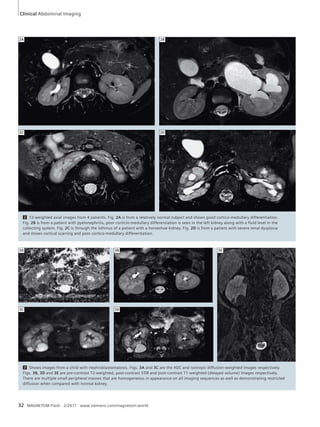
2 T2-weighted axial images from 4 patients. Fig. 2A is from a relatively normal subject and shows good cortico-medullary differentiation. 
Fig. 2B is from a patient with pyelonephritis, poor corticio-medullary differentiation is seen in the left kidney along with a fluid level in the 
collecting system. Fig. 2C is through the isthmus of a patient with a horseshoe kidney. Fig. 2D is from a patient with severe renal dysplasia 
and shows cortical scarring and poor cortico-medullary differentiation. 
3B 3E 
3D 
3A 
3C 
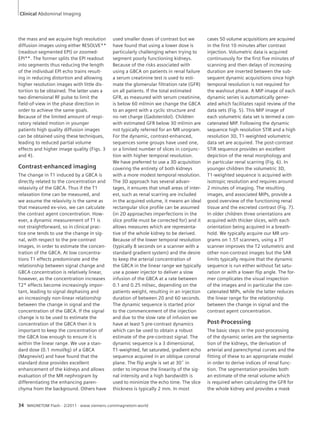
3 Shows images from a child with nephroblastomatosis. Figs. 3A and 3C are the ADC and isotropic diffusion-weighted images respectively. 
Figs. 3B, 3D and 3E are pre-contrast T2-weighted, post-contrast STIR and post-contrast T1-weighted (delayed volume) images respectively. 
There are multiple small peripheral masses that are homogeneous in appearance on all imaging sequences as well as demonstrating restricted 
diffusion when compared with normal kidney. 
32 MAGNETOM Flash · 2/2011 · www.siemens.com/magnetom-world
Abdominal Imaging Clinical 
4A 
4B 
4 Shown images from a 3-year-old girl with Wilms tumors. Figs. 4A and 4C are the ADC and isotropic diffusion-weighted images respectively. 
Figs. 4B and 4D are pre-contrast T2-weighted and post-contrast STIR respectively. Wilms tumors are large and heterogeneous in signal 
characteristics containing both solid and cystic areas. There is restricted diffusion within the mass, but it is not as homogeneous as in areas 
of nephroblastomatosis. 
MAGNETOM Flash · 2/2011 · www.siemens.com/magnetom-world 33 
the fluid challenge and during the time 
of maximal diuresis, pathophysiological 
changes in the kidney that occur in 
response to this stressed state can be 
visualized. A bladder catheter is placed 
whenever possible. The main reason 
for placing a catheter is that children 
become uncomfortable and tend to 
wake from sedation if the bladder is full. 
There are additional imaging benefits 
from using a bladder catheter in that 
interpretation of the images is easier as 
confounding issues such as vesico-ure-teric 
reflux and transmitted bladder pres-sure 
are eliminated. If there is a question 
of a bladder abnormality, the catheter 
can be clamped and images of the dis-tended 
urinary bladder obtained. Almost 
all children under 7 years of age will 
need to be sedated. Optimal solutions 
include general anesthesia or dedicated 
sedation physicians who are able to 
titrate the depth of sedation for the indi-vidual 
patient. Many of our patients are 
referred for the evaluation of antenatal 
hydronephrosis. In this population our 
sedation physicians usually like to wait 
until the patient is at least 3 months of 
age before scheduling the MR urogram. 
Older children who are not sedated are 
asked to either breathe quietly or if they 
are able to co-operate, breathhold imag-ing 
is performed for most sequences. 
Pre-contrast imaging 
One of the strengths of MR urography 
is the ability to combine both contrast-enhanced 
imaging with T2-weighted 
images so that both static and dynamic 
evaluation of the urinary tract is obtained. 
This is particularly helpful in cases of 
marked hydronephrosis or poorly func-tioning 
systems. We obtain a 3D heavily 
T2w urogram which is used to generate 
maximum intensity projections (MIPs) 
and volume rendered images of the pel-vicalyceal 
system and ureters (Fig. 1). 
Volume rendered images are very help-ful 
in analyzing duplex systems or com-plicated 
anatomical variants. We also 
perform an axial T2w TSE through the 
bladder to identify abnormalities of the 
bladder base including ureteroceles and 
ectopic ureteric insertion. Additionally 
we have come to rely on axial high reso-lution 
T2-weighted images in the assess-ment 
of the renal parenchyma (Fig. 2). 
These are typically performed immedi-ately 
after the HASTE scouts and are 
obtained prior to the Furosemide injec-tion 
so that we have a baseline evalua-tion 
of the degree of hydronephrosis 
to which we can compare the delayed 
images. In the case of a renal mass we 
have found diffusion-weighted imaging 
to be helpful in the characterization of 
4C 
4D
Clinical Abdominal Imaging 
the mass and we acquire high resolution 
diffusion images using either RESOLVE** 
(readout-segmented EPI) or zoomed- 
EPI**. The former splits the EPI readout 
into segments thus reducing the length 
of the individual EPI echo trains result-ing 
in reducing distortion and allowing 
higher resolution images with little dis-tortion 
to be obtained. The latter uses a 
two dimensional RF pulse to limit the 
field-of-view in the phase direction in 
order to achieve the same goals. 
Because of the limited amount of respi-ratory 
related motion in younger 
patients high quality diffusion images 
can be obtained using these techniques, 
leading to reduced partial volume 
effects and higher image quality (Figs. 3 
and 4). 
Contrast-enhanced imaging 
The change in T1 induced by a GBCA is 
directly related to the concentration and 
relaxivity of the GBCA. Thus if the T1 
relaxation time can be measured, and 
we assume the relaxivity is the same as 
that measured ex-vivo, we can calculate 
the contrast agent concentration. How-ever, 
a dynamic measurement of T1 is 
not straightforward, so in clinical prac-tice 
one tends to use the change in sig-nal, 
with respect to the pre-contrast 
images, in order to estimate the concen-tration 
of the GBCA. At low concentra-tions 
T1 effects predominate and the 
relationship between signal change and 
GBCA concentration is relatively linear, 
however, as the concentration increases 
T2* effects become increasingly impor-tant, 
leading to signal dephasing and 
an increasingly non-linear relationship 
between the change in signal and the 
concentration of the GBCA. If the signal 
change is to be used to estimate the 
concentration of the GBCA then it is 
important to keep the concentration of 
the GBCA low enough to ensure it is 
within the linear range. We use a stan-dard 
dose (0.1 mmol/kg) of a GBCA 
(Magnevist) and have found that the 
standard dose provides excellent 
enhancement of the kidneys and allows 
evaluation of the MR nephrogram by 
differentiating the enhancing paren-chyma 
from the background. Others have 
used smaller doses of contrast but we 
have found that using a lower dose is 
particularly challenging when trying to 
segment poorly functioning kidneys. 
Because of the risks associated with 
using a GBCA on patients in renal failure 
a serum creatinine test is used to esti-mate 
the glomerular filtration rate (GFR) 
on all patients. If the total estimated 
GFR, as measured with serum creatinine, 
is below 60 ml/min we change the GBCA 
to an agent with a cyclic structure and 
no net charge (Gadoteridol). Children 
with estimated GFR below 30 ml/min are 
not typically referred for an MR urogram. 
For the dynamic, contrast-enhanced, 
sequences some groups have used one, 
or a limited number of slices in conjunc-tion 
with higher temporal resolution. 
We have preferred to use a 3D acquisition 
covering the entirety of both kidneys 
with a more modest temporal resolution. 
The 3D approach has several advan-tages, 
it ensures that small areas of inter-est, 
such as renal scarring are included 
in the acquired volume, it means an ideal 
rectangular slice profile can be assumed 
(in 2D approaches imperfections in the 
slice profile must be corrected for) and it 
allows measures which are representa-tive 
of the whole kidney to be derived. 
Because of the lower temporal resolution 
(typically 8 seconds on a scanner with a 
standard gradient system) and the desire 
to keep the arterial concentration of 
the GBCA in the linear range we typically 
use a power injector to deliver a slow 
infusion of the GBCA at a rate between 
0.1 and 0.25 ml/sec, depending on the 
patients weight, resulting in an injection 
duration of between 20 and 60 seconds. 
The dynamic sequence is started prior 
to the commencement of the injection 
and due to the slow rate of infusion we 
have at least 5 pre-contrast dynamics 
which can be used to obtain a robust 
estimate of the pre-contrast signal. The 
dynamic sequence is a 3 dimensional, 
T1-weighted, fat saturated, gradient echo 
sequence acquired in an oblique coronal 
plane. The flip angle is set at 30˚ in 
order to improve the linearity of the sig-nal 
intensity and a high bandwidth is 
used to minimize the echo time. The slice 
thickness is typically 2 mm. In most 
34 MAGNETOM Flash · 2/2011 · www.siemens.com/magnetom-world 
cases 50 volume acquisitions are acquired 
in the first 10 minutes after contrast 
injection. Volumetric data is acquired 
continuously for the first five minutes of 
scanning and then delays of increasing 
duration are inserted between the sub-sequent 
dynamic acquisitions since high 
temporal resolution is not required for 
the washout phase. A MIP image of each 
dynamic series is automatically gener-ated 
which facilitates rapid review of the 
data sets (Fig. 5). This MIP image of 
each volumetric data set is termed a con-catenated 
MIP. Following the dynamic 
sequence high resolution STIR and a high 
resolution 3D, T1-weighted volumetric 
data set are acquired. The post-contrast 
STIR sequence provides an excellent 
depiction of the renal morphology and 
in particular renal scarring (Fig. 6). In 
younger children the volumetric 3D, 
T1-weighted sequence is acquired with 
isotropic resolution and requires around 
2 minutes of imaging. The resulting 
images, and associated MIPs, provide a 
good overview of the functioning renal 
tissue and the excreted contrast (Fig. 7). 
In older children three orientations are 
acquired with thicker slices, with each 
orientation being acquired in a breath-hold. 
We typically acquire our MR uro-grams 
on 1.5T scanners, using a 3T 
scanner improves the T2 volumetric and 
other non-contrast images but the SAR 
limits typically require that the dynamic 
sequence is run either without fat satu-ration 
or with a lower flip angle. The for-mer 
complicates the visual inspection 
of the images and in particular the con-catenated 
MIPs, while the latter reduces 
the linear range for the relationship 
between the change in signal and the 
contrast agent concentration. 
Post-Processing 
The basic steps in the post-processing 
of the dynamic series are the segmenta-tion 
of the kidneys, the derivation of 
arterial and parenchymal curves and the 
fitting of these to an appropriate model 
in order to derive indices of renal func-tion. 
The segmentation provides both 
an estimate of the renal volume which 
is required when calculating the GFR for 
the whole kidney and provides a mask
Abdominal Imaging Clinical 
5B 5C 
5E 5F 
5 Shows images from a single slice (top row) and the corresponding MIPs (lower row) through the entire volume for three different time points 
corresponding to the vascular (5A, 5D), parenchymal (5B, 5E) and excretory (5C, 5F) phases. In the individual slices in the vascular phase the renal 
cortex is well seen due to its high vascularity while the MIP of this phase provides a good overview of the vasculature and allows features such as 
crossing vessels to be detected. In the parenchymal phase the cortex and medulla are iso-intense, while in the excretory phase high signal intensity 
is seen in the collecting system, ureters and bladder. The dark area in the bladder is the balloon for the bladder catheter. 
MAGNETOM Flash · 2/2011 · www.siemens.com/magnetom-world 35 
5A 
5D
Clinical Abdominal Imaging 
6 7A 7B 
6 Post-contrast STIR image from a patient with a 
small, poorly functioning, left kidney and bilateral 
scarring. 
7 Post-contrast STIR (7A) and delayed, high resolution, T1-weighted (7B) images 
from the patient with horseshoe kidney shown in figure 2. While the right kidney 
has contrast in the collecting system and ureter and has drained contrast into the 
bladder the left kidney shows minimal contrast in the collecting system indicating 
very delayed filtration/concentration of the GBCA. 
which determines the pixels that contrib-ute 
to the average time course for the 
kidney. We currently use either in-house 
software or a beta version of a process-ing 
tool that has been developed by 
Siemens to perform the segmentation. 
In both cases the user performs an initial 
segmentation which is then reviewed 
and refined as necessary until an accept-able 
segmentation is obtained. 
Arterial input function (AIF) 
In order to model renal function an esti-mate 
of the time course of the vascular 
concentration of the GBCA is required 
and this is generally referred to as the 
arterial input function (AIF). The AIF is 
required since the vascular concentration 
affects the rate of filtration of the GBCA 
by the kidneys and even with a standard-ized 
dose and injection protocol there 
will be idiosyncratic variations in the AIF 
caused by physiological differences. For 
pediatric renal studies the arterial signal 
is usually measured in a region-of-inter-est 
(ROI) in the descending aorta, the 
renal arteries being typically too small for 
reliable measurements in children. The 
aorta is viewed in both coronal and sag-ittal 
planes in order to minimize partial 
volume effects by excluding, if possible, 
regions where the aorta cuts through 
the imaging plane. The ROI consists of 
an arbitrary number of points – the points 
typically being positioned at or below 
the level of the renal arteries in order to 
minimize in-flow effects. Even with care-ful 
selection of the location of the ROI 
pulsatility effects can still be present 
and it is not always possible to eliminate 
partial volume and inflow effects. In 
order to reduce the noise in the AIF we 
routinely fit the measured AIF signal to 
a model, however, even after fitting the 
imprecision in the AIF still limits the 
accuracy of GFR quantification with MR 
urography. For methods based on the 
differential function then the imperfec-tions 
in the AIF are common to both 
kidneys and hence cancel out. 
Concentration versus 
time curves 
Deriving the mean signal from the seg-mented 
volumes and converting the 
signal values to concentrations allows 
concentration versus time-curves to be 
derived. Although the contrast dynamics 
can be assessed visually, the curves can 
provide extra information that is not 
always apparent from a visual inspection. 
Figures 8A and 8B show whole kidney 
36 MAGNETOM Flash · 2/2011 · www.siemens.com/magnetom-world 
curves for the patients shown in figures 
5 and 7 respectively. The curves enable 
an assessment of perfusion, concentra-tion 
and excretion for each kidney and 
are analogous to the time activity curves 
of renal scintigraphy. These curves reflect 
only the changes occurring in the renal 
parenchyma, rather than in the paren-chyma 
and collecting systems as is the 
case with renal scintigraphy. The initial 
sharp increase in signal predominantly 
reflects the perfusion phase, with the 
renal cortex enhancing more than the 
medulla due to its higher blood volume. 
The subsequent slower increase in signal 
intensity reflects the accumulation of 
contrast agent in the renal parenchyma 
as it passes through the nephrons. Peak 
parenchymal enhancement typically 
occurs at approximately 150 seconds 
after the initial perfusion phase. After 
this peak there is a general decline in 
signal intensity due to the excretion of 
contrast into the urine and the on-going 
decline in the plasma concentration of 
the GCBA. The late parenchymal curves 
tend to parallel the aortic signal curve. 
As the post-processing becomes easier, 
segmental analysis will become more 
practical and provide greater insights 
into the anatomic and pathophysiologic
Abdominal Imaging Clinical 
10 
8 
6 
4 
2 
0 
Kidney 
10 
8 
6 
4 
2 
0 
6 
5 
4 
3 
2 
1 
0 
–1 
Kidney 
Right kidney 
6 
5 
4 
3 
2 
1 
0 
–1 
Left kidney 
6 
5 
4 
3 
2 
1 
0 
–1 
Right kidney 
6 
5 
4 
3 
2 
1 
0 
–1 
Left kidney 
8 The curves are shown in terms of relative signal, which is defined as (S(t)-So)/So where So is the pre-contrast signal and is linearly relate 
to the contrast agent concentration providing the contrast agent concentration is not too elevated. Figure 8A shows the curves from the normal 
subject shown in figure 5 with relatively symmetrical curves from both kidneys and a peak relative signal approx. 3 minutes post-contrast. Figure 
8B are the curves from the subject with the obstructed horseshoe kidney shown in figures 2 and 7. The curve for the right kidney shows a similar 
pattern to that seen in figure 8A but the curve for the left kidney shows no peak, even though the dynamic imaging covers over 15 minutes after 
the injection of contrast. Figure 8C shows the fits to the Annet model for the curves shown in figure 8A. The top row shows the overall fit for the 
model while the lower row shows the vascular and filtered components of the model. 
MAGNETOM Flash · 2/2011 · www.siemens.com/magnetom-world 37 
85AE 8B 
8C 
Relative Signal 
–200 0 200 400 600 
Time (Seconds) 
Aorta 
L Kid 
R Kid 
Relative Signal (A.U.) 
–200 0 200 400 600 
Time (Seconds) 
Relative Signal (A.U.) 
–200 0 200 400 600 
Time (Seconds) 
Relative Signal (A.U.) 
–200 0 200 400 600 
Time (Seconds) 
Relative Signal (A.U.) 
–200 0 200 400 600 
Time (Seconds) 
Relative Signal 
–200 0 200 400 600 800 1000 1200 
Time (Seconds) 
Aorta 
L Kid 
R Kid
Clinical Abdominal Imaging 
38 MAGNETOM Flash · 2/2011 · www.siemens.com/magnetom-world 
5 Peters AM. Graphical analysis of dynamic data: 
the Patlak-Rutland plot. Nucl Med Commun. 
1994;15:669-672. 
6 Hackstein N, Heckrodt J, Rau WS. Measurement 
of single-kidney glomerular filtration rate using 
a contrast-enhanced dynamic gradient-echo 
sequence and the Rutland-Patlak plot technique. 
J Magn Reson Imaging. 2003;18:714-725. 
7 Annet L, Hermoye L, Peeters F et al. Glomerular 
filtration rate: assessment with dynamic con-trast- 
enhanced MRI and a cortical-compartment 
model in the rabbit kidney. J Magn Reson 
Imaging. 2004;20:843-849. 
8 Sourbron, SP, Michaely HJ, Reiser MF, Schoenberg 
SO. MRI-Measurement of Perfusion and 
Glomerular Filtration in the Human Kidney with 
a Separable Compartment Model. Invest. Radiol. 
2008:43;40-48. 
9 Bokacheva L, Rusinek H, Zhang JL et al. Estimates 
of glomerular filtration rate from MR renography 
and tracer kinetic models. J Magn Reson 
Imaging. 2009;29:371-382. 
10 Pedersen M, Shi Y, Anderson P et al. Quantita-tion 
of differential renal blood flow and renal 
function using dynamic contrast-enhanced MRI 
in rats. Magn Reson Med. 2004;51:510-517. 
11 Mendichovszky I, Pedersen M, Frokiaer J et al. 
How accurate is dynamic contrast-enhanced 
MRI in the assessment of renal glomerular filtra-tion 
rate? A critical appraisal. J Magn Reson 
Imaging. 2008;27:925-931. 
12 Tofts, PS, Brix G. Buckley DL et al. Estimating 
kinetic parameters from dynamic contrast 
enhanced T1-weighted MRI of a diffusible tracer: 
standardized quantities and symbols. J. Magn. 
Reson. Imag. 1999:10;223-232. 
13 Ries M, Jones RA, Basseau F, Moonen CTW and 
Grenier N (2001). Diffusion tensor imaging of 
the kidney. JMRI 14, 42-49. 
14 Porter DA, Heidemann RM. High resolution diffu-sion 
weighted imaging using readout segmented 
echo planar imaging, parallel imaging and a 
two dimensional navigator based reacquisition. 
Magn. Reson. Med (2010): 62;468-475. 
*MR scanning has not been established as safe for 
imaging fetuses and infants under two years of age. 
The responsible physician must evaluate the benefit 
of the MRI examination in comparison to other 
imaging procedures. 
References 
1 Rohrschneider WK, Haufe S, Wiesel M et al. Func-tional 
and morphologic evaluation of congenital 
urinary tract dilatation by using combined static-dynamic 
MR urography: findings in kidneys with 
a single collecting system. Radiology. 
2002;224:683-694. 
2 Grattan-Smith JD, Perez-Brayfield MR, Jones RA, 
Little S, Broecker B, Smith EA, Scherz, HC Kirsch 
AJ. Dynamic contrast enhanced magnetic reso-nance 
urography in the evaluation of hydrone-phrosis 
in children. Pediatric Radiology (2003). 
:33; 293-304. 
3 Jones RA, Grattan-Smith JD, Little S. Pediatric 
magnetic resonance urography. J Magn Reson 
Imaging. 2011;33:510-526. 
4 Patlak CS, Blasberg RG, Fenstermacher JD. Graph-ical 
evaluation of blood-to-brain transfer con-stants 
from multiple-time uptake data. J Cereb 
Blood Flow Metab. 1983;3:1-7. 
changes occurring in the different com-partments 
with various renal diseases. 
Similarly, fitting the models on a pixel by 
pixel basis to produce statistical para-metric 
maps of the model parameters is 
currently too time consuming for routine 
clinical use but as increased computa-tional 
power becomes available these 
will also become clinically feasible. The 
dynamic series can also be used to visu-alize 
the uptake of contrast in renal 
masses and hence help characterize the 
mass. 
Modeling renal function 
Several models of renal function have 
been developed. The Rutland-Patlak 
model, which is widely used in SPECT 
and CT, has also been applied to DCE 
MRI data. This model measures the GFR 
as the transfer of a GBCA from arterial 
blood to the renal tubules and the fact 
that the kidney includes both vascular 
and tubular components is taken into 
account. The amount of GBCA in any one 
kidney at a time point prior to the excre-tion 
of the GBCA can be expressed as 
the sum of the GBCA in the vascular space 
and nephrons respectively. Assuming 
that the plasma concentration of the 
GBCA in the vascular space is proportional 
to the plasma concentration in the aorta 
one can then define constants to repre-sent 
the vascular volume within the kid-ney 
and the clearance of the GBCA from 
the vascular space and write an equation 
for the GFR in terms of the measured 
arterial and renal curves. This equation 
can be rewritten in the form of a linear 
equation and values for the vascular 
volume and the clearance of the GBCA 
can be derived from the plot of this 
equation. Typically one measures the 
average concentration of the GBCA within 
the kidney, thus the equation calculates 
the clearance per unit volume of tissue, 
which we refer to as the unit GFR. We 
believe this quantity is related to the sin-gle 
nephron GFR and have noted that 
this quantity is reduced in decompen-sated, 
as well as dysplastic and uropathic 
kidneys. An estimate of the single kidney 
GFR (SK-GFR) can be obtained by multi-plying 
the unit GFR by the renal volume. 
The Patlak model breaks down after a 
certain time because it fails to take 
account of the onward transport of 
the GBCA (i.e. the drop in signal seen 
at later time points in the parenchymal 
curves). Several more advanced models 
have been developed, the most widely 
used of these being the model devel-oped 
by Annet et al. which includes an 
additional term which accounts for the 
onward transport of the GBCA and 
hence allows the whole time course to 
be modeled. Figure 8C shows the results 
of fitting the data from the subject 
shown in figures 5 and 8A to the Annet 
model. In the case of renal masses other 
models, such as the Tofts model, can be 
applied to the dynamic data to extract 
other parameters such as the tissue per-meability 
or the size of the various tissue 
compartments. 
The results from the renal modeling can 
then be reported as absolute values or in 
terms of the differential renal function. 
The differential renal function (DRF) is 
widely used in nuclear medicine and 
simply expresses the results of functional 
measurements for each kidney as a per-centage 
of the total function (i.e. sum of 
both kidneys). Despite the obvious short-comings, 
which include the assumption 
of a normal contra-lateral kidney as a 
reference and hence neglecting the effect 
of compensatory changes in the contra-lateral 
kidney, the DRF is very useful 
clinically since it removes the effect of 
the main source of error in the func-tional 
calculation, the AIF. 
Contact 
Richard A. Jones 
Department of Radiology 
Children’s Healthcare of Atlanta 
1001 Johnson Ferry Road 
Atlanta, GA 30342 
USA 
Richard.Jones@choa.org 
**The information about this product is preliminary. 
The product is under development and not commer-cially 
available in the U.S., and its future availability 
cannot be ensured.
Abdominal Imaging Clinical 
Pediatric* MR Urography 
1A 1B 1C 
1D 1E 1F 
MAGNETOM Flash · 2/2011 · www.siemens.com/magnetom-world 39 
G. Hadjidekov; G. Tonev; G. Georgieva 
MC ”Pro-Vita”, Sofia, Bulgaria 
Introduction 
MR urography (MRU) – a modern imag-ing 
modality – was introduced to pediat-ric 
uroradiology more than a decade ago 
and has evolved into an effective imag-ing 
tool for the assessment of various 
urologic abnormalities in children. MRU 
provides both morphological and func-tional 
information by means of different 
sequences with or without injection of 
gadolinium. Combined static and 
dynamic contrast-enhanced MR urogra-phy 
is particularly advantageous in the 
pediatric population, offering high spa-tial 
resolution morphologic imaging of 
the urinary tract with reliable informa-tion 
about kidney function and urinary 
excretion in a single examination, with-out 
exposure to ionizing radiation. The 
method is most commonly applied for 
the evaluation of hydronephrosis and 
provides valuable insight into a wide 
range of obstructive uropathies. It is also 
beneficial in tumor characterization, in 
preoperative planning and in the diag-nosis 
of pyelonephritis and renal scar-ring 
where MRU has been shown to be 
superior to renal scintigraphy. Post-pro- 
1 Static MR urography images of a 16-year-old patient with subtle hydronephrosis grade 1 of the right kidney. Coronal T2w syngo BLADE 
(1A, 1B) and axial T2w syngo BLADE (1C) images with fat saturation, 3D coronal T2w TSE maximum intensity projection (1D) and volume 
rendered images (1E, 1F).
Clinical Abdominal Imaging 
cessing algorithms permit the evaluation 
of the split renal function by generating 
time-intensity curves representative for 
the renal function, as well as many other 
parameters. The use of MRU for the 
assessment of urolithiasis, vesicoureteral 
reflux, renal trauma, and fetal urinary 
tract abnormalities is still partially 
limited and technical refinements are 
required. Judicious use of gadolinium-based 
(Gd) contrast agents in children 
at risk for nephrogenic systemic fibrosis 
(NSF) should be employed with atten-tion 
so as to avoid new occurrences. 
Purpose 
The aim of our work is to promote the 
use of MRU in pediatrics trying to pres-ent 
a safe and reliable MRI protocol for 
anatomic imaging that is generally 
accepted. Defining imaging and proce-dural 
recommendations in pediatric uro-radiology 
is an important task, not only 
in standardization of pediatric uroradio-logic 
imaging protocols but also in 
reducing invasiveness and radiation 
dose. The lack of standardization for 
quantitative renal functional evaluation 
and urinary excretion assessment 
requires new studies and extensive inter-disciplinary 
consultations. 
Patient preparation 
The adequate preparation is a prerequi-site 
for good image quality [1–2]. We do 
not routinely place a bladder catheter 
in order to reduce invasiveness of the 
procedure, although catheterization of 
small children is recommended in case 
of megaureter (with or without reflux). 
The intravenous hydratation and admin-istration 
of furosemide are crucial for 
reducing the concentration of Gd [1]. 
Diuretics are recommended in both 
static urography and dynamic urography 
15 minutes before contrast administra-tion. 
In this context, we adopted the 
F-15 protocol and we administered stan-dardized 
hydratation and diuretics prior 
to Gd, in order to reduce artifacts and 
shorten the examination time [3]. In 
children younger than six years of age 
40 MAGNETOM Flash · 2/2011 · www.siemens.com/magnetom-world 
and those who are non-cooperative for 
breathhold techniques, sedation should 
be performed with ketamine (Ketalar) 
and midazolam (Dormicum) according 
to the department’s standard sedation 
protocol [4–5]. Blood pressure, respira-tion, 
heart rate, and oxygen saturation 
are continuously monitored throughout 
MR imaging in all patients. 
Imaging protocol 
MRU examinations are performed on a 
1.5T MAGNETOM ESSENZA, using a 
4-channel Body Matrix coil. The MRU 
protocol should allow a correct evalua-tion 
of the renal parenchyma, upper 
urinary tract, bladder, renal vessels and 
surrounding structures. Such a compre-hensive 
‘one-stop-shop’ protocol must 
be able to provide the required morpho-logical 
and functional information 
within 30–35 minutes. Our MRU proto-col 
consists of a native MRI examination 
with T2w coronal, T1w and T2w axial 
sequences, administration of diuretic 
followed by a dynamic study with gado- 
Table 1: Sequence parameters – 1.5T MAGNETOM ESSENZA 
t2_tru-fi_ 
loc 
haste_ 
16sl_sag 
t2_blade_ 
tra_fs 
t2_ 
blade_ 
cor_fs 
t2_tse 
3d_cor 
t1_sin-gle_ 
vibe_ 
cor 
t1_ 
vibe_ 
dyn_cor 
t1_tse 
3d_sag 
vibe_ 
fs_cor_ 
bh 
single_ 
cor_CE 
TE 2.09 59 123 123 627 0.83 0.83 9 2.38 1.09 
TR 4.17 700 2280 1800 1600 2.62 2.62 696 4.38 3.11 
FA 50 160 150 150 150 10 10 150 8,0 25 
BW 501 789 362 362 219 1090 1090 219 610 520 
FOV 40 38 30 32 34 38 38 34 40 38,5 
ST 8.0 8.0 5,0 5,0 1,5 5,0 3.35 1,5 4,0 1,5 
TA 0:13 0:36 0:48 0:43 2:48 0:04 13:51 1:13 0:11 0:14 
SpS 7 – – – 60 32 32 60 80 56 
Legend: TA = time acquisition in sec., TE = echo time, TR = repetition time, FA = flip angle, FOV = field-of-view, ST = slice thickness, 
bh = breathhold, SpS = slices per slab, BW = bandwidth, VIBE = Volume Interpolated GRE
2 13-year-old boy 
with high grade bilateral 
hydronephrosis and 
megaureters. Persistent 
vesicoureteral reflux 
(VUR) following several 
ureterocystoneostomies 
(UCNS). Static MR uro-graphy 
axial T2w syngo 
BLADE images (2A, 2B), 
coronal T2w syngo BLADE 
images (2C, 2D), coronal 
3D T2w TSE images 
(2E, 2F), 3D coronal T2w 
TSE maximum intensity 
projection (MIP) (2G) and 
volume rendered image 
(2H). 
2A 2B 
2C 2D 
2E 2F 
2G 2H
3A 3B 3C 3D 
3 Ureteropelvic junction (UPJ) obstruction leading to hydronephrosis with dilatation of the right pyelocalyceal system in a 9-year-old girl. Coronal 
T2w syngo BLADE image (3A). MR angiography following Gd administration (Single COR CE) demonstrates accessory right lower pole renal artery 
(arrows), compressing the ureteropelvic junction – Thin MIP images (3B, 3C). Right side hydronephrosis demonstrated on 3D coronal T2w TSE maximum 
intensity projection (3D). The girl was treated successfully by pyeloplasty. 
linium (Gd) injection and 3D reconstruc-tions. 
This MRU protocol allows the 
combination of the whole information, 
provided by conventional exams, ultra-sound 
and scintigraphy in a single 
examination, with or without minimal 
drug toxicity – furosemid and Gd. 
We commence the MRU examination 
with a 3-plane localizer and we use a 
sagittal view to depict the kidneys and 
bladder in order to obtain an oblique 
coronal plan angled parallel to the long 
axis of the kidneys, including ureters 
and bladder. We select a large field-of-view 
(FOV) above both hemidiaphragms 
so as to avoid artifacts from aliasing or 
post-contrast signal intensity decline in 
the upper renal poles. Following the cor-onal 
T2w plane, we perform axial T2w 
and T1w sequences. Fat-suppression 
techniques are used in T1 and T2 hyper 
intense findings and in cases of suspi-cion 
of tumor formation – in and out of 
phase sequences for contour delinea-tion. 
An important pre-contrast 
sequence is 3D T2w urogram with fat-suppression. 
T1-weighted gradient-echo 
sequence with fat-saturation (3D VIBE 
dynamic) is used for the post-contrast 
scan. The dynamic scan is repeated 
within 15 minutes, following Gd injec-tion 
with increasing intervals between 
acquisitions, for the need of post-processing. 
We inject the standard dose 
of 0.1 mmol/kg of gadolinium. Regard-less 
of the patient’s size, placement of 
the coils is crucial. In newborns and 
small children we use the smaller Flex 
coil. Otherwise we use the Body Matrix 
coil to scan older children. It is recom-mended 
to adjust the Body Matrix coil 
anteriorly to assure proper signal distri-bution 
throughout the volume. The 
technical parameters of our sequences 
are presented in Table 1. 
Discussion 
MR urography is a feasible method for 
evaluation of urinary tract pathology in 
neonates and infants [6]. It overcomes 
the limitations of the conventional imag-ing 
techniques and is a superior tool in 
many aspects, especially in the evalua-tion 
of parenchymal kidney diseases and 
poorly functioning systems, assessment 
of ureteral anatomy, renal vasculature 
and tumors. The method is particularly 
helpful for further therapeutic decisions, 
planning of surgical intervention and 
future diagnostic work-up. 
The most common MRU techniques, 
used to visualize the urinary tract, are 
the static (T2w) MRU and excretory 
(T1w) MRU [7–9]. Static MRU uses the 
long relaxation times of the liquids by 
T2w sequences (Fig. 1). Three-dimen-sional 
(3D) respiratory-triggered 
sequences are used to obtain thin-sec-tion 
data sets that can be further post-processed 
to create volume rendered 
(VR) or maximum intensity projection 
(MIP) images of the entire urinary tract 
42 MAGNETOM Flash · 2/2011 · www.siemens.com/magnetom-world 
(Fig. 2) [10–11]. Excretory (T1w) MRU is 
similar to CT urography and intravenous 
urography and is performed after intra-venous 
injection of Gd. The use of con-ventional 
dose – 0.1 mmol/kg and in 
some occasions low-dose Gd opacifica-tion 
– 0.01 mmol/kg allows to maintain 
the linearity between signal and Gd con-centration, 
which is essential for quanti-tative 
measurements and analysis. 
Administration of diuretics improves the 
quality of MRU by increasing the quan-tity 
of the urine and therefore lead to 
better dilution and appropriate distribu-tion 
of Gd in the urinary tract [12–13]. 
The most important sequence of excre-tory 
MRU is 3D gradient-echo. Fat-sup-pression 
is recommended for better 
demonstration of the ureters. MR angi-ography, 
in addition to excretory MR 
urography, demonstrates excellently the 
renal vasculature (Fig. 3). Modern MR 
units scan simultaneously in one volume 
the kidneys, the ureters and the bladder, 
using 3D gradient-echo sequences in 
one breathhold [14–15]. Sometimes 
segmental scanning of the kidneys or 
bladder separately is recommended for 
more detailed image visualization. An 
advantage of static MRU over dynamic, 
T1w MRU is the demonstration of the 
ureters and the ureterovesical junction 
in cases of obstruction or impaired renal 
function [6, 16]. 
There is a growing number of publica-tions 
concerning the criteria for assess-
Abdominal Imaging Clinical 
Contact 
Georgi Hadjidekov, MD 
MC “Pro-Vita” 
Montevideo str. N66 
Sofia 1632 
Bulgaria 
jordiman76@yahoo.com 
MAGNETOM Flash · 2/2011 · www.siemens.com/magnetom-world 43 
ment of the renal function in children 
by dynamic MRU, but the achievement 
of consensus requires more and deeper 
investigations. Functional criteria 
include renal transit time, differential 
renal function, and time–signal intensity 
curves. The technique is challenging and 
is best performed in specialized centers. 
However, this single MRI examination 
could avoid the use of multiple modali-ties 
(e.g. US, conventional urography, 
renal scintigraphy) that individually help 
assess various morphologic features, 
renal function and excretion and there is 
an expanding use of MRI. Current limita-tions 
for widespread distribution of the 
technique are understaffed pediatric 
radiologic departments and time-con-suming 
post-processing. 
Alongside the advantages of MRU, men-tioned 
above, it is necessary to note 
some limitations. Sometimes it requires 
a placement of bladder catheter, admin-istration 
of furosemide and Gd, sedation 
and even anesthesia (for newborns and 
younger children), which is a comple-mentary 
risk [16]. Breathhold tech-niques 
could not be applied in neonates 
and small infants. We use syngo BLADE 
to minimize motion artifacts. Patient 
preparation and the examination itself 
are time-consuming; post-processing 
and calculation of functional curves and 
differential renal function require an 
additional 30 minutes. 
Until recently it was believed that the 
extracellular Gd-based contrast agents 
are safe. However, in 2006, it was dem-onstrated 
that some Gd-based contrast 
agents may provoke the development of 
NSF and/or a generalized fibrotic disor-der 
in renal failure patients [17]. Gd-ions, 
released from Gd-based MR con-trast 
agents, are the likely etiologic 
agent of NSF [18]. The guidelines of the 
European Society of Urogenital Radiol-ogy 
(ESUR) suggest a very careful 
administration of Gd in children with 
renal failure. Absolute contraindications 
are high levels of creatinine and a glomer-ular 
filtration under 30 ml/min/1.73 m2 
and in cases of glomerular filtration 
between 30 and 60 ml/min/1.73 m2 dis-cussions 
with pediatric nephrologists are 
mandatory. Written consent should be 
obtained in spite of the fact that most 
cases of NSF occur in adults and the 
reported cases of NSF without Gd 
administration. In all patients at high 
risk of developing NSF and in the pediat-ric 
group, cyclic Gd-helators should be 
used due to their higher stability [19]. 
Conclusion 
MRU has the potential to become the 
leading diagnostic modality in the near 
future of a wide range of pathological 
conditions affecting the urinary tract in 
newborns and children. It integrates 
exquisite anatomical information with a 
variety of functional data and avoids 
ionizing radiation. MRU is increasingly 
employed as a problem solver when con-ventional 
imaging studies remain incon-clusive 
and its growing application will 
likely improve availability and reduce 
cost in the future. The introduction of 
parallel imaging, higher field strength 
systems, multielement coil technology, 
and gadolinium-based contrast agents 
with increased T1 relaxivity will further 
improve the overall signal-to-noise ratio 
(SNR) and spatial resolution of the 
images. The advances of molecular 
imaging techniques will provide new 
insights about the nature of hereditary 
diseases in pediatric nephrology and 
urology. Potential future applications 
include also virtual endoscopy and MRU-guided 
procedures. 
*MR scanning has not been established as safe for 
imaging fetuses and infants under two years of age. 
The responsible physician must evaluate the benefit of 
the MRI examination in comparison to other imaging 
procedures. 
References 
1 Grattan-Smith, J.D., S.B. Little, and R.A. Jones, 
MR urography in children: how we do it. Pediatr 
Radiol, 2008. 38 Suppl 1: p. S3-17. 
2 Leyendecker, J.R., C.E. Barnes, and R.J. Zagoria, 
MR urography: techniques and clinical applica-tions. 
Radiographics, 2008. 28(1): p. 23-46; 
discussion 46-7. 
3 Grattan-Smith, J.D., et al., MR imaging of kid-neys: 
functional evaluation using F-15 perfusion 
imaging. Pediatr Radiol, 2003. 33(5): p. 293- 
304. 
4 Cengiz, M., Z. Baysal, and S. Ganidagli, Oral 
sedation with midazolam and diphenhydramine 
compared with midazolam alone in children 
undergoing magnetic resonance imaging. 
Paediatr Anaesth, 2006. 16(6): p. 621-6. 
5 Lin, T.F., et al., Antiemetic and analgesic-sparing 
effects of diphenhydramine added to morphine 
intravenous patient-controlled analgesia. Br J 
Anaesth, 2005. 94(6): p. 835-9. 
6 Riccabona, M., et al., Feasibility of MR urography 
in neonates and infants with anomalies of the 
upper urinary tract. Eur Radiol, 2002. 12(6): 
p. 1442-50. 
7 Nolte-Ernsting, C.C., et al., MR urography today. 
Abdom Imaging, 2003. 28(2): p. 191-209. 
8 Garcia-Valtuille, R., et al., Magnetic resonance 
urography: a pictorial overview. Br J Radiol, 
2006. 79(943): p. 614-26. 
9 Nolte-Ernsting, C.C., et al., Diuretic-enhanced 
gadolinium excretory MR urography: comparison 
of conventional gradient-echo sequences and 
echo-planar imaging. Eur Radiol, 2001. 11(1): 
p. 18-27. 
10 Roy, C., et al., MR urography in the evaluation of 
urinary tract obstruction. Abdom Imaging, 
1998. 23(1): p. 27-34. 
11 O’Malley, M.E., et al., MR urography: evaluation 
of a three-dimensional fast spin-echo technique 
in patients with hydronephrosis. AJR Am J 
Roentgenol, 1997. 168(2): p. 387-92. 
12 Szopinski, K., et al., Magnetic resonance uro-graphy: 
initial experience of a low-dose Gd-DT-PA- 
enhanced technique. Eur Radiol, 2000. 
10(7): p. 1158-64. 
13 Hughes, J., et al., MR urography: evaluation of 
different techniques in non-dilated tracts. 
Clin Radiol, 2002. 57(11): p. 989-94. 
14 Nolte-Ernsting, C.C., G.B. Adam, and R.W. 
Gunther, MR urography: examination techniques 
and clinical applications. Eur Radiol, 2001. 
11(3): p. 355-72. 
15 Sudah, M., et al., MR urography in evaluation of 
acute flank pain: T2-weighted sequences and 
gadolinium-enhanced three-dimensional FLASH 
compared with urography. Fast low-angle shot. 
AJR Am J Roentgenol, 2001. 176(1): p. 105-12. 
16 Riccabona, M., Pediatric MRU-its potential and 
its role in the diagnostic work-up of upper 
urinary tract dilatation in infants and children. 
World J Urol, 2004. 22(2): p. 79-87. 
17 Thomsen, H.S. and P. Marckmann, Extracellular 
Gd-CA: differences in prevalence of NSF. Eur J 
Radiol, 2008. 66(2): p. 180-3. 
18 Abraham, J.L., et al., Dermal inorganic gado-linium 
concentrations: evidence for in vivo 
transmetallation and long-term persistence in 
nephrogenic systemic fibrosis. Br J Dermatol, 
2008. 158(2): p. 273-80. 
19 Martin, D.R., et al., Individual kidney blood flow 
measured with contrast-enhanced first-pass 
perfusion MR imaging. Radiology, 2008. 246(1): 
p. 241-8.
Clinical Abdominal Imaging 
Case Report 
Ectopic Ureter: Magnetic 
Resonance Urography 
Sally Harman; Padma Rao, MD 
Children’s MRI Centre, Royal Children’s Hospital, Melbourne, Victoria, Australia 
Patient history 
A 4-year-old female presented with per-sistent 
urinary incontinence. Previous 
ultrasound findings queried bilateral 
duplex kidneys. A cystocope was nega-tive 
for ectopic ureter. Referring urolo-gist 
requested a Magnetic Resonance 
Urogram (MRU) to be carried out. 
Sequence details 
This protocol is carried out at our institu-tion 
on a 3T Siemens MAGNETOM Tim 
Trio with software version syngo MR B17 
using a 12-channel Body Matrix coil. 
T2w 2D transverse fat suppressed turbo 
spin echo. 
T2w 2D coronal fat suppressed turbo 
spin echo. 
T2w SPACE – 3D T2w respiratory trig-gered 
sequence. 
3D coronal T1w gradient sequence with 
fat suppression (dynamic sequence). 
(Undertaken with 8 second breathholds 
over a 15 minute period with 54 passes). 
3D T1w sagittal (delayed after contrast) 
fat suppressed. 
Because of the age of the child this scan 
was carried out under a general anes-thetic. 
Imaging fi ndings 
Bilateral duplex kidneys. The upper moi-ety 
ureter of the right kidney was found 
to be dilated and ectopic. It bypassed 
the bladder and appeared to insert in 
the vagina. 
Discussion 
With the use of 3D T2w respiratory trig-gered 
sequence and the rapid T1w gra-dient 
sequence, effective MRUs are easily 
achievable. At our institution we have seen 
cases where pathology is seen on one of 
these sequences, but not the other. Used 
in conjunction, both are equally valuable. 
The 3D T2w respiratory triggered 
sequence is helpful for gaining, amongst 
44 MAGNETOM Flash · 2/2011 · www.siemens.com/magnetom-world 
others, volume rendered images of the 
complete urinary system, clearly demon-strating 
anatomy. 
The 3D coronal gradient sequence with 
fat suppression carried out as a dynamic 
sequence is of great benefit when look-ing 
at the functional anatomy of the 
urinary system. When utilized in con-junction 
with an appropriate dose of 
furosemide and a well hydrated patient, 
the function of the urinary system can 
be demonstrated. 
Post-processing of the dynamic sequence 
can also be undertaken. At our institution, 
post processing is carried out using 
‘Image J’ software (www.rsbweb.nih. 
gov/ij/) with the MRU plug-in (www.univ-rouen. 
fr/med/MRurography/acccueil.htm). 
Acknowledgements 
Chris Adamson – Developmental & Func-tional 
Brain Imaging – Murdoch Childrens 
Research Insitute, Melbourne, Victoria, 
Australia. 
Michael Kean & Amber Bristowe – 
Children’s MRI Centre @ Royal Children’s 
Hospital, Melbourne, Victoria, Australia. 
Contact 
Sally Harman 
Children’s MRI Centre 
Royal Children’s Hospital 
Melbourne, Victoria 
Australia 
Phone +61 393454301 
sally.harman@rch.org.au 
ALH 
1 Curved multi-planar reconstruction 
(MPR) of the right urinary tract based 
on T2w 3D TSE MR data (syngo SPACE) 
showing the ectopic ureter. 
1
Abdominal Imaging Clinical 
2B 2C 
2E 2F 
MAGNETOM Flash · 2/2011 · www.siemens.com/magnetom-world 45 
2A 
2D 
2 Maximum intensity projection of the 4D data set (3D FLASH with fat saturation) which is used to assess the urinary tract including the kidneys 
(time sorting from (2A) as earliest to (2F) as latest time point). 
2A 
2D
Image Gallery 
Pediatric Imaging in Daily Routine with 
MAGNETOM ESSENZA – a Pictorial Essay 
Han Yan Qiao, MD 
Shanghai Children’s Hospital, Department of Diagnostic Radiology, Shanghai,China 
Introduction 
The Shanghai Children’s Hospital is a 
maximum care centre, specialized solely 
in the needs of children. Founded in 
1937, it was formerly known as the 
“Refugee Children Hospital of Shanghai”. 
Among the founders of the hospital 
were the highly recognised Dr. Fu Wen 
Shou and Dr. Su Zu Fei. In 1953, the 
name was changed to “Shanghai Chil-dren’s 
Hospital” and in 2003 it became 
affiliated to the Shanghai Jiaotong Uni-versity. 
The Shanghai Children’s Hospital 
provides all disciplines of pediatric 
healthcare. Its staff care for more than 
1 million outpatients and – equipped 
with 300 beds – approximately 18,000 
inpatients per year. 
Background 
This high number of patients treated 
per year also reflects that the Shanghai 
Children’s Hospital is recognised as one 
of the leading institutions for pediatric 
healthcare within the greater area of 
Shanghai, if not within China. But it also 
demonstrates the growing need for 
imaging capacities, including MR imag-ing 
(MRI), within the hospital to cover 
46 MAGNETOM Flash · 2/2011 · www.siemens.com/magnetom-world 
all aspects of pediatric patient care. In 
2009, the hospital decided therefore to 
expand its imaging department and add 
an MR unit. The requirements for this 
MR scanner are manifold; e.g. in the 
field of brain imaging, the availability of 
high quality diffusion-weighted imaging 
(DWI) as well as susceptibility-weighted 
imaging (SWI) for clinical routine is an 
important requirement. Flexible coil 
handling as well as high signal-to-noise 
ratio (SNR) and light-weight coil design 
are also important aspects, especially 
when imaging children. Such an MR sys-tem 
must also allow the scan of multiple 
1A 1B 1C
Image Gallery 
MAGNETOM Flash · 2/2011 · www.siemens.com/magnetom-world 47 
regions within one exam and without 
the need of coil repositioning e.g. to 
evaluate the whole central nervous 
system (CNS). 
An ongoing debate concerns the right 
field strength for pediatric imaging. For 
many clinical questions, but also keep-ing 
in mind the dimensions of our small-est 
patients, resolution is one of the key 
elements for highest diagnostic confi-dence 
with MRI. However, increased 
resolution requires higher overall SNR 
and this can easily be achieved by 
simply increasing the B0 magnetic field 
strength. On the other hand, SNR 
depends on the applied coils and SNR 
gains can be achieved without increas-ing 
the B0 just by selecting the right coil 
technology. In addition, comparing 1.5 
to 3 Tesla, this gain in SNR comes at the 
cost of higher energy deposition within 
the body and therefore sometimes a 
more complex sequence handling to 
comply with the specific absorption rate 
(SAR) limitations at 3T. Imaging where 
metallic implants or clips are present can 
be more challenging at 3T than at 1.5T. 
But the decision whether 3T or 1.5T 
represents the perfect system also 
depends on many further and often indi-vidual 
aspects including cost. Lower 
field strengths than 1.5 Tesla have, gen-erally 
speaking, failed to provide the 
required SNR in pediatric imaging, which 
is used either for high resolution or for 
fast scanning. 
At our department we came to the con-clusion 
that a 1.5 Tesla MR system 
would best answer our daily clinical and 
business demands. When defining the 
system requirements, a very flexible coil 
handling and its capacity for advanced 
applications such as SWI in clinical 
routine were prioritized. The decision 
was therefore to invest in a MAGNETOM 
ESSENZA which, thanks to Tim (Total 
Imaging Matrix) coil technology and 
advanced applications, addresses all the 
above requirements. 
At this time point we scan approximately 
20 children per day. Tim technology 
has fulfilled our initial expectations and 
the Tim coils enable us to scan all our 
patients, including neonates* and 
fetuses*. In total, we scanned approxi-mately 
8,000 children since the installa-tion 
of the system in September 2009. 
Most requests concern neurological 
problems including trauma and malfor-mations. 
However, in areas where ultra-sound 
is still the imaging modality of 
choice, we also see an increase in refer-rals 
for abdominal scans, especially for 
the evaluation of further differential 
diagnoses. 
Purpose 
The purpose of this pictorial essay is to 
share some of our interesting cases with 
readers of MAGNETOM Flash magazine 
and also to share our experience with 
the MAGNETOM ESSENZA MRI scanner 
for pediatric imaging. 
Case 1 
A 6-year-old boy with disability of the 
left arm for two days. MRI suspicious of 
Moyamoya disease and corresponding 
to the patients symptoms suspicious of 
cerebral infarction. 
1A) Transversal FLAIR (DarkFluid) with 
motion correction (syngo BLADE). 
1B) Transversal T2w TSE. 
1C) DWI (b = 1000 s/mm2 and ADC map) 
1D) Time-of-flight MR angiography (MIP). 
1E) Coronal inverted T2w TSE. 
1F) Sagittal T2w TSE. 
1D 1E 1F
Image Gallery 
Case 2 
A 4-year-old boy with more than one 
year of recurrent febrile convulsions. 
MRI demonstrated hydrocephalus, cere-bral 
hypoplasia of the corpus callosum 
and absent septum pellucidum as well 
as left frontal schizencephaly (open lip 
type). The boy received a left ventriculo-peritoneal 
shunt. 
48 MAGNETOM Flash · 2/2011 · www.siemens.com/magnetom-world 
2A) Transversal T2w TSE. 
2B) Transversal T1w TIRM with motion 
correction (syngo BLADE). 
2C) Coronal inverted T2w TSE. 
2D) Sagittal T2w TSE. 
2A 2B 
2C 2D
Image Gallery 
MAGNETOM Flash · 2/2011 · www.siemens.com/magnetom-world 49 
Case 3 
An 8-year-old girl presented with early 
onset of breast development. MRI 
showed a cystic dilatation of the left 
ventricle at the temporal horn but could 
rule out abnormalities of the pituitary 
gland. 
3A) Transversal T2w TSE. 
3B) Transversal FLAIR (DarkFluid). 
3C) Coronal inverted T2w TSE. 
3D) Sagittal T2w TSE. 
3E) DWI (b = 1000 s/mm2 and ADC map). 
3A 3B 3C 
3D 3E
Image Gallery 
Case 4 
A 3-month-old girl* that fell into coma 
45 days after birth. MRI shows bilateral 
temporo-occipital brain atrophy with 
cystic encephalomalacia. 
4A) Transversal T2w TSE. 
4B) Transversal FLAIR (DarkFluid) with 
motion correction (syngo BLADE). 
4C) Sagittal T2w TSE. 
50 MAGNETOM Flash · 2/2011 · www.siemens.com/magnetom-world 
4D) Coronal T2w TSE. 
4E) DWI (b = 0, 1000 s/mm2 and 
ADC map). 
4A 4B 
4C 4D 
4E
Image Gallery 
MAGNETOM Flash · 2/2011 · www.siemens.com/magnetom-world 51 
Case 5 
A 45-day-old boy* was rescued after 
asphyxia during birth. MRI follow-up 
exam of the subarachnoidal haemor-rhage 
is shown. MRI demonstrates poly-cystic 
encephalomalacia and bilateral 
subdural effusions. 
5A) Transversal T2w TSE. 
5B) Transversal FLAIR (DarkFluid) with 
5A 5B 5C 
5D 5E 
motion correction (syngo BLADE). 
5C) DWI (b = 1000 s/mm2). 
5D) Sagittal T2w TSE. 
5E) Coronal inverted T2w TSE.
Image Gallery 
Case 6 
An 11-day-old boy* with sub-acute 
intracranial haematoma left fronto-temporal 
of unknown origin. 
6A) Transversal T2w TSE. 
6B) Transversal FLAIR (DarkFluid) with 
motion correction (syngo BLADE). 
6C) SWI (thinslice MIP). 
6D) DWI (b = 1000 s/mm2). 
6E) Time-of-flight MR angiography (MIP). 
52 MAGNETOM Flash · 2/2011 · www.siemens.com/magnetom-world 
6F) Sagittal T2w TSE. 
6G) Transversal, coronal and sagittal 
T1w TSE after contrast media adminis-tration. 
6A 6B 6C 
6D 6E 6F 
6G
Image Gallery 
MAGNETOM Flash · 2/2011 · www.siemens.com/magnetom-world 53 
Case 7 
An 8-month-old girl* presented with 
swelling of the neck since two weeks. 
MRI reveals a cervical lymphoma mani-festation. 
7A) Coronal T1w TSE. 
7B) Coronal T2w TSE. 
7C) Coronal T2w TIRM. 
7D) Sagittal T2w TIRM. 
7E) Sagittal T1w TSE. 
7F) Transversal T1w TSE. 
7G) Transversal T2w TIRM. 
7A 7B 7C 
7D 7E 
7F 7G
Image Gallery 
Case 8 
A 5-month-old boy* presented with 
swelling of the neck for six days but 
without fever. MRI shows clearly the 
abscess formation left cervical. 
From top to bottom coronal, sagittal, 
transversal. 
8A) T2w TIRM. 
8B) T2w TSE. 
8C) Native T1w TSE. 
8D) After contrast media administration. 
8A 8B 8C 8D 
54 MAGNETOM Flash · 2/2011 · www.siemens.com/magnetom-world
Image Gallery 
MAGNETOM Flash · 2/2011 · www.siemens.com/magnetom-world 55 
Case 9 
A 3-year-old boy with gigantic polylobu-lated 
cystic mass of the abdomen and 
pelvis with unknown origin. 
9A) Coronal T2w TSE with fat saturation 
and triggering. 
9B) Transversal T2w TSE with motion 
correction (syngo BLADE) and fat 
saturation. 
9C) Sagittal T2w TSE. 
9D) Sagittal T1w TSE. 
9A 9B 
9C 9D
Image Gallery 
Case 10 
A 3-year-old girl was sent to MRI 
because of fever and weakness of both 
lower extremities for 10 days. MRI 
showed a large mass at Th 2–3. Pre 
(upper row) and images after surgery 
(resection of the intramedullar tumor) 
(lower row). Histopathology revealed a 
solitary bone plasmocytoma. 
10A) Coronal T2w TSE. 
10B) Coronal T2w TIRM. 
10C) Coronal T1w TSE. 
10D) Transversal contrast-enhanced 
T1w TSE. 
10E) Sagittal T2w TSE 
10F) Sagittal contrast-enhanced 
T1w TSE. 
56 MAGNETOM Flash · 2/2011 · www.siemens.com/magnetom-world 
10A 10B
Image Gallery 
10C 10D 10E 10F 
MAGNETOM Flash · 2/2011 · www.siemens.com/magnetom-world 57
Image Gallery 
Case 11 
A 3-month-old girl* with coughing and 
short breath was found to have a large 
intra-hepatic tumor (ultrasound report). 
MRI shows a large cavernous 
haemangioma. 
11A) Transversal T2w TSE without and 
11B) with fat saturation. 
11C) Sagittal T1w TSE. 
11D) Early and late phase T1w TSE after 
contrast-administration. 
11E) Sagittal T1w TSE after contrast-media 
administration. 
11A 11B 11C 
11D 11E 
58 MAGNETOM Flash · 2/2011 · www.siemens.com/magnetom-world
Image Gallery 
MAGNETOM Flash · 2/2011 · www.siemens.com/magnetom-world 59 
Case 12 
Fetal MRI* for further evaluation of right 
diaphragmal hernia and to evaluate 
residual lung volume and developmental 
status is shown. Coronal, sagittal and 
transversal T2w HASTE. 
*MR scanning has not been established as safe for 
imaging fetuses and infants under two years of age. 
The responsible physician must evaluate the benefit of 
the MRI examination in comparison to other imaging 
procedures. 
Contact 
Han Yan Qiao, MD 
Shanghai Children’s Hospital 
Department of Diagnostic Radiology 
No.24, lane 1400 Beijing Xi Road 
Shanghai 200040 
China 
Phone: +86 18917128338 
yanqiaohan@163.com 
12
Clinical Neurology 
Neuro-Infections in Childhood – 
MR Imaging Patterns 
Birgit Ertl-Wagner 
Institute of Clinical Radiology, University of Munich – Grosshadern Campus, Munich, Germany 
Infectious diseases are among the most 
common disorders of the brain and spine 
in childhood. The manifestation of the 
disease and the MR imaging pattern vary 
widely depending on the time of infec-tion 
in relation to the development of 
the brain. Cerebral infections cause dif-ferent 
abnormalities of the brain during 
the following time periods: 
■ Fetal period: neuro-infections in the 
fetus are also called congenital infec-tions; 
they occur in utero 
■ Perinatal period: neuro-infections 
occurring around the time of birth are 
also called neonatal infections 
■ Later childhood and adolescence 
However, MR imaging patterns also 
depend on the infectious agent causing 
the disease. Neuro-infections can, for 
example, be classified as: 
■ Bacterial 
■ Viral 
■ Parasitic 
■ Fungal 
When investigating children with pre-sumed 
infections of the brain, it is 
important to take into account the imag-ing 
patterns of the respective time of 
infection and of the various infectious 
agents. 
1A 1B 
60 MAGNETOM Flash · 2/2011 · www.siemens.com/magnetom-world 
Congenital infections 
Congenital infections of the brain are 
commonly summarized under the 
acronym ToRCH. This acronym stands 
for several infectious agents causing 
congenital infections, i.e.: 
■ Toxoplasmosa gondii 
■ Rubella virus 
■ Cytomegalovirus (CMV) 
■ Herpes simplex virus (HSV) 
Risk factors for a connatal toxoplasmosis 
are maternal contact with cat faeces and 
eating of raw or undercooked meat. It 
occurs in about 1:3,000 to 1:5,000 live 
births. Imaging often reveals calcifica- 
1 Axial T2-weighted image (1A) and FLAIR image (1B) demonstrating patchy signal hyperintensities of the white matter in a 4-year-old girl 
with congenital CMV infection.
Neurology Clinical 
2 Contrast-enhanced axial T1-weighted images demonstrate an increased pachymeningeal and leptomeningeal enhancement in a 13-year-old 
girl with viral meningitis. 
MAGNETOM Flash · 2/2011 · www.siemens.com/magnetom-world 61 
tions in the basal ganglia and in the 
periventricular region. The children may 
suffer from hydrocephalus, but also from 
microcephaly. In contrast to congenital 
CMV infection, disorders of cortical 
development do not usually occur [1]. 
Generally, the consequences tend to be 
less serious the later the infection occurs 
during gestation. 
Due to widespread immunization cam-paigns, 
congenital rubella infections 
have become an exceedingly rare occur-rence 
in the western world. The severity 
of the infections depends on the gesta-tional 
age – infections have an especially 
severe course when they occur during the 
first trimester. The MR imaging appear-ance 
can resemble that of connatal toxo-plasmosis. 
Microcephaly and calcifica-tions 
are observed [2]. 
Cytomegalovirus (CMV) infections are 
by far the most common connatal infec-tion 
in the western world. CMV infections 
during pregnancy are estimated to be ten 
times more common than congenital 
toxoplasma infections – occurring in up 
to 1% of live births. However, only 5 to 
10% of connatal CMV infections affect 
the brain. A common presenting symp-tom 
in children is hearing loss. It is not 
unusual for children to be referred for 
MR imaging prior to surgery for a cochlear 
implant to assess the morphology of the 
inner ear. The MR imaging appearance 
varies depending on the gestational age 
at the time of infection. CMV infections 
may lead to polymicrogyria and / or 
lissencephaly, especially if they occur 
during the second trimester of pregnancy. 
Very commonly, patchy white matter 
lesions with hyperintense signal on 
T2-weighted and FLAIR sequences are 
present (Fig. 1). These are often conflu-ent 
and may occur in the absence of 
abnormalities of cortical development [3]. 
Herpes simplex virus (HSV) infections 
of the brain in the neonate are usually of 
type II and are acquired during vaginal 
birth. MR imaging usually demonstrates 
rapidly progressive signal alterations of 
the white matter eventually leading to 
cystic encephalomalacia with ensuing 
atrophy of the brain [4]. 
Other congenital infections include lym-phocytic 
choriomeningitis (LCM) virus 
infection, syphilis, congenital HIV infec-tion 
and congenital varicella zoster 
infection. 
Generally, connatal infections should 
always be taken into consideration when 
imaging a child with developmental delay 
and / or epilepsy. Children with congeni-tal 
hearing loss usually undergo MR imag-ing 
prior to surgery for a cochlear implant. 
Connatal infections – especially connatal 
CMV infections – are a rather common 
cause for congenital hearing loss and the 
MR imaging should always be scrutinized 
for possible signs of connatal infections 
such as white matter lesions and / or dis-orders 
of cortical development. 
Meningitis, cerebritis 
and abscess 
Meningitis is the most common neuro-infection 
throughout childhood. The 
infectious agent may reach the meninges 
by different routes [5]: 
■ hematogeneously 
■ via an adjacent infection, 
e.g. mastoiditis 
■ through the choroid plexus 
■ via a penetrating injury 
■ by rupture of a cerebral abscess. 
Most commonly, the infectious agent is 
viral. Viral meningitis is not a classic 
imaging diagnosis, but imaging may be 
performed to rule out complications 
and / or to rule out contraindications to 
perform a diagnostic lumbar puncture. 
2A 2B
Clinical Neurology 
3 Contrast-enhanced axial T1-weighted images (3A), diffusion-weighted images (3B) and the concomitant ADC-map (3C) show an intracranial 
abscess with diffusion restriction. 
MR imaging may show a thickening of 
the meninges with an increased 
enhancement after the administration of 
contrast agent – this can affect the lep-tomeninges 
and / or the pachymeninges 
(Fig. 2). However, the MR imaging 
appearance may also be completely nor-mal 
in viral meningitis. A normal MR 
appearance generally does not rule out 
viral meningitis. Complications of viral 
meningitis include concomitant enceph-alitis, 
hydrocephalus and vasculitis. 
Bacterial meningitis usually progresses 
more rapidly with a more severe clinical 
course than viral meningitis. Again, MR 
imaging is mostly performed to investi-gate 
complications and / or to rule out 
contraindications for lumbar puncture. 
The thickening of the meninges is usually 
more pronounced in bacterial meningitis 
compared to viral meningitis. Subdural 
empyemas are a potential complication 
of bacterial meningitis, the occurrence 
of which leads to a pronounced worsen-ing 
of the prognosis [6]. Hemophilus influ-enzae 
may, however, lead to sterile sub-dural 
fluid collections that need to be 
differentiated from empyema. 
Other complications of bacterial menin-gitis 
include hydrocephalus, venous 
infarctions due to thromboses, and arte-rial 
infarctions due to arteritis / vasculi-tis. 
Moreover, bacterial meningitis may 
lead to cerebritis and abscess formation, 
as well as to ventriculitis. 
Tuberculous meningitis may occur in 
children or in adults. Tuberculosis prefer-entially 
affects the basal meninges, 
which show a marked thickening and 
enhancement on MR imaging. Focal 
tuberculomas may also be seen, which 
are often hypointense on T2-weighted 
MR imaging. Common complications 
include hydrocephalus and infarctions 
in the basal ganglia and thalami. 
A focal infection of the brain is called 
cerebritis. At the stage of a cerebritis, 
the focal infection has not yet become 
centrally necrotic. MR imaging usually 
62 MAGNETOM Flash · 2/2011 · www.siemens.com/magnetom-world 
reveals a contrast enhancement of the 
entire lesion with a perifocal edema. 
At a later stage, cerebritis may become 
a cerebral abscess, especially if left 
untreated. Cerebral abscesses in children 
may be a result of a sinusitis or mastoid-itis 
and are then commonly located in 
close proximity to either the paranasal 
sinuses or the petrous bones. MR imaging 
reveals one of the hallmark features of 
cerebral abscesses: a centrally restricted 
diffusion, which aids in differentiating 
cerebral abscess formation from primary 
brain tumors [7]. On conventional MR 
imaging, the central portion of a cerebral 
abscess is usually hyperintense on 
T2-weighted imaging and hypointense 
on T1-weighed imaging, while the rim 
of the lesion shows a pronounced 
enhancement after the administration 
of contrast agent (Fig. 3). 
Especially in small children, ventriculitis 
frequently occurs as a complication of 
meningitis. This may lead to periventric-ular 
and intraventricular abscesses and 
the prognosis is rather unfavorable. 
3A 3B
Neurology Clinical 
MAGNETOM Flash · 2/2011 · www.siemens.com/magnetom-world 63 
MR imaging typically shows a pronounced 
enhancement of the ventricular epen-dyma 
and dilatation of the ventricles. 
Later in the disease process, loculations 
with septae commonly ensue. 
Viral encephalitis 
Viral encephalitis is another important 
neuro-infectious differential diagnosis 
both in children and in adults. There is a 
plethora of viral infectious agents that 
may cause encephalitis. In the following, 
this report focuses on HSV I encephalitis, 
SSPE, tick-borne encephalitis and Ras-mussen 
encephalitis. 
HSV encephalitis is a crucial diagnosis 
not to be missed on MR imaging. The 
earlier treatment is initiated, the better 
the diagnosis is. About one third of HSV 
encephalitis occurs in children, most of 
which are HSV type I infections. Initial 
symptoms may be rather unspecific; 
therefore, the imaging diagnosis can be 
crucial for the patient’s further progno-sis. 
HSV preferentially involves the limbic 
system, and so an involvement of the 
temporal lobes with a signal hyperinten-sity 
on T2-weighted and FLAIR sequences 
especially in the temporomesial portion 
is a common hallmark feature of the 
disorder (Fig. 4). The insular / peri-Sylvian 
regions are commonly involved as well. 
However, the MR imaging appearance 
can also be atypical. An asymmetrical 
involvement of the limbic structures is 
rather common. In addition, the pattern 
of involvement can also be unspecific 
and does not necessarily demonstrate 
a preferential involvement of the limbic 
system, especially in small children [8]. 
If in any doubt, the suspicion of HSV 
encephalitis should be raised and treat-ment 
should be swiftly initiated, until HSV 
infection is ruled out by cerebrospinal 
fluid (CSF) diagnostics. 
Varicella-zoster-encephalitis is a rare 
complication of chicken pox. Affected 
children usually present with cerebellar 
signs such as ataxia or dysarthria. On 
MR imaging there is usually pronounced 
edema of the cerebellum. Supratentorial 
lesions may also be present, e.g. in the 
cortex or in the basal ganglia. 
Subacute sclerosing panencephalitis 
(SSPE) is a devastating and eventually 
lethal disorder of the brain. It is consid-ered 
a late complication of measles 
infection. Affected children suffer from 
a progressive neurodegeneration with 
dementia and pareses. MR imaging ini-tially 
shows patchy signal alterations in 
the cortical and subcortical regions with 
hyperintensities on T2-weighted and 
FLAIR sequences. In the further course, 
pronounced atrophy ensues [9]. 
Other brain manifestations associated 
with measles infection include acute 
postinfectious encephalitis, which is prob-ably 
an autoimmune disorder in relation 
to the measles virus, and progressive 
infectious encephalitis, which is a persis-tent 
infection of the brain. 
Tick-borne encephalites usually have 
a peak occurrence in early summer, 
when ticks are most prevalent. Depend-ing 
on the region, the symptoms and 
imaging appearance may vary. Tick-borne 
encephalitis most commonly starts with 
flu-like symptoms, which may be followed 
by a cerebral and / or spinal affectation. 
On MR imaging, edema of the basal gan-glia 
and thalami with pronounced signal 
hyperintensities on T2-weighted and 
FLAIR sequences is the most common 
imaging pattern. However, both the cor-tical 
ribbon and the spinal cord may be 
involved as well. 
Rasmussen encephalitis is a progres-sive 
disorder of the brain, the cause of 
which is still unknown. Both viral agents 
and autoimmune processes are discussed 
as potential causes. Affected children 
usually suffer from epilepsy and progres-sive 
hemiparesis with the epilepsy com-monly 
being refractory to medical ther-apy. 
The disorder starts focally and 
subsequently spreads throughout the 
cerebral hemisphere. MR imaging shows 
cortical and subcortical edema and later 
progressive atrophy. It is important to 
remember that MR imaging can be com-pletely 
normal in the early stages of the 
disease [10]. 
Parasitic infections 
Parasites are among the most common 
infectious agents affecting the brain 
world-wide, even though they are rather 
rare in the western world. 
Neurocysticercosis is caused by the 
tapeworm taenia solium [11]. Affected 
children commonly complain of head- 
3C
Clinical Neurology 
4A 4B 
4 Axial T2-weighted (4A) and coronal FLAIR sequences (4B) demonstrate edema, predominantly in the right temporal lobe, in a 16-year-old 
boy with HSV type 1 encephalitis. 
References 
1 Diebler C, Dusser A, Dulac O. 1985. Congenital 
toxoplasmosis: clinical and neuroradiological 
evaluation of the cerebral lesions. Neuroradiology. 
27:125-130. 
2 Ishikawa A, Murayama T, Sakuma N. 1982. 
Computed cranial tomography in congenital 
rubella syndrome. Arch Neurol 39:420-422. 
3 Van der Knaap MS, Vermeulen G, Barkhof F, et al. 
2004. Pattern of white matter abnormalities at 
MR imaging: use of polymerase chain reaction 
testing of Guthrie cards to link pattern with con-genital 
cytomegalovirus infection. Radiology 
230:529-536. 
4 Toth C, Harder S, Yager J. 2003. Neonatal herpes 
encephalitis: a case series and review of clinical 
presentation. Can J Neurol Sci 30:36-40. 
5 Barkovich AJ. Infections of the Nervous System. 
In: Barkovich AK: Pediatric Neuroimaging. Lip-pincott 
Williams & Wilkins, Philadelphia, 2005. 
6 TsuchiyaK, Osawa A, Katase S, et al. 2003. 
Diffusion-weighted MRI of subdural and epidural 
empyemas. Neuroradiology. 45:220-223. 
7 Guzman R, Barth A, Lovblad K, et al. 2002. Use of 
diffusion-weighted magnetic resonance imaging 
in differentiating purulent brain processes from 
cystic brain tumors. J Neurosurg 97:1101-1107. 
Contact 
Prof. Dr. med. Birgit Ertl-Wagner 
Institute of Clinical Radiology 
University of Munich – 
Grosshadern Campus 
Marchioninistr. 15 
D-81377 München 
Germany 
Phone: +49-89-7095-3250 
Birgit.Ertl-Wagner@med.uni-muenchen.de 
aches and epilepsy. Cysticerci can be 
found in a parenchymal, leptomeningeal 
or intraventricular location. Parenchymal 
cysticerci tend to be located in the grey 
matter, while leptomeningeal cysticerici 
are mostly found in the basal meninges. 
Intraventricular cysticerci can lead to an 
obstructive hydrocephalus depending 
on the location. 
Echinococcal infections much more 
commonly affect the liver and the lung 
than the central nervous system. In rare 
instances, however, a cerebral echino-coccosis 
can be the first sign of an echi-nococcal 
infection. As in cysticercosis, 
affected children may complain of head-aches 
and / or epilepsy. On MR imaging, 
cystic lesions with a hyperintensity on 
T2-weighted sequences and a concomi-tant 
hypointensity on T1-weighted 
images can be found. 
Conclusions 
Neuroinfectious diseases in childhood 
can be very challenging to diagnose 
using MR imaging. When interpreting 
MR images of affected children, it is 
important to keep the respective imag-ing 
patterns in mind, as the imaging 
appearance varies in relation to the age 
at infection and in relation to the infec-tious 
agent. In addition to establishing 
the diagnosis, it is especially important 
to scrutinize the MR images for potential 
signs of complications from the neuro-infection. 
8 Leonard J, Moran C, Cross D, et al. 2000. 
MR imaging of herpes simplex type 1 
encephalitis in infants and young children. 
AJR Am J Roentgenol 174:1651-1655. 
9 Alkan A, Sarac K, Kutlu R, et al. 2003. Early and 
late-stage subacute sclerosing panencephalitis: 
chemical shift imaging and single-voxel MR 
spectroscopy. AJNR Am J Neuroradiol 24:501-506. 
10 Geller E, Faerber EN, Legido A, et al. 1998. 
Rasmussen encephalitis: complementary role 
of multitechnique neuroimaging. AJNR Am J 
Neuroradiol 19:445-449. 
11 Carpio A. 2002. Neurocysticercosis: an update. 
Lancet Infect Dis 22:751-762. 
64 MAGNETOM Flash · 2/2011 · www.siemens.com/magnetom-world
Subscription 
Siemens Healthcare Publications 
Our publications offer the latest information and background for every healthcare 
fi eld. From the hospital director to the radiological assistant – here, you can quickly fi nd 
information relevant to your needs. 
MAGNETOM Flash 
The Magazine of MR 
Issue Number 2/2011 
Pediatric Imaging 
For current and past issues and to order the magazines, please visit www.siemens.com/healthcare-magazine. 
eNews 
Register for the 
global Siemens 
Healthcare News-letter 
at 
www.siemens.com/ 
healthcare-eNews 
to receive monthly 
updates on topics 
that interest you. 
MAGNETOM Flash · 2/2011 · www.siemens.com/magnetom-world 65 
Medical Solutions 
Innovations and trends 
in healthcare. The 
magazine is designed 
especially for members 
of hospital manage-ment, 
administration 
personnel, and heads 
of medical depart-ments. 
AXIOM Innovations 
Everything from the worlds 
of interventional radiology, 
cardiology, fluoroscopy, 
and radiography. This semi-annual 
magazine is primar-ily 
designed for physicians, 
physicists, researchers, and 
medical technical personnel. 
MAGNETOM Flash 
Everything from the world 
of magnetic resonance 
imaging. The magazine 
presents case reports, 
technology, product news, 
and how-to articles. It is 
primarily designed for 
physicians, physicists, and 
medical technical personnel. 
SOMATOM Sessions 
Everything from the world 
of computed tomography. 
With its innovations, clinical 
applications, and visions, 
this semiannual magazine 
is primarily designed for 
physicians, physicists, 
researchers, and medical 
technical personnel. 
Imaging Life 
Everything from the world 
of molecular imaging 
innovations. This bi-annual 
magazine presents clinical 
case reports, customer 
experiences, and product 
news and is primarily 
designed for physicians, 
hospital management 
and researches. 
How I do it 
Techniques in 
Pediatric MRI 
Page 6 
Fetal Imaging 
Page 95 
Clinical 
MR Urography 
Page 31 
Neuro-Infections 
in Childhood 
MR Imaging Patterns 
Page 60 
MRI of the Lung 
Page 74
Clinical Neurology 
Case Report: 
Chiari II Malformation 
Raghuram K. Rao, MD, MPH; Harnoor Singh, MD; Claudia C. Cotes, MD 
University of Texas-Medical Branch, Galveston, TX, USA 
Patient history 
This is a 9-year-old girl with a known his-tory 
of spina bifida and Chiari II malfor-mation. 
In her past, she has had 2 ven-triculoperitoneal 
shunts placed – one at 
birth, and another at the age of 3. Since 
birth, she has been paraplegic. However, 
until recently, her symptoms have other-wise 
been controlled. For the past year, 
she has experienced progressive dyspha-gia, 
dysarthria, headaches, and constant 
darting eye movements. 
Sequence details 
Images were obtained using a 1.5T 
Siemens MAGNETOM Espree using a 
head coil (Figs. 1, 2) and a neck coil 
(Fig. 3). 
Figure 1: Sagittal T1-weighted scan 
(TR/TE 550/8.8 ms, scan time 2:25 min, 
slice thickness 5 mm). 
Figure 2: Coronal T2-weighted scan 
(TR/TE 4330/91 ms, scan time 2:16 min, 
slice thickness 3 mm). 
Figure 3: Sagittal T2-weighted scan 
(TR/TE 4400/90 ms, scan time 2:17 min, 
slice thickness 3 mm). 
66 MAGNETOM Flash · 2/2011 · www.siemens.com/magnetom-world 
Imaging fi ndings 
Several findings on the study are seen 
commonly in cases of Chiari II malforma-tions. 
In the telencephalon, findings 
include callosal dysgenesis (Fig. 1) and 
interdigitating gyri (Fig. 2). With regards 
to the posterior fossa, the cerebellar ton-sils 
herniate into the posterior cervical 
canal (Fig. 3). The downward sagging 
cerebellum also compresses the dorsal 
brainstem (Fig. 3). Tectal beaking is also 
seen (Fig. 1). 
2 
1 Sagittal T1w image depicting callosal dysgenesis 
and tectal beaking. 
1 
2 Coronal T2w image depicting interdigitating gyri.
Neurology Clinical 
Contact 
Raghuram K. Rao, MD, MPH 
University of Texas – Medical Branch 
Galveston, TX 
USA 
rkrao@utmb.edu 
MAGNETOM Flash · 2/2011 · www.siemens.com/magnetom-world 67 
No spinal cord anomalies were identified. 
A lateral radiograph of the skull (on a 
prior presentation), when ventriculoperi-toneal 
shunt was placed, shows the clas-sic 
finding of a lacunar skull, or lucken-schadel 
(Fig. 4). 
Discussion 
Chiari II malformations can lead to vary-ing 
degrees of lower extremity paralysis 
or neurological manifestations. There are 
numerous associated findings with Chi-ari 
II, which involve the posterior fossa, the 
supratentorium, and the infratentorium. 
Posterior fossa findings: 
The findings noted in the posterior 
fossa involve herniation of the cerebellar 
tonsils, medulla, vermis, and even the 
fourth ventricle downward through the 
foramen magnum; in addition, these 
structures may push superiorly against 
the falx (‘towering cerebellum’) and 
anteriorly towards the brainstem. The 
malpositioning can cause obstruction of 
the fourth ventricle, leading to obstruc-tive 
hydrocephalus. 
Supratentorial findings: 
Apart from hydrocephalus, there are 
numerous other supratentorial findings. 
As in the sample case, the falx may be 
fenestrated accompanied by interhemi-spheric 
gyral interdigitation. Hypoplasia 
of the corpus callosum can be seen, in 
which the corpus may either be partially 
or completely absent. Other findings 
include colpocephaly (disproportionately 
large posterior horns of the lateral ven-tricles), 
downward pointing of the lat-eral 
ventricles, squaring off of the frontal 
horns of the lateral ventricles, and a 
fused and enlarged massa intermedia. 
Infratentorial findings: 
The anterior shifting of the posterior 
fossa contents can cause inferior shifting 
of the pons and medulla and an often 
kinked appearance of the medulla and 
tectal beaking. In the spine, syringomy-elia, 
a tethered cord with a lumbosacral 
myelocele or a myelomengocele can be 
seen. Unlike the sample case, Chiari II 
malformations are nearly always associ-ated 
with myelomeningoceles. 
Osseous findings: 
Besides lacunar skull, other osseous 
findings may be present, including a 
concave clivus, petrous ridge alterations, 
gaping foramen magnum, and low-lying 
transverse sinuses. 
Treatment: 
Treatment is surgical and includes 
decompression of the defect by resec-tion 
of the posterior foramen magnum 
and C1 ring. In addition intraventricular 
shunts are able to divert cerebrospinal 
fluid (CSF) flow appropriately. Fetal sur-gery 
is also an option in select patients. 
3 Sagittal T2w image shows that the cerebellar tonsils herniate 
into the posterior cervical canal and the downward sagging cere-bellum 
compresses the dorsal brainstem. 
4 Lateral radiograph of the skull shows the classic finding of 
a lacunar skull. 
3 4
How-I-do-it 
Optimized Examination Technique 
Reduces Examination Time for Children 
with Retinoblastoma by Half 
Anton S. Quinsten, RT; Sebastian Blex, RT; Nicola Keiper, RT; Sophia L. Goericke, MD 
University Hospital Essen, Diagnostic and Interventional Radiology and Neuroradiology, Essen, Germany 
Introduction 
Retinoblastoma is the most common 
(intraocular) eye tumor of childhood 
with an incidence of approx. one affected 
child per 18,000 live births. If the tumor 
is detected and treated at an early stage, 
more than 95% of patients will survive 
[1]. Tumors that are present in one eye 
only are referred to as unilateral retino-blastoma. 
Approx. 2/3 to 3/4 of affected 
children experience unilateral retinoblas-toma 
[3]. When the tumors are present 
in both eyes, they are referred to as 
bilateral retinoblastoma. Because most 
patients are children, the examination 
usually has to be performed under gen-eral 
anesthesia. 
The most common symptoms include 
leukocoria, strabismus, glaucoma and 
loss of vision. In 30% of cases both eyes 
are affected. 
The diagnosis is usually made on the 
basis of a clinical examination, ophthal-moscopy 
and ultrasound. Magnetic reso-nance 
imaging* (MRI) is the procedure of 
choice for visualizing the local ophthal-mic 
findings, the extent of the tumor 
and possible associated brain changes, 
which is essential for treatment planning. 
An MRI examination of retinoblastoma 
poses a major challenge even for the 
most experienced examiner. Suspected 
retinoblastoma requires far more than a 
standard examination of the orbita. 
Producing high resolution images with 
optimized sequences and MR hardware 
is crucial for treatment planning and 
ultimately for its success. As Technolo-gists 
we play a significant role in this 
process. 
Examination 
Apart from examining the orbits, the 
brain also needs to be visualized. The 
MRI examination can provide informa-tion 
on whether there is extraocular 
tumor growth and/or whether there 
is a tumor of the bones or brain tissue. 
Because the patients are children, the 
examination is performed mostly under 
general anesthesia, and special care is 
required before, during and after the 
examination. 
Since in a third of cases both orbits are 
affected, it is advisable to examine both 
eyes. Previously we used to examine each 
68 MAGNETOM Flash · 2/2011 · www.siemens.com/magnetom-world 
eye separately. This used to take about 
two hours. Now with the new technique 
the whole examination including both 
orbits takes approximately 57 minutes. 
In the following we would like to explain 
our examination technique, now used 
routinely, which allows the brain and 
both eyes to be simultaneously visual-ized 
at high resolution in a considerably 
shorter examination time. 
* MR scanning has not been established as safe for 
imaging fetuses and infants under two years of age. 
The responsible physician must evaluate the benefit of 
the MRI examination in comparison to other imaging 
procedures. 
References 
1 http://www.uk-essen.de/augenklinik/ 
retinoblastom.html 
2 http://www.onmeda.de/krankheiten/ 
retinoblastom-definition-1779-2.html 
3 http://www.uk-essen.de/augenklinik/ 
retinoblastom.html 
4 http://www.kinderkrebsinfo.de/e9031/e10591/ 
e77086/e63970/index_ger.html 
5 http://www.krebsgesellschaft.de/ 
pat_ka_retinoblastom_definition,108207.html 
6 http://www.dr-gumpert.de/ 
html/retinoblastom.html
How-I-do-it 
MAGNETOM Flash · 2/2011 · www.siemens.com/magnetom-world 69 
Examination protocol 
Sequence Slice TR TE Slice FOV Base Phase iPAT Acquisition 
orientation thickness resolution resolution time min:sec 
Localizer 
T2 TSE transverse 5220 106 4 mm 200 512 50 none 03:44 
complete skull 
CISS both eyes transverse 10,54 5,27 0.7 mm 190 256 100 none 04:15 
head coil 
T1 SE both eyes transverse 668 16 2 mm 109 512 50% none 06:53 
orbit coil 
T2 TSE both eyes transverse 6020 153 2 mm 109 512 50% none 09:44 
orbit coil 
T1 SE FS both eyes transverse 568 16 2 mm 109 512 50 none 11:44 
orbit coil 
T1 SE both eyes transverse 668 16 2 mm 109 512 50 none 06:53 
orbit coil 
MPRAGE sagittal 2070 3,52 1 mm 195 384 75 2 08:51 
If nec. with tumors sagittal 569 23 2 mm 109 512 50 none 05:08 
close to papillae T1 SE 
Total 57:12 
examination time
How-I-do-it 
70 MAGNETOM Flash · 2/2011 · www.siemens.com/magnetom-world 
1A Axial planning. 
1B Sagittal planning. 
Examination planning 
1A 
1B
How-I-do-it 
Technical details 
We use two small loop coils from Siemens Healthcare, Erlangen, and place these on the eyes. Both coils are attached securely 
and connected (Figs. 2B, C). 
MAGNETOM Flash · 2/2011 · www.siemens.com/magnetom-world 71 
2C 
2 (A) MAGNETOM Aera at University Hospital Essen. (B, C) Patient positioning with 2 small loop coils. 
2A 
2B
How-I-do-it 
Examination results 
Unilateral retinoblastoma 
72 MAGNETOM Flash · 2/2011 · www.siemens.com/magnetom-world 
3A Transversal T1-weighted SpinEcho 
(SE), 2 mm, native. 
3B Transversal T2-weighted Turbo 
SpinEcho (TSE), 2 mm. 
3C Transversal T1-weighted SE, 
2 mm, post contrast, fatsat. 
3D Sagittal T1-weighted SE, 2 mm, 
post contrast, fatsat. 
3A 3B 
3C 3D 
Bilateral retinoblastoma 
4C 4D 
4A Transversal T1-weighted SE, 2 mm, 
native. 
4B Transversal T2-weighted TSE, 2 mm. 
4C Transversal T1-weighted SE, 2 mm, 
post contrast, fatsat. 
4D Sagittal T1-weighted SE, 2 mm, 
post contrast, fatsat. 
4A 4B
How-I-do-it 
Conclusion 
In summary, high resolution images 
can be obtained using two loop coils 
connected in parallel and a small field-of- 
view of approximately 100 mm. 
This is crucial for a confident diagnosis 
of extraocular tumor growth as well as 
the assessment of tumor growth, spread 
of the cancer and whether other ana-tomical 
structures have been affected. 
As both eyes are examined at the same 
time, examination time can be shortened 
by half, thus greatly reducing the time 
the patient is under general anesthesia. 
Contact 
Anton S. Quinsten 
Essen University Hospital 
Institute for Diagnostic 
and Interventional Radiology 
and Neuroradiology 
Hufelandstrasse 55 
45122 Essen 
Germany 
Phone: +49-201-723-84506 
anton.quinsten@uk-essen.de 
5A Transversal T1-weighted 
SE, 2 mm, native. 
MAGNETOM Flash · 2/2011 · www.siemens.com/magnetom-world 73 
Following right-side enucleation. 
5A 
5B 
5C 
5B Transversal T2-weighted 
TSE, 2 mm. 
5C Transversal T1-weighted SE, 
2 mm, post contrast, fatsat.
Clinical Thorax 
Case Report: MRI of the Lung in a Young 
Child with Abscess Pneumonia Caused by 
H1N1 Infection 
Migle Sumkauskaite1; Jens-Peter Schenk, PD2; Olaf Sommerburg, PD3; Michael Puderbach, MD1,4; 
H.-P. Schlemmer, MD, PD1; Monika Eichinger, MD1 
1 German Cancer Research Center (DKFZ), Dept. of Radiology, Heidelberg, Germany 
2 University Hospital Heidelberg, Div. of Pediatric Radiology, Dept. of Diagnostic and Interventional Radiology, 
Heidelberg, Germany 
3 University Hospital Heidelberg, Div. of Pediatric Pulmonology and Cystic Fibrosis Center, Dept. of Pediatrics III, 
Heidelberg, Germany 
4 Chest Clinic Heidelberg, Dept. of Diagnostic and Interventional Radiology, Heidelberg, Germany 
74 MAGNETOM Flash · 2/2011 · www.siemens.com/magnetom-world 
Introduction 
Influenza is an infectious disease caused 
by RNA viruses of the family Orthomyxo-viridae 
[1]. The most common symp-toms 
of the infection are: fever, rhinor-rhoea, 
sore throat, cough, muscle pain, 
frontal/retro-orbital headache, weak-ness/ 
fatigue [1–3]. Pneumonia is a com-mon 
complication of influenza in young 
children. [1]. We present a case of 
abscess pneumonia caused by H1N1 
infection in a young child and discuss 
the MRI findings of the lungs during 
the course of the disease. 
Patient history 
A 5-year-old girl with a history of rhini-tis, 
cough and fever over a period of 2–3 
weeks, with proven H1N1 infection but 
unsuccessfully treated with antibiotics 
was admitted to our hospital because of 
progressive dyspnoea and fever of 
39.7°C. A chest radiograph showed a 
consolidation of the right lower lung 
field (Fig. 1). 
Laboratory tests demonstrated nonspe-cific 
findings of systemic inflammatory 
illness: 
CRP of 203.9 mg/l (normal < 5 mg/l), 
erythrocyte count 4.0 /pl (normal 
3.9–5.3/pl), 
haemoglobin 10.8 g/dl (normal 
11–14.5 g/dl), 
1 Chest-X-ray at admission: homogenous opacification of the right lower lung field and 
obscured costo-diaphragmatic angle (arrow). 
1
Thorax Clinical 
right lower and middle lobe consolida-tion 
as well as left lower lobe bronchial 
wall thickening (Fig. 3). 
During the following few days the pleu-ral 
effusion was drained and the antibi-otic 
treatment was changed to Tazobac-tam 
and Clindamycin. 
A second follow-up MRI after further 
two weeks demonstrated a decrease of 
pleural effusion and of infiltrates in the 
right lower lobe with residual dystelecta-sis. 
However, a progress of the infiltra-tion 
in the left lower lobe (Figs. 4A–C) 
and basal perfusion defects on the right 
side, as well as dorso-basal defects on 
the left side (Fig. 4D), were seen. 
After clinical restitution a final follow-up 
MRI was performed 4 months later 
showing a small dystelectasis in the 
right lower lobe and pleural thickening 
as sequelae of the consolidation and 
abscess pneumonia (Figs. 5A, B) and 
normal homogenous perfusion of the 
whole lung (Fig. 5C). 
Sequence details 
The T2-weighted syngo BLADE sequence 
parameters were: 
TR 3994 ms, TE 116 ms, FA 146°, slice 
thickness 4 mm, with navigation 
triggering. 
The T2-weighted HASTE sequence 
parameters were: 
TR 571 ms, TE 42 ms, FA 160°, slice 
thickness 6 mm, patient adapted 
field-of-view, with respiratory gating 
(approximately 90 s). 
The T1-weighted VIBE sequence parame-ters 
were: 
TR 5.46 ms, TE 2.38 ms, FA 18°, slice 
thickness 4 mm, with inspiratory 
breathhold. 
In non-compliant patients or smaller* 
children, a T1-TSE-sequence can be per-formed 
within 3 acquisitions in free 
breathing with TR 775 ms, TE 17 ms, 
FA 160°. 
MAGNETOM Flash · 2/2011 · www.siemens.com/magnetom-world 75 
leukocyte 12.34/nl (normal 4.5–13.0/nl). 
Therapy with Cefuroxim and Oseltamivir 
was started. Under treatment the girl’s 
clinical situation worsened and lung 
abscess was suspected following ultra-sound 
examination of the chest. Cross 
sectional imaging was therefore 
requested and MRI examination of the 
thorax was performed. 
Imaging fi ndings 
MRI evaluation of the thorax demon-strated 
right lower and middle lobe con-solidation 
with multiple abscesses (Figs. 
2A–C), enlarged mediastinal lymph 
nodes and small bilateral pleural effu-sion 
(Figs. 2A, B). 
Treatment with Meropenem and 
Clindamycin was started immediately, 
the latter being replaced by Vancmycin 
four days later. A follow-up MRI exami-nation 
was performed after two weeks. 
MRI showed progression of the pleural 
effusion on the right side, unchanged 
Table 1: Sequence parameters 
Sequence Technique Respiratory phase TR (ms) TE (ms) Flip angle (o) 
BLADE T2-weighted navigation 3994 116 146 
triggering 
HASTE T2-weighted respiratory gating 571 42 160 
single-shot sequence 
VIBE T1-weighted 3D inspiratory breath hold 5.46 2.38 18 
gradient echo
2A 
Clinical Thorax 
2B 
2C 
3 
1 
2 
2 
76 MAGNETOM Flash · 2/2011 · www.siemens.com/magnetom-world 
Discussion 
In clinical practice, as a widely available 
imaging modality, chest x-ray is essential 
for primary diagnoses of lung diseases. 
Actually CT is considered to be the “gold 
standard” for the assessment of lung 
parenchyma and the majority of lung 
pathology. However, repeated examina-tions 
to evaluate the progress of the dis-ease 
are frequently necessary in severe 
illness. This leads especially in small 
children to cumulative radiation doses, 
which can be avoided if radiation-free 
imaging modalities are used. 
Magnetic resonance imaging (MRI) as a 
radiation-free technique was already 
proposed as a potential alternative for 
lung imaging in the late 80s [4]. At that 
time, MRI technology was not able to 
produce results comparable to CT [5]. 
New technologies and strategies were 
able to overcome the inherent difficul-ties 
of MRI of the lung [6]. With the 
introduction of parallel imaging in clini-cal 
practice, faster image acquisition 
became possible and thus substantial 
improvement in temporal and/or spatial 
resolution [7–9]. MRI has a lower spatial 
resolution than CT, but its major advan-tage 
is the possibility to characterize dif-ferent 
aspects of tissue based on differ-ent 
contrasts in T1w and T2w, as well as 
enhancement after contrast media 
administration. Additionally, MRI is able 
to visualize different regional functional 
aspects of the lung parenchyma (pulmo-nary 
hemodynamics, perfusion, ventila-tion). 
Today, lung MRI is considered a sensitive 
detector of infiltrative and solid lung 
pathology. It is therefore the ideal fol-low- 
up assessment of pneumonia, pleu-ral 
disease or chronic lung patients with 
pulmonary exacerbations. In children 
with cystic fibrosis it is more and more 
used as a monitoring strategy for lung 
disease progression [10]. 
In this report we present a child with a 
severe abscess pneumonia caused by 
H1N1 virus infection. In addition to the 
areas of consolidation, abscesses were 
found in the right lower lobe accompa-nied 
by bilateral pleural effusion. 
For assessment of lung parenchyma, 
T2-weighted images as well as 
3 
3 
2 First MRI: axial T2-weighted HASTE (2A), syngo BLADE (2B) and 
T1-weighted VIBE image post contrast (2C) showing abscess pneumonia 
of the right lower lobe. Areas of a homogenous increase in T2w signal 
(consolidation) in the right lower lobe (1) and multiple inclusions of in 
T2w hyper and in T1w hypo intense areas with circular peripheral contrast 
media enhancement (abscesses, 2) are demonstrated. Additionally a small 
bilateral pleural effusion is visualized (3).
T1-weighted images before and after 
contrast media injection are performed. 
T1-weighted sequences pre- and post-contrast 
are used for the detection of 
lymph nodes especially in the mediasti-num 
and tumor infiltration into the 
thorax wall. T2-weighted sequences are 
nowadays the method of choice for the 
assessment of lung parenchyma, and 
additionally enable visualization of the 
pathology of mediastinum and thoracic 
wall. 
Ex vivo experiments and in vivo experi-ence 
have shown that solid lung pathol-ogy 
can be successfully detected with 
fast T1-weighted gradient echo 
sequences (T1-GRE). For lung nodules 
larger than 4–5 mm, 3D gradient echo 
sequences reach the detection rates 
of conventional helical CT with a single 
row detector technique [11]. 
The T2-weighted ‘Half-Fourier single-shot 
turbo spin-echo’ (HASTE) sequence 
has a sensitivity of 85%–90% for lung 
nodules larger than 4 mm and a sensitiv-ity 
of 100% for lung lesions larger than 
8 mm [12, 13]. Post-contrast imaging is 
necessary for differentiation of pleural 
processes, such as empyema, abscesses 
or metastatic spread of malign tumors, 
as well as for the evaluation of solid 
intraparenchymal benign/malign tumor 
masses [12]. 
In airways disease the reflex of hypoxic 
vasoconstriction leads to impaired perfu-sion 
in less ventilated lung areas. To 
detect lung perfusion defects, an injec-tion 
of contrast media at the same time 
that a repeated 3D GRE sequence with 
high temporal resolution is acquiring 
MRI data is necessary. 
In the presented case, MRI examinations 
were performed on a 1.5 Tesla MR scan-ner 
(MAGNETOM Avanto, Siemens Erlan-gen, 
Germany). Orientated on a previ-ously 
published standard protocol for 
lung image examination [11], a naviga-tor 
triggered T2w BLADE and T2w HASTE 
sequence as well as a T1w VIBE 
sequence pre- and post-contrast media 
in inspiratory breath hold were used. 
For functional assessment a 3D GRE 
sequence with high temporal resolution 
with parallel contrast media injection 
was performed. 
3A 
3B 
2 
2 
2 
1 
1 
1 
3 
3 
3 First follow-up MRI: axial T2-weighted HASTE (3A), syngo BLADE (3B) 
and T1-weighted VIBE image post contrast (3C): progressive pleural effusion 
on the right side (1) and unchanged right lower lobe consolidation with 
abscesses (2). Bronchial wall thickening is visible in the left lower lobe (3). 
MAGNETOM Flash · 2/2011 · www.siemens.com/magnetom-world 77 
3C
Clinical Thorax 
4 Second follow-up MRI: axial T2-weighted syngo BLADE (4A) as well as axial and coronal HASTE (4B, 4C) show a partial resolution of infiltration 
and pleural effusion in the right lower lobe (1, 2) but a new infiltrate in the left lower lobe (3). Subtraction image of MR perfusion from a dorsal 
slice (4D) show basal right sided and dorso-basal left-sided perfusion defects (4) corresponding to the areas of consolidation. 
Perfusion imaging was performed using 
a time-resolved 3D GRE pulse sequence 
with TR 1.8 ms, TE 0.68 ms, FA 18°. With 
this sequence an image data set of the 
whole lung was acquired within 1.2 sec-onds. 
A total of 25 data sets were 
acquired continuously from the start of 
an intravenous injection of 0.1 mmol/kg 
body weight of Gadopentetat (Magnev-ist, 
Bayer Vital, Leverkusen, Germany) at 
a rate of 3 ml/s. Image data were post-processed 
for image assessment by sub-traction 
of the baseline images without 
contrast from those with maximal con-trast. 
Parallel imaging modalities with 
PAT 2 were used for all images. 
The presented case shows that the 
detection of lung pathology and its 
development during the course of a 
severe illness can be achieved with MRI. 
A combination of T1w and T2w 
sequences together with functional 
imaging provides relevant inormation 
and is able to gide therapeutic decisions. 
In-room time for a patient receiving this 
protocol takes about 20–30 minutes. 
Considering the highly-relevant informa-tion 
acquired without ionizing radiation, 
78 MAGNETOM Flash · 2/2011 · www.siemens.com/magnetom-world 
this seems acceptable for clinicians. 
Moreover, repeated examination can be 
performed without compromising the 
patient, which is important particularly 
in children for follow-up examination. 
In conclusion, MRI of the lung should be 
considered for the assessment of paren-chymal 
lung changes and especially 
if radiation safety aspects are of major 
interest. 
4A 
4C 1, 2 
1, 2 
3 
3 
4 4 
4B 
4D
References 
1 Delaney JW, Fowler RA. 2009 influenza A 
(H1N1): a clinical review. Hosp Pract (Minneap). 
2010:38(2):74–81. 
2 Smith SM, Gums JG. Antivirals for influenza: 
strategies for use in pediatrics. Paediatr Drugs. 
2010 Oct 1;12(5):285–99. 
3 Nelson Textbook of Pediatrics Elsevier 18th 
edition 2011, editors: Robert M. Kliegman, MD, 
Richard E. Behrman, MD, Hal B. Jenson, MD and 
Bonita M.D. Stanton, MD. 
4 Fiel SB, Friedman AC, Caroline DF et al. Magnetic 
resonance imaging in young adults with cystic 
fibrosis. Chest. 1987:91:181–184. 
5 Carr DH, Oades P, Trotman-Dickenson B et al. 
Magnetic resonance scanning in cystic fibrosis: 
comparison with computed tomography. 
Clin Radiol. 1995:50:84–89. 
6 Kauczor HU, Heussel CP, Schreiber WG et al. 
[New developments in MRI of the thorax]. 
Radiologe. 2001:41:279–287. 
7 Swift AJ, Woodhouse N, Fichele S et al. 
Rapid lung volumetry using ultrafast dynamic 
magnetic resonance imaging during forced vital 
capacity maneuver: correlation with spirometry. 
Invest Radiol. 2007:42:37–41. 
8 Heidemann RM, Griswold MA, Kiefer B et al. 
Resolution enhancement in lung 1H imaging 
using parallel imaging methods. Magn Reson 
Med. 2003:49:391–394. 
9 Fink C, Bock M, Puderbach M et al. Partially 
parallel three-dimensional magnetic resonance 
imaging for the assessment of lung perfusion-initial 
results. Invest Radiol. 2003:38:482-488. 
10 M. Puderbach, M. Eichinger, J. Haeselbarth, A. 
Niemann, M.Mall, H.-U. Kauczor Magnetic 
Resonance Imaging (MRI) for early diagnosis of 
lung changes in Children with Cystic Fibroisis 
AJRCCM, 2008:177:773, Abstract issue. 
11 Puderbach M, Hintze C, Ley S, Eichinger M, 
Kauczor H-U, Biederer J. MR imaging of the 
chest: A practical approach at 1,5 T. Eur J of 
Radiology, 2007: 64: 345–355. 
12 MRI of the lung, Springer-Verlag Berlin Heidel-berg, 
1st edition 2009, editor: Kauczor H.-U. 
13 Biederer J, Hintze C, Fabel M MRI of pulmonary 
nodules: technique and diagnostic value. Cancer 
Imaging, 2008: 8(1): 125–130. 
Contact 
Monika Eichinger, MD 
Department of Radiology, E010 
German Cancer Research Center 
Im Neuenheimer Feld 280 
69120 Heidelberg 
Germany 
Phone: +49 6221 422498 
m.eichinger@dkfz-heidelberg.de 
1, 2 
1, 2 
5B 
5C 
5 MRI after clinical restitution: T2-weighted axial syngo BLADE image (5A) 
and T2-weighted axial HASTE image (5B) demonstrate the residual infiltrates 
in the right lower lobe with dysatelectasis (1) and pleural thickening (2). 
Subtraction image of MR perfusion from a dorsal slice shows homogenous 
perfusion (5C). 
* MR scanning has not been established as safe for 
imaging fetuses and infants under two years of age. 
The responsible physician must evaluate the benefit of 
the MRI examination in comparison to other imaging 
procedures. 
MAGNETOM Flash · 2/2011 · www.siemens.com/magnetom-world 79 
5A
Clinical Thorax 
Case Report: Virtual MR 
Broncoscopy in the Fetus* 
Heron Werner1,4; Pedro Daltro1,4; Thomas M. Doring1,2,4; Marcio Bernardes1,2; Jorge R. Lopes dos Santos3; 
Ricardo Fontes3; Simone Belmonte2; Romeu Cortes Domingues1,2 
1Clínica de Diagnóstico por Imagem (CDPI, DASA), Rio de Janeiro, Brazil 
2Clínica Multiimagem (MI, DASA), Rio de Janeiro, Brazil 
3Instituto Nacional de Tecnologia (INT), Rio de Janeiro, Brazil 
4Department of Radiology, Universidade Federal do Rio de Janeiro (UFRJ), Rio de Janeiro, Brazil 
Objective 
To show magnetic resonance imaging 
(MRI) with virtual bronchoscopy (VB) in 
the evaluation of fetal airway patency. 
Introduction 
‘Virtual bronchoscopy’ is a technique 
that involves the creation and evaluation 
of representations of the bronchial tree 
and surrounding structures using spatial 
information derived from imaging 
modalities other than the bronchoscope 
itself [1]. Initially, these two-dimen-sional 
1A 1B 1C 
80 MAGNETOM Flash · 2/2011 · www.siemens.com/magnetom-world 
and later three-dimensional (3D) 
bronchial tree representations were 
generated from computed tomography 
images. However, VB can now also be 
performed using data from MRI. There 
are several software programs available 
to help generate accurate and realistic 
1 Post-processing sequence TrueFISP 3D (1A), a volume rendering (thin VRT) thickness of 1.8 mm. 3D view of the lungs with airway paths 
(sagittal view, 1B) and virtual broncoscopic image of normal carina and mainstem bronchi (1C). 
* MR scanning has not been established as safe for imaging fetuses and infants under two years of age. The responsible physician must evaluate the benefits of the MRI 
examination compared to other imaging procedures.
Thorax Clinical 
used. Its high-resolution with excellent 
contrast fetal imaging allows visualiza-tion 
of internal tissues to be realized [5]. 
In this article we describe how VB was 
performed in both a normal fetus that 
underwent MRI at 28 weeks gestation 
due to placenta previa with suspicion of 
placenta accreta, and also in a 37 week 
fetus with cervical teratoma. 
Methods 
MRI examination was performed using 
a 1.5T scanner (MAGNETOM Avanto, 
Siemens Healthcare, Erlangen, Germany). 
The protocol involved a T2-weighted sin-gle 
shot Turbo Spin Echo sequence in 
the three planes of the fetal body 
(HASTE; shortest repetition time (TR); 
echo time (TE) 140 ms; field-of-view 
300–200 mm; matrix 256×256; slice 
thickness 4 mm; acquisition time 17 s; 
40 slices). In addition, we applied a 
3D T2-weighted balanced steady state 
sequence (TrueFISP) in the sagittal plane 
(TRUFI; TR 3.02 ms; TE 1.34 ms; voxel 
size 1.6×1.6×1.6 mm3; flip angle 70°; 
parallel acquisition PAT factor 2; acquisi-tion 
time, 0.26 s). The entire examina-tion 
time was less than 20 minutes. The 
3D MRI datasets were reconstructed to 
produce an interactive surface model 
of the fetal respiratory tract that could 
be viewed from any angle. First, a 3D 
model of the fetal airway was created 
from the overlapping image layers gen-erated 
by MRI using the Mimics software 
(Materialise, Leuven, Belgium), which 
allowed the surface of the airway to be 
delineated using contrast detection in 
the relevant areas of interest. The 3D 
model thereby generated was exported 
using the standard triangular language 
file format and then converted into an 
OBJ file using the MAYA 3D modeling 
2 3A 3B 
MAGNETOM Flash · 2/2011 · www.siemens.com/magnetom-world 81 
renderings of the bronchial tree [3, 4]. 
MR images are a prerequisite to obtain 
good quality images of the airway paths 
of the fetus. MRI is used to generate a 
3D model of the airway; in most cases 
volume rendering techniques (VRT) are 
used and do also allow interactive fly 
through e.g. for intervention planning. 
In addition, VB based on MRI provides 
additional information about anatomy 
beyond the airway wall is important for 
therapy planning e.g. surgery. 
The development of imaging technology 
has led to vast improvements in fetal 
evaluation. The primary method of fetal 
assessment is the ultrasound examina-tion 
because it is effective, patient-friendly, 
cost-efficient and considered to 
have no collateral effects [2]. When 
ultrasound cannot provide sufficiently 
high-quality images or further (func-tional) 
information is required, MRI is 
2 T2-weighted sequence (coronal view) 
of the fetus (28 weeks) with teratoma. 
3 (3A) 3D reconstruction showing the teratoma and its relationship to the upper airway, trachea 
and lung as well as virtual fly-through (3B).
Clinical Thorax 
82 MAGNETOM Flash · 2/2011 · www.siemens.com/magnetom-world 
References 
1 Ferguson JS, McLennan G. Virtual bronchoscopy. 
Proc Am Thorac Soc. 2005; 2: 488–491. 
2 Frates M, Kumar AJ, Benson CB, Ward VL, 
Tempany CM. Fetal anomalies: comparison of MR 
imaging and US for diagnosis. Radiology 2004; 
232: 398–404. 
3 Lam WW, Tam PKH, Chan FL, Chan K, Cheng W. 
Esophageal atresia and tracheal stenosis: Use of 
three-dimensional CT and virtual bronchoscopy in 
neonates, infants, and children. AJR 2000; 174: 
1009–1012. 
4 Merritt SA, Gibbs JD, Yu KC, Patel V, Rai L, Cornish 
DC, Bascom R, Higgin WE. Image-guided bron-choscopy 
for peripheral lung lesions. Chest 2008; 
134: 1017–1026. 
5 Prayer D, Brugger PC, Prayer L. Fetal MRI: 
techniques and protocols. Pediatr Radiol 2004; 
34: 685–693. 
6 Werner H, Dos Santos JRL; Fontes R, Daltro P, 
Gasparetto E, Marchiori E, Campbell S. Virtual 
bronchoscopy in the fetus. Ultrasound Obstet 
Gynecol 2011; 37: 113–115. 
7 Werner H, Dos Santos JRL; Fontes R, Daltro P, 
Gasparetto E, Marchiori E, Campbell S. Additive 
manufacturing models of fetuses built from three-dimensional 
ultrasound, magnetic resonance 
imaging and computed tomography scan data. 
Ultrasound Obstet Gynecol 2010; 36: 355–361. 
Contact 
Heron Werner 
Clínica de Diagnóstico 
por Imagem (CDPI, DASA) 
Rio de Janeiro 
Brazil 
heron.werner@gmail.com 
software (Autodesk, San Rafael, CA, 
USA) [6, 7]. This program allows the vir-tual 
positioning of observation cameras 
while working with multiple on-screen 
windows. Since the development of the 
3D model, the software has allowed the 
user to determine the best positioned 
viewpoints for visualization of the 3D 
model and also facilitated the adjust-ment 
of lighting parameters to improve 
contrast resolution. Using the navigation 
mode it is also possible to perform 
virtual bronchoscopy to visualize the 
upper respiratory tract from the pharynx 
downwards through the tracheobron-chial 
tree with a quality similar to that 
obtainable by videotaped bronchoscopy. 
Results 
There were two main outcomes: the 
possibility of creating 3D virtual airway 
paths from fetuses with cervical tumors, 
and the carrying out of VB based on 
those images. 
After delivery of the child and based on 
VB, a complete resection of the teratoma 
was conducted. 
Conclusion 
It was demonstrated that MRI data can 
be used to create a 3D model of the 
respiratory tract in a normal and abnor-mal 
fetus. We believe that this technique 
could become a useful tool for the 
assessment of fetal airway patency. 
4 3D view of the fetus obtained by 
TrueFISP 3D. 
4
Expert Talks 
Don’t miss the talks of experienced and renowned experts 
covering a broad range of MRI imaging 
Dynamic 3D MRA – Clinical Concepts 
(syngo TWIST) 
Jörg Barkhausen, M.D. 
University Hospital, Essen 
Clinical Applications of Arterial Spine Labeling 
(syngo ASL) 
John A. Detre, M.D. 
University of Pennsylvania 
Clinical Applications of Diffusion-Tensor Imaging 
(syngo DTI) 
Tammie L. S. Benzinger, M.D., Ph.D. 
Washington University School of Medicine 
Breast Cancer Management – Cross Modality Approach 
John F. Nelson, M.D. 
Battlefield Imaging 
MRI in Sports Medicine 
John A. Carrino, M.D., M.P.H 
Johns Hopkins University, School of Medicine 
Visit us at www.siemens.com/magnetom-world 
Go to Education > e-trainings & Presentations
Clinical Cardiology 
Pediatric Congenital Heart MR Imaging 
at 3T and 1.5T Systems 
Pamela K. Woodard, MD1; Agus Priatna, Ph.D.2; Scott Love, BS, RT1; Gary McNeal, M.S.2; Patrick Broderick, MD3; 
Joseph Billadello, MD.4; Constantine Raptis, MD1; Gautam Singh, MD3 
1Mallinckrodt Institute of Radiology, Washington University School of Medicine, St Louis, Missouri, USA 
2R&D Collaborations, Siemens Healthcare, USA 
3Division of Cardiology, St. Louis Children’s Hospital, Washington University School of Medicine, St. Louis, Missouri, USA 
4Cardiovascular Division, Barnes-Jewish Hospital, Washington University School of Medicine, St. Louis, Missouri, USA 
Introduction 
The performance of pediatric MR imaging 
comes with a set of requirements over and 
above MR imaging in the adult patient. 
A good anesthesia team is necessary for 
infants* and toddlers, and conscious 
sedation may be required for the 5–7 
year old. Gadolinium based contrast vol-umes 
are small and, while power injec-tors 
may be used in toddlers and older 
children, contrast injection in infants 
often must be done by hand through 
small-gauge intraveneous catheters. 
Cardiac MR imaging adds complexity 
with its respiratory motion suppression 
and cardiac gating requirements in a 
patient population often unable to breath-hold 
and with fast heart rates. While 
cardiac MR is performed in children for 
84 MAGNETOM Flash · 2/2011 · www.siemens.com/magnetom-world 
assessment of a number of entities, 
including cardiomyopathy and myocardi-tis 
assessment, the most common indi-cation 
is assessment of congenital heart 
disease. Congenital heart disease imag-ing 
adds cardiac anatomy ambiguity to 
the already complex patient. Cardiac MR 
imaging in these patients often requires 
on-the fly alteration in scan plane set 
Table 1: Example pediatric imaging protocols for 1.5T and 3T cardiac MR scanning. 
1.5T 3.0T 
TrueFISP localizers TrueFISP localizers 
HASTE axial and coronal stacks thru chest HASTE axial and coronal stacks thru chest 
TrueFISP axial stack thru chest TrueFISP axial stack thru chest 
TrueFISP cine vertical long axis single image TurboFLASH cine vertical long axis single image 
TrueFISP cine horizontal long axis stack TurboFLASH cine horizontal long axis stack 
TrueFISP cine short axis stack TurboFLASH cine short axis stack 
TrueFISP LVOT image TurboFLASH LVOT image 
TrueFISP radial hi-res cine aortic valve TurboFLASH aortic valve 
TrueFISP sagittal through main PA TurboFLASH sagittal through main PA 
FLASH-cine phase contrast across aortic FLASH-cine phase contrast across aortic 
and pulmonic valves, for flow quantification and pulmonic valves, for flow quantification 
TWIST dynamic contrast enhanced MRA in selected plane, TWIST dynamic contrast enhanced MRA in selected plane, 
use half dose (0.05 mmol/kg) high relaxivity agent use half dose (0.05 mmol/kg) high relaxivity agent 
such as MultiHance such as MultiHance 
PSIR delayed enhanced TrueFISP short axis stack; PSIR delayed enhanced TurboFLASH short axis stack; 
single LA image single LA image
Cardiology Clinical 
MAGNETOM Flash · 2/2011 · www.siemens.com/magnetom-world 85 
up to accommodate anomalous cardiac 
axes for functional imaging and across 
great vessels for flow quantification. 
Methods 
When performing cardiac MR imaging 
in children regardless of the indication, 
consideration must be given to respira-tory 
motion suppression and cardiac gat-ing. 
While older children can breathhold 
and have heart rates similar to those of 
adults, imaging of infants and younger 
children requires sequence modification 
to adapt to free-breathing and higher 
heart rates. 
Respiratory motion 
suppression 
Static bright and black blood sequences: 
Respiratory motion suppression can be 
performed using several methods other 
than breathhold, depending upon the 
cardiac sequence. Static steady state free 
precession (TrueFISP) bright blood 
sequences as well as black-blood half 
Fourier single shot turbo-spin echo 
(HASTE) can be performed as single shot 
techniques, with all lines of k-space 
acquired in a single heartbeat. TrueFISP 
techniques with inversion recovery can 
also be performed for delayed contrast 
enhanced imaging using single shot 
acquisition of k-space. While disadvan-tages 
include lower spatial resolution, 
single shot sequences, because of their 
fast acquisition, are relatively insensitive 
to both respiratory motion and arrhyth-mias 
or variations in heart rate. 
Cine sequences: 
Bright blood cine steady state free pre-cession 
(TrueFISP) or gradient recalled-echo 
(TurboFLASH) sequences can be 
performed at multiple (usually 3) aver-ages 
to reduce respiratory motion artifact. 
Alternatively, non-triggered real-time 
TrueFISP cines may be performed, with 
the R-wave providing time-stamp infor-mation 
for ventricular size and function 
parameter calculation. While real-time 
techniques are quick and useful for func-tional 
parameter calculation, a disadvan-tage 
is their low resolution making them 
a poor option for simultaneous anatomy 
assessment. 
TrueFISP coronary/anatomy assessment: 
Bright blood TrueFISP volumetric imag-ing 
of the coronaries and cardiovascular 
anatomy can be performed without 
added intravenous contrast agent using 
navigators for respiratory motion supres-sion. 
These navigators, which are set 
up to monitor diaphragmatic motion and 
to acquire data in end expiration, are 
ideal for children who often have regular 
respiratory patterns and are sedated. 
Cardiac gating 
EKG-gating for cardiac MR in children 
can often be easier than EKG-gating for 
adults. While it is true that some chil-dren 
with cardiomyopathies and congen-ital 
heart disease have arrhythmias, they 
are less likely to have the irregular heart 
rate of atrial fibrillation so common in 
older adults. Their fast heart rates, in 
general, tend to shorten the MR acquisi-tion 
and, therefore, the overall examina-tion 
time. Difficulties arise when the 
heart rates are too fast to permit ade-quate 
T2-weighting, (such as with 
T2-weighted Turbo Spin Echo sequences) 
or are too short to permit adequate 
recovery of the inversion recovery pulse 
used to null the myocardium in post 
contrast sequences [1]. In these cases, 
the acquisition can be set to occur over 
multiple heartbeats to maintain adequa-teT2- 
weighing or to permit adequate 
recovery of the inversion recovery pulse. 
Arrhythmias can be addressed with single 
shot techniques in static data acquisition 
as described above or through real-time 
cine data acquisition, again with the 
caveat that for both, the spatial resolu-tion 
will be relatively poor. 
Suggested pediatric protocols 
for 3T MAGNETOM Trio, A Tim 
system, and 1.5T MAGNETOM 
Avanto 
Standard 6-channel body array coils may 
be used for toddlers and older children. 
Infants may require placement in a head 
coil. 
The principal difference between the 
protocols as optimized for the 1.5T and 
3T systems is the more frequent use of 
gradient recalled echo (TurboFLASH) 
sequences at 3T, particularly, in patients 
with MR-compatible metallic implants in 
whom MR imaging is desired. While True- 
FISP sequences can be performed at 3T, 
ideal conditions for TrueFISP imaging, 
such as high flip angle and short TR may 
not be met because of increased specific 
absorption rate (SAR) and frequency off-resonance 
effects. For instance, in order 
to keep the SAR within limits at 3T, the 
flip angle must be reduced for TrueFISP 
sequences [2]. This causes a drop in blood 
pool signal and decreases the contrast 
between the blood pool and myocardium. 
Consequently, while blood-pool/myocar-dial 
contrast-to-noise (CNR) with gradi-ent 
recalled echo TurboFLASH sequences 
may be less than in TrueFISP imaging at 
1.5T, TrueFISP CNR on 3T will be lower 
secondary to lower flip angle require-ments 
secondary to SAR. In addition, 
increased sensitivity to flow-induced 
noise, known as the magneto-hydrody-namic 
effect, can interfere with EKG-gat-ing 
at 3T. Adjusting frequency offsets on 
a slice orientation basis may decrease 
off-resonance effects, but increases over-all 
study time. Thus, because of these 
limitations for TrueFISP imaging at 3T, 
TurboFLASH sequences are frequently 
substituted in pediatric cardiac MR imag-ing 
protocols. 
Conversely, contrast-enhanced MR angi-ography 
usually performs well at 3T. The 
time-resolved MR angiography sequence, 
syngo TWIST, can be very useful at both 
3T and 1.5T for demonstrating the pres-ence 
of intracardiac shunts, leaks across 
baffles, or conduits status post repair, 
using a relatively low gadolinium-based 
intravenous contrast dose [3]. 
Delayed contrast-enhanced MR imaging, 
in general, is used infrequently in con-genital 
heart imaging, however, it may 
have utility in assessing patients followed 
post-operatively. Its presence may have 
predictive value in some patient popula-tions, 
such as those patients status post 
Fontan, where enhancing ventricular 
fibrosis is associated with increased 
arrhythmias and downstream ventricular 
dysfunction [4].
Clinical Cardiology 
Clinical cases 
Cases were performed on either a 1.5T MAGNETOM Avanto or 
3T MAGNETOM Trio, A Tim System MR system. 
Patient 1 (1.5T MAGNETOM Avanto) 
18-year-old patient with L-loop transposition of the great vessels and tricuspid atresia. 
1A 
Ao 
1A Static transverse TrueFISP images show aorta (Ao) arising from the right ventricle (RV). Note that the RV is posterior and that the left ventri-cle 
(LV) is anterior. Arrowhead points to the atretic tricuspid valve, which has been replaced by a fat bar. While the left atrium (LA) and right 
atrium (RA) remain in their anatomically correct locations, there is a large atrial septal defect (ASD) between them. The pulmonary arteries (PAs) 
are fed by a total cavopulmonary shunt/tunneled Fontan (arrow). Asterisk shows the small remnant pulmonic valve (PAs now disconnected). 
Transverse TrueFISP stack of images through the chest obtained prior to imaging along cardiac axes can be useful in defining orientation and 
configuration of great vessels. 
86 MAGNETOM Flash · 2/2011 · www.siemens.com/magnetom-world 
PAs 
RA 
* 
LV 
RV 
LA
Cardiology Clinical 
1B Coronal black-blood HASTE images show the typical ‘piggyback’ configuration of the ventricles with the smaller right ventricle situated 
superior to the dilated left ventricle. Arrow points to a large ventricular septal defect (VSD). Arrowheads point to the tunneled Fontan. 
1C Single frames from long axis and short axis cine images again show smaller RV situated superior to the larger LV. Again, note the Ao arising 
from the RV, and the large VSD (arrow). 
MAGNETOM Flash · 2/2011 · www.siemens.com/magnetom-world 87 
1B 
1C 
Ao 
RV 
LV 
Ao 
LV 
Ao 
RV 
LV 
RV 
LV
Clinical Cardiology 
Patient 2 (3T MAGNETOM Trio, A Tim System) 
18-year-old patient with triscupid atresia and univentricular heart, status post tunneled Fontan. 
2A 
2A TurboFLASH sequence shows D-loop transposition of the great vessels with the Ao arising anterior and to the left of the PA. Arrow points 
to a small VSD between the functionally single ventricle and tiny residual RV. 
2B 
2B syngo TWIST time-resolved MR angiogram captures anatomy at various time points of enhancement. These images show the bidirectional 
Glenn shunt (arrow) feeding the pulmonary arteries (12.8 sec) and Norwood-enhanced Ao later in the contrast bolus (20.3 sec). 
88 MAGNETOM Flash · 2/2011 · www.siemens.com/magnetom-world
Cardiology Clinical 
Patient 3 (3T MAGNETOM Trio, A Tim System) 
19-year-old male patient with tricuspid atresia and normally related vessels, status post total cavo-pumonary shunt/Fontan. 
3A Coronal maximum 
intensity projection 
of the time resolved 
syngo TWIST acquisition 
showing Fontan (arrows). 
3B Example of aortic 
valve acquired with 
TrueFISP (left) and 
TurboFLASH (right) 
sequences. Top row 
images are acquired at 
diastole and bottom row 
images at systole. As 
shown on these valve 
images, acquisitions with 
TurboFLASH sequences 
at 3T show better blood-tissue 
contrast and fewer 
artifacts. With valves this 
blood-tissue contrast is 
accentuated because of 
the time-of-flight (TOF) 
nature of TurboFLASH 
sequences not present in 
TrueFISP. 
MAGNETOM Flash · 2/2011 · www.siemens.com/magnetom-world 89 
3A 
3B
Clinical Cardiology 
Patient 4 (3T MAGNETOM Trio, A Tim System) 
18-year-old male patient with D-loop transposition, tricuspid atresia and interrupted aortic arch, repaired with total cavo-pumonary 
shunt/Fontan and Norwood/Damus-Kaye-Stansel procedure (widening of the Ao by joining it to the main PA). 
4 Transverse black-blood HASTE images show functionally single ventricle with atresia of the tricuspid valve (arrow). Arrowhead points to the 
augmented ascending Ao. Asterisk is in total cavo-pulmonary shunt. 
4 
90 MAGNETOM Flash · 2/2011 · www.siemens.com/magnetom-world
5 Aortic valve acquired 
with the TurboFLASH 
sequence (right) and radial 
TrueFISP cine sequence 
(left), shows how the radial 
high resolution cine 
sequence may be useful in 
obtaining good quality 
imaging of valves at 1.5T. 
Top row shows aortic valve 
in diastole and bottom row 
shows aortic valve is systole. 
This radial TrueFISP sequence 
is less useful at 3T imaging 
because of the artifact 
caused by magneto-hydro-dynamic 
effects. 
Patient 5 (1.5T MAGNETOM Avanto) 
19-year-old male patient with D-transposition, tricuspid atresia and Fontan repair. 
Contact 
Professor Pamela K. Woodard, MD 
Washington University 
Mallinckrodt Institute of Radiology 
510 S. Kingshighway Blvd. 
St. Louis, MO, 63110-1076 
Phone: 314-747-3878 
woodardp@mir.wustl.edu 
References 
1 Bailliard F, Hughes ML, Taylor AM. Introduction 
to cardiac imaging in infants and children: Tech-niques, 
potential, and role in the imaging work-up 
of various cardiac malformations and pediatric 
heart conditions. European Journal of Radiology 
68: 191-198, 2008. 
2 Dagia C, Ditchfield M. 3T MRI in paediatrics: 
Challenges and clinical application. European 
Journal of Radiology 68: 309-319, 2008. 
3 Krishnam MS, Tomasian A, Lohan DG, Tran L, Finn 
JP, Ruehm SG. Low-dose, time-resolved, contrast-enhanced 
3D MR angiography in cardiac and 
vascular diseases: correlation to high spatial 
resolution 3D contrast-enhanced MRA. Clinical 
Radiology 63: 744-755, 2008. 
4 Rathod RH, Prakash A, Powell AJ, Geva T. Myocar-dial 
fibrosis identified by cardiac magnetic reso-nance 
late gadolinium enhancement is associated 
with adverse ventricular mechanics and ventricu-lar 
tachycardia late after Fontan operation. J Am 
Coll Cardiol 55: 1721-1728. 
5 
Cardiology Clinical 
*MR scanning has not been established as safe for imaging fetuses and infants under two years of age. The responsible 
physician must evaluate the benefit of the MRI examination in comparison to other imaging procedures. 
MAGNETOM Flash · 2/2011 · www.siemens.com/magnetom-world 91
Clinical Cardiology 
Case Report: 
ASD (Ostium Secundum Defect) 
Harnoor Singh, MD; Raghuram K. Rao, MD, MPH; Claudia C. Cotes, MD 
University of Texas-Medical Branch, Galveston, TX, USA 
Patient history 
This is a 16-year-old female who pre-sented 
to her primary care clinician with 
three episodes of dizziness upon stand-ing. 
Her laboratory workup was unre-markable 
and her electrocardiogram 
showed a normal sinus rhythm with nor-mal 
axis. Thereafter, she received an 
echocardiogram, which revealed a nor-mal 
cardiac situs, normal four chamber 
intracardiac anatomy, a mildly hypo-plastic 
right ventricular cavity, and tri-cuspid 
regurgitation. She then received 
a cardiac MRI for further workup. 
Sequence details 
Images were obtained using a 3 Tesla 
MAGNETOM Verio (Siemens Healthcare, 
Germany) with a body flex coil anteriorly 
and the spine coil posteriorly. All four 
images were obtained under an axial cine 
TrueFISP Gradient Echo technique. Four 
chamber stacked short axis (PSIF) and 
HASTE images using iPAT (integrated 
parallel acquisition technique) were per-formed 
(TR 46 ms, TE 1.3 ms, slice thick-ness 
8 mm, scan time 10 s). 
Imaging limitation: A thin fossa ovalis 
can be confused with an ostium secun-dum 
atrial septal defect (ASD) on static 
92 MAGNETOM Flash · 2/2011 · www.siemens.com/magnetom-world 
1B 
MR images. This can be avoided using 
cine MRI techniques, which demonstrate 
a flow void extending into the right 
atrium due to a left-to-right shunt from 
the ASD. 
Imaging fi ndings 
Sequential MR images from the cine 
(Figs. 1A–D) illustrate a small defect in 
the mid-portion of the atrial septum, 
representing an ostium secundum 
defect. In addition, there is a separate 
small defect in the mid-portion of the 
muscular ventricular septum. 
1 Cine TrueFISP images showing ostium secundum defect. 
1A
Cardiology Clinical 
1C 1D 
Surgical repair is done in the first year 
of life for symptomatic AV canal defects. 
Large defects may require a Dacron 
patch or suture closure. 
Reference 
1 Kafka H, Mohiaddin RH. Cardiac MRI and pulmo-nary 
MR angiography of sinus venosus defect 
and partial anomalous pulmonary venous con-nection 
in cause of right undiagnosed ventricular 
enlargement. AJR Am J Roentgenol. Jan 2009; 
192(1):259-66. 
MAGNETOM Flash · 2/2011 · www.siemens.com/magnetom-world 93 
Discussion 
ASD is the second most common con-genital 
heart defect after ventricular 
septal defect (VSD), and the most com-mon 
to become symptomatic in adult-hood. 
Ostium secundum defects account 
for majority of the ASDs. Females are 
affected more often than males. 
ASDs can be associated with syndromes, 
which include Holt Oram Syndrome 
(in which an ASD is accompanied by 
upper extremity anomalies) and Trisomy 
21. A majority of the children with 
Trisomy 21 have an ostium primum and 
atrioventricular septal defect. 
Common signs and symptoms include 
dyspnea, accentuation of right precor-dial 
thrust, systolic ejection murmur, 
and wide splitting of P2. 
Adults may develop pulmonary hyper-tension 
from unknown cases of ASD. 
Radiology fi ndings 
Primary diagnosis is made by echocar-diography 
in infants and children. 
Chest radiographs can show cardiomeg-aly. 
Often, an electrocardiogram can 
show right axis deviation. 
A cine MRI, has a sensitivity and specific-ity 
of over 90% in delineating septal 
defects, and can be particularly useful 
when other tests are inconclusive [1]. 
MRI is very useful for depiction of func-tion, 
flow, and anatomy in older children. 
Treatment 
Spontaneous closure occurs in many 
children with secundum ASD. A trans-catheter 
percuteneous closure device is 
the treatment of choice, if ncessecary. 
A primum ASD is not amenable to a 
closure device and patients are operated 
on at 3–5 years of age. 
Contact 
Harnoor Singh, MD 
University of Texas-Medical Branch 
Galveston, TX 
USA 
ha3singh@utmb.edu 
The cine images for 
this case are available 
at our MAGNETOM 
World internet page.
Missing information? 
To make sure you have all the information you need, register for 
our free monthly newsletter on clinical MRI information. 
Check out case reports from MAGNETOM users around the world 
and stay up-to-date with Siemens software applications. 
Register at 
www.siemens.com/magnetom-world 
Go to 
Publications > Subscriptions
How-I-do-it 
Fetal Imaging: How I do it 
Aaron J. Flammang, MBA, BS RT (R) (MR) 
Siemens Corporate Research, Center for Applied Medical Imaging, Baltimore, MD, USA 
MAGNETOM Flash · 2/2011 · www.siemens.com/magnetom-world 95 
Objective 
The goal of this work is to serve as a 
guide for those interested in performing 
fetal MR imaging* (MRI). The proceeding 
is based entirely on current and past 
clinical experience. Although fetal MRI is 
not a new topic, many struggle to estab-lish 
a program that can offer a compre-hensive 
set of tools to diagnose disease 
of the fetus. It is well documented that 
in most cases fetal ultrasound can pro-vide 
the clinical answer. In those cases 
in which results are less than conclusive, 
for reasons such as fetal position or beam 
limitations related to either equipment or 
maternal condition, fetal MRI has been 
shown to augment patient care. 
Patient preparation 
When considering fetal MRI, one must 
first give attention to the act of patient 
preparation. In this respect, patient 
refers to the mother. Providing clear and 
precise instructions prior to the exami-nation 
is one of the best known ways 
to improve exam efficiency and effec-tiveness. 
You should give explicit instruc-tions 
on breathholding (should there be 
any). Provide a brief introduction to the 
sounds generated by the machine and 
explain that the sounds occur because 
the scanner is acquiring images. Assure 
the mother that at all points during the 
study there will be a member of the 
imaging team (Medical Doctor or Tech-nologist) 
in close contact via the com-munications 
equipment provided. Most 
importantly, explain the importance of 
remaining motionless through the pro-cedure. 
Bear in mind two things: 
1. The mother will be lying supine or pos-sibly 
in a decubitus position, which may 
be uncomfortable. Be sensitive to this. 
2. There is a high likelihood that she or 
even others accompanying her will be 
nervous, as fetal MRI is not a com-monly 
indicated study. 
The protocol 
To some, the protocol is the most daunt-ing 
part of performing fetal MRI. Once 
you understand the needs of the physi-cian 
and the various pathologies you 
wish to diagnose, it becomes quite sim-ple 
to design an imaging protocol. 
Whether you perform breathholds for any 
part of the examination is really up to the 
individual facility. It is often found 
unnecessary, given today’s fast imaging 
techniques. Most of these sequences 
lend themselves well to T2 contrast, 
which is of primary concern. Gross 
pathologies, particularly those of the 
neurologic system, are well displayed 
with such contrast. If your goal is to 
achieve T1-weighting, techniques like 
3D VIBE, 2D FLASH and TurboFLASH can 
be employed with moderate breathholds 
(below 25 seconds). Typically, the focus 
of T1-weighted imaging is the fetal brain 
and largely to determine the presence 
of blood byproduct. The 2D techniques 
have the added benefit of physiologic 
triggering through the use of 2D PACE. 
The mainstay of any fetal MRI protocol 
is TrueFISP (True Free Induction with 
Steady State Precession) and HASTE 
(Half Fourier Single Shot Turbo Spin 
Echo). While TrueFISP contrast is derived 
from a relationship of T1/T2 due to mul-tiple 
signal sampling, it can be consid-ered 
significantly T2-weighted. HASTE, 
on the other hand, can be thought of in 
terms of a more traditional Turbo Spin 
Echo technique with a very long echo 
train (roughly half the number of phase 
encoding steps). The contrast presented 
by HASTE is more a ‘pruist’ concept of 
T2-weighting. 
The typical workflow of a fetal MRI pro-tocol 
is described below: 
1. 3 plane free breathing FLASH localizer. 
2. Transversal, sagittal, and coronal True- 
FISP orthogonal to abdomen and pelvis 
of the mother (performed free breath-ing 
in this case). 
3. Transversal, sagittal, and coronal 
HASTE to the fetus (or fetal head), 
with concatenations equal to the 
number of slices. (The selection of 
“Breath Hold” in PACE tab allows for 
manual start in the inline display.) 
4. HASTE ‘Thick Slab’ (80–100 mm) with 
a very late TE (500 ms or greater) 
acquired in a sagittal orientation to 
the fetus. 
5. HASTE ‘Thin Multi-Slab’ (10–20 mm) 
with moderately late TE (150 ms or 
greater) acquired in a sagittal orienta-tion 
to the fetus. 
6. Any T1w or diffusion-weighted (DWI) 
measurement you wish to run. 
A list of typical scan parameters can be 
found in Table 1. The three plane local-izer 
can be taken directly from the abdo-men/ 
library/localizer section of your 
Siemens protocol tree. The other proto-cols 
can also be adapted from the Siemens 
tree. Under the abdomen/library there is 
a category for ‘T2’, which contains 
examples of TrueFISP and HASTE. These 
protocols are a good starting point 
because they make use of minimal refo-cusing 
flip angles for HASTE and non- 
* MR scanning has not been established as safe for 
imaging fetuses and infants under two years of age. 
The responsible physician must evaluate the benefit 
of the MRI examination in comparison to other imag-ing 
procedures.
How-I-do-it 
Table 1: Fetal imaging parameters 
Localizer t2_trufi_three t2_HASTE_three t2_HASTE_thick t2_HASTE_thin 
planes_4mm planes_3mm slab slab 
Sequence Type FLASH TrueFISP HASTE HASTE HASTE 
Slices 13 45 40 1 5 
FOV Read 440 mm 380 mm 340 mm 350 mm 340 mm 
Slice Thickness 8 mm 4 mm 3 mm 80–110 mm 10 mm 
Distance Between NA 0 mm 0.5 mm NA 0 mm 
Slices 
TR 7 ms 4.22 ms 2000–3000 ms 4500 ms 3000 ms 
TE 2.50 ms 1.75 ms 150 ms 670 ms 260 ms 
Averages 2 1 1 1 1 
PAT GRAPPA 2 GRAPPA 2 GRAPPA 2 GRAPPA 2 GRAPPA 2 
Flip Angle 18 degree 65 degree 160 degree 170 degree 160 degree 
Fat Suppression None None None None None 
Base Resolution 256 320 256 384 384 
Phase Resolution 192 240 230 288 307 
Phase/Slice None None ⅝ ⅝ ⅝ 
Partial Fourier 
Rectangular FOV 0% 0% 0% 0% 0% 
Receiver Bandwidth 280 Hz/Px 460 Hz/Px 320 Hz/Px 310 Hz/Px 310 Hz/Px 
Time of acquisition 21 s 32 s 2 min 01 s 4.5 s 15 s 
96 MAGNETOM Flash · 2/2011 · www.siemens.com/magnetom-world
How-I-do-it 
MAGNETOM Flash · 2/2011 · www.siemens.com/magnetom-world 97 
maximum excitation angle for TrueFISP. 
In addition, it is advised whenever possi-ble 
to utilize iPAT (integrated Parallel 
Acquisition Technique) to reduce the 
number of acquired phase encoding 
steps. This not only reduces the specific 
absorption rate (SAR) for the study, but 
also serves to shorten acquisition and 
‘shot’ time for HASTE, making images 
sharper. The necessary thick and thin 
slab protocol steps can also be located 
here under the heading ‘cholangiogra-phy’. 
See Figure 1 for the location of 
protocols. One may inquire as to the rea-soning 
behind the ‘manual start’ recom-mendation 
for HASTE. We find that 
doing so allows us to better ensure suffi-cient 
relaxation has occurred from one 
slice to the next, thereby producing 
images with better signal-to-noise ratio 
(SNR). A mental count of two seconds or 
so should be sufficient. The thick and 
thin slab HASTE acquisitions provide a 
profile of the fetus as well as an overall 
view of the placenta and umbilical cord. 
Common pitfalls-associated 
artifacts 
Movements of the fetus are the most 
common source of image artifacts, espe-cially 
in HASTE images. The biggest issue 
associated with movement is amniotic 
1 Abdomen library of 
the Siemens protocol tree. 
fluid suppression. This results from typi-cal 
slice excitation in which we assume 
all tissue is stationary. After excitation 
and during the process of encoding data 
for the slice, even small movements on 
the part of the fetus can cause unexcited 
spins associated with surrounding fluid 
to move into the imaging plane. The 
resulting artifact is shown in Figure 2 
as a signal void surrounding the fetus. 
In essence, this could most easily be 
described as a flow related artifact. 
Having control over the slice acquisition 
through manual starts allows the user to 
recognize this and provide a brief imag-ing 
respite to allow the fetus to return to 
1
How-I-do-it 
2 3 
2 Flow related artifact caused by fetus movement. 3 Manual start of slice acquisition allows for motion-free images. 
4A 4B 
L R 
4A Insufficient Tim Matrix Mode setting. 4B ‘Triple Mode’ – correct Tim Matrix Mode setting. 
98 MAGNETOM Flash · 2/2011 · www.siemens.com/magnetom-world
5A 5B 
5 Side-by-side positioning of two Body Matrix coils. 
a quiet state before continuing. When 
the scan is completed, you may go back 
and acquire only the slice or slices that 
were disturbed to complete the exam 
Figure 3. 
Another common artifact to consider 
arises from the dependence of the exam 
on the use parallel acquisition. The user 
may observe reduced SNR resulting from 
incorrect application of the technique. 
The most common example of this is 
insufficient number of coil elements 
aligned perpendicular to the phase 
encoding direction of a given slice group. 
This could be due to an unsuitable cho-sen 
phase encoding direction, complex 
multi-angle slice prescription or even an 
insufficient Tim Matrix Mode setting. 
The effect of the latter and its correction 
are shown in Figure 4. Matrix Mode CP 
is used with a PAT factor of two in the 
example on the left, while the corrected 
image on the right shows an image 
acquired using ‘Triple Mode’. It is impor-tant 
to remember that the user has tools 
such as the PAT monitor to guide this 
part of the workflow. 
Coil usage 
Although it is reasonable to see how 
some patients may benefit from slightly 
different positioning strategies (e.g. left 
or right lateral decubitus), it is far more 
common to image the mother in a supine 
orientation. Regardless of the patient’s 
position, placement of coils is crucial. 
This may take some experience. It is 
recommended to evaluate the 3 plane 
localizer to determine if sufficient cover-age 
is achieved. Ideally, you will need to 
How-I-do-it 
include the entire uterus in a single 
field-of-view and the signal should be 
relatively homogeneous. Using work-flow 
features such as ‘AutoCoil Select’ 
is recommended. At the very least, this 
ensures appropriate selection of the 
posterior elements of the Spine Matrix. 
One may need to adjust the Body Matrix 
coil anteriorly to assure proper signal 
distribution throughout the volume. 
It is advised, if you have more than one 
Body Matrix coil, to connect them in 
a side-by-side fashion. This can be par-ticularly 
helpful in cases where fetal 
development is further along, as shown 
in Figure 5. 
Acknowledgements 
I would like to thank the doctors and 
technologists of Johns Hopkins Univer-sity 
Hospital for providing valuable feed-back 
as well as protocol and procedure 
optimization. There are in particular two 
members of the team that deserve 
special recognition. Dr. Thierry A G M 
Huisman MD for his years of experience, 
knowledge and of course guidance pro-vided 
the ground work for a successful 
Fetal MRI program. It is his dedication 
and drive that continues to advance the 
practice beyond the clinical routine. 
Scott Pryde (Chief MRI Technologist) 
provided the means to examine the spe-cial 
needs of this patient subset and 
create an ideal workflow. Scott invested 
himself in the set up and modification 
of the exam protocols and continues to 
train a competent staff in a non stan-dard 
imaging procedure. Scott also pro-vided 
many of the image examples used 
to illustrate this work. 
Contact 
Aaron J. Flammang, MBA, BS RT (R) (MR) 
Clinical Research Scientist 
Siemens Corporate Research 
Center for Applied Medical Imaging 
Baltimore, MD 
USA 
aaron.flammang@siemens.com 
k Follow this QR code or visit us at 
www.siemens.com/magnetom-world 
to download the .edx files for MAGNETOM Avanto 
and MAGNETOM Espree. 
MAGNETOM Flash · 2/2011 · www.siemens.com/magnetom-world 99
Clinical Fetal Imaging 
Case series: Fetal* MR 
Imaging of the Brain at 3T 
Jacques F. Schneider 
University Children’s Hospital, Basel, Switzerland 
Background 
Fetal MR imaging (MRI) is a recognized 
complementary method to fetal ultra-sound 
to identify fetal central nervous 
system (CNS) pathology. It can provide 
additional and diagnostically-relevant 
information, add certainty to ultrasound 
diagnosis and help parental counselling. 
In most imaging centers MRI is performed 
at 1 or 1.5 Tesla field strength, with no 
proven deleterious effect on the fetus 
to date. According to national and inter-national 
guidelines, fetal MRI is recom-mended 
from the second trimester 
of gestation, and specific absorption 
rates (SAR) for each pulse sequences are 
limited by the manufacturers to ensure 
that increase in body temperature is less 
than 0.5°C. Experimental physical evi-dence 
suggests that SAR deposition to 
the fetus in utero is only minimally higher 
at 3 Tesla, and still within the guidelines 
recommendation, but care still needs to 
be taken. 
This case series intends to provide an 
insight into the enhanced visualization 
of fetal CNS in selected brain patholo-gies 
at 3 Tesla. 
Materials and methods 
All images in this case series were 
acquired on a 48-channel whole-body 
3T scanner (MAGNETOM Skyra) with a 
combination of the Body Matrix coil 
anteriorly and integrated spine coil pos-teriorly. 
Fetal brain protocol typically 
consists of T2-weighted (w) HASTE single-shot 
in all three planes, T1w FLASH in 
the axial plane, Diffusion-tensor imaging 
in the axial plane. Selected sequence 
parameters were as follows and adapted 
to the patient: 
Sequence parameters 
Axial / Coronal / Sagittal T2w HASTE 
(free-breathing) 
TR/TE = 1100 / 96 ms, SL = 3 mm, 
FOV = (280*280) mm2, 
matrix = (256*230) px2 
Axial T1w FLASH (breathhold) 
TR/TE = 122 / 2.46 ms, SL= 3 mm, 
FOV = (280*280) mm2, 
matrix = (224*168) px2 
Axial epi2D mddw20 
(free-breathing) 
TR/TE = 4300 / 85 ms, SL 3 mm, 
FOV = (220*220) mm2, 
matrix = (142*142) px2, 
b-value = 800 
Sagittal T2w trufi2d (breathhold) 
TR/TE = 3.88 / 1.7 ms, 
FOV = (376*376) mm2, 
matrix = (614*768) px2 
Conclusion 
This short case series shows that 
fetal MRI at 3T is feasible and delivers 
excellent visualization of fetal brain 
and spine structures. With growing 
experience, the use of 3T systems for 
fetal MRI could add much-needed 
certainty in the diagnostic workup of 
fetal brain pathologies. 
100 MAGNETOM Flash · 2/2011 · www.siemens.com/magnetom-world 
1A 
1D 
* MR scanning has not been established as safe for 
imaging fetuses and infants under two years of age. 
The responsible physician must evaluate the benefits 
of the MRI examination compared to other imaging 
procedures.
Fetal Imaging Clinical 
MAGNETOM Flash · 2/2011 · www.siemens.com/magnetom-world 101 
1B 1C 
1E 
Case 1 
A 30-year-old female in her 23rd week of preg-nancy 
was referred for a fetus presenting with 
hydrocephalus, thickened neck sign, incomplete 
falx and suspicion of corpus callosum agenesis. 
Imaging findings show only a partial absence of 
the corpus callosum with persistency at the genu 
(1A) and a massive dilatation of the ventricular 
system (1B, 1C). There is also a parafalcine cyst 
on the right side (1C). No calcification or bleeding 
(1D) and no parenchymal diffusion anomaly 
were detected (1E).
Clinical Fetal Imaging 
102 MAGNETOM Flash · 2/2011 · www.siemens.com/magnetom-world 
2B 
Case 2 
A 29-year-old female in her 26th week of pregnancy was referred for a fetus with progressive hydrocephalus and 
inconsistent visualization of the midline structures. MRI shows intact corpus callosum and midline structures, a moderate 
dilatation of both side ventricles but clear depiction of cysts at the caudothalamic groove (2A), as well as intraventricular 
septations in both occipital horns (2B), raising the suspicion of an intrauterine infection. Diffusion trace images did not 
show parenchymal ischemia or infarctions (2C) nor were calcifications detected on T1w imaging (2D). Recent cytomega-lovirus 
infection was subsequently confirmed in the mother, and in the fetus after delivery. 
Contact 
Jacques Schneider, MD 
Head of Pediatric Radiology 
University Children’s Hospital UKBB 
CH-4005 Basel 
Switzerland 
Phone +41 61 704 2632 
jacques.schneider@ukbb.ch 
308 % 
209 % 
2A 
2C 2D
3A 3B 
Fetal Imaging Clinical 
Case 3 
A 30-year-old female in her 26th week of pregnancy was referred for a fetus presenting with massive hydrocephalus and 
a large posterior fossa. MRI findings demonstrate massive dilatation of both side ventricles, a cystic dilatation of the posterior 
fossa (3A), a large communication between the retrocerebellar space and the fourth ventricle (3B) and a partial absence 
of the vermis (3A–B). These findings are characteristic for a malformation of the Dandy-Walker variant type. 
4A 4B 4C 
Case 4 
A 35-year-old woman in her 36th week of pregnancy was referred for a suspicion of myelomeningocele and Arnold Chiari 
II malformation. MRI clearly depicts the defect of the posterior spine at the level of the promontorium at L5 with tethered 
cord and myelomeningocele (4A). Never theless, at the craniocervical junction the usual signs of an Arnold-Chiari II 
malformation are missing (4B), and no hydrocephalus was present (4C). 
MAGNETOM Flash · 2/2011 · www.siemens.com/magnetom-world 103
Clinical Fetal Imaging 
Case Report: Intracranial Lipoma 
Confi dently Diagnosed Antenatally 
using the Dixon Technique 
Sally Agnew; A. Michelle Fink 
Children’s MRI Centre, Royal Children’s Hospital, Melbourne, Victoria, Australia 
1A 1B 1C 
1 T1w opposed-phase image derived from a 3D T1w FLASH Dixon acquisition shown in (1A). Corresponding qualitative water (1B) and fat image 
(1C) allow to characterize the lesion as fatty (arrows). 
Sequence details 
Images were acquired on a 1.5T 
MAGNETOM Avanto using a 32-channel 
cardiac coil and software version 
syngo MR B17. 
T1-weighted VIBE, with Dixon in-phase, 
out-of-phase, water suppressed and fat 
saturated images. TR 7.5 ms, TE 2.4 ms, 
BW 300 Hz/px, slice thickness 3 mm, 
FOV 380 mm, matrix (158 x 320) mm2. 
T2-weighted HASTE with fat saturation. 
TR 1260 ms, TE 122 ms, 
BW 121 Hz/px, 3 mm, FOV 240 mm, 
matrix (192 x 256) mm2. 
104 MAGNETOM Flash · 2/2011 · www.siemens.com/magnetom-world 
Imaging fi ndings 
Severe commissural dysgenesis with 
a 10 mm diameter mass lying between 
the anterior horns of the lateral ventri-cles 
and bridging the cerebral hemi-spheres. 
The signal of the mass is nearly 
all fatty, in keeping with a lipoma. Due 
to the location of the mass it can be more 
accurately described as a pericallosal 
lipoma. Associated atrial ventriculomeg-aly 
was again demonstrated. 
Patient history 
34-year-old female carrying a fetus* 
of 33 weeks gestational age, presented 
after an obstetric ultrasound demon-strated 
severe bilateral ventriculomeg-aly, 
dysplastic corpus callosum and a 
solid midline brain mass of inconclusive 
characteristics. Suspicion of lipoma or 
teratoma.
Fetal Imaging Clinical 
2 Coronal (2A), transversal (2B) and 
sagittal (2C) T2w HASTE images show 
severe commissural dysgenesis with a 
10 mm diameter mass lying between the 
anterior horns of the lateral ventricles 
and bridging the cerebral hemispheres. 
Acknowledgments 
Michael Kean for his assistance in 
sequence adaptation. 
Vanessa Orchard and Glenn Cahoon 
for prior developments in RCH fetal 
scanning. 
MAGNETOM Flash · 2/2011 · www.siemens.com/magnetom-world 105 
Contact 
Sally Agnew 
Children’s MR Centre 
Royal Children’s Hospital 
Melbourne 
Australia 
Phone: (03) 9345 4309 
sally.agnew@rch.org.au 
2A 
2C 
Comments 
The T1-weighted Dixon technique 
enabled a conclusive diagnosis of the 
fetal intracranial brain mass. The chemi-cal 
shift artifact; a signal drop-out at 
the fat-fluid interface, was present due 
to the fatty mass and the high water 
content of the fetal brain. The mass 
produced high signal on the water sup-pressed 
image and a signal void on 
the fat saturated image, clearly charac-terizing 
the mass as fatty and hence in 
keeping with a lipoma. 
*MR scanning has not been established 
as safe for imaging fetuses and infants 
under two years of age. The responsible 
physician must evaluate the benefit of 
the MRI examination in comparison to 
other imaging procedures. 
2B
Clinical Fetal Imaging 
Case Report: Fetal* MRI of Triplets for 
Evaluation of the Urinary Tract 
A. Zahiri, MD1; R. Beigi1; A.M. Kajbaf Zade, MD2 
1Ghaem Hospital of Karaj, Department of Radiology, Tehran, Iran 
2Ghaem Hospital of Karaj, Department of Urology, Tehran, Iran 
With increasing numbers of women 
undergoing hormone therapy and in 
vitro fertilization, the total numbers of 
born multiples have been demonstrably 
increasing. Excluding these two groups 
of women, the theoretical relativity in a 
normal population for twins is approxi-mately 
1:85, and for triplets 1:7,000. 
Multiples very often show a reduced 
growth as compared to singles, which 
can already be seen for triplets during 
the 28th week of gestation. Furthermore, 
a multiples pregnancy should be 
106 MAGNETOM Flash · 2/2011 · www.siemens.com/magnetom-world 
in the examination itself as well as in 
reading. 
At our institution, we had the chance to 
image triplets after unclear ultrasound 
findings. 
The referring physicians demanded an 
evaluation of the urinary tracts of the 
triplets of a 25-year-old mother by fetal 
MRI. MRI was conducted using a 1.5 Tesla 
Tim system MAGNETOM Avanto, using 
the Body Matrix and the integrated Spine 
Matrix coil. For fast and reliable assess-ment 
of the urinary tracts of the triplets 
we used a thick-slice heavily T2-weighted 
HASTE sequence. 
MRI demonstrated a typical triple preg-nancy 
with one female fetus in cephalic 
presentation and normal developed geni-tor- 
urinary (GU) tract system. The other 
two fetuses were male and showed 
changes to the GU system. One male 
fetus was also imaged in a cephalic posi-tion 
at the left side of the amniotic 
cavity and MRI revealed a unilateral steno-sis 
at the junction of ureter and bladder 
(UVJ) with dilatation of the upper 
urinary tract including the renal calyx. 
The other male fetus was shown to be 
in breech position and a dilatation of both 
sides of the whole upper urinary tract 
including the renal calix as well as 
distension of the bladder as typically seen 
in PUV was shown. 
After termination of pregnancy by cesar-ean 
section, the third male fetus expired 
shortly after birth and surgery on the other 
fetuses confirmed our MRI diagnosis. 
The two other fetuses had safe termina-tion. 
The fetus with unilateral UVJ stenosis 
is under medical observation and a single 
injection of botax at UVJ for release of 
stenosis. 
regarded as a high-risk pregnancy for 
the mother as well as for the children. 
The diagnosis of multiples pregnancy as 
well as the follow-up of the multiples is 
very often supported by ultrasound. As 
MRI plays an increasing role in the fur-ther 
diagnostic work-up of unclear find-ings 
of ultrasound, the imaging of twins 
with fetal MRI is not an uncommon situ-ation 
nowadays, although the imaging 
of triplets remains a very unusual proce-dure. 
In addition, the imaging of multi-ples 
with MRI requires additional efforts 
1 Fetal MRI of triplets. 
1
Fetal Imaging Clinical 
MAGNETOM Flash · 2/2011 · www.siemens.com/magnetom-world 107 
Fetus No. 2 
Fetus No. 3 
Fetus No. 1 
2 Thick-slice HASTE to evaluate the urinary tract of the triplets. 
2A 
* MR scanning has not been established as safe for imaging fetuses 
and infants under two years of age. The responsible physician must 
evaluate the benefit of the MRI examination in comparison to other 
imaging procedures. 
Contact 
Dr. Alireza Zahiri, MD 
Ghaem Hospital of Karaj 
MRI Department 
Department of Radiology 
4rah dolatabad-7tir SQ 
Karaj, Tehran 31397 
Iran 
alirezazahiri2002@yahoo.com 
2B 
2C 2D
Clinical Fetal Imaging 
Case series: 
MR Imaging of the Fetus* 
Nguyen Thi Thu Trang, MD1; Ha To Nguyen, MD1; Gregor Kasprian, MD2; Lisa Chuah, PhD3 
1Department of Diagnostic Radiology, Maternal and Obstetrics Tu Du Hospital, Ho Chih Min City, Vietnam 
2Department of Radiology, Division of Neuroradiology, Medical University of Vienna, Vienna, Austria 
3Siemens Healthcare, Regional Headquarters, Singapore 
Background 
Fetal MRI is increasingly being used as 
an adjunct to prenatal ultrasound (US) 
in the clinical setting. This case series 
features a number of fetal imaging cases 
at Tu Du Hospital, a specialized obstetrics 
and gynecology hospital in Ho Chi Minh 
City, Vietnam. Since the installation of a 
MAGNETOM Espree in April 2011 (the first 
MR system in the hospital), approximately 
20 fetal MR imaging cases were per-formed 
to date. As noted in Aaron Flam-mang’s 
How-I-do-it article in this issue of 
MAGNETOM Flash, ultrasound can resolve 
most clinical diagnostic questions. Never-theless, 
beyond situations related to 
ultrasound-associated limitations (e.g., 
obese mother, fetal position/condition, 
smaller, sector-shaped field-of-view), MRI 
can, in some cases, provide additional, 
complementary findings, improve diag-nosis 
and modify the treatment approach 
across a number of conditions (e.g., 
cerebral malformations and acquired 
pathologies, pulmonary malformations, 
renal abnormalities, detection of cleft lip 
and palate) [1, 2, 3]. These cases were 
selected to highlight situations where MR 
imaging had provided additional informa-tion 
in fetuses with sonographically diag-nosed 
or suspected pathologies. 
Case 1 
34-week-old fetus with hemor-rhage 
in the left cerebellum 
and heart defects 
The ultrasound on the 28-year-old 
mother had suggested the presence 
of vermian hypoplasia and MRI was 
requested for confirmation. 
The size and shape of the vermis looked 
normal on MR images (Fig. 1A). MR 
imaging additionally revealed a left 
cerebellar hemispheric lesion as the 
result of hemorrhage (Figs. 1B, 1C, 1D). 
1A 
108 MAGNETOM Flash · 2/2011 · www.siemens.com/magnetom-world 
Materials and methods 
All patients reported in the case series 
were scanned on a 1.5T MAGNETOM 
Espree (software version syngo MR B17) 
using a combination of two 6-element 
Body Matrix coils and the 24-element 
Spine Matrix coil. In all cases, the mother 
was scanned in a left lateral decubitus 
position, which can be achieved com-fortably 
within the 70 cm bore of the 
MAGNETOM Espree. For all the cases 
reported below, ultrasound was first per-formed, 
with MR imaging requested to 
provide additional information for diag-nostic 
confirmation and/or prediction of 
postnatal outcome. 
1A The vermis appears to 
be normal in shape and size as 
seen on sagittal T2w HASTE 
images of the fetal brain. 
HASTE: 18 slices, SL 4 mm 
(no gap), TR/TE 2600/102 ms; 
FOV (280*280) mm2; matrix 
(230*256) px2, BW 476 Hz/px, 
acquisitions 1.
Fetal Imaging Clinical 
1B–D A lesion present in 
the left cerebellum as seen 
in the coronal T2w HASTE 
image was revealed by EPI 
diffusion-weighted imaging 
(1C, b700) and ADC maps 
(1D) to be the result of a 
recent hemorrhage. 
HASTE: 18 slices, SL 4 mm 
(no gap), TR/TE 2600/102 ms; 
FOV (280*280) mm2; 
matrix (230*256) px2, 
BW 476 Hz/px, acquisitions 1; 
EPI diffusion: 20 slices, 
SL 4 mm (no gap), TR/TE 
6400/87 ms, FOV (280*280), 
Matrix (112*160) px2; 
BW 1157 Hz/px, PAT factor 2; 
b values: 0, 700; flip angle 90°, 
acquisitions 1. 
1E The presence of an abnor-mally 
large heart was noted 
on the axial T2w HASTE images. 
HASTE: 20 slices, SL 4 mm 
(no gap), TR/TE 2600/102 ms, 
FOV (260*260) mm2, matrix 
(205*256) px2, BW 476 Hz/px, 
PAT factor 2, acquisitions 1. 
MAGNETOM Flash · 2/2011 · www.siemens.com/magnetom-world 109 
1E 
MR imaging also indicated congenital 
heart disease (oversized heart) which 
was not noted in the ultrasound report 
(Fig. 1E). However, MR is not the typical 
modality of choice for cardiac imaging in 
the fetus as the fetal heart is small with 
a high beat rate and cardiac triggering is 
not possible in the fetal setting [4] (but 
see [5]). The mother underwent another 
ultrasound examination which allowed 
the diagnosis of heart defects. The fetus 
was brought to term but died approxi-mately 
two week postpartum with death 
attributed to cardiac failure. 
1B 1C 
1D
Clinical Fetal Imaging 
Case 2 
28-week-old fetus with 
large lymphangioma 
The ultrasound examination had shown 
the presence of a large lymphangioma 
at the neck region of the 28-week-old 
fetus. MR imaging was requested to 
establish the extent of the abnormal 
2A 2B 
2C 2D 
2E 2F 2G 
110 MAGNETOM Flash · 2/2011 · www.siemens.com/magnetom-world 
2A–B The lymphangioma of the neck as seen 
in coronal T2w HASTE images. An old intracys-tic 
hemorrhage can also be seen (green arrow). 
HASTE: 22 slices, SL 4 mm (no gap), TR/TE 
2600/102 ms, FOV (280*280) mm2, matrix 
(230*256) px2, BW 476 Hz/px, acquisitions 1. 
2C–D Sagittal T2w HASTE (2C) and T2w True- 
FISP (2D) images indicate no narrowing or 
displacement of the trachea (green arrow). A 
cystic lymphangioma is also seen on the front 
of the sternum (blue arrow). HASTE: 26 slices, 
SL 4 mm (no gap), TR/TE 2600/102 ms, FOV 
(280*280) mm2, matrix (230*256) px2, BW 
476 Hz/px, Acquisitions 1. TrueFISP: 22 slices, 
SL 4 mm (no gap), TR/TE 4.6/2.3 ms, FOV 
(300*300) mm2, matrix (240*320) px2, flip 
angle 69°, acquisitions 2. 
2E–G The intracystic hemorrhage was seen as hypointense on coronal EPI diffusion (2E b0; 2F b700) and diffusion ADC (2G) images. EPI diffu-sion: 
20 slices, SL 4 mm (no gap), TR/TE 6400/87 ms, FOV (280*280) mm2, matrix (112*160) px2; BW 1157 Hz/px, PAT factor 2; b values: 0, 700; 
flip angle 90°, acquisitions 1. 
tissue and to inform on the prognosis 
of the fetus. 
A large cystic lesion in the neck, consis-tent 
with a lymphangioma, was clearly 
visualized in the MR images (Fig 2A, 2B). 
In addition, MR imaging established the 
lymphangioma to extend to the front of 
the sternum (Fig. 2A, 2C). Crucially, MR 
imaging indicated no narrowing or dis-placement 
of the trachea (Figs. 2C, 2D). 
The dark mass within the lymphangioma 
was determined to be a chronic intra-cystic 
hemorrhage, also seen as dark on 
EPI diffusion images and ADC maps 
(Figs. 2E, 2F, 2G) and T1 FLASH images. 
The fetus is presently under follow-up.
Fetal Imaging Clinical 
c 
3A–C Axial HASTE (3A), sagittal TrueFISP (3B), and coronal TrueFISP (3C) images show an intact right lung (a) with compression of the heart (b) 
and the left lung (c) by the bowels (d) and spleen. HASTE: 25 slices, SL 4 mm (no gap), TR/TE 2800/102 ms, FOV (280*280) mm2, matrix (205*256) 
px2, BW 476 Hz/px, PAT factor 2, acquisitions 1. Sagittal TrueFISP: 20 slices, SL 4 mm (no gap), TR/TE 4.1/2.1 ms, FOV (340*340) mm2, matrix 
(384*512) px2, BW 488 Hz/px, flip angle 70°, acquisitions 1. Coronal TrueFISP: 20 slices, SL 4 mm (no gap), TR/TE 4.1/2.1 ms, FOV (300*300) mm2, 
matrix (384*512) px2, BW 488 Hz/px, flip angle 70°, acquisitions 1. 
The presence of an interhemispheric cyst 
was noted on ultrasound and MR imag-ing 
indicated that it may be an arachnoid 
cyst (Figs. 4A, 4B). In addition, MR indi-normal 
MAGNETOM Flash · 2/2011 · www.siemens.com/magnetom-world 111 
Case 3 
34-week-old fetus with 
diaphragmatic hernia 
Early ultrasounds (22 GW and 24 GW) 
of this fetus had not noted any abnor-malities. 
However, at 34 weeks, congen-ital 
diaphragmatic hernia was diagnosed 
with ultrasound and MR was requested 
3A 3B 3C 
Case 4 
32-week-old fetus with a 
midline arachnoid cyst and 
corpus callosum agenesis 
to provide prediction of postnatal out-come. 
MR imaging indicated herniation 
of the bowel and spleen, with hypoplasia 
of the left lung and heart (Figs. 3A–C). 
However, as MRI-based lung volumetry 
of the right lung indicated a normal vol-ume 
of 40 ml (see [6] for a summary of 
4A–B Coronal TrueFISP 
images which show a large 
arachnoid cyst in the left 
hemisphere and partial 
agenesis of the corpus cal-losum 
(4B). Coronal True- 
FISP: 25 slices, SL 4 mm 
(no gap), TR/TE 4.7/2.4 ms, 
FOV (288*288) mm2, 
matrix (240*320) px2, 
BW 488 Hz/px, flip angle 
70°, acquisitions 1. 
4A 4B 
fetal lung volumes), postnatal 
viability was considered to be positive. 
The fetus was brought to term and 
immediately transferred to the pediatric 
unit for treatment. 
cated an associated partial agenesis of 
the corpus callosum (Fig 4B). The fetus 
is presently under follow-up. 
a 
b 
d 
d 
a 
c
5A 5B 
5A–B Coronal HASTE (5A) and sagittal TrueFISP (5B) images show a large cyst in the spleen, 
dorsolateral to the stomach. HASTE: 12 slices, SL 4 mm (0.4 mm gap), TR/TE 2600/102 ms, 
FOV (260*260) mm2, matrix (205*256) px2, BW 476 Hz/px, PAT factor 2, acquisitions 1. True- 
FISP: 13 slices, SL 4mm (no gap), TR/TE 4.3/2.1 ms, FOV (300*300) mm2, natrix (384*512) px2, 
BW 488 Hz/px, flip angle 70°, acquisitions 1. 
Contact 
Nguyen Thi Thu Trang, MD 
Department of Diagnostic Radiology 
Maternal and Obstetrics Tu Du Hospital 
284 Cong Quyns, District 1 
Ho Chi Minh City 
Vietnam 
nhenconbs@gmail.com 
Clinical Fetal Imaging 
Conclusion 
Fetal MR imaging was recently imple-mented 
in Vietnam. While this is a new 
service, with only a small number of 
patients at this point, this case series 
demonstrates that MR can offer comple-mentary 
information to ultrasound, to 
improve prenatal diagnosis and manage-ment. 
With growing experience and expertise 
and increased acceptance of this proce-dure 
amongst the gynecologists and 
pediatricians, it is expected that this ser-vice 
will grow and will play an increas-ingly 
important role in prenatal diagno-sis 
and management. The information 
from ultrasound and MRI are typically 
complementary. However, in the future, 
MR imaging may make its most signifi-cant 
contributions to fetal imaging 
through the provision of metabolic and 
functional information such as spectros-copy, 
functional MRI (fMRI), diffusion-weighted 
imaging (syngo REVEAL) and 
tractography [7, 8, 9, 10] and enabling 
the examination of fetal anatomy at 
the microstructural level. 
Acknowledgements 
Invaluable technical support and exper-tise 
was provided by Mr Ha-Thuc Nhan, 
Application Specialist, Chi Anh Med-Tech 
Co Ltd, in sequence optimization, data 
collection and selection of images for 
this article. 
9 Mitter C, Kasprian G, Brugger PC, Prayer D. 
(2011). Three-dimensional visualization of fetal 
white-matter pathways in utero. Ultrasound 
Obstet Gynecol, 37: 252–253. 
10 Story L, Damodaram MS, Allsop JM, McGuinness 
A et al. (2010). Proton magnetic resonance spec-troscopy 
in the fetus. Eur J Obstet Gynecol Reprod 
Biol, manuscript in press. 
References 
1 Jelin AC, Norton ME, Bartha AI, Fick AL et al. 
(2008). Intracranial magnetic resonance imaging 
finds in the surviving fetus after spontaneous 
monchorionic cotwin demise. Am J Obstet 
Gynecol; 199: 398.e1–395.e5. 
2 Nemec SF, Kasprian G, Brugger PC, Bettelheim D 
et al. (2011). Abnormalities of the upper extrem-ities 
on fetal MRI. Ultrasound Obstet Gynecol, 
Manuscript in press. 
3 Mailáth-Pokorny M, Worda C, Krampl-Bettelheim 
E, Watzinger F. (2010). What does magnetic 
resonance imaging add to the prenatal ultra-sound 
diagnosis of facial clefts? Ultrasound 
Obstet Gynecol, 36: 445–451. 
4 Brugger PC (2011) MRI of the fetal heart. In: 
D Prayer (ed) Fetal MRI (pp 247–258). Springer: 
Heidelberg. 
5 Manganaro L, Savelli S, Di Maurizio M, Perrone 
et al. (2009). Assessment of congenital heart dis-ease 
(CHD): Is there a role for fetal magnetic res-onance 
imaging (MRI)? Eur J Radiol, 27: 172–180. 
6 Kasprian G (2011) MRI of the normal fetal lung. 
In: D Prayer (ed) Fetal MRI (pp 215–234). Springer: 
Heidelberg. 
7 Garel C. (2008). Fetal MRI: What is the future. 
Ultrasound Obstet Gynecol, 31: 123–128. 
8 Kasprian G, Brugger PC, Weber M, Krssak M et al. 
(2008). In utero tractography of fetal white 
matter development. Neuroimage, 43: 213–224. 
Case 5 
20-week-old fetus with cyst 
in spleen 
Ultrasound in this 19-week-old fetus had 
suggested the presence of a cyst in the 
left diaphragm. However, MR imaging 
indicated the presence of a large splenic 
cyst, seen on the T2w HASTE and T2w 
TrueFISP images as a hyperintense mass 
dorsolateral to the stomach (Figs. 5A, B). 
The patient is presently under follow-up. 
112 MAGNETOM Flash · 2/2011 · www.siemens.com/magnetom-world 
* MR scanning has not been established as safe for 
imaging fetuses and infants under two years of age. 
The responsible physician must evaluate the benefit of 
the MRI examination in comparison to other imaging 
procedures.
Imprint 
MAGNETOM Flash · 2/2011 · www.siemens.com/magnetom-world 113 
MAGNETOM Flash – Imprint 
© 2011 by Siemens AG, Berlin and Munich, 
All Rights Reserved 
Publisher: 
Siemens AG 
Medical Solutions 
Business Unit Magnetic Resonance, 
Karl-Schall-Straße 6, D-91052 Erlangen, 
Germany 
Editor-in-Chief: Dr. Matthias Lichy, M.D. 
(matthias.lichy@siemens.com) 
Associate Editor: Antje Hellwich 
(antje.hellwich@siemens.com) 
Editorial Board: Christiane Bernhardt; 
Peter Kreisler, Ph.D.; Wellesley Were; 
Milind Dhamankar, M.D.; Michelle Kessler; 
Gary McNeal; Sunil Kumar, M.D. 
Production: Norbert Moser, Siemens AG, 
Medical Solutions 
Layout: independent Medien-Design 
Widenmayerstrasse 16, D-80538 Munich 
Printer: Mediahaus Biering GmbH, 
Freisinger Landstr. 21, 80939 Munich, Germany 
Note in accordance with § 33 Para.1 of the 
German Federal Data Protection Law: Despatch is 
made using an address file which is maintained 
with the aid of an automated data processing 
system. 
MAGNETOM Flash with a total circulation of 
35,000 copies is sent free of charge to Siemens 
MR customers, qualified physicians, technolo-gists, 
physicists and radiology departments 
throughout the world. It includes reports in the 
English language on magnetic resonance: 
diagnostic and therapeutic methods and their 
application as well as results and experience 
gained with corresponding systems and solu-tions. 
It introduces from case to case new 
principles and procedures and discusses their 
clinical potential. 
The statements and views of the authors in 
the individual contributions do not necessarily 
reflect the opinion of the publisher. 
The information presented in these articles and 
case reports is for illustration only and is not 
intended to be relied upon by the reader for 
instruction as to the practice of medicine. Any 
health care practitioner reading this information 
is reminded that they must use their own learn-ing, 
training and expertise in dealing with their 
individual patients. This material does not substi-tute 
for that duty and is not intended by Siemens 
Medical Solutions to be used for any purpose 
in that regard. The drugs and doses mentioned 
herein are consistent with the approval labeling 
for uses and/or indications of the drug. The treat-ing 
physician bears the sole responsibility for the 
diagnosis and treatment of patients, including 
drugs and doses prescribed in connection with 
such use. The Operating Instructions must al-ways 
be strictly followed when operating the MR 
system. The sources for the technical data are 
the corresponding data sheets. Results may vary. 
Partial reproduction in printed form of individual 
contributions is permitted, provided the custom-ary 
bibliographical data such as author’s name 
and title of the contribution as well as year, issue 
number and pages of MAGNETOM Flash are 
named, but the editors request that two copies 
be sent to them. The written consent of the au-thors 
and publisher is required for the complete 
reprinting of an article. 
We welcome your questions and comments 
about the editorial content of MAGNETOM Flash. 
Please contact us at magnetomworld.med@ 
siemens.com. Manuscripts as well as suggestions, 
proposals and information are always welcome; 
they are carefully examined and submitted to the 
editorial board for attention. MAGNETOM Flash 
is not responsible for loss, damage, or any 
other injury to unsolicited manuscripts or other 
materials. We reserve the right to edit for 
clarity, accuracy, and space. Include your name, 
address, and phone number and send to the 
editors, address above. 
MAGNETOM Flash is also available 
on the internet: 
www.siemens.com/magnetom-world 
Erratum 
We have to point out an error that 
slipped through quality control in the 
previous issue of MAGNETOM Flash 
(1/2011): 
The Greek letters are missing in 
Joachim Graessner’s “Frequently Asked 
Questions: Diffusion-Weighted 
Imaging (DWI)” 
Please visit 
www.siemens.com/magnetom-world 
to download the corrected PDF.
Please include me in your mailing list for the 
following Siemens Healthcare customer magazine(s): 
Medical Solutions 
MAGNETOM Flash 
SOMATOM Sessions 
AXIOM Innovations 
Stay up to date with the latest information 
Register for: 
Yes, I consent to the above information being used 
for future contact regarding product updates and other 
important news from Siemens. 
Please print clearly! 
Subscription 
unsubscribe from info service 
Please enter your business address 
Institution 
Department 
Function 
Title 
Name 
Street 
Postal Code 
City 
State 
Country 
MR system used 
E-mail 
How I do it 
Techniques in 
Pediatric MRI 
Page 6 
Fetal Imaging 
Page 95 
Clinical 
MR Urography 
Page 31 
Neuro-Infections 
in Childhood – 
MR Imaging Patterns 
Page 60 
MRI of the Lung 
Page 74 
The Magazine of MR 
Issue Number 2/2011 
Pediatric Imaging 
MAGNETOM Flash
SUBSCRIBE NOW! 
– and get your free copy of future 
MAGNETOM Flash! Interesting information from 
the world of magnetic resonance – gratis to your 
desk. Send us this postcard, or subscribe online at 
www.siemens.com/MAGNETOM-World 
MAGNETOM 
Flash 
MAGNETOM Flash 
The Magazine of MR 
Issue Number 2/2011 
Pediatric Imaging 
How I do it 
Techniques in 
Pediatric MRI 
Page 6 
Fetal Imaging 
Page 95 
Clinical 
MR Urography 
Page 31 
Neuro-Infections 
in Childhood – 
MR Imaging Patterns 
Page 60 
MRI of the Lung 
Page 74 
Siemens AG 
Medical Solutions 
Magnetic Resonance 
Antje Hellwich - Marketing 
P.O. Box 32 60 
D-91050 Erlangen 
Germany 
k Visit www.siemens.com/ 
magnetom-world 
for case reports, 
clinical methods, 
application tips, 
talks and much more 
clinical information.
Issue Number 2/2011 47 MAGNETOM Flash 
www.siemens.com/healthcare-magazine 
On account of certain regional limitations of 
sales rights and service availability, we cannot 
guarantee that all products included in this 
brochure are available through the Siemens 
sales organization worldwide. Availability and 
packaging may vary by country and is subject 
to change without prior notice. Some/All of 
the features and products described herein may 
not be available in the United States. 
The information in this document contains 
general technical descriptions of specifications 
and options as well as standard and optional 
features which do not always have to be present 
in individual cases. 
Siemens reserves the right to modify the design, 
packaging, specifications and options described 
herein without prior notice. 
Please contact your local Siemens sales 
representative for the most current information. 
Note: Any technical data contained in this 
document may vary within defined tolerances. 
Original images always lose a certain amount 
of detail when reproduced. 
Global Business Unit 
Siemens AG 
Medical Solutions 
Magnetic Resonance 
Henkestr. 127 
DE-91052 Erlangen 
Germany 
Phone: +49 9131 84-0 
www.siemens.com/healthcare 
Local Contact Information 
Asia 
Siemens Pte Ltd 
The Siemens Center 
60 MacPherson Road 
Singapore 348615 
Phone: +65 6490-8096 
Canada 
Siemens Canada Limited 
Medical Solutions 
2185 Derry Road West 
Mississauga ON L5N 7A6 
Canada 
Phone: +1 905 819-5800 
Europe/Africa/Middle East 
Siemens AG 
Medical Solutions 
Henkestr. 127 
91052 Erlangen 
Germany 
Phone: +49 9131 84-0 
Latin America 
Siemens S.A. 
Medical Solutions 
Avenida de Pte. Julio A. Roca No 516, 
Piso 7 
C1067ABN Buenos Aires 
Argentina 
Phone: +54 11 4340-8400 
USA 
Siemens Medical Solutions U.S.A., Inc. 
51 Valley Stream Parkway 
Malvern, PA 19355 -1406 
USA 
Phone: +1-888-826-9702 
Global Siemens 
Healthcare Headquarters 
Siemens AG 
Healthcare Sector 
Henkestrasse 127 
91052 Erlangen 
Germany 
Phone: +49 9131 84-0 
www.siemens.com/healthcare 
Global Siemens Headquarters 
Siemens AG 
Wittelsbacherplatz 2 
80333 Muenchen 
Germany 
Order No. A91MR-1000-83C-7600 | Printed in Germany | CC MR 01000 ZS 091135. | © 09.11, Siemens AG 
Special Edition: Pediatric MR Imaging

Pediatric Imaging - Issue 47

  • 1.
    MAGNETOM Flash TheMagazine of MR Issue Number 2/2011 Pediatric Imaging How I do it Techniques in Pediatric MRI Page 6 Fetal Imaging Page 95 Clinical MR Urography Page 31 Neuro-Infections in Childhood – MR Imaging Patterns Page 60 MRI of the Lung Page 74
  • 2.
    Editorial 2 MatthiasLichy, MD Editor-in-Chief Dear MAGNETOM user, This special issue of the MAGNETOM Flash magazine is devoted to pediatric* MRI. But why this clear focus on our youngest patients? Because we all know that children are not small adults – they suffer from different types of disease than adults, they are much more sensitive to radiation effects (a deciding factor in strengthening the role of MRI in pediatric radiology) and also demonstrate a different physiology as well as behavior. This has a direct impact on the way we image them and on the way we care for them during an examina-tion. Nevertheless, the numerous debates about all the various and complex aspects of pediat-ric MRI mean that this issue of MAGNETOM Flash cannot aim to provide a complete over-view of even one specialized field-of-interest in pediatric radiology. What you will find within these pages, however, is a wide range of highly interesting clinical cases, practical tips and tricks for your routine work, and an insight into developments in clinical applica-tions. It is clear that pediatric MRI is more than just imaging in smaller dimensions. From a purely MR technology point of view, it is important to note that innovations espe- Matthias Lichy, MD MAGNETOM Flash · 2/2011 · www.siemens.com/magnetom-world cially within the last ten years, together with the overall quality of current MR tech-nology applied to the imaging of adults, also benefit the pediatric radiologist: his use of MRI has become more efficient and new clini-cal applications have opened up in his daily work. Of course, MR applications have to be adopted to meet the demands of children, but what is perhaps the most important par-allel to general radiology is that only by work-ing together, industry and clinical experts, can we bring MR technology successfully into daily clinical usage. And we do this because we are convinced that the applications of MRI have already had, and will continue to have, an increasingly important impact on the care of your youngest patients. I hope you will find the articles in this special issue not only interesting, but also inspiring, and that they provide you with new ideas on the usage of MRI in pediatric radiology. *MR scanning has not been established as safe for imaging fetuses and infants under two years of age. The responsible physician must evaluate the benefit of the MRI examination in comparison to other imaging procedures.
  • 3.
    Editorial Editorial Board We appreciate your comments. Please contact us at magnetomworld.med@siemens.com Antje Hellwich Associate Editor Milind Dhamankar, M.D. Sr. Director, MR Product Marketing, Malvern, PA, USA Review Board Dr. Sunil Kumar S.L. Senior Manager Applications, Canada Okan Ekinci, MD, Center of Clinical Competence – Cardiology Jens-Christoph Georgi, PhD, Global Marketing Manager Biograph mMR Christian Geppert, PhD, Application Development Breast Applications Wilhelm Horger, Application Development Oncology Jürgen Kampmeier, PhD, MR/PET Berthold Kiefer, PhD, Oncological and Interventional Applications Lars Lauer, PhD, Orthopedic Applications Heiko Meyer, PhD, Neuro Applications Edgar Müller, Cardiovascular Applications Silke Quick, Global Marketing Manager Women’s Health Ignacio Vallines, PhD, Global Marketing Manager Neurology and Orthopedics Heike Weh, Clinical Data Manager Christiane Bernhardt Head Outbound Marketing Erlangen, Germany Wellesley Were MR Business Development Manager Australia and New Zealand Gary R. McNeal, MS (BME) Advanced Application Specialist, Cardiovascular MR Imaging Hoffman Estates, IL, USA Michelle Kessler US Installed Base Manager Malvern, PA, USA Peter Kreisler, PhD Collaborations & Applications, Erlangen, Germany MAGNETOM Flash · 2/2011 · www.siemens.com/magnetom-world 3
  • 4.
    Content Further clinicalinformation 4 MAGNETOM Flash · 2/2011 · www.siemens.com/magnetom-world How I do it 6 Techniques in Pediatric MRI – Tips for Imaging Children Glenn Cahoon Clinical Oncology 18 MRI: New Developments in Bone Tumor Imaging Markus Uhl, et al. Clinical Orthopedic Imaging 22 Case Report: Transient Patellar Dislocation Claudia C. Cotes, et al. Clinical Abdominal Imaging 26 Case Series: Body Trunk Imaging of Infl ammatory Disease in Childhood and Adolescence G. Schneider, A. Bücker 31 Pediatric MR Urography Richard A. Jones, et al. 39 Pediatric MR Urography G. Hadjidekov, et al. 6 Pediatric imaging 22 Patellar dislocation Content Visit the MAGNETOM World Internet pages at www.siemens.com/ magnetom-world for further clinical information and talks by international experts.
  • 5.
    Content 60 Neuro-infections Clinical Thorax 74 Case Report: MRI of the Lung in a Young Child with Abscess Pneumonia Caused by H1N1 Infection Monika Eichinger, et al. 80 Case Report: Virtual MR Broncoscopy in the Fetus Heron Werner, et al. Clinical Cardiology 84 Pediatric Congenital Heart MR Imaging at 3T and 1.5T Systems Pamela K. Woodard, et al. 92 Case Report: ASD (Ostium Secundum Defect) Harnoor Singh, et al. How I do it 95 Fetal Imaging: How I do it Aaron J. Flammang 108 Fetal imaging Clinical Fetal Imaging 100 Case Series: Fetal MR Imaging of the Brain at 3T Jacques F. Schneider 104 Case Report: Intracranial Lipoma Confi dently Diagnosed Antenatally using the Dixon Technique Sally Agnew, A. Michelle Fink 106 Case Series: Fetal MRI of Triplets for Evaluation of the Urinary Tract A. Zahiri, et al. 108 Case Series: MR Imaging of the Fetus in Vietnam Nguyen Thi Thu Trang, et al. MAGNETOM Flash · 2/2011 · www.siemens.com/magnetom-world 5 31 Kidney function 44 Case Report: Ectopic Ureter: Magnetic Resonance Urography Sally Harman, Padma Rao Image Gallery 46 Pediatric Imaging in Daily Routine with MAGNETOM ESSENZA – a Pictorial Essay Han Yan Qiao Clinical Neurology 60 Neuro-Infections in Childhood – MR Imaging Patterns Birgit Ertl-Wagner 66 Case Report: Chiari II Malformation Raghuram K. Rao, et al. How I do it 68 Optimized Examination Technique Reduces Examination Time for Chil-dren with Retinoblastoma by Half Anton S. Quinsten, et al. The information presented in MAGNETOM Flash is for illustration only and is not intended to be relied upon by the reader for instruction as to the practice of medicine. Any health care practitioner reading this information is reminded that they must use their own learning, training and expertise in dealing with their individual patients. This material does not substitute for that duty and is not intended by Siemens Medical Solutions to be used for any purpose in that regard. The treating physician bears the sole responsibility for the diagnosis and treatment of patients, including drugs and doses prescribed in connection with such use. The Operating Instructions must always be strictly followed when operating the MR System. The source for the technical data is the corresponding data sheets. MR scanning has not been established as safe for imaging fetuses and infants under two years of age. The responsible physician must evaluate the benefit of the MRI examination in comparison to other imaging procedures.
  • 6.
    How-I-do-it 1 LongerTR and TE times are generally required when imaging very young children. The high water content in neonatal brains, coupled with the lack of fatty myelin results in a reduction in contrast-to-noise ratio (CNR) and grey/white matter differentiation. Restore pulses on T2w imaging can improve CSF contrast and allow shorter TR times to reduce scan time. Techniques in Pediatric MRI – Tips for Imaging Children Glenn Cahoon Royal Children’s Hospital, Melbourne, Australia Magnetic resonance imaging (MRI) exam-inations of children require a particular set of skills and expertise in order to suc-cessfully obtain diagnostic images with minimal distress to the patients and their family. There have been many develop-ments in MRI in recent years, which have lead to a dramatic increase in the number and types of referrals we are now seeing for pediatric MR examinations. This paper provides an overview of the challenges that pediatric patients raise in the MR setting, and some of the different techniques that may be employed to overcome these difficulties. While some technical modifications are described, the focus is on practical recommendations that can assist young children to comply with the MR proce-dure, and minimize the use of anesthe-sia with this vulnerable population. Pediatric MR imaging can be considered a series of subspecialties. Each area, neurology, cardiac, MSK, oncology, all 6 MAGNETOM Flash · 2/2011 · www.siemens.com/magnetom-world have their own subtle nuances that alter as patients mature. In our facility we rou-tinely scan patients from the early fetal* stages right through to young (and not so young) adults with complex congenital conditions. Each of these fields, and stages of development requires their own specialized skills, knowledge, and equip-ment to be performed appropriately, however, there is a number of common challenges and techniques that apply to imaging pediatric patients. 1A 1B
  • 7.
    How-I-do-it MAGNETOM Flash· 2/2011 · www.siemens.com/magnetom-world 7 Challenges of scanning children Safety MRI of children poses a number of spe-cific safety issues with patient heating being the primary concern. Neonates and infants in particular have immature thermoregulation mechanisms, and higher core body temperatures making them particularly sensitive to RF heating effects [1]. These mechanisms are fur-ther affected by sedation and anesthesia common in pediatric imaging [2], or when babies are swaddled for imaging [1]. Children also have a greater surface area to weight ratio than adults. This means for a given weight we often need to expose a greater surface area of the patients to the RF field. This can lead to increased heating in children, and decrease their ability to dissipate this heat. There is intrinsic uncertainty in current specific absorption rate (SAR) predictions based on extrapolated data from phantom models [3] particularly due to factors such as body shape, size, composition, and position within the MR scanner. While definitive data on safety risks are not yet available, close monitor-ing of children, particularly critically ill or compromised infants, is desirable when using higher field strengths and high SAR scan techniques [1]. Anesthesia is an important safety con-sideration in pediatric MRI. While serious complications such as death are rare, there are significantly higher rates of morbidity, particularly amongst neonates, when compared to adult anesthesia [2]. Aside from adverse events there are a number of common side effects includ-ing nausea, vomiting, drowsiness and agitation upon awakening, which affect about one third of pediatric patients [2]. The challenge of monitoring patients in the MR environment coupled with the reduced ability for the patient to commu-nicate adverse events creates significant additional risks [4]. If sedation is required, the associated risks need to be taken into account when deciding to image young children. Anatomy Normal structures in children are smaller than in the average adult. This creates a challenge both in terms of the available signal, and the limits of our scan resolu-tion. Anatomy is further complicated by congenital anomalies and malformations as well as developmental changes [5]. At birth we are about 75% water and we dry out as we age to about 55–65% water for an average adult. This is best appreciated in the neonatal brain. The high water content, and lack of fatty myelin, requires an increase in TE on T2-weighted imaging to around 150– 160 ms to improve contrast. With so much of the available hydrogen in loosely bound water, there often is not much to influence relaxation. The use of fast recovery (restore) pulses at the end of the echo train improves the signal-to-noise ratio (SNR) while allowing for shorter TRs to be used (Fig. 1). T1 contrast can be particularly flat requir-ing an increase in TR to around 1,200 ms at 1.5 Tesla. The use of inversion recovery techniques, and magnetization prepared 3D imaging such as MPRAGE, are evident at many institutions, particularly at higher field strengths [5]. Pathology Children are notoriously poor reporters of symptomatology, and their often vague and non-specific symptoms can belie the seriousness of their condition. Clinical examination is often very diffi-cult, so MRI requests are seldom specific. There are many transient appearances on MR images that can be considered normal at some stages of development and abnormal at others. Recognizing the appearance of normal from abnormal development on MR images and deter-mining the optimal sequences and factors to best display them presents a challenge to technologists with little pediatric experience. An awareness of the conditions that are commonly found in the pediatric population is necessary to tailor scans appropriately. Physiology Pulse rate, blood flow, and respiration rates are considerably faster in children, with normal heart rates that can be in excess of 140 bpm and respiratory rates of 40/min [5]. Children typically find it difficult to satisfactorily hold their breath, creating significant challenges in cardiac, 2 2 Coronal PD-weighted image of an osteo-chondral defect (OCD) of the distal phalynx of the right toe.
  • 8.
    How-I-do-it chest andabdominal imaging. Increased flow rates lead to artifacts from blood vessels and cerebrospinal fluid (CSF) pulsations, creating difficulties with spine and Time-of-Flight (TOF) vessel imaging [5]. Differences and evolution in pediatric physiology may also lead wto changes in the mechanism of injury, or the types of injuries that occur in children, such as growth plate injuries and osteo-chondral defects (OCD) [6]. Behavioral Sedation or anesthetic is commonly required for younger children or those with significant behavioral problems. Factors such as temperament, stress, pain, and illness play an important role in patient compliance, creating difficul-ties in establishing definitive age limits for identifying which children will require these procedures [7]. Encouraging chil-dren to co-operate for an MRI examina-tion and identifying those who cannot are arguably the most significant chal-lenges in pediatric MRI. Techniques in scanning children without sedation Preparation At our institution we begin scanning without sedation from about five years of age, although some positive out-comes have been obtained with patients as young as three years. Adequate prep-aration of children for the MRI procedure has been vital in achieving these results. Our facility employs the services of edu-cational play therapists who use a range of resources to assist children to comply with the procedure, such as brochures, MRI toys and storybooks, discussions with parents, and, most importantly, the ‘mock MRI’ procedure. Simulation The ‘mock MRI’ procedure involves chil-dren undergoing a simulated scan with the assistance of a play therapist prior to the actual diagnostic scan. It acts as both a screening tool, to assist in identi-fying children who are likely to be able to comply with the MRI procedure, and also helps to prepare these children, by familiarizing them with the environ-ment, sounds, and equipment, while teaching them skills (such as breathing, relaxation, or distraction) to cope with the actual procedure (Fig. 2). Use of the ‘mock’ magnet has led to a marked reduction in the numbers of patients who have required anesthetic [7] and reduced the time required for the diag-nostic scan [8]. Several pediatric facili-ties in various countries have introduced a mock procedure in their facilities in recent years [9]. Communication Specialist staff and equipment are clearly helpful in assisting children to comply with an MR scan. However, for technolo-gists, an awareness of how to talk to chil-dren and adolescents at different stages of development and the use of psycho-logical techniques, such as distraction and relaxation, can be the critical factor deter-mining whether a young person is will-ing, or able, to carry out the procedure. Many children are withdrawn or uncom-municative when nervous about a medi-cal procedure, and taking the time to help the child to feel safe and secure in the environment is important. Compli-ance with preschool children may be facilitated by engaging in pretend play, where the child can be encouraged to frame the experience in familiar and non-threatening ways [10]. Nonverbal com-munication comprises a significant pro-portion of a child’s interaction with the world at this stage, and young children can pick up on their parents’ anxiety or the technologist’s impatience through nonverbal clues. They may not under-stand these feelings and can interpret them as anger or fear of the examination. Professionals who work with children typically take steps to ensure that both their verbal communication and body 3 Mock MRI simulator – this procedure identifies patients that are able to comply with the requirements of an MRI examination, as well as prepare them for the clinical scan, saving unnecessary appointments and valuable scanner time. 8 MAGNETOM Flash · 2/2011 · www.siemens.com/magnetom-world 3
  • 9.
    language are reassuringand convey calm-ness and confidence (Table 1). Positive reinforcement, where the child is praised for their efforts at each step, can be very helpful. School age children are able to engage more actively in the procedure, and may respond well to efforts to increase their perceived control. Medical examinations often take the locus of control away from the patient, and this is particularly true in pediatrics where someone else usually makes the decisions for the patient. Empowering children by offer-ing some choice in how they can have the scan can be helpful. This is particu-larly important during adolescence; a period of rapid social and physical changes [10], when increased autonomy is important, yet can be hampered by serious illness. Adolescents are less likely than children or adults to blindly follow instructions, and may be reluctant to accept or comply with the scan in the absence of a flexible approach, where the technologist is sensitive to their concerns. Distraction and relaxation Distraction can be a powerful tool for reducing anxiety and increasing patient compliance. Distraction techniques can be either active or passive. Passive techniques such as audiovisual aids are useful during the scan when patients are required to lie still in the bore. Having a point of interest (such as a parent or video screen) is helpful in maintaining the patient in one position. Active tech-niques which require patient participa-tion such as relaxation breathing, guided imagery, or complex puzzle tasks, are useful in relaxing children before MRI or performing interventions such as intra-venous cannulation and general anes-thetic (GA) inductions. Successful use of intravenous (IV) contrast IV cannulation is a major cause of anxi-ety in young patients presenting for MRI examination. Limiting the use of IV contrast in pediatric examinations can often mean the difference between a successful awake scan and a rebook for sedation. This requires the support of the radiologists to make decisions regard-ing whether the benefits of contrast are worth the potential distress to the patient. Where contrast is necessary, it is often helpful to separate the procedures of IV placement and the MR exam by either placing the cannula before the examina-tion or offering a break between the pre and post contrast scans. Many children respond well to being able to How-I-do-it choose an IV site. Active distraction techniques can be helpful, and there are several aids available to assist with the pain, such as local anesthetic creams, ice, or nitrous oxide. Protocols and sequences Protocol based scanning can be difficult in presenting pediatric patients, as the required sequences differ dramatically depending upon pathology, patient age, compliance, and the clinical questions being asked. It is often necessary for the technologist or radiologist to screen the examination as it progresses and tailor the sequences for the patient and pathol-ogy. A wide field-of-view scan can be helpful to obtain an overview to screen for other pathologies, particularly in children who are difficult to examine clinically. Children can be unpredictable in how long they will remain still, so it is important to prioritize sequences with the highest diagnostic yield such as T2, FLAIR, and diffusion. Scanning in multi-ple planes or using 3D sequences can help delineate disorders as well as mini-mize the chance of pathology being missed through partial voluming or inter-slice gap. Often it is necessary to modify a proto-col or sequence when imaging children of different sizes or capabilities. It is important to strike a balance between optimum image resolution and scan time. MAGNETOM Flash · 2/2011 · www.siemens.com/magnetom-world 9 Table 1: Communicating with children Engage with the child Get down on their level Use simple language Maintain eye contact Frame the experience Help them verbalize Involve the child’s past Smile their experience experiences / play Empower the child Offer limited choices Praise good behavior Be positive “I know you can do this”
  • 10.
    How-I-do-it 4A 4B 4C 4D 10 MAGNETOM Flash · 2/2011 · www.siemens.com/magnetom-world 4 Images of a 3-month-old child with a lipomatous tether of the spinal cord. The patient was scanned awake in a bean bag restraint (4A) using the 4-channel flex array (4B) positioned flat beneath. The high SNR afforded by this coil allowed high resolution thin slice imaging and the addition of iPAT to reduce scan time. Siemens Tim architecture allows flexibility to use coils in a number of orienta-tions, or in combination with other coils, vital for imaging pediatric anatomy.
  • 11.
    When modifying pulsesequences, the following suggestions may be helpful: ■ Select pulse sequences that closely match the FOV required and the coil being used. The less changes you need to make to a sequence, the less chance for error. ■ Concentrate on maintaining voxel size and signal-to-noise when changing field-of-view or matrix size, and consider using interpolation to maintain signal and resolution. The day optimizing throughput (Dot) engines on the newer Siemens scanners can be used to auto-mate many of these decisions. ■ Utilize recovery pulses, where avail-able, to achieve reduction in TR times and to collect the images in multiple concatenations. When combined with interleaving this dramatically reduces the chance of crosstalk when using minimal slice gaps. ■ Use the shortest TE that will maintain image contrast to boost signal and reduce image blur. How-I-do-it Scanning techniques Coil selection Novel uses of MR coils are possible and often necessary in pediatric imaging. Choosing a coil that closely matches the FOV you are imaging is important in extracting the maximum signal from your patients. Use of multichannel arrays is desirable when available to take advantage of parallel imaging techniques (Fig. 4). Volume imaging 3D imaging can be utilized in all areas of the body. The use of 3D sequences per-mits reformatting, which can be helpful 5 Volume imaging: Reformatting of 3D imaging is useful in the investigation of complex congenital conditions. The curved reformat of the T1-weighted MPRAGE sequence allows appreciation of the disorganised left cerebral cortex, and helped in identification of a region of polymicrogyria which was the seizure focus in this 12-year-old girl. MAGNETOM Flash · 2/2011 · www.siemens.com/magnetom-world 11 5A 5B
  • 12.
    How-I-do-it 6A 6B 6C 6D 6E 6F 6 Motion correction – syngo BLADE can be used to provide a limited study in uncooperative patients (6A, 6B), but is particularly useful in imaging posterior fossa lesions in pediatric patients where complex and high flow from CSF and vascular structures cause artifacts that may obscure some lesions (6C, 6D). High parallel imaging factors can also be utilised with multiple excitations to average out motion artifacts (6E None, 6F PAT3). 12 MAGNETOM Flash · 2/2011 · www.siemens.com/magnetom-world
  • 13.
    in reviewing anddiagnosing complex congenital conditions, and may reduce the number of 2D sequences performed. It allows for high resolution, no gap imaging which can be used to accurately measure lesion size, and monitor changes in follow up imaging (Fig. 5). BLADE Rotating k-space techniques are utilised in pediatric MR imaging to reduce arti-facts from physiological motion in the brain, as well as other body areas such as the shoulder, chest, abdomen, and pelvis. It is particularly useful with younger patients scanned at 3T where complex and turbulent flow artifacts can mask pathology [11]. Recent studies show improvement in lesion conspicuity in the posterior fossa through reduction in pulsation artifacts [12]. Disadvan-tages of BLADE include increased scan time, altered image contrast, increased SAR, and reduction in sensitivity to some pathology, particularly haemorrhage [13]. Motion reduction with propeller sequences can be utilized to obtain lim-ited diagnostic information in moving patients; however, their limitations restrict widespread use for correcting voluntary patient motion in pediatric patients (Fig. 6). Parallel imaging The advent of parallel imaging tech-niques and multiple element, phased array coils has transformed pediatric imaging in recent years, providing a boost in either signal or speed. Parallel imaging techniques combine signals from several coil elements to produce an image with increased SNR, or allow par-tial sampling to reduce scan time. The use of parallel image acceleration and multiple acquisitions can be used to aver-age motion artifacts in pediatric imag-ing. Parallel imaging techniques can also be exploited to reduce the duration of breathhold imaging, allowing dynamic capture of fast moving pediatric anatomy. Parallel imaging also reduces inhomogeneity artifacts such as seen in diffusion-weighted imaging [14]. Time resolved angiography When imaging arterio-venous malforma-tions and vascular shunts it is important for treatment and management to iden-tify feeder vessels as well as the direction of blood flow. Rapid heart rates and high flow rates in children often make imag-ing of complex vasculature difficult with traditional MR angiography techniques. Time resolved contrast-enhanced MR angiography (MRA) techniques can pro-vide anatomical as well as functional assessment of these vascular conditions [14]. High fi eld strength imaging (3T) Higher field strengths offer the opportu-nity to address many of the difficulties encountered with pediatric MR imaging. The increased SNR allows for smaller vox-els and increased resolution, or reduced averages for increased speed. Parallel imaging factors can be increased further reducing scan time. Prolonged T1 times facilitate better background suppression for MRA and improved visualization of paramagnetic contrast agents [5]. The advantages offered by higher field strengths have lead to the viability of several new techniques in pediatric MRI. Unfortunately, higher field strengths can also present a number of challenges. The increased field strength leads to greater RF deposition, resulting in increased heating (SAR), which can cause sequence limitation in pediatric imag-ing. B1-field inhomogeneities, chemical shift, motion artifacts and susceptibility artifacts are more pronounced at higher field strengths. However, there are a number of new techniques, which offer potential to mitigate against these diffi-culties. Prolonged T1 relaxation at higher field strengths creates challenges in image contrast, particularly in the neo-natal brain [5]. How-I-do-it Emerging techniques in pediatric MRI SWI Susceptibility-weighted imaging is being increasingly utilized in pediatric patients for imaging trauma, vascular disease such as haemorrhage, telangiectasia, and cav-ernous and venous angiomas, tumors and epilepsy imaging, as well as investigating metabolic disorders (Figs. 7, 8). The use of the phase images can be used to differ-entiate calcification from haemhorrage in lesions [15]. Parallel transmit technology The use of multiple coil elements to transmit part of the RF pulse results in shorter pulse durations, reductions in SAR, and corrections of patient-related inhomogeneities [16]. This addresses some major challenges of pediatric MRI, particularly at higher field strengths. Diffusion Tensor Imaging DTI has provided insights into connectiv-ity and plasticity in the developing brain. It is now entering the clinical realm in the assessment of traumatic brain injury, epilepsy and white matter disease [14]. Arterial Spin Labeling ASL provides functional information of blood perfusion by magnetically tagging inflowing blood upstream from the region of interest. Persistence of the ‘tag’ limits its use in adults; however, this is of less concern in pediatric patients, due to fast flows and relatively short perfusion dis-tances [5]. This technique offers the potential to investigate regions of hypo-and hyper-perfusion, in conditions such as stroke or tumors, without the use of intravenous contrast media; however, further validation is required to demon-strate the clinical utility of this technique in pediatric patients [17]. MR urography Magnetic resonance urography provides both anatomical and functional assess-ment of the kidneys and urinary collect-ing system. The multi-planar capabilities MAGNETOM Flash · 2/2011 · www.siemens.com/magnetom-world 13
  • 14.
    How-I-do-it 7A 7B 7 Images of a 1-month-old who presented with acute seizures. T2w, T1w and diffusion-weighted imaging were unremarkable. Susceptibility-weighted imaging (7A) shows increased venous drainage in the right temporal-parietal region. (7B) The same patient imaged 48 hours later after seizure control with phenobarbital showing normalization of the cerebral flow. The sensitivity of syngo SWI is being increasingly utilized in the pediatric population. 8A 8B 8 Venous angioma as imaged on syngo SWI (8A) and T2w sequences (8B). The ability to obtain this level of detail has allowed us to reduce our reliance on intravenous contrast agents to delineate these lesions. 14 MAGNETOM Flash · 2/2011 · www.siemens.com/magnetom-world
  • 15.
    How-I-do-it 9 Theseimages are of a patient with a pineal cyst causing obstruction of the cerebral aqueduct with associated enlargement of the lateral and third ventricles. The sensitivity to flow of the T2w SPACE sequence can be used to demonstrate the obstruction in the pre surgical images (9A) as well as the increased retrograde flow through the foramen of Monro. The post surgical image (9B) shows the reduction in the size of the cyst as well as the restored flow to the cerebral aqueduct. The 3D sequence can be easily reformatted to show the site of the fenestration of the third ventricle (9C, 9D arrows). Third ventricultomies have been traditionally difficult to demonstrate with standard 2D and phase contrast imaging, however, with a single 3D acquisition we can now easily answer all of the questions of the neurosurgeon. MAGNETOM Flash · 2/2011 · www.siemens.com/magnetom-world 15 9A 9B 9C 9D
  • 16.
    in this population.MRI in children can be extremely challenging physically, mentally, and emotionally, even for a seasoned pediatric technologist; however, these very challenges are also what make pediatric imaging such an interesting and rewarding field for MR technologists. Acknowledgments I would like to thank the patients and staff of the Royal Children’s Hospital, Melbourne, for their inspiration, advice, and support in compiling this paper. References 1 Machata AM, Willshke H, Kaban B, Prayer D, Marhofer P (2009) “ Effect of Brain MRI on Body Core Temperature in Sedated Infants and Children” British Journal of Anaesthesia 102(3):385-9. 2 Cohen MM, Cameron Cal B, Duncan PG (1990) “Pediatric Anesthesia Morbidity and Mortality in the Perioperative Period” Anesthesia and Analgesia 70”160-7. 3 Homman H, Bornert P, Eggers H, Nehrke K, Dossel O, Graesslin I (2011) “Toward individualised SAR models and in vivo validation” Magnetic reso-nance in Medicine doi: 10.1002/mrm.22948. 4 Serafini G, Ongaro C, Mori A, Rossi C, Cavalloro F, Tagliaferri C, Mencherini S, Braschi A (2005) “Anesthesia for MRI in the Pediatric Patient” Minerva Anesthesiology Jun 71(6) 361-6. 5 Dagia C, Ditchfield M. (2008) “3T MRI in paediatrics: Challenges and clinical applications” European Journal of Radiology doi:10.1016/j. ejrad.2008.05.019. 6 Hussain HM, Barnes CE (2007) “Pediatric skeletal trauma- Plain film to MRI” Applied Radiology 36(8):24-33. 7 Carter AJ, Greer ML, Gray SE, Ware, RS (2010) “Mock MRI: reducing the need for anaesthesia in children” Pediatric Radiology Aug;40(8):1368-74. 8 de Amorim e Silva,C.T.J., Mackenzie,A., Hallowell,L.M., Stewart, S.E., Ditchfield, M.R. (2006) “Practice MRI: Reducing the need for se-dation and general anaesthesia in children under-going MRI” Australasian Radiology 50(4),319-323. 9 Hallowell, L.M., Stewart, S.E., de Amorim e Silva, C.T., Ditchfield, M.R. (2008) “Reviewing the process of preparing children for MRI” Pediatric Radiology 38(3), 271-279. 10 Gable S (2010) “Communicating effectively with children” University of Missouri, Columbia, Outreach and Extension information sheet. 11 Vertinsky AT, et al. (2009) “Performance of PROPELLER relative to standard FSE T2-weighted imaging in pediatric brain MRI” Pediatric Radiology. Oct;39(10):1038-47. 12 Von Kalle T, et al. (2010) “Diagnostic Relevant Reduction of Motion Artifacts in the Posterior Fossa by syngo BLADE Imaging” MAGNETOM Flash 43(1/2010):6-11. 13 Forbes KP, et al. (2003) “Brain Imaging in the Unsedated Pediatric Patient: Comparison of Periodically Rotated Overlapping Parallel Lines with Enhanced Reconstruction and Single-Shot Fast Spin-Echo Sequences” American Journal of Neuroradiology 24:794-798. 14 Shenoy-Bangle A, Nimkin K, Gee MS (2010) “Pediatric Imaging: Current and Emergent Trends” Journal of Postgrad Medicine 56:98-102. 15 Zhen Wu, Sandeep Mittal, Karl Kish, Yingjian Yu, J. Hu, Mark Haake (2009) “Identification of Calci-fication with Magnetic Resonance Imaging Using Susceptibility-Weighted Imaging: A Case Study” Journal of Magnetic Resonance Imaging 29(1): 177-182. 16 Wald LL, Adalsteinsson E (2009) “Parallel Trans-mit Technology for High Field MRI” MAGNETOM Flash 40(1/2009):124-135. 17 Chen J, et al. (2009) “Arterial Spin Labelling Perfusion MRI in Pediatric Arterial Ischemic Stroke- Initial Experiences” Journal of Magnetic Resonance Imaging February; 29(2) 282-290. 18 Grattan-Smith JD, Jones R (2008) “Magnetic resonance urography in Children” Magnetic Resonance Imaging Clinics of North America 16 515-531. 19 Sinha R (2009) “Role of MRI in Chron’s disease” Clinical Radiology 64 (4):341-352. Contact Glenn Cahoon Royal Children’s Hospital Melbourne Australia Glenn.Cahoon@rch.org.au *MR scanning has not been established as safe for imaging fetuses and infants under two years of age. The responsible physician must evaluate the benefit of the MRI examination in comparison to other imaging procedures. How-I-do-it of MRI are ideal for displaying complex congenital anomalies of the genito-urinary tract. This information can be used to predict outcome and select patients that are most likely to benefit from surgical intervention [18]. MR enterography Crohn’s disease is a serious and lifelong condition affecting the digestive system. It affects primarily the ileum and colon causing inflammation, ulceration and can lead to abscess formation or fistulae to other organs. Approximately 30% of patients with Crohn’s disease will pres-ent before the age of 20. MRI provides the ability to diagnose and monitor this condition as well as complications such as peri-anal fistulae without exposing the patient to radiation [19]. Conclusion Magnetic resonance imaging referrals for children continue to rise. The lack of ionizing radiation coupled with the high level of detail afforded by MR imaging has made it the examination of choice for a growing number of pediatric presenta-tions. Most children who require mag-netic resonance imaging will be examined in specialist pediatric centers or hospi-tals; however, heightened pressure on specialist centers has lead to many chil-dren being scanned in non-specialist facilities where technologists may have little experience in pediatric imaging. These referrals need to be treated differ-ently to standard adult imaging requests in order to ensure diagnostic imaging with minimal distress and intervention to the patient. There is no ‘one size fits all’ approach to imaging children and pediatric MRI requires dedicated special-ist knowledge, flexibility, and expert input from the technologist. An aware-ness of the challenges in pediatric MRI and experience in pediatric imaging techniques is vital to successful exami-nation 16 MAGNETOM Flash · 2/2011 · www.siemens.com/magnetom-world
  • 17.
    How-I-do-it Try themon your system MAGNETOM Flash · 2/2011 · www.siemens.com/magnetom-world 17 Trial licenses for most of the applications featured in this issue of MAGNETOM Flash are available free of charge for a period of 90 days: Please contact your local Siemens repre-sentative for system requirements and ordering details or * Direct link for US customers: www.siemens.com/WebShop Direct link for UK customers: www.siemens.co.uk/mrwebshop 1 1 Motion correction with syngo BLADE (page 12) 2 2 Venous angioma imaged on susceptibility-weighted imaging, syngo SWI (page 14). 3 3 MIP of a time resolved syngo TWIST acquisition (page 89). visit us online* at www.siemens.com/discoverMR for further details, product overviews, image galleries, step-by-step videos, case studies and general requirement information.
  • 18.
    Clinical Oncology MRI:New Developments in Bone Tumor Imaging Markus Uhl, MD1; W. Reichardt2, Udo Kontny, MD3 1RKK, Dept. of Diagnostic Radiology, Freiburg, Germany 2University Hospital Freiburg, Dept. Med. Physics (Head: Prof. Dr. J. Hennig), Freiburg, Germany 3University Children Hospital, Dept. of Oncology (Head: Prof. Dr. C. Niemeyer), Freiburg, Germany MR imaging has evolved as the most important diagnostic method for local staging of primary bone tumors and for detecting postoperative tumor relapse. It allows accurate preoperative staging of local tumor extent and helps to obtain adequate safety margins: prerequisites for successful limb-salvage surgery. Assessment of the effectiveness of can-cer therapy traditionally relies on the comparison of tumor images acquired before and after therapeutic interven-tion 1A 18 MAGNETOM Flash · 2/2011 · www.siemens.com/magnetom-world by inspection of cross-section images to evaluate changes in tumor size. In osteosarcoma there exists a spe-cific problem: During successful chemo-therapy, the tumor size does not diminish significantly because the therapy has 1B 1 Typical osteosarcoma of the metaphysis of the tibia. The sarcoma breaks through the bony cortex and invades the adjacent soft tissue (1A). The diffusion-weighted EPI-sequence (1B) reveals the restricted proton diffusion in this high-cellular malignant tumor (original b-value image shown at b = 700 s/mm2). In the center of the tumor, a tumor necrosis displays a less hyperintense signal, however, to avoid potential misinter-pretation caused by T2-shine-through effects, evaluation of tumour necrosis and cell density should incorporate quantification of diffusion restriction – especially when evaluating therapy response.
  • 19.
    Oncology Clinical sonto viable tumor tissue. We postu-lated that the water mobility within a tumor would increase over time after treatment and that the magnitude of change would be related to the effective-ness of therapy which results in mem-brane damage and subsequent reduction in cell density. Based on a clinical feasi-bility study in eight patients [1], we found a correlation between the increase of signal in ADC maps and the amount of necrotic tumor-cells in treated human osteogenic sarcomas, indicated by the histological Salzer-Kuntschik-index. Chemotherapy is considered satisfactory if more than 90% of tumor volume becomes necrotic (Salzer-Kuntschik grades 1, 2 or 3). In these cases, the increase in ADC value was more than 0.33 x10⁻³ mm2/sec despite steady tumor volumes during chemotherapy. Calculation of ADC was based on a three scan-trace DWI EPI MR sequence with b-values up to 700 s/mm2; a linear decay of the signal was assumed. These preliminary results reveal that the calculation of an ADC value seems a promising quantitative and sensitive substitute for monitoring the response to chemotherapy in osteo-sarcoma. The value of DWI for determin-ing therapy response in case of osteo-sarcoma could also be shown in animal studies e.g. we observed a significant rela-tionship between dosages of treosulfan applied in a Ewing sarcoma mice model, and effect on ADC as well as delayed tumor volume response [4]. Since the cellularity of osteosarcomas is heterogeneous, especially post-chemo-therapy, the variations in the ADC values are large. For this reason, Kiyoshi [2] considered that the average ADC did not necessarily reflect the higher cellularity component in osteosarcomas. He pre-sumed that the areas with the highest cellularity within heterogeneous tumors best reflect the characteristics of the tumors. According to Kiyoshi, we are now using the minimum ADC in the solid tumor components. A significant differ-ence can be demonstrated between the patients with a good response to chemo-therapy and those with a poor response. We can therefore assume that the mini-mum ADC, which reflects a higher cellu-lar component in the tumor, provides more valuable information for patients with osteosarcoma. DWI as a prognostic tool Based on the results of Kiyoshi’s study, the use of the minimum ADC for evalu-ating the histological response to chemo-therapy in osteosarcoma is considered preferable to the use of the average ADC. Calculating the ADC ratios ([ADCpost – ADCpre] / ADCpre) using the minimum ADC, patients with a good response had a significantly higher minimum ADC ratio than those with a poor response (1.01 ± 0.22 and 0.55 ± 0.29 respec-tively, p < 0.05). Since the high tumor necrosis rate after chemotherapy is an important prognos-tic factor, the minimum ADC ratio might be the most useful prognostic factor in imaging for patients with osteosarcoma [3]. The COSS-study group (European Cooperative Osteosarkoma study group) is currently prospectively testing this fas-cinating new method. Final results show-ing the significance of DWI-monitoring of osteosarcomas are expected in 2014. MAGNETOM Flash · 2/2011 · www.siemens.com/magnetom-world 19 only low impact on the mineralized matrix of the osteogenic sarcoma. How-ever, neo-adjuvant chemotherapy here does have a significant favorable impact on event-free survival. It is essential to monitor the response to chemotherapy to determine whether the prescribed treament regime is effective. Treatment response is considered successful if more than 90% of the tumor cells histo-logically show necrosis. However, histo-logical assessment of tumor necrosis dur-ing the course of chemotherapy would require repeated biopsy [1]. Diffusion-weighted imaging The use of water diffusion as a surrogate marker to probe tumor necrosis is com-pelling because the parameter is strongly affected by membrane permeability between intra- and extracellular com-partments, active transport and direc-tionality of cellular structures that impede water mobility. Therefore, diffusion-weighted imaging (DWI) could be used to characterize highly cellular regions of tumors versus regions which change their cellularity (quantifiable by calculat-ing the apparent diffusion coefficient (ADC)) within the tumor over time (acel-lular and necrotic regions). It could also detect treatment response, which mani-fests itself as a change in cellularity within the tumor over time [1]. Subtle changes in the degree of restriction of diffusion by, for example, an alteration in cell mem-brane integrity or permeability to water, are reflected in changes in the diffusion-weighted MR signal. Therefore, we expect a signal change in diffusion-weighted images in necrotic tumour in compari-
  • 20.
    Clinical Oncology 2AOsteosarcoma of the distal femur before chemotherapy (T1-weighted fat-saturated Spin Echo sequence after intravenous contrast medium application). Notice the large soft-tissue part of the bone tumor. (Note: slight motion artifacts present in this MR image; DWI is in general acquired before administration of contrast media, also EPI based DWI is less error-prone as a consequence of motion as compared to conventional morphologic MR sequences.) References 1 Uhl M, Saueressig U, Koehler G, Kontny U, Niemeyer C, Reichardt W, Ilyasof K, Bley T, Langer M. Evaluation of tumour necrosis during chemotherapy with diffusion-weighted MR imaging: preliminary results in osteosarcomas. Pediatr Radiol. 2006 Dec; 36(12):1306–11. 2 Kiyoshi Oka, Toshitake Yakushiji, Hiro Sato et al. The value of diffusion-weighted imaging for monitoring the chemotherapeutic response of osteosarcoma: a comparison between average apparent diffusion coefficient and minimum 20 MAGNETOM Flash · 2/2011 · www.siemens.com/magnetom-world 2B The ADC map displays the proton-diffusion within the tumor. In com-parison, after 4 cycles of chemotherapy the tumor ‘becomes more red’ as a consequence of increased ADC values, or in other words, more necrotic. In histology, more than 90% of tumor cells were necrotic (good result of chemo therapy). Please note different degrees of necrosis within the tumor tissue, as shown by local variances of degree of increase of ADC values. ADC calculation and further analysis was performed in this case by a self-writ-ten evaluation tool (MATLAB®, The MathWorks Inc.), however, ADC values can easily be derived in clinical routine from ADC maps which are automat-ically calculated by an Inline tool, available for all DWI capable scanners. Contact Prof. Dr. Markus Uhl RKK Diagnostic and Interventional Radiology Pediatric Radiology Sautierstr. 1 79104 Freiburg Germany Phone: +49 761-270-3940 markus.uhl@rkk-sjk.de apparent diffusion coefficient. Skeletal Radiol (2010) 39:141–146. 3 Bley TA, Wieben O, Uhl M. Diffusion-weighted MR imaging in musculoskeletal radiology: applications in trauma, tumors, and inflammation. Magn Reson Imaging Clin N Am. 2009 May; 17(2):263–75. 4 Reichardt W, Juettner E, Uhl M, Elverfeldt DV, Kontny U. Diffusion-weighted imaging as predictor of therapy response in an animal model of Ewing sarcoma. Invest Radiol. 2009 May; 44(5):298–303. ADC in slice 1 10 20 30 40 50 60 70 80 90 20 40 60 20 40 pre treatment post treatment x 10-3 3 2,5 2 1,5 1 2A 2B
  • 21.
    Musculoskeletal Advisory Board Provides Protocols for 1.5 and 3T MAGNETOM systems We have launched the MSK Advisory Board website, providing proven MSK protocols (.edx fi les) for download. To support Technologists there are also coil positioning videos and tips & tricks. Board members are: ■ Christian Glaser, LMU Grosshadern, Germany ■ Jürg Hodler, Balgrist University Hospital, Switzerland ■ Young-Jo Kim, Harvard Medical School, Children’s Hospital Boston, USA ■ Tallal Charles Mamisch, Bern University, Switzerland ■ Michael Recht, New York University, USA ■ Siegfried Trattnig, AKH Wien, Austria ■ Lawrence M. White, University of Toronto, Canada Visit us at www.siemens.com/magnetom-world
  • 22.
    Clinical Orthopedic Imaging Case Report: Transient Patellar Dislocation Patient history A 13-year-old active boy with no past medical history arrived to the Emergency Room complaining of pain in the medial aspect of his left knee. He had a non-contact injury during athletics at school, and he is unsure of the position of the knee during the injury. The patient ambulates with difficulty using a single crutch. Physical exam demonstrated mild pain during flexion with intact extension, tenderness to palpation over the medial retinaculum, and stable Lachman test and no drawer sign. A radiograph of the left knee revealed no fractures and a small suprapatellar joint effusion. The patient underwent an MRI for further evaluation. 22 MAGNETOM Flash · 2/2011 · www.siemens.com/magnetom-world Sequence details Images were obtained utilizing a 3T Siemens MAGNETOM Verio scanner utilizing an 8-channel knee coil. The sequence parameters used were: Figures 1A–C: Sagittal STIR (TR/TE 5580/34 ms, scan time 2:12 min, slice thickness 3 mm). Figures 2A–B: Coronal T1 TurboIR with Claudia C. Cotes, MD; Raghuram K. Rao, MD, MPH; Harnoor Singh, MD University of Texas-Medical Branch, Galveston, TX, USA 1A 1A–C Sagittal STIR images show moderate bone contusions. 1B
  • 23.
    Orthopedic Imaging Clinical MAGNETOM Flash · 2/2011 · www.siemens.com/magnetom-world 23 Magnitude Display (TIRM) using iPAT with a factor of 2 (TR/TE/TI 5250/34/220 ms, scan time 2:12 min, slice thickness 3 mm). Figure 3: Axial T2-weighted image (TR/TE 833/23 ms, scan time 3:45 min, slice thickness 3 mm). Figure 4: Sagittal T2-weighted Turbo Spin Echo (TSE) using iPAT with a factor of 2 with a base resolution of 384 (TR/TE 4880/70 ms, scan time 3:41 min, slice thickness 3 mm). Imaging fi ndings MRI of the left knee shows a partial tear of the medial patellar retinaculum at its patellar insertion (Fig. 3) and moderate bone contusions in the anterolateral femoral condyle and medial aspect of the patella (Figs. 1A, B, and 2B). A nondisplaced fracture is present in the inferomedial pole of the patella, which extends to the articular margin (Figs. 1C and 2A). A large lipohemarthrosis is present (Fig. 4). Discussion Patellar dislocation most commonly occurs in young athletic patients. It results from rotational motions of the knee with rupture of the medial patello-femoral ligament and medial patellar retinaculum, the main stabilizers of the patella. The dislocation is usually tran-sient, and the patella returns to its normal location immediately after the injury. When it occurs in women in the second decade of life, risk factors such as patella alta and trochlear dysplasia play an important role. MRI is the modal-ity of choice in patellar dislocation. It clearly depicts the typical findings includ-ing medial patellofemoral ligament and medial patellar retinaculum injury, bone contusion, and joint effusion, as well as the previously mentioned risk factors (if present), all of which determine patient treatment. 1C
  • 24.
    Clinical Orthopedic Imaging 2 Coronal TIRM images. 3 Axial T2-weighted image shows partial tear of the medial patellar retinaculum. 4 Sagittal T2-weighted Turbo Spin Echo (TSE) shows a large lipohemarthrosis. 2A 2B 3 4 Contact Claudia C. Cotes, MD University of Texas-Medical Branch Galveston, TX USA cccotes@utmb.edu 24 MAGNETOM Flash · 2/2011 · www.siemens.com/magnetom-world
  • 25.
    Relevant clinical information at your fingertips From technology to clinical applications, you will find all the latest news on Siemens MR at www.siemens.com/magnetom-world Don’t miss the talks of international experts on Magnetic Resonance Imaging. Go to Education > e-trainings & Presentations The centerpiece of the MAGNETOM World Internet platform consists of our users’ clinical results. Here you will find case reports and clinical methods. Go to Clinical Corner > Case Studies Just a mouse click away you will find application videos and useful tips allowing you to optimize your daily MR examinations. Go to Clinical Corner > Application Tips For the whole range of clinical MR information visit us at www.siemens.com/magnetom-world
  • 26.
    Clinical Abdominal Imaging Case Series: Body Trunk Imaging of Infl ammatory Disease in Childhood and Adolescence G. Schneider, MD, PhD; A. Bücker, MD Saarland University Hospital, Dept. of Diagnostic and Interventional Radiology, Homburg / Saar, Germany 1A 1B Case 1 Patient history A 6-year-old girl presented at our MR department with the clinical suspicion of a peritonsillar abscess; the request was not to prove the peritonsillitis but to provide reliable information about the presence / absence of an abscess. The imaging protocol included unenhanced coronal TIRM and T1w TSE images as well as transversal T1w SE and T2w TSE sequences; after injection of Gd-DTPA, axial and coronal T1w TSE with fat satu-ration (Dixon technique) were acquired. 26 MAGNETOM Flash · 2/2011 · www.siemens.com/magnetom-world Imaging fi ndings The space occupying lesions of the left hypopharynx proved to be inhomogenous on T2w and partially hypointense on T1w images with peripheral contrast-media enhancement. With a maximum diameter of 3.5 x 3 x 5.7 cm, the structure reaches 1 Coronal T1w TSE (1A) and corresponding transversal native T1w SE (1B) and T2w TSE (1C). 1C
  • 27.
    Abdominal Imaging Clinical MAGNETOM Flash · 2/2011 · www.siemens.com/magnetom-world 27 Background In our daily clinical practice, children presenting with signs of infection and inflammation either spontaneously or after any type of intervention undergo a thorough clinical examination includ-ing blood tests as the first and most important evaluation step. Nowadays, clinical examination of these children includes ultrasound as imaging modality of first choice. It allows to answer most of the clinical questions e.g. appendicitis, nephritis, enteritis – to name a few. Thereby, it usually supports the clinician in narrowing the differential diagnoses sufficiently to make a therapeutic decision. However, if the therapeutic decision points towards surgery consequently imaging prompts for very accurate diagnosis. Abscess formations, necrosis or perforations have to be depicted fast and accurately in order to be able to adequately chose therapy. One example is surgery in case of per-forated appendicitis, which might not be diagnosed by clinical examination, labo-ratory tests and even ultrasound with sufficient accuracy. There are many rea-sons for this, but incomplete visualiza-tion of all relevant anatomical structures because of bowel air is one of the most common practical problems for ultra-sound. However, ultrasound demonstrates from dorsal of the left nuchal nerve / ves-sel street up to the left mandible. A mass effect towards the pharynx can be seen. But, so far, no relevant narrowing of the pharynx has occured. Lymph nodes are seen but none of these are significantly enlarged. The examination reveals regular pneumatisation of the mastoids and sinuses. No suspicious finding in the upper mediastinum and apical lung was found. The unambiguous diagnosis of an abscess of the left palatine tonsil accom-panied by mass effect towards the pharynx prompted immediate surgery followed by an uneventful recovery of this young girl. 1D Post-contrast T1w TSE with fat saturation (Dixon) demonstrating the extent of the abscess. 1D Continued on page 30
  • 28.
    Clinical Abdominal Imaging Case 2 Patient history A 3-year-old boy underwent laparoscopic appendectomy because of the diagnoses of a perforated appendicitis. After initial good recovery, the boy presented with signs of infection and abdominal pain. Two weeks after surgery, he was referred to our MR unit for further evaluation. Imaging protocol included HASTE (coro-nal, transversal and sagittal), axial T1w 2D FLASH and T2w TSE as well as DWI (including ADC mapping). After injection of 0.05 mmol/kg bodyweight Gd-BOPTA, transversal and coronal T1w 2D FLASH with fat saturation were acquired. 2A 2B 28 MAGNETOM Flash · 2/2011 · www.siemens.com/magnetom-world Imaging fi ndings In the area of the former appendix, a contrast-media enhancing, central necrotic appearing mass with a diameter of approximately 4 cm can be seen. The perifocal fatty tissue shows signs of dif-fuse oedemateous reaction as well as contrast-media uptake. Multiple lymph 2A Sagittal, coronal and transversal HASTE demonstrating a mass at the location of the resected appendix. 2C 2B, C Coronal (2B) and transversal (2C) T1w 2D FLASH with fat saturation after contrast media injection showing the abscess formation.
  • 29.
    Abdominal Imaging Clinical MAGNETOM Flash · 2/2011 · www.siemens.com/magnetom-world 29 nodes are shown in this area, too. In addition, further signs of inflammation and smaller necrotic areas ventral to the right kidney and broad contact to Gerota’s fascia is seen. There are no signs of free fluid within the abdomen or pelvis. The other parenchymal organs show no pathologies. Based on the imaging findings, the diagnosis of an abscess formation after laparoscopic appendectomy was given. Treatment decision was open surgery. The abscess was removed and a drain was inserted. The boy recovered fast and could leave the hospital 5 days post treatment. 2D 2E 2E, F Original b-value images of the DWI scan (b = 50, 400, 800 s/mm2) and corresponding ADC map (2F). 2D Magnified transversal images after contrast-media injection showing in detail the abscess (*), surrounding inflammation reaction (dotted arrows) and further abscess suspicious formation (arrow) with direct contact to the ventral border of the Gerota fascia. 2F
  • 30.
    Contact PD Dr.Dr. Günther Schneider Dept. of Diagnostic and Interventional Radiology Saarland University Hospital Kirrberger Strasse 66421 Homburg/Saar Germany dr.guenther.schneider@uks.eu MRI often is also able to differentiate the origin of soft tissue masses [6]. Regarding availability of MRI, at least in maximum-care centres, MRI is available on an emergency basis. In addition, by applying sequences such as HASTE or using motion artifacts reducing k-space acquisition schemes like BLADE, MRI can provide a high and robust image quality even in less compliant patients, where conventional MR techniques might fail. We present two cases from our daily routine that probably would not have undergone MRI ten years ago. These cases clearly demonstrate that MRI can play an important role in imaging of inflammatory complications and infection outside the brain in pediatric patients. These new possibilities using todays state of the art imaging techniques in MRI are asking for a re-evaluation of a daily practise, where CT is often considered the one and only emergency imaging modality beyond ultrasound imaging. General remarks on applied imaging protocols All images shown were acquired at 1.5 Tesla (MAGNETOM Aera); for the body trunk (pelvis / abdomen to the upper mediastinum), a combination of the 18-channel body coil(s) with the integrated 32-channel spine coil was used; for imaging of the neck and skull base, the standard 20-channel head / neck coil was added. Administration of contrast media is in our view essential in cases of inflammation and its potential complications. We also apply routinely diffusion-weighted imaging (DWI) for abdominal scans. According to our expe-rience DWI allows excellent visualization of inflamed tissue. However, its relevance for differentiating inflammation versus tumor or therapy response to anti-inflammatory drugs, is still subject of clinical research. Clinical Abdominal Imaging a higher clinical efficiency in small chil-dren and adolescents compared to adults. This is mainly due to the reduced depth to be imaged allowing higher freqeuency probes and better spatial resolution in pediatric ultrasound examinations com-pared to its application in older and especially obese patients. Furthermore, manoeuvres to displace disturbing air and alternative approaches to image rel-evant structures e.g. assessment of the appendix via a dorsolateral subrenal view instead of the left fronto-lateral window, are more often successful in younger patients. But what if ultrasound fails or because of the invasiveness of the therapeutic decision further imaging is required to strengthen the diagnostic confidence and therapy planning? In most of these cases, computed tomog-raphy (CT) is used as a robust, fast and nowadays 24/7 available imaging modal-ity. But despite all attempts to reduce radi-ation exposure, the utilization of imag-ing modalities like x-ray, fluoroscopy and CT [1], still use ionizing radiation with potentially harmful effects. This is espe-cially true for children, who are more susceptible to ionizing radiation as com-pared to adults [NRPB (1999). “Guidelines on patient dose to promote the optimiza-tion of protection for diagnostic medical exposure.” Radiologial Protection Board 10(1).]. In this clinical scenario, MRI offers two advantages as compared with CT: First a superior soft tissue contrast and second a complete lack of ionizing radia-tion. Consequently, MRI is very often used in clinical settings, when inflamma-tion is considered a differential diagno-sis, e.g. juvenile dermatomyositis, juve-nile idiopathic arthritis, meningitis and encephalitis [2-5] are clinical questions where CT cannot provide the required information offered by MRI. In addition, References 1 image gentlySM – The Alliance for Radiation Safety in Pediatric Imaging http://www.pedrad.org/associations/5364/ig/ 2 Damasio MB, Malattia C, Martini A, Tomà P. Synovial and inflammatory diseases in childhood: role of new imaging modalities in the assessment of patients with juvenile idiopathic arthritis. Pediatr Radiol. 2010 Jun;40(6):985-98. Epub 2010 Apr 30. Review. 3 Tzaribachev N, Well C, Schedel J, Horger M. Whole-body MRI: a helpful diagnostic tool for juvenile dermatomyositis case report and review of the literature. Rheumatol Int. 2009 Oct;29(12):1511-4. Epub 2009 Mar 20. Review. 4 Bonthius DJ, Karacay B., Meningitis and encepha-litis in children. An update. Neurol Clin. 2002 Nov;20(4):1013-38, vi-vii. Review. 3 Faingold R, Oudjhane K, Armstrong DC, Albuquerque PA. Magnetic resonance imaging of congenital, inflammatory, and infectious soft-tissue lesions in children. Top Magn Reson Imaging. 2002 Aug;13(4):241-61. Review. 6. Turkington JR, Paterson A, Sweeney LE, Thornbury GD. Neck masses in children. Br J Radiol. 2005 Jan;78(925):75-85. Review. 30 MAGNETOM Flash · 2/2011 · www.siemens.com/magnetom-world
  • 31.
    Abdominal Imaging Clinical Pediatric* MR Urography Richard A. Jones; Stephen Little; J. Damien Grattan-Smith Children’s Healthcare of Atlanta, Department of Radiology, Atlanta, GA, USA 1A 1B 1 Two oblique views of a MIP created from the heavily T2-weighted volumetric sequence for a patient with an ectopic insertion of the ureters from the upper pole of a duplex kidney. MAGNETOM Flash · 2/2011 · www.siemens.com/magnetom-world 31 MR urography represents the next stage in the evolution of uroradiology because it fuses superb anatomic and functional imaging in a single test that does not use ionizing radiation. It has the poten-tial to revolutionize the imaging approach to renal disease in children. MR urogra-phy has advantages over other modali-ties in that it generates tissue contrast from a variety of sources. In addition to spin echo T1 and T2-weighted images, dynamic imaging is performed in con-junction with the injection of a Gadolin-ium based contrast agent (GBCA) in order to assess the concentrating and excretory functions of the kidney. The evaluation of the dynamic contrast-enhanced images is similar to renal scin-tigraphy but with the important distinc-tion that the signals originating from the renal parenchyma can be separated from those originating from the collect-ing system. The primary indication for MR urography is in the evaluation of hydronephrosis. Other evolving indica-tions for MR urography include evalua-tion of renal scarring and dysplasia, identification of ectopic ureters in chil-dren with urinary incontinence and characterization of renal masses. Patient preparation of MR urography is of crucial importance. For a patient where the indications are hydronephro-sis, renal scarring and dysplasia the patient preparation consists of hydra-tion, injection of a diuretic agent, blad-der catheterization and, in younger chil-dren, sedation. When the indication is a renal mass the diuretic and the bladder catheter can be omitted. Because a fluid challenge is integral to a high quality study, and because we want to limit the concentration of the GBCA in the kidney, the patient has to be hydrated prior to the start of the study and the hydration regime needs to be as reproducible as possible. For this reason we use stan-dardized intravenous hydration regime. If children are to be sedated, we correct their nil per os (NPO) deficit using Ringer’s solution according to the fol-lowing formula: 4 cc/kg/hour for first 10 kg of patient’s weight 2 cc/kg/hour for next 10 kg of patient’s weight 4 cc/kg/hour for each kg above 20 kg patient’s weight If the child is not going to be sedated we hydrate with Ringer’s solution at a dose of 10 cc/kg and given intravenously over 30–40 minutes. The second element of the fluid challenge is an injection of a loop diuretic (Furosemide). We use a standard dose of 1 mg/kg, up to a maxi-mum dose of 20 mg, injected 15 minutes prior to the injection of the GBCA. In addition to being an integral part of the fluid challenge the early administration of the furosemide distends the urinary tract and minimizes the duration of the study. By administering the GBCA after
  • 32.
    Clinical Abdominal Imaging 2A 2B 2C 2D 2 T2-weighted axial images from 4 patients. Fig. 2A is from a relatively normal subject and shows good cortico-medullary differentiation. Fig. 2B is from a patient with pyelonephritis, poor corticio-medullary differentiation is seen in the left kidney along with a fluid level in the collecting system. Fig. 2C is through the isthmus of a patient with a horseshoe kidney. Fig. 2D is from a patient with severe renal dysplasia and shows cortical scarring and poor cortico-medullary differentiation. 3B 3E 3D 3A 3C 3 Shows images from a child with nephroblastomatosis. Figs. 3A and 3C are the ADC and isotropic diffusion-weighted images respectively. Figs. 3B, 3D and 3E are pre-contrast T2-weighted, post-contrast STIR and post-contrast T1-weighted (delayed volume) images respectively. There are multiple small peripheral masses that are homogeneous in appearance on all imaging sequences as well as demonstrating restricted diffusion when compared with normal kidney. 32 MAGNETOM Flash · 2/2011 · www.siemens.com/magnetom-world
  • 33.
    Abdominal Imaging Clinical 4A 4B 4 Shown images from a 3-year-old girl with Wilms tumors. Figs. 4A and 4C are the ADC and isotropic diffusion-weighted images respectively. Figs. 4B and 4D are pre-contrast T2-weighted and post-contrast STIR respectively. Wilms tumors are large and heterogeneous in signal characteristics containing both solid and cystic areas. There is restricted diffusion within the mass, but it is not as homogeneous as in areas of nephroblastomatosis. MAGNETOM Flash · 2/2011 · www.siemens.com/magnetom-world 33 the fluid challenge and during the time of maximal diuresis, pathophysiological changes in the kidney that occur in response to this stressed state can be visualized. A bladder catheter is placed whenever possible. The main reason for placing a catheter is that children become uncomfortable and tend to wake from sedation if the bladder is full. There are additional imaging benefits from using a bladder catheter in that interpretation of the images is easier as confounding issues such as vesico-ure-teric reflux and transmitted bladder pres-sure are eliminated. If there is a question of a bladder abnormality, the catheter can be clamped and images of the dis-tended urinary bladder obtained. Almost all children under 7 years of age will need to be sedated. Optimal solutions include general anesthesia or dedicated sedation physicians who are able to titrate the depth of sedation for the indi-vidual patient. Many of our patients are referred for the evaluation of antenatal hydronephrosis. In this population our sedation physicians usually like to wait until the patient is at least 3 months of age before scheduling the MR urogram. Older children who are not sedated are asked to either breathe quietly or if they are able to co-operate, breathhold imag-ing is performed for most sequences. Pre-contrast imaging One of the strengths of MR urography is the ability to combine both contrast-enhanced imaging with T2-weighted images so that both static and dynamic evaluation of the urinary tract is obtained. This is particularly helpful in cases of marked hydronephrosis or poorly func-tioning systems. We obtain a 3D heavily T2w urogram which is used to generate maximum intensity projections (MIPs) and volume rendered images of the pel-vicalyceal system and ureters (Fig. 1). Volume rendered images are very help-ful in analyzing duplex systems or com-plicated anatomical variants. We also perform an axial T2w TSE through the bladder to identify abnormalities of the bladder base including ureteroceles and ectopic ureteric insertion. Additionally we have come to rely on axial high reso-lution T2-weighted images in the assess-ment of the renal parenchyma (Fig. 2). These are typically performed immedi-ately after the HASTE scouts and are obtained prior to the Furosemide injec-tion so that we have a baseline evalua-tion of the degree of hydronephrosis to which we can compare the delayed images. In the case of a renal mass we have found diffusion-weighted imaging to be helpful in the characterization of 4C 4D
  • 34.
    Clinical Abdominal Imaging the mass and we acquire high resolution diffusion images using either RESOLVE** (readout-segmented EPI) or zoomed- EPI**. The former splits the EPI readout into segments thus reducing the length of the individual EPI echo trains result-ing in reducing distortion and allowing higher resolution images with little dis-tortion to be obtained. The latter uses a two dimensional RF pulse to limit the field-of-view in the phase direction in order to achieve the same goals. Because of the limited amount of respi-ratory related motion in younger patients high quality diffusion images can be obtained using these techniques, leading to reduced partial volume effects and higher image quality (Figs. 3 and 4). Contrast-enhanced imaging The change in T1 induced by a GBCA is directly related to the concentration and relaxivity of the GBCA. Thus if the T1 relaxation time can be measured, and we assume the relaxivity is the same as that measured ex-vivo, we can calculate the contrast agent concentration. How-ever, a dynamic measurement of T1 is not straightforward, so in clinical prac-tice one tends to use the change in sig-nal, with respect to the pre-contrast images, in order to estimate the concen-tration of the GBCA. At low concentra-tions T1 effects predominate and the relationship between signal change and GBCA concentration is relatively linear, however, as the concentration increases T2* effects become increasingly impor-tant, leading to signal dephasing and an increasingly non-linear relationship between the change in signal and the concentration of the GBCA. If the signal change is to be used to estimate the concentration of the GBCA then it is important to keep the concentration of the GBCA low enough to ensure it is within the linear range. We use a stan-dard dose (0.1 mmol/kg) of a GBCA (Magnevist) and have found that the standard dose provides excellent enhancement of the kidneys and allows evaluation of the MR nephrogram by differentiating the enhancing paren-chyma from the background. Others have used smaller doses of contrast but we have found that using a lower dose is particularly challenging when trying to segment poorly functioning kidneys. Because of the risks associated with using a GBCA on patients in renal failure a serum creatinine test is used to esti-mate the glomerular filtration rate (GFR) on all patients. If the total estimated GFR, as measured with serum creatinine, is below 60 ml/min we change the GBCA to an agent with a cyclic structure and no net charge (Gadoteridol). Children with estimated GFR below 30 ml/min are not typically referred for an MR urogram. For the dynamic, contrast-enhanced, sequences some groups have used one, or a limited number of slices in conjunc-tion with higher temporal resolution. We have preferred to use a 3D acquisition covering the entirety of both kidneys with a more modest temporal resolution. The 3D approach has several advan-tages, it ensures that small areas of inter-est, such as renal scarring are included in the acquired volume, it means an ideal rectangular slice profile can be assumed (in 2D approaches imperfections in the slice profile must be corrected for) and it allows measures which are representa-tive of the whole kidney to be derived. Because of the lower temporal resolution (typically 8 seconds on a scanner with a standard gradient system) and the desire to keep the arterial concentration of the GBCA in the linear range we typically use a power injector to deliver a slow infusion of the GBCA at a rate between 0.1 and 0.25 ml/sec, depending on the patients weight, resulting in an injection duration of between 20 and 60 seconds. The dynamic sequence is started prior to the commencement of the injection and due to the slow rate of infusion we have at least 5 pre-contrast dynamics which can be used to obtain a robust estimate of the pre-contrast signal. The dynamic sequence is a 3 dimensional, T1-weighted, fat saturated, gradient echo sequence acquired in an oblique coronal plane. The flip angle is set at 30˚ in order to improve the linearity of the sig-nal intensity and a high bandwidth is used to minimize the echo time. The slice thickness is typically 2 mm. In most 34 MAGNETOM Flash · 2/2011 · www.siemens.com/magnetom-world cases 50 volume acquisitions are acquired in the first 10 minutes after contrast injection. Volumetric data is acquired continuously for the first five minutes of scanning and then delays of increasing duration are inserted between the sub-sequent dynamic acquisitions since high temporal resolution is not required for the washout phase. A MIP image of each dynamic series is automatically gener-ated which facilitates rapid review of the data sets (Fig. 5). This MIP image of each volumetric data set is termed a con-catenated MIP. Following the dynamic sequence high resolution STIR and a high resolution 3D, T1-weighted volumetric data set are acquired. The post-contrast STIR sequence provides an excellent depiction of the renal morphology and in particular renal scarring (Fig. 6). In younger children the volumetric 3D, T1-weighted sequence is acquired with isotropic resolution and requires around 2 minutes of imaging. The resulting images, and associated MIPs, provide a good overview of the functioning renal tissue and the excreted contrast (Fig. 7). In older children three orientations are acquired with thicker slices, with each orientation being acquired in a breath-hold. We typically acquire our MR uro-grams on 1.5T scanners, using a 3T scanner improves the T2 volumetric and other non-contrast images but the SAR limits typically require that the dynamic sequence is run either without fat satu-ration or with a lower flip angle. The for-mer complicates the visual inspection of the images and in particular the con-catenated MIPs, while the latter reduces the linear range for the relationship between the change in signal and the contrast agent concentration. Post-Processing The basic steps in the post-processing of the dynamic series are the segmenta-tion of the kidneys, the derivation of arterial and parenchymal curves and the fitting of these to an appropriate model in order to derive indices of renal func-tion. The segmentation provides both an estimate of the renal volume which is required when calculating the GFR for the whole kidney and provides a mask
  • 35.
    Abdominal Imaging Clinical 5B 5C 5E 5F 5 Shows images from a single slice (top row) and the corresponding MIPs (lower row) through the entire volume for three different time points corresponding to the vascular (5A, 5D), parenchymal (5B, 5E) and excretory (5C, 5F) phases. In the individual slices in the vascular phase the renal cortex is well seen due to its high vascularity while the MIP of this phase provides a good overview of the vasculature and allows features such as crossing vessels to be detected. In the parenchymal phase the cortex and medulla are iso-intense, while in the excretory phase high signal intensity is seen in the collecting system, ureters and bladder. The dark area in the bladder is the balloon for the bladder catheter. MAGNETOM Flash · 2/2011 · www.siemens.com/magnetom-world 35 5A 5D
  • 36.
    Clinical Abdominal Imaging 6 7A 7B 6 Post-contrast STIR image from a patient with a small, poorly functioning, left kidney and bilateral scarring. 7 Post-contrast STIR (7A) and delayed, high resolution, T1-weighted (7B) images from the patient with horseshoe kidney shown in figure 2. While the right kidney has contrast in the collecting system and ureter and has drained contrast into the bladder the left kidney shows minimal contrast in the collecting system indicating very delayed filtration/concentration of the GBCA. which determines the pixels that contrib-ute to the average time course for the kidney. We currently use either in-house software or a beta version of a process-ing tool that has been developed by Siemens to perform the segmentation. In both cases the user performs an initial segmentation which is then reviewed and refined as necessary until an accept-able segmentation is obtained. Arterial input function (AIF) In order to model renal function an esti-mate of the time course of the vascular concentration of the GBCA is required and this is generally referred to as the arterial input function (AIF). The AIF is required since the vascular concentration affects the rate of filtration of the GBCA by the kidneys and even with a standard-ized dose and injection protocol there will be idiosyncratic variations in the AIF caused by physiological differences. For pediatric renal studies the arterial signal is usually measured in a region-of-inter-est (ROI) in the descending aorta, the renal arteries being typically too small for reliable measurements in children. The aorta is viewed in both coronal and sag-ittal planes in order to minimize partial volume effects by excluding, if possible, regions where the aorta cuts through the imaging plane. The ROI consists of an arbitrary number of points – the points typically being positioned at or below the level of the renal arteries in order to minimize in-flow effects. Even with care-ful selection of the location of the ROI pulsatility effects can still be present and it is not always possible to eliminate partial volume and inflow effects. In order to reduce the noise in the AIF we routinely fit the measured AIF signal to a model, however, even after fitting the imprecision in the AIF still limits the accuracy of GFR quantification with MR urography. For methods based on the differential function then the imperfec-tions in the AIF are common to both kidneys and hence cancel out. Concentration versus time curves Deriving the mean signal from the seg-mented volumes and converting the signal values to concentrations allows concentration versus time-curves to be derived. Although the contrast dynamics can be assessed visually, the curves can provide extra information that is not always apparent from a visual inspection. Figures 8A and 8B show whole kidney 36 MAGNETOM Flash · 2/2011 · www.siemens.com/magnetom-world curves for the patients shown in figures 5 and 7 respectively. The curves enable an assessment of perfusion, concentra-tion and excretion for each kidney and are analogous to the time activity curves of renal scintigraphy. These curves reflect only the changes occurring in the renal parenchyma, rather than in the paren-chyma and collecting systems as is the case with renal scintigraphy. The initial sharp increase in signal predominantly reflects the perfusion phase, with the renal cortex enhancing more than the medulla due to its higher blood volume. The subsequent slower increase in signal intensity reflects the accumulation of contrast agent in the renal parenchyma as it passes through the nephrons. Peak parenchymal enhancement typically occurs at approximately 150 seconds after the initial perfusion phase. After this peak there is a general decline in signal intensity due to the excretion of contrast into the urine and the on-going decline in the plasma concentration of the GCBA. The late parenchymal curves tend to parallel the aortic signal curve. As the post-processing becomes easier, segmental analysis will become more practical and provide greater insights into the anatomic and pathophysiologic
  • 37.
    Abdominal Imaging Clinical 10 8 6 4 2 0 Kidney 10 8 6 4 2 0 6 5 4 3 2 1 0 –1 Kidney Right kidney 6 5 4 3 2 1 0 –1 Left kidney 6 5 4 3 2 1 0 –1 Right kidney 6 5 4 3 2 1 0 –1 Left kidney 8 The curves are shown in terms of relative signal, which is defined as (S(t)-So)/So where So is the pre-contrast signal and is linearly relate to the contrast agent concentration providing the contrast agent concentration is not too elevated. Figure 8A shows the curves from the normal subject shown in figure 5 with relatively symmetrical curves from both kidneys and a peak relative signal approx. 3 minutes post-contrast. Figure 8B are the curves from the subject with the obstructed horseshoe kidney shown in figures 2 and 7. The curve for the right kidney shows a similar pattern to that seen in figure 8A but the curve for the left kidney shows no peak, even though the dynamic imaging covers over 15 minutes after the injection of contrast. Figure 8C shows the fits to the Annet model for the curves shown in figure 8A. The top row shows the overall fit for the model while the lower row shows the vascular and filtered components of the model. MAGNETOM Flash · 2/2011 · www.siemens.com/magnetom-world 37 85AE 8B 8C Relative Signal –200 0 200 400 600 Time (Seconds) Aorta L Kid R Kid Relative Signal (A.U.) –200 0 200 400 600 Time (Seconds) Relative Signal (A.U.) –200 0 200 400 600 Time (Seconds) Relative Signal (A.U.) –200 0 200 400 600 Time (Seconds) Relative Signal (A.U.) –200 0 200 400 600 Time (Seconds) Relative Signal –200 0 200 400 600 800 1000 1200 Time (Seconds) Aorta L Kid R Kid
  • 38.
    Clinical Abdominal Imaging 38 MAGNETOM Flash · 2/2011 · www.siemens.com/magnetom-world 5 Peters AM. Graphical analysis of dynamic data: the Patlak-Rutland plot. Nucl Med Commun. 1994;15:669-672. 6 Hackstein N, Heckrodt J, Rau WS. Measurement of single-kidney glomerular filtration rate using a contrast-enhanced dynamic gradient-echo sequence and the Rutland-Patlak plot technique. J Magn Reson Imaging. 2003;18:714-725. 7 Annet L, Hermoye L, Peeters F et al. Glomerular filtration rate: assessment with dynamic con-trast- enhanced MRI and a cortical-compartment model in the rabbit kidney. J Magn Reson Imaging. 2004;20:843-849. 8 Sourbron, SP, Michaely HJ, Reiser MF, Schoenberg SO. MRI-Measurement of Perfusion and Glomerular Filtration in the Human Kidney with a Separable Compartment Model. Invest. Radiol. 2008:43;40-48. 9 Bokacheva L, Rusinek H, Zhang JL et al. Estimates of glomerular filtration rate from MR renography and tracer kinetic models. J Magn Reson Imaging. 2009;29:371-382. 10 Pedersen M, Shi Y, Anderson P et al. Quantita-tion of differential renal blood flow and renal function using dynamic contrast-enhanced MRI in rats. Magn Reson Med. 2004;51:510-517. 11 Mendichovszky I, Pedersen M, Frokiaer J et al. How accurate is dynamic contrast-enhanced MRI in the assessment of renal glomerular filtra-tion rate? A critical appraisal. J Magn Reson Imaging. 2008;27:925-931. 12 Tofts, PS, Brix G. Buckley DL et al. Estimating kinetic parameters from dynamic contrast enhanced T1-weighted MRI of a diffusible tracer: standardized quantities and symbols. J. Magn. Reson. Imag. 1999:10;223-232. 13 Ries M, Jones RA, Basseau F, Moonen CTW and Grenier N (2001). Diffusion tensor imaging of the kidney. JMRI 14, 42-49. 14 Porter DA, Heidemann RM. High resolution diffu-sion weighted imaging using readout segmented echo planar imaging, parallel imaging and a two dimensional navigator based reacquisition. Magn. Reson. Med (2010): 62;468-475. *MR scanning has not been established as safe for imaging fetuses and infants under two years of age. The responsible physician must evaluate the benefit of the MRI examination in comparison to other imaging procedures. References 1 Rohrschneider WK, Haufe S, Wiesel M et al. Func-tional and morphologic evaluation of congenital urinary tract dilatation by using combined static-dynamic MR urography: findings in kidneys with a single collecting system. Radiology. 2002;224:683-694. 2 Grattan-Smith JD, Perez-Brayfield MR, Jones RA, Little S, Broecker B, Smith EA, Scherz, HC Kirsch AJ. Dynamic contrast enhanced magnetic reso-nance urography in the evaluation of hydrone-phrosis in children. Pediatric Radiology (2003). :33; 293-304. 3 Jones RA, Grattan-Smith JD, Little S. Pediatric magnetic resonance urography. J Magn Reson Imaging. 2011;33:510-526. 4 Patlak CS, Blasberg RG, Fenstermacher JD. Graph-ical evaluation of blood-to-brain transfer con-stants from multiple-time uptake data. J Cereb Blood Flow Metab. 1983;3:1-7. changes occurring in the different com-partments with various renal diseases. Similarly, fitting the models on a pixel by pixel basis to produce statistical para-metric maps of the model parameters is currently too time consuming for routine clinical use but as increased computa-tional power becomes available these will also become clinically feasible. The dynamic series can also be used to visu-alize the uptake of contrast in renal masses and hence help characterize the mass. Modeling renal function Several models of renal function have been developed. The Rutland-Patlak model, which is widely used in SPECT and CT, has also been applied to DCE MRI data. This model measures the GFR as the transfer of a GBCA from arterial blood to the renal tubules and the fact that the kidney includes both vascular and tubular components is taken into account. The amount of GBCA in any one kidney at a time point prior to the excre-tion of the GBCA can be expressed as the sum of the GBCA in the vascular space and nephrons respectively. Assuming that the plasma concentration of the GBCA in the vascular space is proportional to the plasma concentration in the aorta one can then define constants to repre-sent the vascular volume within the kid-ney and the clearance of the GBCA from the vascular space and write an equation for the GFR in terms of the measured arterial and renal curves. This equation can be rewritten in the form of a linear equation and values for the vascular volume and the clearance of the GBCA can be derived from the plot of this equation. Typically one measures the average concentration of the GBCA within the kidney, thus the equation calculates the clearance per unit volume of tissue, which we refer to as the unit GFR. We believe this quantity is related to the sin-gle nephron GFR and have noted that this quantity is reduced in decompen-sated, as well as dysplastic and uropathic kidneys. An estimate of the single kidney GFR (SK-GFR) can be obtained by multi-plying the unit GFR by the renal volume. The Patlak model breaks down after a certain time because it fails to take account of the onward transport of the GBCA (i.e. the drop in signal seen at later time points in the parenchymal curves). Several more advanced models have been developed, the most widely used of these being the model devel-oped by Annet et al. which includes an additional term which accounts for the onward transport of the GBCA and hence allows the whole time course to be modeled. Figure 8C shows the results of fitting the data from the subject shown in figures 5 and 8A to the Annet model. In the case of renal masses other models, such as the Tofts model, can be applied to the dynamic data to extract other parameters such as the tissue per-meability or the size of the various tissue compartments. The results from the renal modeling can then be reported as absolute values or in terms of the differential renal function. The differential renal function (DRF) is widely used in nuclear medicine and simply expresses the results of functional measurements for each kidney as a per-centage of the total function (i.e. sum of both kidneys). Despite the obvious short-comings, which include the assumption of a normal contra-lateral kidney as a reference and hence neglecting the effect of compensatory changes in the contra-lateral kidney, the DRF is very useful clinically since it removes the effect of the main source of error in the func-tional calculation, the AIF. Contact Richard A. Jones Department of Radiology Children’s Healthcare of Atlanta 1001 Johnson Ferry Road Atlanta, GA 30342 USA Richard.Jones@choa.org **The information about this product is preliminary. The product is under development and not commer-cially available in the U.S., and its future availability cannot be ensured.
  • 39.
    Abdominal Imaging Clinical Pediatric* MR Urography 1A 1B 1C 1D 1E 1F MAGNETOM Flash · 2/2011 · www.siemens.com/magnetom-world 39 G. Hadjidekov; G. Tonev; G. Georgieva MC ”Pro-Vita”, Sofia, Bulgaria Introduction MR urography (MRU) – a modern imag-ing modality – was introduced to pediat-ric uroradiology more than a decade ago and has evolved into an effective imag-ing tool for the assessment of various urologic abnormalities in children. MRU provides both morphological and func-tional information by means of different sequences with or without injection of gadolinium. Combined static and dynamic contrast-enhanced MR urogra-phy is particularly advantageous in the pediatric population, offering high spa-tial resolution morphologic imaging of the urinary tract with reliable informa-tion about kidney function and urinary excretion in a single examination, with-out exposure to ionizing radiation. The method is most commonly applied for the evaluation of hydronephrosis and provides valuable insight into a wide range of obstructive uropathies. It is also beneficial in tumor characterization, in preoperative planning and in the diag-nosis of pyelonephritis and renal scar-ring where MRU has been shown to be superior to renal scintigraphy. Post-pro- 1 Static MR urography images of a 16-year-old patient with subtle hydronephrosis grade 1 of the right kidney. Coronal T2w syngo BLADE (1A, 1B) and axial T2w syngo BLADE (1C) images with fat saturation, 3D coronal T2w TSE maximum intensity projection (1D) and volume rendered images (1E, 1F).
  • 40.
    Clinical Abdominal Imaging cessing algorithms permit the evaluation of the split renal function by generating time-intensity curves representative for the renal function, as well as many other parameters. The use of MRU for the assessment of urolithiasis, vesicoureteral reflux, renal trauma, and fetal urinary tract abnormalities is still partially limited and technical refinements are required. Judicious use of gadolinium-based (Gd) contrast agents in children at risk for nephrogenic systemic fibrosis (NSF) should be employed with atten-tion so as to avoid new occurrences. Purpose The aim of our work is to promote the use of MRU in pediatrics trying to pres-ent a safe and reliable MRI protocol for anatomic imaging that is generally accepted. Defining imaging and proce-dural recommendations in pediatric uro-radiology is an important task, not only in standardization of pediatric uroradio-logic imaging protocols but also in reducing invasiveness and radiation dose. The lack of standardization for quantitative renal functional evaluation and urinary excretion assessment requires new studies and extensive inter-disciplinary consultations. Patient preparation The adequate preparation is a prerequi-site for good image quality [1–2]. We do not routinely place a bladder catheter in order to reduce invasiveness of the procedure, although catheterization of small children is recommended in case of megaureter (with or without reflux). The intravenous hydratation and admin-istration of furosemide are crucial for reducing the concentration of Gd [1]. Diuretics are recommended in both static urography and dynamic urography 15 minutes before contrast administra-tion. In this context, we adopted the F-15 protocol and we administered stan-dardized hydratation and diuretics prior to Gd, in order to reduce artifacts and shorten the examination time [3]. In children younger than six years of age 40 MAGNETOM Flash · 2/2011 · www.siemens.com/magnetom-world and those who are non-cooperative for breathhold techniques, sedation should be performed with ketamine (Ketalar) and midazolam (Dormicum) according to the department’s standard sedation protocol [4–5]. Blood pressure, respira-tion, heart rate, and oxygen saturation are continuously monitored throughout MR imaging in all patients. Imaging protocol MRU examinations are performed on a 1.5T MAGNETOM ESSENZA, using a 4-channel Body Matrix coil. The MRU protocol should allow a correct evalua-tion of the renal parenchyma, upper urinary tract, bladder, renal vessels and surrounding structures. Such a compre-hensive ‘one-stop-shop’ protocol must be able to provide the required morpho-logical and functional information within 30–35 minutes. Our MRU proto-col consists of a native MRI examination with T2w coronal, T1w and T2w axial sequences, administration of diuretic followed by a dynamic study with gado- Table 1: Sequence parameters – 1.5T MAGNETOM ESSENZA t2_tru-fi_ loc haste_ 16sl_sag t2_blade_ tra_fs t2_ blade_ cor_fs t2_tse 3d_cor t1_sin-gle_ vibe_ cor t1_ vibe_ dyn_cor t1_tse 3d_sag vibe_ fs_cor_ bh single_ cor_CE TE 2.09 59 123 123 627 0.83 0.83 9 2.38 1.09 TR 4.17 700 2280 1800 1600 2.62 2.62 696 4.38 3.11 FA 50 160 150 150 150 10 10 150 8,0 25 BW 501 789 362 362 219 1090 1090 219 610 520 FOV 40 38 30 32 34 38 38 34 40 38,5 ST 8.0 8.0 5,0 5,0 1,5 5,0 3.35 1,5 4,0 1,5 TA 0:13 0:36 0:48 0:43 2:48 0:04 13:51 1:13 0:11 0:14 SpS 7 – – – 60 32 32 60 80 56 Legend: TA = time acquisition in sec., TE = echo time, TR = repetition time, FA = flip angle, FOV = field-of-view, ST = slice thickness, bh = breathhold, SpS = slices per slab, BW = bandwidth, VIBE = Volume Interpolated GRE
  • 41.
    2 13-year-old boy with high grade bilateral hydronephrosis and megaureters. Persistent vesicoureteral reflux (VUR) following several ureterocystoneostomies (UCNS). Static MR uro-graphy axial T2w syngo BLADE images (2A, 2B), coronal T2w syngo BLADE images (2C, 2D), coronal 3D T2w TSE images (2E, 2F), 3D coronal T2w TSE maximum intensity projection (MIP) (2G) and volume rendered image (2H). 2A 2B 2C 2D 2E 2F 2G 2H
  • 42.
    3A 3B 3C3D 3 Ureteropelvic junction (UPJ) obstruction leading to hydronephrosis with dilatation of the right pyelocalyceal system in a 9-year-old girl. Coronal T2w syngo BLADE image (3A). MR angiography following Gd administration (Single COR CE) demonstrates accessory right lower pole renal artery (arrows), compressing the ureteropelvic junction – Thin MIP images (3B, 3C). Right side hydronephrosis demonstrated on 3D coronal T2w TSE maximum intensity projection (3D). The girl was treated successfully by pyeloplasty. linium (Gd) injection and 3D reconstruc-tions. This MRU protocol allows the combination of the whole information, provided by conventional exams, ultra-sound and scintigraphy in a single examination, with or without minimal drug toxicity – furosemid and Gd. We commence the MRU examination with a 3-plane localizer and we use a sagittal view to depict the kidneys and bladder in order to obtain an oblique coronal plan angled parallel to the long axis of the kidneys, including ureters and bladder. We select a large field-of-view (FOV) above both hemidiaphragms so as to avoid artifacts from aliasing or post-contrast signal intensity decline in the upper renal poles. Following the cor-onal T2w plane, we perform axial T2w and T1w sequences. Fat-suppression techniques are used in T1 and T2 hyper intense findings and in cases of suspi-cion of tumor formation – in and out of phase sequences for contour delinea-tion. An important pre-contrast sequence is 3D T2w urogram with fat-suppression. T1-weighted gradient-echo sequence with fat-saturation (3D VIBE dynamic) is used for the post-contrast scan. The dynamic scan is repeated within 15 minutes, following Gd injec-tion with increasing intervals between acquisitions, for the need of post-processing. We inject the standard dose of 0.1 mmol/kg of gadolinium. Regard-less of the patient’s size, placement of the coils is crucial. In newborns and small children we use the smaller Flex coil. Otherwise we use the Body Matrix coil to scan older children. It is recom-mended to adjust the Body Matrix coil anteriorly to assure proper signal distri-bution throughout the volume. The technical parameters of our sequences are presented in Table 1. Discussion MR urography is a feasible method for evaluation of urinary tract pathology in neonates and infants [6]. It overcomes the limitations of the conventional imag-ing techniques and is a superior tool in many aspects, especially in the evalua-tion of parenchymal kidney diseases and poorly functioning systems, assessment of ureteral anatomy, renal vasculature and tumors. The method is particularly helpful for further therapeutic decisions, planning of surgical intervention and future diagnostic work-up. The most common MRU techniques, used to visualize the urinary tract, are the static (T2w) MRU and excretory (T1w) MRU [7–9]. Static MRU uses the long relaxation times of the liquids by T2w sequences (Fig. 1). Three-dimen-sional (3D) respiratory-triggered sequences are used to obtain thin-sec-tion data sets that can be further post-processed to create volume rendered (VR) or maximum intensity projection (MIP) images of the entire urinary tract 42 MAGNETOM Flash · 2/2011 · www.siemens.com/magnetom-world (Fig. 2) [10–11]. Excretory (T1w) MRU is similar to CT urography and intravenous urography and is performed after intra-venous injection of Gd. The use of con-ventional dose – 0.1 mmol/kg and in some occasions low-dose Gd opacifica-tion – 0.01 mmol/kg allows to maintain the linearity between signal and Gd con-centration, which is essential for quanti-tative measurements and analysis. Administration of diuretics improves the quality of MRU by increasing the quan-tity of the urine and therefore lead to better dilution and appropriate distribu-tion of Gd in the urinary tract [12–13]. The most important sequence of excre-tory MRU is 3D gradient-echo. Fat-sup-pression is recommended for better demonstration of the ureters. MR angi-ography, in addition to excretory MR urography, demonstrates excellently the renal vasculature (Fig. 3). Modern MR units scan simultaneously in one volume the kidneys, the ureters and the bladder, using 3D gradient-echo sequences in one breathhold [14–15]. Sometimes segmental scanning of the kidneys or bladder separately is recommended for more detailed image visualization. An advantage of static MRU over dynamic, T1w MRU is the demonstration of the ureters and the ureterovesical junction in cases of obstruction or impaired renal function [6, 16]. There is a growing number of publica-tions concerning the criteria for assess-
  • 43.
    Abdominal Imaging Clinical Contact Georgi Hadjidekov, MD MC “Pro-Vita” Montevideo str. N66 Sofia 1632 Bulgaria jordiman76@yahoo.com MAGNETOM Flash · 2/2011 · www.siemens.com/magnetom-world 43 ment of the renal function in children by dynamic MRU, but the achievement of consensus requires more and deeper investigations. Functional criteria include renal transit time, differential renal function, and time–signal intensity curves. The technique is challenging and is best performed in specialized centers. However, this single MRI examination could avoid the use of multiple modali-ties (e.g. US, conventional urography, renal scintigraphy) that individually help assess various morphologic features, renal function and excretion and there is an expanding use of MRI. Current limita-tions for widespread distribution of the technique are understaffed pediatric radiologic departments and time-con-suming post-processing. Alongside the advantages of MRU, men-tioned above, it is necessary to note some limitations. Sometimes it requires a placement of bladder catheter, admin-istration of furosemide and Gd, sedation and even anesthesia (for newborns and younger children), which is a comple-mentary risk [16]. Breathhold tech-niques could not be applied in neonates and small infants. We use syngo BLADE to minimize motion artifacts. Patient preparation and the examination itself are time-consuming; post-processing and calculation of functional curves and differential renal function require an additional 30 minutes. Until recently it was believed that the extracellular Gd-based contrast agents are safe. However, in 2006, it was dem-onstrated that some Gd-based contrast agents may provoke the development of NSF and/or a generalized fibrotic disor-der in renal failure patients [17]. Gd-ions, released from Gd-based MR con-trast agents, are the likely etiologic agent of NSF [18]. The guidelines of the European Society of Urogenital Radiol-ogy (ESUR) suggest a very careful administration of Gd in children with renal failure. Absolute contraindications are high levels of creatinine and a glomer-ular filtration under 30 ml/min/1.73 m2 and in cases of glomerular filtration between 30 and 60 ml/min/1.73 m2 dis-cussions with pediatric nephrologists are mandatory. Written consent should be obtained in spite of the fact that most cases of NSF occur in adults and the reported cases of NSF without Gd administration. In all patients at high risk of developing NSF and in the pediat-ric group, cyclic Gd-helators should be used due to their higher stability [19]. Conclusion MRU has the potential to become the leading diagnostic modality in the near future of a wide range of pathological conditions affecting the urinary tract in newborns and children. It integrates exquisite anatomical information with a variety of functional data and avoids ionizing radiation. MRU is increasingly employed as a problem solver when con-ventional imaging studies remain incon-clusive and its growing application will likely improve availability and reduce cost in the future. The introduction of parallel imaging, higher field strength systems, multielement coil technology, and gadolinium-based contrast agents with increased T1 relaxivity will further improve the overall signal-to-noise ratio (SNR) and spatial resolution of the images. The advances of molecular imaging techniques will provide new insights about the nature of hereditary diseases in pediatric nephrology and urology. Potential future applications include also virtual endoscopy and MRU-guided procedures. *MR scanning has not been established as safe for imaging fetuses and infants under two years of age. The responsible physician must evaluate the benefit of the MRI examination in comparison to other imaging procedures. References 1 Grattan-Smith, J.D., S.B. Little, and R.A. Jones, MR urography in children: how we do it. Pediatr Radiol, 2008. 38 Suppl 1: p. S3-17. 2 Leyendecker, J.R., C.E. Barnes, and R.J. Zagoria, MR urography: techniques and clinical applica-tions. Radiographics, 2008. 28(1): p. 23-46; discussion 46-7. 3 Grattan-Smith, J.D., et al., MR imaging of kid-neys: functional evaluation using F-15 perfusion imaging. Pediatr Radiol, 2003. 33(5): p. 293- 304. 4 Cengiz, M., Z. Baysal, and S. Ganidagli, Oral sedation with midazolam and diphenhydramine compared with midazolam alone in children undergoing magnetic resonance imaging. Paediatr Anaesth, 2006. 16(6): p. 621-6. 5 Lin, T.F., et al., Antiemetic and analgesic-sparing effects of diphenhydramine added to morphine intravenous patient-controlled analgesia. Br J Anaesth, 2005. 94(6): p. 835-9. 6 Riccabona, M., et al., Feasibility of MR urography in neonates and infants with anomalies of the upper urinary tract. Eur Radiol, 2002. 12(6): p. 1442-50. 7 Nolte-Ernsting, C.C., et al., MR urography today. Abdom Imaging, 2003. 28(2): p. 191-209. 8 Garcia-Valtuille, R., et al., Magnetic resonance urography: a pictorial overview. Br J Radiol, 2006. 79(943): p. 614-26. 9 Nolte-Ernsting, C.C., et al., Diuretic-enhanced gadolinium excretory MR urography: comparison of conventional gradient-echo sequences and echo-planar imaging. Eur Radiol, 2001. 11(1): p. 18-27. 10 Roy, C., et al., MR urography in the evaluation of urinary tract obstruction. Abdom Imaging, 1998. 23(1): p. 27-34. 11 O’Malley, M.E., et al., MR urography: evaluation of a three-dimensional fast spin-echo technique in patients with hydronephrosis. AJR Am J Roentgenol, 1997. 168(2): p. 387-92. 12 Szopinski, K., et al., Magnetic resonance uro-graphy: initial experience of a low-dose Gd-DT-PA- enhanced technique. Eur Radiol, 2000. 10(7): p. 1158-64. 13 Hughes, J., et al., MR urography: evaluation of different techniques in non-dilated tracts. Clin Radiol, 2002. 57(11): p. 989-94. 14 Nolte-Ernsting, C.C., G.B. Adam, and R.W. Gunther, MR urography: examination techniques and clinical applications. Eur Radiol, 2001. 11(3): p. 355-72. 15 Sudah, M., et al., MR urography in evaluation of acute flank pain: T2-weighted sequences and gadolinium-enhanced three-dimensional FLASH compared with urography. Fast low-angle shot. AJR Am J Roentgenol, 2001. 176(1): p. 105-12. 16 Riccabona, M., Pediatric MRU-its potential and its role in the diagnostic work-up of upper urinary tract dilatation in infants and children. World J Urol, 2004. 22(2): p. 79-87. 17 Thomsen, H.S. and P. Marckmann, Extracellular Gd-CA: differences in prevalence of NSF. Eur J Radiol, 2008. 66(2): p. 180-3. 18 Abraham, J.L., et al., Dermal inorganic gado-linium concentrations: evidence for in vivo transmetallation and long-term persistence in nephrogenic systemic fibrosis. Br J Dermatol, 2008. 158(2): p. 273-80. 19 Martin, D.R., et al., Individual kidney blood flow measured with contrast-enhanced first-pass perfusion MR imaging. Radiology, 2008. 246(1): p. 241-8.
  • 44.
    Clinical Abdominal Imaging Case Report Ectopic Ureter: Magnetic Resonance Urography Sally Harman; Padma Rao, MD Children’s MRI Centre, Royal Children’s Hospital, Melbourne, Victoria, Australia Patient history A 4-year-old female presented with per-sistent urinary incontinence. Previous ultrasound findings queried bilateral duplex kidneys. A cystocope was nega-tive for ectopic ureter. Referring urolo-gist requested a Magnetic Resonance Urogram (MRU) to be carried out. Sequence details This protocol is carried out at our institu-tion on a 3T Siemens MAGNETOM Tim Trio with software version syngo MR B17 using a 12-channel Body Matrix coil. T2w 2D transverse fat suppressed turbo spin echo. T2w 2D coronal fat suppressed turbo spin echo. T2w SPACE – 3D T2w respiratory trig-gered sequence. 3D coronal T1w gradient sequence with fat suppression (dynamic sequence). (Undertaken with 8 second breathholds over a 15 minute period with 54 passes). 3D T1w sagittal (delayed after contrast) fat suppressed. Because of the age of the child this scan was carried out under a general anes-thetic. Imaging fi ndings Bilateral duplex kidneys. The upper moi-ety ureter of the right kidney was found to be dilated and ectopic. It bypassed the bladder and appeared to insert in the vagina. Discussion With the use of 3D T2w respiratory trig-gered sequence and the rapid T1w gra-dient sequence, effective MRUs are easily achievable. At our institution we have seen cases where pathology is seen on one of these sequences, but not the other. Used in conjunction, both are equally valuable. The 3D T2w respiratory triggered sequence is helpful for gaining, amongst 44 MAGNETOM Flash · 2/2011 · www.siemens.com/magnetom-world others, volume rendered images of the complete urinary system, clearly demon-strating anatomy. The 3D coronal gradient sequence with fat suppression carried out as a dynamic sequence is of great benefit when look-ing at the functional anatomy of the urinary system. When utilized in con-junction with an appropriate dose of furosemide and a well hydrated patient, the function of the urinary system can be demonstrated. Post-processing of the dynamic sequence can also be undertaken. At our institution, post processing is carried out using ‘Image J’ software (www.rsbweb.nih. gov/ij/) with the MRU plug-in (www.univ-rouen. fr/med/MRurography/acccueil.htm). Acknowledgements Chris Adamson – Developmental & Func-tional Brain Imaging – Murdoch Childrens Research Insitute, Melbourne, Victoria, Australia. Michael Kean & Amber Bristowe – Children’s MRI Centre @ Royal Children’s Hospital, Melbourne, Victoria, Australia. Contact Sally Harman Children’s MRI Centre Royal Children’s Hospital Melbourne, Victoria Australia Phone +61 393454301 sally.harman@rch.org.au ALH 1 Curved multi-planar reconstruction (MPR) of the right urinary tract based on T2w 3D TSE MR data (syngo SPACE) showing the ectopic ureter. 1
  • 45.
    Abdominal Imaging Clinical 2B 2C 2E 2F MAGNETOM Flash · 2/2011 · www.siemens.com/magnetom-world 45 2A 2D 2 Maximum intensity projection of the 4D data set (3D FLASH with fat saturation) which is used to assess the urinary tract including the kidneys (time sorting from (2A) as earliest to (2F) as latest time point). 2A 2D
  • 46.
    Image Gallery PediatricImaging in Daily Routine with MAGNETOM ESSENZA – a Pictorial Essay Han Yan Qiao, MD Shanghai Children’s Hospital, Department of Diagnostic Radiology, Shanghai,China Introduction The Shanghai Children’s Hospital is a maximum care centre, specialized solely in the needs of children. Founded in 1937, it was formerly known as the “Refugee Children Hospital of Shanghai”. Among the founders of the hospital were the highly recognised Dr. Fu Wen Shou and Dr. Su Zu Fei. In 1953, the name was changed to “Shanghai Chil-dren’s Hospital” and in 2003 it became affiliated to the Shanghai Jiaotong Uni-versity. The Shanghai Children’s Hospital provides all disciplines of pediatric healthcare. Its staff care for more than 1 million outpatients and – equipped with 300 beds – approximately 18,000 inpatients per year. Background This high number of patients treated per year also reflects that the Shanghai Children’s Hospital is recognised as one of the leading institutions for pediatric healthcare within the greater area of Shanghai, if not within China. But it also demonstrates the growing need for imaging capacities, including MR imag-ing (MRI), within the hospital to cover 46 MAGNETOM Flash · 2/2011 · www.siemens.com/magnetom-world all aspects of pediatric patient care. In 2009, the hospital decided therefore to expand its imaging department and add an MR unit. The requirements for this MR scanner are manifold; e.g. in the field of brain imaging, the availability of high quality diffusion-weighted imaging (DWI) as well as susceptibility-weighted imaging (SWI) for clinical routine is an important requirement. Flexible coil handling as well as high signal-to-noise ratio (SNR) and light-weight coil design are also important aspects, especially when imaging children. Such an MR sys-tem must also allow the scan of multiple 1A 1B 1C
  • 47.
    Image Gallery MAGNETOMFlash · 2/2011 · www.siemens.com/magnetom-world 47 regions within one exam and without the need of coil repositioning e.g. to evaluate the whole central nervous system (CNS). An ongoing debate concerns the right field strength for pediatric imaging. For many clinical questions, but also keep-ing in mind the dimensions of our small-est patients, resolution is one of the key elements for highest diagnostic confi-dence with MRI. However, increased resolution requires higher overall SNR and this can easily be achieved by simply increasing the B0 magnetic field strength. On the other hand, SNR depends on the applied coils and SNR gains can be achieved without increas-ing the B0 just by selecting the right coil technology. In addition, comparing 1.5 to 3 Tesla, this gain in SNR comes at the cost of higher energy deposition within the body and therefore sometimes a more complex sequence handling to comply with the specific absorption rate (SAR) limitations at 3T. Imaging where metallic implants or clips are present can be more challenging at 3T than at 1.5T. But the decision whether 3T or 1.5T represents the perfect system also depends on many further and often indi-vidual aspects including cost. Lower field strengths than 1.5 Tesla have, gen-erally speaking, failed to provide the required SNR in pediatric imaging, which is used either for high resolution or for fast scanning. At our department we came to the con-clusion that a 1.5 Tesla MR system would best answer our daily clinical and business demands. When defining the system requirements, a very flexible coil handling and its capacity for advanced applications such as SWI in clinical routine were prioritized. The decision was therefore to invest in a MAGNETOM ESSENZA which, thanks to Tim (Total Imaging Matrix) coil technology and advanced applications, addresses all the above requirements. At this time point we scan approximately 20 children per day. Tim technology has fulfilled our initial expectations and the Tim coils enable us to scan all our patients, including neonates* and fetuses*. In total, we scanned approxi-mately 8,000 children since the installa-tion of the system in September 2009. Most requests concern neurological problems including trauma and malfor-mations. However, in areas where ultra-sound is still the imaging modality of choice, we also see an increase in refer-rals for abdominal scans, especially for the evaluation of further differential diagnoses. Purpose The purpose of this pictorial essay is to share some of our interesting cases with readers of MAGNETOM Flash magazine and also to share our experience with the MAGNETOM ESSENZA MRI scanner for pediatric imaging. Case 1 A 6-year-old boy with disability of the left arm for two days. MRI suspicious of Moyamoya disease and corresponding to the patients symptoms suspicious of cerebral infarction. 1A) Transversal FLAIR (DarkFluid) with motion correction (syngo BLADE). 1B) Transversal T2w TSE. 1C) DWI (b = 1000 s/mm2 and ADC map) 1D) Time-of-flight MR angiography (MIP). 1E) Coronal inverted T2w TSE. 1F) Sagittal T2w TSE. 1D 1E 1F
  • 48.
    Image Gallery Case2 A 4-year-old boy with more than one year of recurrent febrile convulsions. MRI demonstrated hydrocephalus, cere-bral hypoplasia of the corpus callosum and absent septum pellucidum as well as left frontal schizencephaly (open lip type). The boy received a left ventriculo-peritoneal shunt. 48 MAGNETOM Flash · 2/2011 · www.siemens.com/magnetom-world 2A) Transversal T2w TSE. 2B) Transversal T1w TIRM with motion correction (syngo BLADE). 2C) Coronal inverted T2w TSE. 2D) Sagittal T2w TSE. 2A 2B 2C 2D
  • 49.
    Image Gallery MAGNETOMFlash · 2/2011 · www.siemens.com/magnetom-world 49 Case 3 An 8-year-old girl presented with early onset of breast development. MRI showed a cystic dilatation of the left ventricle at the temporal horn but could rule out abnormalities of the pituitary gland. 3A) Transversal T2w TSE. 3B) Transversal FLAIR (DarkFluid). 3C) Coronal inverted T2w TSE. 3D) Sagittal T2w TSE. 3E) DWI (b = 1000 s/mm2 and ADC map). 3A 3B 3C 3D 3E
  • 50.
    Image Gallery Case4 A 3-month-old girl* that fell into coma 45 days after birth. MRI shows bilateral temporo-occipital brain atrophy with cystic encephalomalacia. 4A) Transversal T2w TSE. 4B) Transversal FLAIR (DarkFluid) with motion correction (syngo BLADE). 4C) Sagittal T2w TSE. 50 MAGNETOM Flash · 2/2011 · www.siemens.com/magnetom-world 4D) Coronal T2w TSE. 4E) DWI (b = 0, 1000 s/mm2 and ADC map). 4A 4B 4C 4D 4E
  • 51.
    Image Gallery MAGNETOMFlash · 2/2011 · www.siemens.com/magnetom-world 51 Case 5 A 45-day-old boy* was rescued after asphyxia during birth. MRI follow-up exam of the subarachnoidal haemor-rhage is shown. MRI demonstrates poly-cystic encephalomalacia and bilateral subdural effusions. 5A) Transversal T2w TSE. 5B) Transversal FLAIR (DarkFluid) with 5A 5B 5C 5D 5E motion correction (syngo BLADE). 5C) DWI (b = 1000 s/mm2). 5D) Sagittal T2w TSE. 5E) Coronal inverted T2w TSE.
  • 52.
    Image Gallery Case6 An 11-day-old boy* with sub-acute intracranial haematoma left fronto-temporal of unknown origin. 6A) Transversal T2w TSE. 6B) Transversal FLAIR (DarkFluid) with motion correction (syngo BLADE). 6C) SWI (thinslice MIP). 6D) DWI (b = 1000 s/mm2). 6E) Time-of-flight MR angiography (MIP). 52 MAGNETOM Flash · 2/2011 · www.siemens.com/magnetom-world 6F) Sagittal T2w TSE. 6G) Transversal, coronal and sagittal T1w TSE after contrast media adminis-tration. 6A 6B 6C 6D 6E 6F 6G
  • 53.
    Image Gallery MAGNETOMFlash · 2/2011 · www.siemens.com/magnetom-world 53 Case 7 An 8-month-old girl* presented with swelling of the neck since two weeks. MRI reveals a cervical lymphoma mani-festation. 7A) Coronal T1w TSE. 7B) Coronal T2w TSE. 7C) Coronal T2w TIRM. 7D) Sagittal T2w TIRM. 7E) Sagittal T1w TSE. 7F) Transversal T1w TSE. 7G) Transversal T2w TIRM. 7A 7B 7C 7D 7E 7F 7G
  • 54.
    Image Gallery Case8 A 5-month-old boy* presented with swelling of the neck for six days but without fever. MRI shows clearly the abscess formation left cervical. From top to bottom coronal, sagittal, transversal. 8A) T2w TIRM. 8B) T2w TSE. 8C) Native T1w TSE. 8D) After contrast media administration. 8A 8B 8C 8D 54 MAGNETOM Flash · 2/2011 · www.siemens.com/magnetom-world
  • 55.
    Image Gallery MAGNETOMFlash · 2/2011 · www.siemens.com/magnetom-world 55 Case 9 A 3-year-old boy with gigantic polylobu-lated cystic mass of the abdomen and pelvis with unknown origin. 9A) Coronal T2w TSE with fat saturation and triggering. 9B) Transversal T2w TSE with motion correction (syngo BLADE) and fat saturation. 9C) Sagittal T2w TSE. 9D) Sagittal T1w TSE. 9A 9B 9C 9D
  • 56.
    Image Gallery Case10 A 3-year-old girl was sent to MRI because of fever and weakness of both lower extremities for 10 days. MRI showed a large mass at Th 2–3. Pre (upper row) and images after surgery (resection of the intramedullar tumor) (lower row). Histopathology revealed a solitary bone plasmocytoma. 10A) Coronal T2w TSE. 10B) Coronal T2w TIRM. 10C) Coronal T1w TSE. 10D) Transversal contrast-enhanced T1w TSE. 10E) Sagittal T2w TSE 10F) Sagittal contrast-enhanced T1w TSE. 56 MAGNETOM Flash · 2/2011 · www.siemens.com/magnetom-world 10A 10B
  • 57.
    Image Gallery 10C10D 10E 10F MAGNETOM Flash · 2/2011 · www.siemens.com/magnetom-world 57
  • 58.
    Image Gallery Case11 A 3-month-old girl* with coughing and short breath was found to have a large intra-hepatic tumor (ultrasound report). MRI shows a large cavernous haemangioma. 11A) Transversal T2w TSE without and 11B) with fat saturation. 11C) Sagittal T1w TSE. 11D) Early and late phase T1w TSE after contrast-administration. 11E) Sagittal T1w TSE after contrast-media administration. 11A 11B 11C 11D 11E 58 MAGNETOM Flash · 2/2011 · www.siemens.com/magnetom-world
  • 59.
    Image Gallery MAGNETOMFlash · 2/2011 · www.siemens.com/magnetom-world 59 Case 12 Fetal MRI* for further evaluation of right diaphragmal hernia and to evaluate residual lung volume and developmental status is shown. Coronal, sagittal and transversal T2w HASTE. *MR scanning has not been established as safe for imaging fetuses and infants under two years of age. The responsible physician must evaluate the benefit of the MRI examination in comparison to other imaging procedures. Contact Han Yan Qiao, MD Shanghai Children’s Hospital Department of Diagnostic Radiology No.24, lane 1400 Beijing Xi Road Shanghai 200040 China Phone: +86 18917128338 yanqiaohan@163.com 12
  • 60.
    Clinical Neurology Neuro-Infectionsin Childhood – MR Imaging Patterns Birgit Ertl-Wagner Institute of Clinical Radiology, University of Munich – Grosshadern Campus, Munich, Germany Infectious diseases are among the most common disorders of the brain and spine in childhood. The manifestation of the disease and the MR imaging pattern vary widely depending on the time of infec-tion in relation to the development of the brain. Cerebral infections cause dif-ferent abnormalities of the brain during the following time periods: ■ Fetal period: neuro-infections in the fetus are also called congenital infec-tions; they occur in utero ■ Perinatal period: neuro-infections occurring around the time of birth are also called neonatal infections ■ Later childhood and adolescence However, MR imaging patterns also depend on the infectious agent causing the disease. Neuro-infections can, for example, be classified as: ■ Bacterial ■ Viral ■ Parasitic ■ Fungal When investigating children with pre-sumed infections of the brain, it is important to take into account the imag-ing patterns of the respective time of infection and of the various infectious agents. 1A 1B 60 MAGNETOM Flash · 2/2011 · www.siemens.com/magnetom-world Congenital infections Congenital infections of the brain are commonly summarized under the acronym ToRCH. This acronym stands for several infectious agents causing congenital infections, i.e.: ■ Toxoplasmosa gondii ■ Rubella virus ■ Cytomegalovirus (CMV) ■ Herpes simplex virus (HSV) Risk factors for a connatal toxoplasmosis are maternal contact with cat faeces and eating of raw or undercooked meat. It occurs in about 1:3,000 to 1:5,000 live births. Imaging often reveals calcifica- 1 Axial T2-weighted image (1A) and FLAIR image (1B) demonstrating patchy signal hyperintensities of the white matter in a 4-year-old girl with congenital CMV infection.
  • 61.
    Neurology Clinical 2Contrast-enhanced axial T1-weighted images demonstrate an increased pachymeningeal and leptomeningeal enhancement in a 13-year-old girl with viral meningitis. MAGNETOM Flash · 2/2011 · www.siemens.com/magnetom-world 61 tions in the basal ganglia and in the periventricular region. The children may suffer from hydrocephalus, but also from microcephaly. In contrast to congenital CMV infection, disorders of cortical development do not usually occur [1]. Generally, the consequences tend to be less serious the later the infection occurs during gestation. Due to widespread immunization cam-paigns, congenital rubella infections have become an exceedingly rare occur-rence in the western world. The severity of the infections depends on the gesta-tional age – infections have an especially severe course when they occur during the first trimester. The MR imaging appear-ance can resemble that of connatal toxo-plasmosis. Microcephaly and calcifica-tions are observed [2]. Cytomegalovirus (CMV) infections are by far the most common connatal infec-tion in the western world. CMV infections during pregnancy are estimated to be ten times more common than congenital toxoplasma infections – occurring in up to 1% of live births. However, only 5 to 10% of connatal CMV infections affect the brain. A common presenting symp-tom in children is hearing loss. It is not unusual for children to be referred for MR imaging prior to surgery for a cochlear implant to assess the morphology of the inner ear. The MR imaging appearance varies depending on the gestational age at the time of infection. CMV infections may lead to polymicrogyria and / or lissencephaly, especially if they occur during the second trimester of pregnancy. Very commonly, patchy white matter lesions with hyperintense signal on T2-weighted and FLAIR sequences are present (Fig. 1). These are often conflu-ent and may occur in the absence of abnormalities of cortical development [3]. Herpes simplex virus (HSV) infections of the brain in the neonate are usually of type II and are acquired during vaginal birth. MR imaging usually demonstrates rapidly progressive signal alterations of the white matter eventually leading to cystic encephalomalacia with ensuing atrophy of the brain [4]. Other congenital infections include lym-phocytic choriomeningitis (LCM) virus infection, syphilis, congenital HIV infec-tion and congenital varicella zoster infection. Generally, connatal infections should always be taken into consideration when imaging a child with developmental delay and / or epilepsy. Children with congeni-tal hearing loss usually undergo MR imag-ing prior to surgery for a cochlear implant. Connatal infections – especially connatal CMV infections – are a rather common cause for congenital hearing loss and the MR imaging should always be scrutinized for possible signs of connatal infections such as white matter lesions and / or dis-orders of cortical development. Meningitis, cerebritis and abscess Meningitis is the most common neuro-infection throughout childhood. The infectious agent may reach the meninges by different routes [5]: ■ hematogeneously ■ via an adjacent infection, e.g. mastoiditis ■ through the choroid plexus ■ via a penetrating injury ■ by rupture of a cerebral abscess. Most commonly, the infectious agent is viral. Viral meningitis is not a classic imaging diagnosis, but imaging may be performed to rule out complications and / or to rule out contraindications to perform a diagnostic lumbar puncture. 2A 2B
  • 62.
    Clinical Neurology 3Contrast-enhanced axial T1-weighted images (3A), diffusion-weighted images (3B) and the concomitant ADC-map (3C) show an intracranial abscess with diffusion restriction. MR imaging may show a thickening of the meninges with an increased enhancement after the administration of contrast agent – this can affect the lep-tomeninges and / or the pachymeninges (Fig. 2). However, the MR imaging appearance may also be completely nor-mal in viral meningitis. A normal MR appearance generally does not rule out viral meningitis. Complications of viral meningitis include concomitant enceph-alitis, hydrocephalus and vasculitis. Bacterial meningitis usually progresses more rapidly with a more severe clinical course than viral meningitis. Again, MR imaging is mostly performed to investi-gate complications and / or to rule out contraindications for lumbar puncture. The thickening of the meninges is usually more pronounced in bacterial meningitis compared to viral meningitis. Subdural empyemas are a potential complication of bacterial meningitis, the occurrence of which leads to a pronounced worsen-ing of the prognosis [6]. Hemophilus influ-enzae may, however, lead to sterile sub-dural fluid collections that need to be differentiated from empyema. Other complications of bacterial menin-gitis include hydrocephalus, venous infarctions due to thromboses, and arte-rial infarctions due to arteritis / vasculi-tis. Moreover, bacterial meningitis may lead to cerebritis and abscess formation, as well as to ventriculitis. Tuberculous meningitis may occur in children or in adults. Tuberculosis prefer-entially affects the basal meninges, which show a marked thickening and enhancement on MR imaging. Focal tuberculomas may also be seen, which are often hypointense on T2-weighted MR imaging. Common complications include hydrocephalus and infarctions in the basal ganglia and thalami. A focal infection of the brain is called cerebritis. At the stage of a cerebritis, the focal infection has not yet become centrally necrotic. MR imaging usually 62 MAGNETOM Flash · 2/2011 · www.siemens.com/magnetom-world reveals a contrast enhancement of the entire lesion with a perifocal edema. At a later stage, cerebritis may become a cerebral abscess, especially if left untreated. Cerebral abscesses in children may be a result of a sinusitis or mastoid-itis and are then commonly located in close proximity to either the paranasal sinuses or the petrous bones. MR imaging reveals one of the hallmark features of cerebral abscesses: a centrally restricted diffusion, which aids in differentiating cerebral abscess formation from primary brain tumors [7]. On conventional MR imaging, the central portion of a cerebral abscess is usually hyperintense on T2-weighted imaging and hypointense on T1-weighed imaging, while the rim of the lesion shows a pronounced enhancement after the administration of contrast agent (Fig. 3). Especially in small children, ventriculitis frequently occurs as a complication of meningitis. This may lead to periventric-ular and intraventricular abscesses and the prognosis is rather unfavorable. 3A 3B
  • 63.
    Neurology Clinical MAGNETOMFlash · 2/2011 · www.siemens.com/magnetom-world 63 MR imaging typically shows a pronounced enhancement of the ventricular epen-dyma and dilatation of the ventricles. Later in the disease process, loculations with septae commonly ensue. Viral encephalitis Viral encephalitis is another important neuro-infectious differential diagnosis both in children and in adults. There is a plethora of viral infectious agents that may cause encephalitis. In the following, this report focuses on HSV I encephalitis, SSPE, tick-borne encephalitis and Ras-mussen encephalitis. HSV encephalitis is a crucial diagnosis not to be missed on MR imaging. The earlier treatment is initiated, the better the diagnosis is. About one third of HSV encephalitis occurs in children, most of which are HSV type I infections. Initial symptoms may be rather unspecific; therefore, the imaging diagnosis can be crucial for the patient’s further progno-sis. HSV preferentially involves the limbic system, and so an involvement of the temporal lobes with a signal hyperinten-sity on T2-weighted and FLAIR sequences especially in the temporomesial portion is a common hallmark feature of the disorder (Fig. 4). The insular / peri-Sylvian regions are commonly involved as well. However, the MR imaging appearance can also be atypical. An asymmetrical involvement of the limbic structures is rather common. In addition, the pattern of involvement can also be unspecific and does not necessarily demonstrate a preferential involvement of the limbic system, especially in small children [8]. If in any doubt, the suspicion of HSV encephalitis should be raised and treat-ment should be swiftly initiated, until HSV infection is ruled out by cerebrospinal fluid (CSF) diagnostics. Varicella-zoster-encephalitis is a rare complication of chicken pox. Affected children usually present with cerebellar signs such as ataxia or dysarthria. On MR imaging there is usually pronounced edema of the cerebellum. Supratentorial lesions may also be present, e.g. in the cortex or in the basal ganglia. Subacute sclerosing panencephalitis (SSPE) is a devastating and eventually lethal disorder of the brain. It is consid-ered a late complication of measles infection. Affected children suffer from a progressive neurodegeneration with dementia and pareses. MR imaging ini-tially shows patchy signal alterations in the cortical and subcortical regions with hyperintensities on T2-weighted and FLAIR sequences. In the further course, pronounced atrophy ensues [9]. Other brain manifestations associated with measles infection include acute postinfectious encephalitis, which is prob-ably an autoimmune disorder in relation to the measles virus, and progressive infectious encephalitis, which is a persis-tent infection of the brain. Tick-borne encephalites usually have a peak occurrence in early summer, when ticks are most prevalent. Depend-ing on the region, the symptoms and imaging appearance may vary. Tick-borne encephalitis most commonly starts with flu-like symptoms, which may be followed by a cerebral and / or spinal affectation. On MR imaging, edema of the basal gan-glia and thalami with pronounced signal hyperintensities on T2-weighted and FLAIR sequences is the most common imaging pattern. However, both the cor-tical ribbon and the spinal cord may be involved as well. Rasmussen encephalitis is a progres-sive disorder of the brain, the cause of which is still unknown. Both viral agents and autoimmune processes are discussed as potential causes. Affected children usually suffer from epilepsy and progres-sive hemiparesis with the epilepsy com-monly being refractory to medical ther-apy. The disorder starts focally and subsequently spreads throughout the cerebral hemisphere. MR imaging shows cortical and subcortical edema and later progressive atrophy. It is important to remember that MR imaging can be com-pletely normal in the early stages of the disease [10]. Parasitic infections Parasites are among the most common infectious agents affecting the brain world-wide, even though they are rather rare in the western world. Neurocysticercosis is caused by the tapeworm taenia solium [11]. Affected children commonly complain of head- 3C
  • 64.
    Clinical Neurology 4A4B 4 Axial T2-weighted (4A) and coronal FLAIR sequences (4B) demonstrate edema, predominantly in the right temporal lobe, in a 16-year-old boy with HSV type 1 encephalitis. References 1 Diebler C, Dusser A, Dulac O. 1985. Congenital toxoplasmosis: clinical and neuroradiological evaluation of the cerebral lesions. Neuroradiology. 27:125-130. 2 Ishikawa A, Murayama T, Sakuma N. 1982. Computed cranial tomography in congenital rubella syndrome. Arch Neurol 39:420-422. 3 Van der Knaap MS, Vermeulen G, Barkhof F, et al. 2004. Pattern of white matter abnormalities at MR imaging: use of polymerase chain reaction testing of Guthrie cards to link pattern with con-genital cytomegalovirus infection. Radiology 230:529-536. 4 Toth C, Harder S, Yager J. 2003. Neonatal herpes encephalitis: a case series and review of clinical presentation. Can J Neurol Sci 30:36-40. 5 Barkovich AJ. Infections of the Nervous System. In: Barkovich AK: Pediatric Neuroimaging. Lip-pincott Williams & Wilkins, Philadelphia, 2005. 6 TsuchiyaK, Osawa A, Katase S, et al. 2003. Diffusion-weighted MRI of subdural and epidural empyemas. Neuroradiology. 45:220-223. 7 Guzman R, Barth A, Lovblad K, et al. 2002. Use of diffusion-weighted magnetic resonance imaging in differentiating purulent brain processes from cystic brain tumors. J Neurosurg 97:1101-1107. Contact Prof. Dr. med. Birgit Ertl-Wagner Institute of Clinical Radiology University of Munich – Grosshadern Campus Marchioninistr. 15 D-81377 München Germany Phone: +49-89-7095-3250 Birgit.Ertl-Wagner@med.uni-muenchen.de aches and epilepsy. Cysticerci can be found in a parenchymal, leptomeningeal or intraventricular location. Parenchymal cysticerci tend to be located in the grey matter, while leptomeningeal cysticerici are mostly found in the basal meninges. Intraventricular cysticerci can lead to an obstructive hydrocephalus depending on the location. Echinococcal infections much more commonly affect the liver and the lung than the central nervous system. In rare instances, however, a cerebral echino-coccosis can be the first sign of an echi-nococcal infection. As in cysticercosis, affected children may complain of head-aches and / or epilepsy. On MR imaging, cystic lesions with a hyperintensity on T2-weighted sequences and a concomi-tant hypointensity on T1-weighted images can be found. Conclusions Neuroinfectious diseases in childhood can be very challenging to diagnose using MR imaging. When interpreting MR images of affected children, it is important to keep the respective imag-ing patterns in mind, as the imaging appearance varies in relation to the age at infection and in relation to the infec-tious agent. In addition to establishing the diagnosis, it is especially important to scrutinize the MR images for potential signs of complications from the neuro-infection. 8 Leonard J, Moran C, Cross D, et al. 2000. MR imaging of herpes simplex type 1 encephalitis in infants and young children. AJR Am J Roentgenol 174:1651-1655. 9 Alkan A, Sarac K, Kutlu R, et al. 2003. Early and late-stage subacute sclerosing panencephalitis: chemical shift imaging and single-voxel MR spectroscopy. AJNR Am J Neuroradiol 24:501-506. 10 Geller E, Faerber EN, Legido A, et al. 1998. Rasmussen encephalitis: complementary role of multitechnique neuroimaging. AJNR Am J Neuroradiol 19:445-449. 11 Carpio A. 2002. Neurocysticercosis: an update. Lancet Infect Dis 22:751-762. 64 MAGNETOM Flash · 2/2011 · www.siemens.com/magnetom-world
  • 65.
    Subscription Siemens HealthcarePublications Our publications offer the latest information and background for every healthcare fi eld. From the hospital director to the radiological assistant – here, you can quickly fi nd information relevant to your needs. MAGNETOM Flash The Magazine of MR Issue Number 2/2011 Pediatric Imaging For current and past issues and to order the magazines, please visit www.siemens.com/healthcare-magazine. eNews Register for the global Siemens Healthcare News-letter at www.siemens.com/ healthcare-eNews to receive monthly updates on topics that interest you. MAGNETOM Flash · 2/2011 · www.siemens.com/magnetom-world 65 Medical Solutions Innovations and trends in healthcare. The magazine is designed especially for members of hospital manage-ment, administration personnel, and heads of medical depart-ments. AXIOM Innovations Everything from the worlds of interventional radiology, cardiology, fluoroscopy, and radiography. This semi-annual magazine is primar-ily designed for physicians, physicists, researchers, and medical technical personnel. MAGNETOM Flash Everything from the world of magnetic resonance imaging. The magazine presents case reports, technology, product news, and how-to articles. It is primarily designed for physicians, physicists, and medical technical personnel. SOMATOM Sessions Everything from the world of computed tomography. With its innovations, clinical applications, and visions, this semiannual magazine is primarily designed for physicians, physicists, researchers, and medical technical personnel. Imaging Life Everything from the world of molecular imaging innovations. This bi-annual magazine presents clinical case reports, customer experiences, and product news and is primarily designed for physicians, hospital management and researches. How I do it Techniques in Pediatric MRI Page 6 Fetal Imaging Page 95 Clinical MR Urography Page 31 Neuro-Infections in Childhood MR Imaging Patterns Page 60 MRI of the Lung Page 74
  • 66.
    Clinical Neurology CaseReport: Chiari II Malformation Raghuram K. Rao, MD, MPH; Harnoor Singh, MD; Claudia C. Cotes, MD University of Texas-Medical Branch, Galveston, TX, USA Patient history This is a 9-year-old girl with a known his-tory of spina bifida and Chiari II malfor-mation. In her past, she has had 2 ven-triculoperitoneal shunts placed – one at birth, and another at the age of 3. Since birth, she has been paraplegic. However, until recently, her symptoms have other-wise been controlled. For the past year, she has experienced progressive dyspha-gia, dysarthria, headaches, and constant darting eye movements. Sequence details Images were obtained using a 1.5T Siemens MAGNETOM Espree using a head coil (Figs. 1, 2) and a neck coil (Fig. 3). Figure 1: Sagittal T1-weighted scan (TR/TE 550/8.8 ms, scan time 2:25 min, slice thickness 5 mm). Figure 2: Coronal T2-weighted scan (TR/TE 4330/91 ms, scan time 2:16 min, slice thickness 3 mm). Figure 3: Sagittal T2-weighted scan (TR/TE 4400/90 ms, scan time 2:17 min, slice thickness 3 mm). 66 MAGNETOM Flash · 2/2011 · www.siemens.com/magnetom-world Imaging fi ndings Several findings on the study are seen commonly in cases of Chiari II malforma-tions. In the telencephalon, findings include callosal dysgenesis (Fig. 1) and interdigitating gyri (Fig. 2). With regards to the posterior fossa, the cerebellar ton-sils herniate into the posterior cervical canal (Fig. 3). The downward sagging cerebellum also compresses the dorsal brainstem (Fig. 3). Tectal beaking is also seen (Fig. 1). 2 1 Sagittal T1w image depicting callosal dysgenesis and tectal beaking. 1 2 Coronal T2w image depicting interdigitating gyri.
  • 67.
    Neurology Clinical Contact Raghuram K. Rao, MD, MPH University of Texas – Medical Branch Galveston, TX USA rkrao@utmb.edu MAGNETOM Flash · 2/2011 · www.siemens.com/magnetom-world 67 No spinal cord anomalies were identified. A lateral radiograph of the skull (on a prior presentation), when ventriculoperi-toneal shunt was placed, shows the clas-sic finding of a lacunar skull, or lucken-schadel (Fig. 4). Discussion Chiari II malformations can lead to vary-ing degrees of lower extremity paralysis or neurological manifestations. There are numerous associated findings with Chi-ari II, which involve the posterior fossa, the supratentorium, and the infratentorium. Posterior fossa findings: The findings noted in the posterior fossa involve herniation of the cerebellar tonsils, medulla, vermis, and even the fourth ventricle downward through the foramen magnum; in addition, these structures may push superiorly against the falx (‘towering cerebellum’) and anteriorly towards the brainstem. The malpositioning can cause obstruction of the fourth ventricle, leading to obstruc-tive hydrocephalus. Supratentorial findings: Apart from hydrocephalus, there are numerous other supratentorial findings. As in the sample case, the falx may be fenestrated accompanied by interhemi-spheric gyral interdigitation. Hypoplasia of the corpus callosum can be seen, in which the corpus may either be partially or completely absent. Other findings include colpocephaly (disproportionately large posterior horns of the lateral ven-tricles), downward pointing of the lat-eral ventricles, squaring off of the frontal horns of the lateral ventricles, and a fused and enlarged massa intermedia. Infratentorial findings: The anterior shifting of the posterior fossa contents can cause inferior shifting of the pons and medulla and an often kinked appearance of the medulla and tectal beaking. In the spine, syringomy-elia, a tethered cord with a lumbosacral myelocele or a myelomengocele can be seen. Unlike the sample case, Chiari II malformations are nearly always associ-ated with myelomeningoceles. Osseous findings: Besides lacunar skull, other osseous findings may be present, including a concave clivus, petrous ridge alterations, gaping foramen magnum, and low-lying transverse sinuses. Treatment: Treatment is surgical and includes decompression of the defect by resec-tion of the posterior foramen magnum and C1 ring. In addition intraventricular shunts are able to divert cerebrospinal fluid (CSF) flow appropriately. Fetal sur-gery is also an option in select patients. 3 Sagittal T2w image shows that the cerebellar tonsils herniate into the posterior cervical canal and the downward sagging cere-bellum compresses the dorsal brainstem. 4 Lateral radiograph of the skull shows the classic finding of a lacunar skull. 3 4
  • 68.
    How-I-do-it Optimized ExaminationTechnique Reduces Examination Time for Children with Retinoblastoma by Half Anton S. Quinsten, RT; Sebastian Blex, RT; Nicola Keiper, RT; Sophia L. Goericke, MD University Hospital Essen, Diagnostic and Interventional Radiology and Neuroradiology, Essen, Germany Introduction Retinoblastoma is the most common (intraocular) eye tumor of childhood with an incidence of approx. one affected child per 18,000 live births. If the tumor is detected and treated at an early stage, more than 95% of patients will survive [1]. Tumors that are present in one eye only are referred to as unilateral retino-blastoma. Approx. 2/3 to 3/4 of affected children experience unilateral retinoblas-toma [3]. When the tumors are present in both eyes, they are referred to as bilateral retinoblastoma. Because most patients are children, the examination usually has to be performed under gen-eral anesthesia. The most common symptoms include leukocoria, strabismus, glaucoma and loss of vision. In 30% of cases both eyes are affected. The diagnosis is usually made on the basis of a clinical examination, ophthal-moscopy and ultrasound. Magnetic reso-nance imaging* (MRI) is the procedure of choice for visualizing the local ophthal-mic findings, the extent of the tumor and possible associated brain changes, which is essential for treatment planning. An MRI examination of retinoblastoma poses a major challenge even for the most experienced examiner. Suspected retinoblastoma requires far more than a standard examination of the orbita. Producing high resolution images with optimized sequences and MR hardware is crucial for treatment planning and ultimately for its success. As Technolo-gists we play a significant role in this process. Examination Apart from examining the orbits, the brain also needs to be visualized. The MRI examination can provide informa-tion on whether there is extraocular tumor growth and/or whether there is a tumor of the bones or brain tissue. Because the patients are children, the examination is performed mostly under general anesthesia, and special care is required before, during and after the examination. Since in a third of cases both orbits are affected, it is advisable to examine both eyes. Previously we used to examine each 68 MAGNETOM Flash · 2/2011 · www.siemens.com/magnetom-world eye separately. This used to take about two hours. Now with the new technique the whole examination including both orbits takes approximately 57 minutes. In the following we would like to explain our examination technique, now used routinely, which allows the brain and both eyes to be simultaneously visual-ized at high resolution in a considerably shorter examination time. * MR scanning has not been established as safe for imaging fetuses and infants under two years of age. The responsible physician must evaluate the benefit of the MRI examination in comparison to other imaging procedures. References 1 http://www.uk-essen.de/augenklinik/ retinoblastom.html 2 http://www.onmeda.de/krankheiten/ retinoblastom-definition-1779-2.html 3 http://www.uk-essen.de/augenklinik/ retinoblastom.html 4 http://www.kinderkrebsinfo.de/e9031/e10591/ e77086/e63970/index_ger.html 5 http://www.krebsgesellschaft.de/ pat_ka_retinoblastom_definition,108207.html 6 http://www.dr-gumpert.de/ html/retinoblastom.html
  • 69.
    How-I-do-it MAGNETOM Flash· 2/2011 · www.siemens.com/magnetom-world 69 Examination protocol Sequence Slice TR TE Slice FOV Base Phase iPAT Acquisition orientation thickness resolution resolution time min:sec Localizer T2 TSE transverse 5220 106 4 mm 200 512 50 none 03:44 complete skull CISS both eyes transverse 10,54 5,27 0.7 mm 190 256 100 none 04:15 head coil T1 SE both eyes transverse 668 16 2 mm 109 512 50% none 06:53 orbit coil T2 TSE both eyes transverse 6020 153 2 mm 109 512 50% none 09:44 orbit coil T1 SE FS both eyes transverse 568 16 2 mm 109 512 50 none 11:44 orbit coil T1 SE both eyes transverse 668 16 2 mm 109 512 50 none 06:53 orbit coil MPRAGE sagittal 2070 3,52 1 mm 195 384 75 2 08:51 If nec. with tumors sagittal 569 23 2 mm 109 512 50 none 05:08 close to papillae T1 SE Total 57:12 examination time
  • 70.
    How-I-do-it 70 MAGNETOMFlash · 2/2011 · www.siemens.com/magnetom-world 1A Axial planning. 1B Sagittal planning. Examination planning 1A 1B
  • 71.
    How-I-do-it Technical details We use two small loop coils from Siemens Healthcare, Erlangen, and place these on the eyes. Both coils are attached securely and connected (Figs. 2B, C). MAGNETOM Flash · 2/2011 · www.siemens.com/magnetom-world 71 2C 2 (A) MAGNETOM Aera at University Hospital Essen. (B, C) Patient positioning with 2 small loop coils. 2A 2B
  • 72.
    How-I-do-it Examination results Unilateral retinoblastoma 72 MAGNETOM Flash · 2/2011 · www.siemens.com/magnetom-world 3A Transversal T1-weighted SpinEcho (SE), 2 mm, native. 3B Transversal T2-weighted Turbo SpinEcho (TSE), 2 mm. 3C Transversal T1-weighted SE, 2 mm, post contrast, fatsat. 3D Sagittal T1-weighted SE, 2 mm, post contrast, fatsat. 3A 3B 3C 3D Bilateral retinoblastoma 4C 4D 4A Transversal T1-weighted SE, 2 mm, native. 4B Transversal T2-weighted TSE, 2 mm. 4C Transversal T1-weighted SE, 2 mm, post contrast, fatsat. 4D Sagittal T1-weighted SE, 2 mm, post contrast, fatsat. 4A 4B
  • 73.
    How-I-do-it Conclusion Insummary, high resolution images can be obtained using two loop coils connected in parallel and a small field-of- view of approximately 100 mm. This is crucial for a confident diagnosis of extraocular tumor growth as well as the assessment of tumor growth, spread of the cancer and whether other ana-tomical structures have been affected. As both eyes are examined at the same time, examination time can be shortened by half, thus greatly reducing the time the patient is under general anesthesia. Contact Anton S. Quinsten Essen University Hospital Institute for Diagnostic and Interventional Radiology and Neuroradiology Hufelandstrasse 55 45122 Essen Germany Phone: +49-201-723-84506 anton.quinsten@uk-essen.de 5A Transversal T1-weighted SE, 2 mm, native. MAGNETOM Flash · 2/2011 · www.siemens.com/magnetom-world 73 Following right-side enucleation. 5A 5B 5C 5B Transversal T2-weighted TSE, 2 mm. 5C Transversal T1-weighted SE, 2 mm, post contrast, fatsat.
  • 74.
    Clinical Thorax CaseReport: MRI of the Lung in a Young Child with Abscess Pneumonia Caused by H1N1 Infection Migle Sumkauskaite1; Jens-Peter Schenk, PD2; Olaf Sommerburg, PD3; Michael Puderbach, MD1,4; H.-P. Schlemmer, MD, PD1; Monika Eichinger, MD1 1 German Cancer Research Center (DKFZ), Dept. of Radiology, Heidelberg, Germany 2 University Hospital Heidelberg, Div. of Pediatric Radiology, Dept. of Diagnostic and Interventional Radiology, Heidelberg, Germany 3 University Hospital Heidelberg, Div. of Pediatric Pulmonology and Cystic Fibrosis Center, Dept. of Pediatrics III, Heidelberg, Germany 4 Chest Clinic Heidelberg, Dept. of Diagnostic and Interventional Radiology, Heidelberg, Germany 74 MAGNETOM Flash · 2/2011 · www.siemens.com/magnetom-world Introduction Influenza is an infectious disease caused by RNA viruses of the family Orthomyxo-viridae [1]. The most common symp-toms of the infection are: fever, rhinor-rhoea, sore throat, cough, muscle pain, frontal/retro-orbital headache, weak-ness/ fatigue [1–3]. Pneumonia is a com-mon complication of influenza in young children. [1]. We present a case of abscess pneumonia caused by H1N1 infection in a young child and discuss the MRI findings of the lungs during the course of the disease. Patient history A 5-year-old girl with a history of rhini-tis, cough and fever over a period of 2–3 weeks, with proven H1N1 infection but unsuccessfully treated with antibiotics was admitted to our hospital because of progressive dyspnoea and fever of 39.7°C. A chest radiograph showed a consolidation of the right lower lung field (Fig. 1). Laboratory tests demonstrated nonspe-cific findings of systemic inflammatory illness: CRP of 203.9 mg/l (normal < 5 mg/l), erythrocyte count 4.0 /pl (normal 3.9–5.3/pl), haemoglobin 10.8 g/dl (normal 11–14.5 g/dl), 1 Chest-X-ray at admission: homogenous opacification of the right lower lung field and obscured costo-diaphragmatic angle (arrow). 1
  • 75.
    Thorax Clinical rightlower and middle lobe consolida-tion as well as left lower lobe bronchial wall thickening (Fig. 3). During the following few days the pleu-ral effusion was drained and the antibi-otic treatment was changed to Tazobac-tam and Clindamycin. A second follow-up MRI after further two weeks demonstrated a decrease of pleural effusion and of infiltrates in the right lower lobe with residual dystelecta-sis. However, a progress of the infiltra-tion in the left lower lobe (Figs. 4A–C) and basal perfusion defects on the right side, as well as dorso-basal defects on the left side (Fig. 4D), were seen. After clinical restitution a final follow-up MRI was performed 4 months later showing a small dystelectasis in the right lower lobe and pleural thickening as sequelae of the consolidation and abscess pneumonia (Figs. 5A, B) and normal homogenous perfusion of the whole lung (Fig. 5C). Sequence details The T2-weighted syngo BLADE sequence parameters were: TR 3994 ms, TE 116 ms, FA 146°, slice thickness 4 mm, with navigation triggering. The T2-weighted HASTE sequence parameters were: TR 571 ms, TE 42 ms, FA 160°, slice thickness 6 mm, patient adapted field-of-view, with respiratory gating (approximately 90 s). The T1-weighted VIBE sequence parame-ters were: TR 5.46 ms, TE 2.38 ms, FA 18°, slice thickness 4 mm, with inspiratory breathhold. In non-compliant patients or smaller* children, a T1-TSE-sequence can be per-formed within 3 acquisitions in free breathing with TR 775 ms, TE 17 ms, FA 160°. MAGNETOM Flash · 2/2011 · www.siemens.com/magnetom-world 75 leukocyte 12.34/nl (normal 4.5–13.0/nl). Therapy with Cefuroxim and Oseltamivir was started. Under treatment the girl’s clinical situation worsened and lung abscess was suspected following ultra-sound examination of the chest. Cross sectional imaging was therefore requested and MRI examination of the thorax was performed. Imaging fi ndings MRI evaluation of the thorax demon-strated right lower and middle lobe con-solidation with multiple abscesses (Figs. 2A–C), enlarged mediastinal lymph nodes and small bilateral pleural effu-sion (Figs. 2A, B). Treatment with Meropenem and Clindamycin was started immediately, the latter being replaced by Vancmycin four days later. A follow-up MRI exami-nation was performed after two weeks. MRI showed progression of the pleural effusion on the right side, unchanged Table 1: Sequence parameters Sequence Technique Respiratory phase TR (ms) TE (ms) Flip angle (o) BLADE T2-weighted navigation 3994 116 146 triggering HASTE T2-weighted respiratory gating 571 42 160 single-shot sequence VIBE T1-weighted 3D inspiratory breath hold 5.46 2.38 18 gradient echo
  • 76.
    2A Clinical Thorax 2B 2C 3 1 2 2 76 MAGNETOM Flash · 2/2011 · www.siemens.com/magnetom-world Discussion In clinical practice, as a widely available imaging modality, chest x-ray is essential for primary diagnoses of lung diseases. Actually CT is considered to be the “gold standard” for the assessment of lung parenchyma and the majority of lung pathology. However, repeated examina-tions to evaluate the progress of the dis-ease are frequently necessary in severe illness. This leads especially in small children to cumulative radiation doses, which can be avoided if radiation-free imaging modalities are used. Magnetic resonance imaging (MRI) as a radiation-free technique was already proposed as a potential alternative for lung imaging in the late 80s [4]. At that time, MRI technology was not able to produce results comparable to CT [5]. New technologies and strategies were able to overcome the inherent difficul-ties of MRI of the lung [6]. With the introduction of parallel imaging in clini-cal practice, faster image acquisition became possible and thus substantial improvement in temporal and/or spatial resolution [7–9]. MRI has a lower spatial resolution than CT, but its major advan-tage is the possibility to characterize dif-ferent aspects of tissue based on differ-ent contrasts in T1w and T2w, as well as enhancement after contrast media administration. Additionally, MRI is able to visualize different regional functional aspects of the lung parenchyma (pulmo-nary hemodynamics, perfusion, ventila-tion). Today, lung MRI is considered a sensitive detector of infiltrative and solid lung pathology. It is therefore the ideal fol-low- up assessment of pneumonia, pleu-ral disease or chronic lung patients with pulmonary exacerbations. In children with cystic fibrosis it is more and more used as a monitoring strategy for lung disease progression [10]. In this report we present a child with a severe abscess pneumonia caused by H1N1 virus infection. In addition to the areas of consolidation, abscesses were found in the right lower lobe accompa-nied by bilateral pleural effusion. For assessment of lung parenchyma, T2-weighted images as well as 3 3 2 First MRI: axial T2-weighted HASTE (2A), syngo BLADE (2B) and T1-weighted VIBE image post contrast (2C) showing abscess pneumonia of the right lower lobe. Areas of a homogenous increase in T2w signal (consolidation) in the right lower lobe (1) and multiple inclusions of in T2w hyper and in T1w hypo intense areas with circular peripheral contrast media enhancement (abscesses, 2) are demonstrated. Additionally a small bilateral pleural effusion is visualized (3).
  • 77.
    T1-weighted images beforeand after contrast media injection are performed. T1-weighted sequences pre- and post-contrast are used for the detection of lymph nodes especially in the mediasti-num and tumor infiltration into the thorax wall. T2-weighted sequences are nowadays the method of choice for the assessment of lung parenchyma, and additionally enable visualization of the pathology of mediastinum and thoracic wall. Ex vivo experiments and in vivo experi-ence have shown that solid lung pathol-ogy can be successfully detected with fast T1-weighted gradient echo sequences (T1-GRE). For lung nodules larger than 4–5 mm, 3D gradient echo sequences reach the detection rates of conventional helical CT with a single row detector technique [11]. The T2-weighted ‘Half-Fourier single-shot turbo spin-echo’ (HASTE) sequence has a sensitivity of 85%–90% for lung nodules larger than 4 mm and a sensitiv-ity of 100% for lung lesions larger than 8 mm [12, 13]. Post-contrast imaging is necessary for differentiation of pleural processes, such as empyema, abscesses or metastatic spread of malign tumors, as well as for the evaluation of solid intraparenchymal benign/malign tumor masses [12]. In airways disease the reflex of hypoxic vasoconstriction leads to impaired perfu-sion in less ventilated lung areas. To detect lung perfusion defects, an injec-tion of contrast media at the same time that a repeated 3D GRE sequence with high temporal resolution is acquiring MRI data is necessary. In the presented case, MRI examinations were performed on a 1.5 Tesla MR scan-ner (MAGNETOM Avanto, Siemens Erlan-gen, Germany). Orientated on a previ-ously published standard protocol for lung image examination [11], a naviga-tor triggered T2w BLADE and T2w HASTE sequence as well as a T1w VIBE sequence pre- and post-contrast media in inspiratory breath hold were used. For functional assessment a 3D GRE sequence with high temporal resolution with parallel contrast media injection was performed. 3A 3B 2 2 2 1 1 1 3 3 3 First follow-up MRI: axial T2-weighted HASTE (3A), syngo BLADE (3B) and T1-weighted VIBE image post contrast (3C): progressive pleural effusion on the right side (1) and unchanged right lower lobe consolidation with abscesses (2). Bronchial wall thickening is visible in the left lower lobe (3). MAGNETOM Flash · 2/2011 · www.siemens.com/magnetom-world 77 3C
  • 78.
    Clinical Thorax 4Second follow-up MRI: axial T2-weighted syngo BLADE (4A) as well as axial and coronal HASTE (4B, 4C) show a partial resolution of infiltration and pleural effusion in the right lower lobe (1, 2) but a new infiltrate in the left lower lobe (3). Subtraction image of MR perfusion from a dorsal slice (4D) show basal right sided and dorso-basal left-sided perfusion defects (4) corresponding to the areas of consolidation. Perfusion imaging was performed using a time-resolved 3D GRE pulse sequence with TR 1.8 ms, TE 0.68 ms, FA 18°. With this sequence an image data set of the whole lung was acquired within 1.2 sec-onds. A total of 25 data sets were acquired continuously from the start of an intravenous injection of 0.1 mmol/kg body weight of Gadopentetat (Magnev-ist, Bayer Vital, Leverkusen, Germany) at a rate of 3 ml/s. Image data were post-processed for image assessment by sub-traction of the baseline images without contrast from those with maximal con-trast. Parallel imaging modalities with PAT 2 were used for all images. The presented case shows that the detection of lung pathology and its development during the course of a severe illness can be achieved with MRI. A combination of T1w and T2w sequences together with functional imaging provides relevant inormation and is able to gide therapeutic decisions. In-room time for a patient receiving this protocol takes about 20–30 minutes. Considering the highly-relevant informa-tion acquired without ionizing radiation, 78 MAGNETOM Flash · 2/2011 · www.siemens.com/magnetom-world this seems acceptable for clinicians. Moreover, repeated examination can be performed without compromising the patient, which is important particularly in children for follow-up examination. In conclusion, MRI of the lung should be considered for the assessment of paren-chymal lung changes and especially if radiation safety aspects are of major interest. 4A 4C 1, 2 1, 2 3 3 4 4 4B 4D
  • 79.
    References 1 DelaneyJW, Fowler RA. 2009 influenza A (H1N1): a clinical review. Hosp Pract (Minneap). 2010:38(2):74–81. 2 Smith SM, Gums JG. Antivirals for influenza: strategies for use in pediatrics. Paediatr Drugs. 2010 Oct 1;12(5):285–99. 3 Nelson Textbook of Pediatrics Elsevier 18th edition 2011, editors: Robert M. Kliegman, MD, Richard E. Behrman, MD, Hal B. Jenson, MD and Bonita M.D. Stanton, MD. 4 Fiel SB, Friedman AC, Caroline DF et al. Magnetic resonance imaging in young adults with cystic fibrosis. Chest. 1987:91:181–184. 5 Carr DH, Oades P, Trotman-Dickenson B et al. Magnetic resonance scanning in cystic fibrosis: comparison with computed tomography. Clin Radiol. 1995:50:84–89. 6 Kauczor HU, Heussel CP, Schreiber WG et al. [New developments in MRI of the thorax]. Radiologe. 2001:41:279–287. 7 Swift AJ, Woodhouse N, Fichele S et al. Rapid lung volumetry using ultrafast dynamic magnetic resonance imaging during forced vital capacity maneuver: correlation with spirometry. Invest Radiol. 2007:42:37–41. 8 Heidemann RM, Griswold MA, Kiefer B et al. Resolution enhancement in lung 1H imaging using parallel imaging methods. Magn Reson Med. 2003:49:391–394. 9 Fink C, Bock M, Puderbach M et al. Partially parallel three-dimensional magnetic resonance imaging for the assessment of lung perfusion-initial results. Invest Radiol. 2003:38:482-488. 10 M. Puderbach, M. Eichinger, J. Haeselbarth, A. Niemann, M.Mall, H.-U. Kauczor Magnetic Resonance Imaging (MRI) for early diagnosis of lung changes in Children with Cystic Fibroisis AJRCCM, 2008:177:773, Abstract issue. 11 Puderbach M, Hintze C, Ley S, Eichinger M, Kauczor H-U, Biederer J. MR imaging of the chest: A practical approach at 1,5 T. Eur J of Radiology, 2007: 64: 345–355. 12 MRI of the lung, Springer-Verlag Berlin Heidel-berg, 1st edition 2009, editor: Kauczor H.-U. 13 Biederer J, Hintze C, Fabel M MRI of pulmonary nodules: technique and diagnostic value. Cancer Imaging, 2008: 8(1): 125–130. Contact Monika Eichinger, MD Department of Radiology, E010 German Cancer Research Center Im Neuenheimer Feld 280 69120 Heidelberg Germany Phone: +49 6221 422498 m.eichinger@dkfz-heidelberg.de 1, 2 1, 2 5B 5C 5 MRI after clinical restitution: T2-weighted axial syngo BLADE image (5A) and T2-weighted axial HASTE image (5B) demonstrate the residual infiltrates in the right lower lobe with dysatelectasis (1) and pleural thickening (2). Subtraction image of MR perfusion from a dorsal slice shows homogenous perfusion (5C). * MR scanning has not been established as safe for imaging fetuses and infants under two years of age. The responsible physician must evaluate the benefit of the MRI examination in comparison to other imaging procedures. MAGNETOM Flash · 2/2011 · www.siemens.com/magnetom-world 79 5A
  • 80.
    Clinical Thorax CaseReport: Virtual MR Broncoscopy in the Fetus* Heron Werner1,4; Pedro Daltro1,4; Thomas M. Doring1,2,4; Marcio Bernardes1,2; Jorge R. Lopes dos Santos3; Ricardo Fontes3; Simone Belmonte2; Romeu Cortes Domingues1,2 1Clínica de Diagnóstico por Imagem (CDPI, DASA), Rio de Janeiro, Brazil 2Clínica Multiimagem (MI, DASA), Rio de Janeiro, Brazil 3Instituto Nacional de Tecnologia (INT), Rio de Janeiro, Brazil 4Department of Radiology, Universidade Federal do Rio de Janeiro (UFRJ), Rio de Janeiro, Brazil Objective To show magnetic resonance imaging (MRI) with virtual bronchoscopy (VB) in the evaluation of fetal airway patency. Introduction ‘Virtual bronchoscopy’ is a technique that involves the creation and evaluation of representations of the bronchial tree and surrounding structures using spatial information derived from imaging modalities other than the bronchoscope itself [1]. Initially, these two-dimen-sional 1A 1B 1C 80 MAGNETOM Flash · 2/2011 · www.siemens.com/magnetom-world and later three-dimensional (3D) bronchial tree representations were generated from computed tomography images. However, VB can now also be performed using data from MRI. There are several software programs available to help generate accurate and realistic 1 Post-processing sequence TrueFISP 3D (1A), a volume rendering (thin VRT) thickness of 1.8 mm. 3D view of the lungs with airway paths (sagittal view, 1B) and virtual broncoscopic image of normal carina and mainstem bronchi (1C). * MR scanning has not been established as safe for imaging fetuses and infants under two years of age. The responsible physician must evaluate the benefits of the MRI examination compared to other imaging procedures.
  • 81.
    Thorax Clinical used.Its high-resolution with excellent contrast fetal imaging allows visualiza-tion of internal tissues to be realized [5]. In this article we describe how VB was performed in both a normal fetus that underwent MRI at 28 weeks gestation due to placenta previa with suspicion of placenta accreta, and also in a 37 week fetus with cervical teratoma. Methods MRI examination was performed using a 1.5T scanner (MAGNETOM Avanto, Siemens Healthcare, Erlangen, Germany). The protocol involved a T2-weighted sin-gle shot Turbo Spin Echo sequence in the three planes of the fetal body (HASTE; shortest repetition time (TR); echo time (TE) 140 ms; field-of-view 300–200 mm; matrix 256×256; slice thickness 4 mm; acquisition time 17 s; 40 slices). In addition, we applied a 3D T2-weighted balanced steady state sequence (TrueFISP) in the sagittal plane (TRUFI; TR 3.02 ms; TE 1.34 ms; voxel size 1.6×1.6×1.6 mm3; flip angle 70°; parallel acquisition PAT factor 2; acquisi-tion time, 0.26 s). The entire examina-tion time was less than 20 minutes. The 3D MRI datasets were reconstructed to produce an interactive surface model of the fetal respiratory tract that could be viewed from any angle. First, a 3D model of the fetal airway was created from the overlapping image layers gen-erated by MRI using the Mimics software (Materialise, Leuven, Belgium), which allowed the surface of the airway to be delineated using contrast detection in the relevant areas of interest. The 3D model thereby generated was exported using the standard triangular language file format and then converted into an OBJ file using the MAYA 3D modeling 2 3A 3B MAGNETOM Flash · 2/2011 · www.siemens.com/magnetom-world 81 renderings of the bronchial tree [3, 4]. MR images are a prerequisite to obtain good quality images of the airway paths of the fetus. MRI is used to generate a 3D model of the airway; in most cases volume rendering techniques (VRT) are used and do also allow interactive fly through e.g. for intervention planning. In addition, VB based on MRI provides additional information about anatomy beyond the airway wall is important for therapy planning e.g. surgery. The development of imaging technology has led to vast improvements in fetal evaluation. The primary method of fetal assessment is the ultrasound examina-tion because it is effective, patient-friendly, cost-efficient and considered to have no collateral effects [2]. When ultrasound cannot provide sufficiently high-quality images or further (func-tional) information is required, MRI is 2 T2-weighted sequence (coronal view) of the fetus (28 weeks) with teratoma. 3 (3A) 3D reconstruction showing the teratoma and its relationship to the upper airway, trachea and lung as well as virtual fly-through (3B).
  • 82.
    Clinical Thorax 82MAGNETOM Flash · 2/2011 · www.siemens.com/magnetom-world References 1 Ferguson JS, McLennan G. Virtual bronchoscopy. Proc Am Thorac Soc. 2005; 2: 488–491. 2 Frates M, Kumar AJ, Benson CB, Ward VL, Tempany CM. Fetal anomalies: comparison of MR imaging and US for diagnosis. Radiology 2004; 232: 398–404. 3 Lam WW, Tam PKH, Chan FL, Chan K, Cheng W. Esophageal atresia and tracheal stenosis: Use of three-dimensional CT and virtual bronchoscopy in neonates, infants, and children. AJR 2000; 174: 1009–1012. 4 Merritt SA, Gibbs JD, Yu KC, Patel V, Rai L, Cornish DC, Bascom R, Higgin WE. Image-guided bron-choscopy for peripheral lung lesions. Chest 2008; 134: 1017–1026. 5 Prayer D, Brugger PC, Prayer L. Fetal MRI: techniques and protocols. Pediatr Radiol 2004; 34: 685–693. 6 Werner H, Dos Santos JRL; Fontes R, Daltro P, Gasparetto E, Marchiori E, Campbell S. Virtual bronchoscopy in the fetus. Ultrasound Obstet Gynecol 2011; 37: 113–115. 7 Werner H, Dos Santos JRL; Fontes R, Daltro P, Gasparetto E, Marchiori E, Campbell S. Additive manufacturing models of fetuses built from three-dimensional ultrasound, magnetic resonance imaging and computed tomography scan data. Ultrasound Obstet Gynecol 2010; 36: 355–361. Contact Heron Werner Clínica de Diagnóstico por Imagem (CDPI, DASA) Rio de Janeiro Brazil heron.werner@gmail.com software (Autodesk, San Rafael, CA, USA) [6, 7]. This program allows the vir-tual positioning of observation cameras while working with multiple on-screen windows. Since the development of the 3D model, the software has allowed the user to determine the best positioned viewpoints for visualization of the 3D model and also facilitated the adjust-ment of lighting parameters to improve contrast resolution. Using the navigation mode it is also possible to perform virtual bronchoscopy to visualize the upper respiratory tract from the pharynx downwards through the tracheobron-chial tree with a quality similar to that obtainable by videotaped bronchoscopy. Results There were two main outcomes: the possibility of creating 3D virtual airway paths from fetuses with cervical tumors, and the carrying out of VB based on those images. After delivery of the child and based on VB, a complete resection of the teratoma was conducted. Conclusion It was demonstrated that MRI data can be used to create a 3D model of the respiratory tract in a normal and abnor-mal fetus. We believe that this technique could become a useful tool for the assessment of fetal airway patency. 4 3D view of the fetus obtained by TrueFISP 3D. 4
  • 83.
    Expert Talks Don’tmiss the talks of experienced and renowned experts covering a broad range of MRI imaging Dynamic 3D MRA – Clinical Concepts (syngo TWIST) Jörg Barkhausen, M.D. University Hospital, Essen Clinical Applications of Arterial Spine Labeling (syngo ASL) John A. Detre, M.D. University of Pennsylvania Clinical Applications of Diffusion-Tensor Imaging (syngo DTI) Tammie L. S. Benzinger, M.D., Ph.D. Washington University School of Medicine Breast Cancer Management – Cross Modality Approach John F. Nelson, M.D. Battlefield Imaging MRI in Sports Medicine John A. Carrino, M.D., M.P.H Johns Hopkins University, School of Medicine Visit us at www.siemens.com/magnetom-world Go to Education > e-trainings & Presentations
  • 84.
    Clinical Cardiology PediatricCongenital Heart MR Imaging at 3T and 1.5T Systems Pamela K. Woodard, MD1; Agus Priatna, Ph.D.2; Scott Love, BS, RT1; Gary McNeal, M.S.2; Patrick Broderick, MD3; Joseph Billadello, MD.4; Constantine Raptis, MD1; Gautam Singh, MD3 1Mallinckrodt Institute of Radiology, Washington University School of Medicine, St Louis, Missouri, USA 2R&D Collaborations, Siemens Healthcare, USA 3Division of Cardiology, St. Louis Children’s Hospital, Washington University School of Medicine, St. Louis, Missouri, USA 4Cardiovascular Division, Barnes-Jewish Hospital, Washington University School of Medicine, St. Louis, Missouri, USA Introduction The performance of pediatric MR imaging comes with a set of requirements over and above MR imaging in the adult patient. A good anesthesia team is necessary for infants* and toddlers, and conscious sedation may be required for the 5–7 year old. Gadolinium based contrast vol-umes are small and, while power injec-tors may be used in toddlers and older children, contrast injection in infants often must be done by hand through small-gauge intraveneous catheters. Cardiac MR imaging adds complexity with its respiratory motion suppression and cardiac gating requirements in a patient population often unable to breath-hold and with fast heart rates. While cardiac MR is performed in children for 84 MAGNETOM Flash · 2/2011 · www.siemens.com/magnetom-world assessment of a number of entities, including cardiomyopathy and myocardi-tis assessment, the most common indi-cation is assessment of congenital heart disease. Congenital heart disease imag-ing adds cardiac anatomy ambiguity to the already complex patient. Cardiac MR imaging in these patients often requires on-the fly alteration in scan plane set Table 1: Example pediatric imaging protocols for 1.5T and 3T cardiac MR scanning. 1.5T 3.0T TrueFISP localizers TrueFISP localizers HASTE axial and coronal stacks thru chest HASTE axial and coronal stacks thru chest TrueFISP axial stack thru chest TrueFISP axial stack thru chest TrueFISP cine vertical long axis single image TurboFLASH cine vertical long axis single image TrueFISP cine horizontal long axis stack TurboFLASH cine horizontal long axis stack TrueFISP cine short axis stack TurboFLASH cine short axis stack TrueFISP LVOT image TurboFLASH LVOT image TrueFISP radial hi-res cine aortic valve TurboFLASH aortic valve TrueFISP sagittal through main PA TurboFLASH sagittal through main PA FLASH-cine phase contrast across aortic FLASH-cine phase contrast across aortic and pulmonic valves, for flow quantification and pulmonic valves, for flow quantification TWIST dynamic contrast enhanced MRA in selected plane, TWIST dynamic contrast enhanced MRA in selected plane, use half dose (0.05 mmol/kg) high relaxivity agent use half dose (0.05 mmol/kg) high relaxivity agent such as MultiHance such as MultiHance PSIR delayed enhanced TrueFISP short axis stack; PSIR delayed enhanced TurboFLASH short axis stack; single LA image single LA image
  • 85.
    Cardiology Clinical MAGNETOMFlash · 2/2011 · www.siemens.com/magnetom-world 85 up to accommodate anomalous cardiac axes for functional imaging and across great vessels for flow quantification. Methods When performing cardiac MR imaging in children regardless of the indication, consideration must be given to respira-tory motion suppression and cardiac gat-ing. While older children can breathhold and have heart rates similar to those of adults, imaging of infants and younger children requires sequence modification to adapt to free-breathing and higher heart rates. Respiratory motion suppression Static bright and black blood sequences: Respiratory motion suppression can be performed using several methods other than breathhold, depending upon the cardiac sequence. Static steady state free precession (TrueFISP) bright blood sequences as well as black-blood half Fourier single shot turbo-spin echo (HASTE) can be performed as single shot techniques, with all lines of k-space acquired in a single heartbeat. TrueFISP techniques with inversion recovery can also be performed for delayed contrast enhanced imaging using single shot acquisition of k-space. While disadvan-tages include lower spatial resolution, single shot sequences, because of their fast acquisition, are relatively insensitive to both respiratory motion and arrhyth-mias or variations in heart rate. Cine sequences: Bright blood cine steady state free pre-cession (TrueFISP) or gradient recalled-echo (TurboFLASH) sequences can be performed at multiple (usually 3) aver-ages to reduce respiratory motion artifact. Alternatively, non-triggered real-time TrueFISP cines may be performed, with the R-wave providing time-stamp infor-mation for ventricular size and function parameter calculation. While real-time techniques are quick and useful for func-tional parameter calculation, a disadvan-tage is their low resolution making them a poor option for simultaneous anatomy assessment. TrueFISP coronary/anatomy assessment: Bright blood TrueFISP volumetric imag-ing of the coronaries and cardiovascular anatomy can be performed without added intravenous contrast agent using navigators for respiratory motion supres-sion. These navigators, which are set up to monitor diaphragmatic motion and to acquire data in end expiration, are ideal for children who often have regular respiratory patterns and are sedated. Cardiac gating EKG-gating for cardiac MR in children can often be easier than EKG-gating for adults. While it is true that some chil-dren with cardiomyopathies and congen-ital heart disease have arrhythmias, they are less likely to have the irregular heart rate of atrial fibrillation so common in older adults. Their fast heart rates, in general, tend to shorten the MR acquisi-tion and, therefore, the overall examina-tion time. Difficulties arise when the heart rates are too fast to permit ade-quate T2-weighting, (such as with T2-weighted Turbo Spin Echo sequences) or are too short to permit adequate recovery of the inversion recovery pulse used to null the myocardium in post contrast sequences [1]. In these cases, the acquisition can be set to occur over multiple heartbeats to maintain adequa-teT2- weighing or to permit adequate recovery of the inversion recovery pulse. Arrhythmias can be addressed with single shot techniques in static data acquisition as described above or through real-time cine data acquisition, again with the caveat that for both, the spatial resolu-tion will be relatively poor. Suggested pediatric protocols for 3T MAGNETOM Trio, A Tim system, and 1.5T MAGNETOM Avanto Standard 6-channel body array coils may be used for toddlers and older children. Infants may require placement in a head coil. The principal difference between the protocols as optimized for the 1.5T and 3T systems is the more frequent use of gradient recalled echo (TurboFLASH) sequences at 3T, particularly, in patients with MR-compatible metallic implants in whom MR imaging is desired. While True- FISP sequences can be performed at 3T, ideal conditions for TrueFISP imaging, such as high flip angle and short TR may not be met because of increased specific absorption rate (SAR) and frequency off-resonance effects. For instance, in order to keep the SAR within limits at 3T, the flip angle must be reduced for TrueFISP sequences [2]. This causes a drop in blood pool signal and decreases the contrast between the blood pool and myocardium. Consequently, while blood-pool/myocar-dial contrast-to-noise (CNR) with gradi-ent recalled echo TurboFLASH sequences may be less than in TrueFISP imaging at 1.5T, TrueFISP CNR on 3T will be lower secondary to lower flip angle require-ments secondary to SAR. In addition, increased sensitivity to flow-induced noise, known as the magneto-hydrody-namic effect, can interfere with EKG-gat-ing at 3T. Adjusting frequency offsets on a slice orientation basis may decrease off-resonance effects, but increases over-all study time. Thus, because of these limitations for TrueFISP imaging at 3T, TurboFLASH sequences are frequently substituted in pediatric cardiac MR imag-ing protocols. Conversely, contrast-enhanced MR angi-ography usually performs well at 3T. The time-resolved MR angiography sequence, syngo TWIST, can be very useful at both 3T and 1.5T for demonstrating the pres-ence of intracardiac shunts, leaks across baffles, or conduits status post repair, using a relatively low gadolinium-based intravenous contrast dose [3]. Delayed contrast-enhanced MR imaging, in general, is used infrequently in con-genital heart imaging, however, it may have utility in assessing patients followed post-operatively. Its presence may have predictive value in some patient popula-tions, such as those patients status post Fontan, where enhancing ventricular fibrosis is associated with increased arrhythmias and downstream ventricular dysfunction [4].
  • 86.
    Clinical Cardiology Clinicalcases Cases were performed on either a 1.5T MAGNETOM Avanto or 3T MAGNETOM Trio, A Tim System MR system. Patient 1 (1.5T MAGNETOM Avanto) 18-year-old patient with L-loop transposition of the great vessels and tricuspid atresia. 1A Ao 1A Static transverse TrueFISP images show aorta (Ao) arising from the right ventricle (RV). Note that the RV is posterior and that the left ventri-cle (LV) is anterior. Arrowhead points to the atretic tricuspid valve, which has been replaced by a fat bar. While the left atrium (LA) and right atrium (RA) remain in their anatomically correct locations, there is a large atrial septal defect (ASD) between them. The pulmonary arteries (PAs) are fed by a total cavopulmonary shunt/tunneled Fontan (arrow). Asterisk shows the small remnant pulmonic valve (PAs now disconnected). Transverse TrueFISP stack of images through the chest obtained prior to imaging along cardiac axes can be useful in defining orientation and configuration of great vessels. 86 MAGNETOM Flash · 2/2011 · www.siemens.com/magnetom-world PAs RA * LV RV LA
  • 87.
    Cardiology Clinical 1BCoronal black-blood HASTE images show the typical ‘piggyback’ configuration of the ventricles with the smaller right ventricle situated superior to the dilated left ventricle. Arrow points to a large ventricular septal defect (VSD). Arrowheads point to the tunneled Fontan. 1C Single frames from long axis and short axis cine images again show smaller RV situated superior to the larger LV. Again, note the Ao arising from the RV, and the large VSD (arrow). MAGNETOM Flash · 2/2011 · www.siemens.com/magnetom-world 87 1B 1C Ao RV LV Ao LV Ao RV LV RV LV
  • 88.
    Clinical Cardiology Patient2 (3T MAGNETOM Trio, A Tim System) 18-year-old patient with triscupid atresia and univentricular heart, status post tunneled Fontan. 2A 2A TurboFLASH sequence shows D-loop transposition of the great vessels with the Ao arising anterior and to the left of the PA. Arrow points to a small VSD between the functionally single ventricle and tiny residual RV. 2B 2B syngo TWIST time-resolved MR angiogram captures anatomy at various time points of enhancement. These images show the bidirectional Glenn shunt (arrow) feeding the pulmonary arteries (12.8 sec) and Norwood-enhanced Ao later in the contrast bolus (20.3 sec). 88 MAGNETOM Flash · 2/2011 · www.siemens.com/magnetom-world
  • 89.
    Cardiology Clinical Patient3 (3T MAGNETOM Trio, A Tim System) 19-year-old male patient with tricuspid atresia and normally related vessels, status post total cavo-pumonary shunt/Fontan. 3A Coronal maximum intensity projection of the time resolved syngo TWIST acquisition showing Fontan (arrows). 3B Example of aortic valve acquired with TrueFISP (left) and TurboFLASH (right) sequences. Top row images are acquired at diastole and bottom row images at systole. As shown on these valve images, acquisitions with TurboFLASH sequences at 3T show better blood-tissue contrast and fewer artifacts. With valves this blood-tissue contrast is accentuated because of the time-of-flight (TOF) nature of TurboFLASH sequences not present in TrueFISP. MAGNETOM Flash · 2/2011 · www.siemens.com/magnetom-world 89 3A 3B
  • 90.
    Clinical Cardiology Patient4 (3T MAGNETOM Trio, A Tim System) 18-year-old male patient with D-loop transposition, tricuspid atresia and interrupted aortic arch, repaired with total cavo-pumonary shunt/Fontan and Norwood/Damus-Kaye-Stansel procedure (widening of the Ao by joining it to the main PA). 4 Transverse black-blood HASTE images show functionally single ventricle with atresia of the tricuspid valve (arrow). Arrowhead points to the augmented ascending Ao. Asterisk is in total cavo-pulmonary shunt. 4 90 MAGNETOM Flash · 2/2011 · www.siemens.com/magnetom-world
  • 91.
    5 Aortic valveacquired with the TurboFLASH sequence (right) and radial TrueFISP cine sequence (left), shows how the radial high resolution cine sequence may be useful in obtaining good quality imaging of valves at 1.5T. Top row shows aortic valve in diastole and bottom row shows aortic valve is systole. This radial TrueFISP sequence is less useful at 3T imaging because of the artifact caused by magneto-hydro-dynamic effects. Patient 5 (1.5T MAGNETOM Avanto) 19-year-old male patient with D-transposition, tricuspid atresia and Fontan repair. Contact Professor Pamela K. Woodard, MD Washington University Mallinckrodt Institute of Radiology 510 S. Kingshighway Blvd. St. Louis, MO, 63110-1076 Phone: 314-747-3878 woodardp@mir.wustl.edu References 1 Bailliard F, Hughes ML, Taylor AM. Introduction to cardiac imaging in infants and children: Tech-niques, potential, and role in the imaging work-up of various cardiac malformations and pediatric heart conditions. European Journal of Radiology 68: 191-198, 2008. 2 Dagia C, Ditchfield M. 3T MRI in paediatrics: Challenges and clinical application. European Journal of Radiology 68: 309-319, 2008. 3 Krishnam MS, Tomasian A, Lohan DG, Tran L, Finn JP, Ruehm SG. Low-dose, time-resolved, contrast-enhanced 3D MR angiography in cardiac and vascular diseases: correlation to high spatial resolution 3D contrast-enhanced MRA. Clinical Radiology 63: 744-755, 2008. 4 Rathod RH, Prakash A, Powell AJ, Geva T. Myocar-dial fibrosis identified by cardiac magnetic reso-nance late gadolinium enhancement is associated with adverse ventricular mechanics and ventricu-lar tachycardia late after Fontan operation. J Am Coll Cardiol 55: 1721-1728. 5 Cardiology Clinical *MR scanning has not been established as safe for imaging fetuses and infants under two years of age. The responsible physician must evaluate the benefit of the MRI examination in comparison to other imaging procedures. MAGNETOM Flash · 2/2011 · www.siemens.com/magnetom-world 91
  • 92.
    Clinical Cardiology CaseReport: ASD (Ostium Secundum Defect) Harnoor Singh, MD; Raghuram K. Rao, MD, MPH; Claudia C. Cotes, MD University of Texas-Medical Branch, Galveston, TX, USA Patient history This is a 16-year-old female who pre-sented to her primary care clinician with three episodes of dizziness upon stand-ing. Her laboratory workup was unre-markable and her electrocardiogram showed a normal sinus rhythm with nor-mal axis. Thereafter, she received an echocardiogram, which revealed a nor-mal cardiac situs, normal four chamber intracardiac anatomy, a mildly hypo-plastic right ventricular cavity, and tri-cuspid regurgitation. She then received a cardiac MRI for further workup. Sequence details Images were obtained using a 3 Tesla MAGNETOM Verio (Siemens Healthcare, Germany) with a body flex coil anteriorly and the spine coil posteriorly. All four images were obtained under an axial cine TrueFISP Gradient Echo technique. Four chamber stacked short axis (PSIF) and HASTE images using iPAT (integrated parallel acquisition technique) were per-formed (TR 46 ms, TE 1.3 ms, slice thick-ness 8 mm, scan time 10 s). Imaging limitation: A thin fossa ovalis can be confused with an ostium secun-dum atrial septal defect (ASD) on static 92 MAGNETOM Flash · 2/2011 · www.siemens.com/magnetom-world 1B MR images. This can be avoided using cine MRI techniques, which demonstrate a flow void extending into the right atrium due to a left-to-right shunt from the ASD. Imaging fi ndings Sequential MR images from the cine (Figs. 1A–D) illustrate a small defect in the mid-portion of the atrial septum, representing an ostium secundum defect. In addition, there is a separate small defect in the mid-portion of the muscular ventricular septum. 1 Cine TrueFISP images showing ostium secundum defect. 1A
  • 93.
    Cardiology Clinical 1C1D Surgical repair is done in the first year of life for symptomatic AV canal defects. Large defects may require a Dacron patch or suture closure. Reference 1 Kafka H, Mohiaddin RH. Cardiac MRI and pulmo-nary MR angiography of sinus venosus defect and partial anomalous pulmonary venous con-nection in cause of right undiagnosed ventricular enlargement. AJR Am J Roentgenol. Jan 2009; 192(1):259-66. MAGNETOM Flash · 2/2011 · www.siemens.com/magnetom-world 93 Discussion ASD is the second most common con-genital heart defect after ventricular septal defect (VSD), and the most com-mon to become symptomatic in adult-hood. Ostium secundum defects account for majority of the ASDs. Females are affected more often than males. ASDs can be associated with syndromes, which include Holt Oram Syndrome (in which an ASD is accompanied by upper extremity anomalies) and Trisomy 21. A majority of the children with Trisomy 21 have an ostium primum and atrioventricular septal defect. Common signs and symptoms include dyspnea, accentuation of right precor-dial thrust, systolic ejection murmur, and wide splitting of P2. Adults may develop pulmonary hyper-tension from unknown cases of ASD. Radiology fi ndings Primary diagnosis is made by echocar-diography in infants and children. Chest radiographs can show cardiomeg-aly. Often, an electrocardiogram can show right axis deviation. A cine MRI, has a sensitivity and specific-ity of over 90% in delineating septal defects, and can be particularly useful when other tests are inconclusive [1]. MRI is very useful for depiction of func-tion, flow, and anatomy in older children. Treatment Spontaneous closure occurs in many children with secundum ASD. A trans-catheter percuteneous closure device is the treatment of choice, if ncessecary. A primum ASD is not amenable to a closure device and patients are operated on at 3–5 years of age. Contact Harnoor Singh, MD University of Texas-Medical Branch Galveston, TX USA ha3singh@utmb.edu The cine images for this case are available at our MAGNETOM World internet page.
  • 94.
    Missing information? Tomake sure you have all the information you need, register for our free monthly newsletter on clinical MRI information. Check out case reports from MAGNETOM users around the world and stay up-to-date with Siemens software applications. Register at www.siemens.com/magnetom-world Go to Publications > Subscriptions
  • 95.
    How-I-do-it Fetal Imaging:How I do it Aaron J. Flammang, MBA, BS RT (R) (MR) Siemens Corporate Research, Center for Applied Medical Imaging, Baltimore, MD, USA MAGNETOM Flash · 2/2011 · www.siemens.com/magnetom-world 95 Objective The goal of this work is to serve as a guide for those interested in performing fetal MR imaging* (MRI). The proceeding is based entirely on current and past clinical experience. Although fetal MRI is not a new topic, many struggle to estab-lish a program that can offer a compre-hensive set of tools to diagnose disease of the fetus. It is well documented that in most cases fetal ultrasound can pro-vide the clinical answer. In those cases in which results are less than conclusive, for reasons such as fetal position or beam limitations related to either equipment or maternal condition, fetal MRI has been shown to augment patient care. Patient preparation When considering fetal MRI, one must first give attention to the act of patient preparation. In this respect, patient refers to the mother. Providing clear and precise instructions prior to the exami-nation is one of the best known ways to improve exam efficiency and effec-tiveness. You should give explicit instruc-tions on breathholding (should there be any). Provide a brief introduction to the sounds generated by the machine and explain that the sounds occur because the scanner is acquiring images. Assure the mother that at all points during the study there will be a member of the imaging team (Medical Doctor or Tech-nologist) in close contact via the com-munications equipment provided. Most importantly, explain the importance of remaining motionless through the pro-cedure. Bear in mind two things: 1. The mother will be lying supine or pos-sibly in a decubitus position, which may be uncomfortable. Be sensitive to this. 2. There is a high likelihood that she or even others accompanying her will be nervous, as fetal MRI is not a com-monly indicated study. The protocol To some, the protocol is the most daunt-ing part of performing fetal MRI. Once you understand the needs of the physi-cian and the various pathologies you wish to diagnose, it becomes quite sim-ple to design an imaging protocol. Whether you perform breathholds for any part of the examination is really up to the individual facility. It is often found unnecessary, given today’s fast imaging techniques. Most of these sequences lend themselves well to T2 contrast, which is of primary concern. Gross pathologies, particularly those of the neurologic system, are well displayed with such contrast. If your goal is to achieve T1-weighting, techniques like 3D VIBE, 2D FLASH and TurboFLASH can be employed with moderate breathholds (below 25 seconds). Typically, the focus of T1-weighted imaging is the fetal brain and largely to determine the presence of blood byproduct. The 2D techniques have the added benefit of physiologic triggering through the use of 2D PACE. The mainstay of any fetal MRI protocol is TrueFISP (True Free Induction with Steady State Precession) and HASTE (Half Fourier Single Shot Turbo Spin Echo). While TrueFISP contrast is derived from a relationship of T1/T2 due to mul-tiple signal sampling, it can be consid-ered significantly T2-weighted. HASTE, on the other hand, can be thought of in terms of a more traditional Turbo Spin Echo technique with a very long echo train (roughly half the number of phase encoding steps). The contrast presented by HASTE is more a ‘pruist’ concept of T2-weighting. The typical workflow of a fetal MRI pro-tocol is described below: 1. 3 plane free breathing FLASH localizer. 2. Transversal, sagittal, and coronal True- FISP orthogonal to abdomen and pelvis of the mother (performed free breath-ing in this case). 3. Transversal, sagittal, and coronal HASTE to the fetus (or fetal head), with concatenations equal to the number of slices. (The selection of “Breath Hold” in PACE tab allows for manual start in the inline display.) 4. HASTE ‘Thick Slab’ (80–100 mm) with a very late TE (500 ms or greater) acquired in a sagittal orientation to the fetus. 5. HASTE ‘Thin Multi-Slab’ (10–20 mm) with moderately late TE (150 ms or greater) acquired in a sagittal orienta-tion to the fetus. 6. Any T1w or diffusion-weighted (DWI) measurement you wish to run. A list of typical scan parameters can be found in Table 1. The three plane local-izer can be taken directly from the abdo-men/ library/localizer section of your Siemens protocol tree. The other proto-cols can also be adapted from the Siemens tree. Under the abdomen/library there is a category for ‘T2’, which contains examples of TrueFISP and HASTE. These protocols are a good starting point because they make use of minimal refo-cusing flip angles for HASTE and non- * MR scanning has not been established as safe for imaging fetuses and infants under two years of age. The responsible physician must evaluate the benefit of the MRI examination in comparison to other imag-ing procedures.
  • 96.
    How-I-do-it Table 1:Fetal imaging parameters Localizer t2_trufi_three t2_HASTE_three t2_HASTE_thick t2_HASTE_thin planes_4mm planes_3mm slab slab Sequence Type FLASH TrueFISP HASTE HASTE HASTE Slices 13 45 40 1 5 FOV Read 440 mm 380 mm 340 mm 350 mm 340 mm Slice Thickness 8 mm 4 mm 3 mm 80–110 mm 10 mm Distance Between NA 0 mm 0.5 mm NA 0 mm Slices TR 7 ms 4.22 ms 2000–3000 ms 4500 ms 3000 ms TE 2.50 ms 1.75 ms 150 ms 670 ms 260 ms Averages 2 1 1 1 1 PAT GRAPPA 2 GRAPPA 2 GRAPPA 2 GRAPPA 2 GRAPPA 2 Flip Angle 18 degree 65 degree 160 degree 170 degree 160 degree Fat Suppression None None None None None Base Resolution 256 320 256 384 384 Phase Resolution 192 240 230 288 307 Phase/Slice None None ⅝ ⅝ ⅝ Partial Fourier Rectangular FOV 0% 0% 0% 0% 0% Receiver Bandwidth 280 Hz/Px 460 Hz/Px 320 Hz/Px 310 Hz/Px 310 Hz/Px Time of acquisition 21 s 32 s 2 min 01 s 4.5 s 15 s 96 MAGNETOM Flash · 2/2011 · www.siemens.com/magnetom-world
  • 97.
    How-I-do-it MAGNETOM Flash· 2/2011 · www.siemens.com/magnetom-world 97 maximum excitation angle for TrueFISP. In addition, it is advised whenever possi-ble to utilize iPAT (integrated Parallel Acquisition Technique) to reduce the number of acquired phase encoding steps. This not only reduces the specific absorption rate (SAR) for the study, but also serves to shorten acquisition and ‘shot’ time for HASTE, making images sharper. The necessary thick and thin slab protocol steps can also be located here under the heading ‘cholangiogra-phy’. See Figure 1 for the location of protocols. One may inquire as to the rea-soning behind the ‘manual start’ recom-mendation for HASTE. We find that doing so allows us to better ensure suffi-cient relaxation has occurred from one slice to the next, thereby producing images with better signal-to-noise ratio (SNR). A mental count of two seconds or so should be sufficient. The thick and thin slab HASTE acquisitions provide a profile of the fetus as well as an overall view of the placenta and umbilical cord. Common pitfalls-associated artifacts Movements of the fetus are the most common source of image artifacts, espe-cially in HASTE images. The biggest issue associated with movement is amniotic 1 Abdomen library of the Siemens protocol tree. fluid suppression. This results from typi-cal slice excitation in which we assume all tissue is stationary. After excitation and during the process of encoding data for the slice, even small movements on the part of the fetus can cause unexcited spins associated with surrounding fluid to move into the imaging plane. The resulting artifact is shown in Figure 2 as a signal void surrounding the fetus. In essence, this could most easily be described as a flow related artifact. Having control over the slice acquisition through manual starts allows the user to recognize this and provide a brief imag-ing respite to allow the fetus to return to 1
  • 98.
    How-I-do-it 2 3 2 Flow related artifact caused by fetus movement. 3 Manual start of slice acquisition allows for motion-free images. 4A 4B L R 4A Insufficient Tim Matrix Mode setting. 4B ‘Triple Mode’ – correct Tim Matrix Mode setting. 98 MAGNETOM Flash · 2/2011 · www.siemens.com/magnetom-world
  • 99.
    5A 5B 5Side-by-side positioning of two Body Matrix coils. a quiet state before continuing. When the scan is completed, you may go back and acquire only the slice or slices that were disturbed to complete the exam Figure 3. Another common artifact to consider arises from the dependence of the exam on the use parallel acquisition. The user may observe reduced SNR resulting from incorrect application of the technique. The most common example of this is insufficient number of coil elements aligned perpendicular to the phase encoding direction of a given slice group. This could be due to an unsuitable cho-sen phase encoding direction, complex multi-angle slice prescription or even an insufficient Tim Matrix Mode setting. The effect of the latter and its correction are shown in Figure 4. Matrix Mode CP is used with a PAT factor of two in the example on the left, while the corrected image on the right shows an image acquired using ‘Triple Mode’. It is impor-tant to remember that the user has tools such as the PAT monitor to guide this part of the workflow. Coil usage Although it is reasonable to see how some patients may benefit from slightly different positioning strategies (e.g. left or right lateral decubitus), it is far more common to image the mother in a supine orientation. Regardless of the patient’s position, placement of coils is crucial. This may take some experience. It is recommended to evaluate the 3 plane localizer to determine if sufficient cover-age is achieved. Ideally, you will need to How-I-do-it include the entire uterus in a single field-of-view and the signal should be relatively homogeneous. Using work-flow features such as ‘AutoCoil Select’ is recommended. At the very least, this ensures appropriate selection of the posterior elements of the Spine Matrix. One may need to adjust the Body Matrix coil anteriorly to assure proper signal distribution throughout the volume. It is advised, if you have more than one Body Matrix coil, to connect them in a side-by-side fashion. This can be par-ticularly helpful in cases where fetal development is further along, as shown in Figure 5. Acknowledgements I would like to thank the doctors and technologists of Johns Hopkins Univer-sity Hospital for providing valuable feed-back as well as protocol and procedure optimization. There are in particular two members of the team that deserve special recognition. Dr. Thierry A G M Huisman MD for his years of experience, knowledge and of course guidance pro-vided the ground work for a successful Fetal MRI program. It is his dedication and drive that continues to advance the practice beyond the clinical routine. Scott Pryde (Chief MRI Technologist) provided the means to examine the spe-cial needs of this patient subset and create an ideal workflow. Scott invested himself in the set up and modification of the exam protocols and continues to train a competent staff in a non stan-dard imaging procedure. Scott also pro-vided many of the image examples used to illustrate this work. Contact Aaron J. Flammang, MBA, BS RT (R) (MR) Clinical Research Scientist Siemens Corporate Research Center for Applied Medical Imaging Baltimore, MD USA aaron.flammang@siemens.com k Follow this QR code or visit us at www.siemens.com/magnetom-world to download the .edx files for MAGNETOM Avanto and MAGNETOM Espree. MAGNETOM Flash · 2/2011 · www.siemens.com/magnetom-world 99
  • 100.
    Clinical Fetal Imaging Case series: Fetal* MR Imaging of the Brain at 3T Jacques F. Schneider University Children’s Hospital, Basel, Switzerland Background Fetal MR imaging (MRI) is a recognized complementary method to fetal ultra-sound to identify fetal central nervous system (CNS) pathology. It can provide additional and diagnostically-relevant information, add certainty to ultrasound diagnosis and help parental counselling. In most imaging centers MRI is performed at 1 or 1.5 Tesla field strength, with no proven deleterious effect on the fetus to date. According to national and inter-national guidelines, fetal MRI is recom-mended from the second trimester of gestation, and specific absorption rates (SAR) for each pulse sequences are limited by the manufacturers to ensure that increase in body temperature is less than 0.5°C. Experimental physical evi-dence suggests that SAR deposition to the fetus in utero is only minimally higher at 3 Tesla, and still within the guidelines recommendation, but care still needs to be taken. This case series intends to provide an insight into the enhanced visualization of fetal CNS in selected brain patholo-gies at 3 Tesla. Materials and methods All images in this case series were acquired on a 48-channel whole-body 3T scanner (MAGNETOM Skyra) with a combination of the Body Matrix coil anteriorly and integrated spine coil pos-teriorly. Fetal brain protocol typically consists of T2-weighted (w) HASTE single-shot in all three planes, T1w FLASH in the axial plane, Diffusion-tensor imaging in the axial plane. Selected sequence parameters were as follows and adapted to the patient: Sequence parameters Axial / Coronal / Sagittal T2w HASTE (free-breathing) TR/TE = 1100 / 96 ms, SL = 3 mm, FOV = (280*280) mm2, matrix = (256*230) px2 Axial T1w FLASH (breathhold) TR/TE = 122 / 2.46 ms, SL= 3 mm, FOV = (280*280) mm2, matrix = (224*168) px2 Axial epi2D mddw20 (free-breathing) TR/TE = 4300 / 85 ms, SL 3 mm, FOV = (220*220) mm2, matrix = (142*142) px2, b-value = 800 Sagittal T2w trufi2d (breathhold) TR/TE = 3.88 / 1.7 ms, FOV = (376*376) mm2, matrix = (614*768) px2 Conclusion This short case series shows that fetal MRI at 3T is feasible and delivers excellent visualization of fetal brain and spine structures. With growing experience, the use of 3T systems for fetal MRI could add much-needed certainty in the diagnostic workup of fetal brain pathologies. 100 MAGNETOM Flash · 2/2011 · www.siemens.com/magnetom-world 1A 1D * MR scanning has not been established as safe for imaging fetuses and infants under two years of age. The responsible physician must evaluate the benefits of the MRI examination compared to other imaging procedures.
  • 101.
    Fetal Imaging Clinical MAGNETOM Flash · 2/2011 · www.siemens.com/magnetom-world 101 1B 1C 1E Case 1 A 30-year-old female in her 23rd week of preg-nancy was referred for a fetus presenting with hydrocephalus, thickened neck sign, incomplete falx and suspicion of corpus callosum agenesis. Imaging findings show only a partial absence of the corpus callosum with persistency at the genu (1A) and a massive dilatation of the ventricular system (1B, 1C). There is also a parafalcine cyst on the right side (1C). No calcification or bleeding (1D) and no parenchymal diffusion anomaly were detected (1E).
  • 102.
    Clinical Fetal Imaging 102 MAGNETOM Flash · 2/2011 · www.siemens.com/magnetom-world 2B Case 2 A 29-year-old female in her 26th week of pregnancy was referred for a fetus with progressive hydrocephalus and inconsistent visualization of the midline structures. MRI shows intact corpus callosum and midline structures, a moderate dilatation of both side ventricles but clear depiction of cysts at the caudothalamic groove (2A), as well as intraventricular septations in both occipital horns (2B), raising the suspicion of an intrauterine infection. Diffusion trace images did not show parenchymal ischemia or infarctions (2C) nor were calcifications detected on T1w imaging (2D). Recent cytomega-lovirus infection was subsequently confirmed in the mother, and in the fetus after delivery. Contact Jacques Schneider, MD Head of Pediatric Radiology University Children’s Hospital UKBB CH-4005 Basel Switzerland Phone +41 61 704 2632 jacques.schneider@ukbb.ch 308 % 209 % 2A 2C 2D
  • 103.
    3A 3B FetalImaging Clinical Case 3 A 30-year-old female in her 26th week of pregnancy was referred for a fetus presenting with massive hydrocephalus and a large posterior fossa. MRI findings demonstrate massive dilatation of both side ventricles, a cystic dilatation of the posterior fossa (3A), a large communication between the retrocerebellar space and the fourth ventricle (3B) and a partial absence of the vermis (3A–B). These findings are characteristic for a malformation of the Dandy-Walker variant type. 4A 4B 4C Case 4 A 35-year-old woman in her 36th week of pregnancy was referred for a suspicion of myelomeningocele and Arnold Chiari II malformation. MRI clearly depicts the defect of the posterior spine at the level of the promontorium at L5 with tethered cord and myelomeningocele (4A). Never theless, at the craniocervical junction the usual signs of an Arnold-Chiari II malformation are missing (4B), and no hydrocephalus was present (4C). MAGNETOM Flash · 2/2011 · www.siemens.com/magnetom-world 103
  • 104.
    Clinical Fetal Imaging Case Report: Intracranial Lipoma Confi dently Diagnosed Antenatally using the Dixon Technique Sally Agnew; A. Michelle Fink Children’s MRI Centre, Royal Children’s Hospital, Melbourne, Victoria, Australia 1A 1B 1C 1 T1w opposed-phase image derived from a 3D T1w FLASH Dixon acquisition shown in (1A). Corresponding qualitative water (1B) and fat image (1C) allow to characterize the lesion as fatty (arrows). Sequence details Images were acquired on a 1.5T MAGNETOM Avanto using a 32-channel cardiac coil and software version syngo MR B17. T1-weighted VIBE, with Dixon in-phase, out-of-phase, water suppressed and fat saturated images. TR 7.5 ms, TE 2.4 ms, BW 300 Hz/px, slice thickness 3 mm, FOV 380 mm, matrix (158 x 320) mm2. T2-weighted HASTE with fat saturation. TR 1260 ms, TE 122 ms, BW 121 Hz/px, 3 mm, FOV 240 mm, matrix (192 x 256) mm2. 104 MAGNETOM Flash · 2/2011 · www.siemens.com/magnetom-world Imaging fi ndings Severe commissural dysgenesis with a 10 mm diameter mass lying between the anterior horns of the lateral ventri-cles and bridging the cerebral hemi-spheres. The signal of the mass is nearly all fatty, in keeping with a lipoma. Due to the location of the mass it can be more accurately described as a pericallosal lipoma. Associated atrial ventriculomeg-aly was again demonstrated. Patient history 34-year-old female carrying a fetus* of 33 weeks gestational age, presented after an obstetric ultrasound demon-strated severe bilateral ventriculomeg-aly, dysplastic corpus callosum and a solid midline brain mass of inconclusive characteristics. Suspicion of lipoma or teratoma.
  • 105.
    Fetal Imaging Clinical 2 Coronal (2A), transversal (2B) and sagittal (2C) T2w HASTE images show severe commissural dysgenesis with a 10 mm diameter mass lying between the anterior horns of the lateral ventricles and bridging the cerebral hemispheres. Acknowledgments Michael Kean for his assistance in sequence adaptation. Vanessa Orchard and Glenn Cahoon for prior developments in RCH fetal scanning. MAGNETOM Flash · 2/2011 · www.siemens.com/magnetom-world 105 Contact Sally Agnew Children’s MR Centre Royal Children’s Hospital Melbourne Australia Phone: (03) 9345 4309 sally.agnew@rch.org.au 2A 2C Comments The T1-weighted Dixon technique enabled a conclusive diagnosis of the fetal intracranial brain mass. The chemi-cal shift artifact; a signal drop-out at the fat-fluid interface, was present due to the fatty mass and the high water content of the fetal brain. The mass produced high signal on the water sup-pressed image and a signal void on the fat saturated image, clearly charac-terizing the mass as fatty and hence in keeping with a lipoma. *MR scanning has not been established as safe for imaging fetuses and infants under two years of age. The responsible physician must evaluate the benefit of the MRI examination in comparison to other imaging procedures. 2B
  • 106.
    Clinical Fetal Imaging Case Report: Fetal* MRI of Triplets for Evaluation of the Urinary Tract A. Zahiri, MD1; R. Beigi1; A.M. Kajbaf Zade, MD2 1Ghaem Hospital of Karaj, Department of Radiology, Tehran, Iran 2Ghaem Hospital of Karaj, Department of Urology, Tehran, Iran With increasing numbers of women undergoing hormone therapy and in vitro fertilization, the total numbers of born multiples have been demonstrably increasing. Excluding these two groups of women, the theoretical relativity in a normal population for twins is approxi-mately 1:85, and for triplets 1:7,000. Multiples very often show a reduced growth as compared to singles, which can already be seen for triplets during the 28th week of gestation. Furthermore, a multiples pregnancy should be 106 MAGNETOM Flash · 2/2011 · www.siemens.com/magnetom-world in the examination itself as well as in reading. At our institution, we had the chance to image triplets after unclear ultrasound findings. The referring physicians demanded an evaluation of the urinary tracts of the triplets of a 25-year-old mother by fetal MRI. MRI was conducted using a 1.5 Tesla Tim system MAGNETOM Avanto, using the Body Matrix and the integrated Spine Matrix coil. For fast and reliable assess-ment of the urinary tracts of the triplets we used a thick-slice heavily T2-weighted HASTE sequence. MRI demonstrated a typical triple preg-nancy with one female fetus in cephalic presentation and normal developed geni-tor- urinary (GU) tract system. The other two fetuses were male and showed changes to the GU system. One male fetus was also imaged in a cephalic posi-tion at the left side of the amniotic cavity and MRI revealed a unilateral steno-sis at the junction of ureter and bladder (UVJ) with dilatation of the upper urinary tract including the renal calyx. The other male fetus was shown to be in breech position and a dilatation of both sides of the whole upper urinary tract including the renal calix as well as distension of the bladder as typically seen in PUV was shown. After termination of pregnancy by cesar-ean section, the third male fetus expired shortly after birth and surgery on the other fetuses confirmed our MRI diagnosis. The two other fetuses had safe termina-tion. The fetus with unilateral UVJ stenosis is under medical observation and a single injection of botax at UVJ for release of stenosis. regarded as a high-risk pregnancy for the mother as well as for the children. The diagnosis of multiples pregnancy as well as the follow-up of the multiples is very often supported by ultrasound. As MRI plays an increasing role in the fur-ther diagnostic work-up of unclear find-ings of ultrasound, the imaging of twins with fetal MRI is not an uncommon situ-ation nowadays, although the imaging of triplets remains a very unusual proce-dure. In addition, the imaging of multi-ples with MRI requires additional efforts 1 Fetal MRI of triplets. 1
  • 107.
    Fetal Imaging Clinical MAGNETOM Flash · 2/2011 · www.siemens.com/magnetom-world 107 Fetus No. 2 Fetus No. 3 Fetus No. 1 2 Thick-slice HASTE to evaluate the urinary tract of the triplets. 2A * MR scanning has not been established as safe for imaging fetuses and infants under two years of age. The responsible physician must evaluate the benefit of the MRI examination in comparison to other imaging procedures. Contact Dr. Alireza Zahiri, MD Ghaem Hospital of Karaj MRI Department Department of Radiology 4rah dolatabad-7tir SQ Karaj, Tehran 31397 Iran alirezazahiri2002@yahoo.com 2B 2C 2D
  • 108.
    Clinical Fetal Imaging Case series: MR Imaging of the Fetus* Nguyen Thi Thu Trang, MD1; Ha To Nguyen, MD1; Gregor Kasprian, MD2; Lisa Chuah, PhD3 1Department of Diagnostic Radiology, Maternal and Obstetrics Tu Du Hospital, Ho Chih Min City, Vietnam 2Department of Radiology, Division of Neuroradiology, Medical University of Vienna, Vienna, Austria 3Siemens Healthcare, Regional Headquarters, Singapore Background Fetal MRI is increasingly being used as an adjunct to prenatal ultrasound (US) in the clinical setting. This case series features a number of fetal imaging cases at Tu Du Hospital, a specialized obstetrics and gynecology hospital in Ho Chi Minh City, Vietnam. Since the installation of a MAGNETOM Espree in April 2011 (the first MR system in the hospital), approximately 20 fetal MR imaging cases were per-formed to date. As noted in Aaron Flam-mang’s How-I-do-it article in this issue of MAGNETOM Flash, ultrasound can resolve most clinical diagnostic questions. Never-theless, beyond situations related to ultrasound-associated limitations (e.g., obese mother, fetal position/condition, smaller, sector-shaped field-of-view), MRI can, in some cases, provide additional, complementary findings, improve diag-nosis and modify the treatment approach across a number of conditions (e.g., cerebral malformations and acquired pathologies, pulmonary malformations, renal abnormalities, detection of cleft lip and palate) [1, 2, 3]. These cases were selected to highlight situations where MR imaging had provided additional informa-tion in fetuses with sonographically diag-nosed or suspected pathologies. Case 1 34-week-old fetus with hemor-rhage in the left cerebellum and heart defects The ultrasound on the 28-year-old mother had suggested the presence of vermian hypoplasia and MRI was requested for confirmation. The size and shape of the vermis looked normal on MR images (Fig. 1A). MR imaging additionally revealed a left cerebellar hemispheric lesion as the result of hemorrhage (Figs. 1B, 1C, 1D). 1A 108 MAGNETOM Flash · 2/2011 · www.siemens.com/magnetom-world Materials and methods All patients reported in the case series were scanned on a 1.5T MAGNETOM Espree (software version syngo MR B17) using a combination of two 6-element Body Matrix coils and the 24-element Spine Matrix coil. In all cases, the mother was scanned in a left lateral decubitus position, which can be achieved com-fortably within the 70 cm bore of the MAGNETOM Espree. For all the cases reported below, ultrasound was first per-formed, with MR imaging requested to provide additional information for diag-nostic confirmation and/or prediction of postnatal outcome. 1A The vermis appears to be normal in shape and size as seen on sagittal T2w HASTE images of the fetal brain. HASTE: 18 slices, SL 4 mm (no gap), TR/TE 2600/102 ms; FOV (280*280) mm2; matrix (230*256) px2, BW 476 Hz/px, acquisitions 1.
  • 109.
    Fetal Imaging Clinical 1B–D A lesion present in the left cerebellum as seen in the coronal T2w HASTE image was revealed by EPI diffusion-weighted imaging (1C, b700) and ADC maps (1D) to be the result of a recent hemorrhage. HASTE: 18 slices, SL 4 mm (no gap), TR/TE 2600/102 ms; FOV (280*280) mm2; matrix (230*256) px2, BW 476 Hz/px, acquisitions 1; EPI diffusion: 20 slices, SL 4 mm (no gap), TR/TE 6400/87 ms, FOV (280*280), Matrix (112*160) px2; BW 1157 Hz/px, PAT factor 2; b values: 0, 700; flip angle 90°, acquisitions 1. 1E The presence of an abnor-mally large heart was noted on the axial T2w HASTE images. HASTE: 20 slices, SL 4 mm (no gap), TR/TE 2600/102 ms, FOV (260*260) mm2, matrix (205*256) px2, BW 476 Hz/px, PAT factor 2, acquisitions 1. MAGNETOM Flash · 2/2011 · www.siemens.com/magnetom-world 109 1E MR imaging also indicated congenital heart disease (oversized heart) which was not noted in the ultrasound report (Fig. 1E). However, MR is not the typical modality of choice for cardiac imaging in the fetus as the fetal heart is small with a high beat rate and cardiac triggering is not possible in the fetal setting [4] (but see [5]). The mother underwent another ultrasound examination which allowed the diagnosis of heart defects. The fetus was brought to term but died approxi-mately two week postpartum with death attributed to cardiac failure. 1B 1C 1D
  • 110.
    Clinical Fetal Imaging Case 2 28-week-old fetus with large lymphangioma The ultrasound examination had shown the presence of a large lymphangioma at the neck region of the 28-week-old fetus. MR imaging was requested to establish the extent of the abnormal 2A 2B 2C 2D 2E 2F 2G 110 MAGNETOM Flash · 2/2011 · www.siemens.com/magnetom-world 2A–B The lymphangioma of the neck as seen in coronal T2w HASTE images. An old intracys-tic hemorrhage can also be seen (green arrow). HASTE: 22 slices, SL 4 mm (no gap), TR/TE 2600/102 ms, FOV (280*280) mm2, matrix (230*256) px2, BW 476 Hz/px, acquisitions 1. 2C–D Sagittal T2w HASTE (2C) and T2w True- FISP (2D) images indicate no narrowing or displacement of the trachea (green arrow). A cystic lymphangioma is also seen on the front of the sternum (blue arrow). HASTE: 26 slices, SL 4 mm (no gap), TR/TE 2600/102 ms, FOV (280*280) mm2, matrix (230*256) px2, BW 476 Hz/px, Acquisitions 1. TrueFISP: 22 slices, SL 4 mm (no gap), TR/TE 4.6/2.3 ms, FOV (300*300) mm2, matrix (240*320) px2, flip angle 69°, acquisitions 2. 2E–G The intracystic hemorrhage was seen as hypointense on coronal EPI diffusion (2E b0; 2F b700) and diffusion ADC (2G) images. EPI diffu-sion: 20 slices, SL 4 mm (no gap), TR/TE 6400/87 ms, FOV (280*280) mm2, matrix (112*160) px2; BW 1157 Hz/px, PAT factor 2; b values: 0, 700; flip angle 90°, acquisitions 1. tissue and to inform on the prognosis of the fetus. A large cystic lesion in the neck, consis-tent with a lymphangioma, was clearly visualized in the MR images (Fig 2A, 2B). In addition, MR imaging established the lymphangioma to extend to the front of the sternum (Fig. 2A, 2C). Crucially, MR imaging indicated no narrowing or dis-placement of the trachea (Figs. 2C, 2D). The dark mass within the lymphangioma was determined to be a chronic intra-cystic hemorrhage, also seen as dark on EPI diffusion images and ADC maps (Figs. 2E, 2F, 2G) and T1 FLASH images. The fetus is presently under follow-up.
  • 111.
    Fetal Imaging Clinical c 3A–C Axial HASTE (3A), sagittal TrueFISP (3B), and coronal TrueFISP (3C) images show an intact right lung (a) with compression of the heart (b) and the left lung (c) by the bowels (d) and spleen. HASTE: 25 slices, SL 4 mm (no gap), TR/TE 2800/102 ms, FOV (280*280) mm2, matrix (205*256) px2, BW 476 Hz/px, PAT factor 2, acquisitions 1. Sagittal TrueFISP: 20 slices, SL 4 mm (no gap), TR/TE 4.1/2.1 ms, FOV (340*340) mm2, matrix (384*512) px2, BW 488 Hz/px, flip angle 70°, acquisitions 1. Coronal TrueFISP: 20 slices, SL 4 mm (no gap), TR/TE 4.1/2.1 ms, FOV (300*300) mm2, matrix (384*512) px2, BW 488 Hz/px, flip angle 70°, acquisitions 1. The presence of an interhemispheric cyst was noted on ultrasound and MR imag-ing indicated that it may be an arachnoid cyst (Figs. 4A, 4B). In addition, MR indi-normal MAGNETOM Flash · 2/2011 · www.siemens.com/magnetom-world 111 Case 3 34-week-old fetus with diaphragmatic hernia Early ultrasounds (22 GW and 24 GW) of this fetus had not noted any abnor-malities. However, at 34 weeks, congen-ital diaphragmatic hernia was diagnosed with ultrasound and MR was requested 3A 3B 3C Case 4 32-week-old fetus with a midline arachnoid cyst and corpus callosum agenesis to provide prediction of postnatal out-come. MR imaging indicated herniation of the bowel and spleen, with hypoplasia of the left lung and heart (Figs. 3A–C). However, as MRI-based lung volumetry of the right lung indicated a normal vol-ume of 40 ml (see [6] for a summary of 4A–B Coronal TrueFISP images which show a large arachnoid cyst in the left hemisphere and partial agenesis of the corpus cal-losum (4B). Coronal True- FISP: 25 slices, SL 4 mm (no gap), TR/TE 4.7/2.4 ms, FOV (288*288) mm2, matrix (240*320) px2, BW 488 Hz/px, flip angle 70°, acquisitions 1. 4A 4B fetal lung volumes), postnatal viability was considered to be positive. The fetus was brought to term and immediately transferred to the pediatric unit for treatment. cated an associated partial agenesis of the corpus callosum (Fig 4B). The fetus is presently under follow-up. a b d d a c
  • 112.
    5A 5B 5A–BCoronal HASTE (5A) and sagittal TrueFISP (5B) images show a large cyst in the spleen, dorsolateral to the stomach. HASTE: 12 slices, SL 4 mm (0.4 mm gap), TR/TE 2600/102 ms, FOV (260*260) mm2, matrix (205*256) px2, BW 476 Hz/px, PAT factor 2, acquisitions 1. True- FISP: 13 slices, SL 4mm (no gap), TR/TE 4.3/2.1 ms, FOV (300*300) mm2, natrix (384*512) px2, BW 488 Hz/px, flip angle 70°, acquisitions 1. Contact Nguyen Thi Thu Trang, MD Department of Diagnostic Radiology Maternal and Obstetrics Tu Du Hospital 284 Cong Quyns, District 1 Ho Chi Minh City Vietnam nhenconbs@gmail.com Clinical Fetal Imaging Conclusion Fetal MR imaging was recently imple-mented in Vietnam. While this is a new service, with only a small number of patients at this point, this case series demonstrates that MR can offer comple-mentary information to ultrasound, to improve prenatal diagnosis and manage-ment. With growing experience and expertise and increased acceptance of this proce-dure amongst the gynecologists and pediatricians, it is expected that this ser-vice will grow and will play an increas-ingly important role in prenatal diagno-sis and management. The information from ultrasound and MRI are typically complementary. However, in the future, MR imaging may make its most signifi-cant contributions to fetal imaging through the provision of metabolic and functional information such as spectros-copy, functional MRI (fMRI), diffusion-weighted imaging (syngo REVEAL) and tractography [7, 8, 9, 10] and enabling the examination of fetal anatomy at the microstructural level. Acknowledgements Invaluable technical support and exper-tise was provided by Mr Ha-Thuc Nhan, Application Specialist, Chi Anh Med-Tech Co Ltd, in sequence optimization, data collection and selection of images for this article. 9 Mitter C, Kasprian G, Brugger PC, Prayer D. (2011). Three-dimensional visualization of fetal white-matter pathways in utero. Ultrasound Obstet Gynecol, 37: 252–253. 10 Story L, Damodaram MS, Allsop JM, McGuinness A et al. (2010). Proton magnetic resonance spec-troscopy in the fetus. Eur J Obstet Gynecol Reprod Biol, manuscript in press. References 1 Jelin AC, Norton ME, Bartha AI, Fick AL et al. (2008). Intracranial magnetic resonance imaging finds in the surviving fetus after spontaneous monchorionic cotwin demise. Am J Obstet Gynecol; 199: 398.e1–395.e5. 2 Nemec SF, Kasprian G, Brugger PC, Bettelheim D et al. (2011). Abnormalities of the upper extrem-ities on fetal MRI. Ultrasound Obstet Gynecol, Manuscript in press. 3 Mailáth-Pokorny M, Worda C, Krampl-Bettelheim E, Watzinger F. (2010). What does magnetic resonance imaging add to the prenatal ultra-sound diagnosis of facial clefts? Ultrasound Obstet Gynecol, 36: 445–451. 4 Brugger PC (2011) MRI of the fetal heart. In: D Prayer (ed) Fetal MRI (pp 247–258). Springer: Heidelberg. 5 Manganaro L, Savelli S, Di Maurizio M, Perrone et al. (2009). Assessment of congenital heart dis-ease (CHD): Is there a role for fetal magnetic res-onance imaging (MRI)? Eur J Radiol, 27: 172–180. 6 Kasprian G (2011) MRI of the normal fetal lung. In: D Prayer (ed) Fetal MRI (pp 215–234). Springer: Heidelberg. 7 Garel C. (2008). Fetal MRI: What is the future. Ultrasound Obstet Gynecol, 31: 123–128. 8 Kasprian G, Brugger PC, Weber M, Krssak M et al. (2008). In utero tractography of fetal white matter development. Neuroimage, 43: 213–224. Case 5 20-week-old fetus with cyst in spleen Ultrasound in this 19-week-old fetus had suggested the presence of a cyst in the left diaphragm. However, MR imaging indicated the presence of a large splenic cyst, seen on the T2w HASTE and T2w TrueFISP images as a hyperintense mass dorsolateral to the stomach (Figs. 5A, B). The patient is presently under follow-up. 112 MAGNETOM Flash · 2/2011 · www.siemens.com/magnetom-world * MR scanning has not been established as safe for imaging fetuses and infants under two years of age. The responsible physician must evaluate the benefit of the MRI examination in comparison to other imaging procedures.
  • 113.
    Imprint MAGNETOM Flash· 2/2011 · www.siemens.com/magnetom-world 113 MAGNETOM Flash – Imprint © 2011 by Siemens AG, Berlin and Munich, All Rights Reserved Publisher: Siemens AG Medical Solutions Business Unit Magnetic Resonance, Karl-Schall-Straße 6, D-91052 Erlangen, Germany Editor-in-Chief: Dr. Matthias Lichy, M.D. (matthias.lichy@siemens.com) Associate Editor: Antje Hellwich (antje.hellwich@siemens.com) Editorial Board: Christiane Bernhardt; Peter Kreisler, Ph.D.; Wellesley Were; Milind Dhamankar, M.D.; Michelle Kessler; Gary McNeal; Sunil Kumar, M.D. Production: Norbert Moser, Siemens AG, Medical Solutions Layout: independent Medien-Design Widenmayerstrasse 16, D-80538 Munich Printer: Mediahaus Biering GmbH, Freisinger Landstr. 21, 80939 Munich, Germany Note in accordance with § 33 Para.1 of the German Federal Data Protection Law: Despatch is made using an address file which is maintained with the aid of an automated data processing system. MAGNETOM Flash with a total circulation of 35,000 copies is sent free of charge to Siemens MR customers, qualified physicians, technolo-gists, physicists and radiology departments throughout the world. It includes reports in the English language on magnetic resonance: diagnostic and therapeutic methods and their application as well as results and experience gained with corresponding systems and solu-tions. It introduces from case to case new principles and procedures and discusses their clinical potential. The statements and views of the authors in the individual contributions do not necessarily reflect the opinion of the publisher. The information presented in these articles and case reports is for illustration only and is not intended to be relied upon by the reader for instruction as to the practice of medicine. Any health care practitioner reading this information is reminded that they must use their own learn-ing, training and expertise in dealing with their individual patients. This material does not substi-tute for that duty and is not intended by Siemens Medical Solutions to be used for any purpose in that regard. The drugs and doses mentioned herein are consistent with the approval labeling for uses and/or indications of the drug. The treat-ing physician bears the sole responsibility for the diagnosis and treatment of patients, including drugs and doses prescribed in connection with such use. The Operating Instructions must al-ways be strictly followed when operating the MR system. The sources for the technical data are the corresponding data sheets. Results may vary. Partial reproduction in printed form of individual contributions is permitted, provided the custom-ary bibliographical data such as author’s name and title of the contribution as well as year, issue number and pages of MAGNETOM Flash are named, but the editors request that two copies be sent to them. The written consent of the au-thors and publisher is required for the complete reprinting of an article. We welcome your questions and comments about the editorial content of MAGNETOM Flash. Please contact us at magnetomworld.med@ siemens.com. Manuscripts as well as suggestions, proposals and information are always welcome; they are carefully examined and submitted to the editorial board for attention. MAGNETOM Flash is not responsible for loss, damage, or any other injury to unsolicited manuscripts or other materials. We reserve the right to edit for clarity, accuracy, and space. Include your name, address, and phone number and send to the editors, address above. MAGNETOM Flash is also available on the internet: www.siemens.com/magnetom-world Erratum We have to point out an error that slipped through quality control in the previous issue of MAGNETOM Flash (1/2011): The Greek letters are missing in Joachim Graessner’s “Frequently Asked Questions: Diffusion-Weighted Imaging (DWI)” Please visit www.siemens.com/magnetom-world to download the corrected PDF.
  • 114.
    Please include mein your mailing list for the following Siemens Healthcare customer magazine(s): Medical Solutions MAGNETOM Flash SOMATOM Sessions AXIOM Innovations Stay up to date with the latest information Register for: Yes, I consent to the above information being used for future contact regarding product updates and other important news from Siemens. Please print clearly! Subscription unsubscribe from info service Please enter your business address Institution Department Function Title Name Street Postal Code City State Country MR system used E-mail How I do it Techniques in Pediatric MRI Page 6 Fetal Imaging Page 95 Clinical MR Urography Page 31 Neuro-Infections in Childhood – MR Imaging Patterns Page 60 MRI of the Lung Page 74 The Magazine of MR Issue Number 2/2011 Pediatric Imaging MAGNETOM Flash
  • 115.
    SUBSCRIBE NOW! –and get your free copy of future MAGNETOM Flash! Interesting information from the world of magnetic resonance – gratis to your desk. Send us this postcard, or subscribe online at www.siemens.com/MAGNETOM-World MAGNETOM Flash MAGNETOM Flash The Magazine of MR Issue Number 2/2011 Pediatric Imaging How I do it Techniques in Pediatric MRI Page 6 Fetal Imaging Page 95 Clinical MR Urography Page 31 Neuro-Infections in Childhood – MR Imaging Patterns Page 60 MRI of the Lung Page 74 Siemens AG Medical Solutions Magnetic Resonance Antje Hellwich - Marketing P.O. Box 32 60 D-91050 Erlangen Germany k Visit www.siemens.com/ magnetom-world for case reports, clinical methods, application tips, talks and much more clinical information.
  • 116.
    Issue Number 2/201147 MAGNETOM Flash www.siemens.com/healthcare-magazine On account of certain regional limitations of sales rights and service availability, we cannot guarantee that all products included in this brochure are available through the Siemens sales organization worldwide. Availability and packaging may vary by country and is subject to change without prior notice. Some/All of the features and products described herein may not be available in the United States. The information in this document contains general technical descriptions of specifications and options as well as standard and optional features which do not always have to be present in individual cases. Siemens reserves the right to modify the design, packaging, specifications and options described herein without prior notice. Please contact your local Siemens sales representative for the most current information. Note: Any technical data contained in this document may vary within defined tolerances. Original images always lose a certain amount of detail when reproduced. Global Business Unit Siemens AG Medical Solutions Magnetic Resonance Henkestr. 127 DE-91052 Erlangen Germany Phone: +49 9131 84-0 www.siemens.com/healthcare Local Contact Information Asia Siemens Pte Ltd The Siemens Center 60 MacPherson Road Singapore 348615 Phone: +65 6490-8096 Canada Siemens Canada Limited Medical Solutions 2185 Derry Road West Mississauga ON L5N 7A6 Canada Phone: +1 905 819-5800 Europe/Africa/Middle East Siemens AG Medical Solutions Henkestr. 127 91052 Erlangen Germany Phone: +49 9131 84-0 Latin America Siemens S.A. Medical Solutions Avenida de Pte. Julio A. Roca No 516, Piso 7 C1067ABN Buenos Aires Argentina Phone: +54 11 4340-8400 USA Siemens Medical Solutions U.S.A., Inc. 51 Valley Stream Parkway Malvern, PA 19355 -1406 USA Phone: +1-888-826-9702 Global Siemens Healthcare Headquarters Siemens AG Healthcare Sector Henkestrasse 127 91052 Erlangen Germany Phone: +49 9131 84-0 www.siemens.com/healthcare Global Siemens Headquarters Siemens AG Wittelsbacherplatz 2 80333 Muenchen Germany Order No. A91MR-1000-83C-7600 | Printed in Germany | CC MR 01000 ZS 091135. | © 09.11, Siemens AG Special Edition: Pediatric MR Imaging