SOMATOM Sessions 
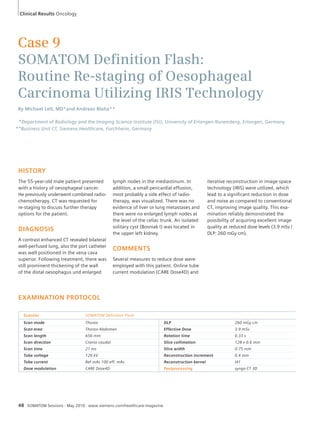
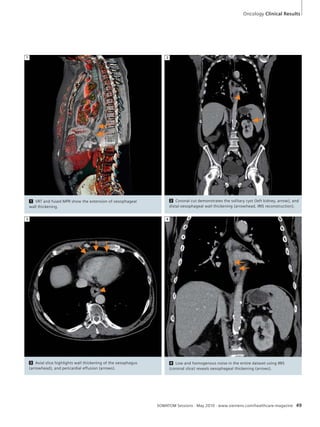
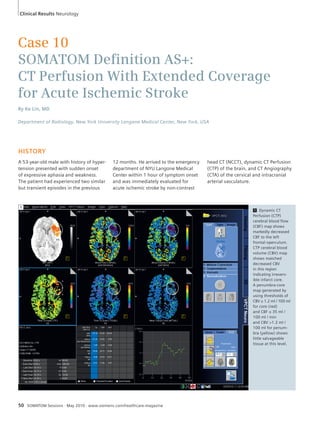
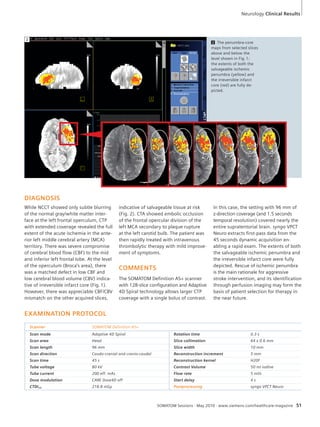
The Difference in Computed Tomography 
26 Issue Number 26/May 2010 
International Edition 
Cover Story 
The Best of Both Worlds 
in Neuro Imaging 
Page 6 
News 
Best Balance Between 
Image Quality 
and Reduced Dose 
Page 18 
Business 
More for Less in Monaco 
Page 28 
Clinical 
Results 
SOMATOM Defi nition AS+: 
CT Perfusion With 
Extended Coverage for 
Acute Ischemic Stroke 
Page 50 
Science 
CT in Pediatrics: Easier 
and Safer With the Flash 
Page 62 
26
Editorial 
2 “Our new neurological 
software combined with 
the SOMATOM Defi nition 
line of scanners repre-sents 
a quantum leap 
in speed, low dose and 
diagnostic accuracy.” 
Sami Atiya, PhD, Chief Executive Officer, 
Business Unit Computed Tomography, Siemens Healthcare, Forchheim, Germany 
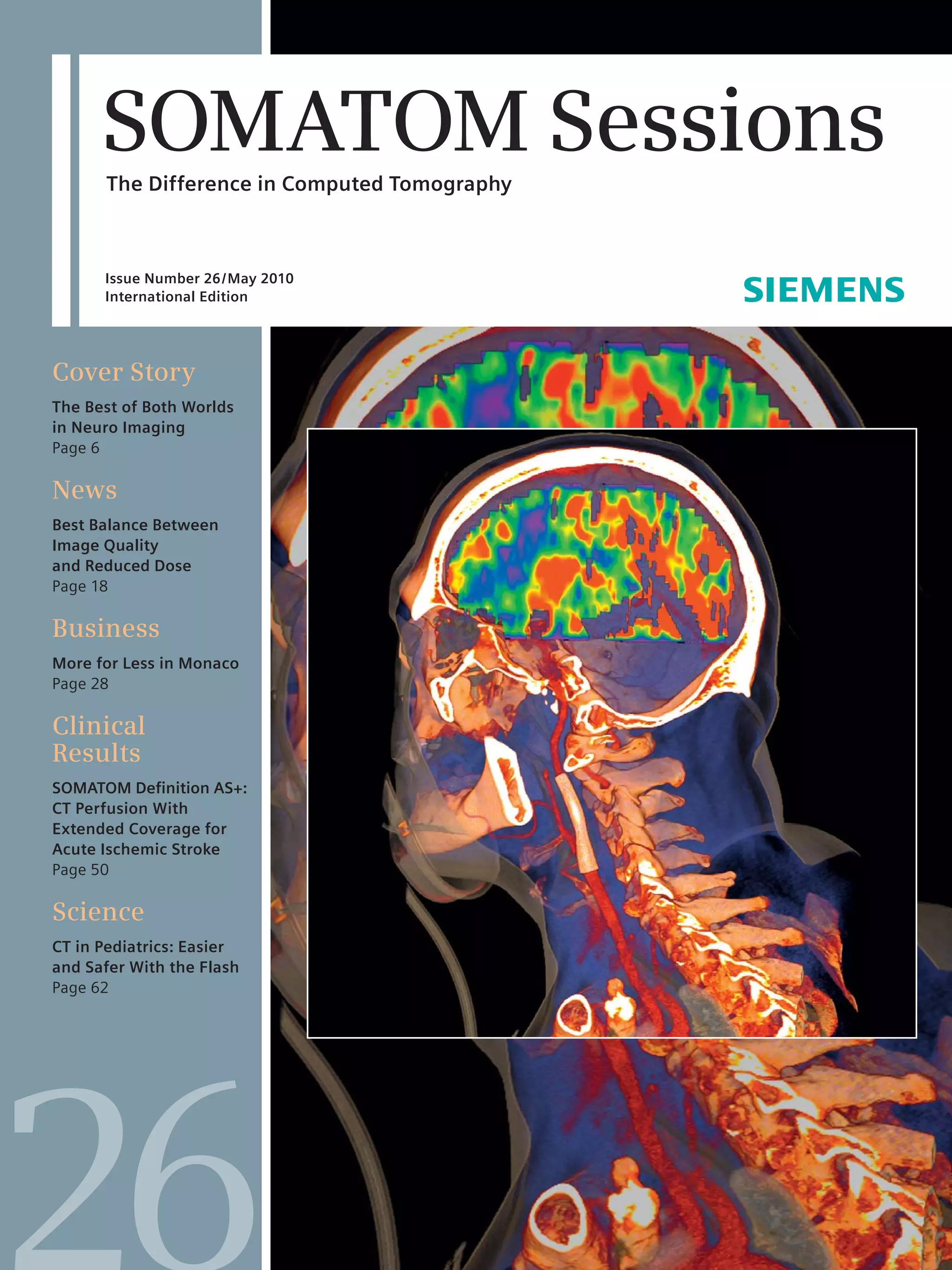
Cover Page: With Volume Perfusion CT Neuro fused with carotid CT Angiography the perfusion status of the brain tissue 
can be observed. Courtesy of University Hospital Göttingen, Germany. 
SOMATOM Sessions · May 2010 · www.siemens.com/healthcare-magazine
Editorial 
Dear Reader, 
Imagine an emergency room only a 
few short years ago: in the middle of 
the night, a 55-year-old, unconscious 
patient is wheeled in. All neurologic 
observations indicate stroke. But 
how severe? Is it an occlusion or a 
hemorrhage and where is it located? 
All crucial questions that demand fast 
answers! The physician on duty could 
request a head CT examination that 
could possibly involve two scans at 15 
to 30 mSv radiation dose. The physician 
would then begin with extensive post-processing 
– possibly using a PACS 
Workstation before the CT results could 
provide life the necessary clinical infor-mation 
required. Not a very pleasant 
alternative for the physicians or the 
patient. 
Now imagine the same situation in a 
modern emergency room equipped with 
Siemens cutting-edge technology such 
as SOMATOM Definition Flash scanner – 
that scans faster than all other CT 
scanners on the market – with latest 
neuro imaging software and syngo.via 
software that “post-process on-the-fly” 
Within minutes, the physician would 
have access to the head scan results with 
all post-processing completed at lowest 
possible dose, including non-enhanced 
CT for exclusion of hemorrhage, com-plete 
vascular status plus functional 
information. 
André Hartung, 
Vice President 
Marketing and Sales 
Business Unit CT, 
Siemens Healthcare 
With syngo.via, Siemens’ new work-place 
software, all time consuming 
pre- and post-processing steps are 
eliminated and all diagnostic infor-mation 
– including information from 
other modalities such as MR, MI and 
PET – are available in almost real time. 
Best possible image quality is pro-vided 
with sophisticated “signal boost” 
technologies or image-optimizing 
techniques resulting in definitive 
grey and white tissue differentiation 
in neuro imaging. Excellent image 
quality and fast processes are bene-ficial 
for both physicians and patients 
as they are preconditions for highest 
diagnostic accuracy and, at the same 
time, low dose safety for the patient. 
In all patient groups, including difficult 
obese and pediatric patients, as well as 
emergency room situations, safety is 
strongly linked to ALARA (As Low As 
Reasonably Achievable) radiation ex-posure. 
In the past, especially in acute 
clinical cases, lowering the radiation 
exposure when utilizing CT for diagnosis 
was not the primary focus. In stroke 
cases, “minutes equaled mind” and for 
accident victims, minutes could mean 
life or death. Today, thanks to Siemens’ 
significant leadership in bringing low 
dose CT into clinical routine, image 
quality is not necessarily tied to a slower 
diagnosis path and higher dose expo- 
sure. CT is steadily moving into the first 
line of emergency and stroke imaging 
mainly because of the wide diagnostic 
spectrum, speed and diagnostic pre-cision. 
Providing all the advantages in 
CT imaging aligned with measures to 
minimize the radiation exposure has 
always been one of Siemens key goals. 
Therefore we have recently introduced 
new technical developments like IRIS to 
reduce radiation exposure to the lowest 
level in the CT industry. In functional 
imaging, e.g. for CT brain perfusion, the 
dose can be reduced by up to 50 % with 
4D Noise Reduction, without compro-mising 
image quality. And our Adaptive 
Dose Shield completely eliminates pre-and 
post-spiral radiation that cannot be 
utilized for image reconstruction. These 
are only a few examples from dozens of 
additional large and small improvements 
developed by our dedicated employees 
to make the radiologist’s life easier and 
the patient’s healthcare better. You will 
find many of these reported in this, and 
in future editions of SOMATOM Sessions. 
Good reading, 
Sincerely 
André Hartung 
* syngo.via can be used as a standalone device or together with a variety of syngo.via based software options, 
which are medical devices in their own rights.. 
SOMATOM Sessions · May 2010 · www.siemens.com/healthcare-magazine 3
Content 
Content 
4 SOMATOM Sessions · May 2010 · www.siemens.com/healthcare-magazine 
Cover Story 
6 The Best of Both Worlds in Neuro 
Imaging 
News 
16 Affordable Performance in 16- and 
64-slice CT 
18 Best Balance Between Image Quality 
and Reduced Dose 
19 IRIS Now Extended to SOMATOM 
Definition AS 20 and SOMATOM 
Definition AS 40 
20 syngo CT 2010B Now Available: 
New Software Version for the 
SOMATOM Definition AS Launched 
20 Worldwide Dose Counter 
21 syngo.via Workstation Face-off 
Sessions 
22 syngo.via CT Speedometer 
24 International CT Image Contest – 
Highest Image Quality at 
Lowest Dose 
Cover Story 
6 Exciting advances in computed 
tomography (CT) examination 
methods, including low dose 
protocols, technical innovations 
such as whole brain CT Perfusion, 
Dual Energy or Neuro Best Contrast 
applications and groundbreaking 
radiological research have drama-tically 
changed the diagnostic 
approach for reading physicians 
by enabling new indications and 
improved timing in the examination 
of patients with acute neurological 
deseases. SOMATOM Sessions 
discussed with five experienced 
physicians how CT can routinely be 
used as the key diagnostic modality 
in neuro imaging before the start 
of appropriate treatment. 
24 
International CT Image Contest 
at Lowest Dose 
6 
The Best of Both Worlds
Content 
64 
Study Finds Atherosclerosis in 3,500 
Year old Egyptian Mummies 
SOMATOM Sessions · May 2010 · www.siemens.com/healthcare-magazine 5 
Oncology 
46 3D Guided RF Ablation and CT 
Perfusion – a New Combination for 
Monitoring of Treatment Response 
48 SOMATOM Definition Flash: 
Routine Re-staging of Oesophageal 
Carcinoma Utilizing IRIS Technology 
Neurology 
50 SOMATOM Definition AS+: CT Perfu-sion 
With Extended Coverage for 
Acute Ischemic Stroke 
52 Vasospasm After Subarachnoid 
Hemorrhage: Volume Perfusion CT 
Neuro 
Acute Care 
56 Dual Energy Scanning: Diagnosis 
of Ruptured Cocaine Capsule 
58 Progressive Kidney Hematoma 
Post-interventional Biopsy 
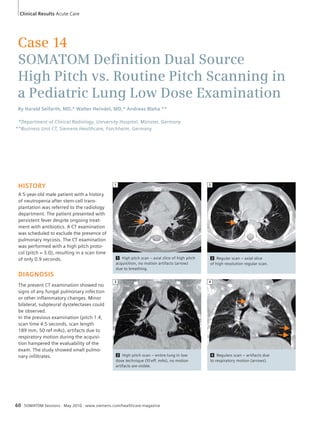
60 SOMATOM Definition Dual Source 
High Pitch vs. Routine Pitch Scanning 
in a Pediatric Lung Low Dose 
Examination 
Business 
28 More for Less in Monaco 
30 New Feature: Neuro Image Quality 
Surpasses all Expectations 
Clinical Results 
Cardio-Vascular 
32 Adenosine Myocardial Stress 
Imaging Using SOMATOM 
Definition Flash 
34 SOMATOM Definition Flash: 
Visualization of the Adamkiewicz 
Artery by IV-CTA in Dual Power Mode 
36 Dynamic Myocardial Stress Perfusion 
38 Pre-operative Exclusion of Coronary 
Artery Stenosis With Less Than 
1 mSv Dose 
40 Utilizing Ultra Low Dose of 0.05 mSv 
for Premature Baby With Congenital 
Heart Disease 
42 SOMATOM Definition Flash: Pediatric 
Patient Without Sedation and 
Breath-Holding 
44 SOMATOM Definition Flash: Dual 
Energy Coronary CT Angiography for 
Evaluation of Chest Pain After RCA 
Revascularization 
Science 
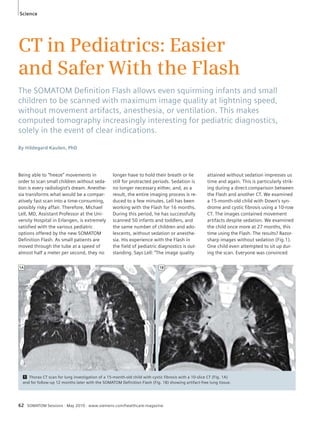
62 CT in Pediatrics: Easier and Safer 
With the Flash 
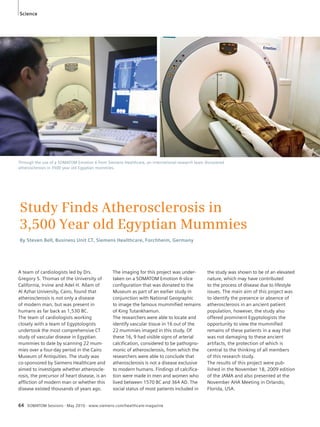
64 Study Finds Atherosclerosis in 
3,500 Year old Egyptian Mummies 
65 Independent Validation of Perfusion 
Evaluation Software 
66 Reduced Procedure Time and Radia-tion 
Dose in Interventional CT Work-flow 
68 Scientific Validation of the SOMATOM 
Definition Flash 
Life 
70 Behind the Scenes: CT Scan Protocols 
72 First syngo.via Hands-on Workshops 
at ECR 2010 
72 Upcoming Events & Congresses 
73 Training Website for Knowledge 
Improvement 
73 Free Trial Licenses for Neuro Imaging 
74 Frequently Asked Questions 
74 Dual Energy CT: Learning From the 
Experts 
75 Clinical Workshops 2010 
76 Siemens Healthcare – Customer 
Magazines 
77 Imprint 
– Highest Image Quality 
52 
Vasospasm After Subarachnoid Hemorrhage: 
Volume Perfusion CT Neuro
Coverstory 
6 SOMATOM Sessions · May 2010 · www.siemens.com/healthcare-magazine
Coverstory 
The Best of Both Worlds in 
Neuro Imaging 
Exceptional Image Quality Meets Lowest Dose 
in Neuroradiology 
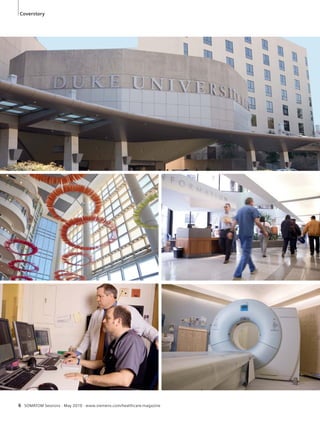
At Duke University Medical Center in Durham, North Carolina, USA and 
elsewhere, Siemens equipment is helping radiologists combine exceptional 
image quality in neuro imaging with innovative dose-reducing features 
to maximize diagnostic confi dence. 
SOMATOM Sessions · May 2010 · www.siemens.com/healthcare-magazine 7 
By Sameh Fahmy 
Exciting advances in computed tomo-graphy 
(CT) examination methods, in-cluding 
low dose protocols, technical 
innovations such as whole brain CT 
Perfusion, Neuro BestContrast or Dual 
Energy applications and groundbreaking 
radiological research have dramatically 
changed the diagnostic approach for 
reading physicians by enabling new indi-cations 
and improved timing in the ex-amination 
of patients with acute neuro-logical 
deseases. CT is routinely used as 
the key diagnostic modality in neuro 
imaging before the start of appropriate 
treatment to detect or exclude intracra-nial 
hemorrhage, either traumatic or 
non-traumatic, or to detect other causes 
of acute onset of neurological disease, 
such as stroke, intracerebral tumors, or 
hematoma. Rapid evaluation is critical 
after trauma and with symptoms such 
as weakness, headache, and dizziness, 
which is why CT is the modality of 
choice in these scenarios. 
Exceptional image quality is key to opti-mize 
diagnosis, and lower dose imaging 
helps to minimize the risk to the patient. 
It is often said that the price of improved 
image quality with CT is increased radia-tion 
dose, but Siemens has shown that 
high quality, low dose imaging is possi-ble 
in even the most challenging neuro-radiology 
applications. Whole brain CT 
Perfusion imaging with Siemens’ unique 
Adaptive 4D Spiral and the use of CT 
Angiography from the aortic arch to the 
cranium are further expanding possibili-ties, 
increasing the diagnostic confidence 
of neurologists and potentially enabling 
more appropriate treatment decisions. 
“By providing really good image quality, 
we are able to improve the efficiency of 
care,” says David S. Enterline, MD, Asso-ciate 
Professor of Radiology and Division 
Chief of Neuroradiology at Duke Uni-versity 
Medical Center in Durham, North 
Carolina, USA. “And through dose sav-ings, 
we can minimize the risk to pa-tients.” 
Neuro BestContrast 
Although newer techniques are revolu-tionizing 
stroke assessment, the gold 
standard for the initial diagnosis of 
stroke and intracranial hemorrhage is 
still non-contrast imaging of the brain. 
Siemens has always placed emphasis on 
providing the highest image quality on 
all of their scanners for this challenging 
application. Now, Siemens has taken 
image quality to the next level. Last 
year, Duke became the first hospital in 
the United States to install Siemens’ 
Neuro BestContrast, an application that 
dramatically increases gray/white matter 
differentiation in non-contrast head CT 
“Neuro BestContrast 
allows radiologists 
to better visualize 
the gray/white mat-ter 
interface to see 
subtle edema and 
signs of stroke, and 
to better delineate 
the cortical margin.” 
David S. Enterline, MD, Division Chief 
Neuroradiology, Duke University Medical 
Center in Durham, North Carolina, USA
1A 1B 1C 
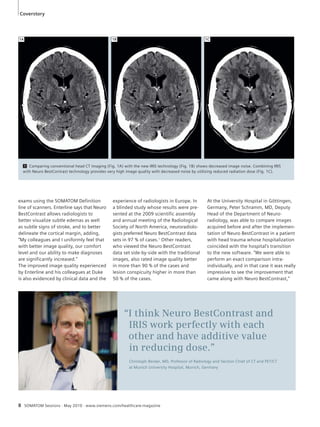
1 Comparing conventional head CT imaging (Fig. 1A) with the new IRIS technology (Fig. 1B) shows decreased image noise. Combining IRIS 
with Neuro BestContrast technology provides very high image quality with decreased noise by utilizing reduced radiation dose (Fig. 1C). 
experience of radiologists in Europe. In 
a blinded study whose results were pre-sented 
at the 2009 scientific assembly 
and annual meeting of the Radiological 
Society of North America, neuroradiolo-gists 
preferred Neuro BestContrast data 
sets in 97 % of cases.1 Other readers, 
who viewed the Neuro BestContrast 
data set side-by-side with the traditional 
images, also rated image quality better 
in more than 90 % of the cases and 
lesion conspicuity higher in more than 
50 % of the cases. 
“I think Neuro BestContrast and 
IRIS work perfectly with each 
other and have additive value 
in reducing dose.” 
Christoph Becker, MD, Professor of Radiology and Section Chief of CT and PET/CT 
at Munich University Hospital, Munich, Germany 
Coverstory 
exams using the SOMATOM Definition 
line of scanners. Enterline says that Neuro 
BestContrast allows radiologists to 
better visualize subtle edemas as well 
as subtle signs of stroke, and to better 
delineate the cortical margin, adding, 
“My colleagues and I uniformly feel that 
with better image quality, our comfort 
level and our ability to make diagnoses 
are significantly increased.” 
The improved image quality experienced 
by Enterline and his colleagues at Duke 
is also evidenced by clinical data and the 
8 SOMATOM Sessions · May 2010 · www.siemens.com/healthcare-magazine 
At the University Hospital in Göttingen, 
Germany, Peter Schramm, MD, Deputy 
Head of the Department of Neuro-radiology, 
was able to compare images 
acquired before and after the implemen-tation 
of Neuro BestContrast in a patient 
with head trauma whose hospitalization 
coincided with the hospital’s transition 
to the new software. “We were able to 
perform an exact comparison intra-individually, 
and in that case it was really 
impressive to see the improvement that 
came along with Neuro BestContrast,”
Coverstory 
Iterative Reconstruction in Image Space (IRIS) 
Image data 
recon 
Master 
recon 
Compare 
Strong artifact and dose reduction 
Well-established image impression 
Fast reconstruction in image space 
SOMATOM Sessions · May 2010 · www.siemens.com/healthcare-magazine 9 
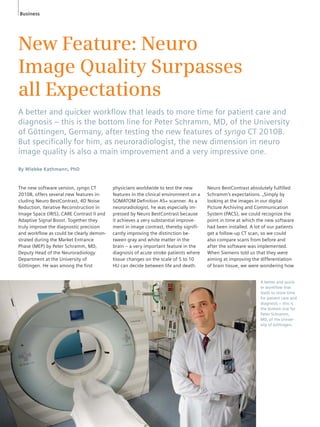
Schramm says. “The delineation of the 
edema and the margins of the edema 
were definitely better visualized using 
Neuro BestContrast, and the same ap-plies 
to the changes that occur in acute 
stroke.” 
Neuro BestContrast improves non-con-trast 
head images by taking advantage 
of the fact that clinically important infor-mation 
from CT scans is contained in me-dium 
and low frequencies, while high fre-quencies 
are dominated by image noise. 
The software processes high-frequency 
data differently than the low-to-medium 
frequency data, resulting in improved 
tissue contrast without the amplification 
of image noise. 
Enterline says the use of Neuro BestCon-trast 
has the potential to reduce radiation 
dose as well. His preliminary data has 
documented a 15 to 20 % improvement 
in gray/white matter differentiation that 
can allow for image acquisition at a lower 
dose than is currently used. “Our institu-tion 
has traditionally fought for lower 
dose,” he says, “and I think this will now 
allow us to further reduce our dose.” 
IRIS 
Neuro BestContrast can be combined 
with another new Siemens technology 
known as Iterative Reconstruction in 
Image Space (IRIS) to reduce dose and 
improve image quality even further. 
“I think they work perfectly with each 
other and have additive value,” says 
Christoph Becker, MD, Professor of Radi-ology 
and Section Chief of Computed 
Tomography and PET/CT at Ludwig-Maxi-milians- 
University in Munich, Germany. 
Iterative reconstruction uses a correction 
loop to improve image quality in several 
steps, or iterations. The idea was first 
introduced in the 1970s, but the com-puting 
power and time required for the 
reconstruction made it impractical for 
use in clinical settings. An alternative 
known as statistical image reconstruction 
reduced the time associated with itera-tive 
reconstruction but produced a tex-ture 
that radiologists found unaccept-able. 
With IRIS, Siemens took a different 
approach. The algorithm takes all of the 
data, which contains fine details as well 
as significant amounts of noise, com-of 
dense structures such as bone and 
calcium, making it easier to visualize 
or rule out subarachnoid hemorrhage. 
Preliminary data from Becker show that 
IRIS reduces dose by 25 % in head CT 
exams yet achieves the same level of 
noise as filtered back projection, the tra-ditional 
method for image reconstruc-tion. 
Becker notes that clinicians can 
also choose to use the same dose as fil-tered 
back projection yet deliver signifi-cantly 
better image quality using IRIS. 
In the United States, Ridgeview Medical 
Slow Raw Data Space Fast Image Data Space 
bines it in a master image and cleans it 
up in the fast-processing image space 
rather than in the slow-processing raw 
data area. The result is that high spatial 
resolution is preserved and noise is re-duced 
– without disrupting workflow. 
Becker says the combination of Neuro 
BestContrast and IRIS, which is available 
on the SOMATOM Definition line of 
scanners, allows him and his colleagues 
to better differentiate the basal ganglia 
and to see subtle signs of stroke. He 
adds that IRIS also reduces the blooming 
Image 
correction 
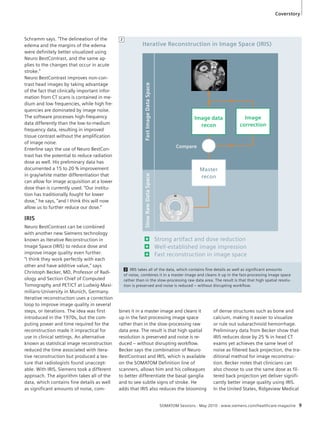
2 IRIS takes all of the data, which contains fine details as well as significant amounts 
of noise, combines it in a master image and cleans it up in the fast-processing image space 
rather than in the slow-processing raw data area. The result is that that high spatial resolu-tion 
is preserved and noise is reduced – without disrupting workflow. 
2
“With the improve-ment 
in radiation 
dose using IRIS, 
the image quality 
is not changed, so 
we just switched 
right over to it.” 
David Gross, MD, Chief of Radiology 
Ridgeview Medical Center, Waconia, 
Minnesota, USA 
Coverstory 
Center in Waconia, Minnesota, USA in-stalled 
IRIS on its SOMATOM Definition 
AS 40-slice CT and its Definition AS+ 
128-slice scanner early in 2010. Chief 
of Radiology, David Gross, MD, directly 
compared images produced using IRIS 
with traditional filtered back projection 
images and then enthusiastically adopt-ed 
IRIS. “After two or three days, we 
decided that there’s no sense in even 
comparing anymore,” Gross says. “With 
the improvement in radiation dose, the 
image quality is not changed, so we 
just switched right over to it.” 
Neuro BestContrast and IRIS build upon 
other Siemens innovations in neuro 
imaging that maximize diagnostic confi-dence. 
The “Posterior Fossa Optimization” 
algorithm, which was introduced in 2001 
and is implemented in all SOMATOM 
Sensation and Definition scanners, 
significantly reduces streaks and dark 
bands, known as Hounsfield Bars, to 
allow for better resolution with less 
artifact. Siemens’ z-Sharp Technology 
provides routine isotropic resolution of 
0.33 mm, one of the industry’s highest, 
enabling the visualization of small 
anatomical details such as fine vascular 
structures. For ultra-high-resolution bone 
imaging for inner ear structures, Siemens’ 
z-UHR Technology provides 0.24 isotro-pic 
resolution. 
Perfusion CT and CTA 
While non-contrast head CT exams are 
still important for excluding intracranial 
hemorrhage and ischemic stroke mimics, 
the use of perfusion CT imaging is in-creasingly 
being adopted. “Dynamic CT 
Perfusion imaging, which can be acquired 
immediately after the non-contrast head 
“Dynamic CT Perfusion imaging, which can 
be acquired immediately after the non-contrast 
head CT while the patient is still in 
the scanner, allows improved detection of 
acute stroke, which has been substantiated 
in several studies.”2, 4 
Ke Lin, MD, Assistant Professor of Radiology, Department of Radiology, New York University 
Langone Medical Center, New York, USA 
10 SOMATOM Sessions · May 2010 · www.siemens.com/healthcare-magazine 
CT while the patient is still in the scanner, 
allows improved detection of acute 
stroke, which has been substantiated in 
several studies,” says Ke Lin, MD, Assis-tant 
Professor of Radiology at New York 
University Langone Medical Center in 
New York City, USA. In a study of 100 
patients presenting to the emergency 
department within three hours of stroke 
onset, Lin and his colleagues found that 
CT Perfusion provided significantly im-proved 
sensitivity and accuracy in acute 
stroke detection over non-contrast CT. 
Specifically, the researchers found that 
CT Perfusion revealed 64.6% of acute 
infarctions compared to 26.2 % for non-contrast 
CT. CT Perfusion also had an ac-curacy 
of 76 % compared to an accuracy 
of 52 % for non-contrast CT.2 
Lin and his colleagues obtained CT Per-fusion 
data from a z-direction coverage 
of 24 mm centered at the mid-basal 
ganglia which maximizes the visualiza-tion 
of the middle cerebral artery terri-tory. 
Still, the researchers noted that 
they missed ten infarcts that were out-side 
of this volume of coverage. The ad-vent 
of whole brain CT Perfusion using 
Siemens’ unique Adaptive 4D Spiral, how-ever, 
further increases the value of CT 
Perfusion by expanding the scan range. 
The revolutionary scan mode, which is 
available on the SOMATOM Definition 
line of scanners, overcomes the limita-tions 
of a static detector design by ap-plying 
a continuously repeated bi-direc-tional 
table movement that smoothly
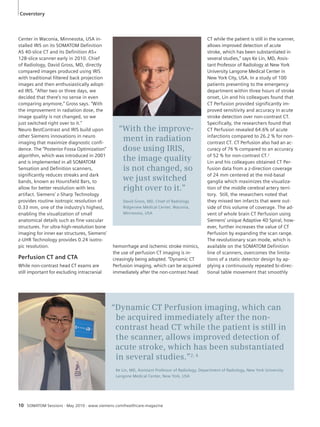
3 Perfusion CT 
imaging is in-creasingly 
be-ing 
adopted in 
daily routine. 
This function 
overcomes the 
limitations of a 
static detector 
design, which 
provides full 
brain coverage, 
and the poten-tial 
for improve-ment 
in diag-nostic 
accuracy 
for acute stroke. 
SOMATOM Sessions · May 2010 · www.siemens.com/healthcare-magazine 11 
3 
Coverstory 
a smooth, fast, and user-friendly work-flow. 
A number of steps are automated, 
including motion correction, bone seg-mentation, 
arterial input function deter-mination, 
and vascular pixel elimination. 
The software allows for simultaneous 
visualization of functional parametric 
maps of cerebral blood flow, cerebral 
blood volume, time to peak, mean tran-sit 
time and other clinically important 
information. With the click of a button, 
clinicians can toggle between axial, 
sagittal and coronal reformations. 
Lin and his colleagues acquire the CT 
Perfusion data for the whole brain in 
just 45 seconds. Next, CT Angiography 
data from the aortic arch through the 
whole brain, a scan range of typically 
more than 30 cm, is acquired in a couple 
of seconds to deliver valuable infor-mation 
about the feeding vessels that 
are not covered by the initial perfusion 
scan. Post-processing takes an additional 
three to five minutes. In total, when 
time for interpretation is accounted for, 
the use of CT Perfusion and CT Angio-moves 
the patient in and out of the 
gantry over the desired scan range. Lin 
has recently switched to a SOMATOM 
Definition AS+ Scanner with all the 
advantages of full brain coverage. “With 
the increased coverage, we now expect 
further improvement in acute stroke 
detection accuracy, as well as the full 
delineation of the ischemic penumbra 
and the infarct core,” Lin says. 
The stroke imaging workflow at NYU 
Langone Medical Center also includes 
a CT Angiography immediately following 
the CT Perfusion exam to evaluate clot 
location, clot burden, and collateral re-cruitment. 
Lin adds that the information 
is also used for planning interventional 
procedures such as mechanical throm-bectomy. 
Lin says the fast image acquisition of 
the SOMATOM Definition AS+ 128-slice 
scanner, combined with the rapid post-processing 
of the Siemens syngo Volume 
Perfusion CT Neuro software, allows 
reading physicians to arrive quickly at an 
appropriate treatment decision through 
graphy adds approximately 10 minutes 
to the acute stroke workflow. “That’s not 
a lot of time considering that the addi-tional 
information provided by the CT 
Perfusion and the CT Angiography may 
have very important implications for the 
patient’s treatment and management,” 
Lin says. 
Reducing Dose in CT Perfusion 
Lin recognizes that, while the use of CT 
Perfusion is moving from academic 
medical centers to community hospitals, 
some barriers to its widespread adoption 
remain. Chief among them is a concern 
about the radiation dose associated with 
the acquisition of CT Perfusion and CT 
Angiography data. The use of Siemens 
4D Noise Reduction, however, can re-duce 
the radiation noise of dynamic CT 
Perfusion. The reconstruction technique 
treats the static anatomical information 
differently from the dynamically chang-ing 
perfusion information that results 
from the in and outflow of the contrast 
agent. By sampling multiple passes over
Coverstory 
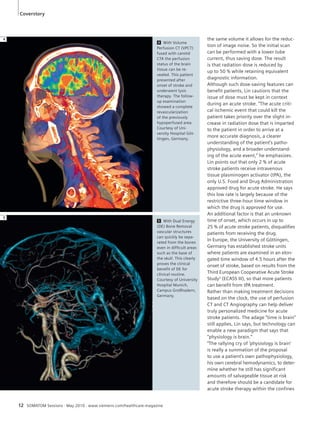
4 With Volume 
Perfusion CT (VPCT) 
fused with carotid 
CTA the perfusion 
status of the brain 
tissue can be re-vealed. 
12 SOMATOM Sessions · May 2010 · www.siemens.com/healthcare-magazine 
This patient 
presented after 
onset of stroke and 
underwent lysis 
therapy. The follow-up 
examination 
showed a complete 
revascularization 
of the previously 
hypoperfused area. 
Courtesy of Uni-versity 
Hospital Göt-tingen, 
Germany. 
the same volume it allows for the reduc-tion 
of image noise. So the initial scan 
can be performed with a lower tube 
current, thus saving dose. The result 
is that radiation dose is reduced by 
up to 50 % while retaining equivalent 
diagnostic information. 
Although such dose-saving features can 
benefit patients, Lin cautions that the 
issue of dose must be kept in context 
during an acute stroke. “The acute criti-cal 
ischemic event that could kill the 
patient takes priority over the slight in-crease 
in radiation dose that is imparted 
to the patient in order to arrive at a 
more accurate diagnosis, a clearer 
understanding of the patient’s patho-physiology, 
and a broader understand-ing 
of the acute event,” he emphasizes. 
Lin points out that only 2 % of acute 
stroke patients receive intravenous 
tissue plasminogen activator (tPA), the 
only U.S. Food and Drug Administration 
approved drug for acute stroke. He says 
this low rate is largely because of the 
restrictive three-hour time window in 
which the drug is approved for use. 
An additional factor is that an unknown 
time of onset, which occurs in up to 
25 % of acute stroke patients, disqualifies 
patients from receiving the drug. 
In Europe, the University of Göttingen, 
Germany has established stroke units 
where patients are examined in an elon-gated 
time window of 4.5 hours after the 
onset of stroke, based on results from the 
Third European Cooperative Acute Stroke 
Study3 (ECASS III), so that more patients 
can benefit from tPA treatment. 
Rather than making treatment decisions 
based on the clock, the use of perfusion 
CT and CT Angiography can help deliver 
truly personalized medicine for acute 
stroke patients. The adage “time is brain” 
still applies, Lin says, but technology can 
enable a new paradigm that says that 
“physiology is brain.” 
“The rallying cry of ‘physiology is brain’ 
is really a summation of the proposal 
to use a patient’s own pathophysiology, 
his own cerebral hemodynamics, to deter-mine 
whether he still has significant 
amounts of salvageable tissue at risk 
and therefore should be a candidate for 
acute stroke therapy within the confines 
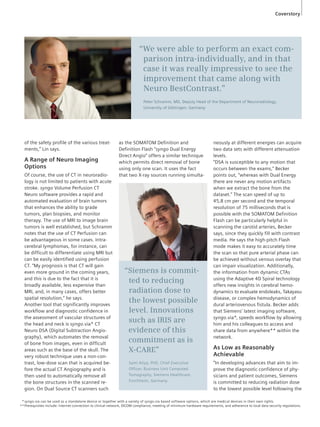
5 With Dual Energy 
(DE) Bone Removal 
vascular structures 
can quickly be sepa-rated 
from the bones 
even in difficult areas 
such as the base of 
the skull. This clearly 
proves the clinical 
benefit of DE for 
clinical routine. 
Courtesy of University 
Hospital Munich, 
Campus Großhadern, 
Germany. 
4 
5
Coverstory 
“We were able to perform an exact com-parison 
intra-individually, and in that 
case it was really impressive to see the 
improvement that came along with 
Neuro BestContrast.” 
Peter Schramm, MD, Deputy Head of the Department of Neuroradiology, 
University of Göttingen, Germany 
of the safety profile of the various treat-ments,” 
Lin says. 
A Range of Neuro Imaging 
Options 
Of course, the use of CT in neuroradio-logy 
is not limited to patients with acute 
stroke. syngo Volume Perfusion CT 
Neuro software provides a rapid and 
automated evaluation of brain tumors 
that enhances the ability to grade 
tumors, plan biopsies, and monitor 
therapy. The use of MRI to image brain 
tumors is well established, but Schramm 
notes that the use of CT Perfusion can 
be advantageous in some cases. Intra-cerebral 
lymphomas, for instance, can 
be difficult to differentiate using MRI but 
can be easily identified using perfusion 
CT. “My prognosis is that CT will gain 
even more ground in the coming years, 
and this is due to the fact that it is 
broadly available, less expensive than 
MRI, and, in many cases, offers better 
spatial resolution,” he says. 
Another tool that significantly improves 
workflow and diagnostic confidence in 
the assessment of vascular structures of 
the head and neck is syngo.via* CT 
Neuro DSA (Digital Subtraction Angio-graphy), 
which automates the removal 
of bone from images, even in difficult 
areas such as the base of the skull. The 
very robust technique uses a non-con-trast, 
low-dose scan that is acquired be-fore 
the actual CT Angiography and is 
then used to automatically remove all 
the bone structures in the scanned re-gion. 
On Dual Source CT scanners such 
as the SOMATOM Definition and 
Definition Flash “syngo Dual Energy 
Direct Angio” offers a similar technique 
which permits direct removal of bone 
using only one scan. It uses the fact 
that two X-ray sources running simulta-neously 
at different energies can acquire 
two data sets with different attenuation 
levels. 
“DSA is susceptible to any motion that 
occurs between the exams,” Becker 
points out, “whereas with Dual Energy 
there are never any motion artifacts 
when we extract the bone from the 
dataset.” The scan speed of up to 
45,8 cm per second and the temporal 
resolution of 75 milliseconds that is 
possible with the SOMATOM Definition 
Flash can be particularly helpful in 
scanning the carotid arteries, Becker 
says, since they quickly fill with contrast 
media. He says the high-pitch Flash 
mode makes it easy to accurately time 
the scan so that pure arterial phase can 
be achieved without venous overlay that 
can impair visualization. Additionally, 
the information from dynamic CTAs 
using the Adaptive 4D Spiral technology 
offers new insights in cerebral hemo-dynamics 
to evaluate endoleaks, Takayasu 
disease, or complex hemodynamics of 
dural arteriovenous fistula. Becker adds 
that Siemens’ latest imaging software, 
syngo.via*, speeds workflow by allowing 
him and his colleagues to access and 
share data from anywhere** within the 
network. 
As Low as Reasonably 
Achievable 
“In developing advances that aim to im-prove 
the diagnostic confidence of phy-sicians 
and patient outcomes, Siemens 
is committed to reducing radiation dose 
to the lowest possible level following the 
“Siemens is commit-ted 
to reducing 
radiation dose to 
the lowest possible 
level. Innovations 
such as IRIS are 
evidence of this 
commitment as is 
X-CARE” 
Sami Atiya, PhD, Chief Executive 
Officer, Business Unit Computed 
Tomography, Siemens Healthcare, 
Forchheim, Germany. 
syngo.via can be used as a standalone device or together with a variety of syngo.via based software options, which are medical devices in their own rights. 
Prerequisites include: internet connection to clinical network, DICOM compliance, meeting of minimum hardware requirements, and adherence to local data security regulations. 
* 
**
Coverstory 
6A 6B 
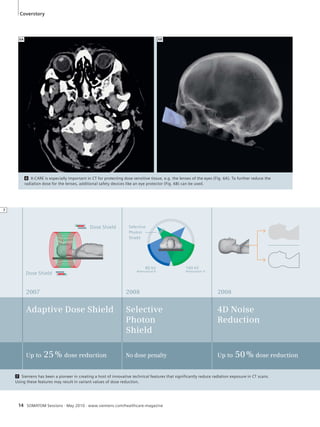
6 X-CARE is especially important in CT for protecting dose sensitive tissue, e.g. the lenses of the eyes (Fig. 6A). To further reduce the 
radiation dose for the lenses, additional safety devices like an eye protector (Fig. 6B) can be used. 
2008 
4D N oise 
Reduction 
Up to 50 % dose reduction 
2007 
Adaptive Dose Shield 
Up to 25 % dose reduction 
Selective 
Photon 
Shield 
2008 
Selective 
Photon 
Shield 
No dose penalty 
140 kV 
Attenuation A 
80 kV 
Attenuation B 
Dose Shield 
Dose Shield 
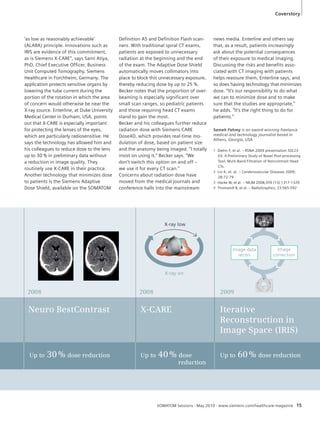
7 Siemens has been a pioneer in creating a host of innovative technical features that significantly reduce radiation exposure in CT scans. 
Using these features may result in variant values of dose reduction. 
14 SOMATOM Sessions · May 2010 · www.siemens.com/healthcare-magazine 
7
1 Diehn F, et al. – RSNA 2009 presentation SSE23- 
03: A Preliminary Study of Novel Post-processing 
Tool: Multi-Band Filtration of Noncontrast Head 
CTs. 
2 Lin K, et. al. – Cerebrovascular Diseases 2009; 
2009 
Coverstory 
Iterative 
Reconstruction in 
Image Space (IRIS) 
Up to 60 % dose reduction 
X- ARE 
Up t 40 % dose 
SOMATOM Sessions · May 2010 · www.siemens.com/healthcare-magazine 15 
2008 
Neuro BestContrast 
Up to 30 % dose reduction 
C 
o 
reduction 
2008 
X-ray low 
X-ray on 
Image data 
recon 
Image 
correction 
28:72-79 
3 Hacke W, et al. – NEJM 2008;359 (13) 1317-1329 
4 Thomandl B, et al. – RadioGraphics, 23:565-592 
‘as low as reasonably achievable’ 
(ALARA) principle. Innovations such as 
IRIS are evidence of this commitment, 
as is Siemens X-CARE”, says Sami Atiya, 
PhD, Chief Executive Officer, Business 
Unit Computed Tomography, Siemens 
Healthcare in Forchheim, Germany. The 
application protects sensitive organs by 
lowering the tube current during the 
portion of the rotation in which the area 
of concern would otherwise be near the 
X-ray source. Enterline, at Duke University 
Medical Center in Durham, USA, points 
out that X-CARE is especially important 
for protecting the lenses of the eyes, 
which are particularly radiosensitive. He 
says the technology has allowed him and 
his colleagues to reduce dose to the lens 
up to 30 % in preliminary data without 
a reduction in image quality. They 
routinely use X-CARE in their practice. 
Another technology that minimizes dose 
to patients is the Siemens Adaptive 
Dose Shield, available on the SOMATOM 
Definition AS and Definition Flash scan-ners. 
With traditional spiral CT exams, 
patients are exposed to unnecessary 
radiation at the beginning and the end 
of the exam. The Adaptive Dose Shield 
automatically moves collimators into 
place to block this unnecessary exposure, 
thereby reducing dose by up to 25 %. 
Becker notes that the proportion of over-beaming 
is especially significant over 
small scan ranges, so pediatric patients 
and those requiring head CT exams 
stand to gain the most. 
Becker and his colleagues further reduce 
radiation dose with Siemens CARE 
Dose4D, which provides real-time mo-dulation 
of dose, based on patient size 
and the anatomy being imaged. “I totally 
insist on using it,” Becker says. “We 
don’t switch this option on and off – 
we use it for every CT scan.” 
Concerns about radiation dose have 
moved from the medical journals and 
conference halls into the mainstream 
news media. Enterline and others say 
that, as a result, patients increasingly 
ask about the potential consequences 
of their exposure to medical imaging. 
Discussing the risks and benefits asso-ciated 
with CT imaging with patients 
helps reassure them, Enterline says, and 
so does having technology that minimizes 
dose. “It’s our responsibility to do what 
we can to minimize dose and to make 
sure that the studies are appropriate,” 
he adds. “It’s the right thing to do for 
patients.” 
Sameh Fahmy is an award-winning freelance 
medical and technology journalist based in 
Athens, Georgia, USA
News 
Affordable Performance 
in 16- and 64-slice CT 
At the European Congress of Radiology in March 2010, Siemens 
introduced new 16- and 64-slice systems to the market: The SOMATOM 
Emotion Excel Edition and the SOMATOM Defi nition AS Excel Edition. 
By Jan Freund, Steven Bell and Rami Kusama, Business Unit CT, Siemens Healthcare, Forchheim, Germany 
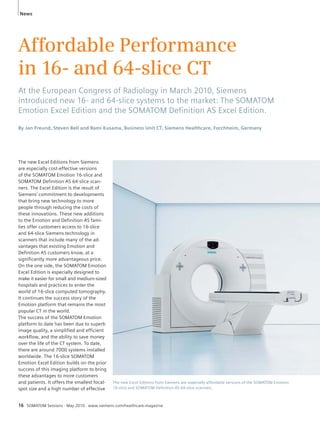
The new Excel Editions from Siemens 
are especially cost-effective versions 
of the SOMATOM Emotion 16-slice and 
SOMATOM Definition AS 64-slice scan-ners. 
The Excel Edition is the result of 
Siemens’ commitment to developments 
that bring new technology to more 
people through reducing the costs of 
these innovations. These new additions 
to the Emotion and Definition AS fami-lies 
offer customers access to 16-slice 
and 64-slice Siemens technology in 
scanners that include many of the ad-vantages 
that existing Emotion and 
Definition AS customers know, at a 
significantly more advantageous price. 
On the one side, the SOMATOM Emotion 
Excel Edition is especially designed to 
make it easier for small and medium-sized 
hospitals and practices to enter the 
world of 16-slice computed tomography. 
It continues the success story of the 
Emotion platform that remains the most 
popular CT in the world. 
The success of the SOMATOM Emotion 
platform to date has been due to superb 
image quality, a simplified and efficient 
workflow, and the ability to save money 
over the life of the CT system. To date, 
there are around 7000 systems installed 
worldwide. The 16-slice SOMATOM 
Emotion Excel Edition builds on the prior 
success of this imaging platform to bring 
these advantages to more customers 
and patients. It offers the smallest focal-spot 
size and a high number of effective 
The new Excel Editions from Siemens are especially affordable versions of the SOMATOM Emotion 
16-slice and SOMATOM Definition AS 64-slice scanners. 
16 SOMATOM Sessions · May 2010 · www.siemens.com/healthcare-magazine
News 
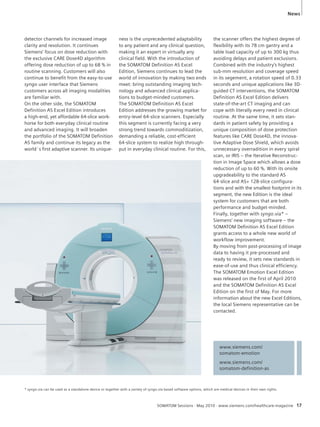
www.siemens.com/ 
somatom-emotion 
www.siemens.com/ 
somatom-definition-as 
SOMATOM Sessions · May 2010 · www.siemens.com/healthcare-magazine 17 
detector channels for increased image 
clarity and resolution. It continues 
Siemens’ focus on dose reduction with 
the exclusive CARE Dose4D algorithm 
offering dose reduction of up to 68 % in 
routine scanning. Customers will also 
continue to benefit from the easy-to-use 
syngo user interface that Siemens 
customers across all imaging modalities 
are familiar with. 
On the other side, the SOMATOM 
Definition AS Excel Edition introduces 
a high-end, yet affordable 64-slice work-horse 
for both everyday clinical routine 
and advanced imaging. It will broaden 
the portfolio of the SOMATOM Definition 
AS family and continue its legacy as the 
world´s first adaptive scanner. Its unique-ness 
is the unprecedented adaptability 
to any patient and any clinical question, 
making it an expert in virtually any 
clinical field. With the introduction of 
the SOMATOM Definition AS Excel 
Edition, Siemens continues to lead the 
world of innovation by making two ends 
meet: bring outstanding imaging tech-nology 
and advanced clinical applica-tions 
to budget-minded customers. 
The SOMATOM Definition AS Excel 
Edition addresses the growing market for 
entry-level 64-slice scanners. Especially 
this segment is currently facing a very 
strong trend towards commoditization, 
demanding a reliable, cost-efficient 
64-slice system to realize high through-put 
in everyday clinical routine. For this, 
the scanner offers the highest degree of 
flexibility with its 78 cm gantry and a 
table load capacity of up to 300 kg thus 
avoiding delays and patient exclusions. 
Combined with the industry’s highest 
sub-mm resolution and coverage speed 
in its segement, a rotation speed of 0.33 
seconds and unique applications like 3D-guided 
CT interventions, the SOMATOM 
Definition AS Excel Edition delivers 
state-of-the-art CT imaging and can 
cope with literally every need in clinical 
routine. At the same time, it sets stan-dards 
in patient safety by providing a 
unique composition of dose protection 
features like CARE Dose4D, the innova-tive 
Adaptive Dose Shield, which avoids 
unnecessary overradition in every spiral 
scan, or IRIS – the Iterative Reconstruc-tion 
in Image Space which allows a dose 
reduction of up to 60 %. With its onsite 
upgradeability to the standard AS 
64-slice and AS+ 128-slice configura-tions 
and with the smallest footprint in its 
segment, the new Edition is the ideal 
system for customers that are both 
performance and budget-minded. 
Finally, together with syngo.via* – 
Siemens’ new imaging software – the 
SOMATOM Definition AS Excel Edition 
grants access to a whole new world of 
workflow improvement. 
By moving from post-processing of image 
data to having it pre-processed and 
ready to review, it sets new standards in 
ease-of-use and thus clinical efficiency. 
The SOMATOM Emotion Excel Edition 
was released on the first of April 2010 
and the SOMATOM Definition AS Excel 
Edition on the first of May. For more 
information about the new Excel Editions, 
the local Siemens representative can be 
contacted. 
* syngo.via can be used as a standalone device or together with a variety of syngo.via based software options, which are medical devices in their own rights.
News 
Best Balance Between 
Image Quality 
and Reduced Dose 
Iterative Reconstruction in Image 
Space (IRIS) provides individual choices 
and benefi ts for all patients. 
By Annette Tuffs, MD 
It is a difficult choice for physicians 
to decide what benefits the patient most, 
the highest resolution with best image 
quality and diagnostic confidence – 
or the lowest radiation level to reduce 
the long-term risks for their patients. 
Modern CT technology like IRIS cannot 
entirely overcome this dilemma, of 
course, but it provides flexible solutions 
that allow choices for the individual 
patient according to age, condition, 
suspected pathology and the specific CT 
investigation being performed, thereby 
permitting the reading physician to 
carefully weigh the benefits of highest 
possible resolution against the advan-tages 
of minimized radiation exposure. 
IRIS – A Success Story 
The peak of these impressive develop-ments 
is IRIS, which stands for Iterative 
Reconstruction in Image Space. It had 
its debut at the 2009 RSNA meeting in 
Chicago and has proven to be another 
Siemens success story in substantially 
reducing radiation dose. It is based upon 
“iterative reconstruction,” a method first 
developed in the 1970s to reduce noise 
in CT images. 
Iterative reconstruction includes a “cor-rection 
loop,” in which images are repeat-edly 
calculated by assumptions. The 
image becomes softer in homogenous 
tissue regions while, at the same time, 
high-contrast tissue boundaries are main-tained. 
Image resolution and image noise 
are no longer closely inter-dependant. 
However, this process required a lot of 
time and enormous computing capacity 
and therefore – before IRIS – was not 
feasible for use in clinical routine. Now, 
Siemens engineers and scientists have 
optimized the process and developed 
IRIS, where time and computing capacity 
are no longer an issue. 
“We are enthusiastic about this innova-tive 
method in CT scanning, that´s why 
we use it in our greatly improved daily 
routine,” says Professor Joseph Schoepf, 
MD, whose Department of Radiology at 
the Medical University of South Carolina, 
Charleston, USA, was one of the first 
to gain clinical experience with IRIS. 
His department has been using IRIS on 
a routine basis since autumn 2009 for 
about 15 patients per day. 
All Patients Benefi t 
Several university hospitals, in Germany 
and abroad, have already been able to 
gather extensive clinical experience with 
IRIS. One of them is the University 
Hospital, Erlangen in Germany, where 
Michael Lell, MD, Senior Physician at the 
Radiology Institute, has been involved in 
studies concerning the potential of IRIS 
in reducing radiation dosage. In one of his 
studies, that he will submit for publica-tion 
in the next months, more than 70 
patients have been evaluated with and 
without IRIS. The radiologists in Erlangen 
were looking specifically at the abdo-men. 
“As a preliminary result, we can say 
that we were able to achieve a 50 % 
dosage reduction while maintaining 
high standards of image quality,” Lell 
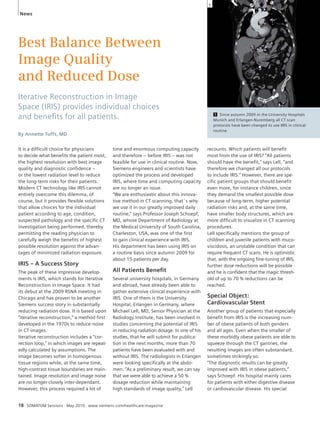
1 Since autumn 2009 in the University Hospitals 
Munich and Erlangen-Nuremberg all CT scan 
protocols have been changed to use IRIS in clinical 
routine. 
recounts. Which patients will benefit 
most from the use of IRIS? “All patients 
should have the benefit,” says Lell, “and 
therefore we changed all our protocols 
to include IRIS.” However, there are spe-cific 
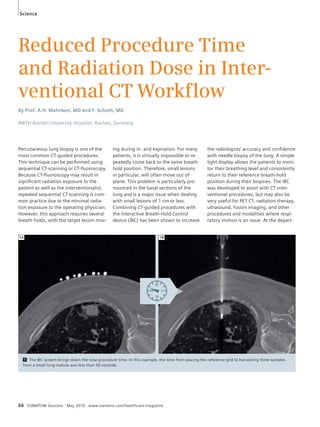
patient groups that should benefit 
even more, for instance children, since 
they demand the smallest possible dose 
because of long-term, higher potential 
radiation risks and, at the same time, 
have smaller body structures, which are 
more difficult to visualize in CT scanning 
procedures. 
Lell specifically mentions the group of 
children and juvenile patients with muco-viscidosis, 
an unstable condition that can 
require frequent CT scans. He is optimistic 
that, with the ongoing fine-tuning of IRIS, 
further dose reductions will be possible 
and he is confident that the magic thresh-old 
of up to 70 % reductions can be 
reached. 
Special Object: 
Cardiovascular Stent 
Another group of patients that especially 
benefit from IRIS is the increasing num-ber 
of obese patients of both genders 
and all ages. Even when the smaller of 
these morbidly obese patients are able to 
squeeze through the CT gantries, the 
resulting images are often substandard, 
sometimes strikingly so. 
“The diagnostic results can be greatly 
improved with IRIS in obese patients,” 
says Schoepf. His hospital mainly cares 
for patients with either digestive disease 
or cardiovascular disease. His special 
18 SOMATOM Sessions · May 2010 · www.siemens.com/healthcare-magazine 
1
News 
IRIS Now Extended to SOMATOM Defi nition AS 20 
and SOMATOM Defi nition AS 40 
By Rami Kusama, Business Unit CT, Siemens Healthcare, Forchheim, Germany 
Because at Siemens dose reduction has 
continued to be given top priority, assur-ing 
both patients and medical personnel 
the best in medical care with the least 
possible risk, the availiability of IRIS with 
the SOMATOM Definition, SOMATOM 
Definition Flash, and SOMATOM 
Definition AS+ and AS 64, will be ex-tended 
to the SOMATOM Definition AS 
40, as well as AS 20. Now all scanners 
from the SOMATOM Definition family* 
will benefit from excellent diagnostic 
image quality with levels of dose lower 
than ever before. With IRIS, Siemens’ 
smart approach to iterative reconstruc-tion, 
up to 60% additional dose reduction 
can be achieved in a wide range of daily 
routine CT applications. 
Dose reduction with CT has been limited 
by the currently used filtered back projec-tion 
reconstruction algorithm. When 
using this conventional reconstruction of 
acquired raw data, a trade-off between 
spatial resolution and image noise has to 
be considered. Higher spatial resolution 
increases the ability to see the smallest 
detail; however, it is directly correlated 
with increased image noise. 
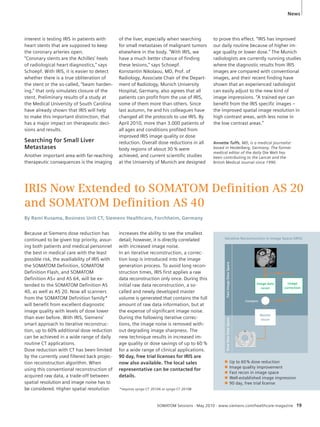
In an iterative reconstruction, a correc-tion 
loop is introduced into the image 
generation process. To avoid long recon-struction 
times, IRIS first applies a raw 
data reconstruction only once. During this 
initial raw data reconstruction, a so-called 
and newly developed master 
volume is generated that contains the full 
amount of raw data information, but at 
the expense of significant image noise. 
During the following iterative correc-tions, 
the image noise is removed with-out 
degrading image sharpness. The 
new technique results in increased im-age 
quality or dose savings of up to 60 % 
for a wide range of clinical applications. 
90 day, free trial licenses for IRIS are 
now also available. The local sales 
representative can be contacted for 
details. 
*requires syngo CT 2010A or syngo CT 2010B 
Iterative Reconstuction in Image Space (IRIS) 
Slow Raw Data Space Fast Image Data Space 
Image data 
recon 
Master 
recon 
Compare 
Image 
correction 
Q Up to 60 % dose reduction 
Q Image quality improvement 
Q Fast recon in image space 
Q Well-established image impression 
Q 90 day, free trial license 
interest is testing IRIS in patients with 
heart stents that are supposed to keep 
the coronary arteries open. 
“Coronary stents are the Achilles’ heels 
of radiological heart diagnostics,” says 
Schoepf. With IRIS, it is easier to detect 
whether there is a true obliteration of 
the stent or the so-called, “beam harden-ing,” 
that only simulates closure of the 
stent. Preliminary results of a study at 
the Medical University of South Carolina 
have already shown that IRIS will help 
to make this important distinction, that 
has a major impact on therapeutic deci-sions 
and results. 
Searching for Small Liver 
Metastases 
Another important area with far-reaching 
therapeutic consequences is the imaging 
of the liver, especially when searching 
for small metastases of malignant tumors 
elsewhere in the body. “With IRIS, we 
have a much better chance of finding 
these lesions,” says Schoepf. 
Konstantin Nikolaou, MD, Prof. of 
Radiology, Associate Chair of the Depart-ment 
of Radiology, Munich University 
Hospital, Germany, also agrees that all 
patients can profit from the use of IRIS, 
some of them more than others. Since 
last autumn, he and his colleagues have 
changed all the protocols to use IRIS. By 
April 2010, more than 3.000 patients of 
all ages and conditions profited from 
improved IRIS image quality or dose 
reduction. Overall dose reductions in all 
body regions of about 30 % were 
achieved, and current scientific studies 
at the University of Munich are designed 
to prove this effect. “IRIS has improved 
our daily routine because of higher im-age 
quality or lower dose.” The Munich 
radiologists are currently running studies 
where the diagnostic results from IRIS 
images are compared with conventional 
images, and their recent finding have 
shown that an experienced radiologist 
can easily adjust to the new kind of 
image impressions. “A trained eye can 
benefit from the IRIS specific images – 
the improved spatial image resolution in 
high contrast areas, with less noise in 
the low contrast areas.” 
Annette Tuffs, MD, is a medical journalist 
based in Heidelberg, Germany. The former 
medical editor of the daily Die Welt has 
been contributing to the Lancet and the 
British Medical Journal since 1990. 
SOMATOM Sessions · May 2010 · www.siemens.com/healthcare-magazine 19
News 
syngo CT 2010B Now Available: 
New Software Version for the 
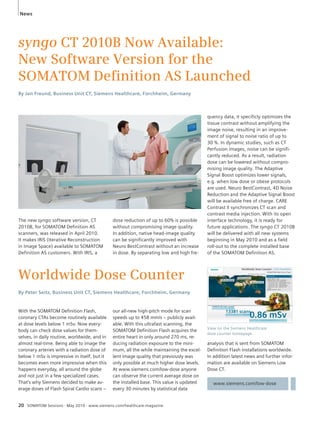
SOMATOM Defi nition AS Launched 
By Jan Freund, Business Unit CT, Siemens Healthcare, Forchheim, Germany 
The new syngo software version, CT 
2010B, for SOMATOM Definition AS 
scanners, was released in April 2010. 
It makes IRIS (Iterative Reconstruction 
in Image Space) available to SOMATOM 
Definition AS customers. With IRIS, a 
dose reduction of up to 60% is possible 
without compromising image quality. 
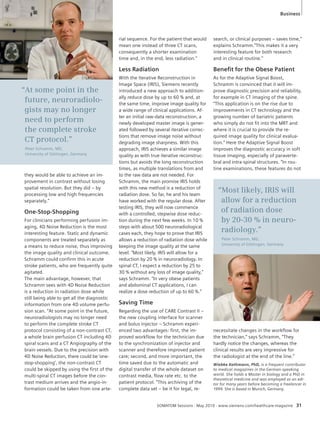
In addition, native head-image quality 
can be significantly improved with 
Neuro BestContrast without an increase 
in dose. By separating low and high fre-quency 
Worldwide Dose Counter 
By Peter Seitz, Business Unit CT, Siemens Healthcare, Forchheim, Germany 
20 SOMATOM Sessions · May 2010 · www.siemens.com/healthcare-magazine 
data, it specificly optimizes the 
tissue contrast without amplifying the 
image noise, resulting in an improve-ment 
of signal to noise ratio of up to 
30 %. In dynamic studies, such as CT 
Perfusion images, noise can be signifi-cantly 
reduced. As a result, radiation 
dose can be lowered without compro-mising 
image quality. The Adaptive 
Signal Boost optimizes lower signals, 
e.g. when low dose or obese protocols 
are used. Neuro BestContrast, 4D Noise 
Reduction and the Adaptive Signal Boost 
will be available free of charge. CARE 
Contrast II synchronizes CT scan and 
contrast media injection. With its open 
interface technology, it is ready for 
future applications. The syngo CT 2010B 
will be delivered with all new systems 
beginning in May 2010 and as a field 
roll-out to the complete installed base 
of the SOMATOM Definition AS. 
With the SOMATOM Definition Flash, 
coronary CTAs become routinely available 
at dose levels below 1 mSv. Now every-body 
can check dose values for them-selves, 
in daily routine, worldwide, and in 
almost real-time. Being able to image the 
coronary arteries with a radiation dose of 
below 1 mSv is impressive in itself, but it 
becomes even more impressive when this 
happens everyday, all around the globe 
and not just in a few specialized cases. 
That’s why Siemens decided to make av-erage 
doses of Flash Spiral Cardio scans – 
View on the Siemens Healthcare 
dose counter homepage. 
analysis that is sent from SOMATOM 
Definition Flash installations worldwide. 
In addition latest news and further infor-mation 
are available on Siemens Low 
Dose CT. 
www.siemens.com/low-dose 
our all-new high-pitch mode for scan 
speeds up to 458 mm/s – publicly avail-able. 
With this ultrafast scanning, the 
SOMATOM Definition Flash acquires the 
entire heart in only around 270 ms, re-ducing 
radiation exposure to the mini-mum, 
all the while maintaining the excel-lent 
image quality that previously was 
only possible at much higher dose levels. 
At www.siemens.com/low-dose anyone 
can observe the current average dose on 
the installed base. This value is updated 
every 30 minutes by statistical data
News 
syngo.via 
Workstation 
Face-off Sessions 
By Karin Barthel, Business Unit CT, 
Siemens Healthcare, Forchheim, Germany 
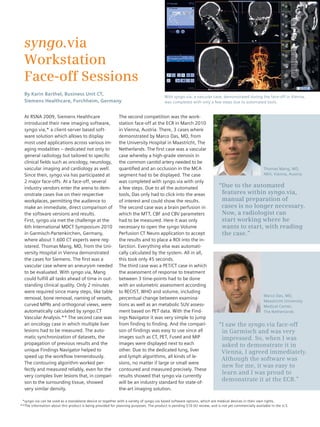
At RSNA 2009, Siemens Healthcare 
introduced their new imaging software, 
syngo.via,* a client-server based soft-ware 
solution which allows to display 
most used applications across various im-aging 
modalities – dedicated not only to 
general radiology but tailored to specific 
clinical fields such as oncology, neurology, 
vascular imaging and cardiology as well. 
Since then, syngo.via has participated at 
2 major face-offs. At a face-off, several 
industry vendors enter the arena to dem-onstrate 
cases live on their respective 
workplaces, permitting the audience to 
make an immediate, direct comparison of 
the software versions and results. 
First, syngo.via met the challenge at the 
6th International MDCT Symposium 2010 
in Garmisch-Partenkirchen, Germany, 
where about 1.600 CT experts were reg-istered. 
Thomas Mang, MD, from the Uni-versity 
Hospital in Vienna demonstrated 
the cases for Siemens. The first was a 
vascular case where an aneurysm needed 
to be evaluated. With syngo.via, Mang 
could fulfill all tasks ahead of time in out-standing 
clinical quality. Only 2 minutes 
were required since many steps, like table 
removal, bone removal, naming of vessels, 
curved MPRs and orthogonal views, were 
automatically calculated by syngo.CT 
Vascular Analysis.** The second case was 
an oncology case in which multiple liver 
lesions had to be measured. The auto-matic 
synchronization of datasets, the 
propagation of previous results and the 
unique Findings Navigator helped to 
speed up the workflow tremendously. 
The contouring algorithm worked per-fectly 
and measured reliably, even for the 
very complex liver lesions that, in compari-son 
to the surrounding tissue, showed 
very similar density. 
With syngo.via, a vascular case, demonstrated during the face-off in Vienna, 
was completed with only a few steps due to automated tools. 
The second competition was the work-station 
face-off at the ECR in March 2010 
in Vienna, Austria. There, 3 cases where 
demonstrated by Marco Das, MD, from 
the University Hospital in Maastricht, The 
Netherlands. The first case was a vascular 
case whereby a high-grade stenosis in 
the common carotid artery needed to be 
quantified and an occlusion in the MCA 
segment had to be displayed. The case 
was completed with syngo.via with only 
a few steps. Due to all the automated 
tools, Das only had to click into the areas 
of interest and could show the results. 
The second case was a brain perfusion in 
which the MTT, CBF and CBV parameters 
had to be measured. Here it was only 
necessary to open the syngo Volume 
Perfusion CT Neuro application to accept 
the results and to place a ROI into the in-farction. 
Everything else was automati-cally 
calculated by the system. All in all, 
this took only 45 seconds. 
The third case was a PET/CT case in which 
the assessment of response to treatment 
between 3 time-points had to be done 
with an volumetric assessment according 
to RECIST, WHO and volume, including 
percentual change between examina-tions 
as well as an metabolic SUV assess-ment 
based on PET data. With the Find-ings 
Navigator it was very simple to jump 
from finding to finding. And the compari-son 
of findings was easy to use since all 
images such as CT, PET, Fused and MIP 
images were displayed next to each 
other. Due to the dedicated lung, liver 
and lymph algorithms, all kinds of le-sions, 
no matter if large or small were 
contoured and measured precisely. These 
results showed that syngo.via currently 
will be an industry standard for state-of-the- 
art imaging solution. 
Thomas Mang, MD, 
AKH, Vienna, Austria 
“Due to the automated 
features within syngo.via, 
manual preparation of 
cases is no longer necessary. 
Now, a radiologist can 
start working where he 
wants to start, with reading 
the case.” 
Marco Das, MD, 
Maastricht University 
Medical Center, 
The Netherlands 
“I saw the syngo.via face-off 
in Garmisch and was very 
impressed. So, when I was 
asked to demonstrate it in 
Vienna, I agreed immediately. 
Although the software was 
new for me, it was easy to 
learn and I was proud to 
demonstrate it at the ECR.” 
* 
** 
syngo.via can be used as a standalone device or together with a variety of syngo.via based software options, which are medical devices in their own rights. 
The information about this product is being provided for planning purposes. The product is pending 510 (k) review, and is not yet commercially available in the U.S.
News 
syngo.via CT Speedometer 
In November 2009, Siemens Healthcare introduced syngo.via, a new 
client-server based imaging solution concept to improve quality 
of patient care, to cut costs for healthcare and to help hospitals and 
practices optimize their workfl ows. 
By Karin Barthel, Business Unit CT, Siemens Healthcare, Forchheim, Germany 
syngo.via* is a new imaging software 
that supports the physician’s diagnostic 
work with indication-specific workflows, 
layouts, and tools. Unlike typical radiolog-ical 
workplace setups – often equipped 
with multiple, isolated workstations – 
syngo.via is a server-based imaging soft-ware 
that can be seamlessly integrated 
in PACS or RIS-based working scenarios, 
accessible from any** PC within a clinical 
network. 
To give an overview of the many oppor-tunities 
for saving time in CT, an easy 
to use tool has now been created: the 
syngo.via CT Speedometer. The CT Speed-ometer 
shows exactly how utilizing 
syngo.via can save time during the whole 
workflow, from patient registration over 
reading the cases up to distributing the 
report. Many time-consuming steps 
which previously had to be done manually 
can now be avoided. 
The following illustrates just a few of the 
time-saving features that are quickly locat-ed 
and explained with the CT Speedometer: 
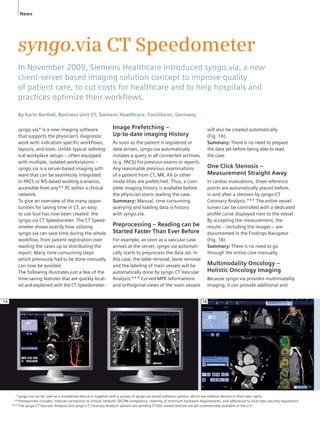
will also be created automatically 
(Fig. 1A). 
Summary: There is no need to prepare 
the data set before being able to read 
the case. 
One Click Stenosis – 
Measurement Straight Away 
In cardiac evaluations, three reference 
points are automatically placed before, 
in and after a stenosis by syngo.CT 
Coronary Analysis.*** The entire vessel 
lumen can be controlled with a dedicated 
profile curve displayed next to the vessel. 
By accepting the measurement, the 
results – including the images – are 
documented in the Findings Navigator 
(Fig. 1B). 
Summary: There is no need to go 
through the entire case manually. 
Multimodality Oncology – 
Holistic Oncology Imaging 
Because syngo.via provides multimodality 
imaging, it can provide additional and 
Image Prefetching – 
Up-to-date imaging History 
As soon as the patient is registered or 
data arrives, syngo.via automatically 
initiates a query in all connected archives 
(e.g. PACS) for previous exams or reports. 
Any reasonable previous examinations 
of a patient from CT, MR, AX or other 
moda-lities are prefetched. Thus, a com-plete 
imaging history is available before 
the physician starts reading the case. 
Summary: Manual, time-consuming 
querying and loading data is history 
with syngo.via. 
Preprocessing – Reading can be 
Started Faster Than Ever Before 
For example, as soon as a vascular case 
arrives at the server, syngo.via automati-cally 
starts to preprocess the data set. In 
this case, the table removal, bone removal 
and the labeling of main vessels will be 
automatically done by syngo.CT Vascular 
Analysis.*** Curved MPR reformations 
and orthogonal views of the main vessels 
1A 1B 
syngo.via can be used as a standalone device or together with a variety of syngo.via based software options, which are medical devices in their own rights. 
Prerequisites includes: internet connection to clinical network, DICOM compliance, meeting of minimum hardware requirements, and adherence to local data security regulations. 
The syngo.CT Vascular Analysis and syngo.CT Coronary Analysis options are pending 510(k) review and are not yet commercially available in the U.S. 
* 
** 
***
News 
“With syngo.via, I can cut the time for my cardio-vascular 
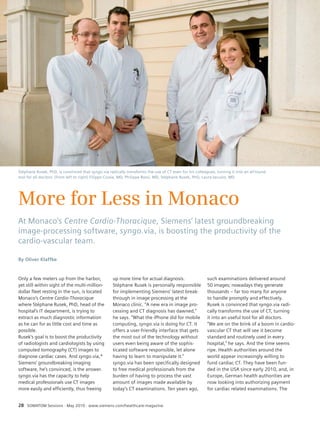
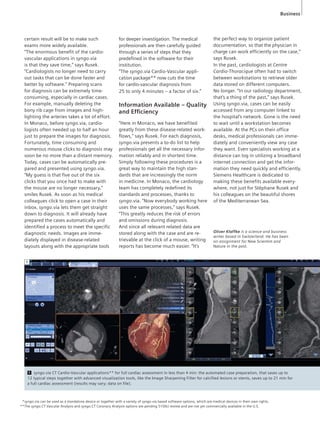
diagnosis from 25 minutes to only 4 minutes.” 
Stéphane Rusek, PhD, Centre Cardio-Thoracique de Monaco, Monaco 
“In an acute care case, e.g. a whole body scan 
with multiple fi ndings – syngo.via can save up to 
23 minutes to diagnosis.” 
Marco Das, MD, University Hospital, Maastricht, The Netherlands 
“Due to the automatic pre-processing of syngo.via a 
substracted case of CT Neuro DSA can be seen imme-diately 
instead of waiting up to 5–12 min post-processing 
time with a traditional CT Neuro DSA software.” 
Jacques Kirsch, MD, Department of Radiology, Hospital Notre-Dame, Tournai, Belgium 
“When reading an oncology follow-up examination such 
as a PET/CT which demonstrates multiple foci of cancer, 
comparison with prior appearance is essential to 
report response of therapy, syngo.via can reduce this 
total interpretation time by 65 %.” 
James Busch, MD, Specialty Networks, USA 
SOMATOM Sessions · May 2010 · www.siemens.com/healthcare-magazine 23 
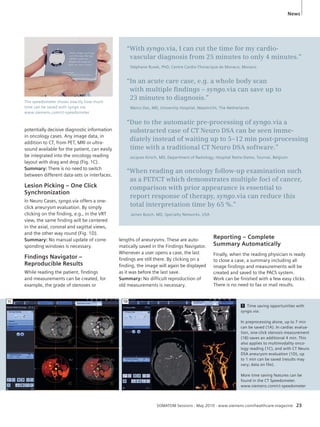
The speedometer shows exactly how much 
time can be saved with syngo.via. 
www.siemens.com/ct-speedometer 
potentially decisive diagnostic information 
in oncology cases. Any image data, in 
addition to CT, from PET, MRI or ultra-sound 
available for the patient, can easily 
be integrated into the oncology reading 
layout with drag and drop (Fig. 1C). 
Summary: There is no need to switch 
between different data-sets or interfaces. 
Lesion Picking – One Click 
Synchronization 
In Neuro Cases, syngo.via offers a one-click 
aneurysm evaluation. By simply 
clicking on the finding, e.g., in the VRT 
view, the same finding will be centered 
in the axial, coronal and sagittal views, 
and the other way round (Fig. 1D). 
Summary: No manual update of corre-sponding 
windows is necessary. 
Findings Navigator – 
Reproducible Results 
While reading the patient, findings 
and measurements can be created, for 
example, the grade of stenoses or 
lengths of aneurysms. These are auto-matically 
saved in the Findings Navigator. 
Whenever a user opens a case, the last 
findings are still there. By clicking on a 
finding, the image will again be displayed 
as it was before the last save. 
Summary: No difficult reproduction of 
old measurements is necessary. 
Reporting – Complete 
Summary Automatically 
Finally, when the reading physician is ready 
to close a case, a summary including all 
image findings and measurements will be 
created and saved to the PACS system. 
Work can be finished with a few easy clicks. 
There is no need to fax or mail results. 
1 Time saving opportunities with 
syngo.via: 
In preprocessing alone, up to 7 min 
can be saved (1A). In cardiac evalua-tion, 
one-click stenosis measurement 
(1B) saves an additional 4 min. This 
also applies to multimodality onco-logy 
reading (1C), and with CT Neuro 
DSA aneurysm evaluation (1D), up 
to 1 min can be saved (results may 
vary; data on file). 
More time saving features can be 
found in the CT Speedometer. 
www.siemens.com/ct-speedometer 
1C 1D
News 
International CT Image 
Contest – Highest Image 
Quality at Lowest Dose 
By Rami Kusama, Business Unit CT, Siemens Healthcare, Forchheim, Germany 
Excellent image quality is an essential 
requirement in computed tomography 
(CT). At the same time, the patient’s 
radiation exposure should be kept as low 
as possible. Siemens wants to motivate 
its users to utilize all dose reduction 
features available on their CT scanners 
to the full extent and share their experi- 
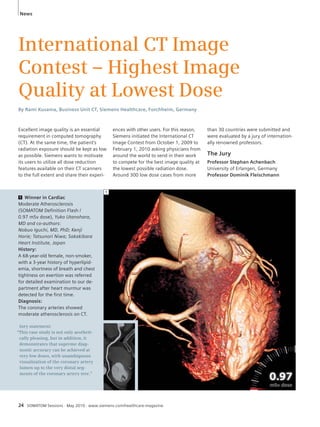
1 Winner in Cardiac 
Moderate Atherosclerosis 
(SOMATOM Definition Flash / 
0.97 mSv dose), Yuko Utanohara, 
MD and co-authors: 
Nobuo Iguchi, MD, PhD; Kenji 
Horie; Tatsunori Niwa; Sakakibara 
Heart Institute, Japan 
History: 
A 68-year-old female, non-smoker, 
with a 3-year history of hyperlipid-emia, 
shortness of breath and chest 
tightness on exertion was referred 
for detailed examination to our de-partment 
after heart murmur was 
detected for the first time. 
Diagnosis: 
The coronary arteries showed 
moderate atherosclerosis on CT. 
Jury statement: 
“This case study is not only aestheti-cally 
pleasing, but in addition, it 
demonstrates that supreme diag-nostic 
accuracy can be achieved at 
very low doses, with unambiguous 
visualization of the coronary artery 
lumen up to the very distal seg-ments 
of the coronary artery tree.” 
ences with other users. For this reason, 
Siemens initiated the International CT 
Image Contest from October 1, 2009 to 
February 1, 2010 asking physicians from 
around the world to send in their work 
to compete for the best image quality at 
the lowest possible radiation dose. 
Around 300 low dose cases from more 
24 SOMATOM Sessions · May 2010 · www.siemens.com/healthcare-magazine 
than 30 countries were submitted and 
were evaluated by a jury of internation-ally 
renowned professors. 
The Jury 
Professor Stephan Achenbach 
University of Erlangen, Germany 
Professor Dominik Fleischmann 
1
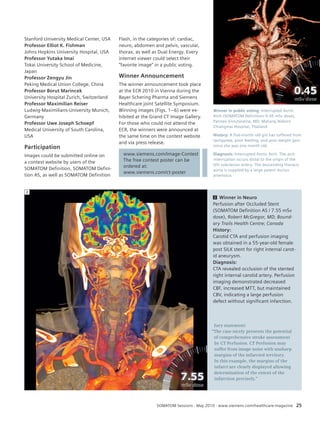
Winner in public voting: Interrupted Aortic 
Arch (SOMATOM Definition/ 0.45 mSv dose), 
Pannee Visrutaratna, MD, Maharaj Nokorn 
Chiangmai Hospital, Thailand 
History: A five-month old girl has suffered from 
tachypnea, poor feeding, and poor weight gain 
since she was one month old. 
Diagnosis: Interrupted Aortic Arch. The arch 
interruption occurs distal to the origin of the 
left subclavian artery. The descending thoracic 
aorta is supplied by a large patent ductus 
arteriosus. 
SOMATOM Sessions · May 2010 · www.siemens.com/healthcare-magazine 25 
Stanford University Medical Center, USA 
Professor Elliot K. Fishman 
Johns Hopkins University Hospital, USA 
Professor Yutaka Imai 
Tokai University School of Medicine, 
Japan 
Professor Zengyu Jin 
Peking Medical Union College, China 
Professor Borut Marincek 
University Hospital Zurich, Switzerland 
Professor Maximilian Reiser 
Ludwig-Maximilians-University Munich, 
Germany 
Professor Uwe Joseph Schoepf 
Medical University of South Carolina, 
USA 
Participation 
Images could be submitted online on 
a contest website by users of the 
SOMATOM Definition, SOMATOM Defini-tion 
AS, as well as SOMATOM Definition 
<<b<i<ttbei tüteb eürbaellr malli tm Diot sDiso-sTiasc-Thaoc>h>o>> 
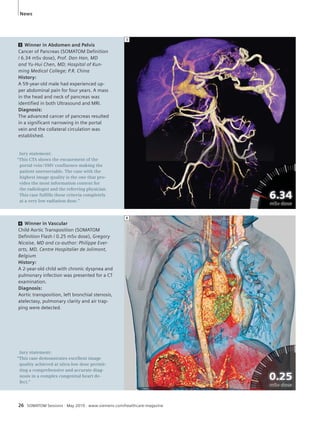
2 Winner in Neuro 
Perfusion after Occluded Stent 
(SOMATOM Definition AS / 7.55 mSv 
dose), Robert McGregor, MD; Bound-ary 
Trails Health Centre; Canada 
History: 
Carotid CTA and perfusion imaging 
was obtained in a 55-year-old female 
post SILK stent for right internal carot-id 
aneurysm. 
Diagnosis: 
CTA revealed occlusion of the stented 
right internal carotid artery. Perfusion 
imaging demonstrated decreased 
CBF, increased MTT, but maintained 
CBV, indicating a large perfusion 
defect without significant infarction. 
Flash, in the categories of: cardiac, 
neuro, abdomen and pelvis, vascular, 
thorax, as well as Dual Energy. Every 
internet viewer could select their 
“favorite image” in a public voting. 
Winner Announcement 
The winner announcement took place 
at the ECR 2010 in Vienna during the 
Bayer Schering Pharma and Siemens 
Healthcare joint Satellite Symposium. 
Winning images (Figs. 1–6) were ex-hibited 
at the Grand CT Image Gallery. 
For those who could not attend the 
ECR, the winners were announced at 
the same time on the contest website 
and via press release. 
Jury statement: 
“The case nicely presents the potential 
of comprehensive stroke assessment 
by CT Perfusion. CT Perfusion may 
suffer from image noise with unsharp 
margins of the infarcted territory. 
In this example, the margins of the 
infarct are clearly displayed allowing 
determination of the extent of the 
infarction precisely.” 
2 
www.siemens.com/Image-Contest 
The free contest poster can be 
ordered at: 
www.siemens.com/ct-poster
News 
3 Winner in Abdomen and Pelvis 
Cancer of Pancreas (SOMATOM Definition 
/ 6.34 mSv dose), Prof. Dan Han, MD 
and Yu-Hui Chen, MD; Hospital of Kun-ming 
Medical College; P.R. China 
History: 
A 59-year-old male had experienced up-per 
abdominal pain for four years. A mass 
in the head and neck of pancreas was 
identified in both Ultrasound and MRI. 
Diagnosis: 
The advanced cancer of pancreas resulted 
in a significant narrowing in the portal 
vein and the collateral circulation was 
established. 
Jury statement: 
“This CTA shows the encasement of the 
portal vein / SMV confl uence making the 
patient unresectable. The case with the 
highest image quality is the one that pro-vides 
the most information content for 
the radiologist and the referring physician. 
This case fulfi lls these criteria completely 
at a very low radiation dose.” 
4 Winner in Vascular 
Child Aortic Transposition (SOMATOM 
Definition Flash / 0.25 mSv dose), Gregory 
Nicaise, MD and co-author: Philippe Ever-arts, 
MD, Centre Hospitalier de Jolimont, 
Belgium 
History: 
A 2-year-old child with chronic dyspnea and 
pulmonary infection was presented for a CT 
examination. 
Diagnosis: 
Aortic transposition, left bronchial stenosis, 
atelectasy, pulmonary clarity and air trap-ping 
were detected. 
Jury statement: 
“This case demonstrates excellent image 
quality achieved at ultra-low dose permit-ting 
a comprehensive and accurate diag-nosis 
in a complex congenital heart de-fect.” 
3 
4 
26 SOMATOM Sessions · May 2010 · www.siemens.com/healthcare-magazine
News 
5 Winner in Thorax 
Flash ECG Thorax (SOMATOM Definition 
Flash / 0.82 mSv dose), Petter Quick; CMIV 
Linköping University; Sweden 
History: 
A 47-year-old woman was presented to the 
CT-department with unspecific chest pain. 
Diagnosis: 
The CT examination showed no pathology and 
could successfully rule out coronary disease, 
pulmonary embolism as well as lung tumor. 
Jury statement: 
“This case represented everything that 
chest CT can be – a high quality, volume 
data set that can provide information 
for vascular imaging as well as the lung 
parenchyma. High quality imaging re-quires 
the right scanner, the right proto-cols 
and the right execution of these 
protocols. This image tells that story 
very nicely.” 
6 Winner in Dual Energy 
Carotid and Circle of Willis 
(SOMATOM Definition Flash / 1.12 mSv dose), 
João Carlos Costa, MD, Diagnóstico por 
Imagem, Lda, Portugal 
History: 
A healthy 75-year-old female was presented 
to the CT-department with a family history 
of carotid artery stenosis. 
Diagnosis: 
Small atherosclerotic plaques in the emergence 
of braquiocephalic trunk and left carotid artery 
were identified. 
Jury statement: 
“This case illustrates the power of Dual 
Energy CT for tissue differentiation. In 
a single image and at tremendously low 
doses, all tissue layers in the human body 
can be simultaneously and intuitively 
displayed and provide the anatomic con-text 
of the target structure, the carotid 
circulation.” 
SOMATOM Sessions · May 2010 · www.siemens.com/healthcare-magazine 27 
5 
6
Business 
Stéphane Rusek, PhD, is convinced that syngo.via radically transforms the use of CT even for his colleagues, turning it into an all’round 
tool for all doctors: (from left to right) Filippo Civaia, MD, Philippe Rossi, MD, Stéphane Rusek, PhD, Laura Iacuzio, MD. 
More for Less in Monaco 
At Monaco’s Centre Cardio-Thoracique, Siemens’ latest groundbreaking 
image-processing software, syngo.via, is boosting the productivity of the 
cardio-vascular team. 
Only a few meters up from the harbor, 
yet still within sight of the multi-million-dollar 
fleet resting in the sun, is located 
Monaco’s Centre Cardio-Thoracique 
where Stéphane Rusek, PhD, head of the 
hospital’s IT department, is trying to 
extract as much diagnostic information 
as he can for as little cost and time as 
possible. 
Rusek’s goal is to boost the productivity 
of radiologists and cardiologists by using 
computed tomography (CT) images to 
diagnose cardiac cases. And syngo.via,* 
Siemens’ groundbreaking imaging 
software, he’s convinced, is the answer. 
syngo.via has the capacity to help 
medical professionals use CT images 
more easily and efficiently, thus freeing 
28 SOMATOM Sessions · May 2010 · www.siemens.com/healthcare-magazine 
such examinations delivered around 
50 images; nowadays they generate 
thousands – far too many for anyone 
to handle promptly and effectively. 
Rusek is convinced that syngo.via radi-cally 
transforms the use of CT, turning 
it into an useful tool for all doctors. 
“We are on the brink of a boom in cardio-vascular 
CT that will see it become 
standard and routinely used in every 
hospital,” he says. And the time seems 
ripe. Health authorities around the 
world appear increasingly willing to 
fund cardiac CT. They have been fun-ded 
in the USA since early 2010, and, in 
Europe, German health authorities are 
now looking into authorizing payment 
for cardiac related examinations. The 
up more time for actual diagnosis. 
Stéphane Rusek is personally responsible 
for implementing Siemens’ latest break-through 
in image processing at the 
Monaco clinic. “A new era in image pro-cessing 
and CT diagnosis has dawned,” 
he says. “What the iPhone did for mobile 
computing, syngo.via is doing for CT. It 
offers a user-friendly interface that gets 
the most out of the technology without 
users even being aware of the sophis-ticated 
software responsible, let alone 
having to learn to manipulate it.” 
syngo.via has been specifically designed 
to free medical professionals from the 
burden of having to process the vast 
amount of images made available by 
today’s CT examinations. Ten years ago, 
By Oliver Klaffke
Business 
certain result will be to make such 
exams more widely available. 
“The enormous benefit of the cardio-vascular 
applications in syngo.via 
is that they save time,” says Rusek. 
“Cardiologists no longer need to carry 
out tasks that can be done faster and 
better by software.” Preparing scans 
for diagnosis can be extremely time-consuming, 
especially in cardiac cases. 
For example, manually deleting the 
bony rib cage from images and high-lighting 
the arteries takes a lot of effort. 
In Monaco, before syngo.via, cardio-logists 
often needed up to half an hour 
just to prepare the images for diagnosis. 
Fortunately, time consuming and 
numerous mouse clicks to diagnosis may 
soon be no more than a distant memory. 
Today, cases can be automatically pre-pared 
and presented using syngo.via. 
“My guess is that five out of the six 
clicks that you once had to make with 
the mouse are no longer necessary,” 
smiles Rusek. As soon as his medical 
colleagues click to open a case in their 
inbox, syngo.via lets them get straight 
down to diagnosis. It will already have 
prepared the cases automatically and 
identified a process to meet the specific 
diagnostic needs. Images are imme-diately 
displayed in disease-related 
layouts along with the appropriate tools 
for deeper investigation. The medical 
professionals are then carefully guided 
through a series of steps that they 
predefined in the software for their 
institution. 
“The syngo.via Cardio-Vascular appli-cation 
package** now cuts the time 
for cardio-vascular diagnosis from 
25 to only 4 minutes – a factor of six.” 
Information Available – Quality 
and Effi ciency 
“Here in Monaco, we have benefited 
greatly from these disease-related work-flows,” 
says Rusek. For each diagnosis, 
syngo.via presents a to-do list to help 
professionals get all the necessary infor-mation 
reliably and in shortest time. 
Simply following these procedures is a 
great way to maintain the high stan-dards 
that are increasingly the norm 
in medicine. In Monaco, the cardiology 
team has completely redefined its 
standards and processes, thanks to 
syngo.via. “Now everybody working here 
uses the same processes,” says Rusek. 
“This greatly reduces the risk of errors 
and omissions during diagnosis. 
And since all relevant related data are 
stored along with the case and are re-trievable 
at the click of a mouse, writing 
reports has become much easier. “It’s 
the perfect way to organize patient 
documentation, so that the physician in 
charge can work efficiently on the case,” 
says Rusek. 
In the past, cardiologists at Centre 
Cardio-Thoracique often had to switch 
between workstations to retrieve older 
data stored on different computers. 
No longer. “In our radiology department, 
that’s a thing of the past,” says Rusek. 
Using syngo.via, cases can be easily 
accessed from any computer linked to 
the hospital’s network. Gone is the need 
to wait until a workstation becomes 
available. At the PCs on their office 
desks, medical professionals can imme-diately 
and conveniently view any case 
they want. Even specialists working at a 
distance can log in utilizing a broadband 
internet connection and get the infor-mation 
they need quickly and efficiently. 
Siemens Healthcare is dedicated to 
making these benefits available every-where, 
not just for Stéphane Rusek and 
his colleagues on the beautiful shores 
of the Mediterranean Sea. 
1 
Oliver Klaffke is a science and business 
writer based in Switzerland. He has been 
on assignment for New Scientist and 
Nature in the past. 
1 syngo.via CT Cardio-Vascular applications** for full cardiac assessment in less than 4 min: the automated case preparation, that saves up to 
12 typical steps together with advanced visualization tools, like the Image Sharpening Filter for calcified lesions or stents, saves up to 21 min for 
a full cardiac assessment (results may vary; data on file). 
syngo.via can be used as a standalone device or together with a variety of syngo.via based software options, which are medical devices in their own rights. 
The syngo.CT Vascular Analysis and syngo.CT Coronary Analysis options are pending 510(k) review and are not yet commercially available in the U.S. 
* 
**
Business 
New Feature: Neuro 
Image Quality Surpasses 
all Expectations 
A better and quicker workfl ow that leads to more time for patient care and 
diagnosis – this is the bottom line for Peter Schramm, MD, of the University 
of Göttingen, Germany, after testing the new features of syngo CT 2010B. 
But specifi cally for him, as neuroradiologist, the new dimension in neuro 
image quality is also a main improvement and a very impressive one. 
By Wiebke Kathmann, PhD 
The new software version, syngo CT 
2010B, offers several new features in-cluding 
Neuro BestContrast, 4D Noise 
Reduction, Iterative Reconstruction in 
Image Space (IRIS), CARE Contrast II and 
Adaptive Signal Boost. Together they 
truly improve the diagnostic precision 
and workflow as could be clearly demon-strated 
during the Market Entrance 
Phase (MEP) by Peter Schramm, MD, 
Deputy Head of the Neuroradiology 
Department at the University of 
Göttingen. He was among the first 
physicians worldwide to test the new 
features in the clinical environment on a 
SOMATOM Definition AS+ scanner. As a 
neuroradiologist, he was especially im-pressed 
by Neuro BestContrast because 
it achieves a very substantial improve-ment 
in image contrast, thereby signifi-cantly 
improving the distinction be-tween 
gray and white matter in the 
brain – a very important feature in the 
diagnosis of acute stroke patients where 
tissue changes on the scale of 5 to 10 
HU can decide between life and death. 
Neuro BestContrast absolutely fulfilled 
Schramm’s expectations. „Simply by 
looking at the images in our digital 
Picture Archiving and Communication 
System (PACS), we could recognize the 
point in time at which the new software 
had been installed. A lot of our patients 
get a follow-up CT scan, so we could 
also compare scans from before and 
after the software was implemented. 
When Siemens told us that they were 
aiming at improving the differentiation 
of brain tissue, we were wondering how 
A better and quick-er 
workflow that 
leads to more time 
for patient care and 
diagnosis – this is 
the bottom line for 
Peter Schramm, 
MD, of the Univer-sity 
of Göttingen.
“At some point in the 
future, neuroradiolo-gists 
may no longer 
need to perform 
the complete stroke 
CT protocol.” 
Peter Schramm, MD, 
University of Göttingen, Germany 
Business 
Wiebke Kathmann, PhD, is a frequent contributor 
to medical magazines in the German-speaking 
world. She holds a Master in biology and a PhD in 
theoretical medicine and was employed as an edi-tor 
for many years before becoming a freelancer in 
1999. She is based in Munich, Germany. 
SOMATOM Sessions · May 2010 · www.siemens.com/healthcare-magazine 31 
they would be able to achieve an im-provement 
in contrast without losing 
spatial resolution. But they did – by 
processing low and high frequencies 
separately.“ 
One-Stop-Shopping 
For clinicians performing perfusion im-aging, 
4D Noise Reduction is the most 
interesting feature. Static and dynamic 
components are treated separately as 
a means to reduce noise, thus improving 
the image quality and clinical outcome. 
Schramm could confirm this in acute 
stroke patients, who are frequently quite 
agitated. 
The main advantage, however, that 
Schramm sees with 4D Noise Reduction 
is a reduction in radiation dose while 
still being able to get all the diagnostic 
information from one 4D volume perfu-sion 
scan. “At some point in the future, 
neuroradiologists may no longer need 
to perform the complete stroke CT 
protocol consisting of a non-contrast CT, 
a whole brain perfusion CT including 4D 
spiral scans and a CT Angiography of the 
brain vessels. Due to the precision with 
4D Noise Reduction, there could be ‘one-stop- 
shopping’, the non-contrast CT 
could be skipped by using the first of the 
multi-spiral CT images before the con-trast 
medium arrives and the angio-in-formation 
could be taken from one arte-rial 
sequence. For the patient that would 
mean one instead of three CT scans, 
consequently a shorter examination 
time and, in the end, less radiation.“ 
Less Radiation 
With the Iterative Reconstruction in 
Image Space (IRIS), Siemens recently 
introduced a new approach to addition-ally 
reduce dose by up to 60 % and, at 
the same time, improve image quality for 
a wide range of clinical applications. Af-ter 
an initial raw-data reconstruction, a 
newly developed master image is gener-ated 
followed by several iterative correc-tions 
that remove image noise without 
degrading image sharpness. With this 
approach, IRIS achieves a similar image 
quality as with true iterative reconstruc-tions 
but avoids the long reconstruction 
times, as multiple translations from and 
to the raw data are not needed. For 
Schramm, the main promise IRIS holds 
with this new method is a reduction of 
radiation dose. So far, he and his team 
have worked with the regular dose. After 
testing IRIS, they will now commence 
with a controlled, stepwise dose reduc-tion 
during the next few weeks. In 10 % 
steps with about 500 neuroradiological 
cases each, they hope to prove that IRIS 
allows a reduction of radiation dose while 
keeping the image quality at the same 
level. “Most likely, IRIS will allow for a 
reduction by 20 % in neuroradiology. In 
spinal CT, I expect a reduction by 25 to 
30 % without any loss of image quality,” 
says Schramm. “In very obese patients 
and abdominal CT applications, I can 
realize a dose reduction of up to 60 %.“ 
Saving Time 
Regarding the use of CARE Contrast II – 
the new coupling interface for scanner 
and bolus injector – Schramm experi-enced 
two advantages: first, the im-proved 
workflow for the technician due 
to the synchronization of injector and 
scanner and therefore improved patient 
care; second, and more important, the 
time saved due to the automatic and 
digital transfer of the whole dataset on 
contrast media, flow rate etc. to the 
patient protocol. ”This archiving of the 
complete data set – be it for legal, re-search, 
or clinical purposes – saves time,“ 
explains Schramm.”This makes it a very 
interesting feature for both research 
and in clinical routine.“ 
Benefi t for the Obese Patient 
As for the Adaptive Signal Boost, 
Schramm is convinced that it will im-prove 
diagnostic precision and reliability, 
for example in CT imaging of the spine. 
“This application is on the rise due to 
improvements in CT technology and the 
growing number of bariatric patients 
who simply do not fit into the MRT and 
where it is crucial to provide the re-quired 
image quality for clinical evalua-tion.” 
Here the Adaptive Signal Boost 
improves the diagnostic accuracy in soft 
tissue imaging, especially of paraverte-bral 
and intra-spinal structures. “In rou-tine 
examinations, these features do not 
“Most likely, IRIS will 
allow for a reduction 
of radiation dose 
by 20-30 % in neuro-radiology.” 
Peter Schramm, MD, 
University of Göttingen, Germany 
necessitate changes in the workflow for 
the technician,” says Schramm, “They 
hardly notice the changes, whereas the 
clinical results are very impressive for 
the radiologist at the end of the line.”
Clinical Results Cardio-Vascular 
Case 1 
Adenosine Myocardial Stress Imaging 
Using SOMATOM Defi nition Flash 
By Gudrun Feuchtner,1, 4 Robert Goetti,1 André Plass,2 Monika Wieser,2 Christophe Wyss,3 
Fernando Vega-Higuera,5 Hans Scheffel,1 Michael Fischer,1 Hatem Alkadhi,1 Sebastian Leschka1 
1 Institute of Diagnostic Radiology, University Hospital Zurich, Switzerland 
2 Clinic of Cardiovascular Surgery, University Hospital Zurich, Switzerland 
3 Cardiology Division, University Hospital, Zurich, Switzerland 
4 Department of Radiology II, Innsbruck Medical University, Austria 
5 Business Unit CT, Siemens Healthcare, Forchheim, Germany. 
HISTORY 
A 51-year-old male with atypical chest 
pain and intermediate coronary risk pro-file 
(cigarette smoking and hypercholes-terolemia) 
underwent two coronary 
128-slice Dual Source CT Angiographies: 
the first under adenosine myocardial 
stress-imaging, the second at rest. 
DIAGNOSIS 
High-pitch CT Angiography showed 
severely calcified left coronary artery 
(Fig. 1C) with significant stenosis, and 
bare-metal stent in the RCA. 
Adenosine CT stress imaging showed 
a reversible myocardial perfusion 
32 SOMATOM Sessions · May 2010 · www.siemens.com/healthcare-magazine 
COMMENTS 
Adenosine stress-imaging of reversible 
myocardial ischemia is feasable with 
128-slice Dual Source CT with compre-hensive 
evaluation of coronary arteries. 
Assessment of PBV reversible ischemia 
with CT is helpful to improve accuracy of 
coronary CT Angiography, especially in 
cases of severe coronary calcification or 
limited in-stent lumen visibility. 
defect indicating ischemia anteroseptal 
at midventricular level (Figs. 1A–1B) 
corresponding to left artery descending 
(LAD) stenosis. No defect was found in-ferior 
of right coronary artery (RCA) vas-cular 
territory. Invasive angiography 
confirmed a significant 90 % stenosis at 
mid LAD and a patent RCA bare-metal 
stent. Total radiation dose was 2.2 mSv 
for adenosine stress and rest CT scans 
using high-pitch Flash Spiral mode at 
3.4 pitch factor. The delay between both 
scans was 5 minutes. Scan time was 
0.44 seconds for each study, tube set-tings 
were 100 kV and 320 mAs, gantry 
rotation time was 0.28 s. 
EXAMINATION PROTOCOL 
Scanner SOMATOM Definition Flash 
Scan mode Flash Spiral Pitch 3.4 
Scan area Heart Slice collimation 128 x 0.6 mm 
Scan length 135 mm Slice width 0.75 mm 
Scan direction Cranio-caudal Reconstruction increment 0.4 mm 
Scan time 0.44 s Reconstruction kernel B 26f 
Tube voltage 100 kV / 100 kV Volume 80 ml 
Tube current 320 mAs/rot. Flow rate 5 ml/s 
Dose modulation CARE Dose4D Start delay 10 s 
CTDIvol 3.09 mGy Postprocessing syngo CT Cardiac – 
Effective Dose 2.2 mSv (in total) Function prototype* 
Rotation time 0.28 s 
*The product is not commercially available in the US.
Cardio-Vascular Clinical Results 
1 By injecting adenosine 
under stress, a perfusion defect 
anteroseptal was shown (arrow, 
Fig. 1A), which was reversible 
after 5 minutes Rest Scan 
(arrow, Fig. 1B). 
A significant mid LAD stenosis 
was detected by CT, and 
quantified as 90 % by invasive 
angiography. Distal after steno-sis 
a severely calcified artery 
was found (arrow, Fig. 1C). 
2 Short axis at midventri-cular 
level showed antero-septal 
myocardial perfusion 
defect during adenosine 
stress (Fig. 2A, arrow), 
which was reversible at 
rest (Fig. 2B, arrow). 
3 Color maps of the myo-cardium 
showed black/dark 
areas (Fig. 3A, arrow) indicating 
ischemic myocardium during 
stress. There was no defect 
at the inferior myocardial 
region supplied by RCA 
corresponding to patent 
RCA stent (Fig. 3B, arrow). 
4 Automated quantifi-cation 
of hypo-attenuating 
perfusion defect antero-septal 
midventricular during 
stress (Fig. 4A, arrow) re-presented 
with the prototype 
of the syngo CT Cardiac 
Function software,* including 
3D segmentation (Fig. 4B). 
No perfusion defect inferior 
of RCA vascular territory could 
be detected (Fig. 4C, arrow). 
1A 
2A 
3A 
First CTA under adenosine stress Second CTA at rest 
1B 
2B 
3B 
4A 
4B 
4C 
1C 
* The product is not commercially 
available in the US.
Clinical Results Cardio-Vascular 
Case 2 
SOMATOM Defi nition Flash: 
Visualization of the Adamkiewicz Artery 
by IV-CTA in Dual Power Mode 
By Yoshiyuki Mizutani, MD* and Tomoko Fujihara** 
*Department of Radiology, Sakakibara Heart Institute, Tokyo, Japan 
**Application Department CT Team, Customer Service Division, Siemens-Asahi Medical Technologies, Tokyo, Japan 
HISTORY 
A 75-year-old female was referred to 
the radiology department of Sakakibara 
Heart Institute to examine where her 
Adamkiewicz artery originated before 
treatment of her thoracic descending 
aortic aneurysm (TAA). The patient was 
scanned with Dual Source CT in dual 
power mode. 
At the referring hospital, the patient 
had been diagnosed with TAA (descend-ing 
aorta of 5.6 cm diameter) by com-puted 
tomography and echography as 
well as right coronary artery (RCA) steno-sis 
by conventional angiography. She 
was referred to Sakakibara Heart Insti-tute 
for surgical vessel replacement and 
coronary artery bypass grafting with 
saphenous vein graft to RCA. 
34 SOMATOM Sessions · May 2010 · www.siemens.com/healthcare-magazine 
DIAGNOSIS 
TAA was clearly seen on the Dual Source 
CT images. An artery originating from a 
lumbar artery was detected, bifurcating 
from the aorta at the upper level of the 
4th lumbar vertebra, entering into the 
spinal canal from the intervertebral fora-men 
between the 4th and 5th lumbar 
vertebrae and running along the spinal 
cord on the ventral side up to the lower 
2 
1 TAA was clearly seen on the Dual Source CT images (VRT). 2 TAA was clearly seen on the Dual Source CT images (thin MIP). 
1
Cardio-Vascular Clinical Results 
4 Adamkiewicz artery connected into the anterior spinal artery. 
EXAMINATION PROTOCOL 
Scanner SOMATOM 
Definition Flash 
Scan area Thorax-abdomen 
Scan length 280 mm 
Scan direction Cranio-caudal 
Scan time 8.41 s 
Tube voltage 100 kV / 100 kV 
Tube current 600 eff. mAs 
Dose modulation CARE Dose4D 
Rotation time 0.5 s 
Slice collimation 128 x 0.6 mm 
Reconstruction 0.3 mm 
increment 
Reconstruction B36 
kernel 
Volume 100 ml 
Flow rate 5.0 ml/s 
Postprocessing syngo InSpace 
4 
SOMATOM Sessions · May 2010 · www.siemens.com/healthcare-magazine 35 
3B 
level of the 12th thoracic vertebra where 
it changed direction forming a hairpin 
shaped structure. It connected into the 
anterior spinal artery. According to these 
characteristics this artery was identified 
as the Adamkiewicz artery. 
The true lumen of the aorta was highly 
enhanced, reaching a CT value of 746 
HU at the level between the 4th and 5th 
lumbar vertebrae whereas the Adam-kiewicz 
artery reached a maximum CT 
value of only 140 HU. 
COMMENTS 
The course of the Adamkiewicz artery 
needs to be determined before surgery 
for TAA repair to ensure that it is not 
damaged during surgery and to reduce 
the risk of postoperative paraplegia. 
However, visualizing the Adamkiewicz 
artery with intravenous (IV) CTA is a 
challenging task as injection and scan 
protocols need to be tailored to the loca-tion 
and size of this artery. Since the 
Adamkiewicz artery is a tiny vessel, a 
fair amount of contrast media needs to 
be injected at reasonably high rates to 
ensure that this tiny vessel is enhanced. 
In addition, since the Adamkiewicz 
artery runs partially inside the spinal 
canal, enough dose needs to be applied 
to achieve a high signal to noise ratio 
(SNR) in an area surrounded by bones. 
Dual Source CT in the dual power mode 
combines the power of two X-ray tubes 
and two generators and can therefore 
provide twice as much X-ray output as 
a single source CT at the same pitch. As 
a result, areas that need additional dose 
can be scanned at high scan speed and 
appropriate tube current for a high SNR. 
The high scan speed was essential for 
visualizing the Adamkiewicz artery, 
since it required several seconds after 
enhancement of the aorta until the 
small arteries were enhanced, then 
quickly scan over the required long scan 
range while the small arteries were still 
enhanced. 
3A 
3 Adamkiewicz artery entering into the spinal canal (Fig. 3A) 
from the intervertebral foramen between the 4th and 5th lumbar 
vertebrae and running along the spinal cord on the ventral side up 
to the lower level of the 12th thoracic vertebra where it changed 
direction forming a hairpin shaped structure (Fig. 3B).
Clinical Results Cardio-Vascular 
Case 3 
Dynamic Myocardial Stress Perfusion 
By Florian Schwarz, MD, Fabian Bamberg, MD, MPH, Christoph R. Becker, MD, 
Alexander Becker, MD, Konstantin Nikolaou, MD 
Department of Clinical Radiology, University of Munich, Campus Großhadern, Munich, Germany 
HISTORY 
A 71-year-old male was referred for eval-uation 
of stable chest pain syndrome 
and enrolled in a prospective cohort study 
to evaluate the diagnostic accuracy and 
clinical feasibility of dynamic myocardial 
stress perfusion imaging by cardiac CT. 
Coronary CT Angiography (CTA) and 
CT-based assessment of myocardial per-fusion 
under adenosine stress was per-formed 
prior to cardiac catheterization. 
DIAGNOSIS 
Coronary CTA revealed heavy calcified 
plaque and a mild to moderate lesion of 
the right coronary artery (RCA, Figs. 1 
and 2). Dynamic adenosine stress perfu-sion 
imaging revealed homogeneous 
perfusion of the myocardium without 
defined perfusion defect (Figs. 4 and 5). 
36 SOMATOM Sessions · May 2010 · www.siemens.com/healthcare-magazine 
COMMENTS 
Non-invasive myocardial perfusion imag-ing 
by CT may represent an attractive 
option to determine the hemodynamic 
relevance of obstructive coronary lesions, 
or lesions with limited evaluability due 
to heavy calcification. However, further 
validation using appropriate gold stan-dards 
is warranted. 
After undergoing the CT Perfusion scan, 
the patient received conventional medical 
therapy. 
1 Maximum intensity display of the right coronary artery, demon-strating 
heavy calcified plaque in the proximal segment and calcified 
and non-calcified plaque in the intermediate segment, causing 
a mild to moderate stenosis (arrow). 
1 
2 Curved multiplanar reformation of the left anterior descending 
coronary artery with minor calcified and non-calcified plaque in the 
proximal segment of the vessel (arrow). 
2
Cardio-Vascular Clinical Results 
time [s] 
CT [HU] 
time [s] 
CT [HU] 
3B 
3 Principle: dynamic volumetric myocardial stress perfusion to quantify Myocardial Blood Flow (MBF). Comparison of different time 
attenuation curve (TCA) pattern with a slower and lower peak (86 ml / 100 ml / min) in an ischemic segment (Fig. 3A) and normal blood flow 
(MBF 159 ml / 100 ml / min) in an healthy segment (Fig. 3B). 
SOMATOM Sessions · May 2010 · www.siemens.com/healthcare-magazine 37 
EXAMINATION PROTOCOL 
Scanner SOMATOM Definition 
Scan mode Dynamic Stress Perfusion Mode Dose modulation no 
Scan area Left ventricular myocardium CTDIvol 94.15 mGy 
Scan length 72 mm Rotation time 0.28 s 
Scan direction Cranio-caudal Slice collimation 32 x 1.2 mm 
Scan time 31 s Slice width 3 mm 
Heart rate 72 bpm Reconstruction increment 2 mm 
Tube voltage 100 kV Reconstruction kernel B23f 
Tube current 350 mAs/rot. Post processing syngo VPCT 
Body Myocardium 
4 Systolic reconstruction display of long axis, color-coded myo-cardial 
stress perfusion image of the left ventricle indicating homo-geneous 
perfusion (green) and the absence of a circumscribed 
perfusion defect. 
4 
5 Short axis color-coded perfusion map of the left ventricle 
demonstrating homogeneous perfusion (green) under 
adenosine stress. 
5 
3A 
80 
60 
40 
20 
0 
0 5 10 15 20 25 30 
100 
80 
60 
40 
20 
0 
0 5 10 15 20 25 30
Clinical Results Cardio-Vascular 
Case 4 
Pre-operative Exclusion of Coronary 
Artery Stenosis With Less Than 1 mSv Dose 
By Sebastian Leschka, MD* and Andreas Blaha** 
Institute of Diagnostic Radiology, University Hospital Zurich, Zurich, Switzerland 
Business Unit CT, Siemens Healthcare, Forchheim, Germany 
HISTORY 
A 71-year-old male patient with a history 
of cerebral infarction caused by a high-grade 
stenosis of the left internal carotid 
artery and lysis therapy was now re-ferred 
to the radiology department to 
rule out coronary artery disease. 
In addition to the coronary CT Angio-graphy 
(CTA) examination a non-en-hanced 
calcium-scoring scan (CaSc) 
was performed. 
The CTA was acquired with a fast pitch 
spiral technique (Flash Spiral Cardio) 
while a mean heart rate of 56 bpm was 
present. 
38 SOMATOM Sessions · May 2010 · www.siemens.com/healthcare-magazine 
COMMENTS 
In combination with the CaSc (0.35 mSv) 
and the CTA (0.8 mSv), an effective 
dose* of 1.1 mSv was applied to the 
patient to detect coronary artery disease. 
The entire acquisition time of the CTA 
was 280 ms; calcium scoring was 
acquired in 120 ms. 
The Flash Spiral cardio method quickly 
and reliably combines low radiation 
dose values with the accurate display of 
the coronary arteries in all segments. 
DIAGNOSIS 
In total, ten calcified lesions could be 
detected in the CaSc. Diffuse distribution 
of calcified deposits was observed in 
the right coronary artery (RCA), the left 
artery descending (LAD) and the left cir-cumflex 
coronary artery (CX). The total 
Agatston score was 130. 
CTA unveiled a normal coronary artery 
anatomy, right dominant coronary supply 
type with regular sized lumen of the 
coronary arteries. RCA and LAD showed 
no hemodynamic relevant lesions. CX 
coronary artery unveiled a stenosis 
smaller than 50% in its proximal seg-ment. 
A deep myocardial bridging of the 
LAD could also be depicted. 
Threshold = 130 HU (102.7 mg/cm3 CaHA) 
Artery Numbers of Calcium Score (2) Volume [mm3] (3) Equiv. Mass 
Lesions (1) [mg CaHA] (4) 
LM 0 0.0 0.00 0.0 
LAD 2 27.5 29.3 4.89 
CX 3 48.3 50.5 8.57 
RCA 5 53.6 66.2 10.81 
Total 10 129.5 146.0 24.27 
(1) Lesion is volume based, (2) Equivalent Agatston score, (3) Isotropic interpolated volume, (4) Calibration Factor: 0.790 
*Effective Dose was calculated using the published conversion factor for an adult chest of 0.014 mSv (mGy cm)-1 [1]. 
[1] McCollough CH et al. Strategies for Reducing Radiation Dose in CT, Radiol. Clin. N. Am. 47: (2009) 27-40. 
* 
**
Cardio-Vascular Clinical Results 
3 
5 6 
SOMATOM Sessions · May 2010 · www.siemens.com/healthcare-magazine 39 
EXAMINATION PROTOCOL 
Scanner SOMATOM Definition 
Scan mode Flash Spiral CorCTA Rotation time 0.28 s 
Scan area Thorax Pitch 3.4 
Scan length 130 mm Spatial Resolution 0.33 mm 
Scan direction Cranio-caudal Slice collimation 128 x 0.6 mm 
Scan time 0.28 s Slice width 0.75 mm 
Heart rate 56 bpm Reconstruction increment 0.7 
Tube voltage 100 kV / 100 kV Reconstruction kernel B26f 
Tube current 320 mAs/rot. Volume 60 ml 
Dose modulation CARE Dose4D Flow rate 6 ml/s 
CTDIvol 3.10 mGy Start delay Test Bolus 
DLP 57 mGy cm Postprocessing syngo Circulation 
Effective Dose 0.8 mSv syngo InSpace 
2 
2 MIP of the LAD shows myocardial bridging 
(arrow). 
3 MIP of the first diagonal branch (D1) of the 
LAD, discovers plunge into myocardium. 
1 
1 VRT of the Coronary arteries shows deep 
myocardial bridging of LAD (arrow). 
5 A stenosis is present in the proximal 
segment of CX artery (arrow). 
6 Cross-sectional view displays the 
stenotic area of CX artery. 
4 
4 MIP of the coronary artery tree with 
removed blood pool of the left ventricle 
reveals calcifications (arrow).
Clinical Results Cardio-Vascular 
Case 5 
Utilizing Ultra Low Dose 
of 0.05 mSv for Premature Baby 
With Congenital Heart Disease 
By Jean-Francois Paul, MD1 and Andreas Blaha2 
1Centre Chirurgical Marie Lannelongue, Le Plessis-Robinson, France 
2Business Unit CT, Siemens Healthcare, Forchheim, Germany 
HISTORY 
A premature baby was referred to the 
radiology department with diagnosis of 
congenital heart disease. An atrial and 
left ventricular septum defect could be 
detected with echocardiography but 
with a doubt about the exact origin and 
*Effective Dose was calculated using the published conversion factor for a pediatric (newborn) chest of 0.039 mSv (mGy cm)-1 [1]. 
To take into account that Siemens calculates the CTDI in a 32 cm CTDI phantom an additional correction factor of 2 had to be applied. 
[1] McCollough CH et al. Strategies for Reducing Radiation Dose in CT, Radiol. Clin. N. Am. 47: (2009) 27-40. 
40 SOMATOM Sessions · May 2010 · www.siemens.com/healthcare-magazine 
course of right pulmonary artery (RPA). 
Therefore a low dose CT examination 
was requested, utilizing low kilovoltage 
(kV) and low milliampere seconds (mAs) 
to achieve ultra low dose radiation 
values. 
DIAGNOSIS 
A mild stenosis present at the ostium 
of the right pulmonary artery could be 
observed. Although the RPA showed an 
irregularity it had a normal anatomical 
course. The ventricular septum defect as 
well as the still open atrial septum could 
be clearly revealed by using oblique pla-nar 
reformations. The right coronary ar-tery 
was well depicted despite a heart 
rate of 157 bpm. 
COMMENTS 
The data acquisition was performed 
with a SOMATOM Definition Flash using 
the ECG-triggered sequential mode 
(Flash Cardio Sequence) which resulted 
in an ultra low dose value. Calculated 
with the dose length product (DLP) of 
0.7, an estimated dose of 0.05 mSv could 
be achieved.* 
Using the Definition Flash low dose ac-quisition 
technique it was possible to de-tect 
this congenital heart disease (CHD) 
in a very early stage of the patients life. 
1 CT imaging with VRT technique shows ventricular septal defect (arrows) 
and persistent foramen ovale (PFO, arrowheads). 
1
2 3 
Cardio-Vascular Clinical Results 
EXAMINATION PROTOCOL 
2 Ventricular 
septal defect in 
MIP technique 
(caudo-cranial 
view, arrow); PFO 
(arrowhead). 
3 Caudo-cranial 
view MIP shows 
mild stenosis and 
irregularity of 
the RPA (arrow). 
4 Cranio-caudal 
view in VRT-tech-nique. 
5 Fused VRT and 
MIP highlighting 
RPA (arrow). 
Scanner SOMATOM Definition Flash 
Scan mode Flash Cardio Sequence Effective Dose 0.05 mSv 
Scan area Thorax Rotation time 0.28 s 
Scan length 33 mm Feed/Rotation one rotation 
Scan direction Cranio-caudal Slice collimation 128 x 0.6 mm 
Scan time 0.18 s Slice width 0.75 mm 
Tube voltage 80 kV / 80 kV Reconstruction increment 0.4 mm 
Tube current 22 mAs / rot. Reconstruction kernel B26f 
CTDIvol 0.18 mGy Postprocessing CT Cardiac Engine 
DLP 0.7 mGy cm 
4 
SOMATOM Sessions · May 2010 · www.siemens.com/healthcare-magazine 41 
5
Clinical Results Cardio-Vascular 
Case 6 
SOMATOM Defi nition Flash: 
Pediatric Patient Without Sedation 
and Breath-Holding 
By Kaori Takada, MD* and Tomoko Fujihara** 
Department of Radiology, Sakakibara Heart Institute, Tokyo, Japan 
Application Department CT Team, Customer Service Division, Siemens-Asahi Medical Technologies, Tokyo, Japan 
HISTORY 
A 4-year-old boy with Tetralogy of Fallot 
(TOF, Fig.1), pulmonary atresia (PA) 
and major aorto-pulmonary collateral 
arteries (MAPCAs) was referred to the 
radiology department of Sakakibara 
Heart Institute for a follow-up examina-tion 
using a SOMATOM Definition Flash, 
Dual Source CT in Flash Spiral mode 
following treatment of his pulmonary 
artery stenosis. 
The patient was diagnosed shortly after 
birth with TOF, PA, MAPCA. When he 
was 10 months old, a stent was inserted 
in the largest MAPCA and a central shunt 
was placed when he was 16 months old. 
When he was 2 years old, he underwent 
right and left modified Blalock-Taussig 
42 SOMATOM Sessions · May 2010 · www.siemens.com/healthcare-magazine 
CT images revealed a tortuous artery 
originating from a right subclavian ar-tery 
that supplied the right and left infe-rior 
lung lobes. The left lung was per-fused 
mainly by the left central pulmo-nary 
artery. The right middle lung lobe 
was perfused by the large right inferior 
diaphragmatic artery (its distal end was 
connected to an artery originating from 
the central pulmonary artery). 
Incidentally, the right coronary artery 
(RCA) was found to originate from the 
aorta at the upper level of left coronary 
artery, the left coronary cusp (Fig. 4), 
which could neither be seen in the previ-ously 
performed catheter angiography 
nor in a 16-MSCT examination. 
Based on these findings a catheter PTA 
of the pulmonary artery stenosis at the 
distal part of the stent was planned. 
COMMENTS 
Dual Source CT Angiography has 
emerged as an essential diagnostic tool 
for the assessment of complex congeni-tal 
heart disease. Nevertheless, dose has 
remained a concern, in particular when 
referring pediatric patients for cardiac 
CT. With the Flash Spiral mode of the 
second generation Dual Source CT, 
pediatric patients can be scanned at 
ultra low dose, as in this case at 1.63 
mGy (effective dose 0.644 mSv). Apart 
from dose concerns, additional chal-lenges 
have been associated with imag-ing 
pediatric congenital heart disease 
shunt surgeries (therefore the subclavi-an 
artery is connected with the pulmo-nary 
artery) within 9 months. Then, at 
the age of 3, an artificial vessel was con-structed 
from the right ventricle (RV) 
to the pulmonary artery by palliative 
Rastelli procedure. 
The patient now underwent a percu-tanous 
transluminal angioplasty (PTA) 
of pulmonary artery. A low dose, Dual 
Source CT scan in the Flash Spiral mode 
was ordered to confirm his postopera-tive 
condition, in particular concerning 
the pulmonary circulation. The patient’s 
weight was 15.6 kg (34.39 lb). 
He was not sedated and no breath-hold 
was needed during the scan. His mean 
heart rate was 95 bpm. 
DIAGNOSIS 
The Dual Source CT images showed that 
the RV-pulmonary artery conduit was 
patent and that the anastomosis site 
had no stenosis. Neither the right nor 
the left pulmonary arteries (about 
4 mm diameter) presented any signifi-cant 
stenosis (Fig. 2). 
A stent was confirmed in the biggest 
MAPCA, which bifurcated from the 
descending aorta at the level of the left 
atrium. It went to the right superior and 
inferior lung lobes, and connected one 
artery originating from right central pul-monary 
artery. Although the stent itself 
was patent, a stenotic part was seen dis-tal 
of the stent (Fig. 3). The Dual Source 
1 Ventricular septal defect that is one 
characteristic of TOF. 
1 
* 
**
Cardio-Vascular Clinical Results 
2A 3A 
2B 3B 
SOMATOM Sessions · May 2010 · www.siemens.com/healthcare-magazine 43 
2 Both, right and left pulmonary arteries (about 4 mm diameter) 
had now significant stenosis. 
3 Stent was embedded in largest MAPCA that showed 
a stenosis (arrow) distal of stent (arrowhead). 
4 RCA originated from left coronary cusp (arrows). 
4A 
4B 
EXAMINATION PROTOCOL 
Scanner SOMATOM Definition Flash 
Scan mode Flash Spiral 
Scan area Thorax / Chest 
Scan length 211 mm 
Scan direction Cranio-caudal 
Scan time 0.52 s 
Tube voltage 80 kV 
Tube current 104 eff. mAs 
CTDIvol 1.63 mGy 
Effective Dose 0.644 mSv 
Rotation time 0.28 s 
Pitch 3.4 
Slice collimation 128 x 0.6 mm 
Slice width 0.6 mm 
Reconstruction increment 0.3 mm 
Spatial resolution 0.33 mm 
Reconstruction Kernel B26f, B46f (stent) 
Contrast 
Flow Rate 2.5 ml/s 
Start delay 17 s 
Volume 30 ml 
patients: the patients have high heart 
rates, the cardiac vessels are tiny, seda-tion 
often presents a risk and most pa-tients 
cannot hold their breath. This 
Dual Source CT Flash scan of 211 mm 
length was taken in only 0.51 seconds 
without sedation or breath-hold. Vessels 
were clearly visualized without artifacts. 
Even coronary anomaly could be seen 
despite the patient’s high heart rate of 
95 bpm. Pulmonary artery in-stent ste-nosis 
could also be evaluated. The Dual 
Source CT Flash images were extremely 
helpful for further treatment planning.
Clinical Results Cardio-Vascular 
Case 7 
SOMATOM Defi nition Flash: 
Dual Energy Coronary CT Angiography 
for Evaluation of Chest Pain After RCA 
Revascularization 
By Ralf W. Bauer, MD, J. Matthias Kerl, MD, Thomas J. Vogl, MD 
Department of Diagnostic and Interventional Radiology, Clinic of the Goethe University, Frankfurt, Germany 
HISTORY 
A 54-year-old female patient underwent 
coronary stent percutaneous translumi-nal 
coronary angioplasty (PTCA) of 
the right coronary artery (RCA) four 
months ago for acute ST-elevation 
myocardial infarction of the inferioseptal 
wall. Now, the patient suffered from 
reduced physical power and labile blood 
pressure and had an event of syncope 
three weeks ago. Invasive coronary angi-ography 
was performed to assess stent 
patency. In-stent occlusion of the mid 
and distal RCA with moderate collateral-ization 
from the left anterior descending 
(LAD) and left circumflex artery (LCX) 
and a patent right ventricular (RV) 
branch were found (Fig. 1). Recanaliza-tion 
was performed with placement of 2 
drug-eluting stents in the distal and mid 
RCA. During intervention, a small con-trast 
material extravasation was seen 
near the ostium in the proximal RCA. 
A small intima dissection was suspected 
and another stent was placed to close 
1 Prior to recanalization: Cardiac catheteri-zation 
showed a prominent RV branch and 
in-stent occlusion of the mid and distal RCA 
(arrow). 
1 
2 Curved multiplanar reformates showed 
instent thrombosis with occlusion beginning 
in the proximal RCA. In the RV branch, which 
was clearly visible on pre-interventional cath 
images, no contrast material filling could be 
delineated (arrows). 
44 SOMATOM Sessions · May 2010 · www.siemens.com/healthcare-magazine 
3 Dual Energy iodine mapping showed a 
large area with decreased perfusion in 
the arterial phase in the inferoseptal wall 
extending from the base to the apex of the 
heart (arrow). 
2 3
Cardio-Vascular Clinical Results 
EXAMINATION PROTOCOL 
Scanner SOMATOM Definition Flash 
Scan mode Dual Energy 
Scan area Heart 
Scan length 170 mm 
Scan direction Cranio-caudal 
Scan time 4.8 s 
Tube voltage A/B 100 kV/140 kV+Sn filter 
Tube current A/B 165 mAs/140 mAs 
CTDIvol 13.29 mGy 
Rotation time 0.28 s 
Pitch 0.17 
Slice collimation 64 x 0.6 mm 
Slice width 0.75 mm 
Reconstruction 
increment 0.4 mm 
Reconstruction 
kernel D26f 
Volume 70 ml contrast media 
Flow rate 5 ml/s 
Start delay Test bolus 
Post processing syngo Dual Energy 
SOMATOM Sessions · May 2010 · www.siemens.com/healthcare-magazine 45 
the leakage. Three hours after interven-tion, 
the patient developed chest tight-ness 
and retrosternal pain. ECG showed 
signs of the known old infarction 
inferiorseptally (Q waves in II, III and 
aVF) but no signs of acute ischemia. 
She was sent to CT to rule out aortic 
dissection. 
DIAGNOSIS 
Cardiac CT was performed in Dual Energy 
mode with retrospective ECG-gating. 
There was no sign of contrast material 
extravasation or aortic dissection. Dual 
Energy CT Angiography revealed in-stent 
thrombosis with occlusion of the RCA 
13 mm after its origin (Fig. 2). While 
on cardiac cath the RV branch was still 
open, DECT showed an occlusion of the 
vessel due to the thrombus in the proxi-mal 
RCA, explaining the patient’s symp-toms. 
Dual Energy myocardial iodine 
mapping showed a large hypoperfused 
area inferoseptal extending from the 
base down to the apex (Fig. 3). Low 
dose step-and-shoot late enhancement 
images 7 minutes after contrast injec-tion 
showed corresponding delayed 
contrast material washout (Fig. 4). On 
regular anatomical multiplanar refor-mates, 
a moderate thinning of the left 
ventricular myocardium was present 
in that area (Fig. 5). 
COMMENTS 
In this case, Dual Energy coronary 
CT Angiography was used to image a 
complication of interventional recanali-zation, 
i.e. acute in-stent thrombosis, 
while the initial clinical diagnosis of 
acute aortic dissection could reliably 
be ruled out. 
A further complication was the occlu-sion 
of the RV branch (which was patent 
prior to intervention) due to the large 
thrombus formation beginning very 
proximally in the RCA. The new hybrid 
reconstruction algorithm for coronary 
CTA images preserves the high temporal 
resolution of 75 ms of the Dual Source 
system and allows for motion-free imag-ing 
of the vascular structures. According 
to the clinical history of the patient, 
assessment of the myocardium with 
Dual Energy first-pass perfusion and 
late enhancement imaging showed signs 
of chronic infarction in the inferoseptal 
wall of the left ventricle. Increased tube 
power as well as improved separation of 
the spectra by using a tin filter (140 kV 
+ Sn filter) allowed for artifact-free im-aging 
of myocardial perfusion. Complete 
diagnostic work-up of the coronary 
arteries and the myocardium was 
achieved with a total dose length product 
of only 294 mGy cm (227 mGy cm CTA + 
67 mGy cm late enhancement). 
4 Late enhancement was present in the in-feroseptal 
wall corresponding to the perfusion 
defect in arterial phase. 
4 
5 Regular anatomical multiplanar reformates 
showed moderate thinning of the interoseptal 
wall consistent with chronic ischemia (arrow). 
5
Clinical Results Oncology 
Case 8 
3D Guided RF Ablation and 
CT Perfusion – a New Combination for 
Monitoring of Treatment Response 
By Hatem Alkadhi, MD*,** and Jan Freund*** 
Institute of Diagnostic Radiology, University Hospital Zurich, Zurich, Switzerland; 
Massachusetts General Hospital, Harvard Medical School, Boston, MA, USA 
Business Unit CT, Siemens Healthcare, Forchheim, Germany 
Today, there is a significant trend for 
more routine biopsies, as well as an in-creasing 
volume of more complex inter-ventional 
procedures such as radio fre-quency 
(RF) ablations and minimally 
invasive surgical procedures. In addition, 
the need for large perfusion ranges is in-creasing 
with the demand for complete 
and comprehensive assessments of the 
whole disease in the entire organ. The 
current challenge in CT interventions is 
to overcome the limitations of conven-tional 
2D CT guidance where, especially 
in difficult cases, the safe navigation 
of the needle is a challenge. 
A more accurate overview of the needle 
position and surrounding organs has 
often been lacking during difficult pro-cedures, 
especially when using oblique 
needle positions in both fluoroscopic 
and non-fluoroscopic procedures. 
Strongly motivated by the increased vol-ume 
of these interventions, radiologists 
have been looking for a solution that 
adds precision while reducing procedure 
time, freeing up the CT suite for more 
patients and procedures and, in addition, 
bringing new revenue opportunities. 
At University Hospital Zurich, radiologists 
are working on an impressive and prom-ising 
solution utilizing Siemens’ real-time 
3D image guidance for minimally 
invasive procedures and CT Perfusion 
in combination with the innovative 
Adaptive 4D Spiral technology. The fol-lowing 
case demonstrates a 3D guided 
RF ablation of a renal cell carcinoma 
with a combined monitoring of treat-ment 
response by Adaptive 4D Spiral 
volume perfusion CT. 
PATIENT HISTORY 
An 80-year-old female patient presented 
to the emergency department with mac-rohematuria. 
A CT of the abdomen 
revealed a mass in the left kidney that 
was suspicious of a renal cell carcinoma 
(Fig. 1). Because severe co-morbidities 
prevented open surgery, the patient was 
scheduled to undergo radio frequency 
ablation (RFA). Considering the large size 
of the tumor, embolization of the mass 
was performed prior to RFA (Fig. 3). 
2 
2 The image shows the RFA procedure of 
the left kidney tumor. 
1 
46 SOMATOM Sessions · May 2010 · www.siemens.com/healthcare-magazine 
3 
3 Selective catheter angiography of the left 
renal artery demonstrating the hyper-vascu-larized 
tumor of the lower pole (left). Angi-ography 
after embolization shows subtotal 
devascularization of the tumor (right). 
1 Contrast-enhanced abdominal CT shows 
an exophytic mass in the left kidney (arrow). 
* 
** 
***
Oncology Clinical Results 
5 
SOMATOM Sessions · May 2010 · www.siemens.com/healthcare-magazine 47 
DIAGNOSIS 
Due to the large size of the tumor, con-ventional 
CT Perfusion studies are nor-mally 
unable to capture the entire tumor 
and therefore deliver only partial perfu-sion 
information. To circumvent this 
limitation, the patient was sent for a 
volume perfusion scan to the SOMATOM 
Definition AS offering the Adaptive 4D 
Spiral scan modes. This allows CT Perfu-sion 
coverage of up to 7 cm. The Adap-tive 
4D Spiral scan was performed one 
day after embolization. It showed the 
tumor to be largely devascularized. 
However, a small proportion in the me-dial 
lower part of the tumor still showed 
blood flow (Fig. 4). 
Two days later, a CT-guided RFA was per-formed 
using the Adaptive 3D Interven-tion 
Suite with its needle path planning 
and on-line tracking mode. Particularly 
the perfused tumor part as demonstrat-ed 
by perfusion CT was targeted (Fig. 2). 
In order to safely reach the dedicated 
areas, a 3D visualization of axial, coronal 
and sagittal slices during the intervention 
was used. In combination with a 2-click 
path planning, a fast and precise needle 
navigation was ensured. Radiation expo-sure 
could be kept very low by applying 
an interventional sequence scan mode 
for needle navigation. 
A CT Perfusion study performed the 
day after RFA shows complete devascu-larization 
of the tumor (Fig. 5) indicating 
a successful treatment of the patient. 
With the ability to perform perfusion 
studies over the entire region of interest, 
it is now possible to assess the extent of 
the disease and visualize the function of 
potential metastases. The combination 
of CT Perfusion studies and CT guided 
RFAs allows the reading physician to 
more precisely assess the treatment 
success after RFA in a timely manner. This 
makes it possible to monitor devascular-ization 
of the kidney tumors only one 
day after RFA. 
COMMENTS 
The increased precision of the 3D visual-ization 
especially helps to more precisely 
position RF needles to ensure the correct 
placement in the perfused tumor area. 
It gives a more accurate overview of the 
needle position and surrounding organs 
during difficult procedures, such as 
oblique needle positions of RFAs. This 
ensures a higher success rate of RF treat-ments. 
In addition, the automated needle 
guidance and tracking tool significantly 
helps to speed up the insertion and 
needle placement with a reduced pa-tient 
exposure. 
The 3D minimal invasive suite in parti-cular 
now offers the freedom to direct 
the entire procedure with just the touch 
of a button – without ever leaving the 
patient’s side. No ongoing, extensive 
communication with the technician for 
additional distance measurements, 
windowing and image adjustments is 
necessary. Since the user is now able 
to easily switch between fluoroscopic, 
sequential and spiral examinations 
without time-consuming scan protocol 
manipulation, the physician saves 
additional time reducing the overall 
interventional procedure time. This 
frees up the valuable CT suite more 
quickly for waiting patients and proce-dures. 
4 Blood volume map shows a largely devascularized tumor after 
embolization treatment, however, also a strongly perfused area 
in the medial, lower part of the tumor (red, yellow). 
4 
5 Blood volume map shows complete devascularization of the kidney 
tumor (purple, blue) after RF treatment.
Clinical Results Oncology 
Case 9 
SOMATOM Defi nition Flash: 
Routine Re-staging of Oesophageal 
Carcinoma Utilizing IRIS Technology 
By Michael Lell, MD*and Andreas Blaha** 
*Department of Radiology and the Imaging Science Institute (ISI), University of Erlangen-Nuremberg, Erlangen, Germany 
**Business Unit CT, Siemens Healthcare, Forchheim, Germany 
HISTORY 
The 55-year-old male patient presented 
with a history of oesophageal cancer. 
He previously underwent combined radio-chemotherapy. 
CT was requested for 
re-staging to discuss further therapy 
options for the patient. 
DIAGNOSIS 
A contrast enhanced CT revealed bilateral 
well-perfused lung, also the port catheter 
was well positioned in the vena cava 
superior. Following treatment, there was 
still prominent thickening of the wall 
of the distal oesophagus und enlarged 
EXAMINATION PROTOCOL 
lymph nodes in the mediastinum. In 
addition, a small pericardial effusion, 
most probably a side effect of radio-therapy, 
was visualized. There was no 
evidence of liver or lung metastases and 
there were no enlarged lymph nodes at 
the level of the celiac trunk. An isolated 
solitary cyst (Bosniak I) was located in 
the upper left kidney. 
COMMENTS 
Several measures to reduce dose were 
employed with this patient. Online tube 
current modulation (CARE Dose4D) and 
Scanner SOMATOM Definition Flash 
Scan mode Thorax DLP 260 mGy cm 
Scan area Thorax-Abdomen Effective Dose 3.9 mSv 
Scan length 656 mm Rotation time 0.33 s 
Scan direction Cranio-caudal Slice collimation 128 x 0.6 mm 
Scan time 21 ms Slice width 0.75 mm 
Tube voltage 120 kV Reconstruction increment 0.4 mm 
Tube current Ref.mAs 100 eff. mAs Reconstruction kernel I41 
Dose modulation CARE Dose4D Postprocessing syngo CT 3D 
48 SOMATOM Sessions · May 2010 · www.siemens.com/healthcare-magazine 
iterative reconstruction in image space 
technology (IRIS) were utilized, which 
lead to a significant reduction in dose 
and noise as compared to conventional 
CT, improving image quality. This exa-mination 
reliably demonstrated the 
possibility of acquiring excellent image 
quality at reduced dose levels (3.9 mSv / 
DLP: 260 mGy cm).
Oncology Clinical Results 
SOMATOM Sessions · May 2010 · www.siemens.com/healthcare-magazine 49 
1 
2 Coronal cut demonstrates the solitary cyst (left kidney, arrow), and 
distal oesophageal wall thickening (arrowhead, IRIS reconstruction). 
2 
3 Axial slice highlights wall thickening of the oesophagus 
(arrowhead), and pericardial effusion (arrows). 
3 
4 Low and homogenous noise in the entire dataset using IRIS 
(coronal slice) reveals oesophageal thickening (arrows). 
4 
1 VRT and fused MPR show the extension of oesophageal 
wall thickening.
Clinical Results Neurology 
Case 10 
SOMATOM Defi nition AS+: 
CT Perfusion With Extended Coverage 
for Acute Ischemic Stroke 
By Ke Lin, MD 
Department of Radiology, New York University Langone Medical Center, New York, USA 
HISTORY 
A 53-year-old male with history of hyper-tension 
presented with sudden onset 
of expressive aphasia and weakness. 
The patient had experienced two similar 
but transient episodes in the previous 
12 months. He arrived to the emergency 
department of NYU Langone Medical 
Center within 1 hour of symptom onset 
and was immediately evaluated for 
acute ischemic stroke by non-contrast 
50 SOMATOM Sessions · May 2010 · www.siemens.com/healthcare-magazine 
head CT (NCCT), dynamic CT Perfusion 
(CTP) of the brain, and CT Angiography 
(CTA) of the cervical and intracranial 
arterial vasculature. 
1 
1 Dynamic CT 
Perfusion (CTP) 
cerebral blood flow 
(CBF) map shows 
markedly decreased 
CBF to the left 
frontal operculum. 
CTP cerebral blood 
volume (CBV) map 
shows matched 
decreased CBV 
in this region 
indicating irrevers-ible 
infarct core. 
A penumbra-core 
map generated by 
using thresholds of 
CBV ≤ 1.2 ml / 100 ml 
for core (red) 
and CBF ≤ 35 ml / 
100 ml / min 
and CBV >1.2 ml / 
100 ml for penum-bra 
(yellow) shows 
little salvageable 
tissue at this level.
Neurology Clinical Results 
2 The penumbra-core 
maps from selected slices 
above and below the 
level shown in Fig. 1: 
the extents of both the 
salvageable ischemic 
penumbra (yellow) and 
the irreversible infarct 
core (red) are fully de-picted. 
indicative of salvageable tissue at risk 
(Fig. 2). CTA showed embolic occlusion 
of the frontal opercular division of the 
left MCA secondary to plaque rupture 
at the left carotid bulb. The patient was 
then rapidly treated with intravenous 
thrombolytic therapy with mild improve-ment 
of symptoms. 
COMMENTS 
The SOMATOM Definition AS+ scanner 
with 128-slice configuration and Adaptive 
4D Spiral technology allows larger CTP 
coverage with a single bolus of contrast. 
In this case, the setting with 96 mm of 
z-direction coverage (and 1.5 seconds 
temporal resolution) covered nearly the 
entire supratentorial brain. syngo VPCT 
Neuro extracts first-pass data from the 
45 seconds dynamic acquisition en-abling 
a rapid exam. The extents of both 
the salvageable ischemic penumbra and 
the irreversible infarct core were fully 
depicted. Rescue of ischemic penumbra 
is the main rationale for aggressive 
stroke intervention, and its identification 
through perfusion imaging may form the 
basis of patient selection for therapy in 
the near future. 
SOMATOM Sessions · May 2010 · www.siemens.com/healthcare-magazine 51 
DIAGNOSIS 
While NCCT showed only subtle blurring 
of the normal gray/white matter inter-face 
at the left frontal operculum, CTP 
with extended coverage revealed the full 
extent of the acute ischemia in the ante-rior 
left middle cerebral artery (MCA) 
territory. There was severe compromise 
of cerebral blood flow (CBF) to the mid 
and inferior left frontal lobe. At the level 
of the operculum (Broca’s area), there 
was a matched defect in low CBF and 
low cerebral blood volume (CBV) indica-tive 
of irreversible infarct core (Fig. 1). 
However, there was appreciable CBF/CBV 
mismatch on the other acquired slices, 
EXAMINATION PROTOCOL 
Scanner SOMATOM Definition AS+ 
Scan mode Adaptive 4D Spiral Rotation time 0.3 s 
Scan area Head Slice collimation 64 x 0.6 mm 
Scan length 96 mm Slice width 10 mm 
Scan direction Caudo-cranial and cranio-caudal Reconstruction increment 5 mm 
Scan time 45 s Reconstruction kernel H20f 
Tube voltage 80 kV Contrast Volume 50 ml iodine 
Tube current 200 eff. mAs Flow rate 5 ml/s 
Dose modulation CARE Dose4D off Start delay 4 s 
CTDIvol 218.8 mGy Postprocessing syngo VPCT Neuro 
2
Clinical Results Neurology 
Case 11 
Vasospasm After Subarachnoid 
Hemorrhage: 
Volume Perfusion CT Neuro 
By Bruno A. Policeni, MD 
Radiology Faculty, Neuroradiology, University of Iowa Hospitals and Clinics, Iowa City, Iowa, USA 
1 3D CT Angiography shows a right mid cerebral artery (MCA) bi-lobed aneurysm 
(arrow). No other aneurysms were found. 
HISTORY 
A 36-year-old female with a history of 
migraine developed a sudden onset of 
the worst headache of her life, lost con-trol 
of the entire right side of her body 
and fell to the floor. However she had 
no trauma to her head and did not lose 
consciousness. She was admitted to the 
emergency department where a head CT 
(Fig. 2) showed right sylvian fissure and 
inter-hemispheric fissure hyperdensity 
consistent with subarachnoid hemor- 
rhage. The temporal horns were mildly 
dilated due to early obstructing hydro-cephalus 
and a small amount of intra-ventricular 
blood was present in the left 
occipital horn. A CT Angiography was 
performed and showed a 7 mm x 4 mm 
bi-lobed berry aneurysm with a narrow 
neck arising from the M1 segment of the 
right mid cerebral artery (MCA, Fig.1). 
The patient was transferred to the 
angiography suite for conventional 
52 SOMATOM Sessions · May 2010 · www.siemens.com/healthcare-magazine 
angiography, confirming the right MCA 
aneurysm (Fig. 3). She underwent im-mediate 
aneurysm coil embolization. On 
day four after the intervention, her neu-rologic 
exam attested deterioration and 
she showed a left facial palsy, indicating 
suspected vasospasm. The patient was 
referred to the radiology department for 
comprehensive stroke imaging, includ-ing 
CT Angiography and Volume Perfu-sion 
CT (VPCT) of the brain to rule out 
vasospasm. 
DIAGNOSIS 
Using the Adaptive 4D Spiral technology 
a 9.6 cm volume perfusion scan cover-ing 
the entire brain was performed and 
the resulting perfusion parameter maps 
were qualitatively and quantitatively 
evaluated in 3D. They demonstrated an 
impaired brain perfusion in the right 
MCA and ACA vascular territory distribu-tion 
with prolonged Mean Transit Time 
(MTT), reduced Cerebral Blood Flow 
(CBF) in the same area and slightly 
increased Cerebral Blood Volume (CBV, 
Fig. 4). CT Angiography images were ob-tained 
from the dynamic VPCT data and 
showed areas of narrowing in the right 
MCA and anterior cerebral artery (ACA, 
Fig. 6). The following angiography con-firmed 
the vasospasm findings consis- 
1 
L R
3 Conventional angiography 
demonstrates the right MCA 
aneurysm in the right internal 
carotid artery injection (ar-row). 
SOMATOM Sessions · May 2010 · www.siemens.com/healthcare-magazine 53 
4 
2 Head CT without contrast 
demonstrates right sylvian 
fissure and interhemispheric 
fissure hyperdensity consis-tent 
with subarachnoid hem-orrhage 
(arrows). The tempo-ral 
horns are mildly dilated 
due to early obstructing 
hydrocephalus (arrowhead). 
2 3 
Neurology Clinical Results 
4 VPCT axial multi-parameter view showing a Maximum Intensity Projection (MIP), Cerebral Blood Flow (CBF), Cerebral Blood Volume (CBV), Time To Peak, 
Time To Drain (TTD) and Mean Transit Time (MTT), MTT and TTD (time to drain, a Siemens origin parameter) being the most useful parameters in this case.
Clinical Results Neurology 
5 3D view of the Time To Drain (TTD) parameter map of the entire brain. Time to drain is a Siemens unique deconvolution based parameter de-scribing 
the time of the earliest washout of contrast medium in seconds. It is a very sensitve parameter to detect perfusion asymetries like MTT. 
tent with segmental narrowing in the 
right MCA/ACA and delayed capillary 
transit time (Fig. 7A). The patient was 
immediately treated with 8 mg intra-arterial 
nicardipine for a period of 10 
minutes and balloon angioplasty was 
performed in the right MCA. Immediate 
follow-up confirmed a successful treat-ment 
(Fig. 7B) and there was also an im-provement 
in the neurologic exam, 
specifically in the left facial palsy. The 
patient was discharged on day 17, neu-rologically 
stable with resolution of the 
facial droop, well-controlled pain and 
ambulating without assistance. She was 
scheduled for a follow-up exam in the 
clinic 6 weeks later. 
COMMENTS 
syngo VPCT Neuro offers dynamic perfu-sion 
analysis of the entire brain. That, 
as in this case, enables the detection of 
vasospasms – even those located in 
upper brain regions or in the posterior 
fossa, not covered by traditional Perfu-sion 
54 SOMATOM Sessions · May 2010 · www.siemens.com/healthcare-magazine 
CT through the base of skull. Thus 
syngo VPCT Neuro in combination with 
the Adaptive 4D Spiral technology is en-hancing 
the diagnostic application. The 
ability to obtain a CT Angiography with 
the same data acquisition is crucial for 
the correlation to the vascular territory 
showing prolonged MTT. Temporal pa-rameter 
maps like MTT in 2D and 3D 
delivered by syngo VPCT Neuro may act 
as a sensible tool to detect perfusion 
asymmetries in the two hemispheres as 
an indicator for vasospasm. 
5
Neurology Clinical Results 
6 Coronal CTA MIP reconstruction from 
the dynamic series demonstrates areas 
of severe vasospasm (arrows) in the right 
ICA and MCA compared to the normal left 
MCA (arrowhead). 
7A 7B 
7 Conventional angiography confirmed severe vasospasm (arrows): segmental narrowing in the right MCA/ACA and a delayed capillary transit 
time (Fig. 7A). Follow up demonstrates resolution of the vasospasm after nicardipine injection and balloon angioplasty (Fig. 7B, arrows). 
SOMATOM Sessions · May 2010 · www.siemens.com/healthcare-magazine 55 
EXAMINATION PROTOCOL 
Scanner SOMATOM Definition AS+ 
Scan mode Adaptive 4D Spiral (spiral shuttle mode) Rotation time 0.3 s 
Scan area Head Slice collimation 128 x 0.6 mm 
Scan length 96 mm Slice width 5 mm for perfusion, 1 mm for CTA 
Scan direction Cranio-caudal and caudo-cranial Reconstruction kernel H20f 
Scan time 45 s; 30 scans total Volume 40 cc Isovue-370 and 50 cc normal saline 
Tube voltage 80 kV Flow rate 8 ml/s 
Tube current 200 mAs Start delay No delay 
CTDIvol 218 mGy Post processing syngo Volume Perfusion CT Neuro 
6
Clinical Results Acute Care 
Case 12 
Dual Energy Scanning: 
Diagnosis of Ruptured Cocaine Capsule 
By Ralf W. Bauer, MD, J. Matthias Kerl, MD, Thomas J. Vogl, MD, Philipp Weisser, MD 
Department of Diagnostic and Interventional Radiology, Clinic of the Goethe University, Frankfurt, Germany 
HISTORY 
A 32-year-old male passenger on a flight 
from South America landed at Rhein- 
Main International Airport in Frankfurt. 
He showed a conspicuous and slightly 
delirious behavior. The customs and 
border police were alert and questioned 
him whether he was carrying or had 
consumed drugs. At first, he denied, but 
as his medical condition dramatically 
worsened, he admitted that he had 
swallowed 24 self-packed capsules with 
columbian cocaine. The patient devel-oped 
heavy attacks of abdominal cramps 
and became more and more apathetic. 
He was transferred to the hospital to lo-calize 
the capsules, to confirm the num-ber, 
and to check, if one of the capsules 
had opened and cocaine had come into 
the bowel lumen – or if the capsules 
had caused an ileus. 
DIAGNOSIS 
A contrast-enhanced, Dual Energy CT 
(DECT) scan of the abdomen was per-formed. 
24 capsules with an average 
size of 2.5 x 3.5 cm and hyperdense 
content were found, confirming the 
patient’s story. Average CT values of the 
hyperdense content were 203 HU at 
80 kV and 140 HU at 140 kV. The cap-sules 
were spread all through the small 
bowel and colon. However, there was 
one capsule in the rectum, that was sig-nificantly 
larger than the others and its 
content showed lower attenuation val-ues 
of 139 HU at 80 kV and 77 HU at 
140 kV. DECT further revealed a thin hy-perdense 
layer-like structure that peeled 
off from that capsule, therefore the sus-picion 
arose that the capsule actually 
had ruptured. Rectoscopy was per-formed 
immediately and the torn cap- 
56 SOMATOM Sessions · May 2010 · www.siemens.com/healthcare-magazine 
sule was secured. The patient recovered 
on the intensive care unit without fur-ther 
major medical treatment and could 
be relieved from the rest of his freight 
with the use of laxatives. 
COMMENTS 
With the use of DECT, a reliable diagnosis 
of the ruptured cocaine capsule could 
be performed and immediate medical 
help provided. To our knowledge this 
is the first report on the Dual Energy 
behaviour of columbian cocaine. This 
might be of future relevance for in vivo 
differentiation of cocaine or heroin of 
different origin in uncommunicative 
body packers. However, further research 
in this field is needed to confirm our 
results. 
EXAMINATION PROTOCOL 
Scanner SOMATOM Definition Flash 
Scan mode Dual Energy Rotation time 0.5 s 
Scan area Abdomen Pitch 0.55 
Scan length 464 mm Slice collimation 14 x 1.2 mm 
Scan direction Cranio-caudal Slice width 1.5 mm 
Scan time 24 s Reconstruction increment 1.0 mm 
Tube voltage A/B 140 kV / 80 kV Reconstruction kernel D30f 
Tube current A/B 49 eff. mAs / 212 eff. mAs Contrast Volume 90 ml 
Dose modulation CARE Dose4D Flow rate 3 ml/s 
CTDIvol 9.14 mGy Postprocessing syngo Dual Energy
4 Ruptured cocaine capsule. Arrows point at the loose outer layer. 
2 
SOMATOM Sessions · May 2010 · www.siemens.com/healthcare-magazine 57 
1 Cocaine capsules distributed throughout the whole intestine. 
3 Color-coding of cocaine capsules facilitates detection and 
counting. 
5 ROI measurements demonstrate typical Dual Energy values of 
columbian cocaine. 
1 
3 
5 
Neuroradiology Clinical Results 
2 Virtual colonoscopy view. 
6 The coronal reformate shows large amounts of fluid in the 
colon lumen. However, no ileus was present. 
4 
6
Clinical Results Acute Care 
Case 13 
Progressive Kidney Hematoma 
Post-interventional Biopsy 
By Sebastian Leschka, MD * and Andreas Blaha ** 
*Institute of Diagnostic Radiology, University Hospital Zurich, Zurich, Switzerland 
**Business Unit CT, Siemens Healthcare, Forchheim, Germany 
HISTORY 
To determine further therapy, the 21- 
year-old patient, status after hepatitis B, 
was referred to the radiology depart-ment. 
Here a biopsy of the renal paren-chyma 
was performed upon which a 
haemorrhage occurred, accompanied by 
the formation of a hematoma. A 3-phase 
kidney CT was performed. Due to the 
nephritic syndrome only 60 ml of con-trast 
media with a flow rate of 4 ml/s 
followed by a 60 ml NaCl bolus (4 ml/s) 
was injected for the kidney CTA. 
1 Fused VRT/MPR 
highlight kidney 
hematoma. 
DIAGNOSIS 
In the native phase, an accumulation of 
liquid at the lower left renal pole was 
seen. The arterial phase showed an 
extravasation of contrast media out of 
the left kidney. An inhomogeneous 
hematoma measuring 15 x 7.5 x 5 cm 
was detected around the left kidney. 
Both kidneys were perfused symmetri-cally, 
unique renal arteries were seen 
bilaterally. In the venous phase a normal 
renal calyx developed on both sides. 
COMMENTS 
Despite the low quantity of applied con-trast 
media, a contrast media enhance-ment 
in the left kidney could be identi-fied 
due to a quick acquisition time of 
0.7 seconds. The SOMATOM Definition 
Flash allowed a precise and rapid 
diagnosis with a reduced given patient 
radiation dose of 3.3 mSv. 
1
Acute Care Clinical Results 
2C 
3C 
SOMATOM Sessions · May 2010 · www.siemens.com/healthcare-magazine 59 
EXAMINATION PROTOCOL 
Scanner SOMATOM Definition Flash 
Scan mode 3-phase kidney Rotation time 0.28 s 
Scan area Abdomen Pitch 2.1 
Scan length 218 mm Slice collimation 128 x 0.6 mm 
Scan direction Cranio-caudal Slice width 2 mm 
Scan time 0.7 s Reconstruction increment 1 mm 
Tube voltage 120 kV / 120 kV Reconstruction kernel B30f 
Tube current 100 eff. mAs Contrast Volume 60 ml Iodine 
Dose modulation CARE Dose4D Flow rate 4 ml/s 
CTDIvol 7.71 mGy Postprocessing syngo CT 3D 
syngo InSpace 
2A 2B 
2 Axial non-enhancement multiplanar reformation (MPR, Fig. 2A); axial early enhancement MPR shows haemorrhages in the 
kidney hematoma (arrow, Fig. 2B). Axial late state MPR shows persistent bleeding (arrow, Fig. 2C). 
3B 
3A 
3 Sagittal non-enhancement MPR (Fig. 3A); sagittal early enhancement MPR shows hemorrhages in the kidney hematoma 
(arrow, Fig. 3B); sagittal late state MPR shows persistent bleeding (arrow, Fig. 3C).
Clinical Results Acute Care 
Case 14 
SOMATOM Defi nition Dual Source 
High Pitch vs. Routine Pitch Scanning in 
a Pediatric Lung Low Dose Examination 
By Harald Seifarth, MD,* Walter Heindel, MD,* Andreas Blaha ** 
*Department of Clinical Radiology, University Hospital, Münster, Germany 
**Business Unit CT, Siemens Healthcare, Forchheim, Germany 
HISTORY 
A 5-year-old male patient with a history 
of neutropenia after stem-cell trans-plantation 
was referred to the radiology 
department. The patient presented with 
persistent fever despite ongoing treat-ment 
with antibiotics. A CT examination 
was scheduled to exclude the presence of 
pulmonary mycosis. The CT examination 
was performed with a high pitch proto-col 
(pitch = 3.0), resulting in a scan time 
of only 0.9 seconds. 
DIAGNOSIS 
The present CT examination showed no 
signs of any fungal pulmonary infection 
or other inflammatory changes. Minor 
bilateral, subpleural dystelectases could 
be observed. 
In the previous examination (pitch 1.4, 
scan time 4.5 seconds, scan length 
189 mm, 50 ref mAs), artifacts due to 
respiratory motion during the acquisi-tion 
hampered the evaluability of the 
exam. The study showed small pulmo-nary 
infiltrates. 
1 2 
3 
60 SOMATOM Sessions · May 2010 · www.siemens.com/healthcare-magazine 
2 Regular scan – axial slice 
of high resolution regular scan. 
1 High pitch scan – axial slice of high pitch 
acquisition, no motion artifacts (arrow) 
due to breathing. 
3 High pitch scan – entire lung in low 
dose technique (10 eff. mAs), no motion 
artifacts are visible. 
4 
4 Regulars scan – artifacts due 
to respiratory motion (arrows).
Acute Care Clinical Results 
5 6 COMMENTS 
EXAMINATION PROTOCOL 
Scanner SOMATOM 
Definition 
Scan mode Thorax HiPitch 
Scan area Thorax 
Scan length 159 mm 
Scan direction Cranio-caudal 
Scan time < 1s 
Tube voltage A/B 120 kV / 120 kV 
Tube current A/B 10 eff. mAs 
Dose modulation CARE Dose4D 
CTDIvol 0.56 mGy 
DLP 9 mGy cm 
Effective Dose 0.37 mSv* 
Rotation time 0.33 s 
Pitch 3.0 
Slice collimation 64 x 0.6 mm 
Slice width 1.0 mm 
Reconstruction 
increment 0.5 mm 
Reconstruction 
kernel B60f 
Postprocessing syngo CT 3D 
syngo InSpace 
7 Volume rendered image of the thorax, showing regular bronchial tree. 
SOMATOM Sessions · May 2010 · www.siemens.com/healthcare-magazine 61 
7 
6 Regular scan – sagittal image shows 
motion artifact of the diaphragm due to 
breathing during the acquisition. 
5 High pitch scan – sharp delineation 
of pulmonary segments. 
Because of motion, the previous CT 
scan made diagnosis more difficult 
(Figs. 2, 4, 6). The fast acquisition 
speed made it possible to reliably 
rule out the presence of pulmonary 
infiltrations and mycosis. Although 
only 10 mAs were utilized, a high 
diagnostic image quality was pre-served. 
Using the new high pitch 
scanning technique a significant re-duction 
of radiation dose is feasible. 
*Effective Dose was calculated using the published conversion factor for an 5-year-old pediatric chest of 0.082 mSv (mGy cm)-1 [1]. 
To take into account that Siemens calculates the CTDI in a 32 cm CTDI phantom an additional correction factor of 2 had to be applied. 
[1] McCollough CH et al. Strategies for Reducing Radiation Dose in CT, Radiol. Clin. N. Am. 47: (2009) 27-40.
Science 
CT in Pediatrics: Easier 
and Safer With the Flash 
The SOMATOM Defi nition Flash allows even squirming infants and small 
children to be scanned with maximum image quality at lightning speed, 
without movement artifacts, anesthesia, or ventilation. This makes 
computed tomography increasingly interesting for pediatric diagnostics, 
solely in the event of clear indications. 
By Hildegard Kaulen, PhD 
Being able to “freeze” movements in 
order to scan small children without seda-tion 
is every radiologist’s dream. Anesthe-sia 
transforms what would be a compar-atively 
fast scan into a time-consuming, 
possibly risky affair. Therefore, Michael 
Lell, MD, Assistant Professor at the Uni-versity 
Hospital in Erlangen, is extremely 
satisfied with the various pediatric 
options offered by the new SOMATOM 
Definition Flash. As small patients are 
moved through the tube at a speed of 
almost half a meter per second, they no 
longer have to hold their breath or lie 
still for protracted periods. Sedation is 
no longer necessary either, and, as a 
result, the entire imaging process is re-duced 
to a few minutes. Lell has been 
working with the Flash for 16 months. 
During this period, he has successfully 
scanned 50 infants and toddlers, and 
the same number of children and ado-lescents, 
without sedation or anesthe-sia. 
His experience with the Flash in 
the field of pediatric diagnostics is out-standing. 
Says Lell: “The image quality 
1A 1B 
62 SOMATOM Sessions · May 2010 · www.siemens.com/healthcare-magazine 
attained without sedation impresses us 
time and again. This is particularly strik-ing 
during a direct comparison between 
the Flash and another CT. We examined 
a 15-month-old child with Down’s syn-drome 
and cystic fibrosis using a 10-row 
CT. The images contained movement 
artifacts despite sedation. We examined 
the child once more at 27 months, this 
time using the Flash. The results? Razor-sharp 
images without sedation (Fig.1). 
One child even attempted to sit up dur-ing 
the scan. Everyone was convinced 
1 Thorax CT scan for lung investigation of a 15-month-old child with cystic fibrosis with a 10-slice CT (Fig. 1A) 
and for follow-up 12 months later with the SOMATOM Definition Flash (Fig. 1B) showing artifact-free lung tissue.
Science 
Assistant Professor Michael Lell, 
MD, completed his medical studies 
at the universities of Regensburg and 
Munich with subsequent qualifica-tion 
as a consultant in radiology and 
habilitation. Employed by the Univer-sity 
Hospital in Erlangen since 1999. 
Promoted to Chief Physician in 2009. 
One-year residency at the David 
Steffen School of Medicine at UCLA. 
Member of national and international 
professional associations; reviewer 
for various journals. 
SOMATOM Sessions · May 2010 · www.siemens.com/healthcare-magazine 63 
that the images would be blurred, but 
this wasn’t the case.” 
Young patients are usually examined 
using ultrasound or MRI devices. Children 
undergoing an MRI must be sedated. 
Lell comments: “Anesthesia and ventila-tion 
necessitate considerable time and 
effort. We are dependent on assistance 
from other specialist disciplines. The an-esthetic 
must be induced, controlled and 
reversed by an anesthetist, and the chil-dren 
have to be monitored for several 
hours afterward. Whereas scanning time 
is relatively short, outpatient care is nec-essary 
for hours.” Medical treatment, 
care and logistics result in substantial 
costs, and the associated risks can also 
be considerable. Anesthesia is an inva-sive 
procedure. Complications may arise 
at any time. Says Lell: “Ventilation also 
leads to anesthesia-related pulmonary 
atelectasis, a condition which causes 
parts of the lungs to collapse, impeding 
gas exchange. It is difficult to assess these 
areas accurately during imaging. This is-sue 
becomes irrelevant if anesthesia and 
ventilation are not used. If it’s a choice 
between performing CT with anesthesia 
or not, then the answer in the case of 
the Flash is a definite no.” 
Setting New Standards 
The SOMATOM Definition Flash is able 
to freeze movements due to its unique 
speed. Scanning speeds of up to 45.8 cm 
per second with a temporal resolution 
of 75 ms ensure that complete chest 
scans of young patients can be recorded 
in 0.4 to 0.5 seconds. No other device 
is as fast. The Flash also sets new stan-dards 
when it comes to radiation expo-sure. 
The Adaptive Dose Shield reduces 
radiation exposure in every single spiral 
scan. But the most impressive dose re-duction 
is possible in the field of cardiol-ogy 
where ultrafast Flash Spiral cuts 
down radiation compared to conventional 
ECG-gated examinations by up to 90 %. 
Lell believes that the Flash will make CT 
scans an increasingly attractive option 
for younger patients. The radiologist 
considers indications to be the decisive 
factor. In pediatrics, a CT would only be 
considered in the event of medical indi-cations 
with few or no alternatives, such 
as polytrauma or tumor staging. In the 
case of multiple injuries, it is more im-portant 
to clarify the extent of the trauma 
suffered than to contemplate a statistical 
increase in cancer risk in the distant 
future. Says Lell: “Some indications neces-sitate 
a CT examination, even if we are 
aware of the effective dose. We don’t 
know exactly how this dose may affect 
the cancer risk in any case as no long-term 
data is available based on medical 
imaging exposure levels.” Lell already 
insists on reduced dose protocols. He 
and his team have developed protocols 
like these for all pediatric indications. In 
Erlangen, children are always scanned 
with a tube voltage of 80 or 100 kV. 
Special anatomy adapted cushions are 
used to fix the small patients during the 
examination. Contrast agents are used 
very sparingly. Lell also ensures that the 
examination area is kept to a minimum, 
and strives to achieve the attention to 
detail necessary for diagnosis. 
Hildegard Kaulen, PhD, is a molecular biolo-gist. 
After stints at the Rockefeller University in 
New York and the Harvard Medical School in 
Boston, she moved to the field of freelance 
science journalism in the mid-1990s and contrib-utes 
to numerous reputable daily newspapers 
and scientific journals. 
Indications for 
Pediatric CT Scans: 
Q Polytrauma 
Q Congenital heart disease 
Q Serious lung diseases such 
as cystic fibrosis or atypical 
pneumonias 
Q Tumor staging 
Benefits of Flash CT 
in Pediatrics: 
Q Images free of movement arti-facts, 
even in the case of 
squirming children 
Q No sedation or deep general 
anesthesia 
Q Imaging possible without assis-tance 
from other disciplines 
such as anesthesia or nursing 
Q No outpatient care or aftercare 
Q No complications as a result 
of anesthesia
Science 
Through the use of a SOMATOM Emotion 6 from Siemens Healthcare, an international research team discovered 
atherosclerosis in 3500 year old Egyptian mummies. 
Study Finds Atherosclerosis in 
3,500 Year old Egyptian Mummies 
By Steven Bell, Business Unit CT, Siemens Healthcare, Forchheim, Germany 
A team of cardiologists led by Drs. 
Gregory S. Thomas of the University of 
California, Irvine and Adel H. Allam of 
Al Azhar University, Cairo, found that 
atherosclerosis is not only a disease 
of modern man, but was present in 
humans as far back as 1,530 BC. 
The team of cardiologists working 
closely with a team of Egyptologists 
undertook the most comprehensive CT 
study of vascular disease in Egyptian 
mummies to date by scanning 22 mum-mies 
over a four-day period in the Cairo 
Museum of Antiquities. The study was 
co-sponsored by Siemens Healthcare and 
aimed to investigate whether atheroscle-rosis, 
the precursor of heart disease, is an 
affliction of modern man or whether this 
disease existed thousands of years ago. 
The imaging for this project was under-taken 
on a SOMATOM Emotion 6-slice 
configuration that was donated to the 
Museum as part of an earlier study in 
conjunction with National Geographic 
to image the famous mummified remains 
of King Tutankhamun. 
The researchers were able to locate and 
identify vascular tissue in 16 out of the 
22 mummies imaged in this study. Of 
these 16, 9 had visible signs of arterial 
calcification, considered to be pathogno-monic 
of atherosclerosis, from which the 
researchers were able to conclude that 
atherosclerosis is not a disease exclusive 
to modern humans. Findings of calcifica-tion 
were made in men and women who 
lived between 1570 BC and 364 AD. The 
social status of most patients included in 
64 SOMATOM Sessions · May 2010 · www.siemens.com/healthcare-magazine 
the study was shown to be of an elevated 
nature, which may have contributed 
to the process of disease due to lifestyle 
issues. The main aim of this project was 
to identify the presence or absence of 
atherosclerosis in an ancient patient 
population, however, the study also 
offered prominent Egyptologists the 
opportunity to view the mummified 
remains of these patients in a way that 
was not damaging to these ancient 
artifacts, the protection of which is 
central to the thinking of all members 
of this research study. 
The results of this project were pub-lished 
in the November 18, 2009 edition 
of the JAMA and also presented at the 
November AHA Meeting in Orlando, 
Florida, USA.
Independent Validation of 
Perfusion Evaluation Software 
By Katharina Otani, PhD and Toshihide Itoh 
Research Collaboration Development, Siemens Asahi Medical Technologies, Tokyo, Japan 
“True multi-center 
trials on stroke 
assessment by CT 
Perfusion and opti-mization 
of patient 
management will 
only be possible 
once every ven-dor’s 
software de-livers 
the same 
perfusion maps.” 
Kohsuke Kudo, MD, PhD, Iwate Medical 
University 
Science 
1 Kudo K, et al . Radiology. 2010 Jan; 254(1):200-9 
2 Konstas A A, et al. Radiology, 2010; 254(1):22-25 
3 Christensen S, et al. Stroke 2009, 40 : 2055 – 2061 
SOMATOM Sessions · Mai 2010 · www.siemens.com/healthcare-magazine 65 
A study by an independent Japanese 
research group reported that Siemens CT 
Perfusion software syngo VPCT Neuro, 
using the maximum slope model to de-rive 
cerebral blood flow (CBF), delivered 
among the most accurate results in the 
assessment of stroke infarct size com-pared 
to other commercial software.1 
Kohsuke Kudo, MD, PhD, from Iwate 
Medical University and his colleagues 
from five other universities in Japan used 
data of 10 stroke patients acquired with a 
four-detector-row scanner and applied 
different algorithms to generate CT Per-fusion 
maps, in particular CBF, cerebral 
blood volume (CBV) and mean transit 
time (MTT) or time to peak (TTP) maps: 
A – singular-value decomposition (SVD, 
CT Perfusion 3, GE Healthcare) 
B – inverse filter IF (Version 2.0, Hitachi 
Medical Systems) 
C – singular-value decomposition (SVD, 
Version 1.201, Philips Healthcare) 
D – maximum slope (MS, VA70A, 
Siemens Healthcare) 
E – box modular transfer function (bMTF, 
Ph 7, Toshiba Medical Systems). 
Kudo compared the perfusion maps with 
the results from free software (Perfusion 
Mismatch Analyzer, PMA) distributed 
by the Acute Stroke Imaging Standard-ization 
Group (ASIST) Japan that applies 
two well-documented deconvolution 
algorithms: standard singular-value de-composition 
(sSVD) and block-circulant 
singular-value decomposition (bSVD). 
sSVD and bSVD algorithms differ with re-spect 
to their sensitivity to contrast tracer 
delay effects. bSVD is considered the 
“gold standard” since it is relatively insen-sitive 
to tracer delay. 
Kudo found that commercial software 
could be classified in two groups: those 
giving similar results to the CBF maps 
obtained with sSVD (A, C, E) and those 
giving similar results to the CBF maps 
obtained with bSVD (B, D). Abnormal 
MTT/TTP areas appeared larger than 
those in bSVD for maps of all commercial 
software (A, C, D, E) except for one ven-dor’s 
software (B). An editorial in the 
same journal issue commented:2 “The 
results of the study by Kudo et al.1 also 
support the use of the maximum slope 
method for CT perfusion post-processing. 
Indeed, a recent MR imaging study3 of 
acute stroke patients reported higher posi-tive 
predictive values for infarction by 
using maximum slope-derived parameters 
(first moment, TTP), versus both delay-sensitive 
and delay-insensitive deconvolu-tion- 
derived parameters. These results 
highlight the delay-insensitive nature of 
perfusion maps derived from maximum-slope 
algorithms. At present, however, 
there remains insufficient evidence to sug-gest 
whether maximum-slope methods 
outperform delay-insensitive deconvolu-tion 
algorithms.” Kudo started working on 
standardization of perfusion software 
after he programmed his own software 
and discovered that his results differed not 
only from the results of one commercial 
software but that the results from all soft-ware 
packages also differed from each 
other. With Makoto Sasaki, MD, he set up 
ASIST Japan supported by a grant from the 
Japanese governement. ASIST Japan has 
introduced a color look-up table for perfu-sion 
maps. Kudo emphasizes that “true 
multicenter trials on stroke assessment by 
CT Perfusion and optimization of patient 
management will only be possible once 
every vendor’s software delivers the same 
perfusion maps”. 
In his study, Kudo used earlier perfusion 
software versions such as Siemens “Neuro 
PCT”. In the meantime however, Siemens 
has developed “syngo VPCT Neuro”, a vol-ume 
perfusion software that gives the op-tion 
to also apply a new tracer delay insen-sitive 
deconvolution algorithm in addition 
to the as well delay insensitive maximum 
slope model used in this study. Kudo is 
currently working on further multi-vendor 
comparison studies. 
http://asist.umin.jp/index-e.htm
Science 
Reduced Procedure Time 
and Radiation Dose in Inter-ventional 
CT Workflow 
By Prof. A.H. Mahnken, MD and F. Schoth, MD 
RWTH Aachen University Hospital, Aachen, Germany 
Percutaneous lung biopsy is one of the 
most common CT-guided procedures. 
This technique can be performed using 
sequential CT-scanning or CT-fluoroscopy. 
Because CT-fluoroscopy may result in 
significant radiation exposure to the 
patient as well as the interventionalist, 
repeated sequential CT-scanning is com-mon 
practice due to the minimal radia-tion 
exposure to the operating physician. 
However, this approach requires several 
breath holds, with the target lesion mov-ing 
during in- and expiration. For many 
patients, it is virtually impossible to re-peatedly 
come back to the same breath 
hold position. Therefore, small lesions 
in particular, will often move out of 
plane. This problem is particularly pro-nounced 
in the basal sections of the 
lung and is a major issue when dealing 
with small lesions of 1 cm or less. 
Combining CT-guided procedures with 
the Interactive Breath-Hold Control 
device (IBC) has been shown to increase 
1A 1B 
45 
60 
15 
30 
66 SOMATOM Sessions · May 2010 · www.siemens.com/healthcare-magazine 
the radiologists’ accuracy and confidence 
with needle biopsy of the lung. A simple 
light display allows the patients to moni-tor 
their breathing level and consistently 
return to their reference breath-hold 
position during their biopsies. The IBC 
was developed to assist with CT inter-ventional 
procedures, but may also be 
very useful for PET CT, radiation therapy, 
ultrasound, fusion imaging, and other 
procedures and modalities where respi-ratory 
motion is an issue. At the depart- 
1 The IBC system brings down the total procedure time. In this example, the time from placing the reference grid to harvesting three samples 
from a small lung nodule was less than 50 seconds.
Science 
2 Combining CT-guided procedures with the Interactive Breath-Hold Control device (IBC) has been shown to increase the radiologists’ accuracy 
and confidence with needle biopsy of the lung. 
SOMATOM Sessions · May 2010 · www.siemens.com/healthcare-magazine 67 
ment of Diagnostic Radiology, RWTH 
Aachen University Hospital in Germany, 
a study was conducted to evaluate the 
IBC system in CT-guided lung biopsy. 
Schoth and colleagues assessed the effect 
of an IBC system on procedure time and 
technical success in trans-thoracic CT-guided 
lung biopsies. In 36 patients with 
a pulmonary nodule, CT-guided biopsy 
was done using a SOMATOM Definition 
scanner, the Adaptive 3D Intervention 
Suite from Siemens and the breath-hold 
device. In a two-arm study with and 
without the device, the biopsy was visu-ally 
successful in all patients. The diame-ter 
of the target lesion was comparable 
in both groups (IBC: 30 +/– 19 mm; con-trol: 
28 +/– 15 mm). But the number of 
imaging steps was significantly smaller 
(p  0.05) and the intervention time was 
significantly shorter (p  0.05) in the IBC 
group (IBC: 9 +/– 5 steps, 17 +/– 10 min; 
control: 13 +/– 5 steps, 26 +/– 12 min). 
Application of the IBC unit reduced the 
intervention time and radiation expo-sure 
in CT-guided biopsy of pulmonary 
nodules while reducing the procedure 
steps. 
In combination with optimized planning 
using the new Adaptive 3D Intervention 
software from Siemens for 3D CT-guided 
interventions, biopsy of smaller nodules 
becomes much easier, resulting in a 
higher technical success rate. With the 
early detection and histological proof of 
lung cancer, treatment is more effective. 
Prognosis significantly improves when 
lung cancer is detected and treated be-fore 
metastases occur. Therefore, a high 
success rate of diagnostic punctures 
during the diagnostic workup greatly 
supports therapy. Moreover, IBC is a rele-vant 
support to therapeutic procedures 
such as radiofrequency ablation or ste-reotactic 
radiation therapy of small lung 
tumors. 
Regarding dose reduction, the IBC inte-grates 
and supplements perfectly into 
the huge expertise that Siemens has 
accumulated to reduce radiation dose in 
CT-guided examinations with such appli-cations 
as CARE Dose4D and HandCARE, 
protecting patients and physicians from 
radiation exposure during CT interven-tions. 
Schoth F, Plumhans C, Kraemer N, Mahnken A, 
Friebe M, Günther RW, Krombach G. – Evaluation 
of an Interactive Breath-Hold Control System 
in CT-Guided Lung Biopsy. Rofo. 2010 Feb 8. 
2 
3 Interactive Breath-Hold Control System was 
developed by Mayo Clinic Rochester, USA to assist 
CT-guided interventional procedures.* 
3 
* The device will be distributed by Medspira (USA) (www.medspira.com) and Siemens AG.
Science 
Scientifi c Validation of the 
SOMATOM Defi nition Flash 
One of the cornerstones of Siemens CT activities has always been the 
scientifi c validation of Siemens’ products and solutions. Independent peer-review 
of publications in scientifi c journals provides an unbiased and 
objective assessment of the capabilities of the systems. 
By Stefan Ulzheimer, PhD, and Peter Seitz 
Business Unit CT, Siemens Healthcare, Forchheim, Germany 
Since the introduction of the Siemens 
SOMATOM Definition Flash at RSNA 
2008, and its commercial availability in 
July 2009, the CT scanner has been cov-ered 
in 15 presentations at the annual 
meeting of the Radiological Society 
of North America in 2009 and ten peer-reviewed 
publications in renowned 
journals. 
These presentations and publications 
prominently feature the notable advan-tages 
of the SOMATOM Definition Flash 
that enhance efficiency and significantly 
improve patient care. 
Split-second Thorax – Lell et al. from 
the University Hospital of Erlangen dem-onstrated 
the SOMATOM Definition 
Flash’s capabilities with its high-pitch 
scan mode in thorax examinations.1 
Twenty-four consecutive patients who 
presented with chest pain received a 
high-pitch thorax scan (Pitch 3.2) to 
exclude coronary artery disease, pulmo-nary 
embolism and aortic dissection. 
The average dose was 1.6 mSv for pa-tients 
who were scanned with a 100 kV 
protocol and 3.2 mSv for patients who 
were scanned with a 120 kV protocol. 
The authors conclude that the “[…] high-pitch 
scan mode allows motion artifact 
free and accurate visualization of the 
thoracic vessels and diagnostic image 
quality of the coronary arteries in pa-tients 
with low and stable heart rates at 
a very low radiation exposure.” 
The dose saving potential of the high-pitch 
scan mode of SOMATOM Definition 
Flash was also evaluated by Sommer et 
al. in a study using an anthropomorphic 
phantom and the data of 31 patients.2 
The average scan time for the complete 
thorax was 0.7 seconds, the average 
dose 4.1 mSv, only one fifth of the dose 
of a conventional gated chest scan. 
Sub-mSv Heart – The robust visualiza-tion 
of the coronary arteries with excel-lent 
image quality at ultra low doses of 
below 1 mSv was the focus of three pub-lications 
by researchers from Zurich, 
Switzerland3 and Erlangen, Germany.4,5 
The latest study from Erlangen used the 
Flash Spiral scan mode in 50 consecutive 
patients with body weight up to 100 kg 
and heart rates up to 60 beats per min-ute 
with an average effective dose of 
0.78 to 0.99 mSv and excellent image 
quality.5 The average dose was 0.87 
mSv. In a similar study from Zurich, 
Leschka et al. found an average dose of 
0.9 mSv in 35 consecutive patients.3 In 
both studies 99% of all coronary seg-ments 
could be evaluated3,5 and the im-age 
quality was rated excellent in 94 % 
of the segments or as, “at least good,” in 
5 % of the segments.5 
Assessment of Myocardial Perfusion – 
The SOMATOM Definition Flash offers 
completely new possibilities to assess 
perfusion deficits in the myocardium 
68 SOMATOM Sessions · May 2010 · www.siemens.com/healthcare-magazine 
due to its unmatched temporal resolu-tion 
and high volume coverage even at 
high heart rates in stressed patients. 
Bastarrika et al. showed that “[…] this 
technique can demonstrate subendocar-dial 
infarction not seen on SPECT but 
confirmed by MRI and can detect isch-emia 
in good correlation with stress-perfusion 
MRI and SPECT.” 6 Fig. 1 shows 
a short axis view of the myocardium 
comparing stress perfusion measured 
with the SOMATOM Definition Flash 
(Fig. 1A) and SPECT (Fig. 1B). 
Single Dose Dual Energy – The latest 
innovation in the area of Dual Energy CT 
(DECT), the Selective Photon Shield, is 
based on an additional tin filter (TF) 
for the high energy spectrum on the 
SOMATOM Definition Flash. The Selec-tive 
Photon Shield allows for the acquisi-tion 
of Dual Energy data without any 
dose penalty compared to standard single 
energy scans and significantly improves 
the separation of the energy spectra. 
A group of scientists from Zurich con-firmed 
this for the syngo application, 
“Calculi Characterization,” using it for the 
differentiation of uric acid (UA) and non- 
UA stones and concluded: “DECT with TF 
and 80-140 kV tube voltage settings 
significantly improves the discrimination 
between UA-containing and non-UA 
containing urinary stones as compared 
with DECT without using the TF […].”7 
Lell et al. from the University of Erlangen
Science 
1 New frontiers in cardiac diagnosis with CT: stress-perfusion images of the heart using the unmatched temporal resolution of the 
SOMATOM Definition Flash compared to SPECT. A stress perfusion scan on the SOMATOM Definition Flash nicely depicts a perfusion 
defect in the myocardium (Fig. 1A). The perfusion defect could be confirmed using SPECT (arrows, Fig. 1B). Courtesy of Joseph Schoepf, 
MD, Medical University of South Carolina, USA. 
tages. For example, a special issue of 
“Investigative Radiology” on “Advances 
in CT technology,” specifically focusing 
on Dual Source, Dual Energy CT and 
multi-slice CT with 128 or more slices, 
is scheduled for this summer. 
SOMATOM Sessions · May 2010 · www.siemens.com/healthcare-magazine 69 
evaluated the application of DECT to 
create bone-free data sets to assess the 
supraaortic arteries.8 Automatic bone 
removal allows for a faster and more re-liable 
diagnosis of vessels close to boney 
structures. The authors conclude that 
“[…] excellent bone suppression could 
be achieved” using the improved scan 
modes and evaluation methods on the 
SOMATOM Definition Flash. 
By combining multi-phase protocols to 
one Dual Energy exam, the dose-saving 
potential of DECT was evaluated by 
Sommer et al. in patients after endovas-cular 
aneurism repair using virtual non-contrast 
images. They achieved a dose 
reduction of 44 % compared to a bi-phase 
protocol. In 70 examinations, all 
24 endoleaks were detected and correctly 
classified.9 
More to Come – In addition to the 
above mentioned publications, many 
others are in the pipeline, promising to 
validate the technical advancements of 
the SOMATOM Definition Flash and, 
even more importantly, how this trans-lates 
into clinical and workflow advan- 
1 Lell M, Hinkmann F, Anders K, Deak P, Kalender 
WA, Uder M, Achenbach S. High-pitch electro-cardiogram- 
triggered computed tomography of 
the chest: initial results, Invest Radiol. 2009 
Nov;44(11):728-33. 
2 Sommer WH, Schenzle JC, Becker CR, Nikolaou 
K, Graser A, Michalski G, Neumaier K, Reiser MF, 
Johnson TR. Saving Dose in Triple-Rule-Out Com-puted 
Tomography Examination Using a High- 
Pitch Dual Spiral Technique. Invest Radiol. 2010 
Feb;45(2):64-71. 
3 Leschka S, Stolzmann P, Desbiolles L, Baumueller 
S, Goetti R, Schertler T, Scheffel H, Plass A, Falk V, 
Feuchtner G, Marincek B, Alkadhi H. Diagnostic 
accuracy of high-pitch dual-source CT for the 
assessment of coronary stenoses: first experience. 
Eur Radiol. 2009 Dec;19(12):2896-903. 
4 Lell M, Marwan M, Schepis T, Pflederer T, Anders 
K, Flohr T, Allmendinger T, Kalender W, Ertel D, 
Thierfelder C, Kuettner A, Ropers D, Daniel WG, 
Achenbach S. Prospectively ECG-triggered high-pitch 
spiral acquisition for coronary CT Angiogra-phy 
using dual source CT: technique and initial 
experience. Eur Radiol. 2009 Nov;19(11):2576-83. 
5 Achenbach S, Marwan M, Ropers D, Schepis T, 
Pflederer T, Anders K, Kuettner A, Daniel WG, 
Uder M, Lell MM. Coronary computed tomogra-phy 
angiography with a consistent dose below 
1 mSv using prospectively electrocardiogram-triggered 
high-pitch spiral acquisition. Eur Heart 
J. 2010 Feb;31(3):340-6. 
6 Bastarrika G, Ramos-Duran L, Schoepf UJ, Rosen-blum 
MA, Abro JA, Brothers RL, Zubieta JL, Chia-ramida 
SA, Kang DK Adenosine-stress dynamic 
myocardial volume perfusion imaging with sec-ond 
generation dual-source computed tomogra-phy: 
Concepts and first experiences. JCCT 2010 
DOI: 10.1016/j.jcct.2010.01.015. 
7 Stolzmann P, Leschka S, Scheffel H, Rentsch K, 
Baumüller S, Desbiolles L, Schmidt B, Marincek 
B, Alkadhi H. Characterization of Urinary Stones 
With Dual-Energy CT: Improved Differentiation 
Using a Tin Filter. Invest Radiol. 2010 Jan; 
45(1):1-6. 
8 Lell M, Hinkmann F, Nkenke E, Schmidt B, 
Seidensticker P, Kalender WA, Uder M, Achenbach 
S. Dual energy CTA of the supraaortic arteries: 
Technical improvements with a novel dual 
source CT system. Eur J Radiol. 2009 Oct 8 
[Epub ahead of print]. 
9 Sommer WH, Graser A, Becker CR, Clevert DA, 
Reiser MF, Nikolaou K, Johnson TR. Image quality 
of virtual noncontrast images derived from dual-energy 
CT Angiography after endovascular 
aneurysm repair. J Vasc Interv Radiol. 2010 Mar; 
21(3):315-21. 
10 Johnson TR, Schenzle JC, Sommer WH, Michalski 
G, Neumaier K, Lechel U, Nikolaou K, Becker H-C, 
Reiser MF. Dual energy CT: How about the dose? 
Invest Radiol. 2010 (in press). 
1A 1B
Life 
Behind the Scenes: 
CT Scan Protocols 
Standard scan protocols are by far more sophisticated than CT users might 
realize. Christiane Koch is the scan protocol designer for Siemens Healthcare, 
Computed Tomography and knows what is important in this fi eld. 
How would you describe your job 
as a scan protocol designer? 
Koch: My task is to create scan protocols 
for all scanners and all software ver-sions. 
Together with colleagues from 
departments of physics, product defini-tion, 
marketing, development and the 
application specialists, I design and set 
up Siemens default scan protocols. 
In doing so, dose and other guidelines 
of various radiological societies from 
different countries need to be observed. 
Scan protocols have to be comparable 
through different software versions and 
scanner models. For example a protocol 
called “AbdomenRoutine” on a 
SOMATOM Emotion is similar to the 
protocol on a SOMATOM Definition. 
I consolidate the data for the scan proto-cols 
in a comprehensive data base. 
These files become translated to a data-base 
called, “ModeLibrary”, and after-wards 
as usable scan protocol to the 
user interface. 
I am in close collaboration with custom-ers 
and application specialists world-wide, 
both during the development 
phase and after systems are installed. 
How do you validate scan protocols 
before a new scanner is released? 
Koch: Functionality and performance are 
tested with phantoms in our laboratory 
during the development phase. For intui-tive 
tests, we do invite Radiographers in 
order to simulate a real live scenario. 
70 SOMATOM Sessions · May 2010 · www.siemens.com/healthcare-magazine 
What is important to know when 
users want to change parameters in 
a default scan protocol? 
Koch: Around 50% of all scan protocol 
parameters run in the background. 
These parameters are, for example, dose 
modulation types and additional recon-struction 
algorithms. It would be ideal if 
our customers would use the default pro-tocols. 
In this manner, following the 
Christiane Koch is the scan protocol designer for Siemens CT. 
By Heike Theessen 
Business Unit CT, Siemens Healthcare, Forchheim, Germany 
This is all done before new scanners are 
delivered to any customer. Then, during 
the so-called “Market Entrance Phase”, 
our collaboration partners begin scan-ning 
patients and the scan protocols are 
clinically tested. The results are reviewed 
and validated by radiologists and physi-cists. 
Before the new CT system is finally 
released, scan protocols are adapted 
according to the results of all prior tests.
Tips from the expert: 
SOMATOM Sessions · May 2010 · www.siemens.com/healthcare-magazine 71 
ALARA principle, the best possible image 
quality at the lowest possible dose can 
be achieved. But, of course, all users need 
to adapt certain parameters to fit their 
individual needs such as breathing 
instructions for the patient or transfer 
rules indicating where images should 
be sent. 
If the operator wants to change any 
parameters within a scan protocol, it is 
important to select the correct base pro-tocol. 
For example an “AbdomenRou-tine” 
protocol should not be changed to 
fit a neck examination and vice versa. 
Also, if an institute has scanners from 
different vendors or different scanner 
models, tube current values can not be 
compared when it comes to dose. Only 
the CTDIvol value represents a compara-ble 
figure. The CTDIvol is a measured 
value of the dose absorbed during a 
CT examination. 
Dedicated children protocols are pro-vided 
on all Siemens CT scanners. What 
is so special about these protocols? 
Koch: Children scan protocols are devel-oped 
in cooperation with pediatric 
radiologists in order to ensure even 
lower dose values as compared to adult 
protocols. By using children protocols, 
the user does not have to adjust dose 
values to the age or weight of the child. 
In these protocols, CARE Dose4D auto-matically 
adapts the tube current to the 
individual patient’s anatomical charac-teristics. 
However, children older than 
6 years or heavier than 55 kg can be 
examined with regular adult protocols. 
Fast scan times are very helpful when 
scanning children since they probably 
will not, or cannot, hold still for the 
duration of the scan. An increased pitch 
value or faster rotation time also sup-port 
fast acquisitions. Repeated scan-ning 
can be avoided. 
Where can users find more informa-tion 
about CT scan protocols? 
Koch: The Workflow Assistant is included 
within the CT Life Card. It is available for 
the SOMATOM Definition family starting 
with software version syngo CT 2007B 
(VA11). Application Guides do exist for 
older scanner models. These media 
include valuable facts about scan proto-cols, 
physical fundamentals, dose mea-sures 
and practical tips and tricks. 
Life 
Q Do not use a protocol from a cer-tain 
body region and change it to 
a protocol to fit another body 
region. 
Q When comparing dose values of 
different scanner models and 
different vendors, it is important 
to compare CTDIvol values, not 
tube current values. Tube current 
values are related primarily to 
filter settings and the scanner 
geometry. 
Q Customized scan protocols can be 
exported through the Scan Proto-col 
Assistant to Excel to be used on 
a PC for further documentation, 
e.g. documentation of dose values. 
Q All or certain scan protocols can 
be copied from one scanner to 
another scanner via the Scan Pro-tocol 
Assistant. Pre-conditions are 
the same scanner model and iden-tical 
software version. 
www.siemens.com/life-courses 
Data for the scan protocols are being consolidated in a comprehensive 
data base. 
“The best possible image 
quality at the lowest dose 
can be achieved by using 
the default scan protocols.” 
Christiane Koch, Business Unit CT, Siemens Healthcare, 
Forchheim, Germany.
Life 
For the 6th consecutive year, Siemens 
Healthcare offered hands-on workshops 
in the experience lounge at ECR 2010. 
Participants could benefit from very 
comprehensive sessions for CT, MR as 
well as PET and SPECT CT. 
Unlike previous years however, the new 
imaging software syngo.via* was used 
for the sessions CT Cardiology, CT Oncol-ogy 
and CT Colonography. During the 90 
minute sessions, Tobias Pflederer, MD, 
from Erlangen University and Thomas 
Mang, MD, from Vienna University, dem-onstrated 
how they can use syngo.via 
for their daily reporting. 
At the beginning of each session, a theo-retical 
introduction into the topic was 
given by the speakers. Pflederer pointed 
out the various dose reduction possibili-ties 
for Cardiac CT while Mang gave an 
overview of patient preparation and 
reading techniques for CT Colonography. 
After a brief demonstration of syngo.via 
by Siemens application specialists, the 
* syngo.via can be used as a standalone device or together with a variety of syngo.via based software options, which are medical devices in their own rights. 
72 SOMATOM Sessions · May 2010 · www.siemens.com/healthcare-magazine 
participants could experience Siemens 
new imaging software for themselves. 
The instructing physicians guided them 
step-by-step through the applications, 
explaining the benefits of syngo.via. 
Customers particularly liked the auto-mated 
case preparation, where all coro-nary 
arteries are automatically labelled 
and functional evaluations for left and 
right ventricle are already done. 
Next workshops with syngo.via are 
planned for ESC 2010 in Stockholm. 
First syngo.via Hands-on 
Workshops at ECR 2010 
By Heike Theessen, Business Unit CT, Siemens Healthcare, Forchheim, Germany 
T. Mang, MD, hold the session on CT Colonography using syngo.via 
Upcoming Events  Congresses 
Title Location Short Description Date Contact 
ASNR Boston, USA 48th Annual Meeting May 15-20, 2010 www.asnr.org 
ISCT San Francisco, 12th International May 18–21, 2010 www.isct.org 
USA Symposium on 
Multidetector-Row CT 
WCC Bejing, China World Congress of June 16–19, 2010 www.worldheart.org 
Cardiology Scientific 
Sessions 2010 
SCCT Las Vegas, USA 5th Annual July 14–15, 2010 www.scct.org 
Scientific Meeting 
ESC Stockholm, Cardiology August 28 – www.escardio.org 
Sweden Congress September 01, 2010 
ESNR Bologna, Italy Neuroradiology October 04–09, 2010 www.esnr.org 
Congress 
RSNA Chicago, USA Annual Meeting of November 28– www.rsna.org 
Radiological Society December 03, 2010 
of North America
Life 
Training Website for Knowledge Improvement 
By Jakub Mochon, Computed Tomography Division, Siemens Medical Solutions, Malvern, Pennsylvania, USA 
Recent years have brought significant 
progress to the area of ischemic stroke 
therapy. Equally important develop-ments 
have taken place on the diagnos-tic 
side. With availability of Adaptive4D 
Spiral on all SOMATOM Definition scan-ners, 
coverage for perfusion imaging 
has been extended beyond the limita-tion 
of the detector size. Physicians can 
now adjust the coverage to the specific 
needs of the patient and the indications 
of the neurological exam. New syngo 
Volume Perfusion CT Neuro software 
offers improved guided workflow and 
enables rapid sharing of perfusion data 
and maps utilizing syngo Expert-i. In or-der 
to improve the knowledge on Sie-mens 
offerings in this area, Siemens USA 
role and utility of CT imaging in 
stroke care. 
Free Trial Licenses for Neuro Imaging 
By Marion Meusel, Business Unit CT, Siemens Healthcare, Forchheim, Germany 
Siemens’ newest application for neuro-logical 
imaging, syngo Volume Perfusion 
CT Neuro, can now be tried for 90 days 
at no cost. 
syngo Volume Perfusion CT Neuro facili-tates 
quantitative 3D volume evaluation 
for differential diagnosis of brain tumors 
and ischemic stroke. In combination 
with Adaptive 4D Spiral technology, ex-tended 
brain coverage is feasible.* It is 
the most complete 3D stroke evaluation 
software on the market and the only ap-plication 
with both maximum slope and 
deconvolution models integrated, sup-porting 
diagnostic results even in critical 
situations. With the 3D Auto Stroke func-tionality, 
therapeutic decisions can be 
made without complex user interac-has 
launched a dedicated website: 
https://www.med.usa.siemens.com/ 
stroke. Particularly beneficial is the three 
part Webcast presented by Ke Lin, MD, 
from New York University: https://www. 
med.usa.siemens.com/stroke/webcast/ 
Part 1: Appropriateness of perfusion in 
stroke diagnosis: Where and when to 
use it. 
Part 2: Workflow, Acquisition and Post 
Processing. 
Part 3: How to read and interpret studies. 
Siemens is also working closely with Ap-plied 
Radiology: http://www.appliedradi-ology. 
com/ on an educational stroke 
forum that will further discuss the diverse 
needs of the stroke teams at the clinics 
and particularly emphasize the beneficial 
tions. All relevant perfusion parameters 
(CBF, CBV, TTP, MTT) are shown in one 
view. The integrated “3D Tissue at Risk 
Evaluation” gives confidence in the dif-ferentiation 
between cerebral tissue at 
risk and core infarct. All these features 
make syngo Volume Perfusion CT Neuro 
night shift and 24/7 service ready. 
In order to improve the knowledge on Siemens 
offerings, Siemens USA has launched a dedicated 
website https://www.med.usa.siemens.com/stroke 
Similar free-trial licenses are available 
for many more clinical applications. 
International: 
www.siemens.com/DiscoverCT 
USA only: www.usa.siemens.com/ 
webShop/CT 
syngo Volume 
Perfusion CT Neuro – 
All dynamic informa-tion 
in one view. 
*Available for the 
SOMATOM Definition 
family only.
Frequently Asked Questions 
By Ivo Driesser, Business Unit CT, Siemens Healthcare, Forchheim, Germany 
In the Scan Protocol Assistant (SPA), 
the user has access to all scan protocols. 
These protocols can be adapted, changed 
or deleted. Everything is clearly listed 
as in the patient model dialog. The 
layout is comparable to the examination 
Dual Energy CT: Learning From the Experts 
By Heike Theessen, Business Unit CT, Siemens Healthcare, Forchheim, Germany 
Siemens Healthcare will offer a work-shop 
on Dual Energy CT in cooperation 
with Thorsten Johnson, MD, Associate 
Professor of Radiology and Head of Com-puted 
Tomography at Munich University 
Hospital, Campus Großhadern, Germany. 
The course will take place in Forchheim, 
Germany from September 10th to Sep-tember 
11th 2010. 
The field of Dual Energy CT scanning 
is expanding incredibly fast. Twelve dif-ferent 
FDA cleared Dual Energy applica-tions 
have already been introduced since 
the launch of Dual Source CT in 2005, 
creating both clinical and educational 
demand. Siemens Healthcare will provide 
a comprehensive overview to those who 
are just starting to integrate Dual Energy 
CT into their daily routine with emphasis 
on understanding the principles and fully 
card, which makes it easy to find the 
entries which should be changed. 
How can SPA help in daily routine? 
1. The entry “CTDIvol”, for example, can 
be added for all scan protocols as follows: 
First the SPA has to be opened, via 
utilizing the potential of Dual Energy CT. 
The two-day training session will include 
presentations on both the physical princi-ples 
and the clinical benefits of Dual 
Energy CT. A hands-on session at a 
SOMATOM Definition scanner, as well as 
on a workstation for extended case re-view 
is also part of the workshop. “Some 
of the things covered in the workshop 
“Options”, “Configuration” and “Scan 
Protocol Assistant”. 
Step 1: Select “Change Protocols.” 
Step 2: Select all protocols. 
Step 3: Go to “scan” where you see all 
the scan parameters. Click on the config-uration 
icon (marked in red on the im-age). 
Select the “CTDIvol” box and place in 
the menu bar via the arrow (marked in 
green). Click on the configuration icon 
again. If desired the“CTDIvol” entry can be 
selected in the menu bar and moved to 
the preferred location. 
2. For 3D reconstructions it is preferable 
to have a non-square matrix. Select in 
Step 2 all the affected protocols by using 
the filter “3D recon jobs”. In in Step 3 
you can change the matrix size. Select 
the column “Matrix size” and in the l ower 
part, make your changes. All selected 
protocols will now be changed. 
In this way, protocols are easily and quickly 
adapted to the users preferences. 
have been used reliably in daily routine 
for years. Some others are only a couple 
of months old. Upon completion of the 
workshop, participants will be at the fore-front 
of Dual Energy technology,” says 
course director Johnson. 
During a workshop 
Thorsten Johnson, MD 
will present both the 
physical principles 
and clinical benefits 
of Dual Energy CT. 
www.siemens.com/life-courses 
Example of 
the Trigger 
card of 
SOMATOM 
Definition 
scanner. 
74 SOMATOM Sessions · May 2010 · www.siemens.com/healthcare-magazine
Life 
Clinical Workshops 2010 
As a cooperation partner of many renowned hospitals, 
Siemens Healthcare offers continuing CT training programs. 
A wide range of clinical workshops keeps participants at 
the forefront of clinical CT imaging. 
Workshop Title Dates Location Course Course 
language director 
Clinical Workshop on July, 28–30 2010 Erlangen, English Prof. Stephan Achenbach, MD 
Cardiac CT / Erlangen Germany 
Clinical Workshop on July, 07–09 2010 Munich, English PD Konstantin Nikolaou, MD 
Cardiac CT / Munich December, Germany Prof. Christoph Becker, MD 
15 –17 2010 Alexander Becker, MD 
Clinical CTA Interpretation November, Erlangen, English Prof. Stephan Achenbach, MD 
Course / Erlangen 18–19 2010 Germany 
Hands-on Workshop September, St. Gallen, German PD Hatem Alkadhi, MD 
Cardiac CT 23–25 2010 Switzerland PD Sebastian Leschka, MD 
Clinical Training Course June, 26–27 2010 Kuching, English Prof. Sim Kui Hian, MD 
on Cardiac CT October, 30–31 2010 Malaysia Ong Tiong Kiam, MD 
Virtual CT-Colonography June, 11–12 2010 Berlin, German Prof. Bernd Lünstedt, MD 
November, 05–06 2010 Germany 
Dual Energy Workshop September, Forchheim, English PD Thorsten Johnson, MD 
10 –11 2010 Germany 
ESGAR CT-Colonography September, Lisbon (Cascais), English 
Workshops 23–24 2010 Portugal Prof. Filippe Caseiro-Alves, MD 
April Dublin, Prof. Helen Fenlon, MD 
13–15, 2011 Ireland Martina Morrin, MD 
September Gothenburg, Prof. Mikael Hellström, MD 
14 –16, 2011 Sweden 
Cardiac-CT Workshop/ Autumn 2010 Dubai, UAE English PD Christoph Becker, MD 
Dubai Alexander Becker, MD 
Hands-on Workshops August, Stockholm, English n.a. 
during ESC 2010 28–31 2010 Sweden 
Experience Lounge November, 28 – Chicago, English n.a. 
at RSNA 2010 December, 2 2010 USA 
In addition, you can always fi nd the latest CT courses offered by Siemens Healthcare at www.siemens.com/SOMATOMEducate 
SOMATOM Sessions · May 2010 · www.siemens.com/healthcare-magazine 75
Life 
Siemens Healthcare – Customer Magazines 
Our customer magazine family offers the latest information and background for every 
healthcare fi eld. From the hospital director to the radiological assistant – here, you can 
quickly fi nd information relevant to your needs. 
Medical Solutions 
Innovation and trends 
in healthcare. The 
magazine, published 
three times a year, is 
designed especially 
for members of the 
hospital management, 
administration per-sonnel, 
and heads of 
medical departments. 
Medical Solutions 
AXIOM Innovations 
Everything from the worlds 
of interventional radiology, 
cardiology, fluoroscopy, 
and radiography. This semi-annual 
magazine is primar-ily 
designed for physicians, 
physicists, researchers, and 
medical technical personnel. 
MAGNETOM Flash 
Everything from the world 
of magnetic resonance 
imaging. The magazine 
presents case reports, 
technology, product news, 
and how-to’s. It is primarily 
designed for physicians, 
physicists, and medical 
technical personnel. 
SOMATOM Sessions 
Everything from the world 
of computed tomography. 
With its innovations, clinical 
applications, and visions, 
this semiannual magazine 
is primarily designed for 
physicians, physicists, 
researchers, and medical 
technical personnel. 
Perspectives 
Everything from the world 
of clinical diagnostics. This 
semi-annual publication pro-vides 
clinical labs with diag-nostic 
trends, technical inno-vations, 
For current and prior issues and to order the magazines, please visit www.siemens.com/healthcare-magazine 
and case studies. 
It is primarily designed for 
laboratorians, clinicians and 
medical technical personnel. 
The Magazine for Healthcare Leadership 
May 2010 
Medicine in 2050 
How today’s babies will grow into the future of healthcare 
Inhalt_May_10_eng.indd 1 23.04.10 09:10 
News 
Our latest topics 
such as product 
news, reference 
stories, reports, 
and general 
interest topics are 
always available at 
www.siemens.com/ 
healthcare-news 
76 SOMATOM Sessions · May 2010 · www.siemens.com/healthcare-magazine
“Neuro BestContrast 
allows radiologists to 
better visualize subtle 
edemas as well as 
subtle signs of stroke, 
and to better delineate 
the cortical margin.” 
David S. Enterline, MD, 
Duke University Medical Center in Durham, North Carolina, USA 
Yes, I consent to the above information being used 
for future contact regarding product updates and other 
important news from Siemens. 
Please print clearly! 
Subscription 
unsubscribe from info service 
Name 
Stay up to date with the latest information 
Register for: 
Street 
the monthly healthcare e-newsletter 
Please enter your business address 
Institution 
Department 
Function 
Title 
Postal Code 
City 
State 
Country 
E-mail 
Please include me in your mailing list for the 
following Siemens Healthcare customer magazine(s): 
Medical Solutions 
MAGNETOM Flash 
SOMATOM Sessions 
AXIOM Innovations 
Responsible for Contents: André Hartung 
Editorial Board: 
Andreas Blaha 
Helge Bohn 
Andreas Fischer 
Thomas Flohr, PhD 
Julia Hoelscher 
Klaudija Ivkovic 
Axel Lorz 
Peter Seitz 
Stefan Ulzheimer, PhD 
Alexander Zimmermann 
Authors of this Issue 
H. Alkadhi, MD, Institute of Diagnostic Radiology, 
University Hospital Zurich, Zurich, Switzerland 
F. Bamberg, MD, Department of Clinical Radiology, 
University of Munich, Campus Großhadern, 
Munich, Germany 
R. W. Bauer, MD, Department of Diagnostic and 
Interventional Radiology, Clinic of the Goethe 
University, Frankfurt, Germany 
A. Becker, MD, Department of Clinical Radiology, 
University of Munich, Campus Großhadern, 
Munich, Germany 
C. R. Becker, MD, Department of Clinical Radiology, 
University of Munich, Campus Großhadern, 
Munich, Germany 
G. Feuchtner, MD, Institute of Diagnostic Radiolo-gy, 
University Hospital Zurich, Zurich, Switzerland 
M. Fischer, MD, Institute of Diagnostic Radiology, 
University Hospital Zurich, Zurich, Switzerland 
R. Goetti, MD, Institute of Diagnostic Radiology, 
University Hospital Zurich, Zurich, Switzerland 
W. Heindel, MD, Department of Clinical Radiology, 
University Hospital, Münster, Germany 
J. M. Kerl, MD, Department of Diagnostic and 
Interventional Radiology, Clinic of the Goethe 
University, Frankfurt, Germany 
M. Lell, MD, Department of Radiology and 
the Imaging Science Institute (ISI), University 
of Erlangen-Nuremberg, Erlangen, Germany 
S. Leschka, MD, Institute of Diagnostic Radiology, 
University Hospital Zurich, Zurich, Switzerland 
K. Lin, MD, Department of Radiology, New York 
University Langone Medical Center, New York, 
NY, USA 
A. H. Mahnken, MD, RWTH Aachen University 
Hospital, Aachen, Germany 
Y. Mizutani, MD, Department of Radiology, 
Sakakibara Heart Institute, Tokyo, Japan 
K. Nikolaou, MD, Department of Clinical Radiology, 
University of Munich, Campus Großhadern, 
Munich, Germany 
J.-F. Paul, MD, Centre Chirurgical Marie 
Lannelongue, Le Plessis-Robinson, France 
A. Plass, MD, Clinic of Cardiovascular Surgery, 
University Hospital Zurich, Zurich, Switzerland 
B. Policeni, MD, Radiology Faculty, Neuroradiology, 
University of Iowa Hospitals and Clinics, Iowa 
City, Iowa, USA 
H. Scheffel, MD, Institute of Diagnostic Radiology, 
University Hospital Zurich, Zurich, Switzerland 
Note in accordance with § 33 Para.1 of the German Federal Data Protection Law: 
Despatch is made using an address file which is maintained with the aid of an 
automated data processing system. 
SOMATOM Sessions with a total circulation of 35,000 copies is sent free of charge 
to Siemens Computed Tomography customers, qualified physicians and radiology 
departments throughout the world. It includes reports in the English language 
on Computed Tomography: diagnostic and therapeutic methods and their applica-tion 
as well as results and experience gained with corresponding systems and 
solutions. It introduces from case to case new principles and procedures and dis-cusses 
their clinical potential. 
The statements and views of the authors in the individual contributions do not 
necessarily reflect the opinion of the publisher. 
The information presented in these articles and case reports is for illustration only 
and is not intended to be relied upon by the reader for instruction as to the prac-tice 
of medicine. Any health care practitioner reading this information is remind-ed 
that they must use their own learning, training and expertise in dealing with 
their individual patients. This material does not substitute for that duty and is not 
intended by Siemens Medical Solutions to be used for any purpose in that regard. 
Imprint 
F. Schoth, MD, RWTH Aachen University Hospital, 
Aachen, Germany 
F. Schwarz, MD, Department of Clinical Radiology, 
University of Munich, Campus Großhadern, 
Munich, Germany 
H. Seifarth, MD, Department of Clinical Radiology, 
University Hospital, Münster, Germany 
K. Takada, MD, Department of Radiology, 
Sakakibara Heart Institute, Tokyo, Japan 
T. J. Vogl, MD, Department of Diagnostic and 
Interventional Radiology, Clinic of the Goethe Uni-versity, 
Frankfurt, Germany 
P. Weisser, MD, Department of Diagnostic and In-terventional 
Radiology, Clinic of the Goethe 
University, Frankfurt, Germany 
M. Wieser, MD, Clinic of Cardiovascular Surgery, 
University Hospital Zurich, Zurich, Switzerland 
C. Wyss, MD, Cardiology Division, University 
Hospital Zurich, Zurich, Switzerland 
Sameh Fahmy, freelance medical and technology 
journalist Tony DeLisa, freelance author 
Wiebke Kathmann, PhD, freelance scientific journalist 
Hildegard Kaulen, PhD, freelance scientific journalist 
Oliver Klaffke, freelance scientific journalist 
Annette Tuffs, MD, medical journalist 
Peter Aulbach; Karin Barthel; Andreas Blaha; 
Steven Bell; Ivo Driesser; Kerstin Fellenzer; Tomoko 
Fujihara; Jan Freund; Tanja Gassert; Toshihide 
Itoh; Christiane Koch, Rami Kusama; Marion 
Meusel; Jakub Mochon; Katharina Otani, PhD; 
Kerstin Putzer; Heike Theessen; Peter Seitz; Ste-fan 
Ulzheimer PhD; Fernando Vega-Higuera; 
Stefan Wünsch, PhD; all Siemens Healthcare 
Photo Credits: Greg Morris, Yohanne Lamoulére/ 
Agentur Focus, Harald Krieg, Thorsten Rother 
Production: Norbert Moser, Siemens AG, 
Medical Solutions 
Design and Editorial Consulting: 
Independent Medien-Design, Munich, Germany 
In cooperation with Primafila AG, Zurich, 
Switzerland; 
Managing Editor: Christa Löberbauer; 
Photo Editor: Susanne Nips; Layout: Claudia 
Diem, Mathias Frisch; All at: Widenmayerstraße 
16, 80538 Munich, Germany 
The drugs and doses mentioned herein are consistent with the approval labeling 
for uses and/or indications of the drug. The treating physician bears the sole 
responsibility for the diagnosis and treatment of patients, including drugs and 
doses prescribed in connection with such use. The Operating Instructions must 
always be strictly followed when operating the CT System. The sources for the 
technical data are the corresponding data sheets. Results may vary. 
Partial reproduction in printed form of individual contributions is permitted, pro-vided 
the customary bibliographical data such as author’s name and title of the 
contribution as well as year, issue number and pages of SOMATOM Sessions are 
named, but the editors request that two copies be sent to them. The written consent 
of the authors and publisher is required for the complete reprinting of an article. 
We welcome your questions and comments about the editorial content of 
SOMATOM Sessions. Manuscripts as well as suggestions, proposals and informa-tion 
are always welcome; they are carefully examined and submitted to the edito-rial 
board for attention. SOMATOM Sessions is not responsible for loss, damage, 
or any other injury to unsolicited manuscripts or other materials. We reserve the 
right to edit for clarity, accuracy, and space. Include your name, address, and 
phone number and send to the editors, address above. 
SOMATOM Sessions – IMPRINT 
© 2010 by Siemens AG, Berlin and Munich 
All Rights Reserved 
Publisher: 
Siemens AG 
Healthcare Sector 
Business Unit Computed Tomography 
Siemensstraße 1, 91301 Forchheim, Germany 
Monika Demuth, PhD 
(monika.demuth@ 
siemens.com) 
Stefan Wünsch, PhD 
(stefan.wuensch@ 
siemens.com) 
SOMATOM Sessions · May 2010 · www.siemens.com/healthcare-magazine 77 
Chief Editors: 
SOMATOM Sessions is also available on the internet: www.siemens.com/SOMATOMWorld
ISCT-Edition May 2010 26 SOMATOM Sessions 
26 
SUBSCRIBE NOW! 
– and get your free copy of future 
SOMATOM Sessions! Interesting information 
from the world of computed tomography – gratis 
to your desk. Send us this postcard, or subscribe 
online at www.siemens.com/ct-news 
SOMATOM 
Sessions 
Rapid evaluation is 
critical after trauma and 
with symptoms such as 
weakness, headache, 
and dizziness, which is 
why CT is the modality 
of choice in these 
scenarios. Exceptional 
image quality is key to 
optimize diagnosis, and 
lower dose imaging 
minimizes risk to the 
patient. 
Siemens AG 
Halthcare Sector 
H CC 11 
Henkestraße 127 
91052 Erlangen 
Germany 
www.siemens.com/healthcare-magazine 
On account of certain regional limitations of 
sales rights and service availability, we cannot 
guarantee that all products included in this 
brochure are available through the Siemens 
sales organization worldwide. Availability and 
packaging may vary by country and is subject 
to change without prior notice. Some/All of 
the features and products described herein may 
not be available in the United States. 
The information in this document contains 
general technical descriptions of specifications 
and options as well as standard and optional 
features which do not always have to be present 
in individual cases. 
Siemens reserves the right to modify the design, 
packaging, specifications and options described 
herein without prior notice. 
Please contact your local Siemens sales 
representative for the most current information. 
Note: Any technical data contained in this 
document may vary within defined tolerances. 
Original images always lose a certain amount 
of detail when reproduced. 
Not for distribution in the US. 
Global Business Unit 
Siemens AG 
Medical Solutions 
Computed Tomography 
Siemensstraße 1 
91301 Forchheim 
Germany 
Phone: +49 9191 18 - 0 
www.siemens.com/healthcare 
Local Contact Information 
Asia/Pacific: 
Siemens Medical Solutions 
Asia Pacific Headquarters 
The Siemens Center 
60 MacPherson Road 
Singapore 348615 
Phone: +65 9622 - 2026 
www.siemens.com/healthcare 
Canada: 
Siemens Canada Limited 
Medical Solutions 
2185 Derry Road West 
Mississauga ON L5N 7A6 
Canada 
Phone: +1 905 819 - 5800 
www.siemens.com/healthcare 
Europe/Africa/Middle East: 
Siemens AG 
Medical Solutions 
Henkestraße 127 
D-91052 Erlangen 
Germany 
Phone: +49 9131 84 - 0 
www.siemens.com/healthcare 
Latin America: 
Siemens S.A. 
Medical Solutions 
Avenida de Pte. Julio A. Roca No 516, Piso 7 
C1067ABN Buenos Aires Argentina 
Phone: +54 11 4340 - 8400 
www.siemens.com/healthcare 
USA: 
Siemens Medical Solutions U.S.A., Inc. 
51 Valley Stream Parkway 
Malvern, PA 19355-1406 
USA 
Phone: +1-888-826 - 9702 
www.siemens.com/healthcare 
Global Siemens 
Healthcare Headquarters 
Siemens AG 
Healthcare Sector 
Henkestraße 127 
91052 Erlangen 
Germany 
Phone: +49 9131 84 - 0 
www.siemens.com/healthcare 
Global Siemens Headquarters 
Siemens AG 
Wittelsbacherplatz 2 
80333 Muenchen 
Germany 
Order No. A91CT-41011-14M1-7600 | Printed in Germany | CC CT 41011 ZS 0510/27. | © 05.2010, Siemens AG

Somatom sessions 26

  • 1.
    SOMATOM Sessions TheDifference in Computed Tomography 26 Issue Number 26/May 2010 International Edition Cover Story The Best of Both Worlds in Neuro Imaging Page 6 News Best Balance Between Image Quality and Reduced Dose Page 18 Business More for Less in Monaco Page 28 Clinical Results SOMATOM Defi nition AS+: CT Perfusion With Extended Coverage for Acute Ischemic Stroke Page 50 Science CT in Pediatrics: Easier and Safer With the Flash Page 62 26
  • 2.
    Editorial 2 “Ournew neurological software combined with the SOMATOM Defi nition line of scanners repre-sents a quantum leap in speed, low dose and diagnostic accuracy.” Sami Atiya, PhD, Chief Executive Officer, Business Unit Computed Tomography, Siemens Healthcare, Forchheim, Germany Cover Page: With Volume Perfusion CT Neuro fused with carotid CT Angiography the perfusion status of the brain tissue can be observed. Courtesy of University Hospital Göttingen, Germany. SOMATOM Sessions · May 2010 · www.siemens.com/healthcare-magazine
  • 3.
    Editorial Dear Reader, Imagine an emergency room only a few short years ago: in the middle of the night, a 55-year-old, unconscious patient is wheeled in. All neurologic observations indicate stroke. But how severe? Is it an occlusion or a hemorrhage and where is it located? All crucial questions that demand fast answers! The physician on duty could request a head CT examination that could possibly involve two scans at 15 to 30 mSv radiation dose. The physician would then begin with extensive post-processing – possibly using a PACS Workstation before the CT results could provide life the necessary clinical infor-mation required. Not a very pleasant alternative for the physicians or the patient. Now imagine the same situation in a modern emergency room equipped with Siemens cutting-edge technology such as SOMATOM Definition Flash scanner – that scans faster than all other CT scanners on the market – with latest neuro imaging software and syngo.via software that “post-process on-the-fly” Within minutes, the physician would have access to the head scan results with all post-processing completed at lowest possible dose, including non-enhanced CT for exclusion of hemorrhage, com-plete vascular status plus functional information. André Hartung, Vice President Marketing and Sales Business Unit CT, Siemens Healthcare With syngo.via, Siemens’ new work-place software, all time consuming pre- and post-processing steps are eliminated and all diagnostic infor-mation – including information from other modalities such as MR, MI and PET – are available in almost real time. Best possible image quality is pro-vided with sophisticated “signal boost” technologies or image-optimizing techniques resulting in definitive grey and white tissue differentiation in neuro imaging. Excellent image quality and fast processes are bene-ficial for both physicians and patients as they are preconditions for highest diagnostic accuracy and, at the same time, low dose safety for the patient. In all patient groups, including difficult obese and pediatric patients, as well as emergency room situations, safety is strongly linked to ALARA (As Low As Reasonably Achievable) radiation ex-posure. In the past, especially in acute clinical cases, lowering the radiation exposure when utilizing CT for diagnosis was not the primary focus. In stroke cases, “minutes equaled mind” and for accident victims, minutes could mean life or death. Today, thanks to Siemens’ significant leadership in bringing low dose CT into clinical routine, image quality is not necessarily tied to a slower diagnosis path and higher dose expo- sure. CT is steadily moving into the first line of emergency and stroke imaging mainly because of the wide diagnostic spectrum, speed and diagnostic pre-cision. Providing all the advantages in CT imaging aligned with measures to minimize the radiation exposure has always been one of Siemens key goals. Therefore we have recently introduced new technical developments like IRIS to reduce radiation exposure to the lowest level in the CT industry. In functional imaging, e.g. for CT brain perfusion, the dose can be reduced by up to 50 % with 4D Noise Reduction, without compro-mising image quality. And our Adaptive Dose Shield completely eliminates pre-and post-spiral radiation that cannot be utilized for image reconstruction. These are only a few examples from dozens of additional large and small improvements developed by our dedicated employees to make the radiologist’s life easier and the patient’s healthcare better. You will find many of these reported in this, and in future editions of SOMATOM Sessions. Good reading, Sincerely André Hartung * syngo.via can be used as a standalone device or together with a variety of syngo.via based software options, which are medical devices in their own rights.. SOMATOM Sessions · May 2010 · www.siemens.com/healthcare-magazine 3
  • 4.
    Content Content 4SOMATOM Sessions · May 2010 · www.siemens.com/healthcare-magazine Cover Story 6 The Best of Both Worlds in Neuro Imaging News 16 Affordable Performance in 16- and 64-slice CT 18 Best Balance Between Image Quality and Reduced Dose 19 IRIS Now Extended to SOMATOM Definition AS 20 and SOMATOM Definition AS 40 20 syngo CT 2010B Now Available: New Software Version for the SOMATOM Definition AS Launched 20 Worldwide Dose Counter 21 syngo.via Workstation Face-off Sessions 22 syngo.via CT Speedometer 24 International CT Image Contest – Highest Image Quality at Lowest Dose Cover Story 6 Exciting advances in computed tomography (CT) examination methods, including low dose protocols, technical innovations such as whole brain CT Perfusion, Dual Energy or Neuro Best Contrast applications and groundbreaking radiological research have drama-tically changed the diagnostic approach for reading physicians by enabling new indications and improved timing in the examination of patients with acute neurological deseases. SOMATOM Sessions discussed with five experienced physicians how CT can routinely be used as the key diagnostic modality in neuro imaging before the start of appropriate treatment. 24 International CT Image Contest at Lowest Dose 6 The Best of Both Worlds
  • 5.
    Content 64 StudyFinds Atherosclerosis in 3,500 Year old Egyptian Mummies SOMATOM Sessions · May 2010 · www.siemens.com/healthcare-magazine 5 Oncology 46 3D Guided RF Ablation and CT Perfusion – a New Combination for Monitoring of Treatment Response 48 SOMATOM Definition Flash: Routine Re-staging of Oesophageal Carcinoma Utilizing IRIS Technology Neurology 50 SOMATOM Definition AS+: CT Perfu-sion With Extended Coverage for Acute Ischemic Stroke 52 Vasospasm After Subarachnoid Hemorrhage: Volume Perfusion CT Neuro Acute Care 56 Dual Energy Scanning: Diagnosis of Ruptured Cocaine Capsule 58 Progressive Kidney Hematoma Post-interventional Biopsy 60 SOMATOM Definition Dual Source High Pitch vs. Routine Pitch Scanning in a Pediatric Lung Low Dose Examination Business 28 More for Less in Monaco 30 New Feature: Neuro Image Quality Surpasses all Expectations Clinical Results Cardio-Vascular 32 Adenosine Myocardial Stress Imaging Using SOMATOM Definition Flash 34 SOMATOM Definition Flash: Visualization of the Adamkiewicz Artery by IV-CTA in Dual Power Mode 36 Dynamic Myocardial Stress Perfusion 38 Pre-operative Exclusion of Coronary Artery Stenosis With Less Than 1 mSv Dose 40 Utilizing Ultra Low Dose of 0.05 mSv for Premature Baby With Congenital Heart Disease 42 SOMATOM Definition Flash: Pediatric Patient Without Sedation and Breath-Holding 44 SOMATOM Definition Flash: Dual Energy Coronary CT Angiography for Evaluation of Chest Pain After RCA Revascularization Science 62 CT in Pediatrics: Easier and Safer With the Flash 64 Study Finds Atherosclerosis in 3,500 Year old Egyptian Mummies 65 Independent Validation of Perfusion Evaluation Software 66 Reduced Procedure Time and Radia-tion Dose in Interventional CT Work-flow 68 Scientific Validation of the SOMATOM Definition Flash Life 70 Behind the Scenes: CT Scan Protocols 72 First syngo.via Hands-on Workshops at ECR 2010 72 Upcoming Events & Congresses 73 Training Website for Knowledge Improvement 73 Free Trial Licenses for Neuro Imaging 74 Frequently Asked Questions 74 Dual Energy CT: Learning From the Experts 75 Clinical Workshops 2010 76 Siemens Healthcare – Customer Magazines 77 Imprint – Highest Image Quality 52 Vasospasm After Subarachnoid Hemorrhage: Volume Perfusion CT Neuro
  • 6.
    Coverstory 6 SOMATOMSessions · May 2010 · www.siemens.com/healthcare-magazine
  • 7.
    Coverstory The Bestof Both Worlds in Neuro Imaging Exceptional Image Quality Meets Lowest Dose in Neuroradiology At Duke University Medical Center in Durham, North Carolina, USA and elsewhere, Siemens equipment is helping radiologists combine exceptional image quality in neuro imaging with innovative dose-reducing features to maximize diagnostic confi dence. SOMATOM Sessions · May 2010 · www.siemens.com/healthcare-magazine 7 By Sameh Fahmy Exciting advances in computed tomo-graphy (CT) examination methods, in-cluding low dose protocols, technical innovations such as whole brain CT Perfusion, Neuro BestContrast or Dual Energy applications and groundbreaking radiological research have dramatically changed the diagnostic approach for reading physicians by enabling new indi-cations and improved timing in the ex-amination of patients with acute neuro-logical deseases. CT is routinely used as the key diagnostic modality in neuro imaging before the start of appropriate treatment to detect or exclude intracra-nial hemorrhage, either traumatic or non-traumatic, or to detect other causes of acute onset of neurological disease, such as stroke, intracerebral tumors, or hematoma. Rapid evaluation is critical after trauma and with symptoms such as weakness, headache, and dizziness, which is why CT is the modality of choice in these scenarios. Exceptional image quality is key to opti-mize diagnosis, and lower dose imaging helps to minimize the risk to the patient. It is often said that the price of improved image quality with CT is increased radia-tion dose, but Siemens has shown that high quality, low dose imaging is possi-ble in even the most challenging neuro-radiology applications. Whole brain CT Perfusion imaging with Siemens’ unique Adaptive 4D Spiral and the use of CT Angiography from the aortic arch to the cranium are further expanding possibili-ties, increasing the diagnostic confidence of neurologists and potentially enabling more appropriate treatment decisions. “By providing really good image quality, we are able to improve the efficiency of care,” says David S. Enterline, MD, Asso-ciate Professor of Radiology and Division Chief of Neuroradiology at Duke Uni-versity Medical Center in Durham, North Carolina, USA. “And through dose sav-ings, we can minimize the risk to pa-tients.” Neuro BestContrast Although newer techniques are revolu-tionizing stroke assessment, the gold standard for the initial diagnosis of stroke and intracranial hemorrhage is still non-contrast imaging of the brain. Siemens has always placed emphasis on providing the highest image quality on all of their scanners for this challenging application. Now, Siemens has taken image quality to the next level. Last year, Duke became the first hospital in the United States to install Siemens’ Neuro BestContrast, an application that dramatically increases gray/white matter differentiation in non-contrast head CT “Neuro BestContrast allows radiologists to better visualize the gray/white mat-ter interface to see subtle edema and signs of stroke, and to better delineate the cortical margin.” David S. Enterline, MD, Division Chief Neuroradiology, Duke University Medical Center in Durham, North Carolina, USA
  • 8.
    1A 1B 1C 1 Comparing conventional head CT imaging (Fig. 1A) with the new IRIS technology (Fig. 1B) shows decreased image noise. Combining IRIS with Neuro BestContrast technology provides very high image quality with decreased noise by utilizing reduced radiation dose (Fig. 1C). experience of radiologists in Europe. In a blinded study whose results were pre-sented at the 2009 scientific assembly and annual meeting of the Radiological Society of North America, neuroradiolo-gists preferred Neuro BestContrast data sets in 97 % of cases.1 Other readers, who viewed the Neuro BestContrast data set side-by-side with the traditional images, also rated image quality better in more than 90 % of the cases and lesion conspicuity higher in more than 50 % of the cases. “I think Neuro BestContrast and IRIS work perfectly with each other and have additive value in reducing dose.” Christoph Becker, MD, Professor of Radiology and Section Chief of CT and PET/CT at Munich University Hospital, Munich, Germany Coverstory exams using the SOMATOM Definition line of scanners. Enterline says that Neuro BestContrast allows radiologists to better visualize subtle edemas as well as subtle signs of stroke, and to better delineate the cortical margin, adding, “My colleagues and I uniformly feel that with better image quality, our comfort level and our ability to make diagnoses are significantly increased.” The improved image quality experienced by Enterline and his colleagues at Duke is also evidenced by clinical data and the 8 SOMATOM Sessions · May 2010 · www.siemens.com/healthcare-magazine At the University Hospital in Göttingen, Germany, Peter Schramm, MD, Deputy Head of the Department of Neuro-radiology, was able to compare images acquired before and after the implemen-tation of Neuro BestContrast in a patient with head trauma whose hospitalization coincided with the hospital’s transition to the new software. “We were able to perform an exact comparison intra-individually, and in that case it was really impressive to see the improvement that came along with Neuro BestContrast,”
  • 9.
    Coverstory Iterative Reconstructionin Image Space (IRIS) Image data recon Master recon Compare Strong artifact and dose reduction Well-established image impression Fast reconstruction in image space SOMATOM Sessions · May 2010 · www.siemens.com/healthcare-magazine 9 Schramm says. “The delineation of the edema and the margins of the edema were definitely better visualized using Neuro BestContrast, and the same ap-plies to the changes that occur in acute stroke.” Neuro BestContrast improves non-con-trast head images by taking advantage of the fact that clinically important infor-mation from CT scans is contained in me-dium and low frequencies, while high fre-quencies are dominated by image noise. The software processes high-frequency data differently than the low-to-medium frequency data, resulting in improved tissue contrast without the amplification of image noise. Enterline says the use of Neuro BestCon-trast has the potential to reduce radiation dose as well. His preliminary data has documented a 15 to 20 % improvement in gray/white matter differentiation that can allow for image acquisition at a lower dose than is currently used. “Our institu-tion has traditionally fought for lower dose,” he says, “and I think this will now allow us to further reduce our dose.” IRIS Neuro BestContrast can be combined with another new Siemens technology known as Iterative Reconstruction in Image Space (IRIS) to reduce dose and improve image quality even further. “I think they work perfectly with each other and have additive value,” says Christoph Becker, MD, Professor of Radi-ology and Section Chief of Computed Tomography and PET/CT at Ludwig-Maxi-milians- University in Munich, Germany. Iterative reconstruction uses a correction loop to improve image quality in several steps, or iterations. The idea was first introduced in the 1970s, but the com-puting power and time required for the reconstruction made it impractical for use in clinical settings. An alternative known as statistical image reconstruction reduced the time associated with itera-tive reconstruction but produced a tex-ture that radiologists found unaccept-able. With IRIS, Siemens took a different approach. The algorithm takes all of the data, which contains fine details as well as significant amounts of noise, com-of dense structures such as bone and calcium, making it easier to visualize or rule out subarachnoid hemorrhage. Preliminary data from Becker show that IRIS reduces dose by 25 % in head CT exams yet achieves the same level of noise as filtered back projection, the tra-ditional method for image reconstruc-tion. Becker notes that clinicians can also choose to use the same dose as fil-tered back projection yet deliver signifi-cantly better image quality using IRIS. In the United States, Ridgeview Medical Slow Raw Data Space Fast Image Data Space bines it in a master image and cleans it up in the fast-processing image space rather than in the slow-processing raw data area. The result is that high spatial resolution is preserved and noise is re-duced – without disrupting workflow. Becker says the combination of Neuro BestContrast and IRIS, which is available on the SOMATOM Definition line of scanners, allows him and his colleagues to better differentiate the basal ganglia and to see subtle signs of stroke. He adds that IRIS also reduces the blooming Image correction 2 IRIS takes all of the data, which contains fine details as well as significant amounts of noise, combines it in a master image and cleans it up in the fast-processing image space rather than in the slow-processing raw data area. The result is that that high spatial resolu-tion is preserved and noise is reduced – without disrupting workflow. 2
  • 10.
    “With the improve-ment in radiation dose using IRIS, the image quality is not changed, so we just switched right over to it.” David Gross, MD, Chief of Radiology Ridgeview Medical Center, Waconia, Minnesota, USA Coverstory Center in Waconia, Minnesota, USA in-stalled IRIS on its SOMATOM Definition AS 40-slice CT and its Definition AS+ 128-slice scanner early in 2010. Chief of Radiology, David Gross, MD, directly compared images produced using IRIS with traditional filtered back projection images and then enthusiastically adopt-ed IRIS. “After two or three days, we decided that there’s no sense in even comparing anymore,” Gross says. “With the improvement in radiation dose, the image quality is not changed, so we just switched right over to it.” Neuro BestContrast and IRIS build upon other Siemens innovations in neuro imaging that maximize diagnostic confi-dence. The “Posterior Fossa Optimization” algorithm, which was introduced in 2001 and is implemented in all SOMATOM Sensation and Definition scanners, significantly reduces streaks and dark bands, known as Hounsfield Bars, to allow for better resolution with less artifact. Siemens’ z-Sharp Technology provides routine isotropic resolution of 0.33 mm, one of the industry’s highest, enabling the visualization of small anatomical details such as fine vascular structures. For ultra-high-resolution bone imaging for inner ear structures, Siemens’ z-UHR Technology provides 0.24 isotro-pic resolution. Perfusion CT and CTA While non-contrast head CT exams are still important for excluding intracranial hemorrhage and ischemic stroke mimics, the use of perfusion CT imaging is in-creasingly being adopted. “Dynamic CT Perfusion imaging, which can be acquired immediately after the non-contrast head “Dynamic CT Perfusion imaging, which can be acquired immediately after the non-contrast head CT while the patient is still in the scanner, allows improved detection of acute stroke, which has been substantiated in several studies.”2, 4 Ke Lin, MD, Assistant Professor of Radiology, Department of Radiology, New York University Langone Medical Center, New York, USA 10 SOMATOM Sessions · May 2010 · www.siemens.com/healthcare-magazine CT while the patient is still in the scanner, allows improved detection of acute stroke, which has been substantiated in several studies,” says Ke Lin, MD, Assis-tant Professor of Radiology at New York University Langone Medical Center in New York City, USA. In a study of 100 patients presenting to the emergency department within three hours of stroke onset, Lin and his colleagues found that CT Perfusion provided significantly im-proved sensitivity and accuracy in acute stroke detection over non-contrast CT. Specifically, the researchers found that CT Perfusion revealed 64.6% of acute infarctions compared to 26.2 % for non-contrast CT. CT Perfusion also had an ac-curacy of 76 % compared to an accuracy of 52 % for non-contrast CT.2 Lin and his colleagues obtained CT Per-fusion data from a z-direction coverage of 24 mm centered at the mid-basal ganglia which maximizes the visualiza-tion of the middle cerebral artery terri-tory. Still, the researchers noted that they missed ten infarcts that were out-side of this volume of coverage. The ad-vent of whole brain CT Perfusion using Siemens’ unique Adaptive 4D Spiral, how-ever, further increases the value of CT Perfusion by expanding the scan range. The revolutionary scan mode, which is available on the SOMATOM Definition line of scanners, overcomes the limita-tions of a static detector design by ap-plying a continuously repeated bi-direc-tional table movement that smoothly
  • 11.
    3 Perfusion CT imaging is in-creasingly be-ing adopted in daily routine. This function overcomes the limitations of a static detector design, which provides full brain coverage, and the poten-tial for improve-ment in diag-nostic accuracy for acute stroke. SOMATOM Sessions · May 2010 · www.siemens.com/healthcare-magazine 11 3 Coverstory a smooth, fast, and user-friendly work-flow. A number of steps are automated, including motion correction, bone seg-mentation, arterial input function deter-mination, and vascular pixel elimination. The software allows for simultaneous visualization of functional parametric maps of cerebral blood flow, cerebral blood volume, time to peak, mean tran-sit time and other clinically important information. With the click of a button, clinicians can toggle between axial, sagittal and coronal reformations. Lin and his colleagues acquire the CT Perfusion data for the whole brain in just 45 seconds. Next, CT Angiography data from the aortic arch through the whole brain, a scan range of typically more than 30 cm, is acquired in a couple of seconds to deliver valuable infor-mation about the feeding vessels that are not covered by the initial perfusion scan. Post-processing takes an additional three to five minutes. In total, when time for interpretation is accounted for, the use of CT Perfusion and CT Angio-moves the patient in and out of the gantry over the desired scan range. Lin has recently switched to a SOMATOM Definition AS+ Scanner with all the advantages of full brain coverage. “With the increased coverage, we now expect further improvement in acute stroke detection accuracy, as well as the full delineation of the ischemic penumbra and the infarct core,” Lin says. The stroke imaging workflow at NYU Langone Medical Center also includes a CT Angiography immediately following the CT Perfusion exam to evaluate clot location, clot burden, and collateral re-cruitment. Lin adds that the information is also used for planning interventional procedures such as mechanical throm-bectomy. Lin says the fast image acquisition of the SOMATOM Definition AS+ 128-slice scanner, combined with the rapid post-processing of the Siemens syngo Volume Perfusion CT Neuro software, allows reading physicians to arrive quickly at an appropriate treatment decision through graphy adds approximately 10 minutes to the acute stroke workflow. “That’s not a lot of time considering that the addi-tional information provided by the CT Perfusion and the CT Angiography may have very important implications for the patient’s treatment and management,” Lin says. Reducing Dose in CT Perfusion Lin recognizes that, while the use of CT Perfusion is moving from academic medical centers to community hospitals, some barriers to its widespread adoption remain. Chief among them is a concern about the radiation dose associated with the acquisition of CT Perfusion and CT Angiography data. The use of Siemens 4D Noise Reduction, however, can re-duce the radiation noise of dynamic CT Perfusion. The reconstruction technique treats the static anatomical information differently from the dynamically chang-ing perfusion information that results from the in and outflow of the contrast agent. By sampling multiple passes over
  • 12.
    Coverstory 4 WithVolume Perfusion CT (VPCT) fused with carotid CTA the perfusion status of the brain tissue can be re-vealed. 12 SOMATOM Sessions · May 2010 · www.siemens.com/healthcare-magazine This patient presented after onset of stroke and underwent lysis therapy. The follow-up examination showed a complete revascularization of the previously hypoperfused area. Courtesy of Uni-versity Hospital Göt-tingen, Germany. the same volume it allows for the reduc-tion of image noise. So the initial scan can be performed with a lower tube current, thus saving dose. The result is that radiation dose is reduced by up to 50 % while retaining equivalent diagnostic information. Although such dose-saving features can benefit patients, Lin cautions that the issue of dose must be kept in context during an acute stroke. “The acute criti-cal ischemic event that could kill the patient takes priority over the slight in-crease in radiation dose that is imparted to the patient in order to arrive at a more accurate diagnosis, a clearer understanding of the patient’s patho-physiology, and a broader understand-ing of the acute event,” he emphasizes. Lin points out that only 2 % of acute stroke patients receive intravenous tissue plasminogen activator (tPA), the only U.S. Food and Drug Administration approved drug for acute stroke. He says this low rate is largely because of the restrictive three-hour time window in which the drug is approved for use. An additional factor is that an unknown time of onset, which occurs in up to 25 % of acute stroke patients, disqualifies patients from receiving the drug. In Europe, the University of Göttingen, Germany has established stroke units where patients are examined in an elon-gated time window of 4.5 hours after the onset of stroke, based on results from the Third European Cooperative Acute Stroke Study3 (ECASS III), so that more patients can benefit from tPA treatment. Rather than making treatment decisions based on the clock, the use of perfusion CT and CT Angiography can help deliver truly personalized medicine for acute stroke patients. The adage “time is brain” still applies, Lin says, but technology can enable a new paradigm that says that “physiology is brain.” “The rallying cry of ‘physiology is brain’ is really a summation of the proposal to use a patient’s own pathophysiology, his own cerebral hemodynamics, to deter-mine whether he still has significant amounts of salvageable tissue at risk and therefore should be a candidate for acute stroke therapy within the confines 5 With Dual Energy (DE) Bone Removal vascular structures can quickly be sepa-rated from the bones even in difficult areas such as the base of the skull. This clearly proves the clinical benefit of DE for clinical routine. Courtesy of University Hospital Munich, Campus Großhadern, Germany. 4 5
  • 13.
    Coverstory “We wereable to perform an exact com-parison intra-individually, and in that case it was really impressive to see the improvement that came along with Neuro BestContrast.” Peter Schramm, MD, Deputy Head of the Department of Neuroradiology, University of Göttingen, Germany of the safety profile of the various treat-ments,” Lin says. A Range of Neuro Imaging Options Of course, the use of CT in neuroradio-logy is not limited to patients with acute stroke. syngo Volume Perfusion CT Neuro software provides a rapid and automated evaluation of brain tumors that enhances the ability to grade tumors, plan biopsies, and monitor therapy. The use of MRI to image brain tumors is well established, but Schramm notes that the use of CT Perfusion can be advantageous in some cases. Intra-cerebral lymphomas, for instance, can be difficult to differentiate using MRI but can be easily identified using perfusion CT. “My prognosis is that CT will gain even more ground in the coming years, and this is due to the fact that it is broadly available, less expensive than MRI, and, in many cases, offers better spatial resolution,” he says. Another tool that significantly improves workflow and diagnostic confidence in the assessment of vascular structures of the head and neck is syngo.via* CT Neuro DSA (Digital Subtraction Angio-graphy), which automates the removal of bone from images, even in difficult areas such as the base of the skull. The very robust technique uses a non-con-trast, low-dose scan that is acquired be-fore the actual CT Angiography and is then used to automatically remove all the bone structures in the scanned re-gion. On Dual Source CT scanners such as the SOMATOM Definition and Definition Flash “syngo Dual Energy Direct Angio” offers a similar technique which permits direct removal of bone using only one scan. It uses the fact that two X-ray sources running simulta-neously at different energies can acquire two data sets with different attenuation levels. “DSA is susceptible to any motion that occurs between the exams,” Becker points out, “whereas with Dual Energy there are never any motion artifacts when we extract the bone from the dataset.” The scan speed of up to 45,8 cm per second and the temporal resolution of 75 milliseconds that is possible with the SOMATOM Definition Flash can be particularly helpful in scanning the carotid arteries, Becker says, since they quickly fill with contrast media. He says the high-pitch Flash mode makes it easy to accurately time the scan so that pure arterial phase can be achieved without venous overlay that can impair visualization. Additionally, the information from dynamic CTAs using the Adaptive 4D Spiral technology offers new insights in cerebral hemo-dynamics to evaluate endoleaks, Takayasu disease, or complex hemodynamics of dural arteriovenous fistula. Becker adds that Siemens’ latest imaging software, syngo.via*, speeds workflow by allowing him and his colleagues to access and share data from anywhere** within the network. As Low as Reasonably Achievable “In developing advances that aim to im-prove the diagnostic confidence of phy-sicians and patient outcomes, Siemens is committed to reducing radiation dose to the lowest possible level following the “Siemens is commit-ted to reducing radiation dose to the lowest possible level. Innovations such as IRIS are evidence of this commitment as is X-CARE” Sami Atiya, PhD, Chief Executive Officer, Business Unit Computed Tomography, Siemens Healthcare, Forchheim, Germany. syngo.via can be used as a standalone device or together with a variety of syngo.via based software options, which are medical devices in their own rights. Prerequisites include: internet connection to clinical network, DICOM compliance, meeting of minimum hardware requirements, and adherence to local data security regulations. * **
  • 14.
    Coverstory 6A 6B 6 X-CARE is especially important in CT for protecting dose sensitive tissue, e.g. the lenses of the eyes (Fig. 6A). To further reduce the radiation dose for the lenses, additional safety devices like an eye protector (Fig. 6B) can be used. 2008 4D N oise Reduction Up to 50 % dose reduction 2007 Adaptive Dose Shield Up to 25 % dose reduction Selective Photon Shield 2008 Selective Photon Shield No dose penalty 140 kV Attenuation A 80 kV Attenuation B Dose Shield Dose Shield 7 Siemens has been a pioneer in creating a host of innovative technical features that significantly reduce radiation exposure in CT scans. Using these features may result in variant values of dose reduction. 14 SOMATOM Sessions · May 2010 · www.siemens.com/healthcare-magazine 7
  • 15.
    1 Diehn F,et al. – RSNA 2009 presentation SSE23- 03: A Preliminary Study of Novel Post-processing Tool: Multi-Band Filtration of Noncontrast Head CTs. 2 Lin K, et. al. – Cerebrovascular Diseases 2009; 2009 Coverstory Iterative Reconstruction in Image Space (IRIS) Up to 60 % dose reduction X- ARE Up t 40 % dose SOMATOM Sessions · May 2010 · www.siemens.com/healthcare-magazine 15 2008 Neuro BestContrast Up to 30 % dose reduction C o reduction 2008 X-ray low X-ray on Image data recon Image correction 28:72-79 3 Hacke W, et al. – NEJM 2008;359 (13) 1317-1329 4 Thomandl B, et al. – RadioGraphics, 23:565-592 ‘as low as reasonably achievable’ (ALARA) principle. Innovations such as IRIS are evidence of this commitment, as is Siemens X-CARE”, says Sami Atiya, PhD, Chief Executive Officer, Business Unit Computed Tomography, Siemens Healthcare in Forchheim, Germany. The application protects sensitive organs by lowering the tube current during the portion of the rotation in which the area of concern would otherwise be near the X-ray source. Enterline, at Duke University Medical Center in Durham, USA, points out that X-CARE is especially important for protecting the lenses of the eyes, which are particularly radiosensitive. He says the technology has allowed him and his colleagues to reduce dose to the lens up to 30 % in preliminary data without a reduction in image quality. They routinely use X-CARE in their practice. Another technology that minimizes dose to patients is the Siemens Adaptive Dose Shield, available on the SOMATOM Definition AS and Definition Flash scan-ners. With traditional spiral CT exams, patients are exposed to unnecessary radiation at the beginning and the end of the exam. The Adaptive Dose Shield automatically moves collimators into place to block this unnecessary exposure, thereby reducing dose by up to 25 %. Becker notes that the proportion of over-beaming is especially significant over small scan ranges, so pediatric patients and those requiring head CT exams stand to gain the most. Becker and his colleagues further reduce radiation dose with Siemens CARE Dose4D, which provides real-time mo-dulation of dose, based on patient size and the anatomy being imaged. “I totally insist on using it,” Becker says. “We don’t switch this option on and off – we use it for every CT scan.” Concerns about radiation dose have moved from the medical journals and conference halls into the mainstream news media. Enterline and others say that, as a result, patients increasingly ask about the potential consequences of their exposure to medical imaging. Discussing the risks and benefits asso-ciated with CT imaging with patients helps reassure them, Enterline says, and so does having technology that minimizes dose. “It’s our responsibility to do what we can to minimize dose and to make sure that the studies are appropriate,” he adds. “It’s the right thing to do for patients.” Sameh Fahmy is an award-winning freelance medical and technology journalist based in Athens, Georgia, USA
  • 16.
    News Affordable Performance in 16- and 64-slice CT At the European Congress of Radiology in March 2010, Siemens introduced new 16- and 64-slice systems to the market: The SOMATOM Emotion Excel Edition and the SOMATOM Defi nition AS Excel Edition. By Jan Freund, Steven Bell and Rami Kusama, Business Unit CT, Siemens Healthcare, Forchheim, Germany The new Excel Editions from Siemens are especially cost-effective versions of the SOMATOM Emotion 16-slice and SOMATOM Definition AS 64-slice scan-ners. The Excel Edition is the result of Siemens’ commitment to developments that bring new technology to more people through reducing the costs of these innovations. These new additions to the Emotion and Definition AS fami-lies offer customers access to 16-slice and 64-slice Siemens technology in scanners that include many of the ad-vantages that existing Emotion and Definition AS customers know, at a significantly more advantageous price. On the one side, the SOMATOM Emotion Excel Edition is especially designed to make it easier for small and medium-sized hospitals and practices to enter the world of 16-slice computed tomography. It continues the success story of the Emotion platform that remains the most popular CT in the world. The success of the SOMATOM Emotion platform to date has been due to superb image quality, a simplified and efficient workflow, and the ability to save money over the life of the CT system. To date, there are around 7000 systems installed worldwide. The 16-slice SOMATOM Emotion Excel Edition builds on the prior success of this imaging platform to bring these advantages to more customers and patients. It offers the smallest focal-spot size and a high number of effective The new Excel Editions from Siemens are especially affordable versions of the SOMATOM Emotion 16-slice and SOMATOM Definition AS 64-slice scanners. 16 SOMATOM Sessions · May 2010 · www.siemens.com/healthcare-magazine
  • 17.
    News www.siemens.com/ somatom-emotion www.siemens.com/ somatom-definition-as SOMATOM Sessions · May 2010 · www.siemens.com/healthcare-magazine 17 detector channels for increased image clarity and resolution. It continues Siemens’ focus on dose reduction with the exclusive CARE Dose4D algorithm offering dose reduction of up to 68 % in routine scanning. Customers will also continue to benefit from the easy-to-use syngo user interface that Siemens customers across all imaging modalities are familiar with. On the other side, the SOMATOM Definition AS Excel Edition introduces a high-end, yet affordable 64-slice work-horse for both everyday clinical routine and advanced imaging. It will broaden the portfolio of the SOMATOM Definition AS family and continue its legacy as the world´s first adaptive scanner. Its unique-ness is the unprecedented adaptability to any patient and any clinical question, making it an expert in virtually any clinical field. With the introduction of the SOMATOM Definition AS Excel Edition, Siemens continues to lead the world of innovation by making two ends meet: bring outstanding imaging tech-nology and advanced clinical applica-tions to budget-minded customers. The SOMATOM Definition AS Excel Edition addresses the growing market for entry-level 64-slice scanners. Especially this segment is currently facing a very strong trend towards commoditization, demanding a reliable, cost-efficient 64-slice system to realize high through-put in everyday clinical routine. For this, the scanner offers the highest degree of flexibility with its 78 cm gantry and a table load capacity of up to 300 kg thus avoiding delays and patient exclusions. Combined with the industry’s highest sub-mm resolution and coverage speed in its segement, a rotation speed of 0.33 seconds and unique applications like 3D-guided CT interventions, the SOMATOM Definition AS Excel Edition delivers state-of-the-art CT imaging and can cope with literally every need in clinical routine. At the same time, it sets stan-dards in patient safety by providing a unique composition of dose protection features like CARE Dose4D, the innova-tive Adaptive Dose Shield, which avoids unnecessary overradition in every spiral scan, or IRIS – the Iterative Reconstruc-tion in Image Space which allows a dose reduction of up to 60 %. With its onsite upgradeability to the standard AS 64-slice and AS+ 128-slice configura-tions and with the smallest footprint in its segment, the new Edition is the ideal system for customers that are both performance and budget-minded. Finally, together with syngo.via* – Siemens’ new imaging software – the SOMATOM Definition AS Excel Edition grants access to a whole new world of workflow improvement. By moving from post-processing of image data to having it pre-processed and ready to review, it sets new standards in ease-of-use and thus clinical efficiency. The SOMATOM Emotion Excel Edition was released on the first of April 2010 and the SOMATOM Definition AS Excel Edition on the first of May. For more information about the new Excel Editions, the local Siemens representative can be contacted. * syngo.via can be used as a standalone device or together with a variety of syngo.via based software options, which are medical devices in their own rights.
  • 18.
    News Best BalanceBetween Image Quality and Reduced Dose Iterative Reconstruction in Image Space (IRIS) provides individual choices and benefi ts for all patients. By Annette Tuffs, MD It is a difficult choice for physicians to decide what benefits the patient most, the highest resolution with best image quality and diagnostic confidence – or the lowest radiation level to reduce the long-term risks for their patients. Modern CT technology like IRIS cannot entirely overcome this dilemma, of course, but it provides flexible solutions that allow choices for the individual patient according to age, condition, suspected pathology and the specific CT investigation being performed, thereby permitting the reading physician to carefully weigh the benefits of highest possible resolution against the advan-tages of minimized radiation exposure. IRIS – A Success Story The peak of these impressive develop-ments is IRIS, which stands for Iterative Reconstruction in Image Space. It had its debut at the 2009 RSNA meeting in Chicago and has proven to be another Siemens success story in substantially reducing radiation dose. It is based upon “iterative reconstruction,” a method first developed in the 1970s to reduce noise in CT images. Iterative reconstruction includes a “cor-rection loop,” in which images are repeat-edly calculated by assumptions. The image becomes softer in homogenous tissue regions while, at the same time, high-contrast tissue boundaries are main-tained. Image resolution and image noise are no longer closely inter-dependant. However, this process required a lot of time and enormous computing capacity and therefore – before IRIS – was not feasible for use in clinical routine. Now, Siemens engineers and scientists have optimized the process and developed IRIS, where time and computing capacity are no longer an issue. “We are enthusiastic about this innova-tive method in CT scanning, that´s why we use it in our greatly improved daily routine,” says Professor Joseph Schoepf, MD, whose Department of Radiology at the Medical University of South Carolina, Charleston, USA, was one of the first to gain clinical experience with IRIS. His department has been using IRIS on a routine basis since autumn 2009 for about 15 patients per day. All Patients Benefi t Several university hospitals, in Germany and abroad, have already been able to gather extensive clinical experience with IRIS. One of them is the University Hospital, Erlangen in Germany, where Michael Lell, MD, Senior Physician at the Radiology Institute, has been involved in studies concerning the potential of IRIS in reducing radiation dosage. In one of his studies, that he will submit for publica-tion in the next months, more than 70 patients have been evaluated with and without IRIS. The radiologists in Erlangen were looking specifically at the abdo-men. “As a preliminary result, we can say that we were able to achieve a 50 % dosage reduction while maintaining high standards of image quality,” Lell 1 Since autumn 2009 in the University Hospitals Munich and Erlangen-Nuremberg all CT scan protocols have been changed to use IRIS in clinical routine. recounts. Which patients will benefit most from the use of IRIS? “All patients should have the benefit,” says Lell, “and therefore we changed all our protocols to include IRIS.” However, there are spe-cific patient groups that should benefit even more, for instance children, since they demand the smallest possible dose because of long-term, higher potential radiation risks and, at the same time, have smaller body structures, which are more difficult to visualize in CT scanning procedures. Lell specifically mentions the group of children and juvenile patients with muco-viscidosis, an unstable condition that can require frequent CT scans. He is optimistic that, with the ongoing fine-tuning of IRIS, further dose reductions will be possible and he is confident that the magic thresh-old of up to 70 % reductions can be reached. Special Object: Cardiovascular Stent Another group of patients that especially benefit from IRIS is the increasing num-ber of obese patients of both genders and all ages. Even when the smaller of these morbidly obese patients are able to squeeze through the CT gantries, the resulting images are often substandard, sometimes strikingly so. “The diagnostic results can be greatly improved with IRIS in obese patients,” says Schoepf. His hospital mainly cares for patients with either digestive disease or cardiovascular disease. His special 18 SOMATOM Sessions · May 2010 · www.siemens.com/healthcare-magazine 1
  • 19.
    News IRIS NowExtended to SOMATOM Defi nition AS 20 and SOMATOM Defi nition AS 40 By Rami Kusama, Business Unit CT, Siemens Healthcare, Forchheim, Germany Because at Siemens dose reduction has continued to be given top priority, assur-ing both patients and medical personnel the best in medical care with the least possible risk, the availiability of IRIS with the SOMATOM Definition, SOMATOM Definition Flash, and SOMATOM Definition AS+ and AS 64, will be ex-tended to the SOMATOM Definition AS 40, as well as AS 20. Now all scanners from the SOMATOM Definition family* will benefit from excellent diagnostic image quality with levels of dose lower than ever before. With IRIS, Siemens’ smart approach to iterative reconstruc-tion, up to 60% additional dose reduction can be achieved in a wide range of daily routine CT applications. Dose reduction with CT has been limited by the currently used filtered back projec-tion reconstruction algorithm. When using this conventional reconstruction of acquired raw data, a trade-off between spatial resolution and image noise has to be considered. Higher spatial resolution increases the ability to see the smallest detail; however, it is directly correlated with increased image noise. In an iterative reconstruction, a correc-tion loop is introduced into the image generation process. To avoid long recon-struction times, IRIS first applies a raw data reconstruction only once. During this initial raw data reconstruction, a so-called and newly developed master volume is generated that contains the full amount of raw data information, but at the expense of significant image noise. During the following iterative correc-tions, the image noise is removed with-out degrading image sharpness. The new technique results in increased im-age quality or dose savings of up to 60 % for a wide range of clinical applications. 90 day, free trial licenses for IRIS are now also available. The local sales representative can be contacted for details. *requires syngo CT 2010A or syngo CT 2010B Iterative Reconstuction in Image Space (IRIS) Slow Raw Data Space Fast Image Data Space Image data recon Master recon Compare Image correction Q Up to 60 % dose reduction Q Image quality improvement Q Fast recon in image space Q Well-established image impression Q 90 day, free trial license interest is testing IRIS in patients with heart stents that are supposed to keep the coronary arteries open. “Coronary stents are the Achilles’ heels of radiological heart diagnostics,” says Schoepf. With IRIS, it is easier to detect whether there is a true obliteration of the stent or the so-called, “beam harden-ing,” that only simulates closure of the stent. Preliminary results of a study at the Medical University of South Carolina have already shown that IRIS will help to make this important distinction, that has a major impact on therapeutic deci-sions and results. Searching for Small Liver Metastases Another important area with far-reaching therapeutic consequences is the imaging of the liver, especially when searching for small metastases of malignant tumors elsewhere in the body. “With IRIS, we have a much better chance of finding these lesions,” says Schoepf. Konstantin Nikolaou, MD, Prof. of Radiology, Associate Chair of the Depart-ment of Radiology, Munich University Hospital, Germany, also agrees that all patients can profit from the use of IRIS, some of them more than others. Since last autumn, he and his colleagues have changed all the protocols to use IRIS. By April 2010, more than 3.000 patients of all ages and conditions profited from improved IRIS image quality or dose reduction. Overall dose reductions in all body regions of about 30 % were achieved, and current scientific studies at the University of Munich are designed to prove this effect. “IRIS has improved our daily routine because of higher im-age quality or lower dose.” The Munich radiologists are currently running studies where the diagnostic results from IRIS images are compared with conventional images, and their recent finding have shown that an experienced radiologist can easily adjust to the new kind of image impressions. “A trained eye can benefit from the IRIS specific images – the improved spatial image resolution in high contrast areas, with less noise in the low contrast areas.” Annette Tuffs, MD, is a medical journalist based in Heidelberg, Germany. The former medical editor of the daily Die Welt has been contributing to the Lancet and the British Medical Journal since 1990. SOMATOM Sessions · May 2010 · www.siemens.com/healthcare-magazine 19
  • 20.
    News syngo CT2010B Now Available: New Software Version for the SOMATOM Defi nition AS Launched By Jan Freund, Business Unit CT, Siemens Healthcare, Forchheim, Germany The new syngo software version, CT 2010B, for SOMATOM Definition AS scanners, was released in April 2010. It makes IRIS (Iterative Reconstruction in Image Space) available to SOMATOM Definition AS customers. With IRIS, a dose reduction of up to 60% is possible without compromising image quality. In addition, native head-image quality can be significantly improved with Neuro BestContrast without an increase in dose. By separating low and high fre-quency Worldwide Dose Counter By Peter Seitz, Business Unit CT, Siemens Healthcare, Forchheim, Germany 20 SOMATOM Sessions · May 2010 · www.siemens.com/healthcare-magazine data, it specificly optimizes the tissue contrast without amplifying the image noise, resulting in an improve-ment of signal to noise ratio of up to 30 %. In dynamic studies, such as CT Perfusion images, noise can be signifi-cantly reduced. As a result, radiation dose can be lowered without compro-mising image quality. The Adaptive Signal Boost optimizes lower signals, e.g. when low dose or obese protocols are used. Neuro BestContrast, 4D Noise Reduction and the Adaptive Signal Boost will be available free of charge. CARE Contrast II synchronizes CT scan and contrast media injection. With its open interface technology, it is ready for future applications. The syngo CT 2010B will be delivered with all new systems beginning in May 2010 and as a field roll-out to the complete installed base of the SOMATOM Definition AS. With the SOMATOM Definition Flash, coronary CTAs become routinely available at dose levels below 1 mSv. Now every-body can check dose values for them-selves, in daily routine, worldwide, and in almost real-time. Being able to image the coronary arteries with a radiation dose of below 1 mSv is impressive in itself, but it becomes even more impressive when this happens everyday, all around the globe and not just in a few specialized cases. That’s why Siemens decided to make av-erage doses of Flash Spiral Cardio scans – View on the Siemens Healthcare dose counter homepage. analysis that is sent from SOMATOM Definition Flash installations worldwide. In addition latest news and further infor-mation are available on Siemens Low Dose CT. www.siemens.com/low-dose our all-new high-pitch mode for scan speeds up to 458 mm/s – publicly avail-able. With this ultrafast scanning, the SOMATOM Definition Flash acquires the entire heart in only around 270 ms, re-ducing radiation exposure to the mini-mum, all the while maintaining the excel-lent image quality that previously was only possible at much higher dose levels. At www.siemens.com/low-dose anyone can observe the current average dose on the installed base. This value is updated every 30 minutes by statistical data
  • 21.
    News syngo.via Workstation Face-off Sessions By Karin Barthel, Business Unit CT, Siemens Healthcare, Forchheim, Germany At RSNA 2009, Siemens Healthcare introduced their new imaging software, syngo.via,* a client-server based soft-ware solution which allows to display most used applications across various im-aging modalities – dedicated not only to general radiology but tailored to specific clinical fields such as oncology, neurology, vascular imaging and cardiology as well. Since then, syngo.via has participated at 2 major face-offs. At a face-off, several industry vendors enter the arena to dem-onstrate cases live on their respective workplaces, permitting the audience to make an immediate, direct comparison of the software versions and results. First, syngo.via met the challenge at the 6th International MDCT Symposium 2010 in Garmisch-Partenkirchen, Germany, where about 1.600 CT experts were reg-istered. Thomas Mang, MD, from the Uni-versity Hospital in Vienna demonstrated the cases for Siemens. The first was a vascular case where an aneurysm needed to be evaluated. With syngo.via, Mang could fulfill all tasks ahead of time in out-standing clinical quality. Only 2 minutes were required since many steps, like table removal, bone removal, naming of vessels, curved MPRs and orthogonal views, were automatically calculated by syngo.CT Vascular Analysis.** The second case was an oncology case in which multiple liver lesions had to be measured. The auto-matic synchronization of datasets, the propagation of previous results and the unique Findings Navigator helped to speed up the workflow tremendously. The contouring algorithm worked per-fectly and measured reliably, even for the very complex liver lesions that, in compari-son to the surrounding tissue, showed very similar density. With syngo.via, a vascular case, demonstrated during the face-off in Vienna, was completed with only a few steps due to automated tools. The second competition was the work-station face-off at the ECR in March 2010 in Vienna, Austria. There, 3 cases where demonstrated by Marco Das, MD, from the University Hospital in Maastricht, The Netherlands. The first case was a vascular case whereby a high-grade stenosis in the common carotid artery needed to be quantified and an occlusion in the MCA segment had to be displayed. The case was completed with syngo.via with only a few steps. Due to all the automated tools, Das only had to click into the areas of interest and could show the results. The second case was a brain perfusion in which the MTT, CBF and CBV parameters had to be measured. Here it was only necessary to open the syngo Volume Perfusion CT Neuro application to accept the results and to place a ROI into the in-farction. Everything else was automati-cally calculated by the system. All in all, this took only 45 seconds. The third case was a PET/CT case in which the assessment of response to treatment between 3 time-points had to be done with an volumetric assessment according to RECIST, WHO and volume, including percentual change between examina-tions as well as an metabolic SUV assess-ment based on PET data. With the Find-ings Navigator it was very simple to jump from finding to finding. And the compari-son of findings was easy to use since all images such as CT, PET, Fused and MIP images were displayed next to each other. Due to the dedicated lung, liver and lymph algorithms, all kinds of le-sions, no matter if large or small were contoured and measured precisely. These results showed that syngo.via currently will be an industry standard for state-of-the- art imaging solution. Thomas Mang, MD, AKH, Vienna, Austria “Due to the automated features within syngo.via, manual preparation of cases is no longer necessary. Now, a radiologist can start working where he wants to start, with reading the case.” Marco Das, MD, Maastricht University Medical Center, The Netherlands “I saw the syngo.via face-off in Garmisch and was very impressed. So, when I was asked to demonstrate it in Vienna, I agreed immediately. Although the software was new for me, it was easy to learn and I was proud to demonstrate it at the ECR.” * ** syngo.via can be used as a standalone device or together with a variety of syngo.via based software options, which are medical devices in their own rights. The information about this product is being provided for planning purposes. The product is pending 510 (k) review, and is not yet commercially available in the U.S.
  • 22.
    News syngo.via CTSpeedometer In November 2009, Siemens Healthcare introduced syngo.via, a new client-server based imaging solution concept to improve quality of patient care, to cut costs for healthcare and to help hospitals and practices optimize their workfl ows. By Karin Barthel, Business Unit CT, Siemens Healthcare, Forchheim, Germany syngo.via* is a new imaging software that supports the physician’s diagnostic work with indication-specific workflows, layouts, and tools. Unlike typical radiolog-ical workplace setups – often equipped with multiple, isolated workstations – syngo.via is a server-based imaging soft-ware that can be seamlessly integrated in PACS or RIS-based working scenarios, accessible from any** PC within a clinical network. To give an overview of the many oppor-tunities for saving time in CT, an easy to use tool has now been created: the syngo.via CT Speedometer. The CT Speed-ometer shows exactly how utilizing syngo.via can save time during the whole workflow, from patient registration over reading the cases up to distributing the report. Many time-consuming steps which previously had to be done manually can now be avoided. The following illustrates just a few of the time-saving features that are quickly locat-ed and explained with the CT Speedometer: will also be created automatically (Fig. 1A). Summary: There is no need to prepare the data set before being able to read the case. One Click Stenosis – Measurement Straight Away In cardiac evaluations, three reference points are automatically placed before, in and after a stenosis by syngo.CT Coronary Analysis.*** The entire vessel lumen can be controlled with a dedicated profile curve displayed next to the vessel. By accepting the measurement, the results – including the images – are documented in the Findings Navigator (Fig. 1B). Summary: There is no need to go through the entire case manually. Multimodality Oncology – Holistic Oncology Imaging Because syngo.via provides multimodality imaging, it can provide additional and Image Prefetching – Up-to-date imaging History As soon as the patient is registered or data arrives, syngo.via automatically initiates a query in all connected archives (e.g. PACS) for previous exams or reports. Any reasonable previous examinations of a patient from CT, MR, AX or other moda-lities are prefetched. Thus, a com-plete imaging history is available before the physician starts reading the case. Summary: Manual, time-consuming querying and loading data is history with syngo.via. Preprocessing – Reading can be Started Faster Than Ever Before For example, as soon as a vascular case arrives at the server, syngo.via automati-cally starts to preprocess the data set. In this case, the table removal, bone removal and the labeling of main vessels will be automatically done by syngo.CT Vascular Analysis.*** Curved MPR reformations and orthogonal views of the main vessels 1A 1B syngo.via can be used as a standalone device or together with a variety of syngo.via based software options, which are medical devices in their own rights. Prerequisites includes: internet connection to clinical network, DICOM compliance, meeting of minimum hardware requirements, and adherence to local data security regulations. The syngo.CT Vascular Analysis and syngo.CT Coronary Analysis options are pending 510(k) review and are not yet commercially available in the U.S. * ** ***
  • 23.
    News “With syngo.via,I can cut the time for my cardio-vascular diagnosis from 25 minutes to only 4 minutes.” Stéphane Rusek, PhD, Centre Cardio-Thoracique de Monaco, Monaco “In an acute care case, e.g. a whole body scan with multiple fi ndings – syngo.via can save up to 23 minutes to diagnosis.” Marco Das, MD, University Hospital, Maastricht, The Netherlands “Due to the automatic pre-processing of syngo.via a substracted case of CT Neuro DSA can be seen imme-diately instead of waiting up to 5–12 min post-processing time with a traditional CT Neuro DSA software.” Jacques Kirsch, MD, Department of Radiology, Hospital Notre-Dame, Tournai, Belgium “When reading an oncology follow-up examination such as a PET/CT which demonstrates multiple foci of cancer, comparison with prior appearance is essential to report response of therapy, syngo.via can reduce this total interpretation time by 65 %.” James Busch, MD, Specialty Networks, USA SOMATOM Sessions · May 2010 · www.siemens.com/healthcare-magazine 23 The speedometer shows exactly how much time can be saved with syngo.via. www.siemens.com/ct-speedometer potentially decisive diagnostic information in oncology cases. Any image data, in addition to CT, from PET, MRI or ultra-sound available for the patient, can easily be integrated into the oncology reading layout with drag and drop (Fig. 1C). Summary: There is no need to switch between different data-sets or interfaces. Lesion Picking – One Click Synchronization In Neuro Cases, syngo.via offers a one-click aneurysm evaluation. By simply clicking on the finding, e.g., in the VRT view, the same finding will be centered in the axial, coronal and sagittal views, and the other way round (Fig. 1D). Summary: No manual update of corre-sponding windows is necessary. Findings Navigator – Reproducible Results While reading the patient, findings and measurements can be created, for example, the grade of stenoses or lengths of aneurysms. These are auto-matically saved in the Findings Navigator. Whenever a user opens a case, the last findings are still there. By clicking on a finding, the image will again be displayed as it was before the last save. Summary: No difficult reproduction of old measurements is necessary. Reporting – Complete Summary Automatically Finally, when the reading physician is ready to close a case, a summary including all image findings and measurements will be created and saved to the PACS system. Work can be finished with a few easy clicks. There is no need to fax or mail results. 1 Time saving opportunities with syngo.via: In preprocessing alone, up to 7 min can be saved (1A). In cardiac evalua-tion, one-click stenosis measurement (1B) saves an additional 4 min. This also applies to multimodality onco-logy reading (1C), and with CT Neuro DSA aneurysm evaluation (1D), up to 1 min can be saved (results may vary; data on file). More time saving features can be found in the CT Speedometer. www.siemens.com/ct-speedometer 1C 1D
  • 24.
    News International CTImage Contest – Highest Image Quality at Lowest Dose By Rami Kusama, Business Unit CT, Siemens Healthcare, Forchheim, Germany Excellent image quality is an essential requirement in computed tomography (CT). At the same time, the patient’s radiation exposure should be kept as low as possible. Siemens wants to motivate its users to utilize all dose reduction features available on their CT scanners to the full extent and share their experi- 1 Winner in Cardiac Moderate Atherosclerosis (SOMATOM Definition Flash / 0.97 mSv dose), Yuko Utanohara, MD and co-authors: Nobuo Iguchi, MD, PhD; Kenji Horie; Tatsunori Niwa; Sakakibara Heart Institute, Japan History: A 68-year-old female, non-smoker, with a 3-year history of hyperlipid-emia, shortness of breath and chest tightness on exertion was referred for detailed examination to our de-partment after heart murmur was detected for the first time. Diagnosis: The coronary arteries showed moderate atherosclerosis on CT. Jury statement: “This case study is not only aestheti-cally pleasing, but in addition, it demonstrates that supreme diag-nostic accuracy can be achieved at very low doses, with unambiguous visualization of the coronary artery lumen up to the very distal seg-ments of the coronary artery tree.” ences with other users. For this reason, Siemens initiated the International CT Image Contest from October 1, 2009 to February 1, 2010 asking physicians from around the world to send in their work to compete for the best image quality at the lowest possible radiation dose. Around 300 low dose cases from more 24 SOMATOM Sessions · May 2010 · www.siemens.com/healthcare-magazine than 30 countries were submitted and were evaluated by a jury of internation-ally renowned professors. The Jury Professor Stephan Achenbach University of Erlangen, Germany Professor Dominik Fleischmann 1
  • 25.
    Winner in publicvoting: Interrupted Aortic Arch (SOMATOM Definition/ 0.45 mSv dose), Pannee Visrutaratna, MD, Maharaj Nokorn Chiangmai Hospital, Thailand History: A five-month old girl has suffered from tachypnea, poor feeding, and poor weight gain since she was one month old. Diagnosis: Interrupted Aortic Arch. The arch interruption occurs distal to the origin of the left subclavian artery. The descending thoracic aorta is supplied by a large patent ductus arteriosus. SOMATOM Sessions · May 2010 · www.siemens.com/healthcare-magazine 25 Stanford University Medical Center, USA Professor Elliot K. Fishman Johns Hopkins University Hospital, USA Professor Yutaka Imai Tokai University School of Medicine, Japan Professor Zengyu Jin Peking Medical Union College, China Professor Borut Marincek University Hospital Zurich, Switzerland Professor Maximilian Reiser Ludwig-Maximilians-University Munich, Germany Professor Uwe Joseph Schoepf Medical University of South Carolina, USA Participation Images could be submitted online on a contest website by users of the SOMATOM Definition, SOMATOM Defini-tion AS, as well as SOMATOM Definition <<b<i<ttbei tüteb eürbaellr malli tm Diot sDiso-sTiasc-Thaoc>h>o>> 2 Winner in Neuro Perfusion after Occluded Stent (SOMATOM Definition AS / 7.55 mSv dose), Robert McGregor, MD; Bound-ary Trails Health Centre; Canada History: Carotid CTA and perfusion imaging was obtained in a 55-year-old female post SILK stent for right internal carot-id aneurysm. Diagnosis: CTA revealed occlusion of the stented right internal carotid artery. Perfusion imaging demonstrated decreased CBF, increased MTT, but maintained CBV, indicating a large perfusion defect without significant infarction. Flash, in the categories of: cardiac, neuro, abdomen and pelvis, vascular, thorax, as well as Dual Energy. Every internet viewer could select their “favorite image” in a public voting. Winner Announcement The winner announcement took place at the ECR 2010 in Vienna during the Bayer Schering Pharma and Siemens Healthcare joint Satellite Symposium. Winning images (Figs. 1–6) were ex-hibited at the Grand CT Image Gallery. For those who could not attend the ECR, the winners were announced at the same time on the contest website and via press release. Jury statement: “The case nicely presents the potential of comprehensive stroke assessment by CT Perfusion. CT Perfusion may suffer from image noise with unsharp margins of the infarcted territory. In this example, the margins of the infarct are clearly displayed allowing determination of the extent of the infarction precisely.” 2 www.siemens.com/Image-Contest The free contest poster can be ordered at: www.siemens.com/ct-poster
  • 26.
    News 3 Winnerin Abdomen and Pelvis Cancer of Pancreas (SOMATOM Definition / 6.34 mSv dose), Prof. Dan Han, MD and Yu-Hui Chen, MD; Hospital of Kun-ming Medical College; P.R. China History: A 59-year-old male had experienced up-per abdominal pain for four years. A mass in the head and neck of pancreas was identified in both Ultrasound and MRI. Diagnosis: The advanced cancer of pancreas resulted in a significant narrowing in the portal vein and the collateral circulation was established. Jury statement: “This CTA shows the encasement of the portal vein / SMV confl uence making the patient unresectable. The case with the highest image quality is the one that pro-vides the most information content for the radiologist and the referring physician. This case fulfi lls these criteria completely at a very low radiation dose.” 4 Winner in Vascular Child Aortic Transposition (SOMATOM Definition Flash / 0.25 mSv dose), Gregory Nicaise, MD and co-author: Philippe Ever-arts, MD, Centre Hospitalier de Jolimont, Belgium History: A 2-year-old child with chronic dyspnea and pulmonary infection was presented for a CT examination. Diagnosis: Aortic transposition, left bronchial stenosis, atelectasy, pulmonary clarity and air trap-ping were detected. Jury statement: “This case demonstrates excellent image quality achieved at ultra-low dose permit-ting a comprehensive and accurate diag-nosis in a complex congenital heart de-fect.” 3 4 26 SOMATOM Sessions · May 2010 · www.siemens.com/healthcare-magazine
  • 27.
    News 5 Winnerin Thorax Flash ECG Thorax (SOMATOM Definition Flash / 0.82 mSv dose), Petter Quick; CMIV Linköping University; Sweden History: A 47-year-old woman was presented to the CT-department with unspecific chest pain. Diagnosis: The CT examination showed no pathology and could successfully rule out coronary disease, pulmonary embolism as well as lung tumor. Jury statement: “This case represented everything that chest CT can be – a high quality, volume data set that can provide information for vascular imaging as well as the lung parenchyma. High quality imaging re-quires the right scanner, the right proto-cols and the right execution of these protocols. This image tells that story very nicely.” 6 Winner in Dual Energy Carotid and Circle of Willis (SOMATOM Definition Flash / 1.12 mSv dose), João Carlos Costa, MD, Diagnóstico por Imagem, Lda, Portugal History: A healthy 75-year-old female was presented to the CT-department with a family history of carotid artery stenosis. Diagnosis: Small atherosclerotic plaques in the emergence of braquiocephalic trunk and left carotid artery were identified. Jury statement: “This case illustrates the power of Dual Energy CT for tissue differentiation. In a single image and at tremendously low doses, all tissue layers in the human body can be simultaneously and intuitively displayed and provide the anatomic con-text of the target structure, the carotid circulation.” SOMATOM Sessions · May 2010 · www.siemens.com/healthcare-magazine 27 5 6
  • 28.
    Business Stéphane Rusek,PhD, is convinced that syngo.via radically transforms the use of CT even for his colleagues, turning it into an all’round tool for all doctors: (from left to right) Filippo Civaia, MD, Philippe Rossi, MD, Stéphane Rusek, PhD, Laura Iacuzio, MD. More for Less in Monaco At Monaco’s Centre Cardio-Thoracique, Siemens’ latest groundbreaking image-processing software, syngo.via, is boosting the productivity of the cardio-vascular team. Only a few meters up from the harbor, yet still within sight of the multi-million-dollar fleet resting in the sun, is located Monaco’s Centre Cardio-Thoracique where Stéphane Rusek, PhD, head of the hospital’s IT department, is trying to extract as much diagnostic information as he can for as little cost and time as possible. Rusek’s goal is to boost the productivity of radiologists and cardiologists by using computed tomography (CT) images to diagnose cardiac cases. And syngo.via,* Siemens’ groundbreaking imaging software, he’s convinced, is the answer. syngo.via has the capacity to help medical professionals use CT images more easily and efficiently, thus freeing 28 SOMATOM Sessions · May 2010 · www.siemens.com/healthcare-magazine such examinations delivered around 50 images; nowadays they generate thousands – far too many for anyone to handle promptly and effectively. Rusek is convinced that syngo.via radi-cally transforms the use of CT, turning it into an useful tool for all doctors. “We are on the brink of a boom in cardio-vascular CT that will see it become standard and routinely used in every hospital,” he says. And the time seems ripe. Health authorities around the world appear increasingly willing to fund cardiac CT. They have been fun-ded in the USA since early 2010, and, in Europe, German health authorities are now looking into authorizing payment for cardiac related examinations. The up more time for actual diagnosis. Stéphane Rusek is personally responsible for implementing Siemens’ latest break-through in image processing at the Monaco clinic. “A new era in image pro-cessing and CT diagnosis has dawned,” he says. “What the iPhone did for mobile computing, syngo.via is doing for CT. It offers a user-friendly interface that gets the most out of the technology without users even being aware of the sophis-ticated software responsible, let alone having to learn to manipulate it.” syngo.via has been specifically designed to free medical professionals from the burden of having to process the vast amount of images made available by today’s CT examinations. Ten years ago, By Oliver Klaffke
  • 29.
    Business certain resultwill be to make such exams more widely available. “The enormous benefit of the cardio-vascular applications in syngo.via is that they save time,” says Rusek. “Cardiologists no longer need to carry out tasks that can be done faster and better by software.” Preparing scans for diagnosis can be extremely time-consuming, especially in cardiac cases. For example, manually deleting the bony rib cage from images and high-lighting the arteries takes a lot of effort. In Monaco, before syngo.via, cardio-logists often needed up to half an hour just to prepare the images for diagnosis. Fortunately, time consuming and numerous mouse clicks to diagnosis may soon be no more than a distant memory. Today, cases can be automatically pre-pared and presented using syngo.via. “My guess is that five out of the six clicks that you once had to make with the mouse are no longer necessary,” smiles Rusek. As soon as his medical colleagues click to open a case in their inbox, syngo.via lets them get straight down to diagnosis. It will already have prepared the cases automatically and identified a process to meet the specific diagnostic needs. Images are imme-diately displayed in disease-related layouts along with the appropriate tools for deeper investigation. The medical professionals are then carefully guided through a series of steps that they predefined in the software for their institution. “The syngo.via Cardio-Vascular appli-cation package** now cuts the time for cardio-vascular diagnosis from 25 to only 4 minutes – a factor of six.” Information Available – Quality and Effi ciency “Here in Monaco, we have benefited greatly from these disease-related work-flows,” says Rusek. For each diagnosis, syngo.via presents a to-do list to help professionals get all the necessary infor-mation reliably and in shortest time. Simply following these procedures is a great way to maintain the high stan-dards that are increasingly the norm in medicine. In Monaco, the cardiology team has completely redefined its standards and processes, thanks to syngo.via. “Now everybody working here uses the same processes,” says Rusek. “This greatly reduces the risk of errors and omissions during diagnosis. And since all relevant related data are stored along with the case and are re-trievable at the click of a mouse, writing reports has become much easier. “It’s the perfect way to organize patient documentation, so that the physician in charge can work efficiently on the case,” says Rusek. In the past, cardiologists at Centre Cardio-Thoracique often had to switch between workstations to retrieve older data stored on different computers. No longer. “In our radiology department, that’s a thing of the past,” says Rusek. Using syngo.via, cases can be easily accessed from any computer linked to the hospital’s network. Gone is the need to wait until a workstation becomes available. At the PCs on their office desks, medical professionals can imme-diately and conveniently view any case they want. Even specialists working at a distance can log in utilizing a broadband internet connection and get the infor-mation they need quickly and efficiently. Siemens Healthcare is dedicated to making these benefits available every-where, not just for Stéphane Rusek and his colleagues on the beautiful shores of the Mediterranean Sea. 1 Oliver Klaffke is a science and business writer based in Switzerland. He has been on assignment for New Scientist and Nature in the past. 1 syngo.via CT Cardio-Vascular applications** for full cardiac assessment in less than 4 min: the automated case preparation, that saves up to 12 typical steps together with advanced visualization tools, like the Image Sharpening Filter for calcified lesions or stents, saves up to 21 min for a full cardiac assessment (results may vary; data on file). syngo.via can be used as a standalone device or together with a variety of syngo.via based software options, which are medical devices in their own rights. The syngo.CT Vascular Analysis and syngo.CT Coronary Analysis options are pending 510(k) review and are not yet commercially available in the U.S. * **
  • 30.
    Business New Feature:Neuro Image Quality Surpasses all Expectations A better and quicker workfl ow that leads to more time for patient care and diagnosis – this is the bottom line for Peter Schramm, MD, of the University of Göttingen, Germany, after testing the new features of syngo CT 2010B. But specifi cally for him, as neuroradiologist, the new dimension in neuro image quality is also a main improvement and a very impressive one. By Wiebke Kathmann, PhD The new software version, syngo CT 2010B, offers several new features in-cluding Neuro BestContrast, 4D Noise Reduction, Iterative Reconstruction in Image Space (IRIS), CARE Contrast II and Adaptive Signal Boost. Together they truly improve the diagnostic precision and workflow as could be clearly demon-strated during the Market Entrance Phase (MEP) by Peter Schramm, MD, Deputy Head of the Neuroradiology Department at the University of Göttingen. He was among the first physicians worldwide to test the new features in the clinical environment on a SOMATOM Definition AS+ scanner. As a neuroradiologist, he was especially im-pressed by Neuro BestContrast because it achieves a very substantial improve-ment in image contrast, thereby signifi-cantly improving the distinction be-tween gray and white matter in the brain – a very important feature in the diagnosis of acute stroke patients where tissue changes on the scale of 5 to 10 HU can decide between life and death. Neuro BestContrast absolutely fulfilled Schramm’s expectations. „Simply by looking at the images in our digital Picture Archiving and Communication System (PACS), we could recognize the point in time at which the new software had been installed. A lot of our patients get a follow-up CT scan, so we could also compare scans from before and after the software was implemented. When Siemens told us that they were aiming at improving the differentiation of brain tissue, we were wondering how A better and quick-er workflow that leads to more time for patient care and diagnosis – this is the bottom line for Peter Schramm, MD, of the Univer-sity of Göttingen.
  • 31.
    “At some pointin the future, neuroradiolo-gists may no longer need to perform the complete stroke CT protocol.” Peter Schramm, MD, University of Göttingen, Germany Business Wiebke Kathmann, PhD, is a frequent contributor to medical magazines in the German-speaking world. She holds a Master in biology and a PhD in theoretical medicine and was employed as an edi-tor for many years before becoming a freelancer in 1999. She is based in Munich, Germany. SOMATOM Sessions · May 2010 · www.siemens.com/healthcare-magazine 31 they would be able to achieve an im-provement in contrast without losing spatial resolution. But they did – by processing low and high frequencies separately.“ One-Stop-Shopping For clinicians performing perfusion im-aging, 4D Noise Reduction is the most interesting feature. Static and dynamic components are treated separately as a means to reduce noise, thus improving the image quality and clinical outcome. Schramm could confirm this in acute stroke patients, who are frequently quite agitated. The main advantage, however, that Schramm sees with 4D Noise Reduction is a reduction in radiation dose while still being able to get all the diagnostic information from one 4D volume perfu-sion scan. “At some point in the future, neuroradiologists may no longer need to perform the complete stroke CT protocol consisting of a non-contrast CT, a whole brain perfusion CT including 4D spiral scans and a CT Angiography of the brain vessels. Due to the precision with 4D Noise Reduction, there could be ‘one-stop- shopping’, the non-contrast CT could be skipped by using the first of the multi-spiral CT images before the con-trast medium arrives and the angio-in-formation could be taken from one arte-rial sequence. For the patient that would mean one instead of three CT scans, consequently a shorter examination time and, in the end, less radiation.“ Less Radiation With the Iterative Reconstruction in Image Space (IRIS), Siemens recently introduced a new approach to addition-ally reduce dose by up to 60 % and, at the same time, improve image quality for a wide range of clinical applications. Af-ter an initial raw-data reconstruction, a newly developed master image is gener-ated followed by several iterative correc-tions that remove image noise without degrading image sharpness. With this approach, IRIS achieves a similar image quality as with true iterative reconstruc-tions but avoids the long reconstruction times, as multiple translations from and to the raw data are not needed. For Schramm, the main promise IRIS holds with this new method is a reduction of radiation dose. So far, he and his team have worked with the regular dose. After testing IRIS, they will now commence with a controlled, stepwise dose reduc-tion during the next few weeks. In 10 % steps with about 500 neuroradiological cases each, they hope to prove that IRIS allows a reduction of radiation dose while keeping the image quality at the same level. “Most likely, IRIS will allow for a reduction by 20 % in neuroradiology. In spinal CT, I expect a reduction by 25 to 30 % without any loss of image quality,” says Schramm. “In very obese patients and abdominal CT applications, I can realize a dose reduction of up to 60 %.“ Saving Time Regarding the use of CARE Contrast II – the new coupling interface for scanner and bolus injector – Schramm experi-enced two advantages: first, the im-proved workflow for the technician due to the synchronization of injector and scanner and therefore improved patient care; second, and more important, the time saved due to the automatic and digital transfer of the whole dataset on contrast media, flow rate etc. to the patient protocol. ”This archiving of the complete data set – be it for legal, re-search, or clinical purposes – saves time,“ explains Schramm.”This makes it a very interesting feature for both research and in clinical routine.“ Benefi t for the Obese Patient As for the Adaptive Signal Boost, Schramm is convinced that it will im-prove diagnostic precision and reliability, for example in CT imaging of the spine. “This application is on the rise due to improvements in CT technology and the growing number of bariatric patients who simply do not fit into the MRT and where it is crucial to provide the re-quired image quality for clinical evalua-tion.” Here the Adaptive Signal Boost improves the diagnostic accuracy in soft tissue imaging, especially of paraverte-bral and intra-spinal structures. “In rou-tine examinations, these features do not “Most likely, IRIS will allow for a reduction of radiation dose by 20-30 % in neuro-radiology.” Peter Schramm, MD, University of Göttingen, Germany necessitate changes in the workflow for the technician,” says Schramm, “They hardly notice the changes, whereas the clinical results are very impressive for the radiologist at the end of the line.”
  • 32.
    Clinical Results Cardio-Vascular Case 1 Adenosine Myocardial Stress Imaging Using SOMATOM Defi nition Flash By Gudrun Feuchtner,1, 4 Robert Goetti,1 André Plass,2 Monika Wieser,2 Christophe Wyss,3 Fernando Vega-Higuera,5 Hans Scheffel,1 Michael Fischer,1 Hatem Alkadhi,1 Sebastian Leschka1 1 Institute of Diagnostic Radiology, University Hospital Zurich, Switzerland 2 Clinic of Cardiovascular Surgery, University Hospital Zurich, Switzerland 3 Cardiology Division, University Hospital, Zurich, Switzerland 4 Department of Radiology II, Innsbruck Medical University, Austria 5 Business Unit CT, Siemens Healthcare, Forchheim, Germany. HISTORY A 51-year-old male with atypical chest pain and intermediate coronary risk pro-file (cigarette smoking and hypercholes-terolemia) underwent two coronary 128-slice Dual Source CT Angiographies: the first under adenosine myocardial stress-imaging, the second at rest. DIAGNOSIS High-pitch CT Angiography showed severely calcified left coronary artery (Fig. 1C) with significant stenosis, and bare-metal stent in the RCA. Adenosine CT stress imaging showed a reversible myocardial perfusion 32 SOMATOM Sessions · May 2010 · www.siemens.com/healthcare-magazine COMMENTS Adenosine stress-imaging of reversible myocardial ischemia is feasable with 128-slice Dual Source CT with compre-hensive evaluation of coronary arteries. Assessment of PBV reversible ischemia with CT is helpful to improve accuracy of coronary CT Angiography, especially in cases of severe coronary calcification or limited in-stent lumen visibility. defect indicating ischemia anteroseptal at midventricular level (Figs. 1A–1B) corresponding to left artery descending (LAD) stenosis. No defect was found in-ferior of right coronary artery (RCA) vas-cular territory. Invasive angiography confirmed a significant 90 % stenosis at mid LAD and a patent RCA bare-metal stent. Total radiation dose was 2.2 mSv for adenosine stress and rest CT scans using high-pitch Flash Spiral mode at 3.4 pitch factor. The delay between both scans was 5 minutes. Scan time was 0.44 seconds for each study, tube set-tings were 100 kV and 320 mAs, gantry rotation time was 0.28 s. EXAMINATION PROTOCOL Scanner SOMATOM Definition Flash Scan mode Flash Spiral Pitch 3.4 Scan area Heart Slice collimation 128 x 0.6 mm Scan length 135 mm Slice width 0.75 mm Scan direction Cranio-caudal Reconstruction increment 0.4 mm Scan time 0.44 s Reconstruction kernel B 26f Tube voltage 100 kV / 100 kV Volume 80 ml Tube current 320 mAs/rot. Flow rate 5 ml/s Dose modulation CARE Dose4D Start delay 10 s CTDIvol 3.09 mGy Postprocessing syngo CT Cardiac – Effective Dose 2.2 mSv (in total) Function prototype* Rotation time 0.28 s *The product is not commercially available in the US.
  • 33.
    Cardio-Vascular Clinical Results 1 By injecting adenosine under stress, a perfusion defect anteroseptal was shown (arrow, Fig. 1A), which was reversible after 5 minutes Rest Scan (arrow, Fig. 1B). A significant mid LAD stenosis was detected by CT, and quantified as 90 % by invasive angiography. Distal after steno-sis a severely calcified artery was found (arrow, Fig. 1C). 2 Short axis at midventri-cular level showed antero-septal myocardial perfusion defect during adenosine stress (Fig. 2A, arrow), which was reversible at rest (Fig. 2B, arrow). 3 Color maps of the myo-cardium showed black/dark areas (Fig. 3A, arrow) indicating ischemic myocardium during stress. There was no defect at the inferior myocardial region supplied by RCA corresponding to patent RCA stent (Fig. 3B, arrow). 4 Automated quantifi-cation of hypo-attenuating perfusion defect antero-septal midventricular during stress (Fig. 4A, arrow) re-presented with the prototype of the syngo CT Cardiac Function software,* including 3D segmentation (Fig. 4B). No perfusion defect inferior of RCA vascular territory could be detected (Fig. 4C, arrow). 1A 2A 3A First CTA under adenosine stress Second CTA at rest 1B 2B 3B 4A 4B 4C 1C * The product is not commercially available in the US.
  • 34.
    Clinical Results Cardio-Vascular Case 2 SOMATOM Defi nition Flash: Visualization of the Adamkiewicz Artery by IV-CTA in Dual Power Mode By Yoshiyuki Mizutani, MD* and Tomoko Fujihara** *Department of Radiology, Sakakibara Heart Institute, Tokyo, Japan **Application Department CT Team, Customer Service Division, Siemens-Asahi Medical Technologies, Tokyo, Japan HISTORY A 75-year-old female was referred to the radiology department of Sakakibara Heart Institute to examine where her Adamkiewicz artery originated before treatment of her thoracic descending aortic aneurysm (TAA). The patient was scanned with Dual Source CT in dual power mode. At the referring hospital, the patient had been diagnosed with TAA (descend-ing aorta of 5.6 cm diameter) by com-puted tomography and echography as well as right coronary artery (RCA) steno-sis by conventional angiography. She was referred to Sakakibara Heart Insti-tute for surgical vessel replacement and coronary artery bypass grafting with saphenous vein graft to RCA. 34 SOMATOM Sessions · May 2010 · www.siemens.com/healthcare-magazine DIAGNOSIS TAA was clearly seen on the Dual Source CT images. An artery originating from a lumbar artery was detected, bifurcating from the aorta at the upper level of the 4th lumbar vertebra, entering into the spinal canal from the intervertebral fora-men between the 4th and 5th lumbar vertebrae and running along the spinal cord on the ventral side up to the lower 2 1 TAA was clearly seen on the Dual Source CT images (VRT). 2 TAA was clearly seen on the Dual Source CT images (thin MIP). 1
  • 35.
    Cardio-Vascular Clinical Results 4 Adamkiewicz artery connected into the anterior spinal artery. EXAMINATION PROTOCOL Scanner SOMATOM Definition Flash Scan area Thorax-abdomen Scan length 280 mm Scan direction Cranio-caudal Scan time 8.41 s Tube voltage 100 kV / 100 kV Tube current 600 eff. mAs Dose modulation CARE Dose4D Rotation time 0.5 s Slice collimation 128 x 0.6 mm Reconstruction 0.3 mm increment Reconstruction B36 kernel Volume 100 ml Flow rate 5.0 ml/s Postprocessing syngo InSpace 4 SOMATOM Sessions · May 2010 · www.siemens.com/healthcare-magazine 35 3B level of the 12th thoracic vertebra where it changed direction forming a hairpin shaped structure. It connected into the anterior spinal artery. According to these characteristics this artery was identified as the Adamkiewicz artery. The true lumen of the aorta was highly enhanced, reaching a CT value of 746 HU at the level between the 4th and 5th lumbar vertebrae whereas the Adam-kiewicz artery reached a maximum CT value of only 140 HU. COMMENTS The course of the Adamkiewicz artery needs to be determined before surgery for TAA repair to ensure that it is not damaged during surgery and to reduce the risk of postoperative paraplegia. However, visualizing the Adamkiewicz artery with intravenous (IV) CTA is a challenging task as injection and scan protocols need to be tailored to the loca-tion and size of this artery. Since the Adamkiewicz artery is a tiny vessel, a fair amount of contrast media needs to be injected at reasonably high rates to ensure that this tiny vessel is enhanced. In addition, since the Adamkiewicz artery runs partially inside the spinal canal, enough dose needs to be applied to achieve a high signal to noise ratio (SNR) in an area surrounded by bones. Dual Source CT in the dual power mode combines the power of two X-ray tubes and two generators and can therefore provide twice as much X-ray output as a single source CT at the same pitch. As a result, areas that need additional dose can be scanned at high scan speed and appropriate tube current for a high SNR. The high scan speed was essential for visualizing the Adamkiewicz artery, since it required several seconds after enhancement of the aorta until the small arteries were enhanced, then quickly scan over the required long scan range while the small arteries were still enhanced. 3A 3 Adamkiewicz artery entering into the spinal canal (Fig. 3A) from the intervertebral foramen between the 4th and 5th lumbar vertebrae and running along the spinal cord on the ventral side up to the lower level of the 12th thoracic vertebra where it changed direction forming a hairpin shaped structure (Fig. 3B).
  • 36.
    Clinical Results Cardio-Vascular Case 3 Dynamic Myocardial Stress Perfusion By Florian Schwarz, MD, Fabian Bamberg, MD, MPH, Christoph R. Becker, MD, Alexander Becker, MD, Konstantin Nikolaou, MD Department of Clinical Radiology, University of Munich, Campus Großhadern, Munich, Germany HISTORY A 71-year-old male was referred for eval-uation of stable chest pain syndrome and enrolled in a prospective cohort study to evaluate the diagnostic accuracy and clinical feasibility of dynamic myocardial stress perfusion imaging by cardiac CT. Coronary CT Angiography (CTA) and CT-based assessment of myocardial per-fusion under adenosine stress was per-formed prior to cardiac catheterization. DIAGNOSIS Coronary CTA revealed heavy calcified plaque and a mild to moderate lesion of the right coronary artery (RCA, Figs. 1 and 2). Dynamic adenosine stress perfu-sion imaging revealed homogeneous perfusion of the myocardium without defined perfusion defect (Figs. 4 and 5). 36 SOMATOM Sessions · May 2010 · www.siemens.com/healthcare-magazine COMMENTS Non-invasive myocardial perfusion imag-ing by CT may represent an attractive option to determine the hemodynamic relevance of obstructive coronary lesions, or lesions with limited evaluability due to heavy calcification. However, further validation using appropriate gold stan-dards is warranted. After undergoing the CT Perfusion scan, the patient received conventional medical therapy. 1 Maximum intensity display of the right coronary artery, demon-strating heavy calcified plaque in the proximal segment and calcified and non-calcified plaque in the intermediate segment, causing a mild to moderate stenosis (arrow). 1 2 Curved multiplanar reformation of the left anterior descending coronary artery with minor calcified and non-calcified plaque in the proximal segment of the vessel (arrow). 2
  • 37.
    Cardio-Vascular Clinical Results time [s] CT [HU] time [s] CT [HU] 3B 3 Principle: dynamic volumetric myocardial stress perfusion to quantify Myocardial Blood Flow (MBF). Comparison of different time attenuation curve (TCA) pattern with a slower and lower peak (86 ml / 100 ml / min) in an ischemic segment (Fig. 3A) and normal blood flow (MBF 159 ml / 100 ml / min) in an healthy segment (Fig. 3B). SOMATOM Sessions · May 2010 · www.siemens.com/healthcare-magazine 37 EXAMINATION PROTOCOL Scanner SOMATOM Definition Scan mode Dynamic Stress Perfusion Mode Dose modulation no Scan area Left ventricular myocardium CTDIvol 94.15 mGy Scan length 72 mm Rotation time 0.28 s Scan direction Cranio-caudal Slice collimation 32 x 1.2 mm Scan time 31 s Slice width 3 mm Heart rate 72 bpm Reconstruction increment 2 mm Tube voltage 100 kV Reconstruction kernel B23f Tube current 350 mAs/rot. Post processing syngo VPCT Body Myocardium 4 Systolic reconstruction display of long axis, color-coded myo-cardial stress perfusion image of the left ventricle indicating homo-geneous perfusion (green) and the absence of a circumscribed perfusion defect. 4 5 Short axis color-coded perfusion map of the left ventricle demonstrating homogeneous perfusion (green) under adenosine stress. 5 3A 80 60 40 20 0 0 5 10 15 20 25 30 100 80 60 40 20 0 0 5 10 15 20 25 30
  • 38.
    Clinical Results Cardio-Vascular Case 4 Pre-operative Exclusion of Coronary Artery Stenosis With Less Than 1 mSv Dose By Sebastian Leschka, MD* and Andreas Blaha** Institute of Diagnostic Radiology, University Hospital Zurich, Zurich, Switzerland Business Unit CT, Siemens Healthcare, Forchheim, Germany HISTORY A 71-year-old male patient with a history of cerebral infarction caused by a high-grade stenosis of the left internal carotid artery and lysis therapy was now re-ferred to the radiology department to rule out coronary artery disease. In addition to the coronary CT Angio-graphy (CTA) examination a non-en-hanced calcium-scoring scan (CaSc) was performed. The CTA was acquired with a fast pitch spiral technique (Flash Spiral Cardio) while a mean heart rate of 56 bpm was present. 38 SOMATOM Sessions · May 2010 · www.siemens.com/healthcare-magazine COMMENTS In combination with the CaSc (0.35 mSv) and the CTA (0.8 mSv), an effective dose* of 1.1 mSv was applied to the patient to detect coronary artery disease. The entire acquisition time of the CTA was 280 ms; calcium scoring was acquired in 120 ms. The Flash Spiral cardio method quickly and reliably combines low radiation dose values with the accurate display of the coronary arteries in all segments. DIAGNOSIS In total, ten calcified lesions could be detected in the CaSc. Diffuse distribution of calcified deposits was observed in the right coronary artery (RCA), the left artery descending (LAD) and the left cir-cumflex coronary artery (CX). The total Agatston score was 130. CTA unveiled a normal coronary artery anatomy, right dominant coronary supply type with regular sized lumen of the coronary arteries. RCA and LAD showed no hemodynamic relevant lesions. CX coronary artery unveiled a stenosis smaller than 50% in its proximal seg-ment. A deep myocardial bridging of the LAD could also be depicted. Threshold = 130 HU (102.7 mg/cm3 CaHA) Artery Numbers of Calcium Score (2) Volume [mm3] (3) Equiv. Mass Lesions (1) [mg CaHA] (4) LM 0 0.0 0.00 0.0 LAD 2 27.5 29.3 4.89 CX 3 48.3 50.5 8.57 RCA 5 53.6 66.2 10.81 Total 10 129.5 146.0 24.27 (1) Lesion is volume based, (2) Equivalent Agatston score, (3) Isotropic interpolated volume, (4) Calibration Factor: 0.790 *Effective Dose was calculated using the published conversion factor for an adult chest of 0.014 mSv (mGy cm)-1 [1]. [1] McCollough CH et al. Strategies for Reducing Radiation Dose in CT, Radiol. Clin. N. Am. 47: (2009) 27-40. * **
  • 39.
    Cardio-Vascular Clinical Results 3 5 6 SOMATOM Sessions · May 2010 · www.siemens.com/healthcare-magazine 39 EXAMINATION PROTOCOL Scanner SOMATOM Definition Scan mode Flash Spiral CorCTA Rotation time 0.28 s Scan area Thorax Pitch 3.4 Scan length 130 mm Spatial Resolution 0.33 mm Scan direction Cranio-caudal Slice collimation 128 x 0.6 mm Scan time 0.28 s Slice width 0.75 mm Heart rate 56 bpm Reconstruction increment 0.7 Tube voltage 100 kV / 100 kV Reconstruction kernel B26f Tube current 320 mAs/rot. Volume 60 ml Dose modulation CARE Dose4D Flow rate 6 ml/s CTDIvol 3.10 mGy Start delay Test Bolus DLP 57 mGy cm Postprocessing syngo Circulation Effective Dose 0.8 mSv syngo InSpace 2 2 MIP of the LAD shows myocardial bridging (arrow). 3 MIP of the first diagonal branch (D1) of the LAD, discovers plunge into myocardium. 1 1 VRT of the Coronary arteries shows deep myocardial bridging of LAD (arrow). 5 A stenosis is present in the proximal segment of CX artery (arrow). 6 Cross-sectional view displays the stenotic area of CX artery. 4 4 MIP of the coronary artery tree with removed blood pool of the left ventricle reveals calcifications (arrow).
  • 40.
    Clinical Results Cardio-Vascular Case 5 Utilizing Ultra Low Dose of 0.05 mSv for Premature Baby With Congenital Heart Disease By Jean-Francois Paul, MD1 and Andreas Blaha2 1Centre Chirurgical Marie Lannelongue, Le Plessis-Robinson, France 2Business Unit CT, Siemens Healthcare, Forchheim, Germany HISTORY A premature baby was referred to the radiology department with diagnosis of congenital heart disease. An atrial and left ventricular septum defect could be detected with echocardiography but with a doubt about the exact origin and *Effective Dose was calculated using the published conversion factor for a pediatric (newborn) chest of 0.039 mSv (mGy cm)-1 [1]. To take into account that Siemens calculates the CTDI in a 32 cm CTDI phantom an additional correction factor of 2 had to be applied. [1] McCollough CH et al. Strategies for Reducing Radiation Dose in CT, Radiol. Clin. N. Am. 47: (2009) 27-40. 40 SOMATOM Sessions · May 2010 · www.siemens.com/healthcare-magazine course of right pulmonary artery (RPA). Therefore a low dose CT examination was requested, utilizing low kilovoltage (kV) and low milliampere seconds (mAs) to achieve ultra low dose radiation values. DIAGNOSIS A mild stenosis present at the ostium of the right pulmonary artery could be observed. Although the RPA showed an irregularity it had a normal anatomical course. The ventricular septum defect as well as the still open atrial septum could be clearly revealed by using oblique pla-nar reformations. The right coronary ar-tery was well depicted despite a heart rate of 157 bpm. COMMENTS The data acquisition was performed with a SOMATOM Definition Flash using the ECG-triggered sequential mode (Flash Cardio Sequence) which resulted in an ultra low dose value. Calculated with the dose length product (DLP) of 0.7, an estimated dose of 0.05 mSv could be achieved.* Using the Definition Flash low dose ac-quisition technique it was possible to de-tect this congenital heart disease (CHD) in a very early stage of the patients life. 1 CT imaging with VRT technique shows ventricular septal defect (arrows) and persistent foramen ovale (PFO, arrowheads). 1
  • 41.
    2 3 Cardio-VascularClinical Results EXAMINATION PROTOCOL 2 Ventricular septal defect in MIP technique (caudo-cranial view, arrow); PFO (arrowhead). 3 Caudo-cranial view MIP shows mild stenosis and irregularity of the RPA (arrow). 4 Cranio-caudal view in VRT-tech-nique. 5 Fused VRT and MIP highlighting RPA (arrow). Scanner SOMATOM Definition Flash Scan mode Flash Cardio Sequence Effective Dose 0.05 mSv Scan area Thorax Rotation time 0.28 s Scan length 33 mm Feed/Rotation one rotation Scan direction Cranio-caudal Slice collimation 128 x 0.6 mm Scan time 0.18 s Slice width 0.75 mm Tube voltage 80 kV / 80 kV Reconstruction increment 0.4 mm Tube current 22 mAs / rot. Reconstruction kernel B26f CTDIvol 0.18 mGy Postprocessing CT Cardiac Engine DLP 0.7 mGy cm 4 SOMATOM Sessions · May 2010 · www.siemens.com/healthcare-magazine 41 5
  • 42.
    Clinical Results Cardio-Vascular Case 6 SOMATOM Defi nition Flash: Pediatric Patient Without Sedation and Breath-Holding By Kaori Takada, MD* and Tomoko Fujihara** Department of Radiology, Sakakibara Heart Institute, Tokyo, Japan Application Department CT Team, Customer Service Division, Siemens-Asahi Medical Technologies, Tokyo, Japan HISTORY A 4-year-old boy with Tetralogy of Fallot (TOF, Fig.1), pulmonary atresia (PA) and major aorto-pulmonary collateral arteries (MAPCAs) was referred to the radiology department of Sakakibara Heart Institute for a follow-up examina-tion using a SOMATOM Definition Flash, Dual Source CT in Flash Spiral mode following treatment of his pulmonary artery stenosis. The patient was diagnosed shortly after birth with TOF, PA, MAPCA. When he was 10 months old, a stent was inserted in the largest MAPCA and a central shunt was placed when he was 16 months old. When he was 2 years old, he underwent right and left modified Blalock-Taussig 42 SOMATOM Sessions · May 2010 · www.siemens.com/healthcare-magazine CT images revealed a tortuous artery originating from a right subclavian ar-tery that supplied the right and left infe-rior lung lobes. The left lung was per-fused mainly by the left central pulmo-nary artery. The right middle lung lobe was perfused by the large right inferior diaphragmatic artery (its distal end was connected to an artery originating from the central pulmonary artery). Incidentally, the right coronary artery (RCA) was found to originate from the aorta at the upper level of left coronary artery, the left coronary cusp (Fig. 4), which could neither be seen in the previ-ously performed catheter angiography nor in a 16-MSCT examination. Based on these findings a catheter PTA of the pulmonary artery stenosis at the distal part of the stent was planned. COMMENTS Dual Source CT Angiography has emerged as an essential diagnostic tool for the assessment of complex congeni-tal heart disease. Nevertheless, dose has remained a concern, in particular when referring pediatric patients for cardiac CT. With the Flash Spiral mode of the second generation Dual Source CT, pediatric patients can be scanned at ultra low dose, as in this case at 1.63 mGy (effective dose 0.644 mSv). Apart from dose concerns, additional chal-lenges have been associated with imag-ing pediatric congenital heart disease shunt surgeries (therefore the subclavi-an artery is connected with the pulmo-nary artery) within 9 months. Then, at the age of 3, an artificial vessel was con-structed from the right ventricle (RV) to the pulmonary artery by palliative Rastelli procedure. The patient now underwent a percu-tanous transluminal angioplasty (PTA) of pulmonary artery. A low dose, Dual Source CT scan in the Flash Spiral mode was ordered to confirm his postopera-tive condition, in particular concerning the pulmonary circulation. The patient’s weight was 15.6 kg (34.39 lb). He was not sedated and no breath-hold was needed during the scan. His mean heart rate was 95 bpm. DIAGNOSIS The Dual Source CT images showed that the RV-pulmonary artery conduit was patent and that the anastomosis site had no stenosis. Neither the right nor the left pulmonary arteries (about 4 mm diameter) presented any signifi-cant stenosis (Fig. 2). A stent was confirmed in the biggest MAPCA, which bifurcated from the descending aorta at the level of the left atrium. It went to the right superior and inferior lung lobes, and connected one artery originating from right central pul-monary artery. Although the stent itself was patent, a stenotic part was seen dis-tal of the stent (Fig. 3). The Dual Source 1 Ventricular septal defect that is one characteristic of TOF. 1 * **
  • 43.
    Cardio-Vascular Clinical Results 2A 3A 2B 3B SOMATOM Sessions · May 2010 · www.siemens.com/healthcare-magazine 43 2 Both, right and left pulmonary arteries (about 4 mm diameter) had now significant stenosis. 3 Stent was embedded in largest MAPCA that showed a stenosis (arrow) distal of stent (arrowhead). 4 RCA originated from left coronary cusp (arrows). 4A 4B EXAMINATION PROTOCOL Scanner SOMATOM Definition Flash Scan mode Flash Spiral Scan area Thorax / Chest Scan length 211 mm Scan direction Cranio-caudal Scan time 0.52 s Tube voltage 80 kV Tube current 104 eff. mAs CTDIvol 1.63 mGy Effective Dose 0.644 mSv Rotation time 0.28 s Pitch 3.4 Slice collimation 128 x 0.6 mm Slice width 0.6 mm Reconstruction increment 0.3 mm Spatial resolution 0.33 mm Reconstruction Kernel B26f, B46f (stent) Contrast Flow Rate 2.5 ml/s Start delay 17 s Volume 30 ml patients: the patients have high heart rates, the cardiac vessels are tiny, seda-tion often presents a risk and most pa-tients cannot hold their breath. This Dual Source CT Flash scan of 211 mm length was taken in only 0.51 seconds without sedation or breath-hold. Vessels were clearly visualized without artifacts. Even coronary anomaly could be seen despite the patient’s high heart rate of 95 bpm. Pulmonary artery in-stent ste-nosis could also be evaluated. The Dual Source CT Flash images were extremely helpful for further treatment planning.
  • 44.
    Clinical Results Cardio-Vascular Case 7 SOMATOM Defi nition Flash: Dual Energy Coronary CT Angiography for Evaluation of Chest Pain After RCA Revascularization By Ralf W. Bauer, MD, J. Matthias Kerl, MD, Thomas J. Vogl, MD Department of Diagnostic and Interventional Radiology, Clinic of the Goethe University, Frankfurt, Germany HISTORY A 54-year-old female patient underwent coronary stent percutaneous translumi-nal coronary angioplasty (PTCA) of the right coronary artery (RCA) four months ago for acute ST-elevation myocardial infarction of the inferioseptal wall. Now, the patient suffered from reduced physical power and labile blood pressure and had an event of syncope three weeks ago. Invasive coronary angi-ography was performed to assess stent patency. In-stent occlusion of the mid and distal RCA with moderate collateral-ization from the left anterior descending (LAD) and left circumflex artery (LCX) and a patent right ventricular (RV) branch were found (Fig. 1). Recanaliza-tion was performed with placement of 2 drug-eluting stents in the distal and mid RCA. During intervention, a small con-trast material extravasation was seen near the ostium in the proximal RCA. A small intima dissection was suspected and another stent was placed to close 1 Prior to recanalization: Cardiac catheteri-zation showed a prominent RV branch and in-stent occlusion of the mid and distal RCA (arrow). 1 2 Curved multiplanar reformates showed instent thrombosis with occlusion beginning in the proximal RCA. In the RV branch, which was clearly visible on pre-interventional cath images, no contrast material filling could be delineated (arrows). 44 SOMATOM Sessions · May 2010 · www.siemens.com/healthcare-magazine 3 Dual Energy iodine mapping showed a large area with decreased perfusion in the arterial phase in the inferoseptal wall extending from the base to the apex of the heart (arrow). 2 3
  • 45.
    Cardio-Vascular Clinical Results EXAMINATION PROTOCOL Scanner SOMATOM Definition Flash Scan mode Dual Energy Scan area Heart Scan length 170 mm Scan direction Cranio-caudal Scan time 4.8 s Tube voltage A/B 100 kV/140 kV+Sn filter Tube current A/B 165 mAs/140 mAs CTDIvol 13.29 mGy Rotation time 0.28 s Pitch 0.17 Slice collimation 64 x 0.6 mm Slice width 0.75 mm Reconstruction increment 0.4 mm Reconstruction kernel D26f Volume 70 ml contrast media Flow rate 5 ml/s Start delay Test bolus Post processing syngo Dual Energy SOMATOM Sessions · May 2010 · www.siemens.com/healthcare-magazine 45 the leakage. Three hours after interven-tion, the patient developed chest tight-ness and retrosternal pain. ECG showed signs of the known old infarction inferiorseptally (Q waves in II, III and aVF) but no signs of acute ischemia. She was sent to CT to rule out aortic dissection. DIAGNOSIS Cardiac CT was performed in Dual Energy mode with retrospective ECG-gating. There was no sign of contrast material extravasation or aortic dissection. Dual Energy CT Angiography revealed in-stent thrombosis with occlusion of the RCA 13 mm after its origin (Fig. 2). While on cardiac cath the RV branch was still open, DECT showed an occlusion of the vessel due to the thrombus in the proxi-mal RCA, explaining the patient’s symp-toms. Dual Energy myocardial iodine mapping showed a large hypoperfused area inferoseptal extending from the base down to the apex (Fig. 3). Low dose step-and-shoot late enhancement images 7 minutes after contrast injec-tion showed corresponding delayed contrast material washout (Fig. 4). On regular anatomical multiplanar refor-mates, a moderate thinning of the left ventricular myocardium was present in that area (Fig. 5). COMMENTS In this case, Dual Energy coronary CT Angiography was used to image a complication of interventional recanali-zation, i.e. acute in-stent thrombosis, while the initial clinical diagnosis of acute aortic dissection could reliably be ruled out. A further complication was the occlu-sion of the RV branch (which was patent prior to intervention) due to the large thrombus formation beginning very proximally in the RCA. The new hybrid reconstruction algorithm for coronary CTA images preserves the high temporal resolution of 75 ms of the Dual Source system and allows for motion-free imag-ing of the vascular structures. According to the clinical history of the patient, assessment of the myocardium with Dual Energy first-pass perfusion and late enhancement imaging showed signs of chronic infarction in the inferoseptal wall of the left ventricle. Increased tube power as well as improved separation of the spectra by using a tin filter (140 kV + Sn filter) allowed for artifact-free im-aging of myocardial perfusion. Complete diagnostic work-up of the coronary arteries and the myocardium was achieved with a total dose length product of only 294 mGy cm (227 mGy cm CTA + 67 mGy cm late enhancement). 4 Late enhancement was present in the in-feroseptal wall corresponding to the perfusion defect in arterial phase. 4 5 Regular anatomical multiplanar reformates showed moderate thinning of the interoseptal wall consistent with chronic ischemia (arrow). 5
  • 46.
    Clinical Results Oncology Case 8 3D Guided RF Ablation and CT Perfusion – a New Combination for Monitoring of Treatment Response By Hatem Alkadhi, MD*,** and Jan Freund*** Institute of Diagnostic Radiology, University Hospital Zurich, Zurich, Switzerland; Massachusetts General Hospital, Harvard Medical School, Boston, MA, USA Business Unit CT, Siemens Healthcare, Forchheim, Germany Today, there is a significant trend for more routine biopsies, as well as an in-creasing volume of more complex inter-ventional procedures such as radio fre-quency (RF) ablations and minimally invasive surgical procedures. In addition, the need for large perfusion ranges is in-creasing with the demand for complete and comprehensive assessments of the whole disease in the entire organ. The current challenge in CT interventions is to overcome the limitations of conven-tional 2D CT guidance where, especially in difficult cases, the safe navigation of the needle is a challenge. A more accurate overview of the needle position and surrounding organs has often been lacking during difficult pro-cedures, especially when using oblique needle positions in both fluoroscopic and non-fluoroscopic procedures. Strongly motivated by the increased vol-ume of these interventions, radiologists have been looking for a solution that adds precision while reducing procedure time, freeing up the CT suite for more patients and procedures and, in addition, bringing new revenue opportunities. At University Hospital Zurich, radiologists are working on an impressive and prom-ising solution utilizing Siemens’ real-time 3D image guidance for minimally invasive procedures and CT Perfusion in combination with the innovative Adaptive 4D Spiral technology. The fol-lowing case demonstrates a 3D guided RF ablation of a renal cell carcinoma with a combined monitoring of treat-ment response by Adaptive 4D Spiral volume perfusion CT. PATIENT HISTORY An 80-year-old female patient presented to the emergency department with mac-rohematuria. A CT of the abdomen revealed a mass in the left kidney that was suspicious of a renal cell carcinoma (Fig. 1). Because severe co-morbidities prevented open surgery, the patient was scheduled to undergo radio frequency ablation (RFA). Considering the large size of the tumor, embolization of the mass was performed prior to RFA (Fig. 3). 2 2 The image shows the RFA procedure of the left kidney tumor. 1 46 SOMATOM Sessions · May 2010 · www.siemens.com/healthcare-magazine 3 3 Selective catheter angiography of the left renal artery demonstrating the hyper-vascu-larized tumor of the lower pole (left). Angi-ography after embolization shows subtotal devascularization of the tumor (right). 1 Contrast-enhanced abdominal CT shows an exophytic mass in the left kidney (arrow). * ** ***
  • 47.
    Oncology Clinical Results 5 SOMATOM Sessions · May 2010 · www.siemens.com/healthcare-magazine 47 DIAGNOSIS Due to the large size of the tumor, con-ventional CT Perfusion studies are nor-mally unable to capture the entire tumor and therefore deliver only partial perfu-sion information. To circumvent this limitation, the patient was sent for a volume perfusion scan to the SOMATOM Definition AS offering the Adaptive 4D Spiral scan modes. This allows CT Perfu-sion coverage of up to 7 cm. The Adap-tive 4D Spiral scan was performed one day after embolization. It showed the tumor to be largely devascularized. However, a small proportion in the me-dial lower part of the tumor still showed blood flow (Fig. 4). Two days later, a CT-guided RFA was per-formed using the Adaptive 3D Interven-tion Suite with its needle path planning and on-line tracking mode. Particularly the perfused tumor part as demonstrat-ed by perfusion CT was targeted (Fig. 2). In order to safely reach the dedicated areas, a 3D visualization of axial, coronal and sagittal slices during the intervention was used. In combination with a 2-click path planning, a fast and precise needle navigation was ensured. Radiation expo-sure could be kept very low by applying an interventional sequence scan mode for needle navigation. A CT Perfusion study performed the day after RFA shows complete devascu-larization of the tumor (Fig. 5) indicating a successful treatment of the patient. With the ability to perform perfusion studies over the entire region of interest, it is now possible to assess the extent of the disease and visualize the function of potential metastases. The combination of CT Perfusion studies and CT guided RFAs allows the reading physician to more precisely assess the treatment success after RFA in a timely manner. This makes it possible to monitor devascular-ization of the kidney tumors only one day after RFA. COMMENTS The increased precision of the 3D visual-ization especially helps to more precisely position RF needles to ensure the correct placement in the perfused tumor area. It gives a more accurate overview of the needle position and surrounding organs during difficult procedures, such as oblique needle positions of RFAs. This ensures a higher success rate of RF treat-ments. In addition, the automated needle guidance and tracking tool significantly helps to speed up the insertion and needle placement with a reduced pa-tient exposure. The 3D minimal invasive suite in parti-cular now offers the freedom to direct the entire procedure with just the touch of a button – without ever leaving the patient’s side. No ongoing, extensive communication with the technician for additional distance measurements, windowing and image adjustments is necessary. Since the user is now able to easily switch between fluoroscopic, sequential and spiral examinations without time-consuming scan protocol manipulation, the physician saves additional time reducing the overall interventional procedure time. This frees up the valuable CT suite more quickly for waiting patients and proce-dures. 4 Blood volume map shows a largely devascularized tumor after embolization treatment, however, also a strongly perfused area in the medial, lower part of the tumor (red, yellow). 4 5 Blood volume map shows complete devascularization of the kidney tumor (purple, blue) after RF treatment.
  • 48.
    Clinical Results Oncology Case 9 SOMATOM Defi nition Flash: Routine Re-staging of Oesophageal Carcinoma Utilizing IRIS Technology By Michael Lell, MD*and Andreas Blaha** *Department of Radiology and the Imaging Science Institute (ISI), University of Erlangen-Nuremberg, Erlangen, Germany **Business Unit CT, Siemens Healthcare, Forchheim, Germany HISTORY The 55-year-old male patient presented with a history of oesophageal cancer. He previously underwent combined radio-chemotherapy. CT was requested for re-staging to discuss further therapy options for the patient. DIAGNOSIS A contrast enhanced CT revealed bilateral well-perfused lung, also the port catheter was well positioned in the vena cava superior. Following treatment, there was still prominent thickening of the wall of the distal oesophagus und enlarged EXAMINATION PROTOCOL lymph nodes in the mediastinum. In addition, a small pericardial effusion, most probably a side effect of radio-therapy, was visualized. There was no evidence of liver or lung metastases and there were no enlarged lymph nodes at the level of the celiac trunk. An isolated solitary cyst (Bosniak I) was located in the upper left kidney. COMMENTS Several measures to reduce dose were employed with this patient. Online tube current modulation (CARE Dose4D) and Scanner SOMATOM Definition Flash Scan mode Thorax DLP 260 mGy cm Scan area Thorax-Abdomen Effective Dose 3.9 mSv Scan length 656 mm Rotation time 0.33 s Scan direction Cranio-caudal Slice collimation 128 x 0.6 mm Scan time 21 ms Slice width 0.75 mm Tube voltage 120 kV Reconstruction increment 0.4 mm Tube current Ref.mAs 100 eff. mAs Reconstruction kernel I41 Dose modulation CARE Dose4D Postprocessing syngo CT 3D 48 SOMATOM Sessions · May 2010 · www.siemens.com/healthcare-magazine iterative reconstruction in image space technology (IRIS) were utilized, which lead to a significant reduction in dose and noise as compared to conventional CT, improving image quality. This exa-mination reliably demonstrated the possibility of acquiring excellent image quality at reduced dose levels (3.9 mSv / DLP: 260 mGy cm).
  • 49.
    Oncology Clinical Results SOMATOM Sessions · May 2010 · www.siemens.com/healthcare-magazine 49 1 2 Coronal cut demonstrates the solitary cyst (left kidney, arrow), and distal oesophageal wall thickening (arrowhead, IRIS reconstruction). 2 3 Axial slice highlights wall thickening of the oesophagus (arrowhead), and pericardial effusion (arrows). 3 4 Low and homogenous noise in the entire dataset using IRIS (coronal slice) reveals oesophageal thickening (arrows). 4 1 VRT and fused MPR show the extension of oesophageal wall thickening.
  • 50.
    Clinical Results Neurology Case 10 SOMATOM Defi nition AS+: CT Perfusion With Extended Coverage for Acute Ischemic Stroke By Ke Lin, MD Department of Radiology, New York University Langone Medical Center, New York, USA HISTORY A 53-year-old male with history of hyper-tension presented with sudden onset of expressive aphasia and weakness. The patient had experienced two similar but transient episodes in the previous 12 months. He arrived to the emergency department of NYU Langone Medical Center within 1 hour of symptom onset and was immediately evaluated for acute ischemic stroke by non-contrast 50 SOMATOM Sessions · May 2010 · www.siemens.com/healthcare-magazine head CT (NCCT), dynamic CT Perfusion (CTP) of the brain, and CT Angiography (CTA) of the cervical and intracranial arterial vasculature. 1 1 Dynamic CT Perfusion (CTP) cerebral blood flow (CBF) map shows markedly decreased CBF to the left frontal operculum. CTP cerebral blood volume (CBV) map shows matched decreased CBV in this region indicating irrevers-ible infarct core. A penumbra-core map generated by using thresholds of CBV ≤ 1.2 ml / 100 ml for core (red) and CBF ≤ 35 ml / 100 ml / min and CBV >1.2 ml / 100 ml for penum-bra (yellow) shows little salvageable tissue at this level.
  • 51.
    Neurology Clinical Results 2 The penumbra-core maps from selected slices above and below the level shown in Fig. 1: the extents of both the salvageable ischemic penumbra (yellow) and the irreversible infarct core (red) are fully de-picted. indicative of salvageable tissue at risk (Fig. 2). CTA showed embolic occlusion of the frontal opercular division of the left MCA secondary to plaque rupture at the left carotid bulb. The patient was then rapidly treated with intravenous thrombolytic therapy with mild improve-ment of symptoms. COMMENTS The SOMATOM Definition AS+ scanner with 128-slice configuration and Adaptive 4D Spiral technology allows larger CTP coverage with a single bolus of contrast. In this case, the setting with 96 mm of z-direction coverage (and 1.5 seconds temporal resolution) covered nearly the entire supratentorial brain. syngo VPCT Neuro extracts first-pass data from the 45 seconds dynamic acquisition en-abling a rapid exam. The extents of both the salvageable ischemic penumbra and the irreversible infarct core were fully depicted. Rescue of ischemic penumbra is the main rationale for aggressive stroke intervention, and its identification through perfusion imaging may form the basis of patient selection for therapy in the near future. SOMATOM Sessions · May 2010 · www.siemens.com/healthcare-magazine 51 DIAGNOSIS While NCCT showed only subtle blurring of the normal gray/white matter inter-face at the left frontal operculum, CTP with extended coverage revealed the full extent of the acute ischemia in the ante-rior left middle cerebral artery (MCA) territory. There was severe compromise of cerebral blood flow (CBF) to the mid and inferior left frontal lobe. At the level of the operculum (Broca’s area), there was a matched defect in low CBF and low cerebral blood volume (CBV) indica-tive of irreversible infarct core (Fig. 1). However, there was appreciable CBF/CBV mismatch on the other acquired slices, EXAMINATION PROTOCOL Scanner SOMATOM Definition AS+ Scan mode Adaptive 4D Spiral Rotation time 0.3 s Scan area Head Slice collimation 64 x 0.6 mm Scan length 96 mm Slice width 10 mm Scan direction Caudo-cranial and cranio-caudal Reconstruction increment 5 mm Scan time 45 s Reconstruction kernel H20f Tube voltage 80 kV Contrast Volume 50 ml iodine Tube current 200 eff. mAs Flow rate 5 ml/s Dose modulation CARE Dose4D off Start delay 4 s CTDIvol 218.8 mGy Postprocessing syngo VPCT Neuro 2
  • 52.
    Clinical Results Neurology Case 11 Vasospasm After Subarachnoid Hemorrhage: Volume Perfusion CT Neuro By Bruno A. Policeni, MD Radiology Faculty, Neuroradiology, University of Iowa Hospitals and Clinics, Iowa City, Iowa, USA 1 3D CT Angiography shows a right mid cerebral artery (MCA) bi-lobed aneurysm (arrow). No other aneurysms were found. HISTORY A 36-year-old female with a history of migraine developed a sudden onset of the worst headache of her life, lost con-trol of the entire right side of her body and fell to the floor. However she had no trauma to her head and did not lose consciousness. She was admitted to the emergency department where a head CT (Fig. 2) showed right sylvian fissure and inter-hemispheric fissure hyperdensity consistent with subarachnoid hemor- rhage. The temporal horns were mildly dilated due to early obstructing hydro-cephalus and a small amount of intra-ventricular blood was present in the left occipital horn. A CT Angiography was performed and showed a 7 mm x 4 mm bi-lobed berry aneurysm with a narrow neck arising from the M1 segment of the right mid cerebral artery (MCA, Fig.1). The patient was transferred to the angiography suite for conventional 52 SOMATOM Sessions · May 2010 · www.siemens.com/healthcare-magazine angiography, confirming the right MCA aneurysm (Fig. 3). She underwent im-mediate aneurysm coil embolization. On day four after the intervention, her neu-rologic exam attested deterioration and she showed a left facial palsy, indicating suspected vasospasm. The patient was referred to the radiology department for comprehensive stroke imaging, includ-ing CT Angiography and Volume Perfu-sion CT (VPCT) of the brain to rule out vasospasm. DIAGNOSIS Using the Adaptive 4D Spiral technology a 9.6 cm volume perfusion scan cover-ing the entire brain was performed and the resulting perfusion parameter maps were qualitatively and quantitatively evaluated in 3D. They demonstrated an impaired brain perfusion in the right MCA and ACA vascular territory distribu-tion with prolonged Mean Transit Time (MTT), reduced Cerebral Blood Flow (CBF) in the same area and slightly increased Cerebral Blood Volume (CBV, Fig. 4). CT Angiography images were ob-tained from the dynamic VPCT data and showed areas of narrowing in the right MCA and anterior cerebral artery (ACA, Fig. 6). The following angiography con-firmed the vasospasm findings consis- 1 L R
  • 53.
    3 Conventional angiography demonstrates the right MCA aneurysm in the right internal carotid artery injection (ar-row). SOMATOM Sessions · May 2010 · www.siemens.com/healthcare-magazine 53 4 2 Head CT without contrast demonstrates right sylvian fissure and interhemispheric fissure hyperdensity consis-tent with subarachnoid hem-orrhage (arrows). The tempo-ral horns are mildly dilated due to early obstructing hydrocephalus (arrowhead). 2 3 Neurology Clinical Results 4 VPCT axial multi-parameter view showing a Maximum Intensity Projection (MIP), Cerebral Blood Flow (CBF), Cerebral Blood Volume (CBV), Time To Peak, Time To Drain (TTD) and Mean Transit Time (MTT), MTT and TTD (time to drain, a Siemens origin parameter) being the most useful parameters in this case.
  • 54.
    Clinical Results Neurology 5 3D view of the Time To Drain (TTD) parameter map of the entire brain. Time to drain is a Siemens unique deconvolution based parameter de-scribing the time of the earliest washout of contrast medium in seconds. It is a very sensitve parameter to detect perfusion asymetries like MTT. tent with segmental narrowing in the right MCA/ACA and delayed capillary transit time (Fig. 7A). The patient was immediately treated with 8 mg intra-arterial nicardipine for a period of 10 minutes and balloon angioplasty was performed in the right MCA. Immediate follow-up confirmed a successful treat-ment (Fig. 7B) and there was also an im-provement in the neurologic exam, specifically in the left facial palsy. The patient was discharged on day 17, neu-rologically stable with resolution of the facial droop, well-controlled pain and ambulating without assistance. She was scheduled for a follow-up exam in the clinic 6 weeks later. COMMENTS syngo VPCT Neuro offers dynamic perfu-sion analysis of the entire brain. That, as in this case, enables the detection of vasospasms – even those located in upper brain regions or in the posterior fossa, not covered by traditional Perfu-sion 54 SOMATOM Sessions · May 2010 · www.siemens.com/healthcare-magazine CT through the base of skull. Thus syngo VPCT Neuro in combination with the Adaptive 4D Spiral technology is en-hancing the diagnostic application. The ability to obtain a CT Angiography with the same data acquisition is crucial for the correlation to the vascular territory showing prolonged MTT. Temporal pa-rameter maps like MTT in 2D and 3D delivered by syngo VPCT Neuro may act as a sensible tool to detect perfusion asymmetries in the two hemispheres as an indicator for vasospasm. 5
  • 55.
    Neurology Clinical Results 6 Coronal CTA MIP reconstruction from the dynamic series demonstrates areas of severe vasospasm (arrows) in the right ICA and MCA compared to the normal left MCA (arrowhead). 7A 7B 7 Conventional angiography confirmed severe vasospasm (arrows): segmental narrowing in the right MCA/ACA and a delayed capillary transit time (Fig. 7A). Follow up demonstrates resolution of the vasospasm after nicardipine injection and balloon angioplasty (Fig. 7B, arrows). SOMATOM Sessions · May 2010 · www.siemens.com/healthcare-magazine 55 EXAMINATION PROTOCOL Scanner SOMATOM Definition AS+ Scan mode Adaptive 4D Spiral (spiral shuttle mode) Rotation time 0.3 s Scan area Head Slice collimation 128 x 0.6 mm Scan length 96 mm Slice width 5 mm for perfusion, 1 mm for CTA Scan direction Cranio-caudal and caudo-cranial Reconstruction kernel H20f Scan time 45 s; 30 scans total Volume 40 cc Isovue-370 and 50 cc normal saline Tube voltage 80 kV Flow rate 8 ml/s Tube current 200 mAs Start delay No delay CTDIvol 218 mGy Post processing syngo Volume Perfusion CT Neuro 6
  • 56.
    Clinical Results AcuteCare Case 12 Dual Energy Scanning: Diagnosis of Ruptured Cocaine Capsule By Ralf W. Bauer, MD, J. Matthias Kerl, MD, Thomas J. Vogl, MD, Philipp Weisser, MD Department of Diagnostic and Interventional Radiology, Clinic of the Goethe University, Frankfurt, Germany HISTORY A 32-year-old male passenger on a flight from South America landed at Rhein- Main International Airport in Frankfurt. He showed a conspicuous and slightly delirious behavior. The customs and border police were alert and questioned him whether he was carrying or had consumed drugs. At first, he denied, but as his medical condition dramatically worsened, he admitted that he had swallowed 24 self-packed capsules with columbian cocaine. The patient devel-oped heavy attacks of abdominal cramps and became more and more apathetic. He was transferred to the hospital to lo-calize the capsules, to confirm the num-ber, and to check, if one of the capsules had opened and cocaine had come into the bowel lumen – or if the capsules had caused an ileus. DIAGNOSIS A contrast-enhanced, Dual Energy CT (DECT) scan of the abdomen was per-formed. 24 capsules with an average size of 2.5 x 3.5 cm and hyperdense content were found, confirming the patient’s story. Average CT values of the hyperdense content were 203 HU at 80 kV and 140 HU at 140 kV. The cap-sules were spread all through the small bowel and colon. However, there was one capsule in the rectum, that was sig-nificantly larger than the others and its content showed lower attenuation val-ues of 139 HU at 80 kV and 77 HU at 140 kV. DECT further revealed a thin hy-perdense layer-like structure that peeled off from that capsule, therefore the sus-picion arose that the capsule actually had ruptured. Rectoscopy was per-formed immediately and the torn cap- 56 SOMATOM Sessions · May 2010 · www.siemens.com/healthcare-magazine sule was secured. The patient recovered on the intensive care unit without fur-ther major medical treatment and could be relieved from the rest of his freight with the use of laxatives. COMMENTS With the use of DECT, a reliable diagnosis of the ruptured cocaine capsule could be performed and immediate medical help provided. To our knowledge this is the first report on the Dual Energy behaviour of columbian cocaine. This might be of future relevance for in vivo differentiation of cocaine or heroin of different origin in uncommunicative body packers. However, further research in this field is needed to confirm our results. EXAMINATION PROTOCOL Scanner SOMATOM Definition Flash Scan mode Dual Energy Rotation time 0.5 s Scan area Abdomen Pitch 0.55 Scan length 464 mm Slice collimation 14 x 1.2 mm Scan direction Cranio-caudal Slice width 1.5 mm Scan time 24 s Reconstruction increment 1.0 mm Tube voltage A/B 140 kV / 80 kV Reconstruction kernel D30f Tube current A/B 49 eff. mAs / 212 eff. mAs Contrast Volume 90 ml Dose modulation CARE Dose4D Flow rate 3 ml/s CTDIvol 9.14 mGy Postprocessing syngo Dual Energy
  • 57.
    4 Ruptured cocainecapsule. Arrows point at the loose outer layer. 2 SOMATOM Sessions · May 2010 · www.siemens.com/healthcare-magazine 57 1 Cocaine capsules distributed throughout the whole intestine. 3 Color-coding of cocaine capsules facilitates detection and counting. 5 ROI measurements demonstrate typical Dual Energy values of columbian cocaine. 1 3 5 Neuroradiology Clinical Results 2 Virtual colonoscopy view. 6 The coronal reformate shows large amounts of fluid in the colon lumen. However, no ileus was present. 4 6
  • 58.
    Clinical Results AcuteCare Case 13 Progressive Kidney Hematoma Post-interventional Biopsy By Sebastian Leschka, MD * and Andreas Blaha ** *Institute of Diagnostic Radiology, University Hospital Zurich, Zurich, Switzerland **Business Unit CT, Siemens Healthcare, Forchheim, Germany HISTORY To determine further therapy, the 21- year-old patient, status after hepatitis B, was referred to the radiology depart-ment. Here a biopsy of the renal paren-chyma was performed upon which a haemorrhage occurred, accompanied by the formation of a hematoma. A 3-phase kidney CT was performed. Due to the nephritic syndrome only 60 ml of con-trast media with a flow rate of 4 ml/s followed by a 60 ml NaCl bolus (4 ml/s) was injected for the kidney CTA. 1 Fused VRT/MPR highlight kidney hematoma. DIAGNOSIS In the native phase, an accumulation of liquid at the lower left renal pole was seen. The arterial phase showed an extravasation of contrast media out of the left kidney. An inhomogeneous hematoma measuring 15 x 7.5 x 5 cm was detected around the left kidney. Both kidneys were perfused symmetri-cally, unique renal arteries were seen bilaterally. In the venous phase a normal renal calyx developed on both sides. COMMENTS Despite the low quantity of applied con-trast media, a contrast media enhance-ment in the left kidney could be identi-fied due to a quick acquisition time of 0.7 seconds. The SOMATOM Definition Flash allowed a precise and rapid diagnosis with a reduced given patient radiation dose of 3.3 mSv. 1
  • 59.
    Acute Care ClinicalResults 2C 3C SOMATOM Sessions · May 2010 · www.siemens.com/healthcare-magazine 59 EXAMINATION PROTOCOL Scanner SOMATOM Definition Flash Scan mode 3-phase kidney Rotation time 0.28 s Scan area Abdomen Pitch 2.1 Scan length 218 mm Slice collimation 128 x 0.6 mm Scan direction Cranio-caudal Slice width 2 mm Scan time 0.7 s Reconstruction increment 1 mm Tube voltage 120 kV / 120 kV Reconstruction kernel B30f Tube current 100 eff. mAs Contrast Volume 60 ml Iodine Dose modulation CARE Dose4D Flow rate 4 ml/s CTDIvol 7.71 mGy Postprocessing syngo CT 3D syngo InSpace 2A 2B 2 Axial non-enhancement multiplanar reformation (MPR, Fig. 2A); axial early enhancement MPR shows haemorrhages in the kidney hematoma (arrow, Fig. 2B). Axial late state MPR shows persistent bleeding (arrow, Fig. 2C). 3B 3A 3 Sagittal non-enhancement MPR (Fig. 3A); sagittal early enhancement MPR shows hemorrhages in the kidney hematoma (arrow, Fig. 3B); sagittal late state MPR shows persistent bleeding (arrow, Fig. 3C).
  • 60.
    Clinical Results AcuteCare Case 14 SOMATOM Defi nition Dual Source High Pitch vs. Routine Pitch Scanning in a Pediatric Lung Low Dose Examination By Harald Seifarth, MD,* Walter Heindel, MD,* Andreas Blaha ** *Department of Clinical Radiology, University Hospital, Münster, Germany **Business Unit CT, Siemens Healthcare, Forchheim, Germany HISTORY A 5-year-old male patient with a history of neutropenia after stem-cell trans-plantation was referred to the radiology department. The patient presented with persistent fever despite ongoing treat-ment with antibiotics. A CT examination was scheduled to exclude the presence of pulmonary mycosis. The CT examination was performed with a high pitch proto-col (pitch = 3.0), resulting in a scan time of only 0.9 seconds. DIAGNOSIS The present CT examination showed no signs of any fungal pulmonary infection or other inflammatory changes. Minor bilateral, subpleural dystelectases could be observed. In the previous examination (pitch 1.4, scan time 4.5 seconds, scan length 189 mm, 50 ref mAs), artifacts due to respiratory motion during the acquisi-tion hampered the evaluability of the exam. The study showed small pulmo-nary infiltrates. 1 2 3 60 SOMATOM Sessions · May 2010 · www.siemens.com/healthcare-magazine 2 Regular scan – axial slice of high resolution regular scan. 1 High pitch scan – axial slice of high pitch acquisition, no motion artifacts (arrow) due to breathing. 3 High pitch scan – entire lung in low dose technique (10 eff. mAs), no motion artifacts are visible. 4 4 Regulars scan – artifacts due to respiratory motion (arrows).
  • 61.
    Acute Care ClinicalResults 5 6 COMMENTS EXAMINATION PROTOCOL Scanner SOMATOM Definition Scan mode Thorax HiPitch Scan area Thorax Scan length 159 mm Scan direction Cranio-caudal Scan time < 1s Tube voltage A/B 120 kV / 120 kV Tube current A/B 10 eff. mAs Dose modulation CARE Dose4D CTDIvol 0.56 mGy DLP 9 mGy cm Effective Dose 0.37 mSv* Rotation time 0.33 s Pitch 3.0 Slice collimation 64 x 0.6 mm Slice width 1.0 mm Reconstruction increment 0.5 mm Reconstruction kernel B60f Postprocessing syngo CT 3D syngo InSpace 7 Volume rendered image of the thorax, showing regular bronchial tree. SOMATOM Sessions · May 2010 · www.siemens.com/healthcare-magazine 61 7 6 Regular scan – sagittal image shows motion artifact of the diaphragm due to breathing during the acquisition. 5 High pitch scan – sharp delineation of pulmonary segments. Because of motion, the previous CT scan made diagnosis more difficult (Figs. 2, 4, 6). The fast acquisition speed made it possible to reliably rule out the presence of pulmonary infiltrations and mycosis. Although only 10 mAs were utilized, a high diagnostic image quality was pre-served. Using the new high pitch scanning technique a significant re-duction of radiation dose is feasible. *Effective Dose was calculated using the published conversion factor for an 5-year-old pediatric chest of 0.082 mSv (mGy cm)-1 [1]. To take into account that Siemens calculates the CTDI in a 32 cm CTDI phantom an additional correction factor of 2 had to be applied. [1] McCollough CH et al. Strategies for Reducing Radiation Dose in CT, Radiol. Clin. N. Am. 47: (2009) 27-40.
  • 62.
    Science CT inPediatrics: Easier and Safer With the Flash The SOMATOM Defi nition Flash allows even squirming infants and small children to be scanned with maximum image quality at lightning speed, without movement artifacts, anesthesia, or ventilation. This makes computed tomography increasingly interesting for pediatric diagnostics, solely in the event of clear indications. By Hildegard Kaulen, PhD Being able to “freeze” movements in order to scan small children without seda-tion is every radiologist’s dream. Anesthe-sia transforms what would be a compar-atively fast scan into a time-consuming, possibly risky affair. Therefore, Michael Lell, MD, Assistant Professor at the Uni-versity Hospital in Erlangen, is extremely satisfied with the various pediatric options offered by the new SOMATOM Definition Flash. As small patients are moved through the tube at a speed of almost half a meter per second, they no longer have to hold their breath or lie still for protracted periods. Sedation is no longer necessary either, and, as a result, the entire imaging process is re-duced to a few minutes. Lell has been working with the Flash for 16 months. During this period, he has successfully scanned 50 infants and toddlers, and the same number of children and ado-lescents, without sedation or anesthe-sia. His experience with the Flash in the field of pediatric diagnostics is out-standing. Says Lell: “The image quality 1A 1B 62 SOMATOM Sessions · May 2010 · www.siemens.com/healthcare-magazine attained without sedation impresses us time and again. This is particularly strik-ing during a direct comparison between the Flash and another CT. We examined a 15-month-old child with Down’s syn-drome and cystic fibrosis using a 10-row CT. The images contained movement artifacts despite sedation. We examined the child once more at 27 months, this time using the Flash. The results? Razor-sharp images without sedation (Fig.1). One child even attempted to sit up dur-ing the scan. Everyone was convinced 1 Thorax CT scan for lung investigation of a 15-month-old child with cystic fibrosis with a 10-slice CT (Fig. 1A) and for follow-up 12 months later with the SOMATOM Definition Flash (Fig. 1B) showing artifact-free lung tissue.
  • 63.
    Science Assistant ProfessorMichael Lell, MD, completed his medical studies at the universities of Regensburg and Munich with subsequent qualifica-tion as a consultant in radiology and habilitation. Employed by the Univer-sity Hospital in Erlangen since 1999. Promoted to Chief Physician in 2009. One-year residency at the David Steffen School of Medicine at UCLA. Member of national and international professional associations; reviewer for various journals. SOMATOM Sessions · May 2010 · www.siemens.com/healthcare-magazine 63 that the images would be blurred, but this wasn’t the case.” Young patients are usually examined using ultrasound or MRI devices. Children undergoing an MRI must be sedated. Lell comments: “Anesthesia and ventila-tion necessitate considerable time and effort. We are dependent on assistance from other specialist disciplines. The an-esthetic must be induced, controlled and reversed by an anesthetist, and the chil-dren have to be monitored for several hours afterward. Whereas scanning time is relatively short, outpatient care is nec-essary for hours.” Medical treatment, care and logistics result in substantial costs, and the associated risks can also be considerable. Anesthesia is an inva-sive procedure. Complications may arise at any time. Says Lell: “Ventilation also leads to anesthesia-related pulmonary atelectasis, a condition which causes parts of the lungs to collapse, impeding gas exchange. It is difficult to assess these areas accurately during imaging. This is-sue becomes irrelevant if anesthesia and ventilation are not used. If it’s a choice between performing CT with anesthesia or not, then the answer in the case of the Flash is a definite no.” Setting New Standards The SOMATOM Definition Flash is able to freeze movements due to its unique speed. Scanning speeds of up to 45.8 cm per second with a temporal resolution of 75 ms ensure that complete chest scans of young patients can be recorded in 0.4 to 0.5 seconds. No other device is as fast. The Flash also sets new stan-dards when it comes to radiation expo-sure. The Adaptive Dose Shield reduces radiation exposure in every single spiral scan. But the most impressive dose re-duction is possible in the field of cardiol-ogy where ultrafast Flash Spiral cuts down radiation compared to conventional ECG-gated examinations by up to 90 %. Lell believes that the Flash will make CT scans an increasingly attractive option for younger patients. The radiologist considers indications to be the decisive factor. In pediatrics, a CT would only be considered in the event of medical indi-cations with few or no alternatives, such as polytrauma or tumor staging. In the case of multiple injuries, it is more im-portant to clarify the extent of the trauma suffered than to contemplate a statistical increase in cancer risk in the distant future. Says Lell: “Some indications neces-sitate a CT examination, even if we are aware of the effective dose. We don’t know exactly how this dose may affect the cancer risk in any case as no long-term data is available based on medical imaging exposure levels.” Lell already insists on reduced dose protocols. He and his team have developed protocols like these for all pediatric indications. In Erlangen, children are always scanned with a tube voltage of 80 or 100 kV. Special anatomy adapted cushions are used to fix the small patients during the examination. Contrast agents are used very sparingly. Lell also ensures that the examination area is kept to a minimum, and strives to achieve the attention to detail necessary for diagnosis. Hildegard Kaulen, PhD, is a molecular biolo-gist. After stints at the Rockefeller University in New York and the Harvard Medical School in Boston, she moved to the field of freelance science journalism in the mid-1990s and contrib-utes to numerous reputable daily newspapers and scientific journals. Indications for Pediatric CT Scans: Q Polytrauma Q Congenital heart disease Q Serious lung diseases such as cystic fibrosis or atypical pneumonias Q Tumor staging Benefits of Flash CT in Pediatrics: Q Images free of movement arti-facts, even in the case of squirming children Q No sedation or deep general anesthesia Q Imaging possible without assis-tance from other disciplines such as anesthesia or nursing Q No outpatient care or aftercare Q No complications as a result of anesthesia
  • 64.
    Science Through theuse of a SOMATOM Emotion 6 from Siemens Healthcare, an international research team discovered atherosclerosis in 3500 year old Egyptian mummies. Study Finds Atherosclerosis in 3,500 Year old Egyptian Mummies By Steven Bell, Business Unit CT, Siemens Healthcare, Forchheim, Germany A team of cardiologists led by Drs. Gregory S. Thomas of the University of California, Irvine and Adel H. Allam of Al Azhar University, Cairo, found that atherosclerosis is not only a disease of modern man, but was present in humans as far back as 1,530 BC. The team of cardiologists working closely with a team of Egyptologists undertook the most comprehensive CT study of vascular disease in Egyptian mummies to date by scanning 22 mum-mies over a four-day period in the Cairo Museum of Antiquities. The study was co-sponsored by Siemens Healthcare and aimed to investigate whether atheroscle-rosis, the precursor of heart disease, is an affliction of modern man or whether this disease existed thousands of years ago. The imaging for this project was under-taken on a SOMATOM Emotion 6-slice configuration that was donated to the Museum as part of an earlier study in conjunction with National Geographic to image the famous mummified remains of King Tutankhamun. The researchers were able to locate and identify vascular tissue in 16 out of the 22 mummies imaged in this study. Of these 16, 9 had visible signs of arterial calcification, considered to be pathogno-monic of atherosclerosis, from which the researchers were able to conclude that atherosclerosis is not a disease exclusive to modern humans. Findings of calcifica-tion were made in men and women who lived between 1570 BC and 364 AD. The social status of most patients included in 64 SOMATOM Sessions · May 2010 · www.siemens.com/healthcare-magazine the study was shown to be of an elevated nature, which may have contributed to the process of disease due to lifestyle issues. The main aim of this project was to identify the presence or absence of atherosclerosis in an ancient patient population, however, the study also offered prominent Egyptologists the opportunity to view the mummified remains of these patients in a way that was not damaging to these ancient artifacts, the protection of which is central to the thinking of all members of this research study. The results of this project were pub-lished in the November 18, 2009 edition of the JAMA and also presented at the November AHA Meeting in Orlando, Florida, USA.
  • 65.
    Independent Validation of Perfusion Evaluation Software By Katharina Otani, PhD and Toshihide Itoh Research Collaboration Development, Siemens Asahi Medical Technologies, Tokyo, Japan “True multi-center trials on stroke assessment by CT Perfusion and opti-mization of patient management will only be possible once every ven-dor’s software de-livers the same perfusion maps.” Kohsuke Kudo, MD, PhD, Iwate Medical University Science 1 Kudo K, et al . Radiology. 2010 Jan; 254(1):200-9 2 Konstas A A, et al. Radiology, 2010; 254(1):22-25 3 Christensen S, et al. Stroke 2009, 40 : 2055 – 2061 SOMATOM Sessions · Mai 2010 · www.siemens.com/healthcare-magazine 65 A study by an independent Japanese research group reported that Siemens CT Perfusion software syngo VPCT Neuro, using the maximum slope model to de-rive cerebral blood flow (CBF), delivered among the most accurate results in the assessment of stroke infarct size com-pared to other commercial software.1 Kohsuke Kudo, MD, PhD, from Iwate Medical University and his colleagues from five other universities in Japan used data of 10 stroke patients acquired with a four-detector-row scanner and applied different algorithms to generate CT Per-fusion maps, in particular CBF, cerebral blood volume (CBV) and mean transit time (MTT) or time to peak (TTP) maps: A – singular-value decomposition (SVD, CT Perfusion 3, GE Healthcare) B – inverse filter IF (Version 2.0, Hitachi Medical Systems) C – singular-value decomposition (SVD, Version 1.201, Philips Healthcare) D – maximum slope (MS, VA70A, Siemens Healthcare) E – box modular transfer function (bMTF, Ph 7, Toshiba Medical Systems). Kudo compared the perfusion maps with the results from free software (Perfusion Mismatch Analyzer, PMA) distributed by the Acute Stroke Imaging Standard-ization Group (ASIST) Japan that applies two well-documented deconvolution algorithms: standard singular-value de-composition (sSVD) and block-circulant singular-value decomposition (bSVD). sSVD and bSVD algorithms differ with re-spect to their sensitivity to contrast tracer delay effects. bSVD is considered the “gold standard” since it is relatively insen-sitive to tracer delay. Kudo found that commercial software could be classified in two groups: those giving similar results to the CBF maps obtained with sSVD (A, C, E) and those giving similar results to the CBF maps obtained with bSVD (B, D). Abnormal MTT/TTP areas appeared larger than those in bSVD for maps of all commercial software (A, C, D, E) except for one ven-dor’s software (B). An editorial in the same journal issue commented:2 “The results of the study by Kudo et al.1 also support the use of the maximum slope method for CT perfusion post-processing. Indeed, a recent MR imaging study3 of acute stroke patients reported higher posi-tive predictive values for infarction by using maximum slope-derived parameters (first moment, TTP), versus both delay-sensitive and delay-insensitive deconvolu-tion- derived parameters. These results highlight the delay-insensitive nature of perfusion maps derived from maximum-slope algorithms. At present, however, there remains insufficient evidence to sug-gest whether maximum-slope methods outperform delay-insensitive deconvolu-tion algorithms.” Kudo started working on standardization of perfusion software after he programmed his own software and discovered that his results differed not only from the results of one commercial software but that the results from all soft-ware packages also differed from each other. With Makoto Sasaki, MD, he set up ASIST Japan supported by a grant from the Japanese governement. ASIST Japan has introduced a color look-up table for perfu-sion maps. Kudo emphasizes that “true multicenter trials on stroke assessment by CT Perfusion and optimization of patient management will only be possible once every vendor’s software delivers the same perfusion maps”. In his study, Kudo used earlier perfusion software versions such as Siemens “Neuro PCT”. In the meantime however, Siemens has developed “syngo VPCT Neuro”, a vol-ume perfusion software that gives the op-tion to also apply a new tracer delay insen-sitive deconvolution algorithm in addition to the as well delay insensitive maximum slope model used in this study. Kudo is currently working on further multi-vendor comparison studies. http://asist.umin.jp/index-e.htm
  • 66.
    Science Reduced ProcedureTime and Radiation Dose in Inter-ventional CT Workflow By Prof. A.H. Mahnken, MD and F. Schoth, MD RWTH Aachen University Hospital, Aachen, Germany Percutaneous lung biopsy is one of the most common CT-guided procedures. This technique can be performed using sequential CT-scanning or CT-fluoroscopy. Because CT-fluoroscopy may result in significant radiation exposure to the patient as well as the interventionalist, repeated sequential CT-scanning is com-mon practice due to the minimal radia-tion exposure to the operating physician. However, this approach requires several breath holds, with the target lesion mov-ing during in- and expiration. For many patients, it is virtually impossible to re-peatedly come back to the same breath hold position. Therefore, small lesions in particular, will often move out of plane. This problem is particularly pro-nounced in the basal sections of the lung and is a major issue when dealing with small lesions of 1 cm or less. Combining CT-guided procedures with the Interactive Breath-Hold Control device (IBC) has been shown to increase 1A 1B 45 60 15 30 66 SOMATOM Sessions · May 2010 · www.siemens.com/healthcare-magazine the radiologists’ accuracy and confidence with needle biopsy of the lung. A simple light display allows the patients to moni-tor their breathing level and consistently return to their reference breath-hold position during their biopsies. The IBC was developed to assist with CT inter-ventional procedures, but may also be very useful for PET CT, radiation therapy, ultrasound, fusion imaging, and other procedures and modalities where respi-ratory motion is an issue. At the depart- 1 The IBC system brings down the total procedure time. In this example, the time from placing the reference grid to harvesting three samples from a small lung nodule was less than 50 seconds.
  • 67.
    Science 2 CombiningCT-guided procedures with the Interactive Breath-Hold Control device (IBC) has been shown to increase the radiologists’ accuracy and confidence with needle biopsy of the lung. SOMATOM Sessions · May 2010 · www.siemens.com/healthcare-magazine 67 ment of Diagnostic Radiology, RWTH Aachen University Hospital in Germany, a study was conducted to evaluate the IBC system in CT-guided lung biopsy. Schoth and colleagues assessed the effect of an IBC system on procedure time and technical success in trans-thoracic CT-guided lung biopsies. In 36 patients with a pulmonary nodule, CT-guided biopsy was done using a SOMATOM Definition scanner, the Adaptive 3D Intervention Suite from Siemens and the breath-hold device. In a two-arm study with and without the device, the biopsy was visu-ally successful in all patients. The diame-ter of the target lesion was comparable in both groups (IBC: 30 +/– 19 mm; con-trol: 28 +/– 15 mm). But the number of imaging steps was significantly smaller (p 0.05) and the intervention time was significantly shorter (p 0.05) in the IBC group (IBC: 9 +/– 5 steps, 17 +/– 10 min; control: 13 +/– 5 steps, 26 +/– 12 min). Application of the IBC unit reduced the intervention time and radiation expo-sure in CT-guided biopsy of pulmonary nodules while reducing the procedure steps. In combination with optimized planning using the new Adaptive 3D Intervention software from Siemens for 3D CT-guided interventions, biopsy of smaller nodules becomes much easier, resulting in a higher technical success rate. With the early detection and histological proof of lung cancer, treatment is more effective. Prognosis significantly improves when lung cancer is detected and treated be-fore metastases occur. Therefore, a high success rate of diagnostic punctures during the diagnostic workup greatly supports therapy. Moreover, IBC is a rele-vant support to therapeutic procedures such as radiofrequency ablation or ste-reotactic radiation therapy of small lung tumors. Regarding dose reduction, the IBC inte-grates and supplements perfectly into the huge expertise that Siemens has accumulated to reduce radiation dose in CT-guided examinations with such appli-cations as CARE Dose4D and HandCARE, protecting patients and physicians from radiation exposure during CT interven-tions. Schoth F, Plumhans C, Kraemer N, Mahnken A, Friebe M, Günther RW, Krombach G. – Evaluation of an Interactive Breath-Hold Control System in CT-Guided Lung Biopsy. Rofo. 2010 Feb 8. 2 3 Interactive Breath-Hold Control System was developed by Mayo Clinic Rochester, USA to assist CT-guided interventional procedures.* 3 * The device will be distributed by Medspira (USA) (www.medspira.com) and Siemens AG.
  • 68.
    Science Scientifi cValidation of the SOMATOM Defi nition Flash One of the cornerstones of Siemens CT activities has always been the scientifi c validation of Siemens’ products and solutions. Independent peer-review of publications in scientifi c journals provides an unbiased and objective assessment of the capabilities of the systems. By Stefan Ulzheimer, PhD, and Peter Seitz Business Unit CT, Siemens Healthcare, Forchheim, Germany Since the introduction of the Siemens SOMATOM Definition Flash at RSNA 2008, and its commercial availability in July 2009, the CT scanner has been cov-ered in 15 presentations at the annual meeting of the Radiological Society of North America in 2009 and ten peer-reviewed publications in renowned journals. These presentations and publications prominently feature the notable advan-tages of the SOMATOM Definition Flash that enhance efficiency and significantly improve patient care. Split-second Thorax – Lell et al. from the University Hospital of Erlangen dem-onstrated the SOMATOM Definition Flash’s capabilities with its high-pitch scan mode in thorax examinations.1 Twenty-four consecutive patients who presented with chest pain received a high-pitch thorax scan (Pitch 3.2) to exclude coronary artery disease, pulmo-nary embolism and aortic dissection. The average dose was 1.6 mSv for pa-tients who were scanned with a 100 kV protocol and 3.2 mSv for patients who were scanned with a 120 kV protocol. The authors conclude that the “[…] high-pitch scan mode allows motion artifact free and accurate visualization of the thoracic vessels and diagnostic image quality of the coronary arteries in pa-tients with low and stable heart rates at a very low radiation exposure.” The dose saving potential of the high-pitch scan mode of SOMATOM Definition Flash was also evaluated by Sommer et al. in a study using an anthropomorphic phantom and the data of 31 patients.2 The average scan time for the complete thorax was 0.7 seconds, the average dose 4.1 mSv, only one fifth of the dose of a conventional gated chest scan. Sub-mSv Heart – The robust visualiza-tion of the coronary arteries with excel-lent image quality at ultra low doses of below 1 mSv was the focus of three pub-lications by researchers from Zurich, Switzerland3 and Erlangen, Germany.4,5 The latest study from Erlangen used the Flash Spiral scan mode in 50 consecutive patients with body weight up to 100 kg and heart rates up to 60 beats per min-ute with an average effective dose of 0.78 to 0.99 mSv and excellent image quality.5 The average dose was 0.87 mSv. In a similar study from Zurich, Leschka et al. found an average dose of 0.9 mSv in 35 consecutive patients.3 In both studies 99% of all coronary seg-ments could be evaluated3,5 and the im-age quality was rated excellent in 94 % of the segments or as, “at least good,” in 5 % of the segments.5 Assessment of Myocardial Perfusion – The SOMATOM Definition Flash offers completely new possibilities to assess perfusion deficits in the myocardium 68 SOMATOM Sessions · May 2010 · www.siemens.com/healthcare-magazine due to its unmatched temporal resolu-tion and high volume coverage even at high heart rates in stressed patients. Bastarrika et al. showed that “[…] this technique can demonstrate subendocar-dial infarction not seen on SPECT but confirmed by MRI and can detect isch-emia in good correlation with stress-perfusion MRI and SPECT.” 6 Fig. 1 shows a short axis view of the myocardium comparing stress perfusion measured with the SOMATOM Definition Flash (Fig. 1A) and SPECT (Fig. 1B). Single Dose Dual Energy – The latest innovation in the area of Dual Energy CT (DECT), the Selective Photon Shield, is based on an additional tin filter (TF) for the high energy spectrum on the SOMATOM Definition Flash. The Selec-tive Photon Shield allows for the acquisi-tion of Dual Energy data without any dose penalty compared to standard single energy scans and significantly improves the separation of the energy spectra. A group of scientists from Zurich con-firmed this for the syngo application, “Calculi Characterization,” using it for the differentiation of uric acid (UA) and non- UA stones and concluded: “DECT with TF and 80-140 kV tube voltage settings significantly improves the discrimination between UA-containing and non-UA containing urinary stones as compared with DECT without using the TF […].”7 Lell et al. from the University of Erlangen
  • 69.
    Science 1 Newfrontiers in cardiac diagnosis with CT: stress-perfusion images of the heart using the unmatched temporal resolution of the SOMATOM Definition Flash compared to SPECT. A stress perfusion scan on the SOMATOM Definition Flash nicely depicts a perfusion defect in the myocardium (Fig. 1A). The perfusion defect could be confirmed using SPECT (arrows, Fig. 1B). Courtesy of Joseph Schoepf, MD, Medical University of South Carolina, USA. tages. For example, a special issue of “Investigative Radiology” on “Advances in CT technology,” specifically focusing on Dual Source, Dual Energy CT and multi-slice CT with 128 or more slices, is scheduled for this summer. SOMATOM Sessions · May 2010 · www.siemens.com/healthcare-magazine 69 evaluated the application of DECT to create bone-free data sets to assess the supraaortic arteries.8 Automatic bone removal allows for a faster and more re-liable diagnosis of vessels close to boney structures. The authors conclude that “[…] excellent bone suppression could be achieved” using the improved scan modes and evaluation methods on the SOMATOM Definition Flash. By combining multi-phase protocols to one Dual Energy exam, the dose-saving potential of DECT was evaluated by Sommer et al. in patients after endovas-cular aneurism repair using virtual non-contrast images. They achieved a dose reduction of 44 % compared to a bi-phase protocol. In 70 examinations, all 24 endoleaks were detected and correctly classified.9 More to Come – In addition to the above mentioned publications, many others are in the pipeline, promising to validate the technical advancements of the SOMATOM Definition Flash and, even more importantly, how this trans-lates into clinical and workflow advan- 1 Lell M, Hinkmann F, Anders K, Deak P, Kalender WA, Uder M, Achenbach S. High-pitch electro-cardiogram- triggered computed tomography of the chest: initial results, Invest Radiol. 2009 Nov;44(11):728-33. 2 Sommer WH, Schenzle JC, Becker CR, Nikolaou K, Graser A, Michalski G, Neumaier K, Reiser MF, Johnson TR. Saving Dose in Triple-Rule-Out Com-puted Tomography Examination Using a High- Pitch Dual Spiral Technique. Invest Radiol. 2010 Feb;45(2):64-71. 3 Leschka S, Stolzmann P, Desbiolles L, Baumueller S, Goetti R, Schertler T, Scheffel H, Plass A, Falk V, Feuchtner G, Marincek B, Alkadhi H. Diagnostic accuracy of high-pitch dual-source CT for the assessment of coronary stenoses: first experience. Eur Radiol. 2009 Dec;19(12):2896-903. 4 Lell M, Marwan M, Schepis T, Pflederer T, Anders K, Flohr T, Allmendinger T, Kalender W, Ertel D, Thierfelder C, Kuettner A, Ropers D, Daniel WG, Achenbach S. Prospectively ECG-triggered high-pitch spiral acquisition for coronary CT Angiogra-phy using dual source CT: technique and initial experience. Eur Radiol. 2009 Nov;19(11):2576-83. 5 Achenbach S, Marwan M, Ropers D, Schepis T, Pflederer T, Anders K, Kuettner A, Daniel WG, Uder M, Lell MM. Coronary computed tomogra-phy angiography with a consistent dose below 1 mSv using prospectively electrocardiogram-triggered high-pitch spiral acquisition. Eur Heart J. 2010 Feb;31(3):340-6. 6 Bastarrika G, Ramos-Duran L, Schoepf UJ, Rosen-blum MA, Abro JA, Brothers RL, Zubieta JL, Chia-ramida SA, Kang DK Adenosine-stress dynamic myocardial volume perfusion imaging with sec-ond generation dual-source computed tomogra-phy: Concepts and first experiences. JCCT 2010 DOI: 10.1016/j.jcct.2010.01.015. 7 Stolzmann P, Leschka S, Scheffel H, Rentsch K, Baumüller S, Desbiolles L, Schmidt B, Marincek B, Alkadhi H. Characterization of Urinary Stones With Dual-Energy CT: Improved Differentiation Using a Tin Filter. Invest Radiol. 2010 Jan; 45(1):1-6. 8 Lell M, Hinkmann F, Nkenke E, Schmidt B, Seidensticker P, Kalender WA, Uder M, Achenbach S. Dual energy CTA of the supraaortic arteries: Technical improvements with a novel dual source CT system. Eur J Radiol. 2009 Oct 8 [Epub ahead of print]. 9 Sommer WH, Graser A, Becker CR, Clevert DA, Reiser MF, Nikolaou K, Johnson TR. Image quality of virtual noncontrast images derived from dual-energy CT Angiography after endovascular aneurysm repair. J Vasc Interv Radiol. 2010 Mar; 21(3):315-21. 10 Johnson TR, Schenzle JC, Sommer WH, Michalski G, Neumaier K, Lechel U, Nikolaou K, Becker H-C, Reiser MF. Dual energy CT: How about the dose? Invest Radiol. 2010 (in press). 1A 1B
  • 70.
    Life Behind theScenes: CT Scan Protocols Standard scan protocols are by far more sophisticated than CT users might realize. Christiane Koch is the scan protocol designer for Siemens Healthcare, Computed Tomography and knows what is important in this fi eld. How would you describe your job as a scan protocol designer? Koch: My task is to create scan protocols for all scanners and all software ver-sions. Together with colleagues from departments of physics, product defini-tion, marketing, development and the application specialists, I design and set up Siemens default scan protocols. In doing so, dose and other guidelines of various radiological societies from different countries need to be observed. Scan protocols have to be comparable through different software versions and scanner models. For example a protocol called “AbdomenRoutine” on a SOMATOM Emotion is similar to the protocol on a SOMATOM Definition. I consolidate the data for the scan proto-cols in a comprehensive data base. These files become translated to a data-base called, “ModeLibrary”, and after-wards as usable scan protocol to the user interface. I am in close collaboration with custom-ers and application specialists world-wide, both during the development phase and after systems are installed. How do you validate scan protocols before a new scanner is released? Koch: Functionality and performance are tested with phantoms in our laboratory during the development phase. For intui-tive tests, we do invite Radiographers in order to simulate a real live scenario. 70 SOMATOM Sessions · May 2010 · www.siemens.com/healthcare-magazine What is important to know when users want to change parameters in a default scan protocol? Koch: Around 50% of all scan protocol parameters run in the background. These parameters are, for example, dose modulation types and additional recon-struction algorithms. It would be ideal if our customers would use the default pro-tocols. In this manner, following the Christiane Koch is the scan protocol designer for Siemens CT. By Heike Theessen Business Unit CT, Siemens Healthcare, Forchheim, Germany This is all done before new scanners are delivered to any customer. Then, during the so-called “Market Entrance Phase”, our collaboration partners begin scan-ning patients and the scan protocols are clinically tested. The results are reviewed and validated by radiologists and physi-cists. Before the new CT system is finally released, scan protocols are adapted according to the results of all prior tests.
  • 71.
    Tips from theexpert: SOMATOM Sessions · May 2010 · www.siemens.com/healthcare-magazine 71 ALARA principle, the best possible image quality at the lowest possible dose can be achieved. But, of course, all users need to adapt certain parameters to fit their individual needs such as breathing instructions for the patient or transfer rules indicating where images should be sent. If the operator wants to change any parameters within a scan protocol, it is important to select the correct base pro-tocol. For example an “AbdomenRou-tine” protocol should not be changed to fit a neck examination and vice versa. Also, if an institute has scanners from different vendors or different scanner models, tube current values can not be compared when it comes to dose. Only the CTDIvol value represents a compara-ble figure. The CTDIvol is a measured value of the dose absorbed during a CT examination. Dedicated children protocols are pro-vided on all Siemens CT scanners. What is so special about these protocols? Koch: Children scan protocols are devel-oped in cooperation with pediatric radiologists in order to ensure even lower dose values as compared to adult protocols. By using children protocols, the user does not have to adjust dose values to the age or weight of the child. In these protocols, CARE Dose4D auto-matically adapts the tube current to the individual patient’s anatomical charac-teristics. However, children older than 6 years or heavier than 55 kg can be examined with regular adult protocols. Fast scan times are very helpful when scanning children since they probably will not, or cannot, hold still for the duration of the scan. An increased pitch value or faster rotation time also sup-port fast acquisitions. Repeated scan-ning can be avoided. Where can users find more informa-tion about CT scan protocols? Koch: The Workflow Assistant is included within the CT Life Card. It is available for the SOMATOM Definition family starting with software version syngo CT 2007B (VA11). Application Guides do exist for older scanner models. These media include valuable facts about scan proto-cols, physical fundamentals, dose mea-sures and practical tips and tricks. Life Q Do not use a protocol from a cer-tain body region and change it to a protocol to fit another body region. Q When comparing dose values of different scanner models and different vendors, it is important to compare CTDIvol values, not tube current values. Tube current values are related primarily to filter settings and the scanner geometry. Q Customized scan protocols can be exported through the Scan Proto-col Assistant to Excel to be used on a PC for further documentation, e.g. documentation of dose values. Q All or certain scan protocols can be copied from one scanner to another scanner via the Scan Pro-tocol Assistant. Pre-conditions are the same scanner model and iden-tical software version. www.siemens.com/life-courses Data for the scan protocols are being consolidated in a comprehensive data base. “The best possible image quality at the lowest dose can be achieved by using the default scan protocols.” Christiane Koch, Business Unit CT, Siemens Healthcare, Forchheim, Germany.
  • 72.
    Life For the6th consecutive year, Siemens Healthcare offered hands-on workshops in the experience lounge at ECR 2010. Participants could benefit from very comprehensive sessions for CT, MR as well as PET and SPECT CT. Unlike previous years however, the new imaging software syngo.via* was used for the sessions CT Cardiology, CT Oncol-ogy and CT Colonography. During the 90 minute sessions, Tobias Pflederer, MD, from Erlangen University and Thomas Mang, MD, from Vienna University, dem-onstrated how they can use syngo.via for their daily reporting. At the beginning of each session, a theo-retical introduction into the topic was given by the speakers. Pflederer pointed out the various dose reduction possibili-ties for Cardiac CT while Mang gave an overview of patient preparation and reading techniques for CT Colonography. After a brief demonstration of syngo.via by Siemens application specialists, the * syngo.via can be used as a standalone device or together with a variety of syngo.via based software options, which are medical devices in their own rights. 72 SOMATOM Sessions · May 2010 · www.siemens.com/healthcare-magazine participants could experience Siemens new imaging software for themselves. The instructing physicians guided them step-by-step through the applications, explaining the benefits of syngo.via. Customers particularly liked the auto-mated case preparation, where all coro-nary arteries are automatically labelled and functional evaluations for left and right ventricle are already done. Next workshops with syngo.via are planned for ESC 2010 in Stockholm. First syngo.via Hands-on Workshops at ECR 2010 By Heike Theessen, Business Unit CT, Siemens Healthcare, Forchheim, Germany T. Mang, MD, hold the session on CT Colonography using syngo.via Upcoming Events Congresses Title Location Short Description Date Contact ASNR Boston, USA 48th Annual Meeting May 15-20, 2010 www.asnr.org ISCT San Francisco, 12th International May 18–21, 2010 www.isct.org USA Symposium on Multidetector-Row CT WCC Bejing, China World Congress of June 16–19, 2010 www.worldheart.org Cardiology Scientific Sessions 2010 SCCT Las Vegas, USA 5th Annual July 14–15, 2010 www.scct.org Scientific Meeting ESC Stockholm, Cardiology August 28 – www.escardio.org Sweden Congress September 01, 2010 ESNR Bologna, Italy Neuroradiology October 04–09, 2010 www.esnr.org Congress RSNA Chicago, USA Annual Meeting of November 28– www.rsna.org Radiological Society December 03, 2010 of North America
  • 73.
    Life Training Websitefor Knowledge Improvement By Jakub Mochon, Computed Tomography Division, Siemens Medical Solutions, Malvern, Pennsylvania, USA Recent years have brought significant progress to the area of ischemic stroke therapy. Equally important develop-ments have taken place on the diagnos-tic side. With availability of Adaptive4D Spiral on all SOMATOM Definition scan-ners, coverage for perfusion imaging has been extended beyond the limita-tion of the detector size. Physicians can now adjust the coverage to the specific needs of the patient and the indications of the neurological exam. New syngo Volume Perfusion CT Neuro software offers improved guided workflow and enables rapid sharing of perfusion data and maps utilizing syngo Expert-i. In or-der to improve the knowledge on Sie-mens offerings in this area, Siemens USA role and utility of CT imaging in stroke care. Free Trial Licenses for Neuro Imaging By Marion Meusel, Business Unit CT, Siemens Healthcare, Forchheim, Germany Siemens’ newest application for neuro-logical imaging, syngo Volume Perfusion CT Neuro, can now be tried for 90 days at no cost. syngo Volume Perfusion CT Neuro facili-tates quantitative 3D volume evaluation for differential diagnosis of brain tumors and ischemic stroke. In combination with Adaptive 4D Spiral technology, ex-tended brain coverage is feasible.* It is the most complete 3D stroke evaluation software on the market and the only ap-plication with both maximum slope and deconvolution models integrated, sup-porting diagnostic results even in critical situations. With the 3D Auto Stroke func-tionality, therapeutic decisions can be made without complex user interac-has launched a dedicated website: https://www.med.usa.siemens.com/ stroke. Particularly beneficial is the three part Webcast presented by Ke Lin, MD, from New York University: https://www. med.usa.siemens.com/stroke/webcast/ Part 1: Appropriateness of perfusion in stroke diagnosis: Where and when to use it. Part 2: Workflow, Acquisition and Post Processing. Part 3: How to read and interpret studies. Siemens is also working closely with Ap-plied Radiology: http://www.appliedradi-ology. com/ on an educational stroke forum that will further discuss the diverse needs of the stroke teams at the clinics and particularly emphasize the beneficial tions. All relevant perfusion parameters (CBF, CBV, TTP, MTT) are shown in one view. The integrated “3D Tissue at Risk Evaluation” gives confidence in the dif-ferentiation between cerebral tissue at risk and core infarct. All these features make syngo Volume Perfusion CT Neuro night shift and 24/7 service ready. In order to improve the knowledge on Siemens offerings, Siemens USA has launched a dedicated website https://www.med.usa.siemens.com/stroke Similar free-trial licenses are available for many more clinical applications. International: www.siemens.com/DiscoverCT USA only: www.usa.siemens.com/ webShop/CT syngo Volume Perfusion CT Neuro – All dynamic informa-tion in one view. *Available for the SOMATOM Definition family only.
  • 74.
    Frequently Asked Questions By Ivo Driesser, Business Unit CT, Siemens Healthcare, Forchheim, Germany In the Scan Protocol Assistant (SPA), the user has access to all scan protocols. These protocols can be adapted, changed or deleted. Everything is clearly listed as in the patient model dialog. The layout is comparable to the examination Dual Energy CT: Learning From the Experts By Heike Theessen, Business Unit CT, Siemens Healthcare, Forchheim, Germany Siemens Healthcare will offer a work-shop on Dual Energy CT in cooperation with Thorsten Johnson, MD, Associate Professor of Radiology and Head of Com-puted Tomography at Munich University Hospital, Campus Großhadern, Germany. The course will take place in Forchheim, Germany from September 10th to Sep-tember 11th 2010. The field of Dual Energy CT scanning is expanding incredibly fast. Twelve dif-ferent FDA cleared Dual Energy applica-tions have already been introduced since the launch of Dual Source CT in 2005, creating both clinical and educational demand. Siemens Healthcare will provide a comprehensive overview to those who are just starting to integrate Dual Energy CT into their daily routine with emphasis on understanding the principles and fully card, which makes it easy to find the entries which should be changed. How can SPA help in daily routine? 1. The entry “CTDIvol”, for example, can be added for all scan protocols as follows: First the SPA has to be opened, via utilizing the potential of Dual Energy CT. The two-day training session will include presentations on both the physical princi-ples and the clinical benefits of Dual Energy CT. A hands-on session at a SOMATOM Definition scanner, as well as on a workstation for extended case re-view is also part of the workshop. “Some of the things covered in the workshop “Options”, “Configuration” and “Scan Protocol Assistant”. Step 1: Select “Change Protocols.” Step 2: Select all protocols. Step 3: Go to “scan” where you see all the scan parameters. Click on the config-uration icon (marked in red on the im-age). Select the “CTDIvol” box and place in the menu bar via the arrow (marked in green). Click on the configuration icon again. If desired the“CTDIvol” entry can be selected in the menu bar and moved to the preferred location. 2. For 3D reconstructions it is preferable to have a non-square matrix. Select in Step 2 all the affected protocols by using the filter “3D recon jobs”. In in Step 3 you can change the matrix size. Select the column “Matrix size” and in the l ower part, make your changes. All selected protocols will now be changed. In this way, protocols are easily and quickly adapted to the users preferences. have been used reliably in daily routine for years. Some others are only a couple of months old. Upon completion of the workshop, participants will be at the fore-front of Dual Energy technology,” says course director Johnson. During a workshop Thorsten Johnson, MD will present both the physical principles and clinical benefits of Dual Energy CT. www.siemens.com/life-courses Example of the Trigger card of SOMATOM Definition scanner. 74 SOMATOM Sessions · May 2010 · www.siemens.com/healthcare-magazine
  • 75.
    Life Clinical Workshops2010 As a cooperation partner of many renowned hospitals, Siemens Healthcare offers continuing CT training programs. A wide range of clinical workshops keeps participants at the forefront of clinical CT imaging. Workshop Title Dates Location Course Course language director Clinical Workshop on July, 28–30 2010 Erlangen, English Prof. Stephan Achenbach, MD Cardiac CT / Erlangen Germany Clinical Workshop on July, 07–09 2010 Munich, English PD Konstantin Nikolaou, MD Cardiac CT / Munich December, Germany Prof. Christoph Becker, MD 15 –17 2010 Alexander Becker, MD Clinical CTA Interpretation November, Erlangen, English Prof. Stephan Achenbach, MD Course / Erlangen 18–19 2010 Germany Hands-on Workshop September, St. Gallen, German PD Hatem Alkadhi, MD Cardiac CT 23–25 2010 Switzerland PD Sebastian Leschka, MD Clinical Training Course June, 26–27 2010 Kuching, English Prof. Sim Kui Hian, MD on Cardiac CT October, 30–31 2010 Malaysia Ong Tiong Kiam, MD Virtual CT-Colonography June, 11–12 2010 Berlin, German Prof. Bernd Lünstedt, MD November, 05–06 2010 Germany Dual Energy Workshop September, Forchheim, English PD Thorsten Johnson, MD 10 –11 2010 Germany ESGAR CT-Colonography September, Lisbon (Cascais), English Workshops 23–24 2010 Portugal Prof. Filippe Caseiro-Alves, MD April Dublin, Prof. Helen Fenlon, MD 13–15, 2011 Ireland Martina Morrin, MD September Gothenburg, Prof. Mikael Hellström, MD 14 –16, 2011 Sweden Cardiac-CT Workshop/ Autumn 2010 Dubai, UAE English PD Christoph Becker, MD Dubai Alexander Becker, MD Hands-on Workshops August, Stockholm, English n.a. during ESC 2010 28–31 2010 Sweden Experience Lounge November, 28 – Chicago, English n.a. at RSNA 2010 December, 2 2010 USA In addition, you can always fi nd the latest CT courses offered by Siemens Healthcare at www.siemens.com/SOMATOMEducate SOMATOM Sessions · May 2010 · www.siemens.com/healthcare-magazine 75
  • 76.
    Life Siemens Healthcare– Customer Magazines Our customer magazine family offers the latest information and background for every healthcare fi eld. From the hospital director to the radiological assistant – here, you can quickly fi nd information relevant to your needs. Medical Solutions Innovation and trends in healthcare. The magazine, published three times a year, is designed especially for members of the hospital management, administration per-sonnel, and heads of medical departments. Medical Solutions AXIOM Innovations Everything from the worlds of interventional radiology, cardiology, fluoroscopy, and radiography. This semi-annual magazine is primar-ily designed for physicians, physicists, researchers, and medical technical personnel. MAGNETOM Flash Everything from the world of magnetic resonance imaging. The magazine presents case reports, technology, product news, and how-to’s. It is primarily designed for physicians, physicists, and medical technical personnel. SOMATOM Sessions Everything from the world of computed tomography. With its innovations, clinical applications, and visions, this semiannual magazine is primarily designed for physicians, physicists, researchers, and medical technical personnel. Perspectives Everything from the world of clinical diagnostics. This semi-annual publication pro-vides clinical labs with diag-nostic trends, technical inno-vations, For current and prior issues and to order the magazines, please visit www.siemens.com/healthcare-magazine and case studies. It is primarily designed for laboratorians, clinicians and medical technical personnel. The Magazine for Healthcare Leadership May 2010 Medicine in 2050 How today’s babies will grow into the future of healthcare Inhalt_May_10_eng.indd 1 23.04.10 09:10 News Our latest topics such as product news, reference stories, reports, and general interest topics are always available at www.siemens.com/ healthcare-news 76 SOMATOM Sessions · May 2010 · www.siemens.com/healthcare-magazine
  • 77.
    “Neuro BestContrast allowsradiologists to better visualize subtle edemas as well as subtle signs of stroke, and to better delineate the cortical margin.” David S. Enterline, MD, Duke University Medical Center in Durham, North Carolina, USA Yes, I consent to the above information being used for future contact regarding product updates and other important news from Siemens. Please print clearly! Subscription unsubscribe from info service Name Stay up to date with the latest information Register for: Street the monthly healthcare e-newsletter Please enter your business address Institution Department Function Title Postal Code City State Country E-mail Please include me in your mailing list for the following Siemens Healthcare customer magazine(s): Medical Solutions MAGNETOM Flash SOMATOM Sessions AXIOM Innovations Responsible for Contents: André Hartung Editorial Board: Andreas Blaha Helge Bohn Andreas Fischer Thomas Flohr, PhD Julia Hoelscher Klaudija Ivkovic Axel Lorz Peter Seitz Stefan Ulzheimer, PhD Alexander Zimmermann Authors of this Issue H. Alkadhi, MD, Institute of Diagnostic Radiology, University Hospital Zurich, Zurich, Switzerland F. Bamberg, MD, Department of Clinical Radiology, University of Munich, Campus Großhadern, Munich, Germany R. W. Bauer, MD, Department of Diagnostic and Interventional Radiology, Clinic of the Goethe University, Frankfurt, Germany A. Becker, MD, Department of Clinical Radiology, University of Munich, Campus Großhadern, Munich, Germany C. R. Becker, MD, Department of Clinical Radiology, University of Munich, Campus Großhadern, Munich, Germany G. Feuchtner, MD, Institute of Diagnostic Radiolo-gy, University Hospital Zurich, Zurich, Switzerland M. Fischer, MD, Institute of Diagnostic Radiology, University Hospital Zurich, Zurich, Switzerland R. Goetti, MD, Institute of Diagnostic Radiology, University Hospital Zurich, Zurich, Switzerland W. Heindel, MD, Department of Clinical Radiology, University Hospital, Münster, Germany J. M. Kerl, MD, Department of Diagnostic and Interventional Radiology, Clinic of the Goethe University, Frankfurt, Germany M. Lell, MD, Department of Radiology and the Imaging Science Institute (ISI), University of Erlangen-Nuremberg, Erlangen, Germany S. Leschka, MD, Institute of Diagnostic Radiology, University Hospital Zurich, Zurich, Switzerland K. Lin, MD, Department of Radiology, New York University Langone Medical Center, New York, NY, USA A. H. Mahnken, MD, RWTH Aachen University Hospital, Aachen, Germany Y. Mizutani, MD, Department of Radiology, Sakakibara Heart Institute, Tokyo, Japan K. Nikolaou, MD, Department of Clinical Radiology, University of Munich, Campus Großhadern, Munich, Germany J.-F. Paul, MD, Centre Chirurgical Marie Lannelongue, Le Plessis-Robinson, France A. Plass, MD, Clinic of Cardiovascular Surgery, University Hospital Zurich, Zurich, Switzerland B. Policeni, MD, Radiology Faculty, Neuroradiology, University of Iowa Hospitals and Clinics, Iowa City, Iowa, USA H. Scheffel, MD, Institute of Diagnostic Radiology, University Hospital Zurich, Zurich, Switzerland Note in accordance with § 33 Para.1 of the German Federal Data Protection Law: Despatch is made using an address file which is maintained with the aid of an automated data processing system. SOMATOM Sessions with a total circulation of 35,000 copies is sent free of charge to Siemens Computed Tomography customers, qualified physicians and radiology departments throughout the world. It includes reports in the English language on Computed Tomography: diagnostic and therapeutic methods and their applica-tion as well as results and experience gained with corresponding systems and solutions. It introduces from case to case new principles and procedures and dis-cusses their clinical potential. The statements and views of the authors in the individual contributions do not necessarily reflect the opinion of the publisher. The information presented in these articles and case reports is for illustration only and is not intended to be relied upon by the reader for instruction as to the prac-tice of medicine. Any health care practitioner reading this information is remind-ed that they must use their own learning, training and expertise in dealing with their individual patients. This material does not substitute for that duty and is not intended by Siemens Medical Solutions to be used for any purpose in that regard. Imprint F. Schoth, MD, RWTH Aachen University Hospital, Aachen, Germany F. Schwarz, MD, Department of Clinical Radiology, University of Munich, Campus Großhadern, Munich, Germany H. Seifarth, MD, Department of Clinical Radiology, University Hospital, Münster, Germany K. Takada, MD, Department of Radiology, Sakakibara Heart Institute, Tokyo, Japan T. J. Vogl, MD, Department of Diagnostic and Interventional Radiology, Clinic of the Goethe Uni-versity, Frankfurt, Germany P. Weisser, MD, Department of Diagnostic and In-terventional Radiology, Clinic of the Goethe University, Frankfurt, Germany M. Wieser, MD, Clinic of Cardiovascular Surgery, University Hospital Zurich, Zurich, Switzerland C. Wyss, MD, Cardiology Division, University Hospital Zurich, Zurich, Switzerland Sameh Fahmy, freelance medical and technology journalist Tony DeLisa, freelance author Wiebke Kathmann, PhD, freelance scientific journalist Hildegard Kaulen, PhD, freelance scientific journalist Oliver Klaffke, freelance scientific journalist Annette Tuffs, MD, medical journalist Peter Aulbach; Karin Barthel; Andreas Blaha; Steven Bell; Ivo Driesser; Kerstin Fellenzer; Tomoko Fujihara; Jan Freund; Tanja Gassert; Toshihide Itoh; Christiane Koch, Rami Kusama; Marion Meusel; Jakub Mochon; Katharina Otani, PhD; Kerstin Putzer; Heike Theessen; Peter Seitz; Ste-fan Ulzheimer PhD; Fernando Vega-Higuera; Stefan Wünsch, PhD; all Siemens Healthcare Photo Credits: Greg Morris, Yohanne Lamoulére/ Agentur Focus, Harald Krieg, Thorsten Rother Production: Norbert Moser, Siemens AG, Medical Solutions Design and Editorial Consulting: Independent Medien-Design, Munich, Germany In cooperation with Primafila AG, Zurich, Switzerland; Managing Editor: Christa Löberbauer; Photo Editor: Susanne Nips; Layout: Claudia Diem, Mathias Frisch; All at: Widenmayerstraße 16, 80538 Munich, Germany The drugs and doses mentioned herein are consistent with the approval labeling for uses and/or indications of the drug. The treating physician bears the sole responsibility for the diagnosis and treatment of patients, including drugs and doses prescribed in connection with such use. The Operating Instructions must always be strictly followed when operating the CT System. The sources for the technical data are the corresponding data sheets. Results may vary. Partial reproduction in printed form of individual contributions is permitted, pro-vided the customary bibliographical data such as author’s name and title of the contribution as well as year, issue number and pages of SOMATOM Sessions are named, but the editors request that two copies be sent to them. The written consent of the authors and publisher is required for the complete reprinting of an article. We welcome your questions and comments about the editorial content of SOMATOM Sessions. Manuscripts as well as suggestions, proposals and informa-tion are always welcome; they are carefully examined and submitted to the edito-rial board for attention. SOMATOM Sessions is not responsible for loss, damage, or any other injury to unsolicited manuscripts or other materials. We reserve the right to edit for clarity, accuracy, and space. Include your name, address, and phone number and send to the editors, address above. SOMATOM Sessions – IMPRINT © 2010 by Siemens AG, Berlin and Munich All Rights Reserved Publisher: Siemens AG Healthcare Sector Business Unit Computed Tomography Siemensstraße 1, 91301 Forchheim, Germany Monika Demuth, PhD (monika.demuth@ siemens.com) Stefan Wünsch, PhD (stefan.wuensch@ siemens.com) SOMATOM Sessions · May 2010 · www.siemens.com/healthcare-magazine 77 Chief Editors: SOMATOM Sessions is also available on the internet: www.siemens.com/SOMATOMWorld
  • 78.
    ISCT-Edition May 201026 SOMATOM Sessions 26 SUBSCRIBE NOW! – and get your free copy of future SOMATOM Sessions! Interesting information from the world of computed tomography – gratis to your desk. Send us this postcard, or subscribe online at www.siemens.com/ct-news SOMATOM Sessions Rapid evaluation is critical after trauma and with symptoms such as weakness, headache, and dizziness, which is why CT is the modality of choice in these scenarios. Exceptional image quality is key to optimize diagnosis, and lower dose imaging minimizes risk to the patient. Siemens AG Halthcare Sector H CC 11 Henkestraße 127 91052 Erlangen Germany www.siemens.com/healthcare-magazine On account of certain regional limitations of sales rights and service availability, we cannot guarantee that all products included in this brochure are available through the Siemens sales organization worldwide. Availability and packaging may vary by country and is subject to change without prior notice. Some/All of the features and products described herein may not be available in the United States. The information in this document contains general technical descriptions of specifications and options as well as standard and optional features which do not always have to be present in individual cases. Siemens reserves the right to modify the design, packaging, specifications and options described herein without prior notice. Please contact your local Siemens sales representative for the most current information. Note: Any technical data contained in this document may vary within defined tolerances. Original images always lose a certain amount of detail when reproduced. Not for distribution in the US. Global Business Unit Siemens AG Medical Solutions Computed Tomography Siemensstraße 1 91301 Forchheim Germany Phone: +49 9191 18 - 0 www.siemens.com/healthcare Local Contact Information Asia/Pacific: Siemens Medical Solutions Asia Pacific Headquarters The Siemens Center 60 MacPherson Road Singapore 348615 Phone: +65 9622 - 2026 www.siemens.com/healthcare Canada: Siemens Canada Limited Medical Solutions 2185 Derry Road West Mississauga ON L5N 7A6 Canada Phone: +1 905 819 - 5800 www.siemens.com/healthcare Europe/Africa/Middle East: Siemens AG Medical Solutions Henkestraße 127 D-91052 Erlangen Germany Phone: +49 9131 84 - 0 www.siemens.com/healthcare Latin America: Siemens S.A. Medical Solutions Avenida de Pte. Julio A. Roca No 516, Piso 7 C1067ABN Buenos Aires Argentina Phone: +54 11 4340 - 8400 www.siemens.com/healthcare USA: Siemens Medical Solutions U.S.A., Inc. 51 Valley Stream Parkway Malvern, PA 19355-1406 USA Phone: +1-888-826 - 9702 www.siemens.com/healthcare Global Siemens Healthcare Headquarters Siemens AG Healthcare Sector Henkestraße 127 91052 Erlangen Germany Phone: +49 9131 84 - 0 www.siemens.com/healthcare Global Siemens Headquarters Siemens AG Wittelsbacherplatz 2 80333 Muenchen Germany Order No. A91CT-41011-14M1-7600 | Printed in Germany | CC CT 41011 ZS 0510/27. | © 05.2010, Siemens AG