Rahman Ud Din
Lecturer Medical Imaging
NWIHS
Learning Outcomes
 What is Diffusion?
 How DWI is acquired?
 Clinical applications of DWI
 Diffusion Tensor Imaging?
Introduction
 Diffusion Weighted Imaging (DWI)
 Effective for diagnosis of various diseases
 Vital technique
 Brain imaging protocols (integral part)
 It’s role is expanding to other body imaging
What is Diffusion?
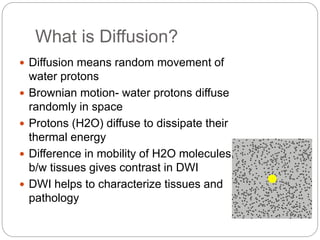
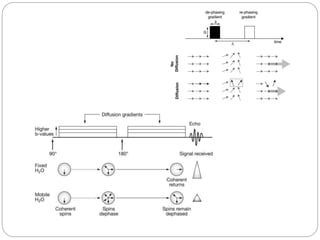
 Diffusion means random movement of
water protons
 Brownian motion- water protons diffuse
randomly in space
 Protons (H2O) diffuse to dissipate their
thermal energy
 Difference in mobility of H2O molecules
b/w tissues gives contrast in DWI
 DWI helps to characterize tissues and
pathology
Types of Diffusion
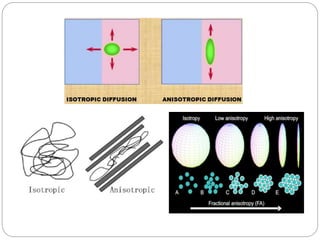
 Isotropic Diffusion
 Possibility of water protons moving in any one
particular direction is equal to the probability that it
will move in any other direction
 Isotropic means uniformity in all directions
 Anisotropic Diffusion
 Water diffusion has preferred direction
 Water can move easily in one direction than other
Isotropic diffusion basis for routine DWI
Anisotropic basis for DTI (diffusion tensor imaging) or
tractography
How do we acquire DWI?
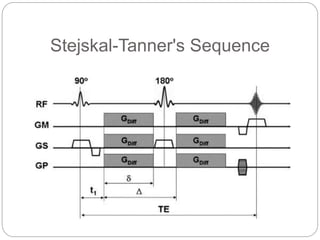
 “Stejskal-Tanner pulsed gradient spin echo seq;”
 First experimental sequence described for the
acquisition of DWI
 Forms the basis for all DWI performed today
 It is a T2-w SE sequence with diffusion gradients
applied before and after the 180 degree pulse
 Now, diffusion gradients can be applied to various
seq;
 Mostly applied to EPI seq; with infinite T2
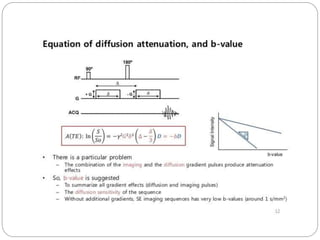
Stejskal-Tanner's Sequence
Terms and Concepts
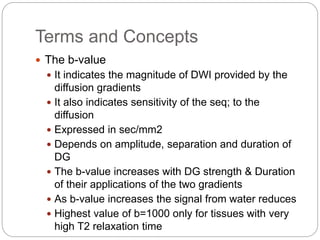
 The b-value
 It indicates the magnitude of DWI provided by the
diffusion gradients
 It also indicates sensitivity of the seq; to the
diffusion
 Expressed in sec/mm2
 Depends on amplitude, separation and duration of
DG
 The b-value increases with DG strength & Duration
of their applications of the two gradients
 As b-value increases the signal from water reduces
 Highest value of b=1000 only for tissues with very
high T2 relaxation time
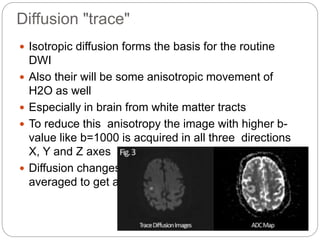
Diffusion "trace"
 Isotropic diffusion forms the basis for the routine
DWI
 Also their will be some anisotropic movement of
H2O as well
 Especially in brain from white matter tracts
 To reduce this anisotropy the image with higher b-
value like b=1000 is acquired in all three directions
X, Y and Z axes
 Diffusion changes along all three axes are then
averaged to get a ‘trace’ diffusion image
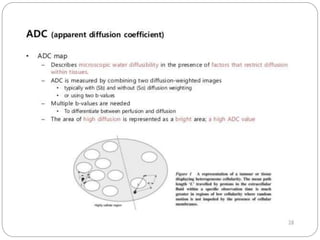
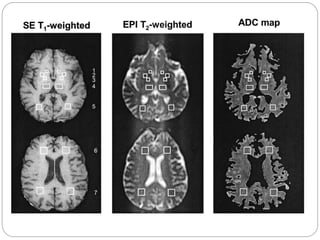
ADC: Apparent Diffusion Coefficient
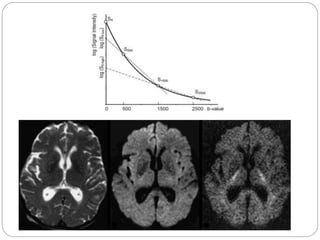
 ADC is measure of diffusion
 Calculated mathematically from b-value=0 and
higher b-value images
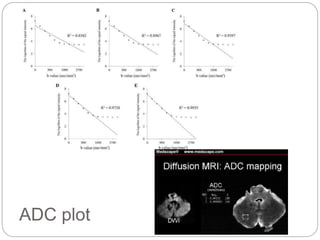
 Signal attenuation of a tissue with increasing
value plotted on graph with relative signal
intensity on y-axis and b-value of x-axis
 Resultant slope of line is ADC
 Done on pixel by pixel basis by computer
 To user it is available as ADC map
 ADC is independent of ‘B’
 Reduced ADC is ‘restricted diffusion’ [bright area]
on DWI
 While on same area will be dark on ADC map
 ADC value from map for AOI measured in
ADC plot
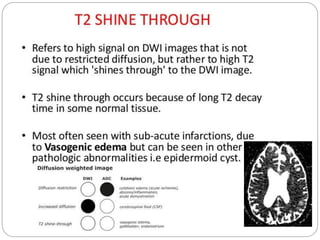
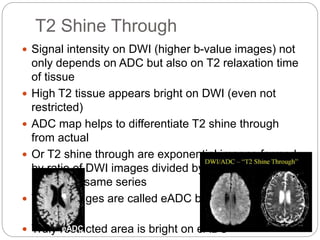
T2 Shine Through
 Signal intensity on DWI (higher b-value images) not
only depends on ADC but also on T2 relaxation time
of tissue
 High T2 tissue appears bright on DWI (even not
restricted)
 ADC map helps to differentiate T2 shine through
from actual
 Or T2 shine through are exponential images formed
by ratio of DWI images divided by T2-w (b=0)
images in same series
 These images are called eADC by some vendors
(Philips)
 Truly restricted area is bright on eADCeADC
Images available to view
 DWI routinely performed with EPI sequence
 Acquisition time is typically less than a minute
 With preset post-processing few sets of images
are available for viewing immediately after
acquisition
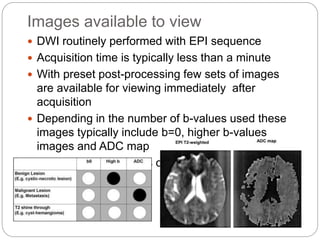
 Depending in the number of b-values used these
images typically include b=0, higher b-values
images and ADC map
 Higher b-value images considered as DWI
Clinical Applications of DWI
DWI in Stroke
 Failure of Na-K ATPase pump tissue ischemia
 Results in influx of extracellular water into cells
 This is called cytotoxic edema
 Net shift of water molecules from extracellular into
restricted intracellular space
 Overall, reduction in diffusion of water molecule in
that area
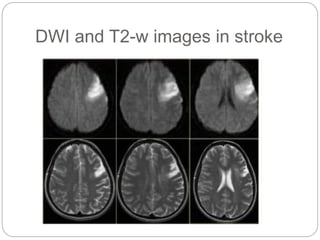
 Manifested as bright signal on DWI and dark signal
on ADC map
 DWI can detect early ischemic tissue (minute to
hours)
 DWI shows stroke lesion earliest (failure of T2
appears normal)
DWI and T2-w images in stroke
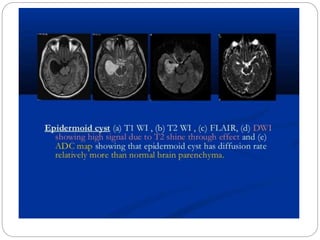
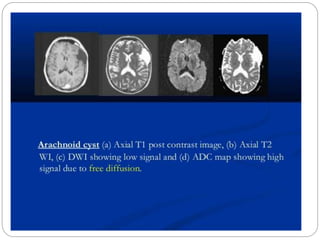
Epidermoid versus Arachnoid cyst
 Epidermoid composed of keratin, debris and solid
cholesterol
 Provide hindrance to diffusion of H2O molecules
 Epidermoid is seen as bright lesion on DWI
 Arachnoid cyst is clear CSF containing cyst, it will
not be bright on DWI will be same as CSF in the
signal intensity
 DWI can detect a residual epidermoid
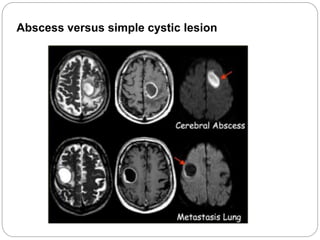
Abscess versus simple cystic lesion
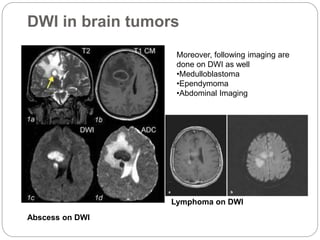
DWI in brain tumors
Abscess on DWI
Lymphoma on DWI
Moreover, following imaging are
done on DWI as well
•Medulloblastoma
•Ependymoma
•Abdominal Imaging
DWI Body Imaging
 Use of DWI in body imaging is new
 Big obstacles in DWI imaging are motion and
short T2 of various organs
 Imaging done with breathe-hold & respiratory
triggering
 DWI mainly used in tumor imaging and in follow-
up imaging
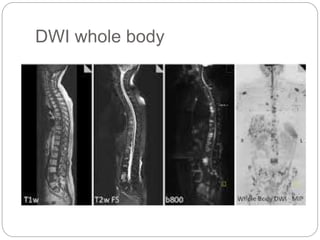
 For staging tumor and lymphoma whole body
imaging with background suppression is used in-
replacement to PET
 DWIBS (DW whole body imaging with
background body signal suppression)
 Final DWIBS images shows only diffusion
DWI whole body
Diffusion Tensor Imaging
 Routine DTI based on anisotropic diffusion of water
molecules
 Tensor is mathematical formalism used to model
anisotropic dif:
Technique
 MR scanner X, Y and Z are never perfectly parallel
to the WM tracts at every point in the image
 In DTI, images are acquired in at least six, usually
12-24 directions instead of three in usual trace
diffusion
 Pure ADC for each pixel is calculated from these
images in multiple directions
 This is called ‘principal eigen value’
 Images formed with principal eigen value is called
DTI that gives orientation of fiber tracts
Uses:
 DTI measure the magnitude of the ADC in the
preferred direction of water diffusion and
perpendicular to the direction
 The resultant image shows WM tracts very well
 Hence this technique is called ‘tractography’
 Various maps used to indicate orientation of fiber
tracts include FA (fractional anisotropy)
 RA (regional anisotropy) and VA (volume ratio) maps
 Tractography for the assessment of relationship of
tracts with tumor, tumor invasion of tracts and
preoperative planning
 Used to evaluate WM tracts in various congenital
Magnetic Resonance Diffusion

Magnetic Resonance Diffusion

  • 1.
    Rahman Ud Din LecturerMedical Imaging NWIHS
  • 2.
    Learning Outcomes  Whatis Diffusion?  How DWI is acquired?  Clinical applications of DWI  Diffusion Tensor Imaging?
  • 3.
    Introduction  Diffusion WeightedImaging (DWI)  Effective for diagnosis of various diseases  Vital technique  Brain imaging protocols (integral part)  It’s role is expanding to other body imaging
  • 4.
    What is Diffusion? Diffusion means random movement of water protons  Brownian motion- water protons diffuse randomly in space  Protons (H2O) diffuse to dissipate their thermal energy  Difference in mobility of H2O molecules b/w tissues gives contrast in DWI  DWI helps to characterize tissues and pathology
  • 5.
    Types of Diffusion Isotropic Diffusion  Possibility of water protons moving in any one particular direction is equal to the probability that it will move in any other direction  Isotropic means uniformity in all directions  Anisotropic Diffusion  Water diffusion has preferred direction  Water can move easily in one direction than other Isotropic diffusion basis for routine DWI Anisotropic basis for DTI (diffusion tensor imaging) or tractography
  • 7.
    How do weacquire DWI?  “Stejskal-Tanner pulsed gradient spin echo seq;”  First experimental sequence described for the acquisition of DWI  Forms the basis for all DWI performed today  It is a T2-w SE sequence with diffusion gradients applied before and after the 180 degree pulse  Now, diffusion gradients can be applied to various seq;  Mostly applied to EPI seq; with infinite T2
  • 8.
  • 10.
    Terms and Concepts The b-value  It indicates the magnitude of DWI provided by the diffusion gradients  It also indicates sensitivity of the seq; to the diffusion  Expressed in sec/mm2  Depends on amplitude, separation and duration of DG  The b-value increases with DG strength & Duration of their applications of the two gradients  As b-value increases the signal from water reduces  Highest value of b=1000 only for tissues with very high T2 relaxation time
  • 13.
    Diffusion "trace"  Isotropicdiffusion forms the basis for the routine DWI  Also their will be some anisotropic movement of H2O as well  Especially in brain from white matter tracts  To reduce this anisotropy the image with higher b- value like b=1000 is acquired in all three directions X, Y and Z axes  Diffusion changes along all three axes are then averaged to get a ‘trace’ diffusion image
  • 15.
    ADC: Apparent DiffusionCoefficient  ADC is measure of diffusion  Calculated mathematically from b-value=0 and higher b-value images  Signal attenuation of a tissue with increasing value plotted on graph with relative signal intensity on y-axis and b-value of x-axis  Resultant slope of line is ADC  Done on pixel by pixel basis by computer  To user it is available as ADC map  ADC is independent of ‘B’  Reduced ADC is ‘restricted diffusion’ [bright area] on DWI  While on same area will be dark on ADC map  ADC value from map for AOI measured in
  • 16.
  • 19.
    T2 Shine Through Signal intensity on DWI (higher b-value images) not only depends on ADC but also on T2 relaxation time of tissue  High T2 tissue appears bright on DWI (even not restricted)  ADC map helps to differentiate T2 shine through from actual  Or T2 shine through are exponential images formed by ratio of DWI images divided by T2-w (b=0) images in same series  These images are called eADC by some vendors (Philips)  Truly restricted area is bright on eADCeADC
  • 20.
    Images available toview  DWI routinely performed with EPI sequence  Acquisition time is typically less than a minute  With preset post-processing few sets of images are available for viewing immediately after acquisition  Depending in the number of b-values used these images typically include b=0, higher b-values images and ADC map  Higher b-value images considered as DWI
  • 21.
    Clinical Applications ofDWI DWI in Stroke  Failure of Na-K ATPase pump tissue ischemia  Results in influx of extracellular water into cells  This is called cytotoxic edema  Net shift of water molecules from extracellular into restricted intracellular space  Overall, reduction in diffusion of water molecule in that area  Manifested as bright signal on DWI and dark signal on ADC map  DWI can detect early ischemic tissue (minute to hours)  DWI shows stroke lesion earliest (failure of T2 appears normal)
  • 22.
    DWI and T2-wimages in stroke
  • 23.
    Epidermoid versus Arachnoidcyst  Epidermoid composed of keratin, debris and solid cholesterol  Provide hindrance to diffusion of H2O molecules  Epidermoid is seen as bright lesion on DWI  Arachnoid cyst is clear CSF containing cyst, it will not be bright on DWI will be same as CSF in the signal intensity  DWI can detect a residual epidermoid
  • 26.
    Abscess versus simplecystic lesion
  • 27.
    DWI in braintumors Abscess on DWI Lymphoma on DWI Moreover, following imaging are done on DWI as well •Medulloblastoma •Ependymoma •Abdominal Imaging
  • 28.
    DWI Body Imaging Use of DWI in body imaging is new  Big obstacles in DWI imaging are motion and short T2 of various organs  Imaging done with breathe-hold & respiratory triggering  DWI mainly used in tumor imaging and in follow- up imaging  For staging tumor and lymphoma whole body imaging with background suppression is used in- replacement to PET  DWIBS (DW whole body imaging with background body signal suppression)  Final DWIBS images shows only diffusion
  • 29.
  • 30.
    Diffusion Tensor Imaging Routine DTI based on anisotropic diffusion of water molecules  Tensor is mathematical formalism used to model anisotropic dif: Technique  MR scanner X, Y and Z are never perfectly parallel to the WM tracts at every point in the image  In DTI, images are acquired in at least six, usually 12-24 directions instead of three in usual trace diffusion  Pure ADC for each pixel is calculated from these images in multiple directions  This is called ‘principal eigen value’
  • 31.
     Images formedwith principal eigen value is called DTI that gives orientation of fiber tracts Uses:  DTI measure the magnitude of the ADC in the preferred direction of water diffusion and perpendicular to the direction  The resultant image shows WM tracts very well  Hence this technique is called ‘tractography’  Various maps used to indicate orientation of fiber tracts include FA (fractional anisotropy)  RA (regional anisotropy) and VA (volume ratio) maps  Tractography for the assessment of relationship of tracts with tumor, tumor invasion of tracts and preoperative planning  Used to evaluate WM tracts in various congenital