Fat
suppression
imaging
By
Roshan Shah
B.Sc. MIT 3rd year
3rd batch
Introduction
 Fat saturation is an MRI technique used to
suppress the signal from normal adipose
tissue.
 To suppress the fat signal for a given MR
sequence a fat suppression module is
typically inserted at the beginning of an
otherwise normal MRI sequence.
Indication
 It is used in MRI for mainly two purpose.
To suppress the signal from normal
adipose tissue to reduce chemical shift
artifact or improve visualization of
uptake of contrast material.
Tissue characterization, particularly in
adrenal gland tumors, bone marrow
infiltration, fatty tumors, etc.
Physics for fat suppression
 (FAT SAT) A specialized technique that selectively
saturates fat protons prior to acquiring data as in
standard sequence, so that they produce a
negligible signal.
 This technique requires a homogeneous magnetic
field and homogeneous volume of tissue.
 To prepare this type of sequence, the following
properties should be used.
 Fat and water have different resonant
frequencies
 They have different Larmor precession
frequencies
 They have different T1 relaxation times.
Advantages
 This method is reliable for contrast material
enhanced T1 weighted imaging.
 It is useful in tissue characterization
particularly in area with a large amount of
fat.
 It also useful for avoiding chemical shift
misregistration artifact.
 Allows good visualization of small anatomical
details.
Disadvantage
Inhomogeneities of the static
magnetic field.
Inhomogeneities In the radio-
frequency field.
Inhomogeneities in volume of tissue.
Methods
 Fat suppression can be achieved in a
number of different ways.
 Short tau inversion recovery (STIR)
 Chemical shift Selective (CHESS) Fat-Sat.
 Spectral Pre-saturation with Inversion Recovery
(SPIR)
 Spectral Attenuated Inversion Recovery (SPAIR)
 Water excitation
 DIXON-based
STIR
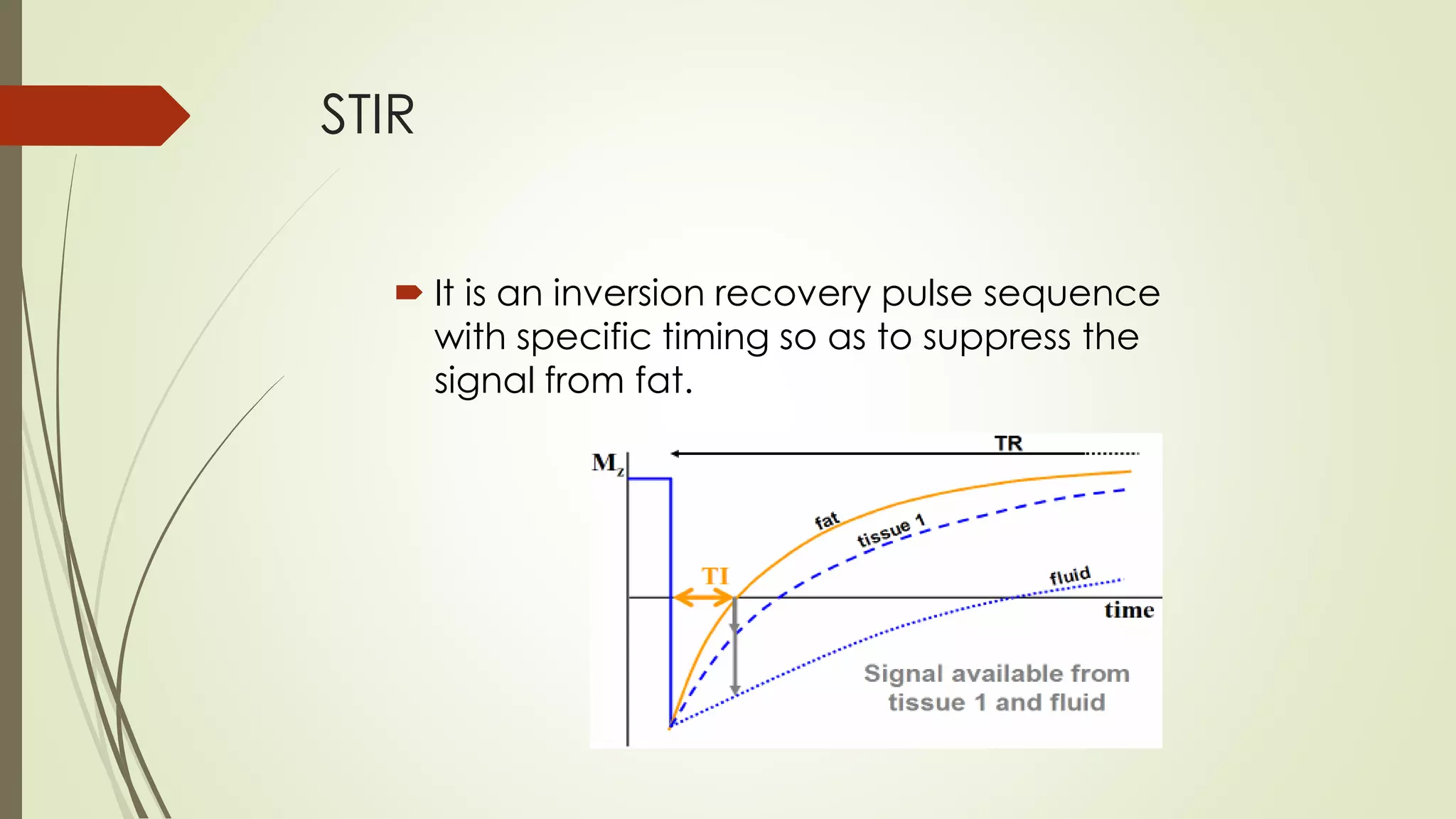
 It is an inversion recovery pulse sequence
with specific timing so as to suppress the
signal from fat.
Cont.…
Advantages:
1. It suppresses whole of the adipose tissue including
water fraction
2. This is only method which can be used even in
magnetic field inhomogeneities.
3. It can be used with low magnetic field strength.
Disadvantages:
1. Beginning at TI null most of the proton have not
completely relaxation, and are therefore still partially
saturated, in this situation will overall produce signal loss
and SNR ratio will decrease.
2. It cannot be used post gadolinium to demonstrate
contrast enhancement.
3. Long acquisition time
4. Tissue contrast is affected. SNR is reduced.
MRI image appearance
 Fluids normally appear bright and fat appear very dark
in a STIR images.
 Pathological processes normally increase the water
content in tissues. Due to the added water component
this results in a signal increase on STIR images.
Consequently pathological processes are usually bright
on STIR images.
STIR sagittal sequence used in C spine imaging and knee
imaging
CHESS
 Based on the chemical shift between fat and
water.
 In this short-duration RF-pulses tuned to the
resonance frequency of fat.
 RF-pulse tuned to the fat resonance frequency
together with a spoiler gradient saturates and
dephase fat protons, leaving only water protons
to produce a signal.
Cont.…
 Advantages
 It can be added to any pulse sequence.
 Can be used for post contrast imaging.
 Disadvantages
 It cannot be used at low field strength.
 It also cannot be use in Inhomogeneities of the
static magnetic field.
Can be used in post contrast MR arthrography.
MRI image appearance
SPIR
 It is the combination of the spectral
saturation and STIR routines.
MRI image appearance
SPAIR
 It is a hybrid technique combining
features of both CHESS and STIR.
 SPAIR uses an adiabatic pulses.
Cont.…
 Advantages
SPAIR provide better and more homogeneous fat
suppression than SPIR
Tissue contrast is not affected.
 Disadvantages
The inversion time is longer.
Reduce number of slice for a given TR.
MRI image appearance
Water excitation
This technique is based on the
chemical shift.
Instead of suppressing fat, these
techniques use a short series of RF
pulses(binomial pulse) to selectively
excite water protons.
No spoilers are needed.
Cont.…
 Advantages
No additional preparation pulse is
necessary.
Reduced sensitivity to B1
Inhomogeneities
 Disadvantages
Increased total measurement time
Reduced maximum number of slices.
Application
 used primarily in the musculoskeletal system, especially
for evaluation of cartilage. Some 3D applications in the
breast and liver have also been reported.
DIXON-based
This technique is based on the chemical shift.
It uses ‘In phase’ and ‘Out phase’ cycling of fat
and water.
Acquiring 2, 3 or more echoes at different TE's,
"water only" and "fat only" images can be
extracted
In-phase
water
Out-phase
fat
Cont.…
 Advantages
Insensitive to B0 and B1
Inhomogeneities.
4 contrasts delivered in one
measurement.
 Disadvantages
Increases minimal TR because in- and
opposed phase data must be
acquired.
Application
The Dixon technique is widely used in abdominal
imaging, imaging of the extremities, and the
spine.
The opposed phased imaging is useful for
detection of small amounts of fat. Ex- adrenal
gland tumors or steatosis.
Fat suppression imaging

Fat suppression imaging

  • 1.
  • 2.
    Introduction  Fat saturationis an MRI technique used to suppress the signal from normal adipose tissue.  To suppress the fat signal for a given MR sequence a fat suppression module is typically inserted at the beginning of an otherwise normal MRI sequence.
  • 3.
    Indication  It isused in MRI for mainly two purpose. To suppress the signal from normal adipose tissue to reduce chemical shift artifact or improve visualization of uptake of contrast material. Tissue characterization, particularly in adrenal gland tumors, bone marrow infiltration, fatty tumors, etc.
  • 4.
    Physics for fatsuppression  (FAT SAT) A specialized technique that selectively saturates fat protons prior to acquiring data as in standard sequence, so that they produce a negligible signal.  This technique requires a homogeneous magnetic field and homogeneous volume of tissue.  To prepare this type of sequence, the following properties should be used.  Fat and water have different resonant frequencies  They have different Larmor precession frequencies  They have different T1 relaxation times.
  • 5.
    Advantages  This methodis reliable for contrast material enhanced T1 weighted imaging.  It is useful in tissue characterization particularly in area with a large amount of fat.  It also useful for avoiding chemical shift misregistration artifact.  Allows good visualization of small anatomical details.
  • 6.
    Disadvantage Inhomogeneities of thestatic magnetic field. Inhomogeneities In the radio- frequency field. Inhomogeneities in volume of tissue.
  • 7.
    Methods  Fat suppressioncan be achieved in a number of different ways.  Short tau inversion recovery (STIR)  Chemical shift Selective (CHESS) Fat-Sat.  Spectral Pre-saturation with Inversion Recovery (SPIR)  Spectral Attenuated Inversion Recovery (SPAIR)  Water excitation  DIXON-based
  • 8.
    STIR  It isan inversion recovery pulse sequence with specific timing so as to suppress the signal from fat.
  • 9.
    Cont.… Advantages: 1. It suppresseswhole of the adipose tissue including water fraction 2. This is only method which can be used even in magnetic field inhomogeneities. 3. It can be used with low magnetic field strength. Disadvantages: 1. Beginning at TI null most of the proton have not completely relaxation, and are therefore still partially saturated, in this situation will overall produce signal loss and SNR ratio will decrease. 2. It cannot be used post gadolinium to demonstrate contrast enhancement. 3. Long acquisition time 4. Tissue contrast is affected. SNR is reduced.
  • 10.
    MRI image appearance Fluids normally appear bright and fat appear very dark in a STIR images.  Pathological processes normally increase the water content in tissues. Due to the added water component this results in a signal increase on STIR images. Consequently pathological processes are usually bright on STIR images.
  • 11.
    STIR sagittal sequenceused in C spine imaging and knee imaging
  • 12.
    CHESS  Based onthe chemical shift between fat and water.  In this short-duration RF-pulses tuned to the resonance frequency of fat.  RF-pulse tuned to the fat resonance frequency together with a spoiler gradient saturates and dephase fat protons, leaving only water protons to produce a signal.
  • 13.
    Cont.…  Advantages  Itcan be added to any pulse sequence.  Can be used for post contrast imaging.  Disadvantages  It cannot be used at low field strength.  It also cannot be use in Inhomogeneities of the static magnetic field. Can be used in post contrast MR arthrography.
  • 14.
  • 15.
    SPIR  It isthe combination of the spectral saturation and STIR routines.
  • 16.
  • 17.
    SPAIR  It isa hybrid technique combining features of both CHESS and STIR.  SPAIR uses an adiabatic pulses.
  • 18.
    Cont.…  Advantages SPAIR providebetter and more homogeneous fat suppression than SPIR Tissue contrast is not affected.  Disadvantages The inversion time is longer. Reduce number of slice for a given TR.
  • 19.
  • 20.
    Water excitation This techniqueis based on the chemical shift. Instead of suppressing fat, these techniques use a short series of RF pulses(binomial pulse) to selectively excite water protons. No spoilers are needed.
  • 22.
    Cont.…  Advantages No additionalpreparation pulse is necessary. Reduced sensitivity to B1 Inhomogeneities  Disadvantages Increased total measurement time Reduced maximum number of slices.
  • 23.
    Application  used primarilyin the musculoskeletal system, especially for evaluation of cartilage. Some 3D applications in the breast and liver have also been reported.
  • 24.
    DIXON-based This technique isbased on the chemical shift. It uses ‘In phase’ and ‘Out phase’ cycling of fat and water. Acquiring 2, 3 or more echoes at different TE's, "water only" and "fat only" images can be extracted
  • 25.
  • 26.
    Cont.…  Advantages Insensitive toB0 and B1 Inhomogeneities. 4 contrasts delivered in one measurement.  Disadvantages Increases minimal TR because in- and opposed phase data must be acquired.
  • 27.
    Application The Dixon techniqueis widely used in abdominal imaging, imaging of the extremities, and the spine. The opposed phased imaging is useful for detection of small amounts of fat. Ex- adrenal gland tumors or steatosis.