Prepared by
Smrite Ranabhat
M. Optom
TIO
 Introduction
 Physics of MRA
 Techniques
 Patient preparation
 Contraindications
 Indications
 Cases
 The American college of Radiology ( ACR ) describes MRA as technique
using “MR pulse sequences “ to determine blood flow and image blood
vessels.
 It relies on time of flight (TOF) for flow images and quantitative measurements
for flow velocity by phase-contrast (PC)
 It is a type of magnetic resonance imaging(MRI) scan that uses a magnetic
field and pulses of radio wave energy to provide pictures of blood vessels
inside the body.
 Advantages of MR angiography:
Compared with catheter angiography, MRA is less invasive, less expensive, and
faster to perform.
For conventional angiography, catheter is inserted though the patients groin and
threaded up into the artery in the brain
MRA does not require this catheter. As a result, it eliminates related
complications such as possible damage to an artery
 Disadvantages of MR angiography:
Does not depict small vessels or extremely slow blood flow as well as
conventional angiography dose.
 Until the early 1990s, the only method for diagnosing disease in the
intracranial arteries was the invasive angiography .
 Angiography has 4% risk of minor stroke,1% risk of major stroke and 0.1%
risk of death.
MRA Conventional
angiography
Non invasive Invasive
No contrast required Nephrotoxic contrast
Non ionizing Ionizing radiation
Signal from flowing blood depends on
 TE
 TR
 Thickness of slice
 Position of slice
Characterstics of flow is given by Reynolds number
(density*viscosity*diameter) which is dimensionless and has no units.
 <2100 laminar flow
 >2100 turbulent flow
Signal loss in MRI is due to
 Turbulence
 High velocity of blood flow
 Dephasing
HVSL (high velocity signal loss)
Absent with GRE pulse sequence
Spins in slice ( stationary spin) or if they have moved ( flowing spin) relax at same
rate with same amplitude.
It is function of velocity and TE.
 In MR angiography it is often essential to eliminate arterial or venous signal
 Use of presaturation pulse to eliminate artifacts
 Eliminates flow related enhancement and phase ghosting
Flow related enhancement (FRE)
Slowing flowing blood enters the first slice of multislice imaging volume,
partially saturated blood remaining from previous sequence is totally replaced by
unsaturated flowing blood which elicits strong signal known as FRE or entry
phenomenan.
Depends on
 Blood velocity
 TR
 Number of slices
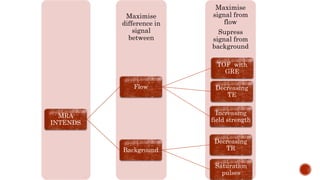
Maximise
signal from
flow
Supress
signal from
background
Maximise
difference in
signal
between
MRA
INTENDS
Flow
TOF with
GRE
Decreasing
TE
Increasing
field strength
Background
Decreasing
TR
Saturation
pulses
 STEPS INVOLVED IN GENERATING IMAGE
90 deg .
Turn on RF
Slice select gradient
Phase encoding gradient
Frequency encoding gradient
Time
TE
 Free induction decay (FID) refers a short-lived
sinusoidal electromagnetic signal which appears
immediately following the 90° pulse.
 It does not contribute to form MR image
 Either of the signals generated by the RF-pulse train
("FIDs" or "Echoes") can be temporarily suppressed
and then made to reappear at a chosen time (TE) by
application of an external magnetic gradient field.
 The gradient is typically applied in two steps:
1) a dephase portion that forces spins out of phase, and
2) a rephase portion that brings them back into phase
as the GRE.
Pulse sequences enable us to control the way in which the system applies pulses
and gradients.
In this way, image weighting and quality is determined.
There are many different pulse sequences available, and each is designed for a
specific purpose.
SPIN ECHO SEQUENCE
 It consists of 90 and 180degree RF pulse
 Initially 90 degree pulse is given
 After 90 degree pulse TM vector starts
dephasing
 Next we are going to give 180 degree pulse
 After giving 180 degree pulse TM vector
direction is changed
 Now TM vector started rephasing
 Getting good signal to form the image
 There is no 180 degree pulse in gradient echo
sequence.
 Rephasing of TM in GRE is done by gradients;
particularly by reversal of the frequency
encoding gradient.
 Since rephasing by gradient gives good signal.
 Initially 90 degree pulse is given
 TM vector started dephasing due to
inhomogeneity
 Gradient polarity is reversed
 TM vector started rephasing
 Completely rephasing TM vectors and good
signal is obtained
 In this type of imaging blood appear bright most of this are gradient echo
sequences.
 In this GRE sequences excitation pulse is slice selected but the rephrasing
which is done by gradient rather than 180 degree pulse is not limited to the
slice of interest and is applied to whole imaging volume therefore a flowing
proton will receive an excitation pulse is rephrased regardless of its slice
position.
 Blood flow- bright image
 Slow flow and clot- black image
 In this techniques blood appears as black as this are spin-echo based sequences
techniques.
 However proton in the flowing blood usually do not receive either 90 degree
or 180 degree pulse.
 Hence signal is not produced and flowing blood appear as dark.
 Slow flow and clots can produced bright signal because they received both 90
degree or 180 degree pulse.
 Maximum intensity projection is replaced by Minimum intensity projection
 Blood flow- black image
 Slow flow and clot- bright image
1.TIME OF FLIGHT (TOF)
2.PHASE CONTRAST (PC)
3.CONTRAST ENHANCED MRA (CE MRA)
Non contrast enhanced( TOF , PC) are time consuming compared to contrast
enhanced.
BASIC PRINCIPLES
Protons are excited using GRE pulse sequence
MANIPULATING MAGNITUDE OF MAGNETIZATION
-Vascular contrast in TOF MRA is due to difference in the magnitude of the
inflowing protons in the blood and the surrounding stationary protons.
- No contrast agent injected
-Motion artifact
-Difficulty with slow flow
TOF MRA is based on the differences in saturation between the extravascular
and intravascular (moving blood) constituents.
A gradient pulse is repeatedly applied to a slice/slab (two-dimensional
[2D]/three-dimensional [3D]) of tissue.
The signal intensity of static tissue (extravascular) is progressively suppressed
by repetitive radio frequency pulses, the signal from the stationary tissue
decreases and becomes more saturated with each pulse.
The moving blood brings unsaturated protons into the tissue slice, which
generates a high signal intensity. and the inflow enhancement in the investigated
vessel produces the angiographic effect.
2D time of flight
Multiple thin section of body are studied individually so even slow blood flow is
identified. With 2-D TOF, multiple thin imaging slices are acquired with a flow
compensated gradient- echo sequences. These images can be combined by using a
technique of reconstruction such as maximum intensity projection(MIP), to obtain a 3-
D image of the vessels analogous to conventional angiography
3D time of flight
In 3D technique , a large volume of tissue is studied ,which can be subsequently
partitioned into individual slices, hence high resolution can be obtained and flow
artifacts are minimized, and less likely to be affected by loops and tortuosity of vessels
An angiographic appearance can be generated using MIP, as is done with 2-D TOF
MOTSA(multiple overlapping thin slab acquisition)
Prevents proton saturation across the slab. This technique have advantage of both 2D
and 3D studies. It is better than 3D TOF MRA in correctly identifying vascular loops
and tortuosity.
Saturation pulses involve the application of RF energy
to suppress the MR signal from moving tissues outside
the imaged volume to reduce or eliminate motion
artifacts.
Misregistration artifact due to swallowing
ARETERIAL AND VENOUS BOOD FLOW IN BRAIN
 Uses parameters typical of 3D TOF MRA but gadolinium contrast is also
given.
 Data are acquired after contrast bolus infusion ( Gad. 0.1-.2 mmol/kg).
 Unlike, time-of-flight (TOF) or phase contrast (PC) imaging, the signals of the
blood in CEMRA is based on the intrinsic T1 signal of blood and rather less on
flow effects; therefore, this technique is less flow sensitive and counteracts
saturation effect.
 It can be performed within seconds
 Nephrogenic systemic fibrosis is rare but serious complication.
 Is based on the T1 values of blood, the surrounding tissue, and paramagnetic
contrast agent.
 T1-shortening contrast agents reduces the T1 value of the blood
(approximately to 50 msec, shorter than that of the surrounding tissues) and
allow the visualization of blood vessels, as the images are no longer dependent
primarily on the inflow effect of the blood.
 Contrast enhanced MRA is performed with a short TR to have low signal (due
to the longer T1) from the stationary tissue.
 Short scan time to facilitate breath hold imaging.
 Venous thrombosis
 Intracranial hypertension
 Drowsiness accompanying headache
MANIPULATING PHASE OF MAGNETIZATION
It is an MRI technique that can be used to visualize moving fluid.
It is typically used for MR venography as a non IV-contrast requiring technique.
Spin that are moving in the same direction as a magnetic field gradient develop a phase
shift that is proportional to the velocity of the spins. This is the basis of phase-contrast
angiography.
In the simplest phase- contrast pulse sequences, bipolar gradients are used to encode the
velocity of the spins.
Stationary spins undergo no net change in phase after the two gradients applied.
Moving spins will experience a different magnitude of the second gradient compared to
the first, because of its different spatial position. This result in net phase shift.
Mostly used for CSF
 In PC MRA bipolar gradient is applied and if the proton is stationary there is
no phase shift. However if the protons are moving, a phase shift occurs.
 The faster the proton moves greater the phase shift.
 Phase is proportional to velocity
 Allows quantification of blood flow and velocity
 Phase sensitization can be acquired along only one axis at a time.
 PC technique tends to be 4 times slower than TOF techniques
 Initial symptoms of cavernous sinus thrombosis are progressively severe
headache or facial pain, usually unilateral and localized to retro-orbital and
frontal regions. High fever is common.
 Later, ophthalmoplegia (typically the 6th cranial nerve in the initial stage),
proptosis, and eyelid edema develop and often become bilateral. Facial
sensation may be diminished or absent.
 Decreased level of consciousness, confusion, seizures, and focal neurologic
deficits are signs of central nervous system (CNS) spread.
 Patients with cavernous sinus thrombosis may also have anisocoria or
mydriasis (3rd cranial nerve dysfunction), papilledema, and vision loss.
• Satisfactory written consent
• Remove all metals and give hospital gown
• Bathroom going prior to examination
• Explain procedure and instruct properly
• Note the weight
Patient positioning for MRA of the brain is generally similar to positioning for
brain MRI. Patients are positioned supine and in a transmit-receive head coil.
 Any electrically , magnetically or mechanically activated implant e.g.: cardiac
pacemaker, insulin pump biostimulator,neurostimulator, cochlear implant , and
hearing aids.( active implant)
 Passive implants
-aneurysm clips( unless made of titanium), stents, hip prostheses, catheter
 Pregnancy ( risk vs benefit ratio to be assessed )
 Ferromagnetic surgical clips or staples
 Metallic foreign body in eye
To evaluate conditions of the carotid arteries such as:
 Stenotic / occlusive disease in symptomatic patients
(e.g., TIA or CVA)
 Stenotic / occlusive disease in asymptomatic members
when Doppler scan is abnormal
 Aneurysms
 Cervicocranial arterial dissection in members with
suggestive signs or symptoms (e.g., unilateral headache ,
oculosympathetic palsy, amaurosis fugax, and symptoms
of focal brain ischemia)
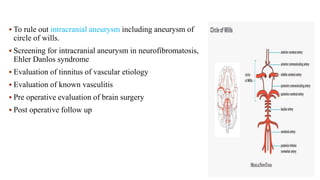
 To rule out intracranial aneurysm including aneurysm of
circle of wills.
 Screening for intracranial aneurysm in neurofibromatosis,
Ehler Danlos syndrome
 Evaluation of tinnitus of vascular etiology
 Evaluation of known vasculitis
 Pre operative evaluation of brain surgery
 Post operative follow up
 As a follow op study of arteriovenous
malformation
An arteriovenous malformation (AVM) is an
abnormal tangle of blood vessels connecting arteries
and veins, which disrupts normal blood flow and
oxygen circulation
To evaluate patients with signs/symptoms highly
suggestive of leaking/ruptured aneurysm or AVM
(i.e., sudden explosive headache, blurred vision, stiff
neck, pulsatile proptosis ,blood in the cerebral spinal
fluid);
A 58-year-old woman with 1 and a half years of right eye redness, ocular hypertension and recurrent headache.
Angiography done ,after endovascular embolism RX redness and hypertension reversed back.
Conclusion
In clinical practice, when corkscrew hyperaemia
accompanied by neurological symptoms is found,
cerebral vascular diseases might be considered.
RX. Endovascular embolization – cutting of blood
supply to certain part
sterotactic radiotherapy
Intracranial vascular disease
 A CCF carotid cavernous fistula refers to an aberrant connection between the
internal carotid artery (ICA), the external carotid artery (ECA) or any of their
branches within the cavernous sinus .
 The symptoms and signs of a CCF always include eyelid swelling, proptosis,
chemosis, and corkscrew hyperemia.
 Cranial nerves III,IV, V and VI can be affected
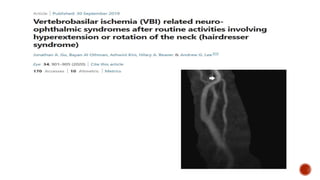
 To definitively establish presence of stenosis or other abnormalities of the vertebrobasilar
system in patients with symptoms highly suggestive of vertebrobasilar syndrome (binocular
vision loss, positional vertigo, dysarthria, dysphagia, diplopia)
The vertebrobasilar (VB) system, comprised of the vertebral and basilar arteries, serves as a
critical arterial supply to the cervical spinal cord brainstem, cerebellum, thalamus, and occipital
lobes.
One of the direct neurologic presentations, locked-in syndrome, is resultant from thrombosis of
the proximal and middle portions of the BA
Clinical manifestations of the locked-in syndrome include nearly complete paralysis of all
voluntary muscles, with preserved consciousness and cognitive function.
Alternatively, distal BA embolism may present with the features which include oculomotor and
pupillary disturbances, visual hallucinations, and alterations in consciousness.
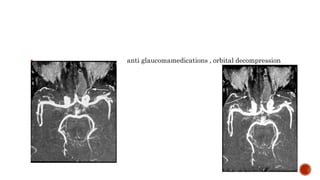
 48 year old woman – TED- 4 week history of pain, redness, and reduced visual acuity
RE
 B/L three wall orbital decompression 8 YRS before
 VA @ CF1m OD and 6/9 OS
 B/L lid retraction and mild generalised restriction of eye movements.
 B/L proptosis measuring 24 mm in the right eye and 23 mm in the left.
 RAPD+ OD
 IOP - 50 mm Hg OD , 20 mm Hg .
 There was right corneal oedema, rubeosis iridis , and moderate anterior chamber
activity. Gonioscopy showed an open, grade 2 angle (Shaffer’s classification) with
rubeotic vessels present in the angle. Fundal examination was limited by the corneal
oedema but no specific abnormality was identified. Examination of the left eye was
normal.
 anti glaucomamedications , orbital decompression
 Various abnormalities of the orbital circulation have been reported in thyroid
ophthalmopathy. Blood flow in the superior ophthalmic vein has been shown to
be reduced or even reversed in some patient.
 Ischemia of the optic nerve head has been postulated to have a role in the
development of optic neuropathy in some patients with thyroid
ophthalmopathy.
 Ocular ischemic syndrome as a result of ophthalmic artery obstruction in
thyroid eye disease. Furthermore, it demonstrates the usefulness of MR
imaging in evaluation of the ophthalmic artery.
MRA for rubeosis iridis , rubeotic glaucoma, iritis
Mra , mrv

Mra , mrv

  • 1.
  • 2.
     Introduction  Physicsof MRA  Techniques  Patient preparation  Contraindications  Indications  Cases
  • 3.
     The Americancollege of Radiology ( ACR ) describes MRA as technique using “MR pulse sequences “ to determine blood flow and image blood vessels.  It relies on time of flight (TOF) for flow images and quantitative measurements for flow velocity by phase-contrast (PC)  It is a type of magnetic resonance imaging(MRI) scan that uses a magnetic field and pulses of radio wave energy to provide pictures of blood vessels inside the body.
  • 4.
     Advantages ofMR angiography: Compared with catheter angiography, MRA is less invasive, less expensive, and faster to perform. For conventional angiography, catheter is inserted though the patients groin and threaded up into the artery in the brain MRA does not require this catheter. As a result, it eliminates related complications such as possible damage to an artery  Disadvantages of MR angiography: Does not depict small vessels or extremely slow blood flow as well as conventional angiography dose.
  • 5.
     Until theearly 1990s, the only method for diagnosing disease in the intracranial arteries was the invasive angiography .  Angiography has 4% risk of minor stroke,1% risk of major stroke and 0.1% risk of death. MRA Conventional angiography Non invasive Invasive No contrast required Nephrotoxic contrast Non ionizing Ionizing radiation
  • 7.
    Signal from flowingblood depends on  TE  TR  Thickness of slice  Position of slice Characterstics of flow is given by Reynolds number (density*viscosity*diameter) which is dimensionless and has no units.  <2100 laminar flow  >2100 turbulent flow
  • 8.
    Signal loss inMRI is due to  Turbulence  High velocity of blood flow  Dephasing HVSL (high velocity signal loss) Absent with GRE pulse sequence Spins in slice ( stationary spin) or if they have moved ( flowing spin) relax at same rate with same amplitude. It is function of velocity and TE.
  • 9.
     In MRangiography it is often essential to eliminate arterial or venous signal  Use of presaturation pulse to eliminate artifacts  Eliminates flow related enhancement and phase ghosting Flow related enhancement (FRE) Slowing flowing blood enters the first slice of multislice imaging volume, partially saturated blood remaining from previous sequence is totally replaced by unsaturated flowing blood which elicits strong signal known as FRE or entry phenomenan. Depends on  Blood velocity  TR  Number of slices
  • 10.
    Maximise signal from flow Supress signal from background Maximise differencein signal between MRA INTENDS Flow TOF with GRE Decreasing TE Increasing field strength Background Decreasing TR Saturation pulses
  • 11.
     STEPS INVOLVEDIN GENERATING IMAGE 90 deg . Turn on RF Slice select gradient Phase encoding gradient Frequency encoding gradient Time TE
  • 12.
     Free inductiondecay (FID) refers a short-lived sinusoidal electromagnetic signal which appears immediately following the 90° pulse.  It does not contribute to form MR image  Either of the signals generated by the RF-pulse train ("FIDs" or "Echoes") can be temporarily suppressed and then made to reappear at a chosen time (TE) by application of an external magnetic gradient field.  The gradient is typically applied in two steps: 1) a dephase portion that forces spins out of phase, and 2) a rephase portion that brings them back into phase as the GRE.
  • 13.
    Pulse sequences enableus to control the way in which the system applies pulses and gradients. In this way, image weighting and quality is determined. There are many different pulse sequences available, and each is designed for a specific purpose.
  • 14.
    SPIN ECHO SEQUENCE It consists of 90 and 180degree RF pulse  Initially 90 degree pulse is given  After 90 degree pulse TM vector starts dephasing  Next we are going to give 180 degree pulse  After giving 180 degree pulse TM vector direction is changed  Now TM vector started rephasing  Getting good signal to form the image
  • 15.
     There isno 180 degree pulse in gradient echo sequence.  Rephasing of TM in GRE is done by gradients; particularly by reversal of the frequency encoding gradient.  Since rephasing by gradient gives good signal.  Initially 90 degree pulse is given  TM vector started dephasing due to inhomogeneity  Gradient polarity is reversed  TM vector started rephasing  Completely rephasing TM vectors and good signal is obtained
  • 17.
     In thistype of imaging blood appear bright most of this are gradient echo sequences.  In this GRE sequences excitation pulse is slice selected but the rephrasing which is done by gradient rather than 180 degree pulse is not limited to the slice of interest and is applied to whole imaging volume therefore a flowing proton will receive an excitation pulse is rephrased regardless of its slice position.  Blood flow- bright image  Slow flow and clot- black image
  • 18.
     In thistechniques blood appears as black as this are spin-echo based sequences techniques.  However proton in the flowing blood usually do not receive either 90 degree or 180 degree pulse.  Hence signal is not produced and flowing blood appear as dark.  Slow flow and clots can produced bright signal because they received both 90 degree or 180 degree pulse.  Maximum intensity projection is replaced by Minimum intensity projection  Blood flow- black image  Slow flow and clot- bright image
  • 19.
    1.TIME OF FLIGHT(TOF) 2.PHASE CONTRAST (PC) 3.CONTRAST ENHANCED MRA (CE MRA) Non contrast enhanced( TOF , PC) are time consuming compared to contrast enhanced. BASIC PRINCIPLES Protons are excited using GRE pulse sequence
  • 20.
    MANIPULATING MAGNITUDE OFMAGNETIZATION -Vascular contrast in TOF MRA is due to difference in the magnitude of the inflowing protons in the blood and the surrounding stationary protons. - No contrast agent injected -Motion artifact -Difficulty with slow flow
  • 21.
    TOF MRA isbased on the differences in saturation between the extravascular and intravascular (moving blood) constituents. A gradient pulse is repeatedly applied to a slice/slab (two-dimensional [2D]/three-dimensional [3D]) of tissue. The signal intensity of static tissue (extravascular) is progressively suppressed by repetitive radio frequency pulses, the signal from the stationary tissue decreases and becomes more saturated with each pulse. The moving blood brings unsaturated protons into the tissue slice, which generates a high signal intensity. and the inflow enhancement in the investigated vessel produces the angiographic effect.
  • 22.
    2D time offlight Multiple thin section of body are studied individually so even slow blood flow is identified. With 2-D TOF, multiple thin imaging slices are acquired with a flow compensated gradient- echo sequences. These images can be combined by using a technique of reconstruction such as maximum intensity projection(MIP), to obtain a 3- D image of the vessels analogous to conventional angiography 3D time of flight In 3D technique , a large volume of tissue is studied ,which can be subsequently partitioned into individual slices, hence high resolution can be obtained and flow artifacts are minimized, and less likely to be affected by loops and tortuosity of vessels An angiographic appearance can be generated using MIP, as is done with 2-D TOF MOTSA(multiple overlapping thin slab acquisition) Prevents proton saturation across the slab. This technique have advantage of both 2D and 3D studies. It is better than 3D TOF MRA in correctly identifying vascular loops and tortuosity.
  • 23.
    Saturation pulses involvethe application of RF energy to suppress the MR signal from moving tissues outside the imaged volume to reduce or eliminate motion artifacts.
  • 24.
  • 25.
    ARETERIAL AND VENOUSBOOD FLOW IN BRAIN
  • 26.
     Uses parameterstypical of 3D TOF MRA but gadolinium contrast is also given.  Data are acquired after contrast bolus infusion ( Gad. 0.1-.2 mmol/kg).  Unlike, time-of-flight (TOF) or phase contrast (PC) imaging, the signals of the blood in CEMRA is based on the intrinsic T1 signal of blood and rather less on flow effects; therefore, this technique is less flow sensitive and counteracts saturation effect.  It can be performed within seconds  Nephrogenic systemic fibrosis is rare but serious complication.
  • 27.
     Is basedon the T1 values of blood, the surrounding tissue, and paramagnetic contrast agent.  T1-shortening contrast agents reduces the T1 value of the blood (approximately to 50 msec, shorter than that of the surrounding tissues) and allow the visualization of blood vessels, as the images are no longer dependent primarily on the inflow effect of the blood.  Contrast enhanced MRA is performed with a short TR to have low signal (due to the longer T1) from the stationary tissue.  Short scan time to facilitate breath hold imaging.
  • 29.
     Venous thrombosis Intracranial hypertension  Drowsiness accompanying headache
  • 31.
    MANIPULATING PHASE OFMAGNETIZATION It is an MRI technique that can be used to visualize moving fluid. It is typically used for MR venography as a non IV-contrast requiring technique. Spin that are moving in the same direction as a magnetic field gradient develop a phase shift that is proportional to the velocity of the spins. This is the basis of phase-contrast angiography. In the simplest phase- contrast pulse sequences, bipolar gradients are used to encode the velocity of the spins. Stationary spins undergo no net change in phase after the two gradients applied. Moving spins will experience a different magnitude of the second gradient compared to the first, because of its different spatial position. This result in net phase shift. Mostly used for CSF
  • 32.
     In PCMRA bipolar gradient is applied and if the proton is stationary there is no phase shift. However if the protons are moving, a phase shift occurs.  The faster the proton moves greater the phase shift.  Phase is proportional to velocity  Allows quantification of blood flow and velocity  Phase sensitization can be acquired along only one axis at a time.  PC technique tends to be 4 times slower than TOF techniques
  • 33.
     Initial symptomsof cavernous sinus thrombosis are progressively severe headache or facial pain, usually unilateral and localized to retro-orbital and frontal regions. High fever is common.  Later, ophthalmoplegia (typically the 6th cranial nerve in the initial stage), proptosis, and eyelid edema develop and often become bilateral. Facial sensation may be diminished or absent.  Decreased level of consciousness, confusion, seizures, and focal neurologic deficits are signs of central nervous system (CNS) spread.  Patients with cavernous sinus thrombosis may also have anisocoria or mydriasis (3rd cranial nerve dysfunction), papilledema, and vision loss.
  • 34.
    • Satisfactory writtenconsent • Remove all metals and give hospital gown • Bathroom going prior to examination • Explain procedure and instruct properly • Note the weight Patient positioning for MRA of the brain is generally similar to positioning for brain MRI. Patients are positioned supine and in a transmit-receive head coil.
  • 35.
     Any electrically, magnetically or mechanically activated implant e.g.: cardiac pacemaker, insulin pump biostimulator,neurostimulator, cochlear implant , and hearing aids.( active implant)  Passive implants -aneurysm clips( unless made of titanium), stents, hip prostheses, catheter  Pregnancy ( risk vs benefit ratio to be assessed )  Ferromagnetic surgical clips or staples  Metallic foreign body in eye
  • 39.
    To evaluate conditionsof the carotid arteries such as:  Stenotic / occlusive disease in symptomatic patients (e.g., TIA or CVA)  Stenotic / occlusive disease in asymptomatic members when Doppler scan is abnormal  Aneurysms  Cervicocranial arterial dissection in members with suggestive signs or symptoms (e.g., unilateral headache , oculosympathetic palsy, amaurosis fugax, and symptoms of focal brain ischemia)
  • 40.
     To ruleout intracranial aneurysm including aneurysm of circle of wills.  Screening for intracranial aneurysm in neurofibromatosis, Ehler Danlos syndrome  Evaluation of tinnitus of vascular etiology  Evaluation of known vasculitis  Pre operative evaluation of brain surgery  Post operative follow up
  • 41.
     As afollow op study of arteriovenous malformation An arteriovenous malformation (AVM) is an abnormal tangle of blood vessels connecting arteries and veins, which disrupts normal blood flow and oxygen circulation To evaluate patients with signs/symptoms highly suggestive of leaking/ruptured aneurysm or AVM (i.e., sudden explosive headache, blurred vision, stiff neck, pulsatile proptosis ,blood in the cerebral spinal fluid);
  • 42.
    A 58-year-old womanwith 1 and a half years of right eye redness, ocular hypertension and recurrent headache. Angiography done ,after endovascular embolism RX redness and hypertension reversed back. Conclusion In clinical practice, when corkscrew hyperaemia accompanied by neurological symptoms is found, cerebral vascular diseases might be considered. RX. Endovascular embolization – cutting of blood supply to certain part sterotactic radiotherapy
  • 44.
    Intracranial vascular disease A CCF carotid cavernous fistula refers to an aberrant connection between the internal carotid artery (ICA), the external carotid artery (ECA) or any of their branches within the cavernous sinus .  The symptoms and signs of a CCF always include eyelid swelling, proptosis, chemosis, and corkscrew hyperemia.  Cranial nerves III,IV, V and VI can be affected
  • 45.
     To definitivelyestablish presence of stenosis or other abnormalities of the vertebrobasilar system in patients with symptoms highly suggestive of vertebrobasilar syndrome (binocular vision loss, positional vertigo, dysarthria, dysphagia, diplopia) The vertebrobasilar (VB) system, comprised of the vertebral and basilar arteries, serves as a critical arterial supply to the cervical spinal cord brainstem, cerebellum, thalamus, and occipital lobes. One of the direct neurologic presentations, locked-in syndrome, is resultant from thrombosis of the proximal and middle portions of the BA Clinical manifestations of the locked-in syndrome include nearly complete paralysis of all voluntary muscles, with preserved consciousness and cognitive function. Alternatively, distal BA embolism may present with the features which include oculomotor and pupillary disturbances, visual hallucinations, and alterations in consciousness.
  • 47.
     48 yearold woman – TED- 4 week history of pain, redness, and reduced visual acuity RE  B/L three wall orbital decompression 8 YRS before  VA @ CF1m OD and 6/9 OS  B/L lid retraction and mild generalised restriction of eye movements.  B/L proptosis measuring 24 mm in the right eye and 23 mm in the left.  RAPD+ OD  IOP - 50 mm Hg OD , 20 mm Hg .  There was right corneal oedema, rubeosis iridis , and moderate anterior chamber activity. Gonioscopy showed an open, grade 2 angle (Shaffer’s classification) with rubeotic vessels present in the angle. Fundal examination was limited by the corneal oedema but no specific abnormality was identified. Examination of the left eye was normal.
  • 48.
     anti glaucomamedications, orbital decompression
  • 49.
     Various abnormalitiesof the orbital circulation have been reported in thyroid ophthalmopathy. Blood flow in the superior ophthalmic vein has been shown to be reduced or even reversed in some patient.  Ischemia of the optic nerve head has been postulated to have a role in the development of optic neuropathy in some patients with thyroid ophthalmopathy.  Ocular ischemic syndrome as a result of ophthalmic artery obstruction in thyroid eye disease. Furthermore, it demonstrates the usefulness of MR imaging in evaluation of the ophthalmic artery. MRA for rubeosis iridis , rubeotic glaucoma, iritis