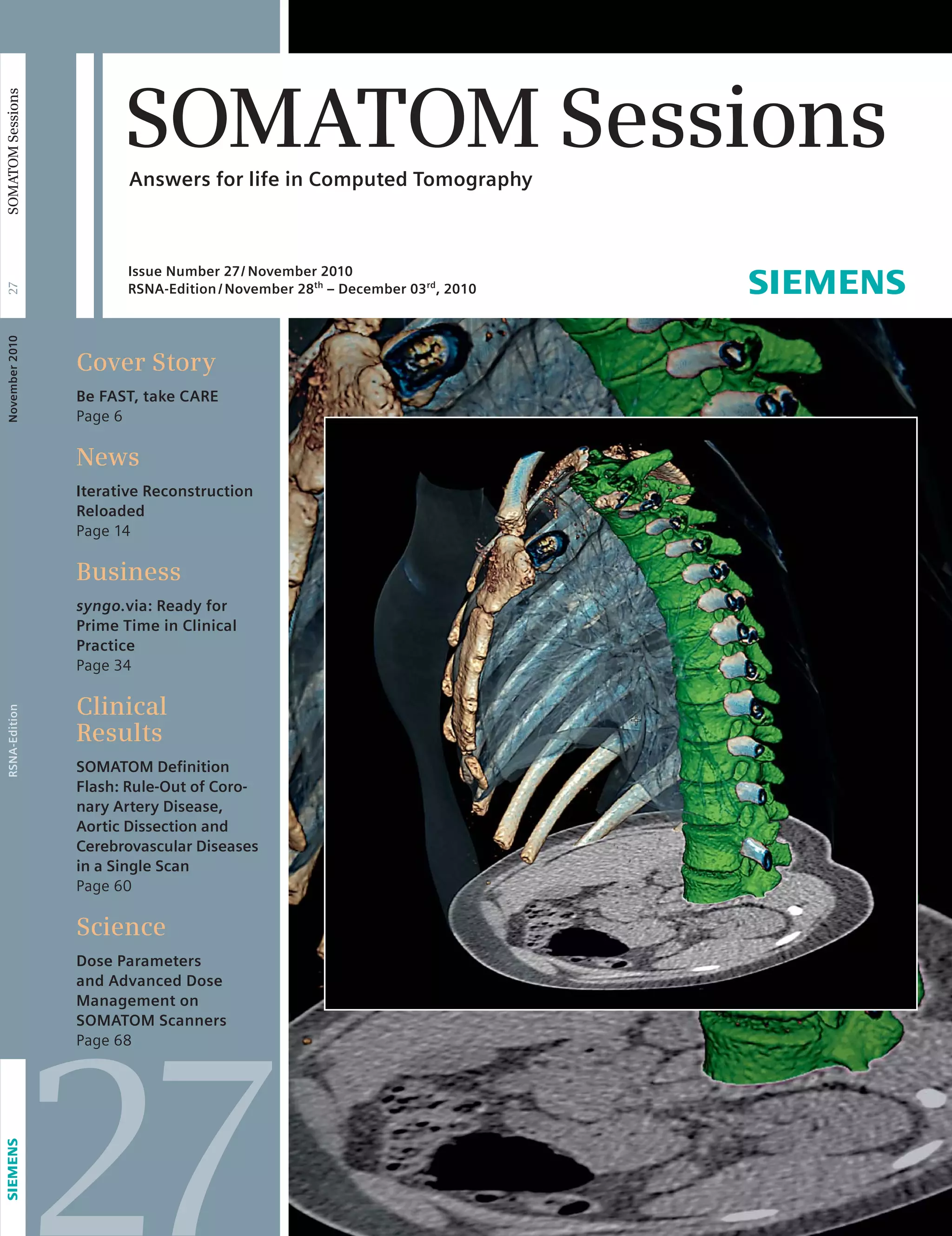
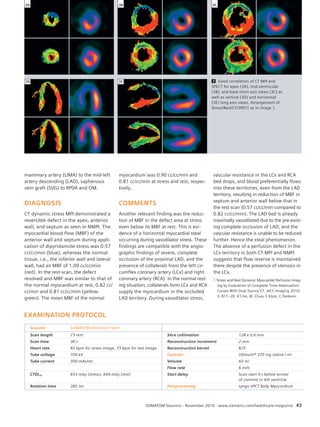
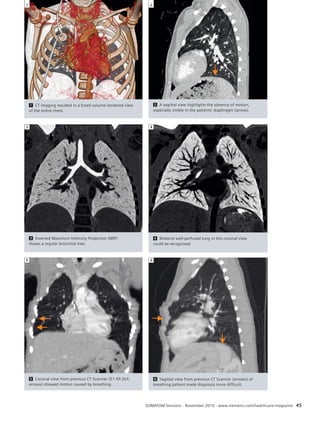
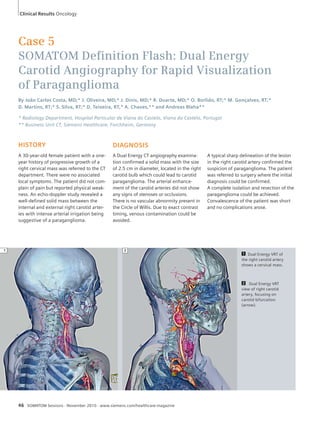
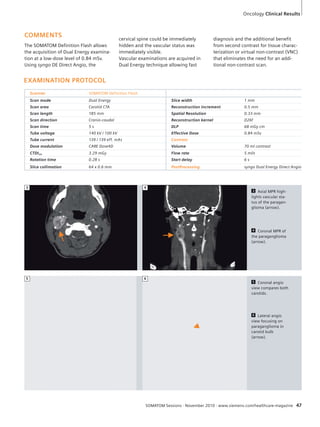
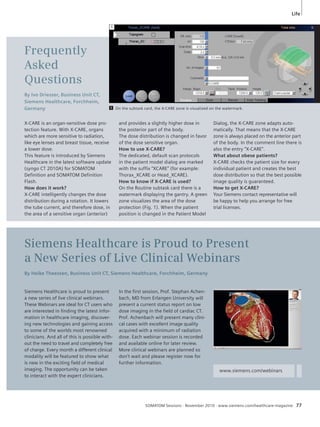
SOMATOM Sessions 
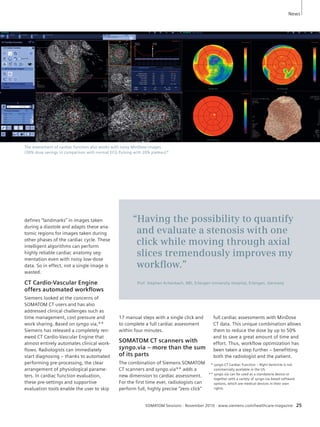
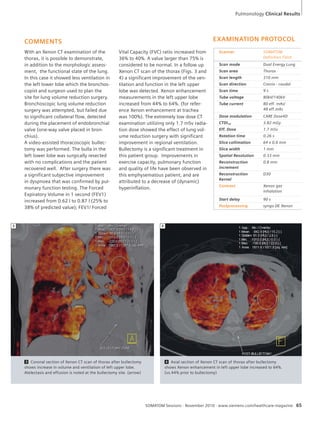
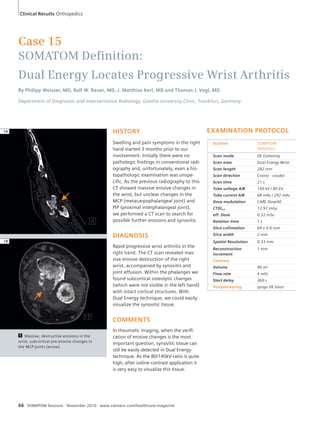
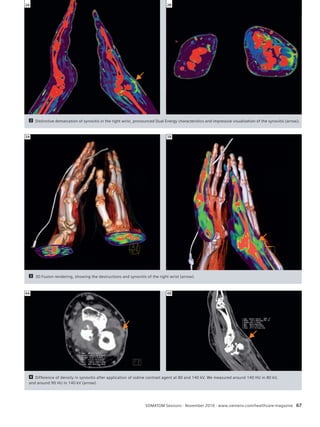
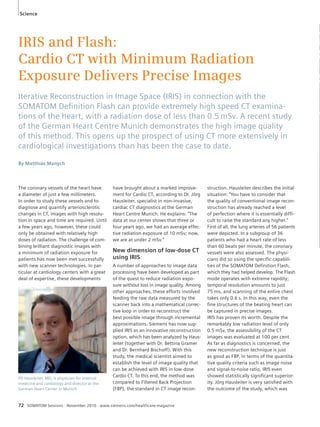
Answers for life in Computed Tomography 
Issue Number 27/ November 2010 
RSNA-Edition /November 28th – December 03rd, 2010 
Cover Story 
Be FAST, take CARE 
Page 6 
News 
Iterative Reconstruction 
Reloaded 
Page 14 
Business 
syngo.via: Ready for 
Prime Time in Clinical 
Practice 
Page 34 
Clinical 
Results 
SOMATOM Defi nition 
Flash: Rule-Out of Coro-nary 
Artery Disease, 
Aortic Dissection and 
Cerebrovascular Diseases 
in a Single Scan 
Page 60 
Science 
Dose Parameters 
and Advanced Dose 
Management on 
SOMATOM Scanners 
Page 68 
27 
RSNA-Edition November 2010 27 SOMATOM Sessions
Editorial 
2 “With FAST CARE we address 
todays’ challenges of our 
customers, accelerate CT 
workfl ows and reduce patient 
exposure even further.” 
Sami Atiya, PhD, Chief Executive Office, 
Business Unit Computed Tomography, Siemens Healthcare, Forchheim, Germany 
Cover Page: Courtesy of University of Erlangen- Nuremberg, Erlangen, Germany 
SOMATOM Sessions · November 2010 · www.siemens.com/healthcare-magazine
Editorial 
Dear Reader, 
Recent improvements in healthcare have 
created a serious backlog of patients at 
many medical facilities, creating a con-tradictory 
situation: the medical care is 
better but it has become more difficult 
to be treated as medical facilities stagger 
under an ever-increasing workload. 
Adding to the contradictory matrix is a 
medically well-informed public con-cerned 
with radiation exposure. An effi-cient, 
faster throughput of patients while 
maintaining quality care has be come 
the critical issue in modern health care. 
The creative and innovative products 
developed by Siemens to deal with this 
situation are truly amazing. The revolu-tionary, 
single-source SOMATOM 
Definition AS (and AS+) scanner that 
reduces many scans to a one click op-eration 
at extremely low dose. The 
second noteworthy is the unique 
SOMATOM Definition Flash scanner that 
scans an entire thorax in less than one 
second with sub-mSv dose and can 
“freeze” even the fastest beating heart, 
producing diagnostic quality cardiology 
images in minutes. 
We then introduced the syngo.via*, 
multi-modality imaging software. With 
syngo.via*, the reading physician can 
observe and analyze CT, MR, PET, 
Radio graphy, Fluroscopy and Angio-graphy 
simultaneously on a single 
monitor – eliminating many trips from 
the regular reading workplace to various 
workstations. Another great advantage 
of syngo.via* is the pre-processing 
André Hartung, 
Vice President 
Marketing and Sales 
Business Unit CT, 
Siemens Healthcare 
system. When a case is opened, many 
pre-processing tasks such as table re-moval, 
bone removal, curved planar re-for 
mat ting, naming of vessels, ejection 
frac tion calculations and orthogonal cuts 
are already done. The reading physician 
can start the interpretation and diagnosis 
immediately. 
The challenge now became combining 
these (and many other) systems to re-lieve 
pressure on hospitals and clinics by 
increasing throughput while maintaining 
quality medical care. This goal resulted in 
the introduction of our new FAST CARE 
platform at the recent RSNA convention 
in Chicago. When it comes to the FAST 
CARE plat form, incorporating “Fully 
Assisting Scanner Technology” (FAST) and 
“Com bined Applications to Reduce Ex-posure” 
(CARE), the name says it all. 
This new platform for the SOMATOM 
Definition family, guides the user through 
a CT scan in just a few intuitive steps, 
starting with planning, through the ac-tual 
scanning process, to recon struction 
and evaluation of clinical images. In this 
way, FAST prio ritizes considerations of 
efficiency and focuses on patient-centric 
productiv ity. 
The CARE standard combines a variety of 
Siemens’ innovations, like CARE kV, CARE 
Child or the next generation of Iterative 
Reconstruction, SAFIRE** that we have 
intro duced at this years’ RSNA. 
patients – including trauma or young 
children – from head to toe without 
having to repeat the scan. In addition you 
now have the possibility to reduce dose 
even further. 
Additionally, in keeping with our tradi-tional 
cooperation with out-of-house 
experts, – radiologists and others who 
are confronted daily with challenges 
in their daily scanning practice – we have 
launched the Siemens Radiation Reduc-tion 
Alliance (SIERRA). This panel of 
highly respected experts in the medical 
imaging field will track and provide 
valuable feed back and make recommen-dations 
on dose-related subjects to 
Siemens, infor mation that will mean 
even healthier examinations for your 
patients. Our ultimate goal with this 
prestigious group is to reduce dose 
exposure in CT to a level below 2.4 mSv, 
the annual natural level of radi ation 
always present in our environement. 
More complete information and valuable 
links on all these new and exciting deve-lop 
ments can be found in the pages of 
this SOMATOM Sessions issue. And 
invisibly em bed ded in every page is a 
factor that is not new here at Siemens… 
better health care for all patients. 
We wish you enjoyable and profitable 
reading. 
Sincerely, 
Using these powerful tools enables you 
to quickly examine your most challenging André Hartung 
** syngo.via can be used as a standalone device or together with a variety of syngo.via based software options, which are medical devices in their own rights. 
** The information about this product is being provided for planning purposes. The product is pending 510 (k) review, and is not yet commercially available in the U.S.
Content 
Cover Story 
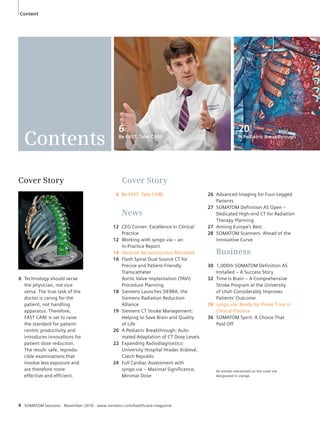
6 Be FAST, Take CARE 
News 
12 CEO Corner: Excellence in Clinical 
Practice 
12 Working with syngo.via – an 
In- Practice Report 
14 Iterative Reconstruction Reloaded 
16 Flash Spiral Dual Source CT for 
Precise and Patient-Friendly 
Transcatheter 
Aortic Valve Implantation (TAVI) 
Procedure Planning. 
18 Siemens Launches SIERRA, the 
Siemens Radiation Reduction 
Alliance 
19 Siemens CT Stroke Management: 
Helping to Save Brain and Quality 
of Life 
20 A Pediatric Breakthrough: Auto-mated 
Adaptation of CT Dose Levels 
22 Expanding Radiodiagnostics: 
University Hospital Hradec Králové, 
Czech Republic 
24 Full Cardiac Assessment with 
syngo.via – Maximal Significance, 
Minimal Dose 
Contents 
Cover Story 
6 Technology should serve 
the physician, not vice 
versa. The true task of the 
doctor is caring for the 
patient, not handling 
apparatus. Therefore, 
FAST CARE is set to raise 
the standard for patient-centric 
productivity and 
intro duces innovations for 
patient dose reduction. 
The result: safe, reprodu-cible 
examinations that 
involve less exposure and 
are therefore more 
effective and efficient. 
4 SOMATOM Sessions · November 2010 · www.siemens.com/healthcare-magazine 
20 
A Pediatric Breakthrough 
6 
Be FAST, Take CARE 
26 Advanced Imaging for Four-Legged 
Patients 
27 SOMATOM Definition AS Open – 
Dedicated High-end CT for Radiation 
Therapy Planning 
27 Among Europe’s Best 
28 SOMATOM Scanners: Ahead of the 
Innovative Curve 
Business 
30 1,000th SOMATOM Definition AS 
Installed – A Success Story 
32 Time is Brain – A Comprehensive 
Stroke Program at the University 
of Utah Considerably Improves 
Patients’ Outcome 
34 syngo.via: Ready for Prime Time in 
Clinical Practice 
36 SOMATOM Spirit: A Choice That 
Paid Off 
All articles mentioned on the cover are 
designated in orange.
Content 
54 Volume Perfusion CT Neuro as a Reli-able 
Tool for Analysis of Ischemic 
Stroke Within Posterior Circulation 
Acute Care 
56 Dual Source, Dual Energy CT: 
Improvement of Lung Perfusion 
Within 5 Hours in a Patient With 
Acute Pulmonary Embolism 
58 Differentiation of Pulmonary Emboli 
and Their Effect on Lung Perfusion 
Determined With a Low-Dose Dual 
Energy Scan 
60 SOMATOM Definition Flash: Rule-Out 
of Coronary Artery Disease, Aortic 
Dissection and Cerebrovascular 
Diseases in a Single Scan 
62 SOMATOM Definition Flash: RIPIT to 
the Rescue – Fast CT Examination 
for Trauma Patients 
Pulmonology 
64 Xenon Ventilation CT Scan Demon-strates 
an Increase in Regional 
Ventilation After Bullectomy in a 
COPD Patient 
Orthopedics 
66 SOMATOM Definition: Dual Energy 
Locates Progressive Wrist Arthritis 
SOMATOM Sessions · November 2010 · www.siemens.com/healthcare-magazine 5 
Clinical Results 
Cardio-Vascular 
38 SOMATOM Definition Flash Ruling 
out Coronary Artery Disease with 
0.69 mSv 
40 SOMATOM Definition Flash: 
Low-Dose Abdomen Pediatric Scan: 
Follow-Up Study of Fibromuscular 
Dysplasia 
42 CT Dynamic Myocardial Stress 
Perfusion Imaging – Correlation 
with SPECT 
Oncology 
44 SOMATOM Definition Flash: Motion-free 
Thoracic Infant Scan: Follow-Up 
Study After Chemotherapy 
46 SOMATOM Definition Flash: 
Dual Energy Carotid Angiography 
for Rapid Visualization of 
Paraganglioma 
48 Total Occlusion of the Left Superior 
Pulmonary Vein by a Metastasis 
Detected with Dual Energy CT 
50 SOMATOM Spirit: Follow-Up Exami-nation 
of Cerebral Meningioma 
Neurology 
52 SOMATOM Definition Flash: Improv-ing 
Image Quality of Brain Scans 
With IRIS, X-CARE and Neuro 
BestContrast 
Science 
68 Dose Parameters and Advanced 
Dose Management on SOMATOM 
Scanners 
72 IRIS and Flash: Cardio CT with 
Minimum Radiation Exposure 
Delivers Precise Images 
Life 
74 Clinical Fellowship: Learning From 
the Experts in the Field 
76 STAR: Specialized Training in 
Advances in Radiology 
76 Evolve Update Facilitates Dose 
Savings 
77 Frequently Asked Questions 
77 Siemens Healthcare is Proud to 
Present a New Series of Live Clinical 
Webinars 
78 News at Educate Homepage: 
Recommended CT Literature 
78 Clinical Workshops 2011 
79 Upcoming Events & Congresses 
80 Corporate Magazines 
81 Imprint 
32 
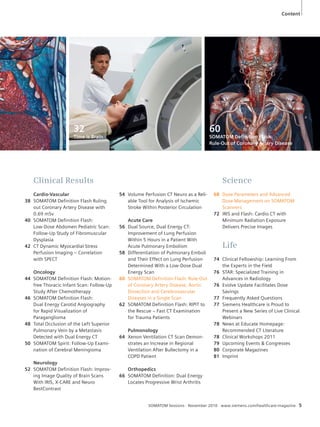
Time is Brain 
60 
SOMATOM Definition Flash: 
Rule-Out of Coronary Artery Disease
Coverstory 
Be FAST, Take CARE 
FAST CARE reduces the complexity of 
CT scans to just a few clicks and facilitates 
even more reduction of dosage. 
Technology should serve the physician, not vice versa. The true task of the 
doctor is caring for the patient, not handling apparatus. Therefore, FAST 
CARE is set to raise the standard for patient-centric productivity and introduces 
several innovations for patient dose reduction. The result: safe, reproducible 
examinations that involve less exposure and are therefore more effective and 
effi cient. Dr. Michael Lell shared his observations and expectations with us. 
By Hildegard Kaulen, PhD 
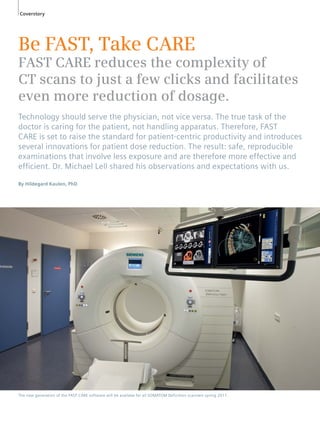
The new generation of the FAST CARE software will be availabe for all SOMATOM Definition scanners spring 2011.
The medical profession is changing. 
As patient numbers increase, budgets 
are ever-decreasing. At the same time, 
patients seek the assurance and the 
advice of the physician. In the University 
Clinic at Erlangen, Germany, too, the 
numbers of examinations have been 
skyrocketing, while the residence time 
at the clinic has been going down. Less 
and less resources for diagnostics are 
available. Associate Professor Dr. med. 
Michael Lell, Senior Physician at the Insti-tute 
of Radiology, feels the pinch, espe-cially 
when it comes to staff. This is why 
he is particularly appreciative of soft-ware 
solutions that not only leave him 
more time for his obligations as a doctor 
and researcher, but also optimizes the 
utilization of staff. When it comes to 
Siemens’ new FAST CARE technology, 
incorporating “Fully Assisting Scanner 
Technologies” (FAST) and “Combined 
Applications to Reduce Exposure” (CARE), 
the name says it all. The new platform 
for the SOMATOM Definition product 
family guides the user through a CT scan 
in just a few intuitive steps, starting with 
planning, through the actual scanning 
process, to reconstruction and evalua-tion 
of clinical images. In this way, FAST 
prioritizes considerations of efficiency 
and focuses on patient-centered produc-tivity. 
Standardization ensures that all 
examinations follow the same pattern, 
avoiding errors and uncertainty. So, 
scans that erroneously fail to depict 
parts of the target organ can be avoided 
in the future. At the same time, FAST 
CARE also offers the user new solutions 
for reducing the applied radiation dose 
and supports the consistent use of 
al ready available solutions. The entire CT 
scan thus not only becomes more intui-tive 
and reproducible, but also safer for 
the patients. 
Reducing users’ workloads 
FAST Planning, one of the new function-alities 
of FAST CARE, provides sugges-tions 
for the scan and reconstructions 
that are appropriate for the selected 
mode based on the characteristics of the 
organ, including the length of the exam-ination 
volume. Thus, for example, in 
the case of a cranial CT, the isocenter is 
automatically adapted to the position of 
the skull. CT scans are complex proce-dures 
and operating the equipment is 
demanding, even with standardized pro-tocols. 
Lell agrees: there will always be 
situations where the standard protocol 
must be adapted to the stature of the 
patient or the problem being investi-gated. 
Also, the technical staff operates 
not just one, but many modalities. The 
constant back and forth between indi-vidual 
applications makes high demands 
of staff members’ expertise and concen-tration. 
A program that guides users 
intuitively through the entire CT scan 
makes the task simpler, safer, more repro-ducible 
and more efficient. “In view of 
the fact that well-trained staff is increas-ingly 
difficult to find,” Lell continues, 
“this is an important aspect.” He has 
high expectations for the automatic cou-pling 
of the contrast agent injection 
with the scanning protocol, which will 
be offered as a special add-on feature 
for the standard package under the des-ignation 
CARE Contrast III. “Currently, 
two staff members work on examina-tions 
involving contrast agents,” says 
Lell. “One of them injects the contrast 
agent, while the other prepares the scan 
. If the injection and the scan are linked, 
Coverstory 
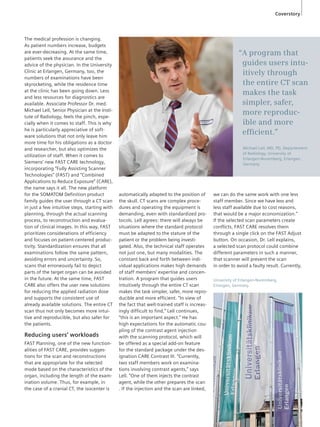
“A program that 
guides users intu-itively 
through 
the entire CT scan 
makes the task 
simpler, safer, 
more reproduc-ible 
and more 
effi cient.” 
Michael Lell, MD, PD, Departement 
of Radiology, University of 
Erlangen-Nuremberg, Erlangen, 
Germany 
we can do the same work with one less 
staff member. Since we have less and 
less staff available due to cost reasons, 
that would be a major economization.” 
If the selected scan parameters create 
conflicts, FAST CARE resolves them 
through a single click on the FAST Adjust 
button. On occasion, Dr. Lell explains, 
a selected scan protocol could combine 
different parameters in such a manner, 
that scanner will prevent the scan 
in order to avoid a faulty result. Currently, 
University of Erlangen-Nuremberg, 
Erlangen, Germany.
Coverstory 
such situations have to be resolved man-ually, 
which costs time. With FAST CARE, 
the FAST Adjust function suggests the 
ideal solution. But the focus is also on 
faster diagnostics. This is where the 
strengths of syngo.via,* Siemens new, 
leading-edge imaging software, come 
into effect. The software automatically 
loads the images into the appropriate 
application and segments them in such 
a way that they can be adjudged with-out 
further ado. The physician can arrive 
at a final diagnosis with just a few clicks 
of the mouse as the images have already 
been pre-processed for him. The applica-tion 
is determined by the disease-specific 
criteria of the case at hand and no longer 
needs to be independently selected. 
Since syngo.via handles all preparatory 
steps, the physician can focus com-pletely 
on his actual task, namely diag-nostics. 
This, too, saves time and 
enhances diagnostic reliability. 
Improved image reconstruction 
FAST CARE also introduces SAFIRE,** 
Siemens’ first raw-data-based iterative 
reconstruction. This technique removes 
noise and artifacts in iterative steps in 
the image and raw data domain, with-out 
compromising image sharpness. The 
procedure can be used in two different 
ways. Either the image quality of the 
standard reconstruction is maintained, 
and the dose can be reduced, or the dose 
level is maintained and clinical images 
of noticeably higher quality are gener-ated. 
Until now, however, calculation of 
the projection data required significantly 
more time than the standard reconstruc-tion. 
For FAST CARE, the image space 
algorithm was enhanced and a new 
reconstruction computer was specially 
developed for this purpose. This now 
also allows use of raw data in the recon-struction 
process to further enhance 
image quality and reduce dose. In this 
way, users can take advantage of the 
potential for dose reduction in a notice-ably 
greater number of examinations 
during routine clinical application, signifi-cantly 
reducing the average dose. (For 
further information, see the article “Iter-ative 
Reconstruction Reloaded” on page 
14 in this issue.) Using the potential of 
SAFIRE, 72% of all Siemens standard pro-tocols 
apply dose of below the average 
annual natural background radiation of 
2.4 mSv.*** 
Michael Lell has performed clinical 
studies with the previous version of the 
software. He describes the results: “For 
research purposes, we always perform 
both the standard reconstruction and the 
iterative reconstruction. With the previ-ous 
algorithm, iterative reconstruction 
takes about four to five times longer than 
standard reconstruction. Here, I expect 
a clear improvement with the new algo-rithm. 
With the previous algorithm an 
abdominal CT can be performed using 
half the dosage without compromising 
image quality. Our work on thoracic CT 
has not yet been concluded, but the 
potential for dosage reduction is ex pec-ted 
to be of a similar order of magni-tude. 
These are considerable reductions 
of dose that should be used. If the new 
algorithm is faster and offers better 
image quality, it is ready for routine 
application.” 
Optimal scan parameters 
for everyone 
When it comes to the sensitive issue 
of radiation exposure, Siemens follows 
the ALARA principle: “As Low As Reason-ably 
Achievable.” FAST CARE comes 
with CARE kV, an expansion of CARE 
Dose4D, which modulates the tube cur-rent 
according to the patient’s anatomy. 
In addition, CARE kV now automatically 
identifies the optimal tube voltage and 
adapts the tube current accordingly. 
This change is useful, for instance, 
when contrast agents are used. Because 
2 
“If the new algorithm 
is faster and offers 
better image quality, 
it is ready for routine 
application.” 
Michael Lell, MD, PD, Departement of Radiology, 
University of Erlangen- Nuremberg, Erlangen, Germany 
*** syngo.via can be used as a standalone device or together with a variety of syngo.via based software options, which are medical devices in their own rights. 
*** SAFIRE: The information about this product is being provided for planning purposes. The product is pending 510 (k) review, and is not yet commercially available in the U.S. 
*** Data on fi le.
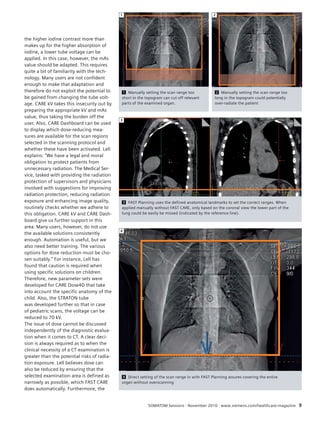
1 Manually setting the scan range too 
short in the topogram can cut off relevant 
parts of the examined organ. 
2 
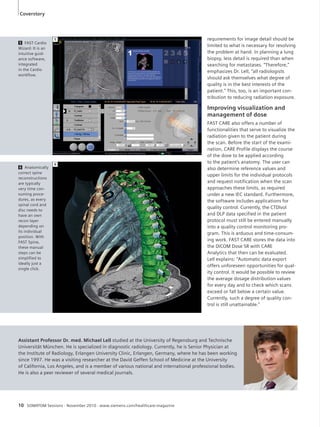
3 FAST Planning uses the defined anatomical landmarks to set the correct ranges. When 
applied manually without FAST CARE, only based on the coronal view the lower part of the 
lung could be easily be missed (indicated by the reference line). 
4 Direct setting of the scan range in with FAST Planning assures covering the entire 
organ without overscanning 
SOMATOM Sessions · November 2010 · www.siemens.com/healthcare-magazine 9 
the higher iodine contrast more than 
makes up for the higher absorption of 
iodine, a lower tube voltage can be 
applied. In this case, however, the mAs 
value should be adapted. This requires 
quite a bit of familiarity with the tech-nology. 
Many users are not confident 
enough to make that adaptation and 
therefore do not exploit the potential to 
be gained from changing the tube volt-age. 
CARE kV takes this insecurity out by 
preparing the appropriate kV and mAs 
value, thus taking the burden off the 
user. Also, CARE Dashboard can be used 
to display which dose-reducing mea-sures 
are available for the scan regions 
selected in the scanning protocol and 
whether these have been activated. Lell 
explains: “We have a legal and moral 
obligation to protect patients from 
unnecessary radiation. The Medical Ser-vice, 
tasked with providing the radiation 
protection of supervisors and physicians 
involved with suggestions for improving 
radiation protection, reducing radiation 
exposure and enhancing image quality, 
routinely checks whether we adhere to 
this obligation. CARE kV and CARE Dash-board 
give us further support in this 
area. Many users, however, do not use 
the available solutions consistently 
enough. Automation is useful, but we 
also need better training. The various 
options for dose reduction must be cho-sen 
suitably.” For instance, Lell has 
found that caution is required when 
using specific solutions on children. 
Therefore, new parameter sets were 
developed for CARE Dose4D that take 
into account the specific anatomy of the 
child. Also, the STRATON tube 
was developed further so that in case 
of pediatric scans, the voltage can be 
reduced to 70 kV. 
The issue of dose cannot be discussed 
independently of the diagnostic evalua-tion 
when it comes to CT. A clear deci-sion 
is always required as to when the 
clinical necessity of a CT examination is 
greater than the potential risks of radia-tion 
exposure. Lell believes dose can 
also be reduced by ensuring that the 
selected examination area is defined as 
narrowly as possible, which FAST CARE 
does automatically. Furthermore, the 
1 
2 Manually setting the scan range too 
long in the topogram could potentially 
over-radiate the patient 
3 
4
Coverstory 
5 
6 
10 SOMATOM Sessions · November 2010 · www.siemens.com/healthcare-magazine 
requirements for image detail should be 
limited to what is necessary for resolving 
the problem at hand. In planning a lung 
biopsy, less detail is required than when 
searching for metastases. “Therefore,” 
emphasizes Dr. Lell, “all radiologists 
should ask themselves what degree of 
quality is in the best interests of the 
patient.” This, too, is an important con-tribution 
to reducing radiation exposure. 
Improving visualization and 
management of dose 
FAST CARE also offers a number of 
functionalities that serve to visualize the 
radiation given to the patient during 
the scan. Before the start of the exami-nation, 
CARE Profile displays the course 
of the dose to be applied according 
to the patient’s anatomy. The user can 
also determine reference values and 
upper limits for the individual protocols 
and request notification when the scan 
approaches these limits, as required 
under a new IEC standard. Furthermore, 
the software includes applications for 
quality control. Currently, the CTDIvol 
and DLP data specified in the patient 
protocol must still be entered manually 
into a quality control monitoring pro-gram. 
This is arduous and time-consum-ing 
work. FAST CARE stores the data into 
the DICOM Dose SR with CARE 
Analytics that then can be evaluated. 
Lell explains: “Automatic data export 
offers unforeseen opportunities for qual-ity 
control. It would be possible to review 
the average dosage distribution values 
for every day and to check which scans 
exceed or fall below a certain value. 
Currently, such a degree of quality con-trol 
is still unattainable.” 
5 FAST Cardio 
Wizard: It is an 
intuitive guid-ance 
software, 
integrated 
in the Cardio 
workflow. 
6 Anatomically 
correct spine 
reconstructions 
are typically 
very time con-suming 
proce-dures, 
as every 
spinal cord and 
disc needs to 
have an own 
recon layer 
depending on 
its individual 
position. With 
FAST Spine, 
these manual 
steps can be 
simplified to 
ideally just a 
single click. 
Assistant Professor Dr. med. Michael Lell studied at the University of Regensburg and Technische 
Universität München. He is specialized in diagnostic radiology. Currently, he is Senior Physician at 
the Institute of Radiology, Erlangen University Clinic, Erlangen, Germany, where he has been working 
since 1997. He was a visiting researcher at the David Geffen School of Medicine at the University 
of California, Los Angeles, and is a member of various national and international professional bodies. 
He is also a peer reviewer of several medical journals.
Coverstory 
Dr. Hildegard Kaulen is a molecular biologist. 
After sojourns at the Rockefeller University in 
New York and Harvard Medical School in Boston, 
USA, she has been working as a freelance sci-ence 
journalist for prestigious daily newspapers 
and science journals since the mid-1990s. 
SOMATOM Sessions · November 2010 · www.siemens.com/healthcare-magazine 11 
Dr. Sodickson, in the past three years, 
concerns have been raised about 
cumulative exposure by repetitive CT 
imaging. How serious is the problem? 
SODICKSON: There is persistent contro-versy 
over the risk models that exist for 
radiation exposure of the magnitude 
used in CT. We attempted to quantify the 
levels of risk using the most common 
Linear-No-Threshold risk model used in 
the 7th Biological Effects of Ionizing 
Radiation (BEIR-VII) report. We studied 
32,000 patients undergoing CT at our 
institution, using the BEIR-VII model to 
estimate cumulative cancer risks from 
CT exposures. We found that 7% of our 
cohort had undergone enough previous 
CT radiation exposure to increase their 
cancer risk by at least 1% or more above 
baseline. As a result, we believe that 
patients undergoing recurrent imaging 
over time warrant heightened radiation 
protection efforts. 
Many CT users don’t take full advan-tage 
of the available dose reduction 
tools and work with protocols that are 
not fully optimized. Is active assis-tance, 
such as that provided by FAST 
CARE, the key to a more universal 
adoption? 
SODICKSON: Active assistance is one of 
many excellent solutions. Any automa-tion 
that makes scanning easier and 
helps to create reproducible results 
across the wide range of patient sizes 
and technologist skill levels is extremely 
valuable. But we also need better default 
protocols that are dose-optimized and 
“We Need Better 
Default Protocols.” 
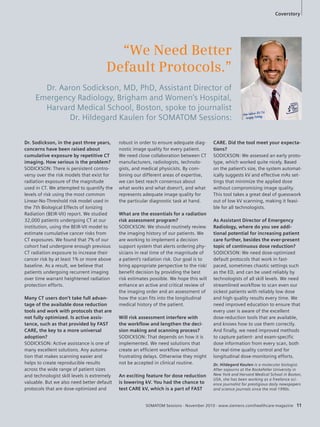
Dr. Aaron Sodickson, MD, PhD, Assistant Director of 
Emergency Radiology, Brigham and Women’s Hospital, 
Harvard Medical School, Boston, spoke to journalist 
Dr. Hildegard Kaulen for SOMATOM Sessions: 
robust in order to ensure adequate diag-nostic 
image quality for every patient. 
We need close collaboration between CT 
manufacturers, radiologists, technolo-gists, 
and medical physicists. By com-bining 
our different areas of expertise, 
we can best reach consensus about 
what works and what doesn’t, and what 
represents adequate image quality for 
the particular diagnostic task at hand. 
What are the essentials for a radiation 
risk assessment program? 
SODICKSON: We should routinely review 
the imaging history of our patients. We 
are working to implement a decision 
support system that alerts ordering phy-sicians 
in real time of the magnitude of 
a patient’s radiation risk. Our goal is to 
bring appropriate perspective to the risk/ 
benefit decision by providing the best 
risk estimates possible. We hope this will 
enhance an active and critical review of 
the imaging order and an assessment of 
how the scan fits into the longitudinal 
medical history of the patient. 
Will risk assessment interfere with 
the workflow and lengthen the deci-sion 
making and scanning process? 
SODICKSON: That depends on how it is 
implemented. We need solutions that 
create an efficient workflow without 
frustrating delays. Otherwise they might 
not be accepted in clinical routine. 
An exciting feature for dose reduction 
is lowering kV. You had the chance to 
test CARE kV, which is a part of FAST 
CARE. Did the tool meet your expecta-tions? 
SODICKSON: We assessed an early proto-type, 
which worked quite nicely. Based 
on the patient’s size, the system automat-ically 
suggests kV and effective mAs set-tings 
that minimize the applied dose 
without compromising image quality. 
This tool takes a great deal of guesswork 
out of low kV scanning, making it feasi-ble 
for all technologists. 
As Assistant Director of Emergency 
Radiology, where do you see addi-tional 
potential for increasing patient 
care further, besides the ever-present 
topic of continuous dose reduction? 
SODICKSON: We need dose-optimized 
default protocols that work in fast-paced, 
sometimes chaotic settings such 
as the ED, and can be used reliably by 
technologists of all skill levels. We need 
streamlined workflow to scan even our 
sickest patients with reliably low dose 
and high quality results every time. We 
need improved education to ensure that 
every user is aware of the excellent 
dose-reduction tools that are available, 
and knows how to use them correctly. 
And finally, we need improved methods 
to capture patient- and exam-specific 
dose information from every scan, both 
for real-time quality control and for 
longitudinal dose-monitoring efforts.
News 
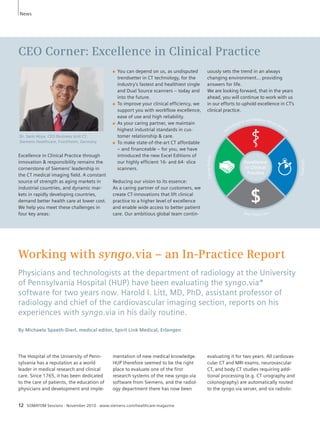
CEO Corner: Excellence in Clinical Practice 
Excellence in Clinical Practice through 
innovation & responsibility remains the 
cornerstone of Siemens’ leadership in 
the CT medical imaging field. A constant 
source of strength as aging markets in 
industrial countries, and dynamic mar-kets 
in rapidly developing countries, 
demand better health care at lower cost. 
We help you meet these challenges in 
four key areas: 
■ You can depend on us, as undisputed 
trendsetter in CT technology, for the 
industry’s fastest and healthiest single 
and Dual Source scanners – today and 
into the future. 
■ To improve your clinical efficiency, we 
support you with workflow excellence, 
ease of use and high reliability. 
■ As your caring partner, we maintain 
highest industrial standards in cus-tomer 
relationship & care. 
■ To make state-of-the-art CT affordable 
– and financeable – for you, we have 
introduced the new Excel Editions of 
our highly efficient 16- and 64- slice 
scanners. 
Reducing our vision to its essence: 
As a caring partner of our customers, we 
create CT-innovations that lift clinical 
practice to a higher level of excellence 
and enable wide access to better patient 
care. Our ambitious global team contin-uously 
Working with syngo.via – an In-Practice Report 
Physicians and technologists at the department of radiology at the University 
of Pennsylvania Hospital (HUP) have been evaluating the syngo.via* 
software for two years now. Harold I. Litt, MD, PhD, assistant professor of 
radiology and chief of the cardiovascular imaging section, reports on his 
experiences with syngo.via in his daily routine. 
By Michaela Spaeth-Dierl, medical editor, Spirit Link Medical, Erlangen 
The Hospital of the University of Penn-sylvania 
has a reputation as a world 
leader in medical research and clinical 
care. Since 1765, it has been dedicated 
to the care of patients, the education of 
physicians and development and imple- 
mentation of new medical knowledge. 
HUP therefore seemed to be the right 
place to evaluate one of the first 
research systems of the new syngo.via 
software from Siemens, and the radiol-ogy 
department there has now been 
12 SOMATOM Sessions · November 2010 · www.siemens.com/healthcare-magazine 
sets the trend in an always 
changing environment… providing 
answers for life. 
We are looking forward, that in the years 
ahead, you will continue to work with us 
in our efforts to uphold excellence in CT’s 
clinical practice. 
evaluating it for two years. All cardiovas-cular 
CT and MRI exams, neurovascular 
CT, and body CT studies requiring addi-tional 
processing (e.g. CT urography and 
colonography) are automatically routed 
to the syngo.via server, and six radiolo- 
Dr. Sami Atiya, CEO Business Unit CT, 
Siemens Healthcare, Forchheim, Germany
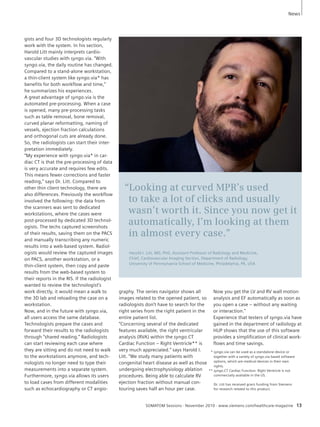
“Looking at curved MPR’s used 
to take a lot of clicks and usually 
wasn’t worth it. Since you now get it 
automatically, I’m looking at them 
in almost every case.” 
Harold I. Litt, MD, PhD, Assistant Professor of Radiology and Medicine, 
Chief, Cardio vascular Imaging Section, Depart ment of Radiology, 
University of Pennsylvania School of Medicine, Philadelphia, PA, USA 
SOMATOM Sessions · November 2010 · www.siemens.com/healthcare-magazine 13 
gists and four 3D technologists regularly 
work with the system. In his section, 
Harold Litt mainly interprets cardio-vascular 
studies with syngo.via. “With 
syngo.via, the daily routine has changed. 
Compared to a stand-alone workstation, 
a thin-client system like syngo.via* has 
benefits for both workflow and time,” 
he summarizes his experiences. 
A great advantage of syngo.via is the 
automated pre-processing. When a case 
is opened, many pre-processing tasks 
such as table removal, bone removal, 
curved planar reformatting, naming of 
vessels, ejection fraction calculations 
and orthogonal cuts are already done. 
So, the radiologists can start their inter-pretation 
immediately. 
“My experience with syngo.via* in car-diac 
CT is that the pre-processing of data 
is very accurate and requires few edits. 
This means fewer corrections and faster 
reading,” says Dr. Litt. Compared to 
other thin client technology, there are 
also differences. Previously the workflow 
involved the following: the data from 
the scanners was sent to dedicated 
workstations, where the cases were 
post-processed by dedicated 3D technol-ogists. 
The techs captured screenshots 
of their results, saving them on the PACS 
and manually transcribing any numeric 
results into a web-based system. Radiol-ogists 
would review the captured images 
on PACS, another workstation, or a 
thin-client system, then copy and paste 
results from the web-based system to 
their reports in the RIS. If the radiologist 
wanted to review the technologist’s 
work directly, it would mean a walk to 
the 3D lab and reloading the case on a 
workstation. 
Now, and in the future with syngo.via, 
all users access the same database. 
Technologists prepare the cases and 
forward their results to the radiologists 
through “shared reading.” Radiologists 
can start reviewing each case where 
they are sitting and do not need to walk 
to the workstations anymore, and tech-nologists 
no longer need to type their 
measurements into a separate system. 
Furthermore, syngo.via allows its users 
to load cases from different modalities 
such as echocardiography or CT angio-graphy. 
The series navigator shows all 
images related to the opened patient, so 
radiologists don’t have to search for the 
right series from the right patient in the 
entire patient list. 
“Concerning several of the dedicated 
features available, the right ventricular 
analysis (RVA) within the syngo.CT 
Cardiac Function – Right Ventricle** is 
very much appreciated.” says Harold I. 
Litt. “We study many patients with 
congenital heart disease as well as those 
undergoing electrophysiology ablation 
procedures. Being able to calculate RV 
ejection fraction without manual con-touring 
saves half an hour per case. 
Now you get the LV and RV wall motion 
analysis and EF automatically as soon as 
you open a case – without any waiting 
or interaction.” 
Experience that testers of syngo.via have 
gained in the department of radiology at 
HUP shows that the use of this software 
provides a simplification of clinical work-flows 
and time savings. 
News 
** syngo.via can be used as a standalone device or 
together with a variety of syngo.via based software 
options, which are medical devices in their own 
rights. 
** syngo.CT Cardiac Function- Right Ventricle is not 
commercially available in the US. 
Dr. Litt has received grant funding from Siemens 
for research related to this product.
News 
Iterative Reconstruction 
Reloaded 
For the fi rst time, SAFIRE* introduces the usage of raw-data information 
within iterative reconstruction for everyday use in clinical practice. 
By Jan Freund, Business Unit CT, Siemens Forchheim, Germany 
For quite some time, iterative recon-struction 
has been heavily discussed in 
the CT community as a highly promising 
method to achieve significant dose 
reduction without compromising image 
quality. Essentially, iterative recon-struction 
introduces a correction loop in 
the image generation process that 
cleans up artifacts and noise in low-dose 
images. The proposed approach is, that 
after the initial reconstruction using the 
weighted filtered back projection 
(WFBP), the measured data of the 
acquired image (in the so-called image 
space) is compared to the data (raw-it 
1A 1B 1C 1D 
14 SOMATOM Sessions · November 2010 · www.siemens.com/healthcare-magazine 
had to conquer the challenge of per-formance. 
In order not to do so at the 
expense of image quality – a “plastic-like” 
image impression was one of the 
major drawbacks of other solutions – 
Siemens found a smart alternative: 
The innovative first step was the recon-struction 
of a super-high resolution 
image that had virtually no image loss. 
This was achieved by not applying the 
filtering that typically reduced image 
noise, taking into account that the 
resulting image was then accordingly 
very noisy, but contained all inform-ation. 
The iteration loops to reduce the 
data). But until now, the implemen-tation 
of this method for clinical practice 
was limited as the necessary re-trans-formation 
of data from the image to the 
raw-data space was very time-consuming 
and the computational power required 
to make it feasible for everyday use was 
not available. Therefore, vendors found 
several different approaches to handle 
this limitation in their first individual 
solutions. 
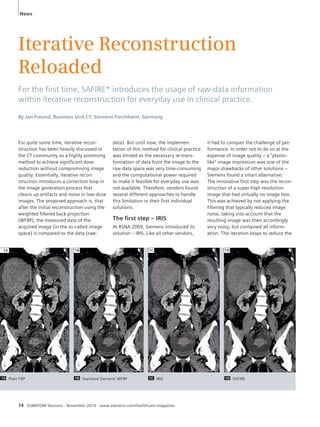
The fi rst step – IRIS 
At RSNA 2009, Siemens introduced its 
solution – IRIS. Like all other vendors, 
1A Plain FBP 1B Standard Siemens’ WFBP 1C IRIS 1D SAFIRE
SOMATOM Sessions · November 2010 · www.siemens.com/healthcare-magazine 15 
noise in the image were then per formed 
completely in image space, which was 
the key to achieve the recon struction 
performance and keep a well-known 
image impression. This unique approach 
then even found its way into the product 
name: IRIS – Iterative Reconstruction in 
Image Space. Several publications 
proved IRIS to be highly effective when 
it comes to reducing dose while main-taining 
diagnostic image quality. The 
University of Erlangen for example, 
achieved average dose reductions of 
50%** for abdomen examinations by 
taking Dual Source datasets done with 
the SOMATOM Definition Flash and 
reconstructing the images based only 
on data from one source. The resulting 
images – now naturally utilizing only 
half the dose – showed the same image 
quality after being reconstructed with 
IRIS compared to those reconstructed 
without IRIS and utilizing the data from 
both sources. 
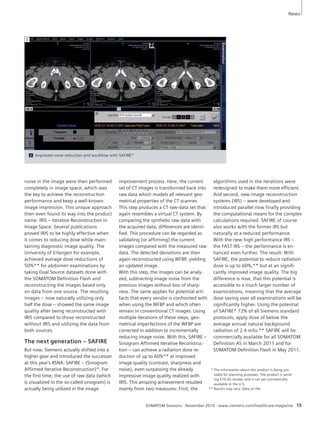
The next generation – SAFIRE 
But now, Siemens actually shifted into a 
higher gear and introduced the successor 
at this year’s RSNA: SAFIRE – (Sinogram 
Affirmed Iterative Recon struction)*. For 
the first time, the use of raw data (which 
is visualized in the so-called sinogram) is 
actually being utilized in the image 
im provement pro cess. Here, the current 
set of CT images is transformed back into 
raw data which models all relevant geo-metrical 
pro perties of the CT scanner. 
This step produces a CT raw-data set that 
again resembles a virtual CT system. By 
com paring the synthetic raw data with 
the acquired data, differences are identi-fied. 
This procedure can be regarded as 
validating (or affirming) the current 
images compared with the measured raw 
data. The detected deviations are then 
again reconstructed using WFBP, yielding 
an updated image. 
With this step, the images can be analy-zed, 
subtracting image noise from the 
previous images without loss of sharp-ness. 
The same applies for potential arti-facts 
that every vendor is confronted with 
when using the WFBP and which often 
remain in conventional CT images. Using 
multiple iterations of these steps, geo-metrical 
imperfections of the WFBP are 
corrected in addition to incremen tally 
reducing image noise. With this, SAFIRE – 
Sinogram Affirmed Iterative Recon struc-tion 
– can achieve a radiation dose re-duction 
of up to 60%** at improved 
image quality (contrast, sharpness and 
noise), even surpassing the already 
impressive image quality realized with 
IRIS. This amazing achievement resulted 
mainly from two measures: First, the 
algorithms used in the iterations were 
redesigned to make them more efficient. 
And second, new image reconstruction 
systems (IRS) – were developed and 
intro duced parallel now finally providing 
the compu tational means for the complex 
calculations required. SAFIRE of course 
also works with the former IRS but 
naturally at a reduced performance. 
With the new high performance IRS – 
the FAST IRS – the performance is en - 
han ced even further. The result: With 
SAFIRE, the potential to reduce radiation 
dose is up to 60%,** but at an signifi-cantly 
improved image quality. The big 
dif ference is now, that this potential is 
accessible to a much larger number of 
examinations, meaning that the average 
dose saving over all examinations will be 
significantly higher. Using the potential 
of SAFIRE* 72% of all Siemens standard 
protocols, apply dose of below the 
average annual natural background 
radiation of 2.4 mSv.** SAFIRE will be 
com mercially available for all SOMATOM 
Definition AS in March 2011 and for 
SOMATOM Definition Flash in May 2011. 
2 Improved noise reduction and workflow with SAFIRE* 
2 
** The information about this product is being pro-vided 
for planning purposes. The product is pend-ing 
510 (k) review, and is not yet commercially 
available in the U.S. 
** Results may vary. Data on file. 
News
Topic 
Flash Spiral for Precise and Patient Friendly 
Transcatheter Aortic Valve Implantation (TAVI) 
Planning. 
By Peter Aulbach 
Business Unit CT, Siemens Healthcare, Forchheim, Germany 
Transcatheter heart valve implantation is 
considered a technology with enormous 
clinical potential. The percutaneous 
implantation of a pulmonary valve was 
reported for the first time in 2000. Since 
then, these procedures have recorded 
constant double-digit annual growth,1 
since it presents a new option to candi-dates 
for whom conventional surgery 
was not suitable. 
Clinical needs and challenges 
The recent PARTNER trial, published in 
the New England Journal of Medicine,2 
demonstrates that transcatheter aortic 
valve implantation (TAVI), in comparison 
with standard therapy, resulted in signif-icantly 
lower rates of death among 
those patients. Patients who undergo 
TAVI show a 45% reduction in the rate of 
death in comparison with those receiv-ing 
standard therapy. 
Exact knowledge of the aortic root anat-omy, 
including the proximal coronary 
arteries, and the entire aorta up to the 
femoral artery bifurcation, is necessary to 
allow accurate pre-procedural planning. 
After scanning with conventional proto-cols, 
CT imaging requires relatively large 
amounts of contrast which can be a prob-lem 
in older patients, especially those 
with concomitant renal disease. Prospec-tively 
triggered high-pitch Flash Spiral 
Dual Source CT (Flash Spiral), with up to 
458 mm/s table feed, is able to obtain all 
important anatomic information in one 
single scan. Because of the extremely 
rapid data acquisition, completed in less 
than 2 seconds (Fig. 1B), the amount of 
contrast agent can be reduced signifi-cantly. 
In conventional aortic valve surgery, the 
access route to the aortic valve is stan-dardized. 
Normally the sizing of the 
utilized valve prosthesis is done directly 
under visual control at the surgical site. 
In contrast, in TAVI procedures all these 
points need to be meticulously addres-sed 
during pre-operative planning, since 
annulus size, access route or distance of 
the coronary ostia to the aortic root will 
influence the procedural strategy and 
the appropriate selection of the artificial 
heart valve. 
Moreover, large amounts of contrast 
agent have to be used in addition to the 
16 SOMATOM Sessions · November 2010 · www.siemens.com/healthcare-magazine 
contrast exposure during the aortic 
valve implantation itself. In the TAVI 
population, more than 50% of patients 
show impairment of renal function 
(elevated serum creatinine levels). 
It is known that up to one third of all 
patients undergoing catheter-based 
aortic valve implantation develop acute 
renal failure in the shortly following 
post-operative course.3 Therefore the 
application of contrast dye needs to be 
reduced to a minimum. 
Benefi ts of Flash Spiral CT 
The latest Dual Source CT system, the 
SOMATOM Definition Flash, allows the 
use of prospectively triggered high-pitch 
spiral data acquisition, called Flash 
Spiral. This mode allows a significant 
reduction of radiation dose compared to 
other CT technologies. Effective radia-tion 
doses of only 3-5 mSv are now only 
needed to visualize all relevant thoraco-abdominal 
structures (Fig. 1). Even 
more importantly, within this patient 
population, this new scan mode allows 
an extremely rapid data acquisition in 
less than 2 seconds (other CT technolo- 
1A 1B
Topic 
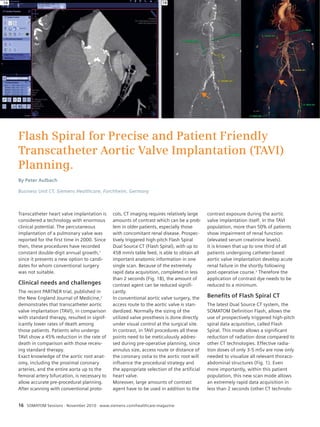
1 80-year old patient with severe aortic valve stenosis prior to trans-catheter 
aortic valve implantation (TAVI). Pre-procedural Flash Spiral 
angiography was performed using high-pitch spiral data acquisition pro-spectively 
triggered at 60% of the R-R interval (128 x 0.6 mm slices, 
100 kV, 320 mAs, SOMATOM Definition Flash). For thoraco-abdominal 
angiography including the coronary arteries (Arrowhead) only 40 ml of 
contrast agent was used (flow rate 4 ml /s). Estimated effective radiation 
dose was 4.3 mSv. at a scan time of 1.7 seconds. 
Images show assessment of aortic annulus diameters in syngo.via (Fig. 
1A dotted line) as well as distances between the aortic annulus and the 
coronary ostia. In addition, peripheral arteries have been evaluated for 
significant stenosis (Fig. 1B). The red arrow indicates an occluded iliac 
artery, making transfemoral access impossible here. The same data also 
shows pronounced calcification along the whole thoracic aorta (Fig. 1C). 
1 Cardiovascular News, Transcatheter heart valve 
replacement: A European perspective, 
www.cxvascular.com, Jan 2010 
2 Valve Implantation for Aortic Stenosis in Patients 
Who Cannot Undergo Surgery, N Engl J Med 
2010 
3 Aregger F, Wenaweser P, Hellige GJ, et al. Risk of 
acute kidney injury in patients with severe aortic 
valve stenosis undergoing transcatheter valve 
replacement. Nephrol Dial Transplant 2009; 24: 
2175–2179. 
4 Vahanian A, Alfieri OR, Al-Attar N, et al. Transcath-eter 
valve implantation for patients with aortic 
stenosis: a position statement from the European 
Association of Cardio-Thoracic Surgery (EACTS) 
and the European Society of Cardiology (ESC), in 
collaboration with the European Association of 
Percutaneous Cardiovascular Interventions 
(EAPCI). EuroIntervention 2008; 4: 193-199. 
2 Up to 60% 
less contrast 
media by use of 
high-pitch spiral 
DSCT angio-graphy 
of the 
complete aorta 
– compared to 
other CT tech-nologies. 
Courtesy of 
University 
of Erlangen- 
Nuremberg, 
Erlangen, 
Germany 
140 ml* 
100 ml# 
SOMATOM Sessions · November 2010 · www.siemens.com/healthcare-magazine 17 
gies need about 6–9 seconds). This per-mits 
a tremendous reduction of contrast 
agent by 50–60%, which is crucial for 
patients with renal insufficiency under-going 
a subsequent TAVI procedure. 
Compared to approximately 100–140 ml 
of contrast agent needed in the past for 
a CT angiography of the entire aorta, it 
is now possible to use only 40 ml (flow 
rate 4 ml/s) for the same examination, 
which poses a significantly reduced risk 
of Contrast Induced Nephropathy (CIN) 
in this patient population (Fig. 2). 
Accurate and fast planning 
with syngo.via 
The decision whether a patient is suit-able 
for a catheter-based procedure and 
the pre-operative planning with the 
selection of the access route are based 
upon results of the CT angiography. The 
size of the aortic annulus for selection of 
the valve prosthesis and the angulation 
of the invasive fluoroscopy which allows 
for simulating the optimal projection of 
the aortic valve during the TAVI proce-dure 
can be predicted from the same 
DSCT angiography data with the support 
of syngo.via.* This leads to further con-trast 
media savings during the invasive 
procedure since the syngo.via* software 
automatically provides the correspond-ing 
C-arm position. 
On the basis of this protocol and ana-tomical 
measurements by Flash Spiral 
CT, physicians are able to quickly per-form 
more patient friendly and precise 
catheter-based procedures. 
The time consuming planning of the 
procedure is very well supported by the 
many automated pre-processing steps 
in the new syngo.via* software which 
in early tests could show to reduce plan-ning 
time by more than 33% (10 min. 
versus 15 min.). 
In a nutshell: Flash Spiral 
and syngo.via 
In conclusion the Definition Flash, 
combined with the highly automated 
syngo.via* workflow modules, provide 
the most possible patient friendly and 
accurate pre-operation planning solution 
available. The high potential for cost 
reduction coming from fewer patients 
suffering acute CIN and therefore 
requesting less of the expensive aftercare 
is not yet taken into account herein. 
SOMATOM Definition Flash: 
www.siemens.com/SOMATOM-Definition- 
Flash 
CT Cardiovascular Engine: 
www.siemens.com/CT-cardiology 
Single-Source CT 
for Abdominal 
Aorta 
160 
140 
120 
100 
80 
60 
40 
20 
0 
*Loewe C, Eur Radiol 2010; #Wu W, AJR 2009; §Flash Thorax Protocol 
40 ml§ 
Amount of Contrast Agent [mL] 
Single-Source CT 
for Triple Rule Out 
Dual Source CT 
SOMATOM 
Definition Flash 
2 
News 
* syngo.via can be used as a standalone device or 
together with a variety of syngo.via based soft-ware 
options, which are medical devices in their 
own rights. 
1C
“I am happy and proud to embark on this initiative together 
with Siemens and my colleagues from around the globe in 
order to ensure that Siemens’ powerful tools for dose reduc-tion 
are used to their fullest extent.” 
U. Joseph Schoepf, MD, Medical University of South Carolina, U.S. 
Siemens Launches SIERRA, the Siemens 
Radiation Reduction Alliance 
SIERRA’s expert panel proposes its fi rst recommendations 
on patient care and radiation reduction 
By Stefan Ulzheimer, PhD, Business Unit CT, Siemens Healthcare, Forchheim, Germany 
In a continual commitment to patient 
care and radiation reduction in Com-puted 
Tomography (CT), Siemens Health-care 
has launched SIERRA, the Siemens 
Radiation Reduction Alliance and has 
established an expert panel to advance 
the cause of dose reduction in CT. The 
new Low Dose Expert Panel includes 16 
specialists in radiology, cardiology and 
physics, who are internationally recog-nized 
for their publications on the sub-ject 
of CT dose. The panel’s objective is 
to generate proposals on how Siemens 
can continue to develop their technology 
and to help users better adapt their pro-cedures 
in order to bring about further 
dose reduction in CT. One of the most 
important suggestions from the first 
meeting of the Low Dose Expert Panel in 
May 2010 concerns methods to recog-nize 
and increase utilization in clinical 
practice of the many CT dose reduction 
technologies that are already available. 
Siemens will pursue the following, 
concrete, first recommendations 
together with its partners: 
Q To establish a baseline of dose levels 
for the 10 most commonly performed 
CT exams, the group agreed to estab-lish 
and contribute to an international, 
multi-institutional dose registry. 
Q The participating, renowned institu-tions 
will share their CT scan protocols 
for the 10 most commonly performed 
examinations on a central web site as 
a first step to promote best practice 
sharing in the field. 
Q Siemens will develop a dedicated low 
dose educational program in close 
collaboration with the involved insti-tutions. 
18 SOMATOM Sessions · November 2010 · www.siemens.com/healthcare-magazine 
The Panel will meet twice a year to dis-cuss 
new ideas and investigate whether 
measures already agreed upon are hav-ing 
a positive impact. The next meeting 
takes place at RSNA 2010. 
www.siemens.com/low-dose-CT 
Current Members of SIERRA’s expert panel: 
Hatem Alkadhi, MD, University Hospital Zürich, Switzerland 
Christoph Becker, MD, Ludwig Maximilians University, Germany 
Elliot Fishman, MD, Johns Hopkins University, U.S. 
Donald Frush, MD, Duke University, U.S. 
Jörg Hausleiter, MD, German Heart Center, Munich, Germany 
Brian Herts, MD, Cleveland Clinic Foundation, U.S. 
Willi Kalender, PhD, Erlangen University, Germany 
Harold Litt, MD, PhD, Pennsylvania University, U.S. 
Cynthia McCollough, PhD, Mayo Clinic, U.S. 
Alec Megibow, MD, NYU-Langone Medical Center, U.S. 
Michael Recht, MD, NYU-Langone Medical Center, U.S. 
Dushyant Sahani, MD, Harvard Medical School, MGH, U.S. 
U. Joseph Schoepf, MD, South Carolina Medical University, U.S. 
Marilyn Siegel, MD, Mallinckrodt Institute of Radiology, U.S. 
Aaron Sodickson, MD, PhD, Brigham and Women’s Hospital, U.S. 
Kheng-Thye Ho, MD, Tan Tock Seng Hospital, Singapore
Siemens CT Stroke Management 
Siemens Healthcare recently has started a new CT Stroke Management 
Online Resource for healthcare professionals highlighting new diagnostic 
opportunities by synergizing with latest Siemens CT scanners and post-processing 
solutions – Helping to Save Brain and Quality of Life. 
By Stefan Wünsch, PhD, Business Unit CT, Siemens Healthcare Forchheim, Germany 
SOMATOM Sessions · November 2010 · www.siemens.com/healthcare-magazine 19 
When diagnosing and treating stroke 
patients, time is critical. Stroke is one of 
the diseases where diagnosis, prognosis 
and treatment drastically changes within 
a short period of time. Every minute in 
which a large vessel ischemic stroke is 
untreated, the average patient loses 1.9 
million neurons, 14 billion synapses, and 
12 km (7 miles) of axonal fibers. Each 
hour in which treatment fails to occur, 
the brain loses as many neuron as it does 
in almost 3.6 years of normal aging*. 
Therefore, the need for faster diagnosis 
and faster treatment is central to acute 
stroke management care. Providing the 
right information in every step of the 
treatment is crucial in order to save 
brain and thus save quality of life for 
stroke patients. Siemens CT Stroke 
Management moves beyond just ruling 
out the bleed by helping to establish a 
personalized treatment plan. Using the 
possibilities of extended brain coverage, 
Siemens has radically improved the 
stroke workflow uniquely adding value 
to stroke management. In order to share 
these approaches, Siemens has pub-lished 
a new information platform www. 
siemens.com/CT-stroke-management to 
share clinical outcomes. Dr. Schramm 
from the University of Göttingen, Ger-many, 
for example, shares his workflow 
www.siemens.com/CT-stroke-management 
of a certified stroke unit from the arrival 
of a stroke patient in the emergency 
department until the decision for further 
treatment is made together with the 
neurologist. In his institute, the door-to-needle 
time is less than 20 min. Further-more, 
leading stroke specialists share 
their experience and protocols in webi-nars 
and presentations. Trial versions are 
offered to Siemens’ customers to test 
the latest software solutions in stroke 
imaging in actual clinical practice. 
This campaign is meant to improve the 
knowledge of stroke diagnosis with 
extended brain coverage and Siemens 
CT solutions and is also designed to inte-grate 
experiences of other customers 
worldwide. 
If you are interested in sharing your 
results with other colleagues on this 
homepage, please contact 
stefan.wuensch@siemens.com 
* Time is brain-quantified. Saver JL. Stroke. 2006 
Jan;37(1):263-6. 
News
News 
A Pediatric Breakthrough: Automated 
Adaptation of CT Dose Levels 
If only Siemens could re-engineer people like it does CT scanners. For 
more than a decade, Siemens has been at the forefront of dose reduction 
in computed tomography. New technology is coming on the market at 
breakneck speeds, with each generation making scans safer and faster. 
By Ron French 
Dose levels of CT scans have fallen 
dramatically in recent years and will 
continue to drop with Siemens’ latest 
scanners. Yet even as CT scans become 
safer for patients, the variation of dose 
from facility to facility can still be 
unac ceptably high, says Dr. Marilyn 
Siegel, Professor of Radiology and 
Pediatrics at Washington University 
School of Medi cine in St. Louis, Missouri 
(USA) and Pediatric Radiologist at the 
affiliated St. Louis Children’s Hospital. 
Siegel is delighted at the advancements 
in CT technology, allowing individual 
organs to be shielded and automatically 
adjusting the dose level in real time as 
the patient moves through the scanner. 
That technology must now be coupled 
with education, to assure that radiolo-gists 
and technologists across the globe 
are aware of – and using – proper pro-tocols 
for each patient. 
A decade ago, the average CT dose was 
15 to 20 mSv. As the use of CTs explod - 
ed (more than 70 million scans are per-formed 
annually in the U.S. alone), 
does it, or you move and you do it 
yourself,” Siegel explains. “Siemens”, 
she adds, “has been at the forefront 
of dose reduction”. 
SOMATOM Defi nition AS: 
The Adaptive Scanner 
At St. Louis Children’s Hospital, the 
volume of CT scans is declining, but it 
is still the tool of choice for many neuro-lo 
gical exams, chest and abdominal 
scans including lung transplants, 
tumors, trauma and abscess infection. 
To limit radiation exposure, the hospital 
invests in the latest CT technology. 
The newest scanner at St. Louis Children’s 
Hospital is a SOMATOM Definition AS. 
The AS is the first scanner to intelligently 
adapt to the patient, changing dose 
levels automatically as it scans thicker 
and thinner parts of the body. Instead of 
setting a dose level that will offer clear 
images in a thick part of the body such 
as the shoulders and maintaining that 
level throughout the scan, dose levels 
rise and fall throughout the scan. 
radiation exposure to the population, 
especially in industrialized countries, 
increased. The National Council on 
Radiation Protection and Measurements 
reported in March 2009 that radiation 
exposure per capita more than doubled 
in the United States in the past two 
decades, largely due to increased use 
of CT, nuclear medicine imaging and 
interventional radiology. 
Because the potential risk of repeated 
radiation exposure accumulates over 
time, and because the tissues of children 
are particularly sensi tive to radiation, 
dose levels are an even bigger concern 
for pediatric radiologists like Siegel. 
“Effective dose in children is 3–5 times 
greater than in adults at comparable 
exposure levels, and you have very 
sensitive tissues, especially the breasts 
and gonads, in children who are 
growing,” Siegel clarifies. “The younger 
the patient, the more is the potential 
risk from radiation. There are two things 
you can do when there is a challenge: 
You can hide and hope somebody else 
“Siemens has been in the forefront of dose-reduction.” Marilyn J. Siegel, MD, Pediatric Radiologist, Washington University School of Medicine and 
St. Louis Children’s Hospital, Missouri, USA
SOMATOM Sessions · November 2010 · www.siemens.com/healthcare-magazine 21 
The Definition AS also reduces dose level 
in spiral scanning by eliminating radia-tion 
in pre- and post-spiral areas that 
won’t be reconstructed. 
Siegel watches on a computer monitor 
as a CT scan is performed on a young 
cancer patient. “Before, we’d set one 
dose level for the entire body,” Siegel 
says, “a dose level high enough for good 
image quality in the thickest part of the 
body. Now, the automated adaption of 
dose level cuts radiation.” 
The scanner also incorporates an Adap-tive 
Dose Shield to limit radiation to 
cli nically relevant parts of the body. The 
result is an average dose of 2 mSv to 
3 mSv in young pediatric patients, a 10- 
fold decrease in dose from a decade ago. 
Though the St. Louis Children’s Hospital 
installed the SOMATOM Definition AS in 
January 2010, the hospital already has 
on order the next generation of Siemens 
CT scanner – the SOMATOM Definition 
Flash. The Flash will offer scans at less 
than 1 mSv – possibly as low as 0.5 mSv. 
“That’s incredible,” Siegel explains. 
“With the Flash, we can lower the dose 
without the need of sedation for patients 
under five (because of the speed of the 
scan). “It’s a win-win situation. The older 
scanners – yes, they were fast, and yes, 
you could reduce the dose, but not like 
you can now,” Siegel says. “It’s really 
about patient care and affecting patient 
outcomes, reducing the risk, and 
in creasing the benefit for these kids.” 
Siegel also published groundbreaking 
work on how dose can be reduced, 
especially in children and small patients, 
by not only adapting the tube current 
but also the tube voltage. Siemens has 
been providing dedicated pediatric pro-tocols 
using low tube voltages of 80 kV 
since 2002 but now they take this 
method to the next level. The latest 
scanners will come with CARE kV, a fea-ture 
that automatically recommends the 
ideal tube voltage for the individual. 
Additionally, Siemens will be the first CT 
vendor to offer a tube voltage setting of 
70 kV which allows for additional dose 
savings in the youngest patients. 
Education and certifi cation 
is key 
Siemens’ willingness to listen to the needs 
of physicians and continue to improve 
their scanners is why Siegel’s pediatric 
radiology department uses Siemens 
equipment. 
Siegel was instrumental in the develop-ment 
of CT protocols for Siemens, and 
serves on an expert panel organized by 
the company to brainstorm ways to reduce 
dose levels in CT. “One of the things that 
we discussed and that Siemens already 
implemented is a warning system that 
alerts the user if certain pre-set dose 
limits are exceeded,” Siegel emphazies. 
“If you choose a protocol and it’s really 
way off, you get a warning to reconsider 
your choices.” 
Siegel does CT accreditation for the 
American College of Radiology. “I am 
sometimes surprised at what I see out 
there,” she says. There is a lot of varia-tion 
in radiation dose among sites. One 
published study found a dose variation 
of 13-fold. “There is a lot of education to 
do, not only for radiologists but also 
technologists,” Siegel says. 
“We know we’re not there yet, but we’re 
making progress.” 
Newer dose reduction scanner technology 
is one part of the solution for dose reduc-tion, 
Siegel says, but another important 
factor is education. Siegel is sold on 
Siemens scanners, but also on the com-pany’s 
commitment to education. 
Siemens personnel are always available 
to answer questions and have helped 
train the hospital’s technologists. 
While the number of CT scans continues 
to rise for adult patients, scan levels 
have stabilized among children and are 
actually going down at academic centers 
such as St. Louis Children’s Hospital. 
Siemens has been a pioneer in reducing 
CT dose level for more than a decade, 
with each new generation of scanners 
breaking barriers. At St. Louis Children’s 
Hospital, Siemens helps train technolo-gists 
to operate the scanners in ways 
to get the best possible images and keep 
radiation dose as low as reasonably 
achievable (the ALARA principle), which 
is what is all about when scanning 
children. 
What’s the future for pediatric radiology 
at St. Louis Children’s Hospital? Faster 
scans. Safer scans. Lower radiation 
doses. More arm-in-arm innovation with 
Siemens. “I feel like I’m lucky to work 
with them,” says Siegel. 
Ron French is a healthcare writer based 
in Detroit, Michigan (USA). 
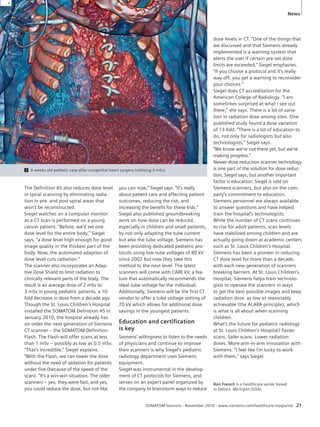
1 6 weeks old pediatic case after congenital heart surgery (utilizing 3 mSv) 
1 
News
Topic 
Expanding Radiodiagnostics: University 
Hospital Hradec Králové, Czech Republic 
The University Hospital in the Czech district capital Hradec Králové has been 
able to increase its radiodiagnostic activities considerably, thanks to the installa-tion 
of a Siemens CT scanner from the SOMATOM Emotion 6 range. Dr. Pavel 
Ryska, principally highlights the device’s performance: reliability, application 
range and image quality. 
By Rudolf Hermann 
With 23 clinical departments, 1,500 
beds and an annual volume of around 
40,000 patients, the University Hospital 
(Fakultni nemocnice) in Hradec Králové, 
the capital of Eastern Bohemia, is one of 
the most important healthcare facilities 
in the Czech Republic. Although, as a 
university hospital, research forms a 
prime focus of activity, the establish-ment 
also fulfills the function of a 
general hospital as Hradec Králové 
has no separate city clinic. This results 
22 SOMATOM Sessions · November 2010 · www.siemens.com/healthcare-magazine 
in slightly different requirements and 
prerequisites in the day-to-day running 
of the hospital, setting it apart from 
traditional university hospitals which 
are not obliged to fulfill this additional 
function. 
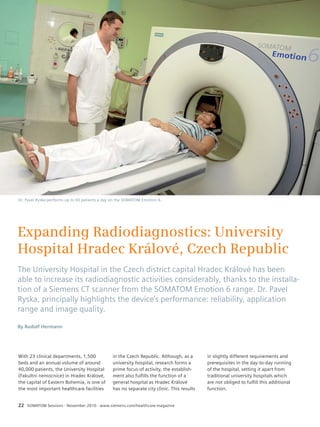
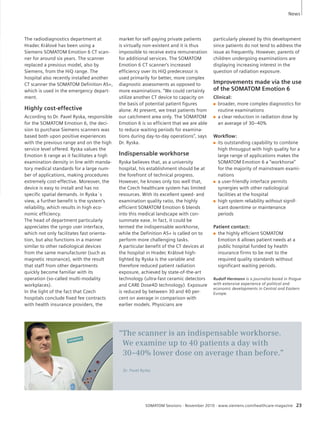
Dr. Pavel Ryska performs up to 40 patients a day on the SOMATOM Emotion 6.
market for self-paying private patients 
is virtually non-existent and it is thus 
impossible to receive extra remuneration 
for additional services. The SOMATOM 
Emotion 6 CT scanner’s increased 
efficiency over its HiQ predecessor is 
used primarily for better, more complex 
diagnostic assessments as opposed to 
more examinations. “We could certainly 
utilize another CT device to capacity on 
the basis of potential patient figures 
alone. At present, we treat patients from 
our catchment area only. The SOMATOM 
Emotion 6 is so efficient that we are able 
to reduce waiting periods for examina-tions 
during day-to-day operations”, says 
Dr. Ryska. 
Indispensable workhorse 
Ryska believes that, as a university 
hospital, his establishment should be at 
the forefront of technical progress. 
However, he knows only too well that, 
the Czech healthcare system has limited 
resources. With its excellent speed- and 
examination quality ratio, the highly 
efficient SOMATOM Emotion 6 blends 
into this medical landscape with con-summate 
ease. In fact, it could be 
termed the indispensable workhorse, 
while the Definition AS+ is called on to 
perform more challenging tasks. 
A particular benefit of the CT devices at 
the hospital in Hradec Králové high-light 
ed by Ryska is the variable and 
therefore reduced patient radiation 
exposure, achieved by state-of-the-art 
technology (ultra-fast ceramic detectors 
and CARE Dose4D technology). Exposure 
is reduced by between 30 and 40 per-cent 
on average in comparison with 
earlier models. Physicians are 
particularly pleased by this development 
since patients do not tend to address the 
issue as frequently. However, parents of 
children undergoing examinations are 
displaying increasing interest in the 
ques tion of radiation exposure. 
Improvements made via the use 
of the SOMATOM Emotion 6 
Clinical: 
Q broader, more complex diagnostics for 
routine examinations 
Q a clear reduction in radiation dose by 
an average of 30–40% 
Workflow: 
Q its outstanding capability to combine 
high througput with high quality for a 
large range of applications makes the 
SOMATOM Emotion 6 a “workhorse” 
for the majority of mainstream exami-nations 
Q a user-friendly interface permits 
synergies with other radiological 
facilities at the hospital 
Q high system reliability without signif-icant 
downtime or maintenance 
periods 
Patient contact: 
Q the highly efficient SOMATOM 
Emotion 6 allows patient needs at a 
public hospital funded by health 
insurance firms to be met to the 
required quality standards without 
significant waiting periods. 
Rudolf Hermann is a journalist based in Prague 
with extensive experience of political and 
economic developments in Central and Eastern 
Europe. 
SOMATOM Sessions · November 2010 · www.siemens.com/healthcare-magazine 23 
The radiodiagnostics department at 
Hradec Králové has been using a 
Siemens SOMATOM Emotion 6 CT scan-ner 
for around six years. The scan ner 
replaced a previous model, also by 
Siemens, from the HiQ range. The 
hospital also recently installed another 
CT scanner the SOMATOM Definition AS+, 
which is used in the emer gency depart-ment. 
Highly cost-effective 
According to Dr. Pavel Ryska, responsible 
for the SOMATOM Emotion 6, the deci-sion 
to purchase Siemens scanners was 
based both upon positive experiences 
with the previous range and on the high 
service level offered. Ryska values the 
Emotion 6 range as it facilitates a high 
examination density in line with manda-tory 
medical standards for a large num-ber 
of applications, making procedures 
extremely cost-effective. Moreover, the 
device is easy to install and has no 
specific spatial demands. In Ryska´s 
view, a further benefit is the system’s 
reliability, which results in high eco-nomic 
efficiency. 
The head of department particularly 
appreciates the syngo user interface, 
which not only facilitates fast orienta-tion, 
but also functions in a manner 
similar to other radiological devices 
from the same manufacturer (such as 
magnetic resonance), with the result 
that staff from other departments 
quickly become familiar with its 
operation (so-called multi-modality 
workplaces). 
In the light of the fact that Czech 
hospitals conclude fixed fee contracts 
with health insurance providers, the 
“The scanner is an indispensable workhorse. 
We examine up to 40 patients a day with 
30–40% lower dose on average than before.” 
Dr. Pavel Ryska 
News
News 
Full Cardiac Assessment with syngo.via – 
Maximal Signifi cance, Minimal Dose 
Siemens has once again succeeded in taking another step forward in the fi eld 
of CT diagnostics. By combining SOMATOM Scanners with the new syngo.via** 
imaging software, cardiac function assessments can now be carried out 
using very low radiation doses. 
By Michaela Spaeth-Dierl, medical editor, Spirit Link Medical, Erlangen 
Assessment of cardiac function with CT 
is still a challenging procedure for radio-logists. 
Siemens has now managed to 
solve some critical issues. A full cardiac 
function evaluation requires multi-phase 
CT data which previously led to high 
patient doses. 
Engineers at Siemens took up the chal-lenge. 
Aiming at turning a difficult pro-cedure 
into a routine task, they devel-oped 
MinDose and syngo.CT Cardiac 
Function*. 
MinDose – about 50% reduc-tion 
of radiation exposure 
Conventional ECG multi-phase datasets 
are usually acquired with a radiation 
dose of 8–10 mSv. MinDose mode has 
now reduced this dose by half. This 
means that a full cardiac function 
assessment is available with approx. 
4 mSv. 
The dose-saving effect of MinDose 
mode is achieved by ECG-controlled 
tube current modulation. Sharp images 
are most likely to be obtained during 
the diastolic phase, when there is mini-mal 
movement in the heart. Therefore, 
the tube output is raised to the maxi-mum 
level during these intervals. 
During the remaining, predominant 
phase of the cardiac cycle, the tube 
current can be reduced to 4%. This is 
a unique plus for Siemens tubes since 
other tubes only allow a current de - 
crease down to 20%. 
24 SOMATOM Sessions · November 2010 · www.siemens.com/healthcare-magazine 
This benefit, however, can only be 
achieved by combining SOMATOM CT 
scanner MinDose data with syngo.CT 
Cardiac Function,* an application run-ning 
on the basis of the syngo.via** 
imaging software. 
syngo.CT Cardiac Function 
optimally handles MinDose 
data 
During a multi-slice CT examination of 
the heart, large amounts of data are 
obtained, but only very few of them are 
used for image reconstruction. With 
the new syngo.CT Cardiac Function, it 
is now possible to use MinDose data for 
a full functional assessment. 
The syngo.CT Cardiac Function software 
Evaluation of cardiac function based on high quality images.*
The assessment of cardiac function also works with noisy MinDose images. 
(30% dose savings in comparison with normal ECG Pulsing with 20% plateau)* 
“Having the possibility to quantify 
and evaluate a stenosis with one 
click while moving through axial 
slices tremendously improves my 
workfl ow.” 
Prof. Stephan Achenbach, MD, Erlangen University Hospital, Erlangen, Germany 
17 manual steps with a single click and 
to complete a full cardiac assessment 
within four minutes. 
SOMATOM CT scanners with 
syngo.via – more than the sum 
of its parts 
The combination of Siemens SOMATOM 
CT scanners and syngo.via** adds a 
new dimension to cardiac assessment. 
For the first time ever, radiologists can 
perform full, highly precise “zero click” 
News 
SOMATOM Sessions · November 2010 · www.siemens.com/healthcare-magazine 25 
defines “landmarks” in images taken 
during a diastole and adapts these ana-tomic 
regions for images taken during 
other phases of the cardiac cycle. These 
intelligent algorithms can perform 
highly reliable cardiac anatomy seg-mentation 
even with noisy low-dose 
data. So in effect, not a single image is 
wasted. 
CT Cardio-Vascular Engine 
offers automated workfl ows 
Siemens looked at the concerns of 
SOMATOM CT users and has also 
addressed clinical challenges such as 
time management, cost pressure and 
work sharing. Based on syngo.via,** 
Siemens has released a completely ren-ewed 
CT Cardio-Vascular Engine that 
almost entirely automates clinical work-flows. 
Radiologists can immediately 
start diagnosing – thanks to automated 
performing pre-processing, the clear 
arrangement of physiological parame-ters. 
In cardiac function evaluation, 
these pre-settings and supportive 
evaluation tools enable the user to skip 
full cardiac assessments with MinDose 
CT data. This unique combination allows 
them to reduce the dose by up to 50% 
and to save a great amount of time and 
effort. Thus, workflow optimization has 
been taken a step further – benefitting 
both the radiologist and the patient. 
** syngo.CT Cardiac Function – Right Ventricle is not 
commercially available in the US. 
** syngo.via can be used as a standalone device or 
together with a variety of syngo.via based software 
options, which are medical devices in their own 
rights.
News 
26 SOMATOM Sessions · November 2010 · www.siemens.com/healthcare-magazine 
Advanced 
Imaging for 
Four-Legged 
Patients 
Installing the SOMATOM 
Spirit has brought a new 
level of patient care to Croft 
Veterinary Hospital in Cram-lington, 
Northumberland, 
UK, while also increasing 
referrals. 
By Sameh Fahmy 
In the same way that tertiary care hospi-tals 
provide the most advanced medical 
care for humans, Croft Veterinary Hospital 
in Cramlington, Northumberland, UK, 
provides companion animals with 
specialized care using state-of-the-art 
equipment. Co-founder Malcolm Ness, 
BVetMed, says that he and his col-leagues 
wanted to build a referral center 
where patient care would not be com-promised 
by technological limitations. 
This is why they chose to install Siemens 
SOMATOM Spirit multi-slice CT scanner 
when they moved to a new and larger 
facility in 2008. “We just wanted to do 
things better and to continue to improve, 
largely for the good of the patients, 
but also for our own academic and intel-lectual 
satisfaction,” Mr. Ness says. 
While the use of CT in veterinary prac-tices 
is still relatively rare, Mr. Ness 
explains that the Spirit technology has 
allowed him and his colleagues to work 
more efficiently while improving patient 
outcomes. Metastases from mammary 
cancers in dogs that were once visual-ized 
with conventional radiography 
taken from three different views are 
now rapidly imaged using CT. Mr. Ness 
points out that, in addition to saving 
time, CT is much more sensitive and 
routinely detects tumors less than 
1 millimeter in diameter. “Cases that 
were really quite complex and challeng-ing 
from a diagnostic imaging point of 
view are now very straightforward, 
quick and affordable,” he says. Planning 
spinal surgeries using radiographic 
myelography used to require multiple 
views and routinely took up to an hour, 
whereas a single CT myelography scan 
can give surgeons all of the information 
they need in minutes. CT also improves 
surgical planning for severely commi-nuted 
fractures and allows for the visual-ization 
of stress fractures in complex 
anatomy, such as the hock (the equiva-lent 
of the human ankle) in greyhounds. 
One feature of the Spirit that is parti-cularly 
useful, Mr. Ness reports, is the 
ability to create three-dimensional 
reconstructions almost instantaneously. 
In addition to helping plan surgeries 
such as pelvis reconstruction following 
a vehicle collision, three-dimensional 
images allow him and his colleagues to 
better communicate treatment needs 
and goals to their clients, the pets’ own-ers. 
He says the Spirit offers the ideal 
combination of image quality, reliability 
and ease of use. 
Leasing through Siemens Financial 
Services allowed Mr. Ness to reduce his 
upfront financial investment and made it 
easier to plan his cash flow, and his 
investment has already resulted in 
increased referrals. “We get a number of 
cases specifically because we have the 
CT,” Mr. Ness says, “and when we’re out 
talking to referring veterinarians, they 
never cease to be amazed by the images 
and are intensely jealous of the fact that 
we have something that can give us such 
brilliant pictures at the drop of a hat.” 
Sameh Fahmy is an award-winning freelance 
medical and technology journalist based in 
Athens, Georgia, USA 
In 2008 Croft Vets has opened the doors to its state-of-the-art flagship 
veterinary hospital.
* The information about this product is being provided for planning purposes. The product is pending 510 (k) review, and is not yet commercially available in the U.S. 
Among Europe’s Best 
By Doris Pischitz, Corporate Communications, Siemens Healthcare, 
Erlangen Germany 
www.siemens.com/healthcare-magazine 
www.siemens.com/healthcare-eNews 
SOMATOM Defi nition AS Open* – 
Dedicated High-end CT for 
Radiation Therapy Planning 
By Jan Freund, Business Unit CT, Siemens Healthcare, Forchheim, Germany 
News 
SOMATOM Sessions · November 2010 · www.siemens.com/healthcare-magazine 27 
At this year’s annual meeting of the 
American Society for Therapeutic Radio-logy 
and Oncology (ASTRO), Siemens 
introduced the new SOMATOM Defini-tion 
AS Open* – the first and only dedi-cated, 
high-end CT system to efficiently 
cover both diagnostic radiology and 
Radiation Therapy (RT) needs. Because of 
its base in diagnostic CT, it delivers cut-ting 
edge radiation image quality. In RT, 
a precise diagnosis and location of the 
tumor is key to an accurate planning, 
positioning of the patient and finally to 
a successful therapy. For example, the 
capability to freeze motion is of highest 
importance in order to easily and accu-rately 
contour the tu mor. The SOMATOM 
Definition AS Open is now a fully dedi- 
Siemens Healthcare Publications received 
the Silver Award in the category “Best 
Crossmedia Solution” at the BCP Best of 
Corporate Publishing Congress in Ham-burg, 
Germany. Under the topic “Health-care 
Publications,” Siemens Healthcare 
submitted its crossmedia publications 
portfolio, which consists of the business-to- 
business magazine Medical Solutions, 
the expert magazines SOMATOM Sessions 
(computed tomography), AXIOM Innova-tions 
(angiography, radiography, and flu-oroscopy), 
MAGNETOM Flash (magnetic 
resonance imaging), Perspectives (labora-tory 
diagnostics), and the Healthcare 
Newsletter. 
The new SOMATOM Definition AS Open* 
with its extra large bore. 
Siemens Healthcare offers a variety of publica-tions 
tailored to the customers’ needs. 
cated RTP system due to its new, specific 
RT options and modifications: its bore 
diameter was increased to 80 cm. Next 
to the regular Field of View (FOV) of 
50 cm and the extended FOV of 80 cm, 
it now also features an innovative High- 
Definition (HD) FOV of 65 cm delivering 
the required accuracy to reliably plan 
radiation treatments. The dedicated, 
multi-purpose table offers a patient load 
capacity of 227 kg with a deflection of 
less than 2 mm and the new Reference- 
Fix function takes care of aligning the 
relation bet ween the different coordi-nate 
systems of the CT system and the 
Linac. And even more so, the SOMATOM 
Definition AS Open is available as a slid-ing 
gantry solution,* so that the patient 
can be kept on the table at all times. 
In addition, Tspace View allows proper 
motion management for safe, fast and 
easy contouring for non-gated conven-tional 
treatments and an open interface 
for respiratory gating is also available. 
The SOMATOM Definition AS Open will 
be available starting March 2011. 
The jury of the largest corporate publish-ing 
contest in Europe honored the best 
publications out of over 600 entries. We 
hope you are just as satisfied with our 
media as the jury. Don’t hesitate to tell us 
your opinion at editor.medicalsolutions. 
healthcare@siemens.com. 
If you would like to subscribe to any of 
our periodicals, please visit our websites.
SOMATOM Scanners Ahead of 
the Innovative Curve 
New Siemens technologies in Computed Tomography lead 
to a wider spectrum of indications, providing additional infor-mation 
for generating a more precise diagnosis. Advantages 
of these new developments have been scientifi cally validated: 
“Investigative Radiology” published two special issues 
dedicated to “Advances in CT Technology”. 
By Heidrun Endt and Stefan Ulzheimer, PhD , Business Unit CT, Siemens Healthcare, 
Forchheim, Germany 
“Investigative Radiology,” a world-renowned 
journal, published two special 
issues in June and July 2010 titled, 
“Advances in CT Technology”. In these 
two special issues, 16 out of the 21 
studies were done on SOMATOM Scan-ners 
which once more exemplifies 
Siemens continuous commitment to 
improve patient care and highlights 
Siemens innovation leadership. 
Perfusion Imaging and CT – 
Angiography 
The Adaptive 4D Spiral allows for whole 
organ perfusion studies and long-range, 
phase-resolved CT-Angiography (CTA). In 
a phantom study, the tissue flow values 
measured with the use of the Adaptive 
4D Spiral correlated very well with those 
measured with the standard dynamic 
scan modes.1 Morhard et al. from Gross-hadern, 
Munich report on the advantages 
of the Adaptive 4D Spiral for brain perfu-sion 
CT with the SOMATOM Definition 
AS+ in 72 patients. The coverage was 
extended to 9.6 cm. Using this new tech-nique, 
“resulted in a different final diag-nosis 
in 34.7% of all exams”2 and “led to 
an augmentation of clinically important 
information in the imaging of acute 
stroke.”2 Helck et al. assessed morphology 
and function in kidney grafts with the 
SOMATOM Definition AS+ simultane-ously. 
3 Qualitative and quantitative per- 
28 SOMATOM Sessions · November 2010 · www.siemens.com/healthcare-magazine 
1 Dual Energy CT 
provides all the infor-mation 
needed for the 
characterization of 
renal masses in a single-phase 
scan. Diagnosis of 
angiomyolipoma in the 
left kidney: 
1A: information of both 
tubes; 
1B: virtual non-contrast 
image; 
1C: iodine image; 
1D: overlay of B and C 
fusion information was acquired 
in 21 patients with liver metastases 
by researchers from Zurich with the 
SOMATOM Definition AS and the 
SOMATOM Definition Flash.4 A future 
indication could be the evaluation 
of perfusion patterns after anti-angio-genetic 
treatment. 
Dual Energy CT 
Dual Energy CT (DECT) allows for the 
acquisition of a virtual non-enhanced 
image and an iodine image with a single 
scan, whereas the conventional method 
would need a dual-phase scan: a true 
non-enhanced scan and one with the 
application of contrast media. Research-ers 
from Grosshadern, Munich evaluated 
CT examinations of 202 patients with 
renal masses comparing these two exam-ination 
modes. “DECT allows for fast and 
accurate characterization of renal masses 
in a single-phase acquisition.”5 A total 
radiation dose of 4.95 mSv was applied 
for the DECT enabling a “48.9% ± 7.0% 
dose reduction over the dual-phase pro-tocol.” 
5 The Selective Photon Shield for 
the SOMATOM Definition Flash makes an 
News 
1B 
1D 
1A 
1C
1 Haberland U. et al. Performance assessment of 
dynamic spiral scan modes with variable pitch 
for quantitative perfusion computed tomogra-phy. 
Invest Radiol. 2010 Jul;45(7):378-86. 
2 Morhard D. et al. Advantages of extended brain 
perfusion computed tomography: 9.6 cm coverage 
with time resolved computed tomography-angiog-raphy 
in comparison to standard stroke-computed 
tomography. Invest Radiol. 2010 Jul;45(7):363-9. 
Dual Energy CT with the SOMATOM 
Defi nition on the Cover of “Radiology” 
By Heidrun Endt and Bernhard Krauss, 
Business Unit CT, Siemens Healthcare, Forchheim, Germany 
A new approach to bone imaging with 
Dual Energy CT on the SOMATOM 
Definition is shown on the cover of 
“Radiology”, August 2010. 
SOMATOM Sessions · November 2010 · www.siemens.com/healthcare-magazine 29 
A new approach to bone imaging with 
Dual Energy CT (DECT) is reported in an 
article published in the August 2010 
issue of “Radiology”. The internationally 
recognized journal chose the cover 
image for this issue from the study 
done by Pache et al. on the SOMATOM 
Definition.1 Researchers from Freiburg 
revealed specific lesions of the bone 
marrow, also known as bone bruise, with 
a DECT virtual non-calcium technique. 
Until now, the diagnosis, “bone bruises,” 
was acquired only from magnetic reso-nance 
(MR) imaging. Bone bruise is dis-cussed, 
“to predict associated soft-tissue 
injuries”1 and to, “be a precursor of early 
degeneration changes.”1 
Twenty-one patients with acute knee 
traumas, were scanned with an MR as 
well as a DECT scan. The applied post-processing 
algorithms enabled the 
scientists to subtract calcium from the 
DECT images so that the marrow space 
of the bones could be assessed. 
The authors concluded that DECT 
”might constitute an option for those 
patients who have contraindications 
to MR imaging or for whom MR imaging 
will not be available”.1 Potentially, “other 
pathologic processes (...), such as meta-static 
spread, could also be detec ted by 
using DECT with higher accuracy or in 
earlier stages than with single-energy 
CT alone.”1 
This study shows once again that Dual 
Energy CT on SOMATOM Scanners pro-vides 
a lot of new possibilities waiting 
to be discovered. 
1 Pache G. et al. Dual-energy CT virtual noncalcium 
technique: detecting posttraumatic bone marrow 
lesions-feasibility study. Radiology. 2010 Aug; 
256(2):617-24. 
improved separation of the energy spectra 
possible and allows for DECT scanning with-out 
additional dose. With this technique 
Thomas et al. from Tuebingen differentiated 
urinary calculi reliably, while Dual Energy con-trast 
was increased.6 The authors suggest: 
“Also other applications as bone and plaque 
removal from DECT-angiographic datasets can 
be expected to benefit (…) because a higher 
DE contrast will be advantageous for the sep-aration 
of iodine and calcium.”6 
Myocardial Perfusion 
Myocardial perfusion imaging is one indica-tion 
to which the spectrum of Computed 
Tomography is extended due to the innova-tive 
technology of the SOMATOM Definition 
Flash. Mahnken et al. from Aachen report on 
initial experience in “quantitative whole heart 
stress perfusion CT imaging”7 in an animal 
model. They assume that “this technique is 
able to show the hemodynamic effect of high 
grade coronary stenosis”7 and that “it exceeds 
the present key limitation of cardiac com-puted 
tomography.”7 First clinical experience 
is shown in a study by Bastarrika et al.: 
http://journals.lww.com/ 
investigativeradiology 
http://radiology.rsna.org/ 
content/256/2.toc 
Scanning with the SOMATOM Definition 
Flash allows for “the evaluation of quali-tative 
and semi quantitative parameters 
of myocardial perfusion in a comparable 
fashion as with MRI.”8 
Outlook 
Further publications are expected to 
come, showing how these new tech-niques 
are applied in clinical practice. 
The editors of these two special issues 
are convinced and conclude: , “For sure, 
innovative research on imaging technol-ogy 
(…) will contribute to advances in 
clinical medicine and patient care.”9 
Siemens Computed Tomography will 
proceed and will stay committed to its 
innovation leadership. 
3 Helck A. et al. Determination of glomerular filtra-tion 
rate using dynamic CT-angiography: simulta-neous 
acquisition of morphological and functional 
information. Invest Radiol. 2010 Jul;45(7):387-92. 
4 Goetti R. et al. Quantitative computed tomogra-phy 
liver perfusion imaging using dynamic spiral 
scanning with variable pitch: feasibility and ini-tial 
results in patients with cancer metastases. 
Invest Radiol. 2010 Jul;45(7):419-26. 
5 Graser A. et al. Single-phase dual-energy CT allows 
for characterization of renal masses as benign or 
malignant. Invest Radiol. 2010 Jul;45(7):399-405. 
6 Thomas C. et al. Differentiation of urinary calculi 
with dual energy CT: effect of spectral shaping 
by high energy tin filtration. Invest Radiol. 2010 
Jul;45(7):393-8.) 
7 Mahnken AH. et al. Quantitative whole heart 
stress perfusion CT imaging as noninvasive 
assessment of hemodynamics in coronary artery 
stenosis: preliminary animal experience. Invest 
Radiol. 2010 Jun;45(6):298-305. 
8 Bastarrika G. et al. Adenosine-stress dynamic 
myocardial CT perfusion imaging: initial clinical 
experience. Invest Radiol. 2010 Jun;45(6):306-13. 
9 Fink C. et al. Advances in CT technology. Invest 
Radiol. 2010 Jun;45(6):289. 
News
Business 
1,000th SOMATOM Defi nition AS 
Installed – A Success Story 
Following its introduction at the RSNA 2007, the fi rst SOMATOM Defi nition AS 
was installed in May 2008. Since then, this unique, single-source CT system – 
the world’s fi rst Adaptive Scanner – has written an unparalleled success story. 
In September 2010, it was crowned with the 1,000th installation. And there 
are many more to come. 
By Jan Freund, Business Unit CT, Siemens Healthcare, Forchheim, Germany 
The updated appearence of the new SOMATOM Definition AS, now with a clear resemblence that it inherited together with multiple features from 
the SOMATOM Definition Flash.
Business 
Right after its introduction, the manufacturing lines of the SOMATOM Definition AS 
were filled and have remained filled since then. 
SOMATOM Sessions · November 2010 · www.siemens.com/healthcare-magazine 31 
With the introduction of the SOMATOM 
Definition AS – the world’s first Adaptive 
Scanner – in 2007, Siemens opened 
a new chapter in single-source CT tech-nology. 
The revolutionary idea was to 
combine high-end CT imaging for any 
clinical task at lowest possible dose with 
a scanner design that didn’t exclude 
patients because of the system’s geome-try. 
And all this with a footprint small 
enough to fit it into literally minimum 
space. The result: for the first time, a 
system actively adapts itself to virtually 
every clinical situation. Offering a 128- 
slice CT system with a pitch-independent 
isotropic resolution of 0.33 mm, a rota-tion 
time of 0.3 seconds and 100 kW 
generator power, it delivers enough 
reserves to meet virtually all clinical 
tasks. With a 78 cm bore diameter, a scan 
range of 200 cm that can be acquired in 
approximate 10 seconds at highest reso-lution 
and a table load capacity of up to 
300 kg, whole body examinations in 
acute care or bariatric imaging were 
turned into clinical routine. Groundbreak-ing 
innovations introduced new dimen-sions 
in CT: the Adaptive 4D Spiral over-came 
the limitations of a static detector 
design and allowed covering whole 
organs in 4D – and the still unique 3D 
interventional suite provided 3D guided 
intervention support. This was all realized 
within a system that could be fit nearly 
everywhere with only an 18 m² footprint, 
freely selectable air or water cooling and 
full on-site upgradeability. 
After the first installations, users were 
immediately excited. Among the first was 
Prof. Joe Schoepf from the Medical Uni-versity 
of South Carolina. In an interview, 
he commented that the “Definition AS 
will effectively overcome a number of 
limitations we face today. […] All the 
guess work is taken out” and it “has all 
the power […] to capture clear images 
unmarred by excess noise, even in obese 
patients.” Following this excitement, 
many publications proved that the 
SOMATOM Definition AS kept the prom-ises 
given. In 2009, a new software ver-sion 
was rolled out to all customers, 
underlining Siemens’ dedication to cus-tomer 
care. With innovative features like 
Neuro BestContrast, it boosted the 
already outstanding image quality even 
further and made IRIS – the Iterative 
Reconstruction in Image Space – avail-able 
for the SOMATOM Definition AS. 
Naturally, this convinced the market and 
the result was the fastest ramp-up in 
Siemens CT’s history. After the first 
installation in May 2008, the SOMATOM 
Definition AS surpassed 500 installations, 
in September 2009, and then achieved 
the 1,000th installation in September 
2010 in Washington DC, USA. 
Now, Siemens has taken the SOMATOM 
Definition AS to the next level with the 
introduction of FAST CARE at this year’s 
RSNA. For decades, Siemens has spear-headed 
dose reduction and has intro-duced 
many innovations following the 
“As Low as Reasonably Achievable” 
(ALARA) principle. For this, Siemens’ initi-ated 
its CARE (Combined Applications to 
Reduce Exposure) philosophy more than 
15 years ago. Additionally, the SOMATOM 
Definition AS brought many innovations 
like the Adaptive Dose Shield that, for the 
first time, virtually eliminated unneces-sary 
over-radiation in every spiral scan. 
The new FAST (Fully Assisting Scanner 
Technologies) philosophy now aims to 
give customers the possibility to maxi-mize 
clinical outcome – meaning to 
achieve best clinical results, but with 
significantly less resources bound to the 
CT system. The ultimate goal: provide 
medical professionals more time for 
patients – or patient-centric productivity. 
The new FAST features, like FAST Plan-ning 
or FAST Spine, simplify typically time 
consuming and complex procedures. The 
scanning process gets more structured 
and results become more reproducible. 
Integrating the capabilities of syngo.via,* 
Siemens’ revolutionary, new imaging 
software, the complete examination – 
from scan preparation to data evaluation 
– is streamlined. This gives medical pro-fessionals 
significantly more time for 
what is of utmost importance: the diag-nosis 
and interaction with their patients, 
leading ultimately to improved clinical 
results with less patient burden. This 
combination of highest image quality at 
lowest dose and highest patient-centric 
productivity is the lever to maximizing 
clinical outcomes. The new SOMATOM 
Definition AS with FAST CARE will be 
available from March 2011. 
* syngo.via can be used as a standalone device or 
together with a variety of syngo.via based soft-ware 
options, which are medical devices in their 
own rights.
Time is Brain – A Comprehensive Stroke 
Program at the University of Utah Helps 
Improve Patients’ Outcome 
In the event of a stroke, every minute counts. Therefore, recognizing a stroke 
and treating it quickly and properly takes top priority. With its comprehensive 
stroke program, the University of Utah is leading the way. 
By Michaela Spaeth-Dierl, Medical Editor, Spirit Link Medical, Erlangen, Germany 
and Jakub Mochon, Business Unit CT, Siemens Healthcare, Malvern, PA, USA 
Stroke is the second leading cause of 
death worldwide and the most common 
cause for serious, long-term disability 
and care dependency. On average, 
795,000 persons suffer a new or a 
recurrent stroke every year and every 
three minutes someone dies of a stroke. 
Saving lives and time through 
close collaboration 
“The more time that elapses between 
the event of a stroke and the beginning 
of therapy, the more brain tissue is 
destroyed – with corresponding conse-quences 
for the affected person,” 
ex plains neuro-interventionalist Edwin 
A. “Steve” Stevens, professor and chair-man 
of the department of radiology at 
the University of Utah Health Sciences 
Center. Thus, an initially small team 
consisting of a neuro-interventionalist – 
Steve Stevens – a neuro-surgeon and a 
stroke neurologist committed to saving 
precious time, developed a stroke pro-gram 
that provides fast and appropriate 
treatment of the stroke patient. Part of 
this program is the foundation of a 
stroke center with a “Brain Attack Team” 
available 24/7. This multi-disciplinary 
team now consists of emergency physi-cians, 
neurologists, neurosurgeons, 
radiologists, and specially trained nurses 
and medical staff. This team is notified 
as soon as a stroke is suspected, often 
even before the patient reaches the 
hospital. 
Staying ahead of the stroke 
A crucial factor for activating the Brain 
Attack Team is recognizing a stroke for 
32 SOMATOM Sessions · November 2010 · www.siemens.com/healthcare-magazine 
what it is. Thus, the stroke program 
aims at educating people who are 
involved with stroke in order to raise 
awareness for its symptoms. This 
includes training programs for physi-cians, 
rescue workers and nurses, as 
well as information events for lay 
people since the latter are often the 
first to arrive at the scene. 
Advanced capabilities for 
an accurate diagnosis and 
effective therapy 
A great advantage of the stroke center 
is that it provides the latest in stroke 
technology, including CT angiography 
as well as diffusion and perfusion MR 
imaging for an accurate diagnosis. 
Therapies include interventional radi-ology 
and advanced neurosurgical 
“CT perfusion plays a tremendous 
role in assessing what tissue is at risk, 
which is why performing the study 
quickly is so important.” 
Edwin A. “Steve” Stevens, MD, Professor and Chairman of Radiology 
Business
Topic 
SOMATOM Sessions · November 2010 · www.siemens.com/healthcare-magazine 33 
techniques such as removing and dis-solving 
clots or reconstructing ruptured 
blood vessels. In order to provide the 
best possible care anywhere, and not 
just at the University Hospital, the stroke 
center has established a TeleStroke 
capability that allows the specialized 
team to review CT scans performed in 
remote counties. 
Fast diagnosis, timely therapy 
and dose reduction 
Once the patient has arrived at the 
hospital and the vital functions have 
been secured, the next step is to quickly 
determine whether the brain attack was 
caused by an ischemic or a hemorrhagic 
infarction. The time window for initi-ating 
a thrombolytic therapy after the 
onset of a stroke is currently three 
hours. Therefore, the first course of 
action is a non-contrast CT. 
“Those initial few minutes make a tre-men 
dous difference in the outcomes 
and that’s why we streamline the pro-cedure 
and the process and why we 
have real-time interpretation to help us 
in those decisions,“ says Steve Stevens. 
The topic of radiation exposure is often 
mentioned when talking about CT 
imaging. But in contrast to MR, for 
example, CT is usually accessible even 
in small and rural hospitals, and it 
doesn’t take much time to perform. 
After a therapy decision has been made, 
further evaluation by CT angio and 
perfusion imaging or MR may follow. 
“So we want to minimize dose, and we 
also want to make sure that we’re 
getting the information we need to 
appropriately take care of our patients,“ 
summarizes Stevens. 
Success becomes apparent 
The success of the stroke program is 
evidenced by a better outcome for the 
patients. “Our patients are now arriving 
much earlier than when we initially 
started,“ says Steve Stevens. 
It’s success is reflected in the higher 
level of education for residents and 
fellows as well as in additional members 
of the team who come from other parts 
of the country to participate in this 
program. 
The University of Utah stroke unit is equipped with latest CT scanner technology using 
a SOMATOM Definition AS+ and the Adaptive 4D spiral technology in order to provide 
whole brain perfusion in stroke patients. Having a brain attack protocol in place, 
In-house stroke neurologists, residents, or fellows from the department of Neurology 
quickly assess the patient and immediately proceed with a CT study to determine 
the nature of the stroke: ischemic or hemorrhagic.
syngo.via: Ready for Prime 
Time in Clinical Practice 
syngo.via,* the revolutionary new medical imaging software, has arrived 
in France. The Centre d’Imagerie Médicale de l’Ouest Parisien (CIMOP) 
is discovering the benefi ts of this sophisticated yet easily accessible visual-ization 
tool, for both routine as well as advanced reading. We met with 
Dr. Yves Martin-Bouyer, radiologist at CIMOP. 
By Christian Rayr 
It’s not a long way from “Val d’Or” to 
“Bizet” (see our insert), but for the five 
radiologists at the Centre d’Imagerie 
Médicale de l’Ouest Parisien (CIMOP), 
the West Paris medical imaging centre, 
and the doctors who work there, the 
journey hasn’t been necessary for a long 
time. CIMOP has set up a computer and 
telephone link to unify patient care 
between its two sites in Saint-Cloud and 
Paris. In 1998, this centre, which receives 
80,000 patients a year and has the 
newest image acquisition methods in 
every field, equipped itself with a Picture 
Archiving and Communication System 
(PACS) and a Radiology Information Sys-tem 
(RIS) that archives all patient cases. 
Radiologist Dr. Martin-Bouyer explains: 
“Due to the portability of images and the 
fact that they can be read on a console, 
34 SOMATOM Sessions · November 2010 · www.siemens.com/healthcare-magazine 
are processed. syngo.via* does the 
reconstruction according to the exam 
programmed and the pathology looked 
for, automatically and without manual 
intervention. “If I have axial images with 
a view of the bones,” explains Dr. Mar-tin- 
Bouyer, “syngo.via* automatically 
removes the elements not useful for 
diagnosis and only displays the images 
I’m interested in according to the appro-priate 
section. I can see the coronary 
arteries directly in 3D, as with an angio-gram. 
I simply click to do a detailed anal-ysis 
of the vessels, and their trajectory is 
displayed. I can revolve around a vessel 
with a 360 degree view, measure a nar-rowing 
– syngo.via* instantly calculates 
the percentage – and so on.“ 
“Here’s another example in oncology,” 
Dr. Martin-Bouyer continues, “the acqui-sition 
is done with the ‘cancer’ applica-tion, 
which prompts syngo.via* to do all 
the corresponding post-processing. 
Hepatic metastases are detected. Now, 
syngo.via* automatically measures the 
exact volume of each lesion. The data is 
then made available to the practitioner 
for reading: if he confirms this data, it 
is stored in the memory. During the 
next exam, this data is displayed on the 
screen and the therapeutic results and/ 
or development of the disease can be 
monitored.” 
we can now make use of the best skills 
within a team and the geographical loca-tion 
of the practitioner or tech ni c ian is no 
longer an issue.” The new syngo.via* 
software has played a part in this set-up 
in recent months. It is a considerable 
“plus” due to its remarkably quick and 
advanced innovative capacities for image 
processing and preparation, which are 
revolutionizing the diagnostic approach. 
No manual intervention 
A patient comes to CIMOP for a vascular 
scan. Once the image acquisition has 
been done, it is transferred to the PACS 
where Dr. Martin-Bouyer could do a 
simple reconstruction in manual mode. 
But with syngo.via*, he can use the case 
preparation function instead. A vascular 
application is selected and the images 
“Due to the portability of images 
and the fact that they can be read 
on a console, we can now make 
use of the best skills within a team 
and the geographical location of 
the practitioner or technician is 
no longer an issue.” 
Dr. Yves Martin-Bouyer, radiologist at CIMOP 
Business
syngo.via,* which can connect to a standard PC, can be integrated into all 
imaging machines and all PACS. 
SOMATOM Sessions · November 2010 · www.siemens.com/healthcare-magazine 35 
Reconstruction time halved 
The images of various exams, such as 
whole body MRI scans (where the series 
of images are automatically organized 
by stages and sorted into successive 
sections), and echograms etc. become 
accessible and comparable with a few 
clicks. Dr. Martin-Bouyer sums up: “In 
oncology, the detection and monitoring 
of changes in lesions and the quality and 
reliability of reporting are significantly 
improved now. In vascular, cardiac or 
peripheral diseases, it is much quicker 
and easier to analyze lesions. The recon-struction 
time has been halved for the 
technician and a coronary scan that took 
20 to 25 minutes now takes 10 minutes. 
When the technician sends me the exam, 
Christian Rayr, an independent journalist 
specialized in health and medicine, lives and 
works in Paris. He contributes to a number of 
professional medical journals and various 
health columns in the general press. 
The Centre d’Imagerie Médicale de l’Ouest Parisien (CIMOP) 
is a professional health facility dedicated to imaging. ISO 9001/ 
V2000 certified for all of its activities, it is based in two medi-cal/ 
surgery clinics (the Clinique Chirurgicale du Val d’Or in Saint- 
Cloud and the Clinique Bizet in Paris’ 16th district) and offers 
a whole range of medical examinations: X-rays, echograms, 
mammograms, osteodensitometry, scans, magnetic resonance 
imaging (MRI), scintigraphy, cardiovascular and interventional 
radiology and positron emission tomography (PET). The main 
specialties concerned are cardiovascular medicine, oncology 
and neurology. 
Patient care is computerized from the appointment stage. The 
time spent in the clinic is half an hour if the patient doesn’t wait 
for the results, an hour if he or she discusses the results with 
the doctor who has analyzed them, an hour and a half if he or 
she waits for the report and copies. Certain exams, vascular 
exams in particular, take extra time and are available as soon 
as possible on an approved website. 
it is ready for reading.” In Val d’Or, the 
technicians confirm the time saved. For 
a lower limb exam, it used to take them 
10 minutes to process the image; they 
now need 3 minutes. 
Easier and quicker to use and more reli-able, 
syngo.via,* which you can connect 
to a standard PC, can be integrated into 
all imaging machines and all PACS. “We 
can expect that such a diagnostic tool 
will gradually become a necessity,” 
predicts Dr. Martin-Bouyer. In autumn 
2010, CIMOP will be setting up a dedi-cated 
unit for interpretation and post-processing, 
where the best skills and best 
equipment will be on hand. 
The Centre d’imagerie Médicale de l’Ouest Pariseien (CIMOP) is based 
in two medical/surgery clinics (the Clinique Chirurgicale du Val d’Or in 
Saint-Cloud and the Clinique Bizet in Paris’ 16th district) 
CIMOP – From Saint-Cloud to Paris 
Business 
* syngo.via can be used as a standalone device or 
together with a variety of syngo.via based software 
options, which are medical devices in their own 
rights.
SOMATOM Spirit: A Choice That Paid Off 
UMDI Medicina Diagnóstica, in Mogi das Cruzes, Brazil, was the fi rst 
purchaser of a SOMATOM Spirit in Latin America, a choice that it now 
recommends to other healthcare centers in the region. 
By Reinaldo José Lopes 
SOMATOM Spirit in daily routine; in a typical day about 50 exams can be done, although this 
number can be as high as 70. 
36 SOMATOM Sessions · November 2010 · www.siemens.com/healthcare-magazine 
Almost as soon as the SOMATOM Spirit 
was available in the market, Nitamar 
Abdala, MD, and his colleagues at UMDI 
Medicina Diagnóstica in Mogi das Cru-zes, 
a major diagnostic clinic in the 
Greater São Paulo area, decided to pur-chase 
the new system. In fact, they were 
the first in Latin America to do so, a 
choice that they have never regretted. 
“The Spirit’s capabilities sounded inter-esting 
from the start,” says Abdala. “We 
had already had excellent previous expe-riences 
with devices produced by Sie-mens. 
The cost was pretty reasonable, 
even low, one could say, if you take into 
account the standard in the market. And 
both speed and spatiotemporal resolution 
were very good.” UMDI is now building 
its first hospital, with the intention of 
keeping its main focus on diagnosis 
while also targeting some treatments. 
According to Abdala, the SOMATOM 
Spirit was instrumental in helping the 
clinic to take this next step. 
“I have already recommended the Spirit 
to five or six small hospitals with which 
we have been in touch,” he says. “It is 
ideally adapted to clinics that are start-ing 
up. If you’re not sure about how big 
your demand for exams is going to be, it 
is a great machine for routine work. You 
can do nearly anything you need to do 
with it, leaving just the more compli-cated 
imaging – involving coronary 
arteries, for example, where you need to 
image a big area in nearly real time – to 
more powerful machines.” 
Business
Topic 
1A 1B 
1C 1D 
1 A, B: Nitamar Abdala, MD, is convinced that SOMATOM Spirit fulfills the expectations of small 
hospitals and furthermore offers a wide range of capabilities. C: Perfusion: Hypoperfused area 
right frontal in this axial slice. D: Dental: Mandibula and molars in volume rendered technique 
until the time you exit it, you need 
only minutes for each patient.” Technician 
Marcelo Francisco Cardoso agrees: “In a 
very short time, the patient can have the 
procedure and leave the clinic with his 
or her exam in hand. There’s no need for 
the patient to come back to pick up the 
results later.” 
In a typical day, says Abdala, about 50 
exams can be done, although this num-ber 
can be as high as 70. “With the 
demand for exams that we have, the 
equipment has paid for itself in two to 
three years,” he explains. 
Abdala reports that the increased speed 
in workflow was the main factor behind 
the quick return on the investment that 
UMDI reaped from the SOMATOM Spirit. 
He also notes that the useful life of Spir-it’s 
components is quite long when com-pared 
to other machines, which has also 
helped the clinic to save money in the 
long term. “That was another good sur-prise,” 
he concludes. 
it does is to give you a very good sense 
of the width of the bone, so that you 
can say, with a great degree of confi-dence, 
whether there’s enough space for 
an implant there, and what is the best 
way to place it while taking into account 
the width of the bone.” (Fig. 1D) 
Quick return on investment 
SOMATOM Spirit’s capabilities of volume 
rendering are also very useful for many 
kinds of cerebral vascular diagnosis, says 
Abdala, especially when it comes to 
imaging the Circle of Willis, a well-known 
hotspot for aneurysms. When a patient 
is being prepared for angiography, Spir-it’s 
CARE Bolus is a valuable “pre-tool,” as 
he puts it. “It helps you to time, quite 
precisely, the injection of the contrast 
with the imaging of brain arteries, for 
example.” 
All of Spirit’s features have made work-flow 
at UMDI twice to three times as 
fast, according to Abdala. “The machine 
itself is quite easy to work with, and 
the software is very user-friendly,” he 
says. “From the time you enter the room 
SOMATOM Sessions · November 2010 · www.siemens.com/healthcare-magazine 37 
Integrated tools add versatility 
With the SOMATOM Spirit, the 25 physi-cians 
at UMDI in Mogi das Cruzes man-age 
to cover 95 percent of the exams 
that their patients require. “The remain-ing 
5 percent we basically choose not to 
do ourselves, and we forward those 
patients to other clinics,” says Abdala. 
He estimates that, among the exams 
that are done with the Spirit, around 20 
percent involve imaging of the abdomen; 
the other major applications involve the 
thorax (15 percent), brain (20 percent) 
and head and neck (10 percent). 
For all those kinds of cases, he says, the 
SOMATOM Spirit was a step forward for 
UMDI. “Before Spirit, you didn’t have tools 
like perfusion analysis for tomography, 
for example. It’s the kind of tool that nor-mally 
is only available for high-perfor-mance 
equipment, but we can do these 
beautifully with Spirit.” 
Abdala notes that the perfusion tools in 
Spirit are especially useful when looking 
into a cerebral vascular incident, like isch-emia 
involving the occlusion of the carotid 
artery. “Of course, in those kinds of cases 
you need to know where to look for the 
problem. You need to have someone with 
clinical expertise, someone who is able to 
interpret the clinical signs of the stroke. 
But once you know more or less where to 
look, the perfusion tool gives you a very 
good picture of the lesion that’s causing 
the problem.” (Fig. 1C) 
He also says that the Dental Scan tool 
has been very useful. It has helped to 
bring to the clinic patients that normally 
wouldn’t be there – those who need to 
be checked for the feasibility of a dental 
implant. “It’s a simple tool, but very 
effective,” says Abdala. “Basically, what 
Reinaldo José Lopes is the science editor 
at Folha de S.Paulo, Brazil’s largest daily 
newspaper.
Clinical Results Cardio-Vascular 
Case 1 
SOMATOM Defi nition Flash: 
Ruling out Coronary Artery Disease 
with 0.69 mSv 
By Ralf W. Bauer, MD, J. Matthias Kerl, MD and Thomas J. Vogl, MD 
Goethe University Clinic, Department of Diagnostic and Interventional Radiology, Frankfurt, Germany 
HISTORY 
A 68-year-old patient with atypical 
chest pain and known, year-long arterial 
hypertension presented at the radiology 
department in order to rule out coronary 
artery disease. Ultrasound showed con-centric 
left ventricular (LV) hypertrophy 
and aortic valve stenosis, grade 1. The 
resting heart rate was 50 bpm and no 
beta-blockers were injected. 
DIAGNOSIS 
Coronary CT angiography using the pro-spectively 
ECG-gated Flash Spiral was 
performed utilizing only 0.69 mSv radia-tion 
dose. Mild concentric LV hypertro-phy 
and minor calcifications of the aortic 
valve were found. There was no sign of 
macroangiopathic arteriosclerotic changes 
in the main coronary arteries and their 
major branches. Coronary artery disease 
could be ruled out in this patient. 
COMMENTS 
In only 0.29 seconds scan time without 
the use of beta-blockers, Coronary CT 
angiography using 100 kV tube voltage 
and the Flash Spiral acquisition mode 
allowed ruling out coronary artery dis-ease 
38 SOMATOM Sessions · November 2010 · www.siemens.com/healthcare-magazine 
1 Volume rendered 
display of the major 
coronary arteries 
was underlined with 
multi-planar recon-struction 
(MPR). 
2 Caudo-cranial 
view of the distal 
part of the right cor-onary 
artery (RCA) 
and patent ductus 
arteriosus (PDA). 
1 2 
in this normal-sized adult patient 
(185 cm / 86 kg) with a DLP of 49. The 
smallest myocardial branches of the 
right coronary artery (RCA), left anterior 
descending artery (LAD) and left circum-flex 
coronary artery (LCX) could be visu-alized, 
underlining best image quality 
at lowest dose values.
Cardio-Vascular Clinical Results 
3 Curved planar 
reformatted (CPR) 
display of the RCA. 
4 90 degree 
angulated view of 
the RCA (compared 
with Fig.3). 
5 Curved planar 
reformatted (CPR) 
display of the left 
anterior descend-ing 
SOMATOM Sessions · November 2010 · www.siemens.com/healthcare-magazine 39 
3 4 
EXAMINATION PROTOCOL 
Scanner SOMATOM Definition Flash 
Scan mode Flash Spiral Rotation time 0.28 s 
Scan area Heart Pitch 3.4 
Scan length 135 mm Slice collimation 128 x 0.6 mm 
Scan direction Cranio-caudal Slice width 0.75 mm 
Scan time 0.29 s Reconstruction increment 0.4 mm 
Heart rate 50 bpm Reconstruction kernel B26f 
Tube voltage 100 kV / 100 kV Contrast 
Tube current 370 mAs/rot. Volume 70 ml 
Dose modulation CARE Dose4D Flow rate 5 ml/s 
CTDIvol 2.59 mGy Start delay Test bolus 
DLP 49 mGy cm Postprocessing syngo InSpace4D 
Effective Dose 0.69 mSv 
artery LAD. 
6 CPR display of 
the entire course 
of the LAD. 
5 6
Case 2 
SOMATOM Defi nition Flash: 
Low-Dose Abdomen Pediatric Scan: Follow-Up 
Study of Fibromuscular Dysplasia 
By Pia Säfström, MD, Nils Dahlström, MD and Petter Quick 
Department of Radiology and Center for Medical Image Science and Visualization (CMIV), 
Linköping University Hospital, Linköping, Sweden 
1 
40 SOMATOM Sessions · November 2010 · www.siemens.com/healthcare-magazine 
1 Fused volume-rendered 
view showed 
variant vascular anat-omy 
consisting of 
the common hepatic 
artery (arrow). 
Clinical Results Cardio-Vascular
DIAGNOSIS 
A fibromuscular dysplasia (FMD) of the 
renal arteries caused the hypertension. 
This led to the suspicion of FMD in 
visceral arteries. CT imaging showed 
variant vascular anatomy consisting of 
the common hepatic artery arising 
from the superior mesenteric artery 
(Fig. 1 and Fig. 3). 
SOMATOM Sessions · November 2010 · www.siemens.com/healthcare-magazine 41 
HISTORY 
A seven-year-old boy who had been 
diagnosed two years prior with fibro-muscular 
dysplasia (FMD) of a right 
renal segmental artery causing severe 
hypertension, presented at our depart-ment 
for a follow-up study. After suc-cessful 
balloon angioplasty, the blood 
pressure normalized. On a follow-up CT 
angiography, small caliber changes in 
the superior mesenteric and gastro-duo-denal 
arteries were suspected. Later 
follow-up CTA showed no progression of 
these findings but new, minute changes 
in the renal arteries were noted. Further 
monitoring with CTA is warranted. 
2 A coronal curved inverted maximum intensity 
projection (MIP) view discovered both renal arteries 
3 A curved inverted maximum 
intensity projection (MIP) allowed 
this view on the hepatic artery 
(arrow). 
4 Coronal inverted MIP showed 
superior mesenteric artery 
EXAMINATION PROTOCOL 
Scanner SOMATOM Definition Flash 
Scan mode Flash Spiral Rotation time 0.28 s 
Scan area Abdomen Pitch 3 
Scan length 240 mm Slice collimation 128 x 0.6 mm 
Scan direction Cranio-caudal Slice width 0.75 mm 
Scan time 0.6 s Reconstruction increment 0.6 mm 
Tube voltage 80 kV Reconstruction kernel B31f 
Tube current 88 mAs Contrast 
Dose modulation CARE Dose4D Volume 20 ml, 320 mg/ml 
CTDIvol 1.4 mGy Flow rate 2 ml/s 
DLP 44 mGy cm Start delay CARE Bolus, trigger 130 HU 
Eff. Dose 0.88 mSv Postprocessing syngo 3D Basic 
2 3 4 
Cardio-Vascular Clinical Results 
COMMENTS 
CTA provides accurate visualization 
of the visceral and renal arteries. 
Low-dose CT technique is advocated 
in pediatric patients, especially when 
repeated follow-up examinations are 
expected. In this case the total effec-tive 
dose was 0.88 mSv using the 
published conversion factor from DLP 
to effective dose of 0.02 mSv / 
(mGy cm) for a five-year-old abdomen 
exam.
Clinical Results Cardio-Vascular 
Case 3 
CT Dynamic Myocardial Stress Perfusion 
Imaging – Correlation with SPECT 
Kheng-Thye Ho, FACC,* Kia-Chong Chua, MSC,* 
Ernst Klotz,** and Christoph Panknin,** 
*Department of Cardiology, Tan Tock Seng Hospital, Singapore, Republic of Singapore 
**Business Unit CT, Siemens Healthcare, Forchheim, Germany 
HISTORY 
A 61-year-old male with cardiac risk fac-tors 
of hypertension and hyerlipidemia 
presented with symptoms of atypical 
chest pain. Resting ECG was unremark-able. 
Dipyridamole-stress nuclear myocar-dial 
perfusion imaging (NMPI) had dem-onstrated 
a very large, reversible defect 
involving the apex, anterior wall and sep-tum. 
The total defect size was quantified 
1 
42 SOMATOM Sessions · November 2010 · www.siemens.com/healthcare-magazine 
1 CT dynamic stress MPI with SPECT 
correlation in the mid-ventricular short 
axis (1A) and the horizontal long axis 
view (1B). Stress are images in the 
upper quadrants, rest images below; 
CT perfusion to the left of the corre-sponding 
SPECT. 
2 Invasive angiography findings: 
Total occlusion of the proximal LAD 
and a 90% lesion in OM3 (2A, arrow), 
and 75% lesion in the RPDA branch 
of the otherwise normal RCA (2B, 
arrowhead). 
as 34% of the left ventricle. Left ventricu-lar 
ejection fraction was estimated as 
65% in the post-stress images by gating. 
Post-stress dilatation was noted in the 
scan, which is an adverse prognostic sign 
in the presence of coronary artery dis-ease. 
Invasive coronary angiography 
demonstrated total occlusion of the prox-imal 
LAD, with collaterals arising from 
both the LCx and RCA. There was also a 
90% lesion in the third obtuse marginal 
branch (OM3) and a 75% lesion in the 
right posterior descending artery (RPDA) 
branch of the right coronary artery 
(RCA). CT myocardial perfusion imaging 
(MPI) was performed prior to CABG.[1] 
The patient underwent successful coro-nary 
bypass surgery, with a left internal 
1A 1B 
2A 2B
Topic 
3A 3B 3C 
vascular resistance in the LCx and RCA 
bed drops, and blood preferentially flows 
into these territories, even from the LAD 
territory, resulting in reduction of MBF in 
septum and anterior wall below that in 
the rest scan (0.57 cc/cc/min compared to 
0.82 cc/cc/min). The LAD bed is already 
maximally vasodilated due to the pre-exist-ing 
complete occlusion of LAD, and the 
vascular resistance is unable to be reduced 
further. Hence the steal phenomenon. 
The absence of a perfusion defect in the 
LCx territory in both CT MPI and NMPI 
suggests that flow reserve is maintained 
there despite the presence of stenosis in 
the LCx. 
SOMATOM Sessions · November 2010 · www.siemens.com/healthcare-magazine 43 
3D 3E 
mammary artery (LIMA) to the mid-left 
artery descending (LAD), saphenous 
vein graft (SVG) to RPDA and OM. 
DIAGNOSIS 
CT dynamic stress MPI demonstrated a 
reversible defect in the apex, anterior 
wall, and septum as seen in NMPI. The 
myocardial blood flow (MBF) of the 
anterior wall and septum during appli-cation 
of dipyridamole-stress was 0.57 
cc/cc/min (blue), whereas the normal 
tissue, i.e., the inferior wall and lateral 
wall, had an MBF of 1.09 cc/cc/min 
(red). In the rest-scan, the defect 
resolved and MBF was similar to that of 
the normal myocardium at rest, 0.82 cc/ 
cc/min and 0.81 cc/cc/min (yellow-green). 
The mean MBF of the normal 
myocardium was 0.90 cc/cc/min and 
0.81 cc/cc/min at stress and rest, respec-tively. 
COMMENTS 
Another relevant finding was the reduc-tion 
of MBF in the defect area at stress 
even below its MBF at rest. This is evi-dence 
of a horizontal myocardial steal 
occurring during vasodilator stress. These 
findings are compatible with the angio-graphic 
findings of severe, complete 
occlusion of the proximal LAD, and the 
presence of collaterals from the left cir-cumflex 
coronary artery (LCx) and right 
coronary artery (RCA). In the normal rest-ing 
situation, collaterals form LCx and RCA 
supply the myocardium in the occluded 
LAD territory. During vasodilator stress, 
3 Good correlation of CT MPI and 
SPECT for apex (3A), mid-ventricular 
(3B), and base short axis views (3C) as 
well as vertical (3D) and horizontal 
(3E) long axis views. Arrangement of 
Stress/Rest/CT/SPECT as in image 1. 
1 Stress and Rest Dynamic Myocardial Perfusion Imag-ing 
by Evaluation of Complete Time-Attenuation 
Curves With Dual-Source CT. JACC Imaging 2010; 
3: 811–20. KT Ho, KC Chua, E Klotz, C Panknin. 
EXAMINATION PROTOCOL 
Scanner SOMATOM Definition Flash 
Scan length 73 mm Slice collimation 128 x 0.6 mm 
Scan time 30 s Reconstruction increment 2 mm 
Heart rate 82 bpm for stress image, 73 bpm for rest image Reconstruction kernel B25 
Tube voltage 100 kV Contrast Ultravist® 370 mg iodine / ml 
Tube current 300 mAs/rot Volume 60 ml 
Flow rate 6 ml/s 
CTDIvol 653 mGy (stress), 649 mGy (rest) Start delay Scan start 4 s before arrival 
of contrast in left ventricle 
Rotation time 285 ms Postprocessing syngo VPCT Body Myocardium
Case 4 
SOMATOM Defi nition Flash 
Motion-free Thoracic Infant Scan: Follow-Up 
Study After Chemotherapy 
By Susann Skoog, MD, Nils Dahlström MD, and Petter Quick 
Department of Radiology and Center for Medical Image Science and Visualization (CMIV), 
Linköping University Hospital, Linköping, Sweden 
HISTORY 
A three-year-old boy with small 
(7-8 mm diameter) lung metastases 
from a germ-cell tumor, successfully 
treated with chemotherapy, was 
referred for follow-up CT of the thorax. 
In a previously acquired CT-examination 
without sedation, utilizing DLP 51.95 
mGycm, 3.28 mGy CTDi vol / scan 
length 140 mm, the patient had been 
coope rative. 
In the present Flash scan, no remaining 
metastases were identified and the 
serum tumor marker Alpha Fetoprotein 
(AFP) levels were normal. 
EXAMINATION PROTOCOL 
DIAGNOSIS 
The ultra-fast thoracic scan mode, using 
pitch value of 3, did not reveal any met-astatic 
lesions or other pathological find-ings 
in the thorax. Both lungs were well 
perfused and there was no sign of any 
enlarged lymph nodes. The size of the 
thymus was increased moderately. 
Inverted maximum intensity projection 
(MIP) showed a regular bronchial tree. 
COMMENTS 
Continuous follow-up CT examinations 
are necessary to monitor the treatment 
effect and determine the complete 
Scanner SOMATOM Definition Flash 
Scan mode Flash Spiral Thorax Eff. Dose 0.54 mSv 
Scan area Thorax CTA Pitch 3 
Scan length 172 mm Slice collimation 128 x 0.6 mm 
Scan direction Cranio-caudal Slice width 0.75 mm 
Scan time 0.42 s Reconstruction increment 0.6 mm 
Tube voltage 120 kV Reconstruction kernel B31f 
Tube current 20 mAs Contrast 
Dose modulation CARE Dose4D Volume 30 ml Ultravist® 370 mg / ml 
CTDIvol 1.23 mGy Flow rate 1 ml/s 
Rotation time 0.28 s Start delay 30 s 
DLP 30 mGy cm Postprocessing syngo InSpace4D 
44 SOMATOM Sessions · November 2010 · www.siemens.com/healthcare-magazine 
patient response. Using the high-pitch 
spiral acquisition of the SOMATOM 
Definition Flash CT, patients can always 
be examined with greatly reduced radia-tion 
dose in comparison to standard CT 
protocols. In this case only 0.54 mSv* 
were necessary to be applied. 
The fast scan mode which acquired the 
patients’ thorax in only 0.42 seconds 
avoided the need to sedate this pediatric 
patient. The resulting images were 
obtained motion free and delivered excel-lent 
and valuable data for a safe diagno-sis 
without the need of a second scan. 
Clinical Results Oncology 
* Effective Dose was calculated using the published conversion factor for a pediatric (5 year old) chest of 0.036 mSv (mGy cm)-1 [1]. 
To take into account that Siemens calculates the CTDi in a 32 cm CTDi phantom, an additional correction factor of 2 had to be applied. 
[1] McCollough CH et al Strategies for Reducing Radiation Dose in CT.
SOMATOM Sessions · November 2010 · www.siemens.com/healthcare-magazine 45 
5 Coronal view from previous CT Scanner (51.95 DLP, 
arrows) showed motion caused by breathing. 
1 
5 
6 Sagittal view from previous CT Scanner (arrows) of 
breathing patient made diagnosis more difficult. 
6 
3 Inverted Maximum Intensity Projection (MIP) 
shows a regular bronchial tree. 
3 
4 Bilateral well-perfused lung in this coronal view 
could be recognized. 
4 
1 CT imaging resulted in a fused volume rendered view 
of the entire chest. 
1 
2 A sagittal view highlights the absence of motion, 
especially visible in the patients’ diaphragm (arrow). 
2
Clinical Results Oncology 
Case 5 
SOMATOM Defi nition Flash: Dual Energy 
Carotid Angiography for Rapid Visualization 
of Paraganglioma 
By João Carlos Costa, MD;* J. Oliveira, MD;* J. Dinis, MD;* R. Duarte, MD;* O. Borlido, RT;* M. Gonçalves, RT;* 
D. Martins, RT;* S. Silva, RT;* D. Teixeira, RT,* A. Chaves,** and Andreas Blaha** 
* Radiology Department, Hospital Particular de Viana do Castelo, Viana do Castelo, Portugal 
** Business Unit CT, Siemens Healthcare, Forchheim, Germany 
HISTORY 
A 30-year-old female patient with a one-year 
history of progressive growth of a 
right cervical mass was referred to the CT 
department. There were no associated 
local symptoms. The patient did not com-plain 
of pain but reported physical weak-ness. 
An echo-doppler study revealed a 
well-defined solid mass between the 
internal and external right carotid arter-ies 
with intense arterial irrigation being 
suggestive of a paraganglioma. 
DIAGNOSIS 
A Dual Energy CT angiography examina-tion 
confirmed a solid mass with the size 
of 2.5 cm in diameter, located in the right 
carotid bulb which could lead to carotid 
paraganglioma. The arterial enhance-ment 
of the carotid arteries did not show 
any signs of stenoses or occlusions. 
There is no vascular abnormity present in 
the Circle of Willis. Due to exact contrast 
timing, venous contamination could be 
avoided. 
46 SOMATOM Sessions · November 2010 · www.siemens.com/healthcare-magazine 
A typical sharp delineation of the lesion 
in the right carotid artery confirmed the 
suspicion of paraganglioma. The patient 
was referred to surgery where the initial 
diagnosis could be confirmed. 
A complete isolation and resection of the 
paraganglioma could be achieved. 
Convalescence of the patient was short 
and no complications arose. 
1 Dual Energy VRT of 
the right carotid artery 
shows a cervical mass. 
2 Dual Energy VRT 
view of right carotid 
artery, focusing on 
carotid bifurcation 
(arrow). 
1 2
diagnosis and the additional benefit 
from second contrast for tissue charac-terization 
or virtual non-contrast (VNC) 
that eliminates the need for an addi-tional 
non-contrast scan. 
3 Axial MPR high-lights 
vascular sta-tus 
of the paragan-glioma 
(arrow). 
4 Coronal MPR of 
the paraganglioma 
(arrow). 
5 Coronal angio 
view compares both 
carotids. 
6 Lateral angio 
view focusing on 
paraganglioma in 
carotid bulb 
(arrow). 
cervical spine could be immediately 
hidden and the vascular status was 
immediately visible. 
Vascular examinations are acquired in 
Dual Energy technique allowing fast 
3 4 
SOMATOM Sessions · November 2010 · www.siemens.com/healthcare-magazine 47 
COMMENTS 
The SOMATOM Definition Flash allows 
the acquisition of Dual Energy examina-tion 
at a low-dose level of 0.84 mSv. 
Using syngo DE Direct Angio, the 
EXAMINATION PROTOCOL 
Scanner SOMATOM Definition Flash 
Scan mode Dual Energy Slice width 1 mm 
Scan area Carotid CTA Reconstruction increment 0.5 mm 
Scan length 185 mm Spatial Resolution 0.33 mm 
Scan direction Cranio-caudal Reconstruction kernel D26f 
Scan time 5 s DLP 68 mGy cm 
Tube voltage 140 kV / 100 kV Effective Dose 0.84 mSv 
Tube current 139 / 139 eff. mAs Contrast 
Dose modulation CARE Dose4D Volume 70 ml contrast 
CTDIvol 3.29 mGy Flow rate 5 ml/s 
Rotation time 0.28 s Start delay 6 s 
Slice collimation 64 x 0.6 mm PostProcessing syngo Dual Energy Direct Angio 
5 6 
Oncology Clinical Results
Clinical Results Oncology 
Case 6 
Total Occlusion of the Left Superior 
Pulmonary Vein by a Metastasis Detected 
with Dual Energy CT 
By Lucía Flors, MD, Carlos Leiva-Salinas, MD, Klaus D. Hagspiel, MD 
Department of Radiology, University of Virginia, VA, USA 
HISTORY 
A 58-year-old male patient with history of 
metastatic melanoma (pulmonary, pleu-ral 
mediastinal and brain metastases), 
recurrent malignant pleural effusion that 
required multiple episodes of thoracocen-tesis 
and recent right thoracoscopic talc 
pleurodesis (specific form of chemical 
pleurodesis), was presented with acute 
onset of shortness of breath and tachy-cardia. 
He was referred to our depart-ment 
for CT angiography in order to rule 
out pulmonary thromboembolism. 
1 CTPA coronal sub-volume, Maximum Intensity Projection (MIP) shows right and left hilar, 
mediastinal as well as right pleural metastases. The left hilar mass encases and occludes the 
left superior pulmonary vein (arrow). The left upper pulmonary artery remains permeable 
(arrowhead). 
48 SOMATOM Sessions · November 2010 · www.siemens.com/healthcare-magazine 
DIAGNOSIS 
The Dual Energy CT images showed mul-tiple 
bulky mediastinal, bilateral hilar 
and right pleural metastases. The left 
mediastinal lesions produced encase-ment 
and occlusion of the left superior 
pulmonary vein. The Dual Energy 
perfused blood volume (PBV) images 
revealed a severe perfusion defect in the 
left upper lobe, caused by the complete 
tumoral occlusion of the left upper pul-monary 
vein. Smaller caliber of vessels 
were noted in the low-attenuating por-tion 
of the under-perfused lung. 
COMMENTS 
One of the main pulmonary applications 
of PBV Dual Energy CT is the assessment 
of perfusion defects due to pulmonary 
embolism. However, alterations in pul-monary 
perfusion are not caused only 
by disruption of the arterial supply but 
also by problems with venous drainage. 
The simultaneous evaluation of the 
iodine perfusion map and the morpho-logical 
CT angiographic images allows 
precise evaluation of the derangements 
in the pulmonary vascular supply or 
drainage and their resulting perfusion 
defects. This information is obtained 
from one single scan and thus without 
dose penalty. 
1
2A 2B 
2 Axial (Fig. 2A) and coronal (Fig. 2B) images in lung window setting show relative hypodensity of the left upper lobe, a large left pulmo-nary 
effusion and a right hilar mass with near complete occlusion of the superior vena cava. Smooth septal thickening is also seen in the right 
upper lobe, most likely due to interstitial edema. Chest drainage tubes are seen in the right arrow pleural space as well as a small amount of 
pleural air related to the recent pleurodesis. 
3A 3B 3C 
3 Coronal (Fig. 3A and 3B) and axial (Fig. 3C) Dual Energy Lung PBV images demonstrate near complete loss of perfusion of the left upper 
lobe caused by metastasis occluding the left superior pulmonary vein. Alteration of the perfusion is also noted within the right upper lobe 
due to septal thickening. 
SOMATOM Sessions · November 2010 · www.siemens.com/healthcare-magazine 49 
EXAMINATION PROTOCOL 
Scanner SOMATOM Definition 
Scan mode Dual Energy Lung 
Scan area Thorax Slice collimation 0.6 mm 
Scan length 308 mm Slice width 1.5 mm 
Scan direction Cranio-caudal Reconstruction increment 1 mm 
Scan time 10 s Reconstruction kernel B30f 
Tube voltage A/B 140 kV / 80 kV Contrast 
Tube current A/B 93 eff. mAs / 382 eff. mAs Volume 100 ml of 350 mg/ml 
Dose modulation CARE Dose4D Flow rate 4 ml/s 
CTDIvol 16.90 mGy Start delay 17 s 
Rotation time 0.5 s Postprocessing syngo DE Lung PBV
Case 7 
SOMATOM Spirit: Follow-Up Examination 
of Cerebral Meningioma 
By Wolfgang Gerlach, MD,* Andreas Blaha** 
*Private Practice, Heidenheim, Germany, 
**Business Unit CT, Siemens Healthcare, Forchheim, Germany 
HISTORY 
This 74-year-old female patient under-went 
a regular follow up procedure 
of the known meningioma located 
in the ventral part of the clivus. To 
exclude progress of the meningioma 
a CT-Angiography was ordered. 
DIAGNOSIS 
The cerebral CT-Angiography (CTA) was 
performed with 80 ml of contrast media 
to achieve a good delineation of the 
meningioma. A homogeneous opacifica-tion 
of the lesion needed to be achieved 
(Mean density could be measured with 
110 Hounsfield units, HU). The menin-gioma 
is situated at the clivus, almost 
extending to the foramen magnum. The 
size was measured with 2.9 x 2.5 cm. 
The sagittal view of the CTA shows the 
extension towards the spinal cord, but no 
derogation of the spinal cord could be 
seen. No abnormity of the cerebral vas-cular 
system could be detected. 
COMMENTS 
The patient requires continuous moni-toring 
to detect early signs of progression 
of the lesion. Therefore a low dose pro-tocol 
was selected 0.5 mSv*. No pro-gression 
could be observed, so the next 
monitoring examination is recommended 
in 12 months. 
To achieve the pure arterial contrast 
1 Cranio-caudal view of the CTA, good opacification of the meningioma (arrow). 
1 
50 SOMATOM Sessions · November 2010 · www.siemens.com/healthcare-magazine 
region of the patients meningioma and 
makes it the preferred visualization 
method for detecting and monitoring 
cerebral meningioma. 
timing an automatic contrast bolus 
tracking software (CARE Bolus CT) was 
utilized. CT provides the exact measure-ment 
and location in the very dense 
Clinical Results Oncology 
* Effective Dose was calculated using the pub-lished 
conversion factor for an adult head of 
0.0021mSv (mGy cm)-1 [1]. 
[1] McCollough CH et al. Strategies for Reduc-ing 
Radation Does in CT, Radiol. Clin. N. Am. 47: 
(2009) 27-40.
2 View of the meningioma showing (arrow) arteria communis posterior exiting. 
3 Caudo-cranial view of the meningioma, mean 
densitiy values of 110 HU. 
4 Sagittal view of meningioma, no spinal cord 
disturbance (arrows). 
SOMATOM Sessions · November 2010 · www.siemens.com/healthcare-magazine 51 
EXAMINATION PROTOCOL 
Scanner SOMATOM Spirit 
Scan mode Spiral Pitch 1.5 
Scan area Head Slice collimation 1.5 mm 
Scan length 66 mm Slice width 2 mm 
Scan direction Caudo-cranial Reconstruction increment 1 mm 
Scan time 22 s Reconstruction kernel H31s 
Tube voltage 130 kV Contrast 
Tube current 165 eff. mAs Volume 80 ml 
CTDIvol 33 mGy Flow rate 2 ml/s 
Rotation time 1.5 s Start delay CARE Bolus 
DLP 239 mGy cm Postprocessing syngo InSpace4D 
Eff. Dose 0.5 mSv 
2 3 
4 
Oncology Clinical Results
Case 8 
SOMATOM Defi nition Flash: 
Improving Image Quality of Brain Scans With 
IRIS, X-CARE and Neuro BestContrast 
By Dominik Augart, Barbara Wieser and Christoph Becker, MD 
Department of Radiology, Ludwig-Maximilians-University, Munich, Germany 
COMMENTS 
Due to the newest scan and reconstruc-tion 
technologies, a significantly better 
image quality resulted making a better 
delineation of bleeding possible. The 
differentiation between old and new 
blood was also substantially improved. 
A further significant advantage of these 
new procedures is not only better image 
quality but also dose reduction. In our 
EXAMINATION PROTOCOL 
Scanner SOMATOM Definition Flash SOMATOM Sensation 64 
Scan area Head Head 
Scan length 150 mm 150 mm 
Scan direction Cranio-caudal Cranio-caudal 
Scan time 9 s 30 s 
Tube voltage 120 kV 120 kV 
Tube current 320 mAs 306 mAs 
Rotation time 1.0 s 1.0 s 
Dose modulation CARE Dose 4D, X-CARE CARE Dose4D 
CTDIvol 42.21 mGy 49.80 mGy 
DLP 661 mGy cm 761,88 mGy cm 
Effective Dose 1.4 mSv 1.6 mSv 
Slice collimation 128 x 0.6 mm 40 x 0.6 mm 
Slice width 5 mm 5 mm 
Reconstruction 
J37s H37 
kernel 
HISTORY 
A 76-year-old female patient with a 
chronic dural hematoma following a fall 
presented at our department. The first 
scan was performed 24 hours after the 
fall with a SOMATOM Sensation, 64-slice 
scanner utilizing CARE Dose4D. To check 
progress of the wound, a follow-up scan 
of the skull was requested. An additional 
exam was taken 7 days later with a 
SOMATOM Definition Flash utilizing IRIS, 
X-CARE, and Neuro BestContrast. 
DIAGNOSIS 
The first scan revealed a chronic sub-dural 
hematoma with old as well as 
fresh blood. There was no indication of 
intra-cerebral, subarachnoid or intra-ventricular 
bleeding. Additionally, there 
was no indication of an ischemic event. 
A significantly better judgment of the 
spread and differentiation between old 
and new blood as well as the chronic 
subdural hematoma was first possible 
with the second examination one week 
later. This clearly showed additional 
hypodense structure indicating fresh 
bleeding that could not be detected in 
the previous examination. 
52 SOMATOM Sessions · November 2010 · www.siemens.com/healthcare-magazine 
follow-up study, we were able to de - 
termine, in addition to an overall dose 
reduction, close to 40% less dose 
applied to the eye lens. This is parti-cularly 
important in order to minimize 
the possibility of long-term damage to 
the eye lens for young patients who 
must undergo repeated scans. 
Clinical Results Neurology
1A 
1B 
1 Significantly improved image quality to delineate the bleeding (arrow). Chronic dural hematoma (Fig. 1B arrow). 
2 Fresh bleeding could be outlined by the hypodense structure (arrow) that couldn’t be clearly seen in the initial examination (Fig. 2B arrow). 
SOMATOM Sessions · November 2010 · www.siemens.com/healthcare-magazine 53 
Flash 
Flash 
S64 
S64 
2A 
2B
Case 9 
Volume Perfusion CT Neuro as a Reliable Tool 
for Analysis of Ischemic Stroke Within Posterior 
Circulation 
By Philipp Gölitz, MD 
Department of Neuroradiology, University of Erlangen-Nuremberg, Erlangen, Germany 
54 SOMATOM Sessions · November 2010 · www.siemens.com/healthcare-magazine 
HISTORY 
A 90-year old male patient was brought 
to our hospital with a right-sided hemi-paresis 
and aphasia existing for two and 
a half hours. Physical examination 
showed an NIHSS (National Institute of 
Health stroke score) of 18. No history of 
neurological disorders or absolute 
arrhythmia was known. From the clinical 
appearance it was suspected that the 
symptoms could be caused by an infarc-tion 
within the left middle cerebral 
artery territory. 
DIAGNOSIS 
The neuro-radiologic examination 
started with a cranial, non-enhanced CT 
(NECT) scan for ruling out intracranial 
hemorrhage or tumor. A short segment 
of the proximal part of the left posterior 
cerebral artery (P1-segment of PCA) was 
found to be hyperdense as a sign of 
thrombembolic occlusion. The grey and 
white matter distinction was not altered. 
Next a volume perfusion CT (VPCT) was 
performed. It revealed a delayed time to 
peak (TTP) of the whole left PCA-terri-tory 
including the thalamus and the left 
cerebral peduncle. Also the mean transit 
time (MTT) was prolongated. On the 
other hand there was no definable 
reduction of the cerebral blood volume 
(CBV) and the cerebral blood flow within 
the PCA-territory. Additionally, measure- 
1 Delayed Time to peak (TTP) and prolonged mean transit time (MTT) show a delay of blood 
flow in the whole left PCA-territory including the thalamus and the left cerebral peduncle 
whereas cerebral blood volume (CBV) and cerebral blood flow (CBF) were unchanged. 
1 
Clinical Results Neurology
Neurology Clinical Results 
3 Fusion of CTA and TTP delay indicate the occlusion (arrow) and 
the corresponding perfusion delay in the PCA-territory (arrowhead). 
2 3 
via the (also in the CTA visible) 
2 CT-angiography (CTA) detected the P1-segment occlusion 
(arrow) on the left side. 
left posterior communicating branch 
from the anterior circulation. The para-meter 
constellation of the VPCT indi-cated 
a large penumbra volume and so it 
was decided to start an intravenous lysis 
therapy. The therapy was successful and 
the patient recovered remarkably. The 
follow-up NECT on next day showed no 
delineation of any infarction. 
COMMENTS 
This case illustrates, that VPCT allows a 
reliable analysis concerning ischemic 
stroke changes also within the posterior 
circulation territory including thalamus 
and midbrain. Moreover, the VPCT can 
be used as a quick, feasible tool for the 
assessment of the tissue at risk and 
thereby the patient management could 
be influenced. 
SOMATOM Sessions · November 2010 · www.siemens.com/healthcare-magazine 55 
ment of the permeability was per-formed, 
which was slightly increased 
only in a few cortical parts. This could be 
interpreted as a predictor of a reduced 
risk of developing a hemorrhagic stroke 
transformation. 
In correlation to the early stroke sign of 
the NECT the CT-angiography (CTA) 
detected the P1-segement occlusion on 
the left side. The P2- and P3-segment of 
the PCA were regularly contrasted, pre-sumably 
EXAMINATION PROTOCOL 
Scanner SOMATOM Definition AS+ 
Scan mode Adaptive 4D Spiral Slice collimation 0.6 mm 
Scan area Head Slice width 3 mm 
Scan length 96 mm Reconstruction increment 1 mm 
Scan direction Caudo-cranial and cranio-caudal Reconstruction kernel H20f 
Scan time 46 s Contrast Ultravist® 370 mg/ml 
Tube voltage 80 kV Volume 30 ml 
Tube current 200 mAs Flow rate 5 ml/s 
CTDIvol 218 mGy Postprocessing syngo Volume Perfusion CT Neuro 
Rotation time 0.3 s
Case 10 
Dual Source, Dual Energy CT: 
Improvement of Lung Perfusion Within 5 Hours 
in a Patient With Acute Pulmonary Embolism 
By Tetsuro Nakazawa, MD; Masahiro Higashi, MD, PhD; Hiroaki Naito, MD, PhD 
Department of Radiology, National Cardiovascular Center, Osaka, Japan 
HISTORY 
A 70-year-old woman complained about 
dyspnea and chest discomfort on exertion. 
The symptoms gradually worsened and she 
was referred to our center with suspicion 
of acute coronary syndrome. An ECG was 
almost normal, but laboratory test results 
showed mild, increased fibrinogen, and 
Ultrasound Cardiography (UCG) showed 
right ventricle dilatation and tricuspid 
regurgitation. From these results, we 
suspected pulmonary thromboembolism 
and ordered a Dual Energy CT scan. 
DIAGNOSIS 
The first Dual Source CT examination 
in the Dual Energy mode was taken at 
11:30. The mixed images revealed 
thrombi in both pulmonary artery trunks 
reaching into the branches and the 
patient was diagnosed with pulmonary 
embolism. Dual Energy lung perfused 
blood volume (PBV) images showed 
perfusion defects in the right lung and 
the left lingular and lower lobe corre-sponding 
to the location of the throm-bus. 
11:30 16:30 
1 CT at 11:30 shows thrombus located in both pulmonary arteries (Fig. 1A and 1B).The Lung 
PBV Dual Energy data revealed a significant reduction of pulmonary perfusion (Fig. 1C and 1D). 
56 SOMATOM Sessions · November 2010 · www.siemens.com/healthcare-magazine 
Heparin therapy was started. Throm-bolytic 
therapy was planned, and then 
an Inferior Vena Cava (IVC) filter was 
placed. The patient felt instant relief 
from dyspnea and therefore a follow-up 
Dual Energy CT scan was performed at 
16:30. The mixed CT images revealed 
that the thrombus was unchanged com-pared 
to five hours earlier. Yet, the Dual 
Energy lung PBV images showed that 
the patient’s lung perfusion had 
improved. 
2 After initiating heparin therapy no 
reduction of thrombus could be observed 
(Fig. 2A and 2B), … 
1A 1B 
1C 1D 
2A 
2C 
11:30 
11:30 11:30 
16:30 
Clinical Results Acute Care
Now, only a small mismatch between the 
images was seen at the periphery of the 
middle lobe of the right lung and the lin-gular 
segment of the left lung. 
COMMENTS 
In the past, scintigraphy was used for PE 
diagnosis. In recent years however MDCT 
has replaced scintigraphy for PE diagno-sis. 
The diagnosis can be done by con-firming 
clots in vessels with CT. In the 
case of this patient, PE could be diag-nosed 
on single Energy CT, but the rea-son 
Acute Care Clinical Results 
for the improvement of clinical symp-toms 
could not be confirmed. Only with 
PBV images acquired by Dual Energy CT 
could we presume that pulmonary perfu-sion 
improvement was the cause for the 
relief of the symptoms. Perhaps this was 
the result of an increased blood flow 
around the thrombus, which was too small 
to be seen from the state of the thrombus 
itself. Only functional images (meaning 
perfusion images) could reveal it. We were 
able to see this small change with only one 
Dual Energy CT scan. Dual Energy Lung 
PBV was extremely helpful in this case. 
3A 3B 
SOMATOM Sessions · November 2010 · www.siemens.com/healthcare-magazine 57 
Considering the patient’s age and physi-cal 
condition, a wait-and-see approach 
was decided and anti-coagulation with 
heparin and warfarin were continued. 
The patient’s symptoms gradually 
improved. One week later we confirmed 
on Dual Energy Lung PBV images that 
perfusion had improved in large parts, 
but slightly decreased perfusion was still 
seen in the mid-right lobe and upper left 
and left lingular segments. The thrombus 
had disappeared on the mixed CT images. 
Two weeks later, the patient underwent 
perfusion and ventilation scintigraphy. 
EXAMINATION PROTOCOL 
Scanner SOMATOM Definition 
Scan mode Dual Energy Lung PBV Pitch 0.8 
Scan area Thorax Slice collimation 0.6 mm 
Scan length 290 mm Slice width 1 mm 
Scan direction Cranio-caudal Reconstruction increment 1 mm 
Scan time 6.9 s Reconstruction kernel D30f 
Tube voltage A/B 80 kV / 140 kV Contrast 
Tube current A/B 45 mAs / 225mAs Volume 60 ml 
Dose modulation CARE Dose4D Flow rate 2 ml/s 
Rotation time 0.33 s Postprocessing Dual Energy Lung PBV 
3C 3D 
… but a considerable improvement of lung 
perfusion (Fig. 2C and 2D). 
3 CT Dual Energy Lung PBV one week later showed almost complete perfusion recovery 
(Fig. 3A and 3B). 2 weeks later perfusion and ventilation scintigraphy unveiled only a small 
remaining defect (Fig. 3C and 3D). 
2B 
2D 
16:30 1 week later 1 week later 
16:30 2 weeks later 2 weeks later
Case 11 
Differentiation of Pulmonary Emboli and 
Their Effect on Lung Perfusion Determined 
With a Low-Dose Dual Energy Scan 
By Lucía Flors, MD, Carlos Leiva-Salinas, MD, Klaus D. Hagspiel, MD 
Department of Radiology, University of Virginia, VA, USA 
HISTORY 
A 48-year-old male patient, status post 
right lung transplant with history of coal 
worker’s pneumoconiosis, emphysema 
and left upper lobe lobectomy, pre-sented 
with acute onset of shortness of 
breath. He was referred to our depart-ment 
for CT angiography in order to rule 
out pulmonary thromboembolism. 
DIAGNOSIS 
On the Dual Energy CT images, an acute 
pulmonary embolus was noted within 
the right lower lobe pulmonary artery, 
involving the segmental and sub-seg-mental 
arteries. The Dual Energy Perfu-sion 
Blood Volume (PBV) images 
revealed perfusion defects in lung areas 
matching the location of the thrombi. 
Scattered perfusion defects were also 
seen throughout the left lung paren-chyma 
due to decreased pulmonary den-sity 
EXAMINATION PROTOCOL 
in areas of severe emphysema and 
bullous disease as revealed in the lung 
window setting. A hemodynamically, 
probably not significant, narrowing of 
the pulmonary arterial anastomosis rela-tive 
to the donor main pulmonary artery 
was also noted. The venous and bron-chial 
anastomoses were normal. 
COMMENTS 
One of the key advantages of Dual 
Energy CT PBV is the ability to differenti-ate 
between occlusive and non-occlusive 
pulmonary emboli. Functional informa-tion 
is added to the otherwise purely 
morphological assessment provided by 
standard CT Pulmonary Angiography 
and thus makes it possible to custom tai-lor 
therapy in certain high risk patients. 
Because the Dual Energy CT PBV algo-rithm 
is optimized for the detection of 
Scanner SOMATOM Definition 
Scan mode DE Lung Pitch 0.8 
Scan area Thorax Slice collimation 0.6 mm 
Scan length 328.5 mm Slice width 1.5 mm 
Scan direction Cranio-caudal Reconstruction increment 1 mm 
Scan time 11 s Reconstruction kernel B30f 
Tube voltage A/B 140 kV / 80 kV Contrast 
Tube current A/B 21 eff. mAs / 83 eff. mAs Volume 100 ml of 350 mg/ml 
Dose modulation CARE Dose4D Flow rate 4 ml/s 
CTDIvol 3.79 mGy Start delay 17 s 
Rotation time 0.5 s Postprocessing syngo DE LungPBV 
58 SOMATOM Sessions · November 2010 · www.siemens.com/healthcare-magazine 
pulmonary emboli, most pulmonary 
parenchymal diseases cause tissue den-sities 
outside the standard range and 
thus are displayed as perfusion or 
pseudo-perfusion defects. In the case of 
emphysema, the cause of the perfusion 
defects is a true decrease in pulmonary 
circulation secondary to lung destruc-tion, 
and it has been reported that the 
degree of decreased perfusion is corre-lated 
with the severity of emphysema.* 
This case also nicely illustrates that high 
quality, Dual Energy lung scans can be 
obtained with relatively low radiation 
dose. The CTDIvol for this exam was 
3.79 mGy, resulting in an estimated 
effective dose of approximately 1.9 mSv. 
Clinical Results Acute Care 
* Pausini V, Remy-Jardin M, Faiure JB, et al. 
“Assessment of Lobar perfusion in smokers 
according to the presence and severity of of 
emphysema: preliminary experience with DE”; 
European Radiology 2009, 19: 2834-2843
2 Axial images in lung window 
setting (Fig. 2A and 2C) and cor-responding 
Dual Energy CT PBV 
images (Fig. 2B and 2D) show 
thrombus within the right lower 
lobe artery with the correspond-ing 
lung perfusion defect (Fig. 
2A and 2B). Severe emphysema-tous 
changes are present in the 
left lung. Perfusion is normal 
within the right upper lobe (Fig. 
2C and 2D). Right loculated pleu-ral 
effusions and diffuse ground 
glass opacities with septal thick-ening 
of unknown etiology are 
also noted. 
SOMATOM Sessions · November 2010 · www.siemens.com/healthcare-magazine 59 
2A 2B 
2C 2D 
3 Coronal color-coded iodine 
perfusion map (Fig. 3A) and 
lung window (Fig. 3B) images 
show decreased perfusion in 
the right lower lobe due to 
acute pulmonary embolism. 
Scattered perfusion defects in 
the left lung due to severe 
emphysematous changes. Also 
note changes post left upper 
lobectomy. 
3A 3B 
1 CTPA sagittal-oblique sub-volume 
maximum intensity 
projection (MIP) (Fig. 1A) and 
sagittal DE CT PBV (Fig. 1B) 
show large thrombus involving 
the right lower lobe pulmonary 
artery (arrow), and near com-plete 
loss of perfusion of the 
matching parenchyma with 
mild narrowing of the pulmo-nary 
arterial anastomosis 
(arrowhead). 
1A 1B
Clinical Results Acute Care 
Case 12 
SOMATOM Defi nition Flash: Rule-Out of 
Coronary Artery Disease, Aortic Dissection and 
Cerebrovascular Diseases in a Single Scan 
Junichiro Nakagawa, MD,* Osamu Tasaki, MD, PhD,* Tomoko Fujihara**and Katharina Otani, PhD** 
*Trauma and Acute Critical Care Center, Osaka University Hospital, Osaka, Japan 
**Marketing Division, Healthcare Sector, Siemens Japan K.K., Tokyo, Japan 
3A 3B 
60 SOMATOM Sessions · November 2010 · www.siemens.com/healthcare-magazine 
HISTORY 
An 89-year-old female patient with dis-turbance 
of consciousness (DOC) and 
respiratory arrest was brought to the 
Trauma and Acute Critical Care Center 
of Osaka University Hospital. She was in 
shock, her level of consciousness (LOC) 
was E1V1M2 (Glasgow Coma Scale, GCS) 
her heart rate was 74 bpm and her blood 
pressure was unmeasureable. Her anam-nesis 
included hypertension, and she 
was on oral medication for diabetes. Her 
spontaneous breathing was coming 
back, but her DOC continued, prompting 
us to perform tracheal intubation and to 
administer an infusion of vasopressors. 
She was pulled out of shock. 
Chest X-ray showed marked enlargement 
of the cardiac silhouette and a mediasti-nal 
shadow suggesting congestive heart 
failure. For a multiple rule-out of coro-nary 
disease, aortic disease and cerebro-vascular 
lesions, we performed a Dual 
Source CT scan in Flash Spiral mode 
(non-ECG-triggered) from head to tho-racic 
region. 
DIAGNOSIS 
The Dual Source CT images showed 
heart enlargement, pericardial effusions 
and left ventricle myocardial hypertro-phy 
(Fig. 1). None of the three major 
1 The Dual Source CT images showed 
heart enlargement, pericardial effusions 
and left ventricle myocardial hypertrophy. 
1 
2 None of the three major coronary arter-ies 
had stenoses. 
2 
3 None of the major cerebral arteries were affected.
4 5 6 
SOMATOM Sessions · November 2010 · www.siemens.com/healthcare-magazine 61 
coronary arteries had stenoses (Fig. 2) 
and no significant abnormity of the aorta 
or cerebrovascular region (Fig. 3 and 4) 
was found. With these results, acute cor-onary 
syndrome, aortic dissection and 
stroke could be ruled out. The pericar-dial 
effusion was diagnosed as chronic 
on echocardiography. Based on the 
left ventricle myocardial hypertrophy 
finding, we suspected hypertrophic 
obstructive cardiomyopathy. 
A diuretic worked well to improve car-diac 
function and respiratory condition. 
After performing tracheotomy, the 
patient’s respiratory status gradually 
improved and she could be weaned from 
ventilatory support after 43 days in 
the hospital. Her level of consciousness 
(LOC) came back to E4VTM6 (GCS) 
and oxygenation could be stopped. On 
the 48th day, the patient was transferred 
to another hospital to receive rehabilita-tion. 
COMMENTS 
Dual Source CT Flash Spiral was used 
for long range CT-Angiography (Fig. 5). 
It gave us necessary information to rule 
out critical acute coronary syndrome, 
thoracic aortic dissection and cerebrovas-cular 
lesions. The Flash Spiral mode is 
5 Dual Source CT Flash Spiral was used 
for long range CT angiography. 
6 The fast pitch of 2.3 allows acquiring motion 
free images in patients who cannot hold their 
breath. 
4 No significant abnormity of the 
aorta. 
an extremely useful tool, in particular 
for ruling out life-threatening disorders 
at initial treatment phase without hav-ing 
to subject the patient to additional 
invasive examinations such as cardiac 
catheterization. As the Flash Spiral scan 
mode has a fast pitch of 2.3 (up to pitch 
3.4), diagnostic images can be acquired 
even of patients who cannot hold their 
breath which is especially useful at 
Trauma and Acute Critical Care Centers 
(Fig. 6). 
EXAMINATION PROTOCOL 
Scanner SOMATOM Definition Flash 
Scan mode Flash Thorax 
Scan area Head to Thorax 
Scan length 570.5 mm 
Scan direction Caudo-cranial 
Scan time 2.07 s 
Tube voltage 120 kV / 120kV 
Tube current 162 eff. mAs 
Dose modulation CARE Dose4D 
CTDIvol 9.06 mGy 
DLP 574 mGy cm 
Rotation time 0.28 s 
Pitch 2.3 
Slice collimation 0.6 mm 
Slice width 0.75 mm 
Reconstruction increment 0.6 mm 
Reconstruction kernel B35f 
Contrast 
Volume 95 ml 
Flow rate 4.0 ml/s 
Start delay 28 s Bolus Tracking
Clinical Results Acute Care 
Case 13 
SOMATOM Defi nition Flash: RIPIT 
to the Rescue – Fast CT Examination 
for Trauma Patients 
Savvas Nicolaou, MD 
Vancouver General Hospital, Department of Emergency Trauma Radiology, Vancouver, Canada 
HISTORY 
A 70-year-old female was involved in 
a high-speed motor vehicle collision. 
An auto launch was triggered imme-diately 
and the patient was transferred 
by heli cop ter to Vancouver General 
Hospital (VGH). 
Immediate imaging was required to 
quickly ascertain the patient’s condition. 
A RIPIT FLASH was performed (Rapid 
Imaging Protocol In Trauma).* 
DIAGNOSIS 
The brain demonstrated subarachnoid 
hemorrhage and small hemorrhagic 
contusion. A complex LEFORT TYPE 3 
VARIANT facial fracture was identified 
instantaneously. The globes were intact. 
In addition there was ground glass den-sity 
in both lower lobes with centrilobular 
nodular tree in bud appearance, signi-fying 
aspiration of blood. The abdomen 
was normal. 
COMMENTS 
Given the age and frailty of the patient, 
an immediate assessment of the patient’s 
condition was required and this was 
provided in a matter of seconds with the 
FLASH RIPIT protocol. 
62 SOMATOM Sessions · November 2010 · www.siemens.com/healthcare-magazine 
The brain findings were not surgical and 
the complex facial fracture was quickly 
repaired. The lung findings ensured that 
the patient was observed with diligence, 
as this could lead to ARDS.** In the 
trauma setting, the “golden hour” is 
critical. If appropriate therapy is instituted 
then, this can have an important impact 
on improving patient outcomes by de-creas 
ing morbidity and mortality. The 
FLASH RIPIT scan can provide critical, 
life-saving information in a matter of 
seconds. 
EXAMINATION PROTOCOL 
Scanner SOMATOM Definition Flash 
Scan area Head to Pelvis Pitch 1.8 
Scan length 911 mm Slice collimation 128 x 0.6 mm 
Scan direction Cranio - caudal Slice width 3 mm 
Scan time 3.8 s Spatial Resolution 0.33 mm 
Tube voltage 140 kV Reconstruction increment 1.5 mm 
Tube current 149 mAs Reconstruction kernel B36f 
Dose modulation CARE Dose4D Contrast 370 mg/ml 
CTDIvol 16.53 mGy Volume 150 ml 
DLP 1596 mGy cm Flow rate 5.0 ml/s 
Rotation time 0.28 s Start delay 6 s 
*The RIPID protocol has been introduced in SOMATOM Sessions # 25 by Savvas, Nicolaou in November 2009 
**Acute Respiratory Distress Syndrome
1, 2 Volume 
Rendered (VRT) 
view showing 
vascular status 
of this trauma 
patient. 
1 2 
3, 4 Fast pitch 
of 1.8 allows 
long range 
scanning from 
head to pelvis. 
The sagittal 
view (Fig. 4) 
shows artifact 
free aortic 
angiogram. 
3 4 
5 Subarach-noid 
hemor-rhage 
delin-eated 
with a 
fused MPR 
(Multi Planar 
Reformation) 
and VRT visual-ization 
tech-nique 
(arrow). 
6 Coronal 
MPR of the 
brain (calcu-lated 
out of the 
full body scan) 
shows the 
extension of 
the bleeding 
(arrow). 
5 6
Clinical Results Pulmonology 
Case 14 
Xenon Ventilation CT Scan 
Demonstrates an Increase in Regional 
Ventilation After Bullectomy 
in a COPD Patient 
By Calvin Yeung W.H., MD and Gladys G. Lo, MD 
Department of Diagnostic and Interventional Radiology, Hong Kong Sanatorium and Hospital 
DIAGNOSIS 
Prior to the examination, a Xenon gas 
inhalation was initiated. Xenon was also 
applied during the acquisition to high-light 
perfusion defects in the lungs. 
The Xenon Dual Energy examination of 
the thorax (Figs. 1 and 2) showed dif-fuse 
emphysema and a large, 9 cm bulla 
in the left lower lobe. There was a signif-icant 
64 SOMATOM Sessions · November 2010 · www.siemens.com/healthcare-magazine 
decrease in ventilation seen in 
left lower lobe due to the bulla. Xenon 
enhancement measurements in left 
upper lobe showed 44% and in compari-son 
to the left lower lobe nearly 0% 
enhancement (Xenon enhancement at 
trachea is at 100% for reference mea-surements). 
HISTORY 
A 70-year-old male (ex-smoker) was 
referred to the hospital with a history of 
severe Chronic Obstructive Pulmonary 
Disease (COPD) with emphysema. A 
Xenon CT-scan of the thorax was per-formed 
to assess regional ventilation 
and plan bullectomy (either broncho-scopic 
or video assisted surgery). 
1 Coronal section of Xenon CT scan of the thorax before bullectomy 
shows marked decrease in regional ventilation in left lower lobe due 
to large bulla. 
2 Axial section of Xenon CT scan of thorax shows Xenon 
enhancement in left upper lobe. 
1 2
Pulmonology Clinical Results 
4 Axial section of Xenon CT scan of thorax after bullectomy 
shows Xenon enhancement in left upper lobe increased to 64%. 
(vs.44% prior to bullectomy) 
3 4 
SOMATOM Sessions · November 2010 · www.siemens.com/healthcare-magazine 65 
COMMENTS 
With an Xenon CT examination of the 
thorax, it is possible to demonstrate, 
in addition to the morphologic assess-ment, 
the functional state of the lung. 
In this case it showed less ventilation in 
the left lower lobe which the bronchos-copist 
and surgeon used to plan the 
site for lung volume reduction surgery. 
Bronchoscopic lung volume reduction 
surgery was attempted, but failed due 
to significant collateral flow, detected 
during the placement of endobronchial 
valve (one-way valve placed in bron-chius). 
A video-assisted thoracoscopic bullec-tomy 
was performed. The bulla in the 
left lower lobe was surgically resected 
with no complications and the patient 
recovered well. After surgery there was 
a significant subjective improvement 
in dyspnoea that was confirmed by pul-monary 
function testing. The Forced 
Expiratory Volume in 1 second (FEV1) 
increased from 0.62 l to 0.87 l (25% to 
38% of predicted value); FEV1/ Forced 
Vital Capacity (FVC) ratio increased from 
36% to 40%. A value larger than 75% is 
considered to be normal. In a follow up 
Xenon CT scan of the thorax (Figs. 3 and 
4) a significant improvement of the ven-tilation 
and function in the left upper 
lobe was detected. Xenon enhancement 
measurements in the left upper lobe 
increased from 44% to 64%. (for refer-ence 
Xenon enhancement at trachea 
was 100%). The extremely low dose CT 
examination utilizing only 1.7 mSv radia-tion 
dose showed the effect of lung vol-ume 
reduction surgery with significant 
improvement in regional ventilation. 
Bullectomy is a significant treatment in 
this patient group. Improvements in 
exercise capacity, pulmonary function 
and quality of life have been observed in 
this emphysematous patient, and are 
attributed to a decrease of (dynamic) 
hyperinflation. 
3 Coronal section of Xenon CT scan of thorax after bullectomy 
shows increase in volume and ventilation of left upper lobe. 
Atelectasis and effusion is noted at the bullectomy site. (arrow) 
EXAMINATION PROTOCOL 
Scanner SOMATOM 
Definition Flash 
Scan mode Dual Energy Lung 
Scan area Thorax 
Scan length 310 mm 
Scan direction Cranio - caudal 
Scan time 9 s 
Tube voltage 80kV/140kV 
Tube current 80 eff. mAs/ 
48 eff.mAs 
Dose modulation CARE Dose4D 
CTDIvol 3.82 mGy 
Eff. Dose 1.7 mSv 
Rotation time 0.26 s 
Slice collimation 64 x 0.6 mm 
Slice width 1 mm 
Spatial Resolution 0.33 mm 
Reconstruction 
0.8 mm 
increment 
Reconstruction 
Kernel 
D30 
Contrast Xenon gas 
inhalation 
Start delay 90 s 
Postprocessing syngo DE Xenon
Case 15 
SOMATOM Defi nition: 
Dual Energy Locates Progressive Wrist Arthritis 
By Philipp Weisser, MD, Ralf W. Bauer, MD, J. Matthias Kerl, MD and Thomas J. Vogl, MD 
Department of Diagnostic and Interventional Radiology, Goethe University Clinic, Frankfurt, Germany 
1 Massive, destructive erosions in the 
wrist, subcortical pre-erosive changes in 
the MCP-joints (arrow). 
HISTORY 
Swelling and pain symptoms in the right 
hand started 3 months prior to our 
involvement. Initially there were no 
pathologic findings in conventional radi-ography 
and, unfortunately, even a his-topathologic 
examination was unspe-cific. 
As the previous radiography to this 
CT showed massive erosive changes in 
the wrist, but unclear changes in the 
MCP (metacarpophalangeal joint) and 
PIP (proximal interphalangeal joint), 
we performed a CT scan to search for 
possible further erosions and synovitis. 
DIAGNOSIS 
Rapid progressive wrist arthritis in the 
right hand. The CT scan revealed mas-sive 
erosive destruction of the right 
wrist, accompanied by synovitis and 
joint effusion. Within the phalanges we 
found subcortical osteolytic changes 
(which were not visible in the left hand) 
with intact cortical structures. With 
Dual Energy technique, we could easily 
visualize the synovitic tissue. 
COMMENTS 
In rheumatic imaging, when the verifi-cation 
of erosive changes is the most 
important question, synovitic tissue can 
still be easily detected in Dual Energy 
technique. As the 80/140kV-ratio is quite 
high, after iodine contrast application it 
is very easy to visualize this tissue. 
66 SOMATOM Sessions · November 2010 · www.siemens.com/healthcare-magazine 
1A 
1B 
EXAMINATION PROTOCOL 
Scanner SOMATOM 
Definition 
Scan mode DE Extremity 
Scan area Dual Energy Wrist 
Scan length 282 mm 
Scan direction Cranio - caudal 
Scan time 21 s 
Tube voltage A/B 140 kV / 80 kV 
Tube current A/B 68 mAs / 292 mAs 
Dose modulation CARE Dose4D 
CTDIvol 12.97 mGy 
eff. Dose 0.32 mSv 
Rotation time 1 s 
Slice collimation 64 x 0.6 mm 
Slice width 2 mm 
Spatial Resolution 0.33 mm 
Reconstruction 
1 mm 
increment 
Contrast 
Volume 90 ml 
Flow rate 4 ml/s 
Start delay 360 s 
Postprocessing syngo DE Gout 
Clinical Results Orthopedics
Acute Care Clinical Re Tsoupltics 
2A 2B 
2 Distinctive demarcation of synovitis in the right wrist, pronounced Dual Energy characteristics and impressive visualization of the synovitis (arrow). 
3A 3B 
3 3D Fusion rendering, showing the destructions and synovitis of the right wrist (arrow). 
4A 4B 
4 Difference of density in synovitis after application of iodine contrast agent at 80 and 140 kV. We measured around 140 HU in 80 kV, 
and around 90 HU in 140 kV (arrow). 
SOMATOM Sessions · November 2010 · www.siemens.com/healthcare-magazine 67
Science 
Dose Parameters and Advanced Dose 
Management on SOMATOM Scanners 
The measurement and calculation of radiation dose in CT is an important 
topic for an effi cient dose management. Quantities such as the CTDI, DLP 
and effective dose are useful when used appropriately. Now Siemens takes 
dose management to a new level by providing tools such as Dose Structured 
Reports and CARE Analytics. 
By Stefan Ulzheimer, PhD, Christianne Leidecker, PhD, and Heidrun Endt 
Business Unit CT, Siemens Healthcare, Forchheim, Germany 
The assessment and management of 
patient dose has become one of the most 
frequently discussed topics in Computed 
Tomography. On SOMATOM Scanners, 
the reporting of established dose para-meters 
like Computed Tomography Dose 
Index (CTDI) and Dose Length Product 
(DLP) has been implemented since 1999. 
For each exam, the information is avail-able 
in the patient protocol, and can be 
viewed and archived as a DICOM image. 
With Dose Structured Reports (Dose SR) 
Siemens is taking the next step to enable 
more transparency in terms of radiation 
dose. Furthermore, tools like CARE 
Analytics provide an easy means to eval-uate 
Dose SR. 
Technical dose parameters – 
CTDIvol and DLP 
The CTDI is the primary dose measure-ment 
concept in CT and is defined by 
the International Electrotechnical Com-mission 
(IEC) [1] and adopted by various 
national bodies such as for example by 
the US Food and Drug Administration 
(FDA). The weighted volume CT Dose 
Index, CTDIvol represents the average 
Calculating effective dose from scanner dose information. 
68 SOMATOM Sessions · November 2010 · www.siemens.com/healthcare-magazine 
absorbed dose within the scan volume 
for standardized phantoms. Their diame-ters 
are 16 and 32 cm, to approximate 
conditions for head and body examina-tions 
so the phantoms do not adequately 
represent patient cross-sections. How-ever 
the CTDIvol is an objective technical 
dose parameter based on a directly mea-sured 
quantity. It takes into account pro-tocol- 
specific parameters and is useful to 
compare different scan protocols across 
various CT scanners. Thus, IEC standards 
require the prospective display of the 
CTDIvol on the console of the CT scanner. 
1 Calculating effective 
dose for adults. From the 
Patient Protocol of this 
abdominal scan, the DLP is 
obtained: 
DLP = 274 mGy·cm 
Using the conversion factor 
for abdominal exams, 
0.015 mSv/(mGy·cm) [3], 
effective dose E is estimated 
to be E = 274 mGy·cm · 
0.015 mSv/(mGy·cm) = 
4.1 mSv 
1
Science 
Calculating effective dose from scanner dose information for a pediatric body exam. 
2 Calculating effective dose for children. Using the same values as in the first example, the DLP is: DLP = 274 mGy·cm. First you have to 
determine if the DLP refers to a 32 cm or 16 cm CTDI phantom. In this case, the DLP is reported in the 32 cm body CT dose phantom. This value 
has to be converted to the head CT dose phantom if pediatric conversion factors published in [table 1] shall be used to compute the effective 
dose: DLP = 2.0 * 274 mGy·cm = 548 mGy·cm. Note: Typical values are between 2.0 and 2.4 for Siemens scanners. Values can be found in the 
System Owner Manual. Since the method of using conversion factors to determine the effective dose is a very rough method usually using a cor-rection 
factor of 2.0 is sufficiently accurate for all scanners. For a 5-year old child, a factor of 0.02 mSv/(mGy·cm) for abdominal exams is used 
[table 1] to estimate E. E = 548 mGy·cm · 0.02 mSv/(mGy·cm). = 11 mSv. If the DLP was already measured in the 16 cm head phantom like it is 
the case on new scanners the conversion factors from table 1 can be used directly without applying an additional factor of 2.0 to 2.4. 
SOMATOM Sessions · November 2010 · www.siemens.com/healthcare-magazine 69 
To represent the overall dose of a given 
scan protocol, the CTDIvol is multiplied 
with the examination range which then 
yields the DLP. 
Towards assessing 
patient dose 
When asking the question of “what is 
the radiation dose”, one really is inter-ested 
in “what is the risk of this exam”? 
However, information on individual 
patient dose depends on multiple para-meters, 
such as patient specific character-istics 
and in addition to the technical 
parameters of the system and exam. 
The International Commission on Radia-tion 
Protection (ICRP) has introduced the 
concept of effective dose which repre-sents 
a risk-related quantity for the con-trol 
of radiation exposure and optimiza-tion 
of protection. It cannot be measured 
directly, but rather is calculated using 
defined dosimetric models. Hence, it 
applies to a reference person and does not 
provide risk information for the individual. 
Table 1 
Region of body Conversion factor from DLP to Effective Dose in [mSv / (mGy ·cm)] 
0 year old 1 year old 5 year old 10 year old Adult 
Head and neck 0.013 0.0085 0.0057 0.0042 0.0031 
Head 0.011 0.0067 0.0040 0.0032 0.0021 
Neck 0.017 0.012 0.011 0.0079 0.0059 
Chest 0.039 0.026 0.018 0.013 0.014 
Abdomen and pelvis 0.049 0.030 0.020 0.015 0.015 
Trunk 0.044 0.028 0.019 0.014 0.015 
One practical method to calcu-late 
effective dose: Conversion 
factors from DLP to effective 
dose for children and adults; 
for different body regions as 
published in [2, 3]. Please note 
that the conversion factors for 
children refer to a DLP measured 
in a 16 cm phantom. On older 
scanners or software versions 
the DLP in pediatric protocols 
often refers to a 32 cm phantom. 
Then an additional correction 
factor has to be applied. 
2
Science 
3 The Dose SR can 
be viewed on the 
scanner console, 
sent to PACS or to 
an independent 
server used to mon-itor 
dose data. 
3 
Practical ways to determine 
effective dose for CT exams 
Several approaches to estimate effective 
dose for CT exams have been investi-gated. 
A generic method was proposed 
to estimate effective dose from the DLP 
of an exam [2], with the DLP being 
reported on most systems. Conversion 
factors for normalized effective dose per 
DLP were obtained from Monte Carlo 
calculations of effective dose for various 
clinical exams. These conversion factors 
depend only on the region of the body 
being scanned (head, neck, thorax, 
abdomen, or pelvis). 
It is important to understand that calcu-lating 
effective dose using this method 
can always only be a rough estimate of 
effective dose because many parameters 
that influence effective dose are not 
taken into account. The body size and 
the exact location of the scanned area in 
relation to the dose sensitive organs are 
only two of those parameters. However, 
usually this method is sufficiently exact 
for the purpose the effective dose con-cept 
was developed for: Radiation protec-tion 
and getting an estimate on the total 
exposure that is also comparable with 
other sources of radiation. 
As an example, Figure 1 illustrates the 
calculation of the effective dose of an 
abdominal scan using conversion factors 
published by Shrimpton et al. [table 1]. 
Special considerations 
for children 
Conversion factors are also available for 
children of various ages [table 1]. 
Special attention has to be paid to the fact 
that the conversion factors published 
apply to values reported in the head CT 
70 SOMATOM Sessions · November 2010 · www.siemens.com/healthcare-magazine 
dose phantom. 
In the past scanners, CTDI values were 
reported in the head CT dose phantom 
for head exams and the body CT dose 
phantom for body exams, irrespective of 
the patient age. This was in line with the 
original IEC standards, which did not 
provide instructions for pediatric exams. 
Thus, for calculations regarding pediatric 
body exams, an additional calculation 
step has to be performed, as illustrated 
in Figure 2. 
The example shown illustrates that the 
same exposure leads to an effective dose 
that is almost three times higher for a 
five year old than an adult. While being 
purely theoretical, the example shows 
that, it is of utmost importance to pay 
special attention when imaging pediatric 
patients, in particular to use dedicated 
pediatric protocols in combination with
Science 
References 
1 IEC 61223-2-6 Evaluation and routine testing in 
medical imaging departments – Part 2-6: Con-stancy 
tests – Imaging performance of computed 
tomography X-ray equipment 
2 Jessen KA, Panzer W, Shrimpton PC, et al. EUR 
16262: European Guidelines on Quality Criteria 
for Computed Tomography. Paper presented at: 
Office for Official Publications of the European 
Communities; Luxembourg. 2000. 
3 Shrimpton PC, Hillier MC, Lewis MA, Dunn M. 
National survey of doses from CT in the UK: 
2003. Br J Radiol Dec;2006 79(948):968–980. 
[PubMed: 17213302] 
SOMATOM Sessions · November 2010 · www.siemens.com/healthcare-magazine 71 
CARE Dose4D. 
To standardize dose reporting for pediat-ric 
patients, future editions of IEC stan-dards 
will require dose reporting in the 
head CT dose phantom for pediatric 
exams, irrespective of the body region 
imaged. Starting with software version 
syngo CT 2011A, Siemens will implement 
this new requirement. As a consequence, 
the conversion factors [table 1] can be 
directly applied also in pediatric proto-cols. 
To ease the transition, the CT dose 
phantom size was added to the user 
interface and it is also reported in the 
Dose SR. 
A new standard: 
Dose Structured Reports 
As the first CT manufacturer Siemens 
now provides the new Dose SR almost 
across its complete CT product portfolio. 
The Dose SR contains comprehensive 
data for each irradiation event, the accu-mulated 
dose and information about the 
context of the exposure. The data is pro-vided 
in electronic format that can be 
sent to any system which receives, stores 
or processes dose information, such as 
conventional PACS or workstations. 
A new tool to evaluate 
Dose Structured Reports: 
CARE Analytics 
The Dose SR can serve as the center 
piece of an institution wide dose quality 
control. To evaluate and analyze the 
information, Siemens provides a new 
free tool, CARE Analytics. It is a stand-alone 
tool and can be installed on an 
office computer. 
With CARE Analytics, one can query Dose 
SR from DICOM nodes directly. Dose 
reporting data can be exported and ana-lyzed 
with standard tools, such as Micro-soft 
Excel™. 
With the prompt implementation of 
Dose SR and the new tool CARE Analytics 
Siemens provides the customer with all 
the information needed for a transpar-ent 
dose management.
Science 
IRIS and Flash: 
Cardio CT with Minimum Radiation 
Exposure Delivers Precise Images 
Iterative Reconstruction in Image Space (IRIS) in connection with the 
SOMATOM Defi nition Flash can provide extremely high speed CT examina-tions 
of the heart, with a radiation dose of less than 0.5 mSv. A recent study 
of the German Heart Centre Munich demonstrates the high image quality 
of this method. This opens up the prospect of using CT more extensively in 
cardiological investigations than has been the case to date. 
By Matthias Manych 
The coronary vessels of the heart have 
a diameter of just a few millimeters. 
In order to study these vessels and to 
diagnose and quantify arteriosclerotic 
changes in CT, images with high resolu-tion 
in space and time are required. Until 
a few years ago, however, these could 
only be obtained with relatively high 
doses of radiation. The challenge of com-bining 
brilliant diagnostic images with 
a minimum of radiation exposure for 
patients has now been met successfully 
with new scanner technologies. In par-ticular 
at cardiology centers with a great 
deal of expertise, these developments 
have brought about a marked improve-ment 
for Cardio CT, according to Dr. Jörg 
Hausleiter, specialist in non-invasive, 
cardiac CT diagnostics at the German 
Heart Centre Munich. He explains: “The 
data at our center shows that three or 
four years ago, we had an average effec-tive 
radiation exposure of 10 mSv; now, 
we are at under 2 mSv.” 
New dimension of low-dose CT 
using IRIS 
A number of approaches to image data 
processing have been developed as part 
of the quest to reduce radiation expo-sure 
without loss in image quality. Among 
other approaches, these efforts involved 
feeding the raw data measured by the 
scanner back into a mathematical correc-tive 
loop in order to reconstruct the 
best possible image through incremental 
approximations. Siemens has now sup-plied 
IRIS as an innovative reconstruction 
option, which has been analyzed by Haus-leiter 
(together with Dr. Bettina Gramer 
and Dr. Bernhard Bischoff). With this 
study, the medical scientist aimed to 
establish the level of image quality that 
can be achieved with IRIS in low-dose 
Cardio CT. To this end, the method was 
compared to Filtered Back Projection 
(FBP), the standard in CT image recon-struction. 
72 SOMATOM Sessions · November 2010 · www.siemens.com/healthcare-magazine 
Hausleiter describes the initial 
situation: “You have to consider that 
the quality of conventional image recon-struction 
has already reached a level 
of perfection where it is essentially diffi-cult 
to raise the standard any higher.” 
First of all, the lung arteries of 56 patients 
were depicted. In a subgroup of 36 
patients who had a heart rate of less 
than 60 beats per minute, the coronary 
vessels were also assessed. The physi-cians 
did so using the specific capabili-ties 
of the SOMATOM Definition Flash, 
which they had helped develop. The Flash 
mode operates with extreme rapidity; 
temporal resolution amounts to just 
75 ms, and scanning of the entire chest 
takes only 0.6 s. In this way, even the 
fine structures of the beating heart can 
be captured in precise images. 
IRIS has proven its worth. Despite the 
remarkably low radiation level of only 
0.5 mSv, the assessibility of the CT 
images was evaluated at 100 per cent. 
As far as diagnostics is concerned, the 
new reconstruction technique is just 
as good as FBP. In terms of the quantita-tive 
quality criteria such as image noise 
and signal-to-noise ratio, IRIS even 
showed statistically significant superior-ity. 
Jörg Hausleiter is very satisfied with 
the outcome of the study, which was 
PD Hausleiter, MD, is physician for internal 
medicine and cardiology and director at the 
German Heart Center in Munich.
1 A 55-year old man under-went 
coronary CT Angiography 
with the SOMATOM Definition 
Flash to exclude a stenosis of the 
pulmonary vein before cardiac 
electrophysiology examination. 
In combination with IRIS the CT 
scan could be carried out with an 
extremely low dose of 0.5 mSv 
(DLP 39 mGy cm). (Courtesy of 
PD Hausleiter, MD, German Heart 
Center, Munich, Germany) 
SOMATOM Sessions · November 2010 · www.siemens.com/healthcare-magazine 73 
presented in May this year at the Interna-tional 
Symposium on Multi-detector Row 
CT in San Francisco: “IRIS and Flash pro-vide 
us with very potent instruments for 
keeping radiation exposure as low as 
possible. At the same time, the resulting 
images are of high diagnostic value. The 
two methods complement one another 
very well, and our results are very prom-ising.” 
Also, as the cardiologist points 
out, IRIS can be used with a less powerful 
CT scanner, which nevertheless will 
deliver better images than have been 
available to date. 
A new perspective for 
cardiac diagnostics 
IRIS reduces image noise and artifacts 
very effectively without loss in spatial 
resolution. Together with state-of-the-art 
scanner technology, radiation expo-sure 
in Cardio CT can be reduced to 
levels well below those in scintigraphy 
and cardiac catheterization. This removes 
one of the main points of criticism against 
CT, which may now take on a new impor-tance 
in cardiac diagnostics. Cardiac 
catheterization is still quite widespread; 
in Germany alone, the method is 
employed about 700.000 to 800.000 
times a year. As Hausleiter points out, 
however, many cases are without patho-logical 
findings, and only 25 to 30 per 
cent of patients must undergo balloon 
dilatation during invasive cardiac imag-ing. 
Thus, it should certainly be possible 
to replace part of these catheterization 
procedures with CT diagnosis. 
High radiation exposure has been an 
obstacle to cardiological screening so far. 
Now, with the possibilities offered by IRIS 
and Flash, the discussion should receive 
a fresh impetus. Against the background 
of cardiovascular diseases as the leading 
cause of death, Hausleiter says: “This is 
certainly worth considering as a concept 
for employing such technologies in 
screening in selected patient groups 
with a higher risk of coronary events.” 
Matthias Manych has a master’s degree in 
Biology and is a freelance scientific journalist 
and editor with a focus on medicine. In addition 
to other topics, he regularly covers develop-ments 
in imaging technology. 
1 
Science
Life 
Clinical Fellowship: Learning 
From the Experts in the Field 
You are eagerly awaiting the arrival of a new CT scanner and are a little ner-vous 
about the new options and features? Then this is the perfect moment 
to attend a Clinical Fellowship program, an educational format Siemens 
Healthcare offers to users of their CT scanners and applications. They pro-vide 
the opportunity to improve your skills while being guided through the 
daily clinical workfl ow at an institution. 
By Wiebke Kathmann, PhD 
Dr. Ralf Bauer (left) and Dr. Matthias Kerl (right) are in charge of the CT fellowship program at Johann Wolfgang Goethe University in Frankfurt/ Germany. 
74 SOMATOM Sessions · November 2010 · www.siemens.com/healthcare-magazine
SOMATOM Sessions · November 2010 · www.siemens.com/healthcare-magazine 75 
Application training and clinical hands-on 
workshops are valuable opportunities 
to learn more about the features of a 
new CT scanner. But they do not repre-sent 
the clinical reality. Choice of proto-col, 
critical determinants of the work-flow 
or contrast injection timing were 
some of the questions that remain open 
even for an experienced radiologist like 
Naama Bogot, MD, Jerusalem, Israel. 
That is why she decided to register for a 
Clinical Fellowship at Siemens once it 
was sure that her department would be 
getting a SOMATOM Definition Flash. At 
the time, she had been working for nine 
years as a radiologist specialized in car-dio 
thoracic imaging and was employed 
at a private institute that is affiliated 
with the Hebrew University. 
The fellow’s perspective 
Bogot had a clear agenda on her mind 
when arriving at the radiology depart-ment 
of the Johann Wolfgang Goethe 
University in Frankfurt Main, Germany: 
“My aim was not to use the fantastic 
new scanner like any other scanner but 
to get the most out of it, to use it in an 
educated way. I also wanted to under-stand 
when to choose a single or a dual 
source mode and when to use flash scan-ning. 
How to avoid mistakes in using the 
technical features and protocols and how 
to best perform Dual Energy CT imaging.” 
There was more on her list. Bogot also 
wanted to deepen her understanding of 
the chemical and physical properties of 
tissues when applying two levels of 
energy as in Dual Energy CT and on how 
to use different levels of radiation in car-diac 
CT imaging. Timing of contrast injec-tion 
was another issue on her agenda. 
“With the SOMATOM Definition Flash 
scanner being so fast there is little time 
for planning the injection.” Besides, she 
felt she needed to learn about dose in 
cardiac CT imaging, as the radiation dose 
needed with the SOMATOM Definition 
Flash is far lower than with any other 
scanner. “Dosing aspects and safe dosing 
are a hot topic for me. I learned a lot.” 
Good learning experience 
Frankfurt was the center of choice for 
Bogot as it is very versatile, offering 
for more refined examinations. Last, but 
not least, the radiation dose is a big 
issue: “We teach fellows how to get the 
maximum result with the least radiation 
dose, because dose has become a big 
issue for patients.” In Frankfurt, fellows 
can learn a wide array of applications of 
Dual Energy scanning, be it cardiovascu-lar 
imaging, diagnosis of lung emboli, 
cardiac diagnosis with flash, sequence 
or dual energy modus, angio CT or onco-logical 
issues. “We do the whole spec-trum 
of diagnostic radiology from head-neck 
scans to trauma diagnosis to angio 
CT from head to toe,” says Kerl. “That 
way, the fellow can experience the scan-ner 
as an all-round-machine.” 
Looking back, Bogot would recommend 
other fellows to plan on two visits. One 
5-day and another 3- to 5-day visit some 
months later after trying out the proto-cols 
back home. “The second time one is 
more focused on what to ask and 
observe.” She herself would love to go 
back in two months. 
Wiebke Kathmann, PhD, is a frequent contribu-tor 
to medical magazines. She holds a Master in 
Biology and a PhD in Theoretical Medicine and 
was employed as an editor for many years 
before becoming a freelancer in 1999. She is 
based in Munich, Germany. 
tumor diagnosis and intervention as well 
as cardiac imaging and other applica-tions. 
Besides, the academic point of 
view and innovative applications had 
sparked her interest when meeting Ralf 
Bauer, MD, and Matthias Kerl, MD, at a 
hands-on workshop earlier in the year. 
Bogot came to Frankfurt for a week. The 
stay fulfilled all of her expectations. She 
managed to look into all the aspects she 
had wanted to study and even set up a 
research collaboration with Bauer and 
Kerl. Bogot very much appreciated the 
enthusiasm of both experts in Frankfurt. 
“Being at the beginning of their career 
they were both very enthusiastic about 
the scanner, eager and open to share 
and skilled in their teaching while I 
could contribute my clinical experience 
as a radiologist. The learning atmo-sphere 
was good and reciprocal.” 
Upon leaving Frankfurt, Bogot felt confi-dent 
and competent about working with 
the new scanner back in Israel. Her con-clusion: 
“The learning curve was a lot 
faster than if I had had to figure it all out 
by myself.” Bogot would recommend fel-low 
radiologist to take advantage of this 
option, provided they are motivated and 
have some background. 
The experts’ perspective 
For Bauer and Kerl, Bogot was not the 
first Clinical Fellow. By now they have 
shared their expertise with ten attend-ees. 
Both enjoy this format and appreci-ate 
the insights they get into the work, 
workflow or applications used in other 
hospitals or the health system in other 
countries. Upon arrival of a fellow, Bauer 
and Kerl first discuss the fellows expecta-tions 
and find out about his or her clinical 
focus back home. Both can differ quite a 
bit as Frankfurt offers this format to tech-nicians 
as well as radiologists. “Some of 
our fellows are already experienced in 
working with Siemens CT scanners, most 
have already done the Application Train-ing. 
Others want to learn about post pro-cessing 
after buying a new software.” 
Bauer’s and Kerl’s goal is to send attend-ees 
home with a set of robust protocols 
for routine applications, to provide them 
with tips and tricks for daily clinical prac-tice 
and to teach them subtle nuances 
“I want to get the most 
out of the new scan-ner 
and use it in the 
most educated way.” 
Dr. Naama Bogot, Department of Radiology, 
Shaare Zedek Medical Center Jerusalem, 
Israel and Department of Radiology, 
University of Michigan Hospital, Ann Arbor 
Michigan, USA
Life 
STAR: Specialized Training 
in Advances in Radiology 
By Axel Lorz, Business Unit CT, Siemens AG, Healthcare Sector, Forchheim, Germany 
eminent leaders in their field who have 
hands-on expertise . The lecture topics 
are jointly selected by the local represen-tatives 
and are tailored to country-specific 
requirements. STAR’s unique 
approach is that it is run without com-mercial 
overtones, which is guaranteed 
by the close cooperation with indepen-dent 
advisors. For the past six years, 
Prof. Hans Ringertz from Linköping Uni-versity, 
Sweden and Stanford University, 
USA, has successfully headed the program 
as Scientific Director. By the end of 2010, 
close to 140 STAR events were held in 
STAR is an international educational 
forum jointly sponsored by Bayer Schering 
Pharma and Siemens and was launched 
way back in 1993. Its aim is to train 
practicing radiologists by offering a wide 
range of topics ranging from refresher 
type courses to cutting-edge develop-ments 
in radiology. The program sym-posia 
are held as regular forums in the 
respective country in conjunction with 
local radiological societies. The meetings 
typically last two days and consist of 
45-minute faculty lectures – followed by 
90 to 120-minute workshops – by five 
76 SOMATOM Sessions · November 2010 · www.siemens.com/healthcare-magazine 
www.star-program.com 
Evolve Update Facilitates Dose Savings 
By Marion Meusel, Business Unit CT, Siemens Healthcare, Forchheim, Germany 
protocols to improve gray-white matter 
differentiation and therefore to achieve 
better contrast without an increase in 
noise or dose. Furthermore syngo CT 
2010A offers new purchasable features 
like IRIS (Iterative Reconstruction in 
Image Space), X-CARE and the Hi-Pitch 
Spiral scan mode. IRIS uses multiple 
iteration steps for the reconstruction of 
CT data while reducing image noise with 
syngo Evolve, Siemens’ non-obsole-scence 
program, ensures latest soft ware 
and hardware upgrades for your medical 
equipment. 
Currently SOMATOM Definition cus-tomers 
with an Evolve contract enjoy 
the upgrade to syngo CT 2010A. Those 
customers will benefit from enhance-ments 
such as Neuro BestContrast 
integrated in the head and neuro scan 
35 different countries with more than 
23,000 radiologists attending. STAR is 
one example of Siemens´ ongoing sup-port 
for the professional education of 
radiologists. To learn more on STAR, the 
following link can be consulted. 
The image shows stan-dard 
reconstruction using 
conventional body kernel 
scanned at 1.4 mSv. 
(Fig. 1A). Here, the initial 
1.4 mSv scan was recon-structed 
with IRIS. Curved 
planar reformation of 
the right coronary artery 
(RCA) showing signifi-cantly 
sharper visualiza-tion 
of calcifications 
with IRIS (Fig. 1B). 
every step and thus allowing up to 60 % 
lower radiation dose and/or improving 
image quality. X-CARE enables organ-sensitive 
dose protection by reducing 
sensitive area exposure up to 40% with-out 
loss of image quality. The Hi-Pitch 
Spiral scan mode for a maximum pitch 
of 3.2 at a maximum scan speed of 
96 mm/s will drastically shorten the scan 
time and eliminate motion artefacts, 
thus being very useful in paediatric 
scanning. 
To discover more on the CT clinical 
application portfolio visit: 
International: 
www.siemens.com/DiscoverCT 
USA only: 
www.usa.siemens.com/ 
webShop/CT 
1A 1B
Life 
SOMATOM Sessions · November 2010 · www.siemens.com/healthcare-magazine 77 
Frequently 
Asked 
Questions 
By Ivo Driesser, Business Unit CT, 
Siemens Healthcare, Forchheim, 
Germany 
and provides a slightly higher dose in 
the posterior part of the body. 
The dose distribution is changed in favor 
of the dose sensitive organ. 
How to use X-CARE? 
The dedicated, default scan protocols 
in the patient model dialog are marked 
with the suffix “XCARE” (for example: 
Thorax_XCARE or Head_XCARE). 
How to know if X-CARE is used? 
On the Routine subtask card there is a 
watermark displaying the gantry. A green 
zone visualizes the area of the dose 
protection (Fig. 1). When the patient 
position is changed in the Patient Model 
X-CARE is an organ-sensitive dose pro-tection 
feature. With X-CARE, organs 
which are more sensitive to radiation, 
like eye lenses and breast tissue, re ceive 
a lower dose. 
This feature is introduced by Siemens 
Healthcare in the latest software update 
(syngo CT 2010A) for SOMATOM 
Definition and SOMATOM Definition 
Flash. 
How does it work? 
X-CARE intelligently changes the dose 
distribution during a rotation. It lowers 
the tube current, and therefore dose, in 
the area of a sensitive organ (anterior) 
On the subtask card, the X-CARE zone is visualized on the watermark. 
Siemens Healthcare is Proud to Present 
a New Series of Live Clinical Webinars 
By Heike Theessen, Business Unit CT, Siemens Healthcare, Forchheim, Germany 
In the first session, Prof. Stephan Achen-bach, 
MD from Erlangen University will 
present a current status report on low 
dose imaging in the field of cardiac CT. 
Prof. Achenbach will present many clini-cal 
cases with excellent image quality 
acquired with a minimum of radiation 
dose. Each webinar session is recorded 
and available online for later review. 
More clinical webinars are planned so 
don’t wait and please register now for 
further information. 
Siemens Healthcare is proud to present 
a new series of live clinical webinars. 
These Webinars are ideal for CT users who 
are interested in finding the latest infor-mation 
in healthcare imaging, discover-ing 
new technologies and gaining access 
to some of the worlds most renowned 
clinicians. And all of this is possible with-out 
the need to travel and completely free 
of charge. Every month a different clinical 
modality will be featured to show what 
is new in the exciting field of medical 
imaging. The opportunity can be taken 
to interact with the expert clinicians. 
Dialog, the X-CARE zone adapts auto-matically. 
That means that the X-CARE 
zone is always placed on the anterior part 
of the body. In the comment line there is 
also the entry “X-CARE”. 
What about obese patients? 
X-CARE checks the patient size for every 
individual patient and creates the best 
dose distribution so that the best possible 
image quality is guaranteed. 
How to get X-CARE? 
Your Siemens contact representative will 
be happy to help you arrange for free 
trial licenses. 
www.siemens.com/webinars 
1 
1
Life 
Clinical Workshops 2011 
As a cooperation partner of many renowned hospitals, Siemens Healthcare offers continuing CT training programs. 
A wide range of clinical workshops keeps participants at the forefront of clinical CT imaging. 
Workshop Title Date Location Course Lan-guage 
Course Director 
Clinical Workshop on Cardiac CT/ 
Munich 
April 6 – 8, 2011 
July 20 – 22, 2011 
October 4 – 6, 2011 
Munich, 
Germany 
78 SOMATOM Sessions · November 2010 · www.siemens.com/healthcare-magazine 
English Prof. Christoph Becker, MD 
PD Thorsten Johnson, MD 
Alexander Becker, MD 
Fabian Bamberg, MD 
Clinical CTA Interpretation Course/ 
Erlangen 
January 13 – 14, 2011 
March 24 – 25, 2011 
June 30 – July 1, 2011 
Erlangen, 
Germany 
English Prof. Stephan Achenbach, 
MD 
Clinical Training Course on Cardiac CT March 12 – 13, 2011 
September 10 – 11, 2011 
Kuching, 
Malaysia 
English Prof. Sim Kui Hian, MD 
Ong Tiong Kiam, MD 
Dual Energy Workshop May 6 – 7, 2011 
September 16 – 17, 2011 
Forchheim, 
Germany 
English PD Thorsten Johnson, MD 
News at Educate Homepage: 
Recommended CT Literature 
By Heike Theessen, Business Unit CT, Siemens Healthcare, Forchheim, Germany 
like to recommend these books to physi-cians 
and technologists who want to get 
a more detailed insight into the technol-ogy 
of CT, cardio-vascular or oncologic 
CT applications. 
With this comprehensive overview, 
which will grow over time and be con-stantly 
updated, you will always have 
the latest CT-related book publications 
to further improve clinical know-how 
right at your finger tips. 
On the Educate Homepage, the authors 
names can be found as well as book 
titles and order numbers with a forward-ing 
link for convenient online ordering. 
A new section on Siemens CT’s Educate 
Homepage supports users with recom-mendations 
about CT literature. 
When it comes to clinical training, 
Siemens strongly relies on an indepen-dent 
network of CT professionals. These 
collaboration partners support fellow-ships 
and workshops throughout the 
year and many of them are very active 
in the CT scientific arena as well. As a 
result of this scientific work, numerous 
books have been published recently by 
well-known CT luminaries, sharing their 
knowledge and experience. As part of 
the education offerings, Siemens would 
www.siemens.com/ 
SOMATOMeducate
Life 
ESGAR CT-Colonography Workshops April 13 – 15, 2011 
September 14 – 16, 2011 
Dublin, Ireland 
Gothenburg, 
Sweden 
Title Dates Short Description Location Contact 
SOMATOM Sessions · November 2010 · www.siemens.com/healthcare-magazine 79 
RSNA November 28 – 
December 3, 2010 
Annual Meeting of Radiological 
Society of North America 
Chicago, USA www.rsna.org 
Arab Health January 24 – 27, 2011 Arab Health Congress Dubai, UAE www.arabhealthonline. 
com 
International 
Stroke Confer-ence 
February 9 – 11, 2011 Present recent scientific work 
related to stroke and cerebrovas-cular 
disease 
Los Angeles, USA http://strokeconference. 
americanheart.org/portal/ 
strokeconference/sc/ 
ECR March 3 – 7, 2011 European Society of 
Radiology 
Wien, Austria www.myesr.org 
AHA March 22 – 25, 2011 Cardiovascular Epidemiology and 
Prevention Scientific Sessions 
Atlanta, USA www.americanheart.org 
ACC April 3 – 5, 2011 American College of 
Cardiology 
New Orleans, USA www.acc.org 
ITEM April 8 – 10, 2011 International Technical Exhibition 
of Medical Imaging 
Yokohama, Japan www.jira-net.or.jp 
AOCR April 11 – 15, 2011 American Osteopathic College of 
Radiology 
Palm Beach, USA www.aocr.org 
DGK April 27 – 30, 2011 German Cardiac Society 
Annual Meeting 
Mannheim, Ger-many 
www.dgk.org 
DRK June 1 – 4, 2011 German Radiology Congress 
Annual Meeting 
Hamburg, Germany www.roentgenkongress.de 
ASNR June 4 – 9, 2011 49th Annual Meeting of 
the National Society of 
Neuroradiology 
Seattle, USA www.asnr.org 
ISCT June 13 – 16, 2011 International Symposium on 
Multidetector Row CT 
San Francisco, USA www.isct.org 
SCCT July 14 – 16, 2011 Society of Cardiovascular 
Computed Tomography 
Denver, USA www.scct.org 
Upcoming Events & Congresses 
English Prof. Helen Fenlon, MD 
Martina Morrin, MD 
Prof. Mikael Hellström, MD 
Experience Lounge at ECR 2011 March 3 – 7, 2011 Vienna, Austria English Siemens Healthcare 
Hands-on Tutorials at ESC 2011 August 27 – 31, 2011 Paris, France English Siemens Healthcare 
In addition, you can register and fi nd the latest CT courses offered by Siemens Healthcare at www.siemens.com/SOMATOMEducate
Subscription 
Siemens Healthcare Publications 
Our publications offer the latest information and background for every healthcare 
fi eld. From the hospital director to the radiological assistant – here, you can quickly fi nd 
information relevant to your needs. 
Medical Solutions 
Innovation and trends 
in healthcare. The 
magazine, published 
three times a year, is 
designed especially 
for members of the 
hospital management, 
administration per-sonnel, 
and heads of 
medical departments. 
AXIOM Innovations 
Everything from the worlds 
of interventional radiology, 
cardiology, fluoroscopy, 
and radiography. This semi-annual 
magazine is primar-ily 
designed for physicians, 
physicists, researchers, and 
medical technical personnel. 
MAGNETOM Flash 
Everything from the world 
of magnetic resonance 
imaging. The magazine 
presents case reports, 
technology, product news, 
and how-to’s. It is primarily 
designed for physicians, 
physicists, and medical 
technical personnel. 
News 
Our latest topics 
such as product 
news, reference 
stories, reports, 
and general 
interest topics are 
always available at 
www.siemens.com/ 
healthcare-news 
For current and prior issues and to order the magazines, please visit www.siemens.com/healthcare-magazine 
80 SOMATOM Sessions · November 2010 · www.siemens.com/healthcare-magazine 
SOMATOM Sessions 
Everything from the world 
of computed tomography. 
With its innovations, clinical 
applications, and visions, 
this semiannual magazine 
is primarily designed for 
physicians, physicists, 
researchers, and medical 
technical personnel.
Did you miss one of the prior issues? 
Please visit www.siemens.com/ct-news and order your free copy! 
Yes, I consent to the above information being used 
for future contact regarding product updates and other 
important news from Siemens. 
Please print clearly! 
Subscription 
unsubscribe from info service 
Name 
Stay up to date with the latest information 
Register for: 
Street 
the monthly healthcare e-newsletter 
Please enter your business address 
Institution 
Department 
Function 
Title 
Postal Code 
City 
State 
Country 
E-mail 
Please include me in your mailing list for the 
following Siemens Healthcare customer magazine(s): 
Medical Solutions 
MAGNETOM Flash 
SOMATOM Sessions 
AXIOM Innovations 
SOMATOM Sessions is also available on the internet: www.siemens.com/SOMATOMWorld 
Note in accordance with § 33 Para.1 of the German Federal Data Protection Law: 
Despatch is made using an address file which is maintained with the aid of an 
automated data processing system. 
SOMATOM Sessions with a total circulation of 35,000 copies is sent free of charge 
to Siemens Computed Tomography customers, qualified physicians and radiology 
departments throughout the world. It includes reports in the English language 
on Computed Tomography: diagnostic and therapeutic methods and their applica-tion 
as well as results and experience gained with corresponding systems and 
solutions. It introduces from case to case new principles and procedures and dis-cusses 
their clinical potential. 
The statements and views of the authors in the individual contributions do not 
necessarily reflect the opinion of the publisher. 
The information presented in these articles and case reports is for illustration only 
and is not intended to be relied upon by the reader for instruction as to the prac-tice 
of medicine. Any health care practitioner reading this information is remind-ed 
that they must use their own learning, training and expertise in dealing with 
their individual patients. This material does not substitute for that duty and is not 
intended by Siemens Medical Solutions to be used for any purpose in that regard. 
The drugs and doses mentioned herein are consistent with the approval labeling 
for uses and/or indications of the drug. The treating physician bears the sole 
responsibility for the diagnosis and treatment of patients, including drugs and 
doses prescribed in connection with such use. The Operating Instructions must 
always be strictly followed when operating the CT System. The sources for the 
technical data are the corresponding data sheets. Results may vary. 
Partial reproduction in printed form of individual contributions is permitted, pro-vided 
the customary bibliographical data such as author’s name and title of the 
Imprint 
contribution as well as year, issue number and pages of SOMATOM Sessions are 
named, but the editors request that two copies be sent to them. The written consent 
of the authors and publisher is required for the complete reprinting of an article. 
We welcome your questions and comments about the editorial content of 
SOMATOM Sessions. Manuscripts as well as suggestions, proposals and informa-tion 
are always welcome; they are carefully examined and submitted to the edito-rial 
board for attention. SOMATOM Sessions is not responsible for loss, damage, 
or any other injury to unsolicited manuscripts or other materials. We reserve the 
right to edit for clarity, accuracy, and space. Include your name, address, and 
phone number and send to the editors, address above. 
SOMATOM Sessions · November 2010 · www.siemens.com/healthcare-magazine 81 
SOMATOM Sessions – IMPRINT 
© 2010 by Siemens AG, 
Berlin and Munich 
All Rights Reserved 
Publisher: 
Siemens AG 
Healthcare Sector 
Business Unit Computed Tomography 
Siemensstraße 1, 91301 Forchheim, 
Germany 
Chief Editors: 
Monika Demuth, PhD 
(monika.demuth@siemens.com) 
Stefan Ulzheimer, PhD 
(stefan.ulzheimer@siemens.com) 
Clinical Editor: 
Andreas Blaha 
(andreas.blaha@siemens.com) 
Project Management: Sandra Kolb 
Responsible for Contents: André Hartung 
Editorial Board: 
Andreas Blaha 
Andreas Fischer 
Stefan Ulzheimer, PhD 
Peter Seitz 
Stefan Wünsch, PhD 
Axel Lorz 
Julia Hölscher 
Jan Freund 
Heidrun Endt 
Authors of this issue: 
Nils Dahlström, MD, Petter Quick, Pia 
Säfström, MD, Susann Skoog, MD, 
Department of Radiology and Center for 
Medical Image Science and Visualization 
(CMIV), Linköping University Hospital, 
Linköping, Sweden 
Kheng-Thye Ho, FACC, Kia-Chong Chua, 
MSC, Department of Cardiology, Tan Tock 
Seng Hospital, Singapore, Republic of 
Singapore 
Wolfgang Gerlach, MD, Private Practice, 
Heidenheim, Germany 
Lucía Flors, MD, Klaus D. Hagspiel, MD, 
Carlos Leiva-Salinas, MD, Department of 
Radiology, University of Virginia, VA; USA 
João Carlos Costa, MD, J. Dinis, MD, 
R. Duarte, MD, J. Oliveira, MD, O. Borlido, 
RT, M. Gonçalves, RT, D. Martins, RT, 
S. Silva, RT, D. Teixeira, RT, Radiology 
Department, Hospital Particular de Viana 
do Castelo, Viana do Castelo, Portugal 
Dominik Augart, MD, Christoph Becker, 
MD, Barbara Wieser, MD, Department 
of Radiology, Ludwig-Maximilians- 
University, Munich, Germany 
Philipp Gölitz, MD, Department of 
Neuroradiology, University of Erlangen- 
Nuremberg, Erlangen, Germany 
Masahiro Higashi, MD, PhD, Hiroaki 
Naito, MD, PhD, Tetsuro Nakazawa, 
MD, Department of Radiology, National 
Cardiovascular Center, Osaka, Japan 
Savvas Nicolaou, MD, Vancouver General 
Hospital, Department of Emergency 
Trauma Radiology, Vancouver/Canada 
Junichiro Nakagawa, MD, Osamu Tasaki, 
MD, PhD, Trauma and Acute Critical Care 
Center, Osaka University Hospital, Osaka, 
Japan 
Gladys G Lo, MD, Calvin Yeung W.H., 
MD, Department of Diagnostic and 
Interventional Radiology, Hong Kong 
Sanatorium and Hospital 
Ralf W. Bauer, MD, J. Matthias Kerl, MD, 
Thomas J. Vogl, MD, Philipp Weisser, 
MD, Department of Diagnostic and 
Interventional Radiology, Goethe 
University Clinic, Frankfurt, Germany 
Ron French, Healthcare writer; Hildegard 
Kaulen, PhD, freelance scientifi c 
journalist; Wiebke Kathmann, PhD, 
freelance journalist; Michaela Spaeth- 
Dierl, medical editor, Spirit Link Medical; 
Rudolf Hermann, journalist; Sameh 
Fahmy, freelance medical and technology 
journalist; Reinaldo José Lopes, science 
editor; Christian Rayr, independent 
journalist; Matthias Manych, freelance 
scientifi c journalist and editor; Tony de 
Lisa, freelance author 
Ernst Klotz, PhD; Christoph Pankin; 
A. Chaves, Tomoko Fujihara; Katharina 
Otani, PhD; Heidrun Endt; Stefan 
Ulzheimer, PhD; Jan Freund; Stefan 
Wünsch, PhD; Peter Aulbach; Heike 
Theessen; Doris Pischitz; Christianne 
Leidecker, PhD; Marion Meusel; Ivo 
Driesser; Axel Lorz; Bernhard Krauss; 
Andreas Blaha; Tanja Gassert; Sami Atiya, 
PhD; Larry Gallone; Jakub Mochon; Lorin 
Gorton; Stéphane Le Roy; all Siemens 
Healthcare 
Photo Credits: 
Thorsten Rother, Jez Coulson/Insight- 
Visual, Johannes Krömer, Philip Singer/ 
Agentur Anzenberger, Jeann-Luc Bertini/ 
Agentur Focus, Douglas Engle/Aurora 
Photos, Stephan Sam 
Production and PrePress: 
Norbert Moser, Kerstin Putzer, 
Siemens AG, Healtchare Sector 
Desing and Editorial Consulting: 
Independent Medien- Design, Munich, 
Germany In cooperation with Primafi la 
AG, Zurich, Switzerland; 
Managing Editor: Christa Löberbauer; 
Photo Editor: Susanne Nips; 
Layout: Claudia Diem, Mathias Frisch 
All at: Widenmayer straße 16, 80538 
Munich, Germany 
The entire editorial staff here at Siemens 
Healthcare extends their appreciation 
to all the experts, radiologists, scholars, 
physicians and technicians, who donated 
their time and energy – without payment 
– in order to share their expertise with 
the readers of SOMATOM Sessions.
www.siemens.com/healthcare-magazine 
On account of certain regional limitations of 
sales rights and service availability, we cannot 
guarantee that all products included in this 
brochure are available through the Siemens 
sales organization worldwide. Availability and 
packaging may vary by country and is subject 
to change without prior notice. Some/All of 
the features and products described herein may 
not be available in the United States. 
The information in this document contains 
general technical descriptions of specifications 
and options as well as standard and optional 
features which do not always have to be present 
in individual cases. 
Siemens reserves the right to modify the design, 
packaging, specifications and options described 
herein without prior notice. 
Please contact your local Siemens sales 
representative for the most current information. 
Note: Any technical data contained in this 
document may vary within defined tolerances. 
Original images always lose a certain amount 
of detail when reproduced. 
Global Business Unit 
Siemens AG 
Healthcare Sector 
Computed Tomography 
Siemensstraße 1 
91301 Forchheim 
Germany 
Phone: +49 9191 18 - 0 
www.siemens.com/healthcare 
Local Contact Information 
Asia/Pacific: 
Siemens Medical Solutions 
Asia Pacific Headquarters 
The Siemens Center 
60 MacPherson Road 
Singapore 348615 
Phone: +65 9622 - 2026 
www.siemens.com/healthcare 
Canada: 
Siemens Canada Limited 
Healthcare Sector 
2185 Derry Road West 
Mississauga ON L5N 7A6 
Canada 
Phone: +1 905 819 - 5800 
www.siemens.com/healthcare 
Europe/Africa/Middle East: 
Siemens AG 
Healthcare Sector 
Henkestraße 127 
D-91052 Erlangen 
Germany 
Phone: +49 9131 84 - 0 
www.siemens.com/healthcare 
Latin America: 
Siemens S.A. 
Medical Solutions 
Avenida de Pte. Julio A. Roca No 516, Piso 7 
C1067ABN Buenos Aires Argentina 
Phone: +54 11 4340 - 8400 
www.siemens.com/healthcare 
USA: 
Siemens Medical Solutions U.S.A., Inc. 
51 Valley Stream Parkway 
Malvern, PA 19355-1406 
USA 
Phone: +1-888-826 - 9702 
www.siemens.com/healthcare 
Global Siemens 
Healthcare Headquarters 
Siemens AG 
Healthcare Sector 
Henkestraße 127 
91052 Erlangen 
Germany 
Phone: +49 9131 84 - 0 
www.siemens.com/healthcare 
Global Siemens Headquarters 
Siemens AG 
Wittelsbacherplatz 2 
80333 Muenchen 
Germany 
Order No. A91CT-41011-97M1-7600 | Printed in Germany | CC CT 41011 ZS 1110/32. | © 11.2010, Siemens AG 
SUBSCRIBE NOW! 
– and get your free copy of future 
SOMATOM Sessions! Interesting information 
from the world of computed tomography – gratis 
to your desk. Send us this postcard, or subscribe 
online at www.siemens.com/ct-news 
SOMATOM 
Sessions 
Siemens AG 
Healthcare Sector 
H CC 11 
Henkestraße 127 
91052 Erlangen 
Germany

Somatom session 27

  • 1.
    SOMATOM Sessions Answersfor life in Computed Tomography Issue Number 27/ November 2010 RSNA-Edition /November 28th – December 03rd, 2010 Cover Story Be FAST, take CARE Page 6 News Iterative Reconstruction Reloaded Page 14 Business syngo.via: Ready for Prime Time in Clinical Practice Page 34 Clinical Results SOMATOM Defi nition Flash: Rule-Out of Coro-nary Artery Disease, Aortic Dissection and Cerebrovascular Diseases in a Single Scan Page 60 Science Dose Parameters and Advanced Dose Management on SOMATOM Scanners Page 68 27 RSNA-Edition November 2010 27 SOMATOM Sessions
  • 2.
    Editorial 2 “WithFAST CARE we address todays’ challenges of our customers, accelerate CT workfl ows and reduce patient exposure even further.” Sami Atiya, PhD, Chief Executive Office, Business Unit Computed Tomography, Siemens Healthcare, Forchheim, Germany Cover Page: Courtesy of University of Erlangen- Nuremberg, Erlangen, Germany SOMATOM Sessions · November 2010 · www.siemens.com/healthcare-magazine
  • 3.
    Editorial Dear Reader, Recent improvements in healthcare have created a serious backlog of patients at many medical facilities, creating a con-tradictory situation: the medical care is better but it has become more difficult to be treated as medical facilities stagger under an ever-increasing workload. Adding to the contradictory matrix is a medically well-informed public con-cerned with radiation exposure. An effi-cient, faster throughput of patients while maintaining quality care has be come the critical issue in modern health care. The creative and innovative products developed by Siemens to deal with this situation are truly amazing. The revolu-tionary, single-source SOMATOM Definition AS (and AS+) scanner that reduces many scans to a one click op-eration at extremely low dose. The second noteworthy is the unique SOMATOM Definition Flash scanner that scans an entire thorax in less than one second with sub-mSv dose and can “freeze” even the fastest beating heart, producing diagnostic quality cardiology images in minutes. We then introduced the syngo.via*, multi-modality imaging software. With syngo.via*, the reading physician can observe and analyze CT, MR, PET, Radio graphy, Fluroscopy and Angio-graphy simultaneously on a single monitor – eliminating many trips from the regular reading workplace to various workstations. Another great advantage of syngo.via* is the pre-processing André Hartung, Vice President Marketing and Sales Business Unit CT, Siemens Healthcare system. When a case is opened, many pre-processing tasks such as table re-moval, bone removal, curved planar re-for mat ting, naming of vessels, ejection frac tion calculations and orthogonal cuts are already done. The reading physician can start the interpretation and diagnosis immediately. The challenge now became combining these (and many other) systems to re-lieve pressure on hospitals and clinics by increasing throughput while maintaining quality medical care. This goal resulted in the introduction of our new FAST CARE platform at the recent RSNA convention in Chicago. When it comes to the FAST CARE plat form, incorporating “Fully Assisting Scanner Technology” (FAST) and “Com bined Applications to Reduce Ex-posure” (CARE), the name says it all. This new platform for the SOMATOM Definition family, guides the user through a CT scan in just a few intuitive steps, starting with planning, through the ac-tual scanning process, to recon struction and evaluation of clinical images. In this way, FAST prio ritizes considerations of efficiency and focuses on patient-centric productiv ity. The CARE standard combines a variety of Siemens’ innovations, like CARE kV, CARE Child or the next generation of Iterative Reconstruction, SAFIRE** that we have intro duced at this years’ RSNA. patients – including trauma or young children – from head to toe without having to repeat the scan. In addition you now have the possibility to reduce dose even further. Additionally, in keeping with our tradi-tional cooperation with out-of-house experts, – radiologists and others who are confronted daily with challenges in their daily scanning practice – we have launched the Siemens Radiation Reduc-tion Alliance (SIERRA). This panel of highly respected experts in the medical imaging field will track and provide valuable feed back and make recommen-dations on dose-related subjects to Siemens, infor mation that will mean even healthier examinations for your patients. Our ultimate goal with this prestigious group is to reduce dose exposure in CT to a level below 2.4 mSv, the annual natural level of radi ation always present in our environement. More complete information and valuable links on all these new and exciting deve-lop ments can be found in the pages of this SOMATOM Sessions issue. And invisibly em bed ded in every page is a factor that is not new here at Siemens… better health care for all patients. We wish you enjoyable and profitable reading. Sincerely, Using these powerful tools enables you to quickly examine your most challenging André Hartung ** syngo.via can be used as a standalone device or together with a variety of syngo.via based software options, which are medical devices in their own rights. ** The information about this product is being provided for planning purposes. The product is pending 510 (k) review, and is not yet commercially available in the U.S.
  • 4.
    Content Cover Story 6 Be FAST, Take CARE News 12 CEO Corner: Excellence in Clinical Practice 12 Working with syngo.via – an In- Practice Report 14 Iterative Reconstruction Reloaded 16 Flash Spiral Dual Source CT for Precise and Patient-Friendly Transcatheter Aortic Valve Implantation (TAVI) Procedure Planning. 18 Siemens Launches SIERRA, the Siemens Radiation Reduction Alliance 19 Siemens CT Stroke Management: Helping to Save Brain and Quality of Life 20 A Pediatric Breakthrough: Auto-mated Adaptation of CT Dose Levels 22 Expanding Radiodiagnostics: University Hospital Hradec Králové, Czech Republic 24 Full Cardiac Assessment with syngo.via – Maximal Significance, Minimal Dose Contents Cover Story 6 Technology should serve the physician, not vice versa. The true task of the doctor is caring for the patient, not handling apparatus. Therefore, FAST CARE is set to raise the standard for patient-centric productivity and intro duces innovations for patient dose reduction. The result: safe, reprodu-cible examinations that involve less exposure and are therefore more effective and efficient. 4 SOMATOM Sessions · November 2010 · www.siemens.com/healthcare-magazine 20 A Pediatric Breakthrough 6 Be FAST, Take CARE 26 Advanced Imaging for Four-Legged Patients 27 SOMATOM Definition AS Open – Dedicated High-end CT for Radiation Therapy Planning 27 Among Europe’s Best 28 SOMATOM Scanners: Ahead of the Innovative Curve Business 30 1,000th SOMATOM Definition AS Installed – A Success Story 32 Time is Brain – A Comprehensive Stroke Program at the University of Utah Considerably Improves Patients’ Outcome 34 syngo.via: Ready for Prime Time in Clinical Practice 36 SOMATOM Spirit: A Choice That Paid Off All articles mentioned on the cover are designated in orange.
  • 5.
    Content 54 VolumePerfusion CT Neuro as a Reli-able Tool for Analysis of Ischemic Stroke Within Posterior Circulation Acute Care 56 Dual Source, Dual Energy CT: Improvement of Lung Perfusion Within 5 Hours in a Patient With Acute Pulmonary Embolism 58 Differentiation of Pulmonary Emboli and Their Effect on Lung Perfusion Determined With a Low-Dose Dual Energy Scan 60 SOMATOM Definition Flash: Rule-Out of Coronary Artery Disease, Aortic Dissection and Cerebrovascular Diseases in a Single Scan 62 SOMATOM Definition Flash: RIPIT to the Rescue – Fast CT Examination for Trauma Patients Pulmonology 64 Xenon Ventilation CT Scan Demon-strates an Increase in Regional Ventilation After Bullectomy in a COPD Patient Orthopedics 66 SOMATOM Definition: Dual Energy Locates Progressive Wrist Arthritis SOMATOM Sessions · November 2010 · www.siemens.com/healthcare-magazine 5 Clinical Results Cardio-Vascular 38 SOMATOM Definition Flash Ruling out Coronary Artery Disease with 0.69 mSv 40 SOMATOM Definition Flash: Low-Dose Abdomen Pediatric Scan: Follow-Up Study of Fibromuscular Dysplasia 42 CT Dynamic Myocardial Stress Perfusion Imaging – Correlation with SPECT Oncology 44 SOMATOM Definition Flash: Motion-free Thoracic Infant Scan: Follow-Up Study After Chemotherapy 46 SOMATOM Definition Flash: Dual Energy Carotid Angiography for Rapid Visualization of Paraganglioma 48 Total Occlusion of the Left Superior Pulmonary Vein by a Metastasis Detected with Dual Energy CT 50 SOMATOM Spirit: Follow-Up Exami-nation of Cerebral Meningioma Neurology 52 SOMATOM Definition Flash: Improv-ing Image Quality of Brain Scans With IRIS, X-CARE and Neuro BestContrast Science 68 Dose Parameters and Advanced Dose Management on SOMATOM Scanners 72 IRIS and Flash: Cardio CT with Minimum Radiation Exposure Delivers Precise Images Life 74 Clinical Fellowship: Learning From the Experts in the Field 76 STAR: Specialized Training in Advances in Radiology 76 Evolve Update Facilitates Dose Savings 77 Frequently Asked Questions 77 Siemens Healthcare is Proud to Present a New Series of Live Clinical Webinars 78 News at Educate Homepage: Recommended CT Literature 78 Clinical Workshops 2011 79 Upcoming Events & Congresses 80 Corporate Magazines 81 Imprint 32 Time is Brain 60 SOMATOM Definition Flash: Rule-Out of Coronary Artery Disease
  • 6.
    Coverstory Be FAST,Take CARE FAST CARE reduces the complexity of CT scans to just a few clicks and facilitates even more reduction of dosage. Technology should serve the physician, not vice versa. The true task of the doctor is caring for the patient, not handling apparatus. Therefore, FAST CARE is set to raise the standard for patient-centric productivity and introduces several innovations for patient dose reduction. The result: safe, reproducible examinations that involve less exposure and are therefore more effective and effi cient. Dr. Michael Lell shared his observations and expectations with us. By Hildegard Kaulen, PhD The new generation of the FAST CARE software will be availabe for all SOMATOM Definition scanners spring 2011.
  • 7.
    The medical professionis changing. As patient numbers increase, budgets are ever-decreasing. At the same time, patients seek the assurance and the advice of the physician. In the University Clinic at Erlangen, Germany, too, the numbers of examinations have been skyrocketing, while the residence time at the clinic has been going down. Less and less resources for diagnostics are available. Associate Professor Dr. med. Michael Lell, Senior Physician at the Insti-tute of Radiology, feels the pinch, espe-cially when it comes to staff. This is why he is particularly appreciative of soft-ware solutions that not only leave him more time for his obligations as a doctor and researcher, but also optimizes the utilization of staff. When it comes to Siemens’ new FAST CARE technology, incorporating “Fully Assisting Scanner Technologies” (FAST) and “Combined Applications to Reduce Exposure” (CARE), the name says it all. The new platform for the SOMATOM Definition product family guides the user through a CT scan in just a few intuitive steps, starting with planning, through the actual scanning process, to reconstruction and evalua-tion of clinical images. In this way, FAST prioritizes considerations of efficiency and focuses on patient-centered produc-tivity. Standardization ensures that all examinations follow the same pattern, avoiding errors and uncertainty. So, scans that erroneously fail to depict parts of the target organ can be avoided in the future. At the same time, FAST CARE also offers the user new solutions for reducing the applied radiation dose and supports the consistent use of al ready available solutions. The entire CT scan thus not only becomes more intui-tive and reproducible, but also safer for the patients. Reducing users’ workloads FAST Planning, one of the new function-alities of FAST CARE, provides sugges-tions for the scan and reconstructions that are appropriate for the selected mode based on the characteristics of the organ, including the length of the exam-ination volume. Thus, for example, in the case of a cranial CT, the isocenter is automatically adapted to the position of the skull. CT scans are complex proce-dures and operating the equipment is demanding, even with standardized pro-tocols. Lell agrees: there will always be situations where the standard protocol must be adapted to the stature of the patient or the problem being investi-gated. Also, the technical staff operates not just one, but many modalities. The constant back and forth between indi-vidual applications makes high demands of staff members’ expertise and concen-tration. A program that guides users intuitively through the entire CT scan makes the task simpler, safer, more repro-ducible and more efficient. “In view of the fact that well-trained staff is increas-ingly difficult to find,” Lell continues, “this is an important aspect.” He has high expectations for the automatic cou-pling of the contrast agent injection with the scanning protocol, which will be offered as a special add-on feature for the standard package under the des-ignation CARE Contrast III. “Currently, two staff members work on examina-tions involving contrast agents,” says Lell. “One of them injects the contrast agent, while the other prepares the scan . If the injection and the scan are linked, Coverstory “A program that guides users intu-itively through the entire CT scan makes the task simpler, safer, more reproduc-ible and more effi cient.” Michael Lell, MD, PD, Departement of Radiology, University of Erlangen-Nuremberg, Erlangen, Germany we can do the same work with one less staff member. Since we have less and less staff available due to cost reasons, that would be a major economization.” If the selected scan parameters create conflicts, FAST CARE resolves them through a single click on the FAST Adjust button. On occasion, Dr. Lell explains, a selected scan protocol could combine different parameters in such a manner, that scanner will prevent the scan in order to avoid a faulty result. Currently, University of Erlangen-Nuremberg, Erlangen, Germany.
  • 8.
    Coverstory such situationshave to be resolved man-ually, which costs time. With FAST CARE, the FAST Adjust function suggests the ideal solution. But the focus is also on faster diagnostics. This is where the strengths of syngo.via,* Siemens new, leading-edge imaging software, come into effect. The software automatically loads the images into the appropriate application and segments them in such a way that they can be adjudged with-out further ado. The physician can arrive at a final diagnosis with just a few clicks of the mouse as the images have already been pre-processed for him. The applica-tion is determined by the disease-specific criteria of the case at hand and no longer needs to be independently selected. Since syngo.via handles all preparatory steps, the physician can focus com-pletely on his actual task, namely diag-nostics. This, too, saves time and enhances diagnostic reliability. Improved image reconstruction FAST CARE also introduces SAFIRE,** Siemens’ first raw-data-based iterative reconstruction. This technique removes noise and artifacts in iterative steps in the image and raw data domain, with-out compromising image sharpness. The procedure can be used in two different ways. Either the image quality of the standard reconstruction is maintained, and the dose can be reduced, or the dose level is maintained and clinical images of noticeably higher quality are gener-ated. Until now, however, calculation of the projection data required significantly more time than the standard reconstruc-tion. For FAST CARE, the image space algorithm was enhanced and a new reconstruction computer was specially developed for this purpose. This now also allows use of raw data in the recon-struction process to further enhance image quality and reduce dose. In this way, users can take advantage of the potential for dose reduction in a notice-ably greater number of examinations during routine clinical application, signifi-cantly reducing the average dose. (For further information, see the article “Iter-ative Reconstruction Reloaded” on page 14 in this issue.) Using the potential of SAFIRE, 72% of all Siemens standard pro-tocols apply dose of below the average annual natural background radiation of 2.4 mSv.*** Michael Lell has performed clinical studies with the previous version of the software. He describes the results: “For research purposes, we always perform both the standard reconstruction and the iterative reconstruction. With the previ-ous algorithm, iterative reconstruction takes about four to five times longer than standard reconstruction. Here, I expect a clear improvement with the new algo-rithm. With the previous algorithm an abdominal CT can be performed using half the dosage without compromising image quality. Our work on thoracic CT has not yet been concluded, but the potential for dosage reduction is ex pec-ted to be of a similar order of magni-tude. These are considerable reductions of dose that should be used. If the new algorithm is faster and offers better image quality, it is ready for routine application.” Optimal scan parameters for everyone When it comes to the sensitive issue of radiation exposure, Siemens follows the ALARA principle: “As Low As Reason-ably Achievable.” FAST CARE comes with CARE kV, an expansion of CARE Dose4D, which modulates the tube cur-rent according to the patient’s anatomy. In addition, CARE kV now automatically identifies the optimal tube voltage and adapts the tube current accordingly. This change is useful, for instance, when contrast agents are used. Because 2 “If the new algorithm is faster and offers better image quality, it is ready for routine application.” Michael Lell, MD, PD, Departement of Radiology, University of Erlangen- Nuremberg, Erlangen, Germany *** syngo.via can be used as a standalone device or together with a variety of syngo.via based software options, which are medical devices in their own rights. *** SAFIRE: The information about this product is being provided for planning purposes. The product is pending 510 (k) review, and is not yet commercially available in the U.S. *** Data on fi le.
  • 9.
    1 Manually settingthe scan range too short in the topogram can cut off relevant parts of the examined organ. 2 3 FAST Planning uses the defined anatomical landmarks to set the correct ranges. When applied manually without FAST CARE, only based on the coronal view the lower part of the lung could be easily be missed (indicated by the reference line). 4 Direct setting of the scan range in with FAST Planning assures covering the entire organ without overscanning SOMATOM Sessions · November 2010 · www.siemens.com/healthcare-magazine 9 the higher iodine contrast more than makes up for the higher absorption of iodine, a lower tube voltage can be applied. In this case, however, the mAs value should be adapted. This requires quite a bit of familiarity with the tech-nology. Many users are not confident enough to make that adaptation and therefore do not exploit the potential to be gained from changing the tube volt-age. CARE kV takes this insecurity out by preparing the appropriate kV and mAs value, thus taking the burden off the user. Also, CARE Dashboard can be used to display which dose-reducing mea-sures are available for the scan regions selected in the scanning protocol and whether these have been activated. Lell explains: “We have a legal and moral obligation to protect patients from unnecessary radiation. The Medical Ser-vice, tasked with providing the radiation protection of supervisors and physicians involved with suggestions for improving radiation protection, reducing radiation exposure and enhancing image quality, routinely checks whether we adhere to this obligation. CARE kV and CARE Dash-board give us further support in this area. Many users, however, do not use the available solutions consistently enough. Automation is useful, but we also need better training. The various options for dose reduction must be cho-sen suitably.” For instance, Lell has found that caution is required when using specific solutions on children. Therefore, new parameter sets were developed for CARE Dose4D that take into account the specific anatomy of the child. Also, the STRATON tube was developed further so that in case of pediatric scans, the voltage can be reduced to 70 kV. The issue of dose cannot be discussed independently of the diagnostic evalua-tion when it comes to CT. A clear deci-sion is always required as to when the clinical necessity of a CT examination is greater than the potential risks of radia-tion exposure. Lell believes dose can also be reduced by ensuring that the selected examination area is defined as narrowly as possible, which FAST CARE does automatically. Furthermore, the 1 2 Manually setting the scan range too long in the topogram could potentially over-radiate the patient 3 4
  • 10.
    Coverstory 5 6 10 SOMATOM Sessions · November 2010 · www.siemens.com/healthcare-magazine requirements for image detail should be limited to what is necessary for resolving the problem at hand. In planning a lung biopsy, less detail is required than when searching for metastases. “Therefore,” emphasizes Dr. Lell, “all radiologists should ask themselves what degree of quality is in the best interests of the patient.” This, too, is an important con-tribution to reducing radiation exposure. Improving visualization and management of dose FAST CARE also offers a number of functionalities that serve to visualize the radiation given to the patient during the scan. Before the start of the exami-nation, CARE Profile displays the course of the dose to be applied according to the patient’s anatomy. The user can also determine reference values and upper limits for the individual protocols and request notification when the scan approaches these limits, as required under a new IEC standard. Furthermore, the software includes applications for quality control. Currently, the CTDIvol and DLP data specified in the patient protocol must still be entered manually into a quality control monitoring pro-gram. This is arduous and time-consum-ing work. FAST CARE stores the data into the DICOM Dose SR with CARE Analytics that then can be evaluated. Lell explains: “Automatic data export offers unforeseen opportunities for qual-ity control. It would be possible to review the average dosage distribution values for every day and to check which scans exceed or fall below a certain value. Currently, such a degree of quality con-trol is still unattainable.” 5 FAST Cardio Wizard: It is an intuitive guid-ance software, integrated in the Cardio workflow. 6 Anatomically correct spine reconstructions are typically very time con-suming proce-dures, as every spinal cord and disc needs to have an own recon layer depending on its individual position. With FAST Spine, these manual steps can be simplified to ideally just a single click. Assistant Professor Dr. med. Michael Lell studied at the University of Regensburg and Technische Universität München. He is specialized in diagnostic radiology. Currently, he is Senior Physician at the Institute of Radiology, Erlangen University Clinic, Erlangen, Germany, where he has been working since 1997. He was a visiting researcher at the David Geffen School of Medicine at the University of California, Los Angeles, and is a member of various national and international professional bodies. He is also a peer reviewer of several medical journals.
  • 11.
    Coverstory Dr. HildegardKaulen is a molecular biologist. After sojourns at the Rockefeller University in New York and Harvard Medical School in Boston, USA, she has been working as a freelance sci-ence journalist for prestigious daily newspapers and science journals since the mid-1990s. SOMATOM Sessions · November 2010 · www.siemens.com/healthcare-magazine 11 Dr. Sodickson, in the past three years, concerns have been raised about cumulative exposure by repetitive CT imaging. How serious is the problem? SODICKSON: There is persistent contro-versy over the risk models that exist for radiation exposure of the magnitude used in CT. We attempted to quantify the levels of risk using the most common Linear-No-Threshold risk model used in the 7th Biological Effects of Ionizing Radiation (BEIR-VII) report. We studied 32,000 patients undergoing CT at our institution, using the BEIR-VII model to estimate cumulative cancer risks from CT exposures. We found that 7% of our cohort had undergone enough previous CT radiation exposure to increase their cancer risk by at least 1% or more above baseline. As a result, we believe that patients undergoing recurrent imaging over time warrant heightened radiation protection efforts. Many CT users don’t take full advan-tage of the available dose reduction tools and work with protocols that are not fully optimized. Is active assis-tance, such as that provided by FAST CARE, the key to a more universal adoption? SODICKSON: Active assistance is one of many excellent solutions. Any automa-tion that makes scanning easier and helps to create reproducible results across the wide range of patient sizes and technologist skill levels is extremely valuable. But we also need better default protocols that are dose-optimized and “We Need Better Default Protocols.” Dr. Aaron Sodickson, MD, PhD, Assistant Director of Emergency Radiology, Brigham and Women’s Hospital, Harvard Medical School, Boston, spoke to journalist Dr. Hildegard Kaulen for SOMATOM Sessions: robust in order to ensure adequate diag-nostic image quality for every patient. We need close collaboration between CT manufacturers, radiologists, technolo-gists, and medical physicists. By com-bining our different areas of expertise, we can best reach consensus about what works and what doesn’t, and what represents adequate image quality for the particular diagnostic task at hand. What are the essentials for a radiation risk assessment program? SODICKSON: We should routinely review the imaging history of our patients. We are working to implement a decision support system that alerts ordering phy-sicians in real time of the magnitude of a patient’s radiation risk. Our goal is to bring appropriate perspective to the risk/ benefit decision by providing the best risk estimates possible. We hope this will enhance an active and critical review of the imaging order and an assessment of how the scan fits into the longitudinal medical history of the patient. Will risk assessment interfere with the workflow and lengthen the deci-sion making and scanning process? SODICKSON: That depends on how it is implemented. We need solutions that create an efficient workflow without frustrating delays. Otherwise they might not be accepted in clinical routine. An exciting feature for dose reduction is lowering kV. You had the chance to test CARE kV, which is a part of FAST CARE. Did the tool meet your expecta-tions? SODICKSON: We assessed an early proto-type, which worked quite nicely. Based on the patient’s size, the system automat-ically suggests kV and effective mAs set-tings that minimize the applied dose without compromising image quality. This tool takes a great deal of guesswork out of low kV scanning, making it feasi-ble for all technologists. As Assistant Director of Emergency Radiology, where do you see addi-tional potential for increasing patient care further, besides the ever-present topic of continuous dose reduction? SODICKSON: We need dose-optimized default protocols that work in fast-paced, sometimes chaotic settings such as the ED, and can be used reliably by technologists of all skill levels. We need streamlined workflow to scan even our sickest patients with reliably low dose and high quality results every time. We need improved education to ensure that every user is aware of the excellent dose-reduction tools that are available, and knows how to use them correctly. And finally, we need improved methods to capture patient- and exam-specific dose information from every scan, both for real-time quality control and for longitudinal dose-monitoring efforts.
  • 12.
    News CEO Corner:Excellence in Clinical Practice Excellence in Clinical Practice through innovation & responsibility remains the cornerstone of Siemens’ leadership in the CT medical imaging field. A constant source of strength as aging markets in industrial countries, and dynamic mar-kets in rapidly developing countries, demand better health care at lower cost. We help you meet these challenges in four key areas: ■ You can depend on us, as undisputed trendsetter in CT technology, for the industry’s fastest and healthiest single and Dual Source scanners – today and into the future. ■ To improve your clinical efficiency, we support you with workflow excellence, ease of use and high reliability. ■ As your caring partner, we maintain highest industrial standards in cus-tomer relationship & care. ■ To make state-of-the-art CT affordable – and financeable – for you, we have introduced the new Excel Editions of our highly efficient 16- and 64- slice scanners. Reducing our vision to its essence: As a caring partner of our customers, we create CT-innovations that lift clinical practice to a higher level of excellence and enable wide access to better patient care. Our ambitious global team contin-uously Working with syngo.via – an In-Practice Report Physicians and technologists at the department of radiology at the University of Pennsylvania Hospital (HUP) have been evaluating the syngo.via* software for two years now. Harold I. Litt, MD, PhD, assistant professor of radiology and chief of the cardiovascular imaging section, reports on his experiences with syngo.via in his daily routine. By Michaela Spaeth-Dierl, medical editor, Spirit Link Medical, Erlangen The Hospital of the University of Penn-sylvania has a reputation as a world leader in medical research and clinical care. Since 1765, it has been dedicated to the care of patients, the education of physicians and development and imple- mentation of new medical knowledge. HUP therefore seemed to be the right place to evaluate one of the first research systems of the new syngo.via software from Siemens, and the radiol-ogy department there has now been 12 SOMATOM Sessions · November 2010 · www.siemens.com/healthcare-magazine sets the trend in an always changing environment… providing answers for life. We are looking forward, that in the years ahead, you will continue to work with us in our efforts to uphold excellence in CT’s clinical practice. evaluating it for two years. All cardiovas-cular CT and MRI exams, neurovascular CT, and body CT studies requiring addi-tional processing (e.g. CT urography and colonography) are automatically routed to the syngo.via server, and six radiolo- Dr. Sami Atiya, CEO Business Unit CT, Siemens Healthcare, Forchheim, Germany
  • 13.
    “Looking at curvedMPR’s used to take a lot of clicks and usually wasn’t worth it. Since you now get it automatically, I’m looking at them in almost every case.” Harold I. Litt, MD, PhD, Assistant Professor of Radiology and Medicine, Chief, Cardio vascular Imaging Section, Depart ment of Radiology, University of Pennsylvania School of Medicine, Philadelphia, PA, USA SOMATOM Sessions · November 2010 · www.siemens.com/healthcare-magazine 13 gists and four 3D technologists regularly work with the system. In his section, Harold Litt mainly interprets cardio-vascular studies with syngo.via. “With syngo.via, the daily routine has changed. Compared to a stand-alone workstation, a thin-client system like syngo.via* has benefits for both workflow and time,” he summarizes his experiences. A great advantage of syngo.via is the automated pre-processing. When a case is opened, many pre-processing tasks such as table removal, bone removal, curved planar reformatting, naming of vessels, ejection fraction calculations and orthogonal cuts are already done. So, the radiologists can start their inter-pretation immediately. “My experience with syngo.via* in car-diac CT is that the pre-processing of data is very accurate and requires few edits. This means fewer corrections and faster reading,” says Dr. Litt. Compared to other thin client technology, there are also differences. Previously the workflow involved the following: the data from the scanners was sent to dedicated workstations, where the cases were post-processed by dedicated 3D technol-ogists. The techs captured screenshots of their results, saving them on the PACS and manually transcribing any numeric results into a web-based system. Radiol-ogists would review the captured images on PACS, another workstation, or a thin-client system, then copy and paste results from the web-based system to their reports in the RIS. If the radiologist wanted to review the technologist’s work directly, it would mean a walk to the 3D lab and reloading the case on a workstation. Now, and in the future with syngo.via, all users access the same database. Technologists prepare the cases and forward their results to the radiologists through “shared reading.” Radiologists can start reviewing each case where they are sitting and do not need to walk to the workstations anymore, and tech-nologists no longer need to type their measurements into a separate system. Furthermore, syngo.via allows its users to load cases from different modalities such as echocardiography or CT angio-graphy. The series navigator shows all images related to the opened patient, so radiologists don’t have to search for the right series from the right patient in the entire patient list. “Concerning several of the dedicated features available, the right ventricular analysis (RVA) within the syngo.CT Cardiac Function – Right Ventricle** is very much appreciated.” says Harold I. Litt. “We study many patients with congenital heart disease as well as those undergoing electrophysiology ablation procedures. Being able to calculate RV ejection fraction without manual con-touring saves half an hour per case. Now you get the LV and RV wall motion analysis and EF automatically as soon as you open a case – without any waiting or interaction.” Experience that testers of syngo.via have gained in the department of radiology at HUP shows that the use of this software provides a simplification of clinical work-flows and time savings. News ** syngo.via can be used as a standalone device or together with a variety of syngo.via based software options, which are medical devices in their own rights. ** syngo.CT Cardiac Function- Right Ventricle is not commercially available in the US. Dr. Litt has received grant funding from Siemens for research related to this product.
  • 14.
    News Iterative Reconstruction Reloaded For the fi rst time, SAFIRE* introduces the usage of raw-data information within iterative reconstruction for everyday use in clinical practice. By Jan Freund, Business Unit CT, Siemens Forchheim, Germany For quite some time, iterative recon-struction has been heavily discussed in the CT community as a highly promising method to achieve significant dose reduction without compromising image quality. Essentially, iterative recon-struction introduces a correction loop in the image generation process that cleans up artifacts and noise in low-dose images. The proposed approach is, that after the initial reconstruction using the weighted filtered back projection (WFBP), the measured data of the acquired image (in the so-called image space) is compared to the data (raw-it 1A 1B 1C 1D 14 SOMATOM Sessions · November 2010 · www.siemens.com/healthcare-magazine had to conquer the challenge of per-formance. In order not to do so at the expense of image quality – a “plastic-like” image impression was one of the major drawbacks of other solutions – Siemens found a smart alternative: The innovative first step was the recon-struction of a super-high resolution image that had virtually no image loss. This was achieved by not applying the filtering that typically reduced image noise, taking into account that the resulting image was then accordingly very noisy, but contained all inform-ation. The iteration loops to reduce the data). But until now, the implemen-tation of this method for clinical practice was limited as the necessary re-trans-formation of data from the image to the raw-data space was very time-consuming and the computational power required to make it feasible for everyday use was not available. Therefore, vendors found several different approaches to handle this limitation in their first individual solutions. The fi rst step – IRIS At RSNA 2009, Siemens introduced its solution – IRIS. Like all other vendors, 1A Plain FBP 1B Standard Siemens’ WFBP 1C IRIS 1D SAFIRE
  • 15.
    SOMATOM Sessions ·November 2010 · www.siemens.com/healthcare-magazine 15 noise in the image were then per formed completely in image space, which was the key to achieve the recon struction performance and keep a well-known image impression. This unique approach then even found its way into the product name: IRIS – Iterative Reconstruction in Image Space. Several publications proved IRIS to be highly effective when it comes to reducing dose while main-taining diagnostic image quality. The University of Erlangen for example, achieved average dose reductions of 50%** for abdomen examinations by taking Dual Source datasets done with the SOMATOM Definition Flash and reconstructing the images based only on data from one source. The resulting images – now naturally utilizing only half the dose – showed the same image quality after being reconstructed with IRIS compared to those reconstructed without IRIS and utilizing the data from both sources. The next generation – SAFIRE But now, Siemens actually shifted into a higher gear and introduced the successor at this year’s RSNA: SAFIRE – (Sinogram Affirmed Iterative Recon struction)*. For the first time, the use of raw data (which is visualized in the so-called sinogram) is actually being utilized in the image im provement pro cess. Here, the current set of CT images is transformed back into raw data which models all relevant geo-metrical pro perties of the CT scanner. This step produces a CT raw-data set that again resembles a virtual CT system. By com paring the synthetic raw data with the acquired data, differences are identi-fied. This procedure can be regarded as validating (or affirming) the current images compared with the measured raw data. The detected deviations are then again reconstructed using WFBP, yielding an updated image. With this step, the images can be analy-zed, subtracting image noise from the previous images without loss of sharp-ness. The same applies for potential arti-facts that every vendor is confronted with when using the WFBP and which often remain in conventional CT images. Using multiple iterations of these steps, geo-metrical imperfections of the WFBP are corrected in addition to incremen tally reducing image noise. With this, SAFIRE – Sinogram Affirmed Iterative Recon struc-tion – can achieve a radiation dose re-duction of up to 60%** at improved image quality (contrast, sharpness and noise), even surpassing the already impressive image quality realized with IRIS. This amazing achievement resulted mainly from two measures: First, the algorithms used in the iterations were redesigned to make them more efficient. And second, new image reconstruction systems (IRS) – were developed and intro duced parallel now finally providing the compu tational means for the complex calculations required. SAFIRE of course also works with the former IRS but naturally at a reduced performance. With the new high performance IRS – the FAST IRS – the performance is en - han ced even further. The result: With SAFIRE, the potential to reduce radiation dose is up to 60%,** but at an signifi-cantly improved image quality. The big dif ference is now, that this potential is accessible to a much larger number of examinations, meaning that the average dose saving over all examinations will be significantly higher. Using the potential of SAFIRE* 72% of all Siemens standard protocols, apply dose of below the average annual natural background radiation of 2.4 mSv.** SAFIRE will be com mercially available for all SOMATOM Definition AS in March 2011 and for SOMATOM Definition Flash in May 2011. 2 Improved noise reduction and workflow with SAFIRE* 2 ** The information about this product is being pro-vided for planning purposes. The product is pend-ing 510 (k) review, and is not yet commercially available in the U.S. ** Results may vary. Data on file. News
  • 16.
    Topic Flash Spiralfor Precise and Patient Friendly Transcatheter Aortic Valve Implantation (TAVI) Planning. By Peter Aulbach Business Unit CT, Siemens Healthcare, Forchheim, Germany Transcatheter heart valve implantation is considered a technology with enormous clinical potential. The percutaneous implantation of a pulmonary valve was reported for the first time in 2000. Since then, these procedures have recorded constant double-digit annual growth,1 since it presents a new option to candi-dates for whom conventional surgery was not suitable. Clinical needs and challenges The recent PARTNER trial, published in the New England Journal of Medicine,2 demonstrates that transcatheter aortic valve implantation (TAVI), in comparison with standard therapy, resulted in signif-icantly lower rates of death among those patients. Patients who undergo TAVI show a 45% reduction in the rate of death in comparison with those receiv-ing standard therapy. Exact knowledge of the aortic root anat-omy, including the proximal coronary arteries, and the entire aorta up to the femoral artery bifurcation, is necessary to allow accurate pre-procedural planning. After scanning with conventional proto-cols, CT imaging requires relatively large amounts of contrast which can be a prob-lem in older patients, especially those with concomitant renal disease. Prospec-tively triggered high-pitch Flash Spiral Dual Source CT (Flash Spiral), with up to 458 mm/s table feed, is able to obtain all important anatomic information in one single scan. Because of the extremely rapid data acquisition, completed in less than 2 seconds (Fig. 1B), the amount of contrast agent can be reduced signifi-cantly. In conventional aortic valve surgery, the access route to the aortic valve is stan-dardized. Normally the sizing of the utilized valve prosthesis is done directly under visual control at the surgical site. In contrast, in TAVI procedures all these points need to be meticulously addres-sed during pre-operative planning, since annulus size, access route or distance of the coronary ostia to the aortic root will influence the procedural strategy and the appropriate selection of the artificial heart valve. Moreover, large amounts of contrast agent have to be used in addition to the 16 SOMATOM Sessions · November 2010 · www.siemens.com/healthcare-magazine contrast exposure during the aortic valve implantation itself. In the TAVI population, more than 50% of patients show impairment of renal function (elevated serum creatinine levels). It is known that up to one third of all patients undergoing catheter-based aortic valve implantation develop acute renal failure in the shortly following post-operative course.3 Therefore the application of contrast dye needs to be reduced to a minimum. Benefi ts of Flash Spiral CT The latest Dual Source CT system, the SOMATOM Definition Flash, allows the use of prospectively triggered high-pitch spiral data acquisition, called Flash Spiral. This mode allows a significant reduction of radiation dose compared to other CT technologies. Effective radia-tion doses of only 3-5 mSv are now only needed to visualize all relevant thoraco-abdominal structures (Fig. 1). Even more importantly, within this patient population, this new scan mode allows an extremely rapid data acquisition in less than 2 seconds (other CT technolo- 1A 1B
  • 17.
    Topic 1 80-yearold patient with severe aortic valve stenosis prior to trans-catheter aortic valve implantation (TAVI). Pre-procedural Flash Spiral angiography was performed using high-pitch spiral data acquisition pro-spectively triggered at 60% of the R-R interval (128 x 0.6 mm slices, 100 kV, 320 mAs, SOMATOM Definition Flash). For thoraco-abdominal angiography including the coronary arteries (Arrowhead) only 40 ml of contrast agent was used (flow rate 4 ml /s). Estimated effective radiation dose was 4.3 mSv. at a scan time of 1.7 seconds. Images show assessment of aortic annulus diameters in syngo.via (Fig. 1A dotted line) as well as distances between the aortic annulus and the coronary ostia. In addition, peripheral arteries have been evaluated for significant stenosis (Fig. 1B). The red arrow indicates an occluded iliac artery, making transfemoral access impossible here. The same data also shows pronounced calcification along the whole thoracic aorta (Fig. 1C). 1 Cardiovascular News, Transcatheter heart valve replacement: A European perspective, www.cxvascular.com, Jan 2010 2 Valve Implantation for Aortic Stenosis in Patients Who Cannot Undergo Surgery, N Engl J Med 2010 3 Aregger F, Wenaweser P, Hellige GJ, et al. Risk of acute kidney injury in patients with severe aortic valve stenosis undergoing transcatheter valve replacement. Nephrol Dial Transplant 2009; 24: 2175–2179. 4 Vahanian A, Alfieri OR, Al-Attar N, et al. Transcath-eter valve implantation for patients with aortic stenosis: a position statement from the European Association of Cardio-Thoracic Surgery (EACTS) and the European Society of Cardiology (ESC), in collaboration with the European Association of Percutaneous Cardiovascular Interventions (EAPCI). EuroIntervention 2008; 4: 193-199. 2 Up to 60% less contrast media by use of high-pitch spiral DSCT angio-graphy of the complete aorta – compared to other CT tech-nologies. Courtesy of University of Erlangen- Nuremberg, Erlangen, Germany 140 ml* 100 ml# SOMATOM Sessions · November 2010 · www.siemens.com/healthcare-magazine 17 gies need about 6–9 seconds). This per-mits a tremendous reduction of contrast agent by 50–60%, which is crucial for patients with renal insufficiency under-going a subsequent TAVI procedure. Compared to approximately 100–140 ml of contrast agent needed in the past for a CT angiography of the entire aorta, it is now possible to use only 40 ml (flow rate 4 ml/s) for the same examination, which poses a significantly reduced risk of Contrast Induced Nephropathy (CIN) in this patient population (Fig. 2). Accurate and fast planning with syngo.via The decision whether a patient is suit-able for a catheter-based procedure and the pre-operative planning with the selection of the access route are based upon results of the CT angiography. The size of the aortic annulus for selection of the valve prosthesis and the angulation of the invasive fluoroscopy which allows for simulating the optimal projection of the aortic valve during the TAVI proce-dure can be predicted from the same DSCT angiography data with the support of syngo.via.* This leads to further con-trast media savings during the invasive procedure since the syngo.via* software automatically provides the correspond-ing C-arm position. On the basis of this protocol and ana-tomical measurements by Flash Spiral CT, physicians are able to quickly per-form more patient friendly and precise catheter-based procedures. The time consuming planning of the procedure is very well supported by the many automated pre-processing steps in the new syngo.via* software which in early tests could show to reduce plan-ning time by more than 33% (10 min. versus 15 min.). In a nutshell: Flash Spiral and syngo.via In conclusion the Definition Flash, combined with the highly automated syngo.via* workflow modules, provide the most possible patient friendly and accurate pre-operation planning solution available. The high potential for cost reduction coming from fewer patients suffering acute CIN and therefore requesting less of the expensive aftercare is not yet taken into account herein. SOMATOM Definition Flash: www.siemens.com/SOMATOM-Definition- Flash CT Cardiovascular Engine: www.siemens.com/CT-cardiology Single-Source CT for Abdominal Aorta 160 140 120 100 80 60 40 20 0 *Loewe C, Eur Radiol 2010; #Wu W, AJR 2009; §Flash Thorax Protocol 40 ml§ Amount of Contrast Agent [mL] Single-Source CT for Triple Rule Out Dual Source CT SOMATOM Definition Flash 2 News * syngo.via can be used as a standalone device or together with a variety of syngo.via based soft-ware options, which are medical devices in their own rights. 1C
  • 18.
    “I am happyand proud to embark on this initiative together with Siemens and my colleagues from around the globe in order to ensure that Siemens’ powerful tools for dose reduc-tion are used to their fullest extent.” U. Joseph Schoepf, MD, Medical University of South Carolina, U.S. Siemens Launches SIERRA, the Siemens Radiation Reduction Alliance SIERRA’s expert panel proposes its fi rst recommendations on patient care and radiation reduction By Stefan Ulzheimer, PhD, Business Unit CT, Siemens Healthcare, Forchheim, Germany In a continual commitment to patient care and radiation reduction in Com-puted Tomography (CT), Siemens Health-care has launched SIERRA, the Siemens Radiation Reduction Alliance and has established an expert panel to advance the cause of dose reduction in CT. The new Low Dose Expert Panel includes 16 specialists in radiology, cardiology and physics, who are internationally recog-nized for their publications on the sub-ject of CT dose. The panel’s objective is to generate proposals on how Siemens can continue to develop their technology and to help users better adapt their pro-cedures in order to bring about further dose reduction in CT. One of the most important suggestions from the first meeting of the Low Dose Expert Panel in May 2010 concerns methods to recog-nize and increase utilization in clinical practice of the many CT dose reduction technologies that are already available. Siemens will pursue the following, concrete, first recommendations together with its partners: Q To establish a baseline of dose levels for the 10 most commonly performed CT exams, the group agreed to estab-lish and contribute to an international, multi-institutional dose registry. Q The participating, renowned institu-tions will share their CT scan protocols for the 10 most commonly performed examinations on a central web site as a first step to promote best practice sharing in the field. Q Siemens will develop a dedicated low dose educational program in close collaboration with the involved insti-tutions. 18 SOMATOM Sessions · November 2010 · www.siemens.com/healthcare-magazine The Panel will meet twice a year to dis-cuss new ideas and investigate whether measures already agreed upon are hav-ing a positive impact. The next meeting takes place at RSNA 2010. www.siemens.com/low-dose-CT Current Members of SIERRA’s expert panel: Hatem Alkadhi, MD, University Hospital Zürich, Switzerland Christoph Becker, MD, Ludwig Maximilians University, Germany Elliot Fishman, MD, Johns Hopkins University, U.S. Donald Frush, MD, Duke University, U.S. Jörg Hausleiter, MD, German Heart Center, Munich, Germany Brian Herts, MD, Cleveland Clinic Foundation, U.S. Willi Kalender, PhD, Erlangen University, Germany Harold Litt, MD, PhD, Pennsylvania University, U.S. Cynthia McCollough, PhD, Mayo Clinic, U.S. Alec Megibow, MD, NYU-Langone Medical Center, U.S. Michael Recht, MD, NYU-Langone Medical Center, U.S. Dushyant Sahani, MD, Harvard Medical School, MGH, U.S. U. Joseph Schoepf, MD, South Carolina Medical University, U.S. Marilyn Siegel, MD, Mallinckrodt Institute of Radiology, U.S. Aaron Sodickson, MD, PhD, Brigham and Women’s Hospital, U.S. Kheng-Thye Ho, MD, Tan Tock Seng Hospital, Singapore
  • 19.
    Siemens CT StrokeManagement Siemens Healthcare recently has started a new CT Stroke Management Online Resource for healthcare professionals highlighting new diagnostic opportunities by synergizing with latest Siemens CT scanners and post-processing solutions – Helping to Save Brain and Quality of Life. By Stefan Wünsch, PhD, Business Unit CT, Siemens Healthcare Forchheim, Germany SOMATOM Sessions · November 2010 · www.siemens.com/healthcare-magazine 19 When diagnosing and treating stroke patients, time is critical. Stroke is one of the diseases where diagnosis, prognosis and treatment drastically changes within a short period of time. Every minute in which a large vessel ischemic stroke is untreated, the average patient loses 1.9 million neurons, 14 billion synapses, and 12 km (7 miles) of axonal fibers. Each hour in which treatment fails to occur, the brain loses as many neuron as it does in almost 3.6 years of normal aging*. Therefore, the need for faster diagnosis and faster treatment is central to acute stroke management care. Providing the right information in every step of the treatment is crucial in order to save brain and thus save quality of life for stroke patients. Siemens CT Stroke Management moves beyond just ruling out the bleed by helping to establish a personalized treatment plan. Using the possibilities of extended brain coverage, Siemens has radically improved the stroke workflow uniquely adding value to stroke management. In order to share these approaches, Siemens has pub-lished a new information platform www. siemens.com/CT-stroke-management to share clinical outcomes. Dr. Schramm from the University of Göttingen, Ger-many, for example, shares his workflow www.siemens.com/CT-stroke-management of a certified stroke unit from the arrival of a stroke patient in the emergency department until the decision for further treatment is made together with the neurologist. In his institute, the door-to-needle time is less than 20 min. Further-more, leading stroke specialists share their experience and protocols in webi-nars and presentations. Trial versions are offered to Siemens’ customers to test the latest software solutions in stroke imaging in actual clinical practice. This campaign is meant to improve the knowledge of stroke diagnosis with extended brain coverage and Siemens CT solutions and is also designed to inte-grate experiences of other customers worldwide. If you are interested in sharing your results with other colleagues on this homepage, please contact stefan.wuensch@siemens.com * Time is brain-quantified. Saver JL. Stroke. 2006 Jan;37(1):263-6. News
  • 20.
    News A PediatricBreakthrough: Automated Adaptation of CT Dose Levels If only Siemens could re-engineer people like it does CT scanners. For more than a decade, Siemens has been at the forefront of dose reduction in computed tomography. New technology is coming on the market at breakneck speeds, with each generation making scans safer and faster. By Ron French Dose levels of CT scans have fallen dramatically in recent years and will continue to drop with Siemens’ latest scanners. Yet even as CT scans become safer for patients, the variation of dose from facility to facility can still be unac ceptably high, says Dr. Marilyn Siegel, Professor of Radiology and Pediatrics at Washington University School of Medi cine in St. Louis, Missouri (USA) and Pediatric Radiologist at the affiliated St. Louis Children’s Hospital. Siegel is delighted at the advancements in CT technology, allowing individual organs to be shielded and automatically adjusting the dose level in real time as the patient moves through the scanner. That technology must now be coupled with education, to assure that radiolo-gists and technologists across the globe are aware of – and using – proper pro-tocols for each patient. A decade ago, the average CT dose was 15 to 20 mSv. As the use of CTs explod - ed (more than 70 million scans are per-formed annually in the U.S. alone), does it, or you move and you do it yourself,” Siegel explains. “Siemens”, she adds, “has been at the forefront of dose reduction”. SOMATOM Defi nition AS: The Adaptive Scanner At St. Louis Children’s Hospital, the volume of CT scans is declining, but it is still the tool of choice for many neuro-lo gical exams, chest and abdominal scans including lung transplants, tumors, trauma and abscess infection. To limit radiation exposure, the hospital invests in the latest CT technology. The newest scanner at St. Louis Children’s Hospital is a SOMATOM Definition AS. The AS is the first scanner to intelligently adapt to the patient, changing dose levels automatically as it scans thicker and thinner parts of the body. Instead of setting a dose level that will offer clear images in a thick part of the body such as the shoulders and maintaining that level throughout the scan, dose levels rise and fall throughout the scan. radiation exposure to the population, especially in industrialized countries, increased. The National Council on Radiation Protection and Measurements reported in March 2009 that radiation exposure per capita more than doubled in the United States in the past two decades, largely due to increased use of CT, nuclear medicine imaging and interventional radiology. Because the potential risk of repeated radiation exposure accumulates over time, and because the tissues of children are particularly sensi tive to radiation, dose levels are an even bigger concern for pediatric radiologists like Siegel. “Effective dose in children is 3–5 times greater than in adults at comparable exposure levels, and you have very sensitive tissues, especially the breasts and gonads, in children who are growing,” Siegel clarifies. “The younger the patient, the more is the potential risk from radiation. There are two things you can do when there is a challenge: You can hide and hope somebody else “Siemens has been in the forefront of dose-reduction.” Marilyn J. Siegel, MD, Pediatric Radiologist, Washington University School of Medicine and St. Louis Children’s Hospital, Missouri, USA
  • 21.
    SOMATOM Sessions ·November 2010 · www.siemens.com/healthcare-magazine 21 The Definition AS also reduces dose level in spiral scanning by eliminating radia-tion in pre- and post-spiral areas that won’t be reconstructed. Siegel watches on a computer monitor as a CT scan is performed on a young cancer patient. “Before, we’d set one dose level for the entire body,” Siegel says, “a dose level high enough for good image quality in the thickest part of the body. Now, the automated adaption of dose level cuts radiation.” The scanner also incorporates an Adap-tive Dose Shield to limit radiation to cli nically relevant parts of the body. The result is an average dose of 2 mSv to 3 mSv in young pediatric patients, a 10- fold decrease in dose from a decade ago. Though the St. Louis Children’s Hospital installed the SOMATOM Definition AS in January 2010, the hospital already has on order the next generation of Siemens CT scanner – the SOMATOM Definition Flash. The Flash will offer scans at less than 1 mSv – possibly as low as 0.5 mSv. “That’s incredible,” Siegel explains. “With the Flash, we can lower the dose without the need of sedation for patients under five (because of the speed of the scan). “It’s a win-win situation. The older scanners – yes, they were fast, and yes, you could reduce the dose, but not like you can now,” Siegel says. “It’s really about patient care and affecting patient outcomes, reducing the risk, and in creasing the benefit for these kids.” Siegel also published groundbreaking work on how dose can be reduced, especially in children and small patients, by not only adapting the tube current but also the tube voltage. Siemens has been providing dedicated pediatric pro-tocols using low tube voltages of 80 kV since 2002 but now they take this method to the next level. The latest scanners will come with CARE kV, a fea-ture that automatically recommends the ideal tube voltage for the individual. Additionally, Siemens will be the first CT vendor to offer a tube voltage setting of 70 kV which allows for additional dose savings in the youngest patients. Education and certifi cation is key Siemens’ willingness to listen to the needs of physicians and continue to improve their scanners is why Siegel’s pediatric radiology department uses Siemens equipment. Siegel was instrumental in the develop-ment of CT protocols for Siemens, and serves on an expert panel organized by the company to brainstorm ways to reduce dose levels in CT. “One of the things that we discussed and that Siemens already implemented is a warning system that alerts the user if certain pre-set dose limits are exceeded,” Siegel emphazies. “If you choose a protocol and it’s really way off, you get a warning to reconsider your choices.” Siegel does CT accreditation for the American College of Radiology. “I am sometimes surprised at what I see out there,” she says. There is a lot of varia-tion in radiation dose among sites. One published study found a dose variation of 13-fold. “There is a lot of education to do, not only for radiologists but also technologists,” Siegel says. “We know we’re not there yet, but we’re making progress.” Newer dose reduction scanner technology is one part of the solution for dose reduc-tion, Siegel says, but another important factor is education. Siegel is sold on Siemens scanners, but also on the com-pany’s commitment to education. Siemens personnel are always available to answer questions and have helped train the hospital’s technologists. While the number of CT scans continues to rise for adult patients, scan levels have stabilized among children and are actually going down at academic centers such as St. Louis Children’s Hospital. Siemens has been a pioneer in reducing CT dose level for more than a decade, with each new generation of scanners breaking barriers. At St. Louis Children’s Hospital, Siemens helps train technolo-gists to operate the scanners in ways to get the best possible images and keep radiation dose as low as reasonably achievable (the ALARA principle), which is what is all about when scanning children. What’s the future for pediatric radiology at St. Louis Children’s Hospital? Faster scans. Safer scans. Lower radiation doses. More arm-in-arm innovation with Siemens. “I feel like I’m lucky to work with them,” says Siegel. Ron French is a healthcare writer based in Detroit, Michigan (USA). 1 6 weeks old pediatic case after congenital heart surgery (utilizing 3 mSv) 1 News
  • 22.
    Topic Expanding Radiodiagnostics:University Hospital Hradec Králové, Czech Republic The University Hospital in the Czech district capital Hradec Králové has been able to increase its radiodiagnostic activities considerably, thanks to the installa-tion of a Siemens CT scanner from the SOMATOM Emotion 6 range. Dr. Pavel Ryska, principally highlights the device’s performance: reliability, application range and image quality. By Rudolf Hermann With 23 clinical departments, 1,500 beds and an annual volume of around 40,000 patients, the University Hospital (Fakultni nemocnice) in Hradec Králové, the capital of Eastern Bohemia, is one of the most important healthcare facilities in the Czech Republic. Although, as a university hospital, research forms a prime focus of activity, the establish-ment also fulfills the function of a general hospital as Hradec Králové has no separate city clinic. This results 22 SOMATOM Sessions · November 2010 · www.siemens.com/healthcare-magazine in slightly different requirements and prerequisites in the day-to-day running of the hospital, setting it apart from traditional university hospitals which are not obliged to fulfill this additional function. Dr. Pavel Ryska performs up to 40 patients a day on the SOMATOM Emotion 6.
  • 23.
    market for self-payingprivate patients is virtually non-existent and it is thus impossible to receive extra remuneration for additional services. The SOMATOM Emotion 6 CT scanner’s increased efficiency over its HiQ predecessor is used primarily for better, more complex diagnostic assessments as opposed to more examinations. “We could certainly utilize another CT device to capacity on the basis of potential patient figures alone. At present, we treat patients from our catchment area only. The SOMATOM Emotion 6 is so efficient that we are able to reduce waiting periods for examina-tions during day-to-day operations”, says Dr. Ryska. Indispensable workhorse Ryska believes that, as a university hospital, his establishment should be at the forefront of technical progress. However, he knows only too well that, the Czech healthcare system has limited resources. With its excellent speed- and examination quality ratio, the highly efficient SOMATOM Emotion 6 blends into this medical landscape with con-summate ease. In fact, it could be termed the indispensable workhorse, while the Definition AS+ is called on to perform more challenging tasks. A particular benefit of the CT devices at the hospital in Hradec Králové high-light ed by Ryska is the variable and therefore reduced patient radiation exposure, achieved by state-of-the-art technology (ultra-fast ceramic detectors and CARE Dose4D technology). Exposure is reduced by between 30 and 40 per-cent on average in comparison with earlier models. Physicians are particularly pleased by this development since patients do not tend to address the issue as frequently. However, parents of children undergoing examinations are displaying increasing interest in the ques tion of radiation exposure. Improvements made via the use of the SOMATOM Emotion 6 Clinical: Q broader, more complex diagnostics for routine examinations Q a clear reduction in radiation dose by an average of 30–40% Workflow: Q its outstanding capability to combine high througput with high quality for a large range of applications makes the SOMATOM Emotion 6 a “workhorse” for the majority of mainstream exami-nations Q a user-friendly interface permits synergies with other radiological facilities at the hospital Q high system reliability without signif-icant downtime or maintenance periods Patient contact: Q the highly efficient SOMATOM Emotion 6 allows patient needs at a public hospital funded by health insurance firms to be met to the required quality standards without significant waiting periods. Rudolf Hermann is a journalist based in Prague with extensive experience of political and economic developments in Central and Eastern Europe. SOMATOM Sessions · November 2010 · www.siemens.com/healthcare-magazine 23 The radiodiagnostics department at Hradec Králové has been using a Siemens SOMATOM Emotion 6 CT scan-ner for around six years. The scan ner replaced a previous model, also by Siemens, from the HiQ range. The hospital also recently installed another CT scanner the SOMATOM Definition AS+, which is used in the emer gency depart-ment. Highly cost-effective According to Dr. Pavel Ryska, responsible for the SOMATOM Emotion 6, the deci-sion to purchase Siemens scanners was based both upon positive experiences with the previous range and on the high service level offered. Ryska values the Emotion 6 range as it facilitates a high examination density in line with manda-tory medical standards for a large num-ber of applications, making procedures extremely cost-effective. Moreover, the device is easy to install and has no specific spatial demands. In Ryska´s view, a further benefit is the system’s reliability, which results in high eco-nomic efficiency. The head of department particularly appreciates the syngo user interface, which not only facilitates fast orienta-tion, but also functions in a manner similar to other radiological devices from the same manufacturer (such as magnetic resonance), with the result that staff from other departments quickly become familiar with its operation (so-called multi-modality workplaces). In the light of the fact that Czech hospitals conclude fixed fee contracts with health insurance providers, the “The scanner is an indispensable workhorse. We examine up to 40 patients a day with 30–40% lower dose on average than before.” Dr. Pavel Ryska News
  • 24.
    News Full CardiacAssessment with syngo.via – Maximal Signifi cance, Minimal Dose Siemens has once again succeeded in taking another step forward in the fi eld of CT diagnostics. By combining SOMATOM Scanners with the new syngo.via** imaging software, cardiac function assessments can now be carried out using very low radiation doses. By Michaela Spaeth-Dierl, medical editor, Spirit Link Medical, Erlangen Assessment of cardiac function with CT is still a challenging procedure for radio-logists. Siemens has now managed to solve some critical issues. A full cardiac function evaluation requires multi-phase CT data which previously led to high patient doses. Engineers at Siemens took up the chal-lenge. Aiming at turning a difficult pro-cedure into a routine task, they devel-oped MinDose and syngo.CT Cardiac Function*. MinDose – about 50% reduc-tion of radiation exposure Conventional ECG multi-phase datasets are usually acquired with a radiation dose of 8–10 mSv. MinDose mode has now reduced this dose by half. This means that a full cardiac function assessment is available with approx. 4 mSv. The dose-saving effect of MinDose mode is achieved by ECG-controlled tube current modulation. Sharp images are most likely to be obtained during the diastolic phase, when there is mini-mal movement in the heart. Therefore, the tube output is raised to the maxi-mum level during these intervals. During the remaining, predominant phase of the cardiac cycle, the tube current can be reduced to 4%. This is a unique plus for Siemens tubes since other tubes only allow a current de - crease down to 20%. 24 SOMATOM Sessions · November 2010 · www.siemens.com/healthcare-magazine This benefit, however, can only be achieved by combining SOMATOM CT scanner MinDose data with syngo.CT Cardiac Function,* an application run-ning on the basis of the syngo.via** imaging software. syngo.CT Cardiac Function optimally handles MinDose data During a multi-slice CT examination of the heart, large amounts of data are obtained, but only very few of them are used for image reconstruction. With the new syngo.CT Cardiac Function, it is now possible to use MinDose data for a full functional assessment. The syngo.CT Cardiac Function software Evaluation of cardiac function based on high quality images.*
  • 25.
    The assessment ofcardiac function also works with noisy MinDose images. (30% dose savings in comparison with normal ECG Pulsing with 20% plateau)* “Having the possibility to quantify and evaluate a stenosis with one click while moving through axial slices tremendously improves my workfl ow.” Prof. Stephan Achenbach, MD, Erlangen University Hospital, Erlangen, Germany 17 manual steps with a single click and to complete a full cardiac assessment within four minutes. SOMATOM CT scanners with syngo.via – more than the sum of its parts The combination of Siemens SOMATOM CT scanners and syngo.via** adds a new dimension to cardiac assessment. For the first time ever, radiologists can perform full, highly precise “zero click” News SOMATOM Sessions · November 2010 · www.siemens.com/healthcare-magazine 25 defines “landmarks” in images taken during a diastole and adapts these ana-tomic regions for images taken during other phases of the cardiac cycle. These intelligent algorithms can perform highly reliable cardiac anatomy seg-mentation even with noisy low-dose data. So in effect, not a single image is wasted. CT Cardio-Vascular Engine offers automated workfl ows Siemens looked at the concerns of SOMATOM CT users and has also addressed clinical challenges such as time management, cost pressure and work sharing. Based on syngo.via,** Siemens has released a completely ren-ewed CT Cardio-Vascular Engine that almost entirely automates clinical work-flows. Radiologists can immediately start diagnosing – thanks to automated performing pre-processing, the clear arrangement of physiological parame-ters. In cardiac function evaluation, these pre-settings and supportive evaluation tools enable the user to skip full cardiac assessments with MinDose CT data. This unique combination allows them to reduce the dose by up to 50% and to save a great amount of time and effort. Thus, workflow optimization has been taken a step further – benefitting both the radiologist and the patient. ** syngo.CT Cardiac Function – Right Ventricle is not commercially available in the US. ** syngo.via can be used as a standalone device or together with a variety of syngo.via based software options, which are medical devices in their own rights.
  • 26.
    News 26 SOMATOMSessions · November 2010 · www.siemens.com/healthcare-magazine Advanced Imaging for Four-Legged Patients Installing the SOMATOM Spirit has brought a new level of patient care to Croft Veterinary Hospital in Cram-lington, Northumberland, UK, while also increasing referrals. By Sameh Fahmy In the same way that tertiary care hospi-tals provide the most advanced medical care for humans, Croft Veterinary Hospital in Cramlington, Northumberland, UK, provides companion animals with specialized care using state-of-the-art equipment. Co-founder Malcolm Ness, BVetMed, says that he and his col-leagues wanted to build a referral center where patient care would not be com-promised by technological limitations. This is why they chose to install Siemens SOMATOM Spirit multi-slice CT scanner when they moved to a new and larger facility in 2008. “We just wanted to do things better and to continue to improve, largely for the good of the patients, but also for our own academic and intel-lectual satisfaction,” Mr. Ness says. While the use of CT in veterinary prac-tices is still relatively rare, Mr. Ness explains that the Spirit technology has allowed him and his colleagues to work more efficiently while improving patient outcomes. Metastases from mammary cancers in dogs that were once visual-ized with conventional radiography taken from three different views are now rapidly imaged using CT. Mr. Ness points out that, in addition to saving time, CT is much more sensitive and routinely detects tumors less than 1 millimeter in diameter. “Cases that were really quite complex and challeng-ing from a diagnostic imaging point of view are now very straightforward, quick and affordable,” he says. Planning spinal surgeries using radiographic myelography used to require multiple views and routinely took up to an hour, whereas a single CT myelography scan can give surgeons all of the information they need in minutes. CT also improves surgical planning for severely commi-nuted fractures and allows for the visual-ization of stress fractures in complex anatomy, such as the hock (the equiva-lent of the human ankle) in greyhounds. One feature of the Spirit that is parti-cularly useful, Mr. Ness reports, is the ability to create three-dimensional reconstructions almost instantaneously. In addition to helping plan surgeries such as pelvis reconstruction following a vehicle collision, three-dimensional images allow him and his colleagues to better communicate treatment needs and goals to their clients, the pets’ own-ers. He says the Spirit offers the ideal combination of image quality, reliability and ease of use. Leasing through Siemens Financial Services allowed Mr. Ness to reduce his upfront financial investment and made it easier to plan his cash flow, and his investment has already resulted in increased referrals. “We get a number of cases specifically because we have the CT,” Mr. Ness says, “and when we’re out talking to referring veterinarians, they never cease to be amazed by the images and are intensely jealous of the fact that we have something that can give us such brilliant pictures at the drop of a hat.” Sameh Fahmy is an award-winning freelance medical and technology journalist based in Athens, Georgia, USA In 2008 Croft Vets has opened the doors to its state-of-the-art flagship veterinary hospital.
  • 27.
    * The informationabout this product is being provided for planning purposes. The product is pending 510 (k) review, and is not yet commercially available in the U.S. Among Europe’s Best By Doris Pischitz, Corporate Communications, Siemens Healthcare, Erlangen Germany www.siemens.com/healthcare-magazine www.siemens.com/healthcare-eNews SOMATOM Defi nition AS Open* – Dedicated High-end CT for Radiation Therapy Planning By Jan Freund, Business Unit CT, Siemens Healthcare, Forchheim, Germany News SOMATOM Sessions · November 2010 · www.siemens.com/healthcare-magazine 27 At this year’s annual meeting of the American Society for Therapeutic Radio-logy and Oncology (ASTRO), Siemens introduced the new SOMATOM Defini-tion AS Open* – the first and only dedi-cated, high-end CT system to efficiently cover both diagnostic radiology and Radiation Therapy (RT) needs. Because of its base in diagnostic CT, it delivers cut-ting edge radiation image quality. In RT, a precise diagnosis and location of the tumor is key to an accurate planning, positioning of the patient and finally to a successful therapy. For example, the capability to freeze motion is of highest importance in order to easily and accu-rately contour the tu mor. The SOMATOM Definition AS Open is now a fully dedi- Siemens Healthcare Publications received the Silver Award in the category “Best Crossmedia Solution” at the BCP Best of Corporate Publishing Congress in Ham-burg, Germany. Under the topic “Health-care Publications,” Siemens Healthcare submitted its crossmedia publications portfolio, which consists of the business-to- business magazine Medical Solutions, the expert magazines SOMATOM Sessions (computed tomography), AXIOM Innova-tions (angiography, radiography, and flu-oroscopy), MAGNETOM Flash (magnetic resonance imaging), Perspectives (labora-tory diagnostics), and the Healthcare Newsletter. The new SOMATOM Definition AS Open* with its extra large bore. Siemens Healthcare offers a variety of publica-tions tailored to the customers’ needs. cated RTP system due to its new, specific RT options and modifications: its bore diameter was increased to 80 cm. Next to the regular Field of View (FOV) of 50 cm and the extended FOV of 80 cm, it now also features an innovative High- Definition (HD) FOV of 65 cm delivering the required accuracy to reliably plan radiation treatments. The dedicated, multi-purpose table offers a patient load capacity of 227 kg with a deflection of less than 2 mm and the new Reference- Fix function takes care of aligning the relation bet ween the different coordi-nate systems of the CT system and the Linac. And even more so, the SOMATOM Definition AS Open is available as a slid-ing gantry solution,* so that the patient can be kept on the table at all times. In addition, Tspace View allows proper motion management for safe, fast and easy contouring for non-gated conven-tional treatments and an open interface for respiratory gating is also available. The SOMATOM Definition AS Open will be available starting March 2011. The jury of the largest corporate publish-ing contest in Europe honored the best publications out of over 600 entries. We hope you are just as satisfied with our media as the jury. Don’t hesitate to tell us your opinion at editor.medicalsolutions. healthcare@siemens.com. If you would like to subscribe to any of our periodicals, please visit our websites.
  • 28.
    SOMATOM Scanners Aheadof the Innovative Curve New Siemens technologies in Computed Tomography lead to a wider spectrum of indications, providing additional infor-mation for generating a more precise diagnosis. Advantages of these new developments have been scientifi cally validated: “Investigative Radiology” published two special issues dedicated to “Advances in CT Technology”. By Heidrun Endt and Stefan Ulzheimer, PhD , Business Unit CT, Siemens Healthcare, Forchheim, Germany “Investigative Radiology,” a world-renowned journal, published two special issues in June and July 2010 titled, “Advances in CT Technology”. In these two special issues, 16 out of the 21 studies were done on SOMATOM Scan-ners which once more exemplifies Siemens continuous commitment to improve patient care and highlights Siemens innovation leadership. Perfusion Imaging and CT – Angiography The Adaptive 4D Spiral allows for whole organ perfusion studies and long-range, phase-resolved CT-Angiography (CTA). In a phantom study, the tissue flow values measured with the use of the Adaptive 4D Spiral correlated very well with those measured with the standard dynamic scan modes.1 Morhard et al. from Gross-hadern, Munich report on the advantages of the Adaptive 4D Spiral for brain perfu-sion CT with the SOMATOM Definition AS+ in 72 patients. The coverage was extended to 9.6 cm. Using this new tech-nique, “resulted in a different final diag-nosis in 34.7% of all exams”2 and “led to an augmentation of clinically important information in the imaging of acute stroke.”2 Helck et al. assessed morphology and function in kidney grafts with the SOMATOM Definition AS+ simultane-ously. 3 Qualitative and quantitative per- 28 SOMATOM Sessions · November 2010 · www.siemens.com/healthcare-magazine 1 Dual Energy CT provides all the infor-mation needed for the characterization of renal masses in a single-phase scan. Diagnosis of angiomyolipoma in the left kidney: 1A: information of both tubes; 1B: virtual non-contrast image; 1C: iodine image; 1D: overlay of B and C fusion information was acquired in 21 patients with liver metastases by researchers from Zurich with the SOMATOM Definition AS and the SOMATOM Definition Flash.4 A future indication could be the evaluation of perfusion patterns after anti-angio-genetic treatment. Dual Energy CT Dual Energy CT (DECT) allows for the acquisition of a virtual non-enhanced image and an iodine image with a single scan, whereas the conventional method would need a dual-phase scan: a true non-enhanced scan and one with the application of contrast media. Research-ers from Grosshadern, Munich evaluated CT examinations of 202 patients with renal masses comparing these two exam-ination modes. “DECT allows for fast and accurate characterization of renal masses in a single-phase acquisition.”5 A total radiation dose of 4.95 mSv was applied for the DECT enabling a “48.9% ± 7.0% dose reduction over the dual-phase pro-tocol.” 5 The Selective Photon Shield for the SOMATOM Definition Flash makes an News 1B 1D 1A 1C
  • 29.
    1 Haberland U.et al. Performance assessment of dynamic spiral scan modes with variable pitch for quantitative perfusion computed tomogra-phy. Invest Radiol. 2010 Jul;45(7):378-86. 2 Morhard D. et al. Advantages of extended brain perfusion computed tomography: 9.6 cm coverage with time resolved computed tomography-angiog-raphy in comparison to standard stroke-computed tomography. Invest Radiol. 2010 Jul;45(7):363-9. Dual Energy CT with the SOMATOM Defi nition on the Cover of “Radiology” By Heidrun Endt and Bernhard Krauss, Business Unit CT, Siemens Healthcare, Forchheim, Germany A new approach to bone imaging with Dual Energy CT on the SOMATOM Definition is shown on the cover of “Radiology”, August 2010. SOMATOM Sessions · November 2010 · www.siemens.com/healthcare-magazine 29 A new approach to bone imaging with Dual Energy CT (DECT) is reported in an article published in the August 2010 issue of “Radiology”. The internationally recognized journal chose the cover image for this issue from the study done by Pache et al. on the SOMATOM Definition.1 Researchers from Freiburg revealed specific lesions of the bone marrow, also known as bone bruise, with a DECT virtual non-calcium technique. Until now, the diagnosis, “bone bruises,” was acquired only from magnetic reso-nance (MR) imaging. Bone bruise is dis-cussed, “to predict associated soft-tissue injuries”1 and to, “be a precursor of early degeneration changes.”1 Twenty-one patients with acute knee traumas, were scanned with an MR as well as a DECT scan. The applied post-processing algorithms enabled the scientists to subtract calcium from the DECT images so that the marrow space of the bones could be assessed. The authors concluded that DECT ”might constitute an option for those patients who have contraindications to MR imaging or for whom MR imaging will not be available”.1 Potentially, “other pathologic processes (...), such as meta-static spread, could also be detec ted by using DECT with higher accuracy or in earlier stages than with single-energy CT alone.”1 This study shows once again that Dual Energy CT on SOMATOM Scanners pro-vides a lot of new possibilities waiting to be discovered. 1 Pache G. et al. Dual-energy CT virtual noncalcium technique: detecting posttraumatic bone marrow lesions-feasibility study. Radiology. 2010 Aug; 256(2):617-24. improved separation of the energy spectra possible and allows for DECT scanning with-out additional dose. With this technique Thomas et al. from Tuebingen differentiated urinary calculi reliably, while Dual Energy con-trast was increased.6 The authors suggest: “Also other applications as bone and plaque removal from DECT-angiographic datasets can be expected to benefit (…) because a higher DE contrast will be advantageous for the sep-aration of iodine and calcium.”6 Myocardial Perfusion Myocardial perfusion imaging is one indica-tion to which the spectrum of Computed Tomography is extended due to the innova-tive technology of the SOMATOM Definition Flash. Mahnken et al. from Aachen report on initial experience in “quantitative whole heart stress perfusion CT imaging”7 in an animal model. They assume that “this technique is able to show the hemodynamic effect of high grade coronary stenosis”7 and that “it exceeds the present key limitation of cardiac com-puted tomography.”7 First clinical experience is shown in a study by Bastarrika et al.: http://journals.lww.com/ investigativeradiology http://radiology.rsna.org/ content/256/2.toc Scanning with the SOMATOM Definition Flash allows for “the evaluation of quali-tative and semi quantitative parameters of myocardial perfusion in a comparable fashion as with MRI.”8 Outlook Further publications are expected to come, showing how these new tech-niques are applied in clinical practice. The editors of these two special issues are convinced and conclude: , “For sure, innovative research on imaging technol-ogy (…) will contribute to advances in clinical medicine and patient care.”9 Siemens Computed Tomography will proceed and will stay committed to its innovation leadership. 3 Helck A. et al. Determination of glomerular filtra-tion rate using dynamic CT-angiography: simulta-neous acquisition of morphological and functional information. Invest Radiol. 2010 Jul;45(7):387-92. 4 Goetti R. et al. Quantitative computed tomogra-phy liver perfusion imaging using dynamic spiral scanning with variable pitch: feasibility and ini-tial results in patients with cancer metastases. Invest Radiol. 2010 Jul;45(7):419-26. 5 Graser A. et al. Single-phase dual-energy CT allows for characterization of renal masses as benign or malignant. Invest Radiol. 2010 Jul;45(7):399-405. 6 Thomas C. et al. Differentiation of urinary calculi with dual energy CT: effect of spectral shaping by high energy tin filtration. Invest Radiol. 2010 Jul;45(7):393-8.) 7 Mahnken AH. et al. Quantitative whole heart stress perfusion CT imaging as noninvasive assessment of hemodynamics in coronary artery stenosis: preliminary animal experience. Invest Radiol. 2010 Jun;45(6):298-305. 8 Bastarrika G. et al. Adenosine-stress dynamic myocardial CT perfusion imaging: initial clinical experience. Invest Radiol. 2010 Jun;45(6):306-13. 9 Fink C. et al. Advances in CT technology. Invest Radiol. 2010 Jun;45(6):289. News
  • 30.
    Business 1,000th SOMATOMDefi nition AS Installed – A Success Story Following its introduction at the RSNA 2007, the fi rst SOMATOM Defi nition AS was installed in May 2008. Since then, this unique, single-source CT system – the world’s fi rst Adaptive Scanner – has written an unparalleled success story. In September 2010, it was crowned with the 1,000th installation. And there are many more to come. By Jan Freund, Business Unit CT, Siemens Healthcare, Forchheim, Germany The updated appearence of the new SOMATOM Definition AS, now with a clear resemblence that it inherited together with multiple features from the SOMATOM Definition Flash.
  • 31.
    Business Right afterits introduction, the manufacturing lines of the SOMATOM Definition AS were filled and have remained filled since then. SOMATOM Sessions · November 2010 · www.siemens.com/healthcare-magazine 31 With the introduction of the SOMATOM Definition AS – the world’s first Adaptive Scanner – in 2007, Siemens opened a new chapter in single-source CT tech-nology. The revolutionary idea was to combine high-end CT imaging for any clinical task at lowest possible dose with a scanner design that didn’t exclude patients because of the system’s geome-try. And all this with a footprint small enough to fit it into literally minimum space. The result: for the first time, a system actively adapts itself to virtually every clinical situation. Offering a 128- slice CT system with a pitch-independent isotropic resolution of 0.33 mm, a rota-tion time of 0.3 seconds and 100 kW generator power, it delivers enough reserves to meet virtually all clinical tasks. With a 78 cm bore diameter, a scan range of 200 cm that can be acquired in approximate 10 seconds at highest reso-lution and a table load capacity of up to 300 kg, whole body examinations in acute care or bariatric imaging were turned into clinical routine. Groundbreak-ing innovations introduced new dimen-sions in CT: the Adaptive 4D Spiral over-came the limitations of a static detector design and allowed covering whole organs in 4D – and the still unique 3D interventional suite provided 3D guided intervention support. This was all realized within a system that could be fit nearly everywhere with only an 18 m² footprint, freely selectable air or water cooling and full on-site upgradeability. After the first installations, users were immediately excited. Among the first was Prof. Joe Schoepf from the Medical Uni-versity of South Carolina. In an interview, he commented that the “Definition AS will effectively overcome a number of limitations we face today. […] All the guess work is taken out” and it “has all the power […] to capture clear images unmarred by excess noise, even in obese patients.” Following this excitement, many publications proved that the SOMATOM Definition AS kept the prom-ises given. In 2009, a new software ver-sion was rolled out to all customers, underlining Siemens’ dedication to cus-tomer care. With innovative features like Neuro BestContrast, it boosted the already outstanding image quality even further and made IRIS – the Iterative Reconstruction in Image Space – avail-able for the SOMATOM Definition AS. Naturally, this convinced the market and the result was the fastest ramp-up in Siemens CT’s history. After the first installation in May 2008, the SOMATOM Definition AS surpassed 500 installations, in September 2009, and then achieved the 1,000th installation in September 2010 in Washington DC, USA. Now, Siemens has taken the SOMATOM Definition AS to the next level with the introduction of FAST CARE at this year’s RSNA. For decades, Siemens has spear-headed dose reduction and has intro-duced many innovations following the “As Low as Reasonably Achievable” (ALARA) principle. For this, Siemens’ initi-ated its CARE (Combined Applications to Reduce Exposure) philosophy more than 15 years ago. Additionally, the SOMATOM Definition AS brought many innovations like the Adaptive Dose Shield that, for the first time, virtually eliminated unneces-sary over-radiation in every spiral scan. The new FAST (Fully Assisting Scanner Technologies) philosophy now aims to give customers the possibility to maxi-mize clinical outcome – meaning to achieve best clinical results, but with significantly less resources bound to the CT system. The ultimate goal: provide medical professionals more time for patients – or patient-centric productivity. The new FAST features, like FAST Plan-ning or FAST Spine, simplify typically time consuming and complex procedures. The scanning process gets more structured and results become more reproducible. Integrating the capabilities of syngo.via,* Siemens’ revolutionary, new imaging software, the complete examination – from scan preparation to data evaluation – is streamlined. This gives medical pro-fessionals significantly more time for what is of utmost importance: the diag-nosis and interaction with their patients, leading ultimately to improved clinical results with less patient burden. This combination of highest image quality at lowest dose and highest patient-centric productivity is the lever to maximizing clinical outcomes. The new SOMATOM Definition AS with FAST CARE will be available from March 2011. * syngo.via can be used as a standalone device or together with a variety of syngo.via based soft-ware options, which are medical devices in their own rights.
  • 32.
    Time is Brain– A Comprehensive Stroke Program at the University of Utah Helps Improve Patients’ Outcome In the event of a stroke, every minute counts. Therefore, recognizing a stroke and treating it quickly and properly takes top priority. With its comprehensive stroke program, the University of Utah is leading the way. By Michaela Spaeth-Dierl, Medical Editor, Spirit Link Medical, Erlangen, Germany and Jakub Mochon, Business Unit CT, Siemens Healthcare, Malvern, PA, USA Stroke is the second leading cause of death worldwide and the most common cause for serious, long-term disability and care dependency. On average, 795,000 persons suffer a new or a recurrent stroke every year and every three minutes someone dies of a stroke. Saving lives and time through close collaboration “The more time that elapses between the event of a stroke and the beginning of therapy, the more brain tissue is destroyed – with corresponding conse-quences for the affected person,” ex plains neuro-interventionalist Edwin A. “Steve” Stevens, professor and chair-man of the department of radiology at the University of Utah Health Sciences Center. Thus, an initially small team consisting of a neuro-interventionalist – Steve Stevens – a neuro-surgeon and a stroke neurologist committed to saving precious time, developed a stroke pro-gram that provides fast and appropriate treatment of the stroke patient. Part of this program is the foundation of a stroke center with a “Brain Attack Team” available 24/7. This multi-disciplinary team now consists of emergency physi-cians, neurologists, neurosurgeons, radiologists, and specially trained nurses and medical staff. This team is notified as soon as a stroke is suspected, often even before the patient reaches the hospital. Staying ahead of the stroke A crucial factor for activating the Brain Attack Team is recognizing a stroke for 32 SOMATOM Sessions · November 2010 · www.siemens.com/healthcare-magazine what it is. Thus, the stroke program aims at educating people who are involved with stroke in order to raise awareness for its symptoms. This includes training programs for physi-cians, rescue workers and nurses, as well as information events for lay people since the latter are often the first to arrive at the scene. Advanced capabilities for an accurate diagnosis and effective therapy A great advantage of the stroke center is that it provides the latest in stroke technology, including CT angiography as well as diffusion and perfusion MR imaging for an accurate diagnosis. Therapies include interventional radi-ology and advanced neurosurgical “CT perfusion plays a tremendous role in assessing what tissue is at risk, which is why performing the study quickly is so important.” Edwin A. “Steve” Stevens, MD, Professor and Chairman of Radiology Business
  • 33.
    Topic SOMATOM Sessions· November 2010 · www.siemens.com/healthcare-magazine 33 techniques such as removing and dis-solving clots or reconstructing ruptured blood vessels. In order to provide the best possible care anywhere, and not just at the University Hospital, the stroke center has established a TeleStroke capability that allows the specialized team to review CT scans performed in remote counties. Fast diagnosis, timely therapy and dose reduction Once the patient has arrived at the hospital and the vital functions have been secured, the next step is to quickly determine whether the brain attack was caused by an ischemic or a hemorrhagic infarction. The time window for initi-ating a thrombolytic therapy after the onset of a stroke is currently three hours. Therefore, the first course of action is a non-contrast CT. “Those initial few minutes make a tre-men dous difference in the outcomes and that’s why we streamline the pro-cedure and the process and why we have real-time interpretation to help us in those decisions,“ says Steve Stevens. The topic of radiation exposure is often mentioned when talking about CT imaging. But in contrast to MR, for example, CT is usually accessible even in small and rural hospitals, and it doesn’t take much time to perform. After a therapy decision has been made, further evaluation by CT angio and perfusion imaging or MR may follow. “So we want to minimize dose, and we also want to make sure that we’re getting the information we need to appropriately take care of our patients,“ summarizes Stevens. Success becomes apparent The success of the stroke program is evidenced by a better outcome for the patients. “Our patients are now arriving much earlier than when we initially started,“ says Steve Stevens. It’s success is reflected in the higher level of education for residents and fellows as well as in additional members of the team who come from other parts of the country to participate in this program. The University of Utah stroke unit is equipped with latest CT scanner technology using a SOMATOM Definition AS+ and the Adaptive 4D spiral technology in order to provide whole brain perfusion in stroke patients. Having a brain attack protocol in place, In-house stroke neurologists, residents, or fellows from the department of Neurology quickly assess the patient and immediately proceed with a CT study to determine the nature of the stroke: ischemic or hemorrhagic.
  • 34.
    syngo.via: Ready forPrime Time in Clinical Practice syngo.via,* the revolutionary new medical imaging software, has arrived in France. The Centre d’Imagerie Médicale de l’Ouest Parisien (CIMOP) is discovering the benefi ts of this sophisticated yet easily accessible visual-ization tool, for both routine as well as advanced reading. We met with Dr. Yves Martin-Bouyer, radiologist at CIMOP. By Christian Rayr It’s not a long way from “Val d’Or” to “Bizet” (see our insert), but for the five radiologists at the Centre d’Imagerie Médicale de l’Ouest Parisien (CIMOP), the West Paris medical imaging centre, and the doctors who work there, the journey hasn’t been necessary for a long time. CIMOP has set up a computer and telephone link to unify patient care between its two sites in Saint-Cloud and Paris. In 1998, this centre, which receives 80,000 patients a year and has the newest image acquisition methods in every field, equipped itself with a Picture Archiving and Communication System (PACS) and a Radiology Information Sys-tem (RIS) that archives all patient cases. Radiologist Dr. Martin-Bouyer explains: “Due to the portability of images and the fact that they can be read on a console, 34 SOMATOM Sessions · November 2010 · www.siemens.com/healthcare-magazine are processed. syngo.via* does the reconstruction according to the exam programmed and the pathology looked for, automatically and without manual intervention. “If I have axial images with a view of the bones,” explains Dr. Mar-tin- Bouyer, “syngo.via* automatically removes the elements not useful for diagnosis and only displays the images I’m interested in according to the appro-priate section. I can see the coronary arteries directly in 3D, as with an angio-gram. I simply click to do a detailed anal-ysis of the vessels, and their trajectory is displayed. I can revolve around a vessel with a 360 degree view, measure a nar-rowing – syngo.via* instantly calculates the percentage – and so on.“ “Here’s another example in oncology,” Dr. Martin-Bouyer continues, “the acqui-sition is done with the ‘cancer’ applica-tion, which prompts syngo.via* to do all the corresponding post-processing. Hepatic metastases are detected. Now, syngo.via* automatically measures the exact volume of each lesion. The data is then made available to the practitioner for reading: if he confirms this data, it is stored in the memory. During the next exam, this data is displayed on the screen and the therapeutic results and/ or development of the disease can be monitored.” we can now make use of the best skills within a team and the geographical loca-tion of the practitioner or tech ni c ian is no longer an issue.” The new syngo.via* software has played a part in this set-up in recent months. It is a considerable “plus” due to its remarkably quick and advanced innovative capacities for image processing and preparation, which are revolutionizing the diagnostic approach. No manual intervention A patient comes to CIMOP for a vascular scan. Once the image acquisition has been done, it is transferred to the PACS where Dr. Martin-Bouyer could do a simple reconstruction in manual mode. But with syngo.via*, he can use the case preparation function instead. A vascular application is selected and the images “Due to the portability of images and the fact that they can be read on a console, we can now make use of the best skills within a team and the geographical location of the practitioner or technician is no longer an issue.” Dr. Yves Martin-Bouyer, radiologist at CIMOP Business
  • 35.
    syngo.via,* which canconnect to a standard PC, can be integrated into all imaging machines and all PACS. SOMATOM Sessions · November 2010 · www.siemens.com/healthcare-magazine 35 Reconstruction time halved The images of various exams, such as whole body MRI scans (where the series of images are automatically organized by stages and sorted into successive sections), and echograms etc. become accessible and comparable with a few clicks. Dr. Martin-Bouyer sums up: “In oncology, the detection and monitoring of changes in lesions and the quality and reliability of reporting are significantly improved now. In vascular, cardiac or peripheral diseases, it is much quicker and easier to analyze lesions. The recon-struction time has been halved for the technician and a coronary scan that took 20 to 25 minutes now takes 10 minutes. When the technician sends me the exam, Christian Rayr, an independent journalist specialized in health and medicine, lives and works in Paris. He contributes to a number of professional medical journals and various health columns in the general press. The Centre d’Imagerie Médicale de l’Ouest Parisien (CIMOP) is a professional health facility dedicated to imaging. ISO 9001/ V2000 certified for all of its activities, it is based in two medi-cal/ surgery clinics (the Clinique Chirurgicale du Val d’Or in Saint- Cloud and the Clinique Bizet in Paris’ 16th district) and offers a whole range of medical examinations: X-rays, echograms, mammograms, osteodensitometry, scans, magnetic resonance imaging (MRI), scintigraphy, cardiovascular and interventional radiology and positron emission tomography (PET). The main specialties concerned are cardiovascular medicine, oncology and neurology. Patient care is computerized from the appointment stage. The time spent in the clinic is half an hour if the patient doesn’t wait for the results, an hour if he or she discusses the results with the doctor who has analyzed them, an hour and a half if he or she waits for the report and copies. Certain exams, vascular exams in particular, take extra time and are available as soon as possible on an approved website. it is ready for reading.” In Val d’Or, the technicians confirm the time saved. For a lower limb exam, it used to take them 10 minutes to process the image; they now need 3 minutes. Easier and quicker to use and more reli-able, syngo.via,* which you can connect to a standard PC, can be integrated into all imaging machines and all PACS. “We can expect that such a diagnostic tool will gradually become a necessity,” predicts Dr. Martin-Bouyer. In autumn 2010, CIMOP will be setting up a dedi-cated unit for interpretation and post-processing, where the best skills and best equipment will be on hand. The Centre d’imagerie Médicale de l’Ouest Pariseien (CIMOP) is based in two medical/surgery clinics (the Clinique Chirurgicale du Val d’Or in Saint-Cloud and the Clinique Bizet in Paris’ 16th district) CIMOP – From Saint-Cloud to Paris Business * syngo.via can be used as a standalone device or together with a variety of syngo.via based software options, which are medical devices in their own rights.
  • 36.
    SOMATOM Spirit: AChoice That Paid Off UMDI Medicina Diagnóstica, in Mogi das Cruzes, Brazil, was the fi rst purchaser of a SOMATOM Spirit in Latin America, a choice that it now recommends to other healthcare centers in the region. By Reinaldo José Lopes SOMATOM Spirit in daily routine; in a typical day about 50 exams can be done, although this number can be as high as 70. 36 SOMATOM Sessions · November 2010 · www.siemens.com/healthcare-magazine Almost as soon as the SOMATOM Spirit was available in the market, Nitamar Abdala, MD, and his colleagues at UMDI Medicina Diagnóstica in Mogi das Cru-zes, a major diagnostic clinic in the Greater São Paulo area, decided to pur-chase the new system. In fact, they were the first in Latin America to do so, a choice that they have never regretted. “The Spirit’s capabilities sounded inter-esting from the start,” says Abdala. “We had already had excellent previous expe-riences with devices produced by Sie-mens. The cost was pretty reasonable, even low, one could say, if you take into account the standard in the market. And both speed and spatiotemporal resolution were very good.” UMDI is now building its first hospital, with the intention of keeping its main focus on diagnosis while also targeting some treatments. According to Abdala, the SOMATOM Spirit was instrumental in helping the clinic to take this next step. “I have already recommended the Spirit to five or six small hospitals with which we have been in touch,” he says. “It is ideally adapted to clinics that are start-ing up. If you’re not sure about how big your demand for exams is going to be, it is a great machine for routine work. You can do nearly anything you need to do with it, leaving just the more compli-cated imaging – involving coronary arteries, for example, where you need to image a big area in nearly real time – to more powerful machines.” Business
  • 37.
    Topic 1A 1B 1C 1D 1 A, B: Nitamar Abdala, MD, is convinced that SOMATOM Spirit fulfills the expectations of small hospitals and furthermore offers a wide range of capabilities. C: Perfusion: Hypoperfused area right frontal in this axial slice. D: Dental: Mandibula and molars in volume rendered technique until the time you exit it, you need only minutes for each patient.” Technician Marcelo Francisco Cardoso agrees: “In a very short time, the patient can have the procedure and leave the clinic with his or her exam in hand. There’s no need for the patient to come back to pick up the results later.” In a typical day, says Abdala, about 50 exams can be done, although this num-ber can be as high as 70. “With the demand for exams that we have, the equipment has paid for itself in two to three years,” he explains. Abdala reports that the increased speed in workflow was the main factor behind the quick return on the investment that UMDI reaped from the SOMATOM Spirit. He also notes that the useful life of Spir-it’s components is quite long when com-pared to other machines, which has also helped the clinic to save money in the long term. “That was another good sur-prise,” he concludes. it does is to give you a very good sense of the width of the bone, so that you can say, with a great degree of confi-dence, whether there’s enough space for an implant there, and what is the best way to place it while taking into account the width of the bone.” (Fig. 1D) Quick return on investment SOMATOM Spirit’s capabilities of volume rendering are also very useful for many kinds of cerebral vascular diagnosis, says Abdala, especially when it comes to imaging the Circle of Willis, a well-known hotspot for aneurysms. When a patient is being prepared for angiography, Spir-it’s CARE Bolus is a valuable “pre-tool,” as he puts it. “It helps you to time, quite precisely, the injection of the contrast with the imaging of brain arteries, for example.” All of Spirit’s features have made work-flow at UMDI twice to three times as fast, according to Abdala. “The machine itself is quite easy to work with, and the software is very user-friendly,” he says. “From the time you enter the room SOMATOM Sessions · November 2010 · www.siemens.com/healthcare-magazine 37 Integrated tools add versatility With the SOMATOM Spirit, the 25 physi-cians at UMDI in Mogi das Cruzes man-age to cover 95 percent of the exams that their patients require. “The remain-ing 5 percent we basically choose not to do ourselves, and we forward those patients to other clinics,” says Abdala. He estimates that, among the exams that are done with the Spirit, around 20 percent involve imaging of the abdomen; the other major applications involve the thorax (15 percent), brain (20 percent) and head and neck (10 percent). For all those kinds of cases, he says, the SOMATOM Spirit was a step forward for UMDI. “Before Spirit, you didn’t have tools like perfusion analysis for tomography, for example. It’s the kind of tool that nor-mally is only available for high-perfor-mance equipment, but we can do these beautifully with Spirit.” Abdala notes that the perfusion tools in Spirit are especially useful when looking into a cerebral vascular incident, like isch-emia involving the occlusion of the carotid artery. “Of course, in those kinds of cases you need to know where to look for the problem. You need to have someone with clinical expertise, someone who is able to interpret the clinical signs of the stroke. But once you know more or less where to look, the perfusion tool gives you a very good picture of the lesion that’s causing the problem.” (Fig. 1C) He also says that the Dental Scan tool has been very useful. It has helped to bring to the clinic patients that normally wouldn’t be there – those who need to be checked for the feasibility of a dental implant. “It’s a simple tool, but very effective,” says Abdala. “Basically, what Reinaldo José Lopes is the science editor at Folha de S.Paulo, Brazil’s largest daily newspaper.
  • 38.
    Clinical Results Cardio-Vascular Case 1 SOMATOM Defi nition Flash: Ruling out Coronary Artery Disease with 0.69 mSv By Ralf W. Bauer, MD, J. Matthias Kerl, MD and Thomas J. Vogl, MD Goethe University Clinic, Department of Diagnostic and Interventional Radiology, Frankfurt, Germany HISTORY A 68-year-old patient with atypical chest pain and known, year-long arterial hypertension presented at the radiology department in order to rule out coronary artery disease. Ultrasound showed con-centric left ventricular (LV) hypertrophy and aortic valve stenosis, grade 1. The resting heart rate was 50 bpm and no beta-blockers were injected. DIAGNOSIS Coronary CT angiography using the pro-spectively ECG-gated Flash Spiral was performed utilizing only 0.69 mSv radia-tion dose. Mild concentric LV hypertro-phy and minor calcifications of the aortic valve were found. There was no sign of macroangiopathic arteriosclerotic changes in the main coronary arteries and their major branches. Coronary artery disease could be ruled out in this patient. COMMENTS In only 0.29 seconds scan time without the use of beta-blockers, Coronary CT angiography using 100 kV tube voltage and the Flash Spiral acquisition mode allowed ruling out coronary artery dis-ease 38 SOMATOM Sessions · November 2010 · www.siemens.com/healthcare-magazine 1 Volume rendered display of the major coronary arteries was underlined with multi-planar recon-struction (MPR). 2 Caudo-cranial view of the distal part of the right cor-onary artery (RCA) and patent ductus arteriosus (PDA). 1 2 in this normal-sized adult patient (185 cm / 86 kg) with a DLP of 49. The smallest myocardial branches of the right coronary artery (RCA), left anterior descending artery (LAD) and left circum-flex coronary artery (LCX) could be visu-alized, underlining best image quality at lowest dose values.
  • 39.
    Cardio-Vascular Clinical Results 3 Curved planar reformatted (CPR) display of the RCA. 4 90 degree angulated view of the RCA (compared with Fig.3). 5 Curved planar reformatted (CPR) display of the left anterior descend-ing SOMATOM Sessions · November 2010 · www.siemens.com/healthcare-magazine 39 3 4 EXAMINATION PROTOCOL Scanner SOMATOM Definition Flash Scan mode Flash Spiral Rotation time 0.28 s Scan area Heart Pitch 3.4 Scan length 135 mm Slice collimation 128 x 0.6 mm Scan direction Cranio-caudal Slice width 0.75 mm Scan time 0.29 s Reconstruction increment 0.4 mm Heart rate 50 bpm Reconstruction kernel B26f Tube voltage 100 kV / 100 kV Contrast Tube current 370 mAs/rot. Volume 70 ml Dose modulation CARE Dose4D Flow rate 5 ml/s CTDIvol 2.59 mGy Start delay Test bolus DLP 49 mGy cm Postprocessing syngo InSpace4D Effective Dose 0.69 mSv artery LAD. 6 CPR display of the entire course of the LAD. 5 6
  • 40.
    Case 2 SOMATOMDefi nition Flash: Low-Dose Abdomen Pediatric Scan: Follow-Up Study of Fibromuscular Dysplasia By Pia Säfström, MD, Nils Dahlström, MD and Petter Quick Department of Radiology and Center for Medical Image Science and Visualization (CMIV), Linköping University Hospital, Linköping, Sweden 1 40 SOMATOM Sessions · November 2010 · www.siemens.com/healthcare-magazine 1 Fused volume-rendered view showed variant vascular anat-omy consisting of the common hepatic artery (arrow). Clinical Results Cardio-Vascular
  • 41.
    DIAGNOSIS A fibromusculardysplasia (FMD) of the renal arteries caused the hypertension. This led to the suspicion of FMD in visceral arteries. CT imaging showed variant vascular anatomy consisting of the common hepatic artery arising from the superior mesenteric artery (Fig. 1 and Fig. 3). SOMATOM Sessions · November 2010 · www.siemens.com/healthcare-magazine 41 HISTORY A seven-year-old boy who had been diagnosed two years prior with fibro-muscular dysplasia (FMD) of a right renal segmental artery causing severe hypertension, presented at our depart-ment for a follow-up study. After suc-cessful balloon angioplasty, the blood pressure normalized. On a follow-up CT angiography, small caliber changes in the superior mesenteric and gastro-duo-denal arteries were suspected. Later follow-up CTA showed no progression of these findings but new, minute changes in the renal arteries were noted. Further monitoring with CTA is warranted. 2 A coronal curved inverted maximum intensity projection (MIP) view discovered both renal arteries 3 A curved inverted maximum intensity projection (MIP) allowed this view on the hepatic artery (arrow). 4 Coronal inverted MIP showed superior mesenteric artery EXAMINATION PROTOCOL Scanner SOMATOM Definition Flash Scan mode Flash Spiral Rotation time 0.28 s Scan area Abdomen Pitch 3 Scan length 240 mm Slice collimation 128 x 0.6 mm Scan direction Cranio-caudal Slice width 0.75 mm Scan time 0.6 s Reconstruction increment 0.6 mm Tube voltage 80 kV Reconstruction kernel B31f Tube current 88 mAs Contrast Dose modulation CARE Dose4D Volume 20 ml, 320 mg/ml CTDIvol 1.4 mGy Flow rate 2 ml/s DLP 44 mGy cm Start delay CARE Bolus, trigger 130 HU Eff. Dose 0.88 mSv Postprocessing syngo 3D Basic 2 3 4 Cardio-Vascular Clinical Results COMMENTS CTA provides accurate visualization of the visceral and renal arteries. Low-dose CT technique is advocated in pediatric patients, especially when repeated follow-up examinations are expected. In this case the total effec-tive dose was 0.88 mSv using the published conversion factor from DLP to effective dose of 0.02 mSv / (mGy cm) for a five-year-old abdomen exam.
  • 42.
    Clinical Results Cardio-Vascular Case 3 CT Dynamic Myocardial Stress Perfusion Imaging – Correlation with SPECT Kheng-Thye Ho, FACC,* Kia-Chong Chua, MSC,* Ernst Klotz,** and Christoph Panknin,** *Department of Cardiology, Tan Tock Seng Hospital, Singapore, Republic of Singapore **Business Unit CT, Siemens Healthcare, Forchheim, Germany HISTORY A 61-year-old male with cardiac risk fac-tors of hypertension and hyerlipidemia presented with symptoms of atypical chest pain. Resting ECG was unremark-able. Dipyridamole-stress nuclear myocar-dial perfusion imaging (NMPI) had dem-onstrated a very large, reversible defect involving the apex, anterior wall and sep-tum. The total defect size was quantified 1 42 SOMATOM Sessions · November 2010 · www.siemens.com/healthcare-magazine 1 CT dynamic stress MPI with SPECT correlation in the mid-ventricular short axis (1A) and the horizontal long axis view (1B). Stress are images in the upper quadrants, rest images below; CT perfusion to the left of the corre-sponding SPECT. 2 Invasive angiography findings: Total occlusion of the proximal LAD and a 90% lesion in OM3 (2A, arrow), and 75% lesion in the RPDA branch of the otherwise normal RCA (2B, arrowhead). as 34% of the left ventricle. Left ventricu-lar ejection fraction was estimated as 65% in the post-stress images by gating. Post-stress dilatation was noted in the scan, which is an adverse prognostic sign in the presence of coronary artery dis-ease. Invasive coronary angiography demonstrated total occlusion of the prox-imal LAD, with collaterals arising from both the LCx and RCA. There was also a 90% lesion in the third obtuse marginal branch (OM3) and a 75% lesion in the right posterior descending artery (RPDA) branch of the right coronary artery (RCA). CT myocardial perfusion imaging (MPI) was performed prior to CABG.[1] The patient underwent successful coro-nary bypass surgery, with a left internal 1A 1B 2A 2B
  • 43.
    Topic 3A 3B3C vascular resistance in the LCx and RCA bed drops, and blood preferentially flows into these territories, even from the LAD territory, resulting in reduction of MBF in septum and anterior wall below that in the rest scan (0.57 cc/cc/min compared to 0.82 cc/cc/min). The LAD bed is already maximally vasodilated due to the pre-exist-ing complete occlusion of LAD, and the vascular resistance is unable to be reduced further. Hence the steal phenomenon. The absence of a perfusion defect in the LCx territory in both CT MPI and NMPI suggests that flow reserve is maintained there despite the presence of stenosis in the LCx. SOMATOM Sessions · November 2010 · www.siemens.com/healthcare-magazine 43 3D 3E mammary artery (LIMA) to the mid-left artery descending (LAD), saphenous vein graft (SVG) to RPDA and OM. DIAGNOSIS CT dynamic stress MPI demonstrated a reversible defect in the apex, anterior wall, and septum as seen in NMPI. The myocardial blood flow (MBF) of the anterior wall and septum during appli-cation of dipyridamole-stress was 0.57 cc/cc/min (blue), whereas the normal tissue, i.e., the inferior wall and lateral wall, had an MBF of 1.09 cc/cc/min (red). In the rest-scan, the defect resolved and MBF was similar to that of the normal myocardium at rest, 0.82 cc/ cc/min and 0.81 cc/cc/min (yellow-green). The mean MBF of the normal myocardium was 0.90 cc/cc/min and 0.81 cc/cc/min at stress and rest, respec-tively. COMMENTS Another relevant finding was the reduc-tion of MBF in the defect area at stress even below its MBF at rest. This is evi-dence of a horizontal myocardial steal occurring during vasodilator stress. These findings are compatible with the angio-graphic findings of severe, complete occlusion of the proximal LAD, and the presence of collaterals from the left cir-cumflex coronary artery (LCx) and right coronary artery (RCA). In the normal rest-ing situation, collaterals form LCx and RCA supply the myocardium in the occluded LAD territory. During vasodilator stress, 3 Good correlation of CT MPI and SPECT for apex (3A), mid-ventricular (3B), and base short axis views (3C) as well as vertical (3D) and horizontal (3E) long axis views. Arrangement of Stress/Rest/CT/SPECT as in image 1. 1 Stress and Rest Dynamic Myocardial Perfusion Imag-ing by Evaluation of Complete Time-Attenuation Curves With Dual-Source CT. JACC Imaging 2010; 3: 811–20. KT Ho, KC Chua, E Klotz, C Panknin. EXAMINATION PROTOCOL Scanner SOMATOM Definition Flash Scan length 73 mm Slice collimation 128 x 0.6 mm Scan time 30 s Reconstruction increment 2 mm Heart rate 82 bpm for stress image, 73 bpm for rest image Reconstruction kernel B25 Tube voltage 100 kV Contrast Ultravist® 370 mg iodine / ml Tube current 300 mAs/rot Volume 60 ml Flow rate 6 ml/s CTDIvol 653 mGy (stress), 649 mGy (rest) Start delay Scan start 4 s before arrival of contrast in left ventricle Rotation time 285 ms Postprocessing syngo VPCT Body Myocardium
  • 44.
    Case 4 SOMATOMDefi nition Flash Motion-free Thoracic Infant Scan: Follow-Up Study After Chemotherapy By Susann Skoog, MD, Nils Dahlström MD, and Petter Quick Department of Radiology and Center for Medical Image Science and Visualization (CMIV), Linköping University Hospital, Linköping, Sweden HISTORY A three-year-old boy with small (7-8 mm diameter) lung metastases from a germ-cell tumor, successfully treated with chemotherapy, was referred for follow-up CT of the thorax. In a previously acquired CT-examination without sedation, utilizing DLP 51.95 mGycm, 3.28 mGy CTDi vol / scan length 140 mm, the patient had been coope rative. In the present Flash scan, no remaining metastases were identified and the serum tumor marker Alpha Fetoprotein (AFP) levels were normal. EXAMINATION PROTOCOL DIAGNOSIS The ultra-fast thoracic scan mode, using pitch value of 3, did not reveal any met-astatic lesions or other pathological find-ings in the thorax. Both lungs were well perfused and there was no sign of any enlarged lymph nodes. The size of the thymus was increased moderately. Inverted maximum intensity projection (MIP) showed a regular bronchial tree. COMMENTS Continuous follow-up CT examinations are necessary to monitor the treatment effect and determine the complete Scanner SOMATOM Definition Flash Scan mode Flash Spiral Thorax Eff. Dose 0.54 mSv Scan area Thorax CTA Pitch 3 Scan length 172 mm Slice collimation 128 x 0.6 mm Scan direction Cranio-caudal Slice width 0.75 mm Scan time 0.42 s Reconstruction increment 0.6 mm Tube voltage 120 kV Reconstruction kernel B31f Tube current 20 mAs Contrast Dose modulation CARE Dose4D Volume 30 ml Ultravist® 370 mg / ml CTDIvol 1.23 mGy Flow rate 1 ml/s Rotation time 0.28 s Start delay 30 s DLP 30 mGy cm Postprocessing syngo InSpace4D 44 SOMATOM Sessions · November 2010 · www.siemens.com/healthcare-magazine patient response. Using the high-pitch spiral acquisition of the SOMATOM Definition Flash CT, patients can always be examined with greatly reduced radia-tion dose in comparison to standard CT protocols. In this case only 0.54 mSv* were necessary to be applied. The fast scan mode which acquired the patients’ thorax in only 0.42 seconds avoided the need to sedate this pediatric patient. The resulting images were obtained motion free and delivered excel-lent and valuable data for a safe diagno-sis without the need of a second scan. Clinical Results Oncology * Effective Dose was calculated using the published conversion factor for a pediatric (5 year old) chest of 0.036 mSv (mGy cm)-1 [1]. To take into account that Siemens calculates the CTDi in a 32 cm CTDi phantom, an additional correction factor of 2 had to be applied. [1] McCollough CH et al Strategies for Reducing Radiation Dose in CT.
  • 45.
    SOMATOM Sessions ·November 2010 · www.siemens.com/healthcare-magazine 45 5 Coronal view from previous CT Scanner (51.95 DLP, arrows) showed motion caused by breathing. 1 5 6 Sagittal view from previous CT Scanner (arrows) of breathing patient made diagnosis more difficult. 6 3 Inverted Maximum Intensity Projection (MIP) shows a regular bronchial tree. 3 4 Bilateral well-perfused lung in this coronal view could be recognized. 4 1 CT imaging resulted in a fused volume rendered view of the entire chest. 1 2 A sagittal view highlights the absence of motion, especially visible in the patients’ diaphragm (arrow). 2
  • 46.
    Clinical Results Oncology Case 5 SOMATOM Defi nition Flash: Dual Energy Carotid Angiography for Rapid Visualization of Paraganglioma By João Carlos Costa, MD;* J. Oliveira, MD;* J. Dinis, MD;* R. Duarte, MD;* O. Borlido, RT;* M. Gonçalves, RT;* D. Martins, RT;* S. Silva, RT;* D. Teixeira, RT,* A. Chaves,** and Andreas Blaha** * Radiology Department, Hospital Particular de Viana do Castelo, Viana do Castelo, Portugal ** Business Unit CT, Siemens Healthcare, Forchheim, Germany HISTORY A 30-year-old female patient with a one-year history of progressive growth of a right cervical mass was referred to the CT department. There were no associated local symptoms. The patient did not com-plain of pain but reported physical weak-ness. An echo-doppler study revealed a well-defined solid mass between the internal and external right carotid arter-ies with intense arterial irrigation being suggestive of a paraganglioma. DIAGNOSIS A Dual Energy CT angiography examina-tion confirmed a solid mass with the size of 2.5 cm in diameter, located in the right carotid bulb which could lead to carotid paraganglioma. The arterial enhance-ment of the carotid arteries did not show any signs of stenoses or occlusions. There is no vascular abnormity present in the Circle of Willis. Due to exact contrast timing, venous contamination could be avoided. 46 SOMATOM Sessions · November 2010 · www.siemens.com/healthcare-magazine A typical sharp delineation of the lesion in the right carotid artery confirmed the suspicion of paraganglioma. The patient was referred to surgery where the initial diagnosis could be confirmed. A complete isolation and resection of the paraganglioma could be achieved. Convalescence of the patient was short and no complications arose. 1 Dual Energy VRT of the right carotid artery shows a cervical mass. 2 Dual Energy VRT view of right carotid artery, focusing on carotid bifurcation (arrow). 1 2
  • 47.
    diagnosis and theadditional benefit from second contrast for tissue charac-terization or virtual non-contrast (VNC) that eliminates the need for an addi-tional non-contrast scan. 3 Axial MPR high-lights vascular sta-tus of the paragan-glioma (arrow). 4 Coronal MPR of the paraganglioma (arrow). 5 Coronal angio view compares both carotids. 6 Lateral angio view focusing on paraganglioma in carotid bulb (arrow). cervical spine could be immediately hidden and the vascular status was immediately visible. Vascular examinations are acquired in Dual Energy technique allowing fast 3 4 SOMATOM Sessions · November 2010 · www.siemens.com/healthcare-magazine 47 COMMENTS The SOMATOM Definition Flash allows the acquisition of Dual Energy examina-tion at a low-dose level of 0.84 mSv. Using syngo DE Direct Angio, the EXAMINATION PROTOCOL Scanner SOMATOM Definition Flash Scan mode Dual Energy Slice width 1 mm Scan area Carotid CTA Reconstruction increment 0.5 mm Scan length 185 mm Spatial Resolution 0.33 mm Scan direction Cranio-caudal Reconstruction kernel D26f Scan time 5 s DLP 68 mGy cm Tube voltage 140 kV / 100 kV Effective Dose 0.84 mSv Tube current 139 / 139 eff. mAs Contrast Dose modulation CARE Dose4D Volume 70 ml contrast CTDIvol 3.29 mGy Flow rate 5 ml/s Rotation time 0.28 s Start delay 6 s Slice collimation 64 x 0.6 mm PostProcessing syngo Dual Energy Direct Angio 5 6 Oncology Clinical Results
  • 48.
    Clinical Results Oncology Case 6 Total Occlusion of the Left Superior Pulmonary Vein by a Metastasis Detected with Dual Energy CT By Lucía Flors, MD, Carlos Leiva-Salinas, MD, Klaus D. Hagspiel, MD Department of Radiology, University of Virginia, VA, USA HISTORY A 58-year-old male patient with history of metastatic melanoma (pulmonary, pleu-ral mediastinal and brain metastases), recurrent malignant pleural effusion that required multiple episodes of thoracocen-tesis and recent right thoracoscopic talc pleurodesis (specific form of chemical pleurodesis), was presented with acute onset of shortness of breath and tachy-cardia. He was referred to our depart-ment for CT angiography in order to rule out pulmonary thromboembolism. 1 CTPA coronal sub-volume, Maximum Intensity Projection (MIP) shows right and left hilar, mediastinal as well as right pleural metastases. The left hilar mass encases and occludes the left superior pulmonary vein (arrow). The left upper pulmonary artery remains permeable (arrowhead). 48 SOMATOM Sessions · November 2010 · www.siemens.com/healthcare-magazine DIAGNOSIS The Dual Energy CT images showed mul-tiple bulky mediastinal, bilateral hilar and right pleural metastases. The left mediastinal lesions produced encase-ment and occlusion of the left superior pulmonary vein. The Dual Energy perfused blood volume (PBV) images revealed a severe perfusion defect in the left upper lobe, caused by the complete tumoral occlusion of the left upper pul-monary vein. Smaller caliber of vessels were noted in the low-attenuating por-tion of the under-perfused lung. COMMENTS One of the main pulmonary applications of PBV Dual Energy CT is the assessment of perfusion defects due to pulmonary embolism. However, alterations in pul-monary perfusion are not caused only by disruption of the arterial supply but also by problems with venous drainage. The simultaneous evaluation of the iodine perfusion map and the morpho-logical CT angiographic images allows precise evaluation of the derangements in the pulmonary vascular supply or drainage and their resulting perfusion defects. This information is obtained from one single scan and thus without dose penalty. 1
  • 49.
    2A 2B 2Axial (Fig. 2A) and coronal (Fig. 2B) images in lung window setting show relative hypodensity of the left upper lobe, a large left pulmo-nary effusion and a right hilar mass with near complete occlusion of the superior vena cava. Smooth septal thickening is also seen in the right upper lobe, most likely due to interstitial edema. Chest drainage tubes are seen in the right arrow pleural space as well as a small amount of pleural air related to the recent pleurodesis. 3A 3B 3C 3 Coronal (Fig. 3A and 3B) and axial (Fig. 3C) Dual Energy Lung PBV images demonstrate near complete loss of perfusion of the left upper lobe caused by metastasis occluding the left superior pulmonary vein. Alteration of the perfusion is also noted within the right upper lobe due to septal thickening. SOMATOM Sessions · November 2010 · www.siemens.com/healthcare-magazine 49 EXAMINATION PROTOCOL Scanner SOMATOM Definition Scan mode Dual Energy Lung Scan area Thorax Slice collimation 0.6 mm Scan length 308 mm Slice width 1.5 mm Scan direction Cranio-caudal Reconstruction increment 1 mm Scan time 10 s Reconstruction kernel B30f Tube voltage A/B 140 kV / 80 kV Contrast Tube current A/B 93 eff. mAs / 382 eff. mAs Volume 100 ml of 350 mg/ml Dose modulation CARE Dose4D Flow rate 4 ml/s CTDIvol 16.90 mGy Start delay 17 s Rotation time 0.5 s Postprocessing syngo DE Lung PBV
  • 50.
    Case 7 SOMATOMSpirit: Follow-Up Examination of Cerebral Meningioma By Wolfgang Gerlach, MD,* Andreas Blaha** *Private Practice, Heidenheim, Germany, **Business Unit CT, Siemens Healthcare, Forchheim, Germany HISTORY This 74-year-old female patient under-went a regular follow up procedure of the known meningioma located in the ventral part of the clivus. To exclude progress of the meningioma a CT-Angiography was ordered. DIAGNOSIS The cerebral CT-Angiography (CTA) was performed with 80 ml of contrast media to achieve a good delineation of the meningioma. A homogeneous opacifica-tion of the lesion needed to be achieved (Mean density could be measured with 110 Hounsfield units, HU). The menin-gioma is situated at the clivus, almost extending to the foramen magnum. The size was measured with 2.9 x 2.5 cm. The sagittal view of the CTA shows the extension towards the spinal cord, but no derogation of the spinal cord could be seen. No abnormity of the cerebral vas-cular system could be detected. COMMENTS The patient requires continuous moni-toring to detect early signs of progression of the lesion. Therefore a low dose pro-tocol was selected 0.5 mSv*. No pro-gression could be observed, so the next monitoring examination is recommended in 12 months. To achieve the pure arterial contrast 1 Cranio-caudal view of the CTA, good opacification of the meningioma (arrow). 1 50 SOMATOM Sessions · November 2010 · www.siemens.com/healthcare-magazine region of the patients meningioma and makes it the preferred visualization method for detecting and monitoring cerebral meningioma. timing an automatic contrast bolus tracking software (CARE Bolus CT) was utilized. CT provides the exact measure-ment and location in the very dense Clinical Results Oncology * Effective Dose was calculated using the pub-lished conversion factor for an adult head of 0.0021mSv (mGy cm)-1 [1]. [1] McCollough CH et al. Strategies for Reduc-ing Radation Does in CT, Radiol. Clin. N. Am. 47: (2009) 27-40.
  • 51.
    2 View ofthe meningioma showing (arrow) arteria communis posterior exiting. 3 Caudo-cranial view of the meningioma, mean densitiy values of 110 HU. 4 Sagittal view of meningioma, no spinal cord disturbance (arrows). SOMATOM Sessions · November 2010 · www.siemens.com/healthcare-magazine 51 EXAMINATION PROTOCOL Scanner SOMATOM Spirit Scan mode Spiral Pitch 1.5 Scan area Head Slice collimation 1.5 mm Scan length 66 mm Slice width 2 mm Scan direction Caudo-cranial Reconstruction increment 1 mm Scan time 22 s Reconstruction kernel H31s Tube voltage 130 kV Contrast Tube current 165 eff. mAs Volume 80 ml CTDIvol 33 mGy Flow rate 2 ml/s Rotation time 1.5 s Start delay CARE Bolus DLP 239 mGy cm Postprocessing syngo InSpace4D Eff. Dose 0.5 mSv 2 3 4 Oncology Clinical Results
  • 52.
    Case 8 SOMATOMDefi nition Flash: Improving Image Quality of Brain Scans With IRIS, X-CARE and Neuro BestContrast By Dominik Augart, Barbara Wieser and Christoph Becker, MD Department of Radiology, Ludwig-Maximilians-University, Munich, Germany COMMENTS Due to the newest scan and reconstruc-tion technologies, a significantly better image quality resulted making a better delineation of bleeding possible. The differentiation between old and new blood was also substantially improved. A further significant advantage of these new procedures is not only better image quality but also dose reduction. In our EXAMINATION PROTOCOL Scanner SOMATOM Definition Flash SOMATOM Sensation 64 Scan area Head Head Scan length 150 mm 150 mm Scan direction Cranio-caudal Cranio-caudal Scan time 9 s 30 s Tube voltage 120 kV 120 kV Tube current 320 mAs 306 mAs Rotation time 1.0 s 1.0 s Dose modulation CARE Dose 4D, X-CARE CARE Dose4D CTDIvol 42.21 mGy 49.80 mGy DLP 661 mGy cm 761,88 mGy cm Effective Dose 1.4 mSv 1.6 mSv Slice collimation 128 x 0.6 mm 40 x 0.6 mm Slice width 5 mm 5 mm Reconstruction J37s H37 kernel HISTORY A 76-year-old female patient with a chronic dural hematoma following a fall presented at our department. The first scan was performed 24 hours after the fall with a SOMATOM Sensation, 64-slice scanner utilizing CARE Dose4D. To check progress of the wound, a follow-up scan of the skull was requested. An additional exam was taken 7 days later with a SOMATOM Definition Flash utilizing IRIS, X-CARE, and Neuro BestContrast. DIAGNOSIS The first scan revealed a chronic sub-dural hematoma with old as well as fresh blood. There was no indication of intra-cerebral, subarachnoid or intra-ventricular bleeding. Additionally, there was no indication of an ischemic event. A significantly better judgment of the spread and differentiation between old and new blood as well as the chronic subdural hematoma was first possible with the second examination one week later. This clearly showed additional hypodense structure indicating fresh bleeding that could not be detected in the previous examination. 52 SOMATOM Sessions · November 2010 · www.siemens.com/healthcare-magazine follow-up study, we were able to de - termine, in addition to an overall dose reduction, close to 40% less dose applied to the eye lens. This is parti-cularly important in order to minimize the possibility of long-term damage to the eye lens for young patients who must undergo repeated scans. Clinical Results Neurology
  • 53.
    1A 1B 1Significantly improved image quality to delineate the bleeding (arrow). Chronic dural hematoma (Fig. 1B arrow). 2 Fresh bleeding could be outlined by the hypodense structure (arrow) that couldn’t be clearly seen in the initial examination (Fig. 2B arrow). SOMATOM Sessions · November 2010 · www.siemens.com/healthcare-magazine 53 Flash Flash S64 S64 2A 2B
  • 54.
    Case 9 VolumePerfusion CT Neuro as a Reliable Tool for Analysis of Ischemic Stroke Within Posterior Circulation By Philipp Gölitz, MD Department of Neuroradiology, University of Erlangen-Nuremberg, Erlangen, Germany 54 SOMATOM Sessions · November 2010 · www.siemens.com/healthcare-magazine HISTORY A 90-year old male patient was brought to our hospital with a right-sided hemi-paresis and aphasia existing for two and a half hours. Physical examination showed an NIHSS (National Institute of Health stroke score) of 18. No history of neurological disorders or absolute arrhythmia was known. From the clinical appearance it was suspected that the symptoms could be caused by an infarc-tion within the left middle cerebral artery territory. DIAGNOSIS The neuro-radiologic examination started with a cranial, non-enhanced CT (NECT) scan for ruling out intracranial hemorrhage or tumor. A short segment of the proximal part of the left posterior cerebral artery (P1-segment of PCA) was found to be hyperdense as a sign of thrombembolic occlusion. The grey and white matter distinction was not altered. Next a volume perfusion CT (VPCT) was performed. It revealed a delayed time to peak (TTP) of the whole left PCA-terri-tory including the thalamus and the left cerebral peduncle. Also the mean transit time (MTT) was prolongated. On the other hand there was no definable reduction of the cerebral blood volume (CBV) and the cerebral blood flow within the PCA-territory. Additionally, measure- 1 Delayed Time to peak (TTP) and prolonged mean transit time (MTT) show a delay of blood flow in the whole left PCA-territory including the thalamus and the left cerebral peduncle whereas cerebral blood volume (CBV) and cerebral blood flow (CBF) were unchanged. 1 Clinical Results Neurology
  • 55.
    Neurology Clinical Results 3 Fusion of CTA and TTP delay indicate the occlusion (arrow) and the corresponding perfusion delay in the PCA-territory (arrowhead). 2 3 via the (also in the CTA visible) 2 CT-angiography (CTA) detected the P1-segment occlusion (arrow) on the left side. left posterior communicating branch from the anterior circulation. The para-meter constellation of the VPCT indi-cated a large penumbra volume and so it was decided to start an intravenous lysis therapy. The therapy was successful and the patient recovered remarkably. The follow-up NECT on next day showed no delineation of any infarction. COMMENTS This case illustrates, that VPCT allows a reliable analysis concerning ischemic stroke changes also within the posterior circulation territory including thalamus and midbrain. Moreover, the VPCT can be used as a quick, feasible tool for the assessment of the tissue at risk and thereby the patient management could be influenced. SOMATOM Sessions · November 2010 · www.siemens.com/healthcare-magazine 55 ment of the permeability was per-formed, which was slightly increased only in a few cortical parts. This could be interpreted as a predictor of a reduced risk of developing a hemorrhagic stroke transformation. In correlation to the early stroke sign of the NECT the CT-angiography (CTA) detected the P1-segement occlusion on the left side. The P2- and P3-segment of the PCA were regularly contrasted, pre-sumably EXAMINATION PROTOCOL Scanner SOMATOM Definition AS+ Scan mode Adaptive 4D Spiral Slice collimation 0.6 mm Scan area Head Slice width 3 mm Scan length 96 mm Reconstruction increment 1 mm Scan direction Caudo-cranial and cranio-caudal Reconstruction kernel H20f Scan time 46 s Contrast Ultravist® 370 mg/ml Tube voltage 80 kV Volume 30 ml Tube current 200 mAs Flow rate 5 ml/s CTDIvol 218 mGy Postprocessing syngo Volume Perfusion CT Neuro Rotation time 0.3 s
  • 56.
    Case 10 DualSource, Dual Energy CT: Improvement of Lung Perfusion Within 5 Hours in a Patient With Acute Pulmonary Embolism By Tetsuro Nakazawa, MD; Masahiro Higashi, MD, PhD; Hiroaki Naito, MD, PhD Department of Radiology, National Cardiovascular Center, Osaka, Japan HISTORY A 70-year-old woman complained about dyspnea and chest discomfort on exertion. The symptoms gradually worsened and she was referred to our center with suspicion of acute coronary syndrome. An ECG was almost normal, but laboratory test results showed mild, increased fibrinogen, and Ultrasound Cardiography (UCG) showed right ventricle dilatation and tricuspid regurgitation. From these results, we suspected pulmonary thromboembolism and ordered a Dual Energy CT scan. DIAGNOSIS The first Dual Source CT examination in the Dual Energy mode was taken at 11:30. The mixed images revealed thrombi in both pulmonary artery trunks reaching into the branches and the patient was diagnosed with pulmonary embolism. Dual Energy lung perfused blood volume (PBV) images showed perfusion defects in the right lung and the left lingular and lower lobe corre-sponding to the location of the throm-bus. 11:30 16:30 1 CT at 11:30 shows thrombus located in both pulmonary arteries (Fig. 1A and 1B).The Lung PBV Dual Energy data revealed a significant reduction of pulmonary perfusion (Fig. 1C and 1D). 56 SOMATOM Sessions · November 2010 · www.siemens.com/healthcare-magazine Heparin therapy was started. Throm-bolytic therapy was planned, and then an Inferior Vena Cava (IVC) filter was placed. The patient felt instant relief from dyspnea and therefore a follow-up Dual Energy CT scan was performed at 16:30. The mixed CT images revealed that the thrombus was unchanged com-pared to five hours earlier. Yet, the Dual Energy lung PBV images showed that the patient’s lung perfusion had improved. 2 After initiating heparin therapy no reduction of thrombus could be observed (Fig. 2A and 2B), … 1A 1B 1C 1D 2A 2C 11:30 11:30 11:30 16:30 Clinical Results Acute Care
  • 57.
    Now, only asmall mismatch between the images was seen at the periphery of the middle lobe of the right lung and the lin-gular segment of the left lung. COMMENTS In the past, scintigraphy was used for PE diagnosis. In recent years however MDCT has replaced scintigraphy for PE diagno-sis. The diagnosis can be done by con-firming clots in vessels with CT. In the case of this patient, PE could be diag-nosed on single Energy CT, but the rea-son Acute Care Clinical Results for the improvement of clinical symp-toms could not be confirmed. Only with PBV images acquired by Dual Energy CT could we presume that pulmonary perfu-sion improvement was the cause for the relief of the symptoms. Perhaps this was the result of an increased blood flow around the thrombus, which was too small to be seen from the state of the thrombus itself. Only functional images (meaning perfusion images) could reveal it. We were able to see this small change with only one Dual Energy CT scan. Dual Energy Lung PBV was extremely helpful in this case. 3A 3B SOMATOM Sessions · November 2010 · www.siemens.com/healthcare-magazine 57 Considering the patient’s age and physi-cal condition, a wait-and-see approach was decided and anti-coagulation with heparin and warfarin were continued. The patient’s symptoms gradually improved. One week later we confirmed on Dual Energy Lung PBV images that perfusion had improved in large parts, but slightly decreased perfusion was still seen in the mid-right lobe and upper left and left lingular segments. The thrombus had disappeared on the mixed CT images. Two weeks later, the patient underwent perfusion and ventilation scintigraphy. EXAMINATION PROTOCOL Scanner SOMATOM Definition Scan mode Dual Energy Lung PBV Pitch 0.8 Scan area Thorax Slice collimation 0.6 mm Scan length 290 mm Slice width 1 mm Scan direction Cranio-caudal Reconstruction increment 1 mm Scan time 6.9 s Reconstruction kernel D30f Tube voltage A/B 80 kV / 140 kV Contrast Tube current A/B 45 mAs / 225mAs Volume 60 ml Dose modulation CARE Dose4D Flow rate 2 ml/s Rotation time 0.33 s Postprocessing Dual Energy Lung PBV 3C 3D … but a considerable improvement of lung perfusion (Fig. 2C and 2D). 3 CT Dual Energy Lung PBV one week later showed almost complete perfusion recovery (Fig. 3A and 3B). 2 weeks later perfusion and ventilation scintigraphy unveiled only a small remaining defect (Fig. 3C and 3D). 2B 2D 16:30 1 week later 1 week later 16:30 2 weeks later 2 weeks later
  • 58.
    Case 11 Differentiationof Pulmonary Emboli and Their Effect on Lung Perfusion Determined With a Low-Dose Dual Energy Scan By Lucía Flors, MD, Carlos Leiva-Salinas, MD, Klaus D. Hagspiel, MD Department of Radiology, University of Virginia, VA, USA HISTORY A 48-year-old male patient, status post right lung transplant with history of coal worker’s pneumoconiosis, emphysema and left upper lobe lobectomy, pre-sented with acute onset of shortness of breath. He was referred to our depart-ment for CT angiography in order to rule out pulmonary thromboembolism. DIAGNOSIS On the Dual Energy CT images, an acute pulmonary embolus was noted within the right lower lobe pulmonary artery, involving the segmental and sub-seg-mental arteries. The Dual Energy Perfu-sion Blood Volume (PBV) images revealed perfusion defects in lung areas matching the location of the thrombi. Scattered perfusion defects were also seen throughout the left lung paren-chyma due to decreased pulmonary den-sity EXAMINATION PROTOCOL in areas of severe emphysema and bullous disease as revealed in the lung window setting. A hemodynamically, probably not significant, narrowing of the pulmonary arterial anastomosis rela-tive to the donor main pulmonary artery was also noted. The venous and bron-chial anastomoses were normal. COMMENTS One of the key advantages of Dual Energy CT PBV is the ability to differenti-ate between occlusive and non-occlusive pulmonary emboli. Functional informa-tion is added to the otherwise purely morphological assessment provided by standard CT Pulmonary Angiography and thus makes it possible to custom tai-lor therapy in certain high risk patients. Because the Dual Energy CT PBV algo-rithm is optimized for the detection of Scanner SOMATOM Definition Scan mode DE Lung Pitch 0.8 Scan area Thorax Slice collimation 0.6 mm Scan length 328.5 mm Slice width 1.5 mm Scan direction Cranio-caudal Reconstruction increment 1 mm Scan time 11 s Reconstruction kernel B30f Tube voltage A/B 140 kV / 80 kV Contrast Tube current A/B 21 eff. mAs / 83 eff. mAs Volume 100 ml of 350 mg/ml Dose modulation CARE Dose4D Flow rate 4 ml/s CTDIvol 3.79 mGy Start delay 17 s Rotation time 0.5 s Postprocessing syngo DE LungPBV 58 SOMATOM Sessions · November 2010 · www.siemens.com/healthcare-magazine pulmonary emboli, most pulmonary parenchymal diseases cause tissue den-sities outside the standard range and thus are displayed as perfusion or pseudo-perfusion defects. In the case of emphysema, the cause of the perfusion defects is a true decrease in pulmonary circulation secondary to lung destruc-tion, and it has been reported that the degree of decreased perfusion is corre-lated with the severity of emphysema.* This case also nicely illustrates that high quality, Dual Energy lung scans can be obtained with relatively low radiation dose. The CTDIvol for this exam was 3.79 mGy, resulting in an estimated effective dose of approximately 1.9 mSv. Clinical Results Acute Care * Pausini V, Remy-Jardin M, Faiure JB, et al. “Assessment of Lobar perfusion in smokers according to the presence and severity of of emphysema: preliminary experience with DE”; European Radiology 2009, 19: 2834-2843
  • 59.
    2 Axial imagesin lung window setting (Fig. 2A and 2C) and cor-responding Dual Energy CT PBV images (Fig. 2B and 2D) show thrombus within the right lower lobe artery with the correspond-ing lung perfusion defect (Fig. 2A and 2B). Severe emphysema-tous changes are present in the left lung. Perfusion is normal within the right upper lobe (Fig. 2C and 2D). Right loculated pleu-ral effusions and diffuse ground glass opacities with septal thick-ening of unknown etiology are also noted. SOMATOM Sessions · November 2010 · www.siemens.com/healthcare-magazine 59 2A 2B 2C 2D 3 Coronal color-coded iodine perfusion map (Fig. 3A) and lung window (Fig. 3B) images show decreased perfusion in the right lower lobe due to acute pulmonary embolism. Scattered perfusion defects in the left lung due to severe emphysematous changes. Also note changes post left upper lobectomy. 3A 3B 1 CTPA sagittal-oblique sub-volume maximum intensity projection (MIP) (Fig. 1A) and sagittal DE CT PBV (Fig. 1B) show large thrombus involving the right lower lobe pulmonary artery (arrow), and near com-plete loss of perfusion of the matching parenchyma with mild narrowing of the pulmo-nary arterial anastomosis (arrowhead). 1A 1B
  • 60.
    Clinical Results AcuteCare Case 12 SOMATOM Defi nition Flash: Rule-Out of Coronary Artery Disease, Aortic Dissection and Cerebrovascular Diseases in a Single Scan Junichiro Nakagawa, MD,* Osamu Tasaki, MD, PhD,* Tomoko Fujihara**and Katharina Otani, PhD** *Trauma and Acute Critical Care Center, Osaka University Hospital, Osaka, Japan **Marketing Division, Healthcare Sector, Siemens Japan K.K., Tokyo, Japan 3A 3B 60 SOMATOM Sessions · November 2010 · www.siemens.com/healthcare-magazine HISTORY An 89-year-old female patient with dis-turbance of consciousness (DOC) and respiratory arrest was brought to the Trauma and Acute Critical Care Center of Osaka University Hospital. She was in shock, her level of consciousness (LOC) was E1V1M2 (Glasgow Coma Scale, GCS) her heart rate was 74 bpm and her blood pressure was unmeasureable. Her anam-nesis included hypertension, and she was on oral medication for diabetes. Her spontaneous breathing was coming back, but her DOC continued, prompting us to perform tracheal intubation and to administer an infusion of vasopressors. She was pulled out of shock. Chest X-ray showed marked enlargement of the cardiac silhouette and a mediasti-nal shadow suggesting congestive heart failure. For a multiple rule-out of coro-nary disease, aortic disease and cerebro-vascular lesions, we performed a Dual Source CT scan in Flash Spiral mode (non-ECG-triggered) from head to tho-racic region. DIAGNOSIS The Dual Source CT images showed heart enlargement, pericardial effusions and left ventricle myocardial hypertro-phy (Fig. 1). None of the three major 1 The Dual Source CT images showed heart enlargement, pericardial effusions and left ventricle myocardial hypertrophy. 1 2 None of the three major coronary arter-ies had stenoses. 2 3 None of the major cerebral arteries were affected.
  • 61.
    4 5 6 SOMATOM Sessions · November 2010 · www.siemens.com/healthcare-magazine 61 coronary arteries had stenoses (Fig. 2) and no significant abnormity of the aorta or cerebrovascular region (Fig. 3 and 4) was found. With these results, acute cor-onary syndrome, aortic dissection and stroke could be ruled out. The pericar-dial effusion was diagnosed as chronic on echocardiography. Based on the left ventricle myocardial hypertrophy finding, we suspected hypertrophic obstructive cardiomyopathy. A diuretic worked well to improve car-diac function and respiratory condition. After performing tracheotomy, the patient’s respiratory status gradually improved and she could be weaned from ventilatory support after 43 days in the hospital. Her level of consciousness (LOC) came back to E4VTM6 (GCS) and oxygenation could be stopped. On the 48th day, the patient was transferred to another hospital to receive rehabilita-tion. COMMENTS Dual Source CT Flash Spiral was used for long range CT-Angiography (Fig. 5). It gave us necessary information to rule out critical acute coronary syndrome, thoracic aortic dissection and cerebrovas-cular lesions. The Flash Spiral mode is 5 Dual Source CT Flash Spiral was used for long range CT angiography. 6 The fast pitch of 2.3 allows acquiring motion free images in patients who cannot hold their breath. 4 No significant abnormity of the aorta. an extremely useful tool, in particular for ruling out life-threatening disorders at initial treatment phase without hav-ing to subject the patient to additional invasive examinations such as cardiac catheterization. As the Flash Spiral scan mode has a fast pitch of 2.3 (up to pitch 3.4), diagnostic images can be acquired even of patients who cannot hold their breath which is especially useful at Trauma and Acute Critical Care Centers (Fig. 6). EXAMINATION PROTOCOL Scanner SOMATOM Definition Flash Scan mode Flash Thorax Scan area Head to Thorax Scan length 570.5 mm Scan direction Caudo-cranial Scan time 2.07 s Tube voltage 120 kV / 120kV Tube current 162 eff. mAs Dose modulation CARE Dose4D CTDIvol 9.06 mGy DLP 574 mGy cm Rotation time 0.28 s Pitch 2.3 Slice collimation 0.6 mm Slice width 0.75 mm Reconstruction increment 0.6 mm Reconstruction kernel B35f Contrast Volume 95 ml Flow rate 4.0 ml/s Start delay 28 s Bolus Tracking
  • 62.
    Clinical Results AcuteCare Case 13 SOMATOM Defi nition Flash: RIPIT to the Rescue – Fast CT Examination for Trauma Patients Savvas Nicolaou, MD Vancouver General Hospital, Department of Emergency Trauma Radiology, Vancouver, Canada HISTORY A 70-year-old female was involved in a high-speed motor vehicle collision. An auto launch was triggered imme-diately and the patient was transferred by heli cop ter to Vancouver General Hospital (VGH). Immediate imaging was required to quickly ascertain the patient’s condition. A RIPIT FLASH was performed (Rapid Imaging Protocol In Trauma).* DIAGNOSIS The brain demonstrated subarachnoid hemorrhage and small hemorrhagic contusion. A complex LEFORT TYPE 3 VARIANT facial fracture was identified instantaneously. The globes were intact. In addition there was ground glass den-sity in both lower lobes with centrilobular nodular tree in bud appearance, signi-fying aspiration of blood. The abdomen was normal. COMMENTS Given the age and frailty of the patient, an immediate assessment of the patient’s condition was required and this was provided in a matter of seconds with the FLASH RIPIT protocol. 62 SOMATOM Sessions · November 2010 · www.siemens.com/healthcare-magazine The brain findings were not surgical and the complex facial fracture was quickly repaired. The lung findings ensured that the patient was observed with diligence, as this could lead to ARDS.** In the trauma setting, the “golden hour” is critical. If appropriate therapy is instituted then, this can have an important impact on improving patient outcomes by de-creas ing morbidity and mortality. The FLASH RIPIT scan can provide critical, life-saving information in a matter of seconds. EXAMINATION PROTOCOL Scanner SOMATOM Definition Flash Scan area Head to Pelvis Pitch 1.8 Scan length 911 mm Slice collimation 128 x 0.6 mm Scan direction Cranio - caudal Slice width 3 mm Scan time 3.8 s Spatial Resolution 0.33 mm Tube voltage 140 kV Reconstruction increment 1.5 mm Tube current 149 mAs Reconstruction kernel B36f Dose modulation CARE Dose4D Contrast 370 mg/ml CTDIvol 16.53 mGy Volume 150 ml DLP 1596 mGy cm Flow rate 5.0 ml/s Rotation time 0.28 s Start delay 6 s *The RIPID protocol has been introduced in SOMATOM Sessions # 25 by Savvas, Nicolaou in November 2009 **Acute Respiratory Distress Syndrome
  • 63.
    1, 2 Volume Rendered (VRT) view showing vascular status of this trauma patient. 1 2 3, 4 Fast pitch of 1.8 allows long range scanning from head to pelvis. The sagittal view (Fig. 4) shows artifact free aortic angiogram. 3 4 5 Subarach-noid hemor-rhage delin-eated with a fused MPR (Multi Planar Reformation) and VRT visual-ization tech-nique (arrow). 6 Coronal MPR of the brain (calcu-lated out of the full body scan) shows the extension of the bleeding (arrow). 5 6
  • 64.
    Clinical Results Pulmonology Case 14 Xenon Ventilation CT Scan Demonstrates an Increase in Regional Ventilation After Bullectomy in a COPD Patient By Calvin Yeung W.H., MD and Gladys G. Lo, MD Department of Diagnostic and Interventional Radiology, Hong Kong Sanatorium and Hospital DIAGNOSIS Prior to the examination, a Xenon gas inhalation was initiated. Xenon was also applied during the acquisition to high-light perfusion defects in the lungs. The Xenon Dual Energy examination of the thorax (Figs. 1 and 2) showed dif-fuse emphysema and a large, 9 cm bulla in the left lower lobe. There was a signif-icant 64 SOMATOM Sessions · November 2010 · www.siemens.com/healthcare-magazine decrease in ventilation seen in left lower lobe due to the bulla. Xenon enhancement measurements in left upper lobe showed 44% and in compari-son to the left lower lobe nearly 0% enhancement (Xenon enhancement at trachea is at 100% for reference mea-surements). HISTORY A 70-year-old male (ex-smoker) was referred to the hospital with a history of severe Chronic Obstructive Pulmonary Disease (COPD) with emphysema. A Xenon CT-scan of the thorax was per-formed to assess regional ventilation and plan bullectomy (either broncho-scopic or video assisted surgery). 1 Coronal section of Xenon CT scan of the thorax before bullectomy shows marked decrease in regional ventilation in left lower lobe due to large bulla. 2 Axial section of Xenon CT scan of thorax shows Xenon enhancement in left upper lobe. 1 2
  • 65.
    Pulmonology Clinical Results 4 Axial section of Xenon CT scan of thorax after bullectomy shows Xenon enhancement in left upper lobe increased to 64%. (vs.44% prior to bullectomy) 3 4 SOMATOM Sessions · November 2010 · www.siemens.com/healthcare-magazine 65 COMMENTS With an Xenon CT examination of the thorax, it is possible to demonstrate, in addition to the morphologic assess-ment, the functional state of the lung. In this case it showed less ventilation in the left lower lobe which the bronchos-copist and surgeon used to plan the site for lung volume reduction surgery. Bronchoscopic lung volume reduction surgery was attempted, but failed due to significant collateral flow, detected during the placement of endobronchial valve (one-way valve placed in bron-chius). A video-assisted thoracoscopic bullec-tomy was performed. The bulla in the left lower lobe was surgically resected with no complications and the patient recovered well. After surgery there was a significant subjective improvement in dyspnoea that was confirmed by pul-monary function testing. The Forced Expiratory Volume in 1 second (FEV1) increased from 0.62 l to 0.87 l (25% to 38% of predicted value); FEV1/ Forced Vital Capacity (FVC) ratio increased from 36% to 40%. A value larger than 75% is considered to be normal. In a follow up Xenon CT scan of the thorax (Figs. 3 and 4) a significant improvement of the ven-tilation and function in the left upper lobe was detected. Xenon enhancement measurements in the left upper lobe increased from 44% to 64%. (for refer-ence Xenon enhancement at trachea was 100%). The extremely low dose CT examination utilizing only 1.7 mSv radia-tion dose showed the effect of lung vol-ume reduction surgery with significant improvement in regional ventilation. Bullectomy is a significant treatment in this patient group. Improvements in exercise capacity, pulmonary function and quality of life have been observed in this emphysematous patient, and are attributed to a decrease of (dynamic) hyperinflation. 3 Coronal section of Xenon CT scan of thorax after bullectomy shows increase in volume and ventilation of left upper lobe. Atelectasis and effusion is noted at the bullectomy site. (arrow) EXAMINATION PROTOCOL Scanner SOMATOM Definition Flash Scan mode Dual Energy Lung Scan area Thorax Scan length 310 mm Scan direction Cranio - caudal Scan time 9 s Tube voltage 80kV/140kV Tube current 80 eff. mAs/ 48 eff.mAs Dose modulation CARE Dose4D CTDIvol 3.82 mGy Eff. Dose 1.7 mSv Rotation time 0.26 s Slice collimation 64 x 0.6 mm Slice width 1 mm Spatial Resolution 0.33 mm Reconstruction 0.8 mm increment Reconstruction Kernel D30 Contrast Xenon gas inhalation Start delay 90 s Postprocessing syngo DE Xenon
  • 66.
    Case 15 SOMATOMDefi nition: Dual Energy Locates Progressive Wrist Arthritis By Philipp Weisser, MD, Ralf W. Bauer, MD, J. Matthias Kerl, MD and Thomas J. Vogl, MD Department of Diagnostic and Interventional Radiology, Goethe University Clinic, Frankfurt, Germany 1 Massive, destructive erosions in the wrist, subcortical pre-erosive changes in the MCP-joints (arrow). HISTORY Swelling and pain symptoms in the right hand started 3 months prior to our involvement. Initially there were no pathologic findings in conventional radi-ography and, unfortunately, even a his-topathologic examination was unspe-cific. As the previous radiography to this CT showed massive erosive changes in the wrist, but unclear changes in the MCP (metacarpophalangeal joint) and PIP (proximal interphalangeal joint), we performed a CT scan to search for possible further erosions and synovitis. DIAGNOSIS Rapid progressive wrist arthritis in the right hand. The CT scan revealed mas-sive erosive destruction of the right wrist, accompanied by synovitis and joint effusion. Within the phalanges we found subcortical osteolytic changes (which were not visible in the left hand) with intact cortical structures. With Dual Energy technique, we could easily visualize the synovitic tissue. COMMENTS In rheumatic imaging, when the verifi-cation of erosive changes is the most important question, synovitic tissue can still be easily detected in Dual Energy technique. As the 80/140kV-ratio is quite high, after iodine contrast application it is very easy to visualize this tissue. 66 SOMATOM Sessions · November 2010 · www.siemens.com/healthcare-magazine 1A 1B EXAMINATION PROTOCOL Scanner SOMATOM Definition Scan mode DE Extremity Scan area Dual Energy Wrist Scan length 282 mm Scan direction Cranio - caudal Scan time 21 s Tube voltage A/B 140 kV / 80 kV Tube current A/B 68 mAs / 292 mAs Dose modulation CARE Dose4D CTDIvol 12.97 mGy eff. Dose 0.32 mSv Rotation time 1 s Slice collimation 64 x 0.6 mm Slice width 2 mm Spatial Resolution 0.33 mm Reconstruction 1 mm increment Contrast Volume 90 ml Flow rate 4 ml/s Start delay 360 s Postprocessing syngo DE Gout Clinical Results Orthopedics
  • 67.
    Acute Care ClinicalRe Tsoupltics 2A 2B 2 Distinctive demarcation of synovitis in the right wrist, pronounced Dual Energy characteristics and impressive visualization of the synovitis (arrow). 3A 3B 3 3D Fusion rendering, showing the destructions and synovitis of the right wrist (arrow). 4A 4B 4 Difference of density in synovitis after application of iodine contrast agent at 80 and 140 kV. We measured around 140 HU in 80 kV, and around 90 HU in 140 kV (arrow). SOMATOM Sessions · November 2010 · www.siemens.com/healthcare-magazine 67
  • 68.
    Science Dose Parametersand Advanced Dose Management on SOMATOM Scanners The measurement and calculation of radiation dose in CT is an important topic for an effi cient dose management. Quantities such as the CTDI, DLP and effective dose are useful when used appropriately. Now Siemens takes dose management to a new level by providing tools such as Dose Structured Reports and CARE Analytics. By Stefan Ulzheimer, PhD, Christianne Leidecker, PhD, and Heidrun Endt Business Unit CT, Siemens Healthcare, Forchheim, Germany The assessment and management of patient dose has become one of the most frequently discussed topics in Computed Tomography. On SOMATOM Scanners, the reporting of established dose para-meters like Computed Tomography Dose Index (CTDI) and Dose Length Product (DLP) has been implemented since 1999. For each exam, the information is avail-able in the patient protocol, and can be viewed and archived as a DICOM image. With Dose Structured Reports (Dose SR) Siemens is taking the next step to enable more transparency in terms of radiation dose. Furthermore, tools like CARE Analytics provide an easy means to eval-uate Dose SR. Technical dose parameters – CTDIvol and DLP The CTDI is the primary dose measure-ment concept in CT and is defined by the International Electrotechnical Com-mission (IEC) [1] and adopted by various national bodies such as for example by the US Food and Drug Administration (FDA). The weighted volume CT Dose Index, CTDIvol represents the average Calculating effective dose from scanner dose information. 68 SOMATOM Sessions · November 2010 · www.siemens.com/healthcare-magazine absorbed dose within the scan volume for standardized phantoms. Their diame-ters are 16 and 32 cm, to approximate conditions for head and body examina-tions so the phantoms do not adequately represent patient cross-sections. How-ever the CTDIvol is an objective technical dose parameter based on a directly mea-sured quantity. It takes into account pro-tocol- specific parameters and is useful to compare different scan protocols across various CT scanners. Thus, IEC standards require the prospective display of the CTDIvol on the console of the CT scanner. 1 Calculating effective dose for adults. From the Patient Protocol of this abdominal scan, the DLP is obtained: DLP = 274 mGy·cm Using the conversion factor for abdominal exams, 0.015 mSv/(mGy·cm) [3], effective dose E is estimated to be E = 274 mGy·cm · 0.015 mSv/(mGy·cm) = 4.1 mSv 1
  • 69.
    Science Calculating effectivedose from scanner dose information for a pediatric body exam. 2 Calculating effective dose for children. Using the same values as in the first example, the DLP is: DLP = 274 mGy·cm. First you have to determine if the DLP refers to a 32 cm or 16 cm CTDI phantom. In this case, the DLP is reported in the 32 cm body CT dose phantom. This value has to be converted to the head CT dose phantom if pediatric conversion factors published in [table 1] shall be used to compute the effective dose: DLP = 2.0 * 274 mGy·cm = 548 mGy·cm. Note: Typical values are between 2.0 and 2.4 for Siemens scanners. Values can be found in the System Owner Manual. Since the method of using conversion factors to determine the effective dose is a very rough method usually using a cor-rection factor of 2.0 is sufficiently accurate for all scanners. For a 5-year old child, a factor of 0.02 mSv/(mGy·cm) for abdominal exams is used [table 1] to estimate E. E = 548 mGy·cm · 0.02 mSv/(mGy·cm). = 11 mSv. If the DLP was already measured in the 16 cm head phantom like it is the case on new scanners the conversion factors from table 1 can be used directly without applying an additional factor of 2.0 to 2.4. SOMATOM Sessions · November 2010 · www.siemens.com/healthcare-magazine 69 To represent the overall dose of a given scan protocol, the CTDIvol is multiplied with the examination range which then yields the DLP. Towards assessing patient dose When asking the question of “what is the radiation dose”, one really is inter-ested in “what is the risk of this exam”? However, information on individual patient dose depends on multiple para-meters, such as patient specific character-istics and in addition to the technical parameters of the system and exam. The International Commission on Radia-tion Protection (ICRP) has introduced the concept of effective dose which repre-sents a risk-related quantity for the con-trol of radiation exposure and optimiza-tion of protection. It cannot be measured directly, but rather is calculated using defined dosimetric models. Hence, it applies to a reference person and does not provide risk information for the individual. Table 1 Region of body Conversion factor from DLP to Effective Dose in [mSv / (mGy ·cm)] 0 year old 1 year old 5 year old 10 year old Adult Head and neck 0.013 0.0085 0.0057 0.0042 0.0031 Head 0.011 0.0067 0.0040 0.0032 0.0021 Neck 0.017 0.012 0.011 0.0079 0.0059 Chest 0.039 0.026 0.018 0.013 0.014 Abdomen and pelvis 0.049 0.030 0.020 0.015 0.015 Trunk 0.044 0.028 0.019 0.014 0.015 One practical method to calcu-late effective dose: Conversion factors from DLP to effective dose for children and adults; for different body regions as published in [2, 3]. Please note that the conversion factors for children refer to a DLP measured in a 16 cm phantom. On older scanners or software versions the DLP in pediatric protocols often refers to a 32 cm phantom. Then an additional correction factor has to be applied. 2
  • 70.
    Science 3 TheDose SR can be viewed on the scanner console, sent to PACS or to an independent server used to mon-itor dose data. 3 Practical ways to determine effective dose for CT exams Several approaches to estimate effective dose for CT exams have been investi-gated. A generic method was proposed to estimate effective dose from the DLP of an exam [2], with the DLP being reported on most systems. Conversion factors for normalized effective dose per DLP were obtained from Monte Carlo calculations of effective dose for various clinical exams. These conversion factors depend only on the region of the body being scanned (head, neck, thorax, abdomen, or pelvis). It is important to understand that calcu-lating effective dose using this method can always only be a rough estimate of effective dose because many parameters that influence effective dose are not taken into account. The body size and the exact location of the scanned area in relation to the dose sensitive organs are only two of those parameters. However, usually this method is sufficiently exact for the purpose the effective dose con-cept was developed for: Radiation protec-tion and getting an estimate on the total exposure that is also comparable with other sources of radiation. As an example, Figure 1 illustrates the calculation of the effective dose of an abdominal scan using conversion factors published by Shrimpton et al. [table 1]. Special considerations for children Conversion factors are also available for children of various ages [table 1]. Special attention has to be paid to the fact that the conversion factors published apply to values reported in the head CT 70 SOMATOM Sessions · November 2010 · www.siemens.com/healthcare-magazine dose phantom. In the past scanners, CTDI values were reported in the head CT dose phantom for head exams and the body CT dose phantom for body exams, irrespective of the patient age. This was in line with the original IEC standards, which did not provide instructions for pediatric exams. Thus, for calculations regarding pediatric body exams, an additional calculation step has to be performed, as illustrated in Figure 2. The example shown illustrates that the same exposure leads to an effective dose that is almost three times higher for a five year old than an adult. While being purely theoretical, the example shows that, it is of utmost importance to pay special attention when imaging pediatric patients, in particular to use dedicated pediatric protocols in combination with
  • 71.
    Science References 1IEC 61223-2-6 Evaluation and routine testing in medical imaging departments – Part 2-6: Con-stancy tests – Imaging performance of computed tomography X-ray equipment 2 Jessen KA, Panzer W, Shrimpton PC, et al. EUR 16262: European Guidelines on Quality Criteria for Computed Tomography. Paper presented at: Office for Official Publications of the European Communities; Luxembourg. 2000. 3 Shrimpton PC, Hillier MC, Lewis MA, Dunn M. National survey of doses from CT in the UK: 2003. Br J Radiol Dec;2006 79(948):968–980. [PubMed: 17213302] SOMATOM Sessions · November 2010 · www.siemens.com/healthcare-magazine 71 CARE Dose4D. To standardize dose reporting for pediat-ric patients, future editions of IEC stan-dards will require dose reporting in the head CT dose phantom for pediatric exams, irrespective of the body region imaged. Starting with software version syngo CT 2011A, Siemens will implement this new requirement. As a consequence, the conversion factors [table 1] can be directly applied also in pediatric proto-cols. To ease the transition, the CT dose phantom size was added to the user interface and it is also reported in the Dose SR. A new standard: Dose Structured Reports As the first CT manufacturer Siemens now provides the new Dose SR almost across its complete CT product portfolio. The Dose SR contains comprehensive data for each irradiation event, the accu-mulated dose and information about the context of the exposure. The data is pro-vided in electronic format that can be sent to any system which receives, stores or processes dose information, such as conventional PACS or workstations. A new tool to evaluate Dose Structured Reports: CARE Analytics The Dose SR can serve as the center piece of an institution wide dose quality control. To evaluate and analyze the information, Siemens provides a new free tool, CARE Analytics. It is a stand-alone tool and can be installed on an office computer. With CARE Analytics, one can query Dose SR from DICOM nodes directly. Dose reporting data can be exported and ana-lyzed with standard tools, such as Micro-soft Excel™. With the prompt implementation of Dose SR and the new tool CARE Analytics Siemens provides the customer with all the information needed for a transpar-ent dose management.
  • 72.
    Science IRIS andFlash: Cardio CT with Minimum Radiation Exposure Delivers Precise Images Iterative Reconstruction in Image Space (IRIS) in connection with the SOMATOM Defi nition Flash can provide extremely high speed CT examina-tions of the heart, with a radiation dose of less than 0.5 mSv. A recent study of the German Heart Centre Munich demonstrates the high image quality of this method. This opens up the prospect of using CT more extensively in cardiological investigations than has been the case to date. By Matthias Manych The coronary vessels of the heart have a diameter of just a few millimeters. In order to study these vessels and to diagnose and quantify arteriosclerotic changes in CT, images with high resolu-tion in space and time are required. Until a few years ago, however, these could only be obtained with relatively high doses of radiation. The challenge of com-bining brilliant diagnostic images with a minimum of radiation exposure for patients has now been met successfully with new scanner technologies. In par-ticular at cardiology centers with a great deal of expertise, these developments have brought about a marked improve-ment for Cardio CT, according to Dr. Jörg Hausleiter, specialist in non-invasive, cardiac CT diagnostics at the German Heart Centre Munich. He explains: “The data at our center shows that three or four years ago, we had an average effec-tive radiation exposure of 10 mSv; now, we are at under 2 mSv.” New dimension of low-dose CT using IRIS A number of approaches to image data processing have been developed as part of the quest to reduce radiation expo-sure without loss in image quality. Among other approaches, these efforts involved feeding the raw data measured by the scanner back into a mathematical correc-tive loop in order to reconstruct the best possible image through incremental approximations. Siemens has now sup-plied IRIS as an innovative reconstruction option, which has been analyzed by Haus-leiter (together with Dr. Bettina Gramer and Dr. Bernhard Bischoff). With this study, the medical scientist aimed to establish the level of image quality that can be achieved with IRIS in low-dose Cardio CT. To this end, the method was compared to Filtered Back Projection (FBP), the standard in CT image recon-struction. 72 SOMATOM Sessions · November 2010 · www.siemens.com/healthcare-magazine Hausleiter describes the initial situation: “You have to consider that the quality of conventional image recon-struction has already reached a level of perfection where it is essentially diffi-cult to raise the standard any higher.” First of all, the lung arteries of 56 patients were depicted. In a subgroup of 36 patients who had a heart rate of less than 60 beats per minute, the coronary vessels were also assessed. The physi-cians did so using the specific capabili-ties of the SOMATOM Definition Flash, which they had helped develop. The Flash mode operates with extreme rapidity; temporal resolution amounts to just 75 ms, and scanning of the entire chest takes only 0.6 s. In this way, even the fine structures of the beating heart can be captured in precise images. IRIS has proven its worth. Despite the remarkably low radiation level of only 0.5 mSv, the assessibility of the CT images was evaluated at 100 per cent. As far as diagnostics is concerned, the new reconstruction technique is just as good as FBP. In terms of the quantita-tive quality criteria such as image noise and signal-to-noise ratio, IRIS even showed statistically significant superior-ity. Jörg Hausleiter is very satisfied with the outcome of the study, which was PD Hausleiter, MD, is physician for internal medicine and cardiology and director at the German Heart Center in Munich.
  • 73.
    1 A 55-yearold man under-went coronary CT Angiography with the SOMATOM Definition Flash to exclude a stenosis of the pulmonary vein before cardiac electrophysiology examination. In combination with IRIS the CT scan could be carried out with an extremely low dose of 0.5 mSv (DLP 39 mGy cm). (Courtesy of PD Hausleiter, MD, German Heart Center, Munich, Germany) SOMATOM Sessions · November 2010 · www.siemens.com/healthcare-magazine 73 presented in May this year at the Interna-tional Symposium on Multi-detector Row CT in San Francisco: “IRIS and Flash pro-vide us with very potent instruments for keeping radiation exposure as low as possible. At the same time, the resulting images are of high diagnostic value. The two methods complement one another very well, and our results are very prom-ising.” Also, as the cardiologist points out, IRIS can be used with a less powerful CT scanner, which nevertheless will deliver better images than have been available to date. A new perspective for cardiac diagnostics IRIS reduces image noise and artifacts very effectively without loss in spatial resolution. Together with state-of-the-art scanner technology, radiation expo-sure in Cardio CT can be reduced to levels well below those in scintigraphy and cardiac catheterization. This removes one of the main points of criticism against CT, which may now take on a new impor-tance in cardiac diagnostics. Cardiac catheterization is still quite widespread; in Germany alone, the method is employed about 700.000 to 800.000 times a year. As Hausleiter points out, however, many cases are without patho-logical findings, and only 25 to 30 per cent of patients must undergo balloon dilatation during invasive cardiac imag-ing. Thus, it should certainly be possible to replace part of these catheterization procedures with CT diagnosis. High radiation exposure has been an obstacle to cardiological screening so far. Now, with the possibilities offered by IRIS and Flash, the discussion should receive a fresh impetus. Against the background of cardiovascular diseases as the leading cause of death, Hausleiter says: “This is certainly worth considering as a concept for employing such technologies in screening in selected patient groups with a higher risk of coronary events.” Matthias Manych has a master’s degree in Biology and is a freelance scientific journalist and editor with a focus on medicine. In addition to other topics, he regularly covers develop-ments in imaging technology. 1 Science
  • 74.
    Life Clinical Fellowship:Learning From the Experts in the Field You are eagerly awaiting the arrival of a new CT scanner and are a little ner-vous about the new options and features? Then this is the perfect moment to attend a Clinical Fellowship program, an educational format Siemens Healthcare offers to users of their CT scanners and applications. They pro-vide the opportunity to improve your skills while being guided through the daily clinical workfl ow at an institution. By Wiebke Kathmann, PhD Dr. Ralf Bauer (left) and Dr. Matthias Kerl (right) are in charge of the CT fellowship program at Johann Wolfgang Goethe University in Frankfurt/ Germany. 74 SOMATOM Sessions · November 2010 · www.siemens.com/healthcare-magazine
  • 75.
    SOMATOM Sessions ·November 2010 · www.siemens.com/healthcare-magazine 75 Application training and clinical hands-on workshops are valuable opportunities to learn more about the features of a new CT scanner. But they do not repre-sent the clinical reality. Choice of proto-col, critical determinants of the work-flow or contrast injection timing were some of the questions that remain open even for an experienced radiologist like Naama Bogot, MD, Jerusalem, Israel. That is why she decided to register for a Clinical Fellowship at Siemens once it was sure that her department would be getting a SOMATOM Definition Flash. At the time, she had been working for nine years as a radiologist specialized in car-dio thoracic imaging and was employed at a private institute that is affiliated with the Hebrew University. The fellow’s perspective Bogot had a clear agenda on her mind when arriving at the radiology depart-ment of the Johann Wolfgang Goethe University in Frankfurt Main, Germany: “My aim was not to use the fantastic new scanner like any other scanner but to get the most out of it, to use it in an educated way. I also wanted to under-stand when to choose a single or a dual source mode and when to use flash scan-ning. How to avoid mistakes in using the technical features and protocols and how to best perform Dual Energy CT imaging.” There was more on her list. Bogot also wanted to deepen her understanding of the chemical and physical properties of tissues when applying two levels of energy as in Dual Energy CT and on how to use different levels of radiation in car-diac CT imaging. Timing of contrast injec-tion was another issue on her agenda. “With the SOMATOM Definition Flash scanner being so fast there is little time for planning the injection.” Besides, she felt she needed to learn about dose in cardiac CT imaging, as the radiation dose needed with the SOMATOM Definition Flash is far lower than with any other scanner. “Dosing aspects and safe dosing are a hot topic for me. I learned a lot.” Good learning experience Frankfurt was the center of choice for Bogot as it is very versatile, offering for more refined examinations. Last, but not least, the radiation dose is a big issue: “We teach fellows how to get the maximum result with the least radiation dose, because dose has become a big issue for patients.” In Frankfurt, fellows can learn a wide array of applications of Dual Energy scanning, be it cardiovascu-lar imaging, diagnosis of lung emboli, cardiac diagnosis with flash, sequence or dual energy modus, angio CT or onco-logical issues. “We do the whole spec-trum of diagnostic radiology from head-neck scans to trauma diagnosis to angio CT from head to toe,” says Kerl. “That way, the fellow can experience the scan-ner as an all-round-machine.” Looking back, Bogot would recommend other fellows to plan on two visits. One 5-day and another 3- to 5-day visit some months later after trying out the proto-cols back home. “The second time one is more focused on what to ask and observe.” She herself would love to go back in two months. Wiebke Kathmann, PhD, is a frequent contribu-tor to medical magazines. She holds a Master in Biology and a PhD in Theoretical Medicine and was employed as an editor for many years before becoming a freelancer in 1999. She is based in Munich, Germany. tumor diagnosis and intervention as well as cardiac imaging and other applica-tions. Besides, the academic point of view and innovative applications had sparked her interest when meeting Ralf Bauer, MD, and Matthias Kerl, MD, at a hands-on workshop earlier in the year. Bogot came to Frankfurt for a week. The stay fulfilled all of her expectations. She managed to look into all the aspects she had wanted to study and even set up a research collaboration with Bauer and Kerl. Bogot very much appreciated the enthusiasm of both experts in Frankfurt. “Being at the beginning of their career they were both very enthusiastic about the scanner, eager and open to share and skilled in their teaching while I could contribute my clinical experience as a radiologist. The learning atmo-sphere was good and reciprocal.” Upon leaving Frankfurt, Bogot felt confi-dent and competent about working with the new scanner back in Israel. Her con-clusion: “The learning curve was a lot faster than if I had had to figure it all out by myself.” Bogot would recommend fel-low radiologist to take advantage of this option, provided they are motivated and have some background. The experts’ perspective For Bauer and Kerl, Bogot was not the first Clinical Fellow. By now they have shared their expertise with ten attend-ees. Both enjoy this format and appreci-ate the insights they get into the work, workflow or applications used in other hospitals or the health system in other countries. Upon arrival of a fellow, Bauer and Kerl first discuss the fellows expecta-tions and find out about his or her clinical focus back home. Both can differ quite a bit as Frankfurt offers this format to tech-nicians as well as radiologists. “Some of our fellows are already experienced in working with Siemens CT scanners, most have already done the Application Train-ing. Others want to learn about post pro-cessing after buying a new software.” Bauer’s and Kerl’s goal is to send attend-ees home with a set of robust protocols for routine applications, to provide them with tips and tricks for daily clinical prac-tice and to teach them subtle nuances “I want to get the most out of the new scan-ner and use it in the most educated way.” Dr. Naama Bogot, Department of Radiology, Shaare Zedek Medical Center Jerusalem, Israel and Department of Radiology, University of Michigan Hospital, Ann Arbor Michigan, USA
  • 76.
    Life STAR: SpecializedTraining in Advances in Radiology By Axel Lorz, Business Unit CT, Siemens AG, Healthcare Sector, Forchheim, Germany eminent leaders in their field who have hands-on expertise . The lecture topics are jointly selected by the local represen-tatives and are tailored to country-specific requirements. STAR’s unique approach is that it is run without com-mercial overtones, which is guaranteed by the close cooperation with indepen-dent advisors. For the past six years, Prof. Hans Ringertz from Linköping Uni-versity, Sweden and Stanford University, USA, has successfully headed the program as Scientific Director. By the end of 2010, close to 140 STAR events were held in STAR is an international educational forum jointly sponsored by Bayer Schering Pharma and Siemens and was launched way back in 1993. Its aim is to train practicing radiologists by offering a wide range of topics ranging from refresher type courses to cutting-edge develop-ments in radiology. The program sym-posia are held as regular forums in the respective country in conjunction with local radiological societies. The meetings typically last two days and consist of 45-minute faculty lectures – followed by 90 to 120-minute workshops – by five 76 SOMATOM Sessions · November 2010 · www.siemens.com/healthcare-magazine www.star-program.com Evolve Update Facilitates Dose Savings By Marion Meusel, Business Unit CT, Siemens Healthcare, Forchheim, Germany protocols to improve gray-white matter differentiation and therefore to achieve better contrast without an increase in noise or dose. Furthermore syngo CT 2010A offers new purchasable features like IRIS (Iterative Reconstruction in Image Space), X-CARE and the Hi-Pitch Spiral scan mode. IRIS uses multiple iteration steps for the reconstruction of CT data while reducing image noise with syngo Evolve, Siemens’ non-obsole-scence program, ensures latest soft ware and hardware upgrades for your medical equipment. Currently SOMATOM Definition cus-tomers with an Evolve contract enjoy the upgrade to syngo CT 2010A. Those customers will benefit from enhance-ments such as Neuro BestContrast integrated in the head and neuro scan 35 different countries with more than 23,000 radiologists attending. STAR is one example of Siemens´ ongoing sup-port for the professional education of radiologists. To learn more on STAR, the following link can be consulted. The image shows stan-dard reconstruction using conventional body kernel scanned at 1.4 mSv. (Fig. 1A). Here, the initial 1.4 mSv scan was recon-structed with IRIS. Curved planar reformation of the right coronary artery (RCA) showing signifi-cantly sharper visualiza-tion of calcifications with IRIS (Fig. 1B). every step and thus allowing up to 60 % lower radiation dose and/or improving image quality. X-CARE enables organ-sensitive dose protection by reducing sensitive area exposure up to 40% with-out loss of image quality. The Hi-Pitch Spiral scan mode for a maximum pitch of 3.2 at a maximum scan speed of 96 mm/s will drastically shorten the scan time and eliminate motion artefacts, thus being very useful in paediatric scanning. To discover more on the CT clinical application portfolio visit: International: www.siemens.com/DiscoverCT USA only: www.usa.siemens.com/ webShop/CT 1A 1B
  • 77.
    Life SOMATOM Sessions· November 2010 · www.siemens.com/healthcare-magazine 77 Frequently Asked Questions By Ivo Driesser, Business Unit CT, Siemens Healthcare, Forchheim, Germany and provides a slightly higher dose in the posterior part of the body. The dose distribution is changed in favor of the dose sensitive organ. How to use X-CARE? The dedicated, default scan protocols in the patient model dialog are marked with the suffix “XCARE” (for example: Thorax_XCARE or Head_XCARE). How to know if X-CARE is used? On the Routine subtask card there is a watermark displaying the gantry. A green zone visualizes the area of the dose protection (Fig. 1). When the patient position is changed in the Patient Model X-CARE is an organ-sensitive dose pro-tection feature. With X-CARE, organs which are more sensitive to radiation, like eye lenses and breast tissue, re ceive a lower dose. This feature is introduced by Siemens Healthcare in the latest software update (syngo CT 2010A) for SOMATOM Definition and SOMATOM Definition Flash. How does it work? X-CARE intelligently changes the dose distribution during a rotation. It lowers the tube current, and therefore dose, in the area of a sensitive organ (anterior) On the subtask card, the X-CARE zone is visualized on the watermark. Siemens Healthcare is Proud to Present a New Series of Live Clinical Webinars By Heike Theessen, Business Unit CT, Siemens Healthcare, Forchheim, Germany In the first session, Prof. Stephan Achen-bach, MD from Erlangen University will present a current status report on low dose imaging in the field of cardiac CT. Prof. Achenbach will present many clini-cal cases with excellent image quality acquired with a minimum of radiation dose. Each webinar session is recorded and available online for later review. More clinical webinars are planned so don’t wait and please register now for further information. Siemens Healthcare is proud to present a new series of live clinical webinars. These Webinars are ideal for CT users who are interested in finding the latest infor-mation in healthcare imaging, discover-ing new technologies and gaining access to some of the worlds most renowned clinicians. And all of this is possible with-out the need to travel and completely free of charge. Every month a different clinical modality will be featured to show what is new in the exciting field of medical imaging. The opportunity can be taken to interact with the expert clinicians. Dialog, the X-CARE zone adapts auto-matically. That means that the X-CARE zone is always placed on the anterior part of the body. In the comment line there is also the entry “X-CARE”. What about obese patients? X-CARE checks the patient size for every individual patient and creates the best dose distribution so that the best possible image quality is guaranteed. How to get X-CARE? Your Siemens contact representative will be happy to help you arrange for free trial licenses. www.siemens.com/webinars 1 1
  • 78.
    Life Clinical Workshops2011 As a cooperation partner of many renowned hospitals, Siemens Healthcare offers continuing CT training programs. A wide range of clinical workshops keeps participants at the forefront of clinical CT imaging. Workshop Title Date Location Course Lan-guage Course Director Clinical Workshop on Cardiac CT/ Munich April 6 – 8, 2011 July 20 – 22, 2011 October 4 – 6, 2011 Munich, Germany 78 SOMATOM Sessions · November 2010 · www.siemens.com/healthcare-magazine English Prof. Christoph Becker, MD PD Thorsten Johnson, MD Alexander Becker, MD Fabian Bamberg, MD Clinical CTA Interpretation Course/ Erlangen January 13 – 14, 2011 March 24 – 25, 2011 June 30 – July 1, 2011 Erlangen, Germany English Prof. Stephan Achenbach, MD Clinical Training Course on Cardiac CT March 12 – 13, 2011 September 10 – 11, 2011 Kuching, Malaysia English Prof. Sim Kui Hian, MD Ong Tiong Kiam, MD Dual Energy Workshop May 6 – 7, 2011 September 16 – 17, 2011 Forchheim, Germany English PD Thorsten Johnson, MD News at Educate Homepage: Recommended CT Literature By Heike Theessen, Business Unit CT, Siemens Healthcare, Forchheim, Germany like to recommend these books to physi-cians and technologists who want to get a more detailed insight into the technol-ogy of CT, cardio-vascular or oncologic CT applications. With this comprehensive overview, which will grow over time and be con-stantly updated, you will always have the latest CT-related book publications to further improve clinical know-how right at your finger tips. On the Educate Homepage, the authors names can be found as well as book titles and order numbers with a forward-ing link for convenient online ordering. A new section on Siemens CT’s Educate Homepage supports users with recom-mendations about CT literature. When it comes to clinical training, Siemens strongly relies on an indepen-dent network of CT professionals. These collaboration partners support fellow-ships and workshops throughout the year and many of them are very active in the CT scientific arena as well. As a result of this scientific work, numerous books have been published recently by well-known CT luminaries, sharing their knowledge and experience. As part of the education offerings, Siemens would www.siemens.com/ SOMATOMeducate
  • 79.
    Life ESGAR CT-ColonographyWorkshops April 13 – 15, 2011 September 14 – 16, 2011 Dublin, Ireland Gothenburg, Sweden Title Dates Short Description Location Contact SOMATOM Sessions · November 2010 · www.siemens.com/healthcare-magazine 79 RSNA November 28 – December 3, 2010 Annual Meeting of Radiological Society of North America Chicago, USA www.rsna.org Arab Health January 24 – 27, 2011 Arab Health Congress Dubai, UAE www.arabhealthonline. com International Stroke Confer-ence February 9 – 11, 2011 Present recent scientific work related to stroke and cerebrovas-cular disease Los Angeles, USA http://strokeconference. americanheart.org/portal/ strokeconference/sc/ ECR March 3 – 7, 2011 European Society of Radiology Wien, Austria www.myesr.org AHA March 22 – 25, 2011 Cardiovascular Epidemiology and Prevention Scientific Sessions Atlanta, USA www.americanheart.org ACC April 3 – 5, 2011 American College of Cardiology New Orleans, USA www.acc.org ITEM April 8 – 10, 2011 International Technical Exhibition of Medical Imaging Yokohama, Japan www.jira-net.or.jp AOCR April 11 – 15, 2011 American Osteopathic College of Radiology Palm Beach, USA www.aocr.org DGK April 27 – 30, 2011 German Cardiac Society Annual Meeting Mannheim, Ger-many www.dgk.org DRK June 1 – 4, 2011 German Radiology Congress Annual Meeting Hamburg, Germany www.roentgenkongress.de ASNR June 4 – 9, 2011 49th Annual Meeting of the National Society of Neuroradiology Seattle, USA www.asnr.org ISCT June 13 – 16, 2011 International Symposium on Multidetector Row CT San Francisco, USA www.isct.org SCCT July 14 – 16, 2011 Society of Cardiovascular Computed Tomography Denver, USA www.scct.org Upcoming Events & Congresses English Prof. Helen Fenlon, MD Martina Morrin, MD Prof. Mikael Hellström, MD Experience Lounge at ECR 2011 March 3 – 7, 2011 Vienna, Austria English Siemens Healthcare Hands-on Tutorials at ESC 2011 August 27 – 31, 2011 Paris, France English Siemens Healthcare In addition, you can register and fi nd the latest CT courses offered by Siemens Healthcare at www.siemens.com/SOMATOMEducate
  • 80.
    Subscription Siemens HealthcarePublications Our publications offer the latest information and background for every healthcare fi eld. From the hospital director to the radiological assistant – here, you can quickly fi nd information relevant to your needs. Medical Solutions Innovation and trends in healthcare. The magazine, published three times a year, is designed especially for members of the hospital management, administration per-sonnel, and heads of medical departments. AXIOM Innovations Everything from the worlds of interventional radiology, cardiology, fluoroscopy, and radiography. This semi-annual magazine is primar-ily designed for physicians, physicists, researchers, and medical technical personnel. MAGNETOM Flash Everything from the world of magnetic resonance imaging. The magazine presents case reports, technology, product news, and how-to’s. It is primarily designed for physicians, physicists, and medical technical personnel. News Our latest topics such as product news, reference stories, reports, and general interest topics are always available at www.siemens.com/ healthcare-news For current and prior issues and to order the magazines, please visit www.siemens.com/healthcare-magazine 80 SOMATOM Sessions · November 2010 · www.siemens.com/healthcare-magazine SOMATOM Sessions Everything from the world of computed tomography. With its innovations, clinical applications, and visions, this semiannual magazine is primarily designed for physicians, physicists, researchers, and medical technical personnel.
  • 81.
    Did you missone of the prior issues? Please visit www.siemens.com/ct-news and order your free copy! Yes, I consent to the above information being used for future contact regarding product updates and other important news from Siemens. Please print clearly! Subscription unsubscribe from info service Name Stay up to date with the latest information Register for: Street the monthly healthcare e-newsletter Please enter your business address Institution Department Function Title Postal Code City State Country E-mail Please include me in your mailing list for the following Siemens Healthcare customer magazine(s): Medical Solutions MAGNETOM Flash SOMATOM Sessions AXIOM Innovations SOMATOM Sessions is also available on the internet: www.siemens.com/SOMATOMWorld Note in accordance with § 33 Para.1 of the German Federal Data Protection Law: Despatch is made using an address file which is maintained with the aid of an automated data processing system. SOMATOM Sessions with a total circulation of 35,000 copies is sent free of charge to Siemens Computed Tomography customers, qualified physicians and radiology departments throughout the world. It includes reports in the English language on Computed Tomography: diagnostic and therapeutic methods and their applica-tion as well as results and experience gained with corresponding systems and solutions. It introduces from case to case new principles and procedures and dis-cusses their clinical potential. The statements and views of the authors in the individual contributions do not necessarily reflect the opinion of the publisher. The information presented in these articles and case reports is for illustration only and is not intended to be relied upon by the reader for instruction as to the prac-tice of medicine. Any health care practitioner reading this information is remind-ed that they must use their own learning, training and expertise in dealing with their individual patients. This material does not substitute for that duty and is not intended by Siemens Medical Solutions to be used for any purpose in that regard. The drugs and doses mentioned herein are consistent with the approval labeling for uses and/or indications of the drug. The treating physician bears the sole responsibility for the diagnosis and treatment of patients, including drugs and doses prescribed in connection with such use. The Operating Instructions must always be strictly followed when operating the CT System. The sources for the technical data are the corresponding data sheets. Results may vary. Partial reproduction in printed form of individual contributions is permitted, pro-vided the customary bibliographical data such as author’s name and title of the Imprint contribution as well as year, issue number and pages of SOMATOM Sessions are named, but the editors request that two copies be sent to them. The written consent of the authors and publisher is required for the complete reprinting of an article. We welcome your questions and comments about the editorial content of SOMATOM Sessions. Manuscripts as well as suggestions, proposals and informa-tion are always welcome; they are carefully examined and submitted to the edito-rial board for attention. SOMATOM Sessions is not responsible for loss, damage, or any other injury to unsolicited manuscripts or other materials. We reserve the right to edit for clarity, accuracy, and space. Include your name, address, and phone number and send to the editors, address above. SOMATOM Sessions · November 2010 · www.siemens.com/healthcare-magazine 81 SOMATOM Sessions – IMPRINT © 2010 by Siemens AG, Berlin and Munich All Rights Reserved Publisher: Siemens AG Healthcare Sector Business Unit Computed Tomography Siemensstraße 1, 91301 Forchheim, Germany Chief Editors: Monika Demuth, PhD (monika.demuth@siemens.com) Stefan Ulzheimer, PhD (stefan.ulzheimer@siemens.com) Clinical Editor: Andreas Blaha (andreas.blaha@siemens.com) Project Management: Sandra Kolb Responsible for Contents: André Hartung Editorial Board: Andreas Blaha Andreas Fischer Stefan Ulzheimer, PhD Peter Seitz Stefan Wünsch, PhD Axel Lorz Julia Hölscher Jan Freund Heidrun Endt Authors of this issue: Nils Dahlström, MD, Petter Quick, Pia Säfström, MD, Susann Skoog, MD, Department of Radiology and Center for Medical Image Science and Visualization (CMIV), Linköping University Hospital, Linköping, Sweden Kheng-Thye Ho, FACC, Kia-Chong Chua, MSC, Department of Cardiology, Tan Tock Seng Hospital, Singapore, Republic of Singapore Wolfgang Gerlach, MD, Private Practice, Heidenheim, Germany Lucía Flors, MD, Klaus D. Hagspiel, MD, Carlos Leiva-Salinas, MD, Department of Radiology, University of Virginia, VA; USA João Carlos Costa, MD, J. Dinis, MD, R. Duarte, MD, J. Oliveira, MD, O. Borlido, RT, M. Gonçalves, RT, D. Martins, RT, S. Silva, RT, D. Teixeira, RT, Radiology Department, Hospital Particular de Viana do Castelo, Viana do Castelo, Portugal Dominik Augart, MD, Christoph Becker, MD, Barbara Wieser, MD, Department of Radiology, Ludwig-Maximilians- University, Munich, Germany Philipp Gölitz, MD, Department of Neuroradiology, University of Erlangen- Nuremberg, Erlangen, Germany Masahiro Higashi, MD, PhD, Hiroaki Naito, MD, PhD, Tetsuro Nakazawa, MD, Department of Radiology, National Cardiovascular Center, Osaka, Japan Savvas Nicolaou, MD, Vancouver General Hospital, Department of Emergency Trauma Radiology, Vancouver/Canada Junichiro Nakagawa, MD, Osamu Tasaki, MD, PhD, Trauma and Acute Critical Care Center, Osaka University Hospital, Osaka, Japan Gladys G Lo, MD, Calvin Yeung W.H., MD, Department of Diagnostic and Interventional Radiology, Hong Kong Sanatorium and Hospital Ralf W. Bauer, MD, J. Matthias Kerl, MD, Thomas J. Vogl, MD, Philipp Weisser, MD, Department of Diagnostic and Interventional Radiology, Goethe University Clinic, Frankfurt, Germany Ron French, Healthcare writer; Hildegard Kaulen, PhD, freelance scientifi c journalist; Wiebke Kathmann, PhD, freelance journalist; Michaela Spaeth- Dierl, medical editor, Spirit Link Medical; Rudolf Hermann, journalist; Sameh Fahmy, freelance medical and technology journalist; Reinaldo José Lopes, science editor; Christian Rayr, independent journalist; Matthias Manych, freelance scientifi c journalist and editor; Tony de Lisa, freelance author Ernst Klotz, PhD; Christoph Pankin; A. Chaves, Tomoko Fujihara; Katharina Otani, PhD; Heidrun Endt; Stefan Ulzheimer, PhD; Jan Freund; Stefan Wünsch, PhD; Peter Aulbach; Heike Theessen; Doris Pischitz; Christianne Leidecker, PhD; Marion Meusel; Ivo Driesser; Axel Lorz; Bernhard Krauss; Andreas Blaha; Tanja Gassert; Sami Atiya, PhD; Larry Gallone; Jakub Mochon; Lorin Gorton; Stéphane Le Roy; all Siemens Healthcare Photo Credits: Thorsten Rother, Jez Coulson/Insight- Visual, Johannes Krömer, Philip Singer/ Agentur Anzenberger, Jeann-Luc Bertini/ Agentur Focus, Douglas Engle/Aurora Photos, Stephan Sam Production and PrePress: Norbert Moser, Kerstin Putzer, Siemens AG, Healtchare Sector Desing and Editorial Consulting: Independent Medien- Design, Munich, Germany In cooperation with Primafi la AG, Zurich, Switzerland; Managing Editor: Christa Löberbauer; Photo Editor: Susanne Nips; Layout: Claudia Diem, Mathias Frisch All at: Widenmayer straße 16, 80538 Munich, Germany The entire editorial staff here at Siemens Healthcare extends their appreciation to all the experts, radiologists, scholars, physicians and technicians, who donated their time and energy – without payment – in order to share their expertise with the readers of SOMATOM Sessions.
  • 82.
    www.siemens.com/healthcare-magazine On accountof certain regional limitations of sales rights and service availability, we cannot guarantee that all products included in this brochure are available through the Siemens sales organization worldwide. Availability and packaging may vary by country and is subject to change without prior notice. Some/All of the features and products described herein may not be available in the United States. The information in this document contains general technical descriptions of specifications and options as well as standard and optional features which do not always have to be present in individual cases. Siemens reserves the right to modify the design, packaging, specifications and options described herein without prior notice. Please contact your local Siemens sales representative for the most current information. Note: Any technical data contained in this document may vary within defined tolerances. Original images always lose a certain amount of detail when reproduced. Global Business Unit Siemens AG Healthcare Sector Computed Tomography Siemensstraße 1 91301 Forchheim Germany Phone: +49 9191 18 - 0 www.siemens.com/healthcare Local Contact Information Asia/Pacific: Siemens Medical Solutions Asia Pacific Headquarters The Siemens Center 60 MacPherson Road Singapore 348615 Phone: +65 9622 - 2026 www.siemens.com/healthcare Canada: Siemens Canada Limited Healthcare Sector 2185 Derry Road West Mississauga ON L5N 7A6 Canada Phone: +1 905 819 - 5800 www.siemens.com/healthcare Europe/Africa/Middle East: Siemens AG Healthcare Sector Henkestraße 127 D-91052 Erlangen Germany Phone: +49 9131 84 - 0 www.siemens.com/healthcare Latin America: Siemens S.A. Medical Solutions Avenida de Pte. Julio A. Roca No 516, Piso 7 C1067ABN Buenos Aires Argentina Phone: +54 11 4340 - 8400 www.siemens.com/healthcare USA: Siemens Medical Solutions U.S.A., Inc. 51 Valley Stream Parkway Malvern, PA 19355-1406 USA Phone: +1-888-826 - 9702 www.siemens.com/healthcare Global Siemens Healthcare Headquarters Siemens AG Healthcare Sector Henkestraße 127 91052 Erlangen Germany Phone: +49 9131 84 - 0 www.siemens.com/healthcare Global Siemens Headquarters Siemens AG Wittelsbacherplatz 2 80333 Muenchen Germany Order No. A91CT-41011-97M1-7600 | Printed in Germany | CC CT 41011 ZS 1110/32. | © 11.2010, Siemens AG SUBSCRIBE NOW! – and get your free copy of future SOMATOM Sessions! Interesting information from the world of computed tomography – gratis to your desk. Send us this postcard, or subscribe online at www.siemens.com/ct-news SOMATOM Sessions Siemens AG Healthcare Sector H CC 11 Henkestraße 127 91052 Erlangen Germany