MRI PHYSICS- PART IDr.Archana Koshy
•Our bodies are made up of roughly 63%
water
•MRI machines use hydrogen atoms which
act like little magnets, having a north and
south pole
•The atoms inside our body are aligned in
all different directions
• Nuclei line up with magnetic moments either in a parallel or anti-
parallel configuration.
• In body tissues more line up in parallel creating a small additional
magnetization M in the direction of B0.
• Frequency of precession of magnetic
moments given by Larmor equation .
g ~ 43 mHz/Tesla
f = Larmor frequency (mHz)
g = Gyromagnetic ratio (mHz/Tesla)
B0 = Magnetic field strength (Tesla)
f = g x B0
PROTONS IN A MAGNETIC FIELD
Bo
Parallel
(low energy)
Anti-Parallel
(high energy)
Spinning protons in a magnetic field will assume two
states.
MRI and Radio Frequencies
• The RF coil produces a radio frequency simultaneously
to the magnetic field
• This radio frequency vibrates at the perfect frequency
(resonance frequency) which helps align the atoms in
the same direction
• The radio frequency coil sent out a signal that
resonates with the protons. The radio waves are then
shut off.
• The protons continue to vibrate sending signals back
to the radio frequency coils that receive these signals.
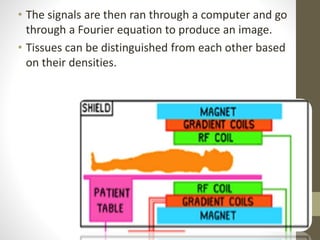
• The signals are then ran through a computer and go
through a Fourier equation to produce an image.
• Tissues can be distinguished from each other based
on their densities.
SPINNING PROTONS – TINY MAGNETS ALIGNS ON THE APPLICATION OF
EXTERNAL MAGNETIC FORCE .
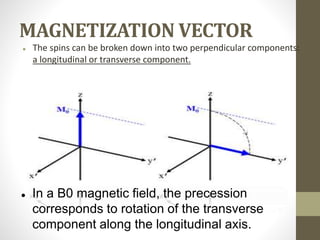
MAGNETIZATION VECTOR
 The spins can be broken down into two perpendicular components:
a longitudinal or transverse component.
 In a B0 magnetic field, the precession
corresponds to rotation of the transverse
component along the longitudinal axis.
LONGITUDINAL
MAGNETIZATION
• External magnetic field is directed along X axis
• Protons align on the parallel and anti parallel to the
external magnetic field (along positive and negative sides )
• Forces of protons on negative and positive side cancel each
other
• Few protons remain on the positive side which arent
cancelled .
• Forces of these protons add up together to form a
magnetic vector along z axis .
TRANSVERSE
MAGNETISATION
MR SIGNAL
• Transverse magnetisation vector formed has a
precession frequency .
• On movement , it produces electric current .
• The coils receive this current as MR signal.
• Strength of the signal depends upon magnitude
of the transverse magnetisation .
• MR signals are Fourior transformed into MR image
by computers .
LOCALISATION OF SIGNAL
• In order to localise the area from where the signals
are originating, three more magnetic fields are
superimposed.
1. Slice selection gradient - Z axis
2. Phase encoding gradient –Y axis
3. Frequency encoding gradient –X axis
RELAXATION
• Recovery of protons back towards equilibrium after having
been disturbed by RF excitation.
• Relaxation times of protons and heterogenous distribution
of tissue proton densities determine the contrast in an MR
image .
• When RF pulse is switched off , TM reduces and LM
increases.
Longitudinal relaxation
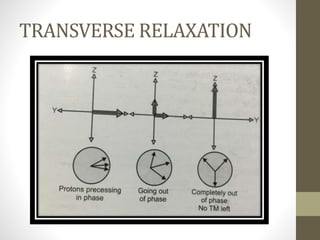
TRANSVERSE RELAXATION
T1
• Time taken by LM to recover after RF pulse is
switched off , to its original value .
• Time taken when LM reaches back to 63% of its
original value .
• Depends upon tissue composition ,structure and
surroundings .
• If lattice has magnetic field, which fluctuates at
Larmor frequency ,transfer of thermal energy
from protons to the lattice is easy and fast .
T2
• Time taken by TM to disappear .
• Depends on inhomogeneity of external
magnetic field .
• If liquid is impure and has larger molecules ,
they move at a slower rate .
• Maintains homogenity of magnetic field
• As a result, protons go out of phase very fast .
• Hence fat has shorter T2 .
SPIN ECHO SEQUENCE
• Most commonly used pulse sequence.
• The pulse sequence timing can be adjusted to give T1-
weighted, Proton or spin density, and T2-weighted images.
• Dual echo and multi echo sequences can be used to obtain
both proton density and T2-weighted images
simultaneously.
• The two variables of interest in spin echo sequences is the
repetition time (TR) and the echo time (TE).
• All spin echo sequences include a slice selective 90 degree
pulse followed by one or more 180 degree refocusing
pulses as shown in the diagram.
GRADIENT ECHO SEQUENCE
• Alternative technique to spin echo sequences
, differing from it in two principal points:
1. Utilization of gradient fields to generate
transverse magnetisation.
2. Flip angles of less than 90°.
• The flip angle is usually at or close to 90 degrees
for a spin echo sequence .
• Commonly varies over a range of about 10 to 80
degrees with gradient echo sequences.

Mri physics

  • 1.
    MRI PHYSICS- PARTIDr.Archana Koshy
  • 2.
    •Our bodies aremade up of roughly 63% water •MRI machines use hydrogen atoms which act like little magnets, having a north and south pole •The atoms inside our body are aligned in all different directions
  • 4.
    • Nuclei lineup with magnetic moments either in a parallel or anti- parallel configuration. • In body tissues more line up in parallel creating a small additional magnetization M in the direction of B0.
  • 5.
    • Frequency ofprecession of magnetic moments given by Larmor equation . g ~ 43 mHz/Tesla f = Larmor frequency (mHz) g = Gyromagnetic ratio (mHz/Tesla) B0 = Magnetic field strength (Tesla) f = g x B0
  • 6.
    PROTONS IN AMAGNETIC FIELD Bo Parallel (low energy) Anti-Parallel (high energy) Spinning protons in a magnetic field will assume two states.
  • 7.
    MRI and RadioFrequencies • The RF coil produces a radio frequency simultaneously to the magnetic field • This radio frequency vibrates at the perfect frequency (resonance frequency) which helps align the atoms in the same direction • The radio frequency coil sent out a signal that resonates with the protons. The radio waves are then shut off. • The protons continue to vibrate sending signals back to the radio frequency coils that receive these signals.
  • 8.
    • The signalsare then ran through a computer and go through a Fourier equation to produce an image. • Tissues can be distinguished from each other based on their densities.
  • 9.
    SPINNING PROTONS –TINY MAGNETS ALIGNS ON THE APPLICATION OF EXTERNAL MAGNETIC FORCE .
  • 10.
    MAGNETIZATION VECTOR  Thespins can be broken down into two perpendicular components: a longitudinal or transverse component.  In a B0 magnetic field, the precession corresponds to rotation of the transverse component along the longitudinal axis.
  • 11.
    LONGITUDINAL MAGNETIZATION • External magneticfield is directed along X axis • Protons align on the parallel and anti parallel to the external magnetic field (along positive and negative sides ) • Forces of protons on negative and positive side cancel each other • Few protons remain on the positive side which arent cancelled . • Forces of these protons add up together to form a magnetic vector along z axis .
  • 13.
  • 15.
    MR SIGNAL • Transversemagnetisation vector formed has a precession frequency . • On movement , it produces electric current . • The coils receive this current as MR signal. • Strength of the signal depends upon magnitude of the transverse magnetisation . • MR signals are Fourior transformed into MR image by computers .
  • 18.
    LOCALISATION OF SIGNAL •In order to localise the area from where the signals are originating, three more magnetic fields are superimposed. 1. Slice selection gradient - Z axis 2. Phase encoding gradient –Y axis 3. Frequency encoding gradient –X axis
  • 20.
    RELAXATION • Recovery ofprotons back towards equilibrium after having been disturbed by RF excitation. • Relaxation times of protons and heterogenous distribution of tissue proton densities determine the contrast in an MR image . • When RF pulse is switched off , TM reduces and LM increases.
  • 21.
  • 22.
  • 25.
    T1 • Time takenby LM to recover after RF pulse is switched off , to its original value . • Time taken when LM reaches back to 63% of its original value . • Depends upon tissue composition ,structure and surroundings . • If lattice has magnetic field, which fluctuates at Larmor frequency ,transfer of thermal energy from protons to the lattice is easy and fast .
  • 26.
    T2 • Time takenby TM to disappear . • Depends on inhomogeneity of external magnetic field . • If liquid is impure and has larger molecules , they move at a slower rate . • Maintains homogenity of magnetic field • As a result, protons go out of phase very fast . • Hence fat has shorter T2 .
  • 28.
    SPIN ECHO SEQUENCE •Most commonly used pulse sequence. • The pulse sequence timing can be adjusted to give T1- weighted, Proton or spin density, and T2-weighted images. • Dual echo and multi echo sequences can be used to obtain both proton density and T2-weighted images simultaneously. • The two variables of interest in spin echo sequences is the repetition time (TR) and the echo time (TE). • All spin echo sequences include a slice selective 90 degree pulse followed by one or more 180 degree refocusing pulses as shown in the diagram.
  • 30.
    GRADIENT ECHO SEQUENCE •Alternative technique to spin echo sequences , differing from it in two principal points: 1. Utilization of gradient fields to generate transverse magnetisation. 2. Flip angles of less than 90°. • The flip angle is usually at or close to 90 degrees for a spin echo sequence . • Commonly varies over a range of about 10 to 80 degrees with gradient echo sequences.