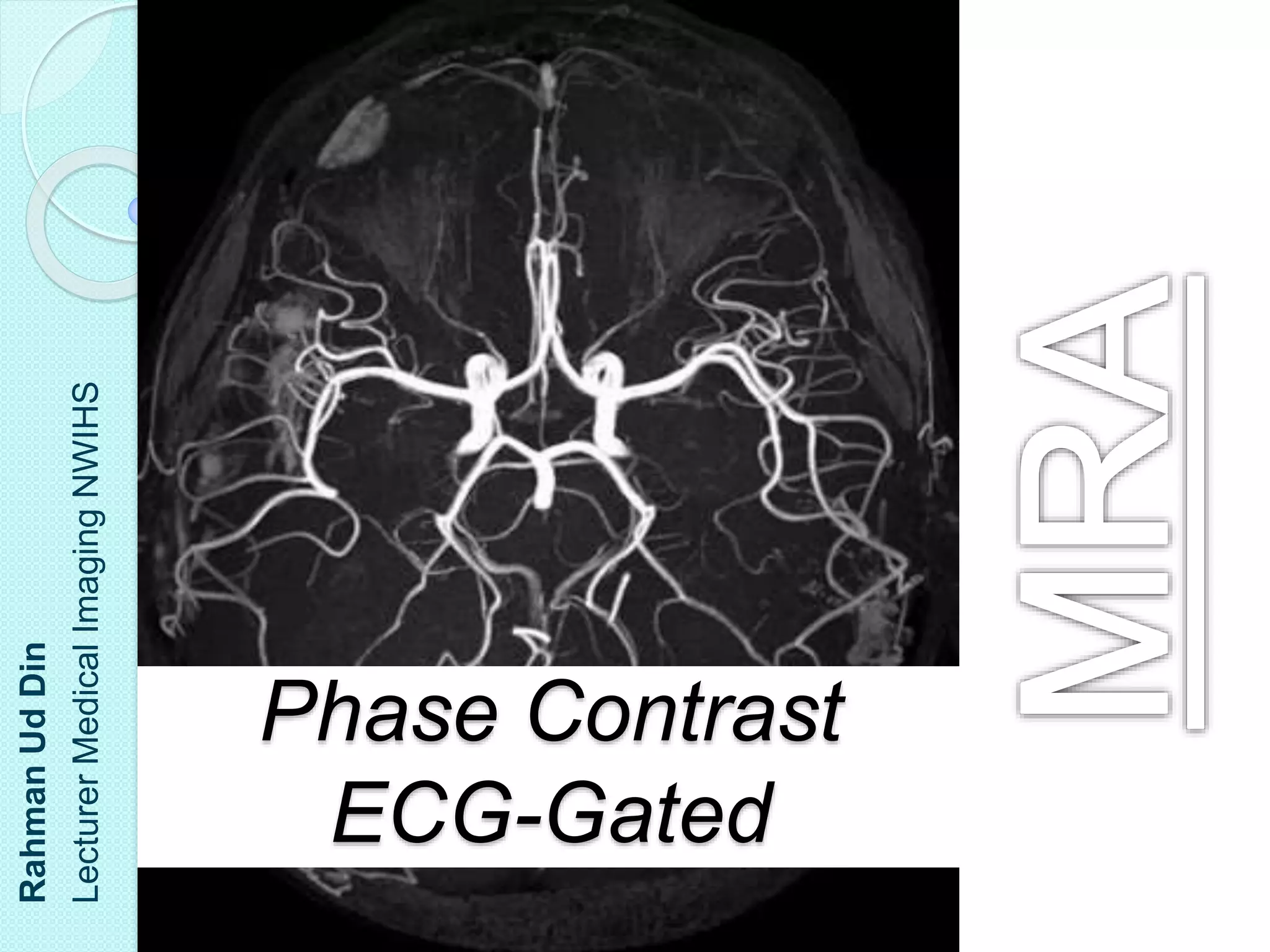
Phase Contrast
ECG-Gated
Rahman
Ud
Din
Lecturer
Medical
Imaging
NWIHS
Learning Outcomes
 Phase Contrast MRA
 VENC (Velocity Encoding)
 ECG-Gated FSE MRA
Phase Contrast MRA
 PC-MRA uses change in the phase of TM of
the blood and form an image
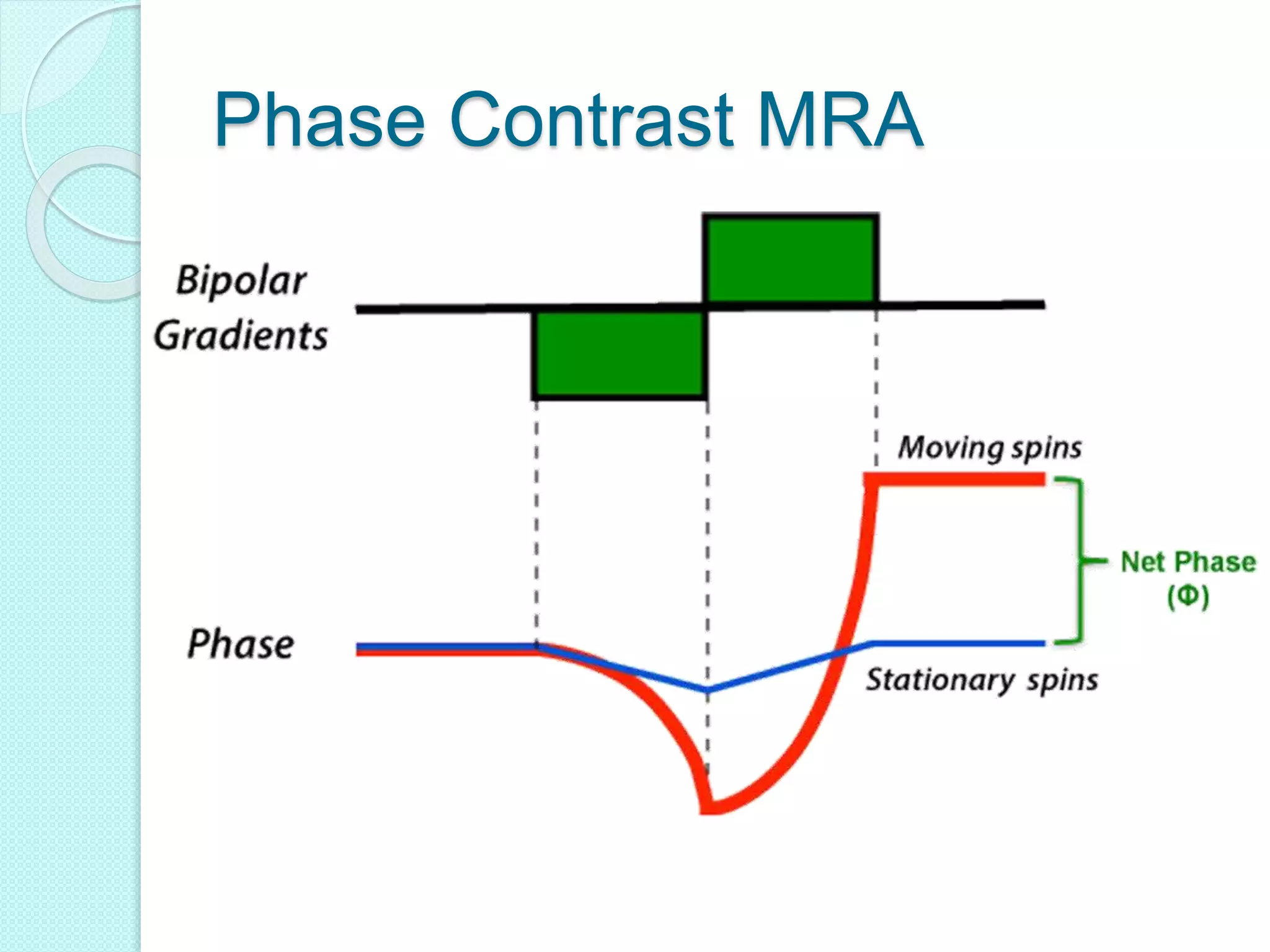
 The selective phase shift of the moving p+
is produced
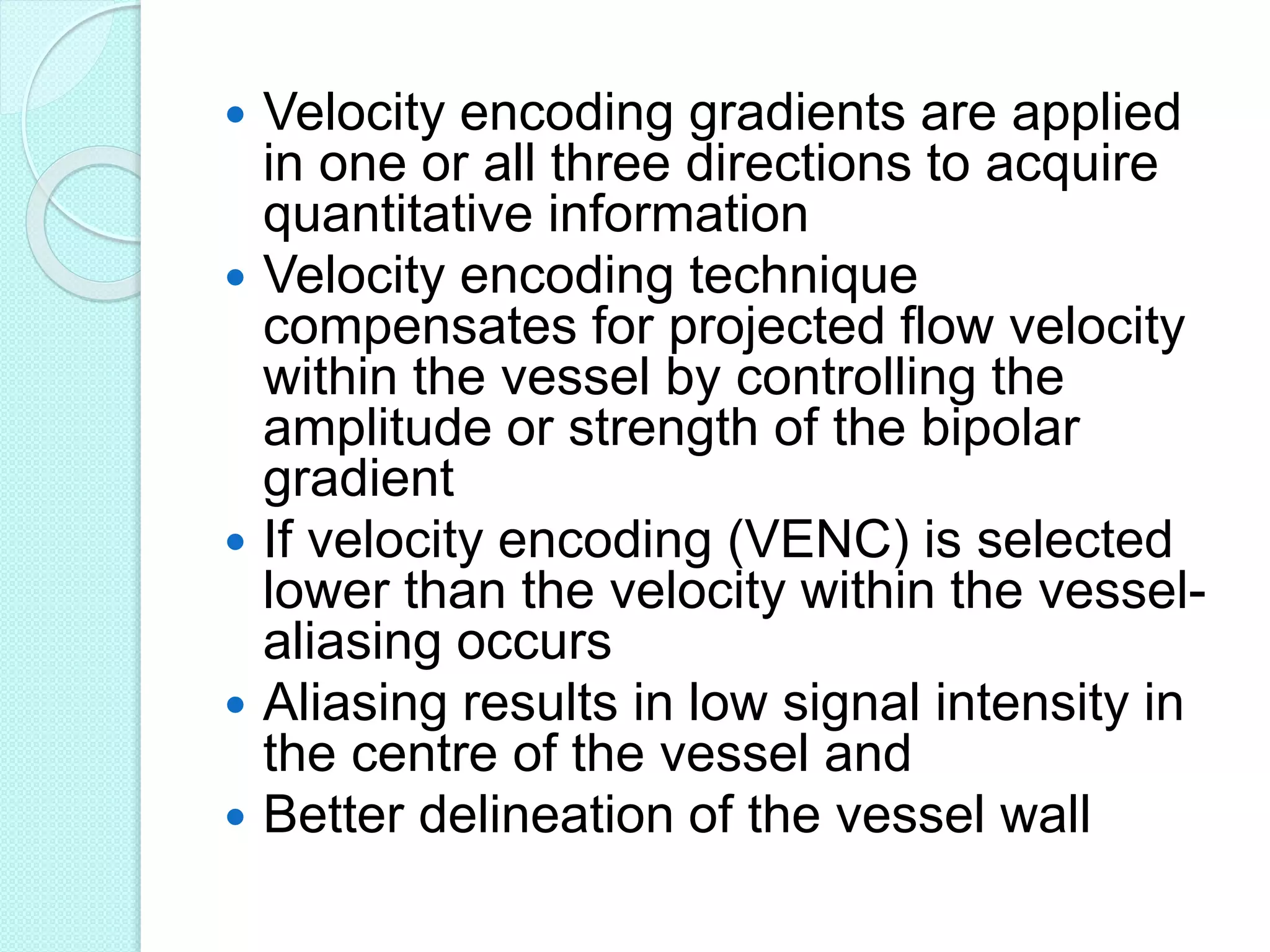
 GRE of a given strength is applied to both
stationery as well as moving p+ causing
phase shift in both but at different rates
 Initial RF excitation pulse brings all p+ in
phase
 Second GRE of same amplitude and
duration but of opposite polarity is applied
Phase Contrast MRA
 In stationery p+ reversal of phase shift
occur of exact amount
 Canceling the effect of original phase
shift
 Resulting into no net phase shift
 Hence, flowing p+ changed their position
the phase shift will not be corrected
 This shift is directly proportional to the
change in location or distance the p+
travel b/w application of first and second
gradients
 The phase shift is used by PC-MRA to
create angiographic image and to
measure flow velocity
VENC (Velocity Encoding )
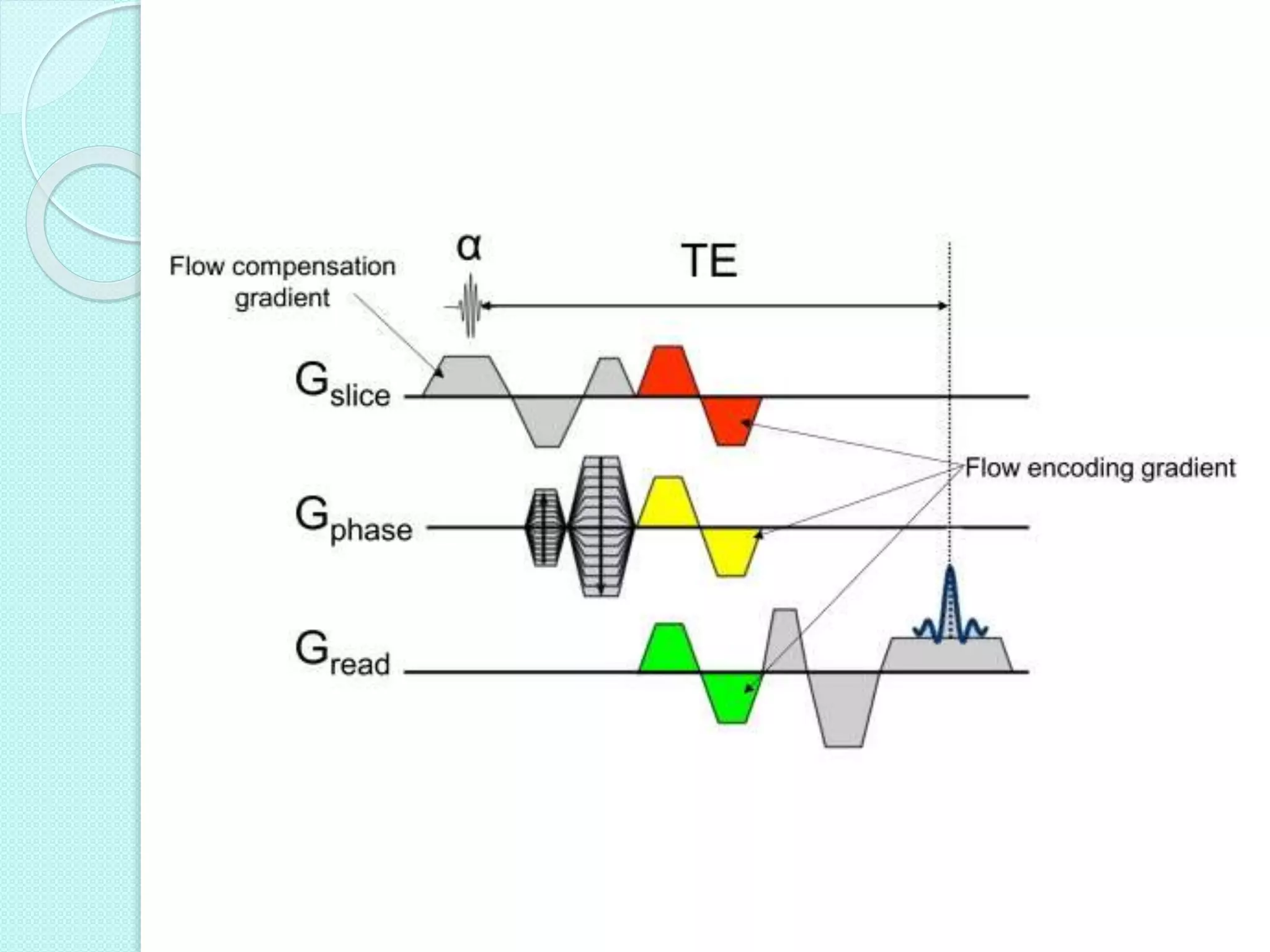
 Velocity encoding gradients are applied
in one or all three directions to acquire
quantitative information
 Velocity encoding technique
compensates for projected flow velocity
within the vessel by controlling the
amplitude or strength of the bipolar
gradient
 If velocity encoding (VENC) is selected
lower than the velocity within the vessel-
aliasing occurs
 Aliasing results in low signal intensity in
the centre of the vessel and
 Better delineation of the vessel wall
 Typical values of the VENC are
◦ 20-30 cm/s for venous flow
◦ 40-60 cm/s for higher velocity with some aliasing
◦ 60-80 cm/s to determine velocity and flow
direction
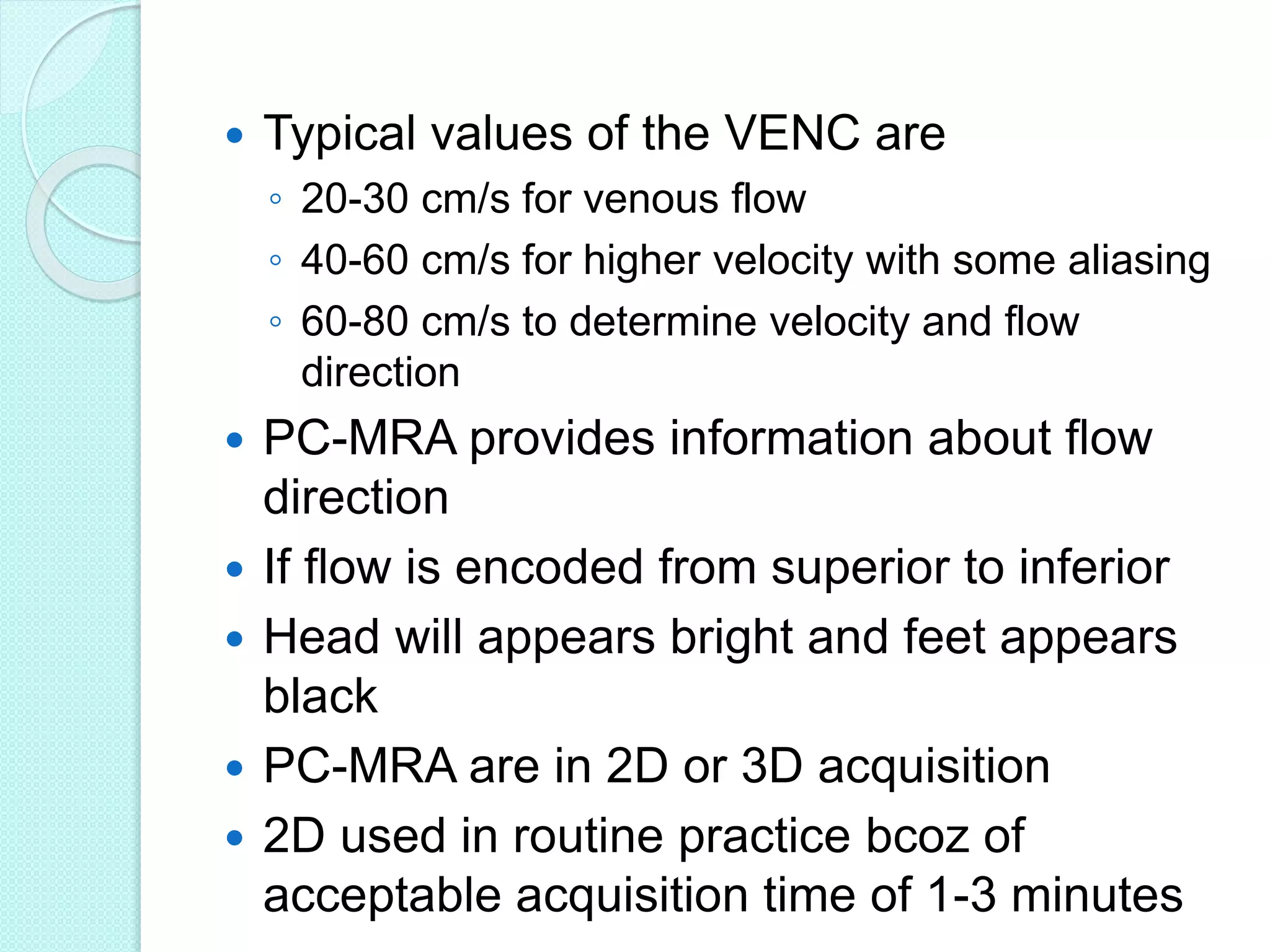
 PC-MRA provides information about flow
direction
 If flow is encoded from superior to inferior
 Head will appears bright and feet appears
black
 PC-MRA are in 2D or 3D acquisition
 2D used in routine practice bcoz of
acceptable acquisition time of 1-3 minutes
Phase Contrast MRA
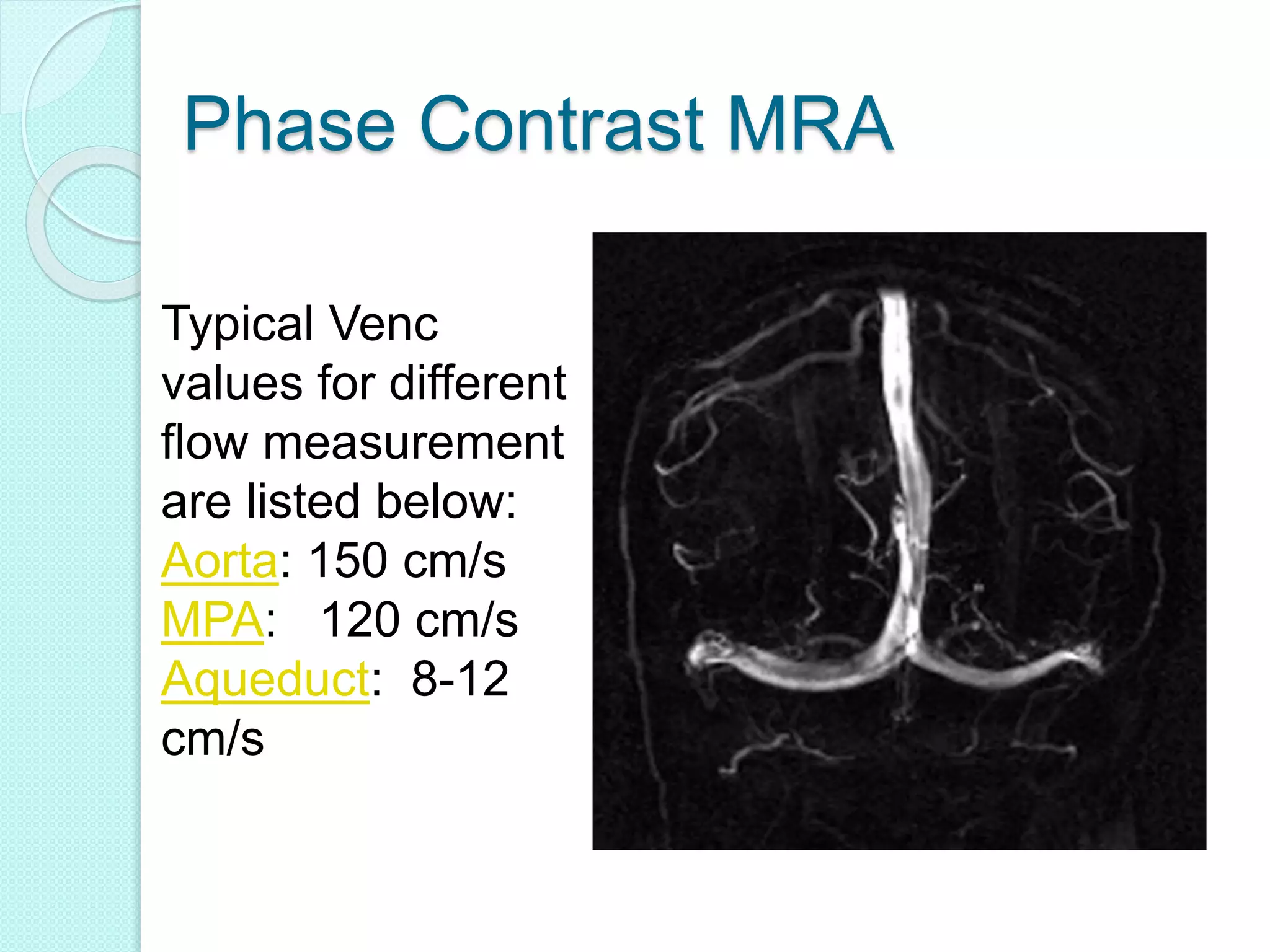
Typical Venc
values for different
flow measurement
are listed below:
Aorta: 150 cm/s
MPA: 120 cm/s
Aqueduct: 8-12
cm/s
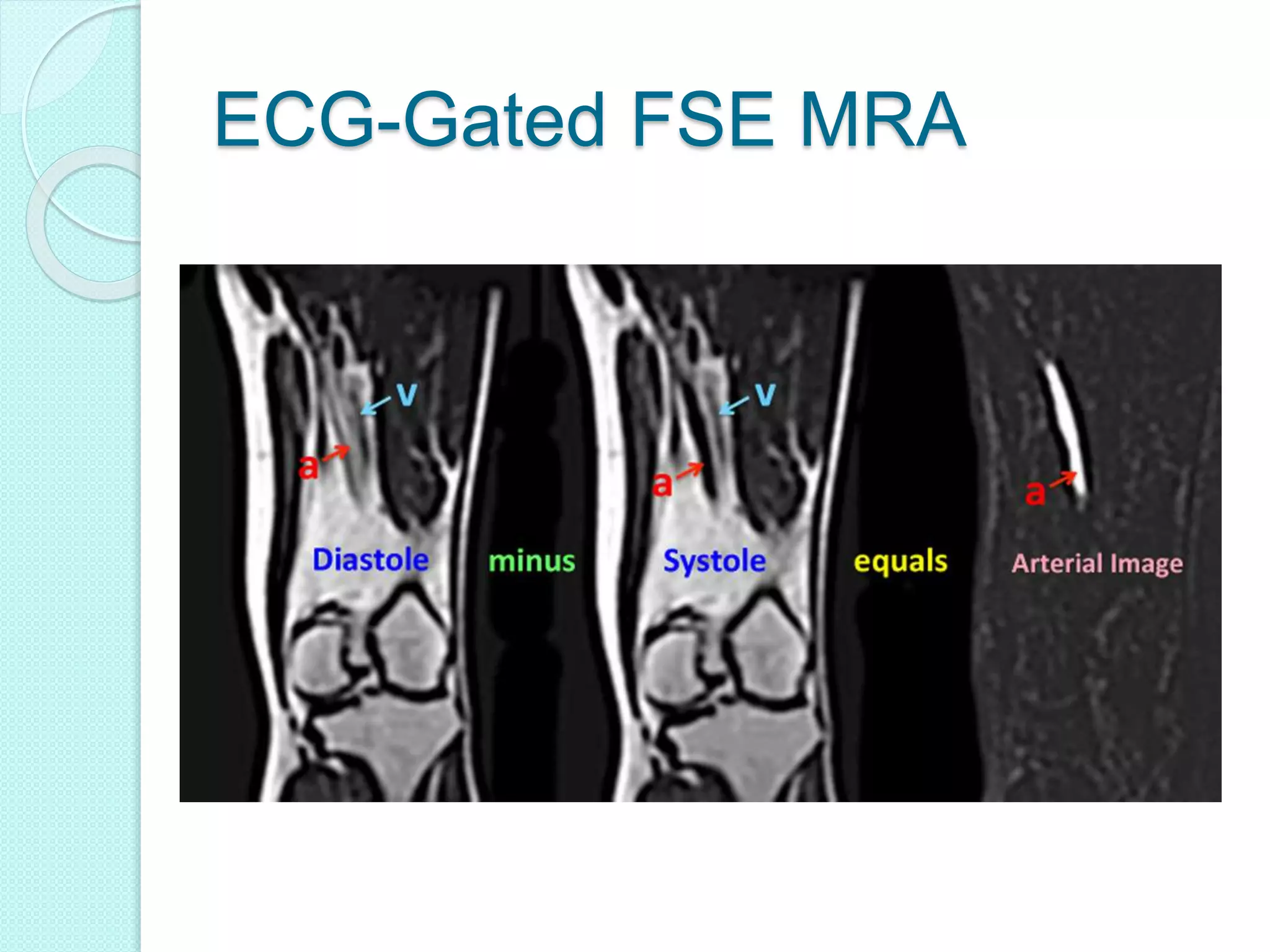
ECG-Gated FSE MRA
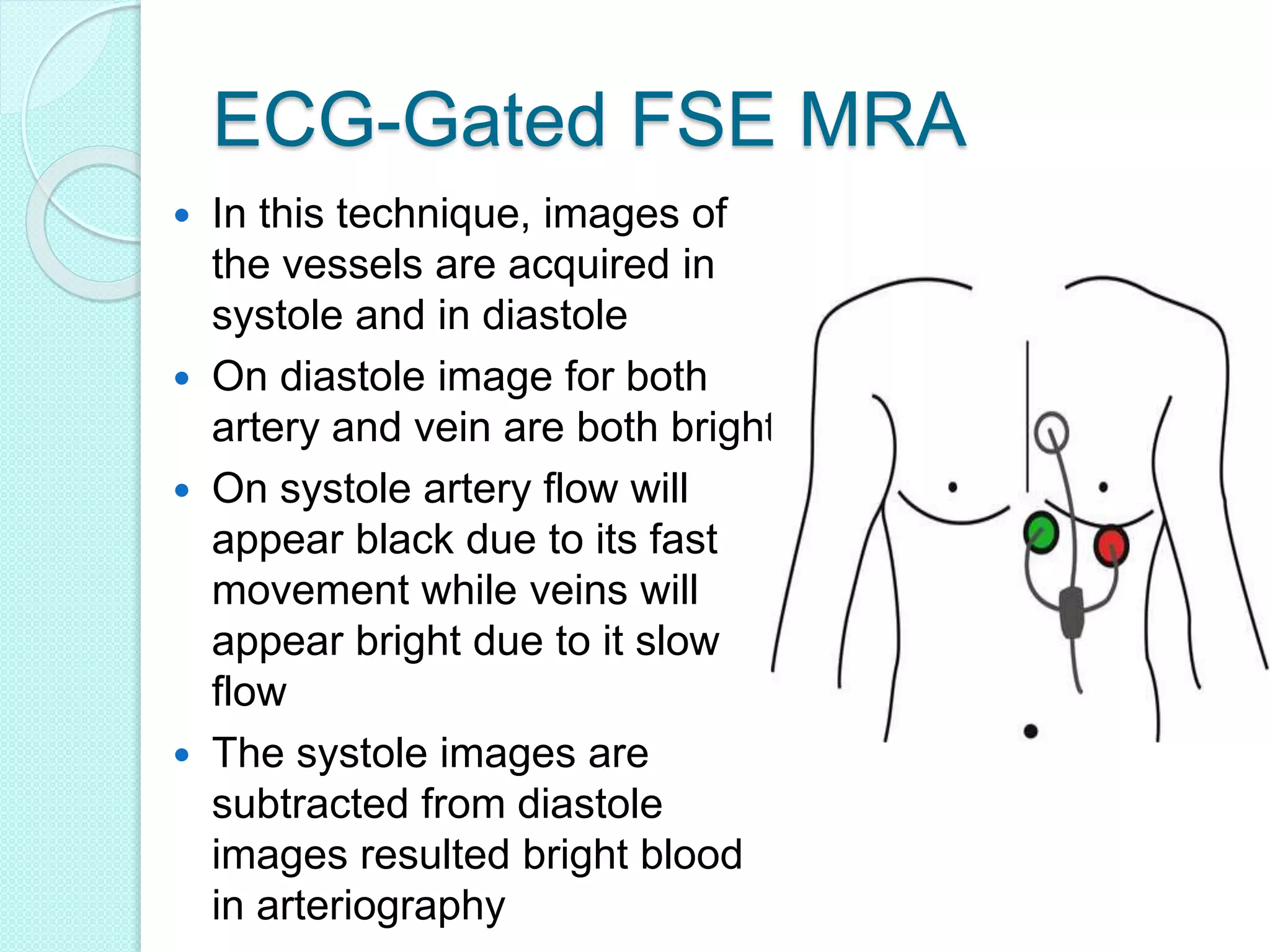
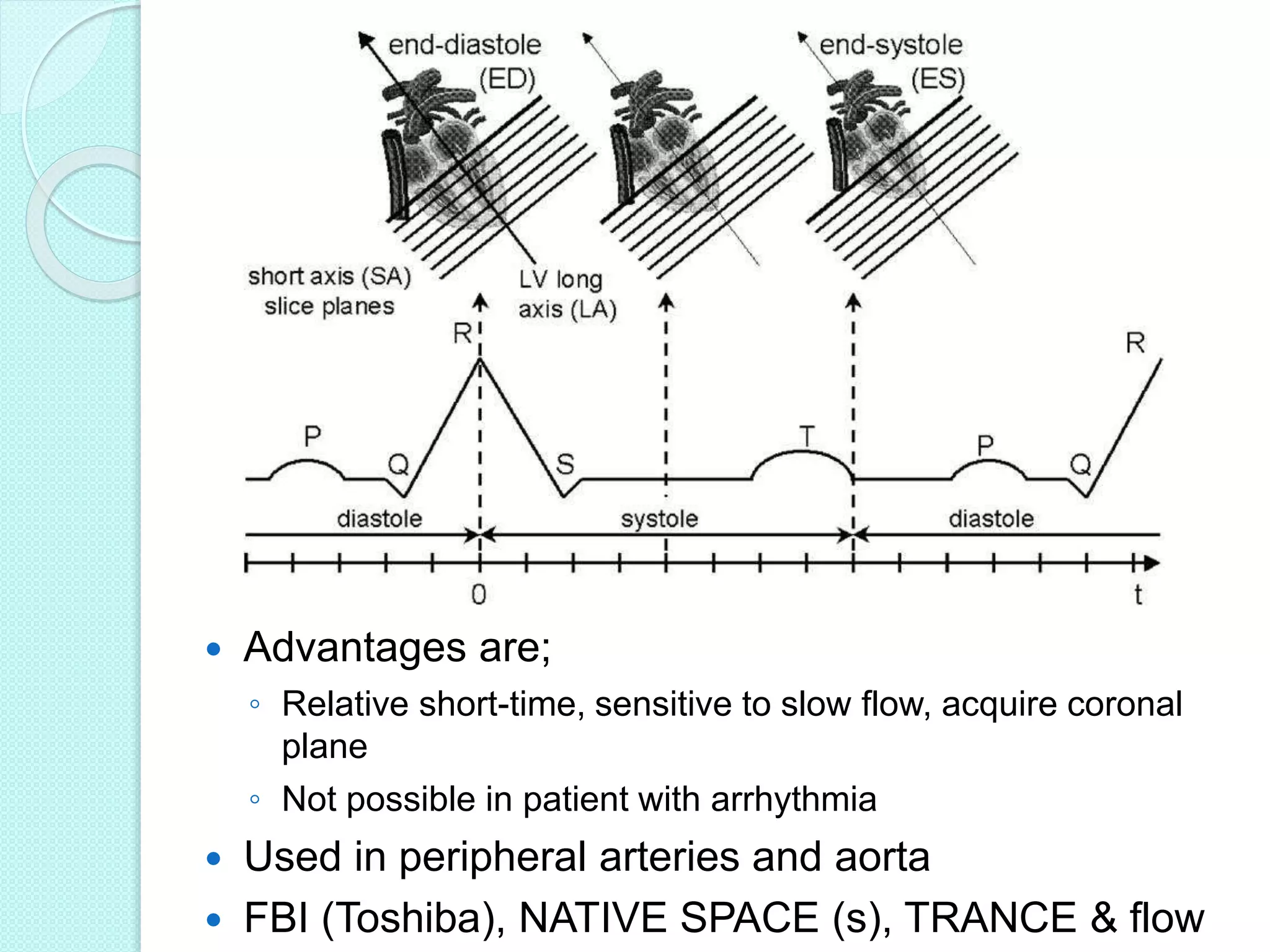
 In this technique, images of
the vessels are acquired in
systole and in diastole
 On diastole image for both
artery and vein are both bright
 On systole artery flow will
appear black due to its fast
movement while veins will
appear bright due to it slow
flow
 The systole images are
subtracted from diastole
images resulted bright blood
in arteriography
 Advantages are;
◦ Relative short-time, sensitive to slow flow, acquire coronal
plane
◦ Not possible in patient with arrhythmia
 Used in peripheral arteries and aorta
 FBI (Toshiba), NATIVE SPACE (s), TRANCE & flow
ECG-Gated FSE MRA
Phase Contrast and ECG-Gated MRA

Phase Contrast and ECG-Gated MRA

  • 1.
  • 2.
    Learning Outcomes  PhaseContrast MRA  VENC (Velocity Encoding)  ECG-Gated FSE MRA
  • 3.
    Phase Contrast MRA PC-MRA uses change in the phase of TM of the blood and form an image  The selective phase shift of the moving p+ is produced  GRE of a given strength is applied to both stationery as well as moving p+ causing phase shift in both but at different rates  Initial RF excitation pulse brings all p+ in phase  Second GRE of same amplitude and duration but of opposite polarity is applied
  • 4.
  • 5.
     In stationeryp+ reversal of phase shift occur of exact amount  Canceling the effect of original phase shift  Resulting into no net phase shift  Hence, flowing p+ changed their position the phase shift will not be corrected  This shift is directly proportional to the change in location or distance the p+ travel b/w application of first and second gradients  The phase shift is used by PC-MRA to create angiographic image and to measure flow velocity
  • 6.
  • 7.
     Velocity encodinggradients are applied in one or all three directions to acquire quantitative information  Velocity encoding technique compensates for projected flow velocity within the vessel by controlling the amplitude or strength of the bipolar gradient  If velocity encoding (VENC) is selected lower than the velocity within the vessel- aliasing occurs  Aliasing results in low signal intensity in the centre of the vessel and  Better delineation of the vessel wall
  • 9.
     Typical valuesof the VENC are ◦ 20-30 cm/s for venous flow ◦ 40-60 cm/s for higher velocity with some aliasing ◦ 60-80 cm/s to determine velocity and flow direction  PC-MRA provides information about flow direction  If flow is encoded from superior to inferior  Head will appears bright and feet appears black  PC-MRA are in 2D or 3D acquisition  2D used in routine practice bcoz of acceptable acquisition time of 1-3 minutes
  • 10.
    Phase Contrast MRA TypicalVenc values for different flow measurement are listed below: Aorta: 150 cm/s MPA: 120 cm/s Aqueduct: 8-12 cm/s
  • 11.
    ECG-Gated FSE MRA In this technique, images of the vessels are acquired in systole and in diastole  On diastole image for both artery and vein are both bright  On systole artery flow will appear black due to its fast movement while veins will appear bright due to it slow flow  The systole images are subtracted from diastole images resulted bright blood in arteriography
  • 12.
     Advantages are; ◦Relative short-time, sensitive to slow flow, acquire coronal plane ◦ Not possible in patient with arrhythmia  Used in peripheral arteries and aorta  FBI (Toshiba), NATIVE SPACE (s), TRANCE & flow
  • 13.