IMMUNE SYSTEM


  PRESENTED BY:
DR MARIAM ASIF
LYMPHATIC AND IMMUNE
      SYSTEM
The Lymphatic and
         Immune Systems

• Main structures of the lymphatic system
  – Lymphatic vessels
• Main components of the immune system
  – Lymphocytes
  – Lymphoid tissue
  – Lymphoid organs
The Lymphatic
      System

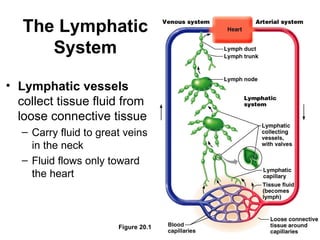
• Lymphatic vessels
  collect tissue fluid from
  loose connective tissue
   – Carry fluid to great veins
     in the neck
   – Fluid flows only toward
     the heart


                        Figure 20.1
Functions of Lymphatic Vessels

• Collect excess tissue fluid and blood proteins
• Return tissue fluid and blood proteins to
  bloodstream
Orders of Lymphatic Vessels

• Lymph capillaries
 - smallest lymph vessels
  – first to receive lymph

• Lymphatic collecting vessels
  – collect from lymph capillaries
Orders of Lymphatic Vessels

• Lymph nodes
  – scattered along collecting vessels

• Lymph trunks
  – collect lymph from collecting vessels

• Lymph ducts
  – empty into veins of the neck
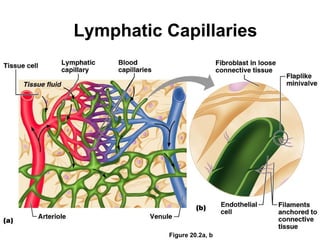
Lymphatic Capillaries

• Located near blood capillaries
• Receive tissue fluid from CT
  - increased volume of tissue fluid
  - minivalve flaps open and allow fluid to enter

• Highly permeability allows entrance of
  – tissue fluid
  – bacteria, viruses, and cancer cells
Lymphatic Capillaries

• Lacteals
  – specialized lymphatic capillaries
  - located in the villi of the small intestines
  - receive digested fats
  - fatty lymph – chyle
Lymphatic Capillaries


          Figure 20.2a, b
Lymphatic Collecting Vessels

• Accompany blood vessels

• Composed of the same three tunics as BVs
• Contain more valves than veins do
  – helps direct the flow of blood

• Lymph propelled by
  – bulging of skeletal muscles
  – pulsing of nearby arteries
  – tunica media of the lymph vessels
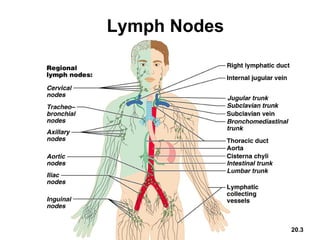
Lymph Nodes

• Cleanse the lymph of pathogens
• Human body contains around 500
• Lymph nodes are organized in clusters
Lymph Nodes


              Figure 20.3
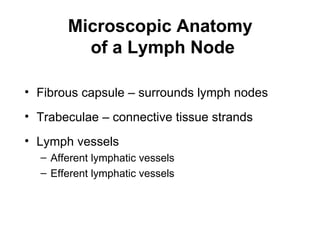
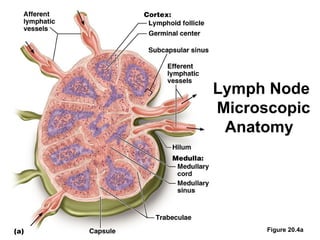
Microscopic Anatomy
         of a Lymph Node

• Fibrous capsule – surrounds lymph nodes
• Trabeculae – connective tissue strands
• Lymph vessels
  – Afferent lymphatic vessels
  – Efferent lymphatic vessels
Lymph Node
Microscopic
 Anatomy


      Figure 20.4a
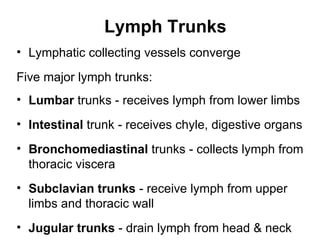
Lymph Trunks
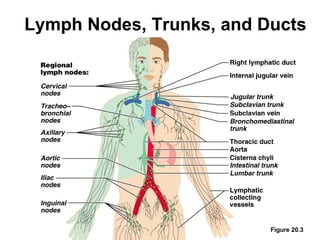
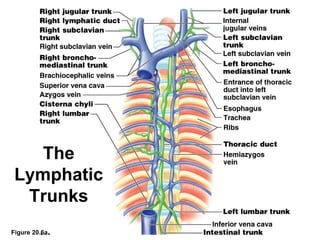
• Lymphatic collecting vessels converge

Five major lymph trunks:
• Lumbar trunks - receives lymph from lower limbs
• Intestinal trunk - receives chyle, digestive organs
• Bronchomediastinal trunks - collects lymph from
  thoracic viscera
• Subclavian trunks - receive lymph from upper
  limbs and thoracic wall
• Jugular trunks - drain lymph from head & neck
Lymph Nodes, Trunks, and Ducts


                          Figure 20.3
The
 Lymphatic
  Trunks
Figure 20.6a
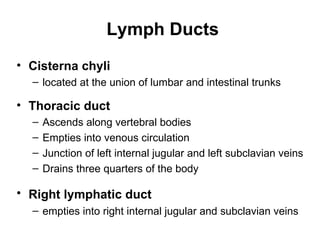
Lymph Ducts
• Cisterna chyli
  – located at the union of lumbar and intestinal trunks

• Thoracic duct
  –   Ascends along vertebral bodies
  –   Empties into venous circulation
  –   Junction of left internal jugular and left subclavian veins
  –   Drains three quarters of the body

• Right lymphatic duct
  – empties into right internal jugular and subclavian veins
The Immune System

• Recognizes specific foreign molecules
• Destroys pathogens effectively
• Key cells – lymphocytes
• Also includes lymphoid tissue and lymphoid
  organs
Lymphocytes

• Infectious organisms attacked by inflammatory
  response
  – macrophages, then lymphocytes

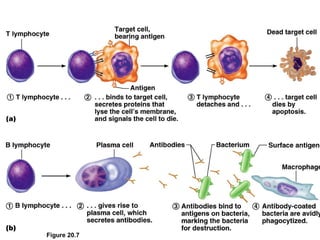
• Cytotoxic T lymphocytes
  –   Attack foreign cells directly
  –   Binds to antigen-bearing cells
  –   Perforates cell membrane
  –   Signals cell to undergo apoptosis
Lymphocytes

• B lymphocytes
 - become plasma cells
 - secrete antibodies, mark cells for destruction by
 macrophages
Figure 20.7
Lymphocyte Activation

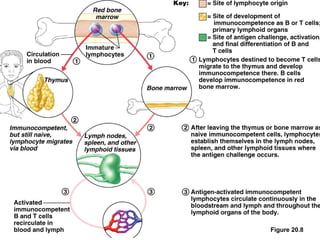
• Lymphocytes originate in bone marrow
• T lymphocytes travel to the thymus gland
• B lymphocytes stay in bone marrow
• Able to recognize a unique antigen
• Gain immunocompetence
  – travels through blood stream
  – meets and binds to a specific antigen
Lymphocyte Activation
• Activating T or B cells produce
  – Effector lymphocytes
     • Short-lived, attack immediately
  – Memory lymphocytes
     • Wait until body encounters their antigen again
        – Basis of acquired immunity
        – Guard against subsequent infections
Figure 20.8
Lymphoid Tissue

• Most important tissue of the immune system

Two general locations:
• Mucous membranes of digestive, urinary,
  respiratory, and reproductive tracts
  - Mucosa-associated lymphoid tissue (MALT)

• Lymphoid organs (except thymus)
Lymphoid Organs

• Primary lymphoid organs
  – Bone marrow
  – Thymus

• Secondary lymphoid organs
  – Lymph nodes, spleen, tonsils
  – Aggregated lymphoid nodules
  – Appendix
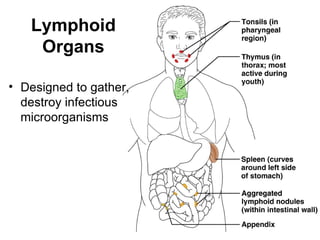
Lymphoid
    Organs

• Designed to gather,
  destroy infectious
  microorganisms


                        Figure 20.10
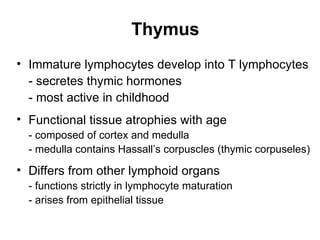
Thymus
• Immature lymphocytes develop into T lymphocytes
  - secretes thymic hormones
  - most active in childhood
• Functional tissue atrophies with age
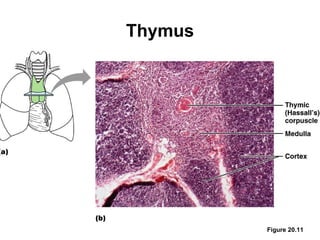
  - composed of cortex and medulla
  - medulla contains Hassall’s corpuscles (thymic corpuseles)

• Differs from other lymphoid organs
  - functions strictly in lymphocyte maturation
  - arises from epithelial tissue
Thymus


         Figure 20.11
Lymph Nodes

Functional pathway
• Lymph percolates through lymph sinuses
• Most antigenic challenges occur in lymph nodes
• Antigens destroyed – activate B and T lymphocytes
Spleen

• Largest lymphoid organ
• Two main blood-cleansing functions
  – Removal of blood-borne antigens
  – Removal and destruction of old or defective blood cells

• Site of hematopoiesis in the fetus
Spleen

• Destruction of antigens
• Site of B cell maturation into plasma cells
• Phagocytosis of bacteria and worn-out RBCs,
  WBCs and platelets
• Storage of platelets
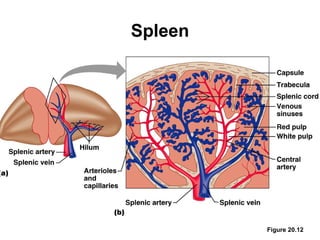
• White pulp – thick sleeves of lymphoid tissue
• Red pulp - surrounds white pulp
  - composed of venous sinuses
  - splenic cords
Spleen


         Figure 20.12
Tonsils

• Simplest lymphoid organs
• Four groups of tonsils
  – palatine, lingual, pharyngeal, and tubal tonsils

• Arranged in a ring to gather and remove
  pathogens
• Underlying lamina propria consists of MALT
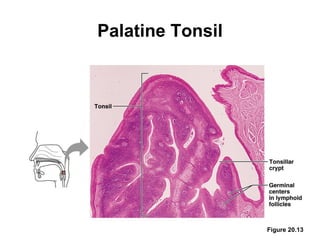
Palatine Tonsil


                  Figure 20.13
Aggregated Lymphoid
        Nodules and Appendix

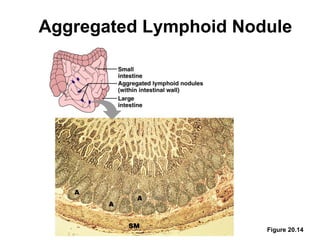
• MALT – abundant in walls of intestines
• Fight invading bacteria
• Generate a wide variety of memory lymphocytes
  - aggregated lymphoid nodules (Peyer’s patches)
  - located in the distal part of the small intestine

• Appendix – tubular offshoot of the cecum
Aggregated Lymphoid Nodule


                       Figure 20.14
Disorders of the Lymphatic
         and Immune Systems
• Chylothorax - leakage of fatty lymph into the
  thorax
• Lymphangitis - inflammation of a lymph vessel
• Mononucleosis - caused by Epstein-Barr virus
  - attacks B lymphocytes

• Hodgkin’s disease - malignancy of lymph nodes
• Non-Hodgkin’s lymphoma - uncontrolled
  multiplication
  - metastasis of undifferentiated lymphocytes
The Lymphatic and Immune
     Systems Throughout Life

• Lymphatic vessels and lymph nodes
  – develop from lymphatic sacs

• Thymus originates as an outgrowth of endoderm
• Spleen, lymph nodes, and MALT
  – arise from mesodermal mesenchyme

Lymphatic and immune system

  • 1.
    IMMUNE SYSTEM PRESENTED BY: DR MARIAM ASIF
  • 2.
  • 3.
    The Lymphatic and Immune Systems • Main structures of the lymphatic system – Lymphatic vessels • Main components of the immune system – Lymphocytes – Lymphoid tissue – Lymphoid organs
  • 4.
    The Lymphatic System • Lymphatic vessels collect tissue fluid from loose connective tissue – Carry fluid to great veins in the neck – Fluid flows only toward the heart Figure 20.1
  • 5.
    Functions of LymphaticVessels • Collect excess tissue fluid and blood proteins • Return tissue fluid and blood proteins to bloodstream
  • 6.
    Orders of LymphaticVessels • Lymph capillaries - smallest lymph vessels – first to receive lymph • Lymphatic collecting vessels – collect from lymph capillaries
  • 7.
    Orders of LymphaticVessels • Lymph nodes – scattered along collecting vessels • Lymph trunks – collect lymph from collecting vessels • Lymph ducts – empty into veins of the neck
  • 8.
    Lymphatic Capillaries • Locatednear blood capillaries • Receive tissue fluid from CT - increased volume of tissue fluid - minivalve flaps open and allow fluid to enter • Highly permeability allows entrance of – tissue fluid – bacteria, viruses, and cancer cells
  • 9.
    Lymphatic Capillaries • Lacteals – specialized lymphatic capillaries - located in the villi of the small intestines - receive digested fats - fatty lymph – chyle
  • 10.
    Lymphatic Capillaries Figure 20.2a, b
  • 11.
    Lymphatic Collecting Vessels •Accompany blood vessels • Composed of the same three tunics as BVs • Contain more valves than veins do – helps direct the flow of blood • Lymph propelled by – bulging of skeletal muscles – pulsing of nearby arteries – tunica media of the lymph vessels
  • 12.
    Lymph Nodes • Cleansethe lymph of pathogens • Human body contains around 500 • Lymph nodes are organized in clusters
  • 13.
    Lymph Nodes Figure 20.3
  • 14.
    Microscopic Anatomy of a Lymph Node • Fibrous capsule – surrounds lymph nodes • Trabeculae – connective tissue strands • Lymph vessels – Afferent lymphatic vessels – Efferent lymphatic vessels
  • 15.
  • 16.
    Lymph Trunks • Lymphaticcollecting vessels converge Five major lymph trunks: • Lumbar trunks - receives lymph from lower limbs • Intestinal trunk - receives chyle, digestive organs • Bronchomediastinal trunks - collects lymph from thoracic viscera • Subclavian trunks - receive lymph from upper limbs and thoracic wall • Jugular trunks - drain lymph from head & neck
  • 17.
    Lymph Nodes, Trunks,and Ducts Figure 20.3
  • 18.
    The Lymphatic Trunks Figure 20.6a
  • 19.
    Lymph Ducts • Cisternachyli – located at the union of lumbar and intestinal trunks • Thoracic duct – Ascends along vertebral bodies – Empties into venous circulation – Junction of left internal jugular and left subclavian veins – Drains three quarters of the body • Right lymphatic duct – empties into right internal jugular and subclavian veins
  • 20.
    The Immune System •Recognizes specific foreign molecules • Destroys pathogens effectively • Key cells – lymphocytes • Also includes lymphoid tissue and lymphoid organs
  • 21.
    Lymphocytes • Infectious organismsattacked by inflammatory response – macrophages, then lymphocytes • Cytotoxic T lymphocytes – Attack foreign cells directly – Binds to antigen-bearing cells – Perforates cell membrane – Signals cell to undergo apoptosis
  • 22.
    Lymphocytes • B lymphocytes - become plasma cells - secrete antibodies, mark cells for destruction by macrophages
  • 23.
  • 24.
    Lymphocyte Activation • Lymphocytesoriginate in bone marrow • T lymphocytes travel to the thymus gland • B lymphocytes stay in bone marrow • Able to recognize a unique antigen • Gain immunocompetence – travels through blood stream – meets and binds to a specific antigen
  • 25.
    Lymphocyte Activation • ActivatingT or B cells produce – Effector lymphocytes • Short-lived, attack immediately – Memory lymphocytes • Wait until body encounters their antigen again – Basis of acquired immunity – Guard against subsequent infections
  • 26.
  • 27.
    Lymphoid Tissue • Mostimportant tissue of the immune system Two general locations: • Mucous membranes of digestive, urinary, respiratory, and reproductive tracts - Mucosa-associated lymphoid tissue (MALT) • Lymphoid organs (except thymus)
  • 28.
    Lymphoid Organs • Primarylymphoid organs – Bone marrow – Thymus • Secondary lymphoid organs – Lymph nodes, spleen, tonsils – Aggregated lymphoid nodules – Appendix
  • 29.
    Lymphoid Organs • Designed to gather, destroy infectious microorganisms Figure 20.10
  • 30.
    Thymus • Immature lymphocytesdevelop into T lymphocytes - secretes thymic hormones - most active in childhood • Functional tissue atrophies with age - composed of cortex and medulla - medulla contains Hassall’s corpuscles (thymic corpuseles) • Differs from other lymphoid organs - functions strictly in lymphocyte maturation - arises from epithelial tissue
  • 31.
    Thymus Figure 20.11
  • 32.
    Lymph Nodes Functional pathway •Lymph percolates through lymph sinuses • Most antigenic challenges occur in lymph nodes • Antigens destroyed – activate B and T lymphocytes
  • 33.
    Spleen • Largest lymphoidorgan • Two main blood-cleansing functions – Removal of blood-borne antigens – Removal and destruction of old or defective blood cells • Site of hematopoiesis in the fetus
  • 34.
    Spleen • Destruction ofantigens • Site of B cell maturation into plasma cells • Phagocytosis of bacteria and worn-out RBCs, WBCs and platelets • Storage of platelets
  • 35.
    • White pulp– thick sleeves of lymphoid tissue • Red pulp - surrounds white pulp - composed of venous sinuses - splenic cords
  • 36.
    Spleen Figure 20.12
  • 37.
    Tonsils • Simplest lymphoidorgans • Four groups of tonsils – palatine, lingual, pharyngeal, and tubal tonsils • Arranged in a ring to gather and remove pathogens • Underlying lamina propria consists of MALT
  • 38.
    Palatine Tonsil Figure 20.13
  • 39.
    Aggregated Lymphoid Nodules and Appendix • MALT – abundant in walls of intestines • Fight invading bacteria • Generate a wide variety of memory lymphocytes - aggregated lymphoid nodules (Peyer’s patches) - located in the distal part of the small intestine • Appendix – tubular offshoot of the cecum
  • 40.
  • 41.
    Disorders of theLymphatic and Immune Systems • Chylothorax - leakage of fatty lymph into the thorax • Lymphangitis - inflammation of a lymph vessel • Mononucleosis - caused by Epstein-Barr virus - attacks B lymphocytes • Hodgkin’s disease - malignancy of lymph nodes • Non-Hodgkin’s lymphoma - uncontrolled multiplication - metastasis of undifferentiated lymphocytes
  • 42.
    The Lymphatic andImmune Systems Throughout Life • Lymphatic vessels and lymph nodes – develop from lymphatic sacs • Thymus originates as an outgrowth of endoderm • Spleen, lymph nodes, and MALT – arise from mesodermal mesenchyme