ANEMIA
Learning Objectives
• At the end of lecture student should be able to know.
• What is anemia?
• Classification of anemia‘s
• Morphological classification
• Pathophysiological classification
• Functional classification
• How do you diagnose anemia?
Definition
• Anemia (a decrease in the number of RBCs, Hb content, or Hematocrit) below the lower
   limit of the normal range for the age and sex of the individual.
• In adults, the lower extreme of the normal haemoglobin is taken as 13.0 g/ dl for males
   and 11.5 g/dl for females.
• Newborn infants have higher haemoglobin level and, therefore, 15 g/dl is taken as the
   lower limit at birth.

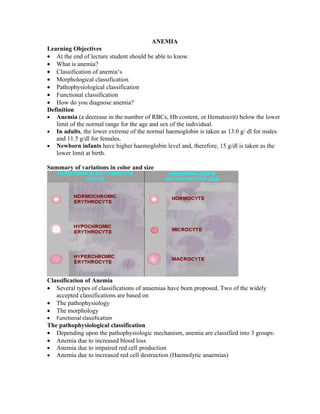
Summary of variations in color and size


Classification of Anemia
• Several types of classifications of anaemias have been proposed. Two of the widely
   accepted classifications are based on
• The pathophysiology
• The morphology
•   Functional classification
The pathophysiological classification
• Depending upon the pathophysiologic mechanism, anemia are classified into 3 groups:
• Anemia due to increased blood loss
• Anemia due to impaired red cell production
• Anemia due to increased red cell destruction (Haemolytic anaemias)
The Morphological classification
• Based on red cell size, haemoglobin content and red cell indices anemia are classified
   into 3 types:
• Microcytic, hypochromic
• Normocytic, normochromic
• Macrocytic, normochromic
•
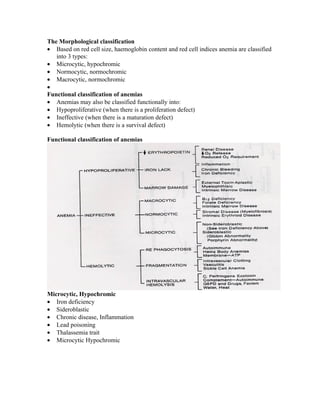
Functional classification of anemias
• Anemias may also be classified functionally into:
• Hypoproliferative (when there is a proliferation defect)
• Ineffective (when there is a maturation defect)
• Hemolytic (when there is a survival defect)

Functional classification of anemias


Microcytic, Hypochromic
• Iron deficiency
• Sideroblastic
• Chronic disease, Inflammation
• Lead poisoning
• Thalassemia trait
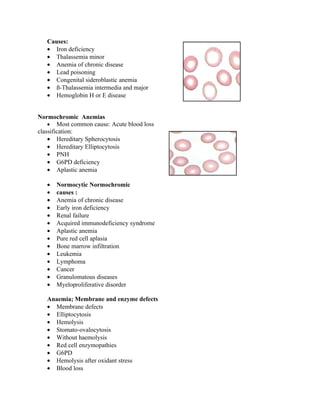
• Microcytic Hypochromic
Causes:
   • Iron deficiency
   • Thalassemia minor
   • Anemia of chronic disease
   • Lead poisoning
   • Congenital sideroblastic anemia
   • ß-Thalassemia intermedia and major
   • Hemoglobin H or E disease


Normochromic Anemias
    • Most common cause: Acute blood loss
classification:
    • Hereditary Spherocytosis
    • Hereditary Elliptocytosis
    • PNH
    • G6PD deficiency
    • Aplastic anemia

   •   Normocytic Normochromic
   •   causes :
   •   Anemia of chronic disease
   •   Early iron deficiency
   •   Renal failure
   •   Acquired immunodeficiency syndrome
   •   Aplastic anemia
   •   Pure red cell aplasia
   •   Bone marrow infiltration
   •   Leukemia
   •   Lymphoma
   •   Cancer
   •   Granulomatous diseases
   •   Myeloproliferative disorder

   Anaemia; Membrane and enzyme defects
   • Membrane defects
   • Elliptocytosis
   • Hemolysis
   • Stomato-ovalocytosis
   • Without haemolysis
   • Red cell enzymopathies
   • G6PD
   • Hemolysis after oxidant stress
   • Blood loss
Macrocytic Anemias

  •   Vitamin B12 deficiency
  •   Folate deficiency
  •   Liver disease

  Macrocytic Normochromic

  •   Causes:
  •   Megaloblastic anemia (B12 or folate deficiency)
  •   Alcoholism
  •   Liver disease
  •   Reticulocytosis
  •   Chemotherapy
  •   Myelodysplastic syndromes
  •   Multiple myeloma
  •   Hypothyroidism

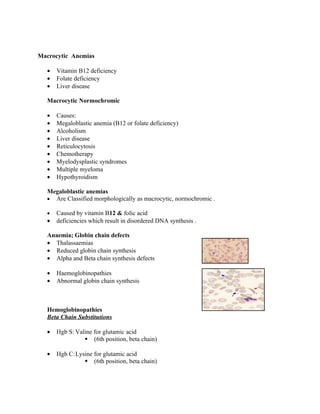
  Megaloblastic anemias
  • Are Classified morphologically as macrocytic, normochromic .

  •   Caused by vitamin B12 & folic acid
  •   deficiencies which result in disordered DNA synthesis .

  Anaemia; Globin chain defects
  • Thalassaemias
  • Reduced globin chain synthesis
  • Alpha and Beta chain synthesis defects

  •   Haemoglobinopathies
  •   Abnormal globin chain synthesis


  Hemoglobinopathies
  Beta Chain Substitutions

  •   Hgb S: Valine for glutamic acid
                 (6th position, beta chain)

  •   Hgb C:Lysine for glutamic acid
                (6th position, beta chain)
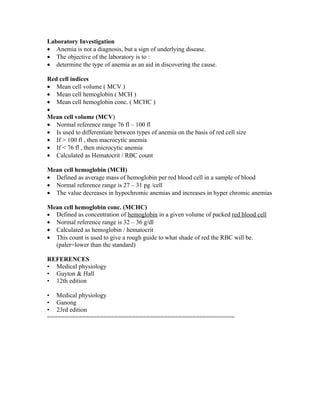
Laboratory Investigation
• Anemia is not a diagnosis, but a sign of underlying disease.
• The objective of the laboratory is to :
• determine the type of anemia as an aid in discovering the cause.

Red cell indices
• Mean cell volume ( MCV )
• Mean cell hemoglobin ( MCH )
• Mean cell hemoglobin conc. ( MCHC )
•
Mean cell volume (MCV)
• Normal reference range 76 fl – 100 fl
• Is used to differentiate between types of anemia on the basis of red cell size
• If > 100 fl , then macrocytic anemia
• If < 76 fl , then microcytic anemia
• Calculated as Hematocrit / RBC count

Mean cell hemoglobin (MCH)
• Defined as average mass of hemoglobin per red blood cell in a sample of blood
• Normal reference range is 27 – 31 pg /cell
• The value decreases in hypochromic anemias and increases in hyper chromic anemias

Mean cell hemoglobin conc. (MCHC)
• Defined as concentration of hemoglobin in a given volume of packed red blood cell
• Normal reference range is 32 – 36 g/dl
• Calculated as hemoglobin / hematocrit
• This count is used to give a rough guide to what shade of red the RBC will be.
  (paler=lower than the standard)

REFERENCES
• Medical physiology
• Guyton & Hall
• 12th edition

• Medical physiology
• Ganong
• 23rd edition
=====================================================

Anemia

  • 1.
    ANEMIA Learning Objectives • Atthe end of lecture student should be able to know. • What is anemia? • Classification of anemia‘s • Morphological classification • Pathophysiological classification • Functional classification • How do you diagnose anemia? Definition • Anemia (a decrease in the number of RBCs, Hb content, or Hematocrit) below the lower limit of the normal range for the age and sex of the individual. • In adults, the lower extreme of the normal haemoglobin is taken as 13.0 g/ dl for males and 11.5 g/dl for females. • Newborn infants have higher haemoglobin level and, therefore, 15 g/dl is taken as the lower limit at birth. Summary of variations in color and size Classification of Anemia • Several types of classifications of anaemias have been proposed. Two of the widely accepted classifications are based on • The pathophysiology • The morphology • Functional classification The pathophysiological classification • Depending upon the pathophysiologic mechanism, anemia are classified into 3 groups: • Anemia due to increased blood loss • Anemia due to impaired red cell production • Anemia due to increased red cell destruction (Haemolytic anaemias)
  • 2.
    The Morphological classification •Based on red cell size, haemoglobin content and red cell indices anemia are classified into 3 types: • Microcytic, hypochromic • Normocytic, normochromic • Macrocytic, normochromic • Functional classification of anemias • Anemias may also be classified functionally into: • Hypoproliferative (when there is a proliferation defect) • Ineffective (when there is a maturation defect) • Hemolytic (when there is a survival defect) Functional classification of anemias Microcytic, Hypochromic • Iron deficiency • Sideroblastic • Chronic disease, Inflammation • Lead poisoning • Thalassemia trait • Microcytic Hypochromic
  • 3.
    Causes: • Iron deficiency • Thalassemia minor • Anemia of chronic disease • Lead poisoning • Congenital sideroblastic anemia • ß-Thalassemia intermedia and major • Hemoglobin H or E disease Normochromic Anemias • Most common cause: Acute blood loss classification: • Hereditary Spherocytosis • Hereditary Elliptocytosis • PNH • G6PD deficiency • Aplastic anemia • Normocytic Normochromic • causes : • Anemia of chronic disease • Early iron deficiency • Renal failure • Acquired immunodeficiency syndrome • Aplastic anemia • Pure red cell aplasia • Bone marrow infiltration • Leukemia • Lymphoma • Cancer • Granulomatous diseases • Myeloproliferative disorder Anaemia; Membrane and enzyme defects • Membrane defects • Elliptocytosis • Hemolysis • Stomato-ovalocytosis • Without haemolysis • Red cell enzymopathies • G6PD • Hemolysis after oxidant stress • Blood loss
  • 4.
    Macrocytic Anemias • Vitamin B12 deficiency • Folate deficiency • Liver disease Macrocytic Normochromic • Causes: • Megaloblastic anemia (B12 or folate deficiency) • Alcoholism • Liver disease • Reticulocytosis • Chemotherapy • Myelodysplastic syndromes • Multiple myeloma • Hypothyroidism Megaloblastic anemias • Are Classified morphologically as macrocytic, normochromic . • Caused by vitamin B12 & folic acid • deficiencies which result in disordered DNA synthesis . Anaemia; Globin chain defects • Thalassaemias • Reduced globin chain synthesis • Alpha and Beta chain synthesis defects • Haemoglobinopathies • Abnormal globin chain synthesis Hemoglobinopathies Beta Chain Substitutions • Hgb S: Valine for glutamic acid  (6th position, beta chain) • Hgb C:Lysine for glutamic acid  (6th position, beta chain)
  • 5.
    Laboratory Investigation • Anemiais not a diagnosis, but a sign of underlying disease. • The objective of the laboratory is to : • determine the type of anemia as an aid in discovering the cause. Red cell indices • Mean cell volume ( MCV ) • Mean cell hemoglobin ( MCH ) • Mean cell hemoglobin conc. ( MCHC ) • Mean cell volume (MCV) • Normal reference range 76 fl – 100 fl • Is used to differentiate between types of anemia on the basis of red cell size • If > 100 fl , then macrocytic anemia • If < 76 fl , then microcytic anemia • Calculated as Hematocrit / RBC count Mean cell hemoglobin (MCH) • Defined as average mass of hemoglobin per red blood cell in a sample of blood • Normal reference range is 27 – 31 pg /cell • The value decreases in hypochromic anemias and increases in hyper chromic anemias Mean cell hemoglobin conc. (MCHC) • Defined as concentration of hemoglobin in a given volume of packed red blood cell • Normal reference range is 32 – 36 g/dl • Calculated as hemoglobin / hematocrit • This count is used to give a rough guide to what shade of red the RBC will be. (paler=lower than the standard) REFERENCES • Medical physiology • Guyton & Hall • 12th edition • Medical physiology • Ganong • 23rd edition =====================================================