Chapt 20: The Lymphatic and Immune Systems Goals Discuss the organization of the lymphatic system, including the vessels, principal lymph nodes, thymus, and spleen Explain the relationship between the lymphatic and circulatory systems, and  the role of lymphoid tissue structures and lymphocytes in the body’s defense An introduction to the Immune System
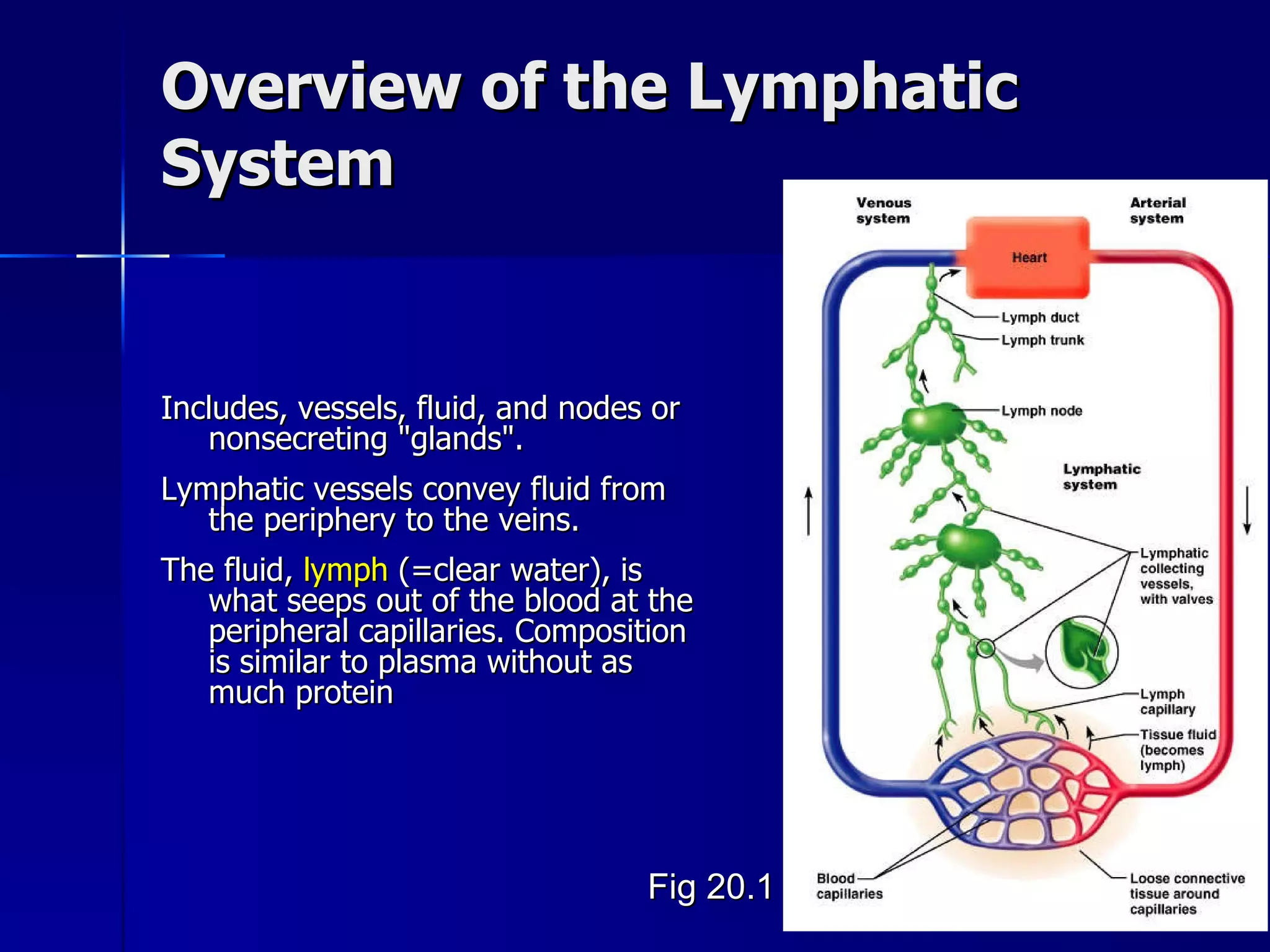
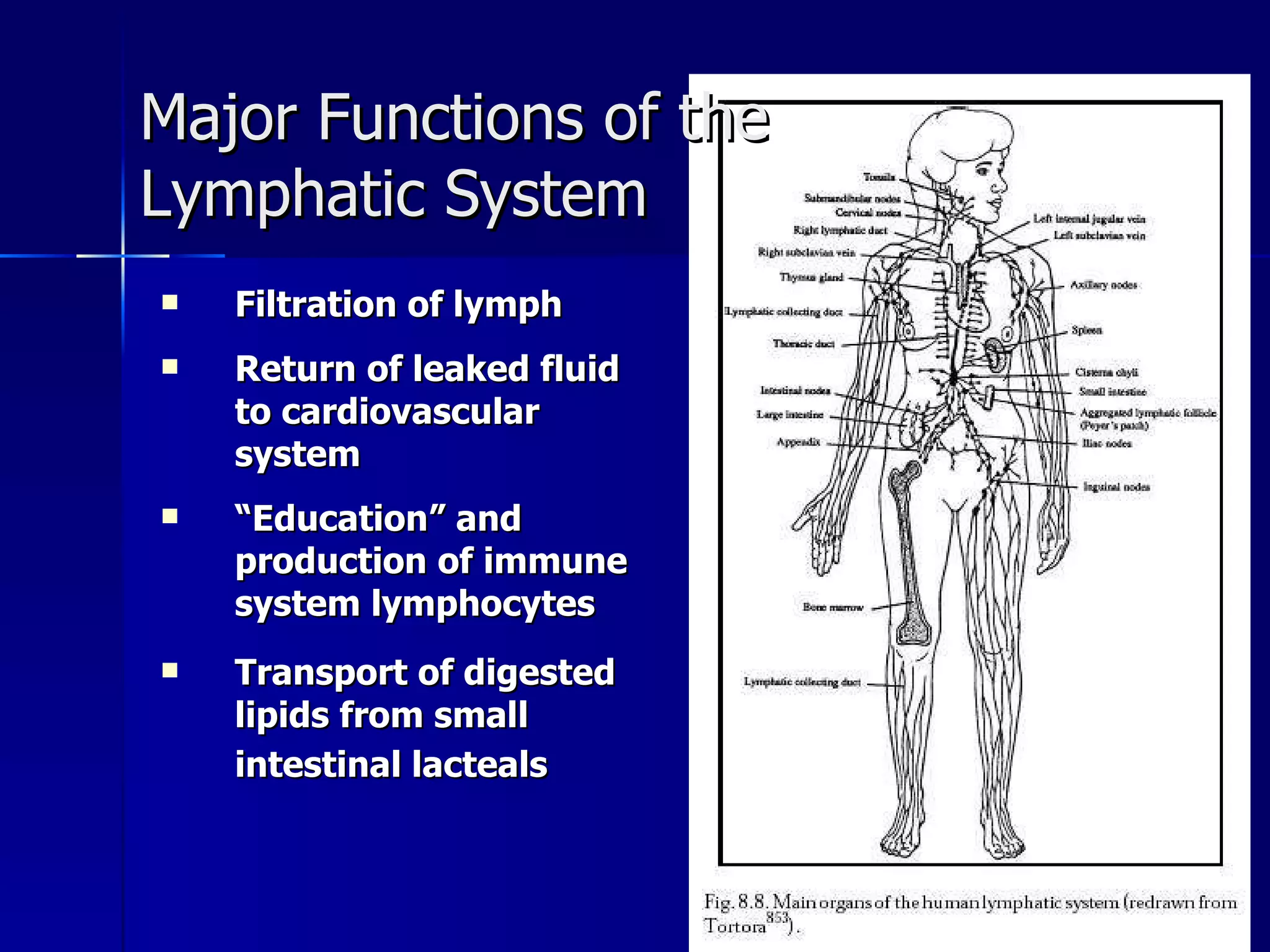
Overview of the Lymphatic System Includes, vessels, fluid, and nodes or nonsecreting "glands".  Lymphatic vessels convey fluid from the periphery to the veins.  The fluid,  lymph  (=clear water), is what seeps out of the blood at the peripheral capillaries. Composition is similar to plasma without as much protein Fig 20.1
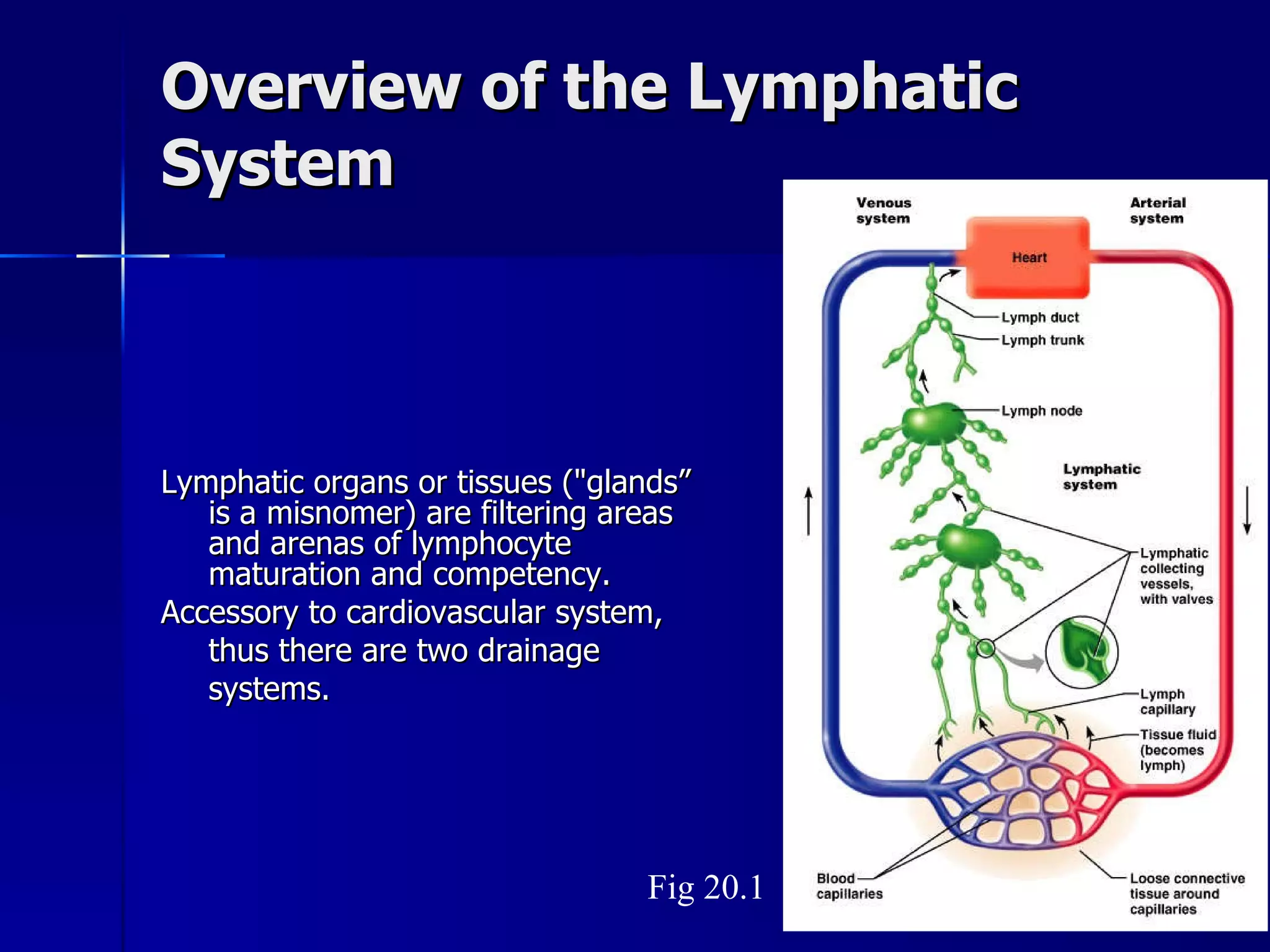
Overview of the Lymphatic System Lymphatic organs or tissues ("glands” is a misnomer) are filtering areas and arenas of lymphocyte maturation and competency. Accessory to cardiovascular system, thus there are two drainage systems. Fig 20.1
Filtration of lymph Return of leaked fluid to cardiovascular system “ Education” and production of immune system lymphocytes Transport of digested lipids from small intestinal lacteals   Major Functions of the Lymphatic System
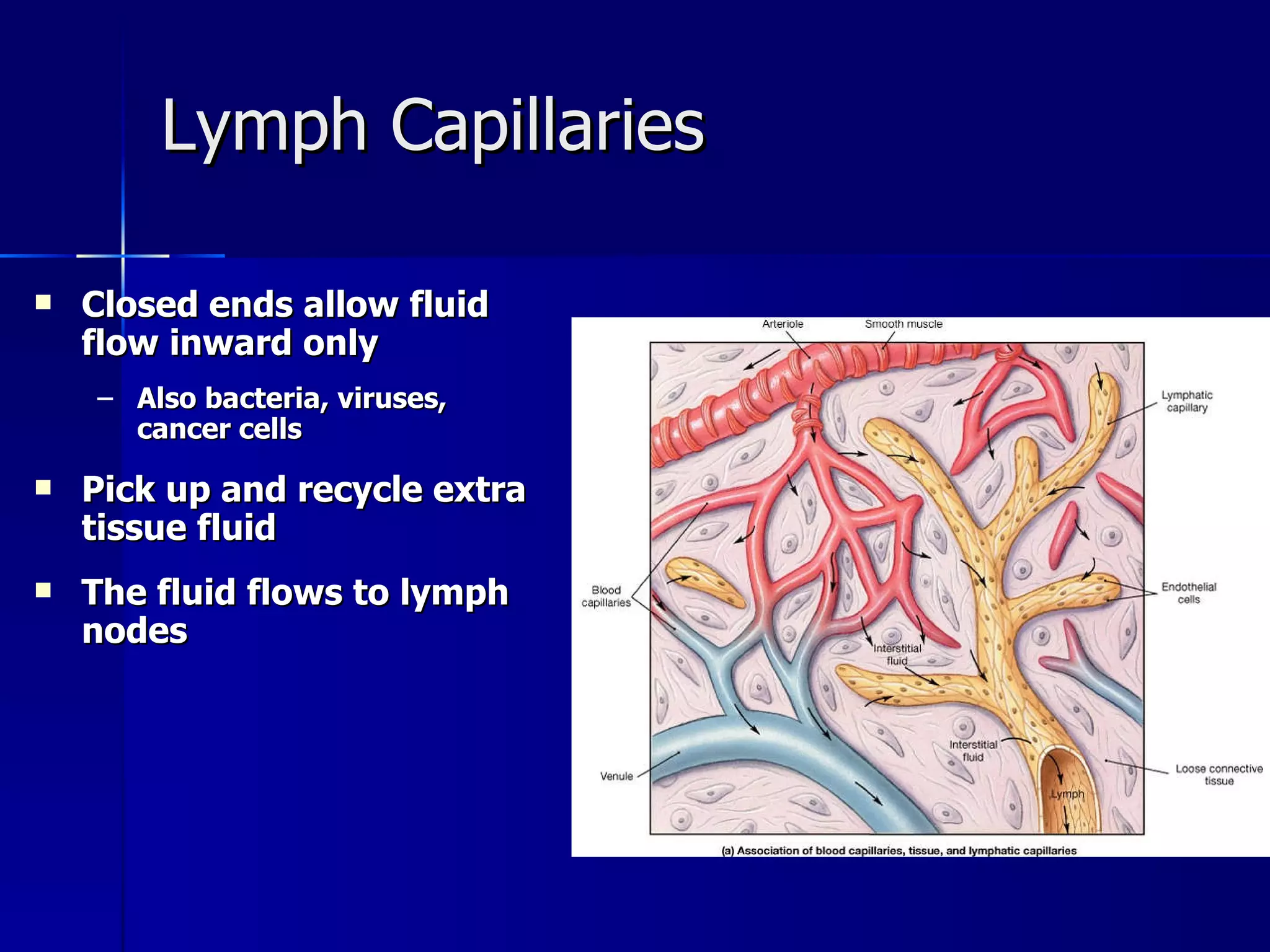
Lymph Capillaries Thin walled endothelium  (no BM) with periodic one way valves. In general they parallel veins. Usually  not visible on tissue sections Capillaries converge into collecting vessels
Lymph Capillaries Closed ends allow fluid flow inward only Also bacteria, viruses, cancer cells Pick up and recycle extra tissue fluid  The fluid flows to lymph nodes
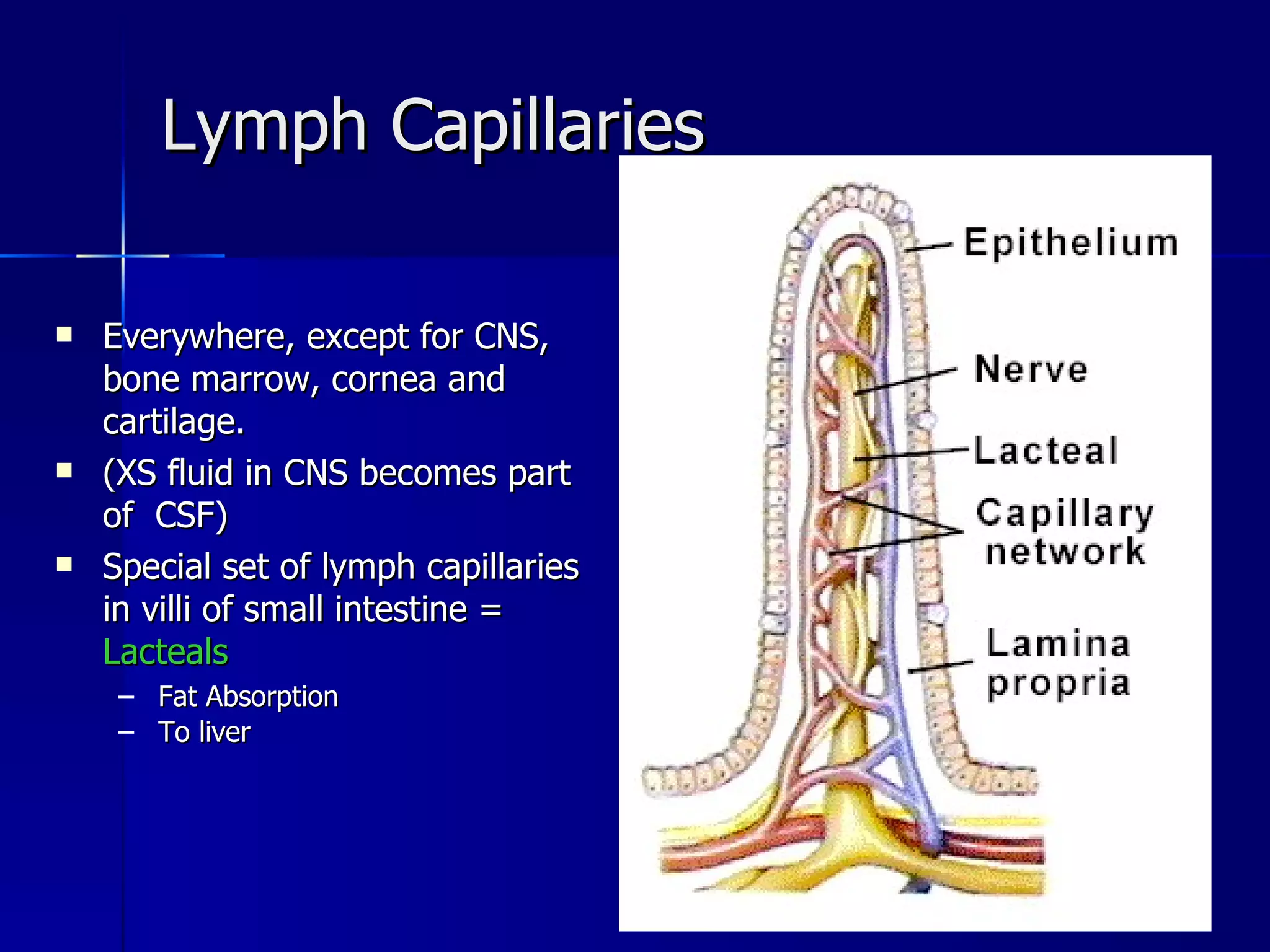
Lymph Capillaries Everywhere, except for CNS, bone marrow, cornea and cartilage. (XS fluid in CNS becomes part of  CSF) Special set of lymph capillaries in villi of small intestine   =   Lacteals Fat Absorption To liver
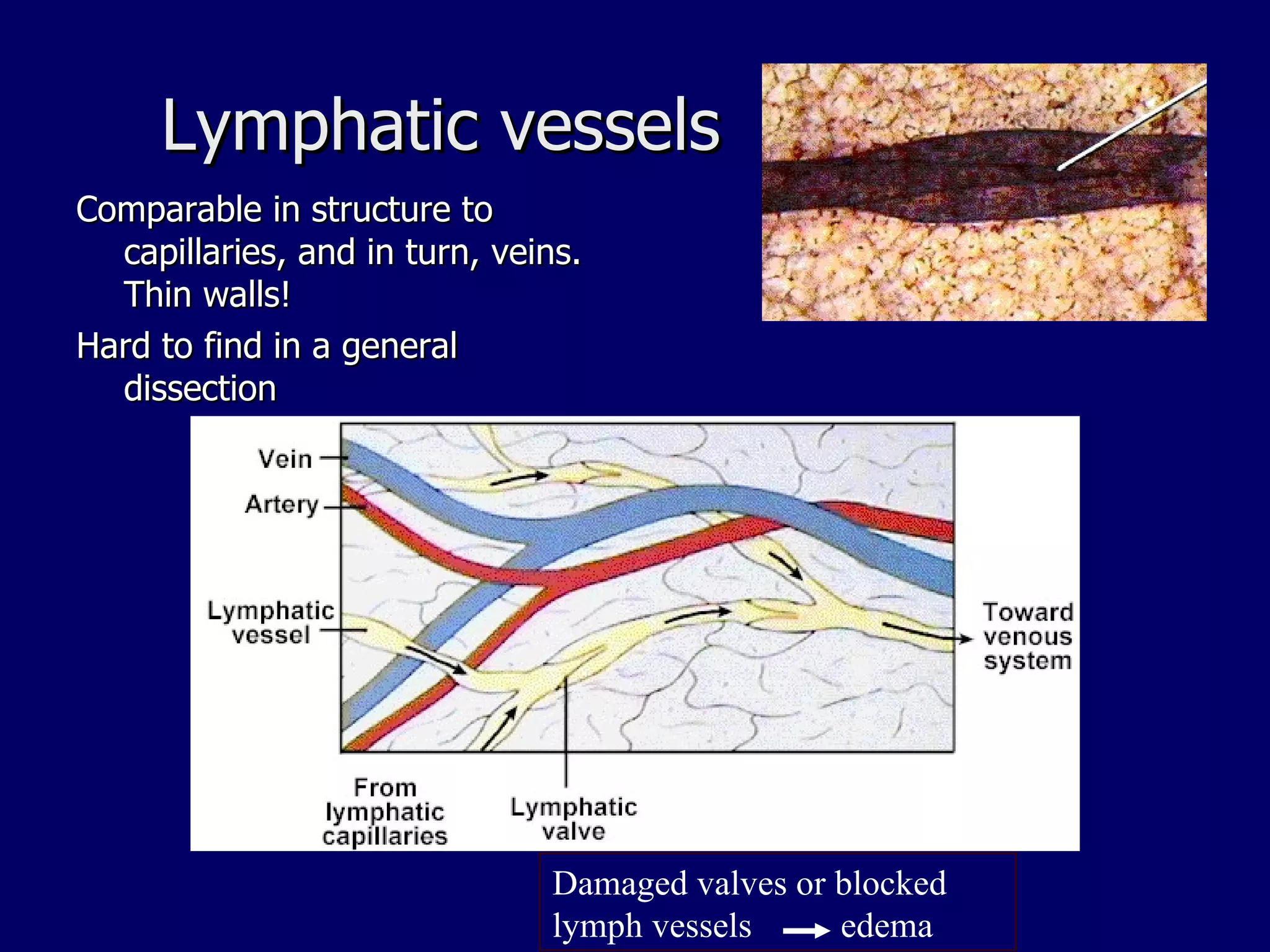
Lymphatic vessels Comparable in structure to capillaries, and in turn, veins.  Thin walls! Hard to find in a general dissection Damaged valves or blocked lymph vessels  edema
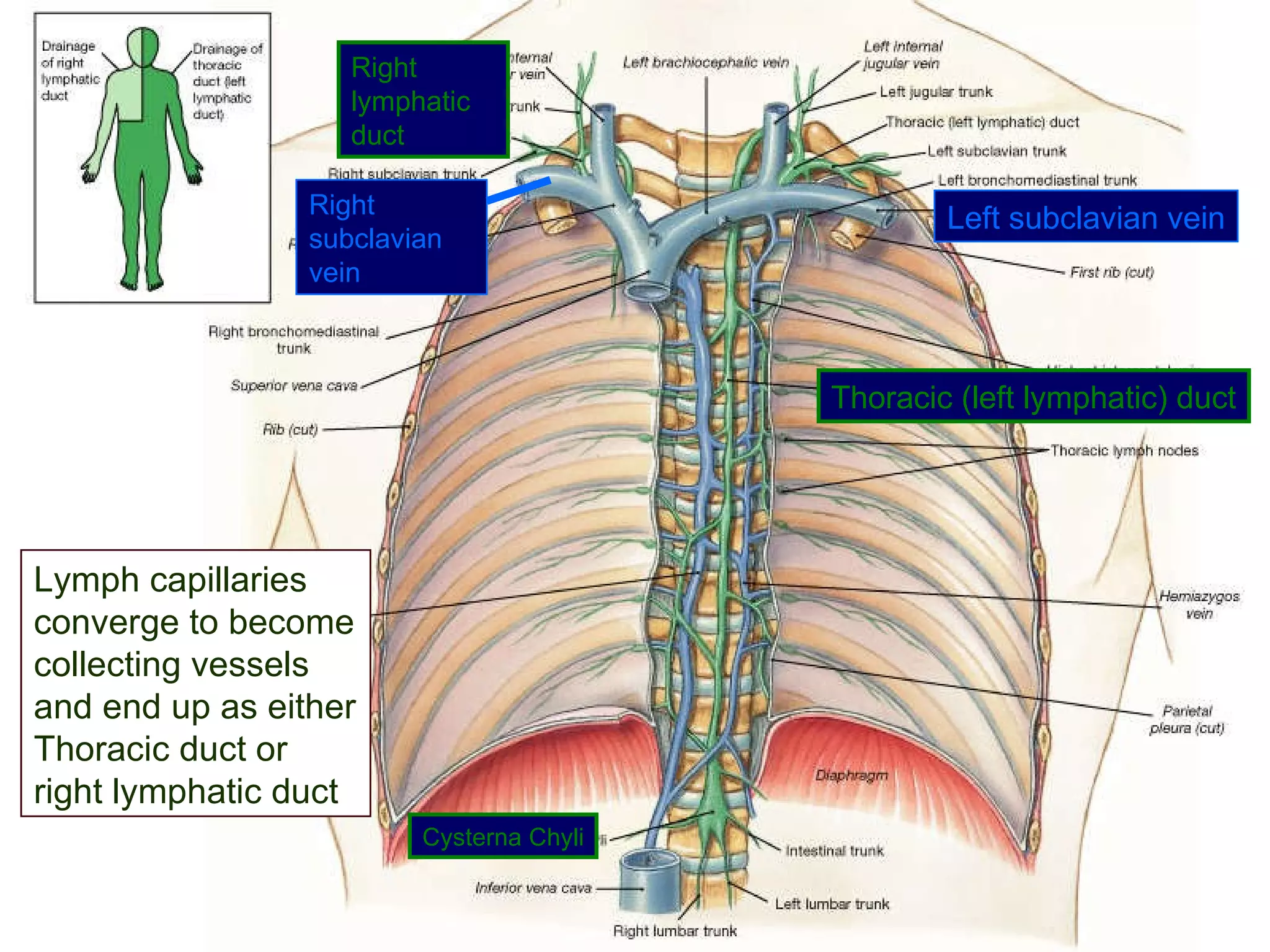
Lymph capillaries converge to become collecting vessels and end up as either Thoracic duct or right lymphatic duct Thoracic (left lymphatic) duct Left subclavian vein Right lymphatic duct Right subclavian vein Cysterna Chyli
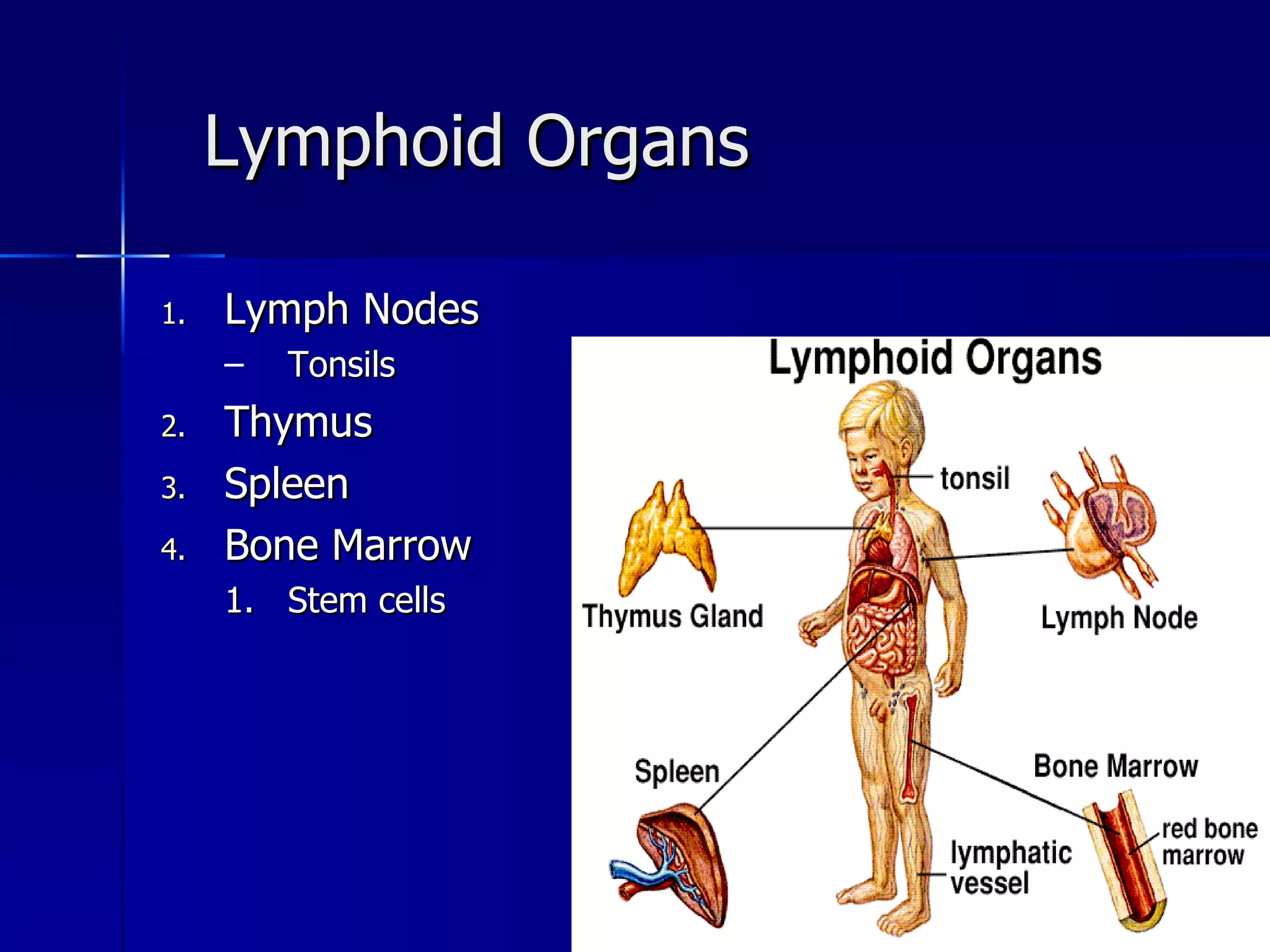
Lymphoid Organs Lymph Nodes Tonsils Thymus Spleen Bone Marrow Stem cells
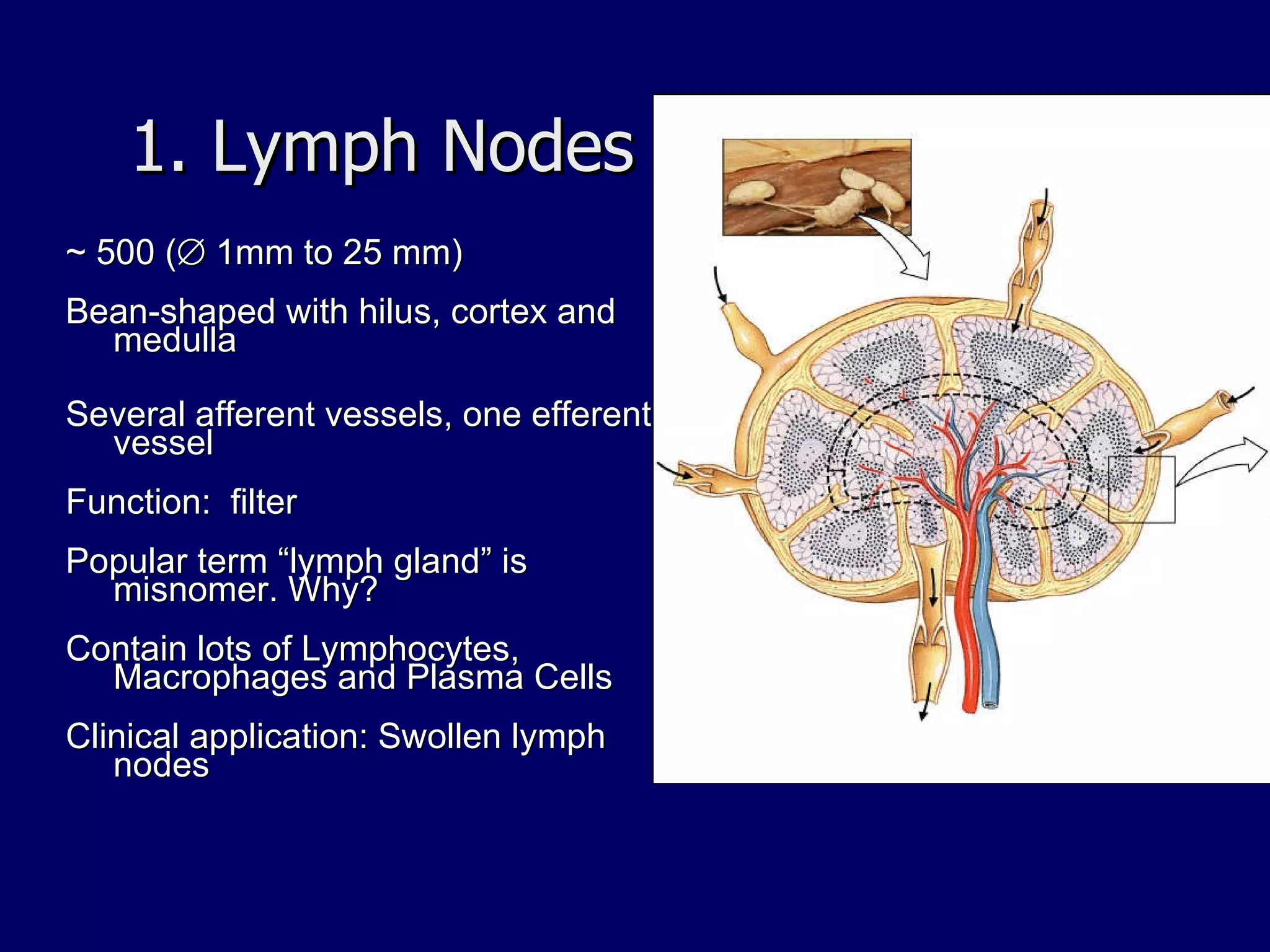
1. Lymph Nodes ~ 500 (   1mm to 25 mm) Bean-shaped with hilus, cortex and medulla Several afferent vessels, one efferent vessel  Function:  filter Popular term “lymph gland” is misnomer. Why? Contain lots of Lymphocytes, Macrophages and Plasma Cells Clinical application: Swollen lymph nodes Fig 23.9
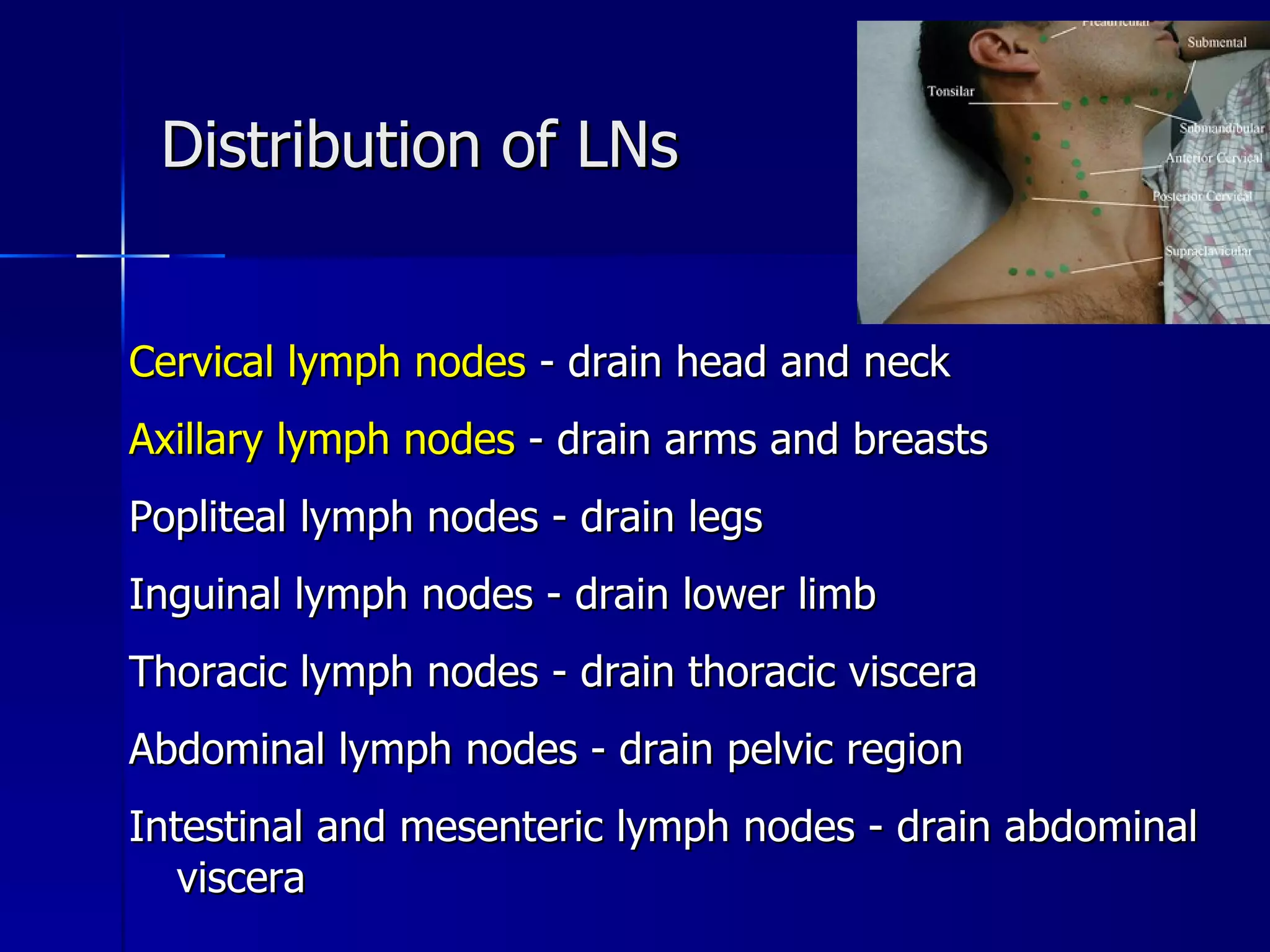
Distribution of LNs Cervical lymph nodes  - drain head and neck Axillary lymph nodes  - drain arms and breasts Popliteal lymph nodes - drain legs Inguinal lymph nodes - drain lower limb Thoracic lymph nodes - drain thoracic viscera Abdominal lymph nodes - drain pelvic region Intestinal and mesenteric lymph nodes - drain abdominal viscera
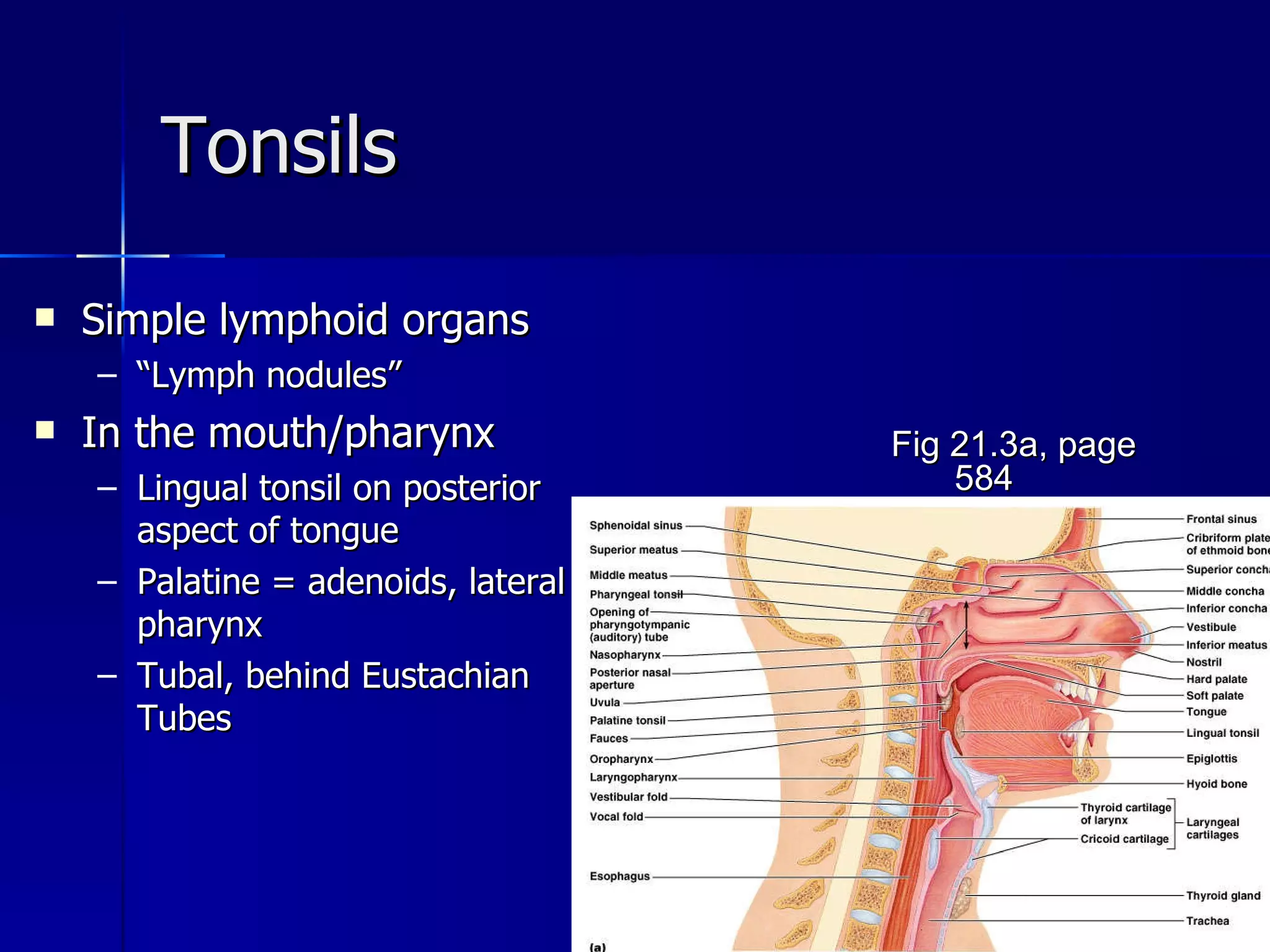
Tonsils Simple lymphoid organs  “ Lymph nodules” In the mouth/pharynx Lingual tonsil on posterior aspect of tongue Palatine = adenoids, lateral pharynx Tubal, behind Eustachian Tubes Fig 21.3a, page 584
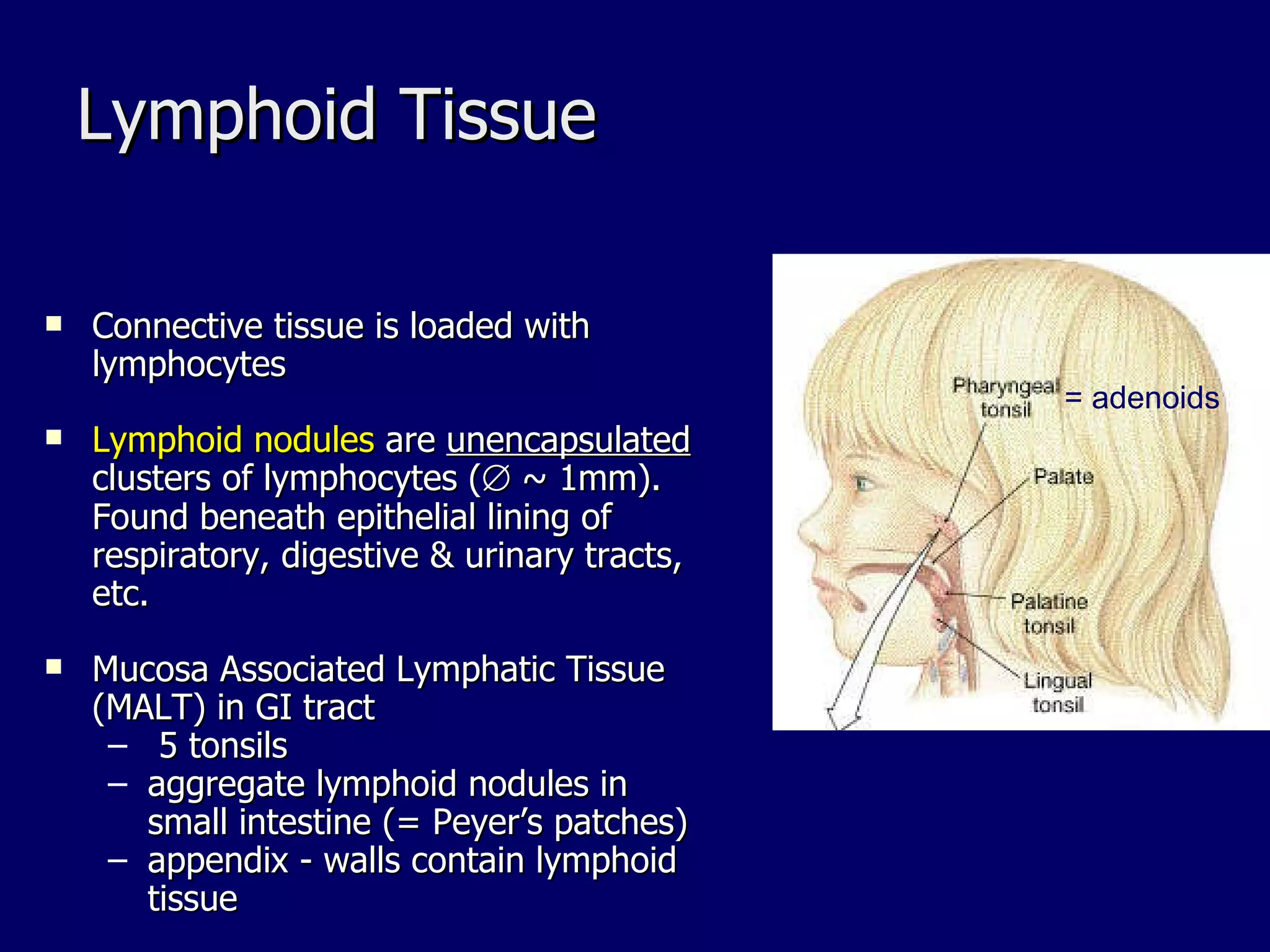
Lymphoid Tissue Connective tissue is loaded with lymphocytes Lymphoid nodules  are  unencapsulated  clusters of lymphocytes (   ~ 1mm). Found beneath epithelial lining of respiratory, digestive & urinary tracts, etc. Mucosa Associated Lymphatic Tissue (MALT) in GI tract 5 tonsils aggregate lymphoid nodules in small intestine (= Peyer’s patches) appendix - walls contain lymphoid tissue = adenoids
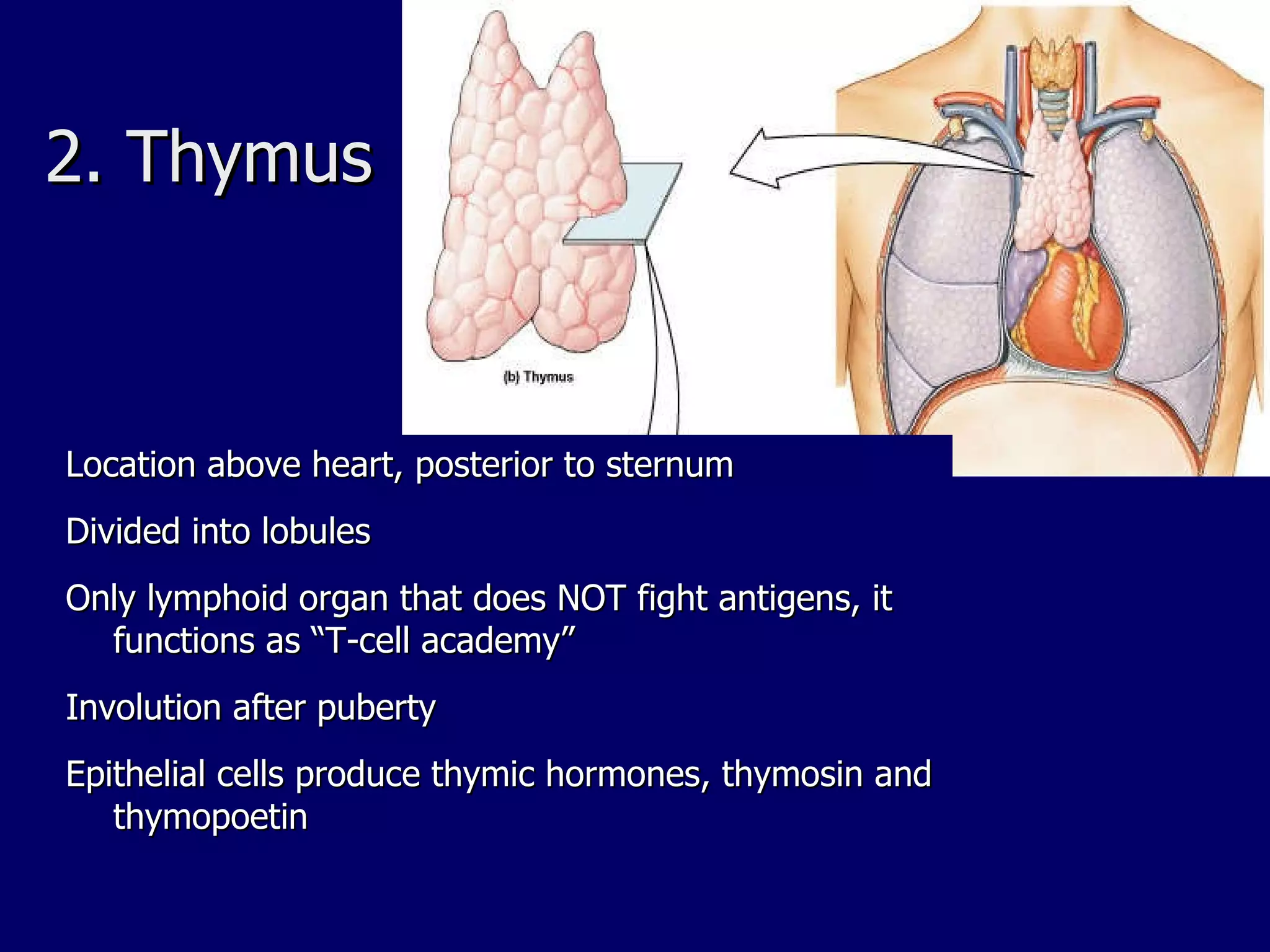
2. Thymus Location above heart, posterior to sternum Divided into lobules Only lymphoid organ that does NOT fight antigens, it functions as “T-cell academy”  Involution after puberty Epithelial cells produce thymic hormones, thymosin and thymopoetin
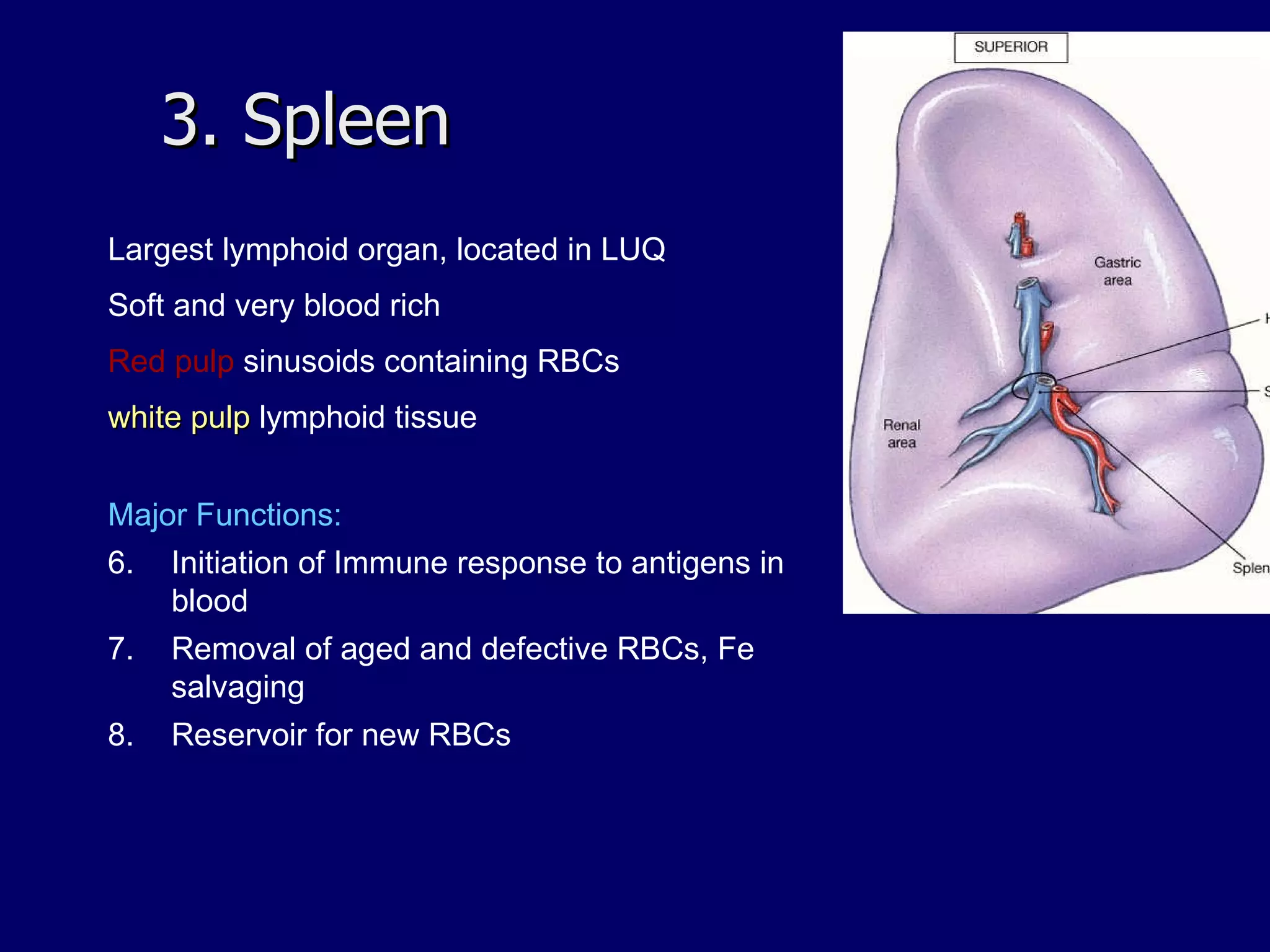
3. Spleen Largest lymphoid organ, located in LUQ Soft and very blood rich Red pulp  sinusoids containing RBCs white pulp  lymphoid tissue Major Functions: Initiation of Immune response to antigens in blood Removal of aged and defective RBCs, Fe salvaging Reservoir for new RBCs
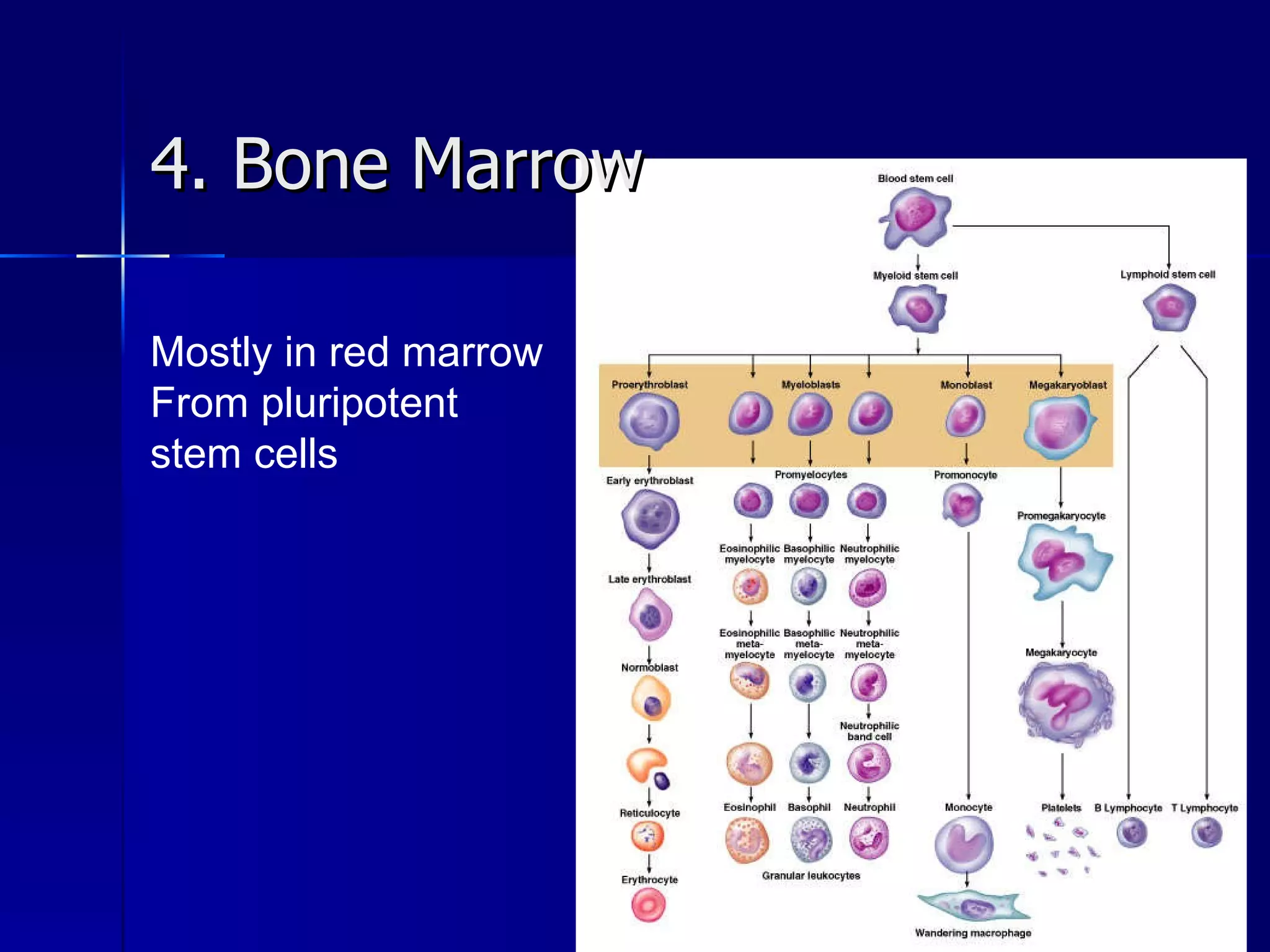
4. Bone Marrow Mostly in red marrow From pluripotent stem cells
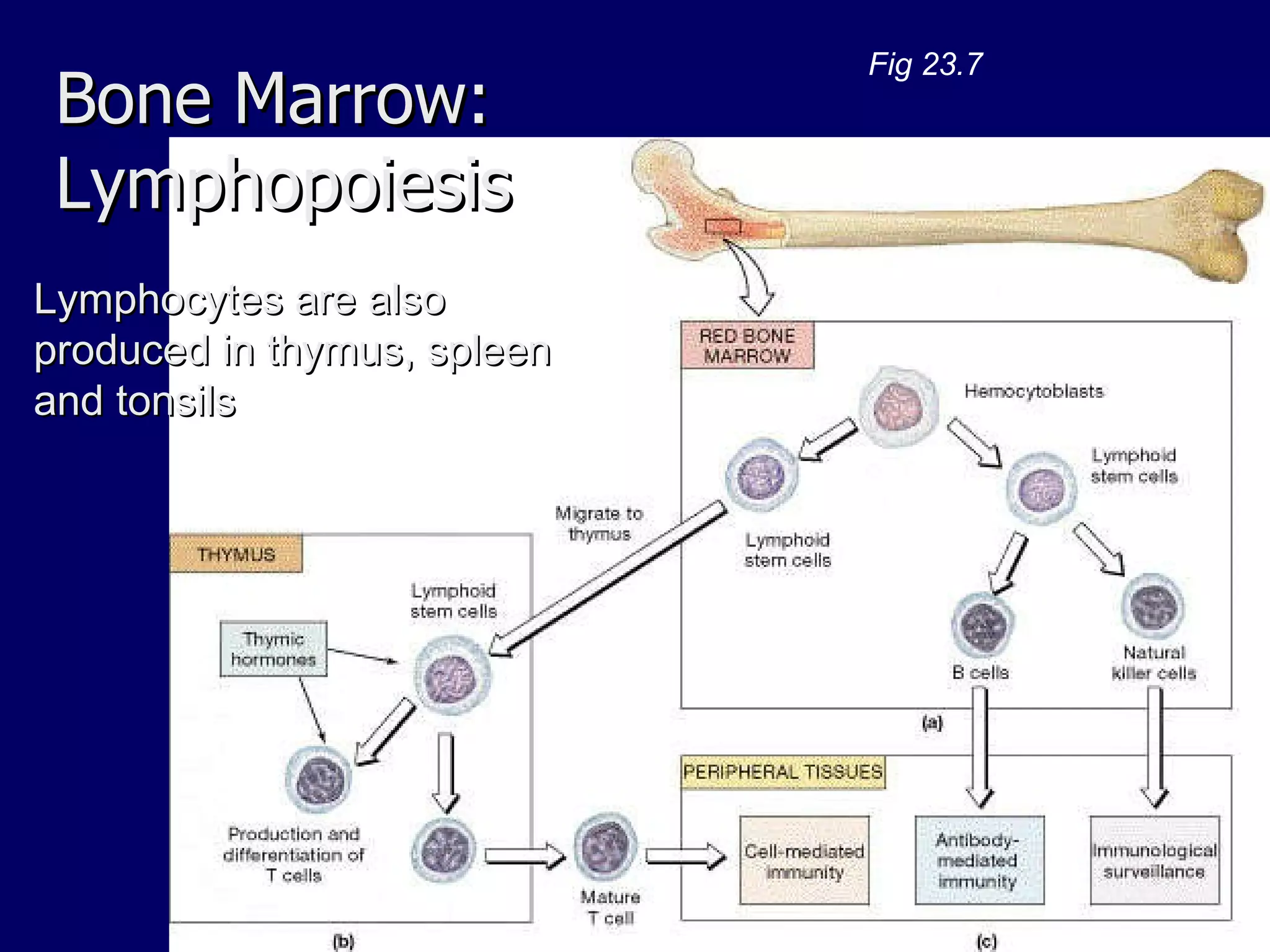
Bone Marrow:  Lymphopoiesis Fig 23.7 Lymphocytes are also produced in thymus, spleen and tonsils
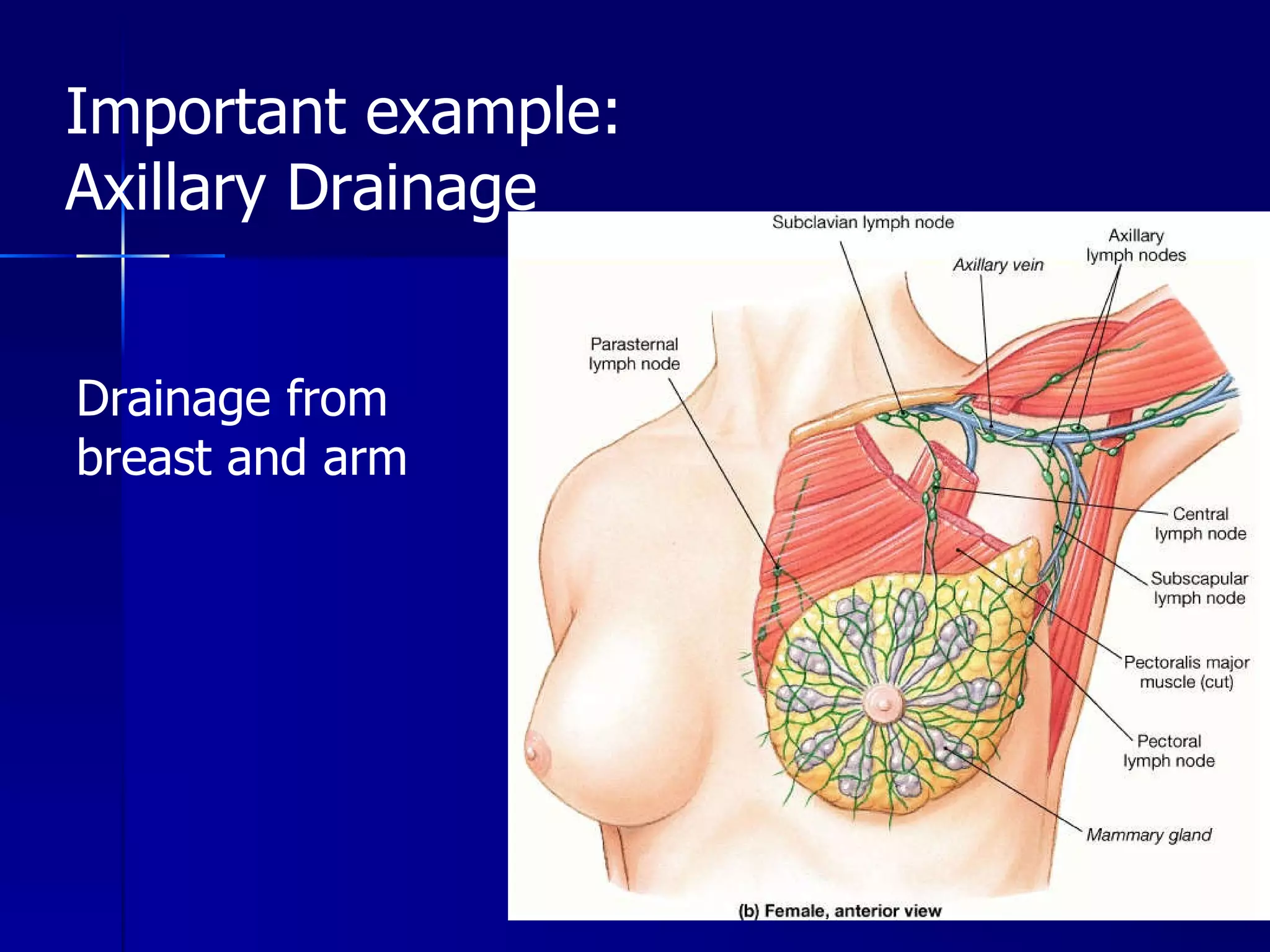
Important example:  Axillary Drainage Drainage from breast and arm
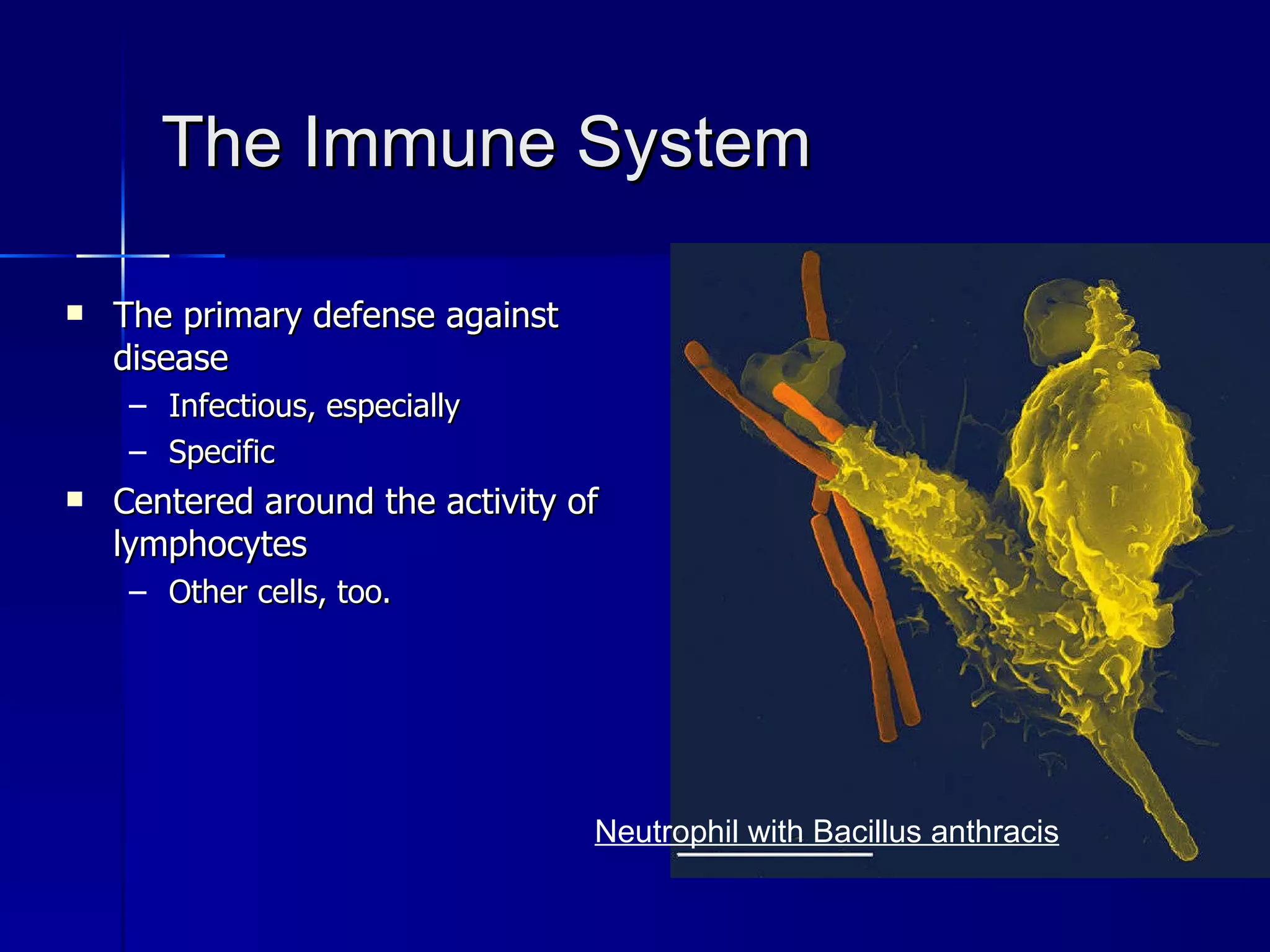
The Immune System The primary defense against disease Infectious, especially Specific Centered around the activity of lymphocytes Other cells, too. Neutrophil with Bacillus anthracis
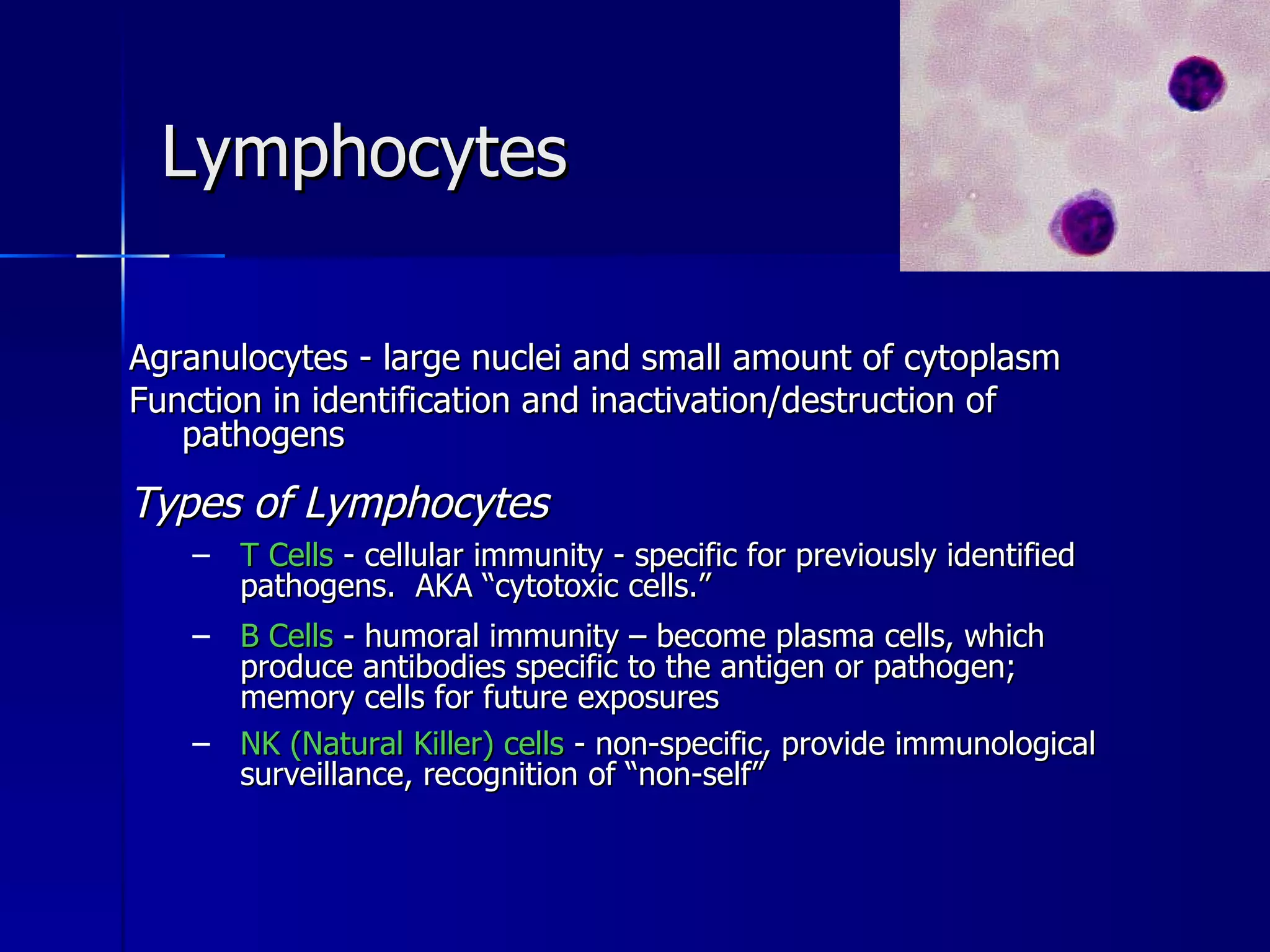
Lymphocytes Agranulocytes - large nuclei and small amount of cytoplasm  Function in identification and inactivation/destruction of pathogens Types of Lymphocytes T Cells  - cellular immunity - specific for previously identified pathogens.  AKA “cytotoxic cells.” B Cells  - humoral immunity – become plasma cells, which produce antibodies specific to the antigen or pathogen; memory cells for future exposures NK (Natural Killer) cells  - non-specific, provide immunological surveillance, recognition of “non-self”
Antibodies (Ab) AKA immunoglobulins (Ig) Proteins produced by plasma cells in response to a specific antigen (Ag) Plasma cells are derived from B-lymphocytes Antibodies [Ab] frequently measured as a diagnostic tool Serology IgG
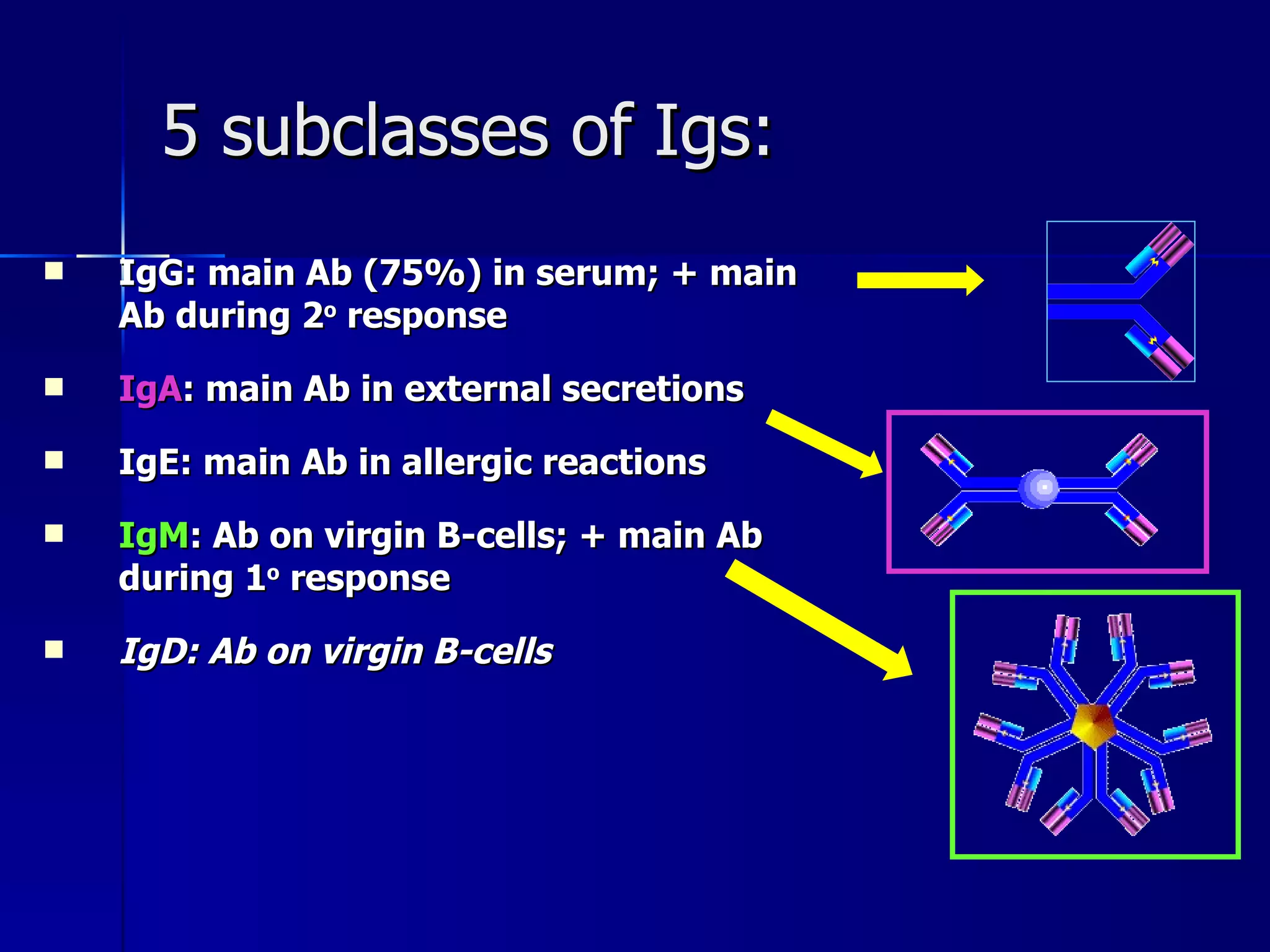
5 subclasses of Igs: IgG: main Ab (75%) in serum; + main Ab during 2 o  response IgA : main Ab in external secretions IgE: main Ab in allergic reactions IgM : Ab on virgin B-cells; + main Ab during 1 o  response IgD: Ab on virgin B-cells
Sunset on the Atlantic Ocean

Chapter20 lymphimmunemarieb

  • 1.
    Chapt 20: TheLymphatic and Immune Systems Goals Discuss the organization of the lymphatic system, including the vessels, principal lymph nodes, thymus, and spleen Explain the relationship between the lymphatic and circulatory systems, and the role of lymphoid tissue structures and lymphocytes in the body’s defense An introduction to the Immune System
  • 2.
    Overview of theLymphatic System Includes, vessels, fluid, and nodes or nonsecreting "glands". Lymphatic vessels convey fluid from the periphery to the veins. The fluid, lymph (=clear water), is what seeps out of the blood at the peripheral capillaries. Composition is similar to plasma without as much protein Fig 20.1
  • 3.
    Overview of theLymphatic System Lymphatic organs or tissues ("glands” is a misnomer) are filtering areas and arenas of lymphocyte maturation and competency. Accessory to cardiovascular system, thus there are two drainage systems. Fig 20.1
  • 4.
    Filtration of lymphReturn of leaked fluid to cardiovascular system “ Education” and production of immune system lymphocytes Transport of digested lipids from small intestinal lacteals Major Functions of the Lymphatic System
  • 5.
    Lymph Capillaries Thinwalled endothelium (no BM) with periodic one way valves. In general they parallel veins. Usually not visible on tissue sections Capillaries converge into collecting vessels
  • 6.
    Lymph Capillaries Closedends allow fluid flow inward only Also bacteria, viruses, cancer cells Pick up and recycle extra tissue fluid The fluid flows to lymph nodes
  • 7.
    Lymph Capillaries Everywhere,except for CNS, bone marrow, cornea and cartilage. (XS fluid in CNS becomes part of CSF) Special set of lymph capillaries in villi of small intestine = Lacteals Fat Absorption To liver
  • 8.
    Lymphatic vessels Comparablein structure to capillaries, and in turn, veins. Thin walls! Hard to find in a general dissection Damaged valves or blocked lymph vessels edema
  • 9.
    Lymph capillaries convergeto become collecting vessels and end up as either Thoracic duct or right lymphatic duct Thoracic (left lymphatic) duct Left subclavian vein Right lymphatic duct Right subclavian vein Cysterna Chyli
  • 10.
    Lymphoid Organs LymphNodes Tonsils Thymus Spleen Bone Marrow Stem cells
  • 11.
    1. Lymph Nodes~ 500 (  1mm to 25 mm) Bean-shaped with hilus, cortex and medulla Several afferent vessels, one efferent vessel Function: filter Popular term “lymph gland” is misnomer. Why? Contain lots of Lymphocytes, Macrophages and Plasma Cells Clinical application: Swollen lymph nodes Fig 23.9
  • 12.
    Distribution of LNsCervical lymph nodes - drain head and neck Axillary lymph nodes - drain arms and breasts Popliteal lymph nodes - drain legs Inguinal lymph nodes - drain lower limb Thoracic lymph nodes - drain thoracic viscera Abdominal lymph nodes - drain pelvic region Intestinal and mesenteric lymph nodes - drain abdominal viscera
  • 13.
    Tonsils Simple lymphoidorgans “ Lymph nodules” In the mouth/pharynx Lingual tonsil on posterior aspect of tongue Palatine = adenoids, lateral pharynx Tubal, behind Eustachian Tubes Fig 21.3a, page 584
  • 14.
    Lymphoid Tissue Connectivetissue is loaded with lymphocytes Lymphoid nodules are unencapsulated clusters of lymphocytes (  ~ 1mm). Found beneath epithelial lining of respiratory, digestive & urinary tracts, etc. Mucosa Associated Lymphatic Tissue (MALT) in GI tract 5 tonsils aggregate lymphoid nodules in small intestine (= Peyer’s patches) appendix - walls contain lymphoid tissue = adenoids
  • 15.
    2. Thymus Locationabove heart, posterior to sternum Divided into lobules Only lymphoid organ that does NOT fight antigens, it functions as “T-cell academy” Involution after puberty Epithelial cells produce thymic hormones, thymosin and thymopoetin
  • 16.
    3. Spleen Largestlymphoid organ, located in LUQ Soft and very blood rich Red pulp sinusoids containing RBCs white pulp lymphoid tissue Major Functions: Initiation of Immune response to antigens in blood Removal of aged and defective RBCs, Fe salvaging Reservoir for new RBCs
  • 17.
    4. Bone MarrowMostly in red marrow From pluripotent stem cells
  • 18.
    Bone Marrow: Lymphopoiesis Fig 23.7 Lymphocytes are also produced in thymus, spleen and tonsils
  • 19.
    Important example: Axillary Drainage Drainage from breast and arm
  • 20.
    The Immune SystemThe primary defense against disease Infectious, especially Specific Centered around the activity of lymphocytes Other cells, too. Neutrophil with Bacillus anthracis
  • 21.
    Lymphocytes Agranulocytes -large nuclei and small amount of cytoplasm Function in identification and inactivation/destruction of pathogens Types of Lymphocytes T Cells - cellular immunity - specific for previously identified pathogens. AKA “cytotoxic cells.” B Cells - humoral immunity – become plasma cells, which produce antibodies specific to the antigen or pathogen; memory cells for future exposures NK (Natural Killer) cells - non-specific, provide immunological surveillance, recognition of “non-self”
  • 22.
    Antibodies (Ab) AKAimmunoglobulins (Ig) Proteins produced by plasma cells in response to a specific antigen (Ag) Plasma cells are derived from B-lymphocytes Antibodies [Ab] frequently measured as a diagnostic tool Serology IgG
  • 23.
    5 subclasses ofIgs: IgG: main Ab (75%) in serum; + main Ab during 2 o response IgA : main Ab in external secretions IgE: main Ab in allergic reactions IgM : Ab on virgin B-cells; + main Ab during 1 o response IgD: Ab on virgin B-cells
  • 24.
    Sunset on theAtlantic Ocean