By
Yogeshwary Bhongade
Assistant Professor
Kamla Neharu College of Pharmacy, Butibori, Nagpur.
Respiratory System
Respiratory System
• The respiratory system is the network of organs and tissues that
help to breath.
• It includes your airways, lungs, and blood vessels.
• The muscles that power lungs are also part of the respiratory
system.
• These parts work together to move oxygen throughout the body
and clean out waste gases like carbon dioxide
Function of Respiratory System
• The respiratory system has many functions. Besides helping
inhale (breathe in) and exhale (breathe out), it:
• Allows to talk and to smell.
• Brings air to body temperature and moisturizes it to the humidity
level body needs.
• Delivers oxygen to the cells in body.
• Removes waste gases, including carbon dioxide, from the body
when exhale.
• Protects your airways from harmful substances and irritants.
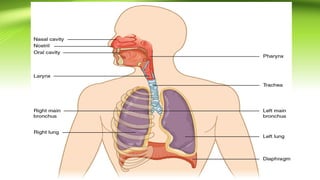
Organs of Respiratory System
1. Nasal Cavity
• It is divided into right a left portions by
septum and lined by mucus membrane.
• The entrance to nasal cavity is formed by
anterior nares(nostrils).
• They contain small hairswhich act as filter
for dust.
• The back of nasal cavities contains
posterior nares
• They form the entrance to nasopharynx.
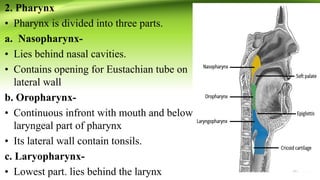
2. Pharynx
• Pharynx is divided into three parts.
a. Nasopharynx-
• Lies behind nasal cavities.
• Contains opening for Eustachian tube on
lateral wall
b. Oropharynx-
• Continuous infront with mouth and below
laryngeal part of pharynx
• Its lateral wall contain tonsils.
c. Laryopharynx-
• Lowest part. lies behind the larynx
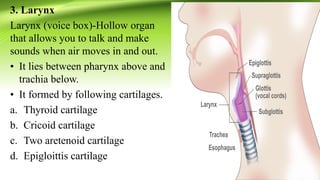
3. Larynx
Larynx (voice box)-Hollow organ
that allows you to talk and make
sounds when air moves in and out.
• It lies between pharynx above and
trachia below.
• It formed by following cartilages.
a. Thyroid cartilage
b. Cricoid cartilage
c. Two aretenoid cartilage
d. Epigloittis cartilage
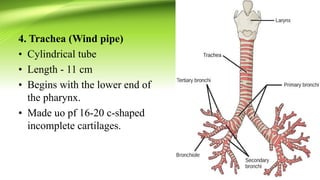
4. Trachea (Wind pipe)
• Cylindrical tube
• Length - 11 cm
• Begins with the lower end of
the pharynx.
• Made uo pf 16-20 c-shaped
incomplete cartilages.
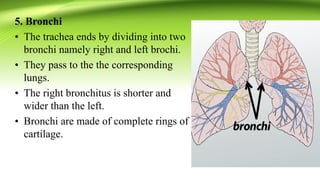
5. Bronchi
• The trachea ends by dividing into two
bronchi namely right and left brochi.
• They pass to the the corresponding
lungs.
• The right bronchitus is shorter and
wider than the left.
• Bronchi are made of complete rings of
cartilage.
6. Bronchioles
• They are formed by the division of
bronchi.
• Bronchioles are the fines branches
of bronchi.
• Bronchioles do not have cartilage.
• They are lined by cuboidal
epithelium.
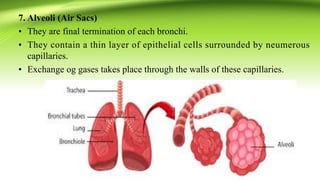
7. Alveoli (Air Sacs)
• They are final termination of each bronchi.
• They contain a thin layer of epithelial cells surrounded by neumerous
capillaries.
• Exchange og gases takes place through the walls of these capillaries.
Respiratory Organs
• Nose
• Pharynx
• Larynx
• Trachea
• Bronchi
• Bronchiole & Alveoli
• Pleura
• Muscles of breathing
( Intercosting Muscles & Diaphragm)
Lungs
• Lungs are the principle organs of the respiration.
• They are two in number lying one on each side of the chest cavity.
• Two lungs are separated in the middle line by heart and other structures of
mediastinum.
Shape-
Conical Shape
Lobes-
Each lungs is divided into lobes by means of fissures.
The right lobe which is bigger has three lobes.
Each lobe consist of number of lobules.
Pleura-
Serous membrane which cover the lungs.
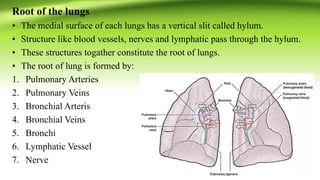
Root of the lungs
• The medial surface of each lungs has a vertical slit called hylum.
• Structure like blood vessels, nerves and lymphatic pass through the hylum.
• These structures togather constitute the root of lungs.
• The root of lung is formed by:
1. Pulmonary Arteries
2. Pulmonary Veins
3. Bronchial Arteris
4. Bronchial Veins
5. Bronchi
6. Lymphatic Vessel
7. Nerve
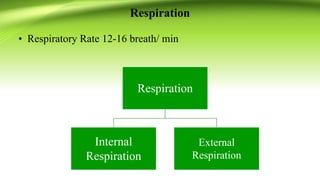
Respiration
• Respiratory Rate 12-16 breath/ min
Respiration
Internal
Respiration
External
Respiration
External Respiration & Internal Respiration
• Exchange of respiratory gases i.e.
O2 and CO2 between lungs and
blood is known as External
Respiration.
• Exchange of gases between blood
and tissue is known as Internal
Respiration.
Mechanism of Respiration
Mechanism
Inspiration
Air goes into lungs from Atm
Active Process
Expiration
Air leaves the lungs into Atm
Passive process
Regulation of Respiation
• Respiration is regulated by
two controls
1. Nervous Control
2. Chemical Control
Nervous Control
• It is exerted by respiratory center present in the medulla
oblangata of brain.
• From this center afferent impulses pass to-
1. Diphragm through phrenic nerve.
2. Intercostal muscle through intercostal nerves.
• These impulses causes rythmic contraction of diphragm and
intercostal muscle.
Chemical Control
• This is effected through carbondioxide content of blood.
• An increase in level of carbondioxide producesstimulation of
respiratory center.
Reflux Mechanism
A. Carotid body and aortic body chemoreceptors:
• Some chemoreceptors also egulate respiration reflexly.
• These chemoreceptors are-
1. Carotide body
2. Aortic body
B. Hering - Breuer reflux-
• lungs contain some stretch receptor.
• Expansion of lungs stimulates these receptors so inspiration stop.
now lungs collapse and there is no strech so inhibition of respiratory
centre through vagus also stops. inspiration stop again
Respiratory Volumes
• Respiratory volume also known as lungs voume .
• Volume of gas in lungs at given time during respiratory cycle is
known as lungs volume
1. Vital Capacity-
• Volume of air expelled by a forced expiration after a forced
inspiration.(Normal Value- 4 litre)
2. Tidal Air-
• Volume of air passing in and out of the lungs with ordinry quiet
breathing. (Normal Value- 0.5 litre)
3. Inspiratory reserve-
• It is additional volume of air that can be taken in by forced
inspiration. (Normal Value- 2.5 litre)
4. Expiratory Reserve-
• Volume of air that can be expelled by forced expiration after
normal inspiration. (Normal Value- 1 litre)
5. Residual Volume-
• Volume of air which remains in the lungs on forced expiration after
normal inspiration. (Normal Value- 1 litre)
6. Total lungs capacity-
• Some of vital capacity ad residual volume. (Normal Value- 5litre)
Exchange of Gases
• Occures in two stages
1. Exchange between tissues and blood (tissue/ internal
respiration)
2. Exchange between alveoli and blood (Pulmonary/ external
Respiration)
Abnormal type of Respiration
1. Cheyne- stroke breathing-Form of periodic breathing in
which group of breaths are separeted by periods of apnea.
2. Apnea-Stoppinf of respiration for short interval.
3. Hyperpnea- Increase in depth of respiration.
4. Dyspnea- Difficulty in breathing.
5. Polypnea- Respiration characterise by rapid rate.
6. Tachypnea- Exceedingly high e of respiration.
Artificial Respiration
• It is employed when respiration fails due to drowning, carbon
monoxide poisoning etc.
Methods
1. Schafer’s Method and Holgers Method- Compression of
thoracic cavity by pressure against ribs.
2. Mouth to Mouth Method- Blowing air into lungs by mouth
3. Rocking Method- For children
4. Instrumental Method- Drinker’s Method, Bragg- Paul Method,
Iron Lung Method.
Thank You

Respiratory system

  • 1.
    By Yogeshwary Bhongade Assistant Professor KamlaNeharu College of Pharmacy, Butibori, Nagpur. Respiratory System
  • 2.
    Respiratory System • Therespiratory system is the network of organs and tissues that help to breath. • It includes your airways, lungs, and blood vessels. • The muscles that power lungs are also part of the respiratory system. • These parts work together to move oxygen throughout the body and clean out waste gases like carbon dioxide
  • 4.
    Function of RespiratorySystem • The respiratory system has many functions. Besides helping inhale (breathe in) and exhale (breathe out), it: • Allows to talk and to smell. • Brings air to body temperature and moisturizes it to the humidity level body needs. • Delivers oxygen to the cells in body. • Removes waste gases, including carbon dioxide, from the body when exhale. • Protects your airways from harmful substances and irritants.
  • 5.
    Organs of RespiratorySystem 1. Nasal Cavity • It is divided into right a left portions by septum and lined by mucus membrane. • The entrance to nasal cavity is formed by anterior nares(nostrils). • They contain small hairswhich act as filter for dust. • The back of nasal cavities contains posterior nares • They form the entrance to nasopharynx.
  • 6.
    2. Pharynx • Pharynxis divided into three parts. a. Nasopharynx- • Lies behind nasal cavities. • Contains opening for Eustachian tube on lateral wall b. Oropharynx- • Continuous infront with mouth and below laryngeal part of pharynx • Its lateral wall contain tonsils. c. Laryopharynx- • Lowest part. lies behind the larynx
  • 7.
    3. Larynx Larynx (voicebox)-Hollow organ that allows you to talk and make sounds when air moves in and out. • It lies between pharynx above and trachia below. • It formed by following cartilages. a. Thyroid cartilage b. Cricoid cartilage c. Two aretenoid cartilage d. Epigloittis cartilage
  • 8.
    4. Trachea (Windpipe) • Cylindrical tube • Length - 11 cm • Begins with the lower end of the pharynx. • Made uo pf 16-20 c-shaped incomplete cartilages.
  • 9.
    5. Bronchi • Thetrachea ends by dividing into two bronchi namely right and left brochi. • They pass to the the corresponding lungs. • The right bronchitus is shorter and wider than the left. • Bronchi are made of complete rings of cartilage.
  • 10.
    6. Bronchioles • Theyare formed by the division of bronchi. • Bronchioles are the fines branches of bronchi. • Bronchioles do not have cartilage. • They are lined by cuboidal epithelium.
  • 11.
    7. Alveoli (AirSacs) • They are final termination of each bronchi. • They contain a thin layer of epithelial cells surrounded by neumerous capillaries. • Exchange og gases takes place through the walls of these capillaries.
  • 12.
    Respiratory Organs • Nose •Pharynx • Larynx • Trachea • Bronchi • Bronchiole & Alveoli • Pleura • Muscles of breathing ( Intercosting Muscles & Diaphragm)
  • 13.
    Lungs • Lungs arethe principle organs of the respiration. • They are two in number lying one on each side of the chest cavity. • Two lungs are separated in the middle line by heart and other structures of mediastinum. Shape- Conical Shape Lobes- Each lungs is divided into lobes by means of fissures. The right lobe which is bigger has three lobes. Each lobe consist of number of lobules. Pleura- Serous membrane which cover the lungs.
  • 14.
    Root of thelungs • The medial surface of each lungs has a vertical slit called hylum. • Structure like blood vessels, nerves and lymphatic pass through the hylum. • These structures togather constitute the root of lungs. • The root of lung is formed by: 1. Pulmonary Arteries 2. Pulmonary Veins 3. Bronchial Arteris 4. Bronchial Veins 5. Bronchi 6. Lymphatic Vessel 7. Nerve
  • 15.
    Respiration • Respiratory Rate12-16 breath/ min Respiration Internal Respiration External Respiration
  • 16.
    External Respiration &Internal Respiration • Exchange of respiratory gases i.e. O2 and CO2 between lungs and blood is known as External Respiration. • Exchange of gases between blood and tissue is known as Internal Respiration.
  • 17.
    Mechanism of Respiration Mechanism Inspiration Airgoes into lungs from Atm Active Process Expiration Air leaves the lungs into Atm Passive process
  • 19.
    Regulation of Respiation •Respiration is regulated by two controls 1. Nervous Control 2. Chemical Control
  • 20.
    Nervous Control • Itis exerted by respiratory center present in the medulla oblangata of brain. • From this center afferent impulses pass to- 1. Diphragm through phrenic nerve. 2. Intercostal muscle through intercostal nerves. • These impulses causes rythmic contraction of diphragm and intercostal muscle.
  • 21.
    Chemical Control • Thisis effected through carbondioxide content of blood. • An increase in level of carbondioxide producesstimulation of respiratory center.
  • 22.
    Reflux Mechanism A. Carotidbody and aortic body chemoreceptors: • Some chemoreceptors also egulate respiration reflexly. • These chemoreceptors are- 1. Carotide body 2. Aortic body B. Hering - Breuer reflux- • lungs contain some stretch receptor. • Expansion of lungs stimulates these receptors so inspiration stop. now lungs collapse and there is no strech so inhibition of respiratory centre through vagus also stops. inspiration stop again
  • 23.
    Respiratory Volumes • Respiratoryvolume also known as lungs voume . • Volume of gas in lungs at given time during respiratory cycle is known as lungs volume 1. Vital Capacity- • Volume of air expelled by a forced expiration after a forced inspiration.(Normal Value- 4 litre) 2. Tidal Air- • Volume of air passing in and out of the lungs with ordinry quiet breathing. (Normal Value- 0.5 litre)
  • 24.
    3. Inspiratory reserve- •It is additional volume of air that can be taken in by forced inspiration. (Normal Value- 2.5 litre) 4. Expiratory Reserve- • Volume of air that can be expelled by forced expiration after normal inspiration. (Normal Value- 1 litre) 5. Residual Volume- • Volume of air which remains in the lungs on forced expiration after normal inspiration. (Normal Value- 1 litre) 6. Total lungs capacity- • Some of vital capacity ad residual volume. (Normal Value- 5litre)
  • 25.
    Exchange of Gases •Occures in two stages 1. Exchange between tissues and blood (tissue/ internal respiration) 2. Exchange between alveoli and blood (Pulmonary/ external Respiration)
  • 26.
    Abnormal type ofRespiration 1. Cheyne- stroke breathing-Form of periodic breathing in which group of breaths are separeted by periods of apnea. 2. Apnea-Stoppinf of respiration for short interval. 3. Hyperpnea- Increase in depth of respiration. 4. Dyspnea- Difficulty in breathing. 5. Polypnea- Respiration characterise by rapid rate. 6. Tachypnea- Exceedingly high e of respiration.
  • 27.
    Artificial Respiration • Itis employed when respiration fails due to drowning, carbon monoxide poisoning etc. Methods 1. Schafer’s Method and Holgers Method- Compression of thoracic cavity by pressure against ribs. 2. Mouth to Mouth Method- Blowing air into lungs by mouth 3. Rocking Method- For children 4. Instrumental Method- Drinker’s Method, Bragg- Paul Method, Iron Lung Method.
  • 28.