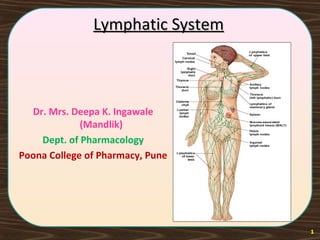
Lymphatic SystemLymphatic System
Dr. Mrs. Deepa K. Ingawale
(Mandlik)
Dept. of Pharmacology
Poona College of Pharmacy, Pune
1
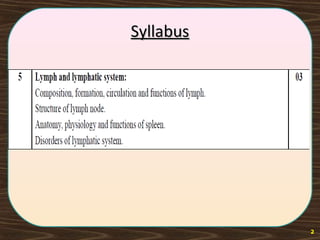
SyllabusSyllabus
2
Learning ObjectivesLearning Objectives
 To understand lymph composition & lymph flow
 To study function & components of lymphatic system
 To study different cells of lymphatic system
 To study structure & function of spleen
 To describe the anatomy & physiology of lymph node
3
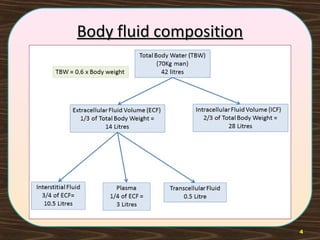
Body fluid compositionBody fluid composition
4
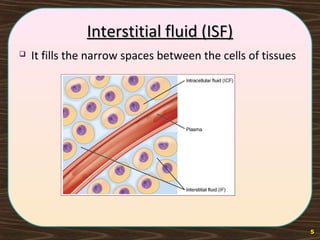
Interstitial fluid (ISF)Interstitial fluid (ISF)
 It fills the narrow spaces between the cells of tissues
5
6
Lymphatic SystemLymphatic System
 It consists of lymph & lymphatic vessels that
transport the lymph.
 After interstitial fluid passes into lymphatic vessels, it
is called lymph
 Difference between interstitial fluid & lymph is
location:
 Interstitial fluid is found between the spaces of the
cells, & lymph is located within lymphatic vessels &
lymphatic tissue.
Lymphatic tissueLymphatic tissue
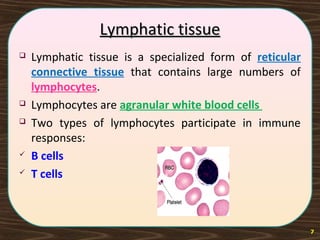
 Lymphatic tissue is a specialized form of reticular
connective tissue that contains large numbers of
lymphocytes.
 Lymphocytes are agranular white blood cells
 Two types of lymphocytes participate in immune
responses:
 B cells
 T cells
7
8
FunctionsFunctions
 Fluid & nutrient transport
 Lymphocyte development
 Immune response
 Reabsorbs excess interstitial fluid
• returns it to the venous circulation
• maintain blood volume levels
 Transport dietary lipids
• Transport lipids & lipid-soluble vitamins (A, D, E, & K)
absorbed by the GI tract.
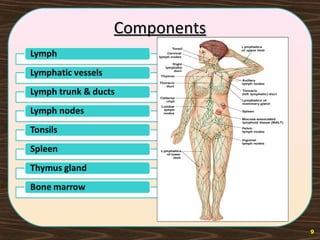
ComponentsComponents
9
10
LymphLymph
 Fluid present in lymphatic system.
 When ISF passes through lymph capillaries it is called as
lymph.
 It is then transported through lymph vessels to lymph nodes
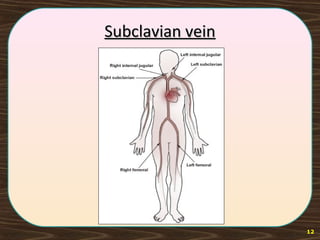
 From lymph node it is transported to ducts & trunks which
drain lymph to right or left subclavian vein, where it mixes
back with blood.
 Clear, colorless fluid
 Similar to blood plasma but low protein content
 Contain macrophages, viruses, bacteria & cellular debris
11
Subclavian veinSubclavian vein
12
13
Flow of LymphFlow of Lymph
 Lymphatic capillaries
 Lymphatic vessels
 Lymph nodes
 Lymphatic trunks
 Collecting ducts
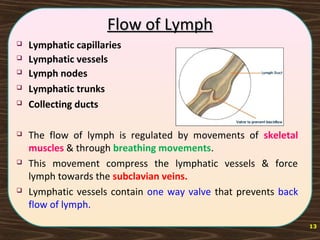
 The flow of lymph is regulated by movements of skeletal
muscles & through breathing movements.
 This movement compress the lymphatic vessels & force
lymph towards the subclavian veins.

 Lymphatic vessels contain one way valve that prevents back
flow of lymph.
14
Lymphatic CapillariesLymphatic Capillaries
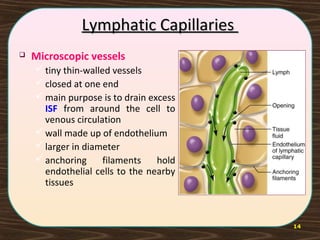
 Microscopic vessels
 tiny thin-walled vessels
 closed at one end
 main purpose is to drain excess
ISF from around the cell to
venous circulation
 wall made up of endothelium
 larger in diameter
 anchoring filaments hold
endothelial cells to the nearby
tissues
15
Lymphatic CapillariesLymphatic Capillaries – Lacteals– Lacteals
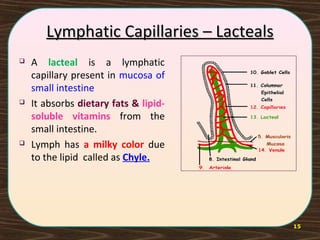
 A lacteal is a lymphatic
capillary present in mucosa of
small intestine
 It absorbs dietary fats & lipid-
soluble vitamins from the
small intestine.
 Lymph has a milky color due
to the lipid called as Chyle.
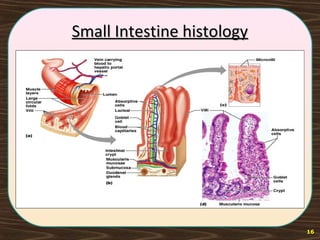
Small Intestine histologySmall Intestine histology
16
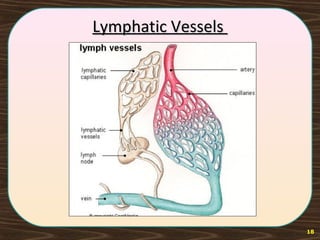
Lymphatic VesselsLymphatic Vessels
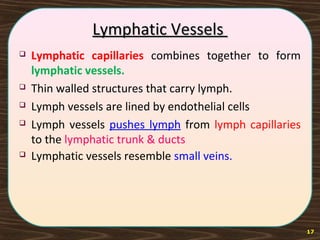
 Lymphatic capillaries combines together to form
lymphatic vessels.
 Thin walled structures that carry lymph.
 Lymph vessels are lined by endothelial cells
 Lymph vessels pushes lymph from lymph capillaries
to the lymphatic trunk & ducts
 Lymphatic vessels resemble small veins.
17
Lymphatic VesselsLymphatic Vessels
18
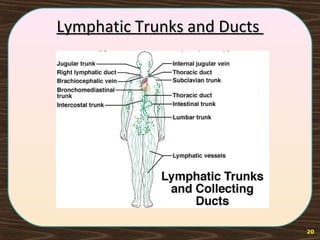
Lymphatic Trunks & DuctsLymphatic Trunks & Ducts
 From lymph vessels, the lymph is delivered to large
lymphatic trunks & ducts.
 Trunks: Six types of trunks are present
• Jugular
• Subclavian
• Bronchomediastinal
• Intestinal
• Lumbar
• Intercostal
 Ducts: Two ducts are present
 Right lymphatic duct
 Thoracic duct
19
Lymphatic Trunks and DuctsLymphatic Trunks and Ducts
20
21
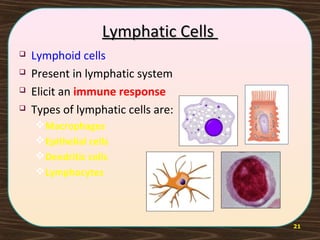
Lymphatic CellsLymphatic Cells
 Lymphoid cells
 Present in lymphatic system
 Elicit an immune response
 Types of lymphatic cells are:
Macrophages
Epithelial cells
Dendritic cells
Lymphocytes
22
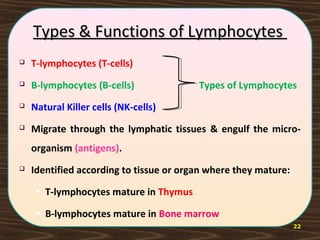
Types & Functions of LymphocytesTypes & Functions of Lymphocytes
 T-lymphocytes (T-cells)
 B-lymphocytes (B-cells) Types of Lymphocytes
 Natural Killer cells (NK-cells)
 Migrate through the lymphatic tissues & engulf the micro-
organism (antigens).
 Identified according to tissue or organ where they mature:
• T-lymphocytes mature in Thymus
• B-lymphocytes mature in Bone marrow
23
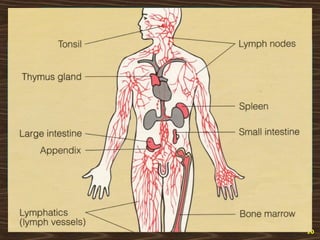
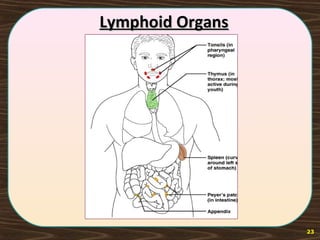
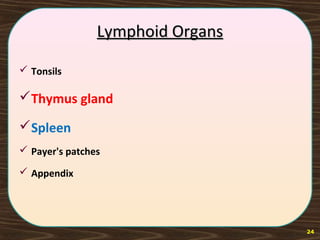
Lymphoid OrgansLymphoid Organs
 Tonsils
Thymus gland
Spleen
 Payer's patches
 Appendix
24
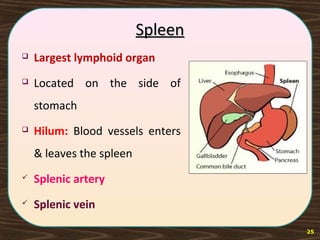
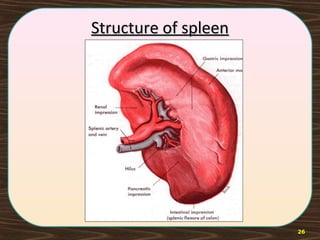
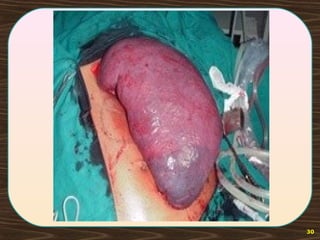
SpleenSpleen
 Largest lymphoid organ
 Located on the side of
stomach
 Hilum: Blood vessels enters
& leaves the spleen
 Splenic artery
 Splenic vein
25
Structure of spleenStructure of spleen
26
StructureStructure ofof SpleenSpleen
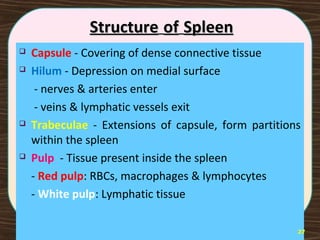
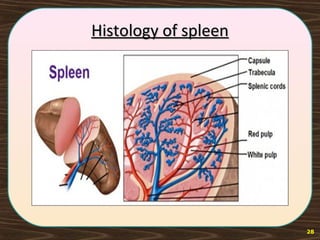
 Capsule - Covering of dense connective tissue
 Hilum - Depression on medial surface
- nerves & arteries enter
- veins & lymphatic vessels exit
 Trabeculae - Extensions of capsule, form partitions
within the spleen
 Pulp - Tissue present inside the spleen
- Red pulp: RBCs, macrophages & lymphocytes
- White pulp: Lymphatic tissue
27
Histology of spleenHistology of spleen
28
29
Functions of SpleenFunctions of Spleen
 Shows an immune response when antigens are
found in blood (White pulp)
 Reservoir of erythrocytes & platelets (Red pulp)
 Phagocytosis of old, defective RBCs & platelets (Red
pulp)
 Phagocytosis of bacteria & other foreign materials.
30
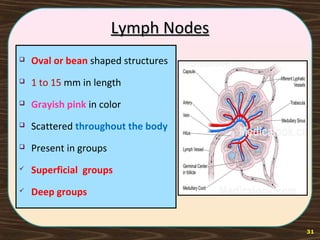
Lymph NodesLymph Nodes
 Oval or bean shaped structures
 1 to 15 mm in length
 Grayish pink in color
 Scattered throughout the body
 Present in groups
 Superficial groups
 Deep groups
31
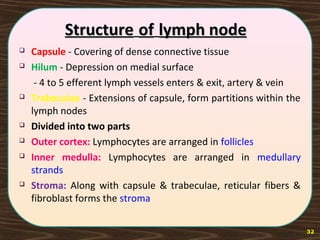
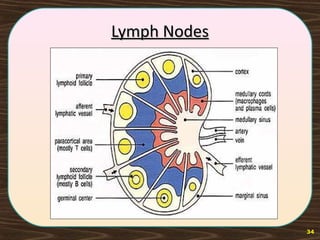
StructureStructure ofof lymph nodelymph node
 Capsule - Covering of dense connective tissue
 Hilum - Depression on medial surface
- 4 to 5 efferent lymph vessels enters & exit, artery & vein
 Trabeculae - Extensions of capsule, form partitions within the
lymph nodes
 Divided into two parts
 Outer cortex: Lymphocytes are arranged in follicles
 Inner medulla: Lymphocytes are arranged in medullary
strands
 Stroma: Along with capsule & trabeculae, reticular fibers &
fibroblast forms the stroma
32
FunctionFunction
 Filters foreign substances from lymph & passes back to
blood
 These substance are trapped by the reticular fibers
within the lymph node
 Macrophages destroy the foreign substances by
phagocytosis
33
Lymph NodesLymph Nodes
34
DisordersDisorders
 Lymphadenitis:
 It is the inflammation or enlargement of a lymph node.
 Acute infection of lymph nodes called as acute lymphadenitis
caused by microbes in the lymph.
 The nodes become inflamed, enlarged, congested with blood.
 Splenomegaly:
 It is an enlargement of the spleen.
35
DisordersDisorders
 Lymphomas:
 There are malignant tumours of lymphoid tissue.
 These are classified as either Hodgkins or non-Hodgkins
lymphomas.
 It affects individuals between age group of 15 & 35 and it is
more common in males.
36
QuestionsQuestions
 SAQs:
 Give the functions of lymphatic tissue. (3 M)
 Give different parts of lymphatic tissue. (3 M)
 Note on lymph (3 M, October 2009)
 Note on lymph node. (3 M, October 2009, May 2010)
 Describe composition and function of lymph. (3 M, October
2009)
 Explain structure and function of lymph node. (5 M, October
2009, 2010, May 2011, 2012)
 Explain structure and function of spleen. (3 M, May 2009,
May 2011, October 2011)
37
38

Lymphatic system

  • 1.
    Lymphatic SystemLymphatic System Dr.Mrs. Deepa K. Ingawale (Mandlik) Dept. of Pharmacology Poona College of Pharmacy, Pune 1
  • 2.
  • 3.
    Learning ObjectivesLearning Objectives To understand lymph composition & lymph flow  To study function & components of lymphatic system  To study different cells of lymphatic system  To study structure & function of spleen  To describe the anatomy & physiology of lymph node 3
  • 4.
    Body fluid compositionBodyfluid composition 4
  • 5.
    Interstitial fluid (ISF)Interstitialfluid (ISF)  It fills the narrow spaces between the cells of tissues 5
  • 6.
    6 Lymphatic SystemLymphatic System It consists of lymph & lymphatic vessels that transport the lymph.  After interstitial fluid passes into lymphatic vessels, it is called lymph  Difference between interstitial fluid & lymph is location:  Interstitial fluid is found between the spaces of the cells, & lymph is located within lymphatic vessels & lymphatic tissue.
  • 7.
    Lymphatic tissueLymphatic tissue Lymphatic tissue is a specialized form of reticular connective tissue that contains large numbers of lymphocytes.  Lymphocytes are agranular white blood cells  Two types of lymphocytes participate in immune responses:  B cells  T cells 7
  • 8.
    8 FunctionsFunctions  Fluid &nutrient transport  Lymphocyte development  Immune response  Reabsorbs excess interstitial fluid • returns it to the venous circulation • maintain blood volume levels  Transport dietary lipids • Transport lipids & lipid-soluble vitamins (A, D, E, & K) absorbed by the GI tract.
  • 9.
  • 10.
  • 11.
    LymphLymph  Fluid presentin lymphatic system.  When ISF passes through lymph capillaries it is called as lymph.  It is then transported through lymph vessels to lymph nodes  From lymph node it is transported to ducts & trunks which drain lymph to right or left subclavian vein, where it mixes back with blood.  Clear, colorless fluid  Similar to blood plasma but low protein content  Contain macrophages, viruses, bacteria & cellular debris 11
  • 12.
  • 13.
    13 Flow of LymphFlowof Lymph  Lymphatic capillaries  Lymphatic vessels  Lymph nodes  Lymphatic trunks  Collecting ducts  The flow of lymph is regulated by movements of skeletal muscles & through breathing movements.  This movement compress the lymphatic vessels & force lymph towards the subclavian veins.  Lymphatic vessels contain one way valve that prevents back flow of lymph.
  • 14.
    14 Lymphatic CapillariesLymphatic Capillaries Microscopic vessels  tiny thin-walled vessels  closed at one end  main purpose is to drain excess ISF from around the cell to venous circulation  wall made up of endothelium  larger in diameter  anchoring filaments hold endothelial cells to the nearby tissues
  • 15.
    15 Lymphatic CapillariesLymphatic Capillaries– Lacteals– Lacteals  A lacteal is a lymphatic capillary present in mucosa of small intestine  It absorbs dietary fats & lipid- soluble vitamins from the small intestine.  Lymph has a milky color due to the lipid called as Chyle.
  • 16.
    Small Intestine histologySmallIntestine histology 16
  • 17.
    Lymphatic VesselsLymphatic Vessels Lymphatic capillaries combines together to form lymphatic vessels.  Thin walled structures that carry lymph.  Lymph vessels are lined by endothelial cells  Lymph vessels pushes lymph from lymph capillaries to the lymphatic trunk & ducts  Lymphatic vessels resemble small veins. 17
  • 18.
  • 19.
    Lymphatic Trunks &DuctsLymphatic Trunks & Ducts  From lymph vessels, the lymph is delivered to large lymphatic trunks & ducts.  Trunks: Six types of trunks are present • Jugular • Subclavian • Bronchomediastinal • Intestinal • Lumbar • Intercostal  Ducts: Two ducts are present  Right lymphatic duct  Thoracic duct 19
  • 20.
    Lymphatic Trunks andDuctsLymphatic Trunks and Ducts 20
  • 21.
    21 Lymphatic CellsLymphatic Cells Lymphoid cells  Present in lymphatic system  Elicit an immune response  Types of lymphatic cells are: Macrophages Epithelial cells Dendritic cells Lymphocytes
  • 22.
    22 Types & Functionsof LymphocytesTypes & Functions of Lymphocytes  T-lymphocytes (T-cells)  B-lymphocytes (B-cells) Types of Lymphocytes  Natural Killer cells (NK-cells)  Migrate through the lymphatic tissues & engulf the micro- organism (antigens).  Identified according to tissue or organ where they mature: • T-lymphocytes mature in Thymus • B-lymphocytes mature in Bone marrow
  • 23.
  • 24.
    Lymphoid OrgansLymphoid Organs Tonsils Thymus gland Spleen  Payer's patches  Appendix 24
  • 25.
    SpleenSpleen  Largest lymphoidorgan  Located on the side of stomach  Hilum: Blood vessels enters & leaves the spleen  Splenic artery  Splenic vein 25
  • 26.
  • 27.
    StructureStructure ofof SpleenSpleen Capsule - Covering of dense connective tissue  Hilum - Depression on medial surface - nerves & arteries enter - veins & lymphatic vessels exit  Trabeculae - Extensions of capsule, form partitions within the spleen  Pulp - Tissue present inside the spleen - Red pulp: RBCs, macrophages & lymphocytes - White pulp: Lymphatic tissue 27
  • 28.
  • 29.
    29 Functions of SpleenFunctionsof Spleen  Shows an immune response when antigens are found in blood (White pulp)  Reservoir of erythrocytes & platelets (Red pulp)  Phagocytosis of old, defective RBCs & platelets (Red pulp)  Phagocytosis of bacteria & other foreign materials.
  • 30.
  • 31.
    Lymph NodesLymph Nodes Oval or bean shaped structures  1 to 15 mm in length  Grayish pink in color  Scattered throughout the body  Present in groups  Superficial groups  Deep groups 31
  • 32.
    StructureStructure ofof lymphnodelymph node  Capsule - Covering of dense connective tissue  Hilum - Depression on medial surface - 4 to 5 efferent lymph vessels enters & exit, artery & vein  Trabeculae - Extensions of capsule, form partitions within the lymph nodes  Divided into two parts  Outer cortex: Lymphocytes are arranged in follicles  Inner medulla: Lymphocytes are arranged in medullary strands  Stroma: Along with capsule & trabeculae, reticular fibers & fibroblast forms the stroma 32
  • 33.
    FunctionFunction  Filters foreignsubstances from lymph & passes back to blood  These substance are trapped by the reticular fibers within the lymph node  Macrophages destroy the foreign substances by phagocytosis 33
  • 34.
  • 35.
    DisordersDisorders  Lymphadenitis:  Itis the inflammation or enlargement of a lymph node.  Acute infection of lymph nodes called as acute lymphadenitis caused by microbes in the lymph.  The nodes become inflamed, enlarged, congested with blood.  Splenomegaly:  It is an enlargement of the spleen. 35
  • 36.
    DisordersDisorders  Lymphomas:  Thereare malignant tumours of lymphoid tissue.  These are classified as either Hodgkins or non-Hodgkins lymphomas.  It affects individuals between age group of 15 & 35 and it is more common in males. 36
  • 37.
    QuestionsQuestions  SAQs:  Givethe functions of lymphatic tissue. (3 M)  Give different parts of lymphatic tissue. (3 M)  Note on lymph (3 M, October 2009)  Note on lymph node. (3 M, October 2009, May 2010)  Describe composition and function of lymph. (3 M, October 2009)  Explain structure and function of lymph node. (5 M, October 2009, 2010, May 2011, 2012)  Explain structure and function of spleen. (3 M, May 2009, May 2011, October 2011) 37
  • 38.