LYMPHATIC
SYSTEM
DR.NILESH KATE.
M.D.
ASSOCIATE PROFESSOR,
DEPARTMENT OF PHYSIOLOGY,
Objectives
 Components
 Lymph formation &
composition
 Lymph flow
 Pathology –
Oedema
Components
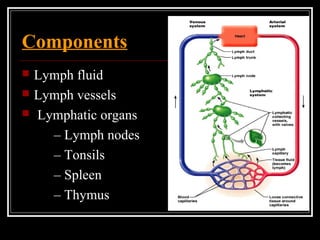
 Lymph fluid
 Lymph vessels
 Lymphatic organs
– Lymph nodes
– Tonsils
– Spleen
– Thymus
Lymph formation & composition
 Formation
 Composition
 Protein content
 Fat content
 Cellular content
Composition of lymph
1. H2O 94%
2. Solids 6%
3. Cells lymphocytes , plasma cells,
4. Electrolytes same as that of plasma
5. Urea, creatinine & amino acid
6. Ca++, phosphrous
7. Chlorides and glucose
8. Clotting factors ,plasma enzymes &antibodies
are present.
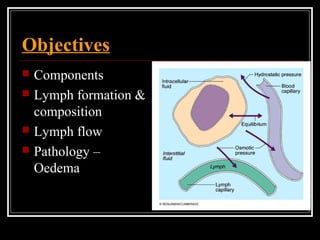
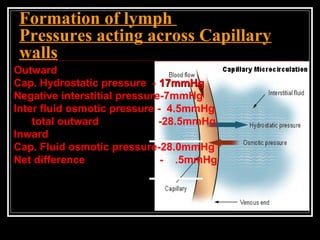
Formation of lymph
Pressures acting across Capillary
walls
Outward
Cap. Hydrostatic pressure - 17mmHg17mmHg
Negative interstitial pressure-7mmHg
Inter fluid osmotic pressure - 4.5mmHg
total outward -28.5mmHg
Inward
Cap. Fluid osmotic pressure-28.0mmHg
Net difference - .5mmHg
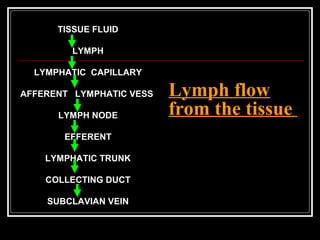
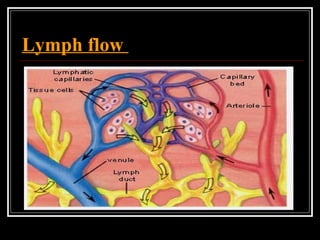
Lymph flow
from the tissue
TISSUE FLUID
LYMPH
LYMPHATIC CAPILLARY
AFFERENT LYMPHATIC VESS
LYMPH NODE
EFFERENT
LYMPHATIC TRUNK
COLLECTING DUCT
SUBCLAVIAN VEIN
Lymphatic Vessels
 Lymphatic capillaries
 Lymphatic collecting
vessels
 Lymphatic trunks
 Lymphatic ducts
 Accompany and parallel
veins in most of body
 Not found in; nails, hair.
 Form an extensive
system that flows one
way toward the heart
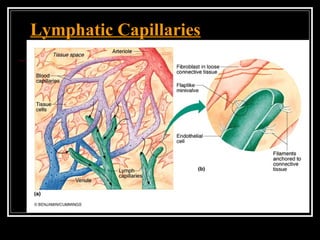
Lymphatic Capillaries
 Found in most places that
contain capillaries
Except bone marrow,
cartilage, CNS, cornea,
nail, spleen
 More permeable than
blood capillaries
 Nature of lymphatic
capillaries allows WBC’s
pathogens, and cancer
cells to enter easily
Lymphatic Capillaries
Lymphatic Collecting Vessels
 Lymphatic capillaries join together to form lymphatic
collecting vessels
 Morphologically similar to veins, except contain more
valves
 Pass through lymph nodes
 Can be superficial or deep
Lymphatic Ducts
 Union of lymphatic trunks
 Two lymphatic trunks in humans
 Right duct drains right side of head,thorax, right
arm. Enters right subclavian vein
 Thoracic duct drains left side of head,thorax, left
arm, and lower ½ of body. Enters left subclavian
vein
Lymph capillaries
converge to become
collecting vessels
and end up as either
Thoracic duct or
right lymphatic duct
Thoracic (left lymphatic) duct
Left subclavian vein
Right
lymphatic
duct
Right
subclavian
vein
Cysterna Chyli
Lymphatic Ducts
Lymph flow
Functions
 Proteins from tissue spaces to blood
 Absorption of nutrients
 Transport mechanism
 Supply O2 and nutrition
 Defense mechanism
Mechanism
 Factors affecting
 Suction effect
 Intrinsic lymphatic pump
 Pumping by external compression
 Negative intrathorasic pressure
 Interstitial fluid pressure
 Increase in capillary surface area
 Increase in capillary permeability
 Increase in functional activity of tissue.
Normal lymph flow
 Normal values – 120 ml/ hr or 2-4 L per day.
 Rate of lymph flow – 100 ml/ hr in thorasic duct
& 20 ml/hr in other
lymphatic
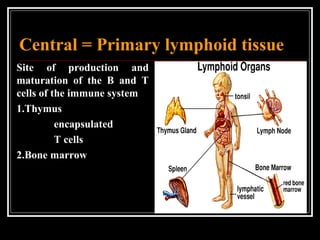
Central = Primary lymphoid tissue
Site of production and
maturation of the B and T
cells of the immune system
1.Thymus
encapsulated
T cells
2.Bone marrow
Lymph Nodes
 Between two lymphatic collecting vessels.
 Serve as filters to capture foreign material.
 Site of lymphocyte production
 Become inflamed / engorged with infectious
material
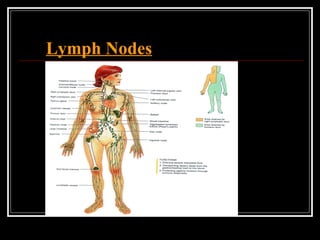
 Can be found in large clusters in inguinal,
cervical and axilla
Lymph Nodes
Lymphatic Nodules
 Filter and attack antigens.
 mucosa-associated lymphatic tissue (MALT) or
tonsils detect antigens and initiate an immune response
 very prominent in the mucosa of the small intestine,
primarily in the ileum Peyer patches
 also prevalent in the appendix
Lymphatic Nodules
Applied physiology
 Lymphadenopathy
 Elephantiasis
 Chyluria
 Chylo thorax
 Oedema of arm in radical mastectomy
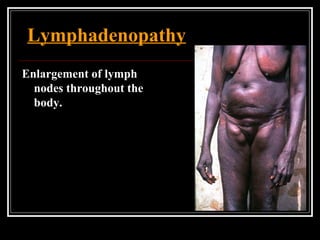
Lymphadenopathy
Enlargement of lymph
nodes throughout the
body.
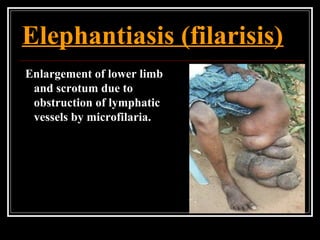
Elephantiasis (filarisis)
Enlargement of lower limb
and scrotum due to
obstruction of lymphatic
vessels by microfilaria.
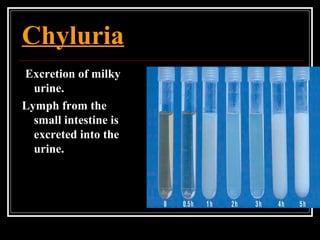
Chyluria
Excretion of milky
urine.
Lymph from the
small intestine is
excreted into the
urine.
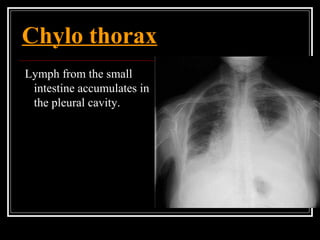
Chylo thorax
Lymph from the small
intestine accumulates in
the pleural cavity.
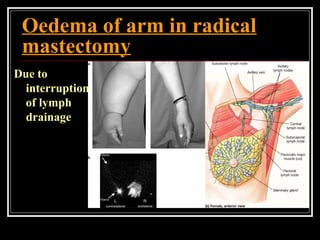
Oedema of arm in radical
mastectomy
Due to
interruption
of lymph
drainage
Edema
Occasionally the balance
of filteration and
reabsorption between
interstitial fluid and
plasma is disrupted.
This results in edema.
Types of edema
1. Intracellular edema – due to increased ICF.
2. Extra cellular edema- due to increased fluid
in the interstitial spaces.
Intracellular edema
Causes
- depression of the metabolic systems of the
tissues
- lack of adequate nutrition to the cells
Extracellular edema
Cause
- an abnormal leakage of fluid from
the plasma to the interstitial
spaces.
- failure of the lymphatics from
interstistium to the blood
Factors affecting edema formation
1. Increased blood hydrostatic pressure in
capillary
2. Decreased oncotic pressure of plasma
proteins.
3. Increased permeability of capillaries
4. Increased ECF fluid volume. (Kidney
failure)
5. Blockage of lymphatic vessels
SAFETY FACTORS – PREVENTS OEDEMA
•Low compliance of interstitum in the negative
pressure range
•Importance of interstitial gel
•Importance of proteoglycans filaments
•Increased lymph flow
•Washdown of interstitial fluid proteins
•Effusion– odema fluid in potential spaces.
Lymphatogogues
Any substance which increases lymph formation is
called as lymphatogogues.
Eg : 1.sunlight
2.warmth
3.histamine.
Thank
you

LYMPHATIC SYSTEM

  • 1.
  • 2.
    Objectives  Components  Lymphformation & composition  Lymph flow  Pathology – Oedema
  • 3.
    Components  Lymph fluid Lymph vessels  Lymphatic organs – Lymph nodes – Tonsils – Spleen – Thymus
  • 4.
    Lymph formation &composition  Formation  Composition  Protein content  Fat content  Cellular content
  • 5.
    Composition of lymph 1.H2O 94% 2. Solids 6% 3. Cells lymphocytes , plasma cells, 4. Electrolytes same as that of plasma 5. Urea, creatinine & amino acid 6. Ca++, phosphrous 7. Chlorides and glucose 8. Clotting factors ,plasma enzymes &antibodies are present.
  • 6.
    Formation of lymph Pressuresacting across Capillary walls Outward Cap. Hydrostatic pressure - 17mmHg17mmHg Negative interstitial pressure-7mmHg Inter fluid osmotic pressure - 4.5mmHg total outward -28.5mmHg Inward Cap. Fluid osmotic pressure-28.0mmHg Net difference - .5mmHg
  • 7.
    Lymph flow from thetissue TISSUE FLUID LYMPH LYMPHATIC CAPILLARY AFFERENT LYMPHATIC VESS LYMPH NODE EFFERENT LYMPHATIC TRUNK COLLECTING DUCT SUBCLAVIAN VEIN
  • 8.
    Lymphatic Vessels  Lymphaticcapillaries  Lymphatic collecting vessels  Lymphatic trunks  Lymphatic ducts  Accompany and parallel veins in most of body  Not found in; nails, hair.  Form an extensive system that flows one way toward the heart
  • 9.
    Lymphatic Capillaries  Foundin most places that contain capillaries Except bone marrow, cartilage, CNS, cornea, nail, spleen  More permeable than blood capillaries  Nature of lymphatic capillaries allows WBC’s pathogens, and cancer cells to enter easily
  • 10.
  • 11.
    Lymphatic Collecting Vessels Lymphatic capillaries join together to form lymphatic collecting vessels  Morphologically similar to veins, except contain more valves  Pass through lymph nodes  Can be superficial or deep
  • 12.
    Lymphatic Ducts  Unionof lymphatic trunks  Two lymphatic trunks in humans  Right duct drains right side of head,thorax, right arm. Enters right subclavian vein  Thoracic duct drains left side of head,thorax, left arm, and lower ½ of body. Enters left subclavian vein
  • 13.
    Lymph capillaries converge tobecome collecting vessels and end up as either Thoracic duct or right lymphatic duct Thoracic (left lymphatic) duct Left subclavian vein Right lymphatic duct Right subclavian vein Cysterna Chyli Lymphatic Ducts
  • 14.
  • 15.
    Functions  Proteins fromtissue spaces to blood  Absorption of nutrients  Transport mechanism  Supply O2 and nutrition  Defense mechanism
  • 16.
    Mechanism  Factors affecting Suction effect  Intrinsic lymphatic pump  Pumping by external compression  Negative intrathorasic pressure  Interstitial fluid pressure  Increase in capillary surface area  Increase in capillary permeability  Increase in functional activity of tissue.
  • 17.
    Normal lymph flow Normal values – 120 ml/ hr or 2-4 L per day.  Rate of lymph flow – 100 ml/ hr in thorasic duct & 20 ml/hr in other lymphatic
  • 18.
    Central = Primarylymphoid tissue Site of production and maturation of the B and T cells of the immune system 1.Thymus encapsulated T cells 2.Bone marrow
  • 19.
    Lymph Nodes  Betweentwo lymphatic collecting vessels.  Serve as filters to capture foreign material.  Site of lymphocyte production  Become inflamed / engorged with infectious material  Can be found in large clusters in inguinal, cervical and axilla
  • 20.
  • 21.
    Lymphatic Nodules  Filterand attack antigens.  mucosa-associated lymphatic tissue (MALT) or tonsils detect antigens and initiate an immune response  very prominent in the mucosa of the small intestine, primarily in the ileum Peyer patches  also prevalent in the appendix
  • 22.
  • 23.
    Applied physiology  Lymphadenopathy Elephantiasis  Chyluria  Chylo thorax  Oedema of arm in radical mastectomy
  • 24.
  • 25.
    Elephantiasis (filarisis) Enlargement oflower limb and scrotum due to obstruction of lymphatic vessels by microfilaria.
  • 26.
    Chyluria Excretion of milky urine. Lymphfrom the small intestine is excreted into the urine.
  • 27.
    Chylo thorax Lymph fromthe small intestine accumulates in the pleural cavity.
  • 28.
    Oedema of armin radical mastectomy Due to interruption of lymph drainage
  • 29.
    Edema Occasionally the balance offilteration and reabsorption between interstitial fluid and plasma is disrupted. This results in edema.
  • 30.
    Types of edema 1.Intracellular edema – due to increased ICF. 2. Extra cellular edema- due to increased fluid in the interstitial spaces.
  • 31.
    Intracellular edema Causes - depressionof the metabolic systems of the tissues - lack of adequate nutrition to the cells
  • 32.
    Extracellular edema Cause - anabnormal leakage of fluid from the plasma to the interstitial spaces. - failure of the lymphatics from interstistium to the blood
  • 33.
    Factors affecting edemaformation 1. Increased blood hydrostatic pressure in capillary 2. Decreased oncotic pressure of plasma proteins. 3. Increased permeability of capillaries 4. Increased ECF fluid volume. (Kidney failure) 5. Blockage of lymphatic vessels
  • 34.
    SAFETY FACTORS –PREVENTS OEDEMA •Low compliance of interstitum in the negative pressure range •Importance of interstitial gel •Importance of proteoglycans filaments •Increased lymph flow •Washdown of interstitial fluid proteins •Effusion– odema fluid in potential spaces.
  • 35.
    Lymphatogogues Any substance whichincreases lymph formation is called as lymphatogogues. Eg : 1.sunlight 2.warmth 3.histamine.
  • 36.