PREPARED BY:
MAULIK
CHAUDHARI
 The cells of our body baths in interstitial fluid which leaks
constantly from the blood stream through the permeable wall of
blood capillaries.
 The lymph fluid is similar in composition to the blood plasma.
 Some tissue fluid returns to the capillaries at their venous end
and the reminder diffuses through the more permeable walls of
the lymph capillaries, it will forms lymph.
 Lymph passes through vessels & lymph nodes before returning to
the blood.
Introduction:-
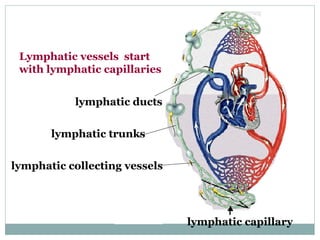
lymphatic capillary
lymphatic trunks
lymphatic collecting vessels
lymphatic ducts
Lymphatic vessels start
with lymphatic capillaries
 Cardiovascular & lymphatic system both are supply
fluid flow in to the body. but both are deferent type
of fluid..
 Lymphatic system does not having closed circuit &
central pump like heart.
 The lymphatic system consist of:
 Lymph
 Lymph vessels
 Lymph nodes
 Lymph organs= spleen, thymus
 Diffuse lymphoid tissue= tonsils
 Bone marrow.
Lymph
Lymph vessels
Lymph node
Lymph organ eg.
Spleen, Thymus
Diffuse lymphoid
tissue eg. Tonsil
It consist of...........
Functions of lymphatic system
1. It is responsible for the removal of interstitial fluid
from tissues.
2. It absorbs fat & fat soluble materials in small
intestine and are absorbed into central lacteals
( lymphatic vessels) of the villi. E.g = fat, fat soluble
vitamins ( A,D,E,K)
1. Lymphatic system plays major role in body
immune function.
 Lymph acts as a "middle man" which transports oxygen, food
materials, hormones, etc., to the body cells
 And brings carbon dioxide and other metabolic wastes, from the
body cells to blood and then finally pours the same into the venous
system.
 Body cells are kept moist by the lymph.
 It destroys the invading microorganisms and foreign particles in the
lymph nodes
travel along with blood
vessels.
1) lymphatic vessels
 Meaning:-After blood travels through capillary beds
and is moved to the venous system, some of its fluid is
left behind in the tissues it called lymph.
 Lymph is a clear, colorless liquid with a composition
similar to blood plasma, with the important exception
of plasma proteins.
 It is nothing but the clear, watery blood plasma leaked
out through the capillary walls to flow around the cells.
 It contains oxygen, proteins, glucose and white blood
cells.
Lymph:-
 All the cells bathed in this fluid receive their
nutrients and oxygen from it.
 Tubular vessels transport lymph back to the blood,
ultimately replacing the volume lost during the
formation of the interstitial fluid.
 Lymph movement occurs despite low pressure due
to peristalsis, valves, and compression during
contraction of adjacent skeletal muscle and arterial
pulsation
 Lymph carries larger particles= bacteria & cell debris
from damaged tissues, which can then filters and
destroyed by a lymph node.
 Lymph contains lymphocytes which circulate in the
lymphatic system.
 In the lacteals of small intestine, fats absorbed into
the lymphatics give the lymph a milky appearance
now called chyle.
the cardiovascular system pumps blood through its system but it
cannot return all the fluid from the body cells.
The lymph system picks up 60%of the fluid dropped off at the cellular
level,
at this point we are talking about
interstial fluid, the IF picks up
plasma and becomes tissue fluid
The tissue fluid is then picked up by lymph capillaries,
the tissue fluid is called lymph
The origin on lymph :-
 Lymph is an alkaline (pH > 7.0)
 Vessels that carry the fluid (lymph) back to the
venous system is called as a lymph vessel.
 Lymphatic vessels are connected with blood vessels
so that they can perform this function.
 Distribution of lymphatic vessels in human body:
 Present=Lymphatic vessels travel alongside blood
vessels
 Absent= Lymphatic vessels are absent from bones,
teeth, bone marrow, and the central nervous system
Lymph vessels:-
Circulation of lymph:-
There are a nine major lymphatic trunks that carry the lymph &
circulate it..
The nine major trunks, draining lymph from regions for which they are
named, are the 1.lumbar,2. jugular, 3.subclavian, 4.bronchomediastinal
trunks, each of which occurs in pairs (left and right, for each side of the
body), and a (5)single intestinal trunk.
Lymphatic ducts= are the largest lymphatic vessels.
1) Right lymphatic duct
2) Left lymphatic duct
These two ducts drain lymph into veins in the neck (the right and left
subclavian veins at their junction with the internal jugular veins).
 The left thoracic duct collects lymph from the left side of the body
and regions of the right side of the body below the thorax.
 It ultimately drains lymph into the left subclavian vein. It begins at
the cisterna chili,
 The right thoracic duct collects lymph from the upper right side of
the body (right arm and right regions of thorax, neck, and head)
 It ultimately drains lymph into the right subclavian vein.
Lymph nodes:-
 They are widely distributed throughout the body
along the lymphatic pathways.
 Lymph nodes are not present in the central nervous
system.
 Composed of lymphoid tissue.
Structure of lymph nodes
 Small bean-shaped structures
 Usually less than 2.5 cm (1 inch) in length.
 Three superficial regions where lymph nodes tend to
cluster
1. Inguinal nodes in the groin
2. Axillary nodes in the armpit
3. Cervical nodes in the neck
Function of Lymph nodes
 Filter the lymph before it is returned to the blood.
 Preventing foreign particles from entering the
bloodstream
 They also produce lymphocytes
Swollen
Lymph
Glands
Spleen
 The spleen contains reticular and lymphatic tissue
and is the largest lymph organ.
 The spleen lies in the left hypochondriac region of
the abdominal cavity between the fundus of the
stomach and the diaphragm.
 It is purplish in colour and varies in size in different
individuals, but is usually about 12 cm long,
 7 cm wide and 2.5 cm thick.
 It weighs about 200 g.
Organs associated with the spleen
 Superiorly and posteriorly – diaphragm
 Inferiorly – left colic flexure of the large
intestine
 Anteriorly – fundus of the stomach
 Medially – pancreas and the left kidney
 Laterally – separated from the 9th,
10th and 11th ribs and the
intercostal muscles by the diaphragm
Structure
 The spleen is slightly oval in shape with the hilum on the
lower medial border. The anterior surface is covered
withperitoneum.
 It is enclosed in a fibroelastic capsule that dips into the
organ, forming trabeculae.
 The cellular material, consisting of lymphocytes and
macrophages, is called splenic pulp, and lies between
the trabeculae.
 Red pulp is the part suffused with blood and white
pulp consists of areas of lymphatic tissue where there
are sleeves of lymphocytes and macrophages around
blood vessels.
The structures entering and leaving the spleen at the
hilum are:
 • splenic artery, a branch of the coeliac artery
 • splenic vein, a branch of the portal vein
 • lymph vessels (efferent only)
 • nerves.
Function
 Phagocytosis
 old and abnormal erythrocytes are mainly destroyed in
the spleen, and the breakdown products, bilirubin and
iron, are transported to the liver via the splenic and
portal veins.
 Other cellular material, e.g. leukocytes, platelets and
bacteria, is phagocytosed in the spleen.
 Unlike lymph nodes, the spleen has no afferent
lymphatics entering it, so it is not exposed to diseases
spread by lymph.
 Storage of blood
 The spleen contains up to 350 mL of blood, and in
response to sympathetic stimulation can rapidly
return most of this volume to the circulation, e.g. in
haemorrhage.
 Immune response
 The spleen contains T- and B-lymphocytes, which
are activated by the presence of antigens, e.g. in
infection.
 Lymphocyte proliferation during serious infection
can cause enlargement of the spleen
(splenomegaly).
 Erythropoiesis
 The spleen and liver are important sites of fetal
blood cell production, and the spleen can also fulfil
this function in adults in times of great need.
Tonsils:-
 Cluster of lymphatic tissue just under the mucous
membranes that line the nose, mouth, and pharynx
(throat) called tonsils.
There are three groups of tonsils.
1. Pharyngeal tonsils
2. Palatine tonsils
3. Lingual tonsils
Function:-
 Provide protection against harmful substances and
pathogens that may enter the body through the
nose or mouth.
 Blood supply by:-Tonsillar branch of facial
artery
 Nerve supply by:-glossopharyngeal nerve
Lymphaticsystem

Lymphaticsystem

  • 1.
  • 2.
     The cellsof our body baths in interstitial fluid which leaks constantly from the blood stream through the permeable wall of blood capillaries.  The lymph fluid is similar in composition to the blood plasma.  Some tissue fluid returns to the capillaries at their venous end and the reminder diffuses through the more permeable walls of the lymph capillaries, it will forms lymph.  Lymph passes through vessels & lymph nodes before returning to the blood. Introduction:-
  • 3.
    lymphatic capillary lymphatic trunks lymphaticcollecting vessels lymphatic ducts Lymphatic vessels start with lymphatic capillaries
  • 4.
     Cardiovascular &lymphatic system both are supply fluid flow in to the body. but both are deferent type of fluid..  Lymphatic system does not having closed circuit & central pump like heart.
  • 5.
     The lymphaticsystem consist of:  Lymph  Lymph vessels  Lymph nodes  Lymph organs= spleen, thymus  Diffuse lymphoid tissue= tonsils  Bone marrow.
  • 6.
    Lymph Lymph vessels Lymph node Lymphorgan eg. Spleen, Thymus Diffuse lymphoid tissue eg. Tonsil It consist of...........
  • 8.
    Functions of lymphaticsystem 1. It is responsible for the removal of interstitial fluid from tissues. 2. It absorbs fat & fat soluble materials in small intestine and are absorbed into central lacteals ( lymphatic vessels) of the villi. E.g = fat, fat soluble vitamins ( A,D,E,K) 1. Lymphatic system plays major role in body immune function.
  • 9.
     Lymph actsas a "middle man" which transports oxygen, food materials, hormones, etc., to the body cells  And brings carbon dioxide and other metabolic wastes, from the body cells to blood and then finally pours the same into the venous system.  Body cells are kept moist by the lymph.  It destroys the invading microorganisms and foreign particles in the lymph nodes
  • 10.
    travel along withblood vessels. 1) lymphatic vessels
  • 11.
     Meaning:-After bloodtravels through capillary beds and is moved to the venous system, some of its fluid is left behind in the tissues it called lymph.  Lymph is a clear, colorless liquid with a composition similar to blood plasma, with the important exception of plasma proteins.  It is nothing but the clear, watery blood plasma leaked out through the capillary walls to flow around the cells.  It contains oxygen, proteins, glucose and white blood cells. Lymph:-
  • 12.
     All thecells bathed in this fluid receive their nutrients and oxygen from it.  Tubular vessels transport lymph back to the blood, ultimately replacing the volume lost during the formation of the interstitial fluid.  Lymph movement occurs despite low pressure due to peristalsis, valves, and compression during contraction of adjacent skeletal muscle and arterial pulsation
  • 13.
     Lymph carrieslarger particles= bacteria & cell debris from damaged tissues, which can then filters and destroyed by a lymph node.  Lymph contains lymphocytes which circulate in the lymphatic system.  In the lacteals of small intestine, fats absorbed into the lymphatics give the lymph a milky appearance now called chyle.
  • 14.
    the cardiovascular systempumps blood through its system but it cannot return all the fluid from the body cells. The lymph system picks up 60%of the fluid dropped off at the cellular level, at this point we are talking about interstial fluid, the IF picks up plasma and becomes tissue fluid The tissue fluid is then picked up by lymph capillaries, the tissue fluid is called lymph The origin on lymph :-
  • 15.
     Lymph isan alkaline (pH > 7.0)
  • 16.
     Vessels thatcarry the fluid (lymph) back to the venous system is called as a lymph vessel.  Lymphatic vessels are connected with blood vessels so that they can perform this function.  Distribution of lymphatic vessels in human body:  Present=Lymphatic vessels travel alongside blood vessels  Absent= Lymphatic vessels are absent from bones, teeth, bone marrow, and the central nervous system Lymph vessels:-
  • 20.
    Circulation of lymph:- Thereare a nine major lymphatic trunks that carry the lymph & circulate it.. The nine major trunks, draining lymph from regions for which they are named, are the 1.lumbar,2. jugular, 3.subclavian, 4.bronchomediastinal trunks, each of which occurs in pairs (left and right, for each side of the body), and a (5)single intestinal trunk. Lymphatic ducts= are the largest lymphatic vessels. 1) Right lymphatic duct 2) Left lymphatic duct These two ducts drain lymph into veins in the neck (the right and left subclavian veins at their junction with the internal jugular veins).
  • 21.
     The leftthoracic duct collects lymph from the left side of the body and regions of the right side of the body below the thorax.  It ultimately drains lymph into the left subclavian vein. It begins at the cisterna chili,  The right thoracic duct collects lymph from the upper right side of the body (right arm and right regions of thorax, neck, and head)  It ultimately drains lymph into the right subclavian vein.
  • 25.
    Lymph nodes:-  Theyare widely distributed throughout the body along the lymphatic pathways.  Lymph nodes are not present in the central nervous system.  Composed of lymphoid tissue.
  • 26.
    Structure of lymphnodes  Small bean-shaped structures  Usually less than 2.5 cm (1 inch) in length.  Three superficial regions where lymph nodes tend to cluster 1. Inguinal nodes in the groin 2. Axillary nodes in the armpit 3. Cervical nodes in the neck
  • 28.
    Function of Lymphnodes  Filter the lymph before it is returned to the blood.  Preventing foreign particles from entering the bloodstream  They also produce lymphocytes
  • 29.
  • 30.
    Spleen  The spleencontains reticular and lymphatic tissue and is the largest lymph organ.  The spleen lies in the left hypochondriac region of the abdominal cavity between the fundus of the stomach and the diaphragm.  It is purplish in colour and varies in size in different individuals, but is usually about 12 cm long,  7 cm wide and 2.5 cm thick.  It weighs about 200 g.
  • 32.
    Organs associated withthe spleen  Superiorly and posteriorly – diaphragm  Inferiorly – left colic flexure of the large intestine  Anteriorly – fundus of the stomach  Medially – pancreas and the left kidney  Laterally – separated from the 9th, 10th and 11th ribs and the intercostal muscles by the diaphragm
  • 35.
    Structure  The spleenis slightly oval in shape with the hilum on the lower medial border. The anterior surface is covered withperitoneum.  It is enclosed in a fibroelastic capsule that dips into the organ, forming trabeculae.  The cellular material, consisting of lymphocytes and macrophages, is called splenic pulp, and lies between the trabeculae.  Red pulp is the part suffused with blood and white pulp consists of areas of lymphatic tissue where there are sleeves of lymphocytes and macrophages around blood vessels.
  • 37.
    The structures enteringand leaving the spleen at the hilum are:  • splenic artery, a branch of the coeliac artery  • splenic vein, a branch of the portal vein  • lymph vessels (efferent only)  • nerves.
  • 38.
    Function  Phagocytosis  oldand abnormal erythrocytes are mainly destroyed in the spleen, and the breakdown products, bilirubin and iron, are transported to the liver via the splenic and portal veins.  Other cellular material, e.g. leukocytes, platelets and bacteria, is phagocytosed in the spleen.  Unlike lymph nodes, the spleen has no afferent lymphatics entering it, so it is not exposed to diseases spread by lymph.
  • 39.
     Storage ofblood  The spleen contains up to 350 mL of blood, and in response to sympathetic stimulation can rapidly return most of this volume to the circulation, e.g. in haemorrhage.
  • 40.
     Immune response The spleen contains T- and B-lymphocytes, which are activated by the presence of antigens, e.g. in infection.  Lymphocyte proliferation during serious infection can cause enlargement of the spleen (splenomegaly).
  • 41.
     Erythropoiesis  Thespleen and liver are important sites of fetal blood cell production, and the spleen can also fulfil this function in adults in times of great need.
  • 42.
    Tonsils:-  Cluster oflymphatic tissue just under the mucous membranes that line the nose, mouth, and pharynx (throat) called tonsils. There are three groups of tonsils. 1. Pharyngeal tonsils 2. Palatine tonsils 3. Lingual tonsils
  • 44.
    Function:-  Provide protectionagainst harmful substances and pathogens that may enter the body through the nose or mouth.  Blood supply by:-Tonsillar branch of facial artery  Nerve supply by:-glossopharyngeal nerve