The Lymphatic System
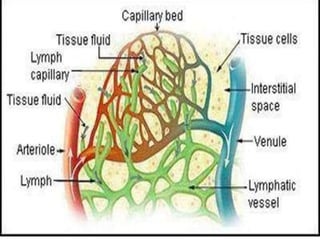
The cells of the body bathed in interstitial fluid which leaks
constantly out of the bloodstream through the permeable
walls of blood capillaries . It is very similar to plasma.
Some tissue fluids return to the capillaries at their venous end
and the reminder diffuses through the more permeable walls
of the lymph capillaries, forming lymph.
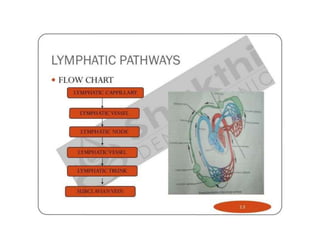
Lymph passes through vessels of increasing size and a
varying number of lymph nodes before returning to the blood.
IMPORTANT TERMS
• Lymph - a fluid that contains white blood cells that
defend against germs
• Lymph vessels - vessels that carry lymph throughout
your body. They are different from blood vessels.
• Lymph nodes - glands found throughout the lymph
vessels. Along with your spleen, these nodes are where
white blood cells fight infection.
LYMPHATIC SYSTEM
(cont.)
• Consists of:
- Lymph
- Network of vessels
- Lymph nodes and nodules
- Tonsils
- Spleen
- Thymus gland
- Bone marrow
FUNCTIONS OF LYMPHATIC SYSTEM
1. TISSUE DRAINAGE;- every day around 21litres of
fluid from plasma, carrying dissolved substances and
some plasma protein, escape from the arterial end of
the capillaries and into the tissues.
2. tissue fluids return directly to bloodstream via the
capillaries at its venous end, but the excess about 3 to
4 liters of fluid is drained away by the lymph
vessels.
3. Without this, the tissues would rapidly become
waterlogged and the cardiovascular system would
begins to fail as the blood volume falls.
2.Absorption in small intestine
Fat and fat- soluble materials eg- the fat- soluble
vitamins are absorbed into the lymphatic vessels of
the villi.
3. Immunity
The lymphatic organs are concerned with the
production and maturation of lymphocytes the white
blood cells are responsible for immunity.
Bone marrow is therefore considered to be lymphatic
tissue since lymphocytes are produced there.
LYMPH (lymph = clear fluid)
• Derived from tissue fluid
• Similar in composition with plasma without protein and
also interstitial fluid
• It transport the plasma protein that seeps out of the
capillary bed back to the blood stream
• It also carries large particles like bacteria and cell debris,
which then filtered and destroyed by lymph nodes.
• In the vessel of the small intestine fat absorbed into the
lymphatic give the lymph a milky appearance
• Contains more white blood cells than plasma
Lymph capillaries
These originate as blind end tubes in the interstitial
spaces .
Same structure as blood capillaries ie single layer of
endothelial cells, but their walls are more permeable to
all the interstitial fluid constituents, including protein
and cell debris .
Tiny capillaries join up to form larger lymph vessels.
All tissues have a network of lymphatic vessels,
important exceptions being the CNS, cornea of eye,
bones and most superficial layers of the skin
Larger lymph vessels
Lymph vessels are often found running alongside the
arteries and veins serving the area.
Their walls are about the same thickness as those of
small veins and have same layers of tissues ie fibrous
covering, a middle layer of smooth muscle and elastic
tissue and inner lining of endothelial cells.
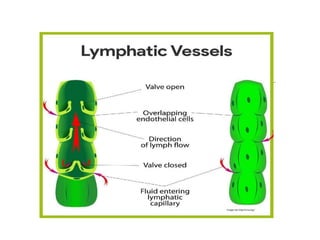
Like veins, lymph vessel have numerous cup shaped
valves to ensure the lymph flows in a one way system
towards the thorax.
There is no pump like the heart involved in the onward
movement of the lymph, but the muscle layer in the walls
of the large vessels has an intrinsic ability to contract
rythmatically (the lymphatic pump).
Lymph vessels are compressed by activity in adjacent
structures such as contraction of muscles and regular
pulsation of large arteries.
This milking action on the vessel wall help to push lymph
along.
Lymph vessel become larger as they join together
forming two large ducts ie-
1. thoracic duct
2. right lymphatic duct
Which empty lymph into the subclavian vein.
The Lymphatic System
A circulatory system for fluids
Returns fluid to the blood
Removes antigens from the body
Exposes antigens to the immune system
Main structures of the lymphatic system
Lymph
Lymphatic vessels
Lymph nodes
Diffuse Lymphoid tissue, Eg: tonsils
Lymphoid organs, Eg: spleen &Thymus
Bone marrow
Lymph
Lymph is a clear watery fluid, similar in composition to
plasma , with important exception of plasma proteins and
identical in composition to interstitial fluid.
Transports the plasma proteins that seep out of the
capillary beds back to the bloodstream.
It also carries away larger particles, Eg. Bacteria, Cell
debris etc.
Contains lymphocytes which circulates in the lymphatic
system allowing them to patrol the different regions of
the body.
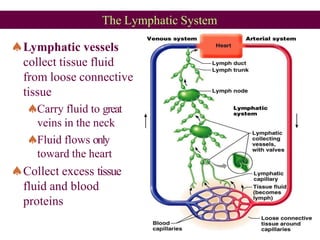
The Lymphatic System
Lymphatic vessels
collect tissue fluid
from loose connective
tissue
Carry fluid to great
veins in the neck
Fluid flows only
toward the heart
Collect excess tissue
fluid and blood
proteins
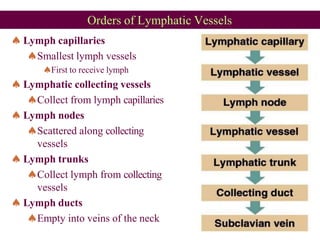
Orders of Lymphatic Vessels
Lymph capillaries
Smallest lymph vessels
First to receive lymph
Lymphatic collecting vessels
Collect from lymph capillaries
Lymph nodes
Scattered along collecting
vessels
Lymph trunks
Collect lymph from collecting
vessels
Lymph ducts
Empty into veins of the neck
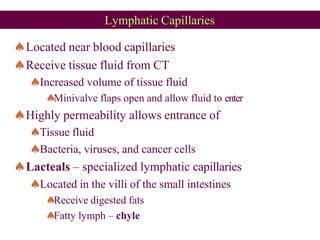
Lymphatic Capillaries
Located near blood capillaries
Receive tissue fluid from CT
Increased volume of tissue fluid
Minivalve flaps open and allow fluid to enter
Highly permeability allows entrance of
Tissue fluid
Bacteria, viruses, and cancer cells
Lacteals – specialized lymphatic capillaries
Located in the villi of the small intestines
Receive digested fats
Fatty lymph – chyle
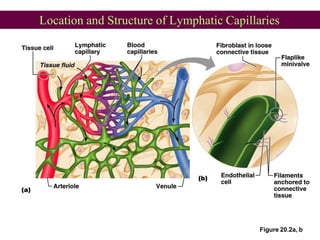
Location and Structure of Lymphatic Capillaries
Figure 20.2a, b
Lymphatic Collecting Vessels
Accompany blood vessels
Composed of the same three tunics as blood
vessels
Contain more valves than veins do
Helps direct the flow of blood
Lymph propelled by
Bulging of skeletal muscles
Pulsing of nearby arteries
Tunica media of the lymph vessels
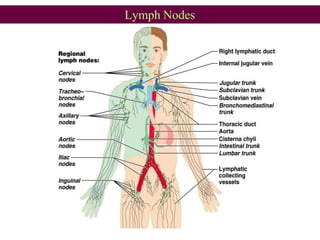
THORACIC DUCT
• The duct begins at the cisterna chyli, which is dilated lymph channel
situated in front of the bodies of the first two lumber vertebrae.
• The duct is about 40 cm long and open into left subclavian vein in
the root of the neck.
• It drains lymph from both legs the pelvic and abdominal cavities, left
half of the thorax head and neck and the left arm.
RIGHT THORACIC DUCT
• Dilated lymph vessel about 1cm long.
• It lies in the root of the neck and opens into the right
subclavian vein
• It drains lymph from the right half of the thorax, head
and neck and the right arm
Lymph Nodes
Lymph nodes are bean shaped organs along with
lymphatic collecting vessels
Up to 1 inch in size
Cleanse the lymph of pathogens
Human body contains around 500
Lymph nodes are organized in clusters
The lymph drains through a number of nodes 8 to 10,
before returning to the venous circulation.
These nodes are considerably in size: some are as small
as a pin head & the largest are about the size of an
almond
Lymph Nodes
Microscopic Anatomy of a Lymph Node
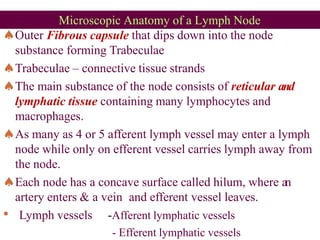
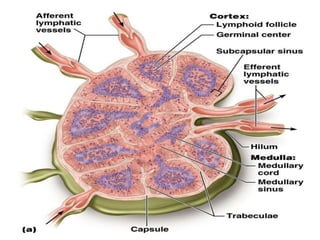
Outer Fibrous capsule that dips down into the node
substance forming Trabeculae
Trabeculae – connective tissue strands
The main substance of the node consists of reticular and
lymphatic tissue containing many lymphocytes and
macrophages.
As many as 4 or 5 afferent lymph vessel may enter a lymph
node while only on efferent vessel carries lymph away from
the node.
Each node has a concave surface called hilum, where an
artery enters & a vein and efferent vessel leaves.
• Lymph vessels -Afferent lymphatic vessels
- Efferent lymphatic vessels
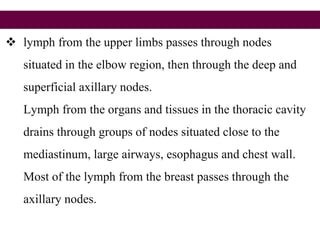
 lymph from the upper limbs passes through nodes
situated in the elbow region, then through the deep and
superficial axillary nodes.
Lymph from the organs and tissues in the thoracic cavity
drains through groups of nodes situated close to the
mediastinum, large airways, esophagus and chest wall.
Most of the lymph from the breast passes through the
axillary nodes.
 Lymph from the pelvic and abdominal cavity passes
through many lymph nodes before entering the
cisterna chyli.
 The pelvic and abdominal nodes are situated mainly
in association with the blood vessels supplying the
organs and close to the main arteries ie aorta and
external and internal iliac arteries.
 The lymph from the lower limbs drains through
deep and superficial nodes including groups of
nodes behind the knee and in the groin.
FUNCTIONS
1. Filtering and phagocytosis-
• lymph is filtered by the reticular and lymphoid tissues as
it passes through lymph nodes.
• Particulate matter includes bacteria, dead and live
phagocytes containing ingested microbes cells from the
malignant tumor, worn out and damaged tissue cells
inhaled particles.
• Organic material is destroyed by macrophages and
antibodies.
• In some cases where the phagocytosis is incomplete they
may stimulate inflammation and enlargement of
node(lymphadenopathy).
2.Proliferation of lymphocytes
• Activated T and B lymphocytes multiply in lymph nodes
• Antibodies produced by sensitized B lymphocytes enter
lymph enter lymph and blood draining the node.
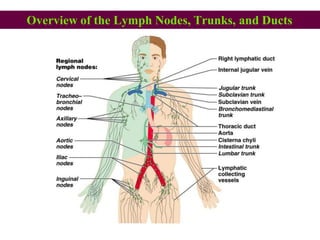
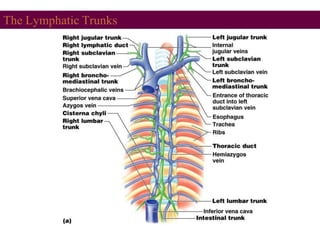
Lymph Trunks
 Lymphatic collecting vessels converge
 Five major lymph trunks
Lumbar trunks
Receives lymph from lower limbs
Intestinal trunk
Receives chyle from digestive organs
Bronchomediastinal trunks
Collects lymph from thoracic viscera
Subclavian trunks
Receive lymph from upper limbs and thoracic wall
Jugular trunks
Drain lymph from the head and neck
Overview of the Lymph Nodes, Trunks, and Ducts
The Lymphatic Trunks
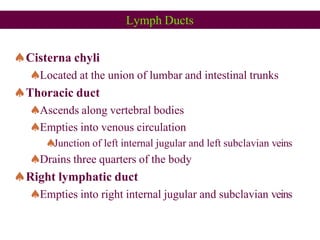
Lymph Ducts
Cisterna chyli
Located at the union of lumbar and intestinal trunks
Thoracic duct
Ascends along vertebral bodies
Empties into venous circulation
Junction of left internal jugular and left subclavian veins
Drains three quarters of the body
Right lymphatic duct
Empties into right internal jugular and subclavian veins
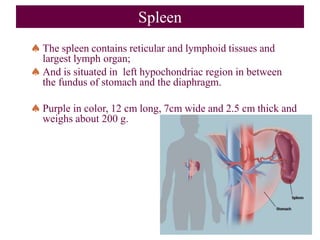
Spleen
The spleen contains reticular and lymphoid tissues and
largest lymph organ;
And is situated in left hypochondriac region in between
the fundus of stomach and the diaphragm.
Purple in color, 12 cm long, 7cm wide and 2.5 cm thick and
weighs about 200 g.
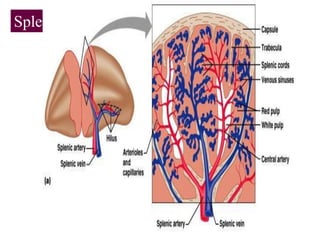
STRUCTURE
 Slightly oval in shape with the hilum on the lower medial
border
 The anterior border is covered with peritoneum
 It is enclosed in a fibro elastic capsule that dips into the
organ, forming Trabeculae.
 The cellular material consists of lymphocytes and
macrophages and known as splenic pulp lies between
Trabeculae.
 Red pulp is part suffused with blood
 White pulp is area with lymphatic tissue
The structures entering and leaving the spleen at the hilum-
 Splenic artery, a branch of coeliac artery
 Splenic vein, branch of portal vein
 Lymph vessels (efferent)
 Nerves
18
Spleen
FUNCTIONS
1. PHAGOCYTOSIS- old and abnormal erythrocytes are
mainly destroyed in spleen and the breakdown products,
bilirubin, iron are transported to the liver via splenic artery
and portal vein and other cellular material like bacteria,
debris is phagocytosed in spleen.
2. STORAGE OF BLOOD- The spleen contains up to 350
ml of blood and in response to sympathetic stimulation can
rapidly return most of this volume to the circulation e.g.-
in hemorrhage.
3. IMMUNE RESPONSE- The spleen contains T and B
lymphocytes which are activated by presence of antigens
e.g.- infection.
4. ERTHROPOESIS- The spleen and liver are important site
of fetal blood cell production and the spleen can also fulfill
the function in adult in times of great need.
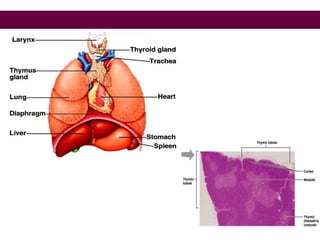
Lies in the upper part of the medistinum behind the sternum &
extends upwards into the root of the neck.
Weighs about 10-15 g at birth and grows until the individual
reaches puberty. 30-40g by middle age .
Prominent in newborns, almost disappears by old age
Function: T lymphocyte maturation (immunocompetence)
Has no follicles because no B cells
Structure:
Consists of two lobes joined by areolar tissue.
Lobes are enclosed by a fibrous capsule which dips into their
substances, dividing them into lobules that consist of an irregular
branching framework of epithelial cells and lymphocytes.
19
Thymus
FUNCTIONS
 Thymic processing produces mature T lymphocytes that
can differ self from foreign tissue also provide the ability
to react only one specific antigen from the millions it will
encounter
 T lymphocytes then leaves the thymus and enters into
blood.
 The maturation of thymus and other lymphoid tissues is
stimulated by thymosin a hormone secreted by epithelial
cells
 As with the increasing age the glands begins to shrink
and effectiveness of T lymphocyte response to antigens
declines.
MUCOSA ASSOCIATED LYMPHOID TISSUE (MALT)
• Contain B and T Lymphocytes which have migrated
from the bone marrow and the thymus and are important
in the early detection of invaders.
• MALT is found throughout the GI tract, in the
respiratory tract, in genitourinary tract, all the systems of
the body exposed to external environment.
• The main group of MALT are the tonsils and aggregated
lymphoid follicles (peyer’s patches)
TONSIL-
These are located in the mouth and throat and will therefore
destroy swallowed and inhaled antigens.
PEYER’S PATCHES
These large collections of lymphoid tissue are found in the
small intestine.
Lymphatic

Lymphatic

  • 1.
  • 2.
    The cells ofthe body bathed in interstitial fluid which leaks constantly out of the bloodstream through the permeable walls of blood capillaries . It is very similar to plasma. Some tissue fluids return to the capillaries at their venous end and the reminder diffuses through the more permeable walls of the lymph capillaries, forming lymph. Lymph passes through vessels of increasing size and a varying number of lymph nodes before returning to the blood.
  • 4.
    IMPORTANT TERMS • Lymph- a fluid that contains white blood cells that defend against germs • Lymph vessels - vessels that carry lymph throughout your body. They are different from blood vessels. • Lymph nodes - glands found throughout the lymph vessels. Along with your spleen, these nodes are where white blood cells fight infection.
  • 5.
    LYMPHATIC SYSTEM (cont.) • Consistsof: - Lymph - Network of vessels - Lymph nodes and nodules - Tonsils - Spleen - Thymus gland - Bone marrow
  • 7.
    FUNCTIONS OF LYMPHATICSYSTEM 1. TISSUE DRAINAGE;- every day around 21litres of fluid from plasma, carrying dissolved substances and some plasma protein, escape from the arterial end of the capillaries and into the tissues. 2. tissue fluids return directly to bloodstream via the capillaries at its venous end, but the excess about 3 to 4 liters of fluid is drained away by the lymph vessels. 3. Without this, the tissues would rapidly become waterlogged and the cardiovascular system would begins to fail as the blood volume falls.
  • 8.
    2.Absorption in smallintestine Fat and fat- soluble materials eg- the fat- soluble vitamins are absorbed into the lymphatic vessels of the villi. 3. Immunity The lymphatic organs are concerned with the production and maturation of lymphocytes the white blood cells are responsible for immunity. Bone marrow is therefore considered to be lymphatic tissue since lymphocytes are produced there.
  • 9.
    LYMPH (lymph =clear fluid) • Derived from tissue fluid • Similar in composition with plasma without protein and also interstitial fluid • It transport the plasma protein that seeps out of the capillary bed back to the blood stream • It also carries large particles like bacteria and cell debris, which then filtered and destroyed by lymph nodes. • In the vessel of the small intestine fat absorbed into the lymphatic give the lymph a milky appearance • Contains more white blood cells than plasma
  • 10.
    Lymph capillaries These originateas blind end tubes in the interstitial spaces . Same structure as blood capillaries ie single layer of endothelial cells, but their walls are more permeable to all the interstitial fluid constituents, including protein and cell debris . Tiny capillaries join up to form larger lymph vessels. All tissues have a network of lymphatic vessels, important exceptions being the CNS, cornea of eye, bones and most superficial layers of the skin
  • 11.
    Larger lymph vessels Lymphvessels are often found running alongside the arteries and veins serving the area. Their walls are about the same thickness as those of small veins and have same layers of tissues ie fibrous covering, a middle layer of smooth muscle and elastic tissue and inner lining of endothelial cells. Like veins, lymph vessel have numerous cup shaped valves to ensure the lymph flows in a one way system towards the thorax.
  • 12.
    There is nopump like the heart involved in the onward movement of the lymph, but the muscle layer in the walls of the large vessels has an intrinsic ability to contract rythmatically (the lymphatic pump). Lymph vessels are compressed by activity in adjacent structures such as contraction of muscles and regular pulsation of large arteries. This milking action on the vessel wall help to push lymph along. Lymph vessel become larger as they join together forming two large ducts ie- 1. thoracic duct 2. right lymphatic duct Which empty lymph into the subclavian vein.
  • 14.
    The Lymphatic System Acirculatory system for fluids Returns fluid to the blood Removes antigens from the body Exposes antigens to the immune system Main structures of the lymphatic system Lymph Lymphatic vessels Lymph nodes Diffuse Lymphoid tissue, Eg: tonsils Lymphoid organs, Eg: spleen &Thymus Bone marrow
  • 15.
    Lymph Lymph is aclear watery fluid, similar in composition to plasma , with important exception of plasma proteins and identical in composition to interstitial fluid. Transports the plasma proteins that seep out of the capillary beds back to the bloodstream. It also carries away larger particles, Eg. Bacteria, Cell debris etc. Contains lymphocytes which circulates in the lymphatic system allowing them to patrol the different regions of the body.
  • 16.
    The Lymphatic System Lymphaticvessels collect tissue fluid from loose connective tissue Carry fluid to great veins in the neck Fluid flows only toward the heart Collect excess tissue fluid and blood proteins
  • 17.
    Orders of LymphaticVessels Lymph capillaries Smallest lymph vessels First to receive lymph Lymphatic collecting vessels Collect from lymph capillaries Lymph nodes Scattered along collecting vessels Lymph trunks Collect lymph from collecting vessels Lymph ducts Empty into veins of the neck
  • 18.
    Lymphatic Capillaries Located nearblood capillaries Receive tissue fluid from CT Increased volume of tissue fluid Minivalve flaps open and allow fluid to enter Highly permeability allows entrance of Tissue fluid Bacteria, viruses, and cancer cells Lacteals – specialized lymphatic capillaries Located in the villi of the small intestines Receive digested fats Fatty lymph – chyle
  • 19.
    Location and Structureof Lymphatic Capillaries Figure 20.2a, b
  • 20.
    Lymphatic Collecting Vessels Accompanyblood vessels Composed of the same three tunics as blood vessels Contain more valves than veins do Helps direct the flow of blood Lymph propelled by Bulging of skeletal muscles Pulsing of nearby arteries Tunica media of the lymph vessels
  • 21.
    THORACIC DUCT • Theduct begins at the cisterna chyli, which is dilated lymph channel situated in front of the bodies of the first two lumber vertebrae. • The duct is about 40 cm long and open into left subclavian vein in the root of the neck. • It drains lymph from both legs the pelvic and abdominal cavities, left half of the thorax head and neck and the left arm.
  • 22.
    RIGHT THORACIC DUCT •Dilated lymph vessel about 1cm long. • It lies in the root of the neck and opens into the right subclavian vein • It drains lymph from the right half of the thorax, head and neck and the right arm
  • 23.
    Lymph Nodes Lymph nodesare bean shaped organs along with lymphatic collecting vessels Up to 1 inch in size Cleanse the lymph of pathogens Human body contains around 500 Lymph nodes are organized in clusters The lymph drains through a number of nodes 8 to 10, before returning to the venous circulation. These nodes are considerably in size: some are as small as a pin head & the largest are about the size of an almond
  • 24.
  • 25.
    Microscopic Anatomy ofa Lymph Node Outer Fibrous capsule that dips down into the node substance forming Trabeculae Trabeculae – connective tissue strands The main substance of the node consists of reticular and lymphatic tissue containing many lymphocytes and macrophages. As many as 4 or 5 afferent lymph vessel may enter a lymph node while only on efferent vessel carries lymph away from the node. Each node has a concave surface called hilum, where an artery enters & a vein and efferent vessel leaves. • Lymph vessels -Afferent lymphatic vessels - Efferent lymphatic vessels
  • 27.
     lymph fromthe upper limbs passes through nodes situated in the elbow region, then through the deep and superficial axillary nodes. Lymph from the organs and tissues in the thoracic cavity drains through groups of nodes situated close to the mediastinum, large airways, esophagus and chest wall. Most of the lymph from the breast passes through the axillary nodes.
  • 28.
     Lymph fromthe pelvic and abdominal cavity passes through many lymph nodes before entering the cisterna chyli.  The pelvic and abdominal nodes are situated mainly in association with the blood vessels supplying the organs and close to the main arteries ie aorta and external and internal iliac arteries.  The lymph from the lower limbs drains through deep and superficial nodes including groups of nodes behind the knee and in the groin.
  • 29.
    FUNCTIONS 1. Filtering andphagocytosis- • lymph is filtered by the reticular and lymphoid tissues as it passes through lymph nodes. • Particulate matter includes bacteria, dead and live phagocytes containing ingested microbes cells from the malignant tumor, worn out and damaged tissue cells inhaled particles. • Organic material is destroyed by macrophages and antibodies. • In some cases where the phagocytosis is incomplete they may stimulate inflammation and enlargement of node(lymphadenopathy).
  • 30.
    2.Proliferation of lymphocytes •Activated T and B lymphocytes multiply in lymph nodes • Antibodies produced by sensitized B lymphocytes enter lymph enter lymph and blood draining the node.
  • 31.
    Lymph Trunks  Lymphaticcollecting vessels converge  Five major lymph trunks Lumbar trunks Receives lymph from lower limbs Intestinal trunk Receives chyle from digestive organs Bronchomediastinal trunks Collects lymph from thoracic viscera Subclavian trunks Receive lymph from upper limbs and thoracic wall Jugular trunks Drain lymph from the head and neck
  • 32.
    Overview of theLymph Nodes, Trunks, and Ducts
  • 33.
  • 34.
    Lymph Ducts Cisterna chyli Locatedat the union of lumbar and intestinal trunks Thoracic duct Ascends along vertebral bodies Empties into venous circulation Junction of left internal jugular and left subclavian veins Drains three quarters of the body Right lymphatic duct Empties into right internal jugular and subclavian veins
  • 35.
    Spleen The spleen containsreticular and lymphoid tissues and largest lymph organ; And is situated in left hypochondriac region in between the fundus of stomach and the diaphragm. Purple in color, 12 cm long, 7cm wide and 2.5 cm thick and weighs about 200 g.
  • 36.
    STRUCTURE  Slightly ovalin shape with the hilum on the lower medial border  The anterior border is covered with peritoneum  It is enclosed in a fibro elastic capsule that dips into the organ, forming Trabeculae.  The cellular material consists of lymphocytes and macrophages and known as splenic pulp lies between Trabeculae.  Red pulp is part suffused with blood  White pulp is area with lymphatic tissue
  • 37.
    The structures enteringand leaving the spleen at the hilum-  Splenic artery, a branch of coeliac artery  Splenic vein, branch of portal vein  Lymph vessels (efferent)  Nerves
  • 38.
  • 39.
    FUNCTIONS 1. PHAGOCYTOSIS- oldand abnormal erythrocytes are mainly destroyed in spleen and the breakdown products, bilirubin, iron are transported to the liver via splenic artery and portal vein and other cellular material like bacteria, debris is phagocytosed in spleen. 2. STORAGE OF BLOOD- The spleen contains up to 350 ml of blood and in response to sympathetic stimulation can rapidly return most of this volume to the circulation e.g.- in hemorrhage.
  • 40.
    3. IMMUNE RESPONSE-The spleen contains T and B lymphocytes which are activated by presence of antigens e.g.- infection. 4. ERTHROPOESIS- The spleen and liver are important site of fetal blood cell production and the spleen can also fulfill the function in adult in times of great need.
  • 41.
    Lies in theupper part of the medistinum behind the sternum & extends upwards into the root of the neck. Weighs about 10-15 g at birth and grows until the individual reaches puberty. 30-40g by middle age . Prominent in newborns, almost disappears by old age Function: T lymphocyte maturation (immunocompetence) Has no follicles because no B cells Structure: Consists of two lobes joined by areolar tissue. Lobes are enclosed by a fibrous capsule which dips into their substances, dividing them into lobules that consist of an irregular branching framework of epithelial cells and lymphocytes. 19 Thymus
  • 43.
    FUNCTIONS  Thymic processingproduces mature T lymphocytes that can differ self from foreign tissue also provide the ability to react only one specific antigen from the millions it will encounter  T lymphocytes then leaves the thymus and enters into blood.  The maturation of thymus and other lymphoid tissues is stimulated by thymosin a hormone secreted by epithelial cells  As with the increasing age the glands begins to shrink and effectiveness of T lymphocyte response to antigens declines.
  • 44.
    MUCOSA ASSOCIATED LYMPHOIDTISSUE (MALT) • Contain B and T Lymphocytes which have migrated from the bone marrow and the thymus and are important in the early detection of invaders. • MALT is found throughout the GI tract, in the respiratory tract, in genitourinary tract, all the systems of the body exposed to external environment. • The main group of MALT are the tonsils and aggregated lymphoid follicles (peyer’s patches)
  • 45.
    TONSIL- These are locatedin the mouth and throat and will therefore destroy swallowed and inhaled antigens. PEYER’S PATCHES These large collections of lymphoid tissue are found in the small intestine.