THE
SKIN
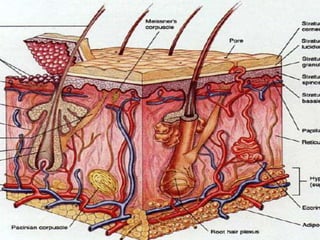
STRUCTURE OF SKIN
The skin is the largest organ in the body and
has a surface area of about 1.5 to 2m2 in adults
and it include glands, hair and nails .
O There are two main layers i.e. epidermis and dermis.
O Between the skin and underlying structures is the
subcutaneous layers composed of areolar tissue and
adipose tissue.
The skin completely covers the body and is continuous
with the membranes lining the body orifices. It
 Protect the underlying structures from injury and from
invasion from microbes.
 Contains sensory (somatic) nerve ending of pain
temperature and touch.
 Involved in regulation of body temperature.
EPIDERMIS
The epidermis is most superficial layer of the
skin composed of stratified keratinized squamous
epithelium, which varies in thickness in different
parts of body .
It is thickest on the palms of the hand and soles
of the feet.
There is no nerve ending in the epidermis.
But, in deeper layers bathed in interstitial fluid
from the dermis which provide oxygen an
nutrients and drain away as lymph.
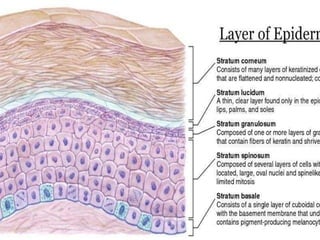
1. There are several layers of epidermis from deepest (germinative
layer) to superficial (stratum corneum) layers.
2. The cells on the surface are flat thin, non-nucleated, dead cells or
squmes in which the cytoplasm has been replaced by fibrous protein
keratin
3. These cells are constantly rubbed off and replaced by cells that
originated in the germinative layer and have undergone gradual
changes as they progressed towards the surface
The maintenance of healthy epidermis depends upon three
processes being synchronized
1. desquamation (shedding) of keratinized cells from the
surface.
2. Effective keratinization of the cells approaching the
surface.
3. Continual cell division in the deeper layers with newly
formed cells being pushed to the surface.
Hairs, secretions from the sebaceous glands and ducts of
sweat glands pass through the epidermis to reach the
surface.
O The surface of the epidermis is ridged by projections of
cells in the dermis called papillae.
O Pattern on fingertips is unique to every individual.
O The downward projection of the germinative layer between
the papillae are believed to aid nutrition of epidermal cells
and stabilize the two layers preventing damage due to
shearing forces.
Skin colour is affected by various factors
1. Melanin
O A dark pigment derived from amino acid tyrosine and
secreted by melanocytes in deep germinative layer is
absorbed by surrounding epithelial cells.
O the amount is genetically determined and varies between
different parts of the body between the people of the
same ethnic origin and ethnic group.
O The melanin protect the skin from harmful effects of
sunlight. Exposure to sunlight promotes synthesis of
melanin.
2. HAEMOGLOBIN
O Normal saturation of hemoglobin and the amount of
blood circulating in the dermis give white skin its pink
colour.
3. Excessive level of bile pigment in blood and carotenes in
the subcutaneous fat give the skin a yellowish colour.
DERMIS
O The dermis is tough and elastic.
O Formed from connective tissue and matrix contain
collagen fibers interlaced with elastic fibers.
O Rupture of elastic fibers occur when skin is overstretched
resulting in permanent straie or stretch marks that is
mainly found in obesity and pregnancy.
O Collagen fibers bind with water and give skin its tensile
strength, decline with age.
O Fibroblasts, macrophages and masts cells are the main
cells found in the dermis.
O Structures in the dermis are –
1. Blood vessels
2. Lymph vessels
3. Sensory nerve ending
4. Sweat glands
5. Hairs arrector pilli muscles and sebaceous glands
Blood and lymph vessels
O Arterioles form a fine network with capillary branches
supplying sweat glands, sebaceous glands, hair follicles
and the dermis .
O Lymph vessels form a network throughout the dermis
Sensory nerve ending
O Sensory receptors sensitive to touch, temperature
pressure and pain are widely distributed in the dermis.
O The pacinian corpuscles is sensitive to deep pressure.
O The skin is an important sensory organ through which
individual receive information about their environment.
Sweat glands
O They are widely distributed throughout the skin and are
most numerous in the palm of the hand and soles of the
feet, axilla and groins.
O They are formed from epithelial cells.
O There are two types of sweat glands.
O The first is commonest type open into the skin surface
through tiny pores and sweat produced here is clear,
watery fluid important in regulating body temperature.
O The second type open into hair follicles and is found e.g.-
in the axilla.
O Bacterial decomposition of these secretions causes an
unpleasant odour. Best example is cerminous gland of
outer ear which secretes ear wax.
O Most important function of sweat is in the regulation of
body temperature
O Excessive sweating may lead to dehydration and serious
depletion of sodium chloride unless intake of water and
salt is appropriately increased.
Hairs
O Formed by down growth of epidermal cells into the
dermis or subcutaneous tissue known as hair follicles.
O At the base of follicle is a cluster of cells called the papilla
or bulb.
O The hair is formed by multiplication of cells of the bulb
and as they push upward away from source of nutrition
the cells die and become keratinsed.
O The part of hair above the skin is shaft and the remainder
is root.
O Hair color is depend on melanin.
O White hair is the result of the replacement of melanin by
tiny air bubbles.
Arrector Pilli
O These are little bundles of smooth muscle fibers attached
to the hair follicle .
O Contraction makes the hair stand erect and raises skin
around hair causing goose flesh.
O The muscles are stimulated by sympathetic nerve fibers in
response to fear and cold.
O Erect hair trap air which act as insulating layer
O This is an efficient warming mechanism when
accomoblished by shivering i.e. involuntary contraction
of skeletal muscles.
Sebaceous gland
O These consist of secretory epithelial cells derived from the
same tissue as their follicle.
O They secrete an oily substance sebum into the hair
follicles and are present in the skin of all parts of the body
except the palms of the hand and soles of the feet.
O Most numerous in the skin of the scalp, face, axilla and
groins.
O Sebum keeps the hair soft and pliable and gives it a shiny
appearance
O It provide some waterproofing and act as a bactericidal
and fungicidal agent, preventing infection.
Nails
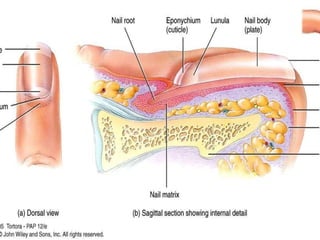
O They are derived from same cells as epidermis and hair
and consist of hard, keratin plates.
O They protect the tips of the fingers and toes.
O The root of the nail is embedded in the skin and covered
by the cuticle which forms the hemispherical pale area
called the lunula.
O The nail plate is the exposed part that has grown out from
the germinative zone of the epidermis called the nail bed.
Functions of skin
Protection –
Skin forms a waterproof layer, provided mainly by
its keratinized epithelium which protect the deeper
and more delicate structure and act as barrier
against-
Invasion by microorganism- The epidermis
contain specialized immune cells called
Langerhans cells type of macrophage
Chemicals
Physical agents e.g.- mild trauma, uv rays
Dehydration
Regulation of body temperature
O Body temp. remains fairly constant at about 36.8C .
O Health variation are limited to 0.5 to 0.75C
O Slightly rises in the evening , during exercise and in
women just after ovulation.
O To ensure the constant temperature a negative feedback
mechanism maintain the balance between heat produced
in the body and heat loss in the body
Heat production
O When metabolic rate increases temperature rises and
when decreases temperature decreases.
O Some of the energy released during metabolic activity is
in the form heat and the most active organ produce most
heat. The principal organs involved are-
1. Skeletal muscles-
O contraction of skeletal muscles produces a large amount
of heat and more strenuous exercise the greater the heat
produced.
O Shivering also involves skeletal muscle contraction
which increases heat production when there is risk of
falling temperature.
2. The liver-
O Very active metabolically and heat is produced as a
byproduct.
O Metabolic rate and heat production are increases after
eating.
3. The digestive organs-
Produce heat during peristalsis and during the chemical
reactions involved in digestion.
Heat loss
O Most heat loss from the body occurs through the skin
O Small amount are expired in air, urine and feaces
O Heat loss through the skin is affected by the difference
between body and environmental temperature, the
amount of body surface exposed and type of cloth worn.
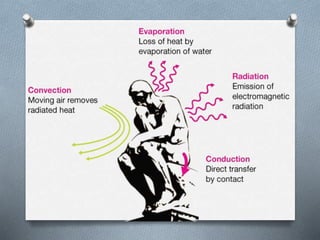
Mechanism of heat loss-
O Evaporation – Body heat turns sweat into vapor. The
body is cooled as the heat converts the water in sweats to
water vapours.
O Convection – Heat loss by air or water moving across
the skin surface. When exposed to cold air, cover
exposed skin and take shelter from the wind. The thicker
the insulating clothing layer, the better it prevents
convection.
O Conduction –clothes and other objects Direct contact
with an object take up the heat
O Radiation – exposed parts of body radiate heat away
from the body.
Control of body temperature
O The temp. regulating Centre is in hypothalamus is
sensitive to temp of circulating blood. This center
respond to decreasing temp by sending nerve impulses to
• Arterioles in the dermis which constrict decreasing blood
flow to the skin.
• Skeletal muscles stimulating shivering.
o When body temp rises heat loss is increased by dilatation
of arterioles increasing blood flow to skin stimulation of
sweat glands causing sweating until it falls to normal
Activity of sweat glands-
O When the body temp is increased b 0.25 to 0.5 C the
sweat glands secrete sweats onto the surface of skin.
O Evaporation of sweat cools the body.
O Loss of heat from the body by evaporation of water
through the skin and expired air still occurs when there is
low temp. this is known as insensible loss of water
Regulation of blood flow through the capillaries-
O Amount of heat loss from the skin depend on blood flow
through dermal capillaries.
O As the temp. rises the arterioles dilates and more blood
enter in the capillaries network in the skin.
O The skin is warm and pink in color.
O If the environmental temp. is low the or if heat production
is deceased the arterioles constricts, this reduce the blood
flow and conserve the heat. The skin feels paler and cool.
Fever
O This is often result of infection caused by release of
chemicals (pyrogens) from inflammatory cells and
invading bacteria.
O Pyrogens act on the hypothalamus which release
prostaglandins that reset the hypothalamic thermostat to a
higher temp.
O The body responds by heat promoting mechanism i.e.
shivering and vasoconstriction.
O When thermostat is reached to normal heat –loss
mechanism is activated , profuse sweating and
vasodilation accompanied by warm skin until the body
temp. falls to the normal level.
Hypothermia
O This means when temp falls below normal level i.e. below
32C, compensatory mechanism to restore body temp.
usually fails
O E.g. shivering is replaced by muscle rigidity and cramps.
O Vasoconstriction fails and blood pressure, pulse and
respiration rates falls.
O Mental confusion and disorientation occurs
O Death occurs usually when the temp. falls below 25C
Formation of vitamin D
O 7-dehydrocholestrol is a lipid –based substance in the
skin and ultraviolet rays in the sunlight convert it to
vitamin D.
O This circulates in the blood and is used with calcium and
phosphate in the formation and maintaince of bone
Absorption
Substance that can be absorbed includes-
 Some drugs in transdermal patches e.g.- hormones
replacement therapy during menopause
 Some toxic chemicals e.g.- mercury
Excretion
Minor excretory organ for some substances like-
 Sodium chloride in sweat
 Urea, when kidney function is impaired
 Aromatic substances- garlic and other spices.
WOUND
HEALING
Conditions required for wound healing
1. Systemic factors-
These includes good nutritional status and general health.
Infection, impaired immunity poor blood supply and
systemic conditions like DM and cancer reduce the rate of
wound healing.
2. Local factors-
Good blood supply to provide oxygen and nutrients and
remove waste products and freedom from contamination by
e.g. microbes, foreign bodies or toxic chemicals.
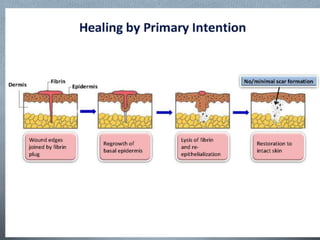
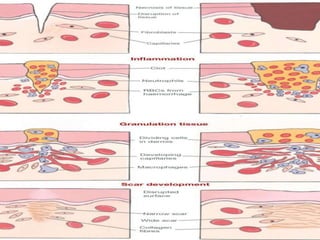
Primary wound healing
Stages of wound healing-
1. Inflammation-
O the cut surfaces become inflamed and blood clots and cell
debris fill the gap between them in few hours.
O Phagocytes includes macrophages and fibroblasts migrate
into the blood clot:-
O Phagocytes begins to remove the clot and cell debris
stimulating fibroblasts activity.
O Fibroblasts secret collagen fibers which begins to bind the
surfaces together.
2. Proliferation –
O Epithelial cells proliferate across the wound through the
clot.
O The epidermis meets and grows upwards until full
thickness is restored.
O The clot above the new tissue become the scab and
separate after 3 to 10 days.
O Granulation tissue consisting of new capillaries buds,
phagocytes and fibroblasts develops invading the clot and
restoring the blood supply to the wound.
O Fibroblasts continue to secret collagen fibers as the clot
and any bacteria are removed by phagocytes.
3. MATURATION-
O The granulation tissue is replaced by fibrous scar tissue.
O Rearrangement of collagen fibers occurs and the strength
of wound increases
O In the time scar becomes less vascular appearing after a
few months as a fine line
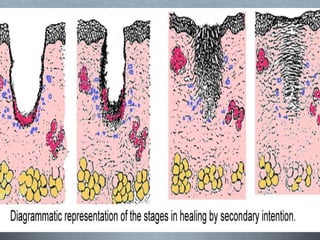
Secondary wound healing
This method of healing follows destruction of a
large amount of tissue or when edges of a wound
cannot be brought into apposition e.g.- pressure
ulcers
1. INFLAMMATION-
This develops on the surface of healthy tissue and
separation of necrotic tissue begins, mainly action of
phagocytes in the inflammatory exudate.
2. Proliferation –
O This begins as granulation tissue, consisting of capillary
buds, phagocytes and fibroblasts and develops at the base
of the cavity.
O It grows towards the surface, stimulated by macrophages
O Phagocytes in the plentiful blood supply tend to prevent
infection of wound by ingesting bacteria
O Some fibroblasts in the wound develops a limited ability
to contract reducing the size of wound and healing time
O When granulation tissue reached the level of dermis
epithelial cells at the edges proliferate and grow towards
the center
3. Maturation-
O This occurs by fibrosis in which scar tissue replaced by
granulation tissue usually over several months until the
full thickness of the skin is restored
O Scar tissue is shiny and does not contain sweat glands
hair follicle or sebaceous gland.
Fibrosis (scar formation)
O Fibrosis tissue is formed during healing by secondary
intention e.g.- chronic inflammation, persistent
ischemia, suppuration or large scale trauma.
O The process begins with granulation tissue then over
time the new capillaries and inflammatory material are
removed leaving the collagen fibers secreted by
fibroblasts.
O Fibrosis tissue may have long lasting damaging effect
Adhesion-
These consist of fibrosis tissue which causes adjacent
structures to stick together and may limit movement e.g.-
between the layers of pleura, preventing inflammation of
lungs or between loops of bowel interfering with
peristalsis,
Fibrosis of infarcts-
O Blockage of a vessel by a thrombus or an embolus cause
an infarction.
O Fibrosis of one large infract or of numerous small infacts
may follow leading to varying degree of organ
dysfunction, e.g.- in heart, brain, kidney and liver
Tissue shrinkage-
This occurs as fibrosis tissue ages. The effect depend
upon the site and extend of the fibrosis e.g.-
O Small tubes such as blood vessels, air passage, ureters,
the urethra, and ducts of glands may become narrow
and lose their elasticity,
O Contractures may extend to joints e.g.- in a limb or digit
there may be limitation of movements or following
burns of the neck the head may pulled to one side.
Complications of wound healing
O Infections- arise from microbial contamination by
bacteria and result in pus (suppuration).
O Pus consist of dead phagocytes, dead cells, cell debris,
fibrin and inflammatory exudate and living and dead
microbes.
O Most common pyogenic pathogens are staphylococcus
aureus and streptococcus aureus.
O Small amount of pus forms boil and large form abscesses.
O Superficial abscess tend to rupture and discharge pus
through the skin. Healing is complete if tissue damage is
not extensive.
O Deep abscesses may have a Varity of outcomes-
1. Early rupture with complete discharge of pus onto
surface , followed by healing
2. Rupture and limited discharge followed by
development of chronic abscess with an infected open
channel or sinus.
3. Rupture and discharge into adjacent organ or cavity
with infected open channel on both sided or fistula.
4. Removal of pus by phagocytes followed by healing
5. Formation of adhesion between adjacent structures or
membranes e.g.- pleura or peritoneum
6. Shrinkage or fibrous tissue which cause narrowing of
tubes or lumen e.g.- esophagus.

Skin

  • 1.
  • 2.
    STRUCTURE OF SKIN Theskin is the largest organ in the body and has a surface area of about 1.5 to 2m2 in adults and it include glands, hair and nails . O There are two main layers i.e. epidermis and dermis. O Between the skin and underlying structures is the subcutaneous layers composed of areolar tissue and adipose tissue.
  • 3.
    The skin completelycovers the body and is continuous with the membranes lining the body orifices. It  Protect the underlying structures from injury and from invasion from microbes.  Contains sensory (somatic) nerve ending of pain temperature and touch.  Involved in regulation of body temperature.
  • 4.
    EPIDERMIS The epidermis ismost superficial layer of the skin composed of stratified keratinized squamous epithelium, which varies in thickness in different parts of body . It is thickest on the palms of the hand and soles of the feet. There is no nerve ending in the epidermis. But, in deeper layers bathed in interstitial fluid from the dermis which provide oxygen an nutrients and drain away as lymph.
  • 5.
    1. There areseveral layers of epidermis from deepest (germinative layer) to superficial (stratum corneum) layers. 2. The cells on the surface are flat thin, non-nucleated, dead cells or squmes in which the cytoplasm has been replaced by fibrous protein keratin 3. These cells are constantly rubbed off and replaced by cells that originated in the germinative layer and have undergone gradual changes as they progressed towards the surface
  • 7.
    The maintenance ofhealthy epidermis depends upon three processes being synchronized 1. desquamation (shedding) of keratinized cells from the surface. 2. Effective keratinization of the cells approaching the surface. 3. Continual cell division in the deeper layers with newly formed cells being pushed to the surface. Hairs, secretions from the sebaceous glands and ducts of sweat glands pass through the epidermis to reach the surface.
  • 8.
    O The surfaceof the epidermis is ridged by projections of cells in the dermis called papillae. O Pattern on fingertips is unique to every individual. O The downward projection of the germinative layer between the papillae are believed to aid nutrition of epidermal cells and stabilize the two layers preventing damage due to shearing forces.
  • 10.
    Skin colour isaffected by various factors 1. Melanin O A dark pigment derived from amino acid tyrosine and secreted by melanocytes in deep germinative layer is absorbed by surrounding epithelial cells. O the amount is genetically determined and varies between different parts of the body between the people of the same ethnic origin and ethnic group. O The melanin protect the skin from harmful effects of sunlight. Exposure to sunlight promotes synthesis of melanin.
  • 11.
    2. HAEMOGLOBIN O Normalsaturation of hemoglobin and the amount of blood circulating in the dermis give white skin its pink colour. 3. Excessive level of bile pigment in blood and carotenes in the subcutaneous fat give the skin a yellowish colour.
  • 12.
    DERMIS O The dermisis tough and elastic. O Formed from connective tissue and matrix contain collagen fibers interlaced with elastic fibers. O Rupture of elastic fibers occur when skin is overstretched resulting in permanent straie or stretch marks that is mainly found in obesity and pregnancy. O Collagen fibers bind with water and give skin its tensile strength, decline with age.
  • 13.
    O Fibroblasts, macrophagesand masts cells are the main cells found in the dermis. O Structures in the dermis are – 1. Blood vessels 2. Lymph vessels 3. Sensory nerve ending 4. Sweat glands 5. Hairs arrector pilli muscles and sebaceous glands
  • 14.
    Blood and lymphvessels O Arterioles form a fine network with capillary branches supplying sweat glands, sebaceous glands, hair follicles and the dermis . O Lymph vessels form a network throughout the dermis
  • 15.
    Sensory nerve ending OSensory receptors sensitive to touch, temperature pressure and pain are widely distributed in the dermis. O The pacinian corpuscles is sensitive to deep pressure. O The skin is an important sensory organ through which individual receive information about their environment.
  • 16.
    Sweat glands O Theyare widely distributed throughout the skin and are most numerous in the palm of the hand and soles of the feet, axilla and groins. O They are formed from epithelial cells. O There are two types of sweat glands. O The first is commonest type open into the skin surface through tiny pores and sweat produced here is clear, watery fluid important in regulating body temperature.
  • 17.
    O The secondtype open into hair follicles and is found e.g.- in the axilla. O Bacterial decomposition of these secretions causes an unpleasant odour. Best example is cerminous gland of outer ear which secretes ear wax. O Most important function of sweat is in the regulation of body temperature O Excessive sweating may lead to dehydration and serious depletion of sodium chloride unless intake of water and salt is appropriately increased.
  • 18.
    Hairs O Formed bydown growth of epidermal cells into the dermis or subcutaneous tissue known as hair follicles. O At the base of follicle is a cluster of cells called the papilla or bulb. O The hair is formed by multiplication of cells of the bulb and as they push upward away from source of nutrition the cells die and become keratinsed.
  • 19.
    O The partof hair above the skin is shaft and the remainder is root. O Hair color is depend on melanin. O White hair is the result of the replacement of melanin by tiny air bubbles.
  • 20.
    Arrector Pilli O Theseare little bundles of smooth muscle fibers attached to the hair follicle . O Contraction makes the hair stand erect and raises skin around hair causing goose flesh. O The muscles are stimulated by sympathetic nerve fibers in response to fear and cold. O Erect hair trap air which act as insulating layer O This is an efficient warming mechanism when accomoblished by shivering i.e. involuntary contraction of skeletal muscles.
  • 21.
    Sebaceous gland O Theseconsist of secretory epithelial cells derived from the same tissue as their follicle. O They secrete an oily substance sebum into the hair follicles and are present in the skin of all parts of the body except the palms of the hand and soles of the feet. O Most numerous in the skin of the scalp, face, axilla and groins. O Sebum keeps the hair soft and pliable and gives it a shiny appearance O It provide some waterproofing and act as a bactericidal and fungicidal agent, preventing infection.
  • 22.
    Nails O They arederived from same cells as epidermis and hair and consist of hard, keratin plates. O They protect the tips of the fingers and toes. O The root of the nail is embedded in the skin and covered by the cuticle which forms the hemispherical pale area called the lunula. O The nail plate is the exposed part that has grown out from the germinative zone of the epidermis called the nail bed.
  • 24.
    Functions of skin Protection– Skin forms a waterproof layer, provided mainly by its keratinized epithelium which protect the deeper and more delicate structure and act as barrier against- Invasion by microorganism- The epidermis contain specialized immune cells called Langerhans cells type of macrophage Chemicals Physical agents e.g.- mild trauma, uv rays Dehydration
  • 25.
    Regulation of bodytemperature O Body temp. remains fairly constant at about 36.8C . O Health variation are limited to 0.5 to 0.75C O Slightly rises in the evening , during exercise and in women just after ovulation. O To ensure the constant temperature a negative feedback mechanism maintain the balance between heat produced in the body and heat loss in the body
  • 26.
    Heat production O Whenmetabolic rate increases temperature rises and when decreases temperature decreases. O Some of the energy released during metabolic activity is in the form heat and the most active organ produce most heat. The principal organs involved are- 1. Skeletal muscles- O contraction of skeletal muscles produces a large amount of heat and more strenuous exercise the greater the heat produced. O Shivering also involves skeletal muscle contraction which increases heat production when there is risk of falling temperature.
  • 27.
    2. The liver- OVery active metabolically and heat is produced as a byproduct. O Metabolic rate and heat production are increases after eating. 3. The digestive organs- Produce heat during peristalsis and during the chemical reactions involved in digestion.
  • 28.
    Heat loss O Mostheat loss from the body occurs through the skin O Small amount are expired in air, urine and feaces O Heat loss through the skin is affected by the difference between body and environmental temperature, the amount of body surface exposed and type of cloth worn.
  • 29.
    Mechanism of heatloss- O Evaporation – Body heat turns sweat into vapor. The body is cooled as the heat converts the water in sweats to water vapours. O Convection – Heat loss by air or water moving across the skin surface. When exposed to cold air, cover exposed skin and take shelter from the wind. The thicker the insulating clothing layer, the better it prevents convection. O Conduction –clothes and other objects Direct contact with an object take up the heat O Radiation – exposed parts of body radiate heat away from the body.
  • 31.
    Control of bodytemperature O The temp. regulating Centre is in hypothalamus is sensitive to temp of circulating blood. This center respond to decreasing temp by sending nerve impulses to • Arterioles in the dermis which constrict decreasing blood flow to the skin. • Skeletal muscles stimulating shivering. o When body temp rises heat loss is increased by dilatation of arterioles increasing blood flow to skin stimulation of sweat glands causing sweating until it falls to normal
  • 32.
    Activity of sweatglands- O When the body temp is increased b 0.25 to 0.5 C the sweat glands secrete sweats onto the surface of skin. O Evaporation of sweat cools the body. O Loss of heat from the body by evaporation of water through the skin and expired air still occurs when there is low temp. this is known as insensible loss of water
  • 33.
    Regulation of bloodflow through the capillaries- O Amount of heat loss from the skin depend on blood flow through dermal capillaries. O As the temp. rises the arterioles dilates and more blood enter in the capillaries network in the skin. O The skin is warm and pink in color. O If the environmental temp. is low the or if heat production is deceased the arterioles constricts, this reduce the blood flow and conserve the heat. The skin feels paler and cool.
  • 34.
    Fever O This isoften result of infection caused by release of chemicals (pyrogens) from inflammatory cells and invading bacteria. O Pyrogens act on the hypothalamus which release prostaglandins that reset the hypothalamic thermostat to a higher temp. O The body responds by heat promoting mechanism i.e. shivering and vasoconstriction. O When thermostat is reached to normal heat –loss mechanism is activated , profuse sweating and vasodilation accompanied by warm skin until the body temp. falls to the normal level.
  • 35.
    Hypothermia O This meanswhen temp falls below normal level i.e. below 32C, compensatory mechanism to restore body temp. usually fails O E.g. shivering is replaced by muscle rigidity and cramps. O Vasoconstriction fails and blood pressure, pulse and respiration rates falls. O Mental confusion and disorientation occurs O Death occurs usually when the temp. falls below 25C
  • 36.
    Formation of vitaminD O 7-dehydrocholestrol is a lipid –based substance in the skin and ultraviolet rays in the sunlight convert it to vitamin D. O This circulates in the blood and is used with calcium and phosphate in the formation and maintaince of bone
  • 37.
    Absorption Substance that canbe absorbed includes-  Some drugs in transdermal patches e.g.- hormones replacement therapy during menopause  Some toxic chemicals e.g.- mercury
  • 38.
    Excretion Minor excretory organfor some substances like-  Sodium chloride in sweat  Urea, when kidney function is impaired  Aromatic substances- garlic and other spices.
  • 39.
  • 40.
    Conditions required forwound healing 1. Systemic factors- These includes good nutritional status and general health. Infection, impaired immunity poor blood supply and systemic conditions like DM and cancer reduce the rate of wound healing. 2. Local factors- Good blood supply to provide oxygen and nutrients and remove waste products and freedom from contamination by e.g. microbes, foreign bodies or toxic chemicals.
  • 41.
    Primary wound healing Stagesof wound healing- 1. Inflammation- O the cut surfaces become inflamed and blood clots and cell debris fill the gap between them in few hours. O Phagocytes includes macrophages and fibroblasts migrate into the blood clot:- O Phagocytes begins to remove the clot and cell debris stimulating fibroblasts activity. O Fibroblasts secret collagen fibers which begins to bind the surfaces together.
  • 42.
    2. Proliferation – OEpithelial cells proliferate across the wound through the clot. O The epidermis meets and grows upwards until full thickness is restored. O The clot above the new tissue become the scab and separate after 3 to 10 days. O Granulation tissue consisting of new capillaries buds, phagocytes and fibroblasts develops invading the clot and restoring the blood supply to the wound. O Fibroblasts continue to secret collagen fibers as the clot and any bacteria are removed by phagocytes.
  • 43.
    3. MATURATION- O Thegranulation tissue is replaced by fibrous scar tissue. O Rearrangement of collagen fibers occurs and the strength of wound increases O In the time scar becomes less vascular appearing after a few months as a fine line
  • 45.
    Secondary wound healing Thismethod of healing follows destruction of a large amount of tissue or when edges of a wound cannot be brought into apposition e.g.- pressure ulcers
  • 46.
    1. INFLAMMATION- This developson the surface of healthy tissue and separation of necrotic tissue begins, mainly action of phagocytes in the inflammatory exudate. 2. Proliferation – O This begins as granulation tissue, consisting of capillary buds, phagocytes and fibroblasts and develops at the base of the cavity. O It grows towards the surface, stimulated by macrophages
  • 47.
    O Phagocytes inthe plentiful blood supply tend to prevent infection of wound by ingesting bacteria O Some fibroblasts in the wound develops a limited ability to contract reducing the size of wound and healing time O When granulation tissue reached the level of dermis epithelial cells at the edges proliferate and grow towards the center
  • 48.
    3. Maturation- O Thisoccurs by fibrosis in which scar tissue replaced by granulation tissue usually over several months until the full thickness of the skin is restored O Scar tissue is shiny and does not contain sweat glands hair follicle or sebaceous gland.
  • 51.
    Fibrosis (scar formation) OFibrosis tissue is formed during healing by secondary intention e.g.- chronic inflammation, persistent ischemia, suppuration or large scale trauma. O The process begins with granulation tissue then over time the new capillaries and inflammatory material are removed leaving the collagen fibers secreted by fibroblasts. O Fibrosis tissue may have long lasting damaging effect
  • 52.
    Adhesion- These consist offibrosis tissue which causes adjacent structures to stick together and may limit movement e.g.- between the layers of pleura, preventing inflammation of lungs or between loops of bowel interfering with peristalsis,
  • 53.
    Fibrosis of infarcts- OBlockage of a vessel by a thrombus or an embolus cause an infarction. O Fibrosis of one large infract or of numerous small infacts may follow leading to varying degree of organ dysfunction, e.g.- in heart, brain, kidney and liver
  • 54.
    Tissue shrinkage- This occursas fibrosis tissue ages. The effect depend upon the site and extend of the fibrosis e.g.- O Small tubes such as blood vessels, air passage, ureters, the urethra, and ducts of glands may become narrow and lose their elasticity, O Contractures may extend to joints e.g.- in a limb or digit there may be limitation of movements or following burns of the neck the head may pulled to one side.
  • 55.
    Complications of woundhealing O Infections- arise from microbial contamination by bacteria and result in pus (suppuration). O Pus consist of dead phagocytes, dead cells, cell debris, fibrin and inflammatory exudate and living and dead microbes. O Most common pyogenic pathogens are staphylococcus aureus and streptococcus aureus. O Small amount of pus forms boil and large form abscesses.
  • 56.
    O Superficial abscesstend to rupture and discharge pus through the skin. Healing is complete if tissue damage is not extensive. O Deep abscesses may have a Varity of outcomes- 1. Early rupture with complete discharge of pus onto surface , followed by healing 2. Rupture and limited discharge followed by development of chronic abscess with an infected open channel or sinus.
  • 57.
    3. Rupture anddischarge into adjacent organ or cavity with infected open channel on both sided or fistula. 4. Removal of pus by phagocytes followed by healing 5. Formation of adhesion between adjacent structures or membranes e.g.- pleura or peritoneum 6. Shrinkage or fibrous tissue which cause narrowing of tubes or lumen e.g.- esophagus.