BY: Mr. Indra Mani Mishra
Training coordinator/Nursing Midwifery Sr. Tutor
State Nodal Centre, College of Nursing, RIMS,
Ranchi
 The lymphatic system is part of
 the circulatory system and an important
 part of the immune system, comprising a
 network of lymphatic vessels that carry a
 clear fluid called lymph (from Latin, lympha
meaning "water”)directionally towards the
heart.
 The interstitial fluid picked up by lymphatic
capillaries is known as lymph. Lymph very closely
resembles the plasma found in the veins: it is a
mixture of about 90% water and 10% solutes such
as proteins, cellular waste products, dissolved
gases, and hormones. Lymph may also contain
bacterial cells that are picked up from diseased
tissues and the white blood cells that fight these
pathogens. In late-stage cancer patients, lymph
often contains cancerous cells that have
metastasized from tumors and may form new
tumors within the lymphatic system.
COMPOSITION OF LYMPH
 The composition of lymph is similar to
 that of plasma but the constituents have
 some additional substances that are too
 large to pass through blood capillary walls
Ex. macroparticles from damaged area
Damaged cells by disease and bacteria.
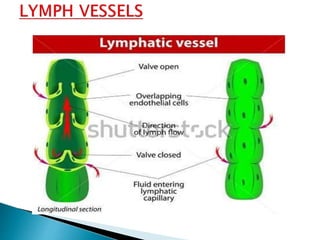
 These originate as blind end tubes in the interstitial
spaces.
 Structurally, they are same as blood capillaries.
 Their walls are more permeable to all interstitial fluid
including proteins and cell debris.
 The capillaries joint to form larger lymph vessels.
 Lymph vessels have numerous cup shaped valves that
prevent back flow of movements of lymph in vessels.
 Lymph vessels join together to form two larger ducts:
(i) The Thoracic duct
(ii) The right Lymphatic duct
 What is duct?
 A duct is a circumscribed channel leading from
an organ.
 Length-40cm
 Ascends through the diaphragm and passes upwards
in the thoracic cavity.
 It drains Lymph from :
a. Both legs
b. The pelvic abdominal cavities
c. Left half of the Thorax
d. Head & Neck
e. The Left upper Limbs (Limbs mean hand (upper
limbs) and legs (lower limbs).
 It lies in the root of the neck and open into
right subclavian vein
 IT DRAINS LYMPH FROM:
a. RIGHT HALF OF THE THORAX (means chest;
thoracic cavity)
b. NECK
c. RIGHT UPPER LIMB
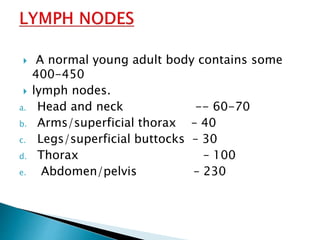
 A normal young adult body contains some
400-450
 lymph nodes.
a. Head and neck -- 60-70
b. Arms/superficial thorax – 40
c. Legs/superficial buttocks – 30
d. Thorax – 100
e. Abdomen/pelvis – 230
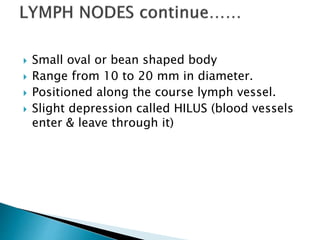
 Small oval or bean shaped body
 Range from 10 to 20 mm in diameter.
 Positioned along the course lymph vessel.
 Slight depression called HILUS (blood vessels
enter & leave through it)
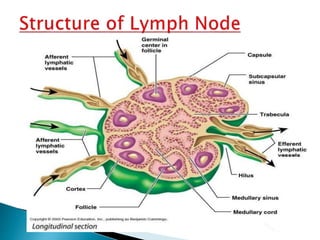
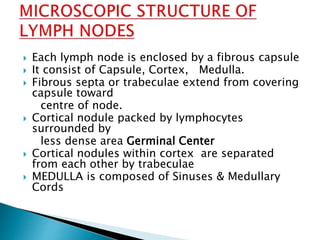
 Each lymph node is enclosed by a fibrous capsule
 It consist of Capsule, Cortex, Medulla.
 Fibrous septa or trabeculae extend from covering
capsule toward
centre of node.
 Cortical nodule packed by lymphocytes
surrounded by
less dense area Germinal Center
 Cortical nodules within cortex are separated
from each other by trabeculae
 MEDULLA is composed of Sinuses & Medullary
Cords
 ZONE 1- is a region of loosely packed cells,
predominantly small lymphocytes,
macrophages and occasional plasma cells.
ZONE 2 - is a denser region internal to zone
1,composed mainly of small lymphocytes and
macrophages
 ZONE 3- comprises the germinal
centers of follicles, its cells include large
lymphoblast, dendritic cells and macrophages.
 DEFENSE:
 As lymph passes through lymph Node reticulo endothelial
cells
 remove microorganisms & other injurious particles
 HEMATOPOIESIS:
 Site for final stage of maturation of lymphocytes &
monocytes (Monocytes are a type of leukocyte, or white
blood cell. They are the largest type of leukocyte and
can differentiate into macrophagesand myeloid lineage de
ndritic cells.) that have migrated from bone marrow
 Phagocytic action.
 Production of antibodies.
 Enlargement of lymph nodes, when the area of drainage is
infected.
 Activate T and B lymphocytes.
 Filtration of lymph.
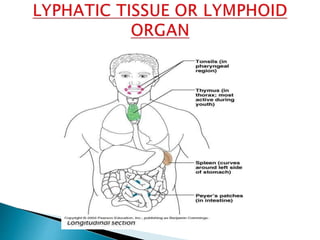
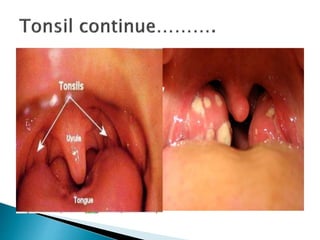
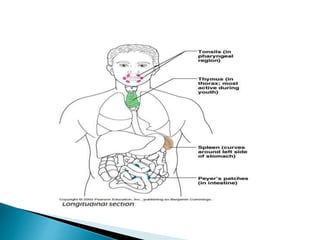
 Small masses of lymphoid tissue around the
pharynx
 Trap and remove bacteria and other foreign
materials
 Tonsillitis is caused by congestion with
bacteria
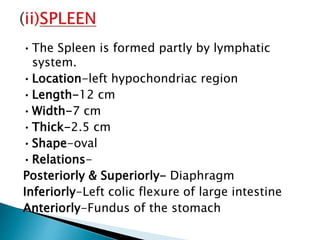
•The Spleen is formed partly by lymphatic
system.
•Location-left hypochondriac region
•Length-12 cm
•Width-7 cm
•Thick-2.5 cm
•Shape-oval
•Relations-
Posteriorly & Superiorly- Diaphragm
Inferiorly-Left colic flexure of large intestine
Anteriorly-Fundus of the stomach
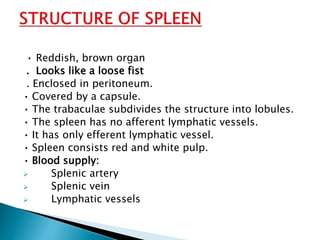
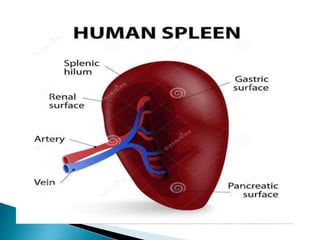
• Reddish, brown organ
. Looks like a loose fist
. Enclosed in peritoneum.
• Covered by a capsule.
• The trabaculae subdivides the structure into lobules.
• The spleen has no afferent lymphatic vessels.
• It has only efferent lymphatic vessel.
• Spleen consists red and white pulp.
• Blood supply:
 Splenic artery
 Splenic vein
 Lymphatic vessels
•Phagocytosis of Bacteria
•Break down of RBC.
•Production of Antibodies.
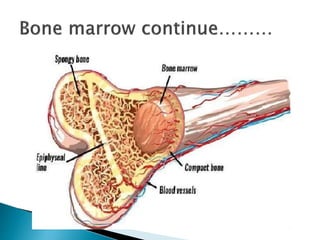
 The Red Bone Marrow is a key element of the
lymphatic system,
 Being one of the primary lymphoid organs that
 generate lymphocytes from immature
hematopoietic progenitor cells.
 The bone marrow and Thymus constitute the
primary lymphoid tissues involved in the
production and early selection of lymphocytes.
 Furthermore, bone marrow performs a valve-like
function to prevent the backflow of lymphatic
fluid in the lymphatic system.
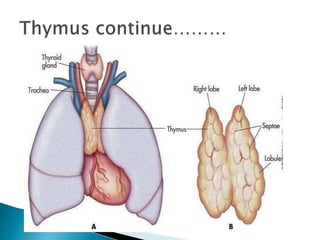
 Weight-15 gms
 Relations-
 Anteriorly-Sternum.
 Posteriorly –Aortic arch.
 Superiorly- Root of neck.
 Inferiorly-Heart.
 Laterally-Lungs.
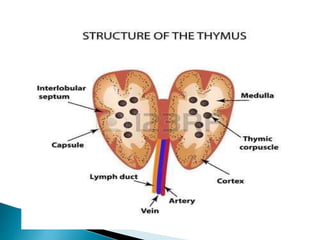
 Lobes- two
 Each lobule has aggregation of lymphocytes.
 The cortex is composed of aggregation of
lymphocytes.
 Medulla contains less lymphocytes.
 The Thymus gland develops mature T lymphocytes.
• Inferior thyroid artery.
• Internal thoracic artery.
• Nerves derived from vagus nerve.
Functions :
• Activation of T-lymphocytes
• Production of antibodies.
• Production of Thymosin hormone.
[Thymosins are small proteins present in many
animal tissues. they are named thymosins because
they were originally isolated from the thymus]
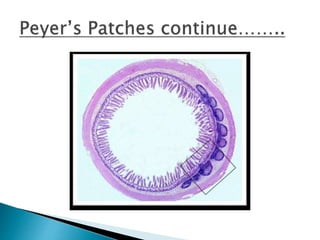
 Found in the wall of the small intestine
 Capture and destroy bacteria in the intestine
 A group of lymphocytes arranged in a round
cluster is called a lymphatic nodule.
 Many organs contain lymphatic nodules. They
contribute to defense against microorganisms
entering the body.
 The lymphatic nodules cannot filter lymph.
 Location: in the walls of alimentary canal (tonsils, appendix
and cecum, Peyer's patches), respiratory passages, and
genitourinary tract, as well as in the other parts of the body.
 Function:: guard the body from and respond to entry of
infectious organisms and toxins.
Primary nodule
 Composition: oval concentrations of lymphocytes contained in
meshwork of reticular cells.
Secondary nodule
 Composition::
 Germinal center - a central region that contains large
lymphocytes, mitotic figures, macrophages, and plasma cells.
 Function: morphologic indication of lymphatic tissue response
to antigen that represents a cascade of events that includes
proliferation (rapid increase in the number or amount)
of lymphocytes, differentiation of plasma cell, and antibody
production.
 outer ring of small lymphocytes.
 It is the diffuse system of small concentration
of lymphoid tissue found in mucosa of various
organs of our body e.g. lung, gastrointestinal
tract.
 It regulates mucosal immunity.
 T-cells, B-cells, Plasma cells and macrophages
populate it.
 It contains a light staining region in the center
(germinal center) and dark staining region at
the periphery.
 Stimulation of its B-lymphocytes lead to
production of Ig A and Ig M (antibodies)
which prevent the adherence of bacteria and
viruses to the epithelium, thus blocking the
entry of these micro-organisms to the
subepithelial layers of the intestine.
 MALTs are called as :
1. GALT: Gut associated lymphoid tissue.
2. BALT: Bronchus associated lymphoid tissue
3. NALT: Nose associated lymphoid tissue.
4. LALT: Larynx associated lymphoid tissue.
5. CALT: Conjunctiva associated lymphoid
tissue
 Lymphatic disease is a class of disorders which directly
affect the components of the lymphatic system.
 Diseases and disorders:
 Hodgkin's Disease/Hodgkin's Lymphoma
 This is a type of cancer of the lymphatic system. It can
start almost anywhere in the body. It is believed to be
caused by HIV, Epstein-Barr Syndrome, age and family
history. Symptoms include weight loss, fever, swollen
lymph nodes, night sweats, itchy skin, fatigue, chest
pain, coughing or trouble swallowing.
 Non-Hodgkin's Lymphoma
 Lymphoma is a usually malignant cancer. It is caused
by the body producing too many abnormal white blood
cells. It is not the same as Hodgkin's Disease.
Symptoms usually include painless, enlarged lymph
node or nodes in the neck, weakness, fever, weight
loss, and anemia.
 Lymphadenitis is an infection of the lymph nodes usually
caused by a virus, bacteria or fungi. Symptoms include
redness or swelling around the lymph node.
 Lymphangitis
 Lymphangitis is an inflammation of the lymph vessels.
Symptoms usually include swelling, redness, warmth, pain
or red streaking around the affected area.
 Lymphedema
 Lymphedema is the chronic pooling of lymph fluid in the
tissue. It usually starts in the feet or lower legs. It's also a
side-effect of some surgical procedures.
 Lymphocytosis
 Lymphocytosis is a high lymphocyte count. It can be
caused by an infection, blood cancer, lymphoma, or
autoimmune disorders that are accompanied by chronic
swelling.
Thank you

Anatomy and physiology of

  • 1.
    BY: Mr. IndraMani Mishra Training coordinator/Nursing Midwifery Sr. Tutor State Nodal Centre, College of Nursing, RIMS, Ranchi
  • 2.
     The lymphaticsystem is part of  the circulatory system and an important  part of the immune system, comprising a  network of lymphatic vessels that carry a  clear fluid called lymph (from Latin, lympha meaning "water”)directionally towards the heart.
  • 3.
     The interstitialfluid picked up by lymphatic capillaries is known as lymph. Lymph very closely resembles the plasma found in the veins: it is a mixture of about 90% water and 10% solutes such as proteins, cellular waste products, dissolved gases, and hormones. Lymph may also contain bacterial cells that are picked up from diseased tissues and the white blood cells that fight these pathogens. In late-stage cancer patients, lymph often contains cancerous cells that have metastasized from tumors and may form new tumors within the lymphatic system.
  • 4.
    COMPOSITION OF LYMPH The composition of lymph is similar to  that of plasma but the constituents have  some additional substances that are too  large to pass through blood capillary walls Ex. macroparticles from damaged area Damaged cells by disease and bacteria.
  • 5.
     These originateas blind end tubes in the interstitial spaces.  Structurally, they are same as blood capillaries.  Their walls are more permeable to all interstitial fluid including proteins and cell debris.  The capillaries joint to form larger lymph vessels.  Lymph vessels have numerous cup shaped valves that prevent back flow of movements of lymph in vessels.  Lymph vessels join together to form two larger ducts: (i) The Thoracic duct (ii) The right Lymphatic duct
  • 7.
     What isduct?  A duct is a circumscribed channel leading from an organ.  Length-40cm  Ascends through the diaphragm and passes upwards in the thoracic cavity.  It drains Lymph from : a. Both legs b. The pelvic abdominal cavities c. Left half of the Thorax d. Head & Neck e. The Left upper Limbs (Limbs mean hand (upper limbs) and legs (lower limbs).
  • 8.
     It liesin the root of the neck and open into right subclavian vein  IT DRAINS LYMPH FROM: a. RIGHT HALF OF THE THORAX (means chest; thoracic cavity) b. NECK c. RIGHT UPPER LIMB
  • 9.
     A normalyoung adult body contains some 400-450  lymph nodes. a. Head and neck -- 60-70 b. Arms/superficial thorax – 40 c. Legs/superficial buttocks – 30 d. Thorax – 100 e. Abdomen/pelvis – 230
  • 10.
     Small ovalor bean shaped body  Range from 10 to 20 mm in diameter.  Positioned along the course lymph vessel.  Slight depression called HILUS (blood vessels enter & leave through it)
  • 12.
     Each lymphnode is enclosed by a fibrous capsule  It consist of Capsule, Cortex, Medulla.  Fibrous septa or trabeculae extend from covering capsule toward centre of node.  Cortical nodule packed by lymphocytes surrounded by less dense area Germinal Center  Cortical nodules within cortex are separated from each other by trabeculae  MEDULLA is composed of Sinuses & Medullary Cords
  • 13.
     ZONE 1-is a region of loosely packed cells, predominantly small lymphocytes, macrophages and occasional plasma cells. ZONE 2 - is a denser region internal to zone 1,composed mainly of small lymphocytes and macrophages  ZONE 3- comprises the germinal centers of follicles, its cells include large lymphoblast, dendritic cells and macrophages.
  • 14.
     DEFENSE:  Aslymph passes through lymph Node reticulo endothelial cells  remove microorganisms & other injurious particles  HEMATOPOIESIS:  Site for final stage of maturation of lymphocytes & monocytes (Monocytes are a type of leukocyte, or white blood cell. They are the largest type of leukocyte and can differentiate into macrophagesand myeloid lineage de ndritic cells.) that have migrated from bone marrow  Phagocytic action.  Production of antibodies.  Enlargement of lymph nodes, when the area of drainage is infected.  Activate T and B lymphocytes.  Filtration of lymph.
  • 16.
     Small massesof lymphoid tissue around the pharynx  Trap and remove bacteria and other foreign materials  Tonsillitis is caused by congestion with bacteria
  • 18.
    •The Spleen isformed partly by lymphatic system. •Location-left hypochondriac region •Length-12 cm •Width-7 cm •Thick-2.5 cm •Shape-oval •Relations- Posteriorly & Superiorly- Diaphragm Inferiorly-Left colic flexure of large intestine Anteriorly-Fundus of the stomach
  • 19.
    • Reddish, brownorgan . Looks like a loose fist . Enclosed in peritoneum. • Covered by a capsule. • The trabaculae subdivides the structure into lobules. • The spleen has no afferent lymphatic vessels. • It has only efferent lymphatic vessel. • Spleen consists red and white pulp. • Blood supply:  Splenic artery  Splenic vein  Lymphatic vessels
  • 21.
    •Phagocytosis of Bacteria •Breakdown of RBC. •Production of Antibodies.
  • 22.
     The RedBone Marrow is a key element of the lymphatic system,  Being one of the primary lymphoid organs that  generate lymphocytes from immature hematopoietic progenitor cells.  The bone marrow and Thymus constitute the primary lymphoid tissues involved in the production and early selection of lymphocytes.  Furthermore, bone marrow performs a valve-like function to prevent the backflow of lymphatic fluid in the lymphatic system.
  • 24.
     Weight-15 gms Relations-  Anteriorly-Sternum.  Posteriorly –Aortic arch.  Superiorly- Root of neck.  Inferiorly-Heart.  Laterally-Lungs.  Lobes- two  Each lobule has aggregation of lymphocytes.  The cortex is composed of aggregation of lymphocytes.  Medulla contains less lymphocytes.  The Thymus gland develops mature T lymphocytes.
  • 27.
    • Inferior thyroidartery. • Internal thoracic artery. • Nerves derived from vagus nerve. Functions : • Activation of T-lymphocytes • Production of antibodies. • Production of Thymosin hormone. [Thymosins are small proteins present in many animal tissues. they are named thymosins because they were originally isolated from the thymus]
  • 28.
     Found inthe wall of the small intestine  Capture and destroy bacteria in the intestine
  • 31.
     A groupof lymphocytes arranged in a round cluster is called a lymphatic nodule.  Many organs contain lymphatic nodules. They contribute to defense against microorganisms entering the body.  The lymphatic nodules cannot filter lymph.
  • 32.
     Location: inthe walls of alimentary canal (tonsils, appendix and cecum, Peyer's patches), respiratory passages, and genitourinary tract, as well as in the other parts of the body.  Function:: guard the body from and respond to entry of infectious organisms and toxins. Primary nodule  Composition: oval concentrations of lymphocytes contained in meshwork of reticular cells. Secondary nodule  Composition::  Germinal center - a central region that contains large lymphocytes, mitotic figures, macrophages, and plasma cells.  Function: morphologic indication of lymphatic tissue response to antigen that represents a cascade of events that includes proliferation (rapid increase in the number or amount) of lymphocytes, differentiation of plasma cell, and antibody production.  outer ring of small lymphocytes.
  • 33.
     It isthe diffuse system of small concentration of lymphoid tissue found in mucosa of various organs of our body e.g. lung, gastrointestinal tract.  It regulates mucosal immunity.  T-cells, B-cells, Plasma cells and macrophages populate it.  It contains a light staining region in the center (germinal center) and dark staining region at the periphery.
  • 34.
     Stimulation ofits B-lymphocytes lead to production of Ig A and Ig M (antibodies) which prevent the adherence of bacteria and viruses to the epithelium, thus blocking the entry of these micro-organisms to the subepithelial layers of the intestine.  MALTs are called as : 1. GALT: Gut associated lymphoid tissue. 2. BALT: Bronchus associated lymphoid tissue 3. NALT: Nose associated lymphoid tissue. 4. LALT: Larynx associated lymphoid tissue. 5. CALT: Conjunctiva associated lymphoid tissue
  • 35.
     Lymphatic diseaseis a class of disorders which directly affect the components of the lymphatic system.  Diseases and disorders:  Hodgkin's Disease/Hodgkin's Lymphoma  This is a type of cancer of the lymphatic system. It can start almost anywhere in the body. It is believed to be caused by HIV, Epstein-Barr Syndrome, age and family history. Symptoms include weight loss, fever, swollen lymph nodes, night sweats, itchy skin, fatigue, chest pain, coughing or trouble swallowing.  Non-Hodgkin's Lymphoma  Lymphoma is a usually malignant cancer. It is caused by the body producing too many abnormal white blood cells. It is not the same as Hodgkin's Disease. Symptoms usually include painless, enlarged lymph node or nodes in the neck, weakness, fever, weight loss, and anemia.
  • 36.
     Lymphadenitis isan infection of the lymph nodes usually caused by a virus, bacteria or fungi. Symptoms include redness or swelling around the lymph node.  Lymphangitis  Lymphangitis is an inflammation of the lymph vessels. Symptoms usually include swelling, redness, warmth, pain or red streaking around the affected area.  Lymphedema  Lymphedema is the chronic pooling of lymph fluid in the tissue. It usually starts in the feet or lower legs. It's also a side-effect of some surgical procedures.  Lymphocytosis  Lymphocytosis is a high lymphocyte count. It can be caused by an infection, blood cancer, lymphoma, or autoimmune disorders that are accompanied by chronic swelling.
  • 37.