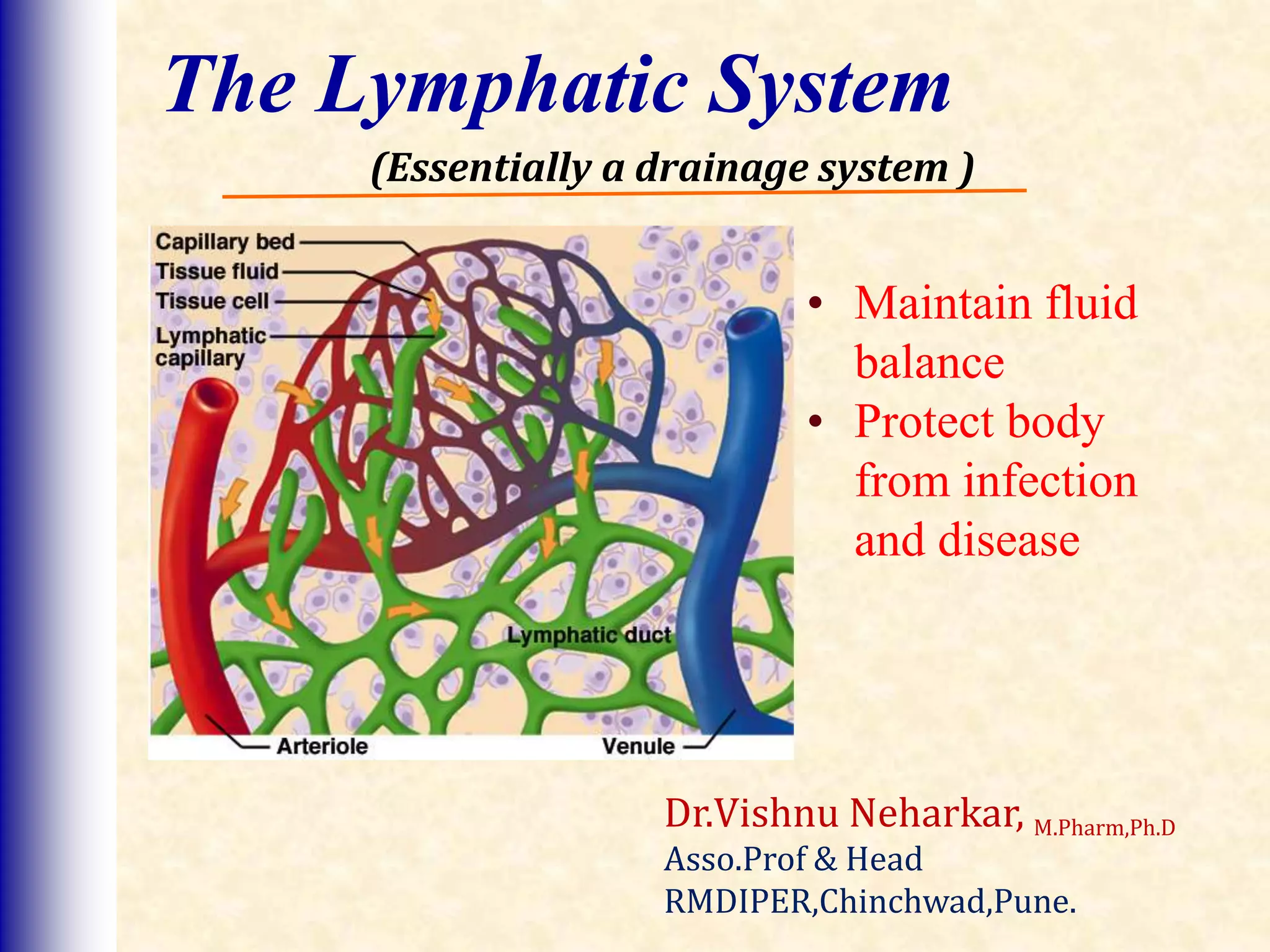
The Lymphatic System
(Essentially a drainage system )
• Maintain fluid
balance
• Protect body
from infection
and disease
Dr.Vishnu Neharkar, M.Pharm,Ph.D
Asso.Prof & Head
RMDIPER,Chinchwad,Pune.
INTRODUCTION
Human being are constantly exposed to variety
of disease producing microorganism such as bacteria
virus and fungi in spite of these exposure most of the
people remain healthy while some develop disease.
In this body defense mechanism also term as
immunity plays important role lymphatic system is a
system responsible for specific protective mechanism.
The lymphatic system consists of lymph and lymphatic
vessel & Organ. It is closely connected with
cardiovascular system and also plays a role in
absorption of fatty food through the digestive system.
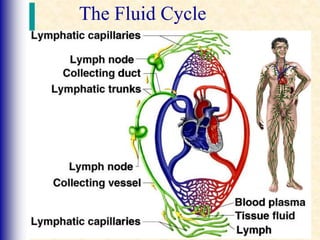
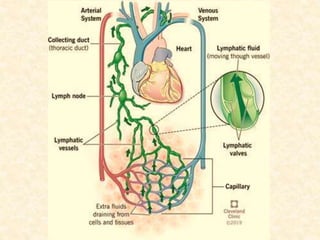
The Fluid Cycle
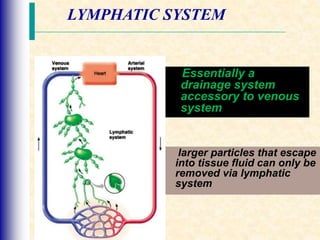
Essentially a
drainage system
accessory to venous
system
larger particles that escape
into tissue fluid can only be
removed via lymphatic
system
LYMPHATIC SYSTEM
LYMPHATIC SYSTEM
This system involves a set of vessels that transports
tissue fluid back into the blood stream and a set of organs
that are involved in the immune system. The lymph vessels
are as branched and abundant as arteries and veins. They
collect lymph- tissue fluid arising from fluid that has leaked
from the capillaries. Proteins also leak from capillaries and
are returned to the blood system by the lymph vessels. The
lymphatic system also collect lipids from the digestive tract
and is involved in exposing pathogens to the immune
system.
Functions of the Lymphatic System
• Reabsorbs excess interstitial fluid:
• returns it to the venous circulation
• maintain blood volume levels
• prevent interstitial fluid levels from rising out of control.
• Transport dietary lipids:
• Lymphatic vessels transport lipids
• lipid-soluble vitamins (A, D, E, and K)
• drain into larger lymphatic vessels
• lymphocyte development, and the immune response.
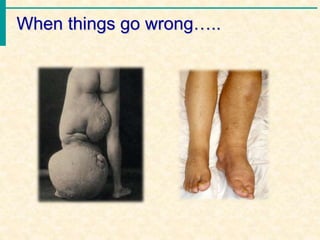
When things go wrong…..
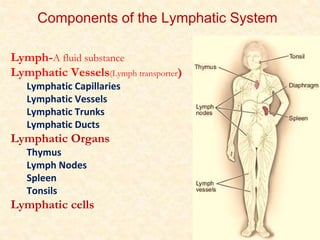
Components of the Lymphatic System
Lymph-A fluid substance
Lymphatic Vessels(Lymph transporter)
Lymphatic Capillaries
Lymphatic Vessels
Lymphatic Trunks
Lymphatic Ducts
Lymphatic Organs
Thymus
Lymph Nodes
Spleen
Tonsils
Lymphatic cells
 Meaning:-After blood travels through capillary
beds and is moved to the venous system, some of its
fluid is left behind in the tissues it called lymph.
 Lymph is a clear, colorless liquid with a
composition similar to blood plasma.
 It is nothing but the clear, watery blood plasma
leaked out through the capillary walls to flow
around the cells.
 It contains oxygen, proteins, glucose and white
blood cells.
Lymph:-
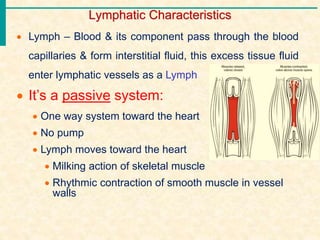
Lymphatic Characteristics
 Lymph – Blood & its component pass through the blood
capillaries & form interstitial fluid, this excess tissue fluid
enter lymphatic vessels as a Lymph
 It’s a passive system:
 One way system toward the heart
 No pump
 Lymph moves toward the heart
 Milking action of skeletal muscle
 Rhythmic contraction of smooth muscle in vessel
walls
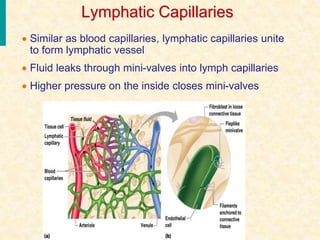
Lymphatic Capillaries
 Similar as blood capillaries, lymphatic capillaries unite
to form lymphatic vessel
 Fluid leaks through mini-valves into lymph capillaries
 Higher pressure on the inside closes mini-valves
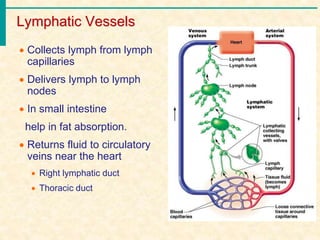
Lymphatic Vessels
 Collects lymph from lymph
capillaries
 Delivers lymph to lymph
nodes
 In small intestine
help in fat absorption.
 Returns fluid to circulatory
veins near the heart
 Right lymphatic duct
 Thoracic duct
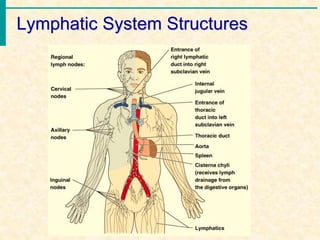
Lymphatic System Structures
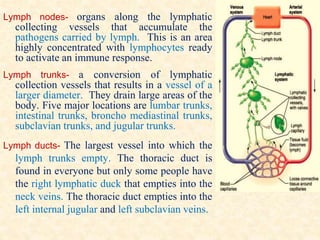
Lymph nodes- organs along the lymphatic
collecting vessels that accumulate the
pathogens carried by lymph. This is an area
highly concentrated with lymphocytes ready
to activate an immune response.
Lymph trunks- a conversion of lymphatic
collection vessels that results in a vessel of a
larger diameter. They drain large areas of the
body. Five major locations are lumbar trunks,
intestinal trunks, broncho mediastinal trunks,
subclavian trunks, and jugular trunks.
Lymph ducts- The largest vessel into which the
lymph trunks empty. The thoracic duct is
found in everyone but only some people have
the right lymphatic duck that empties into the
neck veins. The thoracic duct empties into the
left internal jugular and left subclavian veins.
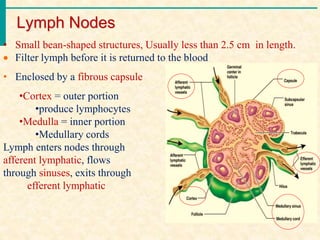
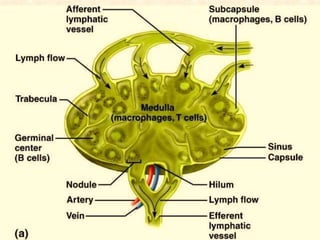
Lymph Nodes
• Small bean-shaped structures, Usually less than 2.5 cm in length.
 Filter lymph before it is returned to the blood
• Enclosed by a fibrous capsule
•Cortex = outer portion
•produce lymphocytes
•Medulla = inner portion
•Medullary cords
Lymph enters nodes through
afferent lymphatic, flows
through sinuses, exits through
efferent lymphatic
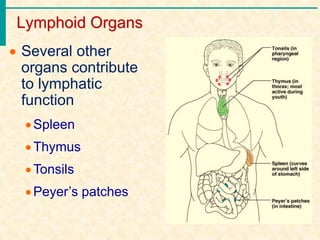
Lymphoid Organs
 Several other
organs contribute
to lymphatic
function
Spleen
Thymus
Tonsils
Peyer’s patches
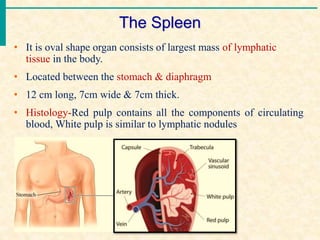
The Spleen
• It is oval shape organ consists of largest mass of lymphatic
tissue in the body.
• Located between the stomach & diaphragm
• 12 cm long, 7cm wide & 7cm thick.
• Histology-Red pulp contains all the components of circulating
blood, White pulp is similar to lymphatic nodules
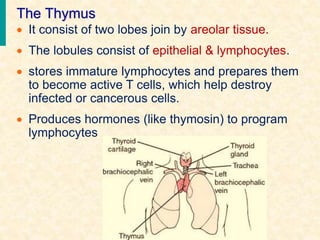
The Thymus
 It consist of two lobes join by areolar tissue.
 The lobules consist of epithelial & lymphocytes.
 stores immature lymphocytes and prepares them
to become active T cells, which help destroy
infected or cancerous cells.
 Produces hormones (like thymosin) to program
lymphocytes
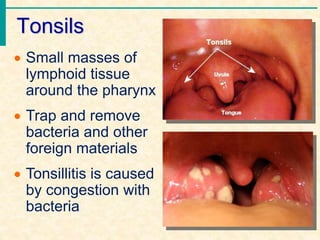
Tonsils
 Small masses of
lymphoid tissue
around the pharynx
 Trap and remove
bacteria and other
foreign materials
 Tonsillitis is caused
by congestion with
bacteria
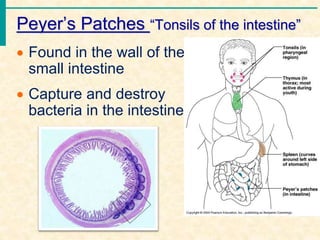
Peyer’s Patches “Tonsils of the intestine”
 Found in the wall of the
small intestine
 Capture and destroy
bacteria in the intestine

Lymphatic system

  • 1.
    The Lymphatic System (Essentiallya drainage system ) • Maintain fluid balance • Protect body from infection and disease Dr.Vishnu Neharkar, M.Pharm,Ph.D Asso.Prof & Head RMDIPER,Chinchwad,Pune.
  • 2.
    INTRODUCTION Human being areconstantly exposed to variety of disease producing microorganism such as bacteria virus and fungi in spite of these exposure most of the people remain healthy while some develop disease. In this body defense mechanism also term as immunity plays important role lymphatic system is a system responsible for specific protective mechanism. The lymphatic system consists of lymph and lymphatic vessel & Organ. It is closely connected with cardiovascular system and also plays a role in absorption of fatty food through the digestive system.
  • 3.
  • 4.
    Essentially a drainage system accessoryto venous system larger particles that escape into tissue fluid can only be removed via lymphatic system LYMPHATIC SYSTEM
  • 5.
    LYMPHATIC SYSTEM This systeminvolves a set of vessels that transports tissue fluid back into the blood stream and a set of organs that are involved in the immune system. The lymph vessels are as branched and abundant as arteries and veins. They collect lymph- tissue fluid arising from fluid that has leaked from the capillaries. Proteins also leak from capillaries and are returned to the blood system by the lymph vessels. The lymphatic system also collect lipids from the digestive tract and is involved in exposing pathogens to the immune system.
  • 6.
    Functions of theLymphatic System • Reabsorbs excess interstitial fluid: • returns it to the venous circulation • maintain blood volume levels • prevent interstitial fluid levels from rising out of control. • Transport dietary lipids: • Lymphatic vessels transport lipids • lipid-soluble vitamins (A, D, E, and K) • drain into larger lymphatic vessels • lymphocyte development, and the immune response.
  • 7.
    When things gowrong…..
  • 8.
    Components of theLymphatic System Lymph-A fluid substance Lymphatic Vessels(Lymph transporter) Lymphatic Capillaries Lymphatic Vessels Lymphatic Trunks Lymphatic Ducts Lymphatic Organs Thymus Lymph Nodes Spleen Tonsils Lymphatic cells
  • 9.
     Meaning:-After bloodtravels through capillary beds and is moved to the venous system, some of its fluid is left behind in the tissues it called lymph.  Lymph is a clear, colorless liquid with a composition similar to blood plasma.  It is nothing but the clear, watery blood plasma leaked out through the capillary walls to flow around the cells.  It contains oxygen, proteins, glucose and white blood cells. Lymph:-
  • 10.
    Lymphatic Characteristics  Lymph– Blood & its component pass through the blood capillaries & form interstitial fluid, this excess tissue fluid enter lymphatic vessels as a Lymph  It’s a passive system:  One way system toward the heart  No pump  Lymph moves toward the heart  Milking action of skeletal muscle  Rhythmic contraction of smooth muscle in vessel walls
  • 11.
    Lymphatic Capillaries  Similaras blood capillaries, lymphatic capillaries unite to form lymphatic vessel  Fluid leaks through mini-valves into lymph capillaries  Higher pressure on the inside closes mini-valves
  • 12.
    Lymphatic Vessels  Collectslymph from lymph capillaries  Delivers lymph to lymph nodes  In small intestine help in fat absorption.  Returns fluid to circulatory veins near the heart  Right lymphatic duct  Thoracic duct
  • 13.
  • 15.
    Lymph nodes- organsalong the lymphatic collecting vessels that accumulate the pathogens carried by lymph. This is an area highly concentrated with lymphocytes ready to activate an immune response. Lymph trunks- a conversion of lymphatic collection vessels that results in a vessel of a larger diameter. They drain large areas of the body. Five major locations are lumbar trunks, intestinal trunks, broncho mediastinal trunks, subclavian trunks, and jugular trunks. Lymph ducts- The largest vessel into which the lymph trunks empty. The thoracic duct is found in everyone but only some people have the right lymphatic duck that empties into the neck veins. The thoracic duct empties into the left internal jugular and left subclavian veins.
  • 16.
    Lymph Nodes • Smallbean-shaped structures, Usually less than 2.5 cm in length.  Filter lymph before it is returned to the blood • Enclosed by a fibrous capsule •Cortex = outer portion •produce lymphocytes •Medulla = inner portion •Medullary cords Lymph enters nodes through afferent lymphatic, flows through sinuses, exits through efferent lymphatic
  • 18.
    Lymphoid Organs  Severalother organs contribute to lymphatic function Spleen Thymus Tonsils Peyer’s patches
  • 19.
    The Spleen • Itis oval shape organ consists of largest mass of lymphatic tissue in the body. • Located between the stomach & diaphragm • 12 cm long, 7cm wide & 7cm thick. • Histology-Red pulp contains all the components of circulating blood, White pulp is similar to lymphatic nodules
  • 20.
    The Thymus  Itconsist of two lobes join by areolar tissue.  The lobules consist of epithelial & lymphocytes.  stores immature lymphocytes and prepares them to become active T cells, which help destroy infected or cancerous cells.  Produces hormones (like thymosin) to program lymphocytes
  • 21.
    Tonsils  Small massesof lymphoid tissue around the pharynx  Trap and remove bacteria and other foreign materials  Tonsillitis is caused by congestion with bacteria
  • 22.
    Peyer’s Patches “Tonsilsof the intestine”  Found in the wall of the small intestine  Capture and destroy bacteria in the intestine