Lymphatic system
Prof. Amol B Deore
M. Pharm (Pharmacology)
MVP’s Institute of Pharmaceutical
Sciences, Nashik (INDIA)
The lymphatic system is associated with the blood and
the cardiovascular system. Both systems transport vital
fluids throughout the body and both have a system of
vessels that transport these fluids.
The lymphatic system transports a fluid called lymph
through special vessels called lymphatic capillaries and
lymphatic trunks.This lymph eventually gets returned to
the blood circulation.
In addition to fluid control, our lymphatic system is
essential to helping us to destroy a large number of
microorganisms that can invade our bodies and cause
disease and even death.
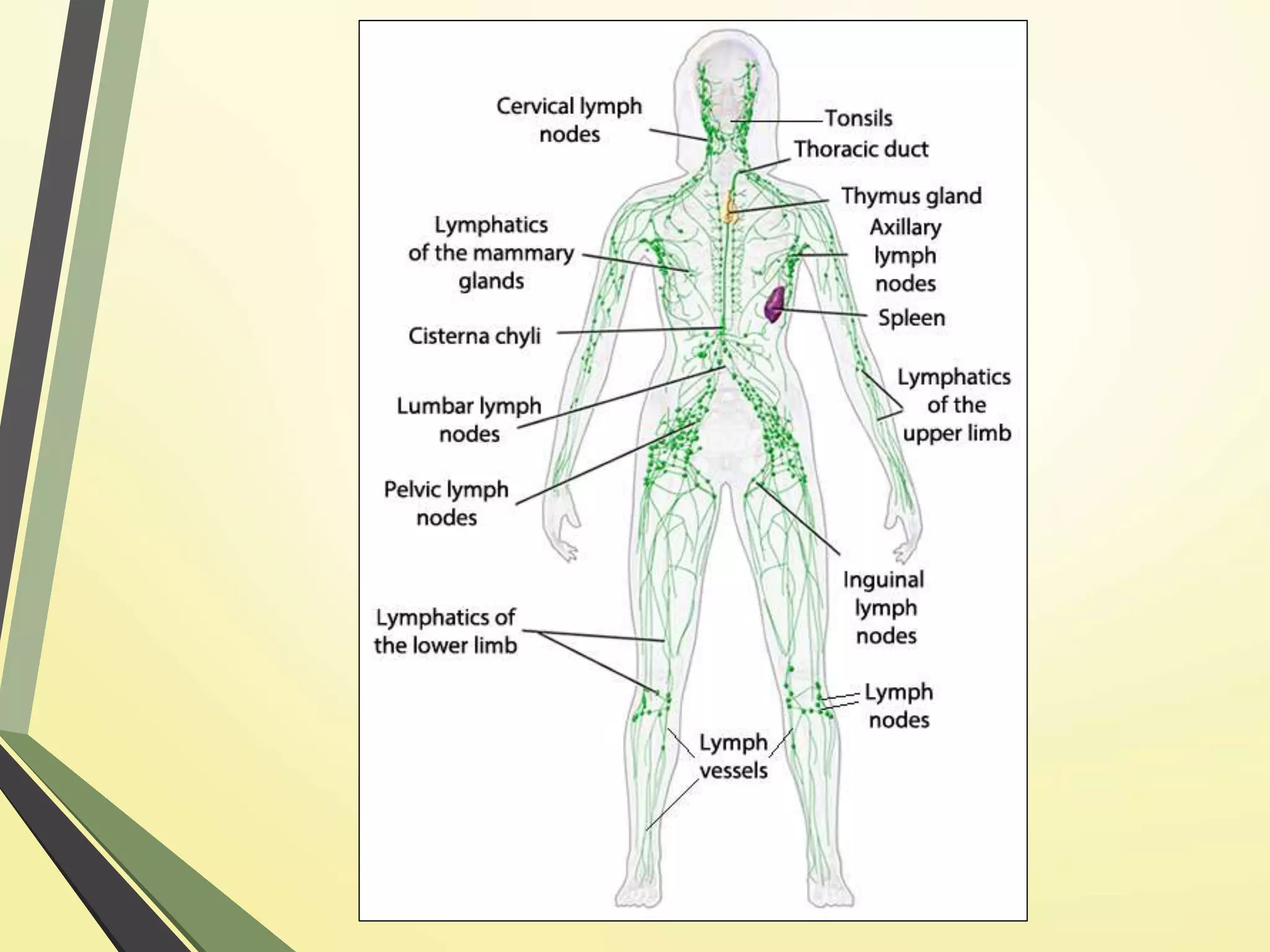
The lymphatic system consists of
Lymph,
Lymphatic vessels,
Lymph nodes,
& lymphatic organs.
The lymphatic organs are the bone marrow, tonsils, the
spleen, the thymus gland, and Peyer’s patches.
Lymph
Lymph is usually clear, transparent and milky fluid flowing through
lymphatic vessels. It appears milky due to presence of absorbed
fats. Lymph differs from blood because lymph does not contain red
blood corpuscles and the protein content is lower.
Composition of Lymph
1.Water
2.The plasma proteins: serum albumin, serum globulin, and
serum fibrinogen,
3.Mineral salts: Na+, K+, Ca+2, HCO3, SO4
4.Organic substances: urea, creatinine, neutral fats and glucose
5.WBCs: Lymphocytes
Functions of lymphatic system
• Tissue drainage: Everyday about 21 litres of plasma move
from the blood capillaries into interstitial space in
between tissue cells to form interstitial fluid. Most of
interstitial fluid gets reabsorbed into capillaries but 3 to 4
litres of fluid are drained into lymphatic capillaries. Now
this fluid is referred as lymph.
• Transporting dietary fats and vitamins: Fats and lipid
soluble vitamins absorbed by lacteals and villi of
gastrointestinal tract and transported to the liver and
adipose tissues.
• Returns plasma protein molecules to blood: ~25-50%
of plasma proteins leak out of capillaries each day they
cannot get back into blood capillaries instead lymphatic
capillaries pick them up and return them to the blood.
• Immunity: the lymphatic organs carry out production
and maturation of lymphocytes, the white blood cells
that are primarily responsible for immunity and defence
mechanism.
• Haematopoiesis: someWBC’s (lymphocytes,
monocytes) are made in lymphatic tissues (not bone
marrow).
Formation and flow of lymph
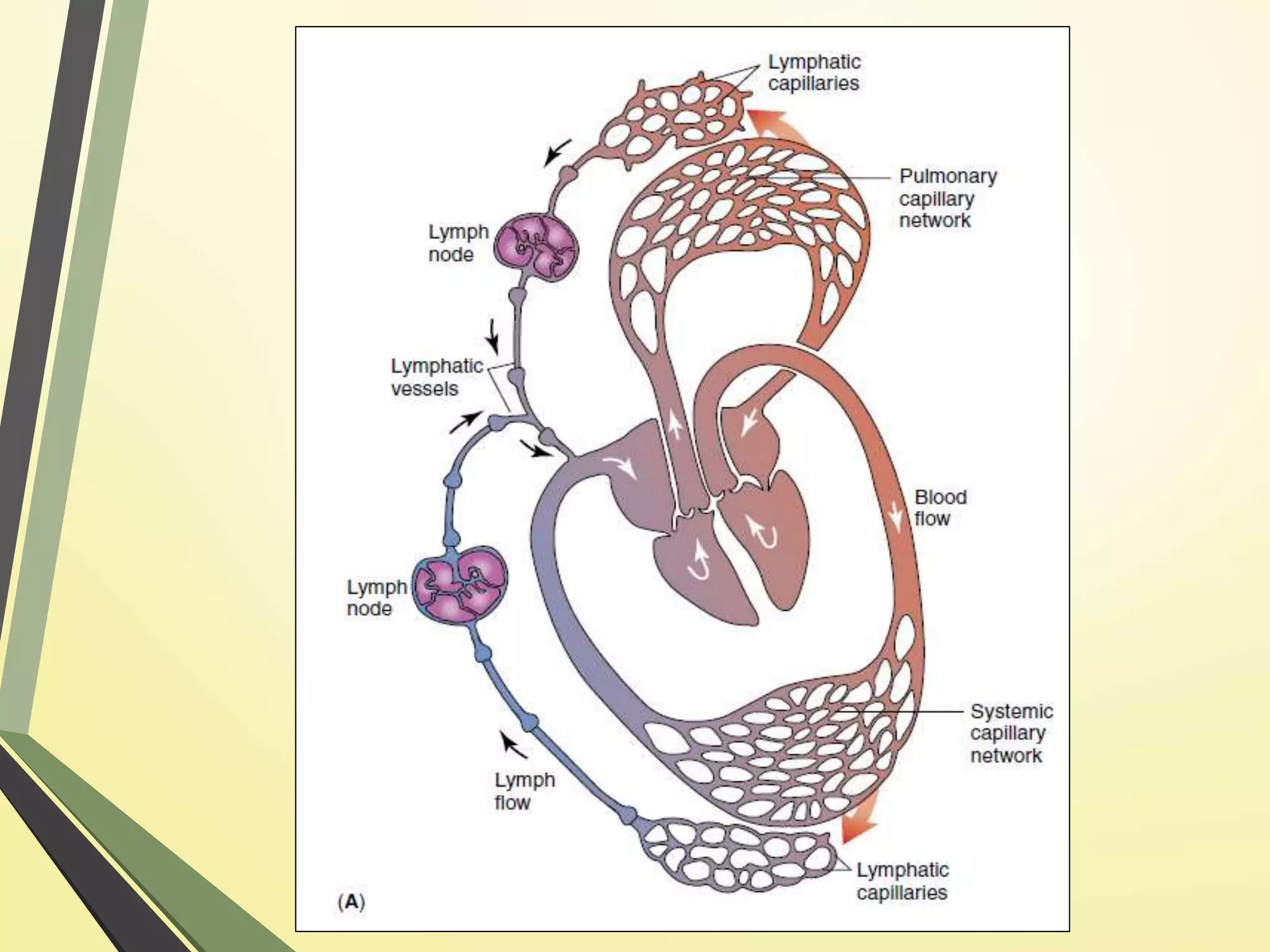
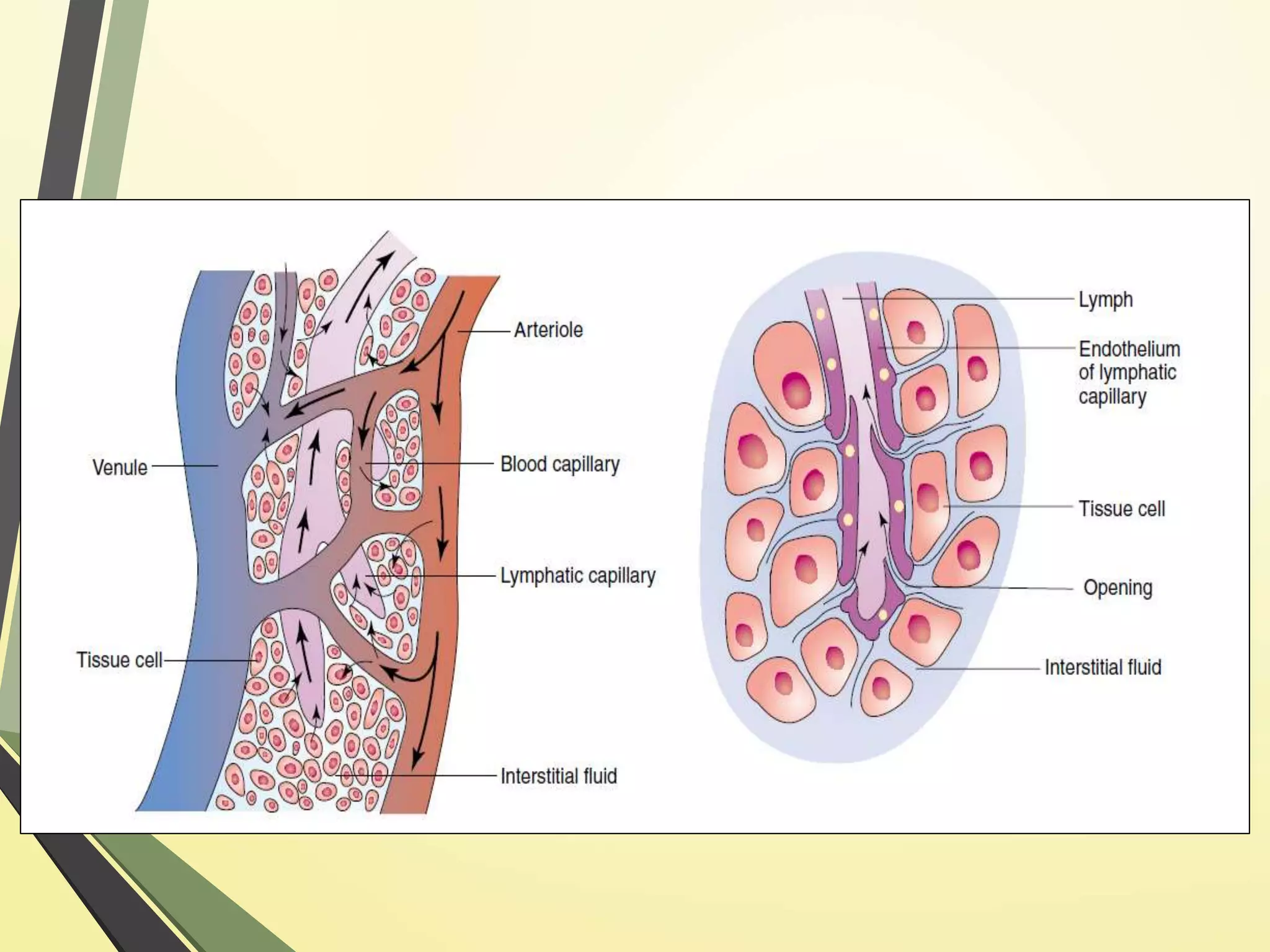
Every day about 21 litres of plasma move from the blood capillaries into interstitial
space in between tissue cells to form interstitial fluid. Most of interstitial fluid gets
reabsorbed into capillaries but 3 to 4 litres of fluid are drained into lymphatic capillaries.
Now this fluid is referred as lymph.
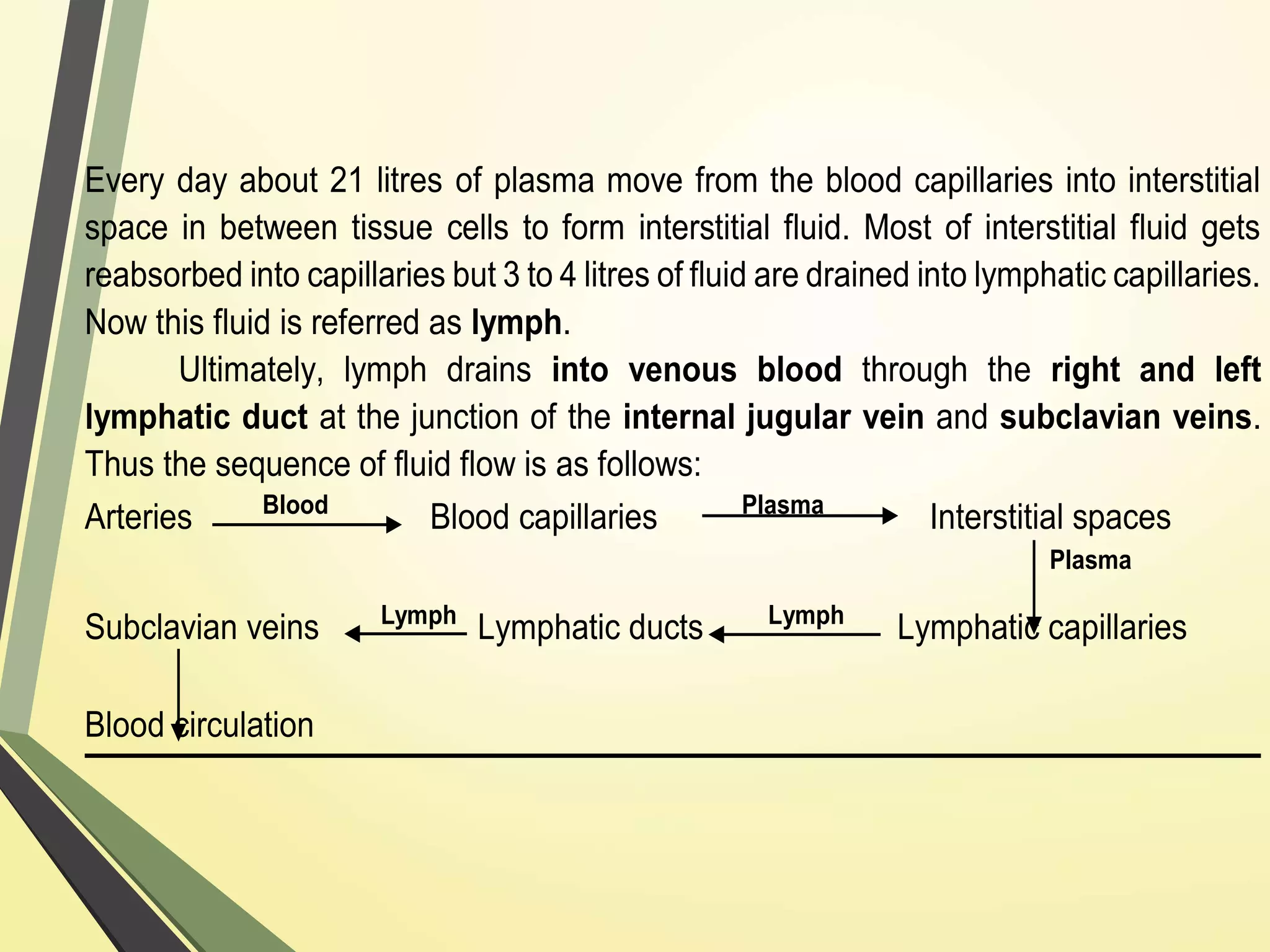
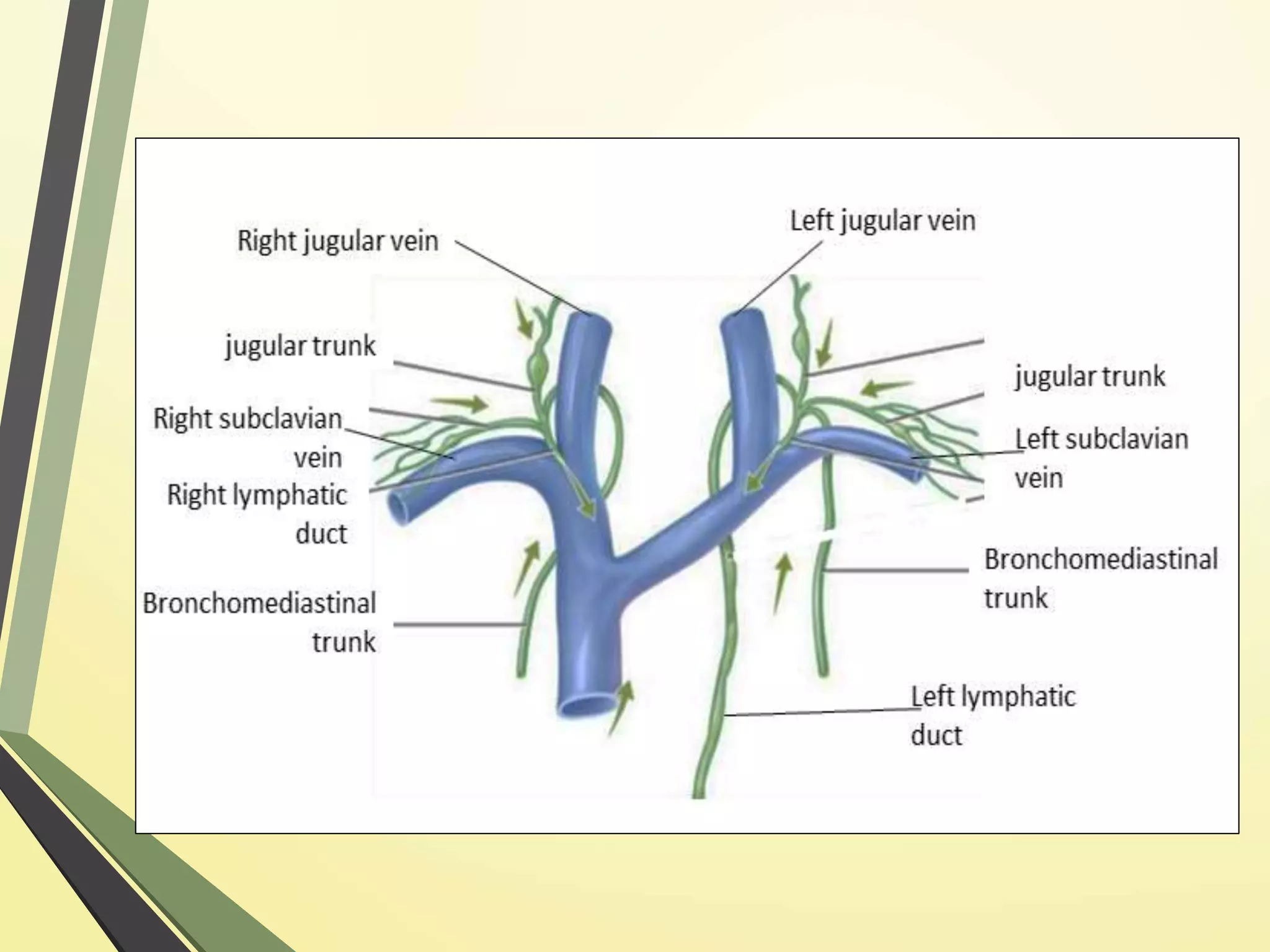
Ultimately, lymph drains into venous blood through the right and left
lymphatic duct at the junction of the internal jugular vein and subclavian veins.
Thus the sequence of fluid flow is as follows:
Arteries Blood
Blood capillaries Plasma
Interstitial spaces
Plasma
Subclavian veins Lymph
Lymphatic ducts Lymph
Lymphatic capillaries
Blood circulation
• The flow of lymph from interstitial tissue spaces to the
lymphatic capillaries, lymphatic ducts and finally to the
subclavian veins is maintained primarily by the skeletal muscle
contractions.
• Contractions of skeletal muscles compress lymphatic vessels
and force lymph toward the right and left subclavian veins.The
respiratory pump alternately expands and compresses the
lymph vessels in the chest cavity and keeps the lymph moving.
One-way valves within the lymphatic vessels prevent backflow
of lymph.
Lymph trunks and ducts
• Lymph passes from lymphatic capillaries into lymphatic vessels
and through lymph nodes. Lymphatic vessel exiting lymph
nodes pass lymph into another node.The exiting lymphatic
vessel united to form lymph trunks. The principal trunks are
the lumbar, intestinal, bronchomediastinal, subclavian and
jugular trunks. The principle trunks eventually pass their lymph
into venous blood through two main channels, the thoracic
duct and the right lymphatic duct.
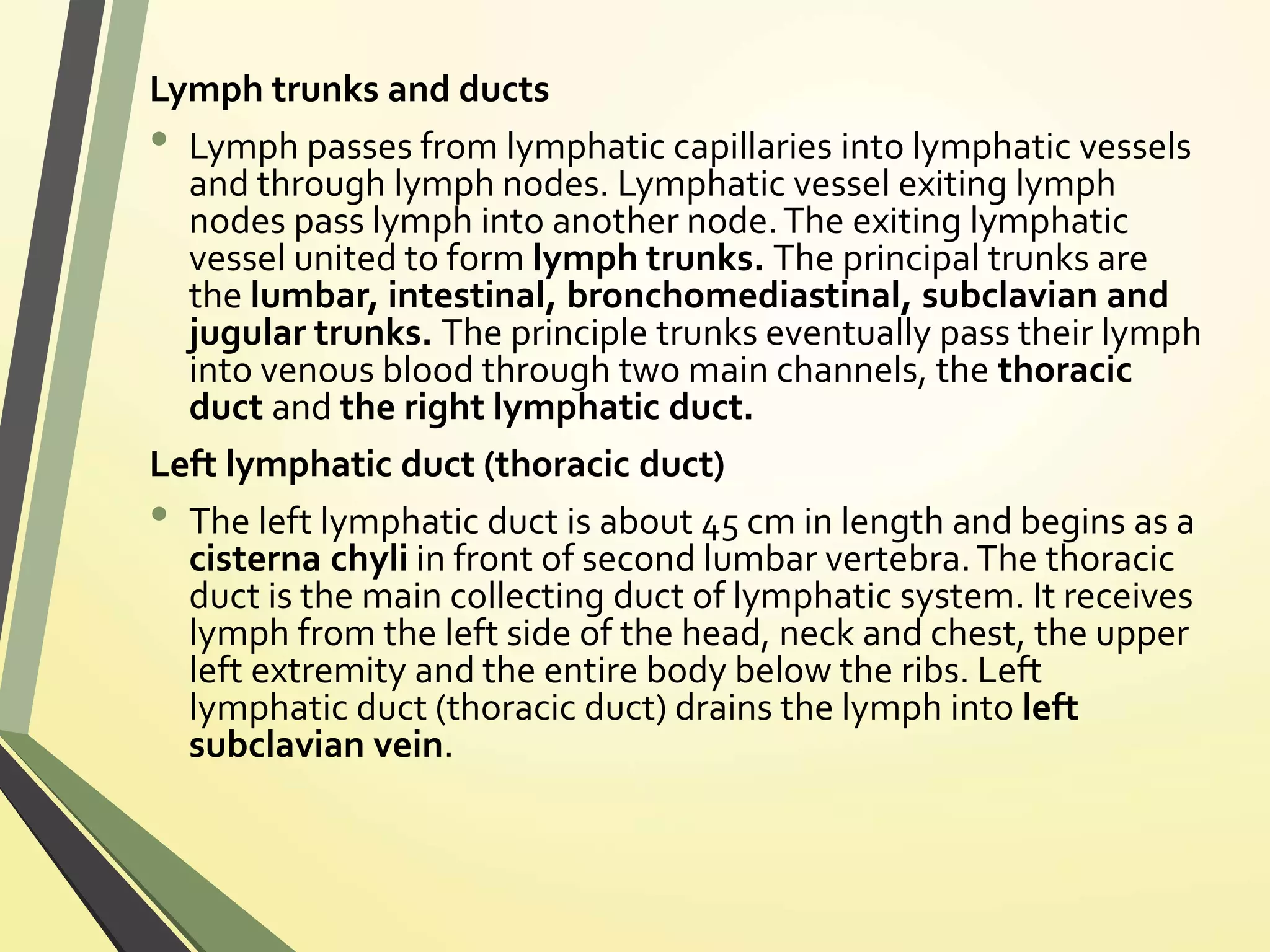
Left lymphatic duct (thoracic duct)
• The left lymphatic duct is about 45 cm in length and begins as a
cisterna chyli in front of second lumbar vertebra.The thoracic
duct is the main collecting duct of lymphatic system. It receives
lymph from the left side of the head, neck and chest, the upper
left extremity and the entire body below the ribs. Left
lymphatic duct (thoracic duct) drains the lymph into left
subclavian vein.
Right lymphatic duct
• The right lymphatic duct is about 1.25 cm long and drains
lymph from the upper right side of the body.The right
lymphatic duct collects lymph from right upper
extremity; right side of the thorax, right lung, right side of
the heart, and liver. Right lymphatic duct opens into right
subclavian vein.
Lymph nodes
• Lymph nodes are oval to bean-shaped organs of
lymphatic system distributed throughout the body
including the gastrointestinal tract, armpits, and neck.
They are also known as lymph glands.
• They range in size from 1 to 25 mm in length, looking like
small seeds or almonds. Each lymph node is covered by a
capsule of fibrous connective tissue.
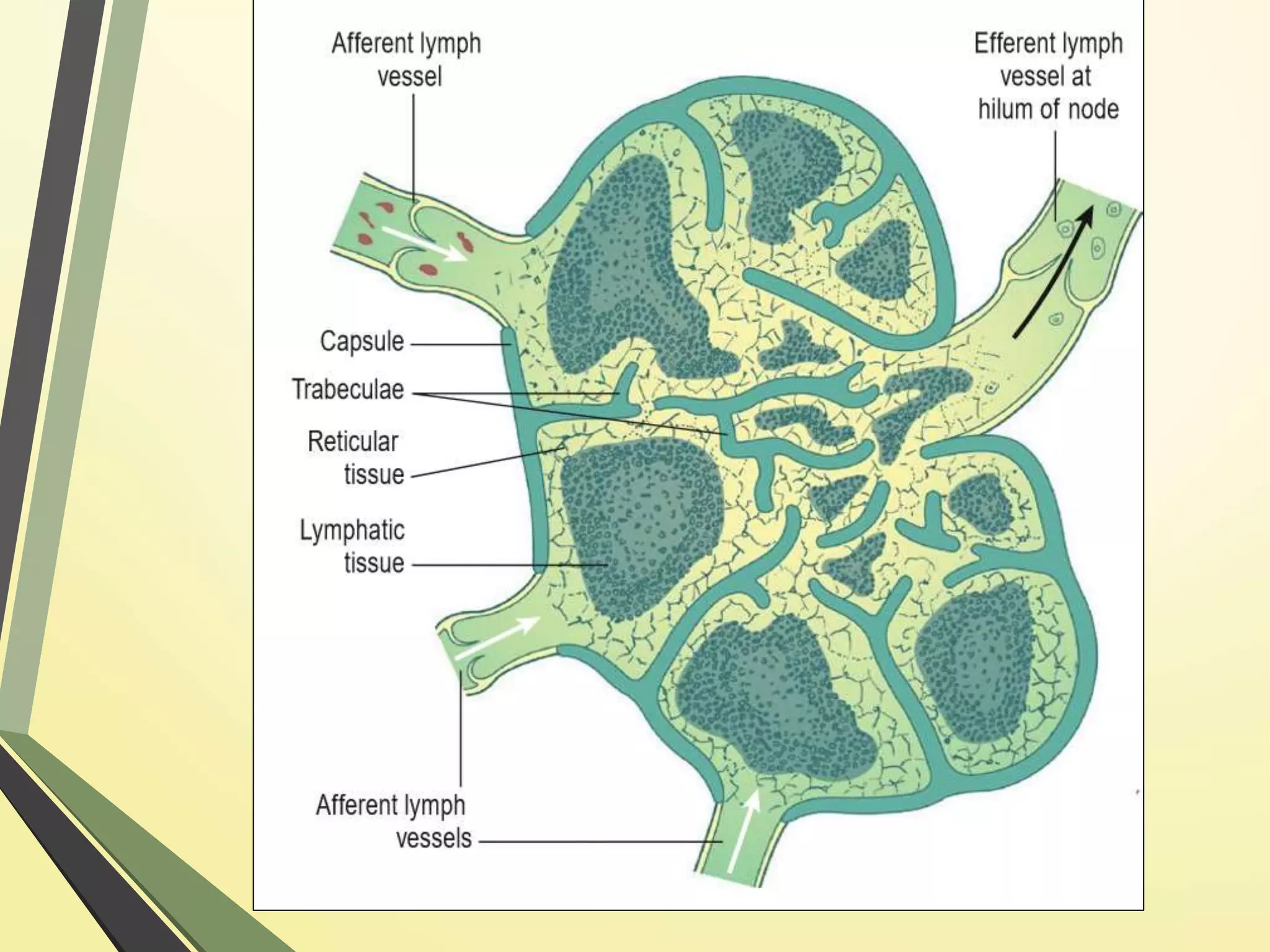
• The capsular extensions are called as trabeculae that
contain lymphatic sinuses, reticular fibers and lymphatic
tissue.The lymph node is divided into two specialized
regions: the cortex and medulla.
• The outer cortex contains densely packed lymphocytes
arranged in masses called follicles.The outer rim of each
follicle containsT-lymphocytes, B-lymphocytes,
macrophages and follicular dendritic cells.
• The inner medulla consists of medullary cords
containing macrophages, plasma cells and lymphocytes.
• Lymphatic vessels that enter the lymph node are called
afferent lymphatic vessels. Lymph flows through the
sinuses in the cortex and then into medulla and exits the
lymph node via efferent lymphatic vessels.
Functions of lymph node
• The lymph node filters foreign substances and cancer
cells from lymph as it passes back towards the
cardiovascular system.These substances trapped by the
reticular fibers within the lymph node.
• The microphages destroy these foreign substances by
phagocytosis and lymphocytes promote destruction of
others by immune responses.
• The proliferation of plasma cells, B- lymphocytes andT-
lymphocytes take place within the lymph node.
SPLEEN
• The spleen is oval in shape and is the single largest organ of
lymphatic system in the body. It measures about 12 cm in
length. It is found in the left upper corner of the abdominal
cavity in between stomach and diaphragm.The spleen consists
of two different kinds of tissue called white pulp and red pulp.
• The white pulp is made up of lymphatic tissue mostly
lymphocytes.
• The red pulp consists of venous sinuses and splenic cords.
Splenic cords consist of red blood cells, macrophages, B- and
T-lymphocytes, plasma cells and granulocytes.
• Blood supply: splenic artery
• Venous drainage: splenic vein
Functions of spleen
• Storage of blood: The spleen contains about 350 ml of blood
and functions as a blood reservoir. During haemorrhage, the
spleen will release blood into the blood circulation.
• Immune response: Spleen contains plasma cells; B- andT-
lymphocytes which are get activated to produce antibodies
against foreign antigens.
• Phagocytosis: Spleen contains fixed macrophages that
phagocytize pathogens or other foreign material in the blood.
• Haemolysis:The macrophages of the spleen also phagocytize
old red blood cells and form bilirubin. By way of portal
circulation, the bilirubin is sent to the liver for excretion in bile.
• Erythropoiesis: the spleen and liver are important sites of blood
cell production in fetal development.
Glossary
• Interstitial space – is a space between two cells
• Extracellular Fluid – usually denotes all body fluid outside the cells
e.g. plasma, lymph, cerebrospinal fluid,
• Intracellular fluid – (within the cell) the fluid inside the cell e.g.
Cytoplasm
• Reservoir - storage space for fluids.
• Macrophage – are a type ofWBC that engulfs and digests cellular
debris, foreign substances, microbes, cancer cells, and anything else.
•ThankingYou

Lymphatic system: Anatomy and Physiology

  • 1.
    Lymphatic system Prof. AmolB Deore M. Pharm (Pharmacology) MVP’s Institute of Pharmaceutical Sciences, Nashik (INDIA)
  • 3.
    The lymphatic systemis associated with the blood and the cardiovascular system. Both systems transport vital fluids throughout the body and both have a system of vessels that transport these fluids. The lymphatic system transports a fluid called lymph through special vessels called lymphatic capillaries and lymphatic trunks.This lymph eventually gets returned to the blood circulation. In addition to fluid control, our lymphatic system is essential to helping us to destroy a large number of microorganisms that can invade our bodies and cause disease and even death.
  • 4.
    The lymphatic systemconsists of Lymph, Lymphatic vessels, Lymph nodes, & lymphatic organs. The lymphatic organs are the bone marrow, tonsils, the spleen, the thymus gland, and Peyer’s patches.
  • 5.
    Lymph Lymph is usuallyclear, transparent and milky fluid flowing through lymphatic vessels. It appears milky due to presence of absorbed fats. Lymph differs from blood because lymph does not contain red blood corpuscles and the protein content is lower. Composition of Lymph 1.Water 2.The plasma proteins: serum albumin, serum globulin, and serum fibrinogen, 3.Mineral salts: Na+, K+, Ca+2, HCO3, SO4 4.Organic substances: urea, creatinine, neutral fats and glucose 5.WBCs: Lymphocytes
  • 6.
    Functions of lymphaticsystem • Tissue drainage: Everyday about 21 litres of plasma move from the blood capillaries into interstitial space in between tissue cells to form interstitial fluid. Most of interstitial fluid gets reabsorbed into capillaries but 3 to 4 litres of fluid are drained into lymphatic capillaries. Now this fluid is referred as lymph. • Transporting dietary fats and vitamins: Fats and lipid soluble vitamins absorbed by lacteals and villi of gastrointestinal tract and transported to the liver and adipose tissues.
  • 7.
    • Returns plasmaprotein molecules to blood: ~25-50% of plasma proteins leak out of capillaries each day they cannot get back into blood capillaries instead lymphatic capillaries pick them up and return them to the blood. • Immunity: the lymphatic organs carry out production and maturation of lymphocytes, the white blood cells that are primarily responsible for immunity and defence mechanism. • Haematopoiesis: someWBC’s (lymphocytes, monocytes) are made in lymphatic tissues (not bone marrow).
  • 8.
  • 9.
    Every day about21 litres of plasma move from the blood capillaries into interstitial space in between tissue cells to form interstitial fluid. Most of interstitial fluid gets reabsorbed into capillaries but 3 to 4 litres of fluid are drained into lymphatic capillaries. Now this fluid is referred as lymph. Ultimately, lymph drains into venous blood through the right and left lymphatic duct at the junction of the internal jugular vein and subclavian veins. Thus the sequence of fluid flow is as follows: Arteries Blood Blood capillaries Plasma Interstitial spaces Plasma Subclavian veins Lymph Lymphatic ducts Lymph Lymphatic capillaries Blood circulation
  • 12.
    • The flowof lymph from interstitial tissue spaces to the lymphatic capillaries, lymphatic ducts and finally to the subclavian veins is maintained primarily by the skeletal muscle contractions. • Contractions of skeletal muscles compress lymphatic vessels and force lymph toward the right and left subclavian veins.The respiratory pump alternately expands and compresses the lymph vessels in the chest cavity and keeps the lymph moving. One-way valves within the lymphatic vessels prevent backflow of lymph.
  • 15.
    Lymph trunks andducts • Lymph passes from lymphatic capillaries into lymphatic vessels and through lymph nodes. Lymphatic vessel exiting lymph nodes pass lymph into another node.The exiting lymphatic vessel united to form lymph trunks. The principal trunks are the lumbar, intestinal, bronchomediastinal, subclavian and jugular trunks. The principle trunks eventually pass their lymph into venous blood through two main channels, the thoracic duct and the right lymphatic duct. Left lymphatic duct (thoracic duct) • The left lymphatic duct is about 45 cm in length and begins as a cisterna chyli in front of second lumbar vertebra.The thoracic duct is the main collecting duct of lymphatic system. It receives lymph from the left side of the head, neck and chest, the upper left extremity and the entire body below the ribs. Left lymphatic duct (thoracic duct) drains the lymph into left subclavian vein.
  • 16.
    Right lymphatic duct •The right lymphatic duct is about 1.25 cm long and drains lymph from the upper right side of the body.The right lymphatic duct collects lymph from right upper extremity; right side of the thorax, right lung, right side of the heart, and liver. Right lymphatic duct opens into right subclavian vein.
  • 17.
    Lymph nodes • Lymphnodes are oval to bean-shaped organs of lymphatic system distributed throughout the body including the gastrointestinal tract, armpits, and neck. They are also known as lymph glands. • They range in size from 1 to 25 mm in length, looking like small seeds or almonds. Each lymph node is covered by a capsule of fibrous connective tissue. • The capsular extensions are called as trabeculae that contain lymphatic sinuses, reticular fibers and lymphatic tissue.The lymph node is divided into two specialized regions: the cortex and medulla.
  • 19.
    • The outercortex contains densely packed lymphocytes arranged in masses called follicles.The outer rim of each follicle containsT-lymphocytes, B-lymphocytes, macrophages and follicular dendritic cells. • The inner medulla consists of medullary cords containing macrophages, plasma cells and lymphocytes. • Lymphatic vessels that enter the lymph node are called afferent lymphatic vessels. Lymph flows through the sinuses in the cortex and then into medulla and exits the lymph node via efferent lymphatic vessels.
  • 20.
    Functions of lymphnode • The lymph node filters foreign substances and cancer cells from lymph as it passes back towards the cardiovascular system.These substances trapped by the reticular fibers within the lymph node. • The microphages destroy these foreign substances by phagocytosis and lymphocytes promote destruction of others by immune responses. • The proliferation of plasma cells, B- lymphocytes andT- lymphocytes take place within the lymph node.
  • 21.
    SPLEEN • The spleenis oval in shape and is the single largest organ of lymphatic system in the body. It measures about 12 cm in length. It is found in the left upper corner of the abdominal cavity in between stomach and diaphragm.The spleen consists of two different kinds of tissue called white pulp and red pulp. • The white pulp is made up of lymphatic tissue mostly lymphocytes. • The red pulp consists of venous sinuses and splenic cords. Splenic cords consist of red blood cells, macrophages, B- and T-lymphocytes, plasma cells and granulocytes. • Blood supply: splenic artery • Venous drainage: splenic vein
  • 23.
    Functions of spleen •Storage of blood: The spleen contains about 350 ml of blood and functions as a blood reservoir. During haemorrhage, the spleen will release blood into the blood circulation. • Immune response: Spleen contains plasma cells; B- andT- lymphocytes which are get activated to produce antibodies against foreign antigens. • Phagocytosis: Spleen contains fixed macrophages that phagocytize pathogens or other foreign material in the blood. • Haemolysis:The macrophages of the spleen also phagocytize old red blood cells and form bilirubin. By way of portal circulation, the bilirubin is sent to the liver for excretion in bile. • Erythropoiesis: the spleen and liver are important sites of blood cell production in fetal development.
  • 24.
    Glossary • Interstitial space– is a space between two cells • Extracellular Fluid – usually denotes all body fluid outside the cells e.g. plasma, lymph, cerebrospinal fluid, • Intracellular fluid – (within the cell) the fluid inside the cell e.g. Cytoplasm • Reservoir - storage space for fluids. • Macrophage – are a type ofWBC that engulfs and digests cellular debris, foreign substances, microbes, cancer cells, and anything else.
  • 25.