Lymphatic Organs & tissue
Organization of lymph vessels
Formation & flow of Lymph
By:
Dr Sarita Sharma
Associate Professor
MMCP, MMDU
• The lymphatic system consists of;
1) A fluid called lymph
2) Vessels called Lymphatic Vessels that transport
the lymph
3) Lymph Node
4) A number of structures and organs containing
Lymphatic tissue: Lymphatic tissue is a
specialized form of reticular connective tissue
that contains large numbers of lymphocytes
What is Lymph?
• Lymph is a clear watery fluid, similar in composition
to plasma, with the exception of plasma proteins,
and identical in composition to interstitial fluid.
• The major difference between interstitial fluid and
lymph is location: Interstitial fluid is found between
cells, and lymph is located within lymphatic vessels
and lymphatic tissue.
• Most components of blood plasma filter through
blood capillary walls to form interstitial fluid. After
interstitial fluid passes into lymphatic vessels, it is
called lymph.
Functions of the Lymphatic System
The lymphatic system has three primary functions:
1. Tissue drainage:
• Every day, around 21 litres of plasma fluid, (Which contain carrying dissolved
substances and some plasma protein), escape from the arterial end of the
capillaries and goes into the tissues.
• Most of this fluid is return directly to the bloodstream via the, but 3-4 litres of
fluid are drained away by the lymphatic vessels.
• Without this, the tissues would rapidly become waterlogged, and the
cardiovascular system would begin to fail as the blood volume falls.
2. Absorption in the small intestine:
• Fat and fat-soluble materials, e.g. the fat-soluble vitamins (A, D, E, and K), are
absorbed into the lymphatic vessels of the villi. (It absorbs and transports fatty
acids and fats as chyle from the digestive system)
3. Immunity:
• The lymphatic organs are concerned with the production and maturation of T
and B lymphocytes, the white blood cells that are primarily responsible for
provision of immunity. Bone marrow is therefore considered to be lymphatic
tissue, since lymphocytes are produced there.
Lymphatic Organs and Tissues
Primary lymphatic organs:
1. The red bone marrow- In flat bones and the epiphyses of long bones of
adults
2. The thymus gland.
• These are the sites where Pluripotent stem cells divide and become
immunocompetent, that is, capable of mounting an immune response.
• Pluripotent stem cells in red bone marrow give rise to mature,
immunocompetent B cells and to pre-T cells.
• The pre-T cells in turn migrate to the thymus, where they become
immunocompetent T cells.
Secondary lymphatic organs & tissues:
• These are the sites where most immune responses occur.
• They include; a). lymph nodes,
b). spleen, and
c). lymphatic nodules (follicles)
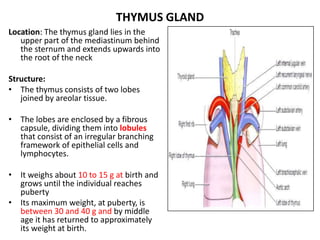
THYMUS GLAND
Location: The thymus gland lies in the
upper part of the mediastinum behind
the sternum and extends upwards into
the root of the neck
Structure:
• The thymus consists of two lobes
joined by areolar tissue.
• The lobes are enclosed by a fibrous
capsule, dividing them into lobules
that consist of an irregular branching
framework of epithelial cells and
lymphocytes.
• It weighs about 10 to 15 g at birth and
grows until the individual reaches
puberty
• Its maximum weight, at puberty, is
between 30 and 40 g and by middle
age it has returned to approximately
its weight at birth.
Function:
• Lymphocytes originate from pluripotent stem cells in red
bone marrow.
• Those that enter the thymus develop into activated T-
lymphocytes.
• Thymic processing produces mature T-lymphocytes
provided each T-lymphocyte with the ability to react to
only one specific antigen from the millions it will encounter.
T-lymphocytes then leave the thymus and enter
the blood. Some enter lymphoid tissues and others
circulate in the bloodstream.
The maturation of the thymus and other
lymphoid tissue is stimulated by thymosin, a hormone
secreted by the epithelial cells that form the framework of
the thymus gland.
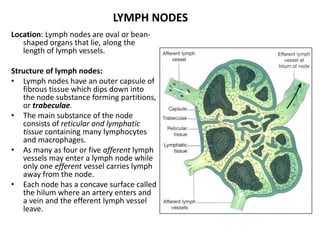
Location: Lymph nodes are oval or bean-
shaped organs that lie, along the
length of lymph vessels.
Structure of lymph nodes:
• Lymph nodes have an outer capsule of
fibrous tissue which dips down into
the node substance forming partitions,
or trabeculae.
• The main substance of the node
consists of reticular and lymphatic
tissue containing many lymphocytes
and macrophages.
• As many as four or five afferent lymph
vessels may enter a lymph node while
only one efferent vessel carries lymph
away from the node.
• Each node has a concave surface called
the hilum where an artery enters and
a vein and the efferent lymph vessel
leave.
LYMPH NODES
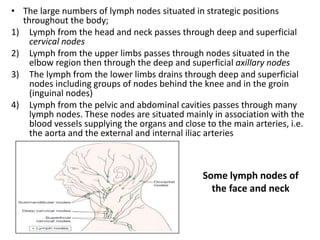
Some lymph nodes of
the face and neck
• The large numbers of lymph nodes situated in strategic positions
throughout the body;
1) Lymph from the head and neck passes through deep and superficial
cervical nodes
2) Lymph from the upper limbs passes through nodes situated in the
elbow region then through the deep and superficial axillary nodes
3) The lymph from the lower limbs drains through deep and superficial
nodes including groups of nodes behind the knee and in the groin
(inguinal nodes)
4) Lymph from the pelvic and abdominal cavities passes through many
lymph nodes. These nodes are situated mainly in association with the
blood vessels supplying the organs and close to the main arteries, i.e.
the aorta and the external and internal iliac arteries
Functions of lymph nodes
1. Filtering and phagocytosis
• Filtering: Lymph is filtered by the reticular and lymphoid tissue as it passes
through lymph nodes.
• Phagocytosis of Particulate matter: It may include microbes, dead and live
phagocytes containing ingested microbes, cells from malignant tumours,
worn out and damaged tissue cells and inhaled particles.
• Organic material is destroyed in lymph nodes by macrophages and
antibodies.
In some cases where phagocytosis of microbes is incomplete
they may stimulate inflammation and enlargement of the node
(lymphadenopathy).
2. Proliferation of lymphocytes
• Activated T- and B-lymphocytes multiply in lymph nodes.
• Antibodies produced by sensitised B-lymphocytes enter lymph and blood
draining the node.
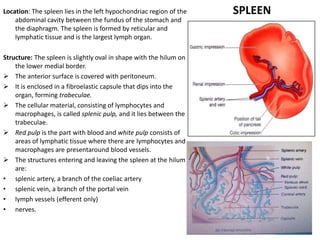
SPLEEN
Location: The spleen lies in the left hypochondriac region of the
abdominal cavity between the fundus of the stomach and
the diaphragm. The spleen is formed by reticular and
lymphatic tissue and is the largest lymph organ.
Structure: The spleen is slightly oval in shape with the hilum on
the lower medial border.
 The anterior surface is covered with peritoneum.
 It is enclosed in a fibroelastic capsule that dips into the
organ, forming trabeculae.
 The cellular material, consisting of lymphocytes and
macrophages, is called splenic pulp, and it lies between the
trabeculae.
 Red pulp is the part with blood and white pulp consists of
areas of lymphatic tissue where there are lymphocytes and
macrophages are presentaround blood vessels.
 The structures entering and leaving the spleen at the hilum
are:
• splenic artery, a branch of the coeliac artery
• splenic vein, a branch of the portal vein
• lymph vessels (efferent only)
• nerves.
Functions:
1. Phagocytosis:
• Old and abnormal erythrocytes are destroyed in the spleen and the
breakdown products, bilirubin and iron, are passed to the liver via the
splenic and portal veins.
• Other cellular material, e.g. leukocytes, platelets and microbes, are
phagocytosed in spleen.
2. Storage of blood:
• The spleen contains up to 350 ml of blood, and in response to
sympathetic stimulation the blood can rapidly return a large part of this
volume to the circulation in critical conditions, e.g. in haemorrhage.
3. Immune response:
• The spleen contains T- and B-lymphocytes, which are activated by the
presence of antigens, e.g. in infection.
• Lymphocyte proliferation during serious infection can cause
enlargement of the spleen (splenomegaly}.
4. Erythropoiesis:
• The spleen and liver are important sites of fetal blood cell production,
and the spleen can also fulfil this function in adults in times of great
need.
Formation & Flow of Lymph
Formation of Lymph:
• Most components of blood plasma filter through blood
capillary walls to form interstitial fluid.
• Every day, around 21 litres of plasma fluid, (Which
contain carrying dissolved substances and some plasma
protein), escape from the arterial end of the capillaries
and goes into the tissues.
• Most of this fluid is return directly to the bloodstream.
• But, The excess filtered fluid—about 3 liters per day—
drains into lymphatic vessels and becomes lymph.
• In this way, interstitial fluid passes into lymphatic
vessels, it is called lymph.
Flow of Lymph
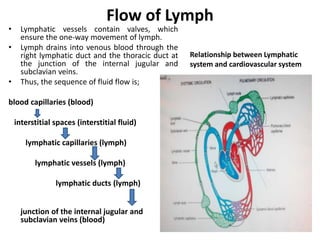
• Lymphatic vessels contain valves, which
ensure the one-way movement of lymph.
• Lymph drains into venous blood through the
right lymphatic duct and the thoracic duct at
the junction of the internal jugular and
subclavian veins.
• Thus, the sequence of fluid flow is;
blood capillaries (blood)
interstitial spaces (interstitial fluid)
lymphatic capillaries (lymph)
lymphatic vessels (lymph)
lymphatic ducts (lymph)
junction of the internal jugular and
subclavian veins (blood)
Relationship between Lymphatic
system and cardiovascular system
The two “pumps” maintain the flow of lymph
1. Skeletal muscle pump
• This pump forces lymph toward the junction of the internal jugular and
subclavian vein by Milking action
• Milking refers to skeletal muscle contractions that drive venous blood
toward the heart ie skeletal muscles by contraction return venous blood
to the heart.
2. Respiratory pump
• Lymph flow is also maintained by pressure changes that occur during
inhalation (breathing in).
• Lymph flows from the abdominal region, where the pressure is higher,
toward the thoracic region, where it is lower.
• When the pressures reverse during exhalation (breathing out), the
valves in lymphatic vessels prevent backflow of lymph.
• In addition, when a lymphatic vessel distends, the smooth muscle in its
wall contracts, which helps move lymph from one segment of the vessel
to the next.
Organization of lymph vessels
• Lymphatic vessels begin as lymphatic capillaries.
• Lymphatic capillaries unite to form larger
lymphatic vessels
• The lymphatic vessels flow lymph through lymph
nodes
• It includes
a. Lymph capillaries
b. Larger lymph vessels
a. Lymph capillaries
• Difference between Blood capillaries and
Lymphatic capillaries;
Lymphatic capillaries have greater permeability
than blood capillaries and thus can absorb large
molecules such as proteins and lipids.
Lymphatic capillaries are also slightly larger in
diameter than blood capillaries and have a unique
one-way structure that permits interstitial fluid to
flow into them but not out.
Location- These originate as blind-end tubes in the
interstitial spaces.
Flow of lymph between interstitial fluid and lymphatic capillary
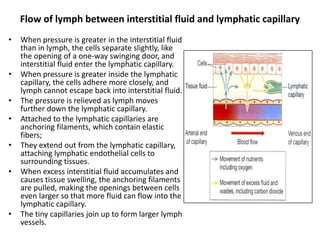
• When pressure is greater in the interstitial fluid
than in lymph, the cells separate slightly, like
the opening of a one-way swinging door, and
interstitial fluid enter the lymphatic capillary.
• When pressure is greater inside the lymphatic
capillary, the cells adhere more closely, and
lymph cannot escape back into interstitial fluid.
• The pressure is relieved as lymph moves
further down the lymphatic capillary.
• Attached to the lymphatic capillaries are
anchoring filaments, which contain elastic
fibers;
• They extend out from the lymphatic capillary,
attaching lymphatic endothelial cells to
surrounding tissues.
• When excess interstitial fluid accumulates and
causes tissue swelling, the anchoring filaments
are pulled, making the openings between cells
even larger so that more fluid can flow into the
lymphatic capillary.
• The tiny capillaries join up to form larger lymph
vessels.
b). Larger lymph vessels
• The walls of lymph have the same layers of tissue, i.e. a fibrous covering, a middle
layer of smooth muscle and elastic tissue and an inner lining of endothelium.
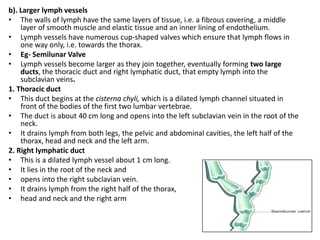
• Lymph vessels have numerous cup-shaped valves which ensure that lymph flows in
one way only, i.e. towards the thorax.
• Eg- Semilunar Valve
• Lymph vessels become larger as they join together, eventually forming two large
ducts, the thoracic duct and right lymphatic duct, that empty lymph into the
subclavian veins.
1. Thoracic duct
• This duct begins at the cisterna chyli, which is a dilated lymph channel situated in
front of the bodies of the first two lumbar vertebrae.
• The duct is about 40 cm long and opens into the left subclavian vein in the root of the
neck.
• It drains lymph from both legs, the pelvic and abdominal cavities, the left half of the
thorax, head and neck and the left arm.
2. Right lymphatic duct
• This is a dilated lymph vessel about 1 cm long.
• It lies in the root of the neck and
• opens into the right subclavian vein.
• It drains lymph from the right half of the thorax,
• head and neck and the right arm
• Examples of Tissues that lack lymphatic
capillaries include;
1) avascular tissues (such as cartilage, the
epidermis, and the cornea of the eye),
2) the central nervous system,
3) portions of the spleen, and
4) red bone marrow.

Lymphatic System.pptx

  • 1.
    Lymphatic Organs &tissue Organization of lymph vessels Formation & flow of Lymph By: Dr Sarita Sharma Associate Professor MMCP, MMDU
  • 2.
    • The lymphaticsystem consists of; 1) A fluid called lymph 2) Vessels called Lymphatic Vessels that transport the lymph 3) Lymph Node 4) A number of structures and organs containing Lymphatic tissue: Lymphatic tissue is a specialized form of reticular connective tissue that contains large numbers of lymphocytes
  • 3.
    What is Lymph? •Lymph is a clear watery fluid, similar in composition to plasma, with the exception of plasma proteins, and identical in composition to interstitial fluid. • The major difference between interstitial fluid and lymph is location: Interstitial fluid is found between cells, and lymph is located within lymphatic vessels and lymphatic tissue. • Most components of blood plasma filter through blood capillary walls to form interstitial fluid. After interstitial fluid passes into lymphatic vessels, it is called lymph.
  • 4.
    Functions of theLymphatic System The lymphatic system has three primary functions: 1. Tissue drainage: • Every day, around 21 litres of plasma fluid, (Which contain carrying dissolved substances and some plasma protein), escape from the arterial end of the capillaries and goes into the tissues. • Most of this fluid is return directly to the bloodstream via the, but 3-4 litres of fluid are drained away by the lymphatic vessels. • Without this, the tissues would rapidly become waterlogged, and the cardiovascular system would begin to fail as the blood volume falls. 2. Absorption in the small intestine: • Fat and fat-soluble materials, e.g. the fat-soluble vitamins (A, D, E, and K), are absorbed into the lymphatic vessels of the villi. (It absorbs and transports fatty acids and fats as chyle from the digestive system) 3. Immunity: • The lymphatic organs are concerned with the production and maturation of T and B lymphocytes, the white blood cells that are primarily responsible for provision of immunity. Bone marrow is therefore considered to be lymphatic tissue, since lymphocytes are produced there.
  • 5.
    Lymphatic Organs andTissues Primary lymphatic organs: 1. The red bone marrow- In flat bones and the epiphyses of long bones of adults 2. The thymus gland. • These are the sites where Pluripotent stem cells divide and become immunocompetent, that is, capable of mounting an immune response. • Pluripotent stem cells in red bone marrow give rise to mature, immunocompetent B cells and to pre-T cells. • The pre-T cells in turn migrate to the thymus, where they become immunocompetent T cells. Secondary lymphatic organs & tissues: • These are the sites where most immune responses occur. • They include; a). lymph nodes, b). spleen, and c). lymphatic nodules (follicles)
  • 7.
    THYMUS GLAND Location: Thethymus gland lies in the upper part of the mediastinum behind the sternum and extends upwards into the root of the neck Structure: • The thymus consists of two lobes joined by areolar tissue. • The lobes are enclosed by a fibrous capsule, dividing them into lobules that consist of an irregular branching framework of epithelial cells and lymphocytes. • It weighs about 10 to 15 g at birth and grows until the individual reaches puberty • Its maximum weight, at puberty, is between 30 and 40 g and by middle age it has returned to approximately its weight at birth.
  • 9.
    Function: • Lymphocytes originatefrom pluripotent stem cells in red bone marrow. • Those that enter the thymus develop into activated T- lymphocytes. • Thymic processing produces mature T-lymphocytes provided each T-lymphocyte with the ability to react to only one specific antigen from the millions it will encounter. T-lymphocytes then leave the thymus and enter the blood. Some enter lymphoid tissues and others circulate in the bloodstream. The maturation of the thymus and other lymphoid tissue is stimulated by thymosin, a hormone secreted by the epithelial cells that form the framework of the thymus gland.
  • 10.
    Location: Lymph nodesare oval or bean- shaped organs that lie, along the length of lymph vessels. Structure of lymph nodes: • Lymph nodes have an outer capsule of fibrous tissue which dips down into the node substance forming partitions, or trabeculae. • The main substance of the node consists of reticular and lymphatic tissue containing many lymphocytes and macrophages. • As many as four or five afferent lymph vessels may enter a lymph node while only one efferent vessel carries lymph away from the node. • Each node has a concave surface called the hilum where an artery enters and a vein and the efferent lymph vessel leave. LYMPH NODES
  • 11.
    Some lymph nodesof the face and neck • The large numbers of lymph nodes situated in strategic positions throughout the body; 1) Lymph from the head and neck passes through deep and superficial cervical nodes 2) Lymph from the upper limbs passes through nodes situated in the elbow region then through the deep and superficial axillary nodes 3) The lymph from the lower limbs drains through deep and superficial nodes including groups of nodes behind the knee and in the groin (inguinal nodes) 4) Lymph from the pelvic and abdominal cavities passes through many lymph nodes. These nodes are situated mainly in association with the blood vessels supplying the organs and close to the main arteries, i.e. the aorta and the external and internal iliac arteries
  • 12.
    Functions of lymphnodes 1. Filtering and phagocytosis • Filtering: Lymph is filtered by the reticular and lymphoid tissue as it passes through lymph nodes. • Phagocytosis of Particulate matter: It may include microbes, dead and live phagocytes containing ingested microbes, cells from malignant tumours, worn out and damaged tissue cells and inhaled particles. • Organic material is destroyed in lymph nodes by macrophages and antibodies. In some cases where phagocytosis of microbes is incomplete they may stimulate inflammation and enlargement of the node (lymphadenopathy). 2. Proliferation of lymphocytes • Activated T- and B-lymphocytes multiply in lymph nodes. • Antibodies produced by sensitised B-lymphocytes enter lymph and blood draining the node.
  • 13.
    SPLEEN Location: The spleenlies in the left hypochondriac region of the abdominal cavity between the fundus of the stomach and the diaphragm. The spleen is formed by reticular and lymphatic tissue and is the largest lymph organ. Structure: The spleen is slightly oval in shape with the hilum on the lower medial border.  The anterior surface is covered with peritoneum.  It is enclosed in a fibroelastic capsule that dips into the organ, forming trabeculae.  The cellular material, consisting of lymphocytes and macrophages, is called splenic pulp, and it lies between the trabeculae.  Red pulp is the part with blood and white pulp consists of areas of lymphatic tissue where there are lymphocytes and macrophages are presentaround blood vessels.  The structures entering and leaving the spleen at the hilum are: • splenic artery, a branch of the coeliac artery • splenic vein, a branch of the portal vein • lymph vessels (efferent only) • nerves.
  • 14.
    Functions: 1. Phagocytosis: • Oldand abnormal erythrocytes are destroyed in the spleen and the breakdown products, bilirubin and iron, are passed to the liver via the splenic and portal veins. • Other cellular material, e.g. leukocytes, platelets and microbes, are phagocytosed in spleen. 2. Storage of blood: • The spleen contains up to 350 ml of blood, and in response to sympathetic stimulation the blood can rapidly return a large part of this volume to the circulation in critical conditions, e.g. in haemorrhage. 3. Immune response: • The spleen contains T- and B-lymphocytes, which are activated by the presence of antigens, e.g. in infection. • Lymphocyte proliferation during serious infection can cause enlargement of the spleen (splenomegaly}. 4. Erythropoiesis: • The spleen and liver are important sites of fetal blood cell production, and the spleen can also fulfil this function in adults in times of great need.
  • 15.
    Formation & Flowof Lymph Formation of Lymph: • Most components of blood plasma filter through blood capillary walls to form interstitial fluid. • Every day, around 21 litres of plasma fluid, (Which contain carrying dissolved substances and some plasma protein), escape from the arterial end of the capillaries and goes into the tissues. • Most of this fluid is return directly to the bloodstream. • But, The excess filtered fluid—about 3 liters per day— drains into lymphatic vessels and becomes lymph. • In this way, interstitial fluid passes into lymphatic vessels, it is called lymph.
  • 16.
    Flow of Lymph •Lymphatic vessels contain valves, which ensure the one-way movement of lymph. • Lymph drains into venous blood through the right lymphatic duct and the thoracic duct at the junction of the internal jugular and subclavian veins. • Thus, the sequence of fluid flow is; blood capillaries (blood) interstitial spaces (interstitial fluid) lymphatic capillaries (lymph) lymphatic vessels (lymph) lymphatic ducts (lymph) junction of the internal jugular and subclavian veins (blood) Relationship between Lymphatic system and cardiovascular system
  • 17.
    The two “pumps”maintain the flow of lymph 1. Skeletal muscle pump • This pump forces lymph toward the junction of the internal jugular and subclavian vein by Milking action • Milking refers to skeletal muscle contractions that drive venous blood toward the heart ie skeletal muscles by contraction return venous blood to the heart. 2. Respiratory pump • Lymph flow is also maintained by pressure changes that occur during inhalation (breathing in). • Lymph flows from the abdominal region, where the pressure is higher, toward the thoracic region, where it is lower. • When the pressures reverse during exhalation (breathing out), the valves in lymphatic vessels prevent backflow of lymph. • In addition, when a lymphatic vessel distends, the smooth muscle in its wall contracts, which helps move lymph from one segment of the vessel to the next.
  • 18.
    Organization of lymphvessels • Lymphatic vessels begin as lymphatic capillaries. • Lymphatic capillaries unite to form larger lymphatic vessels • The lymphatic vessels flow lymph through lymph nodes • It includes a. Lymph capillaries b. Larger lymph vessels
  • 19.
    a. Lymph capillaries •Difference between Blood capillaries and Lymphatic capillaries; Lymphatic capillaries have greater permeability than blood capillaries and thus can absorb large molecules such as proteins and lipids. Lymphatic capillaries are also slightly larger in diameter than blood capillaries and have a unique one-way structure that permits interstitial fluid to flow into them but not out. Location- These originate as blind-end tubes in the interstitial spaces.
  • 20.
    Flow of lymphbetween interstitial fluid and lymphatic capillary • When pressure is greater in the interstitial fluid than in lymph, the cells separate slightly, like the opening of a one-way swinging door, and interstitial fluid enter the lymphatic capillary. • When pressure is greater inside the lymphatic capillary, the cells adhere more closely, and lymph cannot escape back into interstitial fluid. • The pressure is relieved as lymph moves further down the lymphatic capillary. • Attached to the lymphatic capillaries are anchoring filaments, which contain elastic fibers; • They extend out from the lymphatic capillary, attaching lymphatic endothelial cells to surrounding tissues. • When excess interstitial fluid accumulates and causes tissue swelling, the anchoring filaments are pulled, making the openings between cells even larger so that more fluid can flow into the lymphatic capillary. • The tiny capillaries join up to form larger lymph vessels.
  • 21.
    b). Larger lymphvessels • The walls of lymph have the same layers of tissue, i.e. a fibrous covering, a middle layer of smooth muscle and elastic tissue and an inner lining of endothelium. • Lymph vessels have numerous cup-shaped valves which ensure that lymph flows in one way only, i.e. towards the thorax. • Eg- Semilunar Valve • Lymph vessels become larger as they join together, eventually forming two large ducts, the thoracic duct and right lymphatic duct, that empty lymph into the subclavian veins. 1. Thoracic duct • This duct begins at the cisterna chyli, which is a dilated lymph channel situated in front of the bodies of the first two lumbar vertebrae. • The duct is about 40 cm long and opens into the left subclavian vein in the root of the neck. • It drains lymph from both legs, the pelvic and abdominal cavities, the left half of the thorax, head and neck and the left arm. 2. Right lymphatic duct • This is a dilated lymph vessel about 1 cm long. • It lies in the root of the neck and • opens into the right subclavian vein. • It drains lymph from the right half of the thorax, • head and neck and the right arm
  • 22.
    • Examples ofTissues that lack lymphatic capillaries include; 1) avascular tissues (such as cartilage, the epidermis, and the cornea of the eye), 2) the central nervous system, 3) portions of the spleen, and 4) red bone marrow.