Lower limb
Prosthesis
Adib Mursyidi Iskandar Mirza
Orthopedics
Outline
• Definition
• Aim of prosthesis
• Level of amputations of lower limbs
• Components of prosthesis
• General issues
Definition
• Prosthesis
• Device to replace part of the limb or missing limb
“substitute”
• Orthosis
• Externally applied mechanical devices
• Support weakened injured, paralyzed, diseased part
as supplementation
• Prosthetist
• Person skilled in prosthetics and its application
Aim of prosthesis
• To substitute for a lost part
• To restore lost function
• Comfortable ambulation
• Minimal/reduce of expenditure of energy
• Minimizing the shift of the center of gravity of the
body during gait
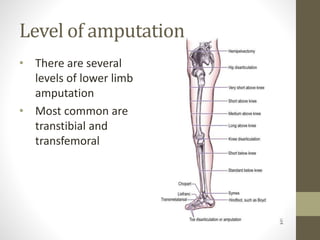
Level of amputation
• There are several
levels of lower limb
amputation
• Most common are
transtibial and
transfemoral
Component of
prosthesis of Lower
Limbs
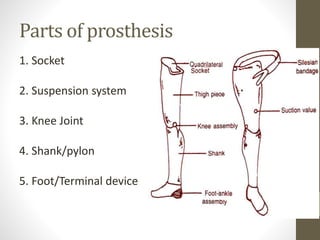
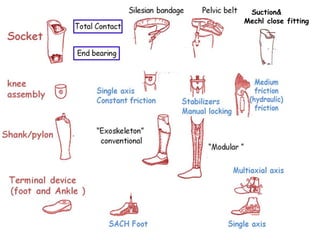
Parts of prosthesis
1. Socket
2. Suspension system
3. Knee Joint
4. Shank/pylon
5. Foot/Terminal device
Suction&
Mechl close fitting
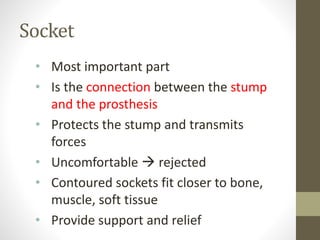
Socket
• Most important part
• Is the connection between the stump
and the prosthesis
• Protects the stump and transmits
forces
• Uncomfortable  rejected
• Contoured sockets fit closer to bone,
muscle, soft tissue
• Provide support and relief
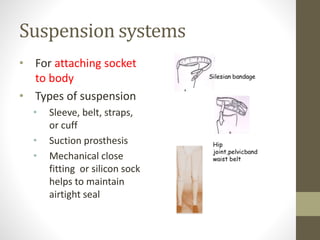
Suspension systems
• For attaching socket
to body
• Types of suspension
• Sleeve, belt, straps,
or cuff
• Suction prosthesis
• Mechanical close
fitting or silicon sock
helps to maintain
airtight seal
Suspension systems materials
• Sleeve – made from
latex
• Cuff – used to hold
prosthesis in residual
limb
• Belt/straps – use a
waist belt with elastic
strap to suspend
prosthesis
• Suction method –
consist of silicon
sleeve with short pin
at the end  will fit
into residual limb and
locks into socket
Knee joint
1. Axis system
2. Friction
3. Stabilizer
Axis system
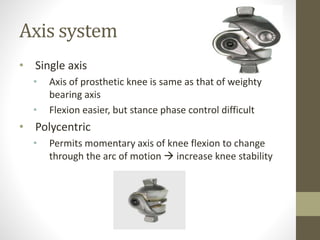
• Single axis
• Axis of prosthetic knee is same as that of weighty
bearing axis
• Flexion easier, but stance phase control difficult
• Polycentric
• Permits momentary axis of knee flexion to change
through the arc of motion  increase knee stability
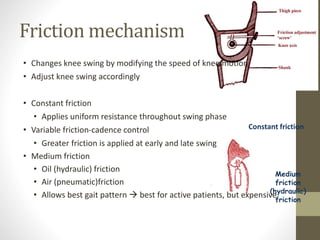
Medium
friction
(hydraulic)
friction
Constant friction
Friction mechanism
• Changes knee swing by modifying the speed of knee motion
• Adjust knee swing accordingly
• Constant friction
• Applies uniform resistance throughout swing phase
• Variable friction-cadence control
• Greater friction is applied at early and late swing
• Medium friction
• Oil (hydraulic) friction
• Air (pneumatic)friction
• Allows best gait pattern  best for active patients, but expensive
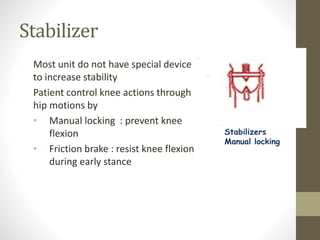
Stabilizers
Manual locking
Stabilizer
Most unit do not have special device
to increase stability
Patient control knee actions through
hip motions by
• Manual locking : prevent knee
flexion
• Friction brake : resist knee flexion
during early stance
Shank/pylon
• Use to connect the socket to the ankle-foot assembly
• Allow axial rotation and absorb, store, and release
energy
Consist of two types
• Exoskeleton
• soft foam contoured to match other limb with hard
outer shell
• Endoskeleton
• internal metal frame with cosmetic soft covering
Ankle-Foot Assembly
Ankle Foot Assembly
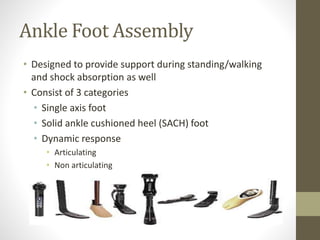
• Designed to provide support during standing/walking
and shock absorption as well
• Consist of 3 categories
• Single axis foot
• Solid ankle cushioned heel (SACH) foot
• Dynamic response
• Articulating
• Non articulating
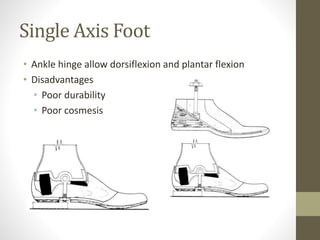
• Ankle hinge allow dorsiflexion and plantar flexion
• Disadvantages
• Poor durability
• Poor cosmesis
Single Axis Foot
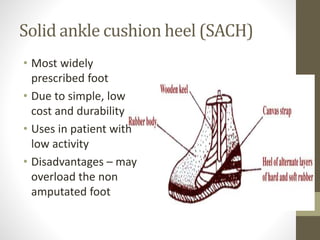
Solid ankle cushion heel (SACH)
• Most widely
prescribed foot
• Due to simple, low
cost and durability
• Uses in patient with
low activity
• Disadvantages – may
overload the non
amputated foot
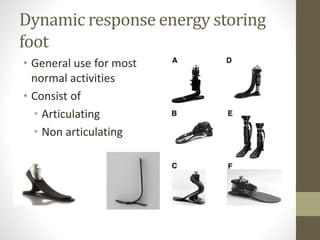
Dynamic response energy storing
foot
• General use for most
normal activities
• Consist of
• Articulating
• Non articulating
Articulating
• Allow motion at the level of human ankle
• Indications
• Patients walking on uneven surfaces
• Advantages
• Absorbs loads and decreases shear forces
• Flexible keels
• acts as a spring to decrease contralateral loading, allow
dorsiflexion, and provide a spring-like push-off
Non articulating
• Have short or long keels
• shorter keels are not as responsive and are indicated
for moderate-activity patients
• longer keels are indicated for high-demand patients
• Different feet for running and lower-demand activities
available
Prescription of prosthesis
• Type of prosthesis required
• Level of amputation
• Material of socket
• Suspension mechanism
• Type of cosmesis required
General Issues
• Choke syndrome
• caused by obstructed venous outflow due to a socket
that is too snug
• acute phase
• red, indurated skin with orange-peel appearance
• chronic phase
• hemosiderin deposits and venous stasis ulcers
• Skin problems
• Contact dermatitis
• most commonly caused by liner, socks, and suspension
mechanism
• treatment
• remove the offending item with symptomatic treatment
• Cysts and excess sweating
• signs of excess shear forces and improperly fitted components
• Scar
• Post operative scar
• Painful residual limb
• possible causes include bony prominences, poorly
fitting prostheses, neuroma formation, and insufficient
soft tissue coverage
• Ineffective suspension system
• Poor socket fit
• Stump volume changes
• Foot alignment abnormalities
Lower Limbs Prosthesis

Lower Limbs Prosthesis

  • 1.
    Lower limb Prosthesis Adib MursyidiIskandar Mirza Orthopedics
  • 2.
    Outline • Definition • Aimof prosthesis • Level of amputations of lower limbs • Components of prosthesis • General issues
  • 3.
    Definition • Prosthesis • Deviceto replace part of the limb or missing limb “substitute” • Orthosis • Externally applied mechanical devices • Support weakened injured, paralyzed, diseased part as supplementation • Prosthetist • Person skilled in prosthetics and its application
  • 4.
    Aim of prosthesis •To substitute for a lost part • To restore lost function • Comfortable ambulation • Minimal/reduce of expenditure of energy • Minimizing the shift of the center of gravity of the body during gait
  • 5.
    Level of amputation •There are several levels of lower limb amputation • Most common are transtibial and transfemoral
  • 6.
  • 7.
    Parts of prosthesis 1.Socket 2. Suspension system 3. Knee Joint 4. Shank/pylon 5. Foot/Terminal device
  • 8.
  • 9.
    Socket • Most importantpart • Is the connection between the stump and the prosthesis • Protects the stump and transmits forces • Uncomfortable  rejected • Contoured sockets fit closer to bone, muscle, soft tissue • Provide support and relief
  • 10.
    Suspension systems • Forattaching socket to body • Types of suspension • Sleeve, belt, straps, or cuff • Suction prosthesis • Mechanical close fitting or silicon sock helps to maintain airtight seal
  • 11.
    Suspension systems materials •Sleeve – made from latex • Cuff – used to hold prosthesis in residual limb • Belt/straps – use a waist belt with elastic strap to suspend prosthesis • Suction method – consist of silicon sleeve with short pin at the end  will fit into residual limb and locks into socket
  • 12.
    Knee joint 1. Axissystem 2. Friction 3. Stabilizer
  • 13.
    Axis system • Singleaxis • Axis of prosthetic knee is same as that of weighty bearing axis • Flexion easier, but stance phase control difficult • Polycentric • Permits momentary axis of knee flexion to change through the arc of motion  increase knee stability
  • 14.
    Medium friction (hydraulic) friction Constant friction Friction mechanism •Changes knee swing by modifying the speed of knee motion • Adjust knee swing accordingly • Constant friction • Applies uniform resistance throughout swing phase • Variable friction-cadence control • Greater friction is applied at early and late swing • Medium friction • Oil (hydraulic) friction • Air (pneumatic)friction • Allows best gait pattern  best for active patients, but expensive
  • 15.
    Stabilizers Manual locking Stabilizer Most unitdo not have special device to increase stability Patient control knee actions through hip motions by • Manual locking : prevent knee flexion • Friction brake : resist knee flexion during early stance
  • 16.
  • 17.
    • Use toconnect the socket to the ankle-foot assembly • Allow axial rotation and absorb, store, and release energy Consist of two types • Exoskeleton • soft foam contoured to match other limb with hard outer shell • Endoskeleton • internal metal frame with cosmetic soft covering
  • 18.
  • 19.
    Ankle Foot Assembly •Designed to provide support during standing/walking and shock absorption as well • Consist of 3 categories • Single axis foot • Solid ankle cushioned heel (SACH) foot • Dynamic response • Articulating • Non articulating
  • 20.
    • Ankle hingeallow dorsiflexion and plantar flexion • Disadvantages • Poor durability • Poor cosmesis Single Axis Foot
  • 21.
    Solid ankle cushionheel (SACH) • Most widely prescribed foot • Due to simple, low cost and durability • Uses in patient with low activity • Disadvantages – may overload the non amputated foot
  • 22.
    Dynamic response energystoring foot • General use for most normal activities • Consist of • Articulating • Non articulating
  • 23.
    Articulating • Allow motionat the level of human ankle • Indications • Patients walking on uneven surfaces • Advantages • Absorbs loads and decreases shear forces • Flexible keels • acts as a spring to decrease contralateral loading, allow dorsiflexion, and provide a spring-like push-off
  • 24.
    Non articulating • Haveshort or long keels • shorter keels are not as responsive and are indicated for moderate-activity patients • longer keels are indicated for high-demand patients • Different feet for running and lower-demand activities available
  • 25.
    Prescription of prosthesis •Type of prosthesis required • Level of amputation • Material of socket • Suspension mechanism • Type of cosmesis required
  • 26.
    General Issues • Chokesyndrome • caused by obstructed venous outflow due to a socket that is too snug • acute phase • red, indurated skin with orange-peel appearance • chronic phase • hemosiderin deposits and venous stasis ulcers
  • 27.
    • Skin problems •Contact dermatitis • most commonly caused by liner, socks, and suspension mechanism • treatment • remove the offending item with symptomatic treatment • Cysts and excess sweating • signs of excess shear forces and improperly fitted components • Scar • Post operative scar
  • 28.
    • Painful residuallimb • possible causes include bony prominences, poorly fitting prostheses, neuroma formation, and insufficient soft tissue coverage
  • 29.
    • Ineffective suspensionsystem • Poor socket fit • Stump volume changes • Foot alignment abnormalities