Adib Mursyidi Iskandar Mirza
A&E Department
• Anatomy
• Pathophysiology
• Thyroid storm
– Etiology
– Early recognition and precipitating factors
– Management
 Myxoedema
– Etiology
– Early recognition and precipitating factors
– Management
• References
 one of the largest endocrine glands
 consists of two connected lobes
 found in the neck, below the thyroid
cartilage (which forms the laryngeal
prominence, or "Adam's apple").
 producing thyroid hormones
 triiodothyronine (T3) and thyroxine
tetraiodothyronine (T4)).
 regulate the growth and rate of function of
many other systems in the body.
 produces calcitonin, which plays a role in
calcium homeostasis.
• Iodide uptake:Na/I
symphorter
• Organification: thyroid
peroxidase (TPO) and
hydrogen peroxide
(HPO)
– R iodide+thyrosyl residual
= di/monothyrosine
• Coupling:
– DiT+DiT =T4
– DiT+ MiT=T3
• Storage
• Release
System Effect of thyroid hormones
CVS  Increase in heart rate, contractility and cardiac output
 Vasodilation
CNS  Mental status alteration
 Excitatory effect
Respiratory  Increase in respiration
Gastrointestinal  Increase in GI motility
Endocrine  Increase in secretion and need for other hormones
 Sudden severe life threatening exacerbation
of hyperthyroidism associated with multiple
organ decompesation
 Mortality rate is 20 – 50 % FATAL
 Most cases secondary to Graves' disease
 Some due to toxic multi-nodular goiter
 Rare causes :
 Malignancies (most do not efficiently produce
thyroid hormones)
 Very rare in children
 Infection, especially pneumonia
 Cerebrovascular accident
 Diabetic ketoacidosis
 Major trauma
 Recent surgery
 Iodine 131 Rx or iodine contrast agents
 Rapid withdrawal of anti-thyroid medications
 In any known case of hyperthyroidism with a
fever
• Fever  indicator of any underlying sepsis or
consequence of thyroid storm
• Tachycardia  usually persist during rest/sleep
• Thyrotoxic symptoms and sign  e.g: weight loss
and tremors
• Multiorgan dysfuctions  CNS, GIT, CVS,
Respiratory
• Hyperpyrexia  underlying sepsis
• Systolic hyper/hypotension, heart failure, atrial
fibrillation/flutter
• Tachycardia out of proportion of fever
• Altered mental status  delirium, agitation, stupor,
coma
• Volume depletion from fever, increased
metabolism, diarrhea
• Stigmata of hyperthyroidism : goitre, tremors, lig
lag/retraction, myopathy
 > 45 : highly suggestive
of storm
 24-44 : suggestive for
impending storm
 < 25 : unlikely to
represent with storm
 Hypoglycemia
 Hypoxia
 Sepsis
 Encephalitis/meningitis
 Alcohol withdrawal/ drug intoxication
 Heat stroke
• Must be managed in critical care are due to
life threatening nature of the disease
- Supply HFM oxygen /Venti mask
- ECG
- Vital signs every 10-15 mins
- SPO2 monitoring
- 2 large bore peripheral lines
 Administered IV fluids – to correct the volume
depletion
 IX: FBC, RP, LFT, Electrolyte, Blood gases,TFT
 Imaging: CXR for evidence of heart failure or
infections
 ECG: presence of ischemia/dysarhythmia
 UFEME, DXT
 Correct the percipitating factors
• Paracetemol , tepid sponging / other cooling technique
B-blocker IV esmolol test dose 250 μg/kg followed by infusion
50μg/min or
Iv propranolol 1mg every 5 min until severe tachycardia
controlled
Oral:
- Propanolol 60mg every 4 hours
- Propanolol 80 mg every 8 hours
PTU 400-600mg PO stat followed by 200-300mg every 4 h
Iodine 1- 2 hours post PTU therapy
- Lugol’s iodine 6-8 drops PO/ryle tube every 8h
- Nbm: IV sodium iodide 1g/500ml saline every 12h
Corticosteroid IV Hydrocortisone 100mg every 8h
IV Dexamethasone 2mg every 6h
 Represents end stage of improperly treated,
neglected, or undiagnosed primary hypothyroidism
 Occurs in 0.1 % or less of cases of hypothyroidism
 Very rare under age 50
 50 % of cases become evident after hospital
admission
 Mortality is 100 % untreated, 50 % even if treated
 Diseases of the :
• Thyroid (primary hypothyroidism) : 95 %
• Pituitary (secondary hypothyroidism) : 4 %
• Hypothalamus (tertiary hypothyroidism) : < 1%
 Can be associated with the multiple endocrine failure
syndromes
 Neurological symptoms: confusion,
lethargy, psychosis (myxoedema madness),
seizures
 Hypothermia: impaired thermogenesis
 Hyponatraemia: renal impairment/SIADH
 Hypoventilation: respiratory acidosis
 Hypoglycemia: decreased gluconeogenesis
 CVS: bradycardia, heart failure, pericardial
effusion, hypotension
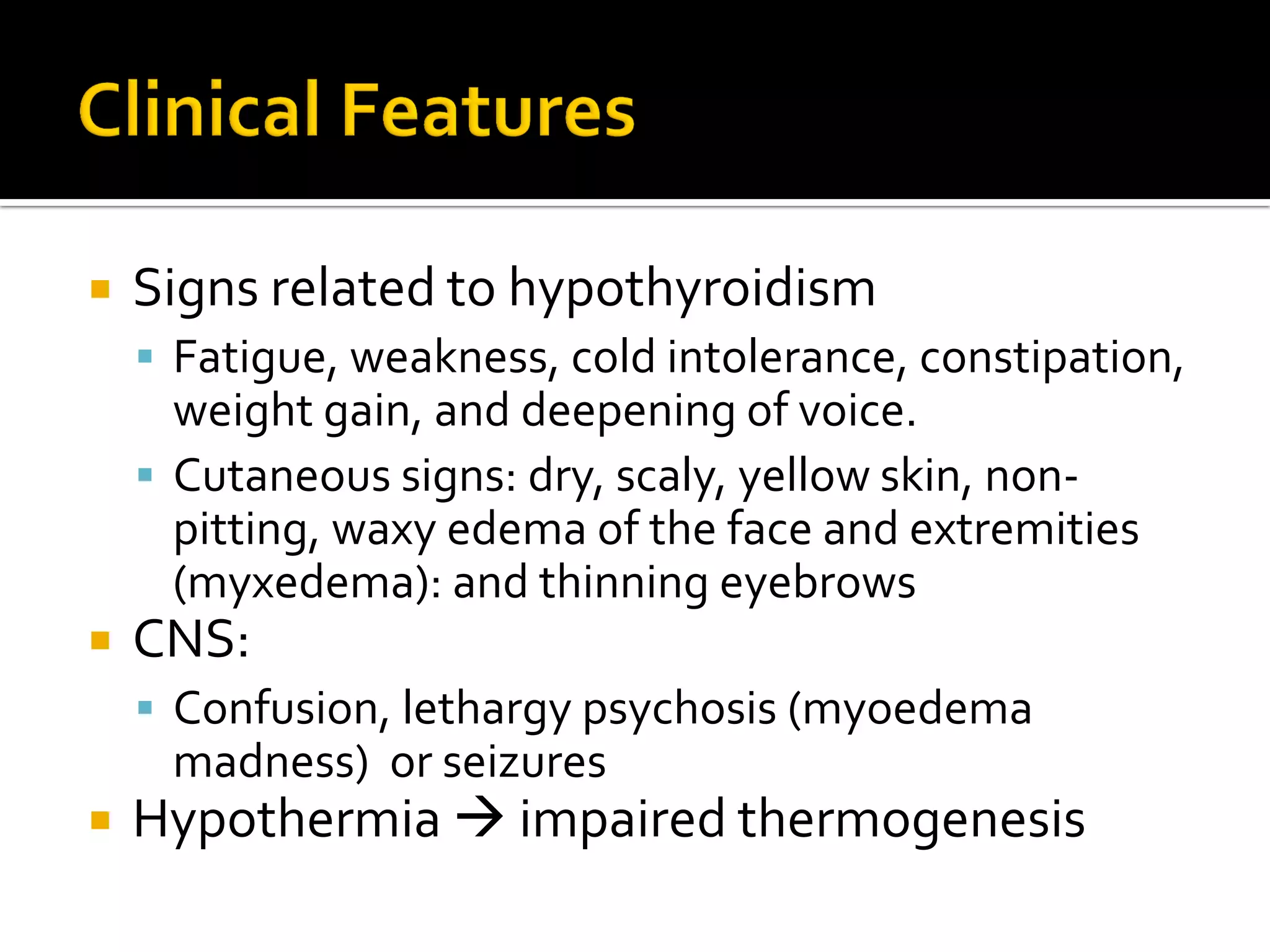
 Signs related to hypothyroidism
 Fatigue, weakness, cold intolerance, constipation,
weight gain, and deepening of voice.
 Cutaneous signs: dry, scaly, yellow skin, non-
pitting, waxy edema of the face and extremities
(myxedema): and thinning eyebrows
 CNS:
 Confusion, lethargy psychosis (myoedema
madness) or seizures
 Hypothermia  impaired thermogenesis
• General appearances: altered mental status
• Vital signs: Bradycardia, hypotension,
hypothermia, hypoventilation
• CVS: muffled heart sound, elevated JVP
• Neurological signs: focal neurological
deficits, tongue laceration (in seizures), slow
ankle reflexes
• Skin: puffy face and carotinemia
• Others: thyroidectomy scars, sepsis evidence
 Blood IX: FBC, RP, CK, ABG,TFT, Cortisol
 DXT
 CXR: look for any cardiomegaly, effusion,
pulmonary edema, pneumonia
 ECG
 Supportive management:
 Vital sign monitoring :Temp, BP, HR, RR, SPO2
 IV access and fluid resuscitation
 Supplemental oxygen
 Warm with heating blanket
 IV Hydrocortisone 100mgTDS
 Medications:
 T3 orT4 (given IV/oral)
 T3 has rapid onset of action and greater biological
activity
 Dose:
 T3: 2.5µgTDS followed by double dose every 2 or
3 days to target dose of 30-40µg per day
 T4: 25µg as test dose, then increase to 500µg on
first day. Subsequent dosing 25-100µg/day
 Treat the precipitating factors
 Hypoglycemia : correction with dextrose saline
 Hyponatremia : slowly infusion of normal saline
 Cardiac failure : diuretics and vasodilators
 Sepsis: IV antibiotics preferred
 To be admitted to high dependency/ICU unit
 Thyroid crises masquerade many illness
 Clinical diagnosis is difficult and requires high
index of suspicious
 To treat the predisposing cause
27 year old female, a master student, presented
with a complaints of back pain and left flank
pain for one day.
Associated severe nausea and vomiting and
palpitations .
She was known case of Graves’
hyperthyroidism with very poor compliance
with the medications as she was busy with
her writing up.
 Examination: Restless, pink , + swelling
around eyelids, + bilateral exophthalmoses,
dehydrated
Temp: 40 C, HR: 132, BP: 120/76
Lungs: clear
Generalised abdominal tenderness, more
towards left flank
Thyroid enlarged with bruit
ECG: Sinus tachycardia
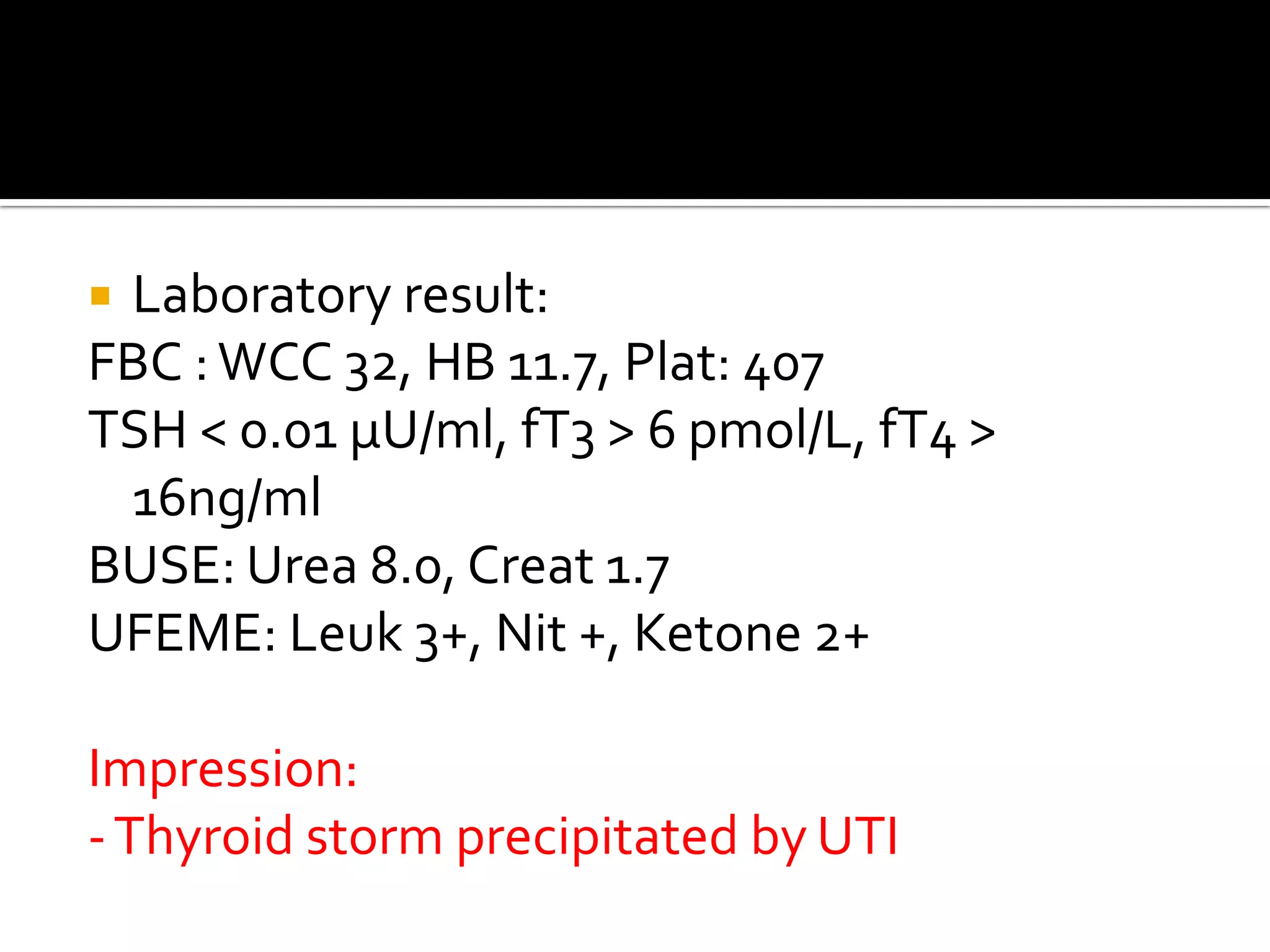
 Laboratory result:
FBC :WCC 32, HB 11.7, Plat: 407
TSH < 0.01 µU/ml, fT3 > 6 pmol/L, fT4 >
16ng/ml
BUSE: Urea 8.0, Creat 1.7
UFEME: Leuk 3+, Nit +, Ketone 2+
Impression:
-Thyroid storm precipitated by UTI
 Burch wartofsky score:
 Temp: 30
 CNS: 10
 GI: 10
 CVS
 -Tachycardia 15
 - CHF: absent
 - AF: absent
 - Precipitating event: 10
 Total: 75
 A case of thyroid strom – JIMSAApril –June 2010Vol. 23 No 2
 “GuideTo the Essentials in Emergency Medicine” by Shirley ooi and Peter
Manning 2md edition , 2015
 Thyroid Strom, an emergency of thyroid
http://www.medicinenet.com/thyroid_storm_symptoms_causes_and_tr
eatment/views.htm
 “identifying and treating thyroid storm and myxoedema coma in the Ed
“ Emergency medicine Prac . August 2009

Thyroid Storms Emergency and Myxedema Crisis

  • 1.
    Adib Mursyidi IskandarMirza A&E Department
  • 2.
    • Anatomy • Pathophysiology •Thyroid storm – Etiology – Early recognition and precipitating factors – Management  Myxoedema – Etiology – Early recognition and precipitating factors – Management • References
  • 3.
     one ofthe largest endocrine glands  consists of two connected lobes  found in the neck, below the thyroid cartilage (which forms the laryngeal prominence, or "Adam's apple").  producing thyroid hormones  triiodothyronine (T3) and thyroxine tetraiodothyronine (T4)).  regulate the growth and rate of function of many other systems in the body.  produces calcitonin, which plays a role in calcium homeostasis.
  • 4.
    • Iodide uptake:Na/I symphorter •Organification: thyroid peroxidase (TPO) and hydrogen peroxide (HPO) – R iodide+thyrosyl residual = di/monothyrosine • Coupling: – DiT+DiT =T4 – DiT+ MiT=T3 • Storage • Release
  • 6.
    System Effect ofthyroid hormones CVS  Increase in heart rate, contractility and cardiac output  Vasodilation CNS  Mental status alteration  Excitatory effect Respiratory  Increase in respiration Gastrointestinal  Increase in GI motility Endocrine  Increase in secretion and need for other hormones
  • 7.
     Sudden severelife threatening exacerbation of hyperthyroidism associated with multiple organ decompesation  Mortality rate is 20 – 50 % FATAL
  • 8.
     Most casessecondary to Graves' disease  Some due to toxic multi-nodular goiter  Rare causes :  Malignancies (most do not efficiently produce thyroid hormones)  Very rare in children
  • 9.
     Infection, especiallypneumonia  Cerebrovascular accident  Diabetic ketoacidosis  Major trauma  Recent surgery  Iodine 131 Rx or iodine contrast agents  Rapid withdrawal of anti-thyroid medications
  • 10.
     In anyknown case of hyperthyroidism with a fever • Fever  indicator of any underlying sepsis or consequence of thyroid storm • Tachycardia  usually persist during rest/sleep • Thyrotoxic symptoms and sign  e.g: weight loss and tremors • Multiorgan dysfuctions  CNS, GIT, CVS, Respiratory
  • 11.
    • Hyperpyrexia underlying sepsis • Systolic hyper/hypotension, heart failure, atrial fibrillation/flutter • Tachycardia out of proportion of fever • Altered mental status  delirium, agitation, stupor, coma • Volume depletion from fever, increased metabolism, diarrhea • Stigmata of hyperthyroidism : goitre, tremors, lig lag/retraction, myopathy
  • 12.
     > 45: highly suggestive of storm  24-44 : suggestive for impending storm  < 25 : unlikely to represent with storm
  • 13.
     Hypoglycemia  Hypoxia Sepsis  Encephalitis/meningitis  Alcohol withdrawal/ drug intoxication  Heat stroke
  • 14.
    • Must bemanaged in critical care are due to life threatening nature of the disease - Supply HFM oxygen /Venti mask - ECG - Vital signs every 10-15 mins - SPO2 monitoring - 2 large bore peripheral lines
  • 15.
     Administered IVfluids – to correct the volume depletion  IX: FBC, RP, LFT, Electrolyte, Blood gases,TFT  Imaging: CXR for evidence of heart failure or infections  ECG: presence of ischemia/dysarhythmia  UFEME, DXT  Correct the percipitating factors • Paracetemol , tepid sponging / other cooling technique
  • 17.
    B-blocker IV esmololtest dose 250 μg/kg followed by infusion 50μg/min or Iv propranolol 1mg every 5 min until severe tachycardia controlled Oral: - Propanolol 60mg every 4 hours - Propanolol 80 mg every 8 hours PTU 400-600mg PO stat followed by 200-300mg every 4 h Iodine 1- 2 hours post PTU therapy - Lugol’s iodine 6-8 drops PO/ryle tube every 8h - Nbm: IV sodium iodide 1g/500ml saline every 12h Corticosteroid IV Hydrocortisone 100mg every 8h IV Dexamethasone 2mg every 6h
  • 19.
     Represents endstage of improperly treated, neglected, or undiagnosed primary hypothyroidism  Occurs in 0.1 % or less of cases of hypothyroidism  Very rare under age 50  50 % of cases become evident after hospital admission  Mortality is 100 % untreated, 50 % even if treated
  • 20.
     Diseases ofthe : • Thyroid (primary hypothyroidism) : 95 % • Pituitary (secondary hypothyroidism) : 4 % • Hypothalamus (tertiary hypothyroidism) : < 1%  Can be associated with the multiple endocrine failure syndromes
  • 21.
     Neurological symptoms:confusion, lethargy, psychosis (myxoedema madness), seizures  Hypothermia: impaired thermogenesis  Hyponatraemia: renal impairment/SIADH  Hypoventilation: respiratory acidosis  Hypoglycemia: decreased gluconeogenesis  CVS: bradycardia, heart failure, pericardial effusion, hypotension
  • 22.
     Signs relatedto hypothyroidism  Fatigue, weakness, cold intolerance, constipation, weight gain, and deepening of voice.  Cutaneous signs: dry, scaly, yellow skin, non- pitting, waxy edema of the face and extremities (myxedema): and thinning eyebrows  CNS:  Confusion, lethargy psychosis (myoedema madness) or seizures  Hypothermia  impaired thermogenesis
  • 23.
    • General appearances:altered mental status • Vital signs: Bradycardia, hypotension, hypothermia, hypoventilation • CVS: muffled heart sound, elevated JVP • Neurological signs: focal neurological deficits, tongue laceration (in seizures), slow ankle reflexes • Skin: puffy face and carotinemia • Others: thyroidectomy scars, sepsis evidence
  • 24.
     Blood IX:FBC, RP, CK, ABG,TFT, Cortisol  DXT  CXR: look for any cardiomegaly, effusion, pulmonary edema, pneumonia  ECG
  • 25.
     Supportive management: Vital sign monitoring :Temp, BP, HR, RR, SPO2  IV access and fluid resuscitation  Supplemental oxygen  Warm with heating blanket  IV Hydrocortisone 100mgTDS
  • 26.
     Medications:  T3orT4 (given IV/oral)  T3 has rapid onset of action and greater biological activity  Dose:  T3: 2.5µgTDS followed by double dose every 2 or 3 days to target dose of 30-40µg per day  T4: 25µg as test dose, then increase to 500µg on first day. Subsequent dosing 25-100µg/day
  • 27.
     Treat theprecipitating factors  Hypoglycemia : correction with dextrose saline  Hyponatremia : slowly infusion of normal saline  Cardiac failure : diuretics and vasodilators  Sepsis: IV antibiotics preferred
  • 28.
     To beadmitted to high dependency/ICU unit
  • 29.
     Thyroid crisesmasquerade many illness  Clinical diagnosis is difficult and requires high index of suspicious  To treat the predisposing cause
  • 30.
    27 year oldfemale, a master student, presented with a complaints of back pain and left flank pain for one day. Associated severe nausea and vomiting and palpitations . She was known case of Graves’ hyperthyroidism with very poor compliance with the medications as she was busy with her writing up.
  • 31.
     Examination: Restless,pink , + swelling around eyelids, + bilateral exophthalmoses, dehydrated Temp: 40 C, HR: 132, BP: 120/76 Lungs: clear Generalised abdominal tenderness, more towards left flank Thyroid enlarged with bruit ECG: Sinus tachycardia
  • 32.
     Laboratory result: FBC:WCC 32, HB 11.7, Plat: 407 TSH < 0.01 µU/ml, fT3 > 6 pmol/L, fT4 > 16ng/ml BUSE: Urea 8.0, Creat 1.7 UFEME: Leuk 3+, Nit +, Ketone 2+ Impression: -Thyroid storm precipitated by UTI
  • 33.
     Burch wartofskyscore:  Temp: 30  CNS: 10  GI: 10  CVS  -Tachycardia 15  - CHF: absent  - AF: absent  - Precipitating event: 10  Total: 75
  • 34.
     A caseof thyroid strom – JIMSAApril –June 2010Vol. 23 No 2  “GuideTo the Essentials in Emergency Medicine” by Shirley ooi and Peter Manning 2md edition , 2015  Thyroid Strom, an emergency of thyroid http://www.medicinenet.com/thyroid_storm_symptoms_causes_and_tr eatment/views.htm  “identifying and treating thyroid storm and myxoedema coma in the Ed “ Emergency medicine Prac . August 2009