UPPER LIMB PROSTHESISUPPER LIMB PROSTHESIS
Astha PatniAstha Patni
IntroductionIntroduction
• Upper limb prosthesis designed to
replace, as much as possible, the
function or appearance of a missing
limb or body part
• Prosthesis can replace some grasping
and manipulating functions of hand
• No sensory feedback
• Role of dominant function replaced to
contra-lateral hand and prosthesis
assists bimanual function
• A successful prosthesis
– comfortable to wear
– easy to don and doff
– light weight and durable
– cosmetically pleasing
– must function well mechanically
– have reasonable maintenance
– motivation of the individual
• Factors
– Amputation level
– Expected function of the prosthesis
– Cognitive function of the patient
– Vocation of the patient
– Avocational interests of the patient
– Cosmetic importance of the prosthesis
– Financial resources of the patient
• Reasons for upper limb amputation
– 0-15 years: Correction of a congenital
deformity or tumor
– 15-45 years: Trauma, tumor
– 60 years: Rare ; tumor or medical
disease
AMPUTATION LEVELSAMPUTATION LEVELS
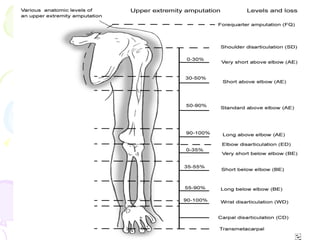
• Transphalangeal amputation: Resection of the
thumb or fingers at distal interphalangeal (DIP),
proximal interphalangeal (PIP), or
metacarpophalangeal (MCP) levels, or at any
level in between
• Transmetacarpal amputation: Resection
through the metacarpals
• Transcarpal amputation: Resection through
the carpal bones
• Wrist disarticulation: Transection between the
carpals and radius/ulna
AMPUTATION LEVELSAMPUTATION LEVELS
• Transradial amputation: Below-elbow amputation
(may be classified as long, medium, or short)
• Elbow disarticulation: Transection through the elbow
joint
• Transhumeral amputation - Above-elbow (Standard
length is 50-90% of humeral length.)
• Shoulder disarticulation: Transection through the
shoulder joint
• Interscapulothoracic disarticulation (forequarter):
Amputation removing the entire shoulder girdle (scapula
and all or part of the clavicle
TYPES
• Body powered or conventional
• External powered or electric
• Cosmetic or passive
• Hybrid
Body powered orBody powered or
conventionalconventional
• Pros
– low cost
– Moderately lightweight
– Most durable
• Cons
– Most body movement to operate
– Most harnessing
– Least satisfactory appearance
External powered or electricExternal powered or electric
• Pros
– Moderate or no harnessing
– Least body movement to operate
– Moderate cosmesis
– More function – proximal levels
• Cons
– Heaviest
– Most expensive
– High maintenance
– Limited sensory feedback
Cosmetic or passiveCosmetic or passive
• Pros
– Most lightweight
– Best cosmesis
– Least harnessing
• Cons
– High cost if custom made
– Least function
Upper limb prosthesisUpper limb prosthesis
• Prosthetic components
– Terminal devices
– Wrists
– Elbows
– Shoulders
• Socket
• Suspension
Terminal devicesTerminal devices
• Functional activities of hand
– Non prehensile
– Prehensile
Terminal devicesTerminal devices
• Non prehensile
– Touching, feeling, pressing down with
fingers, tapping, vibrating the cord of
musical instrument, lifting or pushing
with hand
• Prehensile
– Precision grip (i.e. pincher grip), Tripod
grip, Lateral grip, Hook power grip,
Spherical grip
Terminal devicesTerminal devices
• Active
– Hooks
– Functional hands
– Activity specific devices
• Passive
– Cosmetic hands
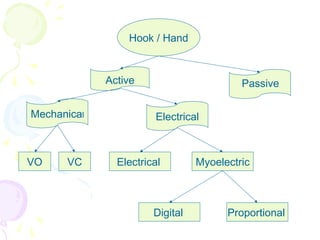
Hook / Hand
Mechanical Electrical
VO VC Electrical Myoelectric
Digital Proportional
PassiveActive
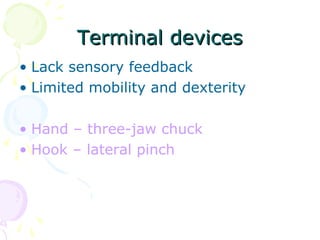
Terminal devicesTerminal devices
• Lack sensory feedback
• Limited mobility and dexterity
• Hand – three-jaw chuck
• Hook – lateral pinch
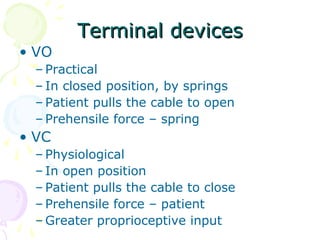
Terminal devicesTerminal devices
• VO
– Practical
– In closed position, by springs
– Patient pulls the cable to open
– Prehensile force – spring
• VC
– Physiological
– In open position
– Patient pulls the cable to close
– Prehensile force – patient
– Greater proprioceptive input
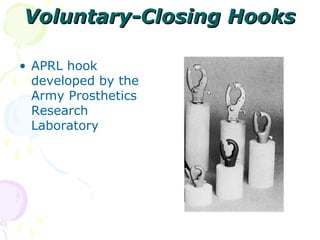
Voluntary-Closing HooksVoluntary-Closing Hooks
• APRL hook
developed by the
Army Prosthetics
Research
Laboratory
Voluntary-Opening HookVoluntary-Opening Hook
Terminal DevicesTerminal Devices
• Hosmer-Dorrance work hooks
• Sierra two-load hook
• United States Manufacturing
Company (USMC) hook
• CAPP terminal device (originally
developed at the Child Amputee
Prosthetics Project at UCLA)
• Otto Bock and Hugh Steeper
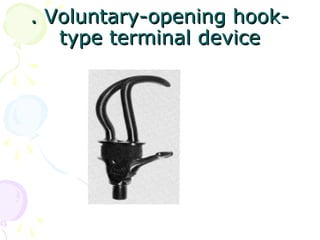
. Voluntary-opening hook-. Voluntary-opening hook-
type terminal devicetype terminal device
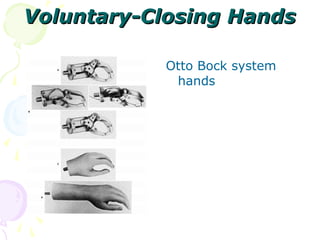
Voluntary-Closing HandsVoluntary-Closing Hands
Otto Bock system
hands
Voluntary-Opening HandsVoluntary-Opening Hands
• Becker Plylite Hand
• Becker Lock-Grip and Imperial
Hands.
• Robin-Aids Mechanical Hand
• Robin-Aids Soft Mechanical Hand
• Sierra Voluntary-Opening Hand
• Hosmer-Dorrance Functional
Hands
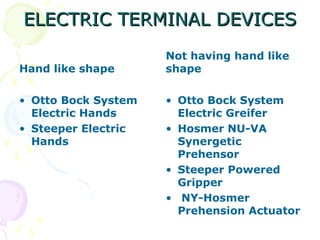
ELECTRIC TERMINAL DEVICESELECTRIC TERMINAL DEVICES
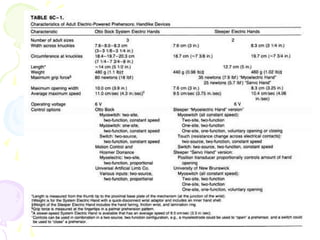
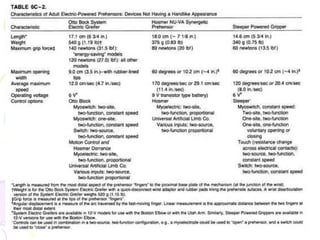
Hand like shape
• Otto Bock System
Electric Hands
• Steeper Electric
Hands
Not having hand like
shape
• Otto Bock System
Electric Greifer
• Hosmer NU-VA
Synergetic
Prehensor
• Steeper Powered
Gripper
• NY-Hosmer
Prehension Actuator
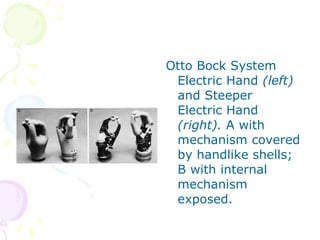
Otto Bock System
Electric Hand (left)
and Steeper
Electric Hand
(right). A with
mechanism covered
by handlike shells;
B with internal
mechanism
exposed.
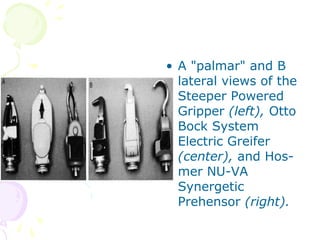
• A "palmar" and B
lateral views of the
Steeper Powered
Gripper (left), Otto
Bock System
Electric Greifer
(center), and Hos-
mer NU-VA
Synergetic
Prehensor (right).
Myoelectric controlMyoelectric control
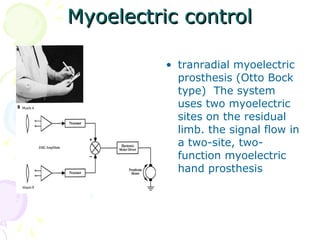
• tranradial myoelectric
prosthesis (Otto Bock
type) The system
uses two myoelectric
sites on the residual
limb. the signal flow in
a two-site, two-
function myoelectric
hand prosthesis
Activity specific devicesActivity specific devices
• Farming
• Construction
• Cooking
• Photography
• Sports: golf, fishing, skiing
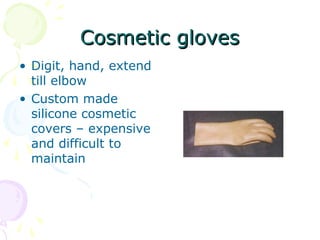
Cosmetic glovesCosmetic gloves
• Digit, hand, extend
till elbow
• Custom made
silicone cosmetic
covers – expensive
and difficult to
maintain
Prosthetic wristsProsthetic wrists
• Provide receptacle for connecting
terminal device
• Pronosupination or flexion based on
functional activities of patient
Prosthetic wristsProsthetic wrists
Types
• Mechanical
– Pronosupination
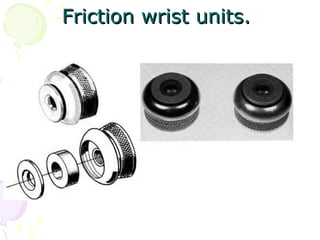
• Friction (Can rotate)
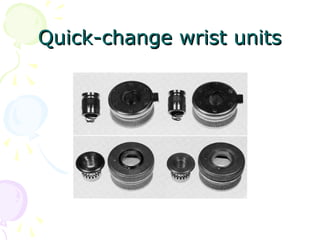
• Quick-disconnect
• Spring-assisted (B/L amputee)
– Flexion (B/L amputee , longer side)
• Spring-assisted internal or external
Prosthetic wristsProsthetic wrists
• Electric (B/L trans-humeral)
– Pronosupination
• Myoelectric (B/L amputee)
• Switch control
Friction wrist units.Friction wrist units.
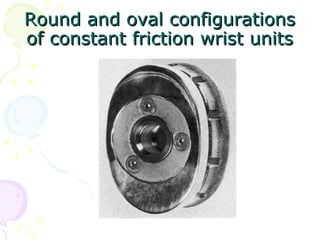
Round and oval configurationsRound and oval configurations
of constant friction wrist unitsof constant friction wrist units
Quick-change wrist unitsQuick-change wrist units
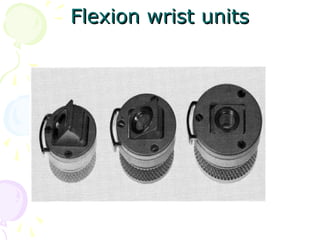
Flexion wrist unitsFlexion wrist units
Electric wrist unitsElectric wrist units
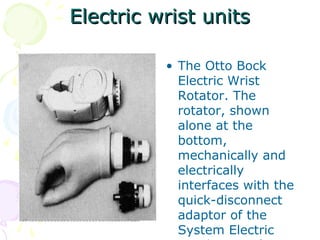
• The Otto Bock
Electric Wrist
Rotator. The
rotator, shown
alone at the
bottom,
mechanically and
electrically
interfaces with the
quick-disconnect
adaptor of the
System Electric
Prosthetic elbowsProsthetic elbows
Classification
• Body-powered elbow
– External with or without spring assisted
flexion (elbow disarticulation)
– Internal, with or without spring assisted
flexion
– Internal, with rotating turntable (allows
internal/ external rotation)
Prosthetic elbowsProsthetic elbows
• Externally powered elbow
– Digital switch control
– Proportional switch control
– Digital myoelectric control
– Proportional myoelectric control
• Passive elbow
– Manual lock
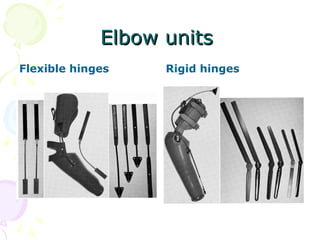
Elbow unitsElbow units
Flexible hinges Rigid hinges
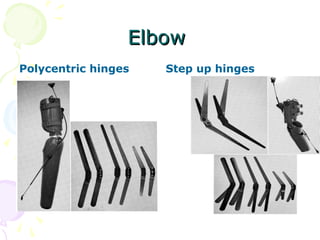
ElbowElbow
Polycentric hinges Step up hinges
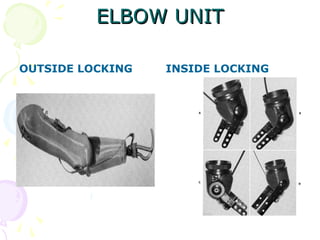
ELBOW UNITELBOW UNIT
OUTSIDE LOCKING INSIDE LOCKING
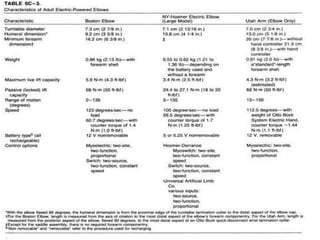
Electrical powered elbowsElectrical powered elbows
• Boston Elbow,
• NY-Hosmer Electric Elbow,
• Utah Arm.
These elbows differ from one
another in mechanical configuration,
drive mechanism, and control
options.
Prosthetic socketsProsthetic sockets
Functions
– Comfortable residual limb – prosthesis
interface
– Efficient energy transference to the
prosthesis
– Secure suspension of the prosthesis
– Adequate cosmesis
Prosthetic socketsProsthetic sockets
• Wood
– Chronic edema
– Trophic skin changes
• Plastic
– Total contact
– Decreased weight
– Increased durability
Prosthetic socketsProsthetic sockets
• Two layers
• Inner-contoured to the residual limb
• External- gives length and shape
• Components are attached to external
layer
Prosthetic socketsProsthetic sockets
• Process
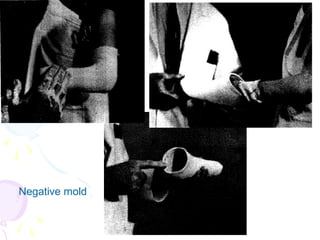
– Negative impression of residual limb
(POP)
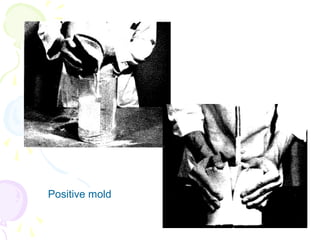
– Positive mold
– Modify positive mold (remove from
pressure tolerant and add to pressure
sensitive)
– Transparent / check socket
– Trial fit and modify
– New positive mold
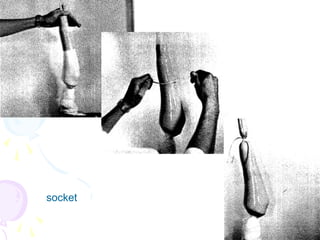
– Final socket
Negative mold
Positive mold
socket
Various socketsVarious sockets
• Wrist disarticulation socket
• long Below elbow socket
• Short below elbow socket
• Very short below elbow socket
[ Split sockets]
Muenster sockets
• Elbow disarticulation socket
• Standard above elbow socket
• Short above elbow socket
• Shoulder disarticulation socket
• Forequarter amputation socket
Suspension systemsSuspension systems
• Functions
– Suspension – securing prosthesis to
residual limb
– Control of prosthesis / terminal devices
• Types
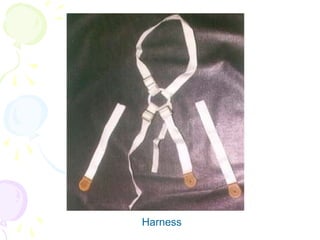
– Harness
• Figure of 8 (traditional)
• Chest strap (proximal amputation)
• Shoulder saddle (proximal amputation)
Harness
Suspension systemsSuspension systems
• Self suspension
– Condylar
– Muenster (Self suspending; Not
preferred in B/L transradial amputation)
– Northwestern
• Semisuction
– Hypobaric
– Semisuction
• Suction
– Full suction
– Silicone sock
Suction suspension
preferred for
Tranhumeral
amputee with normal
contrlateral limb
• Sock
• Interface between residual limb and
socket
• Layers adjustable to volume changes
• Protect skin and improve hygiene
• Socks with special silicone band and
socket with one way valve are used in
semisuction type of suspension systems
Silicone suction suspensionSilicone suction suspension
• Kristinsson in 1986
• Improved suspension with negative
atmospheric pressure
• Reduction of shear forces on skin
• Allows volume adjustment with
residual limb girth changes
• Simplified donning, better elbow
range of motion, lighter
Silicone suction suspensionSilicone suction suspension
• Silicone sleeve with distal
attachment pin that fits into shuttle
lock mechanism in socket
• Rolls silicone liner directly over skin
after spraying alcohol
• Socks over silicone to improve fit
Silicone suction suspensionSilicone suction suspension
• Patients with problems of skin
integrity
– Skin grafting for burns,
– degloving injury,
– insensate skin (diabetes, scleroderma),
– adhesive scar tissue
Control mechanismsControl mechanisms
• Body powered (harness)
– Scapular abduction
– Chest expansion
– Shoulder depression, extension,
abduction, flexion
– Elbow flexion, extension
• Discomfort
• Less cosmetic
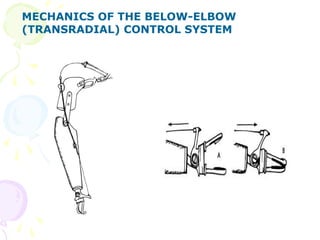
MECHANICS OF THE BELOW-ELBOW
(TRANSRADIAL) CONTROL SYSTEM
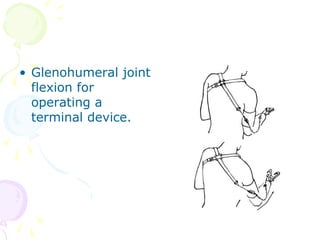
• Glenohumeral joint
flexion for
operating a
terminal device.
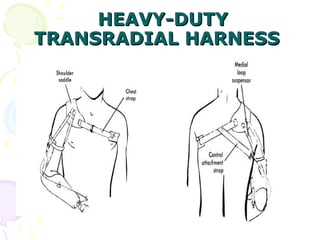
HEAVY-DUTYHEAVY-DUTY
TRANSRADIAL HARNESSTRANSRADIAL HARNESS
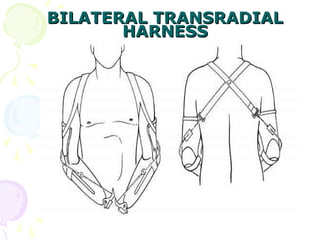
BILATERAL TRANSRADIALBILATERAL TRANSRADIAL
HARNESSHARNESS
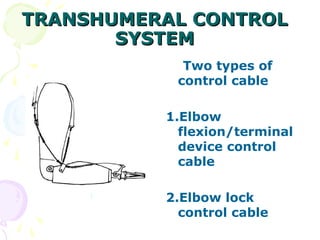
TRANSHUMERAL CONTROLTRANSHUMERAL CONTROL
SYSTEMSYSTEM
Two types of
control cable
1.Elbow
flexion/terminal
device control
cable
2.Elbow lock
control cable
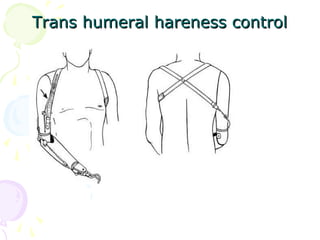
Trans humeral hareness controlTrans humeral hareness control
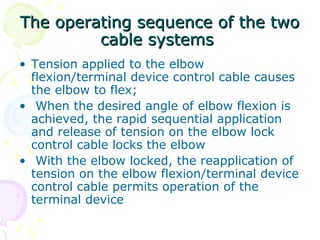
The operating sequence of the twoThe operating sequence of the two
cable systemscable systems
• Tension applied to the elbow
flexion/terminal device control cable causes
the elbow to flex;
• When the desired angle of elbow flexion is
achieved, the rapid sequential application
and release of tension on the elbow lock
control cable locks the elbow
• With the elbow locked, the reapplication of
tension on the elbow flexion/terminal device
control cable permits operation of the
terminal device
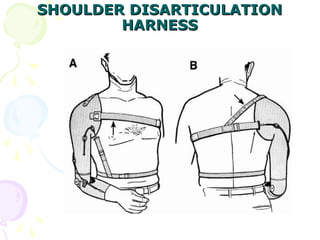
SHOULDER DISARTICULATIONSHOULDER DISARTICULATION
HARNESSHARNESS
Control mechanismsControl mechanisms
• Externally powered prostheses
• Electric motors inside prosthesis for
wrist rotation / elbow flexion or
extension
• Motors controlled by switches,
myoelectric signals, acoustic signals
Control mechanismsControl mechanisms
Switch
• Inside or outside socket
• Activated on contact by amputee
Control mechanismsControl mechanisms
Myoelectric controls
• Electrical activity generated during
muscle contraction to control flow of
energy from a battery to a motor in
prosthetic device
• Antagonistic muscles in distal portion
with normal voluntary activity
Control mechanismsControl mechanisms
Myoelectric controls
• Electrodes inside socket detect muscle
action potentials, amplify them to turn
on motor which brings about
movements
• Single channel: two electrode sites, one
for each function (open & close terminal
device)
• Multi-channel: single electrode,
amplitude of signal determines function
Control mechanismsControl mechanisms
Myoelectric controls
• High cost
• Low reliability
• Heavy (motors, batteries)
– India: electrodes rust quickly because of
sweat, electronic circuits fail due to dust
/ sweat
Prostheses by level ofProstheses by level of
amputationamputation
Prostheses by level ofProstheses by level of
amputationamputation
Partial hand
• Prosthesis not necessary
• Surgical reconstruction – opposition –
for prehension with proprioception
Prostheses by level ofProstheses by level of
amputationamputation
• Wrist disarticulation
– Distal radial-ulnar articulation preserved
for prono-supination
– Socket: tapered and flattened distally
forming an oval shape
– Wrist unit: thin, to minimize length
– Cosmetically: trans radial
Prostheses by level ofProstheses by level of
amputationamputation
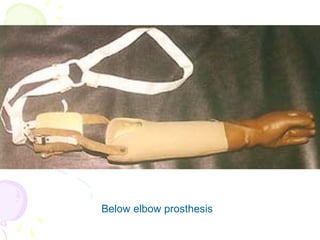
Transradial amputation
Classification (based on length)
• Very short (<35%): rigid elbow hinges
• Short (35-55%): <60º pronosupination,
flexible elbow hinges
• Long (55-90%): 60-120 º
pronosupination, flexible elbow hinges
Below elbow prosthesis
Prostheses by level ofProstheses by level of
amputationamputation
Transradial amputation with decreased
elbow ROM
• Polycentric elbow joints or split socket
with step-up hinges used to provide
additional flexion
• Decreased elbow flexion power
Prostheses by level ofProstheses by level of
amputationamputation
Elbow disarticulation
• Sockets: flat and broad distally (like
epicondyles)
• External elbow joint with cable operated
lock in medial joint
• Suspension: figure of 8, shoulder
saddle, chest strap
• Control system: 2 cables, one to lock
the elbow, other opens terminal device
or flexes elbow
Prostheses by level ofProstheses by level of
amputationamputation
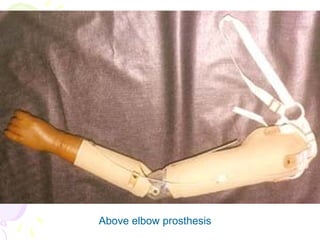
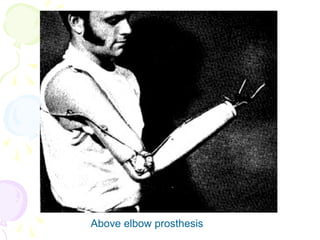
Transhumeral amputation
Classification (based on length of
humerus)
• Very short (<30%)
• Short (30-50%)
• Standard (50-90%)
Prostheses by level ofProstheses by level of
amputationamputation
Transhumeral amputation
• Sockets:
– Residual limb greater than 35% -
proximal trimline within 1cm of
acromion, suspension with figure of 8,
shoulder saddle, or chest strap
– Residual limb smaller than 35% -
proximal trimline 2.5cm medial to
acromion, suspension with chest strap
or suction socket
Prostheses by level ofProstheses by level of
amputationamputation
Transhumeral amputation
• Elbow joint
– Internal elbow joint
• Preferred
• Level of amputation 4 cm or more proximal from
epicondyles
• Allows passive internal / external rotation
• Elbow spring-lift assist available
– External elbow joint
• Distal amputation
• Maintains elbow center with contralateral side
Prostheses by level ofProstheses by level of
amputationamputation
Transhumeral amputation
• Control system
– Dual cable (like elbow disarticulation)
Above elbow prosthesis
Shoulder disarticulation andShoulder disarticulation and
forequarter amputationforequarter amputation
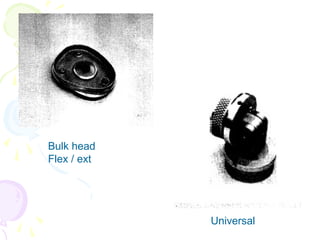
• Socket
– Extends to thorax
– Open –frame socket to decrease weight
and heat
• Similar to transhumeral + shoulder
unit
Bulk head
Flex / ext
Universal
Shoulder disarticulation andShoulder disarticulation and
forequarter amputationforequarter amputation
• Control:
– Triple cable system
– One for elbow flexion when opposite
humerus is flexed
– Second cable opens terminal device with
chest expansion
– Third cable locks / unlocks elbow with
chin / opposite hand
Shoulder disarticulation andShoulder disarticulation and
forequarter amputationforequarter amputation
• Externally powered prosthesis
preferred
• Passive cosmetic prosthetic
restoration in some patients
Upper limb prosthesis (pmr)

Upper limb prosthesis (pmr)

  • 1.
    UPPER LIMB PROSTHESISUPPERLIMB PROSTHESIS Astha PatniAstha Patni
  • 2.
    IntroductionIntroduction • Upper limbprosthesis designed to replace, as much as possible, the function or appearance of a missing limb or body part • Prosthesis can replace some grasping and manipulating functions of hand • No sensory feedback • Role of dominant function replaced to contra-lateral hand and prosthesis assists bimanual function
  • 3.
    • A successfulprosthesis – comfortable to wear – easy to don and doff – light weight and durable – cosmetically pleasing – must function well mechanically – have reasonable maintenance – motivation of the individual
  • 4.
    • Factors – Amputationlevel – Expected function of the prosthesis – Cognitive function of the patient – Vocation of the patient – Avocational interests of the patient – Cosmetic importance of the prosthesis – Financial resources of the patient
  • 5.
    • Reasons forupper limb amputation – 0-15 years: Correction of a congenital deformity or tumor – 15-45 years: Trauma, tumor – 60 years: Rare ; tumor or medical disease
  • 6.
    AMPUTATION LEVELSAMPUTATION LEVELS •Transphalangeal amputation: Resection of the thumb or fingers at distal interphalangeal (DIP), proximal interphalangeal (PIP), or metacarpophalangeal (MCP) levels, or at any level in between • Transmetacarpal amputation: Resection through the metacarpals • Transcarpal amputation: Resection through the carpal bones • Wrist disarticulation: Transection between the carpals and radius/ulna
  • 7.
    AMPUTATION LEVELSAMPUTATION LEVELS •Transradial amputation: Below-elbow amputation (may be classified as long, medium, or short) • Elbow disarticulation: Transection through the elbow joint • Transhumeral amputation - Above-elbow (Standard length is 50-90% of humeral length.) • Shoulder disarticulation: Transection through the shoulder joint • Interscapulothoracic disarticulation (forequarter): Amputation removing the entire shoulder girdle (scapula and all or part of the clavicle
  • 9.
    TYPES • Body poweredor conventional • External powered or electric • Cosmetic or passive • Hybrid
  • 10.
    Body powered orBodypowered or conventionalconventional • Pros – low cost – Moderately lightweight – Most durable • Cons – Most body movement to operate – Most harnessing – Least satisfactory appearance
  • 11.
    External powered orelectricExternal powered or electric • Pros – Moderate or no harnessing – Least body movement to operate – Moderate cosmesis – More function – proximal levels • Cons – Heaviest – Most expensive – High maintenance – Limited sensory feedback
  • 12.
    Cosmetic or passiveCosmeticor passive • Pros – Most lightweight – Best cosmesis – Least harnessing • Cons – High cost if custom made – Least function
  • 13.
    Upper limb prosthesisUpperlimb prosthesis • Prosthetic components – Terminal devices – Wrists – Elbows – Shoulders • Socket • Suspension
  • 14.
    Terminal devicesTerminal devices •Functional activities of hand – Non prehensile – Prehensile
  • 15.
    Terminal devicesTerminal devices •Non prehensile – Touching, feeling, pressing down with fingers, tapping, vibrating the cord of musical instrument, lifting or pushing with hand • Prehensile – Precision grip (i.e. pincher grip), Tripod grip, Lateral grip, Hook power grip, Spherical grip
  • 16.
    Terminal devicesTerminal devices •Active – Hooks – Functional hands – Activity specific devices • Passive – Cosmetic hands
  • 17.
    Hook / Hand MechanicalElectrical VO VC Electrical Myoelectric Digital Proportional PassiveActive
  • 18.
    Terminal devicesTerminal devices •Lack sensory feedback • Limited mobility and dexterity • Hand – three-jaw chuck • Hook – lateral pinch
  • 19.
    Terminal devicesTerminal devices •VO – Practical – In closed position, by springs – Patient pulls the cable to open – Prehensile force – spring • VC – Physiological – In open position – Patient pulls the cable to close – Prehensile force – patient – Greater proprioceptive input
  • 20.
    Voluntary-Closing HooksVoluntary-Closing Hooks •APRL hook developed by the Army Prosthetics Research Laboratory
  • 21.
    Voluntary-Opening HookVoluntary-Opening Hook TerminalDevicesTerminal Devices • Hosmer-Dorrance work hooks • Sierra two-load hook • United States Manufacturing Company (USMC) hook • CAPP terminal device (originally developed at the Child Amputee Prosthetics Project at UCLA) • Otto Bock and Hugh Steeper
  • 22.
    . Voluntary-opening hook-.Voluntary-opening hook- type terminal devicetype terminal device
  • 23.
  • 24.
    Voluntary-Opening HandsVoluntary-Opening Hands •Becker Plylite Hand • Becker Lock-Grip and Imperial Hands. • Robin-Aids Mechanical Hand • Robin-Aids Soft Mechanical Hand • Sierra Voluntary-Opening Hand • Hosmer-Dorrance Functional Hands
  • 25.
    ELECTRIC TERMINAL DEVICESELECTRICTERMINAL DEVICES Hand like shape • Otto Bock System Electric Hands • Steeper Electric Hands Not having hand like shape • Otto Bock System Electric Greifer • Hosmer NU-VA Synergetic Prehensor • Steeper Powered Gripper • NY-Hosmer Prehension Actuator
  • 26.
    Otto Bock System ElectricHand (left) and Steeper Electric Hand (right). A with mechanism covered by handlike shells; B with internal mechanism exposed.
  • 28.
    • A "palmar"and B lateral views of the Steeper Powered Gripper (left), Otto Bock System Electric Greifer (center), and Hos- mer NU-VA Synergetic Prehensor (right).
  • 29.
    Myoelectric controlMyoelectric control •tranradial myoelectric prosthesis (Otto Bock type) The system uses two myoelectric sites on the residual limb. the signal flow in a two-site, two- function myoelectric hand prosthesis
  • 31.
    Activity specific devicesActivityspecific devices • Farming • Construction • Cooking • Photography • Sports: golf, fishing, skiing
  • 32.
    Cosmetic glovesCosmetic gloves •Digit, hand, extend till elbow • Custom made silicone cosmetic covers – expensive and difficult to maintain
  • 33.
    Prosthetic wristsProsthetic wrists •Provide receptacle for connecting terminal device • Pronosupination or flexion based on functional activities of patient
  • 34.
    Prosthetic wristsProsthetic wrists Types •Mechanical – Pronosupination • Friction (Can rotate) • Quick-disconnect • Spring-assisted (B/L amputee) – Flexion (B/L amputee , longer side) • Spring-assisted internal or external
  • 35.
    Prosthetic wristsProsthetic wrists •Electric (B/L trans-humeral) – Pronosupination • Myoelectric (B/L amputee) • Switch control
  • 36.
  • 37.
    Round and ovalconfigurationsRound and oval configurations of constant friction wrist unitsof constant friction wrist units
  • 38.
  • 39.
  • 40.
    Electric wrist unitsElectricwrist units • The Otto Bock Electric Wrist Rotator. The rotator, shown alone at the bottom, mechanically and electrically interfaces with the quick-disconnect adaptor of the System Electric
  • 41.
    Prosthetic elbowsProsthetic elbows Classification •Body-powered elbow – External with or without spring assisted flexion (elbow disarticulation) – Internal, with or without spring assisted flexion – Internal, with rotating turntable (allows internal/ external rotation)
  • 42.
    Prosthetic elbowsProsthetic elbows •Externally powered elbow – Digital switch control – Proportional switch control – Digital myoelectric control – Proportional myoelectric control • Passive elbow – Manual lock
  • 43.
  • 44.
  • 45.
    ELBOW UNITELBOW UNIT OUTSIDELOCKING INSIDE LOCKING
  • 46.
    Electrical powered elbowsElectricalpowered elbows • Boston Elbow, • NY-Hosmer Electric Elbow, • Utah Arm. These elbows differ from one another in mechanical configuration, drive mechanism, and control options.
  • 48.
    Prosthetic socketsProsthetic sockets Functions –Comfortable residual limb – prosthesis interface – Efficient energy transference to the prosthesis – Secure suspension of the prosthesis – Adequate cosmesis
  • 49.
    Prosthetic socketsProsthetic sockets •Wood – Chronic edema – Trophic skin changes • Plastic – Total contact – Decreased weight – Increased durability
  • 50.
    Prosthetic socketsProsthetic sockets •Two layers • Inner-contoured to the residual limb • External- gives length and shape • Components are attached to external layer
  • 51.
    Prosthetic socketsProsthetic sockets •Process – Negative impression of residual limb (POP) – Positive mold – Modify positive mold (remove from pressure tolerant and add to pressure sensitive) – Transparent / check socket – Trial fit and modify – New positive mold – Final socket
  • 52.
  • 53.
  • 54.
  • 55.
    Various socketsVarious sockets •Wrist disarticulation socket • long Below elbow socket • Short below elbow socket • Very short below elbow socket [ Split sockets] Muenster sockets
  • 56.
    • Elbow disarticulationsocket • Standard above elbow socket • Short above elbow socket • Shoulder disarticulation socket • Forequarter amputation socket
  • 57.
    Suspension systemsSuspension systems •Functions – Suspension – securing prosthesis to residual limb – Control of prosthesis / terminal devices • Types – Harness • Figure of 8 (traditional) • Chest strap (proximal amputation) • Shoulder saddle (proximal amputation)
  • 58.
  • 59.
    Suspension systemsSuspension systems •Self suspension – Condylar – Muenster (Self suspending; Not preferred in B/L transradial amputation) – Northwestern • Semisuction – Hypobaric – Semisuction • Suction – Full suction – Silicone sock Suction suspension preferred for Tranhumeral amputee with normal contrlateral limb
  • 60.
    • Sock • Interfacebetween residual limb and socket • Layers adjustable to volume changes • Protect skin and improve hygiene • Socks with special silicone band and socket with one way valve are used in semisuction type of suspension systems
  • 61.
    Silicone suction suspensionSiliconesuction suspension • Kristinsson in 1986 • Improved suspension with negative atmospheric pressure • Reduction of shear forces on skin • Allows volume adjustment with residual limb girth changes • Simplified donning, better elbow range of motion, lighter
  • 62.
    Silicone suction suspensionSiliconesuction suspension • Silicone sleeve with distal attachment pin that fits into shuttle lock mechanism in socket • Rolls silicone liner directly over skin after spraying alcohol • Socks over silicone to improve fit
  • 63.
    Silicone suction suspensionSiliconesuction suspension • Patients with problems of skin integrity – Skin grafting for burns, – degloving injury, – insensate skin (diabetes, scleroderma), – adhesive scar tissue
  • 64.
    Control mechanismsControl mechanisms •Body powered (harness) – Scapular abduction – Chest expansion – Shoulder depression, extension, abduction, flexion – Elbow flexion, extension • Discomfort • Less cosmetic
  • 65.
    MECHANICS OF THEBELOW-ELBOW (TRANSRADIAL) CONTROL SYSTEM
  • 66.
    • Glenohumeral joint flexionfor operating a terminal device.
  • 67.
  • 68.
  • 69.
    TRANSHUMERAL CONTROLTRANSHUMERAL CONTROL SYSTEMSYSTEM Twotypes of control cable 1.Elbow flexion/terminal device control cable 2.Elbow lock control cable
  • 70.
    Trans humeral harenesscontrolTrans humeral hareness control
  • 71.
    The operating sequenceof the twoThe operating sequence of the two cable systemscable systems • Tension applied to the elbow flexion/terminal device control cable causes the elbow to flex; • When the desired angle of elbow flexion is achieved, the rapid sequential application and release of tension on the elbow lock control cable locks the elbow • With the elbow locked, the reapplication of tension on the elbow flexion/terminal device control cable permits operation of the terminal device
  • 72.
  • 73.
    Control mechanismsControl mechanisms •Externally powered prostheses • Electric motors inside prosthesis for wrist rotation / elbow flexion or extension • Motors controlled by switches, myoelectric signals, acoustic signals
  • 74.
    Control mechanismsControl mechanisms Switch •Inside or outside socket • Activated on contact by amputee
  • 75.
    Control mechanismsControl mechanisms Myoelectriccontrols • Electrical activity generated during muscle contraction to control flow of energy from a battery to a motor in prosthetic device • Antagonistic muscles in distal portion with normal voluntary activity
  • 76.
    Control mechanismsControl mechanisms Myoelectriccontrols • Electrodes inside socket detect muscle action potentials, amplify them to turn on motor which brings about movements • Single channel: two electrode sites, one for each function (open & close terminal device) • Multi-channel: single electrode, amplitude of signal determines function
  • 77.
    Control mechanismsControl mechanisms Myoelectriccontrols • High cost • Low reliability • Heavy (motors, batteries) – India: electrodes rust quickly because of sweat, electronic circuits fail due to dust / sweat
  • 78.
    Prostheses by levelofProstheses by level of amputationamputation
  • 79.
    Prostheses by levelofProstheses by level of amputationamputation Partial hand • Prosthesis not necessary • Surgical reconstruction – opposition – for prehension with proprioception
  • 80.
    Prostheses by levelofProstheses by level of amputationamputation • Wrist disarticulation – Distal radial-ulnar articulation preserved for prono-supination – Socket: tapered and flattened distally forming an oval shape – Wrist unit: thin, to minimize length – Cosmetically: trans radial
  • 81.
    Prostheses by levelofProstheses by level of amputationamputation Transradial amputation Classification (based on length) • Very short (<35%): rigid elbow hinges • Short (35-55%): <60º pronosupination, flexible elbow hinges • Long (55-90%): 60-120 º pronosupination, flexible elbow hinges
  • 82.
  • 83.
    Prostheses by levelofProstheses by level of amputationamputation Transradial amputation with decreased elbow ROM • Polycentric elbow joints or split socket with step-up hinges used to provide additional flexion • Decreased elbow flexion power
  • 84.
    Prostheses by levelofProstheses by level of amputationamputation Elbow disarticulation • Sockets: flat and broad distally (like epicondyles) • External elbow joint with cable operated lock in medial joint • Suspension: figure of 8, shoulder saddle, chest strap • Control system: 2 cables, one to lock the elbow, other opens terminal device or flexes elbow
  • 85.
    Prostheses by levelofProstheses by level of amputationamputation Transhumeral amputation Classification (based on length of humerus) • Very short (<30%) • Short (30-50%) • Standard (50-90%)
  • 86.
    Prostheses by levelofProstheses by level of amputationamputation Transhumeral amputation • Sockets: – Residual limb greater than 35% - proximal trimline within 1cm of acromion, suspension with figure of 8, shoulder saddle, or chest strap – Residual limb smaller than 35% - proximal trimline 2.5cm medial to acromion, suspension with chest strap or suction socket
  • 87.
    Prostheses by levelofProstheses by level of amputationamputation Transhumeral amputation • Elbow joint – Internal elbow joint • Preferred • Level of amputation 4 cm or more proximal from epicondyles • Allows passive internal / external rotation • Elbow spring-lift assist available – External elbow joint • Distal amputation • Maintains elbow center with contralateral side
  • 88.
    Prostheses by levelofProstheses by level of amputationamputation Transhumeral amputation • Control system – Dual cable (like elbow disarticulation)
  • 89.
  • 90.
  • 91.
    Shoulder disarticulation andShoulderdisarticulation and forequarter amputationforequarter amputation • Socket – Extends to thorax – Open –frame socket to decrease weight and heat • Similar to transhumeral + shoulder unit
  • 92.
    Bulk head Flex /ext Universal
  • 93.
    Shoulder disarticulation andShoulderdisarticulation and forequarter amputationforequarter amputation • Control: – Triple cable system – One for elbow flexion when opposite humerus is flexed – Second cable opens terminal device with chest expansion – Third cable locks / unlocks elbow with chin / opposite hand
  • 94.
    Shoulder disarticulation andShoulderdisarticulation and forequarter amputationforequarter amputation • Externally powered prosthesis preferred • Passive cosmetic prosthetic restoration in some patients