

LOWER LIMB PROSTHESIS
Dr Thileebphan
INTRODUCTION
Prosthesis
Device to replace part of the limb or missing limb
Prosthetist
Person skilled in prosthetics and its application
Residual limb
Part of the limb that remains after an amputation
Orthosis
Externally applied mechanical devices to Support weakened
injured, paralyzed, diseased part as supplementation.
TO THINK…..
If lower limb amputation done in
FOUR patient
how many will die with in ONE
MONTH?
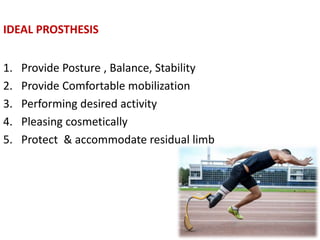
IDEAL PROSTHESIS
1. Provide Posture , Balance, Stability
2. Provide Comfortable mobilization
3. Performing desired activity
4. Pleasing cosmetically
5. Protect & accommodate residual limb
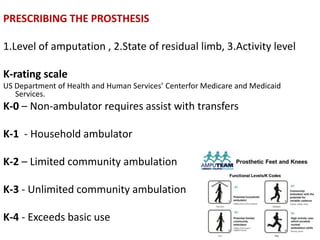
PRESCRIBING THE PROSTHESIS
1.Level of amputation , 2.State of residual limb, 3.Activity level
K-rating scale
US Department of Health and Human Services’ Centerfor Medicare and Medicaid
Services.
K-0 – Non-ambulator requires assist with transfers
K-1 - Household ambulator
K-2 – Limited community ambulation
K-3 - Unlimited community ambulation
K-4 - Exceeds basic use
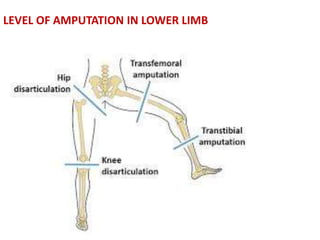
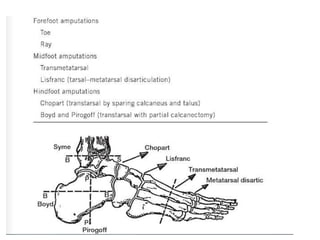
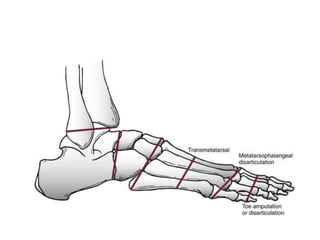
LEVEL OF AMPUTATION IN LOWER LIMB
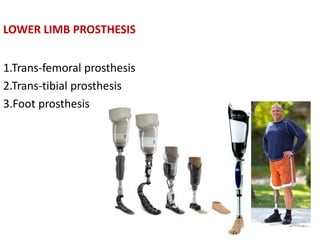
LOWER LIMB PROSTHESIS
1.Trans-femoral prosthesis
2.Trans-tibial prosthesis
3.Foot prosthesis
MAJOR COMPONENT OF THE LOWER LIMB PROSTHESIS
1. The control system
2. Suspension mechanism
3. Socket
4. Knee joint
5. Pylon
6. Terminal device
Suspension system
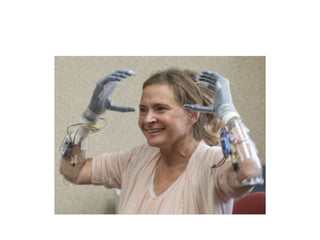
CONTROLLING SYSTEM
Simple prosthesis - largely through gravity
The most sophisticated (and expensive) prosthesis - myo
electric
Electrodes to sense muscular impulses in the residual
limb
SUSPENSION
Attaches the prosthesis to the residual limb.
It actually-
1. Prevent pistoning.
2. Holding and prevent slippage during stance.
TO THINK…..
What if not bother about
pistoning of socket?
Types
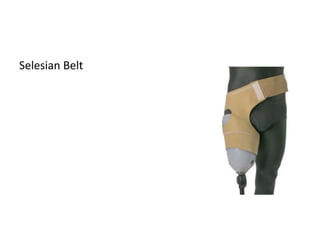
1. Straps & Belts- Selesian belt, Thigh corset – For AK
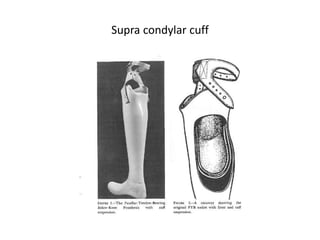
2. Cuff – Supra-condylar cuff, Supra-patellar cuff – For BK
(cautious with PVD patients.)
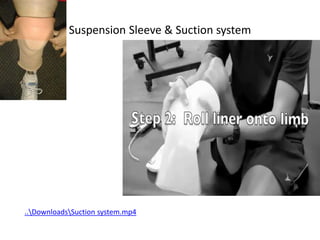
3. Suspension sleeve – Elastomer material rolling into stump and
holding by negative pressure- For BK & AK
4. Suction System – Socket itself attaching to stump by negative
pressure, not suitable in tibia
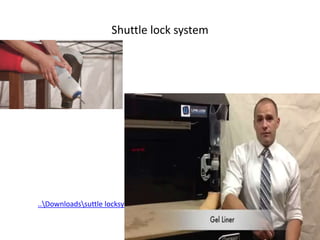
5. Shuttle lock system – More advanced - For BK & AK
6. Combined
Selesian Belt
Supra condylar cuff
Suspension Sleeve & Suction system
..DownloadsSuction system.mp4
Shuttle lock system
..Downloadssuttle locksystem 3.mp4
SOCKET
The connection between the residual limb
and the prosthesis;
It needs to
1. Accommodate & protect the residual limb.
2. Transmit the forces evenly through a greater surface
area.
3. Decrease pressures to any constant area.
4. Not allow distal pooling of fluid within the residual limb.
Types
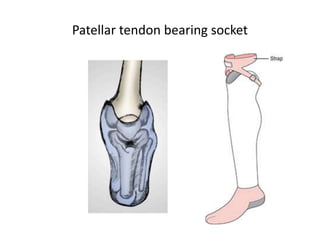
1. Trans-Tibial Sockets – 1. PTB socket
2. Hydrostatic
1. Trans-Femoral Sockets 1. Cylinder
2. Quadrilaeral
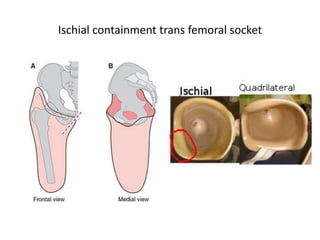
3. Ischial containment
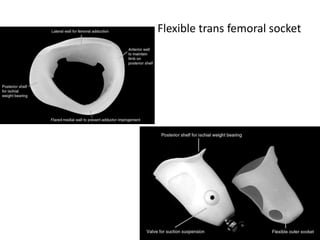
4.Flexible socket
Advancement and more comfortable
Patellar tendon bearing socket
Ischial containment trans femoral socket
Flexible trans femoral socket
KNEE
In case of the trans femoral prosthesis –it is wanted.
It is available
1. Single axis
2. Multiaxis
Types
1.Fixed cadence knee – Fixed resistance in the knee unit to control the
pendulum action of the prosthesis.
Rate of swing is set by the prosthetist.
For K1 & K2 patients
2. Variable cadence knee – Accomodates user’s walking speed and
adopt the gait.
1. Hydraulics or pneumatic – for control
and set rate range. For K3
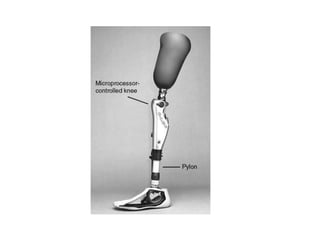
2. Intelligent knee – Combining the
micro processor with above mechanism.
For K4
TO THINK…..
Roughly how much it will cost to
purchase a intelligent knee?
PYLON
A simple tube or shell that attaches the
socket to the terminal device.
It evolved
From simple static shells to dynamic devices that allow
axial rotation and absorb, store, and release energy.
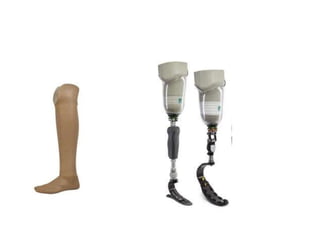
Types
Exo skeleton Composed of a solid piece of wood or rigid
polyurethane covered with plastic laminate and
fashioned into the shape of a leg.
Endo skeleton Internal metal frame with aesthetic soft covering.
Made of - lightweight nylon, aluminum, or carbon/graphite.
Completely interchangeable & prosthesis easily repairable.
TO THINK…..
During prosthetic prescription ,
does weight of prosthesis matter?
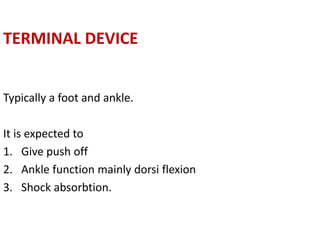
TERMINAL DEVICE
Typically a foot and ankle.
It is expected to
1. Give push off
2. Ankle function mainly dorsi flexion
3. Shock absorbtion.
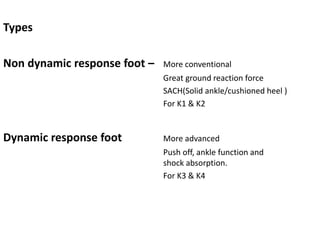
Types
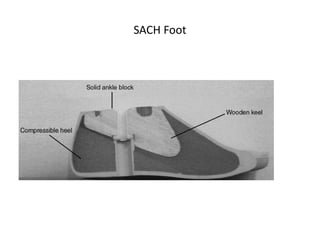
Non dynamic response foot – More conventional
Great ground reaction force
SACH(Solid ankle/cushioned heel )
For K1 & K2
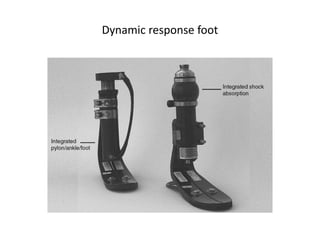
Dynamic response foot More advanced
Push off, ankle function and
shock absorption.
For K3 & K4
SACH Foot
Dynamic response foot
COMPLICATIONS DUE TO PROSTHESIS
1. Choke syndrome
2. Dermatologic problems
3. Painful residual limb
4. Ineffective suspension system
5. Poor socket fit
6. Stump volume changes
REFERENCE
1. Componentry for Lower Extremity Prostheses
Friel, Karen PT, DHS JAAOS - Journal of the American Academy of Orthopaedic
Surgeons: September 2005 - Volume 13 - Issue 5 - p 326–335 Articles
2. AAOS 2nd edition.
Lower limb prosthesis

Lower limb prosthesis

  • 1.
  • 2.
    INTRODUCTION Prosthesis Device to replacepart of the limb or missing limb Prosthetist Person skilled in prosthetics and its application Residual limb Part of the limb that remains after an amputation Orthosis Externally applied mechanical devices to Support weakened injured, paralyzed, diseased part as supplementation.
  • 3.
    TO THINK….. If lowerlimb amputation done in FOUR patient how many will die with in ONE MONTH?
  • 4.
    IDEAL PROSTHESIS 1. ProvidePosture , Balance, Stability 2. Provide Comfortable mobilization 3. Performing desired activity 4. Pleasing cosmetically 5. Protect & accommodate residual limb
  • 5.
    PRESCRIBING THE PROSTHESIS 1.Levelof amputation , 2.State of residual limb, 3.Activity level K-rating scale US Department of Health and Human Services’ Centerfor Medicare and Medicaid Services. K-0 – Non-ambulator requires assist with transfers K-1 - Household ambulator K-2 – Limited community ambulation K-3 - Unlimited community ambulation K-4 - Exceeds basic use
  • 6.
    LEVEL OF AMPUTATIONIN LOWER LIMB
  • 9.
    LOWER LIMB PROSTHESIS 1.Trans-femoralprosthesis 2.Trans-tibial prosthesis 3.Foot prosthesis
  • 10.
    MAJOR COMPONENT OFTHE LOWER LIMB PROSTHESIS 1. The control system 2. Suspension mechanism 3. Socket 4. Knee joint 5. Pylon 6. Terminal device
  • 11.
  • 12.
    CONTROLLING SYSTEM Simple prosthesis- largely through gravity The most sophisticated (and expensive) prosthesis - myo electric Electrodes to sense muscular impulses in the residual limb
  • 14.
    SUSPENSION Attaches the prosthesisto the residual limb. It actually- 1. Prevent pistoning. 2. Holding and prevent slippage during stance.
  • 15.
    TO THINK….. What ifnot bother about pistoning of socket?
  • 16.
    Types 1. Straps &Belts- Selesian belt, Thigh corset – For AK 2. Cuff – Supra-condylar cuff, Supra-patellar cuff – For BK (cautious with PVD patients.) 3. Suspension sleeve – Elastomer material rolling into stump and holding by negative pressure- For BK & AK 4. Suction System – Socket itself attaching to stump by negative pressure, not suitable in tibia 5. Shuttle lock system – More advanced - For BK & AK 6. Combined
  • 17.
  • 18.
  • 19.
    Suspension Sleeve &Suction system ..DownloadsSuction system.mp4
  • 20.
  • 21.
    SOCKET The connection betweenthe residual limb and the prosthesis; It needs to 1. Accommodate & protect the residual limb. 2. Transmit the forces evenly through a greater surface area. 3. Decrease pressures to any constant area. 4. Not allow distal pooling of fluid within the residual limb.
  • 22.
    Types 1. Trans-Tibial Sockets– 1. PTB socket 2. Hydrostatic 1. Trans-Femoral Sockets 1. Cylinder 2. Quadrilaeral 3. Ischial containment 4.Flexible socket Advancement and more comfortable
  • 23.
  • 24.
  • 25.
  • 26.
    KNEE In case ofthe trans femoral prosthesis –it is wanted. It is available 1. Single axis 2. Multiaxis
  • 27.
    Types 1.Fixed cadence knee– Fixed resistance in the knee unit to control the pendulum action of the prosthesis. Rate of swing is set by the prosthetist. For K1 & K2 patients 2. Variable cadence knee – Accomodates user’s walking speed and adopt the gait. 1. Hydraulics or pneumatic – for control and set rate range. For K3 2. Intelligent knee – Combining the micro processor with above mechanism. For K4
  • 29.
    TO THINK….. Roughly howmuch it will cost to purchase a intelligent knee?
  • 30.
    PYLON A simple tubeor shell that attaches the socket to the terminal device. It evolved From simple static shells to dynamic devices that allow axial rotation and absorb, store, and release energy.
  • 31.
    Types Exo skeleton Composedof a solid piece of wood or rigid polyurethane covered with plastic laminate and fashioned into the shape of a leg. Endo skeleton Internal metal frame with aesthetic soft covering. Made of - lightweight nylon, aluminum, or carbon/graphite. Completely interchangeable & prosthesis easily repairable.
  • 33.
    TO THINK….. During prostheticprescription , does weight of prosthesis matter?
  • 34.
    TERMINAL DEVICE Typically afoot and ankle. It is expected to 1. Give push off 2. Ankle function mainly dorsi flexion 3. Shock absorbtion.
  • 35.
    Types Non dynamic responsefoot – More conventional Great ground reaction force SACH(Solid ankle/cushioned heel ) For K1 & K2 Dynamic response foot More advanced Push off, ankle function and shock absorption. For K3 & K4
  • 36.
  • 37.
  • 38.
    COMPLICATIONS DUE TOPROSTHESIS 1. Choke syndrome 2. Dermatologic problems 3. Painful residual limb 4. Ineffective suspension system 5. Poor socket fit 6. Stump volume changes
  • 39.
    REFERENCE 1. Componentry forLower Extremity Prostheses Friel, Karen PT, DHS JAAOS - Journal of the American Academy of Orthopaedic Surgeons: September 2005 - Volume 13 - Issue 5 - p 326–335 Articles 2. AAOS 2nd edition.