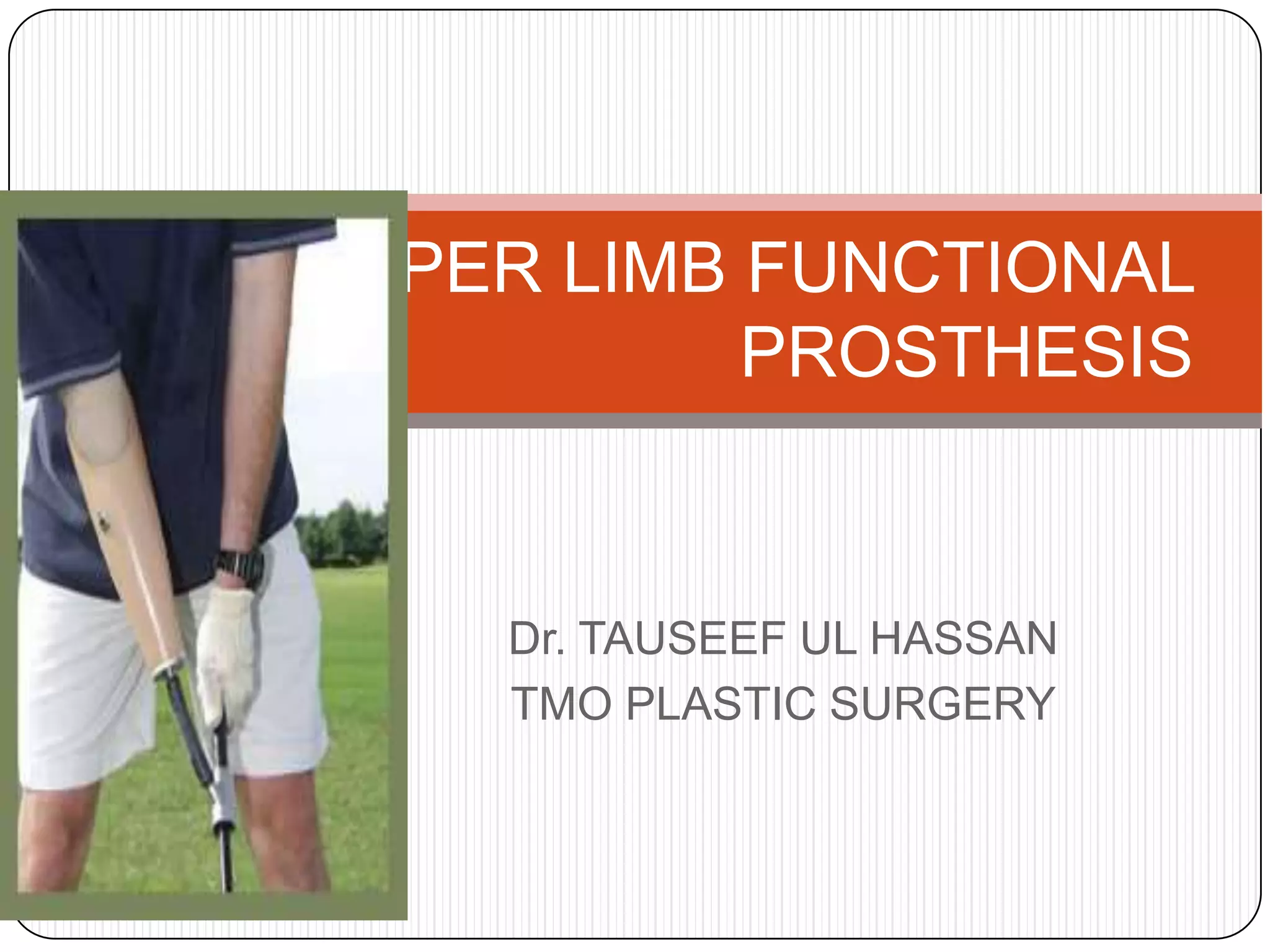
Dr. TAUSEEF UL HASSANTMO PLASTIC SURGERYUPPER LIMB FUNCTIONAL PROSTHESIS
A Prosthesis is a device that is designed to replace, as much possible , the function or appearance of a missing limb or a body part.
CHARACTERISTICS OF A SUCCESSFUL PROSTHESIS: Comfortable to wear
Easy to put on and remove
Light-weight
Durable
Cosmetically pleasing
Must Function well mechanically
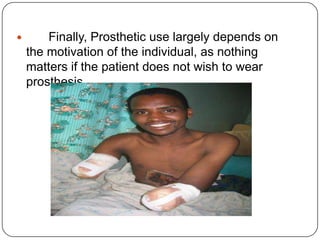
Require only reasonable maintainace.Finally, Prosthetic use largely depends on the motivation of the individual, as nothing matters if the patient does not wish to wear prosthesis.
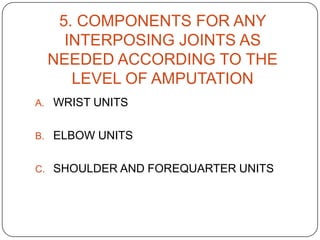
CONSIDERATIONS WHEN CHOOSING A PROSTHESIS: Amputation level
Contour of the Residual limb
Expected function of the Prosthesis
Congnitivefuntion of the Patient
Voacation of the Patient (Desk Job vs Manual Labour)
Avocational interests of the Patient (e.g; Hobbies)
Cosmetic Importance of the Prosthesis
Financial resources of the Patient.Reasons for an Upper Limb Amputations:THIS IS MOSTLY CORRELATED BY AGE.(0-15 years) CONGENITAL DEFORMITY OR TUMOR
(15-45 years) TRAUMA
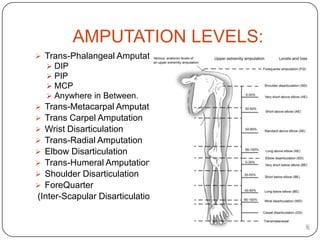
(>60years) SECONDARY TO TUMOR OR MEDICAL DISEASE AMPUTATION LEVELS:Trans-Phalangeal Amputation
DIP
PIP
MCP
Anywhere in Between.
Trans-Metacarpal Amputation
Trans Carpel Amputation
Wrist Disarticulation
Trans-Radial Amputation
Elbow Disarticulation
Trans-Humeral Amputation
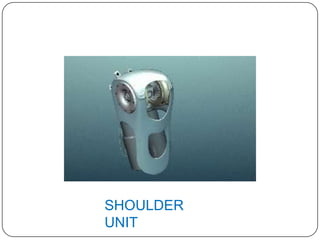
Shoulder Disarticulation
ForeQuarter (Inter-Scapular Disarticulation).
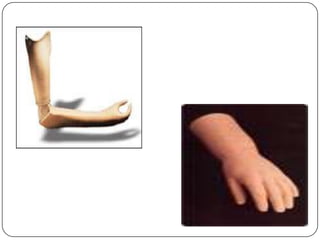
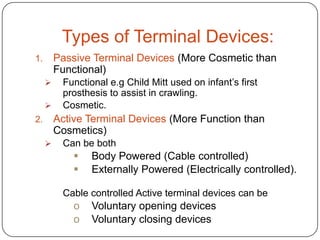
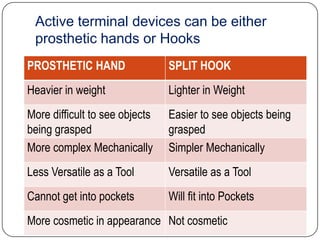
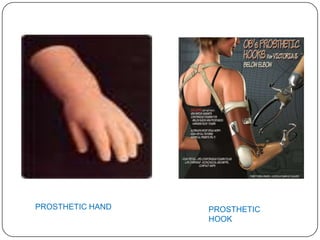
TYPES OF PROSTHESISCOSMETICFUNCTIONAL	Mostly passive or cosmetic  types  on one end to primarily functional types on the other. The purpose of most prosthesis falls somewhere in between.	Cosmetic prosthesis look extremely natural but they often are more difficult to clean, can be expensive and usually sacrifice some function for increased cosmetic appearance.
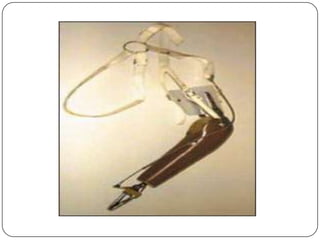
TYPES OF FUNCTIONAL PROSTHESIS:BODY-POWERED PROSTHESIS 		(Cable Controlled)EXTERNALLY POWERED (BATTERY) PROSTHESIS 		(Electrically Controlled)MYOELECTRIC PROSTHESIS
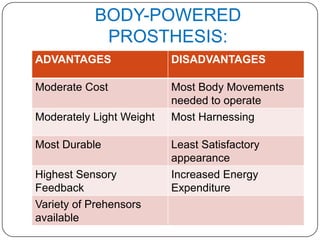
SWITCH-CONTROLLED PROSTHESIS.BODY-POWERED PROSTHESIS:
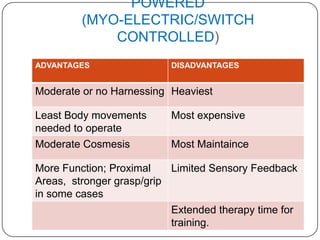
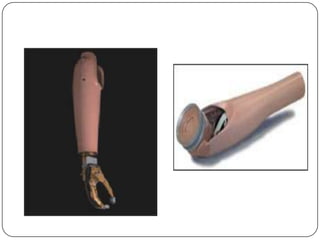
PATIENT CONTROLLED BATTERY-POWERED (MYO-ELECTRIC/SWITCH CONTROLLED)
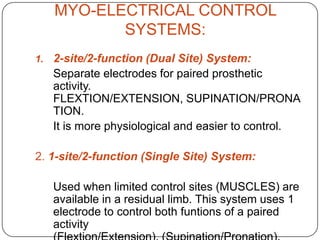
MYO-ELECTRICAL CONTROL SYSTEMS:2-site/2-function (Dual Site) System:	Separate electrodes for paired prosthetic activity. FLEXTION/EXTENSION, SUPINATION/PRONATION.	It is more physiological and easier to control.2. 1-site/2-function (Single Site) System:	Used when limited control sites (MUSCLES) are available in a residual limb. This system uses 1 electrode to control both funtions of a paired activity (Flextion/Extension), (Supination/Pronation).
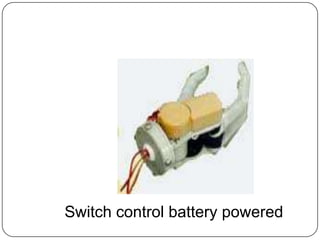
SWITCH CONTROL SYSTEMS:Switch controlled externally powered prosthesis utilize small switches, rather than muscle signals, to operate the elecric motors.	A switch can be activated by movement of a remanant digit or part of a bony prominance against the swithch or by a pull on a suspension harness (similar to movement a patient makes, when operating  a body-powered prosthesis)	This can be a good option to provide contol for external power when myoelectric control sites are not available or when the patient can not master myoelectric control.

Upper limb functional prosthesis