L/L PROSTHETIC COMPONENTS
EXOSKELETAL V/S ENDOSKELETAL
PROSTHESIS
 An artificial device that replaces a missing
body part, which may be lost through trauma,
disease, or is a condition present at birth
(congenital disorder).
 Designed to mimic natural function, structure
& aesthetics of the limb being replaced.
HISTORY
• First prosthetic toe discovered on a mummy from Ancient Egypt
• 300 BC – First documented prosthetic leg made of bronze and iron
with a wooden core
• 1529 – Ambrose Paré: pioneered modern amputation surgery, 1536
produced a transfemoral prosthesis with fixed position, adjustable
harness, replaced iron with leather, paper and glue.
• 1800 – James Potts: wooden shank and socket, steel knee joint
• 1868- Gustav Hermann: replacement of steel with aluminium
• US Civil War
• World War II -----Modern day designs
EXOSKELETAL V/S ENDOSKELETOL
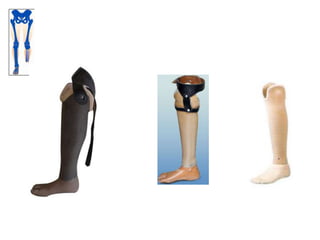
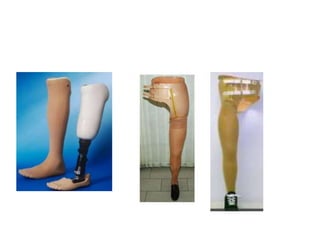
In the exoskeletal prosthesis, the strength is
provided by the outer lamination, andthe
shape or cosmesis (cosmetic cover) is an
integral part of the prosthesis. ...
Endoskeletal prostheses offer more component
options with more adjustability, but the
cosmesis is less durable.
PARTS
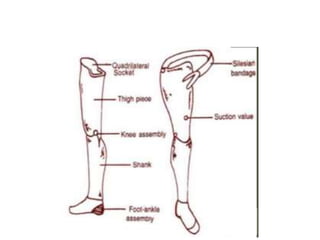
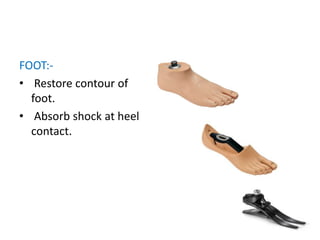
FOOT:-
• Restore contour of
foot.
• Absorb shock at heel
contact.
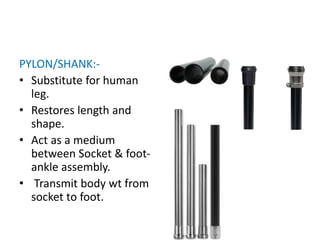
PYLON/SHANK:-
• Substitute for human
leg.
• Restores length and
shape.
• Act as a medium
between Socket & foot-
ankle assembly.
• Transmit body wt from
socket to foot.
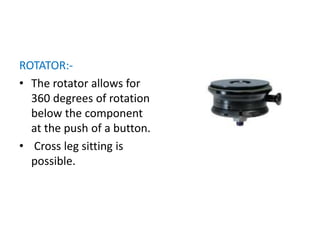
ROTATOR:-
• The rotator allows for
360 degrees of rotation
below the component
at the push of a button.
• Cross leg sitting is
possible.
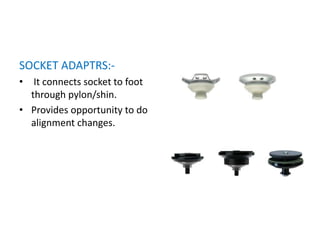
SOCKET ADAPTRS:-
• It connects socket to foot
through pylon/shin.
• Provides opportunity to do
alignment changes.
SOCKET:-
• The prosthetic socket,
essential point of
integration between human
tissue and replacement
limb, is most often also the
place where degree
of prosthetic success
is defined.
• It is the socket that accepts
and transfers to the residual
limb the stresses of weight-
bearing, suspension and
ambulation.
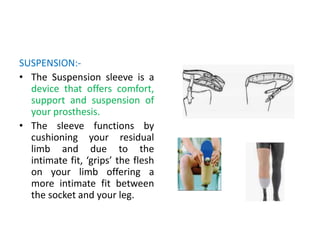
SUSPENSION:-
• The Suspension sleeve is a
device that offers comfort,
support and suspension of
your prosthesis.
• The sleeve functions by
cushioning your residual
limb and due to the
intimate fit, ‘grips’ the flesh
on your limb offering a
more intimate fit between
the socket and your leg.
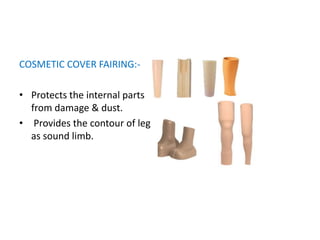
COSMETIC COVER FAIRING:-
• Protects the internal parts
from damage & dust.
• Provides the contour of leg
as sound limb.
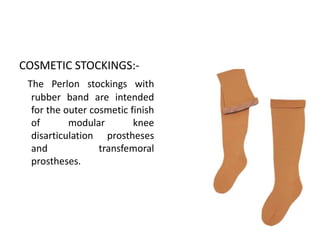
COSMETIC STOCKINGS:-
The Perlon stockings with
rubber band are intended
for the outer cosmetic finish
of modular knee
disarticulation prostheses
and transfemoral
prostheses.
Exoskeletal prosthesis has some
disadvantages:
• Heavy and cumbersome
• Alignment can not be changed after final finish.
• Does not provide efficient stance phase and
swing phase control
• Exoskeletal prostheses are not suitable for
through knee amputation
• Fabrication time for exoskeletal prosthesis is
much longer.
ADVANTAGE OF ENDOSKELETON
COMPONENTS
 Composed of lighter-weight materials like aluminum,
titanium, and graphite.
 Interchangeable connectors and other components such as
knees and feet.
 Components alignment facility.
 Endoskeletal prostheses offer more component options
with more adjustability.
 Offers improved function.
 cosmetically it has much better acceptability and restores
appearance to near normal.
 Time required for fitment of endoskeletal prosthesis is
much less.
Disadvantage
 Cosmesis is less durable.
1.PROSTHETIC COMPONENTS.ppt for rehabbbx

1.PROSTHETIC COMPONENTS.ppt for rehabbbx

  • 1.
  • 3.
    PROSTHESIS  An artificialdevice that replaces a missing body part, which may be lost through trauma, disease, or is a condition present at birth (congenital disorder).  Designed to mimic natural function, structure & aesthetics of the limb being replaced.
  • 4.
    HISTORY • First prosthetictoe discovered on a mummy from Ancient Egypt • 300 BC – First documented prosthetic leg made of bronze and iron with a wooden core • 1529 – Ambrose Paré: pioneered modern amputation surgery, 1536 produced a transfemoral prosthesis with fixed position, adjustable harness, replaced iron with leather, paper and glue. • 1800 – James Potts: wooden shank and socket, steel knee joint • 1868- Gustav Hermann: replacement of steel with aluminium • US Civil War • World War II -----Modern day designs
  • 5.
    EXOSKELETAL V/S ENDOSKELETOL Inthe exoskeletal prosthesis, the strength is provided by the outer lamination, andthe shape or cosmesis (cosmetic cover) is an integral part of the prosthesis. ... Endoskeletal prostheses offer more component options with more adjustability, but the cosmesis is less durable.
  • 6.
  • 12.
    FOOT:- • Restore contourof foot. • Absorb shock at heel contact.
  • 13.
    PYLON/SHANK:- • Substitute forhuman leg. • Restores length and shape. • Act as a medium between Socket & foot- ankle assembly. • Transmit body wt from socket to foot.
  • 14.
    ROTATOR:- • The rotatorallows for 360 degrees of rotation below the component at the push of a button. • Cross leg sitting is possible.
  • 15.
    SOCKET ADAPTRS:- • Itconnects socket to foot through pylon/shin. • Provides opportunity to do alignment changes.
  • 16.
    SOCKET:- • The prostheticsocket, essential point of integration between human tissue and replacement limb, is most often also the place where degree of prosthetic success is defined. • It is the socket that accepts and transfers to the residual limb the stresses of weight- bearing, suspension and ambulation.
  • 17.
    SUSPENSION:- • The Suspensionsleeve is a device that offers comfort, support and suspension of your prosthesis. • The sleeve functions by cushioning your residual limb and due to the intimate fit, ‘grips’ the flesh on your limb offering a more intimate fit between the socket and your leg.
  • 18.
    COSMETIC COVER FAIRING:- •Protects the internal parts from damage & dust. • Provides the contour of leg as sound limb.
  • 19.
    COSMETIC STOCKINGS:- The Perlonstockings with rubber band are intended for the outer cosmetic finish of modular knee disarticulation prostheses and transfemoral prostheses.
  • 21.
    Exoskeletal prosthesis hassome disadvantages: • Heavy and cumbersome • Alignment can not be changed after final finish. • Does not provide efficient stance phase and swing phase control • Exoskeletal prostheses are not suitable for through knee amputation • Fabrication time for exoskeletal prosthesis is much longer.
  • 22.
    ADVANTAGE OF ENDOSKELETON COMPONENTS Composed of lighter-weight materials like aluminum, titanium, and graphite.  Interchangeable connectors and other components such as knees and feet.  Components alignment facility.  Endoskeletal prostheses offer more component options with more adjustability.  Offers improved function.  cosmetically it has much better acceptability and restores appearance to near normal.  Time required for fitment of endoskeletal prosthesis is much less.
  • 23.