 Is the sum of activities required to ensure patients the
best possible physical conditions so that they may by
their own efforts regain as normal as possible a place in
the community and lead an active, productive life
 The rehabilitation team concept gained popularity after
World War II with the need to care for a large number of
injured soldier, particularly those with amputations.
 Because contemporary medical care is often
fragmented with insufficient communication among
clinicians, it is especially worthwhile to describe a model
of excellent care in which all parties work co-operatively.
 Physician
 Surgeon
 Prosthetist
 Orthtotist
 Pedorthist
 Physical therapist
 Occupational therapist
 Nurse
 Social Worker
 Psychologist
 Rehabilitation counsellor
 Amputation is the removal of a body
extremity by trauma, prolonged
constriction, or surgery. As a
surgical measure, it is used to
control pain or a disease process in
the affected limb, such as
malignancy or gangrene. In some
cases, it is carried out on
individuals as a preventative
surgery for such problems.
 Neurovascular and functional status of extremity
 Function and Condition of residual limb (in case of
traumatic amputation)
 Circulatory status and function of unaffected limb
 Signs & Symptoms of infection (culture required)
 Nutritional Status
 Concurrent medical problems
 Current medications
 Emotional reaction to amputation
 Circumstances surrounding amputation (i.e. Traumatic
versus surgical)
 Occupational and social Rehabilitation
 Prosthetics is the evaluation, fabrication, and custom
fitting of artificial limbs to the amputees
 A prosthesis is a device designed to replace, as much as possible,
the function or appearance of a missing limb or body part. An
orthosis, in contrast, is a device designed to support, supplement,
or augment the function of an existing limb or body part.
BELOW KNEE
KNEE
DISARTICULATION ABOVE KNEE
HIP
DISARTICULATION
PROSTHETICS
LOWER EXTREMITY
 PFA could be described as amputation affecting a
portion of the fore, mid or hind foot, but does not include
amputation disarticulating the ankle joint (Syme’s)
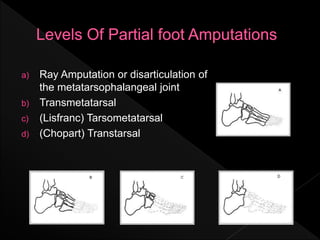
a) Ray Amputation or disarticulation of
the metatarsophalangeal joint
b) Transmetatarsal
c) (Lisfranc) Tarsometatarsal
d) (Chopart) Transtarsal
 An insole with a cork or
foam toe block is attached
distally as a filler
depending upon the ray
amputation.
 An insole with a cork or
foam toe block is attached
distally as a filler
depending upon the level
of amputation.
 Amputation of the complete
metatarsals is called as Lisfranc
Amputation
 Shoe filler: weight bearing
will be on the plantar heel
skin.
 Amputation Through the
talonavicular and
calcaneocuboid joints.
 Is recommended for
neuropathic lesions.
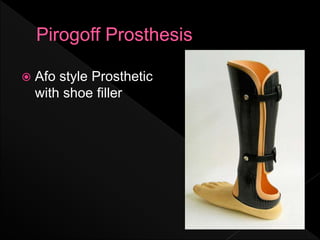
 A.F.O:
› Afo style
Prosthetic with
shoe filler
 Amputation of the foot
through the articulation
of the ankle with
removal of the malleoli
of the tibia and fibula
› Afo style
Prosthetic with
shoe filler
 Amputation of the foot
through the articulation of
the ankle with retention of
part of the calcaneus
 Afo style Prosthetic
with shoe filler
 Amputation of the lower
limb between the ankle
and the knee
 Old Technology
› Suspension:- Suprapatellar cuff or extensions of the
anterior socket brim over the patella.
› Draw backs include
 Atrophy
 Skin problems
 Different types of wounds due to minute in and out
movements of stump in the socket.
 Edema
 Stump deshaping
 Old Technology
 Stump can't tolerate weight bearing.
 Weight is transferred to the patellar tendon and counteracted by pressure
on the popliteal area and the medial tibial flare.
 Amputation of the
lower limb between
the knee and the hip
 The basic goals for fitting and aligning
prostheses for transfemoral amputees seem
simple enough:
› Comfort
› Function
› Cosmesis
 The above-knee prosthesis consists of a minimum of
four major parts:
› the socket
› the knee system
› the shank (or shin)
› the foot-ankle system.
 If suction is not used to retain the leg in place, a
suspension system is needed.
 A variety of designs for each of these components is
available which can be combined to meet the individual
needs of the amputee
 Quadrilateral Socket
 Ischial Containment Socket
 The term quadrilateral refers to the appearance of the
socket when viewed in the transverse plane because
there are four distinguishable sides or walls of the
socket.
 The term "ischial containment" is rather self-descriptive.
It describes several similar concepts in socket design in
which the ischium (and in some cases the ischial
ramus) are enclosed inside the socket.
 Prosthetic knees provide three functions:
› support during stance phase
› smooth and controlled swing phase
› unrestricted flexion for sitting, kneeling, stooping, and
related activities.
 Single axis knee joint
 Polycentric knee joint
 Manual knee lock joint
 Friction control knee joint
 Extension assist knee joint
 Pneumatic control knee joint
 Hydraulic knee joint
 Hip disarticulation is an amputation through the hip joint
capsule, removing the entire lower extremity, with
closure of the remaining musculature over the exposed
acetabulum.
 The transpelvic socket requires careful attention to the distal
contours for proper weight bearing.
 In addition to using the sling casting technique to firm the tissues, it
is useful to contour the area of the contralateral gluteal fold
precisely.
 Contour may add a measure of gluteal bearing on the contralateral
side.
 More importantly, it prevents the hemipelvis from slipping through
the inferior border of the socket and adds significant weight-bearing
stability.
 Good distal contours often provide sufficient weight-bearing stability
to allow the proximal border of the socket to be trimmed far below
the second rib margin.
 The anterodistal trim line should be as close to the midline as
tolerable lest the panniculus protrude hernia-like during weight
bearing.
 The male genitalia should be placed to the side prior to casting to
permit the smallest practical anterodistal opening for the transpelvic
 Introduced in 1997, the C-Leg® was the first
prosthesis system to intelligently control and
adapt to an individual's gait.
 To do this, it takes advantage of
microprocessor-controlled hydraulics, which
adapt dynamically to all walking speeds, in real
time. In addition, the microprocessor makes it
possible to reliably secure the stance phase in
the C-Leg®. This incredible control is made
possible through the use of a sensor system.
Fifty times a second an ankle moment sensor
measures stress while a knee angle sensor
reports angle and angular velocity at the knee.
 C-Leg® technology offers users many advantages,
including permanent stance phase control, the ability to
weight the prosthesis during flexion, dynamic alignment,
lower energy expenditure while walking, and relief for
the sound side and the rest of the body.
L.L Prosthetics.pptx

L.L Prosthetics.pptx

  • 3.
     Is thesum of activities required to ensure patients the best possible physical conditions so that they may by their own efforts regain as normal as possible a place in the community and lead an active, productive life
  • 4.
     The rehabilitationteam concept gained popularity after World War II with the need to care for a large number of injured soldier, particularly those with amputations.  Because contemporary medical care is often fragmented with insufficient communication among clinicians, it is especially worthwhile to describe a model of excellent care in which all parties work co-operatively.
  • 5.
     Physician  Surgeon Prosthetist  Orthtotist  Pedorthist  Physical therapist  Occupational therapist  Nurse  Social Worker  Psychologist  Rehabilitation counsellor
  • 6.
     Amputation isthe removal of a body extremity by trauma, prolonged constriction, or surgery. As a surgical measure, it is used to control pain or a disease process in the affected limb, such as malignancy or gangrene. In some cases, it is carried out on individuals as a preventative surgery for such problems.
  • 7.
     Neurovascular andfunctional status of extremity  Function and Condition of residual limb (in case of traumatic amputation)  Circulatory status and function of unaffected limb  Signs & Symptoms of infection (culture required)  Nutritional Status  Concurrent medical problems  Current medications
  • 8.
     Emotional reactionto amputation  Circumstances surrounding amputation (i.e. Traumatic versus surgical)  Occupational and social Rehabilitation
  • 11.
     Prosthetics isthe evaluation, fabrication, and custom fitting of artificial limbs to the amputees
  • 12.
     A prosthesisis a device designed to replace, as much as possible, the function or appearance of a missing limb or body part. An orthosis, in contrast, is a device designed to support, supplement, or augment the function of an existing limb or body part.
  • 14.
    BELOW KNEE KNEE DISARTICULATION ABOVEKNEE HIP DISARTICULATION PROSTHETICS LOWER EXTREMITY
  • 17.
     PFA couldbe described as amputation affecting a portion of the fore, mid or hind foot, but does not include amputation disarticulating the ankle joint (Syme’s)
  • 18.
    a) Ray Amputationor disarticulation of the metatarsophalangeal joint b) Transmetatarsal c) (Lisfranc) Tarsometatarsal d) (Chopart) Transtarsal
  • 20.
     An insolewith a cork or foam toe block is attached distally as a filler depending upon the ray amputation.
  • 21.
     An insolewith a cork or foam toe block is attached distally as a filler depending upon the level of amputation.
  • 22.
     Amputation ofthe complete metatarsals is called as Lisfranc Amputation
  • 23.
     Shoe filler:weight bearing will be on the plantar heel skin.
  • 24.
     Amputation Throughthe talonavicular and calcaneocuboid joints.  Is recommended for neuropathic lesions.
  • 25.
     A.F.O: › Afostyle Prosthetic with shoe filler
  • 26.
     Amputation ofthe foot through the articulation of the ankle with removal of the malleoli of the tibia and fibula
  • 27.
    › Afo style Prostheticwith shoe filler
  • 28.
     Amputation ofthe foot through the articulation of the ankle with retention of part of the calcaneus
  • 29.
     Afo styleProsthetic with shoe filler
  • 30.
     Amputation ofthe lower limb between the ankle and the knee
  • 31.
     Old Technology ›Suspension:- Suprapatellar cuff or extensions of the anterior socket brim over the patella. › Draw backs include  Atrophy  Skin problems  Different types of wounds due to minute in and out movements of stump in the socket.  Edema  Stump deshaping
  • 32.
  • 33.
     Stump can'ttolerate weight bearing.  Weight is transferred to the patellar tendon and counteracted by pressure on the popliteal area and the medial tibial flare.
  • 37.
     Amputation ofthe lower limb between the knee and the hip
  • 38.
     The basicgoals for fitting and aligning prostheses for transfemoral amputees seem simple enough: › Comfort › Function › Cosmesis
  • 39.
     The above-kneeprosthesis consists of a minimum of four major parts: › the socket › the knee system › the shank (or shin) › the foot-ankle system.  If suction is not used to retain the leg in place, a suspension system is needed.  A variety of designs for each of these components is available which can be combined to meet the individual needs of the amputee
  • 40.
     Quadrilateral Socket Ischial Containment Socket
  • 41.
     The termquadrilateral refers to the appearance of the socket when viewed in the transverse plane because there are four distinguishable sides or walls of the socket.
  • 42.
     The term"ischial containment" is rather self-descriptive. It describes several similar concepts in socket design in which the ischium (and in some cases the ischial ramus) are enclosed inside the socket.
  • 43.
     Prosthetic kneesprovide three functions: › support during stance phase › smooth and controlled swing phase › unrestricted flexion for sitting, kneeling, stooping, and related activities.
  • 44.
     Single axisknee joint  Polycentric knee joint  Manual knee lock joint  Friction control knee joint  Extension assist knee joint  Pneumatic control knee joint  Hydraulic knee joint
  • 50.
     Hip disarticulationis an amputation through the hip joint capsule, removing the entire lower extremity, with closure of the remaining musculature over the exposed acetabulum.
  • 52.
     The transpelvicsocket requires careful attention to the distal contours for proper weight bearing.  In addition to using the sling casting technique to firm the tissues, it is useful to contour the area of the contralateral gluteal fold precisely.  Contour may add a measure of gluteal bearing on the contralateral side.  More importantly, it prevents the hemipelvis from slipping through the inferior border of the socket and adds significant weight-bearing stability.  Good distal contours often provide sufficient weight-bearing stability to allow the proximal border of the socket to be trimmed far below the second rib margin.  The anterodistal trim line should be as close to the midline as tolerable lest the panniculus protrude hernia-like during weight bearing.  The male genitalia should be placed to the side prior to casting to permit the smallest practical anterodistal opening for the transpelvic
  • 57.
     Introduced in1997, the C-Leg® was the first prosthesis system to intelligently control and adapt to an individual's gait.  To do this, it takes advantage of microprocessor-controlled hydraulics, which adapt dynamically to all walking speeds, in real time. In addition, the microprocessor makes it possible to reliably secure the stance phase in the C-Leg®. This incredible control is made possible through the use of a sensor system. Fifty times a second an ankle moment sensor measures stress while a knee angle sensor reports angle and angular velocity at the knee.
  • 58.
     C-Leg® technologyoffers users many advantages, including permanent stance phase control, the ability to weight the prosthesis during flexion, dynamic alignment, lower energy expenditure while walking, and relief for the sound side and the rest of the body.