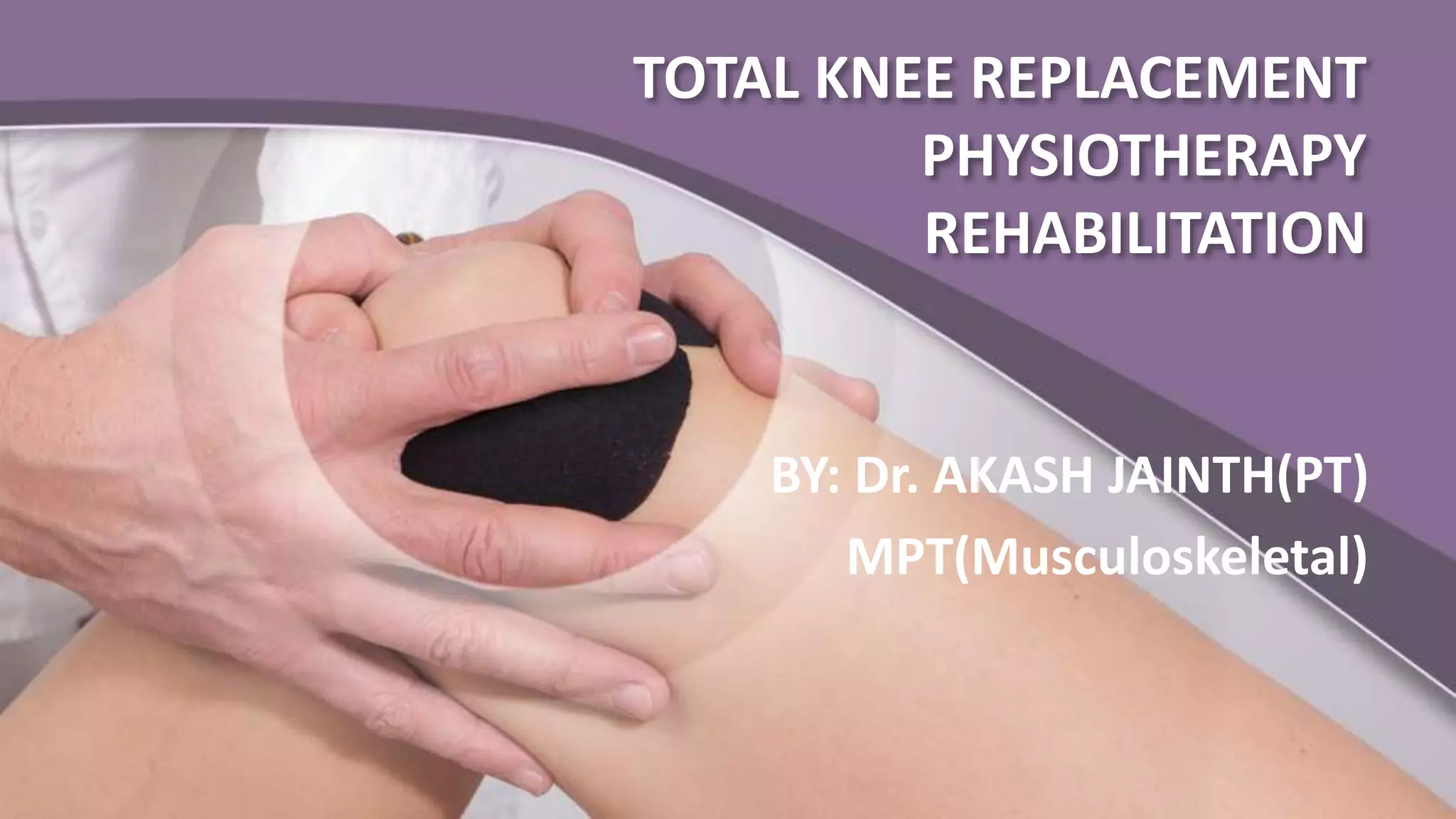
TOTAL KNEE REPLACEMENT
PHYSIOTHERAPY
REHABILITATION
BY: Dr. AKASH JAINTH(PT)
MPT(Musculoskeletal)
• Total knee arthroplasty (TKA) or total knee
replacement (TKR) is a common orthopaedic surgery
that involves replacing the articular surfaces (femoral
condyles and tibial plateau) of the knee joint with
smooth metal and highly cross-linked polyethylene
plastic.[1][2]
TKA aims
• Improves Quality of life
• Reducing pain
• Increasing function
PRE-SURGICAL PHYSIOTHERAPY
• A pre-surgical training programme may also be used to
optimize the functional status of patients to improve post-
surgical recovery.
• Pre-surgical training programmes should focus on postural
control, functional lower limb exercises and strengthening
exercises for bilateral lower extremities.[5]
• Evidence supporting the efficacy of pre-surgical physiotherapy
on patient outcome scores, lower limb strength, pain, range of
movement or hospital length of stay following total knee
arthroplasty is lacking.[6][7][8][9]
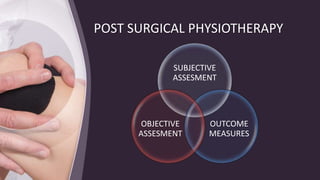
POST SURGICAL PHYSIOTHERAPY
SUBJECTIVE
ASSESMENT
OUTCOME
MEASURES
OBJECTIVE
ASSESMENT
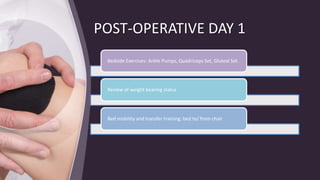
POST-OPERATIVE DAY 1
Bedside Exercises: Ankle Pumps, Quadriceps Set, Gluteal Set.
Review of weight bearing status
Bed mobility and transfer training: bed to/ from chair
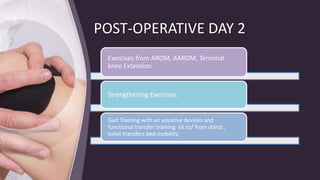
POST-OPERATIVE DAY 2
Exercises from AROM, AAROM, Terminal
knee Extension.
Strengthening Exercises.
Gait Training with an assistive devices and
functional transfer training sit to/ from stand ,
toilet transfers bed mobility.
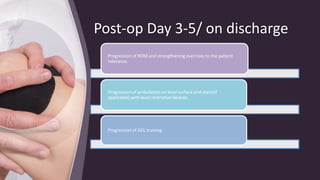
Post-op Day 3-5/ on discharge
Progression of ROM and strengthening exercises to the patient
tolerance.
Progression of ambulation on level surface and stairs(if
applicable) with least restrictive devices.
Progression of ADL training.
PHASE -1 Upto 2-3 weeks
Patient Education
Aim to achieve
minimal pain and
swelling
Aim for
independence in
mobility and ADL
Achieve full weight
bearing
Achieve active and
passive knee flexion
upto 90 degrees and
full extension.
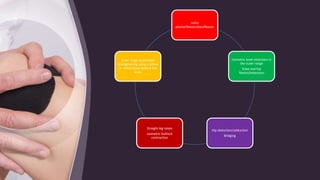
Ankle
plantarflexion/dorsiflexion
Isometric knee extension in
the outer range
Knee and hip
flexion/extension
Hip abduction/adduction
Bridging
Straight leg raises
Isometric buttock
contraction
Inner range quadriceps
strengthening using a pillow
or rolled towel behind the
knee
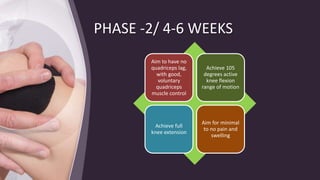
PHASE -2/ 4-6 WEEKS
Aim to have no
quadriceps lag,
with good,
voluntary
quadriceps
muscle control
Achieve 105
degrees active
knee flexion
range of motion
Achieve full
knee extension
Aim for minimal
to no pain and
swelling
PHASE -3 6-8 WEEKS
Strengthening
exercises to ensure
hypertrophy beyond
neural adaptation[10]
Balance and
proprioception
training
Lower limb
functional
exercises
• While primary TKA has been reported to reduce falls
incidence[11] and improve balance-related functions such
as single limb standing balance,[11][12] the sub-optimal
recovery of proprioception, sensory orientation, postural
control, and strength of the operated limb post-TKA is well
documented.[11][12][13]
• Literature highlights the importance of proprioceptive
training, and pre-operative training[13] that involves the
non-operated limb.[12]
• Balance exercises may include single leg balancing,
stepping over objects, lateral step-ups, and standing on
uneven surfaces.
• Post-surgical balance and proprioceptive training that
involves single limb standing may begin when adequate
knee control is achieved on the operated limb, which
typically occurs around 8 weeks post-TKA.[10]
Phase IV: 8-12 weeks, up to 1 year
Aim for independent exercise in the community
setting
Continue regular exercise involving strengthening,
balance and proprioception training
Incorporate strategies for behaviour change to
increase overall physical activity[14]
CAUSES OF TKA Failures
• INFECTION
• POLYETHYLENE WEAR
• INSTABILITY
• ASEPTIC LOOSENING
• ASEPTIC NECROSIS OF PATELLA
• PERIPROSTHETIC FRACTURE
• Can a patient do squatting and cross
leg sitting after TKA ??????
SOME PATIENTS ACHIEVE FULL RANGE
OF MOTION AND SOME DON’T
WHY??????
COMPLICATIONS AFTER TKR
• Problems with wound healing.
• Deep vein thrombus.
• Infection.
• Bleeding.
• Swelling.
• Stiffness.
• Persistent pain.
REFRENCES
• Evans JT, Walker RW, Evans JP, Blom AW, Sayers A, Whitehouse MR. How long
does a knee replacement last? A systematic review and meta-analysis of case
series and national registry reports with more than 15 years of follow-up. The
Lancet. 2019 Feb 16;393(10172):655-63.
• Palmer, S., 2020. Total Knee Arthroplasty (TKA). [online] Medscape. Available
at: [Accessed 22 December 2020].
• Jakobsen TL, Jakobsen MD, Andersen LL, Husted H, Kehlet H, Bandholm
T. Quadriceps muscle activity during commonly used strength training exercises
shortly after total knee arthroplasty: implications for home-based exercise-
selection. Journal of experimental orthopaedics. 2019 Dec 1;6(1):29.
• Scott CE, Oliver WM, MacDonald D, Wade FA, Moran M, Breusch SJ. Predicting
dissatisfaction following total knee arthroplasty in patients under 55 years of
age. The bone & joint journal. 2016 Dec;98(12):1625-34.
• Huber E, de Bie R, Roos E, Bischoff-Ferrari H. Effect of pre-operative
neuromuscular training on functional outcome after total knee replacement: a
randomized-controlled trial. BMC Musculoskeletal Disorders. 2013;14(1).
• Kwok I, Paton B, Haddad F. Does Pre-Operative Physiotherapy Improve
Outcomes in Primary Total Knee Arthroplasty? — A Systematic Review. The
Journal of Arthroplasty. 2015;30(9):1657-1663.
• Alghadir A, Iqbal Z, Anwer S. Comparison of the effect of
pre- and post-operative physical therapy versus post-
operative physical therapy alone on pain and recovery of
function after total knee arthroplasty. Journal of Physical
Therapy Science. 2016;28(10):2754-2758.
• Husted R, Juhl C, Troelsen A, Thorborg K, Kallemose T,
Rathleff M et al. The relationship between prescribed
pre-operative knee-extensor exercise dosage and effect
on knee-extensor strength prior to and following total
knee arthroplasty: a systematic review and meta-
regression analysis of randomized controlled
trials. Osteoarthritis and Cartilage. 2020;28(11):1412-
1426.
• Chesham R, Shanmugam S. Does preoperative
physiotherapy improve postoperative, patient-based
outcomes in older adults who have undergone total knee
arthroplasty? A systematic review. Physiotherapy Theory
and Practice. 2016;33(1):9-30.
• McHugh, A, Rehabilitation Guidelines Following Total Knee
Arthroplasty. Physioplus. 2021.
• Si H, Zeng Y, Zhong J, Zhou Z, Lu Y, Cheng J et al. The effect of primary
total knee arthroplasty on the incidence of falls and balance-related
functions in patients with osteoarthritis. Scientific Reports. 2017;7(1).
• Moutzouri M, Gleeson N, Billis E, Tsepis E, Panoutsopoulou I, Gliatis
J. The effect of total knee arthroplasty on patients’ balance and
incidence of falls: a systematic review. Knee Surgery, Sports
Traumatology, Arthroscopy. 2016;25(11):3439-3451.
• Chan A, Jehu D, Pang M. Falls After Total Knee Arthroplasty:
Frequency, Circumstances, and Associated Factors—A Prospective
Cohort Study. Physical Therapy. 2018;98(9):767-778.
• Arnold J, Walters J, Ferrar K. Does Physical Activity Increase After
Total Hip or Knee Arthroplasty for Osteoarthritis? A Systematic
Review. Journal of Orthopaedic & Sports Physical Therapy.
2016;46(6):431-442.
• Austin MS, Sharkey PF, Hozack WJ, Rothman RH. Knee failure
mechanisms after total knee arthroplasty. Tech Knee Surg. 2004;3:55–
59.

TKR physiotherapy rehabilitation.pptx

  • 1.
    TOTAL KNEE REPLACEMENT PHYSIOTHERAPY REHABILITATION BY:Dr. AKASH JAINTH(PT) MPT(Musculoskeletal)
  • 2.
    • Total kneearthroplasty (TKA) or total knee replacement (TKR) is a common orthopaedic surgery that involves replacing the articular surfaces (femoral condyles and tibial plateau) of the knee joint with smooth metal and highly cross-linked polyethylene plastic.[1][2]
  • 3.
    TKA aims • ImprovesQuality of life • Reducing pain • Increasing function
  • 4.
    PRE-SURGICAL PHYSIOTHERAPY • Apre-surgical training programme may also be used to optimize the functional status of patients to improve post- surgical recovery. • Pre-surgical training programmes should focus on postural control, functional lower limb exercises and strengthening exercises for bilateral lower extremities.[5] • Evidence supporting the efficacy of pre-surgical physiotherapy on patient outcome scores, lower limb strength, pain, range of movement or hospital length of stay following total knee arthroplasty is lacking.[6][7][8][9]
  • 5.
  • 6.
    POST-OPERATIVE DAY 1 BedsideExercises: Ankle Pumps, Quadriceps Set, Gluteal Set. Review of weight bearing status Bed mobility and transfer training: bed to/ from chair
  • 7.
    POST-OPERATIVE DAY 2 Exercisesfrom AROM, AAROM, Terminal knee Extension. Strengthening Exercises. Gait Training with an assistive devices and functional transfer training sit to/ from stand , toilet transfers bed mobility.
  • 8.
    Post-op Day 3-5/on discharge Progression of ROM and strengthening exercises to the patient tolerance. Progression of ambulation on level surface and stairs(if applicable) with least restrictive devices. Progression of ADL training.
  • 9.
    PHASE -1 Upto2-3 weeks Patient Education Aim to achieve minimal pain and swelling Aim for independence in mobility and ADL Achieve full weight bearing Achieve active and passive knee flexion upto 90 degrees and full extension.
  • 10.
    Ankle plantarflexion/dorsiflexion Isometric knee extensionin the outer range Knee and hip flexion/extension Hip abduction/adduction Bridging Straight leg raises Isometric buttock contraction Inner range quadriceps strengthening using a pillow or rolled towel behind the knee
  • 11.
    PHASE -2/ 4-6WEEKS Aim to have no quadriceps lag, with good, voluntary quadriceps muscle control Achieve 105 degrees active knee flexion range of motion Achieve full knee extension Aim for minimal to no pain and swelling
  • 12.
    PHASE -3 6-8WEEKS Strengthening exercises to ensure hypertrophy beyond neural adaptation[10] Balance and proprioception training Lower limb functional exercises
  • 13.
    • While primaryTKA has been reported to reduce falls incidence[11] and improve balance-related functions such as single limb standing balance,[11][12] the sub-optimal recovery of proprioception, sensory orientation, postural control, and strength of the operated limb post-TKA is well documented.[11][12][13] • Literature highlights the importance of proprioceptive training, and pre-operative training[13] that involves the non-operated limb.[12] • Balance exercises may include single leg balancing, stepping over objects, lateral step-ups, and standing on uneven surfaces. • Post-surgical balance and proprioceptive training that involves single limb standing may begin when adequate knee control is achieved on the operated limb, which typically occurs around 8 weeks post-TKA.[10]
  • 14.
    Phase IV: 8-12weeks, up to 1 year Aim for independent exercise in the community setting Continue regular exercise involving strengthening, balance and proprioception training Incorporate strategies for behaviour change to increase overall physical activity[14]
  • 15.
    CAUSES OF TKAFailures • INFECTION • POLYETHYLENE WEAR • INSTABILITY • ASEPTIC LOOSENING • ASEPTIC NECROSIS OF PATELLA • PERIPROSTHETIC FRACTURE
  • 16.
    • Can apatient do squatting and cross leg sitting after TKA ??????
  • 17.
    SOME PATIENTS ACHIEVEFULL RANGE OF MOTION AND SOME DON’T WHY??????
  • 18.
    COMPLICATIONS AFTER TKR •Problems with wound healing. • Deep vein thrombus. • Infection. • Bleeding. • Swelling. • Stiffness. • Persistent pain.
  • 19.
    REFRENCES • Evans JT,Walker RW, Evans JP, Blom AW, Sayers A, Whitehouse MR. How long does a knee replacement last? A systematic review and meta-analysis of case series and national registry reports with more than 15 years of follow-up. The Lancet. 2019 Feb 16;393(10172):655-63. • Palmer, S., 2020. Total Knee Arthroplasty (TKA). [online] Medscape. Available at: [Accessed 22 December 2020]. • Jakobsen TL, Jakobsen MD, Andersen LL, Husted H, Kehlet H, Bandholm T. Quadriceps muscle activity during commonly used strength training exercises shortly after total knee arthroplasty: implications for home-based exercise- selection. Journal of experimental orthopaedics. 2019 Dec 1;6(1):29. • Scott CE, Oliver WM, MacDonald D, Wade FA, Moran M, Breusch SJ. Predicting dissatisfaction following total knee arthroplasty in patients under 55 years of age. The bone & joint journal. 2016 Dec;98(12):1625-34. • Huber E, de Bie R, Roos E, Bischoff-Ferrari H. Effect of pre-operative neuromuscular training on functional outcome after total knee replacement: a randomized-controlled trial. BMC Musculoskeletal Disorders. 2013;14(1). • Kwok I, Paton B, Haddad F. Does Pre-Operative Physiotherapy Improve Outcomes in Primary Total Knee Arthroplasty? — A Systematic Review. The Journal of Arthroplasty. 2015;30(9):1657-1663.
  • 20.
    • Alghadir A,Iqbal Z, Anwer S. Comparison of the effect of pre- and post-operative physical therapy versus post- operative physical therapy alone on pain and recovery of function after total knee arthroplasty. Journal of Physical Therapy Science. 2016;28(10):2754-2758. • Husted R, Juhl C, Troelsen A, Thorborg K, Kallemose T, Rathleff M et al. The relationship between prescribed pre-operative knee-extensor exercise dosage and effect on knee-extensor strength prior to and following total knee arthroplasty: a systematic review and meta- regression analysis of randomized controlled trials. Osteoarthritis and Cartilage. 2020;28(11):1412- 1426. • Chesham R, Shanmugam S. Does preoperative physiotherapy improve postoperative, patient-based outcomes in older adults who have undergone total knee arthroplasty? A systematic review. Physiotherapy Theory and Practice. 2016;33(1):9-30.
  • 21.
    • McHugh, A,Rehabilitation Guidelines Following Total Knee Arthroplasty. Physioplus. 2021. • Si H, Zeng Y, Zhong J, Zhou Z, Lu Y, Cheng J et al. The effect of primary total knee arthroplasty on the incidence of falls and balance-related functions in patients with osteoarthritis. Scientific Reports. 2017;7(1). • Moutzouri M, Gleeson N, Billis E, Tsepis E, Panoutsopoulou I, Gliatis J. The effect of total knee arthroplasty on patients’ balance and incidence of falls: a systematic review. Knee Surgery, Sports Traumatology, Arthroscopy. 2016;25(11):3439-3451. • Chan A, Jehu D, Pang M. Falls After Total Knee Arthroplasty: Frequency, Circumstances, and Associated Factors—A Prospective Cohort Study. Physical Therapy. 2018;98(9):767-778. • Arnold J, Walters J, Ferrar K. Does Physical Activity Increase After Total Hip or Knee Arthroplasty for Osteoarthritis? A Systematic Review. Journal of Orthopaedic & Sports Physical Therapy. 2016;46(6):431-442. • Austin MS, Sharkey PF, Hozack WJ, Rothman RH. Knee failure mechanisms after total knee arthroplasty. Tech Knee Surg. 2004;3:55– 59.