UPPER LIMB PROSTHESES
Dr. Om Prakash
MBBS MD – PMR (AIIMS, New Delhi)
Assistant Professor, Dept. of PMR
SMS Medical College and Attached Hospital , Jaipur,
Rajasthan
History
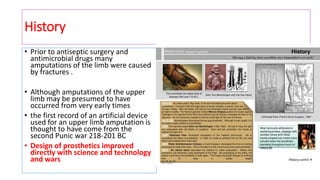
• Prior to antiseptic surgery and
antimicrobial drugs many
amputations of the limb were caused
by fractures .
• Although amputations of the upper
limb may be presumed to have
occurred from very early times
• the first record of an artificial device
used for an upper limb amputation is
thought to have come from the
second Punic war 218-201 BC
• Design of prosthetics improved
directly with science and technology
and wars
Introduction
Incidence
• 6000 to 10,000 major amputations of upper limb occur every
year.
• Upper limb amputations with hand loss is extremely
devastating , upper limb traumatic amputations occur twice
as frequently as traumatic amputations of lower limb
• A prosthesis is a device that is designed to replace, as much as
possible, the function or appearance of a missing limb or body
part.
• Prosthesis can replace some grasping and manipulating functions
of hand
• No sensory feedback
• Role of dominant function replaced to contra-lateral hand and
prosthesis assists bimanual function
Introduction
• A successful prosthesis
• Comfortable to wear
• Easy to don and doff
• Light weight and durable
• Cosmetically pleasing
• Must function well mechanically
• Have reasonable maintenance
• Motivation of the individual
Introduction
• Factors
• Amputation level
• Expected function of the prosthesis
• Cognitive function of the patient
• Vocation of the patient (eg, desk job vs manual laborer)
• Avocational interests of the patient (ie, hobbies)
• Cosmetic importance of the prosthesis
• Financial resources of the patient
Introduction
Most common reasons for an upper extremity
amputation
• Correction of a congenital deformity
• Tumor is commonly seen in individuals aged 0-15 years.
• Trauma is the most common reason for amputation in
patients aged 15-45 years, with tumors being a distant second.
• Upper extremity amputations tend to be rare in patients who
are older than 60 years, but they may be required secondary to
tumor or medical disease.
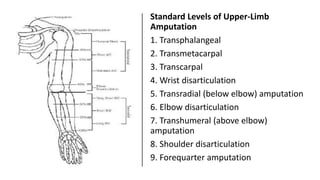
Standard Levels of Upper-Limb
Amputation
1. Transphalangeal
2. Transmetacarpal
3. Transcarpal
4. Wrist disarticulation
5. Transradial (below elbow) amputation
6. Elbow disarticulation
7. Transhumeral (above elbow)
amputation
8. Shoulder disarticulation
9. Forequarter amputation
Upper Limb Prostheses
Four categories of upper limb prosthetic systems:
1. Passive system
2. Body-powered system: Cable controlled
3. Externally powered system: Electrically powered
- Myoelectrically controlled prostheses
-Switch-controlled prostheses
4. Hybrid system.
Cosmetic or passive
• A passive system is primarily cosmetic but also functions as stabilizer. A
passive system is fabricated if the patient does not have enough strength
or movement to control a prosthesis, or wears a prosthesis only for
cosmoses.
• Pros
• Most lightweight
• Best cosmesis
• Least harnessing
• Cons
• High cost if custom made
• Least function
• Low-cost glove stains easily
Body-powered prostheses
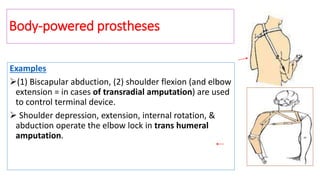
Body powered prostheses use forces generated by body movements
transmitted through cables to operate joints and terminal devices.
Forward flexing the shoulder to provide tension on the control
cable(Bowden cable) of the prosthesis resulting in opening the terminal
device. Relaxing the shoulder forward flexion results in return of the
terminal device to the static closed position.
Body-powered prostheses are more durable and are less expensive and
lighter than myoelectric prostheses
Examples
(1) Biscapular abduction, (2) shoulder flexion (and elbow
extension = in cases of transradial amputation) are used
to control terminal device.
 Shoulder depression, extension, internal rotation, &
abduction operate the elbow lock in trans humeral
amputation.
Body-powered prostheses
Body powered or conventional
• Pros
• Moderate cost
• Moderately lightweight
• Most durable
• Highest sensory feedback
• Cons
• Most body movement to operate
• Most harnessing
• Least satisfactory appearance
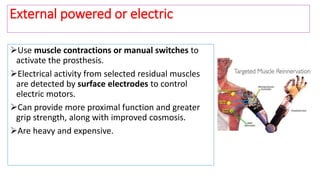
Use muscle contractions or manual switches to
activate the prosthesis.
Electrical activity from selected residual muscles
are detected by surface electrodes to control
electric motors.
Can provide more proximal function and greater
grip strength, along with improved cosmosis.
Are heavy and expensive.
External powered or electric
A myoelectrically controlled prosthesis uses muscle contractions as a
signal to activate the prosthesis. It functions by using surface electrodes to
detect electrical activity from selected residual limb muscles to control
electric motors.
Switch-controlled, prostheses use small switches to operate the electric
motors. These switches typically are enclosed inside the socket or
incorporated into the suspension harness of the prosthesis
A hybrid system uses the patient’s own muscle strength and joint
movement, as well as an external supply for power. An example of a hybrid
system is one in which there is a body powered elbow joint but an externally
powered terminal device.
External powered or electric
• Pros
• Moderate or no harnessing
• Least body movement to operate
• Moderate cosmesis
• More function – proximal levels
• Cons
• Heaviest
• Most expensive
• Most maintenance
• Limited sensory feedback
All conventional body-powered, upper extremity
prostheses have the following components
• Socket
• Suspension
• Control-cable system
• Terminal device
• Components for any interposing joints as needed according
to the level of amputation
• Wrists
• Elbows
• Shoulders
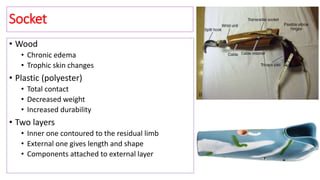
Socket
• Wood
• Chronic edema
• Trophic skin changes
• Plastic (polyester)
• Total contact
• Decreased weight
• Increased durability
• Two layers
• Inner one contoured to the residual limb
• External one gives length and shape
• Components attached to external layer
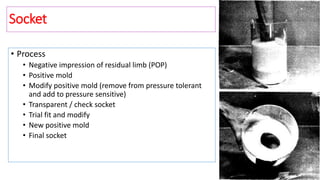
• Process
• Negative impression of residual limb (POP)
• Positive mold
• Modify positive mold (remove from pressure tolerant
and add to pressure sensitive)
• Transparent / check socket
• Trial fit and modify
• New positive mold
• Final socket
Socket
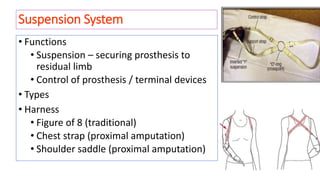
Suspension System
• Functions
• Suspension – securing prosthesis to
residual limb
• Control of prosthesis / terminal devices
• Types
• Harness
• Figure of 8 (traditional)
• Chest strap (proximal amputation)
• Shoulder saddle (proximal amputation)
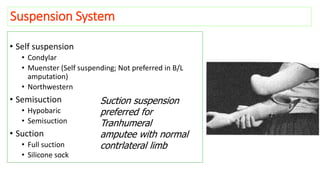
Suspension System
• Self suspension
• Condylar
• Muenster (Self suspending; Not preferred in B/L
amputation)
• Northwestern
• Semisuction
• Hypobaric
• Semisuction
• Suction
• Full suction
• Silicone sock
Suction suspension
preferred for
Tranhumeral
amputee with normal
contrlateral limb
Silicone suction suspension
• Kristinsson in 1986
• Improved suspension with negative atmospheric pressure
• Reduction of shear forces on skin
• Allows volume adjustment with residual limb girth changes
• Simplified donning, better elbow range of motion, lighter
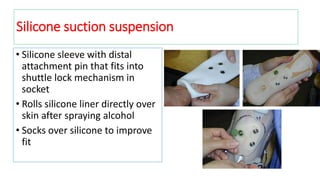
• Silicone sleeve with distal
attachment pin that fits into
shuttle lock mechanism in
socket
• Rolls silicone liner directly over
skin after spraying alcohol
• Socks over silicone to improve
fit
Silicone suction suspension
• Excessive perspiration
• Antiperspirant lotions, botox injections
• Contact dermatitis like reaction
• Zinc oxide or petrolactum paste
• Patients with problems of skin integrity
• Skin grafting for burns
• degloving injury
• insensate skin (diabetes, scleroderma)
• adhesive scar tissue
Silicone suction suspension
Control mechanisms
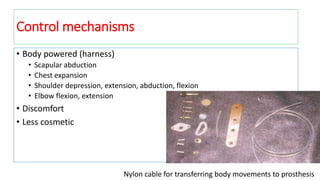
• Body powered (harness)
• Scapular abduction
• Chest expansion
• Shoulder depression, extension, abduction, flexion
• Elbow flexion, extension
• Discomfort
• Less cosmetic
Nylon cable for transferring body movements to prosthesis
Control mechanisms
• Externally powered prostheses
• Electric motors inside prosthesis for wrist rotation / elbow
flexion or extension
• Motors controlled by switches, myoelectric signals, acoustic
signals
• Greater prehensile force
• Proportional prehension
Control mechanisms
• Switch
• Inside or outside socket
• Activated on contact by amputee
• Myoelectric controls
• Electrical activity generated during muscle contraction to control
flow of energy from a battery to a motor in prosthetic device
• Antagonistic muscles in distal portion with normal voluntary
activity
Control mechanisms
• Myoelectric controls
• High cost
• Low reliability
• Heavy (motors, batteries)
• India: electrodes rust quickly because of sweat, electronic
circuits fail due to dust / sweat
Terminal Devices
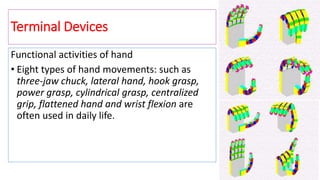
Functional activities of hand
• Eight types of hand movements: such as
three-jaw chuck, lateral hand, hook grasp,
power grasp, cylindrical grasp, centralized
grip, flattened hand and wrist flexion are
often used in daily life.
Terminal Devices
The terminal device is connected to forearm socket.
 Terminal devices are divided into two categories:
Passive terminal device:
Cosmetic hands
Active terminal device
Hooks
Functional hands
Activity specific devices
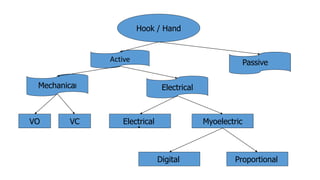
Hook / Hand
Mechanical Electrical
VO VC Electrical Myoelectric
Digital Proportional
PassiveActive
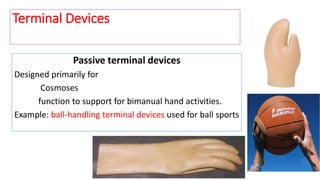
Passive terminal devices
Designed primarily for
Cosmoses
function to support for bimanual hand activities.
Example: ball-handling terminal devices used for ball sports
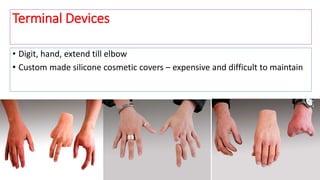
Terminal Devices
• Digit, hand, extend till elbow
• Custom made silicone cosmetic covers – expensive and difficult to maintain
Terminal Devices
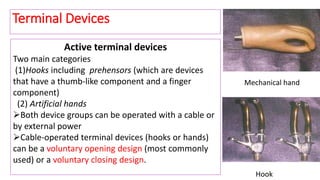
Active terminal devices
Two main categories
(1)Hooks including prehensors (which are devices
that have a thumb-like component and a finger
component)
(2) Artificial hands
Both device groups can be operated with a cable or
by external power
Cable-operated terminal devices (hooks or hands)
can be a voluntary opening design (most commonly
used) or a voluntary closing design.
Terminal Devices
Mechanical hand
Hook
Terminal Devices
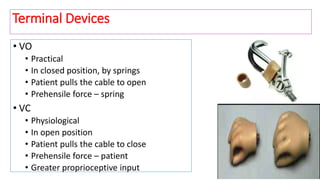
• VO
• Practical
• In closed position, by springs
• Patient pulls the cable to open
• Prehensile force – spring
• VC
• Physiological
• In open position
• Patient pulls the cable to close
• Prehensile force – patient
• Greater proprioceptive input
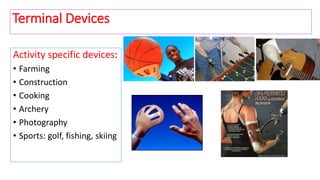
Activity specific devices:
• Farming
• Construction
• Cooking
• Archery
• Photography
• Sports: golf, fishing, skiing
Terminal Devices
Prosthetic wrists or wrist unit
• Provide receptacle for connecting terminal device
• Prono-supination or flexion based on functional activities of patient
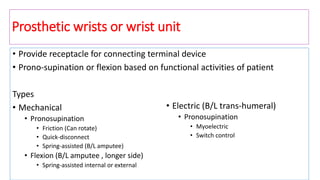
Types
• Mechanical
• Pronosupination
• Friction (Can rotate)
• Quick-disconnect
• Spring-assisted (B/L amputee)
• Flexion (B/L amputee , longer side)
• Spring-assisted internal or external
• Electric (B/L trans-humeral)
• Pronosupination
• Myoelectric
• Switch control
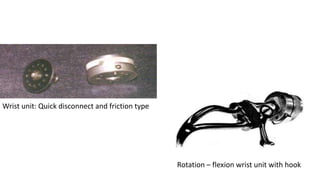
Rotation – flexion wrist unit with hook
Wrist unit: Quick disconnect and friction type
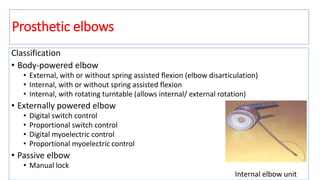
Classification
• Body-powered elbow
• External, with or without spring assisted flexion (elbow disarticulation)
• Internal, with or without spring assisted flexion
• Internal, with rotating turntable (allows internal/ external rotation)
• Externally powered elbow
• Digital switch control
• Proportional switch control
• Digital myoelectric control
• Proportional myoelectric control
• Passive elbow
• Manual lock
Prosthetic elbows
Internal elbow unit
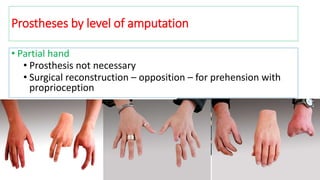
Prostheses by level of amputation
• Partial hand
• Prosthesis not necessary
• Surgical reconstruction – opposition – for prehension with
proprioception
• The person with a partial hand deficiency has four prosthetic
options
1. No prosthetic intervention
2. A passive prosthesis
3. A body-powered prosthesis
4. Multiple task-specific prostheses
Prostheses by level of amputation
• Wrist disarticulation
• Distal radial-ulnar articulation preserved for prono-
supination
• Socket: tapered and flattened distally forming an oval
• Wrist unit: thin, to minimize length
Prostheses by level of amputation
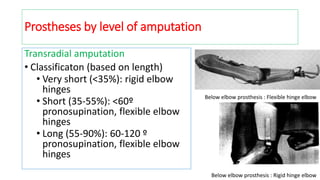
Transradial amputation
• Classificaton (based on length)
• Very short (<35%): rigid elbow
hinges
• Short (35-55%): <60º
pronosupination, flexible elbow
hinges
• Long (55-90%): 60-120 º
pronosupination, flexible elbow
hinges
Below elbow prosthesis : Flexible hinge elbow
Below elbow prosthesis : Rigid hinge elbow
Prostheses by level of amputation
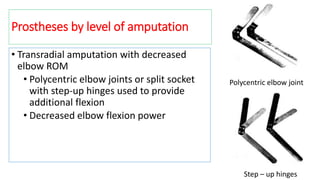
• Transradial amputation with decreased
elbow ROM
• Polycentric elbow joints or split socket
with step-up hinges used to provide
additional flexion
• Decreased elbow flexion power
Polycentric elbow joint
Step – up hinges
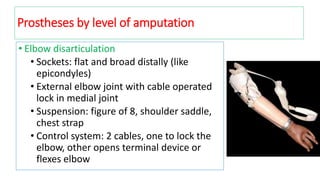
• Elbow disarticulation
• Sockets: flat and broad distally (like
epicondyles)
• External elbow joint with cable operated
lock in medial joint
• Suspension: figure of 8, shoulder saddle,
chest strap
• Control system: 2 cables, one to lock the
elbow, other opens terminal device or
flexes elbow
Prostheses by level of amputation
Transhumeral amputation
• Classification (based on length of humerus)
• Very short (<30%)
• Short (30-50%)
• Standard (50-90%)
Transhumeral amputation
• Sockets:
• Residual limb greater than 35% - proximal trimline within
1cm of acromion, suspension with figure of 8, shoulder
saddle, or chest strap
• Residual limb smaller than 35% - proximal trimline 2.5cm
medial to acromion, suspension with chest strap or
suction socket
Prostheses by level of amputation
• Transhumeral amputation
• Elbow joint
• Internal elbow joint
• Preferred
• Level of amputation 4cm or more proximal from epicondyles
• Allows passive internal / external rotation
• Elbow spring-lift assist available
• External elbow joint
• Distal amputation
• Maintains elbow center with contralateral side
Prostheses by level of amputation
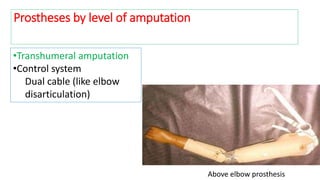
Above elbow prosthesis
Prostheses by level of amputation
•Transhumeral amputation
•Control system
Dual cable (like elbow
disarticulation)
Shoulder disarticulation and forequarter
amputation
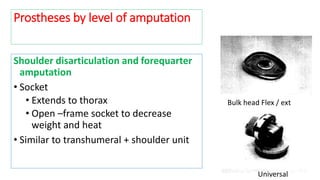
• Socket
• Extends to thorax
• Open –frame socket to decrease
weight and heat
• Similar to transhumeral + shoulder unit
Bulk head Flex / ext
Universal
Prostheses by level of amputation
• Control:
• Triple cable system
• One for elbow flexion when opposite humerus is flexed
• Second cable opens terminal device with chest expansion
• Third cable locks / unlocks elbow with chin / opposite hand
• Externally powered prosthesis preferred
• Passive cosmetic prosthetic restoration in some patients
Shoulder disarticulation and forequarter
amputation
Prosthetic Technology
• Innovations in prosthetics over the
past several years have succeeded in
improving several critical
parameters
• control
• attachment
• functionality
• power.
Advances in Prosthetic Technology
Surgical
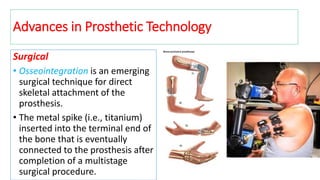
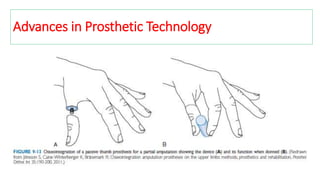
• Osseointegration is an emerging
surgical technique for direct
skeletal attachment of the
prosthesis.
• The metal spike (i.e., titanium)
inserted into the terminal end of
the bone that is eventually
connected to the prosthesis after
completion of a multistage
surgical procedure.
• Benefits
• improved suspension
• Control
• Proprioception
• Elimination of all problems associated with the use of liners and
sockets (e.g., sweating, pain, skin irritation).
• The major problem has been with infection
• Other problems encountered include fracture and loosening
Advances in Prosthetic Technology
• Myoelectric Prostheses:
• Using biological signals to control movement of prosthetic
Image source [4,5]
Advances in Prosthetic Technology
Myoelectric Prostheses cont.
• Uses electrodes to measure action potential
▫ Normally obtains signal from two positions for opening/closing
• Emissions measured on skin surface
▫ Microvolt level
• Electrodes
▫ Signal amplified to use as controls for prosthetic motors
▫ External source (6V battery) needed to operate motor
Data source [3]
Advances in Prosthetic Technology
Myoelectric Prostheses cont.
• Flow diagram
Arm Electrodes Amplifier
DSP
EMG Signal
DAQProsthesis
1. Feature extraction
2. Classification of signal
Data source [6,7]
Advances in Prosthetic Technology
• Myoelectric Prostheses
• Pros
▫ Robust
▫ Simple to implement
▫ Non-invasive
• Cons
▫ “Switch” operated
 Limited number of channels of control
 One joint movement at a time (2 D.O.F.)
▫ Number of signal sources decreases with level of amputation
▫ No sensory function
Image source [10] Data source [6, 11]
Advances in Prosthetic Technology
• Myoelectric Prosthetic:
• Touch Bionics – i-LIMB
• First commercially available
“true 5-finger hand prosthesis”
• Controlled by action potential
• Two input myoelectric (SEMG)
• Open/close fingers
• Independently driven motor in each finger
• Computer in the back of the hand: interprets signals from electrodes
Image , data source [12]
Advances in Prosthetic Technology
• i-LIMB cont’d
• Drawback
• Finger control coupled with open/close function, so not completely
independent
• No sensory control to control grip strength
• Pre-programmed grip patterns to learn
• Signal not physiologically relevant
Image , data source [13]
Advances in Prosthetic Technology
• Targeted Muscle Reinnervation:
• Neural-machine interface
• Takes nerves that innervated severed limb, redirects them to proximal muscle and
skin sites
• Redirect high to low functional significance
Image source [14] , Data source [15]
Advances in Prosthetic Technology
• Targeted Muscle Reinnervationcont.:
• Muscles serve as biological amplifiers of motor commands
• Bipolar EMG electrodes placed on skin over reinnervated muscles
Image source [14,17], Data source [16]
Advances in Prosthetic Technology
• Targeted Muscle Reinnervation cont.
• Pros
▫ Simultaneous control of multiple D.O.F.
 14/21 D.O.F.
▫ Natural feel, connection to nervous system
▫ Potential for sensory feedback
 TSR
• Cons
▫ Invasive
▫ Controlling EMG signal isolation
▫ SEMG concerns
Data source [17, 18]
Advances in Prosthetic Technology
Implanted Electrodes:
• Neuroprosthetic interface
• Allows for sensory feedback and higher number of control channels
• Four miniature electrodes (thin-film longitudinal intra-fascicular electrodes [tfLIFE])
implanted in the nerve
tfLIFE
Image source [19, 20], data source [19,11]
Advances in Prosthetic Technology
Implanted Electrodes
• Pros
• Accurate, complex hand movement allowed
• Hand movement truly controlled by thought
• Cons
• Implant remains in patient only a month at a
time
• Technology not yet perfected
• Invasive
Image source [21], data source [11]
Advances in Prosthetic Technology
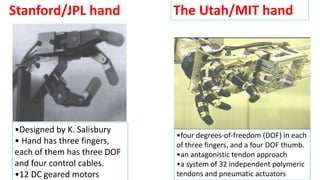
Stanford/JPL hand
•Designed by K. Salisbury
• Hand has three fingers,
each of them has three DOF
and four control cables.
•12 DC geared motors
The Utah/MIT hand
•four degrees-of-freedom (DOF) in each
of three fingers, and a four DOF thumb.
•an antagonistic tendon approach
•a system of 32 independent polymeric
tendons and pneumatic actuators
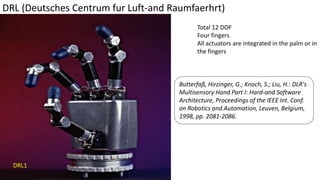
DRL (Deutsches Centrum fur Luft-and Raumfaerhrt)
Total 12 DOF
Four fingers
All actuators are integrated in the palm or in
the fingers
Butterfaß, Hirzinger, G.; Knoch, S.; Liu, H.: DLR's
Multisensory Hand Part I: Hard-and Software
Architecture, Proceedings of the IEEE Int. Conf.
on Robotics and Automation, Leuven, Belgium,
1998, pp. 2081-2086.
DRL1
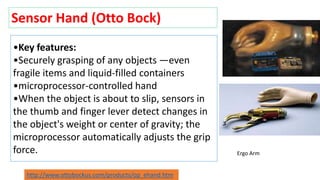
•Key features:
•Securely grasping of any objects —even
fragile items and liquid-filled containers
•microprocessor-controlled hand
•When the object is about to slip, sensors in
the thumb and finger lever detect changes in
the object's weight or center of gravity; the
microprocessor automatically adjusts the grip
force.
Sensor Hand (Otto Bock)
Ergo Arm
http://www.ottobockus.com/products/op_ehand.htm
Future Steps
• Ultimate goal:
• Arm that ties directly into nervous system
• Increase degrees of freedom of prosthetic arm
• Sensory Functions
• Targeted Sensory Reinnervation
Data source [22]
Terminal devices
• Two breakthroughs in terminal device technology have had a
significant impact on the future of electronic prostheses.
• The first is the introduction of water/dust resistant
components. These new components function better in the
real world and have fewer moisture-related problems.
• The second major development is that of speed.
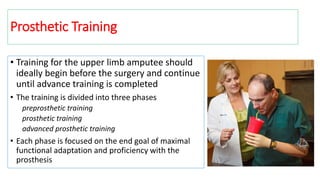
Prosthetic Training
• Training for the upper limb amputee should
ideally begin before the surgery and continue
until advance training is completed
• The training is divided into three phases
preprosthetic training
prosthetic training
advanced prosthetic training
• Each phase is focused on the end goal of maximal
functional adaptation and proficiency with the
prosthesis
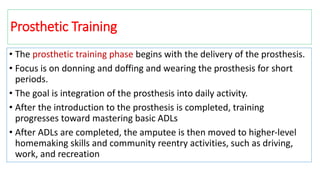
• The prosthetic training phase begins with the delivery of the prosthesis.
• Focus is on donning and doffing and wearing the prosthesis for short
periods.
• The goal is integration of the prosthesis into daily activity.
• After the introduction to the prosthesis is completed, training
progresses toward mastering basic ADLs
• After ADLs are completed, the amputee is then moved to higher-level
homemaking skills and community reentry activities, such as driving,
work, and recreation
Prosthetic Training
FOLLOW-UP
• The need for regular lifelong follow-up by the rehabilitation team
inclusive of the physiatrist cannot be overemphasized
• After discharge from the therapy program, the amputee should be
regularly monitored in an outpatient clinic by the rehabilitation team
• Evaluate new and ongoing medical issues
• Evaluate pain management
• Evaluate skin integrity
• Evaluate emotional adjustment inclusive of family
• Evaluate prosthetic condition and fit
• Evaluate progress with functional goals
• Evaluate family and community reintegration
• Evaluate recreational and sport adaption
• Evaluate vocational options
• Evaluate need for social services
• Evaluate need for adaptive equipment.
FOLLOW-UP
Terminal devices
• Two breakthroughs in terminal device technology have had a
significant impact on the future of electronic prostheses.
• The first is the introduction of water/dust resistant
components. These new components function better in the
real world and have fewer moisture-related problems.
• The second major development is that of speed.

Upper Limb Prosthetics - Dr Om Prakash

  • 1.
    UPPER LIMB PROSTHESES Dr.Om Prakash MBBS MD – PMR (AIIMS, New Delhi) Assistant Professor, Dept. of PMR SMS Medical College and Attached Hospital , Jaipur, Rajasthan
  • 2.
    History • Prior toantiseptic surgery and antimicrobial drugs many amputations of the limb were caused by fractures . • Although amputations of the upper limb may be presumed to have occurred from very early times • the first record of an artificial device used for an upper limb amputation is thought to have come from the second Punic war 218-201 BC • Design of prosthetics improved directly with science and technology and wars
  • 3.
    Introduction Incidence • 6000 to10,000 major amputations of upper limb occur every year. • Upper limb amputations with hand loss is extremely devastating , upper limb traumatic amputations occur twice as frequently as traumatic amputations of lower limb
  • 4.
    • A prosthesisis a device that is designed to replace, as much as possible, the function or appearance of a missing limb or body part. • Prosthesis can replace some grasping and manipulating functions of hand • No sensory feedback • Role of dominant function replaced to contra-lateral hand and prosthesis assists bimanual function Introduction
  • 5.
    • A successfulprosthesis • Comfortable to wear • Easy to don and doff • Light weight and durable • Cosmetically pleasing • Must function well mechanically • Have reasonable maintenance • Motivation of the individual Introduction
  • 6.
    • Factors • Amputationlevel • Expected function of the prosthesis • Cognitive function of the patient • Vocation of the patient (eg, desk job vs manual laborer) • Avocational interests of the patient (ie, hobbies) • Cosmetic importance of the prosthesis • Financial resources of the patient Introduction
  • 7.
    Most common reasonsfor an upper extremity amputation • Correction of a congenital deformity • Tumor is commonly seen in individuals aged 0-15 years. • Trauma is the most common reason for amputation in patients aged 15-45 years, with tumors being a distant second. • Upper extremity amputations tend to be rare in patients who are older than 60 years, but they may be required secondary to tumor or medical disease.
  • 8.
    Standard Levels ofUpper-Limb Amputation 1. Transphalangeal 2. Transmetacarpal 3. Transcarpal 4. Wrist disarticulation 5. Transradial (below elbow) amputation 6. Elbow disarticulation 7. Transhumeral (above elbow) amputation 8. Shoulder disarticulation 9. Forequarter amputation
  • 9.
    Upper Limb Prostheses Fourcategories of upper limb prosthetic systems: 1. Passive system 2. Body-powered system: Cable controlled 3. Externally powered system: Electrically powered - Myoelectrically controlled prostheses -Switch-controlled prostheses 4. Hybrid system.
  • 10.
    Cosmetic or passive •A passive system is primarily cosmetic but also functions as stabilizer. A passive system is fabricated if the patient does not have enough strength or movement to control a prosthesis, or wears a prosthesis only for cosmoses. • Pros • Most lightweight • Best cosmesis • Least harnessing • Cons • High cost if custom made • Least function • Low-cost glove stains easily
  • 11.
    Body-powered prostheses Body poweredprostheses use forces generated by body movements transmitted through cables to operate joints and terminal devices. Forward flexing the shoulder to provide tension on the control cable(Bowden cable) of the prosthesis resulting in opening the terminal device. Relaxing the shoulder forward flexion results in return of the terminal device to the static closed position. Body-powered prostheses are more durable and are less expensive and lighter than myoelectric prostheses
  • 12.
    Examples (1) Biscapular abduction,(2) shoulder flexion (and elbow extension = in cases of transradial amputation) are used to control terminal device.  Shoulder depression, extension, internal rotation, & abduction operate the elbow lock in trans humeral amputation. Body-powered prostheses
  • 13.
    Body powered orconventional • Pros • Moderate cost • Moderately lightweight • Most durable • Highest sensory feedback • Cons • Most body movement to operate • Most harnessing • Least satisfactory appearance
  • 14.
    Use muscle contractionsor manual switches to activate the prosthesis. Electrical activity from selected residual muscles are detected by surface electrodes to control electric motors. Can provide more proximal function and greater grip strength, along with improved cosmosis. Are heavy and expensive. External powered or electric
  • 15.
    A myoelectrically controlledprosthesis uses muscle contractions as a signal to activate the prosthesis. It functions by using surface electrodes to detect electrical activity from selected residual limb muscles to control electric motors. Switch-controlled, prostheses use small switches to operate the electric motors. These switches typically are enclosed inside the socket or incorporated into the suspension harness of the prosthesis A hybrid system uses the patient’s own muscle strength and joint movement, as well as an external supply for power. An example of a hybrid system is one in which there is a body powered elbow joint but an externally powered terminal device. External powered or electric
  • 16.
    External powered orelectric • Pros • Moderate or no harnessing • Least body movement to operate • Moderate cosmesis • More function – proximal levels • Cons • Heaviest • Most expensive • Most maintenance • Limited sensory feedback
  • 17.
    All conventional body-powered,upper extremity prostheses have the following components • Socket • Suspension • Control-cable system • Terminal device • Components for any interposing joints as needed according to the level of amputation • Wrists • Elbows • Shoulders
  • 18.
    Socket • Wood • Chronicedema • Trophic skin changes • Plastic (polyester) • Total contact • Decreased weight • Increased durability • Two layers • Inner one contoured to the residual limb • External one gives length and shape • Components attached to external layer
  • 19.
    • Process • Negativeimpression of residual limb (POP) • Positive mold • Modify positive mold (remove from pressure tolerant and add to pressure sensitive) • Transparent / check socket • Trial fit and modify • New positive mold • Final socket Socket
  • 20.
    Suspension System • Functions •Suspension – securing prosthesis to residual limb • Control of prosthesis / terminal devices • Types • Harness • Figure of 8 (traditional) • Chest strap (proximal amputation) • Shoulder saddle (proximal amputation)
  • 21.
    Suspension System • Selfsuspension • Condylar • Muenster (Self suspending; Not preferred in B/L amputation) • Northwestern • Semisuction • Hypobaric • Semisuction • Suction • Full suction • Silicone sock Suction suspension preferred for Tranhumeral amputee with normal contrlateral limb
  • 22.
    Silicone suction suspension •Kristinsson in 1986 • Improved suspension with negative atmospheric pressure • Reduction of shear forces on skin • Allows volume adjustment with residual limb girth changes • Simplified donning, better elbow range of motion, lighter
  • 23.
    • Silicone sleevewith distal attachment pin that fits into shuttle lock mechanism in socket • Rolls silicone liner directly over skin after spraying alcohol • Socks over silicone to improve fit Silicone suction suspension
  • 24.
    • Excessive perspiration •Antiperspirant lotions, botox injections • Contact dermatitis like reaction • Zinc oxide or petrolactum paste • Patients with problems of skin integrity • Skin grafting for burns • degloving injury • insensate skin (diabetes, scleroderma) • adhesive scar tissue Silicone suction suspension
  • 25.
    Control mechanisms • Bodypowered (harness) • Scapular abduction • Chest expansion • Shoulder depression, extension, abduction, flexion • Elbow flexion, extension • Discomfort • Less cosmetic Nylon cable for transferring body movements to prosthesis
  • 26.
    Control mechanisms • Externallypowered prostheses • Electric motors inside prosthesis for wrist rotation / elbow flexion or extension • Motors controlled by switches, myoelectric signals, acoustic signals • Greater prehensile force • Proportional prehension
  • 27.
    Control mechanisms • Switch •Inside or outside socket • Activated on contact by amputee • Myoelectric controls • Electrical activity generated during muscle contraction to control flow of energy from a battery to a motor in prosthetic device • Antagonistic muscles in distal portion with normal voluntary activity
  • 28.
    Control mechanisms • Myoelectriccontrols • High cost • Low reliability • Heavy (motors, batteries) • India: electrodes rust quickly because of sweat, electronic circuits fail due to dust / sweat
  • 29.
    Terminal Devices Functional activitiesof hand • Eight types of hand movements: such as three-jaw chuck, lateral hand, hook grasp, power grasp, cylindrical grasp, centralized grip, flattened hand and wrist flexion are often used in daily life.
  • 30.
    Terminal Devices The terminaldevice is connected to forearm socket.  Terminal devices are divided into two categories: Passive terminal device: Cosmetic hands Active terminal device Hooks Functional hands Activity specific devices
  • 31.
    Hook / Hand MechanicalElectrical VO VC Electrical Myoelectric Digital Proportional PassiveActive
  • 32.
    Passive terminal devices Designedprimarily for Cosmoses function to support for bimanual hand activities. Example: ball-handling terminal devices used for ball sports Terminal Devices
  • 33.
    • Digit, hand,extend till elbow • Custom made silicone cosmetic covers – expensive and difficult to maintain Terminal Devices
  • 34.
    Active terminal devices Twomain categories (1)Hooks including prehensors (which are devices that have a thumb-like component and a finger component) (2) Artificial hands Both device groups can be operated with a cable or by external power Cable-operated terminal devices (hooks or hands) can be a voluntary opening design (most commonly used) or a voluntary closing design. Terminal Devices Mechanical hand Hook
  • 35.
    Terminal Devices • VO •Practical • In closed position, by springs • Patient pulls the cable to open • Prehensile force – spring • VC • Physiological • In open position • Patient pulls the cable to close • Prehensile force – patient • Greater proprioceptive input
  • 36.
    Activity specific devices: •Farming • Construction • Cooking • Archery • Photography • Sports: golf, fishing, skiing Terminal Devices
  • 37.
    Prosthetic wrists orwrist unit • Provide receptacle for connecting terminal device • Prono-supination or flexion based on functional activities of patient Types • Mechanical • Pronosupination • Friction (Can rotate) • Quick-disconnect • Spring-assisted (B/L amputee) • Flexion (B/L amputee , longer side) • Spring-assisted internal or external • Electric (B/L trans-humeral) • Pronosupination • Myoelectric • Switch control
  • 38.
    Rotation – flexionwrist unit with hook Wrist unit: Quick disconnect and friction type
  • 39.
    Classification • Body-powered elbow •External, with or without spring assisted flexion (elbow disarticulation) • Internal, with or without spring assisted flexion • Internal, with rotating turntable (allows internal/ external rotation) • Externally powered elbow • Digital switch control • Proportional switch control • Digital myoelectric control • Proportional myoelectric control • Passive elbow • Manual lock Prosthetic elbows Internal elbow unit
  • 40.
    Prostheses by levelof amputation • Partial hand • Prosthesis not necessary • Surgical reconstruction – opposition – for prehension with proprioception
  • 41.
    • The personwith a partial hand deficiency has four prosthetic options 1. No prosthetic intervention 2. A passive prosthesis 3. A body-powered prosthesis 4. Multiple task-specific prostheses Prostheses by level of amputation
  • 42.
    Prostheses by levelof amputation • Wrist disarticulation • Distal radial-ulnar articulation preserved for prono- supination • Socket: tapered and flattened distally forming an oval • Wrist unit: thin, to minimize length
  • 43.
    Prostheses by levelof amputation Transradial amputation • Classificaton (based on length) • Very short (<35%): rigid elbow hinges • Short (35-55%): <60º pronosupination, flexible elbow hinges • Long (55-90%): 60-120 º pronosupination, flexible elbow hinges Below elbow prosthesis : Flexible hinge elbow Below elbow prosthesis : Rigid hinge elbow
  • 44.
    Prostheses by levelof amputation • Transradial amputation with decreased elbow ROM • Polycentric elbow joints or split socket with step-up hinges used to provide additional flexion • Decreased elbow flexion power Polycentric elbow joint Step – up hinges
  • 45.
    • Elbow disarticulation •Sockets: flat and broad distally (like epicondyles) • External elbow joint with cable operated lock in medial joint • Suspension: figure of 8, shoulder saddle, chest strap • Control system: 2 cables, one to lock the elbow, other opens terminal device or flexes elbow Prostheses by level of amputation
  • 46.
    Prostheses by levelof amputation Transhumeral amputation • Classification (based on length of humerus) • Very short (<30%) • Short (30-50%) • Standard (50-90%)
  • 47.
    Transhumeral amputation • Sockets: •Residual limb greater than 35% - proximal trimline within 1cm of acromion, suspension with figure of 8, shoulder saddle, or chest strap • Residual limb smaller than 35% - proximal trimline 2.5cm medial to acromion, suspension with chest strap or suction socket Prostheses by level of amputation
  • 48.
    • Transhumeral amputation •Elbow joint • Internal elbow joint • Preferred • Level of amputation 4cm or more proximal from epicondyles • Allows passive internal / external rotation • Elbow spring-lift assist available • External elbow joint • Distal amputation • Maintains elbow center with contralateral side Prostheses by level of amputation
  • 49.
    Above elbow prosthesis Prosthesesby level of amputation •Transhumeral amputation •Control system Dual cable (like elbow disarticulation)
  • 50.
    Shoulder disarticulation andforequarter amputation • Socket • Extends to thorax • Open –frame socket to decrease weight and heat • Similar to transhumeral + shoulder unit Bulk head Flex / ext Universal Prostheses by level of amputation
  • 51.
    • Control: • Triplecable system • One for elbow flexion when opposite humerus is flexed • Second cable opens terminal device with chest expansion • Third cable locks / unlocks elbow with chin / opposite hand • Externally powered prosthesis preferred • Passive cosmetic prosthetic restoration in some patients Shoulder disarticulation and forequarter amputation
  • 52.
    Prosthetic Technology • Innovationsin prosthetics over the past several years have succeeded in improving several critical parameters • control • attachment • functionality • power. Advances in Prosthetic Technology
  • 53.
    Advances in ProstheticTechnology Surgical • Osseointegration is an emerging surgical technique for direct skeletal attachment of the prosthesis. • The metal spike (i.e., titanium) inserted into the terminal end of the bone that is eventually connected to the prosthesis after completion of a multistage surgical procedure.
  • 54.
    • Benefits • improvedsuspension • Control • Proprioception • Elimination of all problems associated with the use of liners and sockets (e.g., sweating, pain, skin irritation). • The major problem has been with infection • Other problems encountered include fracture and loosening Advances in Prosthetic Technology
  • 55.
  • 56.
    • Myoelectric Prostheses: •Using biological signals to control movement of prosthetic Image source [4,5] Advances in Prosthetic Technology
  • 57.
    Myoelectric Prostheses cont. •Uses electrodes to measure action potential ▫ Normally obtains signal from two positions for opening/closing • Emissions measured on skin surface ▫ Microvolt level • Electrodes ▫ Signal amplified to use as controls for prosthetic motors ▫ External source (6V battery) needed to operate motor Data source [3] Advances in Prosthetic Technology
  • 58.
    Myoelectric Prostheses cont. •Flow diagram Arm Electrodes Amplifier DSP EMG Signal DAQProsthesis 1. Feature extraction 2. Classification of signal Data source [6,7] Advances in Prosthetic Technology
  • 59.
    • Myoelectric Prostheses •Pros ▫ Robust ▫ Simple to implement ▫ Non-invasive • Cons ▫ “Switch” operated  Limited number of channels of control  One joint movement at a time (2 D.O.F.) ▫ Number of signal sources decreases with level of amputation ▫ No sensory function Image source [10] Data source [6, 11] Advances in Prosthetic Technology
  • 60.
    • Myoelectric Prosthetic: •Touch Bionics – i-LIMB • First commercially available “true 5-finger hand prosthesis” • Controlled by action potential • Two input myoelectric (SEMG) • Open/close fingers • Independently driven motor in each finger • Computer in the back of the hand: interprets signals from electrodes Image , data source [12] Advances in Prosthetic Technology
  • 61.
    • i-LIMB cont’d •Drawback • Finger control coupled with open/close function, so not completely independent • No sensory control to control grip strength • Pre-programmed grip patterns to learn • Signal not physiologically relevant Image , data source [13] Advances in Prosthetic Technology
  • 62.
    • Targeted MuscleReinnervation: • Neural-machine interface • Takes nerves that innervated severed limb, redirects them to proximal muscle and skin sites • Redirect high to low functional significance Image source [14] , Data source [15] Advances in Prosthetic Technology
  • 63.
    • Targeted MuscleReinnervationcont.: • Muscles serve as biological amplifiers of motor commands • Bipolar EMG electrodes placed on skin over reinnervated muscles Image source [14,17], Data source [16] Advances in Prosthetic Technology
  • 64.
    • Targeted MuscleReinnervation cont. • Pros ▫ Simultaneous control of multiple D.O.F.  14/21 D.O.F. ▫ Natural feel, connection to nervous system ▫ Potential for sensory feedback  TSR • Cons ▫ Invasive ▫ Controlling EMG signal isolation ▫ SEMG concerns Data source [17, 18] Advances in Prosthetic Technology
  • 65.
    Implanted Electrodes: • Neuroprostheticinterface • Allows for sensory feedback and higher number of control channels • Four miniature electrodes (thin-film longitudinal intra-fascicular electrodes [tfLIFE]) implanted in the nerve tfLIFE Image source [19, 20], data source [19,11] Advances in Prosthetic Technology
  • 66.
    Implanted Electrodes • Pros •Accurate, complex hand movement allowed • Hand movement truly controlled by thought • Cons • Implant remains in patient only a month at a time • Technology not yet perfected • Invasive Image source [21], data source [11] Advances in Prosthetic Technology
  • 67.
    Stanford/JPL hand •Designed byK. Salisbury • Hand has three fingers, each of them has three DOF and four control cables. •12 DC geared motors The Utah/MIT hand •four degrees-of-freedom (DOF) in each of three fingers, and a four DOF thumb. •an antagonistic tendon approach •a system of 32 independent polymeric tendons and pneumatic actuators
  • 68.
    DRL (Deutsches Centrumfur Luft-and Raumfaerhrt) Total 12 DOF Four fingers All actuators are integrated in the palm or in the fingers Butterfaß, Hirzinger, G.; Knoch, S.; Liu, H.: DLR's Multisensory Hand Part I: Hard-and Software Architecture, Proceedings of the IEEE Int. Conf. on Robotics and Automation, Leuven, Belgium, 1998, pp. 2081-2086. DRL1
  • 69.
    •Key features: •Securely graspingof any objects —even fragile items and liquid-filled containers •microprocessor-controlled hand •When the object is about to slip, sensors in the thumb and finger lever detect changes in the object's weight or center of gravity; the microprocessor automatically adjusts the grip force. Sensor Hand (Otto Bock) Ergo Arm http://www.ottobockus.com/products/op_ehand.htm
  • 70.
    Future Steps • Ultimategoal: • Arm that ties directly into nervous system • Increase degrees of freedom of prosthetic arm • Sensory Functions • Targeted Sensory Reinnervation Data source [22]
  • 71.
    Terminal devices • Twobreakthroughs in terminal device technology have had a significant impact on the future of electronic prostheses. • The first is the introduction of water/dust resistant components. These new components function better in the real world and have fewer moisture-related problems. • The second major development is that of speed.
  • 72.
    Prosthetic Training • Trainingfor the upper limb amputee should ideally begin before the surgery and continue until advance training is completed • The training is divided into three phases preprosthetic training prosthetic training advanced prosthetic training • Each phase is focused on the end goal of maximal functional adaptation and proficiency with the prosthesis
  • 73.
    • The prosthetictraining phase begins with the delivery of the prosthesis. • Focus is on donning and doffing and wearing the prosthesis for short periods. • The goal is integration of the prosthesis into daily activity. • After the introduction to the prosthesis is completed, training progresses toward mastering basic ADLs • After ADLs are completed, the amputee is then moved to higher-level homemaking skills and community reentry activities, such as driving, work, and recreation Prosthetic Training
  • 74.
    FOLLOW-UP • The needfor regular lifelong follow-up by the rehabilitation team inclusive of the physiatrist cannot be overemphasized • After discharge from the therapy program, the amputee should be regularly monitored in an outpatient clinic by the rehabilitation team • Evaluate new and ongoing medical issues • Evaluate pain management • Evaluate skin integrity • Evaluate emotional adjustment inclusive of family
  • 75.
    • Evaluate prostheticcondition and fit • Evaluate progress with functional goals • Evaluate family and community reintegration • Evaluate recreational and sport adaption • Evaluate vocational options • Evaluate need for social services • Evaluate need for adaptive equipment. FOLLOW-UP
  • 76.
    Terminal devices • Twobreakthroughs in terminal device technology have had a significant impact on the future of electronic prostheses. • The first is the introduction of water/dust resistant components. These new components function better in the real world and have fewer moisture-related problems. • The second major development is that of speed.