GENERAL PRINCIPLES
OF
AMPUTATION
DR NIKHIL DROLIA
JR I
Amputation : Loss of a limb or part of a limb
 The word amputation is derived from the Latin word amputare, "to
cut away"
 Should not be viewed as a failure of treatment but as the first step
in Rehabilitation
 Should be performed by the most experienced surgeon in team
HISTORY
 Earliest amputation were done on unanesthetized patients &
haemostasis attained by crushing or dipping the open stump in
boiling oil
 Hippocrates was the first to use ligatures
 Morel’s introduced torniquet in 1674
 Lister’s introduced antiseptic technique in
reducing mortality
AMPUTATION
 Indications
 Scoring
 Surgical Principles
 Amputation level
 Technical Aspects
 Open Amputations
 Post operative care
 Amputation in children
 Complications
INDICATIONS
 Dead limb – Gangrene
 Deadly limb- Wet gangrene ,Spreading cellulitis ,
Arteriovenous fistula, Other (e.g. malignancy)
 ‘Dead loss’ limb -Severe rest pain , Paralysis ,Other(e.g.
contracture, trauma)
 Only absolute indication : irreversible ischemia in
diseased or traumatized limb
 Peripheral vascular disease
 Trauma
 Burns
 Frostbite
 Infections
 Tumors
PERIPHERAL VASCULAR DISEASE
 Most common age group 50 to 75 yrs
 Most patients have concomitant disease processes in cerebral
vasculature, coronary arteries & kidney.
 Co morbid conditions-diabetes, smoking, prior stroke, prior
major amputation, decreased transcutaneous oxygen levels,
decreased ankle-brachail blood pressure index, ulcers.
 Most significant predictor of amputation in diabetics is
peripheral neuropathy as measured by insensitivity to the
Semmes Weinstein 5.07 monofilament.
 Perioperative mortality rate-30 % & 40% die within 2 yrs.
TRAUMA
 Most common in young patients
 Male >Female
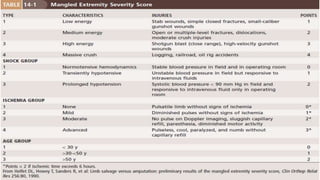
 Lange’s absolute indications for amputation in type III C tibial
injuries :
o Crush injury with warm ischemia time of > 6 hrs
 Relative indications :
o Serious associated injuries
o Severe ipsilateral foot injuries
 Decision as to a limb which can be saved , should be saved or not
 Early amputation and prosthetic fitting :
◦ Decreased morbidity
◦ Fewer operations
◦ Shorter hospital stay
◦ Decreased hospital costs
◦ Shorter Rehabilitation
◦ Earlier return to work
 Acute trauma : functional stump length of stump must be maintained
whenever possible
 Necessary for acute or chronic infections which are unresponsive to
antibiotics and surgical debridement
 Most worrisome infection produced by gas forming bacteria( eg.
Clostrdium,streptococcal)
 Disability from non healing trophic ulcer , chronic osteomyelitis ,
infected nonunion
 Squamous cell carcinoma from chronic discharging sinus
INFECTION
 Limb salvage vs. Amputation
◦ Would survival be affected by treatment choice
◦ Comparison of short term and long term morbidity
◦ Function of salvaged limb
◦ Psychosocial consequences
 Amputation for malignancy is technically demanding
 Limb salvage : Disadvantages
◦ More extensive surgical procedure
◦ Greater risk of infection
◦ Wound dehiscence
◦ Flap necrosis
TUMORS
◦ Increased blood loss
◦ Deep venous thrombosis
 Late complications :
◦ Periprosthetic fractures
◦ Prosthetic loosening
◦ Graft host nonunion
◦ Allograft fractures
◦ Leg length discrepancy
◦ Late infection
 Increased function by increased length of stump vs. Increased complications with
shorter stump
 Revascularization may aid in increasing length of stump but peripheral bypass
surgery may compromise wound healing of a future transtibial amputation
 More proximal level of amputation promotes slower walking velocity in order to
conserve energy
 Amputation should be performed at most distal level if ambulation is main concern
 Potential for wound healing best measured by transcutaneous O2 measurement
LEVEL OF AMPUTATION
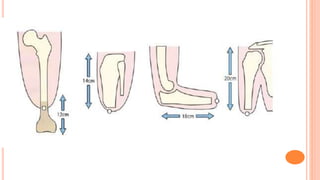
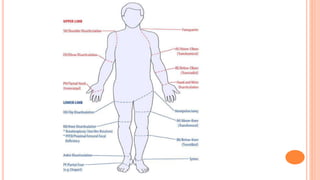
Ideal length of amputation stump
 Above knee amputation : 23-27 cm from greater trochanter or 12 cm from
knee
 Below knee amputation : 12 -17 cm stump length
2.5cm for every 30 cm of height
 Above elbow amputation : 20 cm from shoulder
 Below elbow amputation : 18 cm from olecranon
Factors affecting level of stump
 Section of bone above a joint may prevent use of best type of artificial joint
 Retention of limb remnants below joint which cannot move distal part is not
justified
 When B/K amputation not possible , disarticulation favored
 In ischaemic limbs , level just below distal most pulsation
Ideal stump
 Conical shape ( ideal shape )
 Ideal length
 Good muscle power
 Joint should be supple
 Non adherent scar
 No fixed deformity
 Absence of neuroma
 Bone well covered by muscles
 Muscular and not flabby
 Bone covered by muscles , free from infection
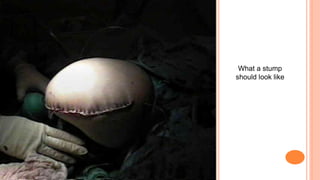
What a stump
should look like
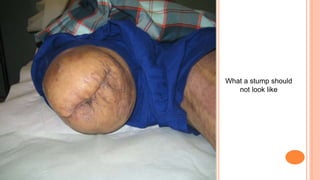
What a stump should
not look like
Efforts should be aimed at
 Stump drainage and removal of drain in time
 Stump splinting
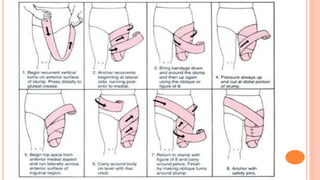
 Proper stump bandaging
 Early starting of stump exercises
 Stump hygiene and intermittent exposure to air
 Tourniquet : Advantageous, contraindicated in ischaemic limbs.
Exsanguinations contraindicated in infected limbs & tumors
Skin Flap
 Flaps should be kept thick
◦ Posterior skin flap should be => anterior skin flap
◦ With modern total contact prosthesis , location of scar not important
◦ Flap should not be adherent to the underlying bone
◦ Preferable to have atypical skin flap than higher level amputation
◦ Large dog ears are to be avoided
◦ Combined length of flaps should be 1/3 of circumference of limb at level of
amputation
SURGICAL TECHNIQUE
Muscles
◦ Muscles sectioned 5 cm distal to level of intended bone resection
◦ May be stabilized by myoplasty or myodesis
◦ Myoplasty : Suturing muscle to periosteum or fascia of opposing musculature
◦ Myodesis : Suturing muscle or tendon to bone
◦ Myodesis should be performed to have stronger insertion , help maximize
strength , minimize atrophy
◦ Myodesed muscle counterbalance antagonists and prevent contractures and
maximize residual limb function
◦ Myodesis contraindicated in severe ischemia due to increased risk of wound
breakdown
Advantages of Myoplasty/Myodesis
 Shape of stump is good
 Muscles insulate cut nerve endings and bone from prosthesis
 Muscles originating proximally to joint produce better stump mobility and increase
leverage
 Muscles not acting on joint contract isometrically and assist in venous return
 Prevent retraction and painful muscle contractions
 Phantom pain prevented
Blood vessels
 Larger vessels doubly ligated
 Tourniquet should be deflated before closure
 Drain preferable for 48-72 hrs
Nerves
 After nerve is divided it almost always forms neuroma
 Neuroma is painful if traumatized repeatedly
 Techniques to prevent neuroma formation : end loop anastomosis ,
perineural closure , Silastic capping , sealing epineurial tube with butyl-
cyanoacrylate , ligation , cauterization or burying nerve ends in muscle
/bone
 Strong tension should be avoided while stretching
 Larger nerves may need ligation for blood vessels
Bone
 Excessive periosteal stripping contraindicated
 May result in formation of ring sequestrum or bony overgrowth
 Bone should be rasped to form a smooth contour- over anterior aspect for below
knee , lateral aspect of femur and over radial styloid
 Fibula cut slightly proximally to produce conical stump
 Skin not closed over level of amputations
 First of the at least 2 surgeries used to create functional stump
 Required in :
 Extensive contaminated injuries
 Infection
 Guillotine amputations : all tissue from skin to bone cut at same level ;
wound left open for further management ; done as an emergency
procedure
 Open amputations with flaps where wound open , flaps covered later
OPEN AMPUTATIONS
 Treatment of stump crucial from time amputation is completed till definitive
prosthesis is fitted
 Gradual shift from conventional soft dressings to rigid dressing
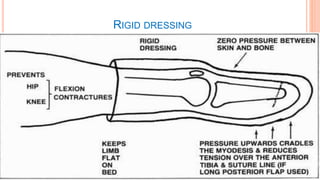
 Rigid dressing :
POP cast applied to stump at conclusion of surgery
◦ Appropriate padding of all bony prominences
◦ Avoiding proximal constriction of ring
◦ Use of dependable cast suspension methods
 If immediate weight bearing intended , true prosthetic cast should be
applied by certified prosthetist
POST OPERATIVE CARE
Advantages of Rigid dressings
 Prevent edema at surgical site
 Protect wound from bed trauma
 Enhance wound healing
 Early maturation of stump
 Decrease postoperative pain
 Allow early mobilization from bed
 Prevent formation of knee flexion contractures
 Drains removed at 48 hrs post op
 Stump is elevated by raising foot end
`Avoid leaving stump in dependent position
RIGID DRESSING
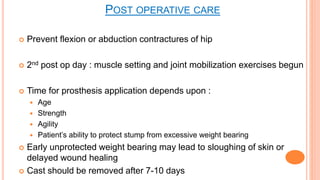
 Prevent flexion or abduction contractures of hip
 2nd post op day : muscle setting and joint mobilization exercises begun
 Time for prosthesis application depends upon :
 Age
 Strength
 Agility
 Patient’s ability to protect stump from excessive weight bearing
 Early unprotected weight bearing may lead to sloughing of skin or
delayed wound healing
 Cast should be removed after 7-10 days
POST OPERATIVE CARE
 Hematoma
 Infection
 Wound Necrosis
 Contractures
 Pain
 Phantom limb sensation
 Dermatological problems
COMPLICATIONS
 Hematoma:
 Prevented by rigid dressing , meticulous hemostasis
 May delay wound healing
 Serve as nidus for infection
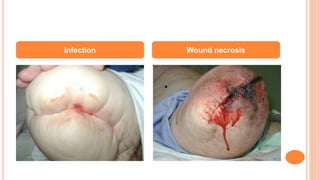
 Infection :
 More common in ischemic ,diabetic limbs
 Deep wound infection should be treated with immediate debridement
 Delayed closure may be difficult because of edema
 Smith and Burgess method of closing central 1/3 of wound and leaving rest
packed open
 Wound Necrosis:
 Nutritional supplementation , TLC , albumin counts
 Necrosis of skin edge < 1 cm can be treated conservatively
 Discontinue prosthetic until wound healed
 If severe necrosis with loss of bone coverage , wedge resection indicated
 Contractures:
 Prevented by proper stump positioning , gentle passive stretching , exercises
 Increased ambulation reduces contractures
 May need wedging casts or surgical release of contracted sutures
 Dermatological problems :
 Contact Dermatitis
 Bacterial folliculitis
 Epidermoid cysts
 Verrucous hyperplasia
 Pain :
 Phantom limb , Phantom pain, residual pain , pain from distant site
 Back ache more common in amputees
 Residual pain more often due to improper fitting
 Painful neuroma usually is easily palpable
 Phantom limb :
 Very common
 Usually not very bothersome
 Telescoping
 Phantom limb pain bothersome , present mostly in proximal level amputations
 Conservative measures tried
Infection Wound necrosis
 Most often due to trauma followed by neoplasms , infection
 General body growth and stump growth important
 Considerations :
 Preserve length as much as possible
 Preserve important growth plates
 Prefer disarticulation rather than amputation
 Preserve knee joint whenever possible
 Stabilize and normalize proximal portion of limb
 To prevent stump overgrowth , myodesis must be preferred at the time of
surgery
 Terminal overgrowth : appositional spike like new bone formation
 Regular prosthetic checking
AMPUTATIONS IN CHILDREN
REFERENCES
 Campbell
 Apley’s
 Google

amputation

  • 1.
  • 2.
    Amputation : Lossof a limb or part of a limb  The word amputation is derived from the Latin word amputare, "to cut away"  Should not be viewed as a failure of treatment but as the first step in Rehabilitation  Should be performed by the most experienced surgeon in team
  • 3.
    HISTORY  Earliest amputationwere done on unanesthetized patients & haemostasis attained by crushing or dipping the open stump in boiling oil  Hippocrates was the first to use ligatures  Morel’s introduced torniquet in 1674  Lister’s introduced antiseptic technique in reducing mortality
  • 4.
    AMPUTATION  Indications  Scoring Surgical Principles  Amputation level  Technical Aspects  Open Amputations  Post operative care  Amputation in children  Complications
  • 5.
    INDICATIONS  Dead limb– Gangrene  Deadly limb- Wet gangrene ,Spreading cellulitis , Arteriovenous fistula, Other (e.g. malignancy)  ‘Dead loss’ limb -Severe rest pain , Paralysis ,Other(e.g. contracture, trauma)
  • 6.
     Only absoluteindication : irreversible ischemia in diseased or traumatized limb  Peripheral vascular disease  Trauma  Burns  Frostbite  Infections  Tumors
  • 7.
    PERIPHERAL VASCULAR DISEASE Most common age group 50 to 75 yrs  Most patients have concomitant disease processes in cerebral vasculature, coronary arteries & kidney.  Co morbid conditions-diabetes, smoking, prior stroke, prior major amputation, decreased transcutaneous oxygen levels, decreased ankle-brachail blood pressure index, ulcers.  Most significant predictor of amputation in diabetics is peripheral neuropathy as measured by insensitivity to the Semmes Weinstein 5.07 monofilament.  Perioperative mortality rate-30 % & 40% die within 2 yrs.
  • 8.
    TRAUMA  Most commonin young patients  Male >Female  Lange’s absolute indications for amputation in type III C tibial injuries : o Crush injury with warm ischemia time of > 6 hrs  Relative indications : o Serious associated injuries o Severe ipsilateral foot injuries  Decision as to a limb which can be saved , should be saved or not
  • 9.
     Early amputationand prosthetic fitting : ◦ Decreased morbidity ◦ Fewer operations ◦ Shorter hospital stay ◦ Decreased hospital costs ◦ Shorter Rehabilitation ◦ Earlier return to work  Acute trauma : functional stump length of stump must be maintained whenever possible
  • 11.
     Necessary foracute or chronic infections which are unresponsive to antibiotics and surgical debridement  Most worrisome infection produced by gas forming bacteria( eg. Clostrdium,streptococcal)  Disability from non healing trophic ulcer , chronic osteomyelitis , infected nonunion  Squamous cell carcinoma from chronic discharging sinus INFECTION
  • 12.
     Limb salvagevs. Amputation ◦ Would survival be affected by treatment choice ◦ Comparison of short term and long term morbidity ◦ Function of salvaged limb ◦ Psychosocial consequences  Amputation for malignancy is technically demanding  Limb salvage : Disadvantages ◦ More extensive surgical procedure ◦ Greater risk of infection ◦ Wound dehiscence ◦ Flap necrosis TUMORS
  • 13.
    ◦ Increased bloodloss ◦ Deep venous thrombosis  Late complications : ◦ Periprosthetic fractures ◦ Prosthetic loosening ◦ Graft host nonunion ◦ Allograft fractures ◦ Leg length discrepancy ◦ Late infection
  • 14.
     Increased functionby increased length of stump vs. Increased complications with shorter stump  Revascularization may aid in increasing length of stump but peripheral bypass surgery may compromise wound healing of a future transtibial amputation  More proximal level of amputation promotes slower walking velocity in order to conserve energy  Amputation should be performed at most distal level if ambulation is main concern  Potential for wound healing best measured by transcutaneous O2 measurement LEVEL OF AMPUTATION
  • 15.
    Ideal length ofamputation stump  Above knee amputation : 23-27 cm from greater trochanter or 12 cm from knee  Below knee amputation : 12 -17 cm stump length 2.5cm for every 30 cm of height  Above elbow amputation : 20 cm from shoulder  Below elbow amputation : 18 cm from olecranon
  • 18.
    Factors affecting levelof stump  Section of bone above a joint may prevent use of best type of artificial joint  Retention of limb remnants below joint which cannot move distal part is not justified  When B/K amputation not possible , disarticulation favored  In ischaemic limbs , level just below distal most pulsation
  • 19.
    Ideal stump  Conicalshape ( ideal shape )  Ideal length  Good muscle power  Joint should be supple  Non adherent scar  No fixed deformity  Absence of neuroma  Bone well covered by muscles  Muscular and not flabby  Bone covered by muscles , free from infection
  • 20.
  • 21.
    What a stumpshould not look like
  • 22.
    Efforts should beaimed at  Stump drainage and removal of drain in time  Stump splinting  Proper stump bandaging  Early starting of stump exercises  Stump hygiene and intermittent exposure to air
  • 23.
     Tourniquet :Advantageous, contraindicated in ischaemic limbs. Exsanguinations contraindicated in infected limbs & tumors Skin Flap  Flaps should be kept thick ◦ Posterior skin flap should be => anterior skin flap ◦ With modern total contact prosthesis , location of scar not important ◦ Flap should not be adherent to the underlying bone ◦ Preferable to have atypical skin flap than higher level amputation ◦ Large dog ears are to be avoided ◦ Combined length of flaps should be 1/3 of circumference of limb at level of amputation SURGICAL TECHNIQUE
  • 24.
    Muscles ◦ Muscles sectioned5 cm distal to level of intended bone resection ◦ May be stabilized by myoplasty or myodesis ◦ Myoplasty : Suturing muscle to periosteum or fascia of opposing musculature ◦ Myodesis : Suturing muscle or tendon to bone ◦ Myodesis should be performed to have stronger insertion , help maximize strength , minimize atrophy ◦ Myodesed muscle counterbalance antagonists and prevent contractures and maximize residual limb function ◦ Myodesis contraindicated in severe ischemia due to increased risk of wound breakdown
  • 26.
    Advantages of Myoplasty/Myodesis Shape of stump is good  Muscles insulate cut nerve endings and bone from prosthesis  Muscles originating proximally to joint produce better stump mobility and increase leverage  Muscles not acting on joint contract isometrically and assist in venous return  Prevent retraction and painful muscle contractions  Phantom pain prevented
  • 27.
    Blood vessels  Largervessels doubly ligated  Tourniquet should be deflated before closure  Drain preferable for 48-72 hrs
  • 28.
    Nerves  After nerveis divided it almost always forms neuroma  Neuroma is painful if traumatized repeatedly  Techniques to prevent neuroma formation : end loop anastomosis , perineural closure , Silastic capping , sealing epineurial tube with butyl- cyanoacrylate , ligation , cauterization or burying nerve ends in muscle /bone  Strong tension should be avoided while stretching  Larger nerves may need ligation for blood vessels
  • 29.
    Bone  Excessive periostealstripping contraindicated  May result in formation of ring sequestrum or bony overgrowth  Bone should be rasped to form a smooth contour- over anterior aspect for below knee , lateral aspect of femur and over radial styloid  Fibula cut slightly proximally to produce conical stump
  • 30.
     Skin notclosed over level of amputations  First of the at least 2 surgeries used to create functional stump  Required in :  Extensive contaminated injuries  Infection  Guillotine amputations : all tissue from skin to bone cut at same level ; wound left open for further management ; done as an emergency procedure  Open amputations with flaps where wound open , flaps covered later OPEN AMPUTATIONS
  • 31.
     Treatment ofstump crucial from time amputation is completed till definitive prosthesis is fitted  Gradual shift from conventional soft dressings to rigid dressing  Rigid dressing : POP cast applied to stump at conclusion of surgery ◦ Appropriate padding of all bony prominences ◦ Avoiding proximal constriction of ring ◦ Use of dependable cast suspension methods  If immediate weight bearing intended , true prosthetic cast should be applied by certified prosthetist POST OPERATIVE CARE
  • 32.
    Advantages of Rigiddressings  Prevent edema at surgical site  Protect wound from bed trauma  Enhance wound healing  Early maturation of stump  Decrease postoperative pain  Allow early mobilization from bed  Prevent formation of knee flexion contractures  Drains removed at 48 hrs post op  Stump is elevated by raising foot end `Avoid leaving stump in dependent position
  • 33.
  • 35.
     Prevent flexionor abduction contractures of hip  2nd post op day : muscle setting and joint mobilization exercises begun  Time for prosthesis application depends upon :  Age  Strength  Agility  Patient’s ability to protect stump from excessive weight bearing  Early unprotected weight bearing may lead to sloughing of skin or delayed wound healing  Cast should be removed after 7-10 days POST OPERATIVE CARE
  • 36.
     Hematoma  Infection Wound Necrosis  Contractures  Pain  Phantom limb sensation  Dermatological problems COMPLICATIONS
  • 37.
     Hematoma:  Preventedby rigid dressing , meticulous hemostasis  May delay wound healing  Serve as nidus for infection  Infection :  More common in ischemic ,diabetic limbs  Deep wound infection should be treated with immediate debridement  Delayed closure may be difficult because of edema  Smith and Burgess method of closing central 1/3 of wound and leaving rest packed open  Wound Necrosis:  Nutritional supplementation , TLC , albumin counts  Necrosis of skin edge < 1 cm can be treated conservatively  Discontinue prosthetic until wound healed  If severe necrosis with loss of bone coverage , wedge resection indicated
  • 38.
     Contractures:  Preventedby proper stump positioning , gentle passive stretching , exercises  Increased ambulation reduces contractures  May need wedging casts or surgical release of contracted sutures  Dermatological problems :  Contact Dermatitis  Bacterial folliculitis  Epidermoid cysts  Verrucous hyperplasia
  • 39.
     Pain : Phantom limb , Phantom pain, residual pain , pain from distant site  Back ache more common in amputees  Residual pain more often due to improper fitting  Painful neuroma usually is easily palpable  Phantom limb :  Very common  Usually not very bothersome  Telescoping  Phantom limb pain bothersome , present mostly in proximal level amputations  Conservative measures tried
  • 40.
  • 41.
     Most oftendue to trauma followed by neoplasms , infection  General body growth and stump growth important  Considerations :  Preserve length as much as possible  Preserve important growth plates  Prefer disarticulation rather than amputation  Preserve knee joint whenever possible  Stabilize and normalize proximal portion of limb  To prevent stump overgrowth , myodesis must be preferred at the time of surgery  Terminal overgrowth : appositional spike like new bone formation  Regular prosthetic checking AMPUTATIONS IN CHILDREN
  • 42.

Editor's Notes

  • #8 Ankle brachial blood pressure index