Chest Tube Insertion &
Central Venous Line
Dr Adib Mursyidi Iskandar Mirza
Emergency Department
IIUM Medical Centre
What is Chest Tube?
• Tube thoracostomy is the insertion of a tube (chest tube) into the
pleural cavity to drain air, blood, bile, pus, or other fluids.
Indication
• Pneumothorax: Open or closed; simple or tension
• Hemothorax
• Hemopneumothorax
• Hydrothorax
• Chylothorax
• Empyema
• Pleural effusion
• Patients with penetrating chest wall injury who are intubated or about to be
intubated
• Considered for those about to undergo air transport who are at risk for
pneumothorax
Contraindication
• Relative contraindications include the following:
• Coagulopathy
• Pulmonary bullae
• Pulmonary, pleural, or thoracic adhesions
• Loculated pleural effusion or empyema
• Skin infection over the chest tube insertion site
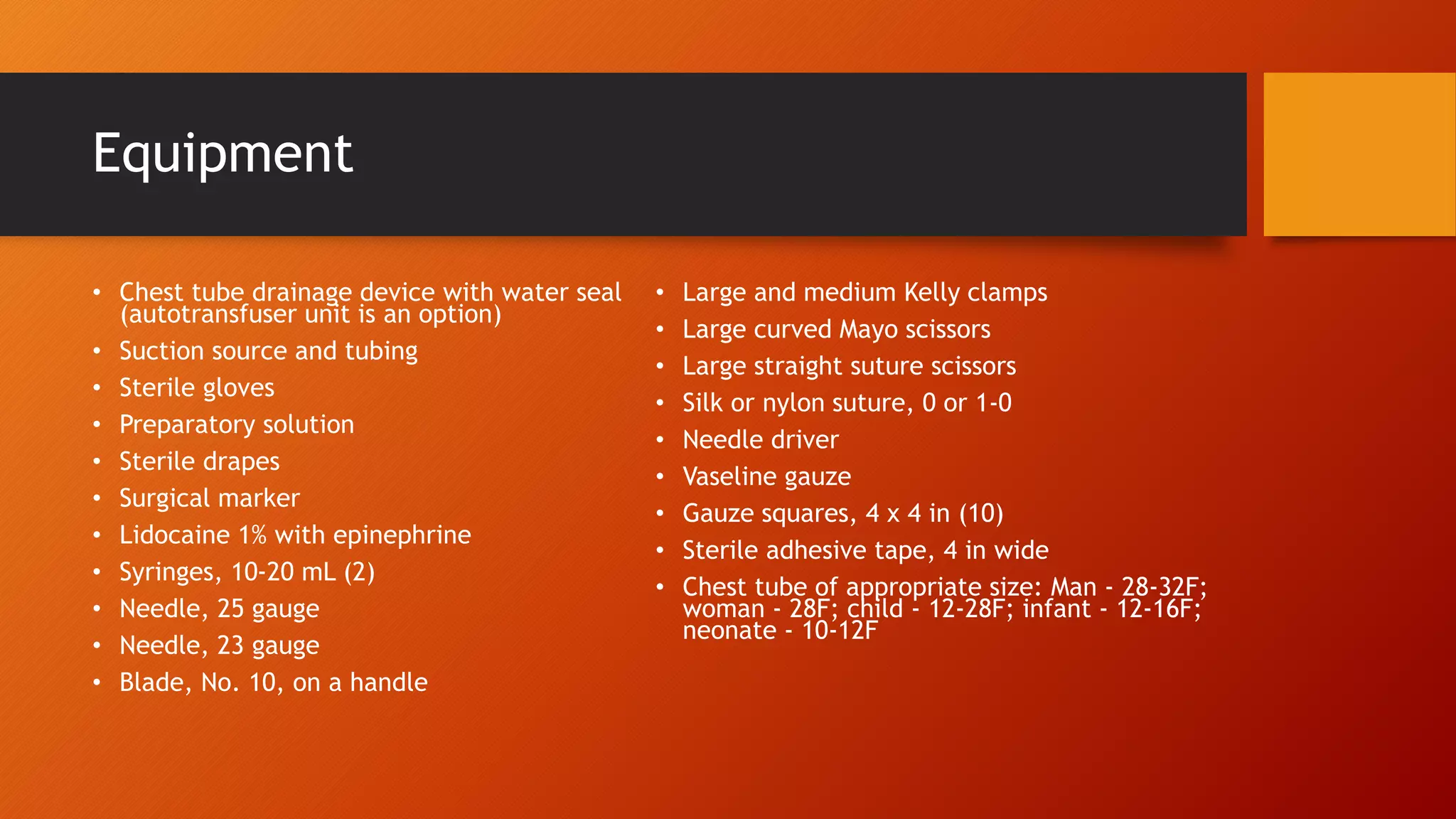
Equipment
• Chest tube drainage device with water seal
(autotransfuser unit is an option)
• Suction source and tubing
• Sterile gloves
• Preparatory solution
• Sterile drapes
• Surgical marker
• Lidocaine 1% with epinephrine
• Syringes, 10-20 mL (2)
• Needle, 25 gauge
• Needle, 23 gauge
• Blade, No. 10, on a handle
• Large and medium Kelly clamps
• Large curved Mayo scissors
• Large straight suture scissors
• Silk or nylon suture, 0 or 1-0
• Needle driver
• Vaseline gauze
• Gauze squares, 4 x 4 in (10)
• Sterile adhesive tape, 4 in wide
• Chest tube of appropriate size: Man - 28-32F;
woman - 28F; child - 12-28F; infant - 12-16F;
neonate - 10-12F
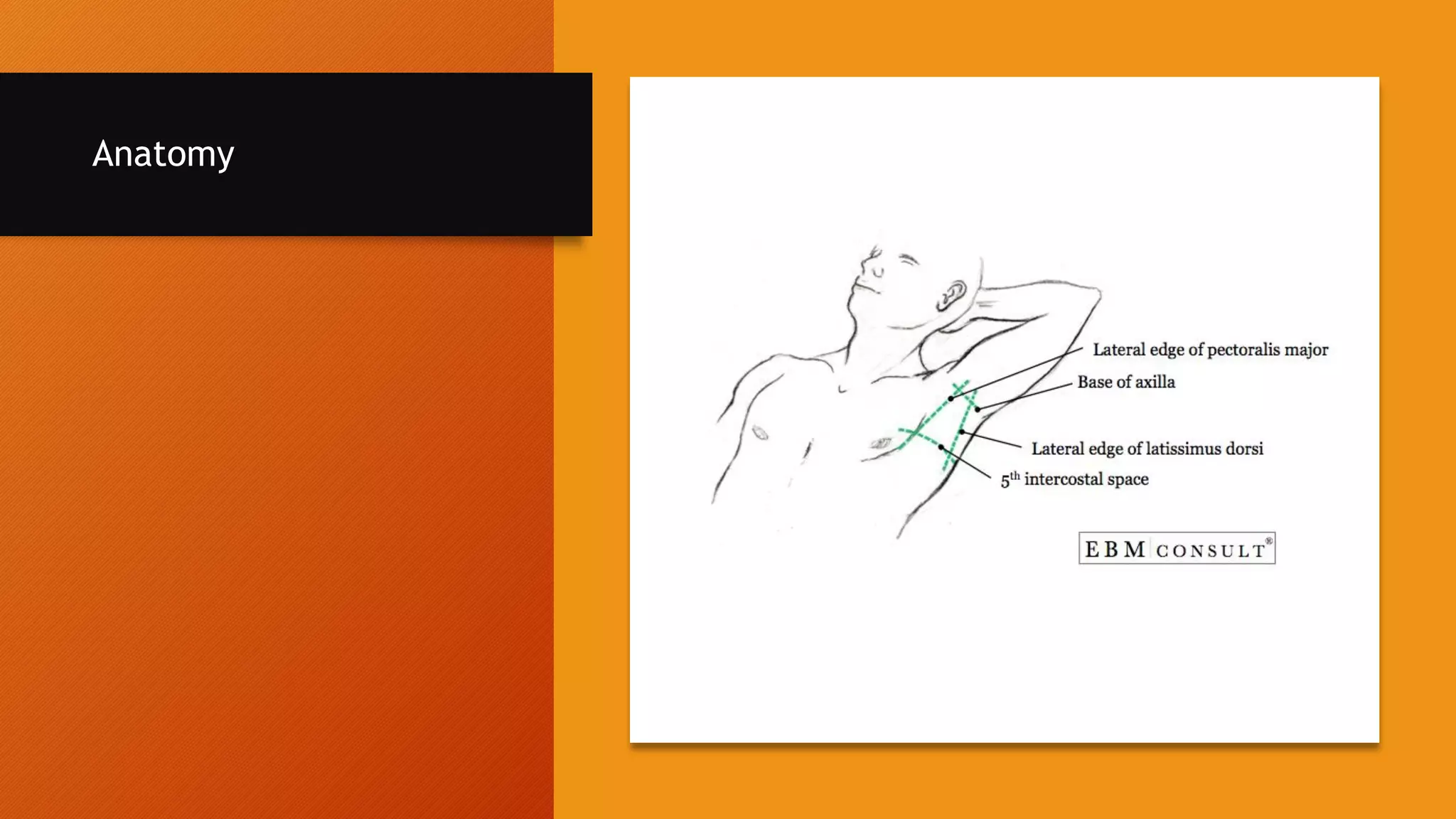
Anatomy
Central
Venous Line
Central Venous Line
• This procedure can be associated with significant complications
and must always be performed under supervision until
competence is attained.
• Commonly used sites
• Internal jugular vein (IJV), subclavian vein and femoral vein, which are all
located close to arteries and nerves that can be damaged by a misplaced
needle
• In addition the subclavian vein lies near the pleura of the lung
with the risk of pneumothorax
Indications
• Intravenous administration of specific drugs (e.g. dopamine or
adrenaline)
• Inability to obtain adequate peripheral IV access in the critically
unwell patient, in a timely fashion
• Haemodialysis
• Central venous pressure monitoring, the insertion of a pulmonary
artery (Swan-Ganz) catheter to measure wedge pressure
• Hyperalimentation (TPN administration)
• Cardiopulmonary resuscitation.
Contraindication
• Less invasive forms of IV access are possible and adequate
• Overlying skin lesion such as cellulitis or burns
• Uncorrected bleeding diathesis
• Obstruction of the vein by tumour, mass or thrombosis
• Uncooperative patient.
Anatomy
Guidewire Insertion Length
Questions?
Thank you

Chest Tube

  • 1.
    Chest Tube Insertion& Central Venous Line Dr Adib Mursyidi Iskandar Mirza Emergency Department IIUM Medical Centre
  • 2.
    What is ChestTube? • Tube thoracostomy is the insertion of a tube (chest tube) into the pleural cavity to drain air, blood, bile, pus, or other fluids.
  • 3.
    Indication • Pneumothorax: Openor closed; simple or tension • Hemothorax • Hemopneumothorax • Hydrothorax • Chylothorax • Empyema • Pleural effusion • Patients with penetrating chest wall injury who are intubated or about to be intubated • Considered for those about to undergo air transport who are at risk for pneumothorax
  • 4.
    Contraindication • Relative contraindicationsinclude the following: • Coagulopathy • Pulmonary bullae • Pulmonary, pleural, or thoracic adhesions • Loculated pleural effusion or empyema • Skin infection over the chest tube insertion site
  • 5.
    Equipment • Chest tubedrainage device with water seal (autotransfuser unit is an option) • Suction source and tubing • Sterile gloves • Preparatory solution • Sterile drapes • Surgical marker • Lidocaine 1% with epinephrine • Syringes, 10-20 mL (2) • Needle, 25 gauge • Needle, 23 gauge • Blade, No. 10, on a handle • Large and medium Kelly clamps • Large curved Mayo scissors • Large straight suture scissors • Silk or nylon suture, 0 or 1-0 • Needle driver • Vaseline gauze • Gauze squares, 4 x 4 in (10) • Sterile adhesive tape, 4 in wide • Chest tube of appropriate size: Man - 28-32F; woman - 28F; child - 12-28F; infant - 12-16F; neonate - 10-12F
  • 6.
  • 7.
  • 8.
    Central Venous Line •This procedure can be associated with significant complications and must always be performed under supervision until competence is attained. • Commonly used sites • Internal jugular vein (IJV), subclavian vein and femoral vein, which are all located close to arteries and nerves that can be damaged by a misplaced needle • In addition the subclavian vein lies near the pleura of the lung with the risk of pneumothorax
  • 9.
    Indications • Intravenous administrationof specific drugs (e.g. dopamine or adrenaline) • Inability to obtain adequate peripheral IV access in the critically unwell patient, in a timely fashion • Haemodialysis • Central venous pressure monitoring, the insertion of a pulmonary artery (Swan-Ganz) catheter to measure wedge pressure • Hyperalimentation (TPN administration) • Cardiopulmonary resuscitation.
  • 10.
    Contraindication • Less invasiveforms of IV access are possible and adequate • Overlying skin lesion such as cellulitis or burns • Uncorrected bleeding diathesis • Obstruction of the vein by tumour, mass or thrombosis • Uncooperative patient.
  • 11.
  • 12.
  • 13.
  • 14.