Lower Limb orthosis
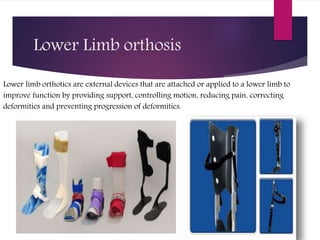
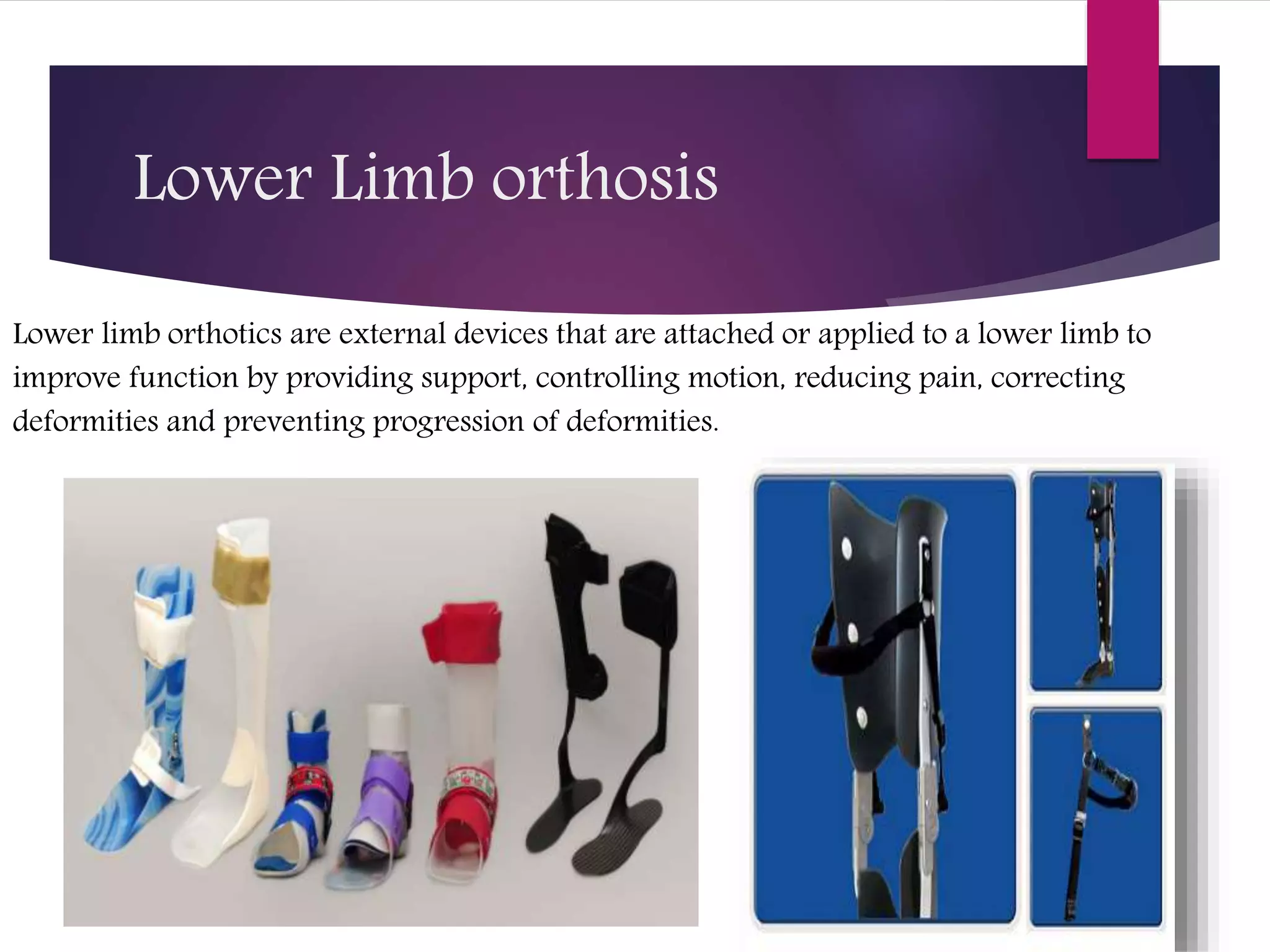
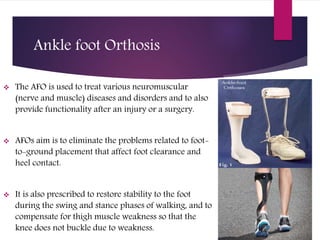
Lower limb orthotics are external devices that are attached or applied to a lower limb to
improve function by providing support, controlling motion, reducing pain, correcting
deformities and preventing progression of deformities.
Ankle foot Orthosis
 The AFO is used to treat various neuromuscular
(nerve and muscle) diseases and disorders and to also
provide functionality after an injury or a surgery.
 AFOs aim is to eliminate the problems related to foot-
to-ground placement that affect foot clearance and
heel contact.
 It is also prescribed to restore stability to the foot
during the swing and stance phases of walking, and to
compensate for thigh muscle weakness so that the
knee does not buckle due to weakness.
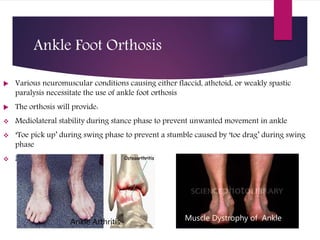
Ankle Foot Orthosis
 Various neuromuscular conditions causing either flaccid, athetoid, or weakly spastic
paralysis necessitate the use of ankle foot orthosis
 The orthosis will provide:
 Mediolateral stability during stance phase to prevent unwanted movement in ankle
 ‘Toe pick up’ during swing phase to prevent a stumble caused by ‘toe drag’ during swing
phase
 Near Normal Gait
Ankle Arthritis Muscle Dystrophy of Ankle
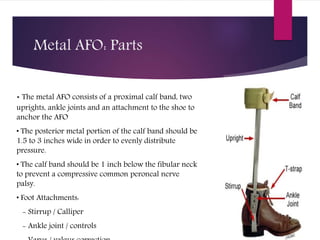
Metal AFO: Parts
• The metal AFO consists of a proximal calf band, two
uprights, ankle joints and an attachment to the shoe to
anchor the AFO
• The posterior metal portion of the calf band should be
1.5 to 3 inches wide in order to evenly distribute
pressure.
• The calf band should be 1 inch below the fibular neck
to prevent a compressive common peroneal nerve
palsy.
• Foot Attachments:
- Stirrup / Calliper
- Ankle joint / controls
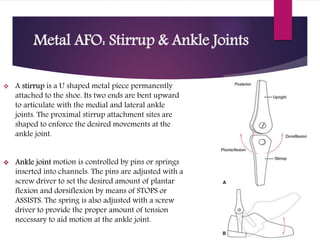
Metal AFO: Stirrup & Ankle Joints
 A stirrup is a U shaped metal piece permanently
attached to the shoe. Its two ends are bent upward
to articulate with the medial and lateral ankle
joints. The proximal stirrup attachment sites are
shaped to enforce the desired movements at the
ankle joint.
 Ankle joint motion is controlled by pins or springs
inserted into channels. The pins are adjusted with a
screw driver to set the desired amount of plantar
flexion and dorsiflexion by means of STOPS or
ASSISTS. The spring is also adjusted with a screw
driver to provide the proper amount of tension
necessary to aid motion at the ankle joint.
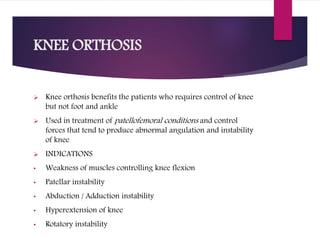
KNEE ORTHOSIS
 Knee orthosis benefits the patients who requires control of knee
but not foot and ankle
 Used in treatment of patellofemoral conditions and control
forces that tend to produce abnormal angulation and instability
of knee
 INDICATIONS
• Weakness of muscles controlling knee flexion
• Patellar instability
• Abduction / Adduction instability
• Hyperextension of knee
• Rotatory instability
KNEE
ORTHOSIS
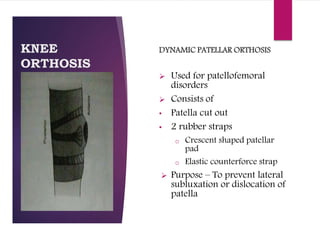
DYNAMIC PATELLAR ORTHOSIS
 Used for patellofemoral
disorders
 Consists of
• Patella cut out
• 2 rubber straps
o Crescent shaped patellar
pad
o Elastic counterforce strap
 Purpose – To prevent lateral
subluxation or dislocation of
patella
KNEE
ORTHOSIS
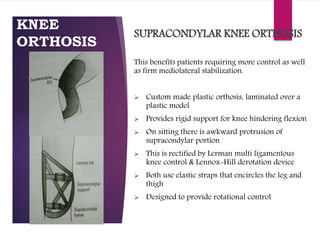
SUPRACONDYLAR KNEE ORTHOSIS
This benefits patients requiring more control as well
as firm mediolateral stabilization.
 Custom made plastic orthosis, laminated over a
plastic model
 Provides rigid support for knee hindering flexion
 On sitting there is awkward protrusion of
supracondylar portion
 This is rectified by Lerman multi ligamentous
knee control & Lennox-Hill derotation device
 Both use elastic straps that encircles the leg and
thigh
 Designed to provide rotational control
KNEE ORTHOSIS
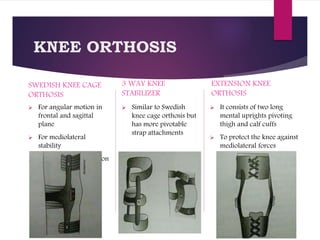
SWEDISH KNEE CAGE
ORTHOSIS
 For angular motion in
frontal and sagittal
plane
 For mediolateral
stability
 Restricts hyperextension
3 WAY KNEE
STABILIZER
 Similar to Swedish
knee cage orthosis but
has more pivotable
strap attachments
EXTENSION KNEE
ORTHOSIS
 It consists of two long
mental uprights pivoting
thigh and calf cuffs
 To protect the knee against
mediolateral forces
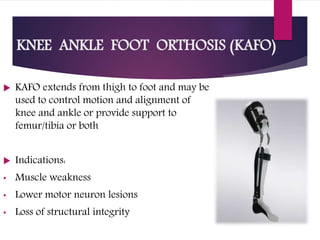
KNEE ANKLE FOOT ORTHOSIS (KAFO)
 KAFO extends from thigh to foot and may be
used to control motion and alignment of
knee and ankle or provide support to
femur/tibia or both
 Indications:
• Muscle weakness
• Lower motor neuron lesions
• Loss of structural integrity
Functions
• To relieve weight partially or totally from the hip
• To relieve stress in leg
• Stabilization of knee
• To combine the functional units of AFO
• To exert hip control function in traumatic paraplegia
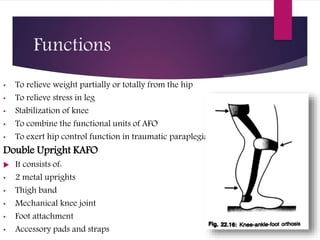
Double Upright KAFO
 It consists of:
• 2 metal uprights
• Thigh band
• Mechanical knee joint
• Foot attachment
• Accessory pads and straps
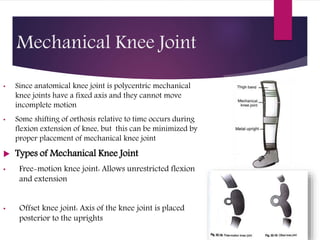
Mechanical Knee Joint
• Since anatomical knee joint is polycentric mechanical
knee joints have a fixed axis and they cannot move
incomplete motion
• Some shifting of orthosis relative to time occurs during
flexion extension of knee, but this can be minimized by
proper placement of mechanical knee joint
 Types of Mechanical Knee Joint
• Free-motion knee joint: Allows unrestricted flexion
and extension
• Offset knee joint: Axis of the knee joint is placed
posterior to the uprights
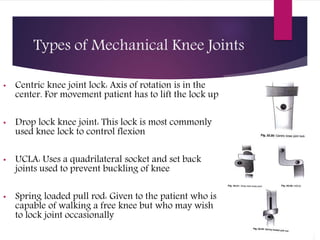
Types of Mechanical Knee Joints
• Centric knee joint lock: Axis of rotation is in the
center. For movement patient has to lift the lock up
• Drop lock knee joint: This lock is most commonly
used knee lock to control flexion
• UCLA: Uses a quadrilateral socket and set back
joints used to prevent buckling of knee
• Spring loaded pull rod: Given to the patient who is
capable of walking a free knee but who may wish
to lock joint occasionally
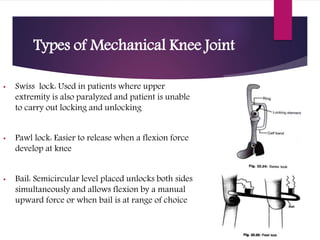
Types of Mechanical Knee Joint
• Swiss lock: Used in patients where upper
extremity is also paralyzed and patient is unable
to carry out locking and unlocking
• Pawl lock: Easier to release when a flexion force
develop at knee
• Bail: Semicircular level placed unlocks both sides
simultaneously and allows flexion by a manual
upward force or when bail is at range of choice
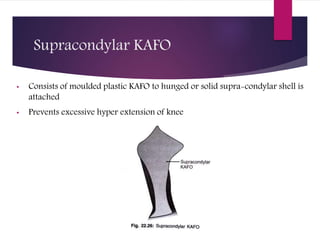
Supracondylar KAFO
• Consists of moulded plastic KAFO to hunged or solid supra-condylar shell is
attached
• Prevents excessive hyper extension of knee
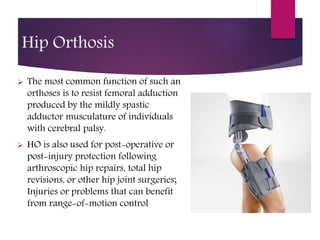
Hip Orthosis
 The most common function of such an
orthoses is to resist femoral adduction
produced by the mildly spastic
adductor musculature of individuals
with cerebral palsy.
 HO is also used for post-operative or
post-injury protection following
arthroscopic hip repairs, total hip
revisions, or other hip joint surgeries;
Injuries or problems that can benefit
from range-of-motion control
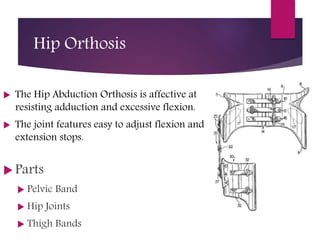
Hip Orthosis
 The Hip Abduction Orthosis is affective at
resisting adduction and excessive flexion.
 The joint features easy to adjust flexion and
extension stops.
 Parts
 Pelvic Band
 Hip Joints
 Thigh Bands
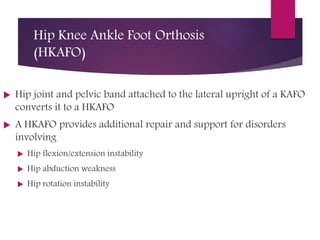
Hip Knee Ankle Foot Orthosis
(HKAFO)
 Hip joint and pelvic band attached to the lateral upright of a KAFO
converts it to a HKAFO
 A HKAFO provides additional repair and support for disorders
involving
 Hip flexion/extension instability
 Hip abduction weakness
 Hip rotation instability
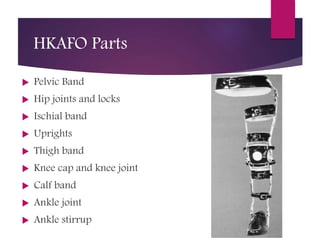
HKAFO Parts
 Pelvic Band
 Hip joints and locks
 Ischial band
 Uprights
 Thigh band
 Knee cap and knee joint
 Calf band
 Ankle joint
 Ankle stirrup
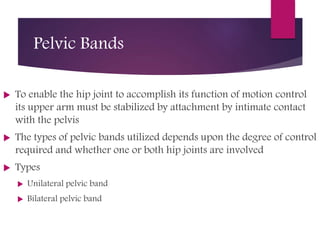
Pelvic Bands
 To enable the hip joint to accomplish its function of motion control
its upper arm must be stabilized by attachment by intimate contact
with the pelvis
 The types of pelvic bands utilized depends upon the degree of control
required and whether one or both hip joints are involved
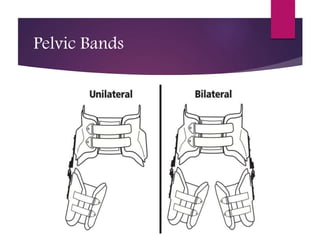
 Types
 Unilateral pelvic band
 Bilateral pelvic band
Pelvic Bands
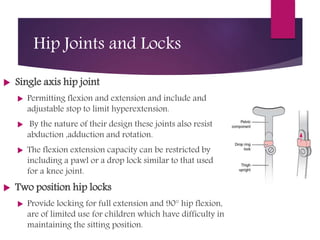
Hip Joints and Locks
 Single axis hip joint
 Permitting flexion and extension and include and
adjustable stop to limit hyperextension.
 By the nature of their design these joints also resist
abduction ,adduction and rotation.
 The flexion extension capacity can be restricted by
including a pawl or a drop lock similar to that used
for a knee joint.
 Two position hip locks
 Provide locking for full extension and 90° hip flexion,
are of limited use for children which have difficulty in
maintaining the sitting position.
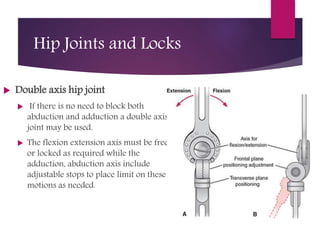
 Double axis hip joint
 If there is no need to block both
abduction and adduction a double axis
joint may be used.
 The flexion extension axis must be free
or locked as required while the
adduction, abduction axis include
adjustable stops to place limit on these
motions as needed.
Hip Joints and Locks
THANK-YOU!

Lower limb orthosis

  • 1.
    Lower Limb orthosis Lowerlimb orthotics are external devices that are attached or applied to a lower limb to improve function by providing support, controlling motion, reducing pain, correcting deformities and preventing progression of deformities.
  • 2.
    Ankle foot Orthosis The AFO is used to treat various neuromuscular (nerve and muscle) diseases and disorders and to also provide functionality after an injury or a surgery.  AFOs aim is to eliminate the problems related to foot- to-ground placement that affect foot clearance and heel contact.  It is also prescribed to restore stability to the foot during the swing and stance phases of walking, and to compensate for thigh muscle weakness so that the knee does not buckle due to weakness.
  • 3.
    Ankle Foot Orthosis Various neuromuscular conditions causing either flaccid, athetoid, or weakly spastic paralysis necessitate the use of ankle foot orthosis  The orthosis will provide:  Mediolateral stability during stance phase to prevent unwanted movement in ankle  ‘Toe pick up’ during swing phase to prevent a stumble caused by ‘toe drag’ during swing phase  Near Normal Gait Ankle Arthritis Muscle Dystrophy of Ankle
  • 4.
    Metal AFO: Parts •The metal AFO consists of a proximal calf band, two uprights, ankle joints and an attachment to the shoe to anchor the AFO • The posterior metal portion of the calf band should be 1.5 to 3 inches wide in order to evenly distribute pressure. • The calf band should be 1 inch below the fibular neck to prevent a compressive common peroneal nerve palsy. • Foot Attachments: - Stirrup / Calliper - Ankle joint / controls
  • 5.
    Metal AFO: Stirrup& Ankle Joints  A stirrup is a U shaped metal piece permanently attached to the shoe. Its two ends are bent upward to articulate with the medial and lateral ankle joints. The proximal stirrup attachment sites are shaped to enforce the desired movements at the ankle joint.  Ankle joint motion is controlled by pins or springs inserted into channels. The pins are adjusted with a screw driver to set the desired amount of plantar flexion and dorsiflexion by means of STOPS or ASSISTS. The spring is also adjusted with a screw driver to provide the proper amount of tension necessary to aid motion at the ankle joint.
  • 6.
    KNEE ORTHOSIS  Kneeorthosis benefits the patients who requires control of knee but not foot and ankle  Used in treatment of patellofemoral conditions and control forces that tend to produce abnormal angulation and instability of knee  INDICATIONS • Weakness of muscles controlling knee flexion • Patellar instability • Abduction / Adduction instability • Hyperextension of knee • Rotatory instability
  • 7.
    KNEE ORTHOSIS DYNAMIC PATELLAR ORTHOSIS Used for patellofemoral disorders  Consists of • Patella cut out • 2 rubber straps o Crescent shaped patellar pad o Elastic counterforce strap  Purpose – To prevent lateral subluxation or dislocation of patella
  • 8.
    KNEE ORTHOSIS SUPRACONDYLAR KNEE ORTHOSIS Thisbenefits patients requiring more control as well as firm mediolateral stabilization.  Custom made plastic orthosis, laminated over a plastic model  Provides rigid support for knee hindering flexion  On sitting there is awkward protrusion of supracondylar portion  This is rectified by Lerman multi ligamentous knee control & Lennox-Hill derotation device  Both use elastic straps that encircles the leg and thigh  Designed to provide rotational control
  • 9.
    KNEE ORTHOSIS SWEDISH KNEECAGE ORTHOSIS  For angular motion in frontal and sagittal plane  For mediolateral stability  Restricts hyperextension 3 WAY KNEE STABILIZER  Similar to Swedish knee cage orthosis but has more pivotable strap attachments EXTENSION KNEE ORTHOSIS  It consists of two long mental uprights pivoting thigh and calf cuffs  To protect the knee against mediolateral forces
  • 10.
    KNEE ANKLE FOOTORTHOSIS (KAFO)  KAFO extends from thigh to foot and may be used to control motion and alignment of knee and ankle or provide support to femur/tibia or both  Indications: • Muscle weakness • Lower motor neuron lesions • Loss of structural integrity
  • 11.
    Functions • To relieveweight partially or totally from the hip • To relieve stress in leg • Stabilization of knee • To combine the functional units of AFO • To exert hip control function in traumatic paraplegia Double Upright KAFO  It consists of: • 2 metal uprights • Thigh band • Mechanical knee joint • Foot attachment • Accessory pads and straps
  • 12.
    Mechanical Knee Joint •Since anatomical knee joint is polycentric mechanical knee joints have a fixed axis and they cannot move incomplete motion • Some shifting of orthosis relative to time occurs during flexion extension of knee, but this can be minimized by proper placement of mechanical knee joint  Types of Mechanical Knee Joint • Free-motion knee joint: Allows unrestricted flexion and extension • Offset knee joint: Axis of the knee joint is placed posterior to the uprights
  • 13.
    Types of MechanicalKnee Joints • Centric knee joint lock: Axis of rotation is in the center. For movement patient has to lift the lock up • Drop lock knee joint: This lock is most commonly used knee lock to control flexion • UCLA: Uses a quadrilateral socket and set back joints used to prevent buckling of knee • Spring loaded pull rod: Given to the patient who is capable of walking a free knee but who may wish to lock joint occasionally
  • 14.
    Types of MechanicalKnee Joint • Swiss lock: Used in patients where upper extremity is also paralyzed and patient is unable to carry out locking and unlocking • Pawl lock: Easier to release when a flexion force develop at knee • Bail: Semicircular level placed unlocks both sides simultaneously and allows flexion by a manual upward force or when bail is at range of choice
  • 15.
    Supracondylar KAFO • Consistsof moulded plastic KAFO to hunged or solid supra-condylar shell is attached • Prevents excessive hyper extension of knee
  • 16.
    Hip Orthosis  Themost common function of such an orthoses is to resist femoral adduction produced by the mildly spastic adductor musculature of individuals with cerebral palsy.  HO is also used for post-operative or post-injury protection following arthroscopic hip repairs, total hip revisions, or other hip joint surgeries; Injuries or problems that can benefit from range-of-motion control
  • 17.
    Hip Orthosis  TheHip Abduction Orthosis is affective at resisting adduction and excessive flexion.  The joint features easy to adjust flexion and extension stops.  Parts  Pelvic Band  Hip Joints  Thigh Bands
  • 18.
    Hip Knee AnkleFoot Orthosis (HKAFO)  Hip joint and pelvic band attached to the lateral upright of a KAFO converts it to a HKAFO  A HKAFO provides additional repair and support for disorders involving  Hip flexion/extension instability  Hip abduction weakness  Hip rotation instability
  • 19.
    HKAFO Parts  PelvicBand  Hip joints and locks  Ischial band  Uprights  Thigh band  Knee cap and knee joint  Calf band  Ankle joint  Ankle stirrup
  • 20.
    Pelvic Bands  Toenable the hip joint to accomplish its function of motion control its upper arm must be stabilized by attachment by intimate contact with the pelvis  The types of pelvic bands utilized depends upon the degree of control required and whether one or both hip joints are involved  Types  Unilateral pelvic band  Bilateral pelvic band
  • 21.
  • 22.
    Hip Joints andLocks  Single axis hip joint  Permitting flexion and extension and include and adjustable stop to limit hyperextension.  By the nature of their design these joints also resist abduction ,adduction and rotation.  The flexion extension capacity can be restricted by including a pawl or a drop lock similar to that used for a knee joint.  Two position hip locks  Provide locking for full extension and 90° hip flexion, are of limited use for children which have difficulty in maintaining the sitting position.
  • 23.
     Double axiship joint  If there is no need to block both abduction and adduction a double axis joint may be used.  The flexion extension axis must be free or locked as required while the adduction, abduction axis include adjustable stops to place limit on these motions as needed. Hip Joints and Locks
  • 24.