Lower Limb Prostheses
Description
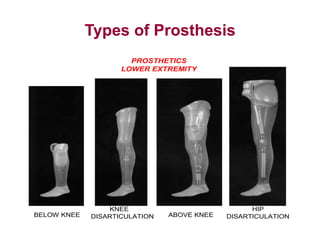
There are several levels of lower limb amputation,
including partial foot, ankle disarticulation,
transtibial (below the knee), knee disarticulation,
transfemoral (above the knee), and hip
disarticulation. The most common are transtibial
(mid-calf) and transfemoral (mid-thigh).
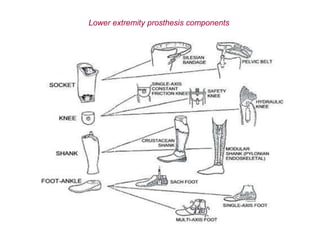
The basic components of a lower extremity
prosthesis include:
• the socket, a sock or gel liner, a suspension system, a
knee joint (articulating joint), the shank (a pylon), and a
foot (terminal device)
Lower extremity prosthesis components
Foot-ankle assembly
• The foot-ankle assembly is designed to provide a base
of support during standing and walking, in addition to
providing shock absorption and push-off during walking
on even and uneven terrain. Four general categories of
foot-ankle assemblies are non-articulated, articulated,
elastic keel, and dynamic-response. One of the most
widely prescribed foot is the solid-ankle-cushion-heel
(SACH) foot, due to its simplicity, low cost, and durability.
It may be inappropriate, however, for active community
ambulators and sports participants.
Shank
• The shank corresponds to the anatomical lower leg, and
is used to connect the socket to the ankle-foot assembly.
In an endoskeletal shank, a central pylon, which is a
narrow vertical support, rests inside a foam cosmetic
cover. Endoskeletal systems allow for adjustment and
realignment of prosthetic components. In an exoskeletal
shank, the strength of the shank is provided by a hard
outer shell that is either hollow or filled with lightweight
material. Exoskeletal systems are more durable than
endoskeletal systems; however, they may be heavier
and have a fixed alignment, making adjustments difficult.
Suspension
• Suspension devices should keep the prosthesis firmly in place
during use and allow comfortable sitting. Several types of
suspension exist, both for the transtibial and transfemoral
amputation. Common transtibial suspensions include sleeve,
supracondylar, cuff, belt and strap, thigh-lacer, and suction styles.
Sleeves are made of neoprene, urethane, or latex and are used over
the shank, socket and thigh. Supracondylar and cuff suspensions
are used to capture the femoral condyles and hold the prosthesis on
the residual limb. The belt and strap method uses a waist belt with
an anterior elastic strap to suspend the prosthesis, while the thigh-
lacer method uses a snug-fitting corset around the thigh. The
suction method consists of a silicone sleeve with a short pin at the
end. The sleeve fits over the residual limb and the pin locks into the
socket. With a transfemoral prosthesis, suction and several types of
belt suspension also are available.
The socket
• The socket enables the prosthesis to connect and fit to
the stump (residual limb). This is the most important
prosthetic component. A good fit is critical. A socket that
is uncomfortable is a common reason why a prosthesis
is rejected. Contoured sockets fit closer to the remaining
bones, muscles, and soft tissues providing better
support, and provide relief where it's needed for comfort
Prosthetic rehabilitation:
• physical therapy for range of motion, strength, bed
mobility, transfers, and single limb ambulation often
takes place during the initial rehabilitation period.
• A temporary prosthesis allows for early ambulation and
continued shrinkage of the residual limb until a definitive
prosthesis is fit.
• The socket should fit securely on the residual limb,
• prosthesis length should match the length of the intact
leg.
• The patient must learn how to properly put on the
residual limb sock and the prosthesis itself.
Role of Physical therapy:
1) Ensures that the inside of the socket is smooth and that
all joints move freely.
2) Evaluates prosthetic function immediately and over time.
3) Makes assessment of gait and watchs for
compensations and gait deviations that may indicate a
problem with the prosthesis.
4) Gives patient instructions regarding proper care and
maintenance for each individual
Training
• Individuals begin with learning to keep their bodies stable in a
closed environment with no manipulation or variability.
• practicing standing balance on one or both legs. (ambulation
training)
• Individuals must be taught how to transfer to and from surfaces,
assume a variety of positions such as kneeling or squatting, and
manage falls.
• use of a traditional cane, quad cane, or crutches may be indicated.
• Patient motivation,
Types of Prosthesis
BELOW KNEE
KNEE
DISARTICULATION ABOVE KNEE
HIP
DISARTICULATION
PROSTHETICS
LOWER EXTREMITY
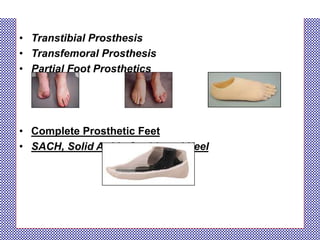
• Transtibial Prosthesis
• Transfemoral Prosthesis
• Partial Foot Prosthetics
• Complete Prosthetic Feet
• SACH, Solid Ankle Cushioned Heel
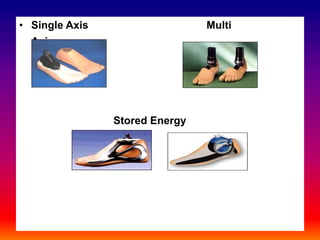
• Single Axis Multi
Axis
Stored Energy
Current Technology/Manufacturing
• In recent years there have been significant advancements in artificial
limbs.
• New plastics and other materials, such as carbon fiber, have
allowed artificial limbs to be stronger and lighter, limiting the amount
of extra energy necessary to operate the limb.
• These materials have allowed artificial limbs to look much more
realisticIn addition to new materials,
• the use of electronics has become very common in artificial limbs.
• Myoelectric limbs, which control the limbs by converting muscle
movements to electrical signals, have become much more common
than cable operated limbs.
• Myoelectric limbs allow the amputees to more directly control the
artificial limb.
• Computers are also used extensively in the manufacturing of limbs.

107493_Lower Limb Pro..PPT

  • 1.
    Lower Limb Prostheses Description Thereare several levels of lower limb amputation, including partial foot, ankle disarticulation, transtibial (below the knee), knee disarticulation, transfemoral (above the knee), and hip disarticulation. The most common are transtibial (mid-calf) and transfemoral (mid-thigh).
  • 2.
    The basic componentsof a lower extremity prosthesis include: • the socket, a sock or gel liner, a suspension system, a knee joint (articulating joint), the shank (a pylon), and a foot (terminal device)
  • 3.
  • 4.
    Foot-ankle assembly • Thefoot-ankle assembly is designed to provide a base of support during standing and walking, in addition to providing shock absorption and push-off during walking on even and uneven terrain. Four general categories of foot-ankle assemblies are non-articulated, articulated, elastic keel, and dynamic-response. One of the most widely prescribed foot is the solid-ankle-cushion-heel (SACH) foot, due to its simplicity, low cost, and durability. It may be inappropriate, however, for active community ambulators and sports participants.
  • 5.
    Shank • The shankcorresponds to the anatomical lower leg, and is used to connect the socket to the ankle-foot assembly. In an endoskeletal shank, a central pylon, which is a narrow vertical support, rests inside a foam cosmetic cover. Endoskeletal systems allow for adjustment and realignment of prosthetic components. In an exoskeletal shank, the strength of the shank is provided by a hard outer shell that is either hollow or filled with lightweight material. Exoskeletal systems are more durable than endoskeletal systems; however, they may be heavier and have a fixed alignment, making adjustments difficult.
  • 6.
    Suspension • Suspension devicesshould keep the prosthesis firmly in place during use and allow comfortable sitting. Several types of suspension exist, both for the transtibial and transfemoral amputation. Common transtibial suspensions include sleeve, supracondylar, cuff, belt and strap, thigh-lacer, and suction styles. Sleeves are made of neoprene, urethane, or latex and are used over the shank, socket and thigh. Supracondylar and cuff suspensions are used to capture the femoral condyles and hold the prosthesis on the residual limb. The belt and strap method uses a waist belt with an anterior elastic strap to suspend the prosthesis, while the thigh- lacer method uses a snug-fitting corset around the thigh. The suction method consists of a silicone sleeve with a short pin at the end. The sleeve fits over the residual limb and the pin locks into the socket. With a transfemoral prosthesis, suction and several types of belt suspension also are available.
  • 7.
    The socket • Thesocket enables the prosthesis to connect and fit to the stump (residual limb). This is the most important prosthetic component. A good fit is critical. A socket that is uncomfortable is a common reason why a prosthesis is rejected. Contoured sockets fit closer to the remaining bones, muscles, and soft tissues providing better support, and provide relief where it's needed for comfort
  • 8.
    Prosthetic rehabilitation: • physicaltherapy for range of motion, strength, bed mobility, transfers, and single limb ambulation often takes place during the initial rehabilitation period. • A temporary prosthesis allows for early ambulation and continued shrinkage of the residual limb until a definitive prosthesis is fit. • The socket should fit securely on the residual limb, • prosthesis length should match the length of the intact leg. • The patient must learn how to properly put on the residual limb sock and the prosthesis itself.
  • 9.
    Role of Physicaltherapy: 1) Ensures that the inside of the socket is smooth and that all joints move freely. 2) Evaluates prosthetic function immediately and over time. 3) Makes assessment of gait and watchs for compensations and gait deviations that may indicate a problem with the prosthesis. 4) Gives patient instructions regarding proper care and maintenance for each individual
  • 10.
    Training • Individuals beginwith learning to keep their bodies stable in a closed environment with no manipulation or variability. • practicing standing balance on one or both legs. (ambulation training) • Individuals must be taught how to transfer to and from surfaces, assume a variety of positions such as kneeling or squatting, and manage falls. • use of a traditional cane, quad cane, or crutches may be indicated. • Patient motivation,
  • 11.
    Types of Prosthesis BELOWKNEE KNEE DISARTICULATION ABOVE KNEE HIP DISARTICULATION PROSTHETICS LOWER EXTREMITY
  • 12.
    • Transtibial Prosthesis •Transfemoral Prosthesis • Partial Foot Prosthetics • Complete Prosthetic Feet • SACH, Solid Ankle Cushioned Heel
  • 13.
    • Single AxisMulti Axis Stored Energy
  • 14.
    Current Technology/Manufacturing • Inrecent years there have been significant advancements in artificial limbs. • New plastics and other materials, such as carbon fiber, have allowed artificial limbs to be stronger and lighter, limiting the amount of extra energy necessary to operate the limb. • These materials have allowed artificial limbs to look much more realisticIn addition to new materials, • the use of electronics has become very common in artificial limbs. • Myoelectric limbs, which control the limbs by converting muscle movements to electrical signals, have become much more common than cable operated limbs. • Myoelectric limbs allow the amputees to more directly control the artificial limb. • Computers are also used extensively in the manufacturing of limbs.