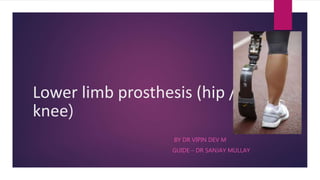
Lower limb prosthesis (hip /
knee)
BY DR VIPIN DEV M
GUIDE – DR SANJAY MULLAY
PROSTHESIS
 Device to replace part of the limb or complete limb
 “substitute”
 Prosthetist: Health care professional who designs, fabricates and fits limb
prosthesis
Aim of prosthesis
 To substitute for a lost part
 To restore lost function
 Comfortable ambulation
 Minimal/reduce of expenditure of energy
 Minimizing the shift of the center of gravity of the body during gait
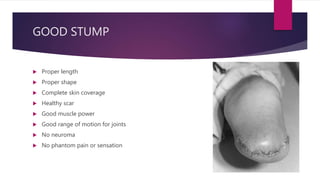
GOOD STUMP
 Proper length
 Proper shape
 Complete skin coverage
 Healthy scar
 Good muscle power
 Good range of motion for joints
 No neuroma
 No phantom pain or sensation
PREPROSTHETIC TRAINING
 Training in
 Active rom exercise
 Proper positioning of stump
 Muscle strengthening
 Skin care
 Crutch training
 Wheel chair training
 Self care
 Patient and family education
PROSTHETIC TRAINING
 Prosthetic fitting – alignment check , pressure point relief , color check
 Donning and doffing caring
 Skin care training
 Gait training
 Maintenance of prosthesis
IMMEDIATE POST OPERATIVE
PROSTHESIS
 Described by Berlemont
 On conclusion of amputation temporary prosthesis given
 Most common – rigid plaster cast molded like PTB to which pylon and foot attached
 Physio started in 24-48 hours
 Advantage
 Reduce edema and pain
 Prevent muscle contracture and atrophy
 Reduce chance of phantom pain and speeds up rehabilitation
 Disadvantages
 Increased chance of wound gaping
 Delayed wound healing
 Infection
TRANSTIBIAL / TRANSFEMORAL
AMPUTATION
TRANSTIBIAL AMPUTATION .
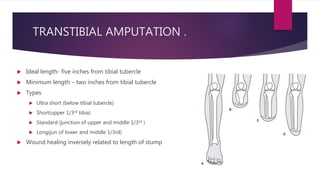
 Ideal length- five inches from tibial tubercle
 Minimum length – two inches from tibial tubercle
 Types
 Ultra short (below tibial tubercle)
 Short(upper 1/3rd tibia)
 Standard (junction of upper and middle 1/3rd )
 Long(jun of lower and middle 1/3rd)
 Wound healing inversely related to length of stump
TRANSTIBIAL PROSTHESIS
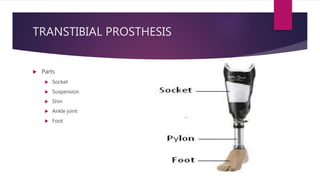
 Parts
 Socket
 Suspension
 Shin
 Ankle joint
 Foot
SOCKET
 Encloses the stump
 Forms connection b/w stump and artificial limb
 Protects the stump and transmits forces
 PLUG FIT SOCKETS – open ended and stump fits in like
a plug fits in drain
TYPES
 Conventional Below Knee Socket
 Patellar Tendon Bearing Socket
 Patellar Tendon Bearing Supracondylar Suprapatellar Socket
 Bent Knee Socket
 Slip Socket
Conventional Below Knee Socket
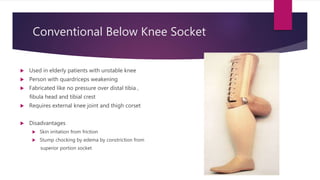
 Used in elderly patients with unstable knee
 Person with quardriceps weakening
 Fabricated like no pressure over distal tibia ,
fibula head and tibial crest
 Requires external knee joint and thigh corset
 Disadvantages
 Skin irritation from friction
 Stump chocking by edema by constriction from
superior portion socket
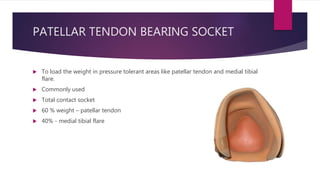
PATELLAR TENDON BEARING SOCKET
 To load the weight in pressure tolerant areas like patellar tendon and medial tibial
flare.
 Commonly used
 Total contact socket
 60 % weight – patellar tendon
 40% - medial tibial flare
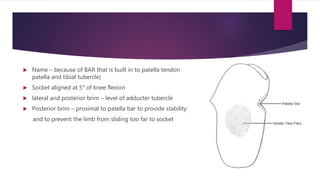
 Name – because of BAR that is built in to patella tendon (midway b/w
patella and tibial tubercle)
 Socket aligned at 5° of knee flexion
 lateral and posterior brim – level of adducter tubercle
 Posterior brim – proximal to patella bar to provide stability
and to prevent the limb from sliding too far to socket
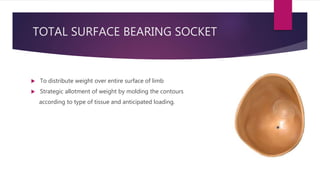
TOTAL SURFACE BEARING SOCKET
 To distribute weight over entire surface of limb
 Strategic allotment of weight by molding the contours
according to type of tissue and anticipated loading.
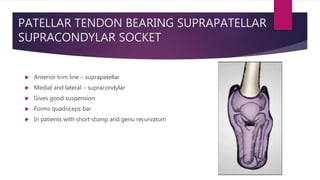
PATELLAR TENDON BEARING SUPRAPATELLAR
SUPRACONDYLAR SOCKET
 Anterior trim line – suprapatellar
 Medial and lateral – supracondylar
 Gives good suspension
 Forms quadriceps bar
 In patients with short stump and genu recurvatum
SLIP SOCKET
 Two layers
 External – wooden or plastic socket
 Internal – fine leather
 Uses
 Short stump
 Painful scars
BENT KNEE SOCKET
 Indication – patients having FFD of stump
 Up to 20 ° can be accommodated
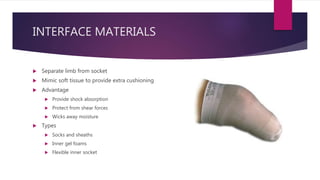
INTERFACE MATERIALS
 Separate limb from socket
 Mimic soft tissue to provide extra cushioning
 Advantage
 Provide shock absorption
 Protect from shear forces
 Wicks away moisture
 Types
 Socks and sheaths
 Inner gel foams
 Flexible inner socket
SUSPENSION
 The method of connecting a prosthesis to residual limb
 Suspension designed according to activity level, comfort and safety
 If suspension not adequate – motion occur between socket and limb – called
pistoning
SUSPENSION - TYPES
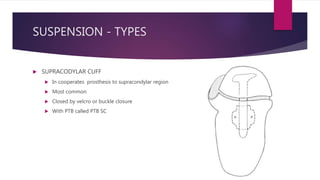
 SUPRACODYLAR CUFF
 In cooperates prosthesis to supracondylar region
 Most common
 Closed by velcro or buckle closure
 With PTB called PTB SC
 Waist belt
 Cuff strap
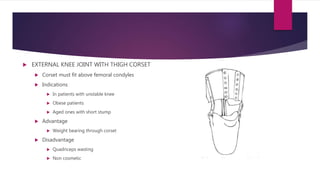
 EXTERNAL KNEE JOINT WITH THIGH CORSET
 Corset must fit above femoral condyles
 Indications
 In patients with unstable knee
 Obese patients
 Aged ones with short stump
 Advantage
 Weight bearing through corset
 Disadvantage
 Quadriceps wasting
 Non cosmetic
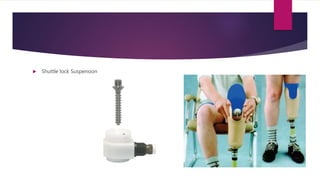
 Shuttle lock Suspension
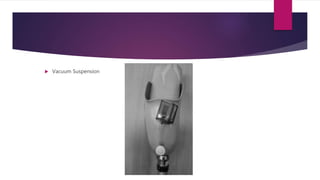
 Vacuum Suspension
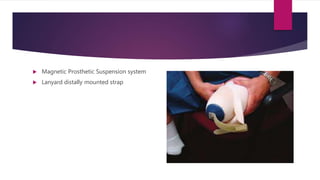
 Magnetic Prosthetic Suspension system
 Lanyard distally mounted strap
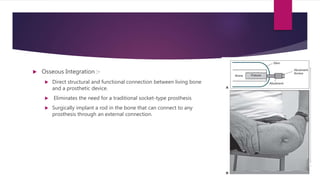
 Osseous Integration :-
 Direct structural and functional connection between living bone
and a prosthetic device.
 Eliminates the need for a traditional socket-type prosthesis
 Surgically implant a rod in the bone that can connect to any
prosthesis through an external connection.
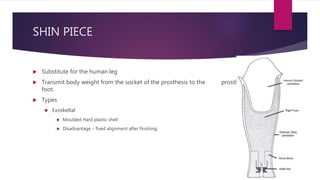
SHIN PIECE
 Substitute for the human leg
 Transmit body weight from the socket of the prosthesis to the prosthetic
foot.
 Types
 Exoskeltal
 Moulded Hard plastic shell
 Disadvantage – fixed alignment after finishing.
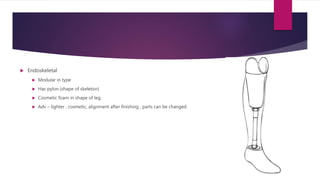
 Endoskeletal
 Modular in type
 Has pylon (shape of skeleton)
 Cosmetic foam in shape of leg.
 Adv – lighter , cosmetic, alignment after finishing , parts can be changed
ANKLE FOOT ASSEMBLY
 Designed to provide support during standing/walking and shock absorption as well
 Types
 SOLID ANKLE CUSHION HEEL (SACH)
 SINGLE AXIS FOOT
 MULTI AXIS FOOT
 SOLID ANKLE FLEXIBLE KEEL FOOT
 ENERGY STORING FOOT
SOLID ANKLE CUSHION HEEL (SACH)
 Commonest one
 No ankle joint
 Solid heel made of wood or metal
 Cushion heel – rubber heel edge or alternating hard
and soft rubber layers
 Cushion heel compresses during heel strike –stimulate
plantar flexion
 Light weight , durable and little maintenance
 Modifications - MADRAS FOOT/ JAIPUR FOOT
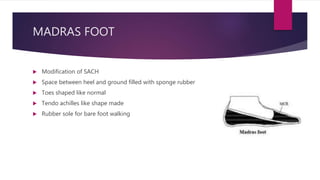
MADRAS FOOT
 Modification of SACH
 Space between heel and ground filled with sponge rubber
 Toes shaped like normal
 Tendo achilles like shape made
 Rubber sole for bare foot walking
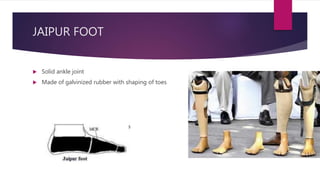
JAIPUR FOOT
 Solid ankle joint
 Made of galvinized rubber with shaping of toes
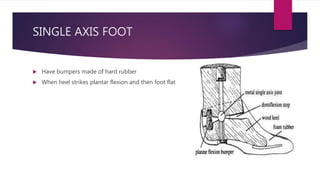
SINGLE AXIS FOOT
 Have bumpers made of hard rubber
 When heel strikes plantar flexion and then foot flat
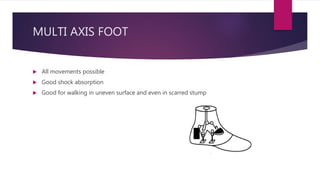
MULTI AXIS FOOT
 All movements possible
 Good shock absorption
 Good for walking in uneven surface and even in scarred stump
SOLID ANKLE FLEXIBLE KEEL FOOT
 Similar to SACH
 Use flexible keel
 Good shock absorption
 In obese ones
ENERGY STORING FOOT
 Dynamic response foot
 Shock absorbing leaf spring or carbon steel used
 Absorb energy on heel contact
 Release in terminal stance providing propultion
TRANSFEMORAL PROSTHESIS
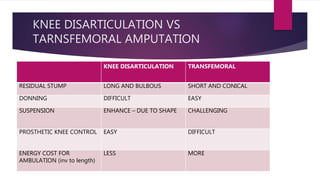
KNEE DISARTICULATION VS
TARNSFEMORAL AMPUTATION
KNEE DISARTICULATION TRANSFEMORAL
RESIDUAL STUMP LONG AND BULBOUS SHORT AND CONICAL
DONNING DIFFICULT EASY
SUSPENSION ENHANCE – DUE TO SHAPE CHALLENGING
PROSTHETIC KNEE CONTROL EASY DIFFICULT
ENERGY COST FOR
AMBULATION (inv to length)
LESS MORE
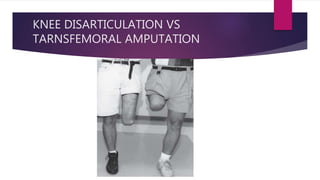
KNEE DISARTICULATION VS
TARNSFEMORAL AMPUTATION
TRANSFEMORAL AMPUTATION -
PRINCIPLES
 Amputation between femoral condyles and greater trochanter
 Preserve as much as length as possible
 Countering abduction force of G. MED and G.MIN – suturing adductors to femur
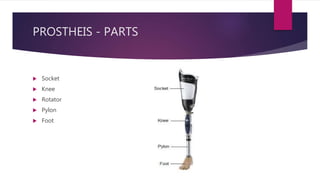
PROSTHEIS - PARTS
 Socket
 Knee
 Rotator
 Pylon
 Foot
SOCKET
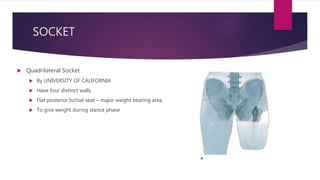
 Quadrilateral Socket
 By UNIVERSITY OF CALIFORNIA
 Have four distinct walls
 Flat posterior Ischial seat – major weight bearing area
 To give weight during stance phase
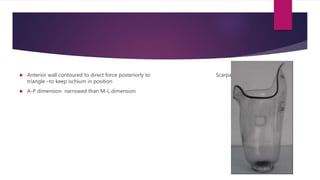
 Anterior wall contoured to direct force posteriorly to Scarpa’s
triangle –to keep ischium in position
 A-P dimension narrowed than M-L dimension
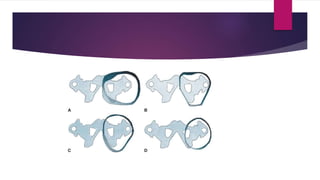
ISCHIAL CONTAINMENT SOCKET
 Different types – depends on structures contained
 A-P dimension more than M-L dimension to prevent
abduction
 CAT – CAM- contoured anterior trochanteric controlled
alignment method- to maintain femur in adducted
position and to control socket rotation by containing
ischial tuberocity
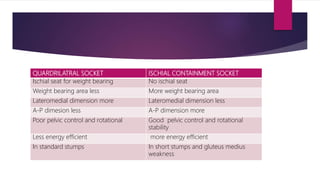
QUARDRILATRAL SOCKET ISCHIAL CONTAINMENT SOCKET
Ischial seat for weight bearing No ischial seat
Weight bearing area less More weight bearing area
Lateromedial dimension more Lateromedial dimension less
A-P dimesion less A-P dimension more
Poor pelvic control and rotational Good pelvic control and rotational
stability
Less energy efficient more energy efficient
In standard stumps In short stumps and gluteus medius
weakness
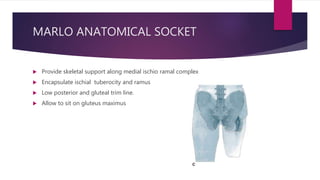
MARLO ANATOMICAL SOCKET
 Provide skeletal support along medial ischio ramal complex
 Encapsulate ischial tuberocity and ramus
 Low posterior and gluteal trim line.
 Allow to sit on gluteus maximus
ELEVATED VACCUM SOCKET
 Low trim lines(subischial)
 Good comfort and rom
 2-4 inches below ischial tuberosity
SUSPENSION
 Traditional pull in suction suspension
 Roll on suspension liners
 Shuttle lock systems
 Cushion liner with air expulsion valve
 Silesian belt
 Total elastic suspension belt
 Pelvic belt
KNEE JOINT PROSTHESIS
 difficult to replicate
 Modified hinge joint
KNEE JOINT PROSTHESIS- TYPES
 SINGLE AXIS KNEE UNITS
 Simple hinge
 Fixed center of rotation
 Cadence responsive minimal
 Allow flexion and extension
 No mechanical stability
 Give support during stance not during swing
 Light weight , durable and low maintanace
 Not good for ones having short stump
 For patients with primary residual limb who can voluntary stabilize the knee through active hip
extension against posterior wall of prosthesis
POLYCENTRIC KNEE JOINT
 Moving center of rotation
 Rotates in more than one axis
 During swing phase, it leads to shortening of distal prosthesis enhancing toe
clearance
 Good for long residual limb or knee disarticulation patients
 Good stance phase stability – so in short stump ones and hip extensor weakness
patients
 Less durable than single axis
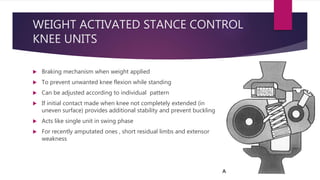
WEIGHT ACTIVATED STANCE CONTROL
KNEE UNITS
 Braking mechanism when weight applied
 To prevent unwanted knee flexion while standing
 Can be adjusted according to individual pattern
 If initial contact made when knee not completely extended (in
uneven surface) provides additional stability and prevent buckling
 Acts like single unit in swing phase
 For recently amputated ones , short residual limbs and extensor
weakness
MANUAL LOCKING KNEE UNITS
 For ones who rely on stability during stance
 Single axis knee with a locking mechanism
 Locks when knee fully extended
 Compromise toe clearance in swing
 So less height than contralateral leg
 Usually walk with knee locked in extension
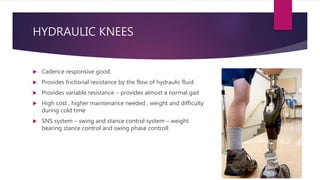
HYDRAULIC KNEES
 Cadence responsive good
 Provides frictional resistance by the flow of hydraulic fluid
 Provides variable resistance – provides almost a normal gait
 High cost , higher maintenance needed , weight and difficulty
during cold time
 SNS system – swing and stance control system – weight
bearing stance control and swing phase controll
PNEUMAIC KNEE PROSTHESIS
 LIKE HYDRAULIC
 Less weight , maintainance cost less
 Less cadence control than hydraulic
INTELLIGENT PROSTHESIS PLUS
 Microprocessor swing phase control knee
 Sensors monitor knee position during swing and pressure sensors detecting
ground related forces during stance
TRANSVERSE ROTATORS
 To sit crossed leg.
 External button pushed to unlock it
 gets locked automatically when knee back to neutral
COMPLICATIONS
 General Issues
 • Choke syndrome
 • caused by obstructed venous outflow due to a socketthat is too snug
 • acute phase
 Red indurated skin with orange-peel appearance
 chronic phase
 hemosiderin deposits and venous stasis ulcers
 Skin problems
 Contact dermatitis
 most commonly caused by liner, socks, and suspension mechanism
 treatment
 remove the offending item with symptomatic treatment
 Cysts and excess sweating
 Painful residual limb
 possible causes include bony prominences, poorly
 fitting prostheses, neuroma formation, and insufficient
 soft tissue coverage
THANK YOU…