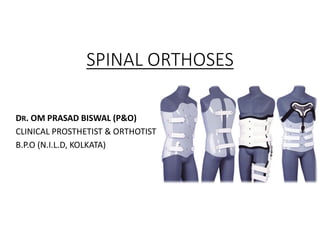
SPINAL ORTHOSES
DR. OM PRASAD BISWAL (P&O)
CLINICAL PROSTHETIST & ORTHOTIST
B.P.O (N.I.L.D, KOLKATA)
INTRODUCTION
• Spinal orthoses are external apparatus applied to the spinal segments used to
manage a variety of spinal conditions.
• The general purpose of a brace is to limit the motion of a spinal region,
decreasing the amount of load applied to the region treated.
• Orthoses are most frequently used when there is concern that loading the spine
may result in deformity (i.e., treating an unstable fracture), when the spine is
compromised in a way that requires additional support for healing (i.e.,
postsurgical management or osteoporosis), when the patient is experiencing low
back pain that can be relieved by either limiting motion or increasing abdominal
support, or when there is existing spinal deformity such as scoliosis.
• Another major function of a spinal orthosis is to serve as a psychological
reminder to restrict trunk or neck motion, or at least to encourage the patient to
move cautiously.
OBJECTIVES
• Reduce pain
• Supporting certain weakened or paralyzed spinal segments
• Increased proprioception
• Skeletal realignment
• Correction of spinal deformities
• Prevent progressive deformities
• Protection against spinal instability
• Minimized complications
• Healing of ligaments and bones
Biomechanical Principles
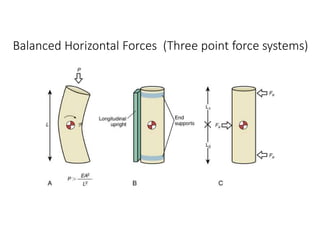
 Balanced Horizontal Forces
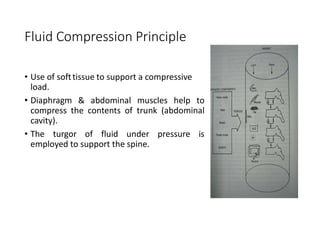
 Fluid Compression Principle
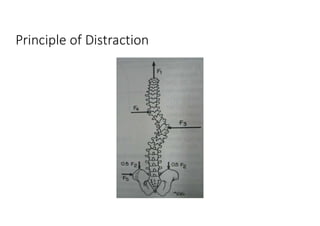
 Principle of Distraction
 Skeletal Fixation
 Kinesthetic Reminder
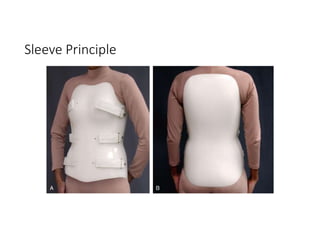
 Sleeve Principle
Balanced Horizontal Forces (Three point force systems)
Fluid Compression Principle
• Use of softtissue to support a compressive
load.
• Diaphragm & abdominal muscles help to
compress the contents of trunk (abdominal
cavity).
• The turgor of fluid under pressure is
employed to support the spine.
Principle of Distraction
Skeletal Fixation
Kinesthetic reminder
• The orthosis irritates the patient in some way serving as
stimulus to limit the activity.
Sleeve Principle
CLASSIFICATION OF SPINAL ORTHOSIS
(a) Terminology based on the joints or segment they include-
• S O (Sacral Orthosis)
• S I O (Sacro-Iliac Orthosis)
• L S O (Lumbo-Sacral Orthosis)
• T O (Thoracic Orthosis)
• T L S O (Thoraco-Lumbo-Sacral Orthosis)
• C T O (Cervico-Thoracic Orthosis)
• C T L S O (Cervico-Thoraco-Lumbo-Sacral Orthosis)
• C O (CERVICAL ORTHOSIS)
• H C O (Head Cervical Orthosis)
(b) According to motion restriction-
• Flexion- Extension (FE) control
• Flexion- Extension- Rotation (FER) Control
• Flexion- Extension- Lateral bending-Rotation (FELR) Control
(c) According to materials used-
• Rigid
• Flexible
Cont.
Cont.
(d) According to function-
• Supportive
• Immobilization/Rigid
• Corrective
HALO Orthosis
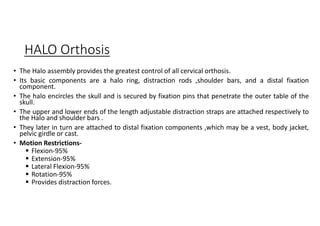
• The Halo assembly provides the greatest control of all cervical orthosis.
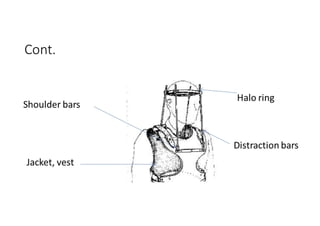
• Its basic components are a halo ring, distraction rods ,shoulder bars, and a distal fixation
component.
• The halo encircles the skull and is secured by fixation pins that penetrate the outer table of the
skull.
• The upper and lower ends of the length adjustable distraction straps are attached respectively to
the Halo and shoulder bars .
• They later in turn are attached to distal fixation components ,which may be a vest, body jacket,
pelvic girdle or cast.
• Motion Restrictions-
 Flexion-95%
 Extension-95%
 Lateral Flexion-95%
 Rotation-95%
 Provides distraction forces.
Cont.
Cont.
• This orthosis provides maximum restriction in motion of all the
cervical orthoses. It is the most stable orthosis, especially in the
superior cervical spine segment.
• A halo is used for approximately 3 months (10 to 12 weeks) to
ensure healing of a fracture or of a spinal fusion.
• Indications-
 Dens type I, II, or III fractures of C2 .
 C1 fractures with rupture of the transverse ligament
 Atlantoaxial instability from RA, with ligamentous disruption and
erosion of the dens.
 C2 neural arch fractures and disc disruption between C2 and C3. Bony,
single-column cervical fractures
 Cervical arthrodesis - Postoperative
Cont.
• Contraindications-
 Concomitant skull fracture with cervical injury
 Damaged or infected skin over pin insertion sites
• Complications-
 Neck pain or stiffness
 Pin loosening
 Pin site infection
 Scarring
 Pain at pin sites
 Pressure sores
Cervical Orthoses
• Encircles the neck and support the chin and is designed to fit
the body anywhere from the jaw to the chest.
• Types-
 Soft Cervical Collars
 Rigid Cervical Collars (Thomas)
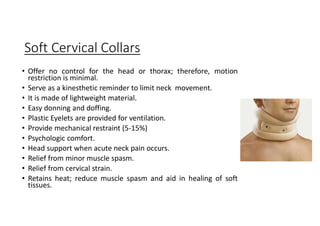
Soft Cervical Collars
• Offer no control for the head or thorax; therefore, motion
restriction is minimal.
• Serve as a kinesthetic reminder to limit neck movement.
• It is made of lightweight material.
• Easy donning and doffing.
• Plastic Eyelets are provided for ventilation.
• Provide mechanical restraint (5-15%)
• Psychologic comfort.
• Head support when acute neck pain occurs.
• Relief from minor muscle spasm.
• Relief from cervical strain.
• Retains heat; reduce muscle spasm and aid in healing of soft
tissues.
Limitations of motion:
• Limits 5-15% full flexion and extension
• Limits 5-10% full lateral bending
• Limits 10-17% full rotation
Rigid Thomas Cervical Collars
• Similar in shape to a soft collar but are made of
low density thermoplastic materials.
• Height can be adjusted in certain designs.
• Easy donning and doffing.
• It may include a chin support.
Motion Restrictions-
• Limits 20-25% full flexion and extension.
• Less effective in restricting rotation and lateral
bending.
• Better than a soft collar in motion restriction.
Head-Cervical Orthosis (HCOs)
• Head cervical orthoses (HCOs) include the occiput and chin in order
to decrease range of motion (ROM).
• Philadelphia collar
• Miami J collar
• Malibu collar
• Aspen collar
• Jobst Vertebrace
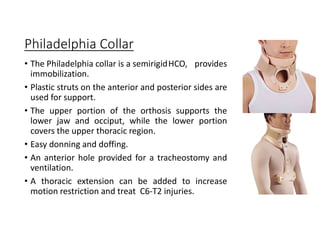
Philadelphia Collar
• The Philadelphia collar is a semirigidHCO, provides
immobilization.
• Plastic struts on the anterior and posterior sides are
used for support.
• The upper portion of the orthosis supports the
lower jaw and occiput, while the lower portion
covers the upper thoracic region.
• Easy donning and doffing.
• An anterior hole provided for a tracheostomy and
ventilation.
• A thoracic extension can be added to increase
motion restriction and treat C6-T2 injuries.
• Indications-
Anterior cervical fusion
Halo removal
Dens type I cervical fractures of C2
Anterior discectomy
Suspected cervical trauma in unconscious patients
Cervical strain
• Motion Restrictions-
Flexion and extension are limited by 65-70%
Rotation is limited by 60-65%.
Lateral bending is limited by 30-35%.
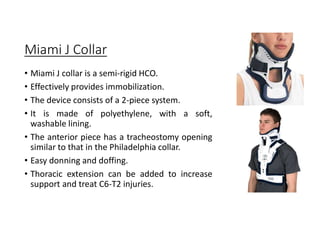
Miami J Collar
• Miami J collar is a semi-rigid HCO.
• Effectively provides immobilization.
• The device consists of a 2-piece system.
• It is made of polyethylene, with a soft,
washable lining.
• The anterior piece has a tracheostomy opening
similar to that in the Philadelphia collar.
• Easy donning and doffing.
• Thoracic extension can be added to increase
support and treat C6-T2 injuries.
• Indications-
Anterior cervical fusion
Halo removal
Dens type I cervical fractures of C2
Anterior discectomy
Suspected cervical trauma in unconscious patients
Cervical strain
• Motion Restrictions-
Flexion and extension are limited by 55-75%.
Rotation is limited by 70%.
Lateral bending is limited by 60%.
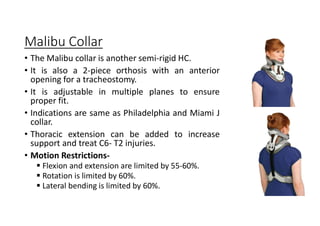
Malibu Collar
• The Malibu collar is another semi-rigid HC.
• It is also a 2-piece orthosis with an anterior
opening for a tracheostomy.
• It is adjustable in multiple planes to ensure
proper fit.
• Indications are same as Philadelphia and Miami J
collar.
• Thoracic extension can be added to increase
support and treat C6- T2 injuries.
• Motion Restrictions-
 Flexion and extension are limited by 55-60%.
 Rotation is limited by 60%.
 Lateral bending is limited by 60%.
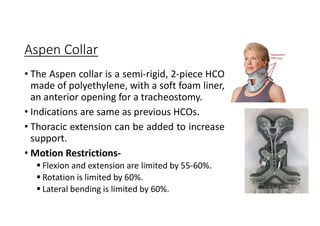
Aspen Collar
• The Aspen collar is a semi-rigid, 2-piece HCO
made of polyethylene, with a soft foam liner,
an anterior opening for a tracheostomy.
• Indications are same as previous HCOs.
• Thoracic extension can be added to increase
support.
• Motion Restrictions-
 Flexion and extension are limited by 55-60%.
 Rotation is limited by 60%.
 Lateral bending is limited by 60%.
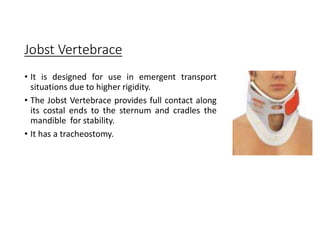
Jobst Vertebrace
• It is designed for use in emergent transport
situations due to higher rigidity.
• The Jobst Vertebrace provides full contact along
its costal ends to the sternum and cradles the
mandible for stability.
• It has a tracheostomy.
Cervico-Thoracic Orthoses
• Cervico-thoracic orthoses are designed to provide support and
immobilization of the cervical and upper thoracic spine.
• Cervico-Thoracic Orthoses (CTOs) provide greater motion restriction
from C5-C7 spine. All CTOs tend to control flexion better than extension
• It provides anterior/posterior, lateral and rotational control.
• CTOs are used in minimally unstable fractures.
• Types-
 SOMI Brace
 Yale C-T Orthosis
 Four Poster Brace
 Guilford Brace
 Minerva Brace
Sternal Occipital Mandibular Immobilizer (SOMI) Brace
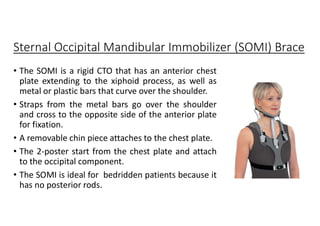
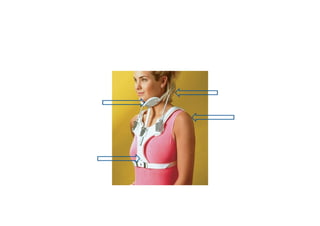
• The SOMI is a rigid CTO that has an anterior chest
plate extending to the xiphoid process, as well as
metal or plastic bars that curve over the shoulder.
• Straps from the metal bars go over the shoulder
and cross to the opposite side of the anterior plate
for fixation.
• A removable chin piece attaches to the chest plate.
• The 2-poster start from the chest plate and attach
to the occipital component.
• The SOMI is ideal for bedridden patients because it
has no posterior rods.
Cont.
• It controls flexion, extension, lateral bending, and rotation of the cervical
spine.
• Cervical flexion and extension are limited by 70%-75%.
• Lateral bending is limited by 35%
• Rotation is limited by 60-65%
• Pressure systems are used for control of motion, as well as to provide
slight distraction for immobilization of the spine.
• A benefit of the SOMI orthosis is that it can be put while the patient is in
the supine position.
• Indications-
Cervical sprains, strains,
Stable fractures
Protection and to limit mobility during the healing process
In the postoperative patient
• Contraindications-
Unstable fractures with ligament instability
Yale C-T Orthosis
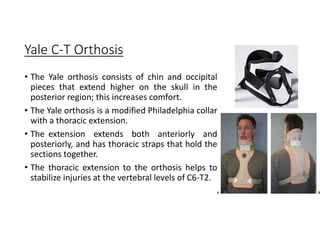
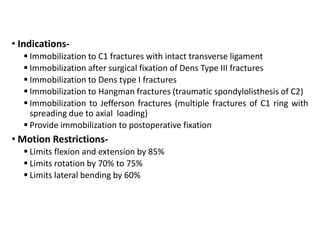
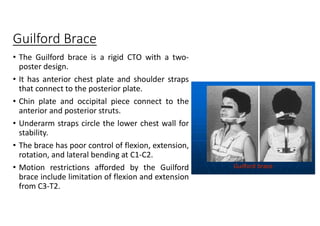
• The Yale orthosis consists of chin and occipital
pieces that extend higher on the skull in the
posterior region; this increases comfort.
• The Yale orthosis is a modified Philadelphia collar
with a thoracic extension.
• The extension extends both anteriorly and
posteriorly, and has thoracic straps that hold the
sections together.
• The thoracic extension to the orthosis helps to
stabilize injuries at the vertebral levels of C6-T2.
• Indications-
 Immobilization to C1 fractures with intact transverse ligament
 Immobilization after surgical fixation of Dens Type III fractures
 Immobilization to Dens type I fractures
 Immobilization to Hangman fractures (traumatic spondylolisthesis of C2)
 Immobilization to Jefferson fractures (multiple fractures of C1 ring with
spreading due to axial loading)
 Provide immobilization to postoperative fixation
• Motion Restrictions-
 Limits flexion and extension by 85%
 Limits rotation by 70% to 75%
 Limits lateral bending by 60%
Four-Poster Brace
• The four-poster brace is a rigid orthosis with anterior
and posterior chest pads connected by a leather
strap.
• Occipital and mandibular support pieces connect to
the chest pads and have adjustable struts.
• This brace uses shoulder straps, but it has no
underarm support.
• Open design allows heat loss from the neck.
• Motion restrictions-
 Limits flexion and extension by 80%
 Limits lateral bending by 55%-80%
 Limits rotation by 70%
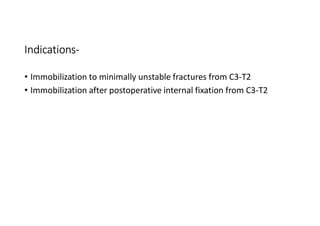
Guilford Brace
• The Guilford brace is a rigid CTO with a two-
poster design.
• It has anterior chest plate and shoulder straps
that connect to the posterior plate.
• Chin plate and occipital piece connect to the
anterior and posterior struts.
• Underarm straps circle the lower chest wall for
stability.
• The brace has poor control of flexion, extension,
rotation, and lateral bending at C1-C2.
• Motion restrictions afforded by the Guilford
brace include limitation of flexion and extension
from C3-T2.
Indications-
• Immobilization to minimally unstable fractures from C3-T2
• Immobilization after postoperative internal fixation from C3-T2
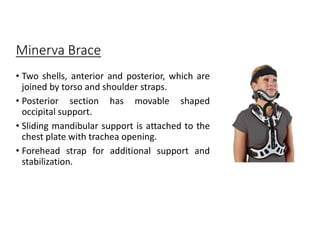
Minerva Brace
• Two shells, anterior and posterior, which are
joined by torso and shoulder straps.
• Posterior section has movable shaped
occipital support.
• Sliding mandibular support is attached to the
chest plate with trachea opening.
• Forehead strap for additional support and
stabilization.
Cont.
• Indications-
 Stabilization (C3 - T2)
 Stable fractures
 Post-trauma, muscle and ligament injury
 Nerve impingement
 R/A and Spondylitis
 Post-surgery
• Motion Restrictions- Controls flexion, extension-77%, lateral-76% and
rotary movements 100% of the cervical spine.
Thoraco-Lumbo-Sacral Orthoses (TLSO)
• TLS F-E control orthosis (Taylor brace)
• TLS F-E-L control (Knight Taylor brace)
• TLS F-E-R control orthosis (Cow horn brace)
• TLS flexion (F) control orthosis-
 Cruciform anterior spinal hyper- extension (CASH) TLSO
 Jewett or Becher TLSO
• TLS F-E-L-R control (TLS jacket)
• Boston TLSO
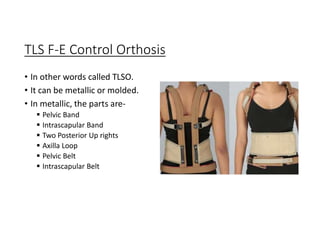
TLS F-E Control Orthosis
• In other words called TLSO.
• It can be metallic or molded.
• In metallic, the parts are-
 Pelvic Band
 Intrascapular Band
 Two Posterior Up rights
 Axilla Loop
 Pelvic Belt
 Intrascapular Belt
Cont.
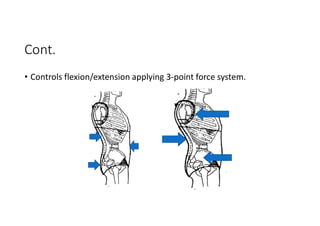
• Controls flexion/extension applying 3-point force system.
Indications-
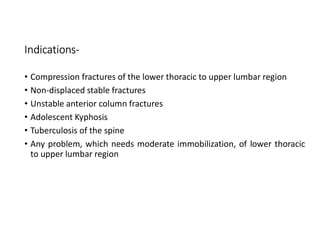
• Compression fractures of the lower thoracic to upper lumbar region
• Non-displaced stable fractures
• Adolescent Kyphosis
• Tuberculosis of the spine
TLS F-E-L Control Orthosis
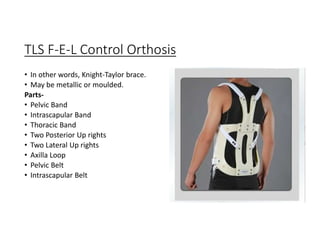
• In other words, Knight-Taylor brace.
• May be metallic or moulded.
Parts-
• Pelvic Band
• Intrascapular Band
• Thoracic Band
• Two Posterior Up rights
• Two Lateral Up rights
• Axilla Loop
• Pelvic Belt
• Intrascapular Belt
Cont.
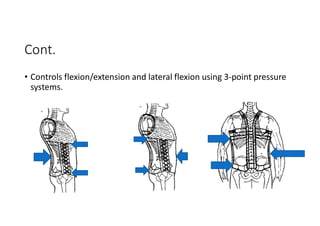
• Controls flexion/extension and lateral flexion using 3-point pressure
systems.
Indications-
• Compression fractures of the lower thoracic to upper lumbar region
• Non-displaced stable fractures
• Unstable anterior column fractures
• Adolescent Kyphosis
• Tuberculosis of the spine
• Any problem, which needs moderate immobilization, of lower thoracic
to upper lumbar region
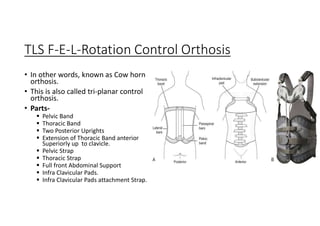
TLS F-E-L-Rotation Control Orthosis
• In other words, known as Cow horn
orthosis.
• This is also called tri-planar control
orthosis.
• Parts-
 Pelvic Band
 Thoracic Band
 Two Posterior Uprights
 Extension of Thoracic Band anterior
Superiorly up to clavicle.
 Pelvic Strap
 Thoracic Strap
 Full front Abdominal Support
 Infra Clavicular Pads.
 Infra Clavicular Pads attachment Strap.
Cont.
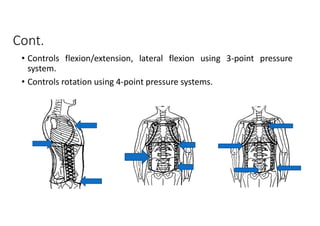
• Controls flexion/extension, lateral flexion using 3-point pressure
system.
• Controls rotation using 4-point pressure systems.
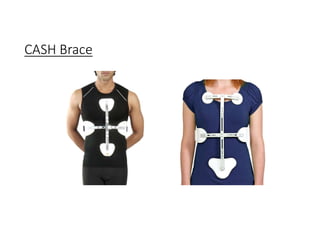
CASH Brace
Cont.
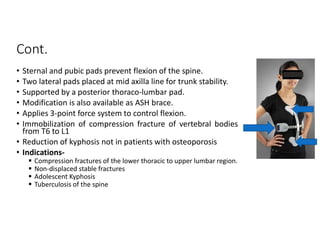
• Sternal and pubic pads prevent flexion of the spine.
• Two lateral pads placed at mid axilla line for trunk stability.
• Supported by a posterior thoraco-lumbar pad.
• Modification is also available as ASH brace.
• Applies 3-point force system to control flexion.
• Immobilization of compression fracture of vertebral bodies
from T6 to L1
• Reduction of kyphosis not in patients with osteoporosis
• Indications-
 Compression fractures of the lower thoracic to upper lumbar region.
 Non-displaced stable fractures
 Adolescent Kyphosis
 Tuberculosis of the spine
Jewett Brace
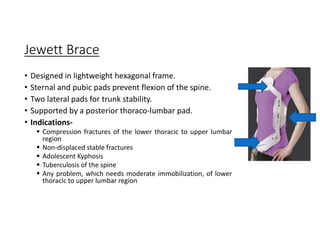
• Designed in lightweight hexagonal frame.
• Sternal and pubic pads prevent flexion of the spine.
• Two lateral pads for trunk stability.
• Supported by a posterior thoraco-lumbar pad.
• Indications-
 Compression fractures of the lower thoracic to upper lumbar
region
 Non-displaced stable fractures
 Adolescent Kyphosis
 Tuberculosis of the spine
 Any problem, which needs moderate immobilization, of lower
thoracic to upper lumbar region
TLS F-E-L-R Molded Orthosis (TLSO Body Jacket)
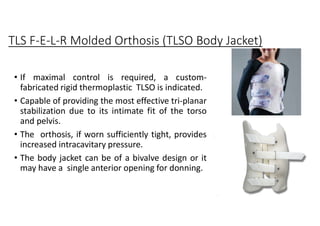
• If maximal control is required, a custom-
fabricated rigid thermoplastic TLSO is indicated.
• Capable of providing the most effective tri-planar
stabilization due to its intimate fit of the torso
and pelvis.
• The orthosis, if worn sufficiently tight, provides
increased intracavitary pressure.
• The body jacket can be of a bivalve design or it
may have a single anterior opening for donning.
Cont.
• The bivalve design probably is best suited for patients with variable
volume.
• A TLSO using an anterior opening does not accommodate volume
fluctuation well but may be simpler for patients to don, so this device
may be more suitable for non-surgical patients.
• The height of the TLSO is determined by the spinal level
requiring stabilization.
• Body jackets are frequently used post surgically or during an acute
trauma.
Indications-
• Immobilization for compression fractures from osteoporosis
• Immobilization after surgical stabilization for spinal fractures
• Bracing for idiopathic scoliosis
• Immobilization for unstable spinal disorders for T3 to L3
TLSO for Scoliosis
• Boston Brace
• Miami Brace
• Wilmington brace
• Rosenberger Orthosis
• New York Orthopaedic Hospital orthosis(NYOH)
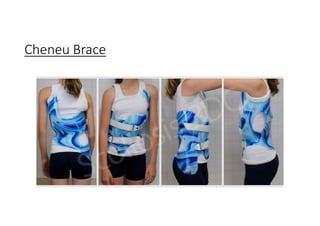
• Cheneau Brace
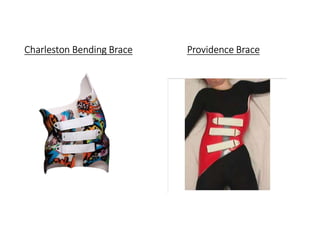
• Providence brace
• Charleston nocturnal flexion brace/ Charleston bending brace
Boston Brace
• Generally a customized, posterior opening, plastic module which
encompasses the pelvis and thorax to reduce and prevent progression of
lumbar, thoracolumbar, and thoracic curves with apices below T8.
• The goal of the Boston Bracing System is to allow non-operative treatment
of scoliosis by preventing progression of the scoliosis in the growing child.
• Design features of the module include: Symmetry, reaction points to affect
considerable reduction of lumber lordosis, concavity over of the abdomen
to increase intra cavity pressure and assist in reducing lumbar lordosis.
Indications-
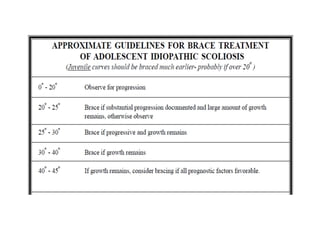
• The pre-adolescent with a moderate scoliosis (curvature >30⁰) is at
significant risk for progression of the scoliosis and may derive great
benefit from brace wear.
• The adolescent with a 45-degree curvature and growth remaining may
achieve curve control with bracing.
• In general, for the adolescent with a curvature 30-45 degrees and
growth remaining, brace treatment is indicated
• In juvenile idiopathic scoliosis, brace wear is initiated when the
curvature exceeds 20⁰.
• Curve Location
• Hypokyphosis and Thoracic Lordosis
Types-
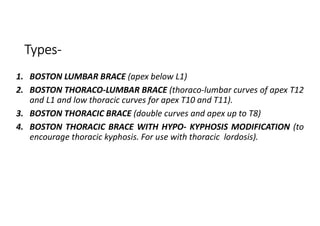
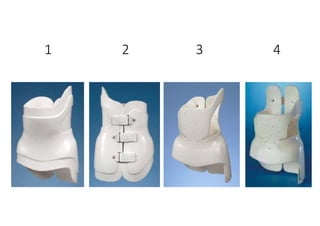
1. BOSTON LUMBAR BRACE (apex below L1)
2. BOSTON THORACO-LUMBAR BRACE (thoraco-lumbar curves of apex T12
and L1 and low thoracic curves for apex T10 and T11).
3. BOSTON THORACIC BRACE (double curves and apex up to T8)
4. BOSTON THORACIC BRACE WITH HYPO- KYPHOSIS MODIFICATION (to
encourage thoracic kyphosis. For use with thoracic lordosis).
1 2 3 4
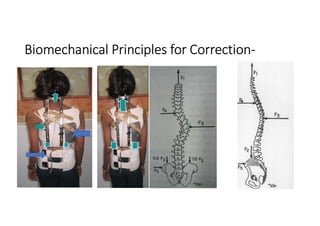
Biomechanical Principle-
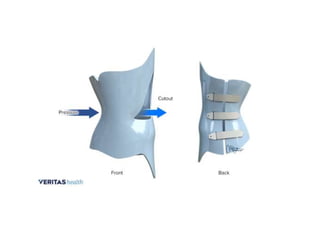
• Boston brace principles dictate that opposite every force there
should be an area of relief so that the trunk may shift.
• ACTIVE AS WELL AS PASSIVE CORRECTION.
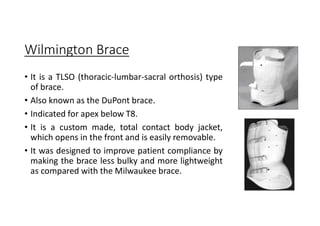
Wilmington Brace
• It is a TLSO (thoracic-lumbar-sacral orthosis) type
of brace.
• Also known as the DuPont brace.
• Indicated for apex below T8.
• It is a custom made, total contact body jacket,
which opens in the front and is easily removable.
• It was designed to improve patient compliance by
making the brace less bulky and more lightweight
as compared with the Milwaukee brace.
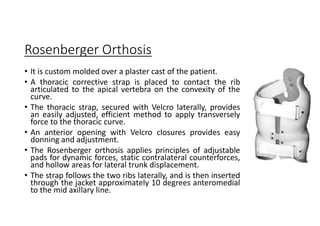
Rosenberger Orthosis
• It is custom molded over a plaster cast of the patient.
• A thoracic corrective strap is placed to contact the rib
articulated to the apical vertebra on the convexity of the
curve.
• The thoracic strap, secured with Velcro laterally, provides
an easily adjusted, efficient method to apply transversely
force to the thoracic curve.
• An anterior opening with Velcro closures provides easy
donning and adjustment.
• The Rosenberger orthosis applies principles of adjustable
pads for dynamic forces, static contralateral counterforces,
and hollow areas for lateral trunk displacement.
• The strap follows the two ribs laterally, and is then inserted
through the jacket approximately 10 degrees anteromedial
to the mid axillary line.
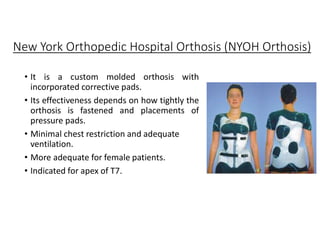
New York Orthopedic Hospital Orthosis (NYOH Orthosis)
• It is a custom molded orthosis with
incorporated corrective pads.
• Its effectiveness depends on how tightly the
orthosis is fastened and placements of
pressure pads.
• Minimal chest restriction and adequate
ventilation.
• More adequate for female patients.
• Indicated for apex of T7.
Miami Brace
• Custom molded, posterior opening TLSO.
• Prescribed for curves apices below T6.
• Minimal coverage of anterior and lateral aspects of
the thorax so as to permit maximal spinal motion,
reduce impairment of pulmonary function, and
obviate possible interference with breast
development.
• It’s trimmed short enough to allow forward bending.
Charleston Bending Brace Providence Brace
Cheneu Brace
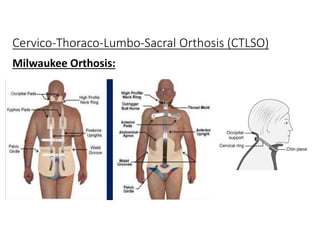
Cervico-Thoraco-Lumbo-Sacral Orthosis (CTLSO)
Milwaukee Orthosis:
• It is the first modern day brace used to treat spinal deformities.
• It was developed by Blount and Schmidt Moe in 1945 for the post-
operative treatment of post-polio scoliosis.
• Most effective Orthosis in correcting the lateral curvature up to 40-45
degrees.
• It is easily adjustable for growth.
• Due to its open design, it does not compress the thorax.
• Correction of spinal deformity in a brace is achieved by two means:
• Passively by the effect of brace pressure from pads or traction from the
brace design, and
• Actively from muscle contractions and movement of the body away from
the pad.
Biomechanical Principles for Correction-
• Advantages-
 Because of its open design with uprights and pads, it minimally restricts
respiration.
 The open design allows good air circulation so wearing in hot climates is
not a problem.
 It can be lengthened as the child grows. Pad placement is altered with
growth or when curve correction dictates such a change.
• Disadvantages-
 The problem with the Milwaukee Brace today is psychological, with poor
acceptance by teenage patients and some physicians.
 It is heavy, cumbersome and uncomfortable.
 Donning and doffing is not easy.
 Requires a skilled Orthotist.
Lumbo-Sacral Orthoses
• Encompasses the lumbo-sacral region.
• Types-
• LS Corsets
• LS Rigid Orthoses
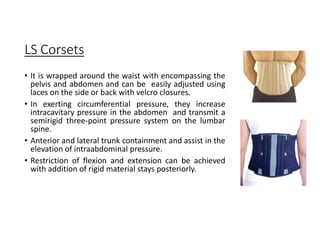
LS Corsets
• It is wrapped around the waist with encompassing the
pelvis and abdomen and can be easily adjusted using
laces on the side or back with velcro closures.
• In exerting circumferential pressure, they increase
intracavitary pressure in the abdomen and transmit a
semirigid three-point pressure system on the lumbar
spine.
• Anterior and lateral trunk containment and assist in the
elevation of intraabdominal pressure.
• Restriction of flexion and extension can be achieved
with addition of rigid material stays posteriorly.
• Indications-
 Low back pain,
 Herniated disks
 lumbar muscle strain, and
 To control gross trunk motion for pain control after single-column
compression fractures with one-third or less anterior height loss.
• Contraindications-
 Unstable fractures
LS Rigid Orthoses
• Metallic
• LS Flexion-Extension Control Orthosis (Chair Back Brace)
• LS FE Lateral Control Orthosis (Knight Chair Back Brace)
• LS E-L Control Orthosis (William Lordosis Brace)
• Molded
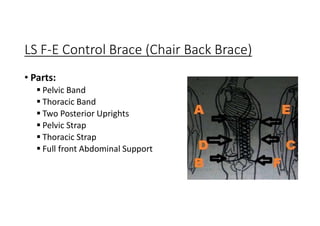
LS F-E Control Brace (Chair Back Brace)
• Parts:
 Pelvic Band
 Thoracic Band
 Two Posterior Uprights
 Pelvic Strap
 Thoracic Strap
 Full front Abdominal Support
• Indications :
 Unloading of the intervertebral discs and transmit pressure to soft
tissue areas
 Relief for LBP
 Immobilization after lumbar laminectomy
 Kinesthetic reminder to patient following surgery
• Motion restrictions :
 Limits flexion and extension at the L1-L4 level
 Limits rotation minimally
 Limits lateral bending by 45% in the thoracolumbar spine
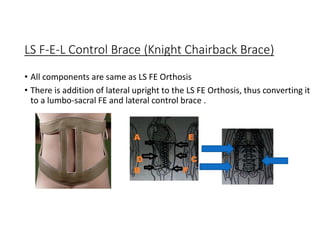
LS F-E-L Control Brace (Knight Chairback Brace)
• All components are same as LS FE Orthosis
• There is addition of lateral upright to the LS FE Orthosis, thus converting it
to a lumbo-sacral FE and lateral control brace .
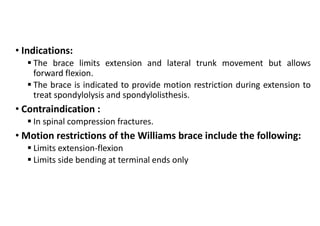
• Indications:
 The brace limits extension and lateral trunk movement but allows
forward flexion.
 The brace is indicated to provide motion restriction during extension to
treat spondylolysis and spondylolisthesis.
• Contraindication :
 In spinal compression fractures.
• Motion restrictions of the Williams brace include the following:
 Limits extension-flexion
 Limits side bending at terminal ends only
LS E-L Control Orthosis
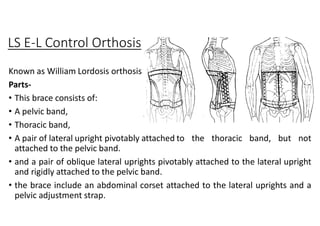
Known as William Lordosis orthosis
Parts-
• This brace consists of:
• A pelvic band,
• Thoracic band,
• A pair of lateral upright pivotably attached to the thoracic band, but not
attached to the pelvic band.
• and a pair of oblique lateral uprights pivotably attached to the lateral upright
and rigidly attached to the pelvic band.
• the brace include an abdominal corset attached to the lateral uprights and a
pelvic adjustment strap.
LS Molded Orthosis
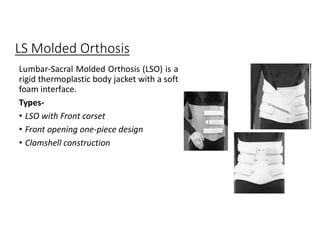
Lumbar-Sacral Molded Orthosis (LSO) is a
rigid thermoplastic body jacket with a soft
foam interface.
Types-
• LSO with Front corset
• Front opening one-piece design
• Clamshell construction
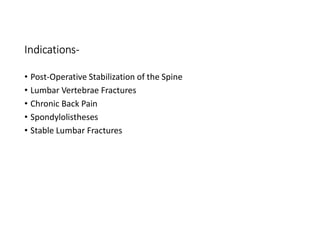
Indications-
• Post-Operative Stabilization of the Spine
• Lumbar Vertebrae Fractures
• Chronic Back Pain
• Spondylolistheses
• Stable Lumbar Fractures
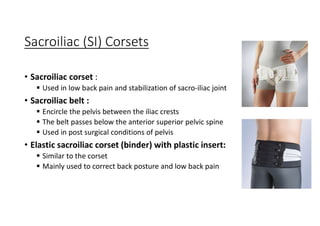
Sacroiliac (SI) Corsets
• Sacroiliac corset :
 Used in low back pain and stabilization of sacro-iliac joint
• Sacroiliac belt :
 Encircle the pelvis between the iliac crests
 The belt passes below the anterior superior pelvic spine
 Used in post surgical conditions of pelvis
• Elastic sacroiliac corset (binder) with plastic insert:
 Similar to the corset
 Mainly used to correct back posture and low back pain
Negative Physiological consequences
• Weakness follows reduced functional demands
• Prolonged disuse leads to atrophy
• Contracture follows immobilization and atrophy
• Psychological dependence follows and increases physical dependence
• Symptoms may increase following any of the above or wrongly fitted
orthosis.
Dr. Om Prasad Biswal (P&O)
Clinical Prosthetist & Orthotist
B.P.O (N.I.L.D, Kolkata)
Email Id: biswalomprasad@gmail.com
Phone No: 7978450567 (Call)
7044519795(What’s App)