PARTIAL FOOT
PROSTHESIS
 Purpose:
 Restore foot function particularly in walking
 Simulate shape of the missing foot segment
 Pt lost one or more toes may simply pad the
toe section of shoe…… to improve
appearance of the upper portion of the shoe.
 Standing is not affected, assuming the
metatarsal heads remain
 When individual walks, late stance will be less
forceful, particularly if phalanges of the great toe
are absent.
 An arch support ……. Maintain alignment of
amputated foot
 Transmetatarsal amputation:- disturbs foot
appearance
 Prosthesis prevent shoe from developing
unnatural crease
 Bears most weight on heels
 Prosthesis plastic socket for remainder of the foot
 Rigid plate…….. Restore
 Bottom of prosthesis…… rocker bar effects
 Amputation or disarticulation ….. Through
tarsals poses additional problem of retaining
small foot during swing phase
 Prosthesis used ……. Transmetatarsal
amputation is augmented with plastic calf
shell, which is strapped around the leg.
Transtibial prosthesis
 Retains anatomical knee and its motor ansd
sensory function
 Cause…. ?
 Syme’s amputation limb is longer than….?
 Improving prosthetic control
 Syme’s amputation…… tolerate more weight
through end of the limb
 Includes…foot-ankle assembly and socket
 Transtibial…… suspension and shank
component
1) foot-ankle assembly
 Pros foot restores general contours
 Absorbs shock
 Many assemblies also provide slight motion in
frontal & transverse plane
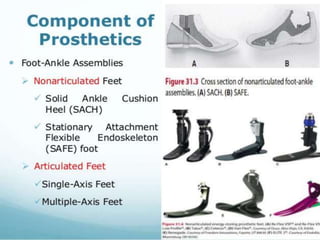
 Non articulated feet:-
 Us ….. Most popular type
 Lighter in weight, more durable, more
attractive , some versions are made to suit
high heeled shoes
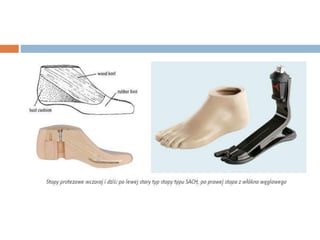
SACH
 most commonly prescribe foot
 Consist wooden or metal keel …. Terminates at a
point corresponding to MTPJ.
 Keel… covered with rubber
 Post portion is resilient , absorbs shock, permit
plantarflexion in early stance phase
 Late stance….. Hyperextension
 Manufactured in a wide range of sizes…
 Having heel cushion….. Allows a very small
amount of medial-lateral and transverse motion
Other nonarticulated feet
 Version of SACH is (SAFE)
 Stationary attachment flexible endoskeleton foot
 Heavier and expensive than SACH
 It has rigid ankle block joined to post portion of
keel at 45 degree angle. Comparable to
anatomical subtalar jt
 The junction permits the wearerto maintain the
contact with moderately uneven terrains, bec of
greater range of medial-lateral range of motion
permitted in the rear foot.

 large Variety of prosthetic feet are available…..
Selection depends on needs of individual like
wearers activity level, weight, level of
amputation as well as length and shape of the
amputation.
Single axis feet
 It permits plant and dorsif
 Multiple-axis feet:
 Move slightly in all planes to aid the wearer in
maintaining max contact with walking surface.
 Heavier and less durable
 Rotators:-
 Component placed above the prosthetic foot to
absorb shock .
 Most often used with single axis feet and those
with transfemoral amputation.
2) Shank
 Substitute for human leg, restoring leg length
and shape
 Located above foot ankle assembly and below
the socket
 Which type of prost does not have shank…. ?
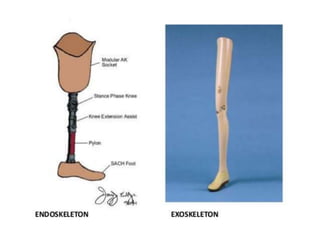
 Two types exoskeleon
 Endoskeleton
 Which one is more durable and more
frequently prescribe??
3) socket
 The amputated limb fits into a plastic
receptacle called the socket.
 Socket is designed to contact all portions of
the amputated limb for maximum distribution of
load , assist venous blood circulation, provide
tactile feedback
 Sockets are custom made of plastic molded
over a model of the pts amputation limb
 The model may be produced from a plaster
cast of the amputation limb or by (CAD-CAM)
 Socket is aligned on shank.
 Two types
 Lined socket
 Unlined socket
 a) Lined socket:
 transtibial socket is generally includes a
resilient polyethylene foam liner.
 Cushioning the amputation limb
 The removable liner facilitates alteration of the socket
size.
 Liner however adds the bulk of the prosthesis and is a
heat insulator…….. Uncomfortable in summer
b) Unlined socket
 Sometimes referred as hard socket
 Misnomer
 b/c pt has a soft interface provided by socks or
a sheath worn with unlined socket
 Occasionally a resilient pad is placed ……
bottom ….to Cushion distal end of ampu limb
 More satisfactory choice……. Stabilized b/c It
is easy to wear but difficult to alter the shape
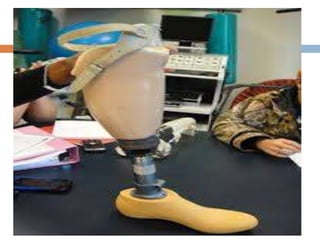
4) Suspension
 During the swing phase of walking, the
prosthesis requires some form of suspension
to hold it in place.
 Cuff Variant :-
 The cuff, a leather variant encircling the thigh
immediately above the femoral epicondyles,
permits the user to adjust the snugness of
suspension easily.
 An alternative to the cuff is a rubber sleeve, a
tubular component that covers the proximal
socket and the distal thigh.
Distal attachment
 Very secure suspension is achieved with the
use of a silicone sheath with a distal metal pin.
The sheath clings the skin. The user inserts
the sheathed limb into the prosthesis, guiding
the attached pin into a receptacle in the socket
. During swing phase, the pin mechanism
prevents the prosthesis from slipping.
Brim variant
 The prosthesis may be suspended by its socket
walls extended proximally. With supracondylar
(SC) suspension , the med & lat walls extended
above the femoral epicondyles. The medial wall
has a plastic wedge. When donning the
prosthesis, the client removes the wedge, places
the amputation limb in the socket, then places the
wedge b/w the socket and the medial epicondyle
to retain the prosthesis on the limb.
 supracondylar (SC) suspension increases med lat
stability of pros.
 More difficult to fabricate, more expensive and not
readily adjustable.
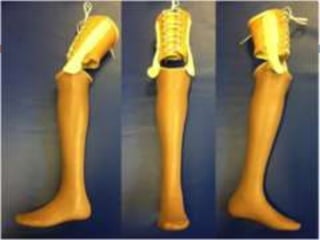
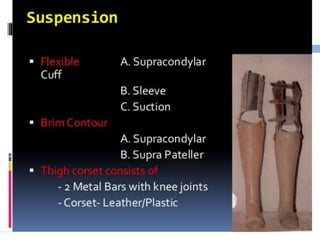
Thigh corset
 Some individuals with very sensitive skin may
benefit from thigh corset suspension. Metal hinges
attach distally to the medial and lateral aspects of
the socket and proximally to a leather or flexible
plastic corset.
 Corset heights vary and may reach the ischial
tuberosity for maximum weight relief on the
amputated limb.
 Prolonged use of a thigh corset produces
pressure atrophy of the thigh. A prosthesis with
corset suspension is more difficult to don…….
Fasten laces or pressure loop straps.
Syme’s suspension
 Syme’s prosthesis is suspended by the contours of its
brims and socket walls, without a cuff or other
suspension mechanism.
 Vacuum-Assisted Socket System:-
 Used less frequently with transtibial
amputation owing to reduced surface area of the
residual limb.
 Uniquely combines use of a pump, linear and sleeve
to achieve elevated vacuum in an airtight
environment.
 The vacuum is believed to promote fluid exchange,
reduce moisture buildup, regulate volume fluctuations
and increase proprioceptive awareness of where the
limb is in space.
Partial foot prosthesis

Partial foot prosthesis

  • 1.
  • 2.
     Purpose:  Restorefoot function particularly in walking  Simulate shape of the missing foot segment  Pt lost one or more toes may simply pad the toe section of shoe…… to improve appearance of the upper portion of the shoe.  Standing is not affected, assuming the metatarsal heads remain
  • 3.
     When individualwalks, late stance will be less forceful, particularly if phalanges of the great toe are absent.  An arch support ……. Maintain alignment of amputated foot  Transmetatarsal amputation:- disturbs foot appearance  Prosthesis prevent shoe from developing unnatural crease  Bears most weight on heels  Prosthesis plastic socket for remainder of the foot  Rigid plate…….. Restore  Bottom of prosthesis…… rocker bar effects
  • 4.
     Amputation ordisarticulation ….. Through tarsals poses additional problem of retaining small foot during swing phase  Prosthesis used ……. Transmetatarsal amputation is augmented with plastic calf shell, which is strapped around the leg.
  • 5.
    Transtibial prosthesis  Retainsanatomical knee and its motor ansd sensory function  Cause…. ?  Syme’s amputation limb is longer than….?  Improving prosthetic control  Syme’s amputation…… tolerate more weight through end of the limb  Includes…foot-ankle assembly and socket  Transtibial…… suspension and shank component
  • 6.
    1) foot-ankle assembly Pros foot restores general contours  Absorbs shock  Many assemblies also provide slight motion in frontal & transverse plane  Non articulated feet:-  Us ….. Most popular type  Lighter in weight, more durable, more attractive , some versions are made to suit high heeled shoes
  • 7.
    SACH  most commonlyprescribe foot  Consist wooden or metal keel …. Terminates at a point corresponding to MTPJ.  Keel… covered with rubber  Post portion is resilient , absorbs shock, permit plantarflexion in early stance phase  Late stance….. Hyperextension  Manufactured in a wide range of sizes…  Having heel cushion….. Allows a very small amount of medial-lateral and transverse motion
  • 8.
    Other nonarticulated feet Version of SACH is (SAFE)  Stationary attachment flexible endoskeleton foot  Heavier and expensive than SACH  It has rigid ankle block joined to post portion of keel at 45 degree angle. Comparable to anatomical subtalar jt  The junction permits the wearerto maintain the contact with moderately uneven terrains, bec of greater range of medial-lateral range of motion permitted in the rear foot. 
  • 9.
     large Varietyof prosthetic feet are available….. Selection depends on needs of individual like wearers activity level, weight, level of amputation as well as length and shape of the amputation.
  • 10.
    Single axis feet It permits plant and dorsif  Multiple-axis feet:  Move slightly in all planes to aid the wearer in maintaining max contact with walking surface.  Heavier and less durable  Rotators:-  Component placed above the prosthetic foot to absorb shock .  Most often used with single axis feet and those with transfemoral amputation.
  • 11.
    2) Shank  Substitutefor human leg, restoring leg length and shape  Located above foot ankle assembly and below the socket  Which type of prost does not have shank…. ?  Two types exoskeleon  Endoskeleton  Which one is more durable and more frequently prescribe??
  • 16.
    3) socket  Theamputated limb fits into a plastic receptacle called the socket.  Socket is designed to contact all portions of the amputated limb for maximum distribution of load , assist venous blood circulation, provide tactile feedback  Sockets are custom made of plastic molded over a model of the pts amputation limb  The model may be produced from a plaster cast of the amputation limb or by (CAD-CAM)
  • 17.
     Socket isaligned on shank.  Two types  Lined socket  Unlined socket  a) Lined socket:  transtibial socket is generally includes a resilient polyethylene foam liner.  Cushioning the amputation limb  The removable liner facilitates alteration of the socket size.  Liner however adds the bulk of the prosthesis and is a heat insulator…….. Uncomfortable in summer
  • 18.
    b) Unlined socket Sometimes referred as hard socket  Misnomer  b/c pt has a soft interface provided by socks or a sheath worn with unlined socket  Occasionally a resilient pad is placed …… bottom ….to Cushion distal end of ampu limb  More satisfactory choice……. Stabilized b/c It is easy to wear but difficult to alter the shape
  • 19.
    4) Suspension  Duringthe swing phase of walking, the prosthesis requires some form of suspension to hold it in place.  Cuff Variant :-  The cuff, a leather variant encircling the thigh immediately above the femoral epicondyles, permits the user to adjust the snugness of suspension easily.  An alternative to the cuff is a rubber sleeve, a tubular component that covers the proximal socket and the distal thigh.
  • 21.
    Distal attachment  Verysecure suspension is achieved with the use of a silicone sheath with a distal metal pin. The sheath clings the skin. The user inserts the sheathed limb into the prosthesis, guiding the attached pin into a receptacle in the socket . During swing phase, the pin mechanism prevents the prosthesis from slipping.
  • 22.
    Brim variant  Theprosthesis may be suspended by its socket walls extended proximally. With supracondylar (SC) suspension , the med & lat walls extended above the femoral epicondyles. The medial wall has a plastic wedge. When donning the prosthesis, the client removes the wedge, places the amputation limb in the socket, then places the wedge b/w the socket and the medial epicondyle to retain the prosthesis on the limb.  supracondylar (SC) suspension increases med lat stability of pros.  More difficult to fabricate, more expensive and not readily adjustable.
  • 23.
    Thigh corset  Someindividuals with very sensitive skin may benefit from thigh corset suspension. Metal hinges attach distally to the medial and lateral aspects of the socket and proximally to a leather or flexible plastic corset.  Corset heights vary and may reach the ischial tuberosity for maximum weight relief on the amputated limb.  Prolonged use of a thigh corset produces pressure atrophy of the thigh. A prosthesis with corset suspension is more difficult to don……. Fasten laces or pressure loop straps.
  • 25.
    Syme’s suspension  Syme’sprosthesis is suspended by the contours of its brims and socket walls, without a cuff or other suspension mechanism.  Vacuum-Assisted Socket System:-  Used less frequently with transtibial amputation owing to reduced surface area of the residual limb.  Uniquely combines use of a pump, linear and sleeve to achieve elevated vacuum in an airtight environment.  The vacuum is believed to promote fluid exchange, reduce moisture buildup, regulate volume fluctuations and increase proprioceptive awareness of where the limb is in space.

Editor's Notes

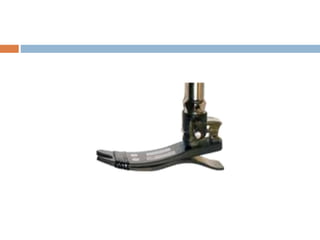
  • #14 Springlite with adjustment rod