AMPUTATIONDr.ManojVermaManojVerma
   “Surgical removal of limb or part of the limb through a bone or multiple bones”Disarticulation;-“Surgical removal of  hole limb or part of the limb through a joint”
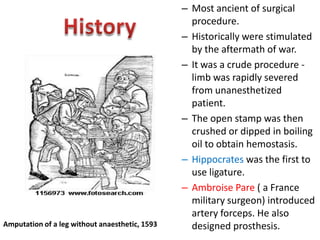
Most ancient of surgical procedure. Historically were stimulated by the aftermath of war. It was a crude procedure -     limb was rapidly severed from unanesthetized patient. The open stamp was then crushed or dipped in boiling oil to obtain hemostasis. Hippocrates was the first to use ligature. Ambroise Pare ( a France military surgeon) introduced artery forceps. He also designed prosthesis. HistoryAmputation of a leg without anaesthetic, 1593
Age;-     common in 50-75 yrs of age                       traumatic- common in young age   Sex;-  aprox. 75% male                                25% female Limb;- aprox. 85% - lower limb                                   15% -- upper limb       Incidence
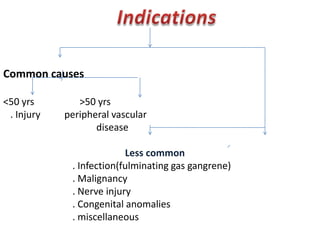
Common causes<50 yrs                   >50 yrs   . Injury          peripheral vascular                                       diseaseLess common                             . Infection(fulminating gas gangrene)                             . Malignancy                             . Nerve injury                             . Congenital anomalies                             . miscellaneousIndications
‘ DDD’ Dead Deadly Dam Nuisance           Indications: Amputation
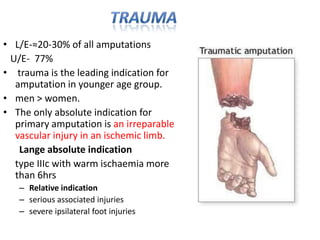
TraumaL/E-≈20-30% of all amputations   U/E-  77%   trauma is the leading indication for amputation in younger age group.men > women.The only absolute indication for primary amputation is an irreparable vascular injury in an ischemic limb.Lange absolute indication      type IIIc with warm ischaemia more than 6hrs Relative indication serious associated injuries severe ipsilateral foot injuries
To Remove  the limb subjectivity predicive salvage index limb injury score mangled extremity syndrome index Attempts to salvage a severely injured limb may lead to metabolic overload and secondary organ failure Injury severity score > 50 : contraindication to limb salvage mangled extremity severity score(M.E.S.S. )(Helfet, CORR, 80, 1990) (most useful)               < 7 : Salvage 8-12 : Amputate
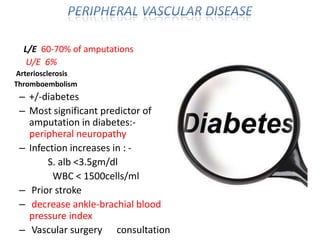
PERIPHERAL VASCULAR DISEASE  L/E  60-70% of amputations   U/E  6%        ArteriosclerosisThromboembolism+/-diabetes Most significant predictor of amputation in diabetes:- peripheral neuropathy Infection increases in : -            S. alb <3.5gm/dl               WBC < 1500cells/ml  Prior strokedecrease ankle-brachial blood pressure indexVascular surgery      consultation
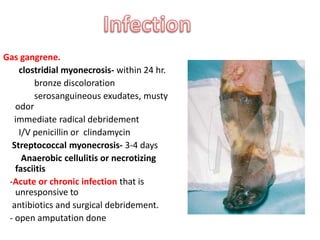
InfectionGas gangrene. clostridialmyonecrosis- within 24 hr.              bronze discolorationserosanguineous exudates, musty odor     immediate radical debridement       I/V penicillin or  clindamycinStreptococcal myonecrosis- 3-4 daysAnaerobic cellulitis or necrotizing fasciitis          -Acute or chronic infection that is unresponsive to     antibiotics and surgical debridement.   - open amputation done
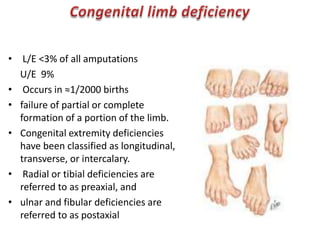
Congenital limb deficiency L/E <3% of all amputations     U/E  9% Occurs in ≈1/2000 birthsfailure of partial or complete formation of a portion of the limb. Congenital extremity deficiencies have been classified as longitudinal, transverse, or intercalary. Radial or tibial deficiencies are referred to as preaxial, and ulnar and fibular deficiencies are referred to as postaxial
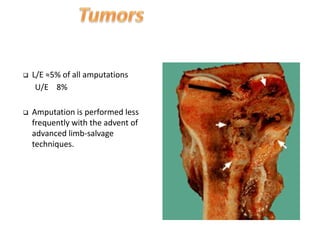
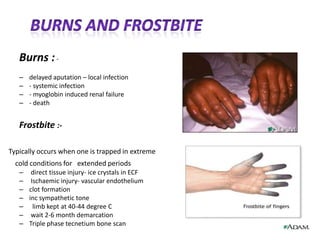
TumorsL/E ≈5% of all amputations      U/E    8% Amputation is performed less frequently with the advent of advanced limb-salvage techniques. Burns and FrostbiteBurns : -delayed aputation – local infection - systemic infection - myoglobin induced renal failure - death Frostbite :-Typically occurs when one is trapped in extreme cold conditions for   extended periods direct tissue injury- ice crystals in ECF Ischaemic injury- vascular endothelium clot formation inc sympathetic tone   limb kept at 40-44 degree C  wait 2-6 month demarcation Triple phase tecnetium bone scan
    OpenGuillotine           modified guillotine    Closed amputation           revised           plannedTypes of amputation
“The energy required for walking is inversely proportionate to the length of the remaining limb”  Amputation of the lower extremity is often the treatment of choice for an unreconstructable or a functionally unsatisfactory limb The higher the level of a lower-limb amputation, the greater the energy expenditure that is required for walking As the level of the amputation moves proximally, the walking speed of the individual decreases, and the oxygen consumption increases Pathophysiology
In transtibial amputations, the energy cost for walking is not much greater than that required for persons who have not undergone amputations. For those who have undergone transfemoral amputations, the energy required is 50-65% greater than that required for those who have not undergone amputations .
HematocritCreatinine levels should be monitored. In individuals with muscle injury and necrosis, myoglobin enters the systemic circulation and can lead to renal insufficiency and failure. especially in individuals with thermal and electrical burns.Potassium and calcium levels should be monitored. Elevated levels of these electrolytes may lead to cardiac arrhythmias and seizures. White blood cell count, C-reactive protein , and ESR Expect the C-reactive protein to be the first laboratory value to respond to treatment, Platelets Lab Studies
X-ray   AP & Lat viewComputed tomography (CT) scanning and magnetic resonance imaging (MRI) are performed for the patient tumour workup or for osteomyelitis to ensure that the surgical margins are appropriate. Technetium-99m (99mTc) pyrophosphate bone scanning has been used to predict the need for amputation in persons with electrical burns and frostbite.   A 94% sensitivity rate and a 100% specificity rate has been reported in demarcating viable tissues from nonviable tissues. Imaging Studies
Doppler ultrasonography-  measure arterial pressure; In approximately 15% of patients with PVD, the results are falsely elevated because of the noncompressibility of the calcified extremity arteries. Doppler ultrasonography has been used in the past to predict wound healing.    A minimum measurement of 70 mm Hg is believed to be necessary for wound healing. Ischemic index (II): -This index is the ratio of the Doppler ultrasonography pressure at the level being tested to the brachial systolic pressure. An II of 0.5 or greater at the surgical level is necessary to support wound healing.Ankle-brachial index: -The II at the ankle level is believed to be the best indicator for assessing adequate inflow to the ischemic limb. An index less than 0.45 indicates incisions distal to the ankle will not heal.
Preoperative preparation includes the following steps: -Appropriate preoperative antibioticsA tourniquet is placed on the limb prophylacticallyVascular and bone instruments are requested. A series of 45º-angled chisels are obtained for osteomyoplastic reconstruction. An appropriate strength saw for cutting boneVessel ligatures are obtained.
General principles for amputation surgery involve appropriate management of skin, bone, nerves, and vessels, as follows: -The greatest skin length possible should be maintained for muscle coverage and a tension-free closure.
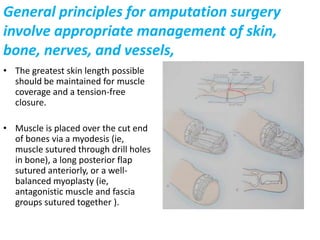
General principles for amputation surgery involve appropriate management of skin, bone, nerves, and vessels, The greatest skin length possible should be maintained for muscle coverage and a tension-free closure.
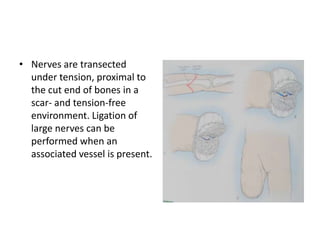
Muscle is placed over the cut end of bones via a myodesis (ie, muscle sutured through drill holes in bone), a long posterior flap sutured anteriorly, or a well-balanced myoplasty (ie, antagonistic muscle and fascia groups sutured together ).Nerves are transected under tension, proximal to the cut end of bones in a scar- and tension-free environment. Ligation of large nerves can be performed when an associated vessel is present. The larger arteries and veins are dissected and separately ligated. This prevents the development of arteriovenous fistulas and aneurysms. Bony prominences around disarticulations are removed with a saw and filed smooth. Diaphysealtransections can be covered with a local flexible osteoperiosteal graft. Maintaining the maximal extremity length possible is desirable. However, below-knee amputations are best performed 12.5-17.5 cm below the joint line for nonischemic limbs One application guide is to make a limb 2.5 cm long for every 30 cm of body height for upper limb. For ischemic limbs, a higher level of 10-12.5 cm below the joint line is used because making limbs longer than this can interfere with prosthetic use and design
Preserve the physis. Amputations through the metaphysis (such as above-knee or distal forearm level) or diaphysis are not recommended in children because of the progressive relative shortening of the residual limb. This is most critical in the femur, but it is applicable to other long bones as well. Disarticulate when possible. Disarticulation completely eliminates the problem of terminal overgrowth and subsequent revision surgery. Standard surgical principles for amputation in the child
Preserve stump shape. The pediatric amputation stump becomes conical with growth, so preservation of bony architecture such as a short segment of proximal fibula or the distal condyles of the humerus will assist in subsequent rotational control of the prosthesis.The split-thickness skin graft can hypertrophy and become sufficiently strong to withstand the shear forces of prosthesis use.
Close attention to soft tissue techniques.Avoid unnecessary dissection between skin and subcutaneous, fascial & muscle plane.In adult periosteum should not be stripped proximal to the level of transection .In children 0.5cm removal of distal periosteum prevents terminal growth . Precautions
Prompt, uncomplicated wound healing Control of edemaControl of Postoperative pain Prevention of joint contractures Rapid rehabilitationGoals of Postoperative Management
Post operative: -Rigid dressing : decresesedema, decreases post operative pain, protect limb from trauma, early mobilsation. Cast to be appied at the end of the procedure, changed on the post op day 5 + IPOP Cast changed weekly In postoperative prosthesis : early training with an IPOP is believed to increase the long term acceptance and use of prosthesis New prosthesis around 18 months regular check-ups every 3-6 months for the next two years. Two weeks after surgery, muscle-contraction exercises and progressive desensitization of the residual extremity are initiated. Desensitization is started with a towel for distal residual extremity pressure, and distal-end bearing is started on a soft structure (usually a bed).
Care of the Stump keep the stump clean, dry, and free from infection at all times. If fitted with a prosthesis, you should remove it before going to sleep. Inspect and wash the stump with mild soap and warm water every night, then dry thoroughly and apply talcum powder. do not use the prosthesis until the skin has healed. The stump sock should be changed daily, and the inside of the socket may be cleaned with mild soap.
Depression Anxiety Crying spells Insomnia Loss of appetite Suicidal ideation Up to 2/3 of amputees will manifest postoperative psychiatric symptoms
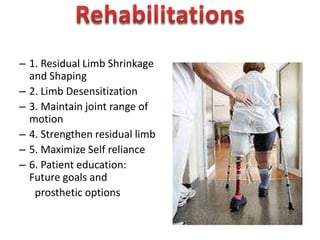
Rehabilitations1. Residual Limb Shrinkage and Shaping 2. Limb Desensitization 3. Maintain joint range of motion 4. Strengthen residual limb 5. Maximize Self reliance 6. Patient education: Future goals and       prosthetic options
Risk factors for complications includesBlood clotting disorder Diabetes AnemiaCertain medication, such as steroids Infection Obesity Complications
  hematoma1.Failure of wound to heal :- gap if wider than 1cm needs revision 2.Infection : -open – flaps retract / edematous        results in shortening the bone Rx        close only central 1/3 for coverage of bone. 3. Phantom limb sensation :- diminishes over time, telescoping 4. Pain and phantom pain : -massage , cold packs, exercise and neuromuscular stimulation   -TENS ( trans cutaneous electric nerve stimulation) : incorporated in a prosthesis   -carbamazipine,Phenytoin,gabapentin,Amitriptylin &Mexiletine  - Preioperative analgesia can prevent or decrease the later incidence of phantom pain.
5. Edemamistakes :- 1) Too tightly applied cast 2) Soft spica cast – not applied in Transfemoral cast -Proximal constriction  management -Elevation     6. Joint contacture7. Deep vein thrombosis
Some special type of amputationDupuytren’s amputation ;-  amputation of the arm at the shoulder joint. elliptic amputation   one in which the cut has an elliptical outline. Gritti-Stokes amputation ;-  amputation of the leg through the knee, using an oval anterior flap.
Hey’s amputation ;-  amputation of the foot between the tarsus and metatarsus.
interpelviabdominal amputation ;-  amputation of the thigh with excision of the lateral half of the pelvis.
interscapulothoracic amputation ;-  amputation of the arm with excision of the lateral portion of the shoulder girdle.
Larrey’s amputation;-   amputation at the shoulder joint. spontaneous amputation;-   loss of a part without surgical intervention, as in diabetes mellitusSarmiento’s amputation- level is 1.3 cms proximal to ankle joint line.
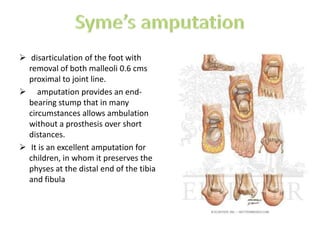
Teale’s amputation;-   amputation with short and long rectangular flaps. Syme’s amputation disarticulation of the foot with removal of both malleoli 0.6 cms proximal to joint line.
    amputation provides an end-bearing stump that in many circumstances allows ambulation without a prosthesis over short distances.
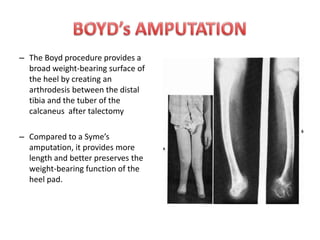
 It is an excellent amputation for children, in whom it preserves the physes at the distal end of the tibia and fibulaBOYD’s AMPUTATIONThe Boyd procedure provides a broad weight-bearing surface of the heel by creating an arthrodesis between the distal tibia and the tuber of the calcaneus  after talectomyCompared to a Syme’s amputation, it provides more length and better preserves the weight-bearing function of the heel pad.
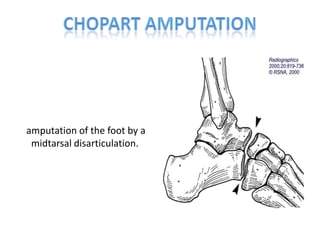
   amputation of the foot by a midtarsal disarticulation.Chopart amputation
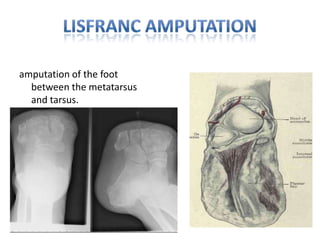
Lisfranc amputationamputation of the foot between the metatarsus and tarsus.
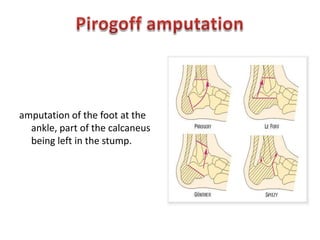
amputation of the foot at the ankle, part of the calcaneus being left in the stump.Pirogoff amputation
Transcarpal amputation ;-At this level, supination and pronation of the forearm, as well as flexion and extension of the wrist, Ideally, a long full-thickness palmar and shorter dorsal flap should be created in a ratio of 2:1. Finger flexor and extensor tendons should be drawn, divided, and allowed to retract deep into the proximal wound. Conversely, wrist flexor and extensor tendons are identified and released from their distal insertions and reflected proximally out of the way. The wrist flexors and extensors should be anchored to the remaining carpus in line with their insertions to preserve active wrist motion
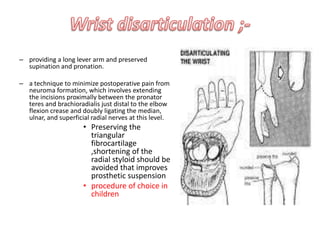
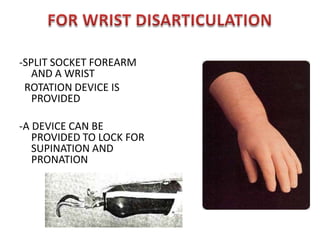
Wrist disarticulation ;-providing a long lever arm and preserved supination and pronation.a technique to minimize postoperative pain from neuroma formation, which involves extending the incisions proximally between the pronatorteres and brachioradialis just distal to the elbow flexion crease and doubly ligating the median, ulnar, and superficial radial nerves at this level. Preserving the triangular fibrocartilage ,shortening of the radial styloid should be avoided that improves prosthetic suspensionprocedure of choice in children
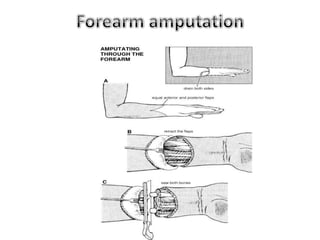
Forearm amputation
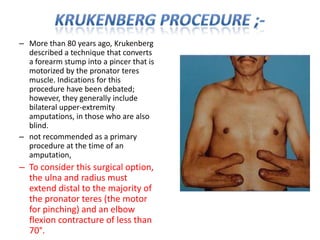
Krukenberg procedure ;-More than 80 years ago, Krukenberg described a technique that converts a forearm stump into a pincer that is motorized by the pronatorteres muscle. Indications for this procedure have been debated; however, they generally include bilateral upper-extremity amputations, in those who are also blind. not recommended as a primary procedure at the time of an amputation, To consider this surgical option, the ulna and radius must extend distal to the majority of the pronatorteres (the motor for pinching) and an elbow flexion contracture of less than 70°.
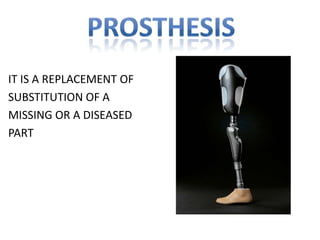
PROSTHESISIT IS A REPLACEMENT OF SUBSTITUTION OF A MISSING OR A DISEASED PART
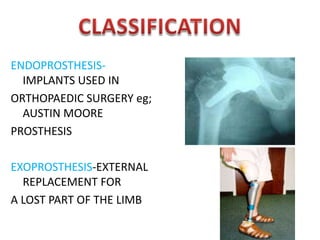
CLASSIFICATIONENDOPROSTHESIS- IMPLANTS USED IN    ORTHOPAEDIC SURGERY eg; AUSTIN MOORE PROSTHESISEXOPROSTHESIS-EXTERNAL REPLACEMENT FOR A LOST PART OF THE LIMB
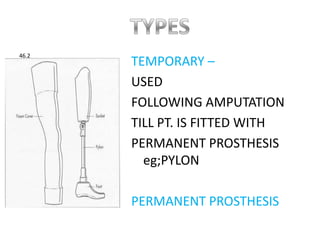
TEMPORARY –USED  FOLLOWING AMPUTATIONTILL PT. IS FITTED WITH             PERMANENT PROSTHESIS eg;PYLONPERMANENT PROSTHESIS46.2TYPES
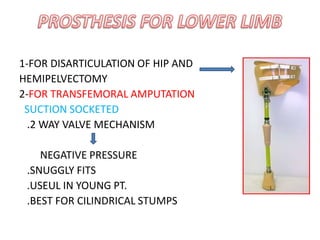
PROSTHESIS FOR LOWER LIMB1-FOR DISARTICULATION OF HIP AND HEMIPELVECTOMY2-FOR TRANSFEMORAL AMPUTATIONSUCTION SOCKETED    .2 WAY VALVE MECHANISM          NEGATIVE PRESSURE   .SNUGGLY FITS   .USEUL IN YOUNG PT.   .BEST FOR CILINDRICAL STUMPS
NON SUCTION SOCKETED- PELVIC BANDS INPLACE OF NEGATIVE PRESSURE TO HOLD
SUCION SOCKETED-LESS SKIN INFECTION-FEEL OF CLOSE CONTACT  WITH PROSTHESIS-SOCKS ARE NOT NECESSSARY-NOT EASY TO WEAR-LESS COMFORTABLENON SUCTION SOCKETED-MORE INCIDENCE OF SKIN INFECTION-NOT SO-NECESSARY-EASY TO WEAR-MORE COMFORTABLECAMPARISON FOR SUCTION SOCKETED PROSTHESIS WITH NON SUCTION SOCKETED
PROSTHESIS FOR BELOW KNEE AMPUTATIONPTB PROSTHESIS-  SOCKET FITS EXACTLY OVER THE   PATELLAR TENDON AND TIBIAL   CONDYLES
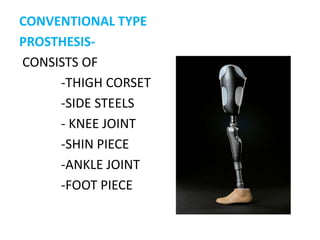
CONVENTIONAL TYPE PROSTHESIS- CONSISTS OF             -THIGH CORSET             -SIDE STEELS             - KNEE JOINT             -SHIN PIECE             -ANKLE JOINT             -FOOT PIECE
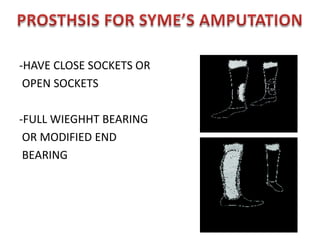
-HAVE CLOSE SOCKETS OR  OPEN SOCKETS-FULL WIEGHHT BEARING  OR MODIFIED END  BEARINGPROSTHSIS FOR SYME’S AMPUTATION
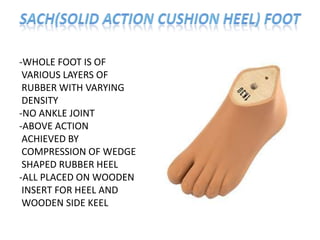
-WHOLE FOOT IS OF  VARIOUS LAYERS OF  RUBBER WITH VARYING DENSITY -NO ANKLE JOINT-ABOVE ACTION  ACHIEVED BY  COMPRESSION OF WEDGE  SHAPED RUBBER HEEL-ALL PLACED ON WOODEN  INSERT FOR HEEL AND  WOODEN SIDE KEELSACH(SOLID ACTION CUSHION HEEL) FOOT
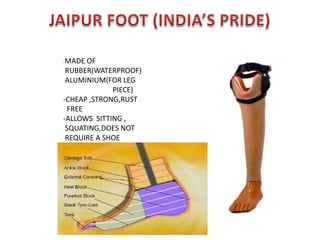
JAIPUR FOOT (INDIA’S PRIDE)-MADE OF  RUBBER(WATERPROOF) ALUMINIUM(FOR LEG                            PIECE)-CHEAP ,STRONG,RUST   FREE-ALLOWS  SITTING ,  SQUATING,DOES NOT  REQUIRE A SHOE
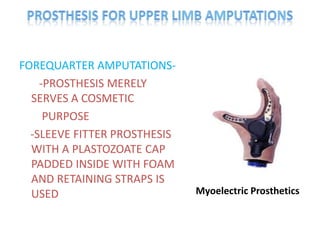
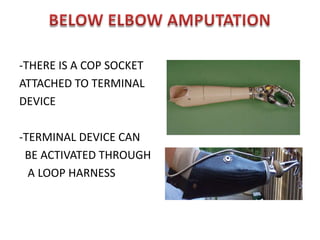
PROSTHESIS FOR UPPER LIMB AMPUTATIONSFOREQUARTER AMPUTATIONS-        -PROSTHESIS MERELY SERVES A COSMETIC                 PURPOSE    -SLEEVE FITTER PROSTHESIS WITH A PLASTOZOATE CAP PADDED INSIDE WITH FOAM AND RETAINING STRAPS IS USEDMyoelectric Prosthetics
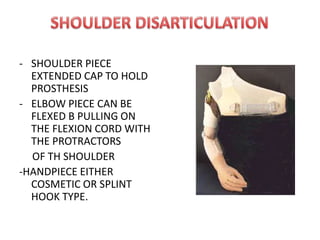
SHOULDER PIECE EXTENDED CAP TO HOLD PROSTHESIS
ELBOW PIECE CAN BE FLEXED B PULLING ON THE FLEXION CORD WITH THE PROTRACTORS      OF TH SHOULDER-HANDPIECE EITHER COSMETIC OR SPLINT HOOK TYPE.SHOULDER DISARTICULATION
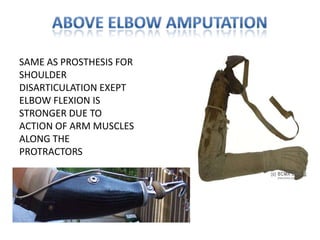
ABOVE ELBOW AMPUTATIONSAME AS PROSTHESIS FOR SHOULDER DISARTICULATION EXEPTELBOW FLEXION IS STRONGER DUE TO ACTION OF ARM MUSCLESALONG THE PROTRACTORS

Amputation

  • 1.
  • 2.
    “Surgical removal of limb or part of the limb through a bone or multiple bones”Disarticulation;-“Surgical removal of hole limb or part of the limb through a joint”
  • 3.
    Most ancient ofsurgical procedure. Historically were stimulated by the aftermath of war. It was a crude procedure - limb was rapidly severed from unanesthetized patient. The open stamp was then crushed or dipped in boiling oil to obtain hemostasis. Hippocrates was the first to use ligature. Ambroise Pare ( a France military surgeon) introduced artery forceps. He also designed prosthesis. HistoryAmputation of a leg without anaesthetic, 1593
  • 4.
    Age;- common in 50-75 yrs of age traumatic- common in young age Sex;- aprox. 75% male 25% female Limb;- aprox. 85% - lower limb 15% -- upper limb Incidence
  • 5.
    Common causes<50 yrs >50 yrs . Injury peripheral vascular diseaseLess common . Infection(fulminating gas gangrene) . Malignancy . Nerve injury . Congenital anomalies . miscellaneousIndications
  • 6.
    ‘ DDD’ DeadDeadly Dam Nuisance Indications: Amputation
  • 7.
    TraumaL/E-≈20-30% of allamputations U/E- 77% trauma is the leading indication for amputation in younger age group.men > women.The only absolute indication for primary amputation is an irreparable vascular injury in an ischemic limb.Lange absolute indication type IIIc with warm ischaemia more than 6hrs Relative indication serious associated injuries severe ipsilateral foot injuries
  • 8.
    To Remove the limb subjectivity predicive salvage index limb injury score mangled extremity syndrome index Attempts to salvage a severely injured limb may lead to metabolic overload and secondary organ failure Injury severity score > 50 : contraindication to limb salvage mangled extremity severity score(M.E.S.S. )(Helfet, CORR, 80, 1990) (most useful) < 7 : Salvage 8-12 : Amputate
  • 9.
    PERIPHERAL VASCULAR DISEASE L/E 60-70% of amputations U/E 6% ArteriosclerosisThromboembolism+/-diabetes Most significant predictor of amputation in diabetes:- peripheral neuropathy Infection increases in : - S. alb <3.5gm/dl WBC < 1500cells/ml Prior strokedecrease ankle-brachial blood pressure indexVascular surgery consultation
  • 10.
    InfectionGas gangrene. clostridialmyonecrosis-within 24 hr. bronze discolorationserosanguineous exudates, musty odor immediate radical debridement I/V penicillin or clindamycinStreptococcal myonecrosis- 3-4 daysAnaerobic cellulitis or necrotizing fasciitis -Acute or chronic infection that is unresponsive to antibiotics and surgical debridement. - open amputation done
  • 11.
    Congenital limb deficiencyL/E <3% of all amputations U/E 9% Occurs in ≈1/2000 birthsfailure of partial or complete formation of a portion of the limb. Congenital extremity deficiencies have been classified as longitudinal, transverse, or intercalary. Radial or tibial deficiencies are referred to as preaxial, and ulnar and fibular deficiencies are referred to as postaxial
  • 12.
    TumorsL/E ≈5% ofall amputations U/E 8% Amputation is performed less frequently with the advent of advanced limb-salvage techniques. Burns and FrostbiteBurns : -delayed aputation – local infection - systemic infection - myoglobin induced renal failure - death Frostbite :-Typically occurs when one is trapped in extreme cold conditions for extended periods direct tissue injury- ice crystals in ECF Ischaemic injury- vascular endothelium clot formation inc sympathetic tone limb kept at 40-44 degree C wait 2-6 month demarcation Triple phase tecnetium bone scan
  • 13.
    OpenGuillotine modified guillotine Closed amputation revised plannedTypes of amputation
  • 14.
    “The energy requiredfor walking is inversely proportionate to the length of the remaining limb” Amputation of the lower extremity is often the treatment of choice for an unreconstructable or a functionally unsatisfactory limb The higher the level of a lower-limb amputation, the greater the energy expenditure that is required for walking As the level of the amputation moves proximally, the walking speed of the individual decreases, and the oxygen consumption increases Pathophysiology
  • 15.
    In transtibial amputations,the energy cost for walking is not much greater than that required for persons who have not undergone amputations. For those who have undergone transfemoral amputations, the energy required is 50-65% greater than that required for those who have not undergone amputations .
  • 16.
    HematocritCreatinine levels shouldbe monitored. In individuals with muscle injury and necrosis, myoglobin enters the systemic circulation and can lead to renal insufficiency and failure. especially in individuals with thermal and electrical burns.Potassium and calcium levels should be monitored. Elevated levels of these electrolytes may lead to cardiac arrhythmias and seizures. White blood cell count, C-reactive protein , and ESR Expect the C-reactive protein to be the first laboratory value to respond to treatment, Platelets Lab Studies
  • 17.
    X-ray AP & Lat viewComputed tomography (CT) scanning and magnetic resonance imaging (MRI) are performed for the patient tumour workup or for osteomyelitis to ensure that the surgical margins are appropriate. Technetium-99m (99mTc) pyrophosphate bone scanning has been used to predict the need for amputation in persons with electrical burns and frostbite. A 94% sensitivity rate and a 100% specificity rate has been reported in demarcating viable tissues from nonviable tissues. Imaging Studies
  • 18.
    Doppler ultrasonography- measure arterial pressure; In approximately 15% of patients with PVD, the results are falsely elevated because of the noncompressibility of the calcified extremity arteries. Doppler ultrasonography has been used in the past to predict wound healing. A minimum measurement of 70 mm Hg is believed to be necessary for wound healing. Ischemic index (II): -This index is the ratio of the Doppler ultrasonography pressure at the level being tested to the brachial systolic pressure. An II of 0.5 or greater at the surgical level is necessary to support wound healing.Ankle-brachial index: -The II at the ankle level is believed to be the best indicator for assessing adequate inflow to the ischemic limb. An index less than 0.45 indicates incisions distal to the ankle will not heal.
  • 19.
    Preoperative preparation includesthe following steps: -Appropriate preoperative antibioticsA tourniquet is placed on the limb prophylacticallyVascular and bone instruments are requested. A series of 45º-angled chisels are obtained for osteomyoplastic reconstruction. An appropriate strength saw for cutting boneVessel ligatures are obtained.
  • 20.
    General principles foramputation surgery involve appropriate management of skin, bone, nerves, and vessels, as follows: -The greatest skin length possible should be maintained for muscle coverage and a tension-free closure.
  • 21.
    General principles foramputation surgery involve appropriate management of skin, bone, nerves, and vessels, The greatest skin length possible should be maintained for muscle coverage and a tension-free closure.
  • 22.
    Muscle is placedover the cut end of bones via a myodesis (ie, muscle sutured through drill holes in bone), a long posterior flap sutured anteriorly, or a well-balanced myoplasty (ie, antagonistic muscle and fascia groups sutured together ).Nerves are transected under tension, proximal to the cut end of bones in a scar- and tension-free environment. Ligation of large nerves can be performed when an associated vessel is present. The larger arteries and veins are dissected and separately ligated. This prevents the development of arteriovenous fistulas and aneurysms. Bony prominences around disarticulations are removed with a saw and filed smooth. Diaphysealtransections can be covered with a local flexible osteoperiosteal graft. Maintaining the maximal extremity length possible is desirable. However, below-knee amputations are best performed 12.5-17.5 cm below the joint line for nonischemic limbs One application guide is to make a limb 2.5 cm long for every 30 cm of body height for upper limb. For ischemic limbs, a higher level of 10-12.5 cm below the joint line is used because making limbs longer than this can interfere with prosthetic use and design
  • 23.
    Preserve the physis.Amputations through the metaphysis (such as above-knee or distal forearm level) or diaphysis are not recommended in children because of the progressive relative shortening of the residual limb. This is most critical in the femur, but it is applicable to other long bones as well. Disarticulate when possible. Disarticulation completely eliminates the problem of terminal overgrowth and subsequent revision surgery. Standard surgical principles for amputation in the child
  • 24.
    Preserve stump shape.The pediatric amputation stump becomes conical with growth, so preservation of bony architecture such as a short segment of proximal fibula or the distal condyles of the humerus will assist in subsequent rotational control of the prosthesis.The split-thickness skin graft can hypertrophy and become sufficiently strong to withstand the shear forces of prosthesis use.
  • 25.
    Close attention tosoft tissue techniques.Avoid unnecessary dissection between skin and subcutaneous, fascial & muscle plane.In adult periosteum should not be stripped proximal to the level of transection .In children 0.5cm removal of distal periosteum prevents terminal growth . Precautions
  • 26.
    Prompt, uncomplicated woundhealing Control of edemaControl of Postoperative pain Prevention of joint contractures Rapid rehabilitationGoals of Postoperative Management
  • 27.
    Post operative: -Rigiddressing : decresesedema, decreases post operative pain, protect limb from trauma, early mobilsation. Cast to be appied at the end of the procedure, changed on the post op day 5 + IPOP Cast changed weekly In postoperative prosthesis : early training with an IPOP is believed to increase the long term acceptance and use of prosthesis New prosthesis around 18 months regular check-ups every 3-6 months for the next two years. Two weeks after surgery, muscle-contraction exercises and progressive desensitization of the residual extremity are initiated. Desensitization is started with a towel for distal residual extremity pressure, and distal-end bearing is started on a soft structure (usually a bed).
  • 28.
    Care of theStump keep the stump clean, dry, and free from infection at all times. If fitted with a prosthesis, you should remove it before going to sleep. Inspect and wash the stump with mild soap and warm water every night, then dry thoroughly and apply talcum powder. do not use the prosthesis until the skin has healed. The stump sock should be changed daily, and the inside of the socket may be cleaned with mild soap.
  • 29.
    Care of theStump keep the stump clean, dry, and free from infection at all times. If fitted with a prosthesis, you should remove it before going to sleep. Inspect and wash the stump with mild soap and warm water every night, then dry thoroughly and apply talcum powder. do not use the prosthesis until the skin has healed. The stump sock should be changed daily, and the inside of the socket may be cleaned with mild soap.
  • 30.
    Depression Anxiety Cryingspells Insomnia Loss of appetite Suicidal ideation Up to 2/3 of amputees will manifest postoperative psychiatric symptoms
  • 31.
    Rehabilitations1. Residual LimbShrinkage and Shaping 2. Limb Desensitization 3. Maintain joint range of motion 4. Strengthen residual limb 5. Maximize Self reliance 6. Patient education: Future goals and prosthetic options
  • 32.
    Risk factors forcomplications includesBlood clotting disorder Diabetes AnemiaCertain medication, such as steroids Infection Obesity Complications
  • 33.
    hematoma1.Failureof wound to heal :- gap if wider than 1cm needs revision 2.Infection : -open – flaps retract / edematous results in shortening the bone Rx close only central 1/3 for coverage of bone. 3. Phantom limb sensation :- diminishes over time, telescoping 4. Pain and phantom pain : -massage , cold packs, exercise and neuromuscular stimulation -TENS ( trans cutaneous electric nerve stimulation) : incorporated in a prosthesis -carbamazipine,Phenytoin,gabapentin,Amitriptylin &Mexiletine - Preioperative analgesia can prevent or decrease the later incidence of phantom pain.
  • 34.
    5. Edemamistakes :-1) Too tightly applied cast 2) Soft spica cast – not applied in Transfemoral cast -Proximal constriction management -Elevation 6. Joint contacture7. Deep vein thrombosis
  • 35.
    Some special typeof amputationDupuytren’s amputation ;-  amputation of the arm at the shoulder joint. elliptic amputation   one in which the cut has an elliptical outline. Gritti-Stokes amputation ;-  amputation of the leg through the knee, using an oval anterior flap.
  • 36.
    Hey’s amputation ;- amputation of the foot between the tarsus and metatarsus.
  • 37.
    interpelviabdominal amputation ;- amputation of the thigh with excision of the lateral half of the pelvis.
  • 38.
    interscapulothoracic amputation ;- amputation of the arm with excision of the lateral portion of the shoulder girdle.
  • 39.
    Larrey’s amputation;-  amputation at the shoulder joint. spontaneous amputation;-   loss of a part without surgical intervention, as in diabetes mellitusSarmiento’s amputation- level is 1.3 cms proximal to ankle joint line.
  • 40.
    Teale’s amputation;-  amputation with short and long rectangular flaps. Syme’s amputation disarticulation of the foot with removal of both malleoli 0.6 cms proximal to joint line.
  • 41.
    amputation provides an end-bearing stump that in many circumstances allows ambulation without a prosthesis over short distances.
  • 42.
    It isan excellent amputation for children, in whom it preserves the physes at the distal end of the tibia and fibulaBOYD’s AMPUTATIONThe Boyd procedure provides a broad weight-bearing surface of the heel by creating an arthrodesis between the distal tibia and the tuber of the calcaneus after talectomyCompared to a Syme’s amputation, it provides more length and better preserves the weight-bearing function of the heel pad.
  • 43.
    amputation of the foot by a midtarsal disarticulation.Chopart amputation
  • 44.
    Lisfranc amputationamputation ofthe foot between the metatarsus and tarsus.
  • 45.
    amputation of thefoot at the ankle, part of the calcaneus being left in the stump.Pirogoff amputation
  • 46.
    Transcarpal amputation ;-Atthis level, supination and pronation of the forearm, as well as flexion and extension of the wrist, Ideally, a long full-thickness palmar and shorter dorsal flap should be created in a ratio of 2:1. Finger flexor and extensor tendons should be drawn, divided, and allowed to retract deep into the proximal wound. Conversely, wrist flexor and extensor tendons are identified and released from their distal insertions and reflected proximally out of the way. The wrist flexors and extensors should be anchored to the remaining carpus in line with their insertions to preserve active wrist motion
  • 47.
    Wrist disarticulation ;-providinga long lever arm and preserved supination and pronation.a technique to minimize postoperative pain from neuroma formation, which involves extending the incisions proximally between the pronatorteres and brachioradialis just distal to the elbow flexion crease and doubly ligating the median, ulnar, and superficial radial nerves at this level. Preserving the triangular fibrocartilage ,shortening of the radial styloid should be avoided that improves prosthetic suspensionprocedure of choice in children
  • 48.
  • 49.
    Krukenberg procedure ;-Morethan 80 years ago, Krukenberg described a technique that converts a forearm stump into a pincer that is motorized by the pronatorteres muscle. Indications for this procedure have been debated; however, they generally include bilateral upper-extremity amputations, in those who are also blind. not recommended as a primary procedure at the time of an amputation, To consider this surgical option, the ulna and radius must extend distal to the majority of the pronatorteres (the motor for pinching) and an elbow flexion contracture of less than 70°.
  • 50.
    PROSTHESISIT IS AREPLACEMENT OF SUBSTITUTION OF A MISSING OR A DISEASED PART
  • 51.
    CLASSIFICATIONENDOPROSTHESIS- IMPLANTS USEDIN ORTHOPAEDIC SURGERY eg; AUSTIN MOORE PROSTHESISEXOPROSTHESIS-EXTERNAL REPLACEMENT FOR A LOST PART OF THE LIMB
  • 52.
    TEMPORARY –USED FOLLOWING AMPUTATIONTILL PT. IS FITTED WITH PERMANENT PROSTHESIS eg;PYLONPERMANENT PROSTHESIS46.2TYPES
  • 53.
    PROSTHESIS FOR LOWERLIMB1-FOR DISARTICULATION OF HIP AND HEMIPELVECTOMY2-FOR TRANSFEMORAL AMPUTATIONSUCTION SOCKETED .2 WAY VALVE MECHANISM NEGATIVE PRESSURE .SNUGGLY FITS .USEUL IN YOUNG PT. .BEST FOR CILINDRICAL STUMPS
  • 54.
    NON SUCTION SOCKETED-PELVIC BANDS INPLACE OF NEGATIVE PRESSURE TO HOLD
  • 55.
    SUCION SOCKETED-LESS SKININFECTION-FEEL OF CLOSE CONTACT WITH PROSTHESIS-SOCKS ARE NOT NECESSSARY-NOT EASY TO WEAR-LESS COMFORTABLENON SUCTION SOCKETED-MORE INCIDENCE OF SKIN INFECTION-NOT SO-NECESSARY-EASY TO WEAR-MORE COMFORTABLECAMPARISON FOR SUCTION SOCKETED PROSTHESIS WITH NON SUCTION SOCKETED
  • 56.
    PROSTHESIS FOR BELOWKNEE AMPUTATIONPTB PROSTHESIS- SOCKET FITS EXACTLY OVER THE PATELLAR TENDON AND TIBIAL CONDYLES
  • 57.
    CONVENTIONAL TYPE PROSTHESIS-CONSISTS OF -THIGH CORSET -SIDE STEELS - KNEE JOINT -SHIN PIECE -ANKLE JOINT -FOOT PIECE
  • 58.
    -HAVE CLOSE SOCKETSOR OPEN SOCKETS-FULL WIEGHHT BEARING OR MODIFIED END BEARINGPROSTHSIS FOR SYME’S AMPUTATION
  • 59.
    -WHOLE FOOT ISOF VARIOUS LAYERS OF RUBBER WITH VARYING DENSITY -NO ANKLE JOINT-ABOVE ACTION ACHIEVED BY COMPRESSION OF WEDGE SHAPED RUBBER HEEL-ALL PLACED ON WOODEN INSERT FOR HEEL AND WOODEN SIDE KEELSACH(SOLID ACTION CUSHION HEEL) FOOT
  • 60.
    JAIPUR FOOT (INDIA’SPRIDE)-MADE OF RUBBER(WATERPROOF) ALUMINIUM(FOR LEG PIECE)-CHEAP ,STRONG,RUST FREE-ALLOWS SITTING , SQUATING,DOES NOT REQUIRE A SHOE
  • 61.
    PROSTHESIS FOR UPPERLIMB AMPUTATIONSFOREQUARTER AMPUTATIONS- -PROSTHESIS MERELY SERVES A COSMETIC PURPOSE -SLEEVE FITTER PROSTHESIS WITH A PLASTOZOATE CAP PADDED INSIDE WITH FOAM AND RETAINING STRAPS IS USEDMyoelectric Prosthetics
  • 62.
    SHOULDER PIECE EXTENDEDCAP TO HOLD PROSTHESIS
  • 63.
    ELBOW PIECE CANBE FLEXED B PULLING ON THE FLEXION CORD WITH THE PROTRACTORS OF TH SHOULDER-HANDPIECE EITHER COSMETIC OR SPLINT HOOK TYPE.SHOULDER DISARTICULATION
  • 64.
    ABOVE ELBOW AMPUTATIONSAMEAS PROSTHESIS FOR SHOULDER DISARTICULATION EXEPTELBOW FLEXION IS STRONGER DUE TO ACTION OF ARM MUSCLESALONG THE PROTRACTORS