Principles of 
AMPUTATION 
Dr Arojuraye S.A 
National Orthopaedic Hospital 
Dala-Kano
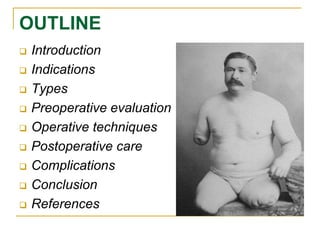
OUTLINE 
 Introduction 
 Indications 
 Types 
 Preoperative evaluation 
 Operative techniques 
 Postoperative care 
 Complications 
 Conclusion 
 References
Introduction 
 Definition 
Trans-osseous removal of a limb or part of it. 
 Most ancient surgical procedure 
 Multidisciplinary: Surgeon, Nurses, 
Prosthetist, Physiotherapist, Occupational 
therapists, Social worker & Psychologist.
Introduction… 
 Amputation: not a failure of Rx, but the 1st 
step toward a patient's return to a more 
comfortable & reproductive life. 
 The procedure should be planned & 
performed with the same care & skill used in 
any other reconstructive surgery.
Introduction… 
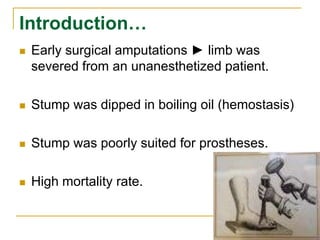
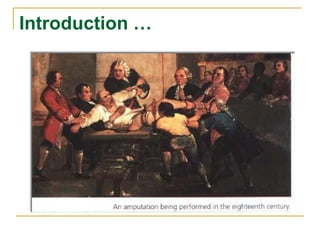
 Early surgical amputations ► limb was 
severed from an unanesthetized patient. 
 Stump was dipped in boiling oil (hemostasis) 
 Stump was poorly suited for prostheses. 
 High mortality rate.
Introduction …
Introduction… 
 Hippocrates: first to use ligatures 
 1529: Popularized by Ambroise Paré 
 Paré also introduced the “artery forceps 
 He also designed sophisticated prostheses 
 1674: Morel's introduce tourniquet 
 1867: Lord Lister's introduce asepsis
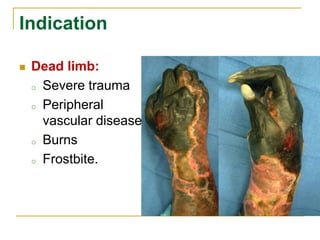
Indication 
 Dead limb: 
o Severe trauma 
o Peripheral 
vascular disease 
o Burns 
o Frostbite.
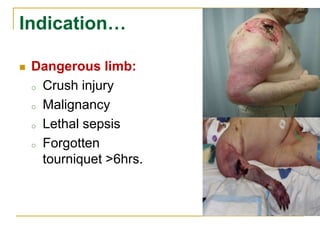
Indication… 
 Dangerous limb: 
o Crush injury 
o Malignancy 
o Lethal sepsis 
o Forgotten 
tourniquet >6hrs.
Indication… 
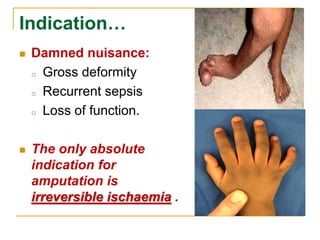
 Damned nuisance: 
o Gross deformity 
o Recurrent sepsis 
o Loss of function. 
 The only absolute 
indication for 
amputation is 
irreversible ischaemia .
Types 
 Provisional amputation 
o Circular or with flaps 
o When primary healing is unlikely or 
o Amputate as distal as aetiology will allow 
o Skin flap is sutured loosely over a pack 
o Re-amputation perform when stump is ok
Types… 
 Definitive end-bearing amputation 
o Weight is taken through the end of the stump 
o The scar should not be terminal 
o Bone end must be solid (cut near the joint) 
 Definitive non-end-bearing amputation 
o Commonest variety 
o All upper limb & most lower limb amputations 
o The scar can be terminal
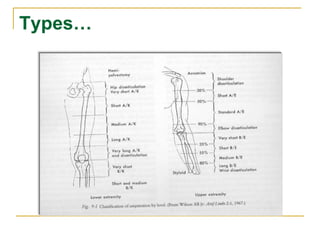
Types…
Pre-operative Evaluation 
 History 
o Aetiology 
o Comorbidities 
 Physical examination 
o CVS, Renal & 
o Nervous system 
 Investigation 
o Doppler indices 
o Transcutaneous O2 tension
Pre-operative Evaluation… 
 Optimization: 
Anaemia, hypotension, infection, nutrition 
 Consultations: 
Nephrologist, Cardiologist, Neurologist 
If vascular dx has progress to the point of amputation, most 
patients also have concomitant dx process in the cerebral, renal & 
coronary vasculatures.
Pre-operative Evaluation… 
 Counseling & consent 
Procedure, anaesthesia, complications, 
prosthesis & limitations. 
 MESS ≥ 7 
Removes subjectivity from decision making 
in trauma cases. 
No scoring system can replace experience & good clinical judgment.
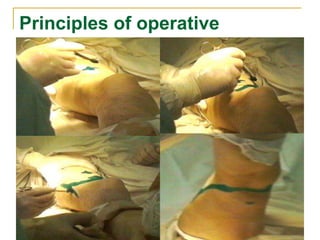
Principles of operative 
techniques 
 Anaesthesia 
Regional, G.A 
 Antibiotics 
Broad-spectrum, IV 
 Tourniquet 
Except in arterial insufficiency
Principles of operative 
techniques..
Principles of operative 
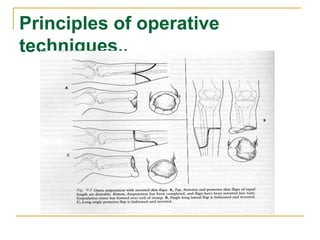
techniques..  Skin flaps 
o The combined length equals 1.5 times the 
width of the limb at the site of amputation. 
o Ant. & post. Flaps of equal length for UL & 
A/K amputations. Long posterior flap for BK 
amputation.
Principles of operative 
techniques..
Principles of operative 
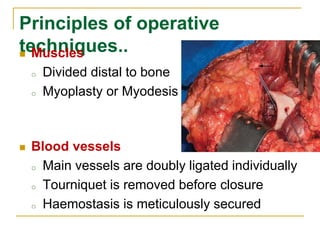
techniques..  Muscles 
o Divided distal to bone 
o Myoplasty or Myodesis 
 Blood vessels 
o Main vessels are doubly ligated individually 
o Tourniquet is removed before closure 
o Haemostasis is meticulously secured
Principles of operative 
techniques.. 
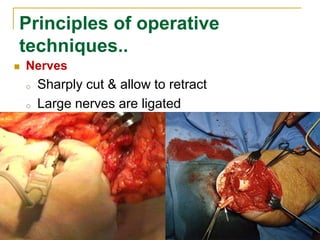
 Nerves 
o Sharply cut & allow to retract 
o Large nerves are ligated
Principles of operative 
techniques.. 
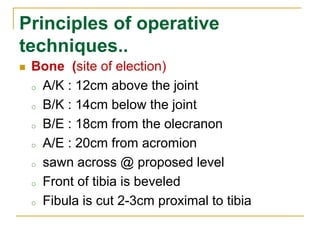
 Bone (site of election) 
o A/K : 12cm above the joint 
o B/K : 14cm below the joint 
o B/E : 18cm from the olecranon 
o A/E : 20cm from acromion 
o sawn across @ proposed level 
o Front of tibia is beveled 
o Fibula is cut 2-3cm proximal to tibia
Principles of operative 
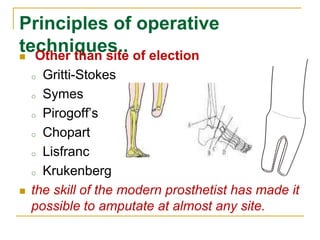
techniques..  Other than site of election 
o Gritti-Stokes 
o Symes 
o Pirogoff’s 
o Chopart 
o Lisfranc 
o Krukenberg 
 the skill of the modern prosthetist has made it 
possible to amputate at almost any site.
Principles of operative 
techniques.. 
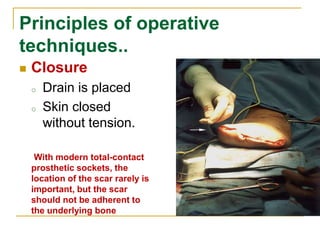
 Closure 
o Drain is placed 
o Skin closed 
without tension. 
With modern total-contact 
prosthetic sockets, the 
location of the scar rarely is 
important, but the scar 
should not be adherent to 
the underlying bone
Principles of operative 
techniques.. 
 Conical Dressing 
o Soft dressing with crepe bandage 
o Rigid dressing with POP 
• Rigid dressings prevent edema at the surgical site 
• Enhance wound healing & early maturation of the stump 
• Decrease postoperative pain 
• Allow earlier mobilization & ambulation 
• Prevent knee flexion contractures in B/K amputation
Principles of operative 
techniques.. 
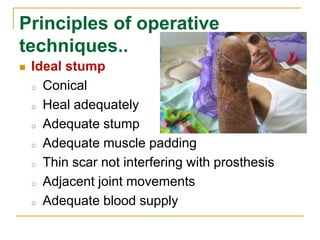
 Ideal stump 
o Conical 
o Heal adequately 
o Adequate stump 
o Adequate muscle padding 
o Thin scar not interfering with prosthesis 
o Adjacent joint movements 
o Adequate blood supply
Post-operative management 
 Analgesics 
 Antibiotics 
 DVT prophylaxis 
 Stump elevation (foot of the bed) 
 Avoid flexion contracture at knee & hip
Post-operative management… 
 Educate patient how to position the stump 
 Mobilize out of bed in 1DPO 
 Remove drain in 48hrs 
 Remove stitches in 2/52
Post-operative management… 
 Early physiotherapy 
o Muscle setting exercises 1st 
o Joint movement exercises 
o Ambulation with parallel bars, then crutches 
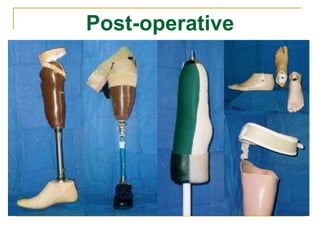
 Prosthetic ambulation time depends on: 
o Age of the patient 
o Strength & agility of the patient 
o Patient's ability to protect the stump
Post-operative 
management…
Complications 
 Early 
o Bleeding & haematoma 
o Flap necrosis 
o Surgical wound infection 
o Gas gangrene
Complications … 
 Late 
o Phantom pain 
o Phantom limb 
o Joint deformity
Conclusion 
 Amputation is the most ancient surgical 
procedure 
 It should not be seen as a failure of Rx, but 
rather as the first step towards a patient’s 
return to a more comfortable & productive life 
 It does not end in the operating room; post op 
care is equally important.
References 
 Selvadurai Nayagam, David Warwick. Orthopaedic 
operations; Apley’s system of orhtopaedics & 
fractures, 9th Ed; 12:325-328. 
 Canale & Beaty: General principles of amputations: 
Campbell's Operative Orthopaedics, 11th edition. 
 John Ebenezer: Amputations; Textbook of 
Orthopaedics, 4th Edition; 60:787-791. 
 Tintle SM et. Al: Traumatic & trauma-related 
amputations: Bone Joint Surg Am. 2010 Dec 
15;92(18):2934-45.

Principles of amputation

  • 1.
    Principles of AMPUTATION Dr Arojuraye S.A National Orthopaedic Hospital Dala-Kano
  • 2.
    OUTLINE  Introduction  Indications  Types  Preoperative evaluation  Operative techniques  Postoperative care  Complications  Conclusion  References
  • 3.
    Introduction  Definition Trans-osseous removal of a limb or part of it.  Most ancient surgical procedure  Multidisciplinary: Surgeon, Nurses, Prosthetist, Physiotherapist, Occupational therapists, Social worker & Psychologist.
  • 4.
    Introduction…  Amputation:not a failure of Rx, but the 1st step toward a patient's return to a more comfortable & reproductive life.  The procedure should be planned & performed with the same care & skill used in any other reconstructive surgery.
  • 5.
    Introduction…  Earlysurgical amputations ► limb was severed from an unanesthetized patient.  Stump was dipped in boiling oil (hemostasis)  Stump was poorly suited for prostheses.  High mortality rate.
  • 6.
  • 7.
    Introduction…  Hippocrates:first to use ligatures  1529: Popularized by Ambroise Paré  Paré also introduced the “artery forceps  He also designed sophisticated prostheses  1674: Morel's introduce tourniquet  1867: Lord Lister's introduce asepsis
  • 8.
    Indication  Deadlimb: o Severe trauma o Peripheral vascular disease o Burns o Frostbite.
  • 9.
    Indication…  Dangerouslimb: o Crush injury o Malignancy o Lethal sepsis o Forgotten tourniquet >6hrs.
  • 10.
    Indication…  Damnednuisance: o Gross deformity o Recurrent sepsis o Loss of function.  The only absolute indication for amputation is irreversible ischaemia .
  • 11.
    Types  Provisionalamputation o Circular or with flaps o When primary healing is unlikely or o Amputate as distal as aetiology will allow o Skin flap is sutured loosely over a pack o Re-amputation perform when stump is ok
  • 12.
    Types…  Definitiveend-bearing amputation o Weight is taken through the end of the stump o The scar should not be terminal o Bone end must be solid (cut near the joint)  Definitive non-end-bearing amputation o Commonest variety o All upper limb & most lower limb amputations o The scar can be terminal
  • 13.
  • 14.
    Pre-operative Evaluation History o Aetiology o Comorbidities  Physical examination o CVS, Renal & o Nervous system  Investigation o Doppler indices o Transcutaneous O2 tension
  • 15.
    Pre-operative Evaluation… Optimization: Anaemia, hypotension, infection, nutrition  Consultations: Nephrologist, Cardiologist, Neurologist If vascular dx has progress to the point of amputation, most patients also have concomitant dx process in the cerebral, renal & coronary vasculatures.
  • 16.
    Pre-operative Evaluation… Counseling & consent Procedure, anaesthesia, complications, prosthesis & limitations.  MESS ≥ 7 Removes subjectivity from decision making in trauma cases. No scoring system can replace experience & good clinical judgment.
  • 17.
    Principles of operative techniques  Anaesthesia Regional, G.A  Antibiotics Broad-spectrum, IV  Tourniquet Except in arterial insufficiency
  • 18.
  • 19.
    Principles of operative techniques..  Skin flaps o The combined length equals 1.5 times the width of the limb at the site of amputation. o Ant. & post. Flaps of equal length for UL & A/K amputations. Long posterior flap for BK amputation.
  • 20.
  • 21.
    Principles of operative techniques..  Muscles o Divided distal to bone o Myoplasty or Myodesis  Blood vessels o Main vessels are doubly ligated individually o Tourniquet is removed before closure o Haemostasis is meticulously secured
  • 22.
    Principles of operative techniques..  Nerves o Sharply cut & allow to retract o Large nerves are ligated
  • 23.
    Principles of operative techniques..  Bone (site of election) o A/K : 12cm above the joint o B/K : 14cm below the joint o B/E : 18cm from the olecranon o A/E : 20cm from acromion o sawn across @ proposed level o Front of tibia is beveled o Fibula is cut 2-3cm proximal to tibia
  • 24.
    Principles of operative techniques..  Other than site of election o Gritti-Stokes o Symes o Pirogoff’s o Chopart o Lisfranc o Krukenberg  the skill of the modern prosthetist has made it possible to amputate at almost any site.
  • 25.
    Principles of operative techniques..  Closure o Drain is placed o Skin closed without tension. With modern total-contact prosthetic sockets, the location of the scar rarely is important, but the scar should not be adherent to the underlying bone
  • 26.
    Principles of operative techniques..  Conical Dressing o Soft dressing with crepe bandage o Rigid dressing with POP • Rigid dressings prevent edema at the surgical site • Enhance wound healing & early maturation of the stump • Decrease postoperative pain • Allow earlier mobilization & ambulation • Prevent knee flexion contractures in B/K amputation
  • 27.
    Principles of operative techniques..  Ideal stump o Conical o Heal adequately o Adequate stump o Adequate muscle padding o Thin scar not interfering with prosthesis o Adjacent joint movements o Adequate blood supply
  • 28.
    Post-operative management Analgesics  Antibiotics  DVT prophylaxis  Stump elevation (foot of the bed)  Avoid flexion contracture at knee & hip
  • 29.
    Post-operative management… Educate patient how to position the stump  Mobilize out of bed in 1DPO  Remove drain in 48hrs  Remove stitches in 2/52
  • 30.
    Post-operative management… Early physiotherapy o Muscle setting exercises 1st o Joint movement exercises o Ambulation with parallel bars, then crutches  Prosthetic ambulation time depends on: o Age of the patient o Strength & agility of the patient o Patient's ability to protect the stump
  • 31.
  • 32.
    Complications  Early o Bleeding & haematoma o Flap necrosis o Surgical wound infection o Gas gangrene
  • 33.
    Complications … Late o Phantom pain o Phantom limb o Joint deformity
  • 34.
    Conclusion  Amputationis the most ancient surgical procedure  It should not be seen as a failure of Rx, but rather as the first step towards a patient’s return to a more comfortable & productive life  It does not end in the operating room; post op care is equally important.
  • 35.
    References  SelvaduraiNayagam, David Warwick. Orthopaedic operations; Apley’s system of orhtopaedics & fractures, 9th Ed; 12:325-328.  Canale & Beaty: General principles of amputations: Campbell's Operative Orthopaedics, 11th edition.  John Ebenezer: Amputations; Textbook of Orthopaedics, 4th Edition; 60:787-791.  Tintle SM et. Al: Traumatic & trauma-related amputations: Bone Joint Surg Am. 2010 Dec 15;92(18):2934-45.