• Scalar quantities : 
Quantities which have only magnitude and no direction are called scalar 
quantities, e.g. mass, distance, time, speed, volume, density, pressure, 
work, energy, electric current, temperature, etc. 
• Vector quantities : 
Quantities which have magnitude as well as direction and obey the 
triangle law of vector addition or equivalently the parallelogram law of 
vector addition are called vector quantities, e.g. position, displacement, 
velocity, force, acceleration, weight, momentum, impulse, electric field, 
magnetic field, current density, etc.
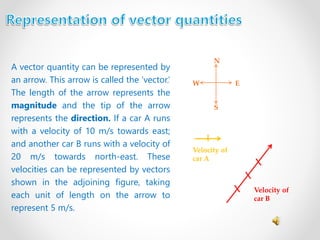
A vector quantity can be represented by 
an arrow. This arrow is called the ‘vector.’ 
The length of the arrow represents the 
magnitude and the tip of the arrow 
represents the direction. If a car A runs 
with a velocity of 10 m/s towards east; 
and another car B runs with a velocity of 
20 m/s towards north-east. These 
velocities can be represented by vectors 
shown in the adjoining figure, taking 
each unit of length on the arrow to 
represent 5 m/s. 
N 
W E 
S 
Velocity of 
car A 
Velocity of 
car B
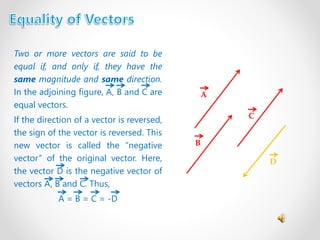
Two or more vectors are said to be 
equal if, and only if, they have the 
same magnitude and same direction. 
In the adjoining figure, A, B and C are 
equal vectors. 
If the direction of a vector is reversed, 
the sign of the vector is reversed. This 
new vector is called the “negative 
vector” of the original vector. Here, 
the vector D is the negative vector of 
vectors A, B and C. Thus, 
A = B = C = -D 
A 
B 
C 
D
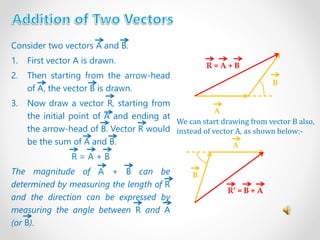
Consider two vectors A and B. 
1. First vector A is drawn. 
2. Then starting from the arrow-head 
of A, the vector B is drawn. 
3. Now draw a vector R, starting from 
the initial point of A and ending at 
the arrow-head of B. Vector R would 
be the sum of A and B. 
R = A + B 
The magnitude of A + B can be 
determined by measuring the length of R 
and the direction can be expressed by 
measuring the angle between R and A 
(or B). 
A 
B 
R = A + B 
We can start drawing from vector B also, 
instead of vector A, as shown below:- 
A 
B 
R’ = B + A
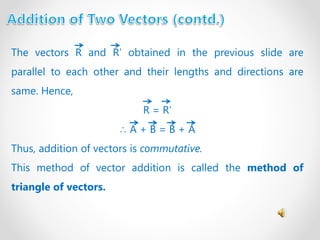
The vectors R and R’ obtained in the previous slide are 
parallel to each other and their lengths and directions are 
same. Hence, 
R = R’ 
∴ A + B = B + A 
Thus, addition of vectors is commutative. 
This method of vector addition is called the method of 
triangle of vectors.
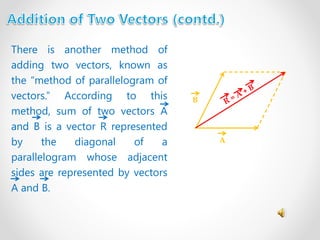
There is another method of 
adding two vectors, known as 
the “method of parallelogram of 
vectors.” According to this 
method, sum of two vectors A 
and B is a vector R represented 
by the diagonal of a 
parallelogram whose adjacent 
sides are represented by vectors 
A and B. 
A 
B
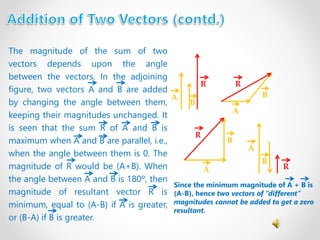
The magnitude of the sum of two 
vectors depends upon the angle 
between the vectors. In the adjoining 
figure, two vectors A and B are added 
by changing the angle between them, 
keeping their magnitudes unchanged. It 
is seen that the sum R of A and B is 
maximum when A and B are parallel, i.e., 
when the angle between them is 0. The 
magnitude of R would be (A+B). When 
the angle between A and B is 180º, then 
magnitude of resultant vector R is 
minimum, equal to (A-B) if A is greater, 
or (B-A) if B is greater. 
A 
R 
B 
A 
B 
R 
A 
B 
R 
A 
B 
R 
Since the minimum magnitude of A + B is 
(A-B), hence two vectors of “different” 
magnitudes cannot be added to get a zero 
resultant.
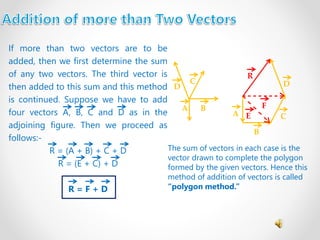
If more than two vectors are to be 
added, then we first determine the sum 
of any two vectors. The third vector is 
then added to this sum and this method 
is continued. Suppose we have to add 
four vectors A, B, C and D as in the 
adjoining figure. Then we proceed as 
follows:- 
R = (A + B) + C + D 
R = (E + C) + D 
R = F + D 
C 
A B 
D 
A 
E C 
B 
F 
D 
R 
The sum of vectors in each case is the 
vector drawn to complete the polygon 
formed by the given vectors. Hence this 
method of addition of vectors is called 
“polygon method.”
** The vectors need not be added in the order seen in the last slide. 
Vector C may be first added to vector A, then vector D and finally 
vector B. 
∴ R’ = A + C + D + B 
But vector R and vector R’ are parallel, equal in length and are in 
the same direction. 
∴ R = R’ 
or, A + B + C + D = A + C + D + B 
Hence vector addition is associative. 
** If three or more vectors themselves complete a triangle or a 
polygon, then their sum-vector or resultant vector cannot be 
drawn. It means that the sum of these vectors is zero.
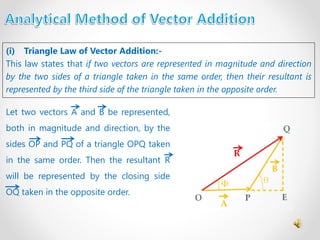
(i) Triangle Law of Vector Addition:- 
This law states that if two vectors are represented in magnitude and direction 
by the two sides of a triangle taken in the same order, then their resultant is 
represented by the third side of the triangle taken in the opposite order. 
Let two vectors A and B be represented, 
both in magnitude and direction, by the 
sides OP and PQ of a triangle OPQ taken 
in the same order. Then the resultant R 
will be represented by the closing side 
OQ taken in the opposite order. 
O P 
Q 
R 
A 
B 
E 
Φ θ
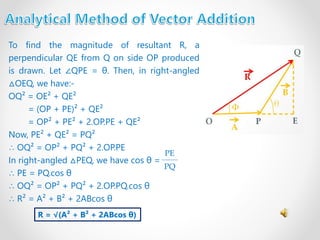
To find the magnitude of resultant R, a 
perpendicular QE from Q on side OP produced 
is drawn. Let ∠QPE = θ. Then, in right-angled 
△OEQ, we have:- 
OQ² = OE² + QE² 
= (OP + PE)² + QE² 
= OP² + PE² + 2.OP.PE + QE² 
Now, PE² + QE² = PQ² 
∴ OQ² = OP² + PQ² + 2.OP.PE 
In right-angled △PEQ, we have cos θ = 
∴ PE = PQ.cos θ 
∴ OQ² = OP² + PQ² + 2.OP.PQ.cos θ 
∴ R² = A² + B² + 2ABcos θ 
PE 
PQ 
R = √(A² + B² + 2ABcos θ)
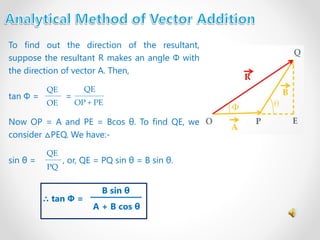
To find out the direction of the resultant, 
suppose the resultant R makes an angle Φ with 
the direction of vector A. Then, 
QE 
OE 
tan Φ = = 
Now OP = A and PE = Bcos θ. To find QE, we 
consider △PEQ. We have:- 
sin θ = , or, QE = PQ sin θ = B sin θ. 
∴ tan Φ = 
QE 
OP + PE 
QE 
PQ 
B sin θ 
A + B cos θ
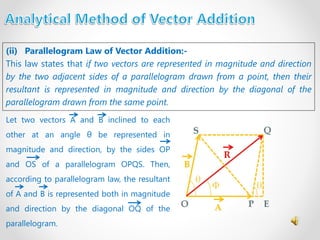
(ii) Parallelogram Law of Vector Addition:- 
This law states that if two vectors are represented in magnitude and direction 
by the two adjacent sides of a parallelogram drawn from a point, then their 
resultant is represented in magnitude and direction by the diagonal of the 
parallelogram drawn from the same point. 
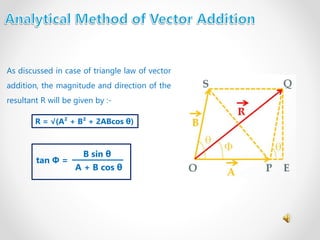
Let two vectors A and B inclined to each 
other at an angle θ be represented in 
magnitude and direction, by the sides OP 
and OS of a parallelogram OPQS. Then, 
according to parallelogram law, the resultant 
of A and B is represented both in magnitude 
and direction by the diagonal OQ of the 
parallelogram. 
B 
S Q 
Φ θ 
A 
R 
θ 
O P E
As discussed in case of triangle law of vector 
addition, the magnitude and direction of the 
resultant R will be given by :- 
R = √(A² + B² + 2ABcos θ) 
tan Φ = 
B sin θ 
A + B cos θ
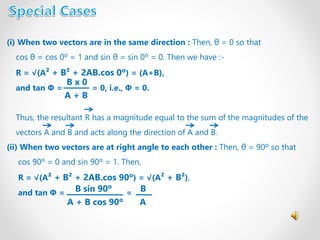
(i) When two vectors are in the same direction : Then, θ = 0 so that 
cos θ = cos 0º = 1 and sin θ = sin 0º = 0. Then we have :- 
R = √(A² + B² + 2AB.cos 0º) = (A+B), 
and tan Φ = = 0, i.e., Φ = 0. 
B x 0 
A + B 
Thus, the resultant R has a magnitude equal to the sum of the magnitudes of the 
vectors A and B and acts along the direction of A and B. 
(ii) When two vectors are at right angle to each other : Then, θ = 90º so that 
cos 90º = 0 and sin 90º = 1. Then, 
R = √(A² + B² + 2AB.cos 90º) = √(A² + B²), 
and tan Φ = = 
B sin 90º 
A + B cos 90º 
B 
A
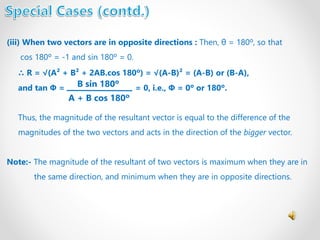
(iii) When two vectors are in opposite directions : Then, θ = 180º, so that 
cos 180º = -1 and sin 180º = 0. 
∴ R = √(A² + B² + 2AB.cos 180º) = √(A-B)² = (A-B) or (B-A), 
B sin 180º 
and tan Φ = = 0, i.e., Φ = 0º or 180º. 
A + B cos 180º 
Thus, the magnitude of the resultant vector is equal to the difference of the 
magnitudes of the two vectors and acts in the direction of the bigger vector. 
Note:- The magnitude of the resultant of two vectors is maximum when they are in 
the same direction, and minimum when they are in opposite directions.
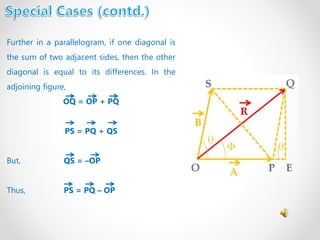
Further in a parallelogram, if one diagonal is 
the sum of two adjacent sides, then the other 
diagonal is equal to its differences. In the 
adjoining figure, 
OQ = OP + PQ 
PS = PQ + QS 
But, QS = –OP 
Thus, PS = PQ – OP
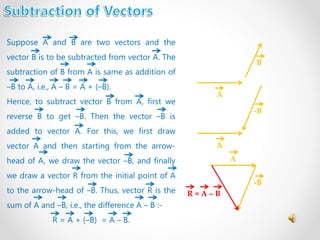
Suppose A and B are two vectors and the 
vector B is to be subtracted from vector A. The 
subtraction of B from A is same as addition of 
–B to A, i.e., A – B = A + (–B). 
Hence, to subtract vector B from A, first we 
reverse B to get –B. Then the vector –B is 
added to vector A. For this, we first draw 
vector A and then starting from the arrow-head 
of A, we draw the vector –B, and finally 
we draw a vector R from the initial point of A 
to the arrow-head of –B. Thus, vector R is the 
sum of A and –B, i.e., the difference A – B :- 
R = A + (–B) = A – B. 
A 
B 
A 
-B 
A 
-B 
R = A – B
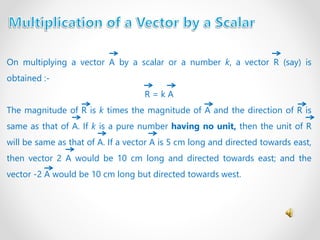
On multiplying a vector A by a scalar or a number k, a vector R (say) is 
obtained :- 
R = k A 
The magnitude of R is k times the magnitude of A and the direction of R is 
same as that of A. If k is a pure number having no unit, then the unit of R 
will be same as that of A. If a vector A is 5 cm long and directed towards east, 
then vector 2 A would be 10 cm long and directed towards east; and the 
vector -2 A would be 10 cm long but directed towards west.
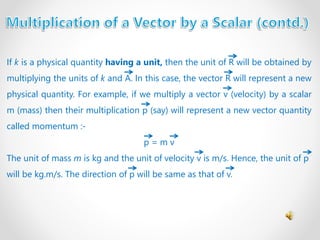
If k is a physical quantity having a unit, then the unit of R will be obtained by 
multiplying the units of k and A. In this case, the vector R will represent a new 
physical quantity. For example, if we multiply a vector v (velocity) by a scalar 
m (mass) then their multiplication p (say) will represent a new vector quantity 
called momentum :- 
p = m v 
The unit of mass m is kg and the unit of velocity v is m/s. Hence, the unit of p 
will be kg.m/s. The direction of p will be same as that of v.
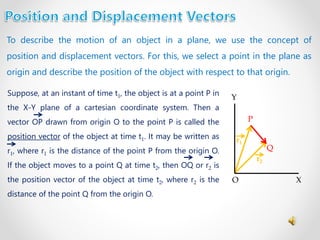
To describe the motion of an object in a plane, we use the concept of 
position and displacement vectors. For this, we select a point in the plane as 
origin and describe the position of the object with respect to that origin. 
Y 
P 
Q 
r1 
r2 
O X 
Suppose, at an instant of time t1, the object is at a point P in 
the X-Y plane of a cartesian coordinate system. Then a 
vector OP drawn from origin O to the point P is called the 
position vector of the object at time t1. It may be written as 
r1, where r1 is the distance of the point P from the origin O. 
If the object moves to a point Q at time t2, then OQ or r2 is 
the position vector of the object at time t2, where r2 is the 
distance of the point Q from the origin O.
Y 
P 
Q 
r1 
r2 
O X 
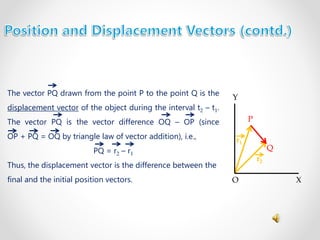
The vector PQ drawn from the point P to the point Q is the 
displacement vector of the object during the interval t2 – t1. 
The vector PQ is the vector difference OQ – OP (since 
OP + PQ = OQ by triangle law of vector addition), i.e., 
PQ = r2 – r1 
Thus, the displacement vector is the difference between the 
final and the initial position vectors.
If two vectors A and B are equal, then their difference A – B is defined as zero vector 
or null vector and is denoted as 0. 
A – B = 0, if A = B. 
Thus, zero vector is a vector of zero magnitude having no specific direction. Its initial 
and terminal points are coincident. 
Properties:- 
• A + 0 = A 
• n 0 = 0 
• 0 A = 0
Though a zero vector does not quite fit in our description of a vector as it 
has no specific direction, in this way it is considered as one of the non-proper 
vectors. Still it is needed in vector algebra due to the following 
reasons :- 
• What is A – B when A = B? 
• What is A + B + C if these vectors form a closed figure? 
• We know that with respect to origin in cartesian coordinate system, position 
vector of a point P is OP, then what’s the position vector of origin itself? 
• What is the displacement vector of a stationary object? 
• What is the acceleration vector of an object moving with a constant velocity? 
Answer to all these questions is a zero vector.
A vector whose magnitude is unity is called a “unit vector”. 
If A is a vector whose magnitude A ≠ 0, then A / A is a unit vector whose direction is 
the direction of A. The unit vector in the direction of A is written as A. Thus, 
^ A 
^ 
A = or, A = A A 
^ 
A 
Thus, any vector in the direction of unit vector may be written as the product of the 
unit vector and the scalar magnitude of that vector. 
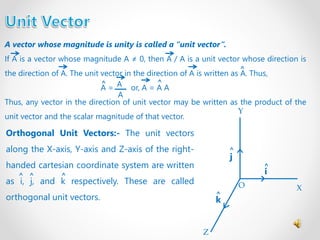
Orthogonal Unit Vectors:- The unit vectors 
along the X-axis, Y-axis and Z-axis of the right-handed 
cartesian coordinate system are written 
^ ^ ^ 
as i, j, and k respectively. These are called 
orthogonal unit vectors. 
Y 
^ 
O X 
Z 
^ 
j 
i 
^k
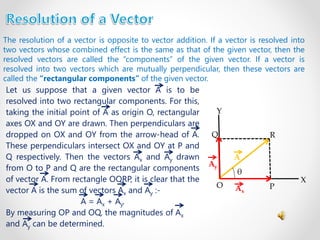
The resolution of a vector is opposite to vector addition. If a vector is resolved into 
two vectors whose combined effect is the same as that of the given vector, then the 
resolved vectors are called the “components” of the given vector. If a vector is 
resolved into two vectors which are mutually perpendicular, then these vectors are 
called the “rectangular components” of the given vector. 
Let us suppose that a given vector A is to be 
resolved into two rectangular components. For this, 
taking the initial point of A as origin O, rectangular 
axes OX and OY are drawn. Then perpendiculars are 
dropped on OX and OY from the arrow-head of A. 
These perpendiculars intersect OX and OY at P and 
Q respectively. Then the vectors Ax and Ay drawn 
from O to P and Q are the rectangular components 
of vector A. From rectangle OQRP, it is clear that the 
vector A is the sum of vectors Ax and Ay :- 
A = Ax + Ay. 
By measuring OP and OQ, the magnitudes of Ax 
and Ay can be determined. 
X 
Y 
Q R 
O 
P 
A 
θ 
Ax 
Ay
^ ^ 
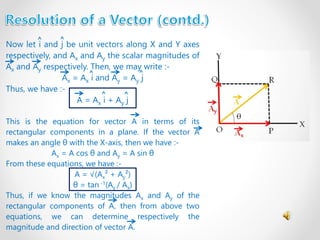
Now let i and j be unit vectors along X and Y axes 
respectively, and Ax and Ay the scalar magnitudes of 
Ax and Ay respectively. Then, we may write :- 
^ ^ 
Ax = Ax i and Ay = Ay j 
Thus, we have :- 
^ ^ 
A = Ax i + Ay j 
This is the equation for vector A in terms of its 
rectangular components in a plane. If the vector A 
makes an angle θ with the X-axis, then we have :- 
Ax = A cos θ and Ay = A sin θ 
From these equations, we have :- 
A = √(Ax² + Ay²) 
θ = tan -1(Ay / Ax) 
Thus, if we know the magnitudes Ax and Ay of the 
rectangular components of A, then from above two 
equations, we can determine respectively the 
magnitude and direction of vector A.
The multiplication of two vector quantities cannot be done by simple 
algebraic method. The product of two vectors may be a scalar as well as a 
vector. For example, both ‘force’ and ‘displacement’ are vector quantities. 
Their product may be ‘work’ as well as ‘moment of force’. Work is a scalar 
but moment of force is a vector quantity. 
Vector quantities are represented by vectors. If the product of two vectors is 
a scalar quantity, then it is called ‘scalar product’; if the product is a vector 
quantity then it is called ‘vector product.’ If A and B are two vectors, then 
their scalar product is written as A ∙ B (read A dot B), and the vector product 
is written as A x B (read A cross B). Hence, the scalar product is also called 
‘dot product’ and the vector product is also called ‘cross product.’
The scalar product of two vectors is defined as a 
scalar quantity equal to the product of their 
magnitudes and the cosine of the angle between 
them. Thus, if θ is the angle between A and B, then, 
A ∙ B = A B cos θ, 
where A and B are the magnitudes of A and B. The 
quantity AB cos θ is a scalar quantity. 
θ 
A 
B 
Now, B cos θ is the component of vector B in the direction of A. Hence, the 
scalar product of two vectors is equal to the product of the magnitude 
of one vector and the component of the second vector in the direction 
of the first vector.
(i) Power P is the rate of doing work. We know that :- 
Work W = Force F ∙ Displacement S 
W 
t t 
∴ = F ∙ 
Hence, Power P = F ∙ v 
Thus, power is the scalar product of force and velocity. 
(ii) The magnetic flux (Φ) linked with a plane is defined as scalar product of 
uniform magnetic field B and vector area A of that plane :- 
Φ = B ∙ A 
S
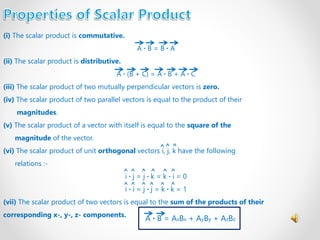
(i) The scalar product is commutative. 
A ∙ B = B ∙ A 
(ii) The scalar product is distributive. 
A ∙ (B + C) = A ∙ B + A ∙ C 
(iii) The scalar product of two mutually perpendicular vectors is zero. 
(iv) The scalar product of two parallel vectors is equal to the product of their 
magnitudes. 
(v) The scalar product of a vector with itself is equal to the square of the 
magnitude of the vector. 
^ ^ ^ 
(vi) The scalar product of unit orthogonal vectors i, j, k have the following 
relations :- 
^ ^ ^ ^ ^ ^ 
^ ^ ^ ^ ^ ^ 
i ∙ j = j ∙ k = k ∙ i = 0 
i ∙ i = j ∙ j = k ∙ k = 1 
(vii) The scalar product of two vectors is equal to the sum of the products of their 
corresponding x-, y-, z- components. A ∙ B = AxBx + AyBy + AzBz
The vector product of two vectors is defined as a vector having a 
magnitude equal to the product of the magnitudes of the two vectors and 
the sine of the angle between them, and having the direction perpendicular 
to the plane containing the two vectors. Thus, if A and B be two vectors, then 
their vector product, written as A x B, is a vector C defined by :- 
^ 
C = A x B = AB sin (A, B) n, 
where A and B are the magnitudes of A and B; (A, B) is the angle between them 
^ 
and n is a unit vector perpendicular to the plane of A and B. 
^ 
The direction of C (or n) is perpendicular to the plane containing A and B and 
its sense is decided by right-hand screw rule.
(i) Suppose there is a particle P of mass m whose 
position vector is r w.r.t the origin O of an inertial 
reference frame. Let p (= m v) be the linear momentum 
of the particle. Then, the angular momentum J of the 
particle about the origin O is defined as the vector 
product of r and p, i.e., 
J = r x p 
Its scalar magnitude is J = r p sin θ, 
where θ is the angle between r and p. 
(ii) The instantaneous linear velocity v of a particle is 
equal to the vector product of its angular velocity ω 
and its position vector r with reference to some origin, 
i.e., v = ω x r 
Z 
Y 
X 
O 
θ 
J 
r p 
P
(i) The vector product is “not” commutative, i.e., 
A x B ≠ B x A 
(ii) The vector product is distributive, i.e., 
A x (B + C) = A x B + A x C 
(iii) The magnitude of the vector product of two vectors mutually at right angles is equal to the 
product of the magnitudes of the vectors. 
(iv) The vector product of two parallel vectors is a null vector (or zero). 
(v) The vector product of a vector by itself is a null vector (zero), i.e., 
A x A = 0 
^ ^ ^ 
^ ^ 
^ ^ 
(vi) The vector product of unit orthogonal vectors i, j, k have the following relations :- 
^ ^ 
^ 
(a) i x j = –j x i = k 
^ 
^ 
^ 
j x k = –k x j = i 
^ ^ ^ 
^ ^ 
k x i = –i x k = j 
^ ^ ^ ^ ^ ^ 
(b) i x i = j x j = k x k = 0 
(vii) The vector product of two vectors in terms of their x-, y- and z- components can be 
expressed as a determinant.
Name:- Pankaj Bhootra 
Class:- 11 C 
Physics Project

Vectors - A Basic Study

  • 2.
    • Scalar quantities: Quantities which have only magnitude and no direction are called scalar quantities, e.g. mass, distance, time, speed, volume, density, pressure, work, energy, electric current, temperature, etc. • Vector quantities : Quantities which have magnitude as well as direction and obey the triangle law of vector addition or equivalently the parallelogram law of vector addition are called vector quantities, e.g. position, displacement, velocity, force, acceleration, weight, momentum, impulse, electric field, magnetic field, current density, etc.
  • 3.
    A vector quantitycan be represented by an arrow. This arrow is called the ‘vector.’ The length of the arrow represents the magnitude and the tip of the arrow represents the direction. If a car A runs with a velocity of 10 m/s towards east; and another car B runs with a velocity of 20 m/s towards north-east. These velocities can be represented by vectors shown in the adjoining figure, taking each unit of length on the arrow to represent 5 m/s. N W E S Velocity of car A Velocity of car B
  • 4.
    Two or morevectors are said to be equal if, and only if, they have the same magnitude and same direction. In the adjoining figure, A, B and C are equal vectors. If the direction of a vector is reversed, the sign of the vector is reversed. This new vector is called the “negative vector” of the original vector. Here, the vector D is the negative vector of vectors A, B and C. Thus, A = B = C = -D A B C D
  • 5.
    Consider two vectorsA and B. 1. First vector A is drawn. 2. Then starting from the arrow-head of A, the vector B is drawn. 3. Now draw a vector R, starting from the initial point of A and ending at the arrow-head of B. Vector R would be the sum of A and B. R = A + B The magnitude of A + B can be determined by measuring the length of R and the direction can be expressed by measuring the angle between R and A (or B). A B R = A + B We can start drawing from vector B also, instead of vector A, as shown below:- A B R’ = B + A
  • 6.
    The vectors Rand R’ obtained in the previous slide are parallel to each other and their lengths and directions are same. Hence, R = R’ ∴ A + B = B + A Thus, addition of vectors is commutative. This method of vector addition is called the method of triangle of vectors.
  • 7.
    There is anothermethod of adding two vectors, known as the “method of parallelogram of vectors.” According to this method, sum of two vectors A and B is a vector R represented by the diagonal of a parallelogram whose adjacent sides are represented by vectors A and B. A B
  • 8.
    The magnitude ofthe sum of two vectors depends upon the angle between the vectors. In the adjoining figure, two vectors A and B are added by changing the angle between them, keeping their magnitudes unchanged. It is seen that the sum R of A and B is maximum when A and B are parallel, i.e., when the angle between them is 0. The magnitude of R would be (A+B). When the angle between A and B is 180º, then magnitude of resultant vector R is minimum, equal to (A-B) if A is greater, or (B-A) if B is greater. A R B A B R A B R A B R Since the minimum magnitude of A + B is (A-B), hence two vectors of “different” magnitudes cannot be added to get a zero resultant.
  • 9.
    If more thantwo vectors are to be added, then we first determine the sum of any two vectors. The third vector is then added to this sum and this method is continued. Suppose we have to add four vectors A, B, C and D as in the adjoining figure. Then we proceed as follows:- R = (A + B) + C + D R = (E + C) + D R = F + D C A B D A E C B F D R The sum of vectors in each case is the vector drawn to complete the polygon formed by the given vectors. Hence this method of addition of vectors is called “polygon method.”
  • 10.
    ** The vectorsneed not be added in the order seen in the last slide. Vector C may be first added to vector A, then vector D and finally vector B. ∴ R’ = A + C + D + B But vector R and vector R’ are parallel, equal in length and are in the same direction. ∴ R = R’ or, A + B + C + D = A + C + D + B Hence vector addition is associative. ** If three or more vectors themselves complete a triangle or a polygon, then their sum-vector or resultant vector cannot be drawn. It means that the sum of these vectors is zero.
  • 11.
    (i) Triangle Lawof Vector Addition:- This law states that if two vectors are represented in magnitude and direction by the two sides of a triangle taken in the same order, then their resultant is represented by the third side of the triangle taken in the opposite order. Let two vectors A and B be represented, both in magnitude and direction, by the sides OP and PQ of a triangle OPQ taken in the same order. Then the resultant R will be represented by the closing side OQ taken in the opposite order. O P Q R A B E Φ θ
  • 12.
    To find themagnitude of resultant R, a perpendicular QE from Q on side OP produced is drawn. Let ∠QPE = θ. Then, in right-angled △OEQ, we have:- OQ² = OE² + QE² = (OP + PE)² + QE² = OP² + PE² + 2.OP.PE + QE² Now, PE² + QE² = PQ² ∴ OQ² = OP² + PQ² + 2.OP.PE In right-angled △PEQ, we have cos θ = ∴ PE = PQ.cos θ ∴ OQ² = OP² + PQ² + 2.OP.PQ.cos θ ∴ R² = A² + B² + 2ABcos θ PE PQ R = √(A² + B² + 2ABcos θ)
  • 13.
    To find outthe direction of the resultant, suppose the resultant R makes an angle Φ with the direction of vector A. Then, QE OE tan Φ = = Now OP = A and PE = Bcos θ. To find QE, we consider △PEQ. We have:- sin θ = , or, QE = PQ sin θ = B sin θ. ∴ tan Φ = QE OP + PE QE PQ B sin θ A + B cos θ
  • 14.
    (ii) Parallelogram Lawof Vector Addition:- This law states that if two vectors are represented in magnitude and direction by the two adjacent sides of a parallelogram drawn from a point, then their resultant is represented in magnitude and direction by the diagonal of the parallelogram drawn from the same point. Let two vectors A and B inclined to each other at an angle θ be represented in magnitude and direction, by the sides OP and OS of a parallelogram OPQS. Then, according to parallelogram law, the resultant of A and B is represented both in magnitude and direction by the diagonal OQ of the parallelogram. B S Q Φ θ A R θ O P E
  • 15.
    As discussed incase of triangle law of vector addition, the magnitude and direction of the resultant R will be given by :- R = √(A² + B² + 2ABcos θ) tan Φ = B sin θ A + B cos θ
  • 16.
    (i) When twovectors are in the same direction : Then, θ = 0 so that cos θ = cos 0º = 1 and sin θ = sin 0º = 0. Then we have :- R = √(A² + B² + 2AB.cos 0º) = (A+B), and tan Φ = = 0, i.e., Φ = 0. B x 0 A + B Thus, the resultant R has a magnitude equal to the sum of the magnitudes of the vectors A and B and acts along the direction of A and B. (ii) When two vectors are at right angle to each other : Then, θ = 90º so that cos 90º = 0 and sin 90º = 1. Then, R = √(A² + B² + 2AB.cos 90º) = √(A² + B²), and tan Φ = = B sin 90º A + B cos 90º B A
  • 17.
    (iii) When twovectors are in opposite directions : Then, θ = 180º, so that cos 180º = -1 and sin 180º = 0. ∴ R = √(A² + B² + 2AB.cos 180º) = √(A-B)² = (A-B) or (B-A), B sin 180º and tan Φ = = 0, i.e., Φ = 0º or 180º. A + B cos 180º Thus, the magnitude of the resultant vector is equal to the difference of the magnitudes of the two vectors and acts in the direction of the bigger vector. Note:- The magnitude of the resultant of two vectors is maximum when they are in the same direction, and minimum when they are in opposite directions.
  • 18.
    Further in aparallelogram, if one diagonal is the sum of two adjacent sides, then the other diagonal is equal to its differences. In the adjoining figure, OQ = OP + PQ PS = PQ + QS But, QS = –OP Thus, PS = PQ – OP
  • 19.
    Suppose A andB are two vectors and the vector B is to be subtracted from vector A. The subtraction of B from A is same as addition of –B to A, i.e., A – B = A + (–B). Hence, to subtract vector B from A, first we reverse B to get –B. Then the vector –B is added to vector A. For this, we first draw vector A and then starting from the arrow-head of A, we draw the vector –B, and finally we draw a vector R from the initial point of A to the arrow-head of –B. Thus, vector R is the sum of A and –B, i.e., the difference A – B :- R = A + (–B) = A – B. A B A -B A -B R = A – B
  • 20.
    On multiplying avector A by a scalar or a number k, a vector R (say) is obtained :- R = k A The magnitude of R is k times the magnitude of A and the direction of R is same as that of A. If k is a pure number having no unit, then the unit of R will be same as that of A. If a vector A is 5 cm long and directed towards east, then vector 2 A would be 10 cm long and directed towards east; and the vector -2 A would be 10 cm long but directed towards west.
  • 21.
    If k isa physical quantity having a unit, then the unit of R will be obtained by multiplying the units of k and A. In this case, the vector R will represent a new physical quantity. For example, if we multiply a vector v (velocity) by a scalar m (mass) then their multiplication p (say) will represent a new vector quantity called momentum :- p = m v The unit of mass m is kg and the unit of velocity v is m/s. Hence, the unit of p will be kg.m/s. The direction of p will be same as that of v.
  • 22.
    To describe themotion of an object in a plane, we use the concept of position and displacement vectors. For this, we select a point in the plane as origin and describe the position of the object with respect to that origin. Y P Q r1 r2 O X Suppose, at an instant of time t1, the object is at a point P in the X-Y plane of a cartesian coordinate system. Then a vector OP drawn from origin O to the point P is called the position vector of the object at time t1. It may be written as r1, where r1 is the distance of the point P from the origin O. If the object moves to a point Q at time t2, then OQ or r2 is the position vector of the object at time t2, where r2 is the distance of the point Q from the origin O.
  • 23.
    Y P Q r1 r2 O X The vector PQ drawn from the point P to the point Q is the displacement vector of the object during the interval t2 – t1. The vector PQ is the vector difference OQ – OP (since OP + PQ = OQ by triangle law of vector addition), i.e., PQ = r2 – r1 Thus, the displacement vector is the difference between the final and the initial position vectors.
  • 24.
    If two vectorsA and B are equal, then their difference A – B is defined as zero vector or null vector and is denoted as 0. A – B = 0, if A = B. Thus, zero vector is a vector of zero magnitude having no specific direction. Its initial and terminal points are coincident. Properties:- • A + 0 = A • n 0 = 0 • 0 A = 0
  • 25.
    Though a zerovector does not quite fit in our description of a vector as it has no specific direction, in this way it is considered as one of the non-proper vectors. Still it is needed in vector algebra due to the following reasons :- • What is A – B when A = B? • What is A + B + C if these vectors form a closed figure? • We know that with respect to origin in cartesian coordinate system, position vector of a point P is OP, then what’s the position vector of origin itself? • What is the displacement vector of a stationary object? • What is the acceleration vector of an object moving with a constant velocity? Answer to all these questions is a zero vector.
  • 26.
    A vector whosemagnitude is unity is called a “unit vector”. If A is a vector whose magnitude A ≠ 0, then A / A is a unit vector whose direction is the direction of A. The unit vector in the direction of A is written as A. Thus, ^ A ^ A = or, A = A A ^ A Thus, any vector in the direction of unit vector may be written as the product of the unit vector and the scalar magnitude of that vector. Orthogonal Unit Vectors:- The unit vectors along the X-axis, Y-axis and Z-axis of the right-handed cartesian coordinate system are written ^ ^ ^ as i, j, and k respectively. These are called orthogonal unit vectors. Y ^ O X Z ^ j i ^k
  • 27.
    The resolution ofa vector is opposite to vector addition. If a vector is resolved into two vectors whose combined effect is the same as that of the given vector, then the resolved vectors are called the “components” of the given vector. If a vector is resolved into two vectors which are mutually perpendicular, then these vectors are called the “rectangular components” of the given vector. Let us suppose that a given vector A is to be resolved into two rectangular components. For this, taking the initial point of A as origin O, rectangular axes OX and OY are drawn. Then perpendiculars are dropped on OX and OY from the arrow-head of A. These perpendiculars intersect OX and OY at P and Q respectively. Then the vectors Ax and Ay drawn from O to P and Q are the rectangular components of vector A. From rectangle OQRP, it is clear that the vector A is the sum of vectors Ax and Ay :- A = Ax + Ay. By measuring OP and OQ, the magnitudes of Ax and Ay can be determined. X Y Q R O P A θ Ax Ay
  • 28.
    ^ ^ Nowlet i and j be unit vectors along X and Y axes respectively, and Ax and Ay the scalar magnitudes of Ax and Ay respectively. Then, we may write :- ^ ^ Ax = Ax i and Ay = Ay j Thus, we have :- ^ ^ A = Ax i + Ay j This is the equation for vector A in terms of its rectangular components in a plane. If the vector A makes an angle θ with the X-axis, then we have :- Ax = A cos θ and Ay = A sin θ From these equations, we have :- A = √(Ax² + Ay²) θ = tan -1(Ay / Ax) Thus, if we know the magnitudes Ax and Ay of the rectangular components of A, then from above two equations, we can determine respectively the magnitude and direction of vector A.
  • 29.
    The multiplication oftwo vector quantities cannot be done by simple algebraic method. The product of two vectors may be a scalar as well as a vector. For example, both ‘force’ and ‘displacement’ are vector quantities. Their product may be ‘work’ as well as ‘moment of force’. Work is a scalar but moment of force is a vector quantity. Vector quantities are represented by vectors. If the product of two vectors is a scalar quantity, then it is called ‘scalar product’; if the product is a vector quantity then it is called ‘vector product.’ If A and B are two vectors, then their scalar product is written as A ∙ B (read A dot B), and the vector product is written as A x B (read A cross B). Hence, the scalar product is also called ‘dot product’ and the vector product is also called ‘cross product.’
  • 30.
    The scalar productof two vectors is defined as a scalar quantity equal to the product of their magnitudes and the cosine of the angle between them. Thus, if θ is the angle between A and B, then, A ∙ B = A B cos θ, where A and B are the magnitudes of A and B. The quantity AB cos θ is a scalar quantity. θ A B Now, B cos θ is the component of vector B in the direction of A. Hence, the scalar product of two vectors is equal to the product of the magnitude of one vector and the component of the second vector in the direction of the first vector.
  • 31.
    (i) Power Pis the rate of doing work. We know that :- Work W = Force F ∙ Displacement S W t t ∴ = F ∙ Hence, Power P = F ∙ v Thus, power is the scalar product of force and velocity. (ii) The magnetic flux (Φ) linked with a plane is defined as scalar product of uniform magnetic field B and vector area A of that plane :- Φ = B ∙ A S
  • 32.
    (i) The scalarproduct is commutative. A ∙ B = B ∙ A (ii) The scalar product is distributive. A ∙ (B + C) = A ∙ B + A ∙ C (iii) The scalar product of two mutually perpendicular vectors is zero. (iv) The scalar product of two parallel vectors is equal to the product of their magnitudes. (v) The scalar product of a vector with itself is equal to the square of the magnitude of the vector. ^ ^ ^ (vi) The scalar product of unit orthogonal vectors i, j, k have the following relations :- ^ ^ ^ ^ ^ ^ ^ ^ ^ ^ ^ ^ i ∙ j = j ∙ k = k ∙ i = 0 i ∙ i = j ∙ j = k ∙ k = 1 (vii) The scalar product of two vectors is equal to the sum of the products of their corresponding x-, y-, z- components. A ∙ B = AxBx + AyBy + AzBz
  • 33.
    The vector productof two vectors is defined as a vector having a magnitude equal to the product of the magnitudes of the two vectors and the sine of the angle between them, and having the direction perpendicular to the plane containing the two vectors. Thus, if A and B be two vectors, then their vector product, written as A x B, is a vector C defined by :- ^ C = A x B = AB sin (A, B) n, where A and B are the magnitudes of A and B; (A, B) is the angle between them ^ and n is a unit vector perpendicular to the plane of A and B. ^ The direction of C (or n) is perpendicular to the plane containing A and B and its sense is decided by right-hand screw rule.
  • 34.
    (i) Suppose thereis a particle P of mass m whose position vector is r w.r.t the origin O of an inertial reference frame. Let p (= m v) be the linear momentum of the particle. Then, the angular momentum J of the particle about the origin O is defined as the vector product of r and p, i.e., J = r x p Its scalar magnitude is J = r p sin θ, where θ is the angle between r and p. (ii) The instantaneous linear velocity v of a particle is equal to the vector product of its angular velocity ω and its position vector r with reference to some origin, i.e., v = ω x r Z Y X O θ J r p P
  • 35.
    (i) The vectorproduct is “not” commutative, i.e., A x B ≠ B x A (ii) The vector product is distributive, i.e., A x (B + C) = A x B + A x C (iii) The magnitude of the vector product of two vectors mutually at right angles is equal to the product of the magnitudes of the vectors. (iv) The vector product of two parallel vectors is a null vector (or zero). (v) The vector product of a vector by itself is a null vector (zero), i.e., A x A = 0 ^ ^ ^ ^ ^ ^ ^ (vi) The vector product of unit orthogonal vectors i, j, k have the following relations :- ^ ^ ^ (a) i x j = –j x i = k ^ ^ ^ j x k = –k x j = i ^ ^ ^ ^ ^ k x i = –i x k = j ^ ^ ^ ^ ^ ^ (b) i x i = j x j = k x k = 0 (vii) The vector product of two vectors in terms of their x-, y- and z- components can be expressed as a determinant.
  • 36.
    Name:- Pankaj Bhootra Class:- 11 C Physics Project