Directional Derivatives and the Gradient
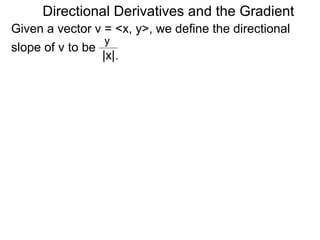
Given a vector v = <x, y>, we define the directional
                  y
slope of v to be
                 |x|.
Directional Derivatives and the Gradient
Given a vector v = <x, y>, we define the directional
                  y
slope of v to be
                 |x|.
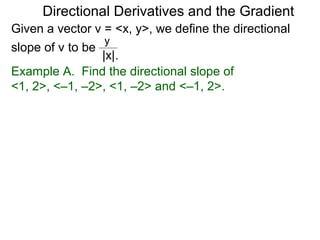
Example A. Find the directional slope of
<1, 2>, <–1, –2>, <1, –2> and <–1, 2>.
Directional Derivatives and the Gradient
Given a vector v = <x, y>, we define the directional
                  y
slope of v to be
                 |x|.
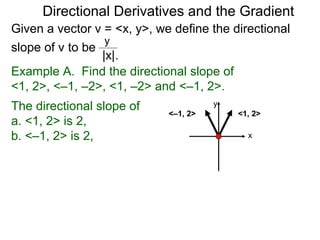
Example A. Find the directional slope of
<1, 2>, <–1, –2>, <1, –2> and <–1, 2>.
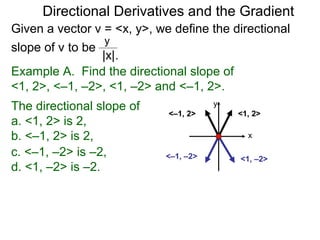
The directional slope of               y
                             <–1, 2>       <1, 2>
a. <1, 2> is 2,
b. <–1, 2> is 2,                             x
Directional Derivatives and the Gradient
Given a vector v = <x, y>, we define the directional
                  y
slope of v to be
                 |x|.
Example A. Find the directional slope of
<1, 2>, <–1, –2>, <1, –2> and <–1, 2>.
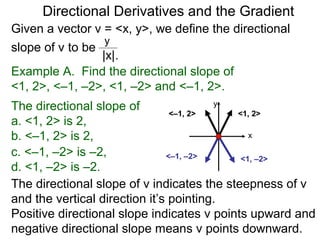
The directional slope of               y
                             <–1, 2>       <1, 2>
a. <1, 2> is 2,
b. <–1, 2> is 2,                             x

c. <–1, –2> is –2,          <–1, –2>       <1, –2>
d. <1, –2> is –2.
Directional Derivatives and the Gradient
Given a vector v = <x, y>, we define the directional
                  y
slope of v to be
                 |x|.
Example A. Find the directional slope of
<1, 2>, <–1, –2>, <1, –2> and <–1, 2>.
The directional slope of                y
                                <–1, 2>    <1, 2>
a. <1, 2> is 2,
b. <–1, 2> is 2,                              x

c. <–1, –2> is –2,             <–1, –2>     <1, –2>
d. <1, –2> is –2.
The directional slope of v indicates the steepness of v
and the vertical direction it’s pointing.
Positive directional slope indicates v points upward and
negative directional slope means v points downward.
Directional Derivatives and the Gradient
                                                   y = f(x)
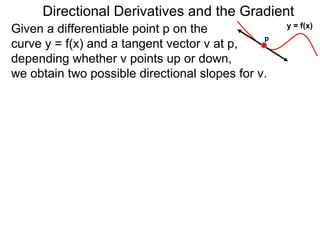
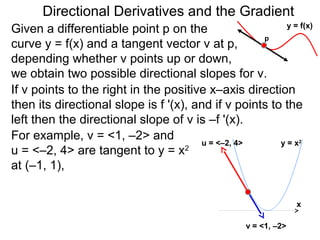
Given a differentiable point p on the
                                               p
curve y = f(x) and a tangent vector v at p,
depending whether v points up or down,
we obtain two possible directional slopes for v.
Directional Derivatives and the Gradient
                                                         y = f(x)
Given a differentiable point p on the
                                                    p
curve y = f(x) and a tangent vector v at p,
depending whether v points up or down,
we obtain two possible directional slopes for v.
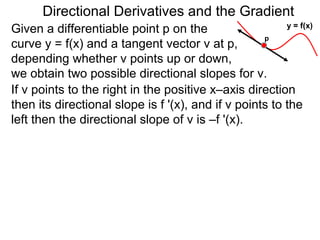
If v points to the right in the positive x–axis direction
then its directional slope is f '(x), and if v points to the
left then the directional slope of v is –f '(x).
Directional Derivatives and the Gradient
                                                         y = f(x)
Given a differentiable point p on the
                                                    p
curve y = f(x) and a tangent vector v at p,
depending whether v points up or down,
we obtain two possible directional slopes for v.
If v points to the right in the positive x–axis direction
then its directional slope is f '(x), and if v points to the
left then the directional slope of v is –f '(x).
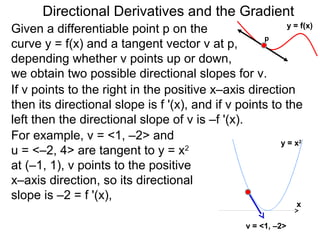
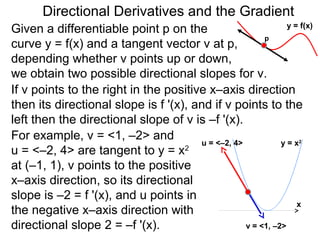
For example, v = <1, –2> and           u = <–2, 4>      y=x     2

u = <–2, 4> are tangent to y = x    2

at (–1, 1),


                                                                x

                                                  v = <1, –2>
Directional Derivatives and the Gradient
                                                         y = f(x)
Given a differentiable point p on the
                                                    p
curve y = f(x) and a tangent vector v at p,
depending whether v points up or down,
we obtain two possible directional slopes for v.
If v points to the right in the positive x–axis direction
then its directional slope is f '(x), and if v points to the
left then the directional slope of v is –f '(x).
For example, v = <1, –2> and                            y=x     2

u = <–2, 4> are tangent to y = x    2

at (–1, 1), v points to the positive
x–axis direction, so its directional
slope is –2 = f '(x),
                                                                x

                                                  v = <1, –2>
Directional Derivatives and the Gradient
                                                               y = f(x)
Given a differentiable point p on the
                                                        p
curve y = f(x) and a tangent vector v at p,
depending whether v points up or down,
we obtain two possible directional slopes for v.
If v points to the right in the positive x–axis direction
then its directional slope is f '(x), and if v points to the
left then the directional slope of v is –f '(x).
For example, v = <1, –2> and           u = <–2, 4>           y=x   2

u = <–2, 4> are tangent to y = x    2

at (–1, 1), v points to the positive
x–axis direction, so its directional
slope is –2 = f '(x), and u points in
                                                                  x
the negative x–axis direction with
directional slope 2 = –f '(x).                     v = <1, –2>
Directional Derivatives and the Gradient
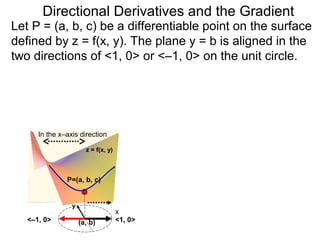
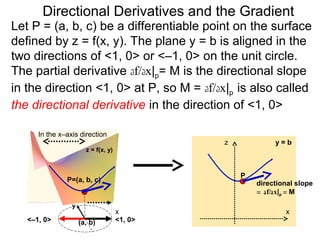
Let P = (a, b, c) be a differentiable point on the surface
defined by z = f(x, y). The plane y = b is aligned in the
two directions of <1, 0> or <–1, 0> on the unit circle.
Directional Derivatives and the Gradient
Let P = (a, b, c) be a differentiable point on the surface
defined by z = f(x, y). The plane y = b is aligned in the
two directions of <1, 0> or <–1, 0> on the unit circle.


      In the x–axis direction

                       z = f(x, y)


               P=(a, b, c)


                 y
                                     x
   <–1, 0>           (a, b)          <1, 0>
Directional Derivatives and the Gradient
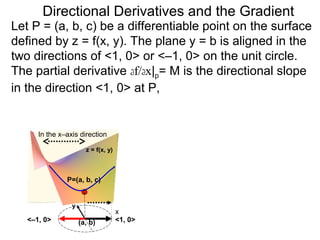
Let P = (a, b, c) be a differentiable point on the surface
defined by z = f(x, y). The plane y = b is aligned in the
two directions of <1, 0> or <–1, 0> on the unit circle.
The partial derivative df/dx|p= M is the directional slope
in the direction <1, 0> at P,


      In the x–axis direction

                       z = f(x, y)


               P=(a, b, c)


                 y
                                     x
   <–1, 0>           (a, b)          <1, 0>
Directional Derivatives and the Gradient
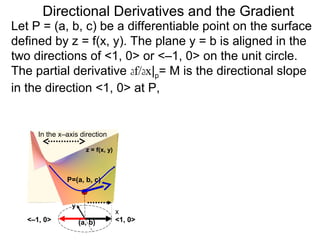
Let P = (a, b, c) be a differentiable point on the surface
defined by z = f(x, y). The plane y = b is aligned in the
two directions of <1, 0> or <–1, 0> on the unit circle.
The partial derivative df/dx|p= M is the directional slope
in the direction <1, 0> at P,


      In the x–axis direction

                       z = f(x, y)


               P=(a, b, c)


                 y
                                     x
   <–1, 0>           (a, b)          <1, 0>
Directional Derivatives and the Gradient
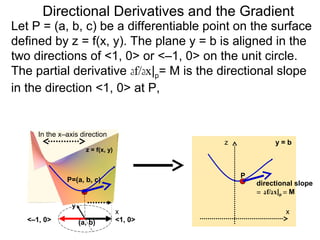
Let P = (a, b, c) be a differentiable point on the surface
defined by z = f(x, y). The plane y = b is aligned in the
two directions of <1, 0> or <–1, 0> on the unit circle.
The partial derivative df/dx|p= M is the directional slope
in the direction <1, 0> at P,


      In the x–axis direction
                                              z            y=b
                       z = f(x, y)


                                                  P
               P=(a, b, c)
                                                      directional slope
                                                      = df/dx|p = M
                 y
                                     x                        x
   <–1, 0>           (a, b)          <1, 0>
Directional Derivatives and the Gradient
Let P = (a, b, c) be a differentiable point on the surface
defined by z = f(x, y). The plane y = b is aligned in the
two directions of <1, 0> or <–1, 0> on the unit circle.
The partial derivative df/dx|p= M is the directional slope
in the direction <1, 0> at P, so M = df/dx|p is also called
the directional derivative in the direction of <1, 0>

      In the x–axis direction
                                              z            y=b
                       z = f(x, y)


                                                  P
               P=(a, b, c)
                                                      directional slope
                                                      = df/dx|p = M
                 y
                                     x                        x
   <–1, 0>           (a, b)          <1, 0>
Directional Derivatives and the Gradient
Let P = (a, b, c) be a differentiable point on the surface
defined by z = f(x, y). The plane y = b is aligned in the
two directions of <1, 0> or <–1, 0> on the unit circle.
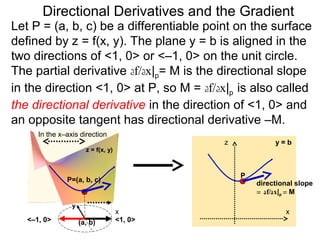
The partial derivative df/dx|p= M is the directional slope
in the direction <1, 0> at P, so M = df/dx|p is also called
the directional derivative in the direction of <1, 0> and
an opposite tangent has directional derivative –M.
      In the x–axis direction
                                              z            y=b
                       z = f(x, y)


                                                  P
               P=(a, b, c)
                                                      directional slope
                                                      = df/dx|p = M
                 y
                                     x                        x
   <–1, 0>           (a, b)          <1, 0>
Directional Derivatives and the Gradient
Let P = (a, b, c) be a differentiable point on the surface
defined by z = f(x, y). The plane y = b is aligned in the
two directions of <1, 0> or <–1, 0> on the unit circle.
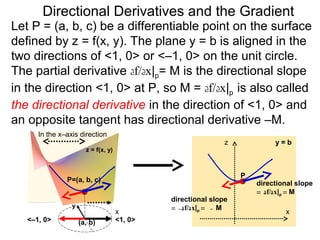
The partial derivative df/dx|p= M is the directional slope
in the direction <1, 0> at P, so M = df/dx|p is also called
the directional derivative in the direction of <1, 0> and
an opposite tangent has directional derivative –M.
      In the x–axis direction
                                                              z            y=b
                       z = f(x, y)


                                                                  P
               P=(a, b, c)
                                                                      directional slope
                                                                      = df/dx|p = M
                                              directional slope
                 y                            = –df/dx|p = – M
                                     x                                        x
   <–1, 0>           (a, b)          <1, 0>
Directional Derivatives and the Gradient
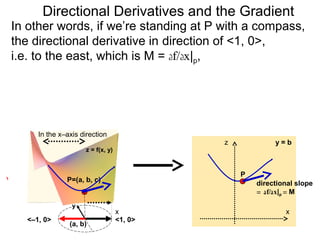
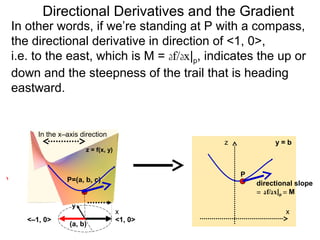
In other words, if we’re standing at P with a compass,
the directional derivative in direction of <1, 0>,
i.e. to the east, which is M = df/dx|p,


     In the x–axis direction
                                           z            y=b
                    z = f(x, y)


                                               P
              P=(a, b, c)
                                                   directional slope
                                                   = df/dx|p = M
                y
                                  x                        x
  <–1, 0>                         <1, 0>
               (a, b)
Directional Derivatives and the Gradient
In other words, if we’re standing at P with a compass,
the directional derivative in direction of <1, 0>,
i.e. to the east, which is M = df/dx|p, indicates the up or
down and the steepness of the trail that is heading
eastward.


      In the x–axis direction
                                            z            y=b
                     z = f(x, y)


                                                P
               P=(a, b, c)
                                                    directional slope
                                                    = df/dx|p = M
                 y
                                   x                        x
   <–1, 0>                         <1, 0>
                (a, b)
Directional Derivatives and the Gradient
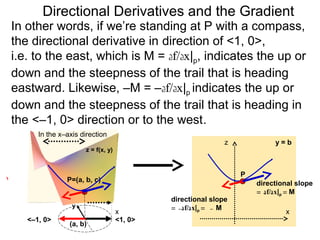
In other words, if we’re standing at P with a compass,
the directional derivative in direction of <1, 0>,
i.e. to the east, which is M = df/dx|p, indicates the up or
down and the steepness of the trail that is heading
eastward. Likewise, –M = –df/dx|p indicates the up or
down and the steepness of the trail that is heading in
the <–1, 0> direction or to the west.
      In the x–axis direction
                                                            z            y=b
                     z = f(x, y)


                                                                P
               P=(a, b, c)
                                                                    directional slope
                                                                    = df/dx|p = M
                                            directional slope
                 y                          = –df/dx|p = – M
                                   x                                        x
   <–1, 0>                         <1, 0>
                (a, b)
Directional Derivatives and the Gradient
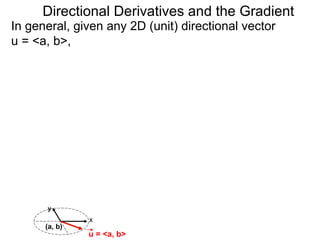
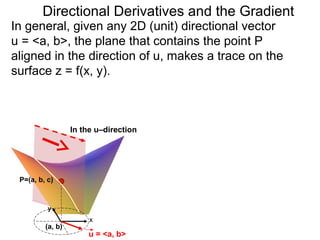
In general, given any 2D (unit) directional vector
u = <a, b>,


      y
               x
      (a, b)
               u = <a, b>
Directional Derivatives and the Gradient
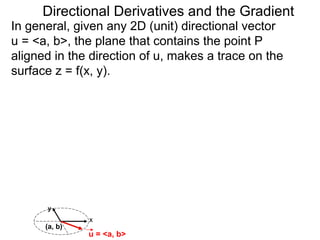
In general, given any 2D (unit) directional vector
u = <a, b>, the plane that contains the point P
aligned in the direction of u, makes a trace on the
surface z = f(x, y).


      y
               x
      (a, b)
               u = <a, b>
Directional Derivatives and the Gradient
In general, given any 2D (unit) directional vector
u = <a, b>, the plane that contains the point P
aligned in the direction of u, makes a trace on the
surface z = f(x, y).


                  In the u–direction


 P=(a, b, c)


          y
                       x
         (a, b)
                      u = <a, b>
Directional Derivatives and the Gradient
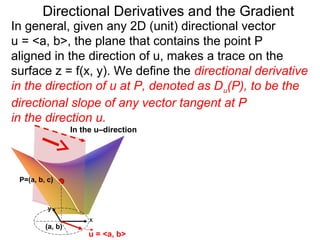
In general, given any 2D (unit) directional vector
u = <a, b>, the plane that contains the point P
aligned in the direction of u, makes a trace on the
surface z = f(x, y). We define the directional derivative
in the direction of u at P, denoted as D u(P), to be the
directional slope of any vector tangent at P
in the direction u.
                  In the u–direction


 P=(a, b, c)


          y
                       x
         (a, b)
                      u = <a, b>
Directional Derivatives and the Gradient
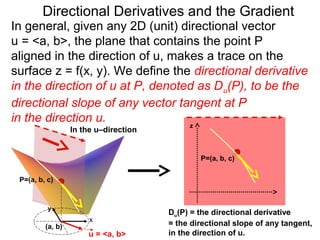
In general, given any 2D (unit) directional vector
u = <a, b>, the plane that contains the point P
aligned in the direction of u, makes a trace on the
surface z = f(x, y). We define the directional derivative
in the direction of u at P, denoted as D u(P), to be the
directional slope of any vector tangent at P
in the direction u.               z
                  In the u–direction


                                               P=(a, b, c)


 P=(a, b, c)


          y
                                       Du(P) = the directional derivative
                       x
         (a, b)                        = the directional slope of any tangent,
                      u = <a, b>       in the direction of u.
Directional Derivatives and the Gradient
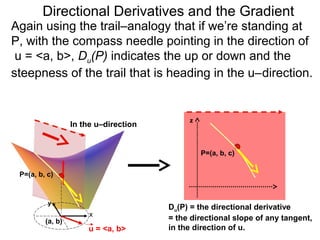
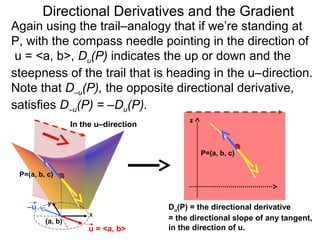
Again using the trail–analogy that if we’re standing at
P, with the compass needle pointing in the direction of
 u = <a, b>, Du(P) indicates the up or down and the
steepness of the trail that is heading in the u–direction.


                                            z
                  In the u–direction


                                                P=(a, b, c)

 P=(a, b, c)


          y
                                       Du(P) = the directional derivative
                       x
         (a, b)                        = the directional slope of any tangent,
                      u = <a, b>       in the direction of u.
Directional Derivatives and the Gradient
Again using the trail–analogy that if we’re standing at
P, with the compass needle pointing in the direction of
 u = <a, b>, Du(P) indicates the up or down and the
steepness of the trail that is heading in the u–direction.
Note that D–u(P), the opposite directional derivative,
satisfies D–u(P) = –Du(P).
                                            z
                  In the u–direction


                                                P=(a, b, c)

 P=(a, b, c)


          y
   –u                                  Du(P) = the directional derivative
                       x
         (a, b)                        = the directional slope of any tangent,
                      u = <a, b>       in the direction of u.
Directional Derivatives and the Gradient
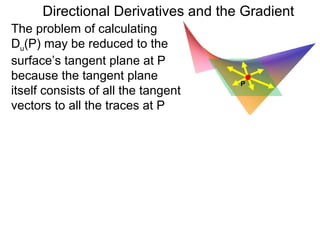
The problem of calculating
Du(P) may be reduced to the
surface’s tangent plane at P
because the tangent plane
itself consists of all the tangent
vectors to all the traces at P
Directional Derivatives and the Gradient
The problem of calculating
Du(P) may be reduced to the
surface’s tangent plane at P
because the tangent plane
                                     P
itself consists of all the tangent
vectors to all the traces at P
Directional Derivatives and the Gradient
The problem of calculating
Du(P) may be reduced to the
surface’s tangent plane at P
because the tangent plane
                                      P
itself consists of all the tangent
vectors to all the traces at P and
Du(P) are precisely the directional       x

slopes of these vectors.
Directional Derivatives and the Gradient
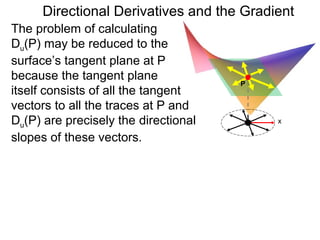
The problem of calculating
Du(P) may be reduced to the
surface’s tangent plane at P
because the tangent plane
                                            P
itself consists of all the tangent
vectors to all the traces at P and
Du(P) are precisely the directional                  x

slopes of these vectors.
Hence let’s study the directional derivatives of a
plane.
Directional Derivatives and the Gradient
The problem of calculating
Du(P) may be reduced to the
surface’s tangent plane at P
because the tangent plane
                                            P
itself consists of all the tangent
vectors to all the traces at P and
Du(P) are precisely the directional                  x

slopes of these vectors.
Hence let’s study the directional derivatives of a
plane.
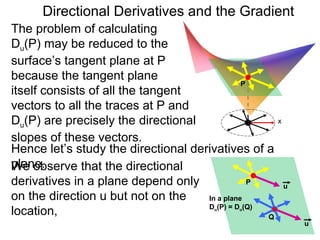
We observe that the directional
derivatives in a plane depend only
on the direction u but not on the
location,
Directional Derivatives and the Gradient
The problem of calculating
Du(P) may be reduced to the
surface’s tangent plane at P
because the tangent plane
                                               P
itself consists of all the tangent
vectors to all the traces at P and
Du(P) are precisely the directional                    x

slopes of these vectors.
Hence let’s study the directional derivatives of a
plane.
We observe that the directional
derivatives in a plane depend only               P
                                                           u
on the direction u but not on the    In a plane
                                     D (P) = D (Q)
location,                               u    u

                                                   Q
                                                               u
Directional Derivatives and the Gradient
The problem of calculating
Du(P) may be reduced to the
surface’s tangent plane at P
because the tangent plane
                                                P
itself consists of all the tangent
vectors to all the traces at P and
Du(P) are precisely the directional                     x

slopes of these vectors.
Hence let’s study the directional derivatives of a
plane.
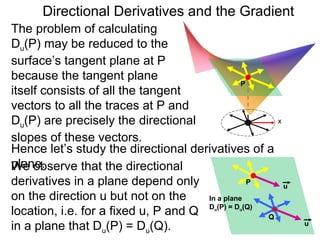
We observe that the directional
derivatives in a plane depend only                P
                                                            u
on the direction u but not on the     In a plane
location, i.e. for a fixed u, P and Q D (P) = D (Q) Q
                                        u     u


in a plane that Du(P) = Du(Q).                                  u
Directional Derivatives and the Gradient
We also note that the directional derivatives in the
plane are determined by the way the plane sits in
space. For example, a flat plane defined by z = c has
the Du(P) = 0 for all u's and P's.
Directional Derivatives and the Gradient
We also note that the directional derivatives in the
plane are determined by the way the plane sits in
space. For example, a flat plane defined by z = c has
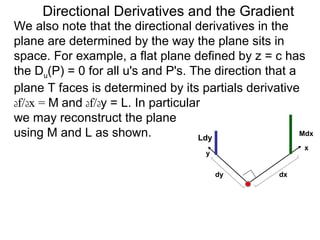
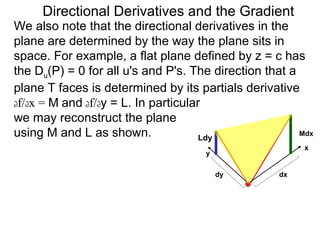
the Du(P) = 0 for all u's and P's. The direction that a
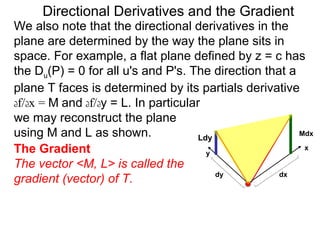
plane T faces is determined by its partials derivative
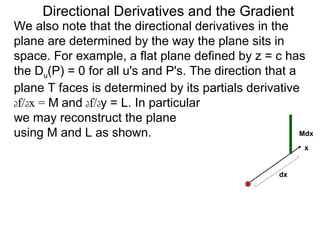
df/dx = M and df/dy = L. In particular
we may reconstruct the plane
using M and L as shown.
Directional Derivatives and the Gradient
We also note that the directional derivatives in the
plane are determined by the way the plane sits in
space. For example, a flat plane defined by z = c has
the Du(P) = 0 for all u's and P's. The direction that a
plane T faces is determined by its partials derivative
df/dx = M and df/dy = L. In particular
we may reconstruct the plane
using M and L as shown.                                 Mdx

                                                         x


                                                    dx
Directional Derivatives and the Gradient
We also note that the directional derivatives in the
plane are determined by the way the plane sits in
space. For example, a flat plane defined by z = c has
the Du(P) = 0 for all u's and P's. The direction that a
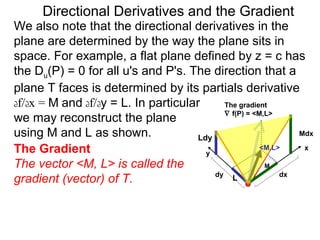
plane T faces is determined by its partials derivative
df/dx = M and df/dy = L. In particular
we may reconstruct the plane
using M and L as shown.               Ldy
                                                        Mdx

                                                         x
                                     y


                                         dy         dx
Directional Derivatives and the Gradient
We also note that the directional derivatives in the
plane are determined by the way the plane sits in
space. For example, a flat plane defined by z = c has
the Du(P) = 0 for all u's and P's. The direction that a
plane T faces is determined by its partials derivative
df/dx = M and df/dy = L. In particular
we may reconstruct the plane
using M and L as shown.               Ldy
                                                        Mdx

                                                         x
                                     y


                                         dy         dx
Directional Derivatives and the Gradient
We also note that the directional derivatives in the
plane are determined by the way the plane sits in
space. For example, a flat plane defined by z = c has
the Du(P) = 0 for all u's and P's. The direction that a
plane T faces is determined by its partials derivative
df/dx = M and df/dy = L. In particular
we may reconstruct the plane
using M and L as shown.               Ldy
                                                        Mdx

The Gradient                            y
                                                         x

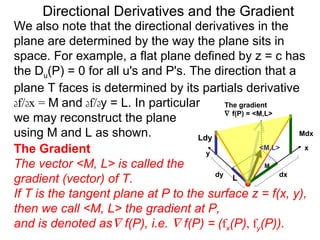
The vector <M, L> is called the
                                          dy        dx
gradient (vector) of T.
Directional Derivatives and the Gradient
We also note that the directional derivatives in the
plane are determined by the way the plane sits in
space. For example, a flat plane defined by z = c has
the Du(P) = 0 for all u's and P's. The direction that a
plane T faces is determined by its partials derivative
df/dx = M and df/dy = L. In particular       The gradient
                                             ∇ f(P) = <M,L>
we may reconstruct the plane
using M and L as shown.               Ldy
                                                                Mdx

The Gradient                            y
                                                        <M,L>    x

The vector <M, L> is called the                          M
                                          dy                 dx
gradient (vector) of T.                        L
Directional Derivatives and the Gradient
We also note that the directional derivatives in the
plane are determined by the way the plane sits in
space. For example, a flat plane defined by z = c has
the Du(P) = 0 for all u's and P's. The direction that a
plane T faces is determined by its partials derivative
df/dx = M and df/dy = L. In particular       The gradient
                                             ∇ f(P) = <M,L>
we may reconstruct the plane
using M and L as shown.               Ldy
                                                                Mdx

The Gradient                            y
                                                        <M,L>    x

The vector <M, L> is called the                          M
                                          dy                 dx
gradient (vector) of T.                        L

If T is the tangent plane at P to the surface z = f(x, y),
then we call <M, L> the gradient at P,
and is denoted as∇ f(P), i.e. ∇ f(P) = (fx(P), fy(P)).
Directional Derivatives and the Gradient
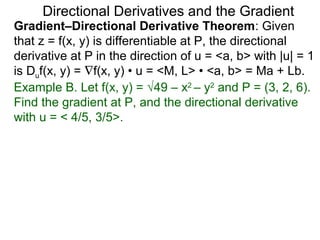
Gradient–Directional Derivative Theorem: Given
that z = f(x, y) is differentiable at P, the directional
derivative at P in the direction of u = <a, b> with |u| = 1
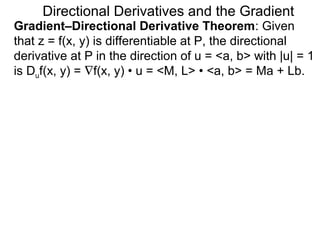
is Duf(x, y) = ∇f(x, y) • u = <M, L> • <a, b> = Ma + Lb.
Directional Derivatives and the Gradient
Gradient–Directional Derivative Theorem: Given
that z = f(x, y) is differentiable at P, the directional
derivative at P in the direction of u = <a, b> with |u| = 1
is Duf(x, y) = ∇f(x, y) • u = <M, L> • <a, b> = Ma + Lb.
Example B. Let f(x, y) = √49 – x2 – y2 and P = (3, 2, 6).
Find the gradient at P, and the directional derivative
with u = < 4/5, 3/5>.
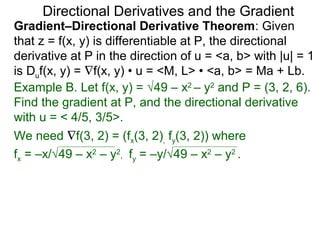
Directional Derivatives and the Gradient
Gradient–Directional Derivative Theorem: Given
that z = f(x, y) is differentiable at P, the directional
derivative at P in the direction of u = <a, b> with |u| = 1
is Duf(x, y) = ∇f(x, y) • u = <M, L> • <a, b> = Ma + Lb.
Example B. Let f(x, y) = √49 – x2 – y2 and P = (3, 2, 6).
Find the gradient at P, and the directional derivative
with u = < 4/5, 3/5>.
We need ∇f(3, 2) = (fx(3, 2), fy(3, 2)) where
fx = –x/√49 – x2 – y2, fy = –y/√49 – x2 – y2 .
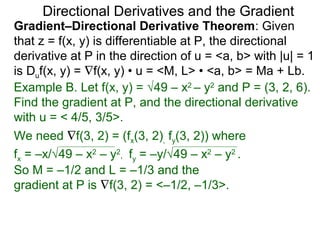
Directional Derivatives and the Gradient
Gradient–Directional Derivative Theorem: Given
that z = f(x, y) is differentiable at P, the directional
derivative at P in the direction of u = <a, b> with |u| = 1
is Duf(x, y) = ∇f(x, y) • u = <M, L> • <a, b> = Ma + Lb.
Example B. Let f(x, y) = √49 – x2 – y2 and P = (3, 2, 6).
Find the gradient at P, and the directional derivative
with u = < 4/5, 3/5>.
We need ∇f(3, 2) = (fx(3, 2), fy(3, 2)) where
fx = –x/√49 – x2 – y2, fy = –y/√49 – x2 – y2 .
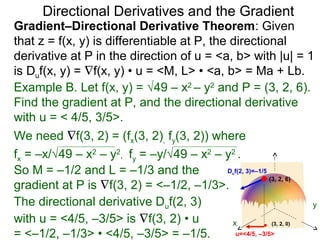
So M = –1/2 and L = –1/3 and the
gradient at P is ∇f(3, 2) = <–1/2, –1/3>.
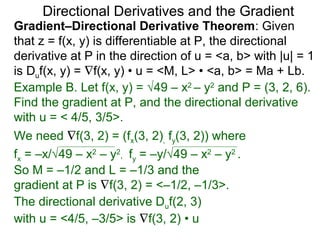
Directional Derivatives and the Gradient
Gradient–Directional Derivative Theorem: Given
that z = f(x, y) is differentiable at P, the directional
derivative at P in the direction of u = <a, b> with |u| = 1
is Duf(x, y) = ∇f(x, y) • u = <M, L> • <a, b> = Ma + Lb.
Example B. Let f(x, y) = √49 – x2 – y2 and P = (3, 2, 6).
Find the gradient at P, and the directional derivative
with u = < 4/5, 3/5>.
We need ∇f(3, 2) = (fx(3, 2), fy(3, 2)) where
fx = –x/√49 – x2 – y2, fy = –y/√49 – x2 – y2 .
So M = –1/2 and L = –1/3 and the
gradient at P is ∇f(3, 2) = <–1/2, –1/3>.
The directional derivative Duf(2, 3)
with u = <4/5, –3/5> is ∇f(3, 2) • u
Directional Derivatives and the Gradient
Gradient–Directional Derivative Theorem: Given
that z = f(x, y) is differentiable at P, the directional
derivative at P in the direction of u = <a, b> with |u| = 1
is Duf(x, y) = ∇f(x, y) • u = <M, L> • <a, b> = Ma + Lb.
Example B. Let f(x, y) = √49 – x2 – y2 and P = (3, 2, 6).
Find the gradient at P, and the directional derivative
with u = < 4/5, 3/5>.
We need ∇f(3, 2) = (fx(3, 2), fy(3, 2)) where
fx = –x/√49 – x2 – y2, fy = –y/√49 – x2 – y2 .
So M = –1/2 and L = –1/3 and the
gradient at P is ∇f(3, 2) = <–1/2, –1/3>.
The directional derivative Duf(2, 3)
with u = <4/5, –3/5> is ∇f(3, 2) • u
= <–1/2, –1/3> • <4/5, –3/5> = –1/5.
Directional Derivatives and the Gradient
Gradient–Directional Derivative Theorem: Given
that z = f(x, y) is differentiable at P, the directional
derivative at P in the direction of u = <a, b> with |u| = 1
is Duf(x, y) = ∇f(x, y) • u = <M, L> • <a, b> = Ma + Lb.
Example B. Let f(x, y) = √49 – x2 – y2 and P = (3, 2, 6).
Find the gradient at P, and the directional derivative
with u = < 4/5, 3/5>.
We need ∇f(3, 2) = (fx(3, 2), fy(3, 2)) where
fx = –x/√49 – x2 – y2, fy = –y/√49 – x2 – y2 .
So M = –1/2 and L = –1/3 and the            D f(2, 3)=–1/5
                                                   u
                                                           (3, 2, 6)
gradient at P is ∇f(3, 2) = <–1/2, –1/3>.
The directional derivative Duf(2, 3)                                  y
with u = <4/5, –3/5> is ∇f(3, 2) • u         x              (3, 2, 0)

= <–1/2, –1/3> • <4/5, –3/5> = –1/5.           u=<4/5, –3/5>
Directional Derivatives and the Gradient
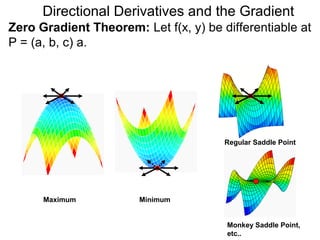
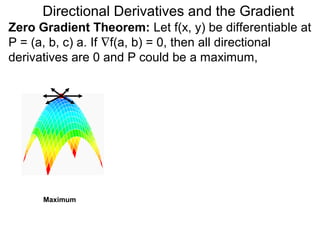
Zero Gradient Theorem: Let f(x, y) be differentiable at
P = (a, b, c) a.


                                       Regular Saddle Point


      Maximum          Minimum


                                       Monkey Saddle Point,
                                       etc..
Directional Derivatives and the Gradient
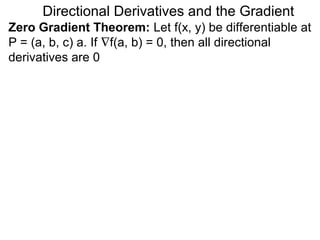
Zero Gradient Theorem: Let f(x, y) be differentiable at
P = (a, b, c) a. If ∇f(a, b) = 0, then all directional
derivatives are 0
Directional Derivatives and the Gradient
Zero Gradient Theorem: Let f(x, y) be differentiable at
P = (a, b, c) a. If ∇f(a, b) = 0, then all directional
derivatives are 0 and P could be a maximum,


      Maximum
Directional Derivatives and the Gradient
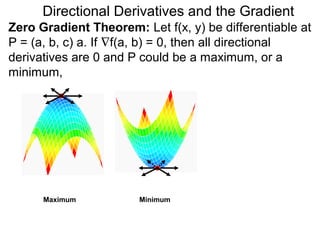
Zero Gradient Theorem: Let f(x, y) be differentiable at
P = (a, b, c) a. If ∇f(a, b) = 0, then all directional
derivatives are 0 and P could be a maximum, or a
minimum,


      Maximum          Minimum
Directional Derivatives and the Gradient
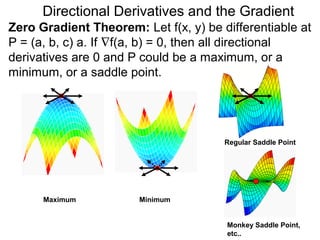
Zero Gradient Theorem: Let f(x, y) be differentiable at
P = (a, b, c) a. If ∇f(a, b) = 0, then all directional
derivatives are 0 and P could be a maximum, or a
minimum, or a saddle point.


                                       Regular Saddle Point


      Maximum          Minimum


                                       Monkey Saddle Point,
                                       etc..
Directional Derivatives and the Gradient
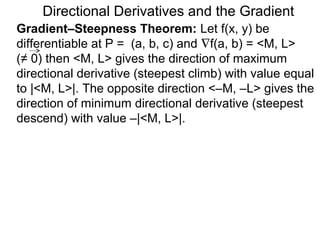
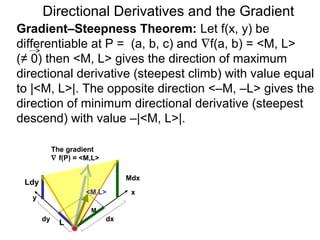
Gradient–Steepness Theorem: Let f(x, y) be
differentiable at P = (a, b, c) and ∇f(a, b) = <M, L>
(≠ 0) then <M, L> gives the direction of maximum
directional derivative (steepest climb) with value equal
to |<M, L>|. The opposite direction <–M, –L> gives the
direction of minimum directional derivative (steepest
descend) with value –|<M, L>|.
Directional Derivatives and the Gradient
Gradient–Steepness Theorem: Let f(x, y) be
differentiable at P = (a, b, c) and ∇f(a, b) = <M, L>
(≠ 0) then <M, L> gives the direction of maximum
directional derivative (steepest climb) with value equal
to |<M, L>|. The opposite direction <–M, –L> gives the
direction of minimum directional derivative (steepest
descend) with value –|<M, L>|.

            The gradient
            ∇ f(P) = <M,L>

                                  Mdx
 Ldy
                      <M,L>        x
   y
                       M
       dy                    dx
              L
Directional Derivatives and the Gradient
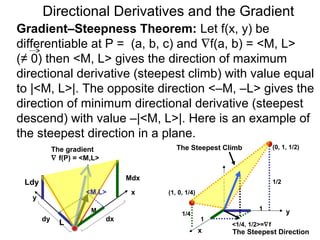
Gradient–Steepness Theorem: Let f(x, y) be
differentiable at P = (a, b, c) and ∇f(a, b) = <M, L>
(≠ 0) then <M, L> gives the direction of maximum
directional derivative (steepest climb) with value equal
to |<M, L>|. The opposite direction <–M, –L> gives the
direction of minimum directional derivative (steepest
descend) with value –|<M, L>|. Here is an example of
the steepest direction in a plane.
            The gradient                   The Steepest Climb             (0, 1, 1/2)
            ∇ f(P) = <M,L>

                                  Mdx
 Ldy                                                                      1/2
                      <M,L>        x    (1, 0, 1/4)
   y
                       M                                           1
                                             1/4                                y
       dy                    dx                       1
              L                                           <1/4, 1/2>=∇f
                                                      x   The Steepest Direction
Directional Derivatives and the Gradient
Example: Let f(x, y) = √k – x2 – y2, with k > 0. Draw the
gradient in the R2 plane at (a, b) in the domain.
Directional Derivatives and the Gradient
Example: Let f(x, y) = √k – x2 – y2, with k > 0. Draw the
gradient in the R2 plane at (a, b) in the domain.
We have fx = –x/√49 – x2 – y2, fy = –y/√49 – x2 – y2 .
Directional Derivatives and the Gradient
Example: Let f(x, y) = √k – x2 – y2, with k > 0. Draw the
gradient in the R2 plane at (a, b) in the domain.
We have fx = –x/√49 – x2 – y2, fy = –y/√49 – x2 – y2 .
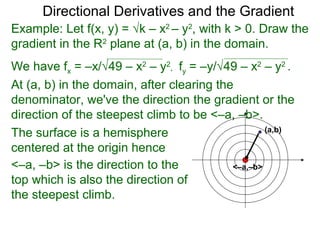
At (a, b) in the domain, after clearing the
denominator, we've the direction the gradient or the
direction of the steepest climb to be <–a, –b>.
Directional Derivatives and the Gradient
Example: Let f(x, y) = √k – x2 – y2, with k > 0. Draw the
gradient in the R2 plane at (a, b) in the domain.
We have fx = –x/√49 – x2 – y2, fy = –y/√49 – x2 – y2 .
At (a, b) in the domain, after clearing the
denominator, we've the direction the gradient or the
direction of the steepest climb to be <–a, –b>.
The surface is a hemisphere
centered at the origin hence
<–a, –b> is the direction to the
top which is also the direction of
the steepest climb.
Directional Derivatives and the Gradient
Example: Let f(x, y) = √k – x2 – y2, with k > 0. Draw the
gradient in the R2 plane at (a, b) in the domain.
We have fx = –x/√49 – x2 – y2, fy = –y/√49 – x2 – y2 .
At (a, b) in the domain, after clearing the
denominator, we've the direction the gradient or the
direction of the steepest climb to be <–a, –b>.
                                                   (a,b)
The surface is a hemisphere
centered at the origin hence
<–a, –b> is the direction to the           <–a,–b>
top which is also the direction of
the steepest climb.
Directional Derivatives and the Gradient
Gradient–Level Theorem: Let f(x, y) be differentiable
at P with a nonzero gradient then the gradient is
perpendicular to the level curve.
Directional Derivatives and the Gradient
Gradient–Level Theorem: Let f(x, y) be differentiable
at P with a nonzero gradient then the gradient is
perpendicular to the level curve.
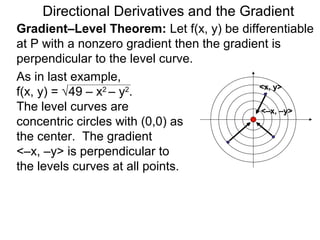
As in last example,
f(x, y) = √49 – x2 – y2.
The level curves are
concentric circles with (0,0) as
the center.
Directional Derivatives and the Gradient
Gradient–Level Theorem: Let f(x, y) be differentiable
at P with a nonzero gradient then the gradient is
perpendicular to the level curve.
As in last example,
                                            <x, y>
f(x, y) = √49 – x2 – y2.
The level curves are                        <–x, –y>
concentric circles with (0,0) as
the center. The gradient
<–x, –y> is perpendicular to
the levels curves at all points.

18 directional derivatives and gradient

  • 1.
  • 2.
    Directional Derivatives andthe Gradient Given a vector v = <x, y>, we define the directional y slope of v to be |x|.
  • 3.
    Directional Derivatives andthe Gradient Given a vector v = <x, y>, we define the directional y slope of v to be |x|. Example A. Find the directional slope of <1, 2>, <–1, –2>, <1, –2> and <–1, 2>.
  • 4.
    Directional Derivatives andthe Gradient Given a vector v = <x, y>, we define the directional y slope of v to be |x|. Example A. Find the directional slope of <1, 2>, <–1, –2>, <1, –2> and <–1, 2>. The directional slope of y <–1, 2> <1, 2> a. <1, 2> is 2, b. <–1, 2> is 2, x
  • 5.
    Directional Derivatives andthe Gradient Given a vector v = <x, y>, we define the directional y slope of v to be |x|. Example A. Find the directional slope of <1, 2>, <–1, –2>, <1, –2> and <–1, 2>. The directional slope of y <–1, 2> <1, 2> a. <1, 2> is 2, b. <–1, 2> is 2, x c. <–1, –2> is –2, <–1, –2> <1, –2> d. <1, –2> is –2.
  • 6.
    Directional Derivatives andthe Gradient Given a vector v = <x, y>, we define the directional y slope of v to be |x|. Example A. Find the directional slope of <1, 2>, <–1, –2>, <1, –2> and <–1, 2>. The directional slope of y <–1, 2> <1, 2> a. <1, 2> is 2, b. <–1, 2> is 2, x c. <–1, –2> is –2, <–1, –2> <1, –2> d. <1, –2> is –2. The directional slope of v indicates the steepness of v and the vertical direction it’s pointing. Positive directional slope indicates v points upward and negative directional slope means v points downward.
  • 7.
    Directional Derivatives andthe Gradient y = f(x) Given a differentiable point p on the p curve y = f(x) and a tangent vector v at p, depending whether v points up or down, we obtain two possible directional slopes for v.
  • 8.
    Directional Derivatives andthe Gradient y = f(x) Given a differentiable point p on the p curve y = f(x) and a tangent vector v at p, depending whether v points up or down, we obtain two possible directional slopes for v. If v points to the right in the positive x–axis direction then its directional slope is f '(x), and if v points to the left then the directional slope of v is –f '(x).
  • 9.
    Directional Derivatives andthe Gradient y = f(x) Given a differentiable point p on the p curve y = f(x) and a tangent vector v at p, depending whether v points up or down, we obtain two possible directional slopes for v. If v points to the right in the positive x–axis direction then its directional slope is f '(x), and if v points to the left then the directional slope of v is –f '(x). For example, v = <1, –2> and u = <–2, 4> y=x 2 u = <–2, 4> are tangent to y = x 2 at (–1, 1), x v = <1, –2>
  • 10.
    Directional Derivatives andthe Gradient y = f(x) Given a differentiable point p on the p curve y = f(x) and a tangent vector v at p, depending whether v points up or down, we obtain two possible directional slopes for v. If v points to the right in the positive x–axis direction then its directional slope is f '(x), and if v points to the left then the directional slope of v is –f '(x). For example, v = <1, –2> and y=x 2 u = <–2, 4> are tangent to y = x 2 at (–1, 1), v points to the positive x–axis direction, so its directional slope is –2 = f '(x), x v = <1, –2>
  • 11.
    Directional Derivatives andthe Gradient y = f(x) Given a differentiable point p on the p curve y = f(x) and a tangent vector v at p, depending whether v points up or down, we obtain two possible directional slopes for v. If v points to the right in the positive x–axis direction then its directional slope is f '(x), and if v points to the left then the directional slope of v is –f '(x). For example, v = <1, –2> and u = <–2, 4> y=x 2 u = <–2, 4> are tangent to y = x 2 at (–1, 1), v points to the positive x–axis direction, so its directional slope is –2 = f '(x), and u points in x the negative x–axis direction with directional slope 2 = –f '(x). v = <1, –2>
  • 12.
    Directional Derivatives andthe Gradient Let P = (a, b, c) be a differentiable point on the surface defined by z = f(x, y). The plane y = b is aligned in the two directions of <1, 0> or <–1, 0> on the unit circle.
  • 13.
    Directional Derivatives andthe Gradient Let P = (a, b, c) be a differentiable point on the surface defined by z = f(x, y). The plane y = b is aligned in the two directions of <1, 0> or <–1, 0> on the unit circle. In the x–axis direction z = f(x, y) P=(a, b, c) y x <–1, 0> (a, b) <1, 0>
  • 14.
    Directional Derivatives andthe Gradient Let P = (a, b, c) be a differentiable point on the surface defined by z = f(x, y). The plane y = b is aligned in the two directions of <1, 0> or <–1, 0> on the unit circle. The partial derivative df/dx|p= M is the directional slope in the direction <1, 0> at P, In the x–axis direction z = f(x, y) P=(a, b, c) y x <–1, 0> (a, b) <1, 0>
  • 15.
    Directional Derivatives andthe Gradient Let P = (a, b, c) be a differentiable point on the surface defined by z = f(x, y). The plane y = b is aligned in the two directions of <1, 0> or <–1, 0> on the unit circle. The partial derivative df/dx|p= M is the directional slope in the direction <1, 0> at P, In the x–axis direction z = f(x, y) P=(a, b, c) y x <–1, 0> (a, b) <1, 0>
  • 16.
    Directional Derivatives andthe Gradient Let P = (a, b, c) be a differentiable point on the surface defined by z = f(x, y). The plane y = b is aligned in the two directions of <1, 0> or <–1, 0> on the unit circle. The partial derivative df/dx|p= M is the directional slope in the direction <1, 0> at P, In the x–axis direction z y=b z = f(x, y) P P=(a, b, c) directional slope = df/dx|p = M y x x <–1, 0> (a, b) <1, 0>
  • 17.
    Directional Derivatives andthe Gradient Let P = (a, b, c) be a differentiable point on the surface defined by z = f(x, y). The plane y = b is aligned in the two directions of <1, 0> or <–1, 0> on the unit circle. The partial derivative df/dx|p= M is the directional slope in the direction <1, 0> at P, so M = df/dx|p is also called the directional derivative in the direction of <1, 0> In the x–axis direction z y=b z = f(x, y) P P=(a, b, c) directional slope = df/dx|p = M y x x <–1, 0> (a, b) <1, 0>
  • 18.
    Directional Derivatives andthe Gradient Let P = (a, b, c) be a differentiable point on the surface defined by z = f(x, y). The plane y = b is aligned in the two directions of <1, 0> or <–1, 0> on the unit circle. The partial derivative df/dx|p= M is the directional slope in the direction <1, 0> at P, so M = df/dx|p is also called the directional derivative in the direction of <1, 0> and an opposite tangent has directional derivative –M. In the x–axis direction z y=b z = f(x, y) P P=(a, b, c) directional slope = df/dx|p = M y x x <–1, 0> (a, b) <1, 0>
  • 19.
    Directional Derivatives andthe Gradient Let P = (a, b, c) be a differentiable point on the surface defined by z = f(x, y). The plane y = b is aligned in the two directions of <1, 0> or <–1, 0> on the unit circle. The partial derivative df/dx|p= M is the directional slope in the direction <1, 0> at P, so M = df/dx|p is also called the directional derivative in the direction of <1, 0> and an opposite tangent has directional derivative –M. In the x–axis direction z y=b z = f(x, y) P P=(a, b, c) directional slope = df/dx|p = M directional slope y = –df/dx|p = – M x x <–1, 0> (a, b) <1, 0>
  • 20.
    Directional Derivatives andthe Gradient In other words, if we’re standing at P with a compass, the directional derivative in direction of <1, 0>, i.e. to the east, which is M = df/dx|p, In the x–axis direction z y=b z = f(x, y) P P=(a, b, c) directional slope = df/dx|p = M y x x <–1, 0> <1, 0> (a, b)
  • 21.
    Directional Derivatives andthe Gradient In other words, if we’re standing at P with a compass, the directional derivative in direction of <1, 0>, i.e. to the east, which is M = df/dx|p, indicates the up or down and the steepness of the trail that is heading eastward. In the x–axis direction z y=b z = f(x, y) P P=(a, b, c) directional slope = df/dx|p = M y x x <–1, 0> <1, 0> (a, b)
  • 22.
    Directional Derivatives andthe Gradient In other words, if we’re standing at P with a compass, the directional derivative in direction of <1, 0>, i.e. to the east, which is M = df/dx|p, indicates the up or down and the steepness of the trail that is heading eastward. Likewise, –M = –df/dx|p indicates the up or down and the steepness of the trail that is heading in the <–1, 0> direction or to the west. In the x–axis direction z y=b z = f(x, y) P P=(a, b, c) directional slope = df/dx|p = M directional slope y = –df/dx|p = – M x x <–1, 0> <1, 0> (a, b)
  • 23.
    Directional Derivatives andthe Gradient In general, given any 2D (unit) directional vector u = <a, b>, y x (a, b) u = <a, b>
  • 24.
    Directional Derivatives andthe Gradient In general, given any 2D (unit) directional vector u = <a, b>, the plane that contains the point P aligned in the direction of u, makes a trace on the surface z = f(x, y). y x (a, b) u = <a, b>
  • 25.
    Directional Derivatives andthe Gradient In general, given any 2D (unit) directional vector u = <a, b>, the plane that contains the point P aligned in the direction of u, makes a trace on the surface z = f(x, y). In the u–direction P=(a, b, c) y x (a, b) u = <a, b>
  • 26.
    Directional Derivatives andthe Gradient In general, given any 2D (unit) directional vector u = <a, b>, the plane that contains the point P aligned in the direction of u, makes a trace on the surface z = f(x, y). We define the directional derivative in the direction of u at P, denoted as D u(P), to be the directional slope of any vector tangent at P in the direction u. In the u–direction P=(a, b, c) y x (a, b) u = <a, b>
  • 27.
    Directional Derivatives andthe Gradient In general, given any 2D (unit) directional vector u = <a, b>, the plane that contains the point P aligned in the direction of u, makes a trace on the surface z = f(x, y). We define the directional derivative in the direction of u at P, denoted as D u(P), to be the directional slope of any vector tangent at P in the direction u. z In the u–direction P=(a, b, c) P=(a, b, c) y Du(P) = the directional derivative x (a, b) = the directional slope of any tangent, u = <a, b> in the direction of u.
  • 28.
    Directional Derivatives andthe Gradient Again using the trail–analogy that if we’re standing at P, with the compass needle pointing in the direction of u = <a, b>, Du(P) indicates the up or down and the steepness of the trail that is heading in the u–direction. z In the u–direction P=(a, b, c) P=(a, b, c) y Du(P) = the directional derivative x (a, b) = the directional slope of any tangent, u = <a, b> in the direction of u.
  • 29.
    Directional Derivatives andthe Gradient Again using the trail–analogy that if we’re standing at P, with the compass needle pointing in the direction of u = <a, b>, Du(P) indicates the up or down and the steepness of the trail that is heading in the u–direction. Note that D–u(P), the opposite directional derivative, satisfies D–u(P) = –Du(P). z In the u–direction P=(a, b, c) P=(a, b, c) y –u Du(P) = the directional derivative x (a, b) = the directional slope of any tangent, u = <a, b> in the direction of u.
  • 30.
    Directional Derivatives andthe Gradient The problem of calculating Du(P) may be reduced to the surface’s tangent plane at P because the tangent plane itself consists of all the tangent vectors to all the traces at P
  • 31.
    Directional Derivatives andthe Gradient The problem of calculating Du(P) may be reduced to the surface’s tangent plane at P because the tangent plane P itself consists of all the tangent vectors to all the traces at P
  • 32.
    Directional Derivatives andthe Gradient The problem of calculating Du(P) may be reduced to the surface’s tangent plane at P because the tangent plane P itself consists of all the tangent vectors to all the traces at P and Du(P) are precisely the directional x slopes of these vectors.
  • 33.
    Directional Derivatives andthe Gradient The problem of calculating Du(P) may be reduced to the surface’s tangent plane at P because the tangent plane P itself consists of all the tangent vectors to all the traces at P and Du(P) are precisely the directional x slopes of these vectors. Hence let’s study the directional derivatives of a plane.
  • 34.
    Directional Derivatives andthe Gradient The problem of calculating Du(P) may be reduced to the surface’s tangent plane at P because the tangent plane P itself consists of all the tangent vectors to all the traces at P and Du(P) are precisely the directional x slopes of these vectors. Hence let’s study the directional derivatives of a plane. We observe that the directional derivatives in a plane depend only on the direction u but not on the location,
  • 35.
    Directional Derivatives andthe Gradient The problem of calculating Du(P) may be reduced to the surface’s tangent plane at P because the tangent plane P itself consists of all the tangent vectors to all the traces at P and Du(P) are precisely the directional x slopes of these vectors. Hence let’s study the directional derivatives of a plane. We observe that the directional derivatives in a plane depend only P u on the direction u but not on the In a plane D (P) = D (Q) location, u u Q u
  • 36.
    Directional Derivatives andthe Gradient The problem of calculating Du(P) may be reduced to the surface’s tangent plane at P because the tangent plane P itself consists of all the tangent vectors to all the traces at P and Du(P) are precisely the directional x slopes of these vectors. Hence let’s study the directional derivatives of a plane. We observe that the directional derivatives in a plane depend only P u on the direction u but not on the In a plane location, i.e. for a fixed u, P and Q D (P) = D (Q) Q u u in a plane that Du(P) = Du(Q). u
  • 37.
    Directional Derivatives andthe Gradient We also note that the directional derivatives in the plane are determined by the way the plane sits in space. For example, a flat plane defined by z = c has the Du(P) = 0 for all u's and P's.
  • 38.
    Directional Derivatives andthe Gradient We also note that the directional derivatives in the plane are determined by the way the plane sits in space. For example, a flat plane defined by z = c has the Du(P) = 0 for all u's and P's. The direction that a plane T faces is determined by its partials derivative df/dx = M and df/dy = L. In particular we may reconstruct the plane using M and L as shown.
  • 39.
    Directional Derivatives andthe Gradient We also note that the directional derivatives in the plane are determined by the way the plane sits in space. For example, a flat plane defined by z = c has the Du(P) = 0 for all u's and P's. The direction that a plane T faces is determined by its partials derivative df/dx = M and df/dy = L. In particular we may reconstruct the plane using M and L as shown. Mdx x dx
  • 40.
    Directional Derivatives andthe Gradient We also note that the directional derivatives in the plane are determined by the way the plane sits in space. For example, a flat plane defined by z = c has the Du(P) = 0 for all u's and P's. The direction that a plane T faces is determined by its partials derivative df/dx = M and df/dy = L. In particular we may reconstruct the plane using M and L as shown. Ldy Mdx x y dy dx
  • 41.
    Directional Derivatives andthe Gradient We also note that the directional derivatives in the plane are determined by the way the plane sits in space. For example, a flat plane defined by z = c has the Du(P) = 0 for all u's and P's. The direction that a plane T faces is determined by its partials derivative df/dx = M and df/dy = L. In particular we may reconstruct the plane using M and L as shown. Ldy Mdx x y dy dx
  • 42.
    Directional Derivatives andthe Gradient We also note that the directional derivatives in the plane are determined by the way the plane sits in space. For example, a flat plane defined by z = c has the Du(P) = 0 for all u's and P's. The direction that a plane T faces is determined by its partials derivative df/dx = M and df/dy = L. In particular we may reconstruct the plane using M and L as shown. Ldy Mdx The Gradient y x The vector <M, L> is called the dy dx gradient (vector) of T.
  • 43.
    Directional Derivatives andthe Gradient We also note that the directional derivatives in the plane are determined by the way the plane sits in space. For example, a flat plane defined by z = c has the Du(P) = 0 for all u's and P's. The direction that a plane T faces is determined by its partials derivative df/dx = M and df/dy = L. In particular The gradient ∇ f(P) = <M,L> we may reconstruct the plane using M and L as shown. Ldy Mdx The Gradient y <M,L> x The vector <M, L> is called the M dy dx gradient (vector) of T. L
  • 44.
    Directional Derivatives andthe Gradient We also note that the directional derivatives in the plane are determined by the way the plane sits in space. For example, a flat plane defined by z = c has the Du(P) = 0 for all u's and P's. The direction that a plane T faces is determined by its partials derivative df/dx = M and df/dy = L. In particular The gradient ∇ f(P) = <M,L> we may reconstruct the plane using M and L as shown. Ldy Mdx The Gradient y <M,L> x The vector <M, L> is called the M dy dx gradient (vector) of T. L If T is the tangent plane at P to the surface z = f(x, y), then we call <M, L> the gradient at P, and is denoted as∇ f(P), i.e. ∇ f(P) = (fx(P), fy(P)).
  • 45.
    Directional Derivatives andthe Gradient Gradient–Directional Derivative Theorem: Given that z = f(x, y) is differentiable at P, the directional derivative at P in the direction of u = <a, b> with |u| = 1 is Duf(x, y) = ∇f(x, y) • u = <M, L> • <a, b> = Ma + Lb.
  • 46.
    Directional Derivatives andthe Gradient Gradient–Directional Derivative Theorem: Given that z = f(x, y) is differentiable at P, the directional derivative at P in the direction of u = <a, b> with |u| = 1 is Duf(x, y) = ∇f(x, y) • u = <M, L> • <a, b> = Ma + Lb. Example B. Let f(x, y) = √49 – x2 – y2 and P = (3, 2, 6). Find the gradient at P, and the directional derivative with u = < 4/5, 3/5>.
  • 47.
    Directional Derivatives andthe Gradient Gradient–Directional Derivative Theorem: Given that z = f(x, y) is differentiable at P, the directional derivative at P in the direction of u = <a, b> with |u| = 1 is Duf(x, y) = ∇f(x, y) • u = <M, L> • <a, b> = Ma + Lb. Example B. Let f(x, y) = √49 – x2 – y2 and P = (3, 2, 6). Find the gradient at P, and the directional derivative with u = < 4/5, 3/5>. We need ∇f(3, 2) = (fx(3, 2), fy(3, 2)) where fx = –x/√49 – x2 – y2, fy = –y/√49 – x2 – y2 .
  • 48.
    Directional Derivatives andthe Gradient Gradient–Directional Derivative Theorem: Given that z = f(x, y) is differentiable at P, the directional derivative at P in the direction of u = <a, b> with |u| = 1 is Duf(x, y) = ∇f(x, y) • u = <M, L> • <a, b> = Ma + Lb. Example B. Let f(x, y) = √49 – x2 – y2 and P = (3, 2, 6). Find the gradient at P, and the directional derivative with u = < 4/5, 3/5>. We need ∇f(3, 2) = (fx(3, 2), fy(3, 2)) where fx = –x/√49 – x2 – y2, fy = –y/√49 – x2 – y2 . So M = –1/2 and L = –1/3 and the gradient at P is ∇f(3, 2) = <–1/2, –1/3>.
  • 49.
    Directional Derivatives andthe Gradient Gradient–Directional Derivative Theorem: Given that z = f(x, y) is differentiable at P, the directional derivative at P in the direction of u = <a, b> with |u| = 1 is Duf(x, y) = ∇f(x, y) • u = <M, L> • <a, b> = Ma + Lb. Example B. Let f(x, y) = √49 – x2 – y2 and P = (3, 2, 6). Find the gradient at P, and the directional derivative with u = < 4/5, 3/5>. We need ∇f(3, 2) = (fx(3, 2), fy(3, 2)) where fx = –x/√49 – x2 – y2, fy = –y/√49 – x2 – y2 . So M = –1/2 and L = –1/3 and the gradient at P is ∇f(3, 2) = <–1/2, –1/3>. The directional derivative Duf(2, 3) with u = <4/5, –3/5> is ∇f(3, 2) • u
  • 50.
    Directional Derivatives andthe Gradient Gradient–Directional Derivative Theorem: Given that z = f(x, y) is differentiable at P, the directional derivative at P in the direction of u = <a, b> with |u| = 1 is Duf(x, y) = ∇f(x, y) • u = <M, L> • <a, b> = Ma + Lb. Example B. Let f(x, y) = √49 – x2 – y2 and P = (3, 2, 6). Find the gradient at P, and the directional derivative with u = < 4/5, 3/5>. We need ∇f(3, 2) = (fx(3, 2), fy(3, 2)) where fx = –x/√49 – x2 – y2, fy = –y/√49 – x2 – y2 . So M = –1/2 and L = –1/3 and the gradient at P is ∇f(3, 2) = <–1/2, –1/3>. The directional derivative Duf(2, 3) with u = <4/5, –3/5> is ∇f(3, 2) • u = <–1/2, –1/3> • <4/5, –3/5> = –1/5.
  • 51.
    Directional Derivatives andthe Gradient Gradient–Directional Derivative Theorem: Given that z = f(x, y) is differentiable at P, the directional derivative at P in the direction of u = <a, b> with |u| = 1 is Duf(x, y) = ∇f(x, y) • u = <M, L> • <a, b> = Ma + Lb. Example B. Let f(x, y) = √49 – x2 – y2 and P = (3, 2, 6). Find the gradient at P, and the directional derivative with u = < 4/5, 3/5>. We need ∇f(3, 2) = (fx(3, 2), fy(3, 2)) where fx = –x/√49 – x2 – y2, fy = –y/√49 – x2 – y2 . So M = –1/2 and L = –1/3 and the D f(2, 3)=–1/5 u (3, 2, 6) gradient at P is ∇f(3, 2) = <–1/2, –1/3>. The directional derivative Duf(2, 3) y with u = <4/5, –3/5> is ∇f(3, 2) • u x (3, 2, 0) = <–1/2, –1/3> • <4/5, –3/5> = –1/5. u=<4/5, –3/5>
  • 52.
    Directional Derivatives andthe Gradient Zero Gradient Theorem: Let f(x, y) be differentiable at P = (a, b, c) a. Regular Saddle Point Maximum Minimum Monkey Saddle Point, etc..
  • 53.
    Directional Derivatives andthe Gradient Zero Gradient Theorem: Let f(x, y) be differentiable at P = (a, b, c) a. If ∇f(a, b) = 0, then all directional derivatives are 0
  • 54.
    Directional Derivatives andthe Gradient Zero Gradient Theorem: Let f(x, y) be differentiable at P = (a, b, c) a. If ∇f(a, b) = 0, then all directional derivatives are 0 and P could be a maximum, Maximum
  • 55.
    Directional Derivatives andthe Gradient Zero Gradient Theorem: Let f(x, y) be differentiable at P = (a, b, c) a. If ∇f(a, b) = 0, then all directional derivatives are 0 and P could be a maximum, or a minimum, Maximum Minimum
  • 56.
    Directional Derivatives andthe Gradient Zero Gradient Theorem: Let f(x, y) be differentiable at P = (a, b, c) a. If ∇f(a, b) = 0, then all directional derivatives are 0 and P could be a maximum, or a minimum, or a saddle point. Regular Saddle Point Maximum Minimum Monkey Saddle Point, etc..
  • 57.
    Directional Derivatives andthe Gradient Gradient–Steepness Theorem: Let f(x, y) be differentiable at P = (a, b, c) and ∇f(a, b) = <M, L> (≠ 0) then <M, L> gives the direction of maximum directional derivative (steepest climb) with value equal to |<M, L>|. The opposite direction <–M, –L> gives the direction of minimum directional derivative (steepest descend) with value –|<M, L>|.
  • 58.
    Directional Derivatives andthe Gradient Gradient–Steepness Theorem: Let f(x, y) be differentiable at P = (a, b, c) and ∇f(a, b) = <M, L> (≠ 0) then <M, L> gives the direction of maximum directional derivative (steepest climb) with value equal to |<M, L>|. The opposite direction <–M, –L> gives the direction of minimum directional derivative (steepest descend) with value –|<M, L>|. The gradient ∇ f(P) = <M,L> Mdx Ldy <M,L> x y M dy dx L
  • 59.
    Directional Derivatives andthe Gradient Gradient–Steepness Theorem: Let f(x, y) be differentiable at P = (a, b, c) and ∇f(a, b) = <M, L> (≠ 0) then <M, L> gives the direction of maximum directional derivative (steepest climb) with value equal to |<M, L>|. The opposite direction <–M, –L> gives the direction of minimum directional derivative (steepest descend) with value –|<M, L>|. Here is an example of the steepest direction in a plane. The gradient The Steepest Climb (0, 1, 1/2) ∇ f(P) = <M,L> Mdx Ldy 1/2 <M,L> x (1, 0, 1/4) y M 1 1/4 y dy dx 1 L <1/4, 1/2>=∇f x The Steepest Direction
  • 60.
    Directional Derivatives andthe Gradient Example: Let f(x, y) = √k – x2 – y2, with k > 0. Draw the gradient in the R2 plane at (a, b) in the domain.
  • 61.
    Directional Derivatives andthe Gradient Example: Let f(x, y) = √k – x2 – y2, with k > 0. Draw the gradient in the R2 plane at (a, b) in the domain. We have fx = –x/√49 – x2 – y2, fy = –y/√49 – x2 – y2 .
  • 62.
    Directional Derivatives andthe Gradient Example: Let f(x, y) = √k – x2 – y2, with k > 0. Draw the gradient in the R2 plane at (a, b) in the domain. We have fx = –x/√49 – x2 – y2, fy = –y/√49 – x2 – y2 . At (a, b) in the domain, after clearing the denominator, we've the direction the gradient or the direction of the steepest climb to be <–a, –b>.
  • 63.
    Directional Derivatives andthe Gradient Example: Let f(x, y) = √k – x2 – y2, with k > 0. Draw the gradient in the R2 plane at (a, b) in the domain. We have fx = –x/√49 – x2 – y2, fy = –y/√49 – x2 – y2 . At (a, b) in the domain, after clearing the denominator, we've the direction the gradient or the direction of the steepest climb to be <–a, –b>. The surface is a hemisphere centered at the origin hence <–a, –b> is the direction to the top which is also the direction of the steepest climb.
  • 64.
    Directional Derivatives andthe Gradient Example: Let f(x, y) = √k – x2 – y2, with k > 0. Draw the gradient in the R2 plane at (a, b) in the domain. We have fx = –x/√49 – x2 – y2, fy = –y/√49 – x2 – y2 . At (a, b) in the domain, after clearing the denominator, we've the direction the gradient or the direction of the steepest climb to be <–a, –b>. (a,b) The surface is a hemisphere centered at the origin hence <–a, –b> is the direction to the <–a,–b> top which is also the direction of the steepest climb.
  • 65.
    Directional Derivatives andthe Gradient Gradient–Level Theorem: Let f(x, y) be differentiable at P with a nonzero gradient then the gradient is perpendicular to the level curve.
  • 66.
    Directional Derivatives andthe Gradient Gradient–Level Theorem: Let f(x, y) be differentiable at P with a nonzero gradient then the gradient is perpendicular to the level curve. As in last example, f(x, y) = √49 – x2 – y2. The level curves are concentric circles with (0,0) as the center.
  • 67.
    Directional Derivatives andthe Gradient Gradient–Level Theorem: Let f(x, y) be differentiable at P with a nonzero gradient then the gradient is perpendicular to the level curve. As in last example, <x, y> f(x, y) = √49 – x2 – y2. The level curves are <–x, –y> concentric circles with (0,0) as the center. The gradient <–x, –y> is perpendicular to the levels curves at all points.