SR PHYSICS ACADEMY
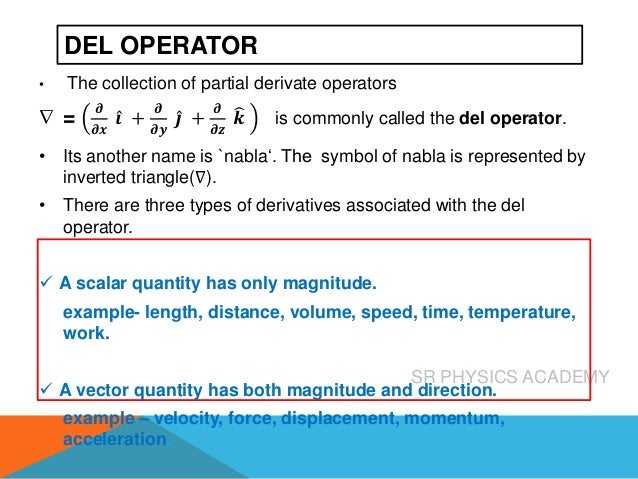
DEL OPERATOR
• The collection of partial derivate operators
 =
𝝏
𝝏𝒙
𝒊 +
𝝏
𝝏𝒚
𝒋 +
𝝏
𝝏𝒛
𝒌 is commonly called the del operator.
• Its another name is `nabla‘. The symbol of nabla is represented by
inverted triangle(∇).
• There are three types of derivatives associated with the del
operator.
 A scalar quantity has only magnitude.
example- length, distance, volume, speed, time, temperature,
work.
 A vector quantity has both magnitude and direction.
example – velocity, force, displacement, momentum,
acceleration.
SR PHYSICS ACADEMY
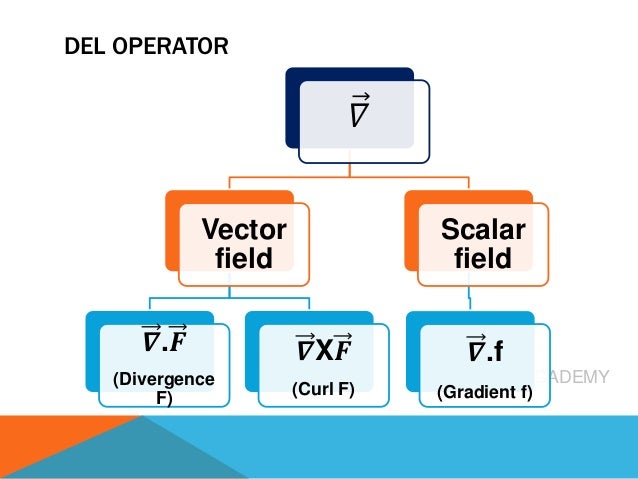
DEL OPERATOR
𝛻
Vector
field
𝜵.𝑭
(Divergence
F)
𝜵X𝑭
(Curl F)
Scalar
field
𝜵.f
(Gradient f)
SR PHYSICS ACADEMY
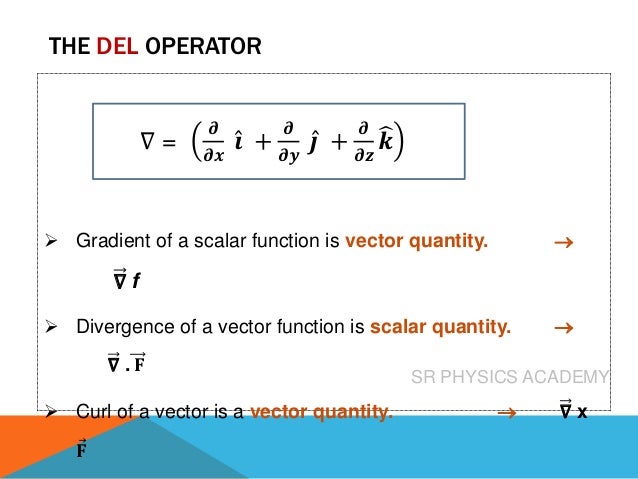
THE DEL OPERATOR
 Gradient of a scalar function is vector quantity. 
∇ f
 Divergence of a vector function is scalar quantity. 
∇ . 𝐅
 Curl of a vector is a vector quantity.  ∇ x
𝐅
∇ =
𝝏
𝝏𝒙
𝒊 +
𝝏
𝝏𝒚
𝒋 +
𝝏
𝝏𝒛
𝒌
SR PHYSICS ACADEMY
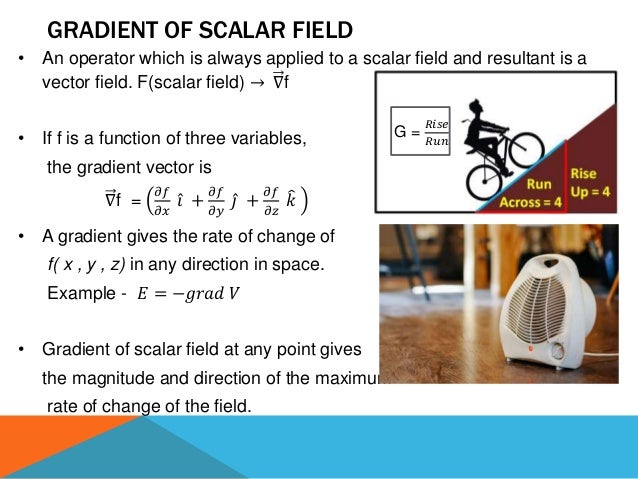
GRADIENT OF SCALAR FIELD
• An operator which is always applied to a scalar field and resultant is a
vector field. F(scalar field) → ∇f
• If f is a function of three variables,
the gradient vector is
∇f =
𝜕𝑓
𝜕𝑥
𝑖 +
𝜕𝑓
𝜕𝑦
𝑗 +
𝜕𝑓
𝜕𝑧
𝑘
• A gradient gives the rate of change of
f( x , y , z) in any direction in space.
Example - 𝐸 = −𝑔𝑟𝑎𝑑 𝑉
• Gradient of scalar field at any point gives
the magnitude and direction of the maximum
rate of change of the field.
G =
𝑅𝑖𝑠𝑒
𝑅𝑢𝑛
SR PHYSICS ACADEMY
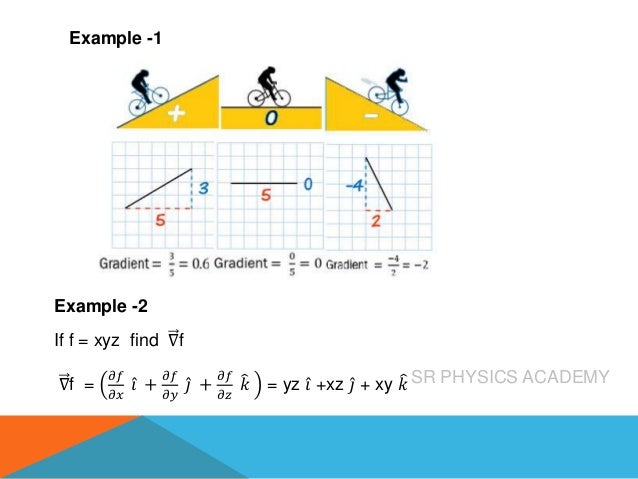
Example -2
If f = xyz find ∇f
∇f =
𝜕𝑓
𝜕𝑥
𝑖 +
𝜕𝑓
𝜕𝑦
𝑗 +
𝜕𝑓
𝜕𝑧
𝑘 = yz 𝑖 +xz 𝑗 + xy 𝑘
Example -1
SR PHYSICS ACADEMY
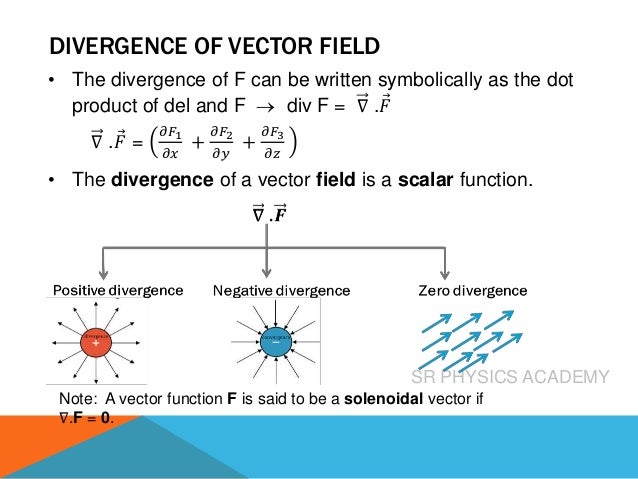
DIVERGENCE OF VECTOR FIELD
• The divergence of F can be written symbolically as the dot
product of del and F  div F = ∇ .𝐹
∇ .𝐹 =
𝜕𝐹1
𝜕𝑥
+
𝜕𝐹2
𝜕𝑦
+
𝜕𝐹3
𝜕𝑧
• The divergence of a vector field is a scalar function.
Note: A vector function F is said to be a solenoidal vector if
∇.F = 0.
SR PHYSICS ACADEMY
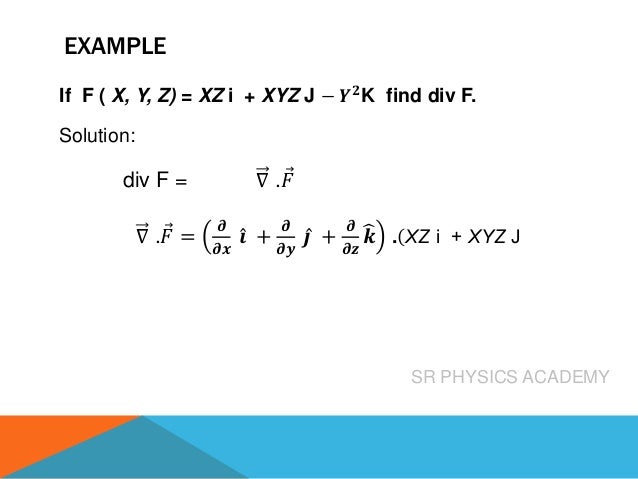
EXAMPLE
If F ( X, Y, Z) = XZ i + XYZ J − 𝒀𝟐K find div F.
Solution:
div F = ∇ .𝐹
∇ .𝐹 =
𝝏
𝝏𝒙
𝒊 +
𝝏
𝝏𝒚
𝒋 +
𝝏
𝝏𝒛
𝒌 . XZ i + XYZ J
SR PHYSICS ACADEMY
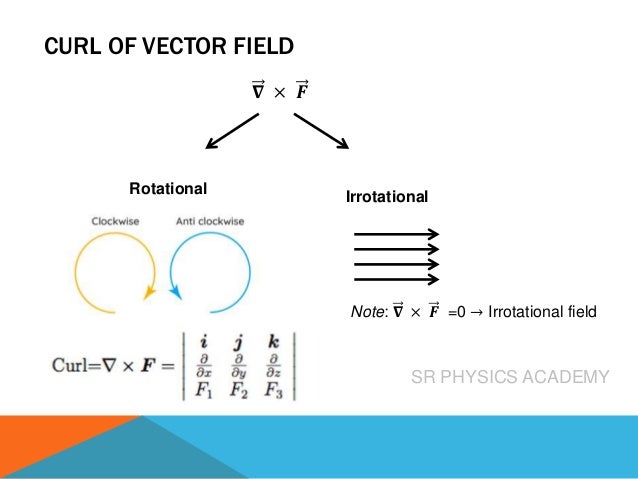
CURL OF VECTOR FIELD
𝛁 × 𝑭
Rotational Irrotational
Note: 𝛁 × 𝑭 =0 → Irrotational field
SR PHYSICS ACADEMY
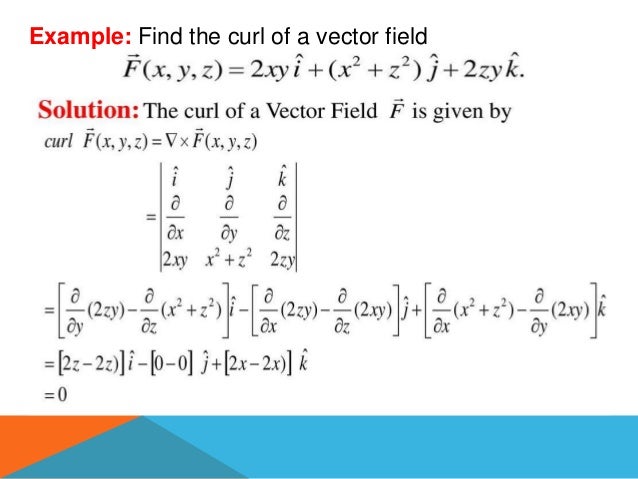
Example: Find the curl of a vector field
Visit our YouTube Channel SR Physics Academy and
watch the video on Gradient, Divergence and Curl of a
Function.
Click the link to watch the video:
https://youtu.be/LSZin_b3xmY
Step 1: Search for ‘SR Physics Academy’ on YouTube.
Step 2: Go to Playlist ’Electromagnetic theory in
English’.
Step 3: Watch the video ‘Gradient, Divergence and Curl
of a Function’
SUBSCRIBE

Gradient, Divergence and Curl of function

  • 2.
    SR PHYSICS ACADEMY DELOPERATOR • The collection of partial derivate operators  = 𝝏 𝝏𝒙 𝒊 + 𝝏 𝝏𝒚 𝒋 + 𝝏 𝝏𝒛 𝒌 is commonly called the del operator. • Its another name is `nabla‘. The symbol of nabla is represented by inverted triangle(∇). • There are three types of derivatives associated with the del operator.  A scalar quantity has only magnitude. example- length, distance, volume, speed, time, temperature, work.  A vector quantity has both magnitude and direction. example – velocity, force, displacement, momentum, acceleration.
  • 3.
    SR PHYSICS ACADEMY DELOPERATOR 𝛻 Vector field 𝜵.𝑭 (Divergence F) 𝜵X𝑭 (Curl F) Scalar field 𝜵.f (Gradient f)
  • 4.
    SR PHYSICS ACADEMY THEDEL OPERATOR  Gradient of a scalar function is vector quantity.  ∇ f  Divergence of a vector function is scalar quantity.  ∇ . 𝐅  Curl of a vector is a vector quantity.  ∇ x 𝐅 ∇ = 𝝏 𝝏𝒙 𝒊 + 𝝏 𝝏𝒚 𝒋 + 𝝏 𝝏𝒛 𝒌
  • 5.
    SR PHYSICS ACADEMY GRADIENTOF SCALAR FIELD • An operator which is always applied to a scalar field and resultant is a vector field. F(scalar field) → ∇f • If f is a function of three variables, the gradient vector is ∇f = 𝜕𝑓 𝜕𝑥 𝑖 + 𝜕𝑓 𝜕𝑦 𝑗 + 𝜕𝑓 𝜕𝑧 𝑘 • A gradient gives the rate of change of f( x , y , z) in any direction in space. Example - 𝐸 = −𝑔𝑟𝑎𝑑 𝑉 • Gradient of scalar field at any point gives the magnitude and direction of the maximum rate of change of the field. G = 𝑅𝑖𝑠𝑒 𝑅𝑢𝑛
  • 6.
    SR PHYSICS ACADEMY Example-2 If f = xyz find ∇f ∇f = 𝜕𝑓 𝜕𝑥 𝑖 + 𝜕𝑓 𝜕𝑦 𝑗 + 𝜕𝑓 𝜕𝑧 𝑘 = yz 𝑖 +xz 𝑗 + xy 𝑘 Example -1
  • 7.
    SR PHYSICS ACADEMY DIVERGENCEOF VECTOR FIELD • The divergence of F can be written symbolically as the dot product of del and F  div F = ∇ .𝐹 ∇ .𝐹 = 𝜕𝐹1 𝜕𝑥 + 𝜕𝐹2 𝜕𝑦 + 𝜕𝐹3 𝜕𝑧 • The divergence of a vector field is a scalar function. Note: A vector function F is said to be a solenoidal vector if ∇.F = 0.
  • 8.
    SR PHYSICS ACADEMY EXAMPLE IfF ( X, Y, Z) = XZ i + XYZ J − 𝒀𝟐K find div F. Solution: div F = ∇ .𝐹 ∇ .𝐹 = 𝝏 𝝏𝒙 𝒊 + 𝝏 𝝏𝒚 𝒋 + 𝝏 𝝏𝒛 𝒌 . XZ i + XYZ J
  • 9.
    SR PHYSICS ACADEMY CURLOF VECTOR FIELD 𝛁 × 𝑭 Rotational Irrotational Note: 𝛁 × 𝑭 =0 → Irrotational field
  • 10.
    SR PHYSICS ACADEMY Example:Find the curl of a vector field
  • 11.
    Visit our YouTubeChannel SR Physics Academy and watch the video on Gradient, Divergence and Curl of a Function. Click the link to watch the video: https://youtu.be/LSZin_b3xmY Step 1: Search for ‘SR Physics Academy’ on YouTube. Step 2: Go to Playlist ’Electromagnetic theory in English’. Step 3: Watch the video ‘Gradient, Divergence and Curl of a Function’
  • 12.