METROLOGY
MEASUREMENT OF
SCREW THREADS
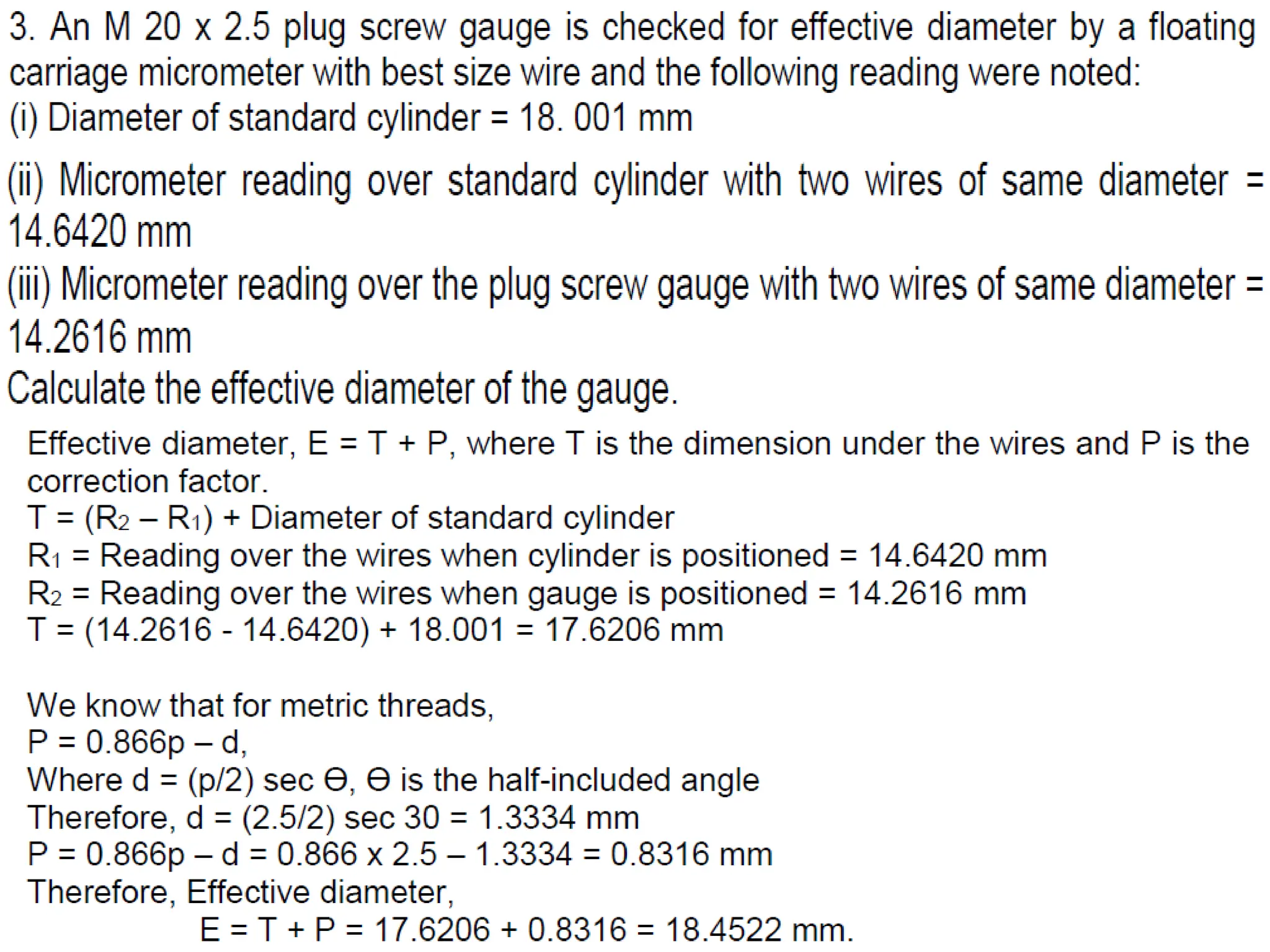
Screw Threads Terminology
1. Screw thread:
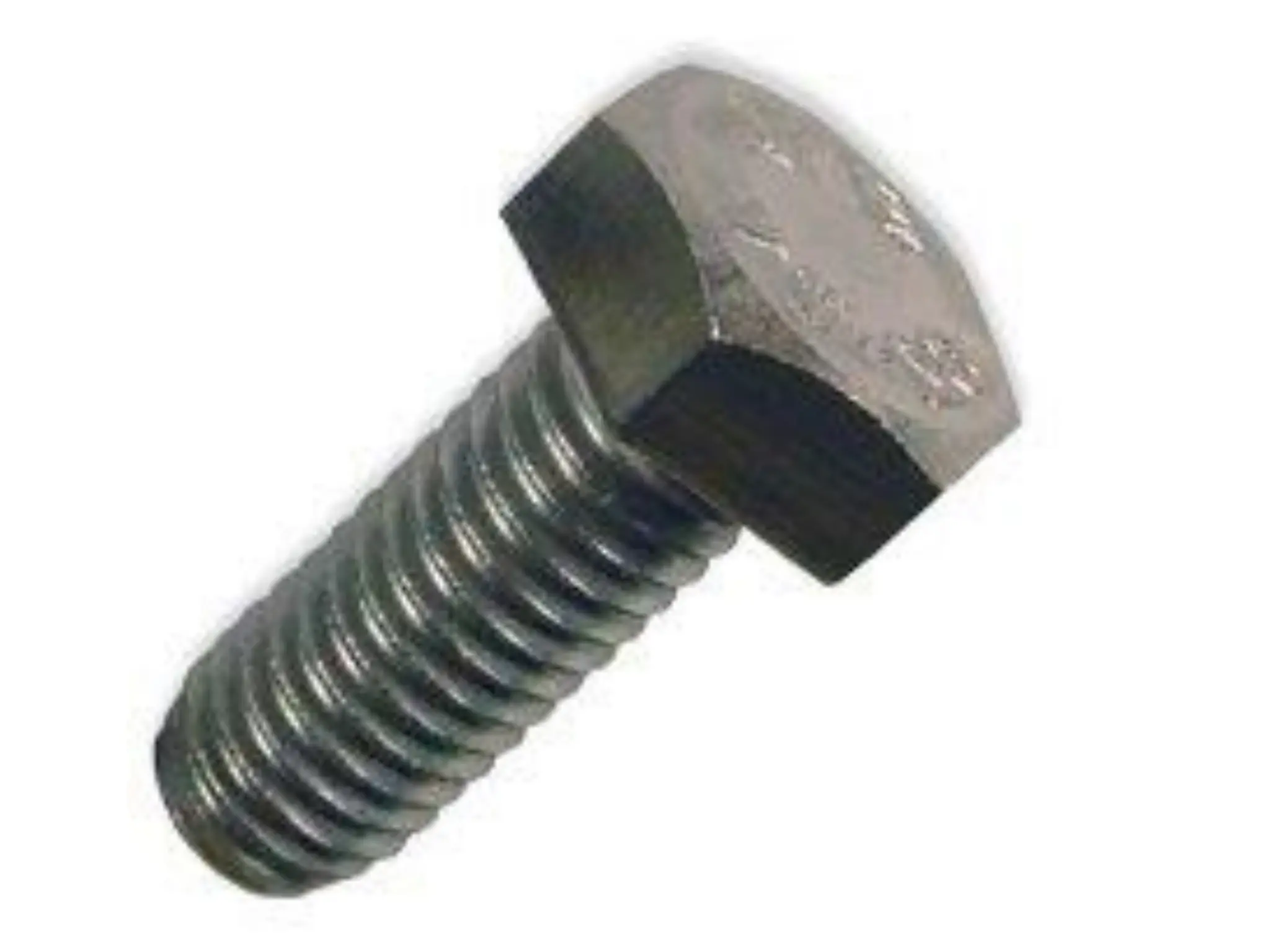
A screw thread is the helical ridge produced by
forming a continuous helical groove of uniform
section on the external or internal surface of a
cylinder or cone.
A screw thread formed on a cylinder is known as
straight or parallel screw thread, while the one
formed on a cone or frustum of a cone is known
as tapered screw thread.
2. Axis of a thread:
This is imaginary line running longitudinally
through the centre of the screw.
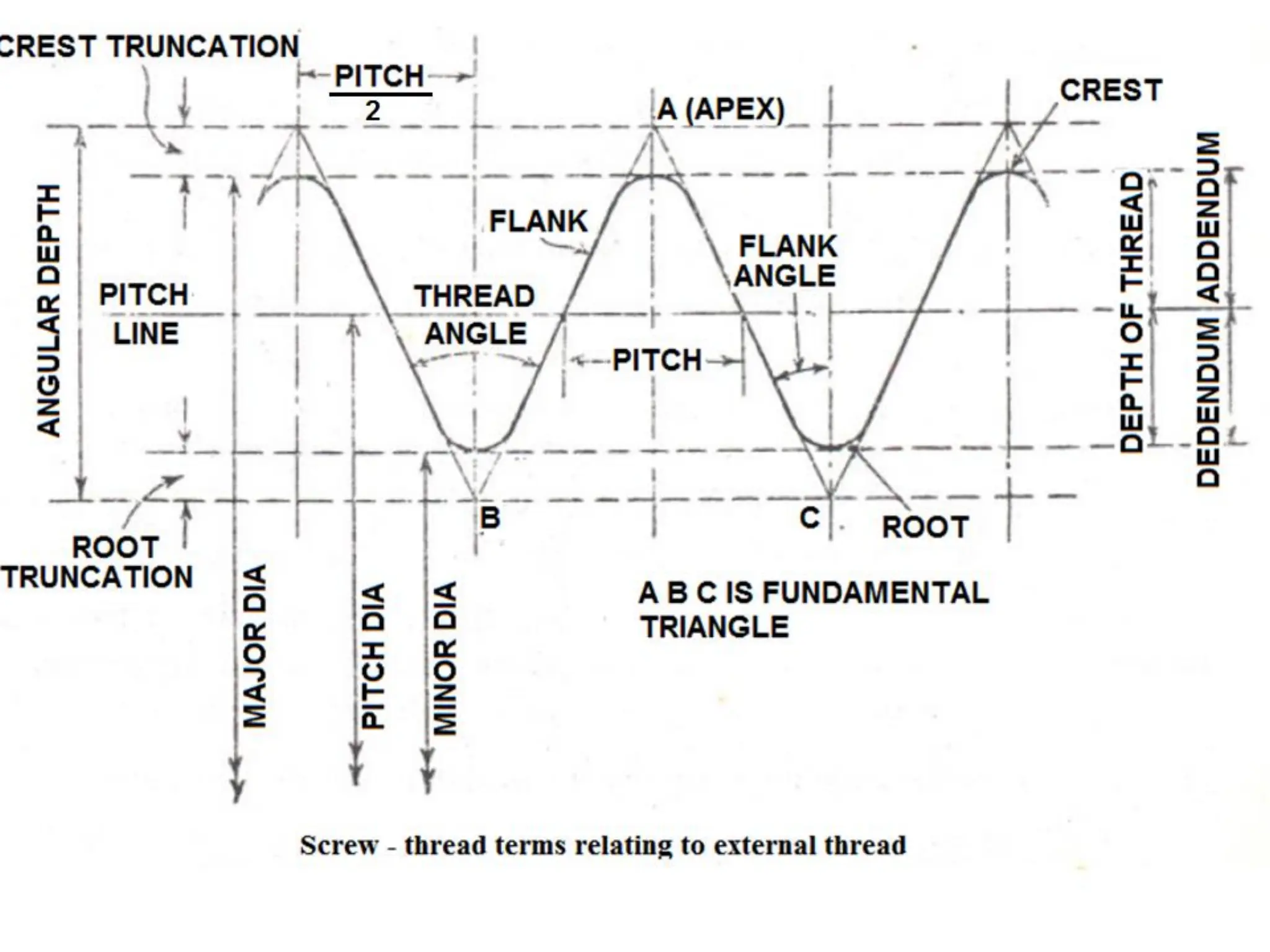
3. Crest of thread :
This is defined as the prominent part of
thread, whether it be external or internal.
4. Root of thread :
This is defined as the bottom of the groove
between the two flanks of the thread,
whether it be external or internal.
5. Flanks of thread :
These are straight edges which connect the crest
with the root.
6. Angle of thread (Included angle):
This is the angle between the flanks or slope of
the thread measured in an axial plane.
7. Flank angle:
The flank angles are the angles between
individual flanks and the perpendicular to the
axis of the thread which passes through the
vertex of the fundamental triangle. The flank
angle of a symmetrical thread is commonly
termed as the half-angle of thread.
8. Pitch:
The pitch of a thread is the distance, measured
parallel to the axis of the thread, between
corresponding points on adjacent thread forms in the
same axial plane and on the same side of axis.
The basic pitch is equal to the lead divided by the
number of thread starts. On drawings of thread
sections, the pitch is shown as the distance from the
centre of one thread crest to the centre of the next,
and this representation is correct for single start as well
as multi-start threads.
9. Depth of thread:
This is the distance from the crest or tip of the
thread to the root of the thread measured
perpendicular to the longitudinal axis or this
could be defined as the distance measured
radially between the major and minor cylinders.
10.Fundamental triangle:
This is found by extending the flanks and joining
the points B and C. Thus in Figure, triangle ABC
is referred to fundamental triangle. Here
BC = pitch, and the vertical height of the triangle
is called angular or theoretical depth. The point
A is the apex of the triangle ABC.
11.Truncation:
A thread is sometimes truncated at the crest or
at the root or at both crest and root. The
truncation at the crest is the radial distance
from the crest to the nearest apex of the
fundamental triangle. Similarly the truncation
at the root is the radial distance from the root to
the nearest apex.
12.Addendum:
For an external thread, this is defined as the
radial distance between the major and pitch
cylinders. For an internal thread this is the radial
distance between the minor and pitch cylinders.
13.Dedendum:
This is the radial distance between the pitch
and minor cylinder for external thread, and for
internal thread, this is the radial distance
between the major and pitch cylinders.
14.Major diameter:
In case of a straight thread, this is the diameter of
the major cylinder (imaginary cylinder, co-axial
with the screw, which just touches the crests of an
external thread or the root of an internal thread).
It is often referred to as the outside diameter, crest
diameter or full diameter of external threads.
15.Minor diameter:
In case of straight thread, this is the diameter of the
minor cylinder (an imaginary cylinder, co-axial
with the screw which just touches the roots of an
external thread or the crest of an internal thread).
It is often referred to as root diameter or cone
diameter of external threads.
16.Effective diameter or pitch diameter:
In case of straight thread, this is the diameter of the pitch
cylinder (the imaginary cylinder which is co-axial with
the axis of the screw, and intersects the flank of the
threads in such a way as to make the width of
threads and width of the spaces between the threads
equal).
If the pitch cylinder be imagined as generated by a straight
line parallel to the axis of screw, that straight line is then
referred to as the pitch line. Along the pitch line, the
widths of the threads and the widths of the spaces are
equal on a perfect thread.
This is the most important dimension as it decides the
quality of the fit between the screw and the nut.
Errors in Threads.
In the case of screw threads there are at least five
important elements which require consideration
and error in anyone of these can cause rejection of
the thread.
In routine production all of these five elements
major diameter,
minor diameter,
effective diameter,
pitch and
angle
of the thread form) must be checked and method of
gauging must be able to cover all these elements.
Pitch Errors in Screw Threads.
Classification:
Progressive Pitch Error.
Periodic Pitch Error.
Drunken Thread.
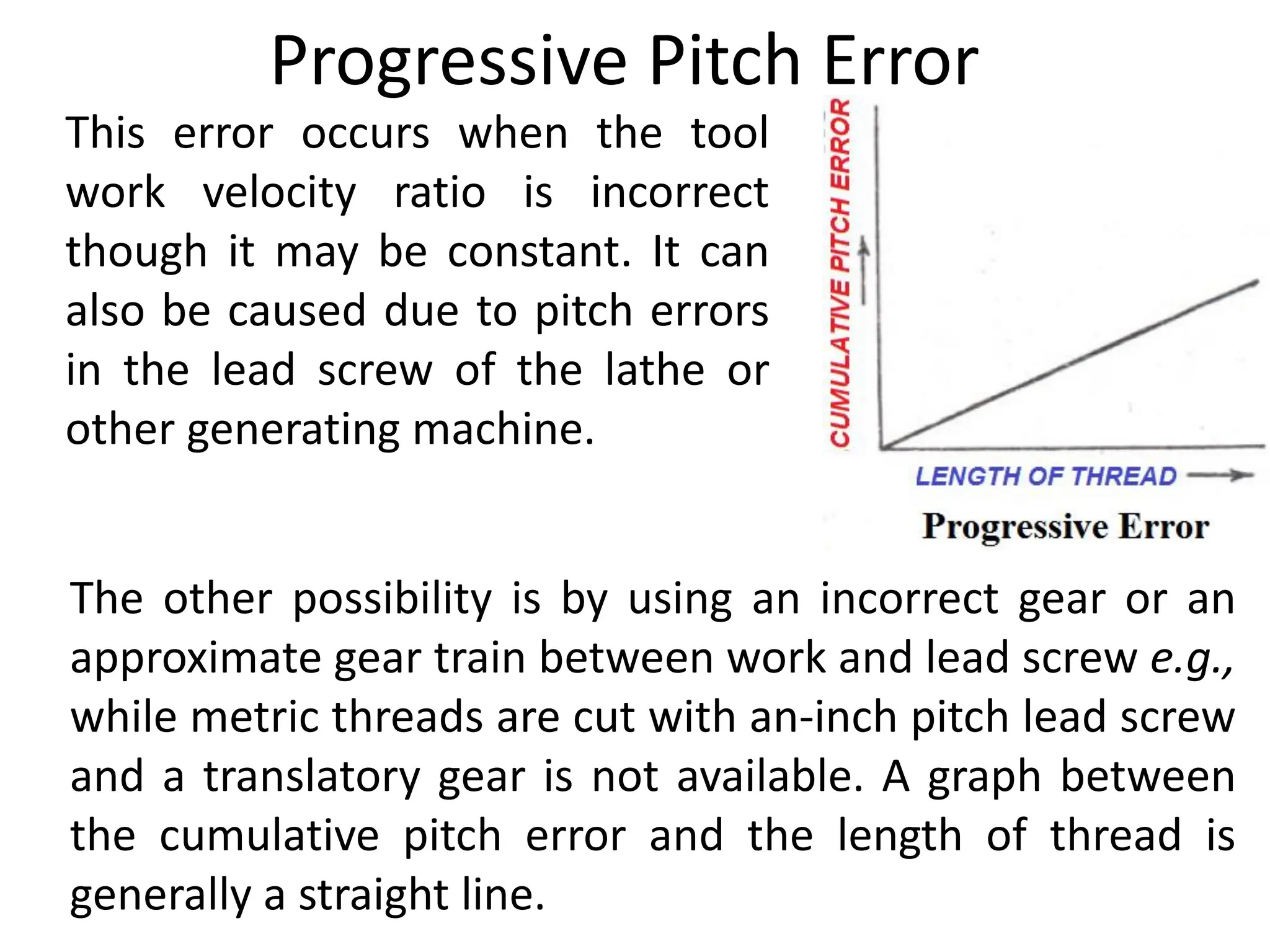
Progressive Pitch Error
This error occurs when the tool
work velocity ratio is incorrect
though it may be constant. It can
also be caused due to pitch errors
in the lead screw of the lathe or
other generating machine.
The other possibility is by using an incorrect gear or an
approximate gear train between work and lead screw e.g.,
while metric threads are cut with an-inch pitch lead screw
and a translatory gear is not available. A graph between
the cumulative pitch error and the length of thread is
generally a straight line.
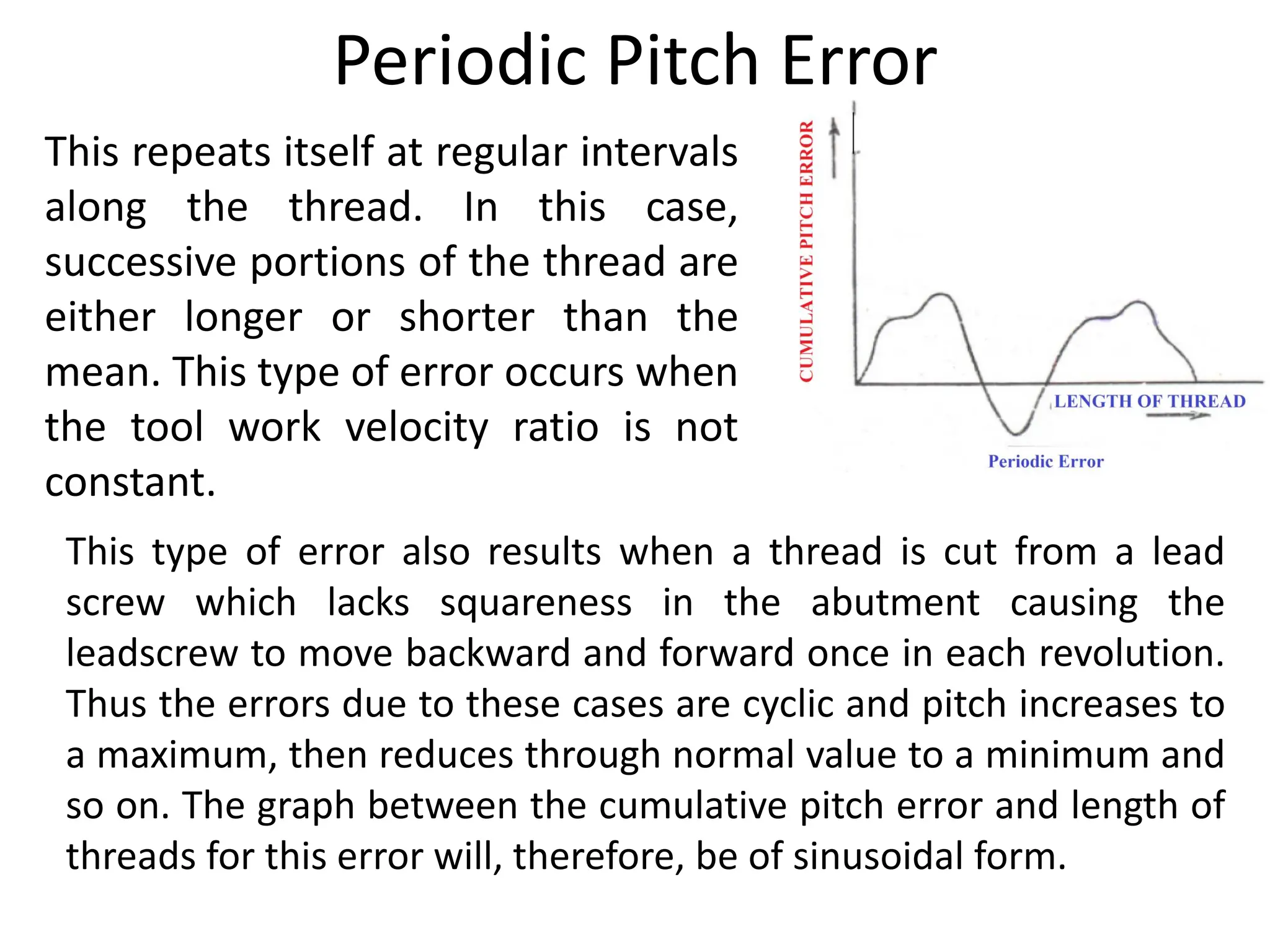
Periodic Pitch Error
This repeats itself at regular intervals
along the thread. In this case,
successive portions of the thread are
either longer or shorter than the
mean. This type of error occurs when
the tool work velocity ratio is not
constant.
This type of error also results when a thread is cut from a lead
screw which lacks squareness in the abutment causing the
leadscrew to move backward and forward once in each revolution.
Thus the errors due to these cases are cyclic and pitch increases to
a maximum, then reduces through normal value to a minimum and
so on. The graph between the cumulative pitch error and length of
threads for this error will, therefore, be of sinusoidal form.
Drunken Thread.
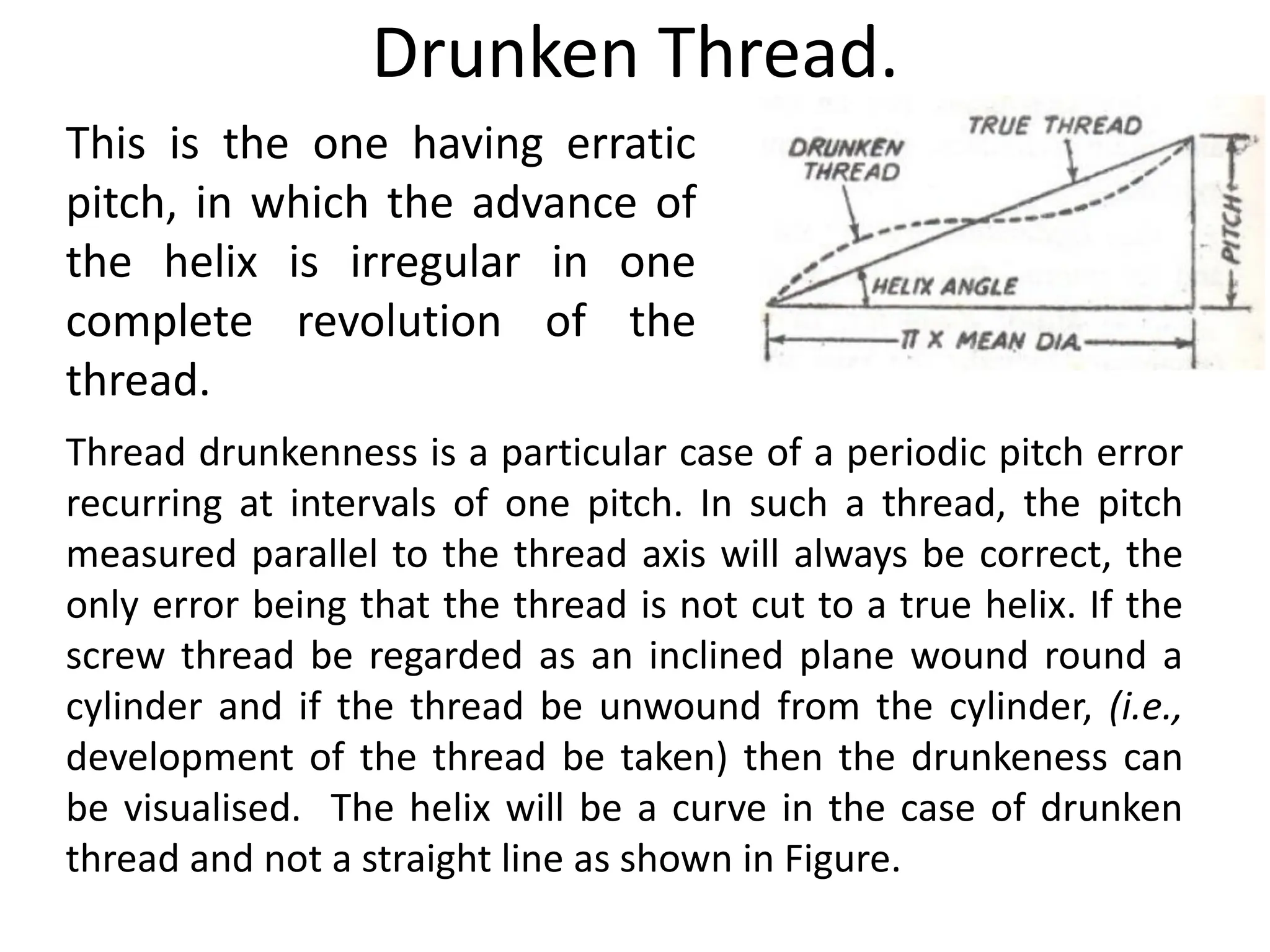
This is the one having erratic
pitch, in which the advance of
the helix is irregular in one
complete revolution of the
thread.
Thread drunkenness is a particular case of a periodic pitch error
recurring at intervals of one pitch. In such a thread, the pitch
measured parallel to the thread axis will always be correct, the
only error being that the thread is not cut to a true helix. If the
screw thread be regarded as an inclined plane wound round a
cylinder and if the thread be unwound from the cylinder, (i.e.,
development of the thread be taken) then the drunkeness can
be visualised. The helix will be a curve in the case of drunken
thread and not a straight line as shown in Figure.
Effect of Pitch Errors
An error in pitch virtually increases the
effective diameter of a bolt or screw and
decreases the effective diameter of a nut.
The meaning of the virtual change in
effective diameter is that if any screw is
perfect except for pitch error, it will not
screw easily into a perfect ring gauge of
same nominal size until its effective
diameter is reduced.
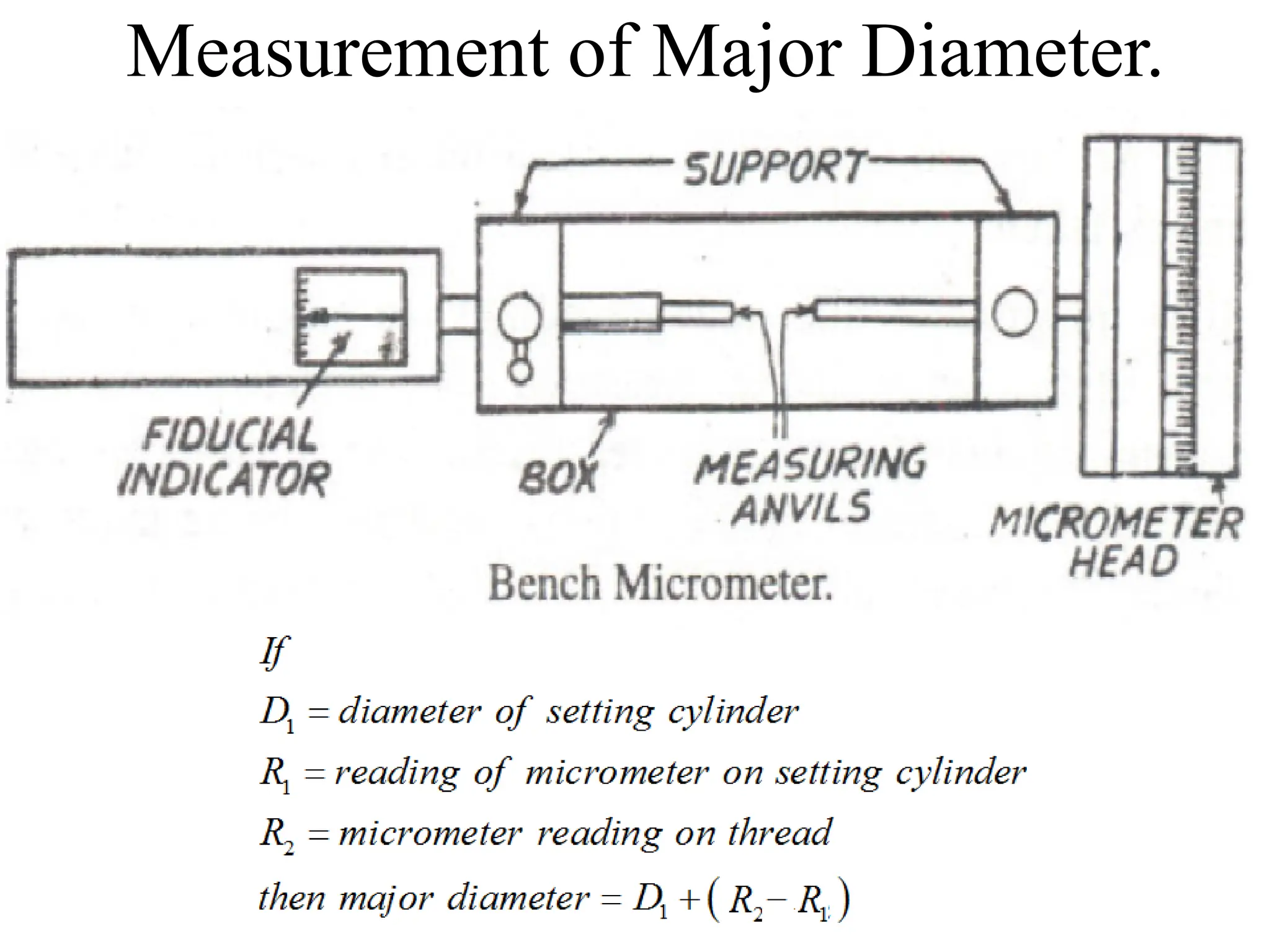
Measurement of Major Diameter.
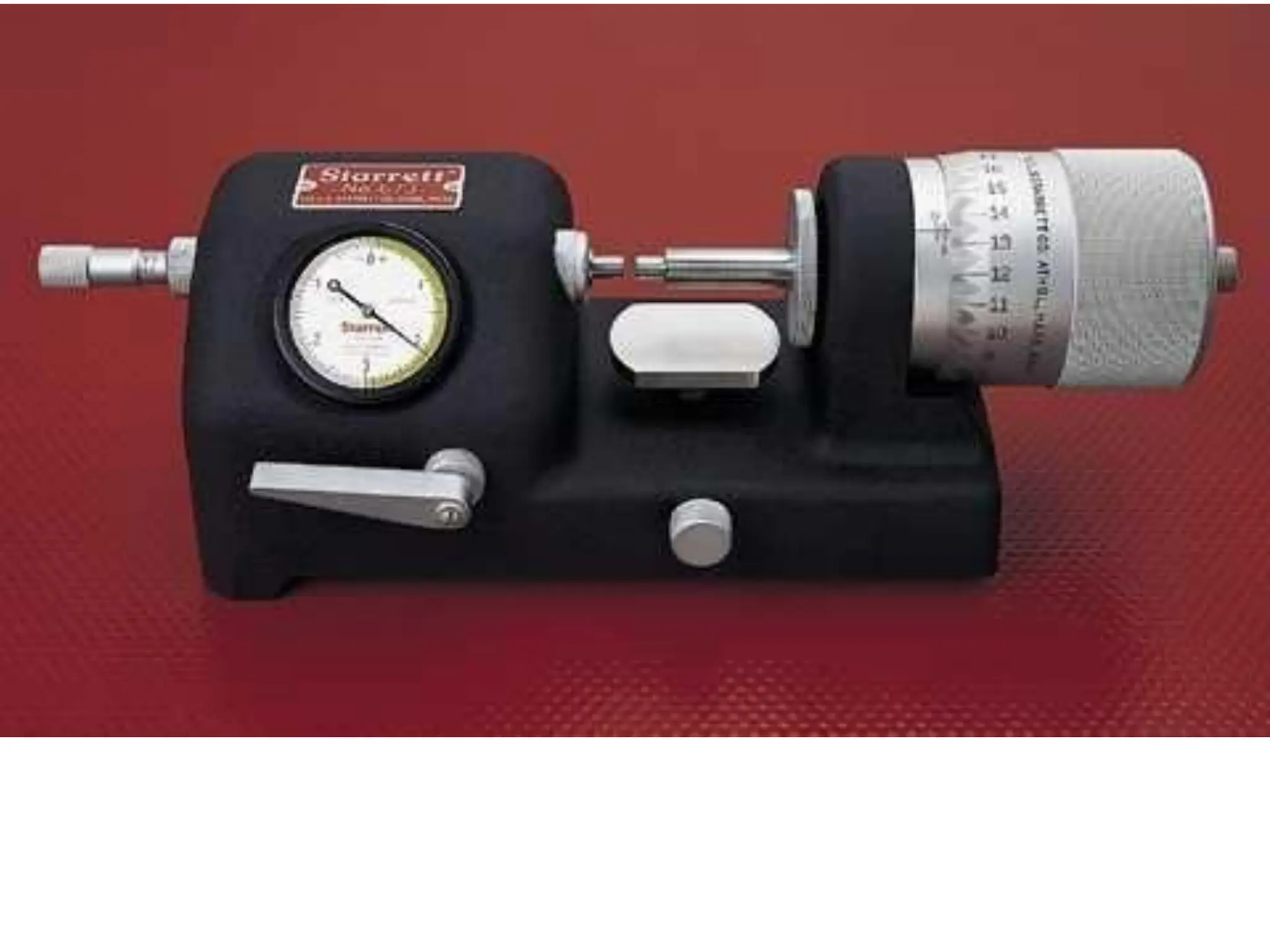
BENCH MICROMETER
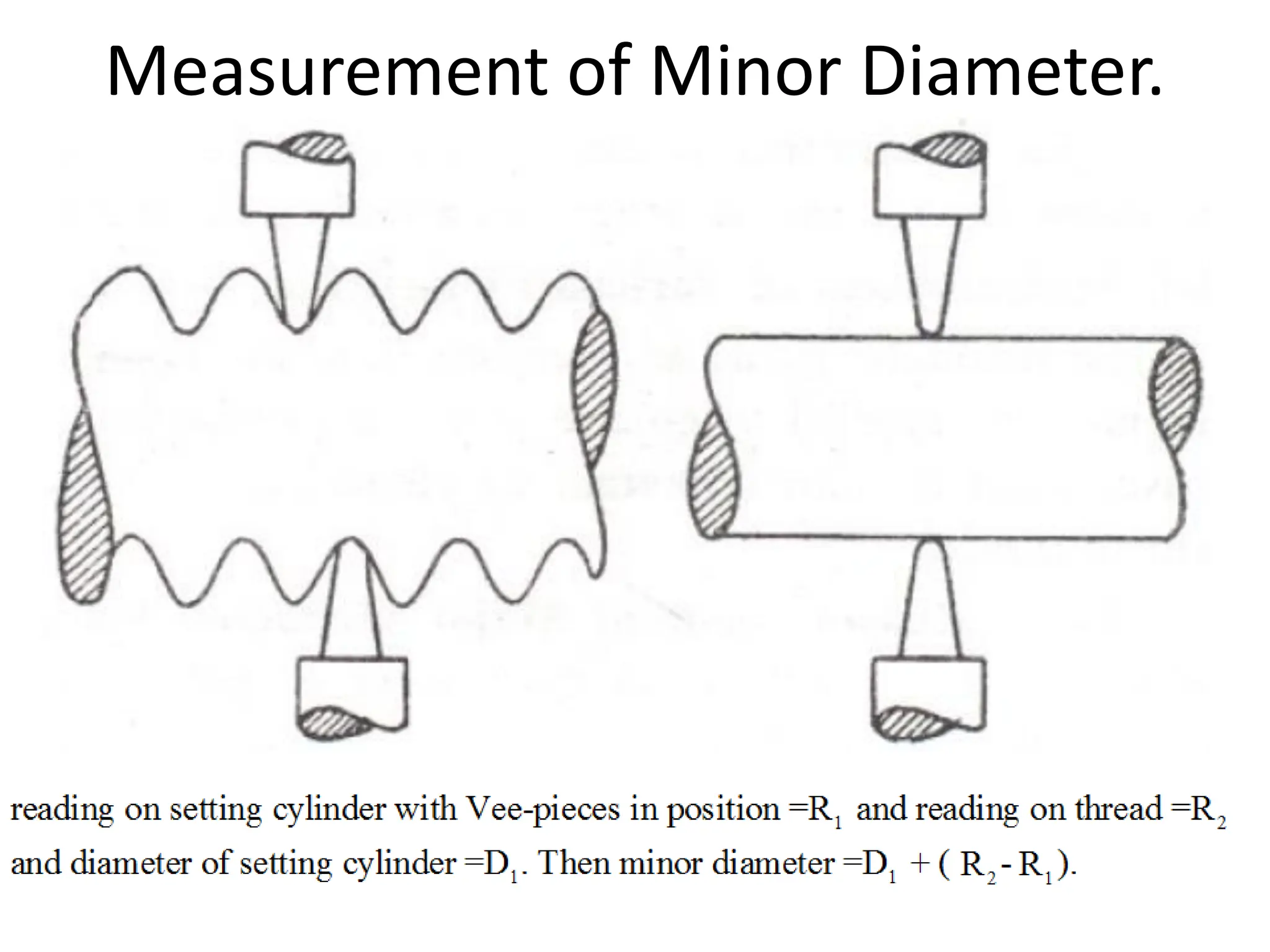
Measurement of Minor Diameter.
Effective Diameter Measurements
The effective diameter or the pitch diameter can
be measured by anyone of the following
methods :
Micrometer method
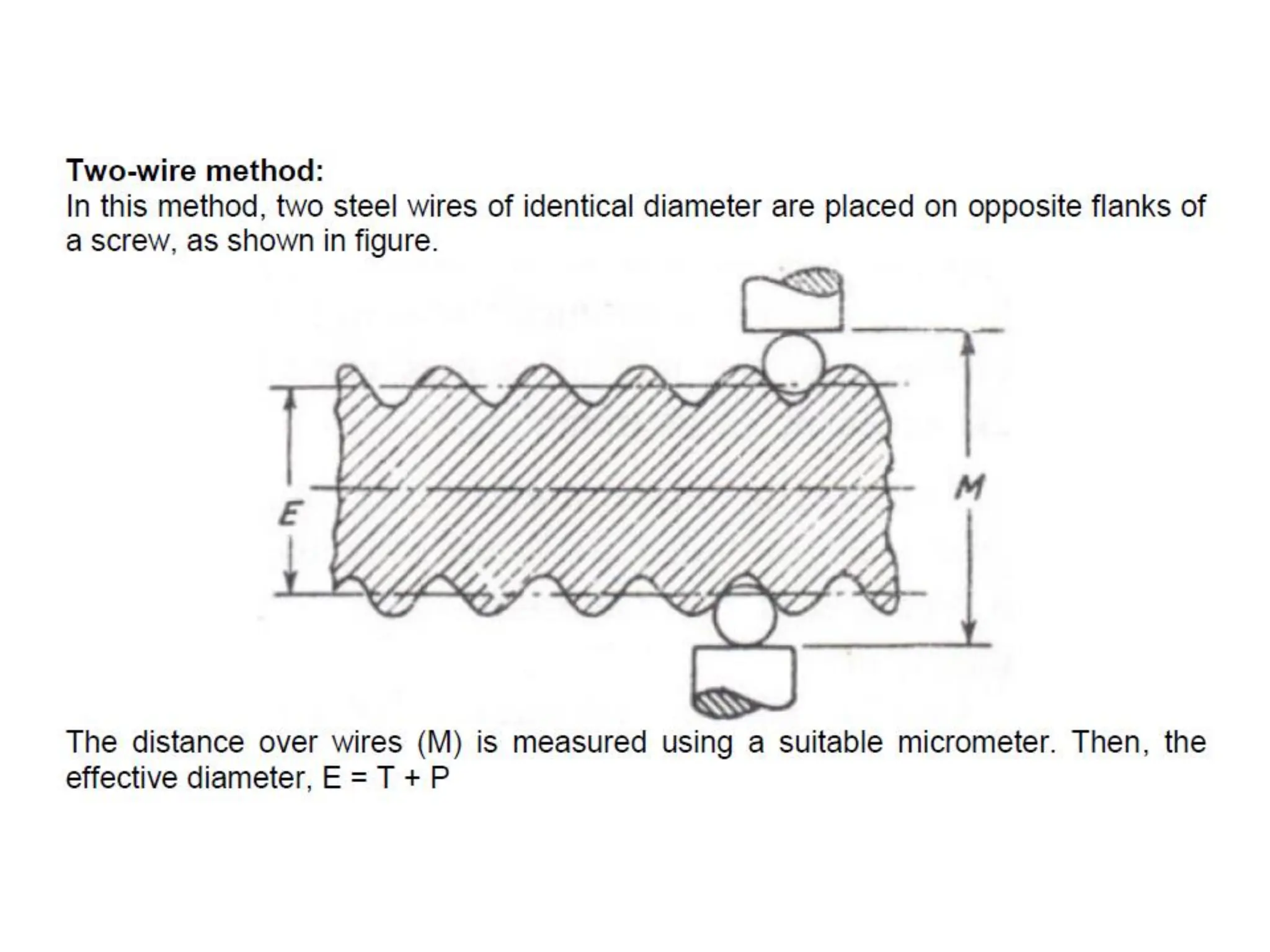
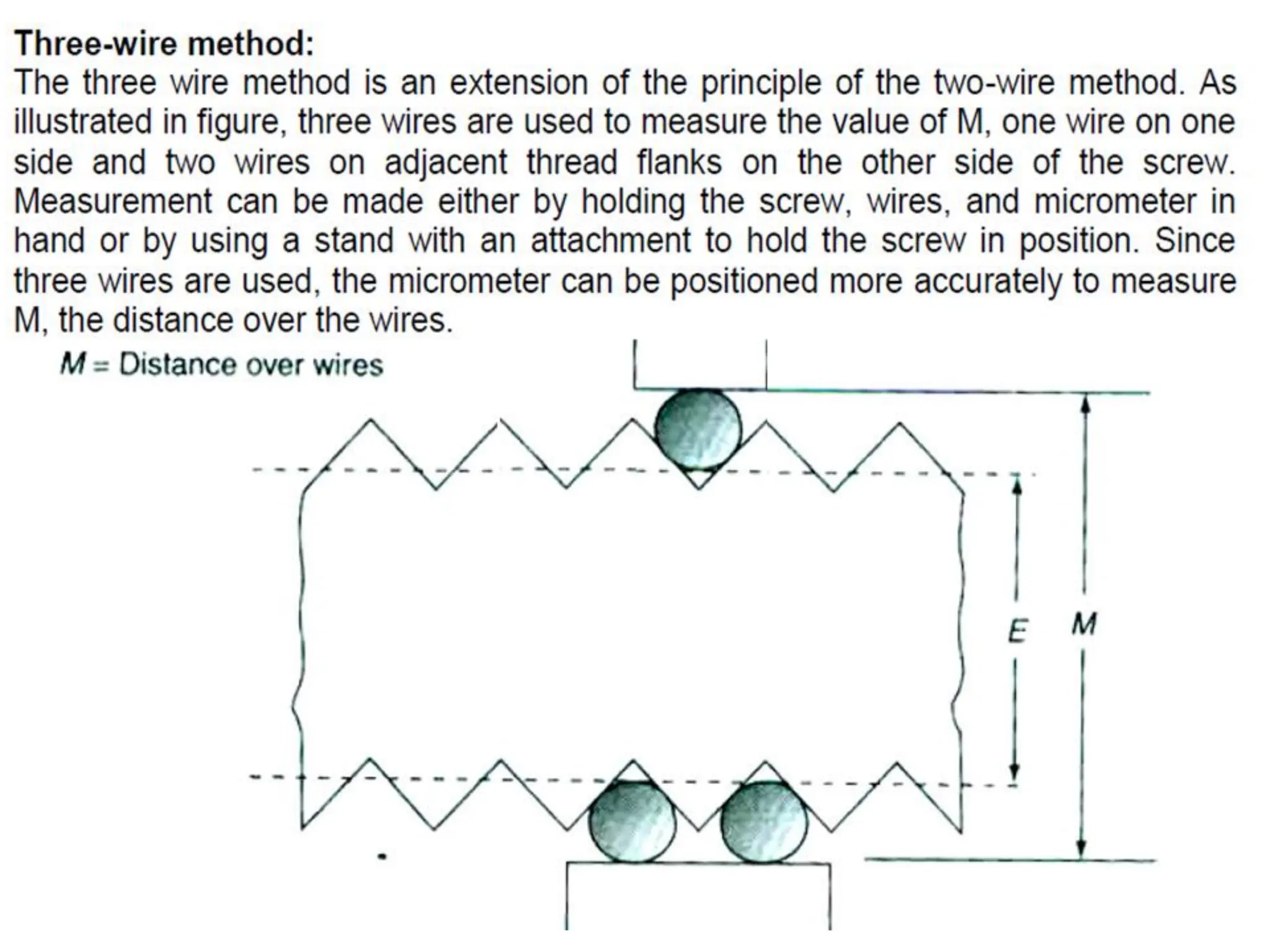
One wire, Two wire or three wire
or rod method.
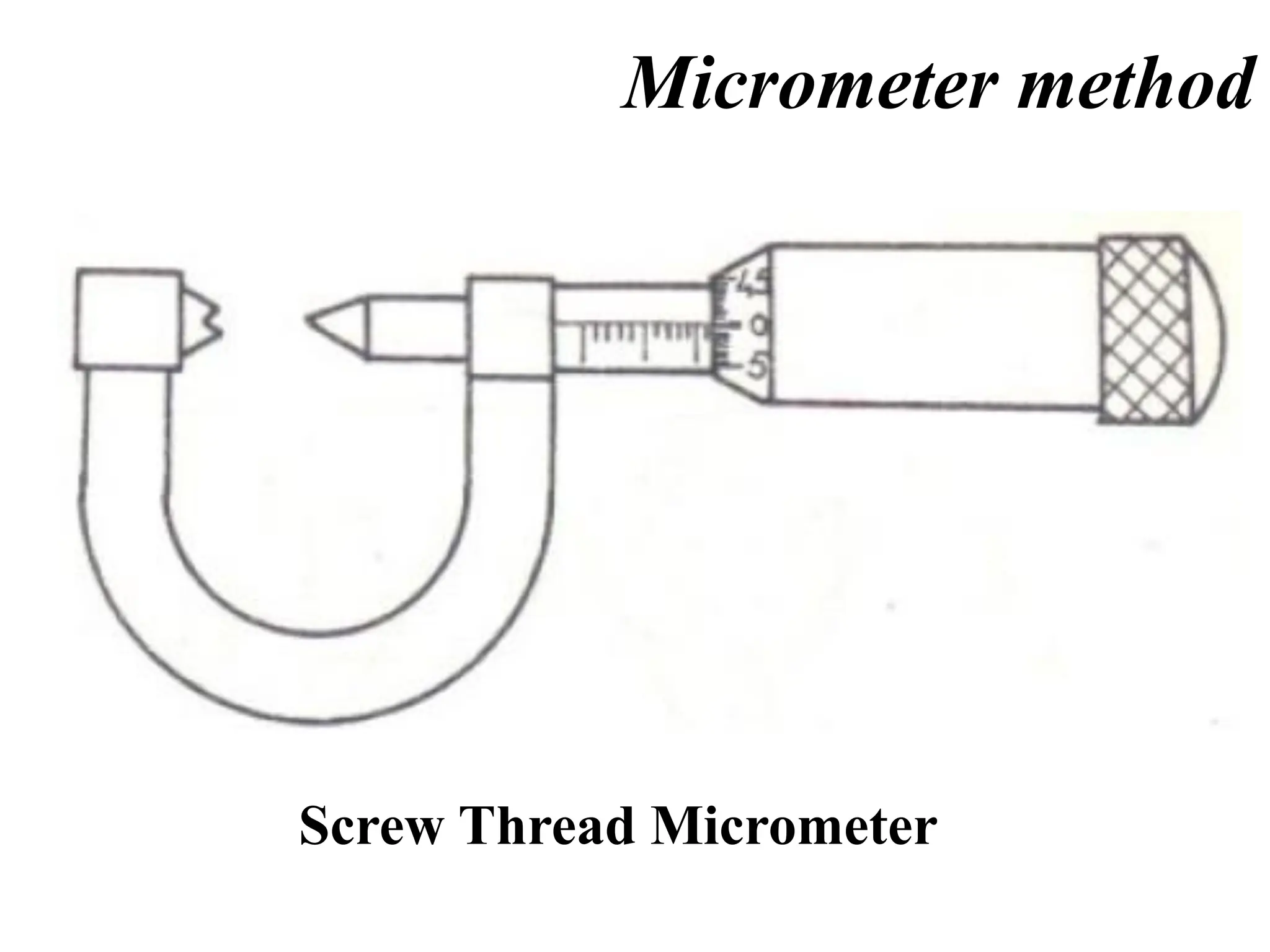
Micrometer method
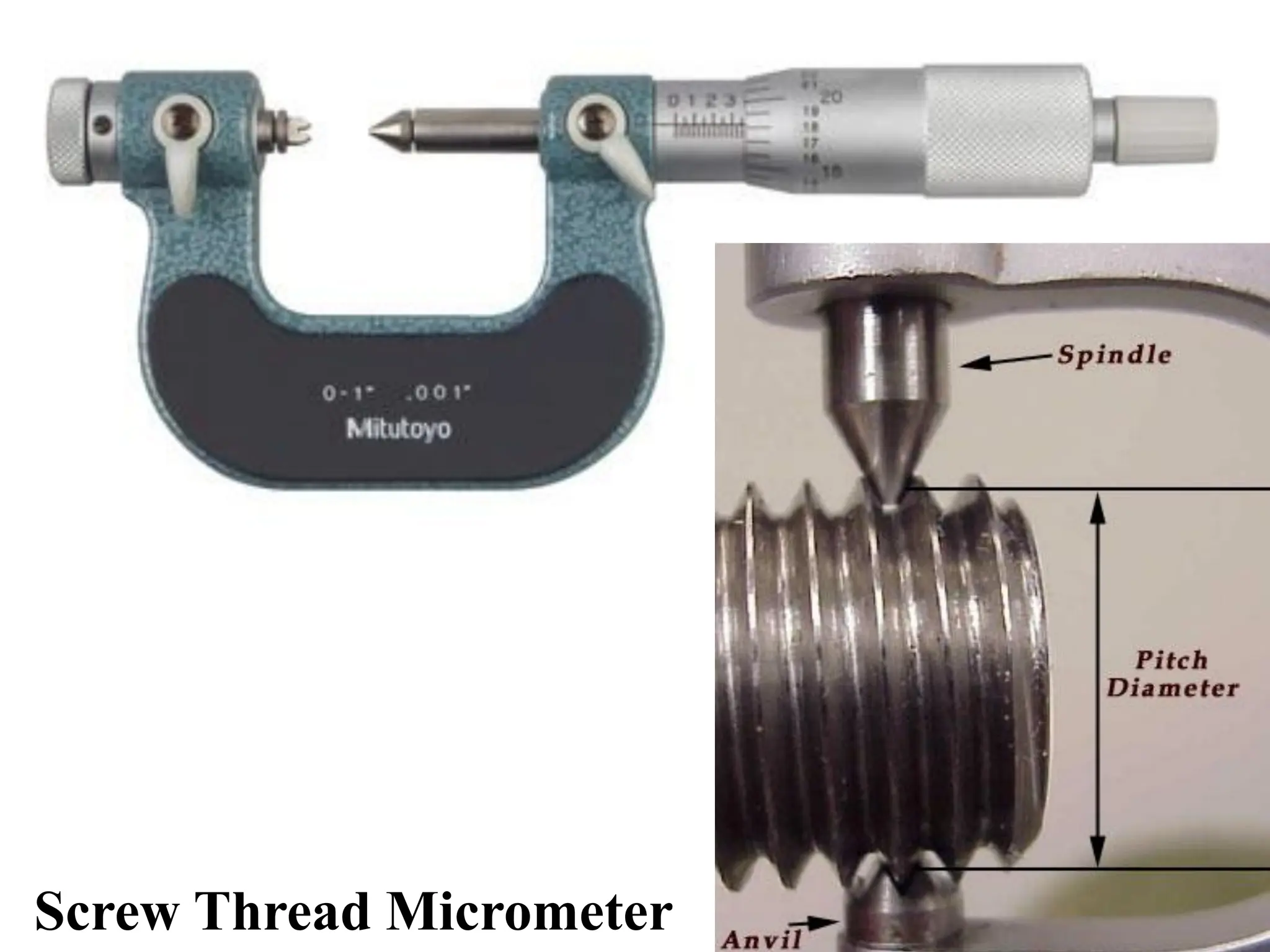
Screw Thread Micrometer
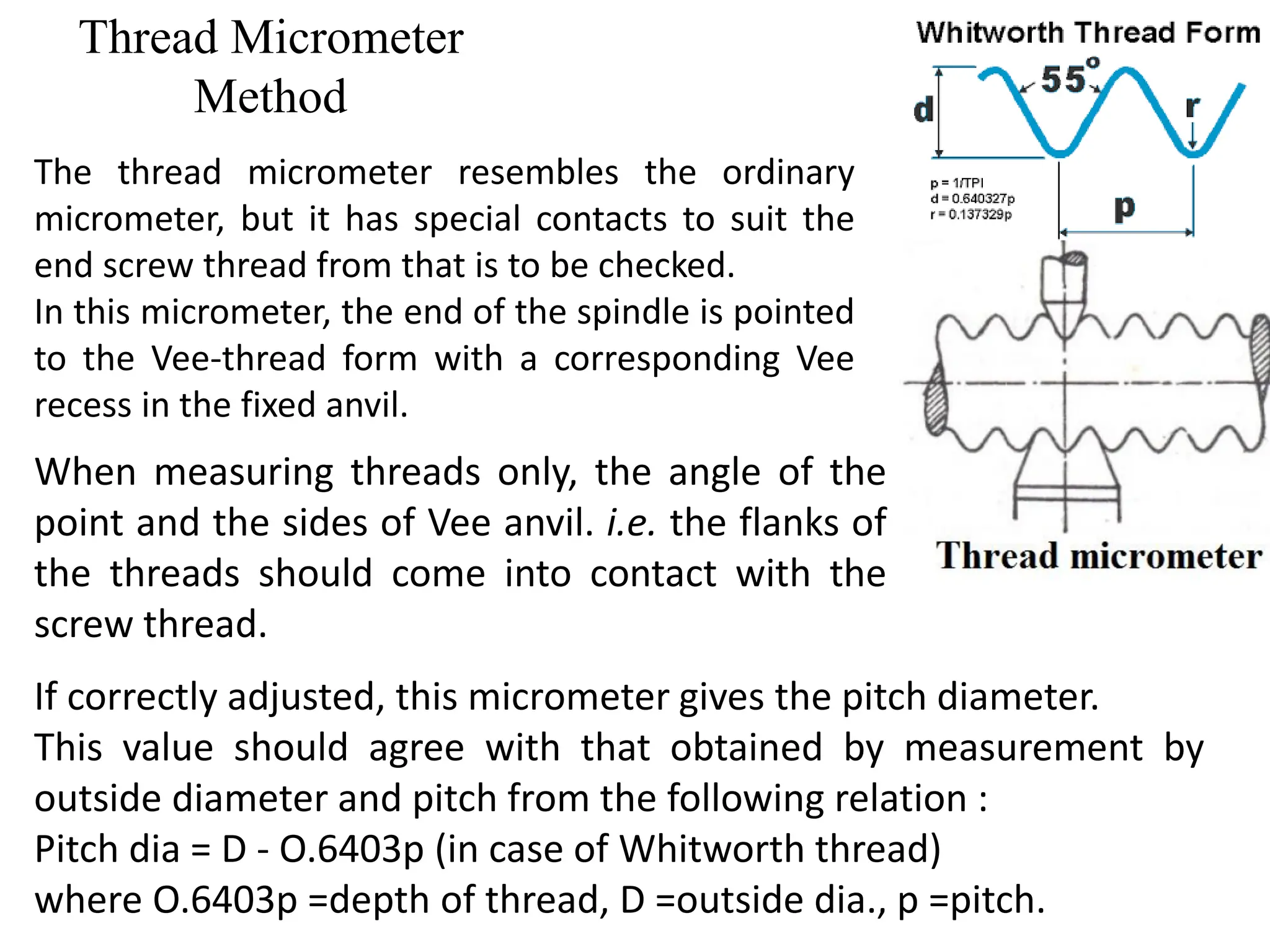
Thread Micrometer
Method
The thread micrometer resembles the ordinary
micrometer, but it has special contacts to suit the
end screw thread from that is to be checked.
In this micrometer, the end of the spindle is pointed
to the Vee-thread form with a corresponding Vee
recess in the fixed anvil.
When measuring threads only, the angle of the
point and the sides of Vee anvil. i.e. the flanks of
the threads should come into contact with the
screw thread.
If correctly adjusted, this micrometer gives the pitch diameter.
This value should agree with that obtained by measurement by
outside diameter and pitch from the following relation :
Pitch dia = D - O.6403p (in case of Whitworth thread)
where O.6403p =depth of thread, D =outside dia., p =pitch.
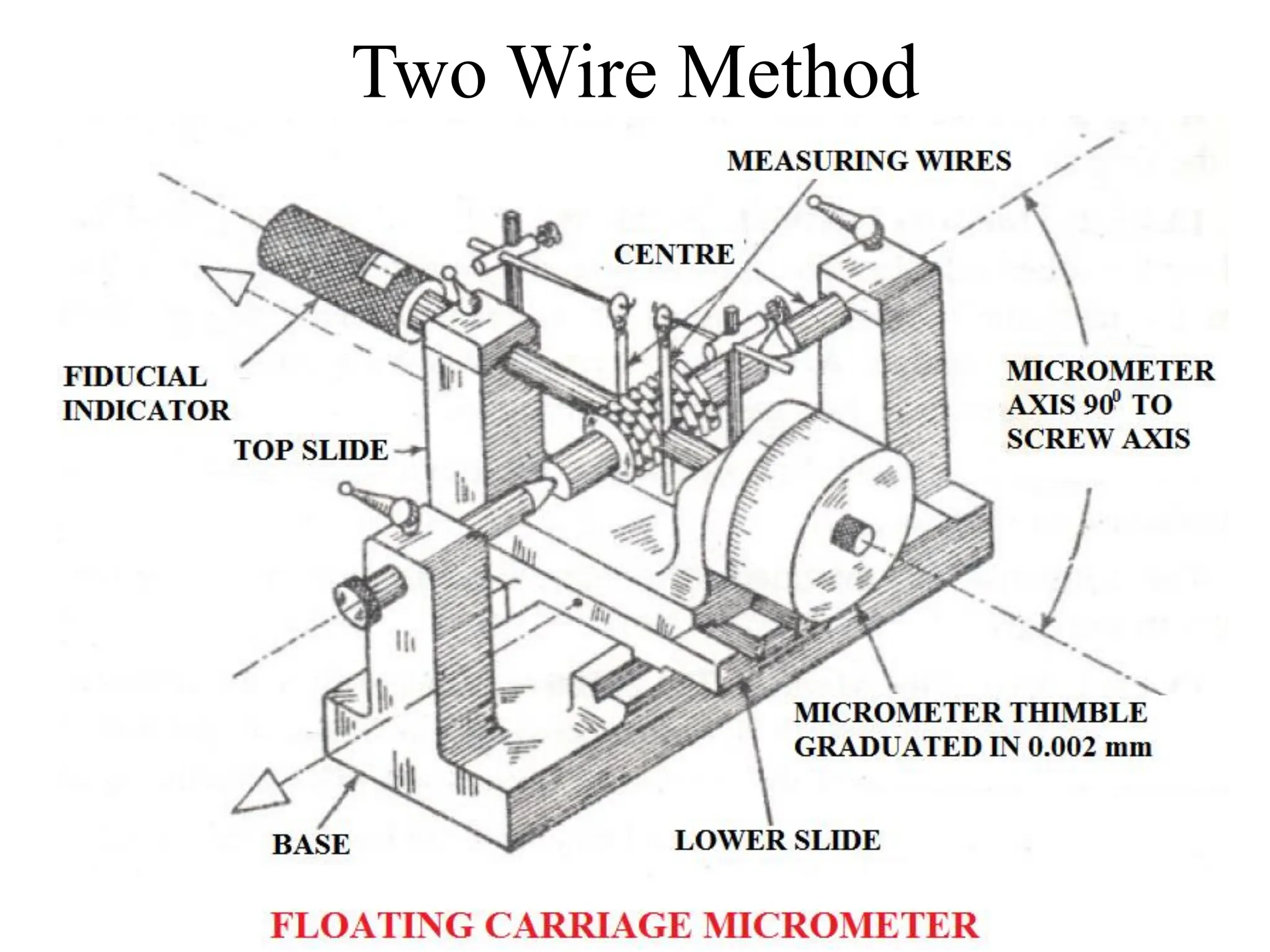
Two Wire Method
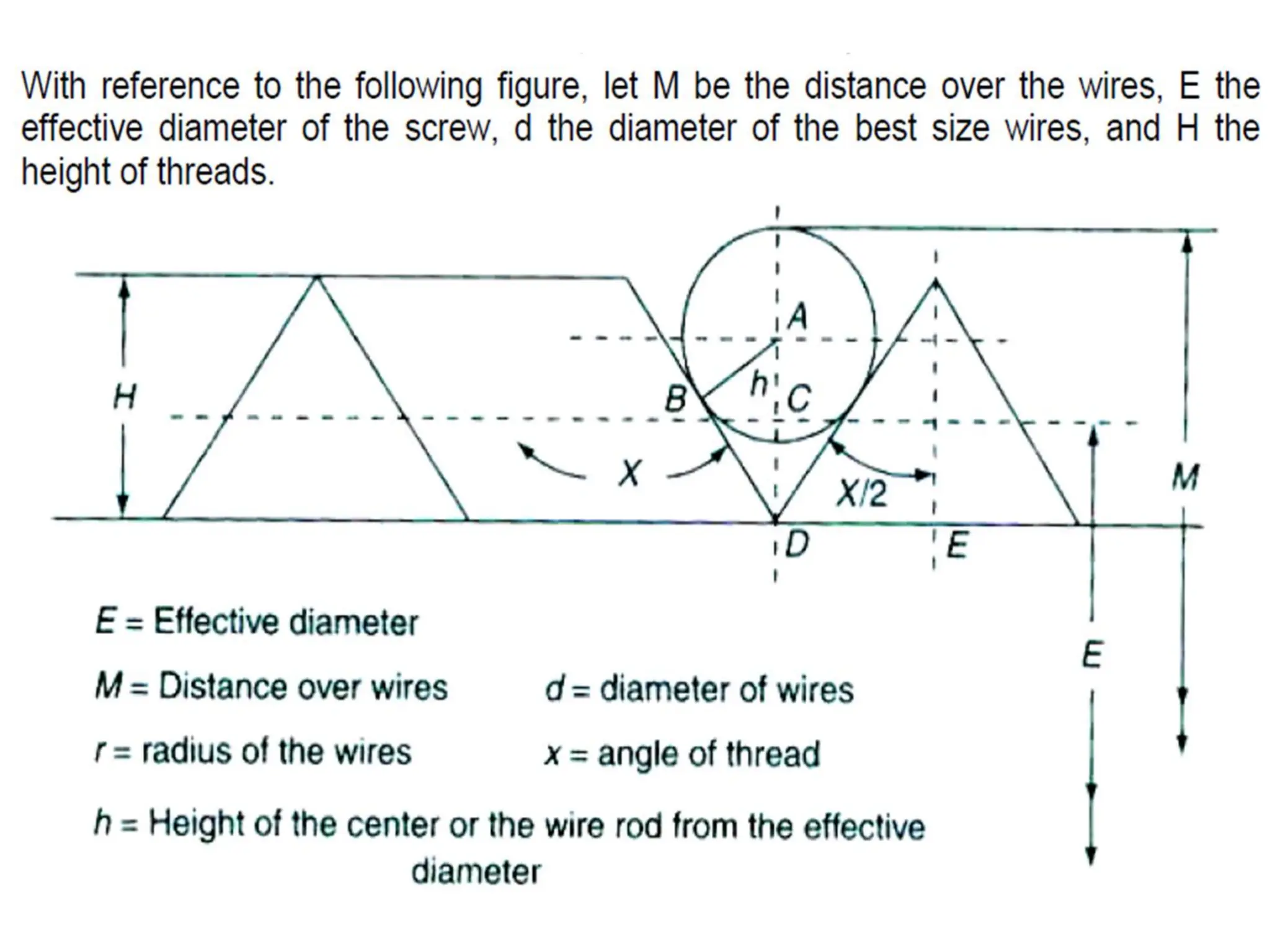
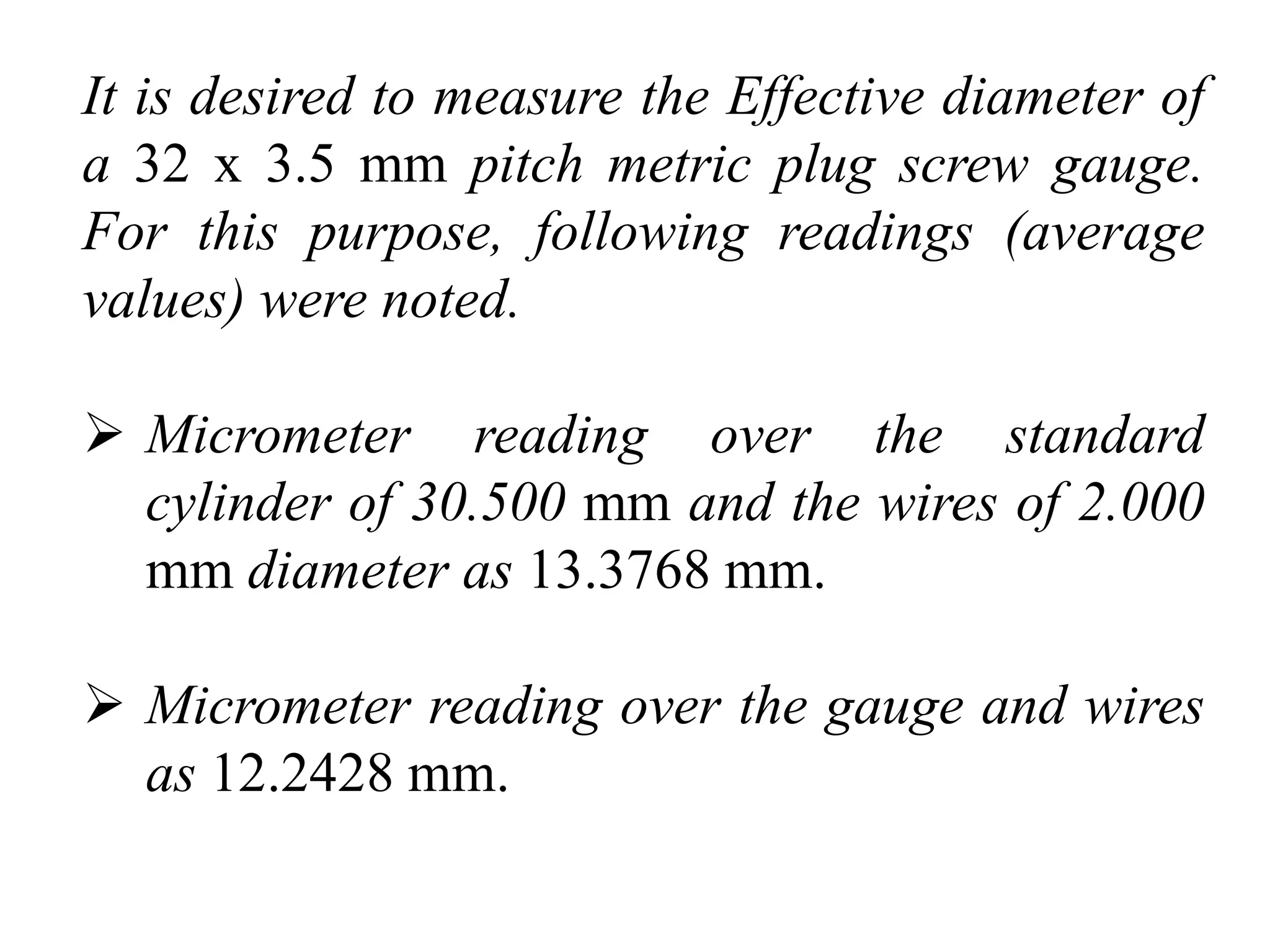
It is desired to measure the Effective diameter of
a 32 x 3.5 mm pitch metric plug screw gauge.
For this purpose, following readings (average
values) were noted.
 Micrometer reading over the standard
cylinder of 30.500 mm and the wires of 2.000
mm diameter as 13.3768 mm.
 Micrometer reading over the gauge and wires
as 12.2428 mm.
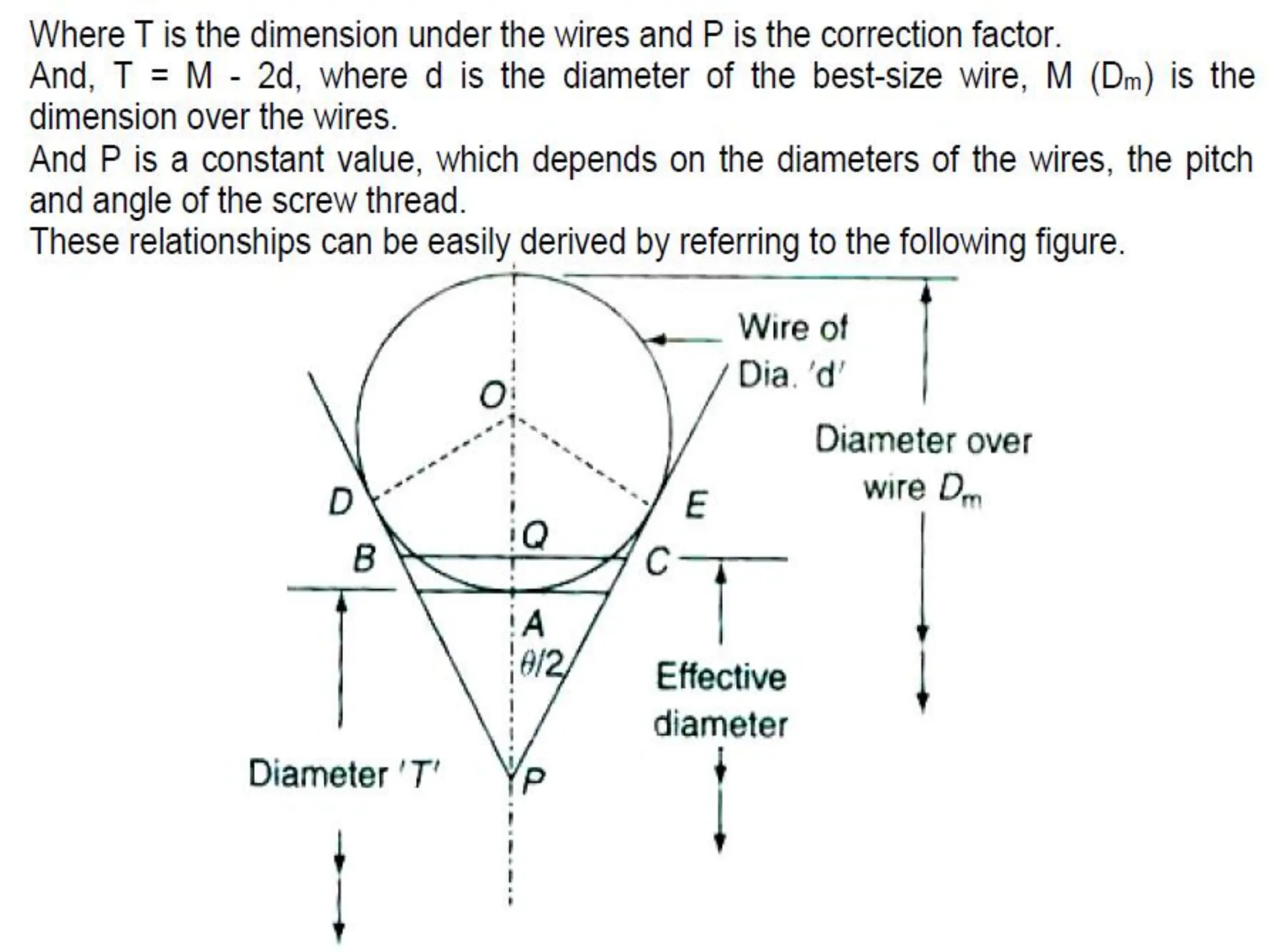
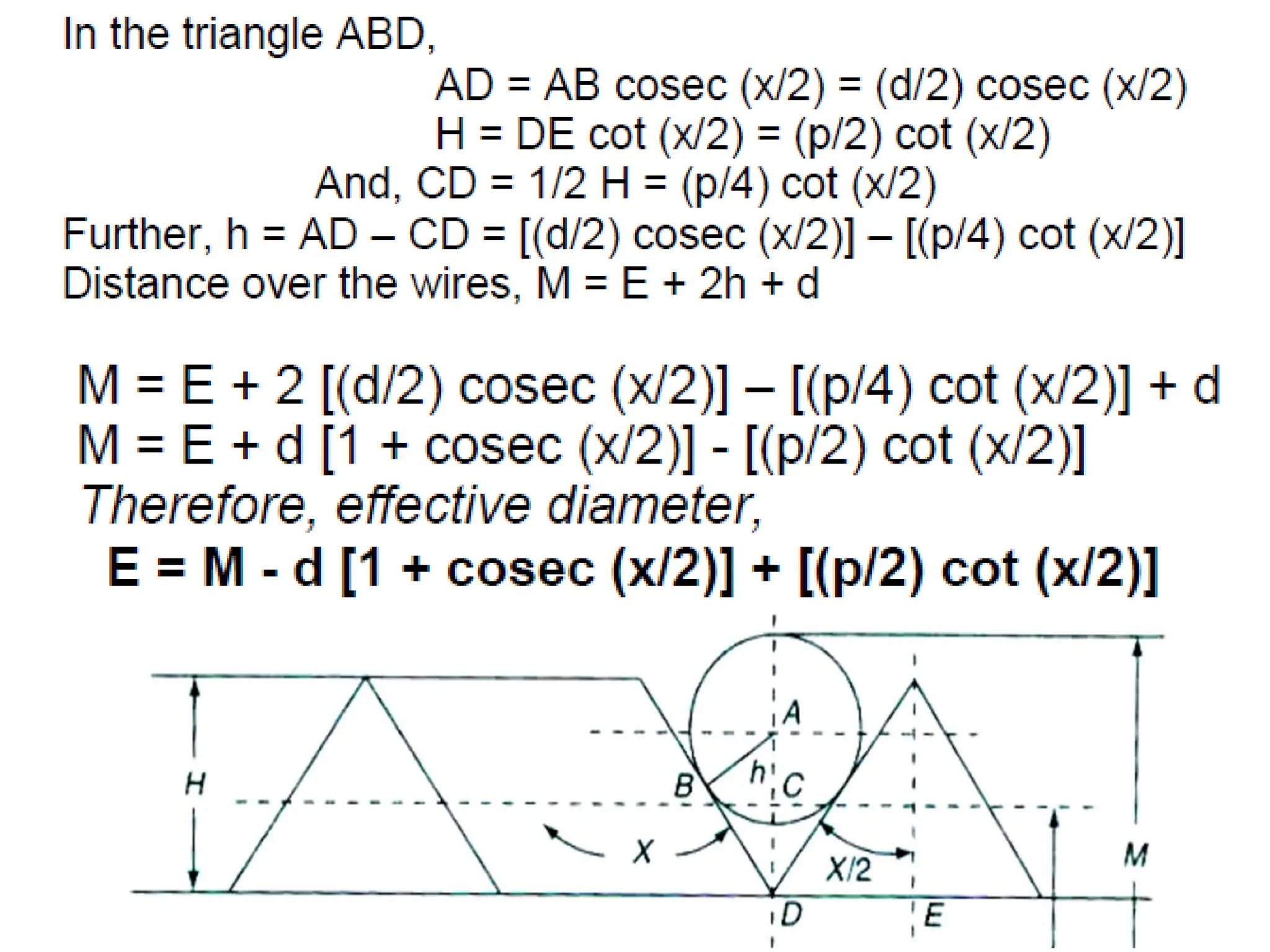
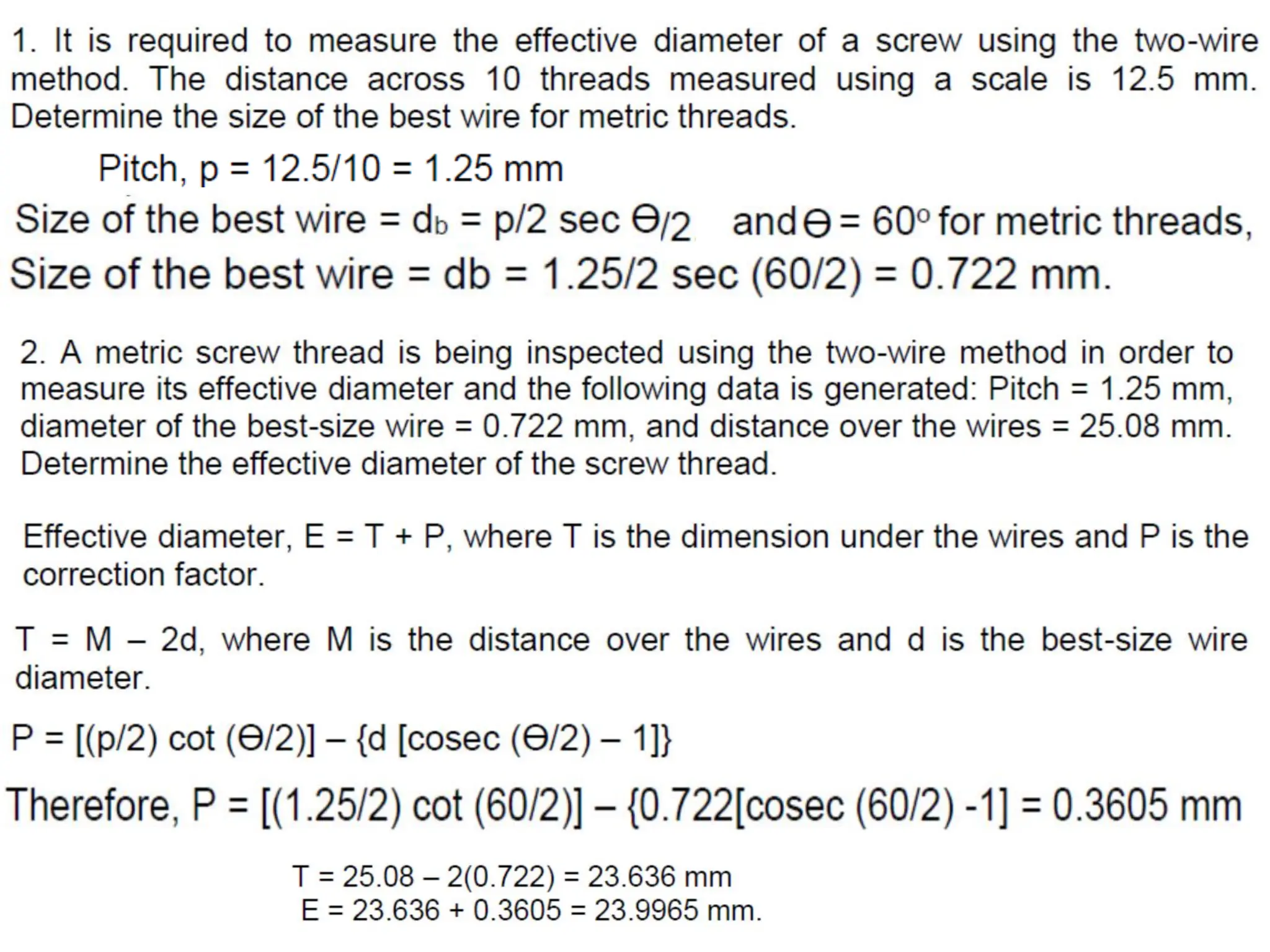
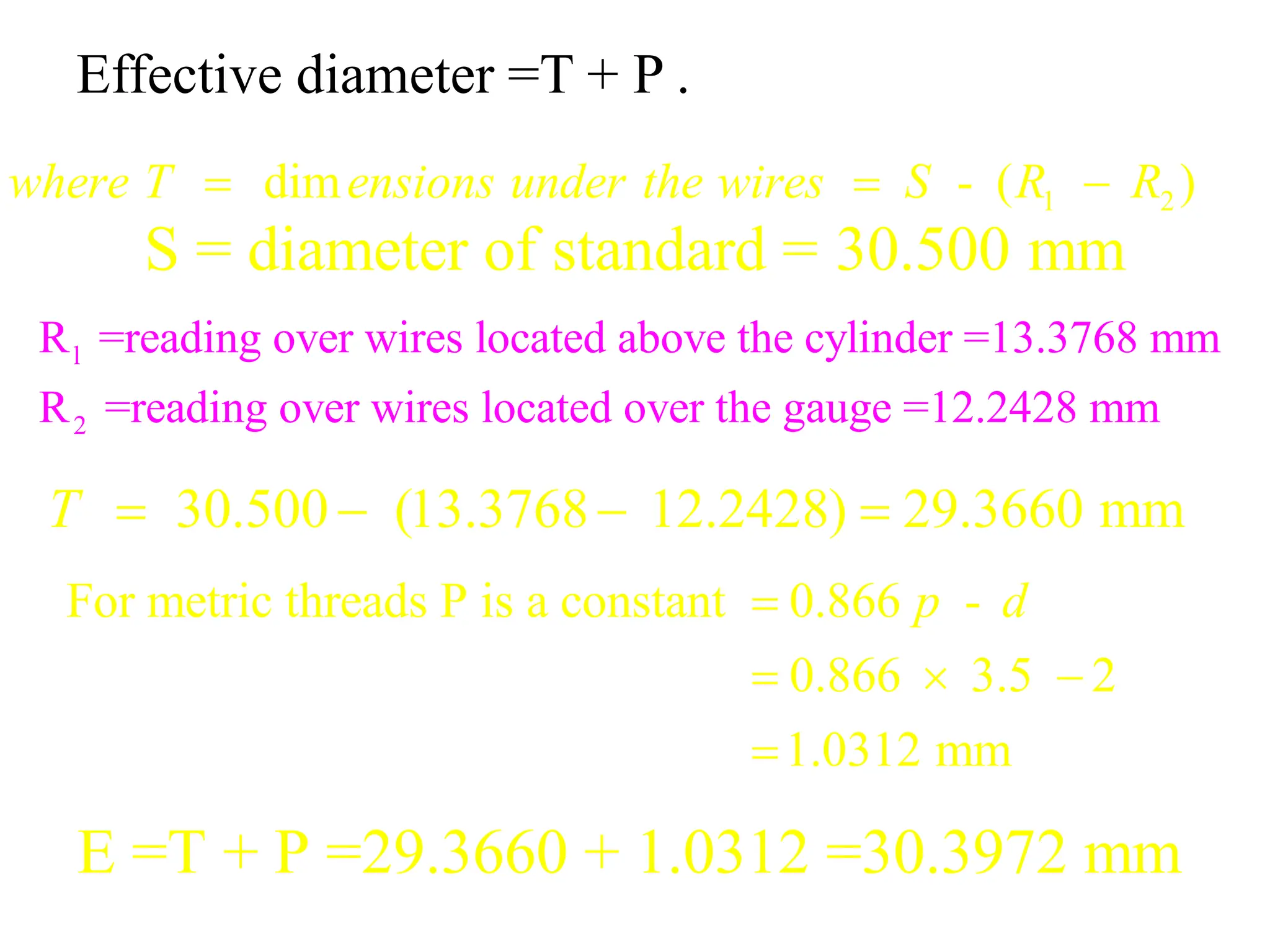
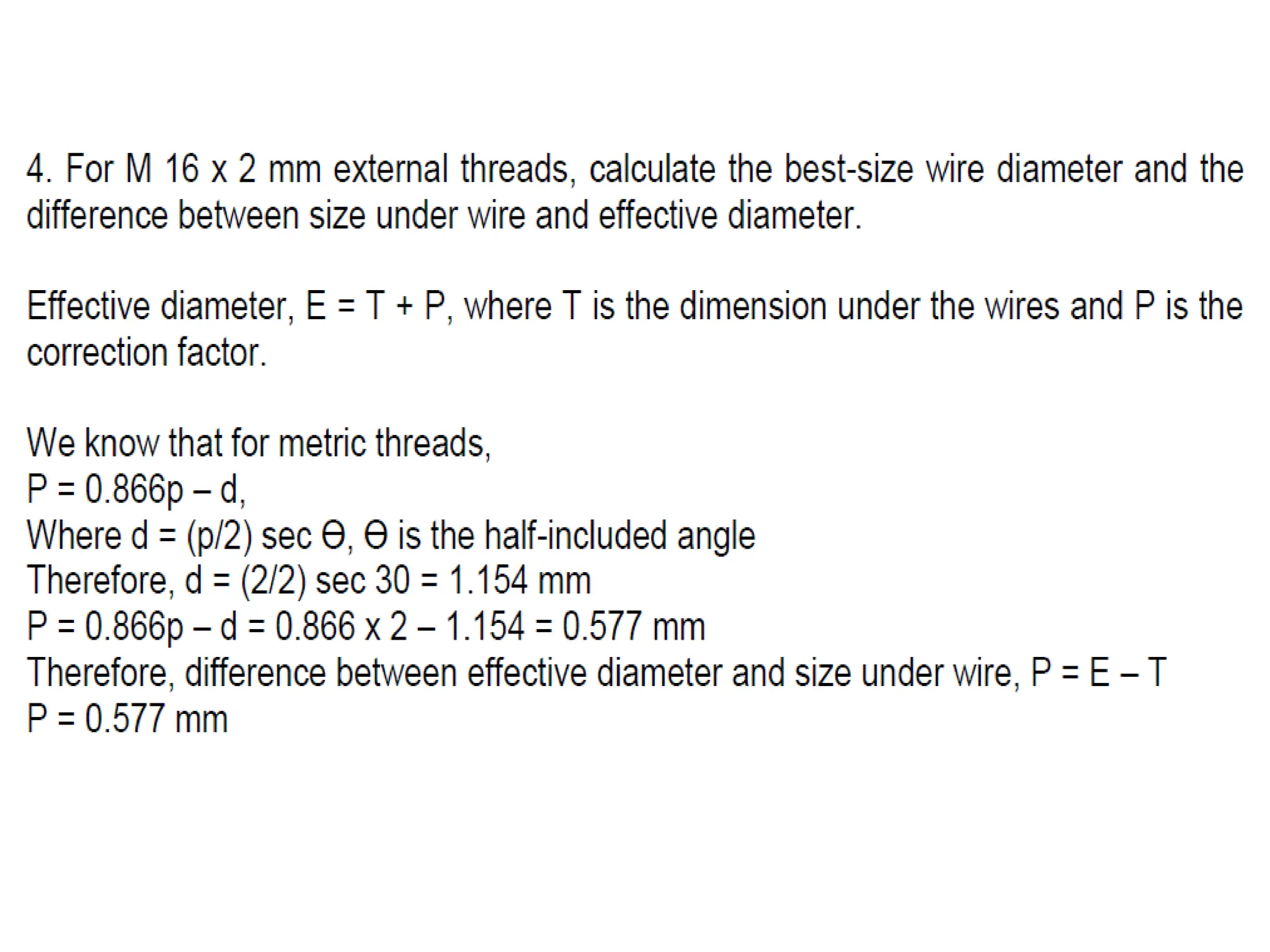
Effective diameter =T + P .
1 2
dim - ( )
where T ensions under the wires S R R
  
S = diameter of standard = 30.500 mm
l
2
R =reading over wires located above the cylinder =13.3768 mm
R =reading over wires located over the gauge =12.2428 mm
30.500 (13.3768 12.2428) 29.3660 mm
T    
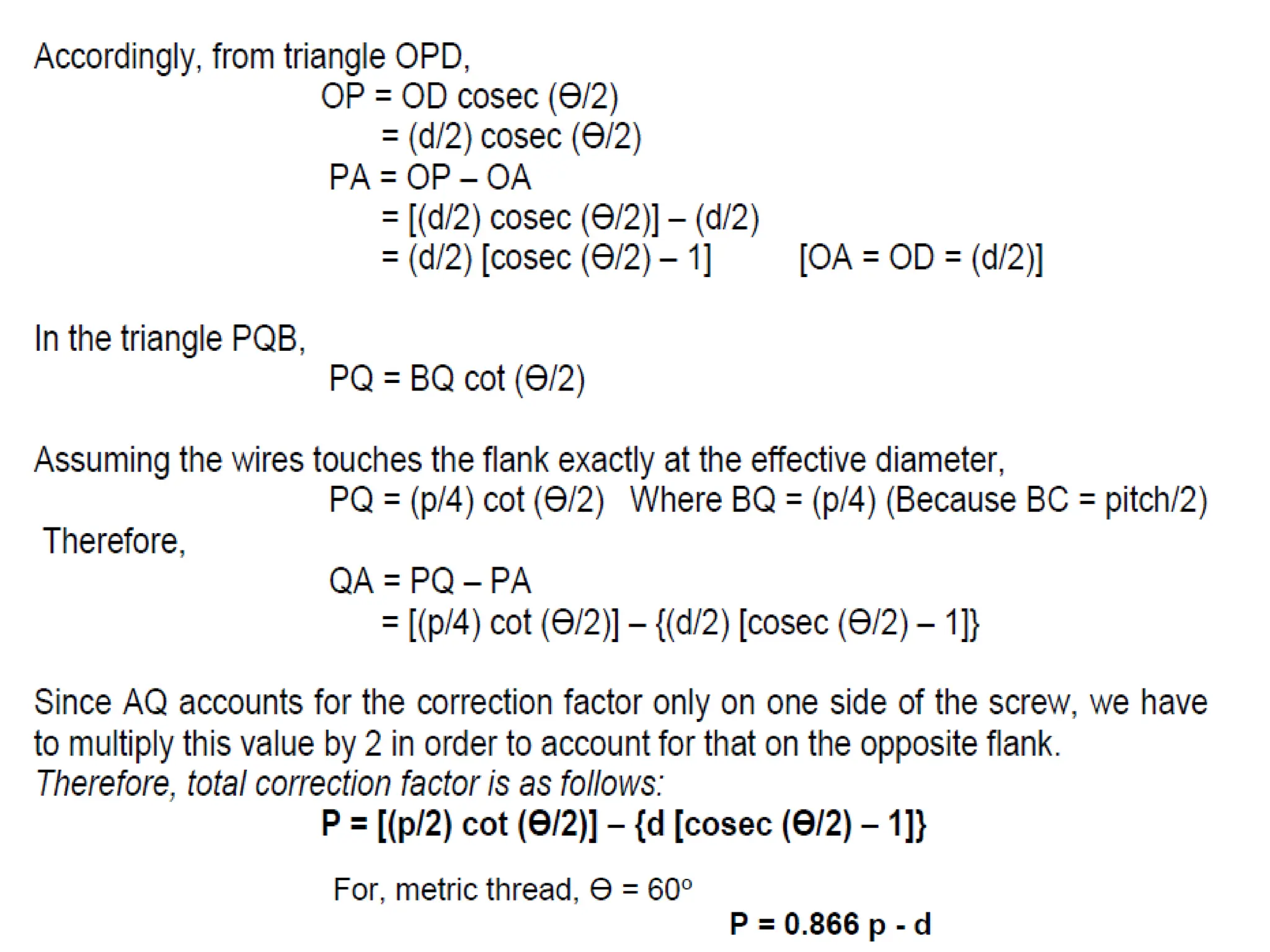
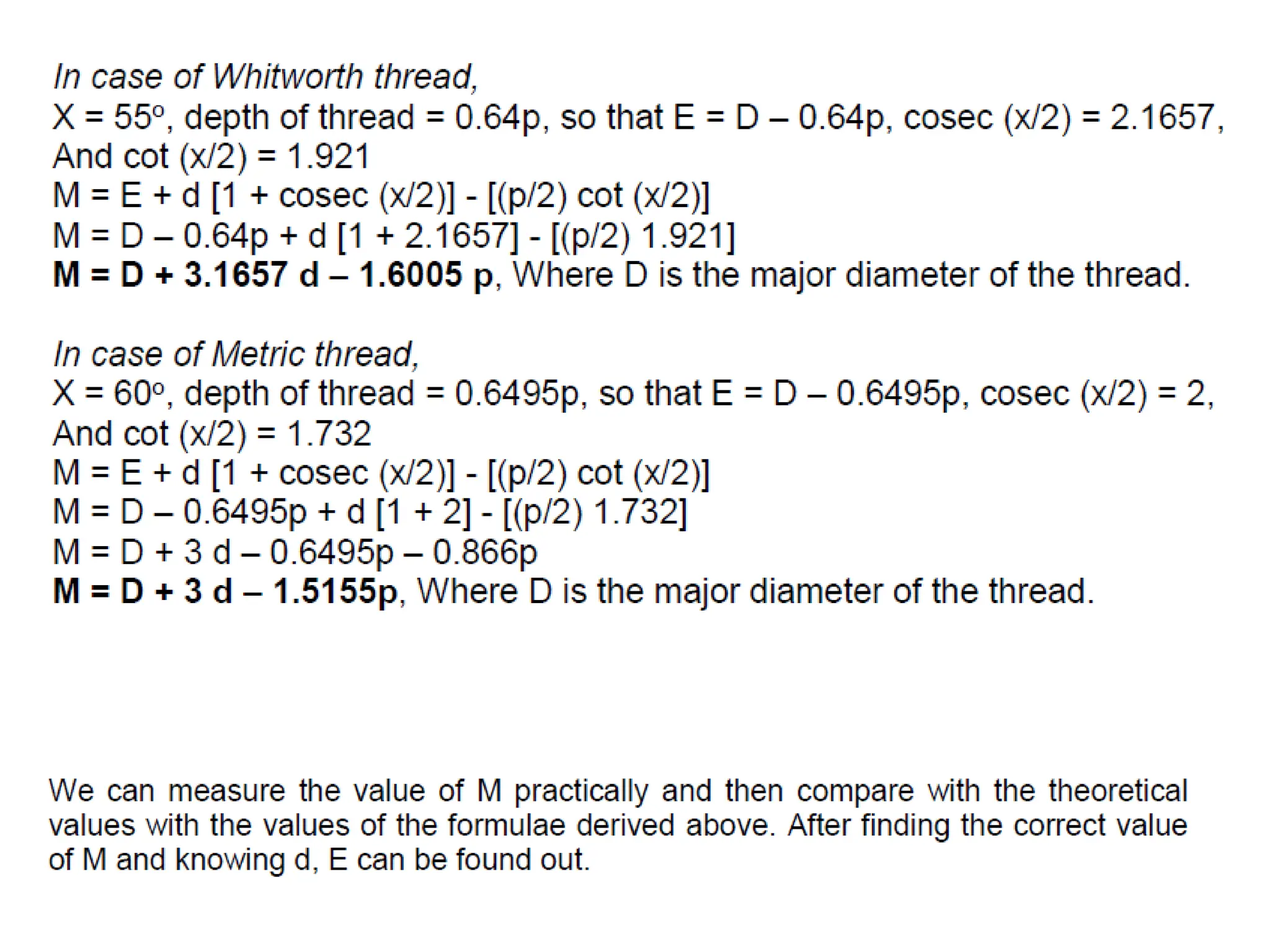
For metric threads P is a constant 0.866 -
0.866 3.5 2
1.0312 mm
p d

  

E =T + P =29.3660 + 1.0312 =30.3972 mm

Chapter 11 - SCREW THREADS sllides.pdf .

  • 1.
  • 4.
    Screw Threads Terminology 1.Screw thread: A screw thread is the helical ridge produced by forming a continuous helical groove of uniform section on the external or internal surface of a cylinder or cone. A screw thread formed on a cylinder is known as straight or parallel screw thread, while the one formed on a cone or frustum of a cone is known as tapered screw thread.
  • 5.
    2. Axis ofa thread: This is imaginary line running longitudinally through the centre of the screw. 3. Crest of thread : This is defined as the prominent part of thread, whether it be external or internal. 4. Root of thread : This is defined as the bottom of the groove between the two flanks of the thread, whether it be external or internal.
  • 6.
    5. Flanks ofthread : These are straight edges which connect the crest with the root. 6. Angle of thread (Included angle): This is the angle between the flanks or slope of the thread measured in an axial plane. 7. Flank angle: The flank angles are the angles between individual flanks and the perpendicular to the axis of the thread which passes through the vertex of the fundamental triangle. The flank angle of a symmetrical thread is commonly termed as the half-angle of thread.
  • 7.
    8. Pitch: The pitchof a thread is the distance, measured parallel to the axis of the thread, between corresponding points on adjacent thread forms in the same axial plane and on the same side of axis. The basic pitch is equal to the lead divided by the number of thread starts. On drawings of thread sections, the pitch is shown as the distance from the centre of one thread crest to the centre of the next, and this representation is correct for single start as well as multi-start threads.
  • 8.
    9. Depth ofthread: This is the distance from the crest or tip of the thread to the root of the thread measured perpendicular to the longitudinal axis or this could be defined as the distance measured radially between the major and minor cylinders. 10.Fundamental triangle: This is found by extending the flanks and joining the points B and C. Thus in Figure, triangle ABC is referred to fundamental triangle. Here BC = pitch, and the vertical height of the triangle is called angular or theoretical depth. The point A is the apex of the triangle ABC.
  • 9.
    11.Truncation: A thread issometimes truncated at the crest or at the root or at both crest and root. The truncation at the crest is the radial distance from the crest to the nearest apex of the fundamental triangle. Similarly the truncation at the root is the radial distance from the root to the nearest apex.
  • 10.
    12.Addendum: For an externalthread, this is defined as the radial distance between the major and pitch cylinders. For an internal thread this is the radial distance between the minor and pitch cylinders. 13.Dedendum: This is the radial distance between the pitch and minor cylinder for external thread, and for internal thread, this is the radial distance between the major and pitch cylinders.
  • 11.
    14.Major diameter: In caseof a straight thread, this is the diameter of the major cylinder (imaginary cylinder, co-axial with the screw, which just touches the crests of an external thread or the root of an internal thread). It is often referred to as the outside diameter, crest diameter or full diameter of external threads. 15.Minor diameter: In case of straight thread, this is the diameter of the minor cylinder (an imaginary cylinder, co-axial with the screw which just touches the roots of an external thread or the crest of an internal thread). It is often referred to as root diameter or cone diameter of external threads.
  • 12.
    16.Effective diameter orpitch diameter: In case of straight thread, this is the diameter of the pitch cylinder (the imaginary cylinder which is co-axial with the axis of the screw, and intersects the flank of the threads in such a way as to make the width of threads and width of the spaces between the threads equal). If the pitch cylinder be imagined as generated by a straight line parallel to the axis of screw, that straight line is then referred to as the pitch line. Along the pitch line, the widths of the threads and the widths of the spaces are equal on a perfect thread. This is the most important dimension as it decides the quality of the fit between the screw and the nut.
  • 13.
    Errors in Threads. Inthe case of screw threads there are at least five important elements which require consideration and error in anyone of these can cause rejection of the thread. In routine production all of these five elements major diameter, minor diameter, effective diameter, pitch and angle of the thread form) must be checked and method of gauging must be able to cover all these elements.
  • 14.
    Pitch Errors inScrew Threads. Classification: Progressive Pitch Error. Periodic Pitch Error. Drunken Thread.
  • 15.
    Progressive Pitch Error Thiserror occurs when the tool work velocity ratio is incorrect though it may be constant. It can also be caused due to pitch errors in the lead screw of the lathe or other generating machine. The other possibility is by using an incorrect gear or an approximate gear train between work and lead screw e.g., while metric threads are cut with an-inch pitch lead screw and a translatory gear is not available. A graph between the cumulative pitch error and the length of thread is generally a straight line.
  • 16.
    Periodic Pitch Error Thisrepeats itself at regular intervals along the thread. In this case, successive portions of the thread are either longer or shorter than the mean. This type of error occurs when the tool work velocity ratio is not constant. This type of error also results when a thread is cut from a lead screw which lacks squareness in the abutment causing the leadscrew to move backward and forward once in each revolution. Thus the errors due to these cases are cyclic and pitch increases to a maximum, then reduces through normal value to a minimum and so on. The graph between the cumulative pitch error and length of threads for this error will, therefore, be of sinusoidal form.
  • 17.
    Drunken Thread. This isthe one having erratic pitch, in which the advance of the helix is irregular in one complete revolution of the thread. Thread drunkenness is a particular case of a periodic pitch error recurring at intervals of one pitch. In such a thread, the pitch measured parallel to the thread axis will always be correct, the only error being that the thread is not cut to a true helix. If the screw thread be regarded as an inclined plane wound round a cylinder and if the thread be unwound from the cylinder, (i.e., development of the thread be taken) then the drunkeness can be visualised. The helix will be a curve in the case of drunken thread and not a straight line as shown in Figure.
  • 18.
    Effect of PitchErrors An error in pitch virtually increases the effective diameter of a bolt or screw and decreases the effective diameter of a nut. The meaning of the virtual change in effective diameter is that if any screw is perfect except for pitch error, it will not screw easily into a perfect ring gauge of same nominal size until its effective diameter is reduced.
  • 19.
  • 20.
  • 21.
  • 22.
    Effective Diameter Measurements Theeffective diameter or the pitch diameter can be measured by anyone of the following methods : Micrometer method One wire, Two wire or three wire or rod method.
  • 23.
  • 24.
  • 25.
    Thread Micrometer Method The threadmicrometer resembles the ordinary micrometer, but it has special contacts to suit the end screw thread from that is to be checked. In this micrometer, the end of the spindle is pointed to the Vee-thread form with a corresponding Vee recess in the fixed anvil. When measuring threads only, the angle of the point and the sides of Vee anvil. i.e. the flanks of the threads should come into contact with the screw thread. If correctly adjusted, this micrometer gives the pitch diameter. This value should agree with that obtained by measurement by outside diameter and pitch from the following relation : Pitch dia = D - O.6403p (in case of Whitworth thread) where O.6403p =depth of thread, D =outside dia., p =pitch.
  • 26.
  • 39.
    It is desiredto measure the Effective diameter of a 32 x 3.5 mm pitch metric plug screw gauge. For this purpose, following readings (average values) were noted.  Micrometer reading over the standard cylinder of 30.500 mm and the wires of 2.000 mm diameter as 13.3768 mm.  Micrometer reading over the gauge and wires as 12.2428 mm.
  • 40.
    Effective diameter =T+ P . 1 2 dim - ( ) where T ensions under the wires S R R    S = diameter of standard = 30.500 mm l 2 R =reading over wires located above the cylinder =13.3768 mm R =reading over wires located over the gauge =12.2428 mm 30.500 (13.3768 12.2428) 29.3660 mm T     For metric threads P is a constant 0.866 - 0.866 3.5 2 1.0312 mm p d      E =T + P =29.3660 + 1.0312 =30.3972 mm