MANIPAL INSTITUTE OF TECHNOLOGY
Department of Mechanical & Manufacturing Engineering, MIT, Manipal 1
MANIPAL INSTITUTE OF TECHNOLOGY
Measurements
&
Measurement Systems
MANIPAL INSTITUTE OF TECHNOLOGY
Department of Mechanical & Manufacturing Engineering, MIT, Manipal 2
MANIPAL INSTITUTE OF TECHNOLOGY
MEASUREMENT SYSTEM
• Measurement means determination of anything that exists in some
amount.
• If those things that exist are related to mechanical engineering, then
the determination of such amounts are referred to as mechanical
measurements.
• An engineer is not only interested in the measurement of physical
variables but also concerned with their control.
• These two functions are closely related because one must be able to
measure a variable such as temperature, or flow in order to control
it.
MANIPAL INSTITUTE OF TECHNOLOGY
Department of Mechanical & Manufacturing Engineering, MIT, Manipal 3
MANIPAL INSTITUTE OF TECHNOLOGY
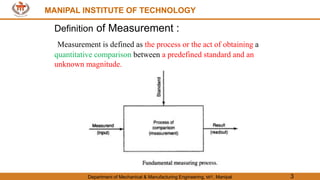
Definition of Measurement :
Measurement is defined as the process or the act of obtaining a
quantitative comparison between a predefined standard and an
unknown magnitude.
MANIPAL INSTITUTE OF TECHNOLOGY
Department of Mechanical & Manufacturing Engineering, MIT, Manipal 4
MANIPAL INSTITUTE OF TECHNOLOGY
Requirements of Measurements
MANIPAL INSTITUTE OF TECHNOLOGY
Department of Mechanical & Manufacturing Engineering, MIT, Manipal 5
MANIPAL INSTITUTE OF TECHNOLOGY
SIGNIFICANCE OF MEASUREMENT SYSTEM
Measurement provides the fundamental basis for research and
development. Development is the final stage of the design
procedure involving the measurement of various quantities
pertaining to operation and performance of the device being
developed.
• Measurement is also a fundamental element of any control
process, which requires the measured discrepancy between the
actual and the desired performances.
MANIPAL INSTITUTE OF TECHNOLOGY
Department of Mechanical & Manufacturing Engineering, MIT, Manipal 6
MANIPAL INSTITUTE OF TECHNOLOGY
• Many operations require measurement for proper performance .
For example :In modern central power stations, temperatures, pressures, vibrational
amplitudes etc., are monitored by measurement to ensure proper performance .
• Measurement is also a bias of commerce, because the cost of the products are
established on the basis of amounts of materials, power, expenditure of time and labour
, and other constraints .
MANIPAL INSTITUTE OF TECHNOLOGY
Department of Mechanical & Manufacturing Engineering, MIT, Manipal 7
MANIPAL INSTITUTE OF TECHNOLOGY
Methods of Measurements
• Direct Methods
In these methods, the unknown quantity (measurand) is directly
compared against a standard. The result is expressed as a numerical
number and a unit. The standard in fact is a physical embodiment of a
unit.
E.g.: measurement of length, mass , time.
MANIPAL INSTITUTE OF TECHNOLOGY
Department of Mechanical & Manufacturing Engineering, MIT, Manipal 8
MANIPAL INSTITUTE OF TECHNOLOGY
• Indirect Methods
A measurement system consists of a transducing element which
converts the quantity to be measured in to an analogous signal.
The analogous signal is then processed by some intermediate
means and is then fed to the end devices which present the results
of the measurement.
MANIPAL INSTITUTE OF TECHNOLOGY
Department of Mechanical & Manufacturing Engineering, MIT, Manipal 9
MANIPAL INSTITUTE OF TECHNOLOGY
Primary, Secondary & Tertiary Measurements
• Primary Measurement
It is one that can be made by direct observation without involving
any conversion of the measured quantity in to length where the
observer can sense the change directly.
E.g.: matching of two lengths, two colours, counting of strokes of
a clock chime to measure the time.
MANIPAL INSTITUTE OF TECHNOLOGY
Department of Mechanical & Manufacturing Engineering, MIT, Manipal 10
MANIPAL INSTITUTE OF TECHNOLOGY
• It is clear that there are two distinct categories of length measurement.
1. A primary measurement of the length of the quantity itself
2. The length of travel of an indicator over a calibrated scale where length unit may
represent any quantity under measurement ( temperature, pressure, speed etc.). This
type of length measurement may be secondary or tertiary.
MANIPAL INSTITUTE OF TECHNOLOGY
Department of Mechanical & Manufacturing Engineering, MIT, Manipal 11
MANIPAL INSTITUTE OF TECHNOLOGY
• Secondary Measurement
It involves only one translation (conversion) to be done on the
quantity under measurement to convert it in to a change of length.
E.g.: to measure pressure of gas it requires
1. An instrument which translates pressure changes in to length
changes
2. A length scale or a standard which is calibrated in length units
equivalent to known changes in pressure.
Therefore in a pressure gauge the primary signal (pressure) is
transmitted to a transducer and the secondary signal (length) is
transmitted to observer’s eye.
MANIPAL INSTITUTE OF TECHNOLOGY
Department of Mechanical & Manufacturing Engineering, MIT, Manipal 12
MANIPAL INSTITUTE OF TECHNOLOGY
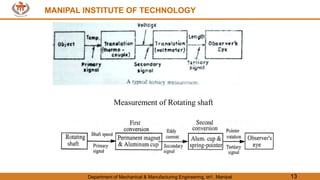
• Tertiary Measurement
It involves two translations.
E.g.: measurement of temperature of an object by thermocouple.
1. The primary signal (temperature) is transmitted to a translator
which generates a voltage which is a function of the
temperature.
2. The voltage in turn is applied to a voltmeter through a pair of
wires to convert voltage in to length. The tertiary signal
(length change) is transmitted to the observer’s brain.
MANIPAL INSTITUTE OF TECHNOLOGY
Department of Mechanical & Manufacturing Engineering, MIT, Manipal 13
MANIPAL INSTITUTE OF TECHNOLOGY
Measurement of Rotating shaft
MANIPAL INSTITUTE OF TECHNOLOGY
Department of Mechanical & Manufacturing Engineering, MIT, Manipal 14
MANIPAL INSTITUTE OF TECHNOLOGY
Generalized Measurement System
MANIPAL INSTITUTE OF TECHNOLOGY
Department of Mechanical & Manufacturing Engineering, MIT, Manipal 15
MANIPAL INSTITUTE OF TECHNOLOGY
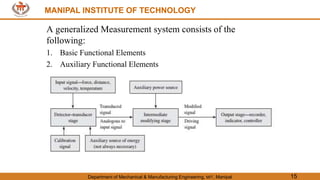
A generalized Measurement system consists of the
following:
1. Basic Functional Elements
2. Auxiliary Functional Elements
MANIPAL INSTITUTE OF TECHNOLOGY
Department of Mechanical & Manufacturing Engineering, MIT, Manipal 16
MANIPAL INSTITUTE OF TECHNOLOGY
Most measuring systems fall within the framework of a general
arrangement consisting of three phases or stages:
• Stage 1. A detection-transduction, or sensor -transducer, stage
• Stage 2. An intermediate stage, which we shall call the signal
conditioning stage
• Stage 3. A terminating, or readout-recording, stage
MANIPAL INSTITUTE OF TECHNOLOGY
Department of Mechanical & Manufacturing Engineering, MIT, Manipal 17
MANIPAL INSTITUTE OF TECHNOLOGY
1. Basic Functional Element
They are those that form the integral parts of all instruments.
They are the following
1. Transducer Element that senses and converts the desired input
to a more convenient and practicable form to be handled by
the measurement system.
2. Signal Conditioning or Intermediate Modifying Element for
manipulating/processing the output of the transducer in a
suitable form.
3. Data Presentation Element for giving the information about
the measurand or measured variable in the quantitative form.
MANIPAL INSTITUTE OF TECHNOLOGY
Department of Mechanical & Manufacturing Engineering, MIT, Manipal 18
MANIPAL INSTITUTE OF TECHNOLOGY
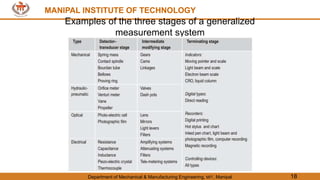
Examples of the three stages of a generalized
measurement system
MANIPAL INSTITUTE OF TECHNOLOGY
Department of Mechanical & Manufacturing Engineering, MIT, Manipal 19
MANIPAL INSTITUTE OF TECHNOLOGY
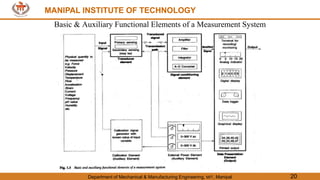
2.Auxiliary Functional Element
They are those which may be incorporated in a particular system depending on the
type of requirement, the nature of measurement technique etc.
1. Calibration Element to provide a built-in calibration facility.
2. External power Element to facilitate the working of one or more of
the elements like the transducer element, the signal conditioning
element, the data processing element or the feedback element.
3. Feedback Element to control the variation of the physical quantity
that is being measured. In addition feedback element is provided in
the null-seeking potentiometric or Wheatstone bridge devices to
make them automatic or self- balancing.
4. Microprocessor Element to facilitate the manipulation of data for
the purpose of simplifying or accelerating the data interpretation. It
is always used in conjunction with analog-to-digital converter
which is incorporated in the signal conditioning element.
MANIPAL INSTITUTE OF TECHNOLOGY
Department of Mechanical & Manufacturing Engineering, MIT, Manipal 20
MANIPAL INSTITUTE OF TECHNOLOGY
Basic & Auxiliary Functional Elements of a Measurement System
MANIPAL INSTITUTE OF TECHNOLOGY
Department of Mechanical & Manufacturing Engineering, MIT, Manipal 21
MANIPAL INSTITUTE OF TECHNOLOGY
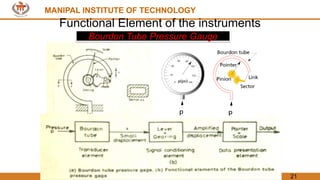
Functional Element of the instruments
Bourdon Tube Pressure Gauge
MANIPAL INSTITUTE OF TECHNOLOGY
Department of Mechanical & Manufacturing Engineering, MIT, Manipal 22
MANIPAL INSTITUTE OF TECHNOLOGY
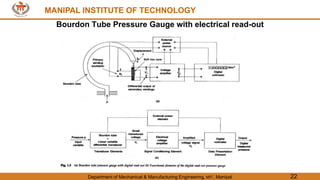
Bourdon Tube Pressure Gauge with electrical read-out
MANIPAL INSTITUTE OF TECHNOLOGY
Department of Mechanical & Manufacturing Engineering, MIT, Manipal 23
MANIPAL INSTITUTE OF TECHNOLOGY
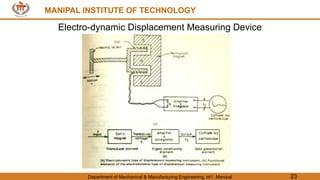
Electro-dynamic Displacement Measuring Device
MANIPAL INSTITUTE OF TECHNOLOGY
Department of Mechanical & Manufacturing Engineering, MIT, Manipal 24
MANIPAL INSTITUTE OF TECHNOLOGY
Transducer Element
MANIPAL INSTITUTE OF TECHNOLOGY
Department of Mechanical & Manufacturing Engineering, MIT, Manipal 27
MANIPAL INSTITUTE OF TECHNOLOGY
Desirable Characteristics of Transducer Element
• The transducer element should recognize and sense the desired
input signal and should be insensitive to other signals present
simultaneously in the measurand.
• It should not alter the event to be measured.
• The output should preferably be electrical to obtain the advantages
of modern computing and display devices.
• It should have good accuracy
• It should have good reproducibility(precision)
• It should have amplitude linearity
MANIPAL INSTITUTE OF TECHNOLOGY
Department of Mechanical & Manufacturing Engineering, MIT, Manipal 28
MANIPAL INSTITUTE OF TECHNOLOGY
• It should not induce phase distortions (i.e. should not induce
time-lag between the input and the output transducer signals)
• It should be able to withstand hostile environment without
damage and should maintain the accuracy within acceptable
limits.
• It should be easily available reasonably priced and compact in
shape and size (preferably portable).
• It should have good reliability.
MANIPAL INSTITUTE OF TECHNOLOGY
Department of Mechanical & Manufacturing Engineering, MIT, Manipal 29
MANIPAL INSTITUTE OF TECHNOLOGY
Signal Conditioning Element
• The output of the transducer element is usually too small to
operate an indicator or a recorder. Therefore, it is suitably
processed and modified in the signal conditioning element.
• The transducer signal may be fed to the signal conditioning
element by means of either mechanical linkages (levers, gears,
etc.), electrical cables, fluid transmission through liquids or
through pneumatic transmission using air. For remote
transmission purposes, special devices like radio links or
telemetry systems may be employed.
• The signal conditioning operations that are carried out on the
transduced information may be one or more of the following:
MANIPAL INSTITUTE OF TECHNOLOGY
Department of Mechanical & Manufacturing Engineering, MIT, Manipal 30
MANIPAL INSTITUTE OF TECHNOLOGY
The term amplification means increasing the amplitude of the signal
without affecting its waveform. A suitable amplifying element is incorporated
in the signal conditioning element which may be one of the following
depending on the type of transducer signal.

1. Mechanical amplifying elements such as levers, gears or a combination
of the two designed to have a multiplying effect on the input transducer
signal.
2. Hydraulic/Pneumatic amplifying element employing various types of
valves or constrictions, such as venturimeter/ orificemeter, to get
significant variation in pressure with small variation in the input
parameters.
3. Optical amplifying elements in which lenses, mirrors and combinations
of lenses and mirrors or lamp and scale arrangement are employed to
convert the small input displacement into an output of sizable magnitude
for a convenient display of the same.
MANIPAL INSTITUTE OF TECHNOLOGY
Department of Mechanical & Manufacturing Engineering, MIT, Manipal 31
MANIPAL INSTITUTE OF TECHNOLOGY
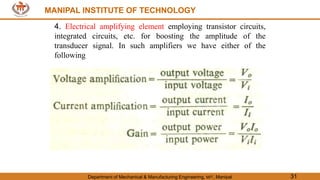
4. Electrical amplifying element employing transistor circuits,
integrated circuits, etc. for boosting the amplitude of the
transducer signal. In such amplifiers we have either of the

following
MANIPAL INSTITUTE OF TECHNOLOGY
Department of Mechanical & Manufacturing Engineering, MIT, Manipal 34
MANIPAL INSTITUTE OF TECHNOLOGY
Data Presentation Element
This element gathers the output of the signal conditioning
element and presents the same to be read or seen by the
experimenter.
This element should:
1. Have as fast as response as possible
2. Impose as little drag on the system as possible
3. Have very small inertia, friction, stiction, etc. (hence using
light rays and electron beams is advantageous)
MANIPAL INSTITUTE OF TECHNOLOGY
Department of Mechanical & Manufacturing Engineering, MIT, Manipal 35
MANIPAL INSTITUTE OF TECHNOLOGY
• This element may be either of the visual display type, graphic
recording type or a magnetic tape. In the visual display type element,
devices such as pointer and scale / panel meter, multi-channel CRO,
storage CRO, etc. may be employed.
• The graphic recording type element gives a permanent record of the
input data. The device in this element may be pen recorders using
heated stylus, ink recorders on paper charts, optical recording systems
such as mirror galvanometer recorders or ultraviolet recorders on
special photosensitive paper. Further a magnetic tape may be used to
acquire input data which could be reproduced at a later date for
analysis.
• In case the output of the signal conditioning element is in the digital
form, then the same may be displayed visually on a digital display
device. Alternatively, it may be suitably recorded either on punched
cards, perforated papers tape, magnetic tape, typewritten page or a
combination of these systems for further processing.
MANIPAL INSTITUTE OF TECHNOLOGY
Department of Mechanical & Manufacturing Engineering, MIT, Manipal 36
MANIPAL INSTITUTE OF TECHNOLOGY
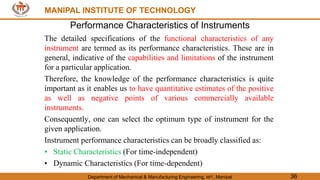
Performance Characteristics of Instruments
The detailed specifications of the functional characteristics of any
instrument are termed as its performance characteristics. These are in
general, indicative of the capabilities and limitations of the instrument
for a particular application.
Therefore, the knowledge of the performance characteristics is quite
important as it enables us to have quantitative estimates of the positive
as well as negative points of various commercially available
instruments.
Consequently, one can select the optimum type of instrument for the
given application.
Instrument performance characteristics can be broadly classified as:
• Static Characteristics (For time-independent)
• Dynamic Characteristics (For time-dependent)
MANIPAL INSTITUTE OF TECHNOLOGY
Department of Mechanical & Manufacturing Engineering, MIT, Manipal 37
MANIPAL INSTITUTE OF TECHNOLOGY
• In a number of situations, the desired input to the instrument
may be constant or varying slowly with respect to time. In
these situations, the dynamic characteristics are not important.
• Therefore, the various static performance parameters like
accuracy, precision, resolution, sensitivity, linearity,
hysteresis, drift, overload capacity, impedance loading, etc. are
usually good enough to give meaningful quantitative
descriptions of the instrument.
MANIPAL INSTITUTE OF TECHNOLOGY
Department of Mechanical & Manufacturing Engineering, MIT, Manipal 38
MANIPAL INSTITUTE OF TECHNOLOGY
Static Calibration
• Calibration is a comparison between measurements – one of
known magnitude or correctness made or set with one device
and another measurement made in as similar a way as possible
with a second device.
• Static Calibration refers to a procedure where an input, either
constant or slowly time varying, is applied to an instrument
and corresponding output measured, while all other inputs
(desired, interfering, modifying) are kept constant at some
value.
• Instruments are so constructed that the signal conversion they
perform have the property of irreversibility or directionality.
This implies that a change in an input quantity will cause a
corresponding change in the output.
MANIPAL INSTITUTE OF TECHNOLOGY
Department of Mechanical & Manufacturing Engineering, MIT, Manipal 40
MANIPAL INSTITUTE OF TECHNOLOGY
Static Performance Characteristics of
Instruments
MANIPAL INSTITUTE OF TECHNOLOGY
Department of Mechanical & Manufacturing Engineering, MIT, Manipal 41
MANIPAL INSTITUTE OF TECHNOLOGY
• Linearity
• Static Sensitivity
• Repeatability
• Hysteresis
• Threshold
• Readability
• Range / Span
• Accuracy
• Precision
• Resolution
• Dead Band
• Backlash
• Drift
• Impedance Loading and
Matching
MANIPAL INSTITUTE OF TECHNOLOGY
Department of Mechanical & Manufacturing Engineering, MIT, Manipal 42
MANIPAL INSTITUTE OF TECHNOLOGY
Linearity
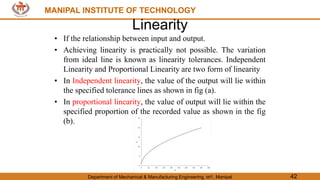
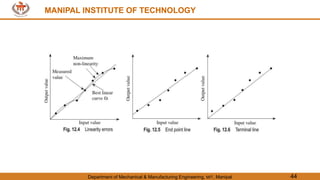
• If the relationship between input and output.
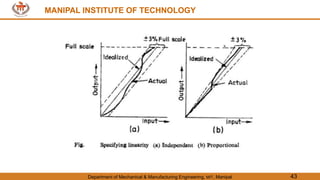
• Achieving linearity is practically not possible. The variation
from ideal line is known as linearity tolerances. Independent
Linearity and Proportional Linearity are two form of linearity
• In Independent linearity, the value of the output will lie within
the specified tolerance lines as shown in fig (a).
• In proportional linearity, the value of output will lie within the
specified proportion of the recorded value as shown in the fig
(b).
MANIPAL INSTITUTE OF TECHNOLOGY
Department of Mechanical & Manufacturing Engineering, MIT, Manipal 43
MANIPAL INSTITUTE OF TECHNOLOGY
Department of Mechanical & Manufacturing Engineering, MIT, Manipal 44
MANIPAL INSTITUTE OF TECHNOLOGY
Department of Mechanical & Manufacturing Engineering, MIT, Manipal 45
MANIPAL INSTITUTE OF TECHNOLOGY
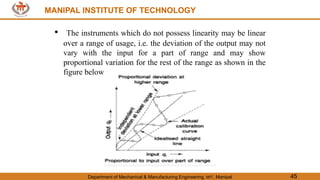
• The instruments which do not possess linearity may be linear
over a range of usage, i.e. the deviation of the output may not
vary with the input for a part of range and may show
proportional variation for the rest of the range as shown in the
figure below
MANIPAL INSTITUTE OF TECHNOLOGY
Department of Mechanical & Manufacturing Engineering, MIT, Manipal 46
MANIPAL INSTITUTE OF TECHNOLOGY
Static Sensitivity
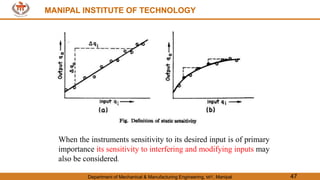
• Static Sensitivity: - The static sensitivity is defined as the slope
of the calibration curve
• That is given by
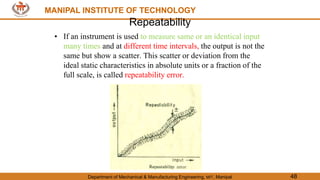
• If the input-output relation is linear, the sensitivity is constant
for all values of input. The sensitivity of nonlinear instrument
depends on the input quantity. The two curves for both linear
and nonlinear are shown in the figures below
MANIPAL INSTITUTE OF TECHNOLOGY
Department of Mechanical & Manufacturing Engineering, MIT, Manipal 47
MANIPAL INSTITUTE OF TECHNOLOGY
When the instruments sensitivity to its desired input is of primary
importance its sensitivity to interfering and modifying inputs may
also be considered.
MANIPAL INSTITUTE OF TECHNOLOGY
Department of Mechanical & Manufacturing Engineering, MIT, Manipal 48
MANIPAL INSTITUTE OF TECHNOLOGY
Repeatability
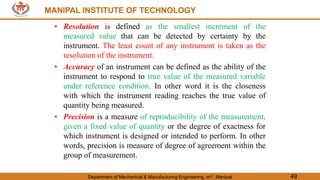
• If an instrument is used to measure same or an identical input
many times and at different time intervals, the output is not the
same but show a scatter. This scatter or deviation from the
ideal static characteristics in absolute units or a fraction of the
full scale, is called repeatability error.
MANIPAL INSTITUTE OF TECHNOLOGY
Department of Mechanical & Manufacturing Engineering, MIT, Manipal 49
MANIPAL INSTITUTE OF TECHNOLOGY
• Resolution is defined as the smallest increment of the
measured value that can be detected by certainty by the
instrument. The least count of any instrument is taken as the
resolution of the instrument.
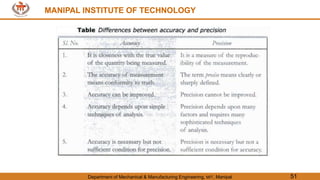
• Accuracy of an instrument can be defined as the ability of the
instrument to respond to true value of the measured variable
under reference condition. In other word it is the closeness
with which the instrument reading reaches the true value of
quantity being measured.
• Precision is a measure of reproducibility of the measurement,
given a fixed value of quantity or the degree of exactness for
which instrument is designed or intended to perform. In other
words, precision is measure of degree of agreement within the
group of measurement.
MANIPAL INSTITUTE OF TECHNOLOGY
Department of Mechanical & Manufacturing Engineering, MIT, Manipal 50
MANIPAL INSTITUTE OF TECHNOLOGY
Department of Mechanical & Manufacturing Engineering, MIT, Manipal 51
MANIPAL INSTITUTE OF TECHNOLOGY
Department of Mechanical & Manufacturing Engineering, MIT, Manipal 52
MANIPAL INSTITUTE OF TECHNOLOGY
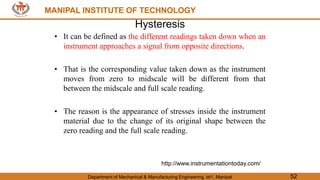
Hysteresis
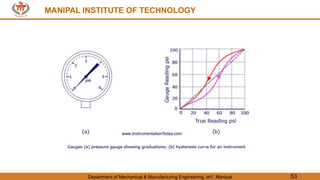
• It can be defined as the different readings taken down when an
instrument approaches a signal from opposite directions.
• That is the corresponding value taken down as the instrument
moves from zero to midscale will be different from that
between the midscale and full scale reading.
• The reason is the appearance of stresses inside the instrument
material due to the change of its original shape between the
zero reading and the full scale reading.
http://www.instrumentationtoday.com/
MANIPAL INSTITUTE OF TECHNOLOGY
Department of Mechanical & Manufacturing Engineering, MIT, Manipal 53
MANIPAL INSTITUTE OF TECHNOLOGY
Department of Mechanical & Manufacturing Engineering, MIT, Manipal 54
MANIPAL INSTITUTE OF TECHNOLOGY
Threshold
• If the input to the instrument is gradually increased from zero,
a minimum value of that input is required to detect the output.
• This minimum value of the input is defined as the threshold of
the instrument.
• The numerical value of the input to cause a change in the
output is called the threshold value of the instrument.
• Both threshold and resolution are not zero because of various
factors like friction between moving parts , play or looseness
in joints (backlash), inertia of the moving parts, length of the
scale, spacing of graduations, size of the pointer, parallax,
effect etc.
MANIPAL INSTITUTE OF TECHNOLOGY
Department of Mechanical & Manufacturing Engineering, MIT, Manipal 55
MANIPAL INSTITUTE OF TECHNOLOGY
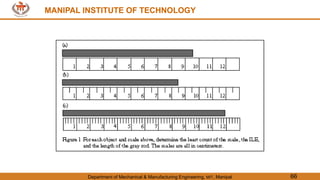
Readability - The readability depends both on the instrument and the
observer.
Refers to the ease with which the readings of a measuring instrument
can be read.
Reproducibility - It can be defined as the ability of an instrument to
produce the same output repeatedly after reading the same input
repeatedly, under the same conditions. The span refers to the range of
the instrument.
Range - It can be defined as the measure of the instrument between
the lowest and highest readings it can measure. A thermometer has a
scale from −40°C to 100°C. Thus the range varies from −40°C to
100°C.
Span - It can be defined as the range of an instrument from the
minimum to maximum scale value. In the case of a thermometer, its
scale goes from −40°C to 100°C. Thus its span is 140°C.
MANIPAL INSTITUTE OF TECHNOLOGY
Department of Mechanical & Manufacturing Engineering, MIT, Manipal 57
MANIPAL INSTITUTE OF TECHNOLOGY
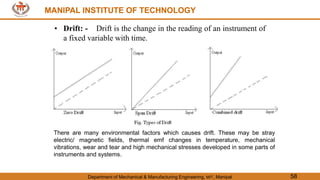
Backlash
• It is defined as the maximum distance or angle through which any
part of the mechanical system may be moved in one direction
without causing motion of the next part. The output-input
characteristics of an instrument system with backlash error is similar
to hysteresis loop due to Coulomb’s friction. Backlash error can be
minimized if the components are made to very close tolerances.
MANIPAL INSTITUTE OF TECHNOLOGY
Department of Mechanical & Manufacturing Engineering, MIT, Manipal 58
MANIPAL INSTITUTE OF TECHNOLOGY
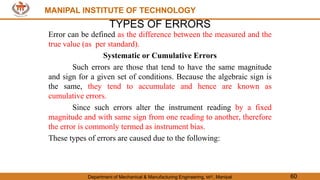
• Drift: - Drift is the change in the reading of an instrument of
a fixed variable with time.
There are many environmental factors which causes drift. These may be stray
electric/ magnetic fields, thermal emf changes in temperature, mechanical
vibrations, wear and tear and high mechanical stresses developed in some parts of
instruments and systems.
MANIPAL INSTITUTE OF TECHNOLOGY
Department of Mechanical & Manufacturing Engineering, MIT, Manipal 60
MANIPAL INSTITUTE OF TECHNOLOGY
TYPES OF ERRORS
Error can be defined as the difference between the measured and the
true value (as per standard).
Systematic or Cumulative Errors
Such errors are those that tend to have the same magnitude
and sign for a given set of conditions. Because the algebraic sign is
the same, they tend to accumulate and hence are known as
cumulative errors.
Since such errors alter the instrument reading by a fixed
magnitude and with same sign from one reading to another, therefore
the error is commonly termed as instrument bias.
These types of errors are caused due to the following:
MANIPAL INSTITUTE OF TECHNOLOGY
Department of Mechanical & Manufacturing Engineering, MIT, Manipal 61
MANIPAL INSTITUTE OF TECHNOLOGY
Instrument Errors
Certain errors are inherent in the instrument systems.
These may be caused due to poor design/ construction of the
instrument. Errors in the divisions of graduated scales, inequality
of the balance arms, irregular spring tension, etc. cause such
errors.
Instrument errors can be avoided by:
I. Selecting a suitable instrument for a given application
II. Applying suitable correction after determining the amount of
instrument error
III.Calibrating the instrument against a suitable standard
MANIPAL INSTITUTE OF TECHNOLOGY
Department of Mechanical & Manufacturing Engineering, MIT, Manipal 62
MANIPAL INSTITUTE OF TECHNOLOGY
Environmental error
These types of errors are caused due to variation of conditions
external to the measuring device, including the conditions in the
area surrounding the instrument. Commonly occurring changes in
environmental conditions that may affect the instrument
characteristics are the effects of changes in temperature,
barometric pressure, humidity, wind forces, magnetic or
electrostatic fields, etc.
For example, change in ambient temperature causes errors
due to expansion of the measuring tape. Similarly, buoyant effect
of the wind causes errors on weights of a chemical balance.
MANIPAL INSTITUTE OF TECHNOLOGY
Department of Mechanical & Manufacturing Engineering, MIT, Manipal 63
MANIPAL INSTITUTE OF TECHNOLOGY
Loading Error
Such errors are caused by the act of measurement on the
physical system being tested.
Common examples of this type are:
I. An obstruction type flow meter may partially block or absorb
the flow conditions and consequently the flow rate shown by
the meter may not be same as before the meter installation.
II. Introduction of a thermometer alters the thermal capacity of
the system and thereby changes the original state of the
system which gives rise to loading error in the temperature
measurement.
MANIPAL INSTITUTE OF TECHNOLOGY
Department of Mechanical & Manufacturing Engineering, MIT, Manipal 64
MANIPAL INSTITUTE OF TECHNOLOGY
Accidental or Random Errors
These errors are caused due to random variations in the parameter
or the system of measurement. Such errors vary in magnitude and
may be either positive or negative on the basis of chance alone.
Since these errors are in either direction, they tend to compensate
one another. Therefore these errors are also called chance or
compensating type of errors.
The presence of such errors is detected by a lack of
consistency in the measured values when the same input is
imposed repeatedly on the instrument.
In a well designed experiment very few random errors
occur but they become important in a high accuracy work.
MANIPAL INSTITUTE OF TECHNOLOGY
Department of Mechanical & Manufacturing Engineering, MIT, Manipal 65
MANIPAL INSTITUTE OF TECHNOLOGY
1.Inconsistencies Associated with Accurate Measurement of
Small Quantities
The outputs of the instruments become inconsistent when very
accurate measurements are being made. This is because when
the instruments are built or adjusted to measure small quantities,
the random errors (which are of the order of the measured
quantities) become noticeable.
For example - if one wishes to measure the weight of a bucket of
water to the nearest kilogram, there would be no excuse of one
observation differing from another, no matter how many times
the measurements are made.
However, if one attempts to determine the same weight to the
nearest milligram, individual observations are sure to differ
unless the are performed with extreme care and without
prejudice.
MANIPAL INSTITUTE OF TECHNOLOGY
Department of Mechanical & Manufacturing Engineering, MIT, Manipal 66
MANIPAL INSTITUTE OF TECHNOLOGY
Department of Mechanical & Manufacturing Engineering, MIT, Manipal 67
MANIPAL INSTITUTE OF TECHNOLOGY
2.Presence of Certain System Defects
System defects such as large dimensional tolerance in mating
parts and the presence of friction contribute to errors that are
either positive or negative depending on the direction of motion.
The former causes backlash error and the latter causes
slackness in the meter bearings. One way of detecting and
correcting such errors is to measure the quantity first while
increasing and then decreasing the magnitude. This procedure is
based on the method of symmetry.
MANIPAL INSTITUTE OF TECHNOLOGY
Department of Mechanical & Manufacturing Engineering, MIT, Manipal 68
MANIPAL INSTITUTE OF TECHNOLOGY
3. Effect of Unrestrained and Randomly Varying Parameters
Chance errors are also caused due to effect of certain
uncontrolled disturbances which influence the instrument output.
Line voltage fluctuations, vibration of the instrument supports,
etc. are common examples of this type. The experimenter should
try to reduce the influence of such randomly varying parameters
to the minimum. But , in spite of this there are always certain
residual contributions due to these random perturbations.
MANIPAL INSTITUTE OF TECHNOLOGY
Department of Mechanical & Manufacturing Engineering, MIT, Manipal 69
MANIPAL INSTITUTE OF TECHNOLOGY
Miscellaneous Type of Gross Errors
• Personal or Human Errors
These are caused due to the limitations in the human senses.
For example, one may sometimes consistently read the observed
value either high or low and thus introduce systematic errors in
the results. While at another time one may record the observed
value slightly differently than the actual reading and consequently
introduce random error in the data. Therefore, it becomes
necessary to exercise extreme care with mature and considered
judgement in recording the observation so as to reduce such
errors.
MANIPAL INSTITUTE OF TECHNOLOGY
Department of Mechanical & Manufacturing Engineering, MIT, Manipal 70
MANIPAL INSTITUTE OF TECHNOLOGY
• Errors due to Faulty Components/ Adjustments
Sometimes there is a misalignment of moving parts, electrical
leakage, poor optics, etc. in the measuring system. These may
simultaneously cause, for example, zero shift coupled with zero
drift which are systematic and random errors respectively.
In such cases, it becomes necessary to determine the magnitude
of the systematic and random errors from the overall gross error.
The procedure usually consists of repeating a measurement a
sufficiently large number of times by feeding a ‘standard’ signal
to the instrument. The difference between the mean value of
signal and the standard signal gives the best estimate of
systematic error. Further, the estimate of uncertainty which
represents the random errors in measurement is evaluated from
the dispersion of the data
MANIPAL INSTITUTE OF TECHNOLOGY
Department of Mechanical & Manufacturing Engineering, MIT, Manipal 71
MANIPAL INSTITUTE OF TECHNOLOGY
• Improper Application of the Instrument
Errors of this type are caused due to the use of instrument in
conditions which do not conform to the desired design/ operating
conditions.
For example, extreme vibrations, mechanical shock or pick-up
due to electrical noise could introduce so much gross error as to
mask the test information. In such cases it becomes necessary to
stop the experiment until the disturbing elements causing the
chaotic type of gross errors are eliminated.
MANIPAL INSTITUTE OF TECHNOLOGY
Department of Mechanical & Manufacturing Engineering, MIT, Manipal 72
MANIPAL INSTITUTE OF TECHNOLOGY
Nakra B.C. and Chaudry K.K., Instrumentation, Measurement & Analysis, Tata McGraw Hill, New Delhi, 2002.
MANIPAL INSTITUTE OF TECHNOLOGY
Department of Mechanical & Manufacturing Engineering, MIT, Manipal 73
MANIPAL INSTITUTE OF TECHNOLOGY
Department of Mechanical & Manufacturing Engineering, MIT, Manipal 74
MANIPAL INSTITUTE OF TECHNOLOGY
Alan S Morris, Measurement and Instrumentation Principles Butterworth-Heinemann, 09-Mar-2001 - Technology & Engineering -
512 pages
MANIPAL INSTITUTE OF TECHNOLOGY
Department of Mechanical & Manufacturing Engineering, MIT, Manipal 75
MANIPAL INSTITUTE OF TECHNOLOGY
Department of Mechanical & Manufacturing Engineering, MIT, Manipal 76
MANIPAL INSTITUTE OF TECHNOLOGY
• A dial gauge is used to measure the pressure in the
vessel. The pivot is not exactly centered and as a result
the readings are subject to systematic error. It was found
that the imperfection makes the readings too large in a
linear fashion from state 1, i.e. 6.895kN/m2 for a dial
readings of zero to state 2, i.e. 27.58kN/m2 for a dial
reading of 150. What would be the value of pressure for
a dial reading of 100?
MANIPAL INSTITUTE OF TECHNOLOGY
Department of Mechanical & Manufacturing Engineering, MIT, Manipal 77
MANIPAL INSTITUTE OF TECHNOLOGY
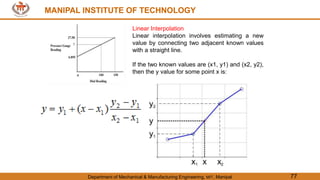
Linear Interpolation
Linear interpolation involves estimating a new
value by connecting two adjacent known values
with a straight line.
If the two known values are (x1, y1) and (x2, y2),
then the y value for some point x is:
MANIPAL INSTITUTE OF TECHNOLOGY
Department of Mechanical & Manufacturing Engineering, MIT, Manipal 78
MANIPAL INSTITUTE OF TECHNOLOGY
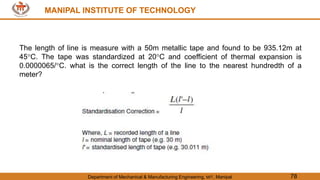
The length of line is measure with a 50m metallic tape and found to be 935.12m at
45C. The tape was standardized at 20C and coefficient of thermal expansion is
0.0000065/C. what is the correct length of the line to the nearest hundredth of a
meter?
MANIPAL INSTITUTE OF TECHNOLOGY
Department of Mechanical & Manufacturing Engineering, MIT, Manipal 79
MANIPAL INSTITUTE OF TECHNOLOGY
Correction =
935.12 [ (50 + 50 x 0.0000065 x 25) −50]
50
= 0.151957 m
Actual Length = Lm + correction = 935.12 + 0.151957
= 935.272m
MANIPAL INSTITUTE OF TECHNOLOGY
Department of Mechanical & Manufacturing Engineering, MIT, Manipal 80
MANIPAL INSTITUTE OF TECHNOLOGY
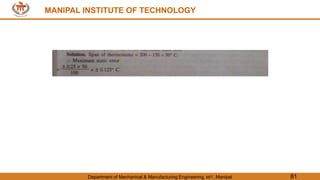
• A thermometer is calibrated 150 C to 200 C. The
accuracy is specified within +/- 0.25 percent of instrument
span. What is the maximum static error.
Sawhney A.K., Mechanical Measurement & Instrumentation, Dhanpat
Rai & Co, New Delhi, 2002.
MANIPAL INSTITUTE OF TECHNOLOGY
Department of Mechanical & Manufacturing Engineering, MIT, Manipal 81
MANIPAL INSTITUTE OF TECHNOLOGY
Department of Mechanical & Manufacturing Engineering, MIT, Manipal 82
MANIPAL INSTITUTE OF TECHNOLOGY
Department of Mechanical & Manufacturing Engineering, MIT, Manipal 83
MANIPAL INSTITUTE OF TECHNOLOGY

Measurements & Measurement .Systems.pptx

  • 1.
    MANIPAL INSTITUTE OFTECHNOLOGY Department of Mechanical & Manufacturing Engineering, MIT, Manipal 1 MANIPAL INSTITUTE OF TECHNOLOGY Measurements & Measurement Systems
  • 2.
    MANIPAL INSTITUTE OFTECHNOLOGY Department of Mechanical & Manufacturing Engineering, MIT, Manipal 2 MANIPAL INSTITUTE OF TECHNOLOGY MEASUREMENT SYSTEM • Measurement means determination of anything that exists in some amount. • If those things that exist are related to mechanical engineering, then the determination of such amounts are referred to as mechanical measurements. • An engineer is not only interested in the measurement of physical variables but also concerned with their control. • These two functions are closely related because one must be able to measure a variable such as temperature, or flow in order to control it.
  • 3.
    MANIPAL INSTITUTE OFTECHNOLOGY Department of Mechanical & Manufacturing Engineering, MIT, Manipal 3 MANIPAL INSTITUTE OF TECHNOLOGY Definition of Measurement : Measurement is defined as the process or the act of obtaining a quantitative comparison between a predefined standard and an unknown magnitude.
  • 4.
    MANIPAL INSTITUTE OFTECHNOLOGY Department of Mechanical & Manufacturing Engineering, MIT, Manipal 4 MANIPAL INSTITUTE OF TECHNOLOGY Requirements of Measurements
  • 5.
    MANIPAL INSTITUTE OFTECHNOLOGY Department of Mechanical & Manufacturing Engineering, MIT, Manipal 5 MANIPAL INSTITUTE OF TECHNOLOGY SIGNIFICANCE OF MEASUREMENT SYSTEM Measurement provides the fundamental basis for research and development. Development is the final stage of the design procedure involving the measurement of various quantities pertaining to operation and performance of the device being developed. • Measurement is also a fundamental element of any control process, which requires the measured discrepancy between the actual and the desired performances.
  • 6.
    MANIPAL INSTITUTE OFTECHNOLOGY Department of Mechanical & Manufacturing Engineering, MIT, Manipal 6 MANIPAL INSTITUTE OF TECHNOLOGY • Many operations require measurement for proper performance . For example :In modern central power stations, temperatures, pressures, vibrational amplitudes etc., are monitored by measurement to ensure proper performance . • Measurement is also a bias of commerce, because the cost of the products are established on the basis of amounts of materials, power, expenditure of time and labour , and other constraints .
  • 7.
    MANIPAL INSTITUTE OFTECHNOLOGY Department of Mechanical & Manufacturing Engineering, MIT, Manipal 7 MANIPAL INSTITUTE OF TECHNOLOGY Methods of Measurements • Direct Methods In these methods, the unknown quantity (measurand) is directly compared against a standard. The result is expressed as a numerical number and a unit. The standard in fact is a physical embodiment of a unit. E.g.: measurement of length, mass , time.
  • 8.
    MANIPAL INSTITUTE OFTECHNOLOGY Department of Mechanical & Manufacturing Engineering, MIT, Manipal 8 MANIPAL INSTITUTE OF TECHNOLOGY • Indirect Methods A measurement system consists of a transducing element which converts the quantity to be measured in to an analogous signal. The analogous signal is then processed by some intermediate means and is then fed to the end devices which present the results of the measurement.
  • 9.
    MANIPAL INSTITUTE OFTECHNOLOGY Department of Mechanical & Manufacturing Engineering, MIT, Manipal 9 MANIPAL INSTITUTE OF TECHNOLOGY Primary, Secondary & Tertiary Measurements • Primary Measurement It is one that can be made by direct observation without involving any conversion of the measured quantity in to length where the observer can sense the change directly. E.g.: matching of two lengths, two colours, counting of strokes of a clock chime to measure the time.
  • 10.
    MANIPAL INSTITUTE OFTECHNOLOGY Department of Mechanical & Manufacturing Engineering, MIT, Manipal 10 MANIPAL INSTITUTE OF TECHNOLOGY • It is clear that there are two distinct categories of length measurement. 1. A primary measurement of the length of the quantity itself 2. The length of travel of an indicator over a calibrated scale where length unit may represent any quantity under measurement ( temperature, pressure, speed etc.). This type of length measurement may be secondary or tertiary.
  • 11.
    MANIPAL INSTITUTE OFTECHNOLOGY Department of Mechanical & Manufacturing Engineering, MIT, Manipal 11 MANIPAL INSTITUTE OF TECHNOLOGY • Secondary Measurement It involves only one translation (conversion) to be done on the quantity under measurement to convert it in to a change of length. E.g.: to measure pressure of gas it requires 1. An instrument which translates pressure changes in to length changes 2. A length scale or a standard which is calibrated in length units equivalent to known changes in pressure. Therefore in a pressure gauge the primary signal (pressure) is transmitted to a transducer and the secondary signal (length) is transmitted to observer’s eye.
  • 12.
    MANIPAL INSTITUTE OFTECHNOLOGY Department of Mechanical & Manufacturing Engineering, MIT, Manipal 12 MANIPAL INSTITUTE OF TECHNOLOGY • Tertiary Measurement It involves two translations. E.g.: measurement of temperature of an object by thermocouple. 1. The primary signal (temperature) is transmitted to a translator which generates a voltage which is a function of the temperature. 2. The voltage in turn is applied to a voltmeter through a pair of wires to convert voltage in to length. The tertiary signal (length change) is transmitted to the observer’s brain.
  • 13.
    MANIPAL INSTITUTE OFTECHNOLOGY Department of Mechanical & Manufacturing Engineering, MIT, Manipal 13 MANIPAL INSTITUTE OF TECHNOLOGY Measurement of Rotating shaft
  • 14.
    MANIPAL INSTITUTE OFTECHNOLOGY Department of Mechanical & Manufacturing Engineering, MIT, Manipal 14 MANIPAL INSTITUTE OF TECHNOLOGY Generalized Measurement System
  • 15.
    MANIPAL INSTITUTE OFTECHNOLOGY Department of Mechanical & Manufacturing Engineering, MIT, Manipal 15 MANIPAL INSTITUTE OF TECHNOLOGY A generalized Measurement system consists of the following: 1. Basic Functional Elements 2. Auxiliary Functional Elements
  • 16.
    MANIPAL INSTITUTE OFTECHNOLOGY Department of Mechanical & Manufacturing Engineering, MIT, Manipal 16 MANIPAL INSTITUTE OF TECHNOLOGY Most measuring systems fall within the framework of a general arrangement consisting of three phases or stages: • Stage 1. A detection-transduction, or sensor -transducer, stage • Stage 2. An intermediate stage, which we shall call the signal conditioning stage • Stage 3. A terminating, or readout-recording, stage
  • 17.
    MANIPAL INSTITUTE OFTECHNOLOGY Department of Mechanical & Manufacturing Engineering, MIT, Manipal 17 MANIPAL INSTITUTE OF TECHNOLOGY 1. Basic Functional Element They are those that form the integral parts of all instruments. They are the following 1. Transducer Element that senses and converts the desired input to a more convenient and practicable form to be handled by the measurement system. 2. Signal Conditioning or Intermediate Modifying Element for manipulating/processing the output of the transducer in a suitable form. 3. Data Presentation Element for giving the information about the measurand or measured variable in the quantitative form.
  • 18.
    MANIPAL INSTITUTE OFTECHNOLOGY Department of Mechanical & Manufacturing Engineering, MIT, Manipal 18 MANIPAL INSTITUTE OF TECHNOLOGY Examples of the three stages of a generalized measurement system
  • 19.
    MANIPAL INSTITUTE OFTECHNOLOGY Department of Mechanical & Manufacturing Engineering, MIT, Manipal 19 MANIPAL INSTITUTE OF TECHNOLOGY 2.Auxiliary Functional Element They are those which may be incorporated in a particular system depending on the type of requirement, the nature of measurement technique etc. 1. Calibration Element to provide a built-in calibration facility. 2. External power Element to facilitate the working of one or more of the elements like the transducer element, the signal conditioning element, the data processing element or the feedback element. 3. Feedback Element to control the variation of the physical quantity that is being measured. In addition feedback element is provided in the null-seeking potentiometric or Wheatstone bridge devices to make them automatic or self- balancing. 4. Microprocessor Element to facilitate the manipulation of data for the purpose of simplifying or accelerating the data interpretation. It is always used in conjunction with analog-to-digital converter which is incorporated in the signal conditioning element.
  • 20.
    MANIPAL INSTITUTE OFTECHNOLOGY Department of Mechanical & Manufacturing Engineering, MIT, Manipal 20 MANIPAL INSTITUTE OF TECHNOLOGY Basic & Auxiliary Functional Elements of a Measurement System
  • 21.
    MANIPAL INSTITUTE OFTECHNOLOGY Department of Mechanical & Manufacturing Engineering, MIT, Manipal 21 MANIPAL INSTITUTE OF TECHNOLOGY Functional Element of the instruments Bourdon Tube Pressure Gauge
  • 22.
    MANIPAL INSTITUTE OFTECHNOLOGY Department of Mechanical & Manufacturing Engineering, MIT, Manipal 22 MANIPAL INSTITUTE OF TECHNOLOGY Bourdon Tube Pressure Gauge with electrical read-out
  • 23.
    MANIPAL INSTITUTE OFTECHNOLOGY Department of Mechanical & Manufacturing Engineering, MIT, Manipal 23 MANIPAL INSTITUTE OF TECHNOLOGY Electro-dynamic Displacement Measuring Device
  • 24.
    MANIPAL INSTITUTE OFTECHNOLOGY Department of Mechanical & Manufacturing Engineering, MIT, Manipal 24 MANIPAL INSTITUTE OF TECHNOLOGY Transducer Element
  • 25.
    MANIPAL INSTITUTE OFTECHNOLOGY Department of Mechanical & Manufacturing Engineering, MIT, Manipal 27 MANIPAL INSTITUTE OF TECHNOLOGY Desirable Characteristics of Transducer Element • The transducer element should recognize and sense the desired input signal and should be insensitive to other signals present simultaneously in the measurand. • It should not alter the event to be measured. • The output should preferably be electrical to obtain the advantages of modern computing and display devices. • It should have good accuracy • It should have good reproducibility(precision) • It should have amplitude linearity
  • 26.
    MANIPAL INSTITUTE OFTECHNOLOGY Department of Mechanical & Manufacturing Engineering, MIT, Manipal 28 MANIPAL INSTITUTE OF TECHNOLOGY • It should not induce phase distortions (i.e. should not induce time-lag between the input and the output transducer signals) • It should be able to withstand hostile environment without damage and should maintain the accuracy within acceptable limits. • It should be easily available reasonably priced and compact in shape and size (preferably portable). • It should have good reliability.
  • 27.
    MANIPAL INSTITUTE OFTECHNOLOGY Department of Mechanical & Manufacturing Engineering, MIT, Manipal 29 MANIPAL INSTITUTE OF TECHNOLOGY Signal Conditioning Element • The output of the transducer element is usually too small to operate an indicator or a recorder. Therefore, it is suitably processed and modified in the signal conditioning element. • The transducer signal may be fed to the signal conditioning element by means of either mechanical linkages (levers, gears, etc.), electrical cables, fluid transmission through liquids or through pneumatic transmission using air. For remote transmission purposes, special devices like radio links or telemetry systems may be employed. • The signal conditioning operations that are carried out on the transduced information may be one or more of the following:
  • 28.
    MANIPAL INSTITUTE OFTECHNOLOGY Department of Mechanical & Manufacturing Engineering, MIT, Manipal 30 MANIPAL INSTITUTE OF TECHNOLOGY The term amplification means increasing the amplitude of the signal without affecting its waveform. A suitable amplifying element is incorporated in the signal conditioning element which may be one of the following depending on the type of transducer signal. 1. Mechanical amplifying elements such as levers, gears or a combination of the two designed to have a multiplying effect on the input transducer signal. 2. Hydraulic/Pneumatic amplifying element employing various types of valves or constrictions, such as venturimeter/ orificemeter, to get significant variation in pressure with small variation in the input parameters. 3. Optical amplifying elements in which lenses, mirrors and combinations of lenses and mirrors or lamp and scale arrangement are employed to convert the small input displacement into an output of sizable magnitude for a convenient display of the same.
  • 29.
    MANIPAL INSTITUTE OFTECHNOLOGY Department of Mechanical & Manufacturing Engineering, MIT, Manipal 31 MANIPAL INSTITUTE OF TECHNOLOGY 4. Electrical amplifying element employing transistor circuits, integrated circuits, etc. for boosting the amplitude of the transducer signal. In such amplifiers we have either of the following
  • 30.
    MANIPAL INSTITUTE OFTECHNOLOGY Department of Mechanical & Manufacturing Engineering, MIT, Manipal 34 MANIPAL INSTITUTE OF TECHNOLOGY Data Presentation Element This element gathers the output of the signal conditioning element and presents the same to be read or seen by the experimenter. This element should: 1. Have as fast as response as possible 2. Impose as little drag on the system as possible 3. Have very small inertia, friction, stiction, etc. (hence using light rays and electron beams is advantageous)
  • 31.
    MANIPAL INSTITUTE OFTECHNOLOGY Department of Mechanical & Manufacturing Engineering, MIT, Manipal 35 MANIPAL INSTITUTE OF TECHNOLOGY • This element may be either of the visual display type, graphic recording type or a magnetic tape. In the visual display type element, devices such as pointer and scale / panel meter, multi-channel CRO, storage CRO, etc. may be employed. • The graphic recording type element gives a permanent record of the input data. The device in this element may be pen recorders using heated stylus, ink recorders on paper charts, optical recording systems such as mirror galvanometer recorders or ultraviolet recorders on special photosensitive paper. Further a magnetic tape may be used to acquire input data which could be reproduced at a later date for analysis. • In case the output of the signal conditioning element is in the digital form, then the same may be displayed visually on a digital display device. Alternatively, it may be suitably recorded either on punched cards, perforated papers tape, magnetic tape, typewritten page or a combination of these systems for further processing.
  • 32.
    MANIPAL INSTITUTE OFTECHNOLOGY Department of Mechanical & Manufacturing Engineering, MIT, Manipal 36 MANIPAL INSTITUTE OF TECHNOLOGY Performance Characteristics of Instruments The detailed specifications of the functional characteristics of any instrument are termed as its performance characteristics. These are in general, indicative of the capabilities and limitations of the instrument for a particular application. Therefore, the knowledge of the performance characteristics is quite important as it enables us to have quantitative estimates of the positive as well as negative points of various commercially available instruments. Consequently, one can select the optimum type of instrument for the given application. Instrument performance characteristics can be broadly classified as: • Static Characteristics (For time-independent) • Dynamic Characteristics (For time-dependent)
  • 33.
    MANIPAL INSTITUTE OFTECHNOLOGY Department of Mechanical & Manufacturing Engineering, MIT, Manipal 37 MANIPAL INSTITUTE OF TECHNOLOGY • In a number of situations, the desired input to the instrument may be constant or varying slowly with respect to time. In these situations, the dynamic characteristics are not important. • Therefore, the various static performance parameters like accuracy, precision, resolution, sensitivity, linearity, hysteresis, drift, overload capacity, impedance loading, etc. are usually good enough to give meaningful quantitative descriptions of the instrument.
  • 34.
    MANIPAL INSTITUTE OFTECHNOLOGY Department of Mechanical & Manufacturing Engineering, MIT, Manipal 38 MANIPAL INSTITUTE OF TECHNOLOGY Static Calibration • Calibration is a comparison between measurements – one of known magnitude or correctness made or set with one device and another measurement made in as similar a way as possible with a second device. • Static Calibration refers to a procedure where an input, either constant or slowly time varying, is applied to an instrument and corresponding output measured, while all other inputs (desired, interfering, modifying) are kept constant at some value. • Instruments are so constructed that the signal conversion they perform have the property of irreversibility or directionality. This implies that a change in an input quantity will cause a corresponding change in the output.
  • 35.
    MANIPAL INSTITUTE OFTECHNOLOGY Department of Mechanical & Manufacturing Engineering, MIT, Manipal 40 MANIPAL INSTITUTE OF TECHNOLOGY Static Performance Characteristics of Instruments
  • 36.
    MANIPAL INSTITUTE OFTECHNOLOGY Department of Mechanical & Manufacturing Engineering, MIT, Manipal 41 MANIPAL INSTITUTE OF TECHNOLOGY • Linearity • Static Sensitivity • Repeatability • Hysteresis • Threshold • Readability • Range / Span • Accuracy • Precision • Resolution • Dead Band • Backlash • Drift • Impedance Loading and Matching
  • 37.
    MANIPAL INSTITUTE OFTECHNOLOGY Department of Mechanical & Manufacturing Engineering, MIT, Manipal 42 MANIPAL INSTITUTE OF TECHNOLOGY Linearity • If the relationship between input and output. • Achieving linearity is practically not possible. The variation from ideal line is known as linearity tolerances. Independent Linearity and Proportional Linearity are two form of linearity • In Independent linearity, the value of the output will lie within the specified tolerance lines as shown in fig (a). • In proportional linearity, the value of output will lie within the specified proportion of the recorded value as shown in the fig (b).
  • 38.
    MANIPAL INSTITUTE OFTECHNOLOGY Department of Mechanical & Manufacturing Engineering, MIT, Manipal 43 MANIPAL INSTITUTE OF TECHNOLOGY
  • 39.
    MANIPAL INSTITUTE OFTECHNOLOGY Department of Mechanical & Manufacturing Engineering, MIT, Manipal 44 MANIPAL INSTITUTE OF TECHNOLOGY
  • 40.
    MANIPAL INSTITUTE OFTECHNOLOGY Department of Mechanical & Manufacturing Engineering, MIT, Manipal 45 MANIPAL INSTITUTE OF TECHNOLOGY • The instruments which do not possess linearity may be linear over a range of usage, i.e. the deviation of the output may not vary with the input for a part of range and may show proportional variation for the rest of the range as shown in the figure below
  • 41.
    MANIPAL INSTITUTE OFTECHNOLOGY Department of Mechanical & Manufacturing Engineering, MIT, Manipal 46 MANIPAL INSTITUTE OF TECHNOLOGY Static Sensitivity • Static Sensitivity: - The static sensitivity is defined as the slope of the calibration curve • That is given by • If the input-output relation is linear, the sensitivity is constant for all values of input. The sensitivity of nonlinear instrument depends on the input quantity. The two curves for both linear and nonlinear are shown in the figures below
  • 42.
    MANIPAL INSTITUTE OFTECHNOLOGY Department of Mechanical & Manufacturing Engineering, MIT, Manipal 47 MANIPAL INSTITUTE OF TECHNOLOGY When the instruments sensitivity to its desired input is of primary importance its sensitivity to interfering and modifying inputs may also be considered.
  • 43.
    MANIPAL INSTITUTE OFTECHNOLOGY Department of Mechanical & Manufacturing Engineering, MIT, Manipal 48 MANIPAL INSTITUTE OF TECHNOLOGY Repeatability • If an instrument is used to measure same or an identical input many times and at different time intervals, the output is not the same but show a scatter. This scatter or deviation from the ideal static characteristics in absolute units or a fraction of the full scale, is called repeatability error.
  • 44.
    MANIPAL INSTITUTE OFTECHNOLOGY Department of Mechanical & Manufacturing Engineering, MIT, Manipal 49 MANIPAL INSTITUTE OF TECHNOLOGY • Resolution is defined as the smallest increment of the measured value that can be detected by certainty by the instrument. The least count of any instrument is taken as the resolution of the instrument. • Accuracy of an instrument can be defined as the ability of the instrument to respond to true value of the measured variable under reference condition. In other word it is the closeness with which the instrument reading reaches the true value of quantity being measured. • Precision is a measure of reproducibility of the measurement, given a fixed value of quantity or the degree of exactness for which instrument is designed or intended to perform. In other words, precision is measure of degree of agreement within the group of measurement.
  • 45.
    MANIPAL INSTITUTE OFTECHNOLOGY Department of Mechanical & Manufacturing Engineering, MIT, Manipal 50 MANIPAL INSTITUTE OF TECHNOLOGY
  • 46.
    MANIPAL INSTITUTE OFTECHNOLOGY Department of Mechanical & Manufacturing Engineering, MIT, Manipal 51 MANIPAL INSTITUTE OF TECHNOLOGY
  • 47.
    MANIPAL INSTITUTE OFTECHNOLOGY Department of Mechanical & Manufacturing Engineering, MIT, Manipal 52 MANIPAL INSTITUTE OF TECHNOLOGY Hysteresis • It can be defined as the different readings taken down when an instrument approaches a signal from opposite directions. • That is the corresponding value taken down as the instrument moves from zero to midscale will be different from that between the midscale and full scale reading. • The reason is the appearance of stresses inside the instrument material due to the change of its original shape between the zero reading and the full scale reading. http://www.instrumentationtoday.com/
  • 48.
    MANIPAL INSTITUTE OFTECHNOLOGY Department of Mechanical & Manufacturing Engineering, MIT, Manipal 53 MANIPAL INSTITUTE OF TECHNOLOGY
  • 49.
    MANIPAL INSTITUTE OFTECHNOLOGY Department of Mechanical & Manufacturing Engineering, MIT, Manipal 54 MANIPAL INSTITUTE OF TECHNOLOGY Threshold • If the input to the instrument is gradually increased from zero, a minimum value of that input is required to detect the output. • This minimum value of the input is defined as the threshold of the instrument. • The numerical value of the input to cause a change in the output is called the threshold value of the instrument. • Both threshold and resolution are not zero because of various factors like friction between moving parts , play or looseness in joints (backlash), inertia of the moving parts, length of the scale, spacing of graduations, size of the pointer, parallax, effect etc.
  • 50.
    MANIPAL INSTITUTE OFTECHNOLOGY Department of Mechanical & Manufacturing Engineering, MIT, Manipal 55 MANIPAL INSTITUTE OF TECHNOLOGY Readability - The readability depends both on the instrument and the observer. Refers to the ease with which the readings of a measuring instrument can be read. Reproducibility - It can be defined as the ability of an instrument to produce the same output repeatedly after reading the same input repeatedly, under the same conditions. The span refers to the range of the instrument. Range - It can be defined as the measure of the instrument between the lowest and highest readings it can measure. A thermometer has a scale from −40°C to 100°C. Thus the range varies from −40°C to 100°C. Span - It can be defined as the range of an instrument from the minimum to maximum scale value. In the case of a thermometer, its scale goes from −40°C to 100°C. Thus its span is 140°C.
  • 51.
    MANIPAL INSTITUTE OFTECHNOLOGY Department of Mechanical & Manufacturing Engineering, MIT, Manipal 57 MANIPAL INSTITUTE OF TECHNOLOGY Backlash • It is defined as the maximum distance or angle through which any part of the mechanical system may be moved in one direction without causing motion of the next part. The output-input characteristics of an instrument system with backlash error is similar to hysteresis loop due to Coulomb’s friction. Backlash error can be minimized if the components are made to very close tolerances.
  • 52.
    MANIPAL INSTITUTE OFTECHNOLOGY Department of Mechanical & Manufacturing Engineering, MIT, Manipal 58 MANIPAL INSTITUTE OF TECHNOLOGY • Drift: - Drift is the change in the reading of an instrument of a fixed variable with time. There are many environmental factors which causes drift. These may be stray electric/ magnetic fields, thermal emf changes in temperature, mechanical vibrations, wear and tear and high mechanical stresses developed in some parts of instruments and systems.
  • 53.
    MANIPAL INSTITUTE OFTECHNOLOGY Department of Mechanical & Manufacturing Engineering, MIT, Manipal 60 MANIPAL INSTITUTE OF TECHNOLOGY TYPES OF ERRORS Error can be defined as the difference between the measured and the true value (as per standard). Systematic or Cumulative Errors Such errors are those that tend to have the same magnitude and sign for a given set of conditions. Because the algebraic sign is the same, they tend to accumulate and hence are known as cumulative errors. Since such errors alter the instrument reading by a fixed magnitude and with same sign from one reading to another, therefore the error is commonly termed as instrument bias. These types of errors are caused due to the following:
  • 54.
    MANIPAL INSTITUTE OFTECHNOLOGY Department of Mechanical & Manufacturing Engineering, MIT, Manipal 61 MANIPAL INSTITUTE OF TECHNOLOGY Instrument Errors Certain errors are inherent in the instrument systems. These may be caused due to poor design/ construction of the instrument. Errors in the divisions of graduated scales, inequality of the balance arms, irregular spring tension, etc. cause such errors. Instrument errors can be avoided by: I. Selecting a suitable instrument for a given application II. Applying suitable correction after determining the amount of instrument error III.Calibrating the instrument against a suitable standard
  • 55.
    MANIPAL INSTITUTE OFTECHNOLOGY Department of Mechanical & Manufacturing Engineering, MIT, Manipal 62 MANIPAL INSTITUTE OF TECHNOLOGY Environmental error These types of errors are caused due to variation of conditions external to the measuring device, including the conditions in the area surrounding the instrument. Commonly occurring changes in environmental conditions that may affect the instrument characteristics are the effects of changes in temperature, barometric pressure, humidity, wind forces, magnetic or electrostatic fields, etc. For example, change in ambient temperature causes errors due to expansion of the measuring tape. Similarly, buoyant effect of the wind causes errors on weights of a chemical balance.
  • 56.
    MANIPAL INSTITUTE OFTECHNOLOGY Department of Mechanical & Manufacturing Engineering, MIT, Manipal 63 MANIPAL INSTITUTE OF TECHNOLOGY Loading Error Such errors are caused by the act of measurement on the physical system being tested. Common examples of this type are: I. An obstruction type flow meter may partially block or absorb the flow conditions and consequently the flow rate shown by the meter may not be same as before the meter installation. II. Introduction of a thermometer alters the thermal capacity of the system and thereby changes the original state of the system which gives rise to loading error in the temperature measurement.
  • 57.
    MANIPAL INSTITUTE OFTECHNOLOGY Department of Mechanical & Manufacturing Engineering, MIT, Manipal 64 MANIPAL INSTITUTE OF TECHNOLOGY Accidental or Random Errors These errors are caused due to random variations in the parameter or the system of measurement. Such errors vary in magnitude and may be either positive or negative on the basis of chance alone. Since these errors are in either direction, they tend to compensate one another. Therefore these errors are also called chance or compensating type of errors. The presence of such errors is detected by a lack of consistency in the measured values when the same input is imposed repeatedly on the instrument. In a well designed experiment very few random errors occur but they become important in a high accuracy work.
  • 58.
    MANIPAL INSTITUTE OFTECHNOLOGY Department of Mechanical & Manufacturing Engineering, MIT, Manipal 65 MANIPAL INSTITUTE OF TECHNOLOGY 1.Inconsistencies Associated with Accurate Measurement of Small Quantities The outputs of the instruments become inconsistent when very accurate measurements are being made. This is because when the instruments are built or adjusted to measure small quantities, the random errors (which are of the order of the measured quantities) become noticeable. For example - if one wishes to measure the weight of a bucket of water to the nearest kilogram, there would be no excuse of one observation differing from another, no matter how many times the measurements are made. However, if one attempts to determine the same weight to the nearest milligram, individual observations are sure to differ unless the are performed with extreme care and without prejudice.
  • 59.
    MANIPAL INSTITUTE OFTECHNOLOGY Department of Mechanical & Manufacturing Engineering, MIT, Manipal 66 MANIPAL INSTITUTE OF TECHNOLOGY
  • 60.
    MANIPAL INSTITUTE OFTECHNOLOGY Department of Mechanical & Manufacturing Engineering, MIT, Manipal 67 MANIPAL INSTITUTE OF TECHNOLOGY 2.Presence of Certain System Defects System defects such as large dimensional tolerance in mating parts and the presence of friction contribute to errors that are either positive or negative depending on the direction of motion. The former causes backlash error and the latter causes slackness in the meter bearings. One way of detecting and correcting such errors is to measure the quantity first while increasing and then decreasing the magnitude. This procedure is based on the method of symmetry.
  • 61.
    MANIPAL INSTITUTE OFTECHNOLOGY Department of Mechanical & Manufacturing Engineering, MIT, Manipal 68 MANIPAL INSTITUTE OF TECHNOLOGY 3. Effect of Unrestrained and Randomly Varying Parameters Chance errors are also caused due to effect of certain uncontrolled disturbances which influence the instrument output. Line voltage fluctuations, vibration of the instrument supports, etc. are common examples of this type. The experimenter should try to reduce the influence of such randomly varying parameters to the minimum. But , in spite of this there are always certain residual contributions due to these random perturbations.
  • 62.
    MANIPAL INSTITUTE OFTECHNOLOGY Department of Mechanical & Manufacturing Engineering, MIT, Manipal 69 MANIPAL INSTITUTE OF TECHNOLOGY Miscellaneous Type of Gross Errors • Personal or Human Errors These are caused due to the limitations in the human senses. For example, one may sometimes consistently read the observed value either high or low and thus introduce systematic errors in the results. While at another time one may record the observed value slightly differently than the actual reading and consequently introduce random error in the data. Therefore, it becomes necessary to exercise extreme care with mature and considered judgement in recording the observation so as to reduce such errors.
  • 63.
    MANIPAL INSTITUTE OFTECHNOLOGY Department of Mechanical & Manufacturing Engineering, MIT, Manipal 70 MANIPAL INSTITUTE OF TECHNOLOGY • Errors due to Faulty Components/ Adjustments Sometimes there is a misalignment of moving parts, electrical leakage, poor optics, etc. in the measuring system. These may simultaneously cause, for example, zero shift coupled with zero drift which are systematic and random errors respectively. In such cases, it becomes necessary to determine the magnitude of the systematic and random errors from the overall gross error. The procedure usually consists of repeating a measurement a sufficiently large number of times by feeding a ‘standard’ signal to the instrument. The difference between the mean value of signal and the standard signal gives the best estimate of systematic error. Further, the estimate of uncertainty which represents the random errors in measurement is evaluated from the dispersion of the data
  • 64.
    MANIPAL INSTITUTE OFTECHNOLOGY Department of Mechanical & Manufacturing Engineering, MIT, Manipal 71 MANIPAL INSTITUTE OF TECHNOLOGY • Improper Application of the Instrument Errors of this type are caused due to the use of instrument in conditions which do not conform to the desired design/ operating conditions. For example, extreme vibrations, mechanical shock or pick-up due to electrical noise could introduce so much gross error as to mask the test information. In such cases it becomes necessary to stop the experiment until the disturbing elements causing the chaotic type of gross errors are eliminated.
  • 65.
    MANIPAL INSTITUTE OFTECHNOLOGY Department of Mechanical & Manufacturing Engineering, MIT, Manipal 72 MANIPAL INSTITUTE OF TECHNOLOGY Nakra B.C. and Chaudry K.K., Instrumentation, Measurement & Analysis, Tata McGraw Hill, New Delhi, 2002.
  • 66.
    MANIPAL INSTITUTE OFTECHNOLOGY Department of Mechanical & Manufacturing Engineering, MIT, Manipal 73 MANIPAL INSTITUTE OF TECHNOLOGY
  • 67.
    MANIPAL INSTITUTE OFTECHNOLOGY Department of Mechanical & Manufacturing Engineering, MIT, Manipal 74 MANIPAL INSTITUTE OF TECHNOLOGY Alan S Morris, Measurement and Instrumentation Principles Butterworth-Heinemann, 09-Mar-2001 - Technology & Engineering - 512 pages
  • 68.
    MANIPAL INSTITUTE OFTECHNOLOGY Department of Mechanical & Manufacturing Engineering, MIT, Manipal 75 MANIPAL INSTITUTE OF TECHNOLOGY
  • 69.
    MANIPAL INSTITUTE OFTECHNOLOGY Department of Mechanical & Manufacturing Engineering, MIT, Manipal 76 MANIPAL INSTITUTE OF TECHNOLOGY • A dial gauge is used to measure the pressure in the vessel. The pivot is not exactly centered and as a result the readings are subject to systematic error. It was found that the imperfection makes the readings too large in a linear fashion from state 1, i.e. 6.895kN/m2 for a dial readings of zero to state 2, i.e. 27.58kN/m2 for a dial reading of 150. What would be the value of pressure for a dial reading of 100?
  • 70.
    MANIPAL INSTITUTE OFTECHNOLOGY Department of Mechanical & Manufacturing Engineering, MIT, Manipal 77 MANIPAL INSTITUTE OF TECHNOLOGY Linear Interpolation Linear interpolation involves estimating a new value by connecting two adjacent known values with a straight line. If the two known values are (x1, y1) and (x2, y2), then the y value for some point x is:
  • 71.
    MANIPAL INSTITUTE OFTECHNOLOGY Department of Mechanical & Manufacturing Engineering, MIT, Manipal 78 MANIPAL INSTITUTE OF TECHNOLOGY The length of line is measure with a 50m metallic tape and found to be 935.12m at 45C. The tape was standardized at 20C and coefficient of thermal expansion is 0.0000065/C. what is the correct length of the line to the nearest hundredth of a meter?
  • 72.
    MANIPAL INSTITUTE OFTECHNOLOGY Department of Mechanical & Manufacturing Engineering, MIT, Manipal 79 MANIPAL INSTITUTE OF TECHNOLOGY Correction = 935.12 [ (50 + 50 x 0.0000065 x 25) −50] 50 = 0.151957 m Actual Length = Lm + correction = 935.12 + 0.151957 = 935.272m
  • 73.
    MANIPAL INSTITUTE OFTECHNOLOGY Department of Mechanical & Manufacturing Engineering, MIT, Manipal 80 MANIPAL INSTITUTE OF TECHNOLOGY • A thermometer is calibrated 150 C to 200 C. The accuracy is specified within +/- 0.25 percent of instrument span. What is the maximum static error. Sawhney A.K., Mechanical Measurement & Instrumentation, Dhanpat Rai & Co, New Delhi, 2002.
  • 74.
    MANIPAL INSTITUTE OFTECHNOLOGY Department of Mechanical & Manufacturing Engineering, MIT, Manipal 81 MANIPAL INSTITUTE OF TECHNOLOGY
  • 75.
    MANIPAL INSTITUTE OFTECHNOLOGY Department of Mechanical & Manufacturing Engineering, MIT, Manipal 82 MANIPAL INSTITUTE OF TECHNOLOGY
  • 76.
    MANIPAL INSTITUTE OFTECHNOLOGY Department of Mechanical & Manufacturing Engineering, MIT, Manipal 83 MANIPAL INSTITUTE OF TECHNOLOGY

Editor's Notes

  • #3 Without knowing speed of the vehicle you cant control it.
  • #14 Digital Indicator of speedometer.
  • #18 The primary function of the first stage is to detect or to sense the measurand. • At the same time, ideally, this stage should be insensitive to every other possible input. • For instance, if it is a pressure pickup, it should be insensitive to say, acceleration; • if it is a strain gage, it should be insensitive to temperature; Second, or Signal-Conditioning, Stage • In addition, it may perform one or more basic operations, such as selective filtering to remove noise, integration, differentiation, as may be required. • Probably the most common function of the second stage is to increase either amplitude or power of the signal, or both, to the level required to drive the final terminating device .
  • #55 Resolution: -    It is defined as the smallest increment of the measured value that can be detected by certainty by the instrument. The least count of any instrument is taken as the resolution of the instrument.
  • #78  = 20.685kN/m2