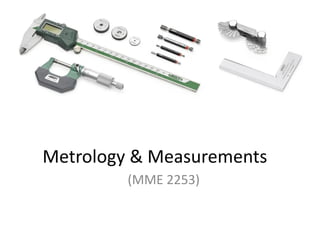
Metrology & Measurements
(MME 2253)
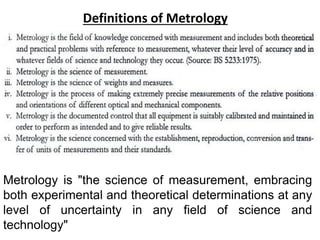
Definitions of Metrology
Metrology is "the science of measurement, embracing
both experimental and theoretical determinations at any
level of uncertainty in any field of science and
technology"
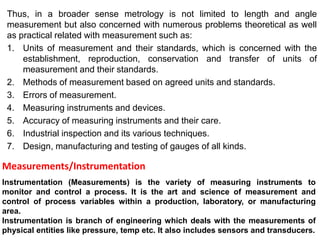
Thus, in a broader sense metrology is not limited to length and angle
measurement but also concerned with numerous problems theoretical as well
as practical related with measurement such as:
1. Units of measurement and their standards, which is concerned with the
establishment, reproduction, conservation and transfer of units of
measurement and their standards.
2. Methods of measurement based on agreed units and standards.
3. Errors of measurement.
4. Measuring instruments and devices.
5. Accuracy of measuring instruments and their care.
6. Industrial inspection and its various techniques.
7. Design, manufacturing and testing of gauges of all kinds.
Instrumentation (Measurements) is the variety of measuring instruments to
monitor and control a process. It is the art and science of measurement and
control of process variables within a production, laboratory, or manufacturing
area.
Instrumentation is branch of engineering which deals with the measurements of
physical entities like pressure, temp etc. It also includes sensors and transducers.
Measurements/Instrumentation
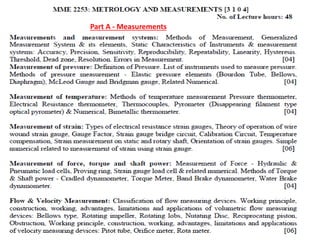
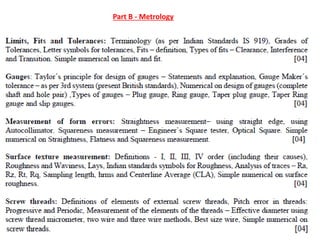
Part A - Measurements
Part B - Metrology
Note: All the above reference books (except 6th) are important from knowledge
point of view and are worth buying. For simplicity 2nd and 3rd can be referred.
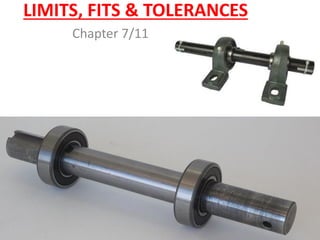
LIMITS, FITS & TOLERANCES
Chapter 7/11
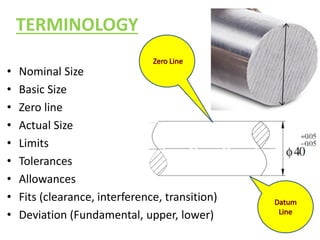
TERMINOLOGY
• Nominal Size
• Basic Size
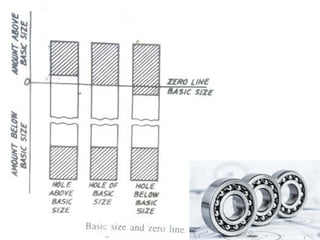
• Zero line
• Actual Size
• Limits
• Tolerances
• Allowances
• Fits (clearance, interference, transition)
• Deviation (Fundamental, upper, lower)
Nominal Size
• The nominal size of a dimension or part is the size by which
it is referred to as a matter of convenience (Eg: 50mm shaft or
2 inch shaft)
Basic Size
• The size of a part in relation to which all limits of
variation are determined (Eg: 49±0.5mm)
Zero line
• Line which represents the basic size so that the
deviation from the basic size is zero (Eg:49mm line)
Actual Size
• This is the measured size (Eg:49.25mm)
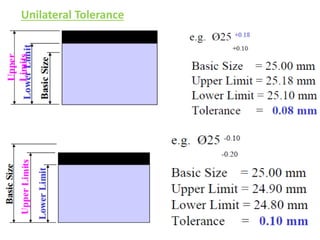
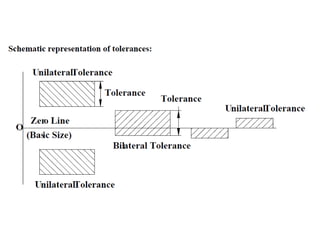
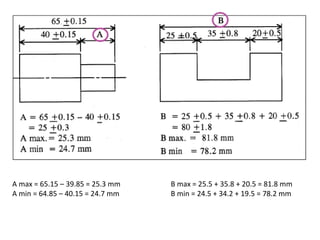
Unilateral Tolerance
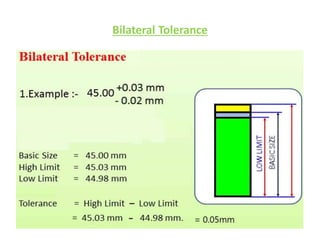
Bilateral Tolerance
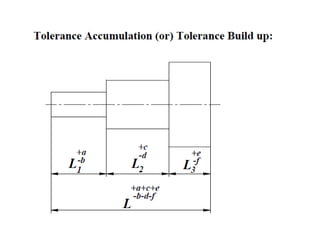
A max = 65.15 – 39.85 = 25.3 mm
A min = 64.85 – 40.15 = 24.7 mm
B max = 25.5 + 35.8 + 20.5 = 81.8 mm
B min = 24.5 + 34.2 + 19.5 = 78.2 mm
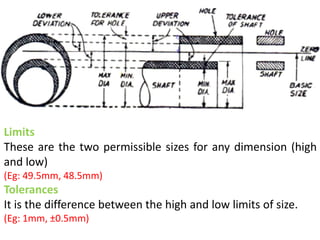
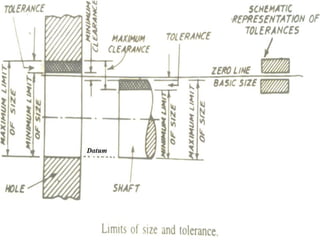
Limits
These are the two permissible sizes for any dimension (high
and low)
(Eg: 49.5mm, 48.5mm)
Tolerances
It is the difference between the high and low limits of size.
(Eg: 1mm, ±0.5mm)
Fits
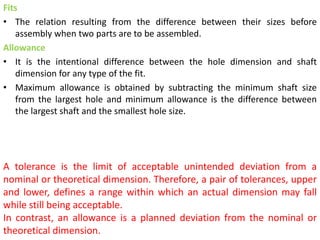
• The relation resulting from the difference between their sizes before
assembly when two parts are to be assembled.
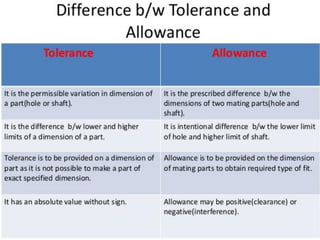
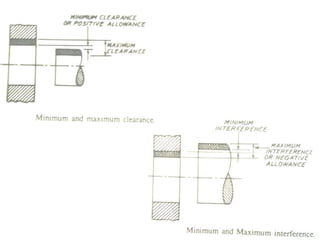
Allowance
• It is the intentional difference between the hole dimension and shaft
dimension for any type of the fit.
• Maximum allowance is obtained by subtracting the minimum shaft size
from the largest hole and minimum allowance is the difference between
the largest shaft and the smallest hole size.
A tolerance is the limit of acceptable unintended deviation from a
nominal or theoretical dimension. Therefore, a pair of tolerances, upper
and lower, defines a range within which an actual dimension may fall
while still being acceptable.
In contrast, an allowance is a planned deviation from the nominal or
theoretical dimension.
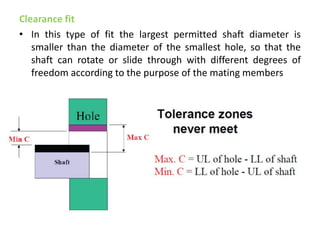
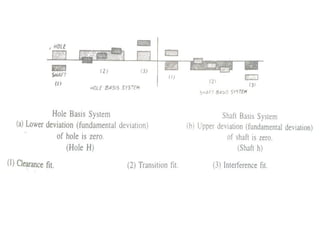
Clearance fit
• In this type of fit the largest permitted shaft diameter is
smaller than the diameter of the smallest hole, so that the
shaft can rotate or slide through with different degrees of
freedom according to the purpose of the mating members
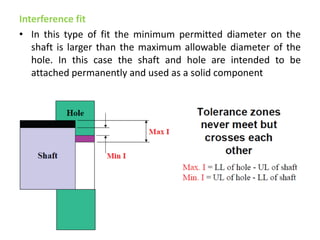
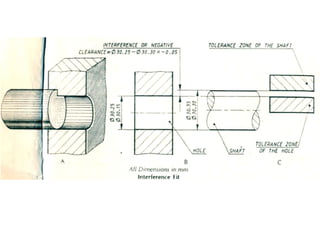
Interference fit
• In this type of fit the minimum permitted diameter on the
shaft is larger than the maximum allowable diameter of the
hole. In this case the shaft and hole are intended to be
attached permanently and used as a solid component
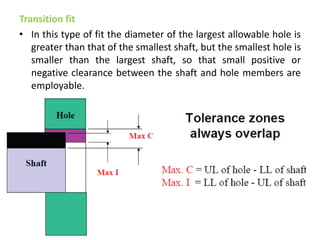
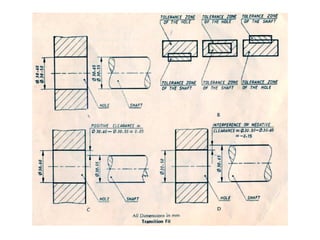
Transition fit
• In this type of fit the diameter of the largest allowable hole is
greater than that of the smallest shaft, but the smallest hole is
smaller than the largest shaft, so that small positive or
negative clearance between the shaft and hole members are
employable.
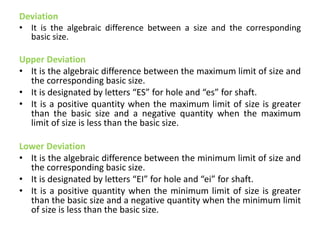
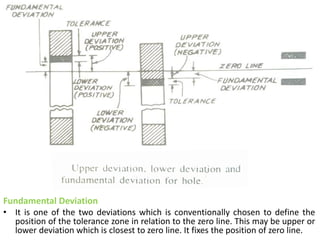
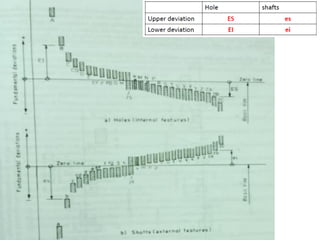
Deviation
• It is the algebraic difference between a size and the corresponding
basic size.
Upper Deviation
• It is the algebraic difference between the maximum limit of size and
the corresponding basic size.
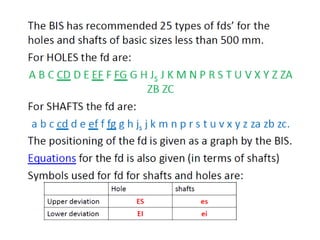
• It is designated by letters “ES” for hole and “es” for shaft.
• It is a positive quantity when the maximum limit of size is greater
than the basic size and a negative quantity when the maximum
limit of size is less than the basic size.
Lower Deviation
• It is the algebraic difference between the minimum limit of size and
the corresponding basic size.
• It is designated by letters “EI” for hole and “ei” for shaft.
• It is a positive quantity when the minimum limit of size is greater
than the basic size and a negative quantity when the minimum limit
of size is less than the basic size.
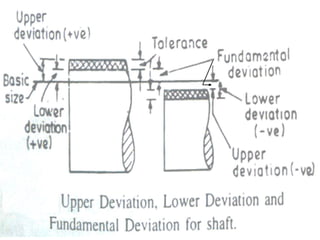
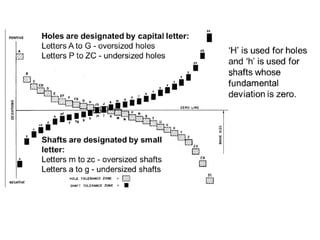
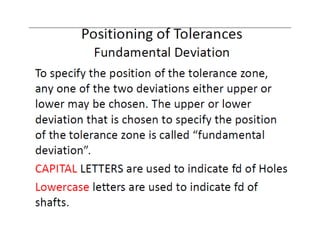
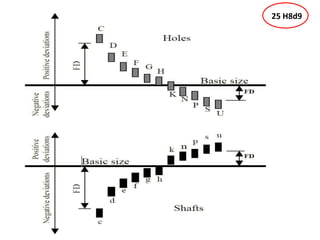
Fundamental Deviation
• It is one of the two deviations which is conventionally chosen to define the
position of the tolerance zone in relation to the zero line. This may be upper or
lower deviation which is closest to zero line. It fixes the position of zero line.
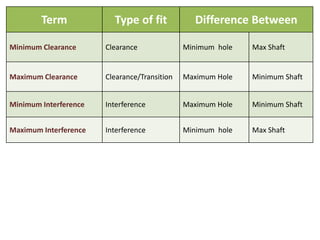
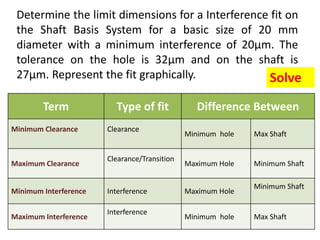
Term Type of fit Difference Between
Minimum Clearance Clearance Minimum hole Max Shaft
Maximum Clearance Clearance/Transition Maximum Hole Minimum Shaft
Minimum Interference Interference Maximum Hole Minimum Shaft
Maximum Interference Interference Minimum hole Max Shaft
Hole Basis: In this system, the basic diameter of the hole is constant while the shaft
size is varied according to the type of fit.
Significance of Hole basis system: The bureau of Indian Standards (BIS) recommends
both hole basis and shaft basis systems, but their selection depends on the
production methods. Generally, holes are produced by drilling, boring, reaming,
broaching, etc. whereas shafts are either turned or ground.
If the shaft basis system is used to specify the limit dimensions to obtain various
types of fits, number of holes of different sizes are required, which in turn requires
tools of different sizes.[ Since drill bits comes in standard sizes only]
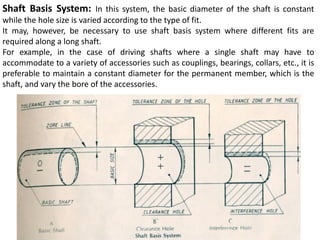
Shaft Basis System: In this system, the basic diameter of the shaft is constant
while the hole size is varied according to the type of fit.
It may, however, be necessary to use shaft basis system where different fits are
required along a long shaft.
For example, in the case of driving shafts where a single shaft may have to
accommodate to a variety of accessories such as couplings, bearings, collars, etc., it is
preferable to maintain a constant diameter for the permanent member, which is the
shaft, and vary the bore of the accessories.
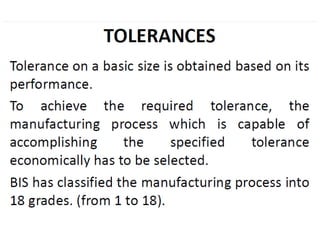
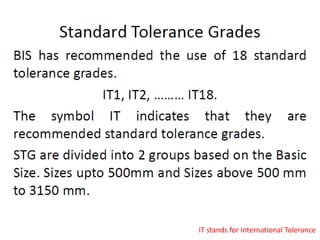
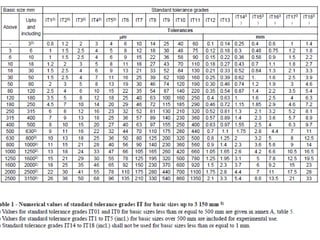
IT stands for International Tolerance
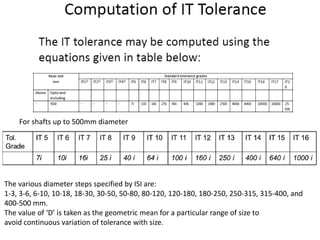
For shafts up to 500mm diameter
The various diameter steps specified by ISI are:
1-3, 3-6, 6-10, 10-18, 18-30, 30-50, 50-80, 80-120, 120-180, 180-250, 250-315, 315-400, and
400-500 mm.
The value of ‘D’ is taken as the geometric mean for a particular range of size to
avoid continuous variation of tolerance with size.
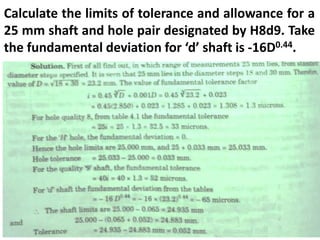
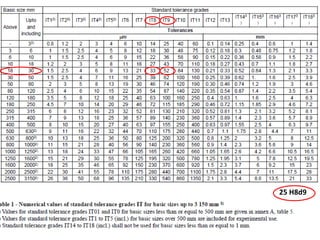
Calculate the limits of tolerance and allowance for a
25 mm shaft and hole pair designated by H8d9. Take
the fundamental deviation for ‘d’ shaft is -16D0.44.
25 H8d9
25 H8d9
25 H8d9
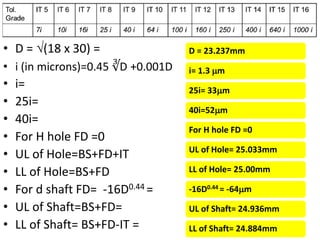
• D = (18 x 30) =
• i (in microns)=0.45 ∛D +0.001D
• i=
• 25i=
• 40i=
• For H hole FD =0
• UL of Hole=BS+FD+IT
• LL of Hole=BS+FD
• For d shaft FD= -16D0.44 =
• UL of Shaft=BS+FD=
• LL of Shaft= BS+FD-IT =
D = 23.237mm
i= 1.3 m
25i= 33m
40i=52m
For H hole FD =0
UL of Hole= 25.033mm
LL of Hole= 25.00mm
-16D0.44 = -64m
UL of Shaft= 24.936mm
LL of Shaft= 24.884mm
For H hole FD =0
UL of Hole= 25.033mm
LL of Hole= 25.00mm
FD for Shaft= -64m
UL of Shaft= 24.936mm
LL of Shaft= 24.884mm
HoleTolerance = 33m Shaft Tolerance =52m
Graphical Representation of Limits (Not to Scale)
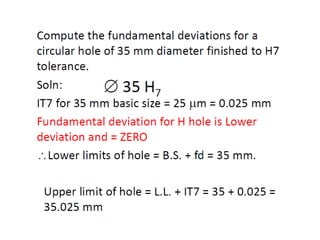
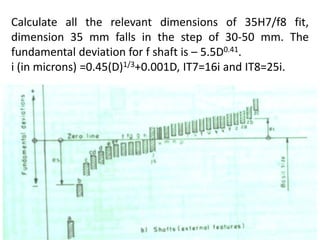
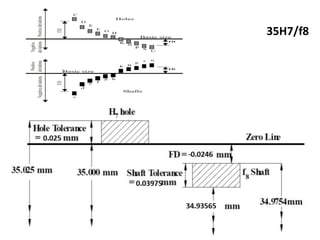
Calculate all the relevant dimensions of 35H7/f8 fit,
dimension 35 mm falls in the step of 30-50 mm. The
fundamental deviation for f shaft is – 5.5D0.41.
i (in microns) =0.45(D)1/3+0.001D, IT7=16i and IT8=25i.
35H7/f8
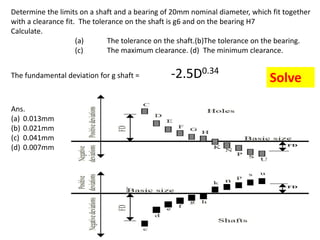
Determine the limits on a shaft and a bearing of 20mm nominal diameter, which fit together
with a clearance fit. The tolerance on the shaft is g6 and on the bearing H7
Calculate.
(a) The tolerance on the shaft.(b)The tolerance on the bearing.
(c) The maximum clearance. (d) The minimum clearance.
The fundamental deviation for g shaft = -2.5D0.34
Ans.
(a) 0.013mm
(b) 0.021mm
(c) 0.041mm
(d) 0.007mm
Solve
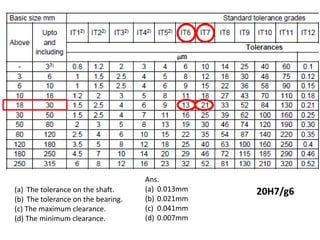
20H7/g6
(a) The tolerance on the shaft.
(b) The tolerance on the bearing.
(c) The maximum clearance.
(d) The minimum clearance.
Ans.
(a) 0.013mm
(b) 0.021mm
(c) 0.041mm
(d) 0.007mm
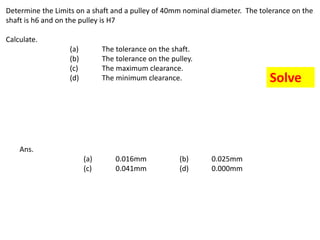
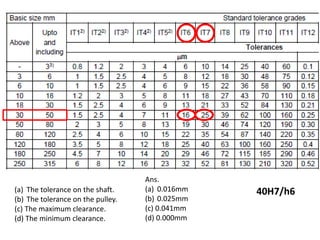
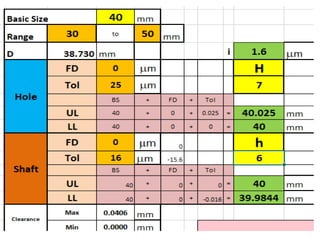
Determine the Limits on a shaft and a pulley of 40mm nominal diameter. The tolerance on the
shaft is h6 and on the pulley is H7
Calculate.
(a) The tolerance on the shaft.
(b) The tolerance on the pulley.
(c) The maximum clearance.
(d) The minimum clearance.
Ans.
(a) 0.016mm (b) 0.025mm
(c) 0.041mm (d) 0.000mm
Solve
40H7/h6
(a) The tolerance on the shaft.
(b) The tolerance on the pulley.
(c) The maximum clearance.
(d) The minimum clearance.
Ans.
(a) 0.016mm
(b) 0.025mm
(c) 0.041mm
(d) 0.000mm
Determine the Limits on a shaft and a pulley of 45mm nominal diameter. The tolerance on
the shaft is g6 and on the pulley is H7
Calculate.
(a) The tolerance on the shaft.
(b) The tolerance on the pulley.
(c) The maximum clearance.
(d) The minimum clearance.
Ans.
(a) 0.016 (b) 0.025
(c) 0.050 (d) 0.009
Solve
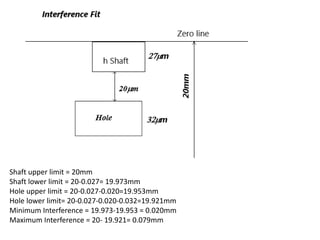
Determine the limit dimensions for a Interference fit on
the Shaft Basis System for a basic size of 20 mm
diameter with a minimum interference of 20μm. The
tolerance on the hole is 32μm and on the shaft is
27μm. Represent the fit graphically.
Term Type of fit Difference Between
Minimum Clearance Clearance
Minimum hole Max Shaft
Maximum Clearance
Clearance/Transition
Maximum Hole Minimum Shaft
Minimum Interference Interference Maximum Hole
Minimum Shaft
Maximum Interference
Interference
Minimum hole Max Shaft
Solve
Shaft upper limit = 20mm
Shaft lower limit = 20-0.027= 19.973mm
Hole upper limit = 20-0.027-0.020=19.953mm
Hole lower limit= 20-0.027-0.020-0.032=19.921mm
Minimum Interference = 19.973-19.953 = 0.020mm
Maximum Interference = 20- 19.921= 0.079mm

Limits Fits and Tolerances ppt.pdf .

  • 1.
  • 2.
    Definitions of Metrology Metrologyis "the science of measurement, embracing both experimental and theoretical determinations at any level of uncertainty in any field of science and technology"
  • 3.
    Thus, in abroader sense metrology is not limited to length and angle measurement but also concerned with numerous problems theoretical as well as practical related with measurement such as: 1. Units of measurement and their standards, which is concerned with the establishment, reproduction, conservation and transfer of units of measurement and their standards. 2. Methods of measurement based on agreed units and standards. 3. Errors of measurement. 4. Measuring instruments and devices. 5. Accuracy of measuring instruments and their care. 6. Industrial inspection and its various techniques. 7. Design, manufacturing and testing of gauges of all kinds. Instrumentation (Measurements) is the variety of measuring instruments to monitor and control a process. It is the art and science of measurement and control of process variables within a production, laboratory, or manufacturing area. Instrumentation is branch of engineering which deals with the measurements of physical entities like pressure, temp etc. It also includes sensors and transducers. Measurements/Instrumentation
  • 4.
    Part A -Measurements
  • 5.
    Part B -Metrology
  • 6.
    Note: All theabove reference books (except 6th) are important from knowledge point of view and are worth buying. For simplicity 2nd and 3rd can be referred.
  • 7.
    LIMITS, FITS &TOLERANCES Chapter 7/11
  • 8.
    TERMINOLOGY • Nominal Size •Basic Size • Zero line • Actual Size • Limits • Tolerances • Allowances • Fits (clearance, interference, transition) • Deviation (Fundamental, upper, lower)
  • 9.
    Nominal Size • Thenominal size of a dimension or part is the size by which it is referred to as a matter of convenience (Eg: 50mm shaft or 2 inch shaft) Basic Size • The size of a part in relation to which all limits of variation are determined (Eg: 49±0.5mm) Zero line • Line which represents the basic size so that the deviation from the basic size is zero (Eg:49mm line) Actual Size • This is the measured size (Eg:49.25mm)
  • 10.
  • 11.
  • 14.
    A max =65.15 – 39.85 = 25.3 mm A min = 64.85 – 40.15 = 24.7 mm B max = 25.5 + 35.8 + 20.5 = 81.8 mm B min = 24.5 + 34.2 + 19.5 = 78.2 mm
  • 16.
    Limits These are thetwo permissible sizes for any dimension (high and low) (Eg: 49.5mm, 48.5mm) Tolerances It is the difference between the high and low limits of size. (Eg: 1mm, ±0.5mm)
  • 18.
    Fits • The relationresulting from the difference between their sizes before assembly when two parts are to be assembled. Allowance • It is the intentional difference between the hole dimension and shaft dimension for any type of the fit. • Maximum allowance is obtained by subtracting the minimum shaft size from the largest hole and minimum allowance is the difference between the largest shaft and the smallest hole size. A tolerance is the limit of acceptable unintended deviation from a nominal or theoretical dimension. Therefore, a pair of tolerances, upper and lower, defines a range within which an actual dimension may fall while still being acceptable. In contrast, an allowance is a planned deviation from the nominal or theoretical dimension.
  • 19.
    Clearance fit • Inthis type of fit the largest permitted shaft diameter is smaller than the diameter of the smallest hole, so that the shaft can rotate or slide through with different degrees of freedom according to the purpose of the mating members
  • 21.
    Interference fit • Inthis type of fit the minimum permitted diameter on the shaft is larger than the maximum allowable diameter of the hole. In this case the shaft and hole are intended to be attached permanently and used as a solid component
  • 23.
    Transition fit • Inthis type of fit the diameter of the largest allowable hole is greater than that of the smallest shaft, but the smallest hole is smaller than the largest shaft, so that small positive or negative clearance between the shaft and hole members are employable.
  • 25.
    Deviation • It isthe algebraic difference between a size and the corresponding basic size. Upper Deviation • It is the algebraic difference between the maximum limit of size and the corresponding basic size. • It is designated by letters “ES” for hole and “es” for shaft. • It is a positive quantity when the maximum limit of size is greater than the basic size and a negative quantity when the maximum limit of size is less than the basic size. Lower Deviation • It is the algebraic difference between the minimum limit of size and the corresponding basic size. • It is designated by letters “EI” for hole and “ei” for shaft. • It is a positive quantity when the minimum limit of size is greater than the basic size and a negative quantity when the minimum limit of size is less than the basic size.
  • 27.
    Fundamental Deviation • Itis one of the two deviations which is conventionally chosen to define the position of the tolerance zone in relation to the zero line. This may be upper or lower deviation which is closest to zero line. It fixes the position of zero line.
  • 29.
    Term Type offit Difference Between Minimum Clearance Clearance Minimum hole Max Shaft Maximum Clearance Clearance/Transition Maximum Hole Minimum Shaft Minimum Interference Interference Maximum Hole Minimum Shaft Maximum Interference Interference Minimum hole Max Shaft
  • 32.
    Hole Basis: Inthis system, the basic diameter of the hole is constant while the shaft size is varied according to the type of fit. Significance of Hole basis system: The bureau of Indian Standards (BIS) recommends both hole basis and shaft basis systems, but their selection depends on the production methods. Generally, holes are produced by drilling, boring, reaming, broaching, etc. whereas shafts are either turned or ground. If the shaft basis system is used to specify the limit dimensions to obtain various types of fits, number of holes of different sizes are required, which in turn requires tools of different sizes.[ Since drill bits comes in standard sizes only]
  • 33.
    Shaft Basis System:In this system, the basic diameter of the shaft is constant while the hole size is varied according to the type of fit. It may, however, be necessary to use shaft basis system where different fits are required along a long shaft. For example, in the case of driving shafts where a single shaft may have to accommodate to a variety of accessories such as couplings, bearings, collars, etc., it is preferable to maintain a constant diameter for the permanent member, which is the shaft, and vary the bore of the accessories.
  • 38.
    IT stands forInternational Tolerance
  • 40.
    For shafts upto 500mm diameter The various diameter steps specified by ISI are: 1-3, 3-6, 6-10, 10-18, 18-30, 30-50, 50-80, 80-120, 120-180, 180-250, 250-315, 315-400, and 400-500 mm. The value of ‘D’ is taken as the geometric mean for a particular range of size to avoid continuous variation of tolerance with size.
  • 45.
    Calculate the limitsof tolerance and allowance for a 25 mm shaft and hole pair designated by H8d9. Take the fundamental deviation for ‘d’ shaft is -16D0.44.
  • 46.
  • 47.
  • 48.
  • 49.
    • D =(18 x 30) = • i (in microns)=0.45 ∛D +0.001D • i= • 25i= • 40i= • For H hole FD =0 • UL of Hole=BS+FD+IT • LL of Hole=BS+FD • For d shaft FD= -16D0.44 = • UL of Shaft=BS+FD= • LL of Shaft= BS+FD-IT = D = 23.237mm i= 1.3 m 25i= 33m 40i=52m For H hole FD =0 UL of Hole= 25.033mm LL of Hole= 25.00mm -16D0.44 = -64m UL of Shaft= 24.936mm LL of Shaft= 24.884mm
  • 50.
    For H holeFD =0 UL of Hole= 25.033mm LL of Hole= 25.00mm FD for Shaft= -64m UL of Shaft= 24.936mm LL of Shaft= 24.884mm HoleTolerance = 33m Shaft Tolerance =52m Graphical Representation of Limits (Not to Scale)
  • 51.
    Calculate all therelevant dimensions of 35H7/f8 fit, dimension 35 mm falls in the step of 30-50 mm. The fundamental deviation for f shaft is – 5.5D0.41. i (in microns) =0.45(D)1/3+0.001D, IT7=16i and IT8=25i.
  • 52.
  • 53.
    Determine the limitson a shaft and a bearing of 20mm nominal diameter, which fit together with a clearance fit. The tolerance on the shaft is g6 and on the bearing H7 Calculate. (a) The tolerance on the shaft.(b)The tolerance on the bearing. (c) The maximum clearance. (d) The minimum clearance. The fundamental deviation for g shaft = -2.5D0.34 Ans. (a) 0.013mm (b) 0.021mm (c) 0.041mm (d) 0.007mm Solve
  • 54.
    20H7/g6 (a) The toleranceon the shaft. (b) The tolerance on the bearing. (c) The maximum clearance. (d) The minimum clearance. Ans. (a) 0.013mm (b) 0.021mm (c) 0.041mm (d) 0.007mm
  • 56.
    Determine the Limitson a shaft and a pulley of 40mm nominal diameter. The tolerance on the shaft is h6 and on the pulley is H7 Calculate. (a) The tolerance on the shaft. (b) The tolerance on the pulley. (c) The maximum clearance. (d) The minimum clearance. Ans. (a) 0.016mm (b) 0.025mm (c) 0.041mm (d) 0.000mm Solve
  • 57.
    40H7/h6 (a) The toleranceon the shaft. (b) The tolerance on the pulley. (c) The maximum clearance. (d) The minimum clearance. Ans. (a) 0.016mm (b) 0.025mm (c) 0.041mm (d) 0.000mm
  • 59.
    Determine the Limitson a shaft and a pulley of 45mm nominal diameter. The tolerance on the shaft is g6 and on the pulley is H7 Calculate. (a) The tolerance on the shaft. (b) The tolerance on the pulley. (c) The maximum clearance. (d) The minimum clearance. Ans. (a) 0.016 (b) 0.025 (c) 0.050 (d) 0.009 Solve
  • 60.
    Determine the limitdimensions for a Interference fit on the Shaft Basis System for a basic size of 20 mm diameter with a minimum interference of 20μm. The tolerance on the hole is 32μm and on the shaft is 27μm. Represent the fit graphically. Term Type of fit Difference Between Minimum Clearance Clearance Minimum hole Max Shaft Maximum Clearance Clearance/Transition Maximum Hole Minimum Shaft Minimum Interference Interference Maximum Hole Minimum Shaft Maximum Interference Interference Minimum hole Max Shaft Solve
  • 61.
    Shaft upper limit= 20mm Shaft lower limit = 20-0.027= 19.973mm Hole upper limit = 20-0.027-0.020=19.953mm Hole lower limit= 20-0.027-0.020-0.032=19.921mm Minimum Interference = 19.973-19.953 = 0.020mm Maximum Interference = 20- 19.921= 0.079mm