Polar Coordinates
Polar Coordinates
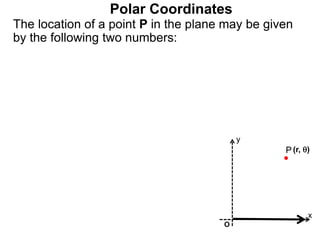
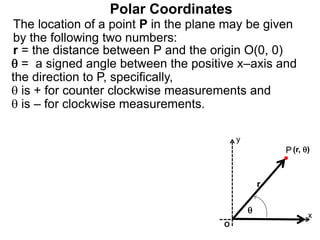
The location of a point P in the plane may be given
by the following two numbers:
P
x
y
(r, )
O
Polar Coordinates
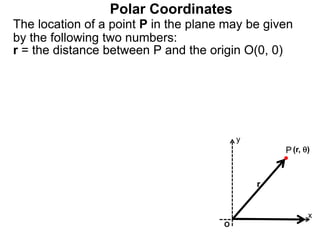
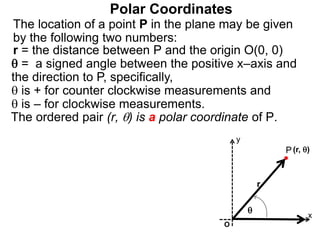
r = the distance between P and the origin O(0, 0)
The location of a point P in the plane may be given
by the following two numbers:
P
x
(r, )
r
O
y
Polar Coordinates
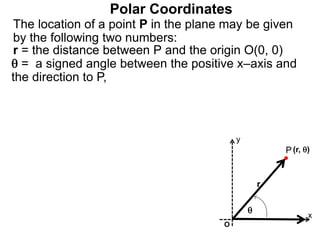
r = the distance between P and the origin O(0, 0)
 = a signed angle between the positive x–axis and
the direction to P,
The location of a point P in the plane may be given
by the following two numbers:
P
x
(r, )

r
O
y
Polar Coordinates
r = the distance between P and the origin O(0, 0)
 = a signed angle between the positive x–axis and
the direction to P, specifically,
 is + for counter clockwise measurements and
 is – for clockwise measurements.
The location of a point P in the plane may be given
by the following two numbers:
P
x
(r, )

r
O
y
Polar Coordinates
r = the distance between P and the origin O(0, 0)
 = a signed angle between the positive x–axis and
the direction to P, specifically,
 is + for counter clockwise measurements and
 is – for clockwise measurements.
The location of a point P in the plane may be given
by the following two numbers:
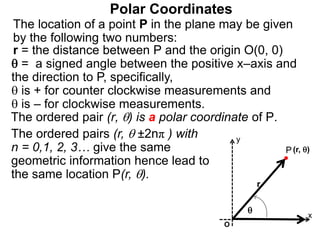
The ordered pair (r, ) is a polar coordinate of P.
P
x
(r, )

r
O
y
Polar Coordinates
r = the distance between P and the origin O(0, 0)
 = a signed angle between the positive x–axis and
the direction to P, specifically,
 is + for counter clockwise measurements and
 is – for clockwise measurements.
The location of a point P in the plane may be given
by the following two numbers:
The ordered pair (r, ) is a polar coordinate of P.
P
x
(r, )

r
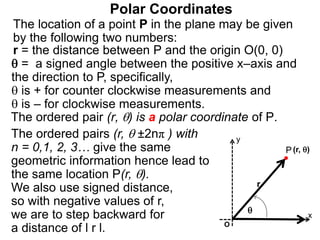
The ordered pairs (r,  ±2nπ ) with
n = 0,1, 2, 3… give the same
geometric information hence lead to
the same location P(r, ).
O
y
Polar Coordinates
r = the distance between P and the origin O(0, 0)
 = a signed angle between the positive x–axis and
the direction to P, specifically,
 is + for counter clockwise measurements and
 is – for clockwise measurements.
The location of a point P in the plane may be given
by the following two numbers:
The ordered pair (r, ) is a polar coordinate of P.
P
x
(r, )

r
The ordered pairs (r,  ±2nπ ) with
n = 0,1, 2, 3… give the same
geometric information hence lead to
the same location P(r, ).
We also use signed distance,
so with negative values of r,
we are to step backward for
a distance of l r l. O
y
Polar Coordinates
If needed, we write (a, b)P for a polar coordinate
ordered pair, and (a, b)R for the rectangular
coordinate ordered pair.
Polar Coordinates
Conversion Rules
If needed, we write (a, b)P for a polar coordinate
ordered pair, and (a, b)R for the rectangular
coordinate ordered pair.
Polar Coordinates
Conversion Rules
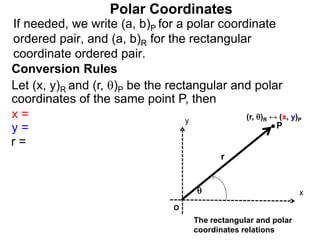
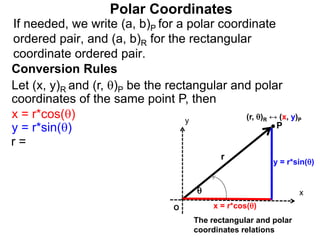
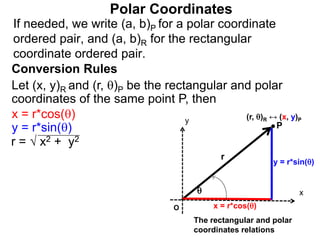
Let (x, y)R and (r, )P be the rectangular and polar
coordinates of the same point P, then
P
x
y

r
O
The rectangular and polar
coordinates relations
x =
y =
r =
If needed, we write (a, b)P for a polar coordinate
ordered pair, and (a, b)R for the rectangular
coordinate ordered pair.
(r, )R ↔ (x, y)P
Polar Coordinates
Conversion Rules
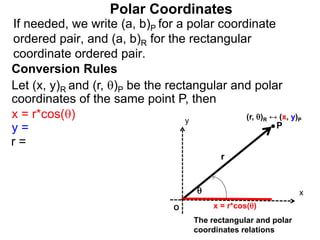
Let (x, y)R and (r, )P be the rectangular and polar
coordinates of the same point P, then
P
x
y (r, )R ↔ (x, y)P

r
O x = r*cos()
The rectangular and polar
coordinates relations
x = r*cos()
y =
r =
If needed, we write (a, b)P for a polar coordinate
ordered pair, and (a, b)R for the rectangular
coordinate ordered pair.
Polar Coordinates
Conversion Rules
Let (x, y)R and (r, )P be the rectangular and polar
coordinates of the same point P, then
P
x
y

r
O x = r*cos()
The rectangular and polar
coordinates relations
x = r*cos()
y = r*sin()
y = r*sin()
r =
If needed, we write (a, b)P for a polar coordinate
ordered pair, and (a, b)R for the rectangular
coordinate ordered pair.
(r, )R ↔ (x, y)P
Polar Coordinates
Conversion Rules
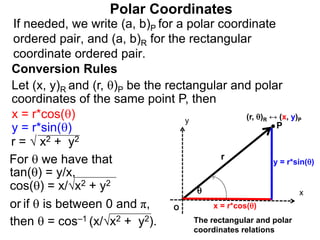
Let (x, y)R and (r, )P be the rectangular and polar
coordinates of the same point P, then
P
x
y

r
O x = r*cos()
y = r*sin()
The rectangular and polar
coordinates relations
x = r*cos()
y = r*sin()
r = √ x2 + y2
If needed, we write (a, b)P for a polar coordinate
ordered pair, and (a, b)R for the rectangular
coordinate ordered pair.
(r, )R ↔ (x, y)P
Polar Coordinates
Conversion Rules
Let (x, y)R and (r, )P be the rectangular and polar
coordinates of the same point P, then
P
x
y

r
O x = r*cos()
y = r*sin()
The rectangular and polar
coordinates relations
x = r*cos()
y = r*sin()
r = √ x2 + y2
For  we have that
tan() = y/x,
cos() = x/√x2 + y2
or if  is between 0 and π,
then  = cos–1 (x/√x2 + y2).
If needed, we write (a, b)P for a polar coordinate
ordered pair, and (a, b)R for the rectangular
coordinate ordered pair.
(r, )R ↔ (x, y)P
Polar Coordinates
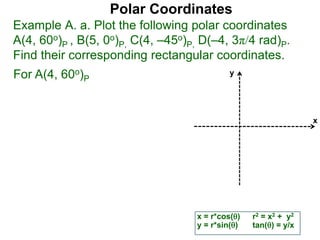
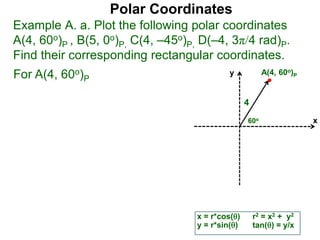
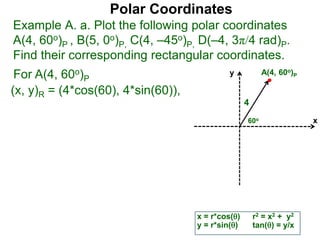
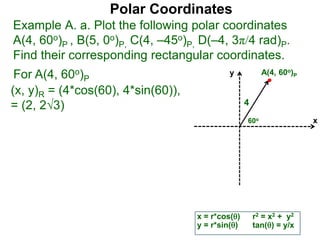
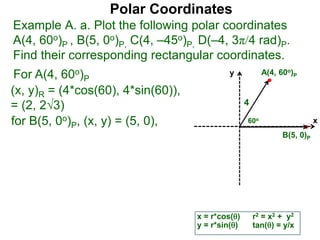
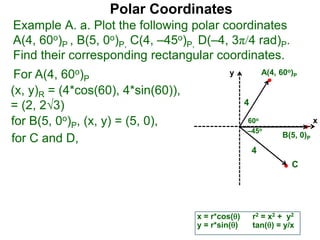
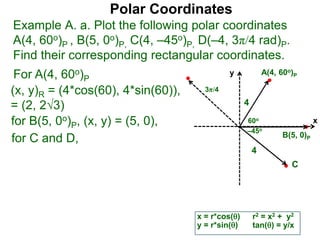
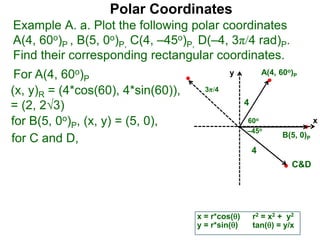
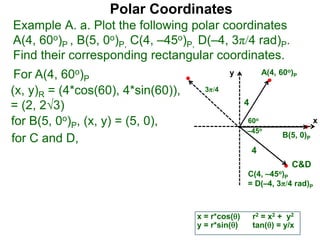
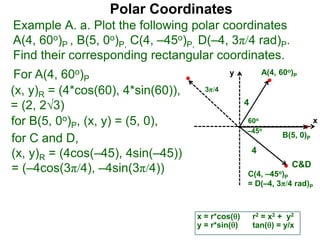
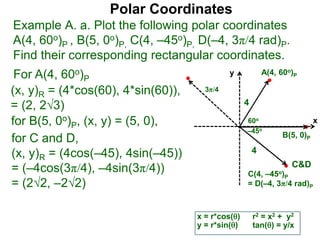
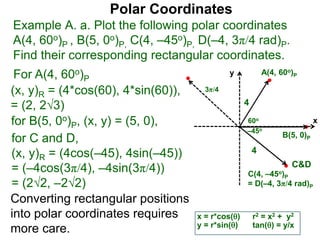
Example A. a. Plot the following polar coordinates
A(4, 60o)P , B(5, 0o)P, C(4, –45o)P, D(–4, 3π/4 rad)P.
Find their corresponding rectangular coordinates.
Polar Coordinates
Example A. a. Plot the following polar coordinates
A(4, 60o)P , B(5, 0o)P, C(4, –45o)P, D(–4, 3π/4 rad)P.
Find their corresponding rectangular coordinates.
x
y
x = r*cos()
y = r*sin()
r2 = x2 + y2
tan() = y/x
For A(4, 60o)P
Polar Coordinates
Example A. a. Plot the following polar coordinates
A(4, 60o)P , B(5, 0o)P, C(4, –45o)P, D(–4, 3π/4 rad)P.
Find their corresponding rectangular coordinates.
x
y
60o
4
x = r*cos()
y = r*sin()
A(4, 60o)P
r2 = x2 + y2
tan() = y/x
For A(4, 60o)P
Polar Coordinates
Example A. a. Plot the following polar coordinates
A(4, 60o)P , B(5, 0o)P, C(4, –45o)P, D(–4, 3π/4 rad)P.
Find their corresponding rectangular coordinates.
For A(4, 60o)P
x = r*cos()
y = r*sin()
(x, y)R = (4*cos(60), 4*sin(60)),
r2 = x2 + y2
tan() = y/x
x
y
60o
4
A(4, 60o)P
Polar Coordinates
Example A. a. Plot the following polar coordinates
A(4, 60o)P , B(5, 0o)P, C(4, –45o)P, D(–4, 3π/4 rad)P.
Find their corresponding rectangular coordinates.
For A(4, 60o)P
x = r*cos()
y = r*sin()
(x, y)R = (4*cos(60), 4*sin(60)),
= (2, 23)
r2 = x2 + y2
tan() = y/x
x
y
60o
4
A(4, 60o)P
Polar Coordinates
Example A. a. Plot the following polar coordinates
A(4, 60o)P , B(5, 0o)P, C(4, –45o)P, D(–4, 3π/4 rad)P.
Find their corresponding rectangular coordinates.
For A(4, 60o)P
x = r*cos()
y = r*sin()
(x, y)R = (4*cos(60), 4*sin(60)),
= (2, 23)
for B(5, 0o)P, (x, y) = (5, 0),
r2 = x2 + y2
tan() = y/x
x
y
60o
4
A(4, 60o)P
B(5, 0)P
Polar Coordinates
Example A. a. Plot the following polar coordinates
A(4, 60o)P , B(5, 0o)P, C(4, –45o)P, D(–4, 3π/4 rad)P.
Find their corresponding rectangular coordinates.
x
y
60o
4
For A(4, 60o)P
x = r*cos()
y = r*sin()
(x, y)R = (4*cos(60), 4*sin(60)),
= (2, 23)
for B(5, 0o)P, (x, y) = (5, 0),
for C and D,
A(4, 60o)P
B(5, 0)P
4
r2 = x2 + y2
tan() = y/x
–45o
C
Polar Coordinates
Example A. a. Plot the following polar coordinates
A(4, 60o)P , B(5, 0o)P, C(4, –45o)P, D(–4, 3π/4 rad)P.
Find their corresponding rectangular coordinates.
x
y
60o
4
For A(4, 60o)P
x = r*cos()
y = r*sin()
(x, y)R = (4*cos(60), 4*sin(60)),
= (2, 23)
for B(5, 0o)P, (x, y) = (5, 0),
for C and D,
A(4, 60o)P
B(5, 0)P
4
r2 = x2 + y2
tan() = y/x
–45o
3π/4
C
Polar Coordinates
Example A. a. Plot the following polar coordinates
A(4, 60o)P , B(5, 0o)P, C(4, –45o)P, D(–4, 3π/4 rad)P.
Find their corresponding rectangular coordinates.
x
y
60o
4
For A(4, 60o)P
x = r*cos()
y = r*sin()
(x, y)R = (4*cos(60), 4*sin(60)),
= (2, 23)
for B(5, 0o)P, (x, y) = (5, 0),
for C and D,
A(4, 60o)P
B(5, 0)P
4
r2 = x2 + y2
tan() = y/x
–45o
3π/4
C&D
Polar Coordinates
Example A. a. Plot the following polar coordinates
A(4, 60o)P , B(5, 0o)P, C(4, –45o)P, D(–4, 3π/4 rad)P.
Find their corresponding rectangular coordinates.
x
y
60o
4
For A(4, 60o)P
x = r*cos()
y = r*sin()
(x, y)R = (4*cos(60), 4*sin(60)),
= (2, 23)
for B(5, 0o)P, (x, y) = (5, 0),
for C and D,
A(4, 60o)P
B(5, 0)P
C(4, –45o)P
= D(–4, 3π/4 rad)P
4
r2 = x2 + y2
tan() = y/x
–45o
3π/4
C&D
Polar Coordinates
Example A. a. Plot the following polar coordinates
A(4, 60o)P , B(5, 0o)P, C(4, –45o)P, D(–4, 3π/4 rad)P.
Find their corresponding rectangular coordinates.
x
y
60o
4
For A(4, 60o)P
x = r*cos()
y = r*sin()
(x, y)R = (4*cos(60), 4*sin(60)),
= (2, 23)
for B(5, 0o)P, (x, y) = (5, 0),
for C and D,
(x, y)R = (4cos(–45), 4sin(–45))
= (–4cos(3π/4), –4sin(3π/4))
A(4, 60o)P
B(5, 0)P
C(4, –45o)P
= D(–4, 3π/4 rad)P
4
r2 = x2 + y2
tan() = y/x
–45o
3π/4
C&D
Polar Coordinates
Example A. a. Plot the following polar coordinates
A(4, 60o)P , B(5, 0o)P, C(4, –45o)P, D(–4, 3π/4 rad)P.
Find their corresponding rectangular coordinates.
x
y
60o
4
For A(4, 60o)P
x = r*cos()
y = r*sin()
(x, y)R = (4*cos(60), 4*sin(60)),
= (2, 23)
for B(5, 0o)P, (x, y) = (5, 0),
for C and D,
(x, y)R = (4cos(–45), 4sin(–45))
= (–4cos(3π/4), –4sin(3π/4))
= (22, –22)
A(4, 60o)P
B(5, 0)P
C(4, –45o)P
= D(–4, 3π/4 rad)P
4
r2 = x2 + y2
tan() = y/x
–45o
3π/4
C&D
Polar Coordinates
Example A. a. Plot the following polar coordinates
A(4, 60o)P , B(5, 0o)P, C(4, –45o)P, D(–4, 3π/4 rad)P.
Find their corresponding rectangular coordinates.
x
y
60o
4
For A(4, 60o)P
x = r*cos()
y = r*sin()
(x, y)R = (4*cos(60), 4*sin(60)),
= (2, 23)
for B(5, 0o)P, (x, y) = (5, 0),
for C and D,
(x, y)R = (4cos(–45), 4sin(–45))
= (–4cos(3π/4), –4sin(3π/4))
= (22, –22)
A(4, 60o)P
B(5, 0)P
C(4, –45o)P
= D(–4, 3π/4 rad)P
4
Converting rectangular positions
into polar coordinates requires
more care.
r2 = x2 + y2
tan() = y/x
–45o
3π/4
C&D
Polar Coordinates
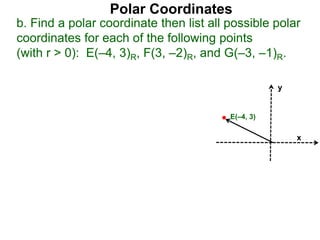
b. Find a polar coordinate then list all possible polar
coordinates for each of the following points
(with r > 0): E(–4, 3)R, F(3, –2)R, and G(–3, –1)R.
Polar Coordinates
b. Find a polar coordinate then list all possible polar
coordinates for each of the following points
(with r > 0): E(–4, 3)R, F(3, –2)R, and G(–3, –1)R.
x
y
E(–4, 3)
Polar Coordinates
b. Find a polar coordinate then list all possible polar
coordinates for each of the following points
(with r > 0): E(–4, 3)R, F(3, –2)R, and G(–3, –1)R.
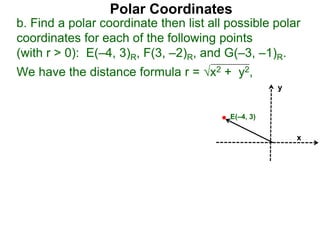
We have the distance formula r = x2 + y2,
x
y
E(–4, 3)
Polar Coordinates
b. Find a polar coordinate then list all possible polar
coordinates for each of the following points
(with r > 0): E(–4, 3)R, F(3, –2)R, and G(–3, –1)R.
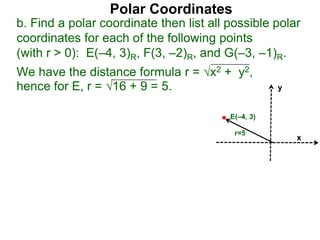
We have the distance formula r = x2 + y2,
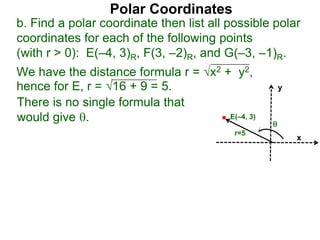
hence for E, r = 16 + 9 = 5.
x
y
E(–4, 3)
r=5
Polar Coordinates
b. Find a polar coordinate then list all possible polar
coordinates for each of the following points
(with r > 0): E(–4, 3)R, F(3, –2)R, and G(–3, –1)R.
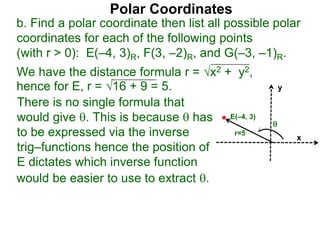
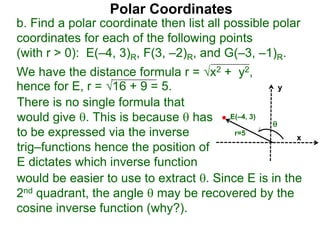
There is no single formula that
would give .
We have the distance formula r = x2 + y2,
hence for E, r = 16 + 9 = 5.
x
y
E(–4, 3)
r=5

Polar Coordinates
b. Find a polar coordinate then list all possible polar
coordinates for each of the following points
(with r > 0): E(–4, 3)R, F(3, –2)R, and G(–3, –1)R.
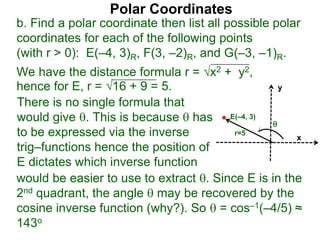
There is no single formula that
would give . This is because  has
to be expressed via the inverse
trig–functions hence the position of
E dictates which inverse function
We have the distance formula r = x2 + y2,
hence for E, r = 16 + 9 = 5.
would be easier to use to extract .
x
y
E(–4, 3)
r=5

Polar Coordinates
b. Find a polar coordinate then list all possible polar
coordinates for each of the following points
(with r > 0): E(–4, 3)R, F(3, –2)R, and G(–3, –1)R.
We have the distance formula r = x2 + y2,
hence for E, r = 16 + 9 = 5.
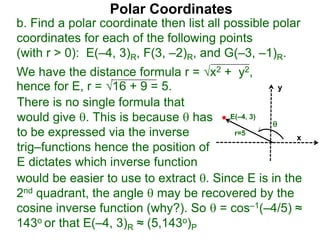
would be easier to use to extract . Since E is in the
2nd quadrant, the angle  may be recovered by the
cosine inverse function (why?).
x
y
E(–4, 3)
r=5
There is no single formula that
would give . This is because  has
to be expressed via the inverse
trig–functions hence the position of
E dictates which inverse function

Polar Coordinates
b. Find a polar coordinate then list all possible polar
coordinates for each of the following points
(with r > 0): E(–4, 3)R, F(3, –2)R, and G(–3, –1)R.
We have the distance formula r = x2 + y2,
hence for E, r = 16 + 9 = 5.
x
y
E(–4, 3)

r=5
would be easier to use to extract . Since E is in the
2nd quadrant, the angle  may be recovered by the
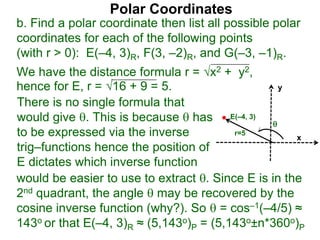
cosine inverse function (why?). So  = cos–1(–4/5) ≈
143o
There is no single formula that
would give . This is because  has
to be expressed via the inverse
trig–functions hence the position of
E dictates which inverse function
Polar Coordinates
b. Find a polar coordinate then list all possible polar
coordinates for each of the following points
(with r > 0): E(–4, 3)R, F(3, –2)R, and G(–3, –1)R.
We have the distance formula r = x2 + y2,
hence for E, r = 16 + 9 = 5.
x
y
E(–4, 3)

r=5
would be easier to use to extract . Since E is in the
2nd quadrant, the angle  may be recovered by the
cosine inverse function (why?). So  = cos–1(–4/5) ≈
143o or that E(–4, 3)R ≈ (5,143o)P
There is no single formula that
would give . This is because  has
to be expressed via the inverse
trig–functions hence the position of
E dictates which inverse function
Polar Coordinates
b. Find a polar coordinate then list all possible polar
coordinates for each of the following points
(with r > 0): E(–4, 3)R, F(3, –2)R, and G(–3, –1)R.
We have the distance formula r = x2 + y2,
hence for E, r = 16 + 9 = 5.
x
y
E(–4, 3)

r=5
would be easier to use to extract . Since E is in the
2nd quadrant, the angle  may be recovered by the
cosine inverse function (why?). So  = cos–1(–4/5) ≈
143o or that E(–4, 3)R ≈ (5,143o)P = (5,143o±n*360o)P
There is no single formula that
would give . This is because  has
to be expressed via the inverse
trig–functions hence the position of
E dictates which inverse function
Polar Coordinates
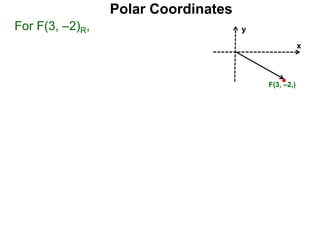
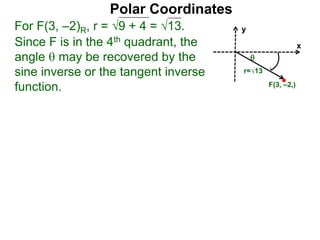
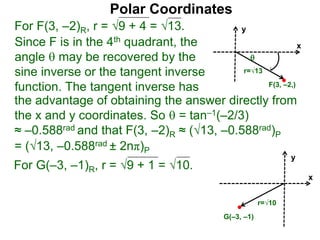
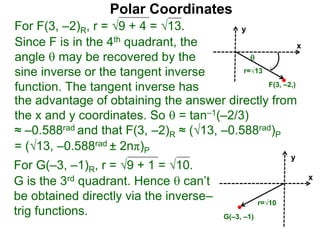
For F(3, –2)R,
x
y
F(3, –2,)
Polar Coordinates
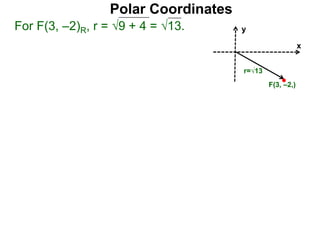
For F(3, –2)R, r = 9 + 4 = √13.
x
y
F(3, –2,)
r=√13
Polar Coordinates
For F(3, –2)R, r = 9 + 4 = √13.
x
y
F(3, –2,)
Since F is in the 4th quadrant, the
angle  may be recovered by the
sine inverse or the tangent inverse
function.

r=√13
Polar Coordinates
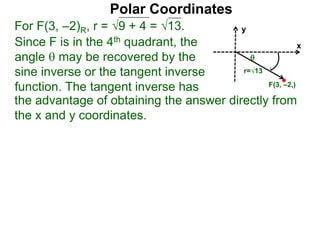
For F(3, –2)R, r = 9 + 4 = √13.
x
y
F(3, –2,)
Since F is in the 4th quadrant, the
angle  may be recovered by the
sine inverse or the tangent inverse
function. The tangent inverse has
the advantage of obtaining the answer directly from
the x and y coordinates.

r=√13
Polar Coordinates
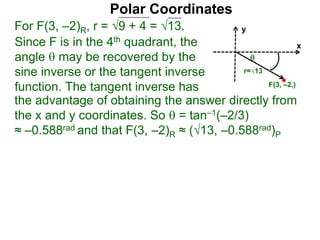
For F(3, –2)R, r = 9 + 4 = √13.
x
y
F(3, –2,)
Since F is in the 4th quadrant, the
angle  may be recovered by the
sine inverse or the tangent inverse
function. The tangent inverse has
the advantage of obtaining the answer directly from
the x and y coordinates. So  = tan–1(–2/3)
≈ –0.588rad and that F(3, –2)R ≈ (√13, –0.588rad)P

r=√13
Polar Coordinates
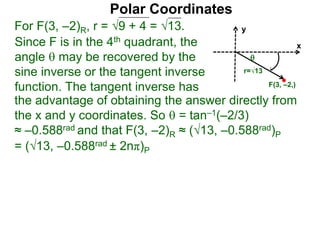
For F(3, –2)R, r = 9 + 4 = √13.
x
y
F(3, –2,)

r=√13
Since F is in the 4th quadrant, the
angle  may be recovered by the
sine inverse or the tangent inverse
function. The tangent inverse has
= (√13, –0.588rad ± 2nπ)P
the advantage of obtaining the answer directly from
the x and y coordinates. So  = tan–1(–2/3)
≈ –0.588rad and that F(3, –2)R ≈ (√13, –0.588rad)P
Polar Coordinates
For F(3, –2)R, r = 9 + 4 = √13.
x
y
F(3, –2,)

r=√13
Since F is in the 4th quadrant, the
angle  may be recovered by the
sine inverse or the tangent inverse
function. The tangent inverse has
= (√13, –0.588rad ± 2nπ)P
the advantage of obtaining the answer directly from
the x and y coordinates. So  = tan–1(–2/3)
≈ –0.588rad and that F(3, –2)R ≈ (√13, –0.588rad)P
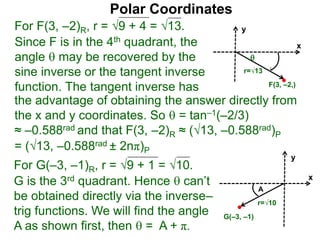
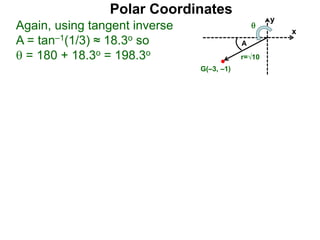
For G(–3, –1)R, r = 9 + 1 = √10.
x
y
G(–3, –1)
r=√10
Polar Coordinates
For F(3, –2)R, r = 9 + 4 = √13.
x
y
F(3, –2,)

r=√13
Since F is in the 4th quadrant, the
angle  may be recovered by the
sine inverse or the tangent inverse
function. The tangent inverse has
= (√13, –0.588rad ± 2nπ)P
the advantage of obtaining the answer directly from
the x and y coordinates. So  = tan–1(–2/3)
≈ –0.588rad and that F(3, –2)R ≈ (√13, –0.588rad)P
For G(–3, –1)R, r = 9 + 1 = √10.
G is the 3rd quadrant. Hence  can’t
be obtained directly via the inverse–
trig functions.
x
y
G(–3, –1)
r=√10
Polar Coordinates
For F(3, –2)R, r = 9 + 4 = √13.
x
y
F(3, –2,)

r=√13
Since F is in the 4th quadrant, the
angle  may be recovered by the
sine inverse or the tangent inverse
function. The tangent inverse has
= (√13, –0.588rad ± 2nπ)P
the advantage of obtaining the answer directly from
the x and y coordinates. So  = tan–1(–2/3)
≈ –0.588rad and that F(3, –2)R ≈ (√13, –0.588rad)P
For G(–3, –1)R, r = 9 + 1 = √10.
G is the 3rd quadrant. Hence  can’t
be obtained directly via the inverse–
trig functions. We will find the angle
A as shown first, then  = A + π.
x
y
G(–3, –1)
r=√10
A
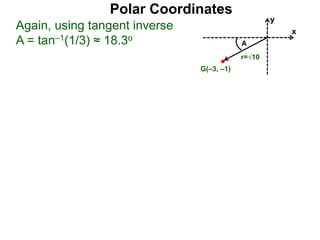
Polar Coordinates
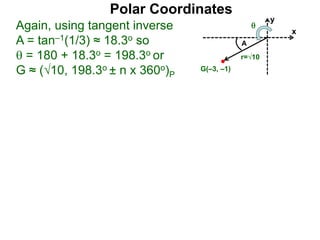
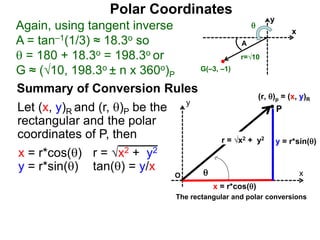
Again, using tangent inverse
A = tan–1(1/3) ≈ 18.3o
x
y
G(–3, –1)
r=√10
A
Polar Coordinates
Again, using tangent inverse
A = tan–1(1/3) ≈ 18.3o so
 = 180 + 18.3o = 198.3o
x
y
G(–3, –1)
r=√10
A

Polar Coordinates
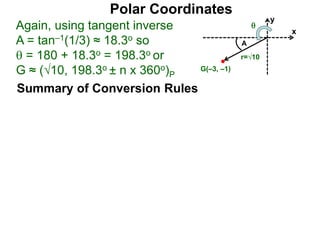
Again, using tangent inverse
A = tan–1(1/3) ≈ 18.3o so
 = 180 + 18.3o = 198.3o or
G ≈ (√10, 198.3o ± n x 360o)P
x
y
G(–3, –1)
r=√10
A

Polar Coordinates
Again, using tangent inverse
A = tan–1(1/3) ≈ 18.3o so
 = 180 + 18.3o = 198.3o or
G ≈ (√10, 198.3o ± n x 360o)P
x
y
G(–3, –1)
r=√10
A

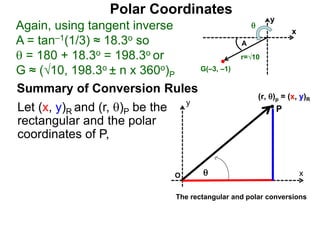
Summary of Conversion Rules
Polar Coordinates
Again, using tangent inverse
A = tan–1(1/3) ≈ 18.3o so
 = 180 + 18.3o = 198.3o or
G ≈ (√10, 198.3o ± n x 360o)P
x
y
G(–3, –1)
r=√10
A

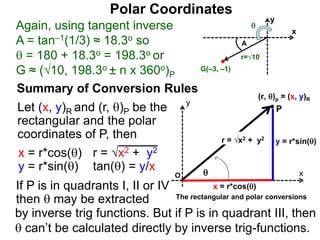
Let (x, y)R and (r, )P be the
rectangular and the polar
coordinates of P,
P
x
y
O
The rectangular and polar conversions
(r, )p = (x, y)R
Summary of Conversion Rules
Polar Coordinates
Again, using tangent inverse
A = tan–1(1/3) ≈ 18.3o so
 = 180 + 18.3o = 198.3o or
G ≈ (√10, 198.3o ± n x 360o)P
x
y
G(–3, –1)
r=√10
A

Let (x, y)R and (r, )P be the
rectangular and the polar
coordinates of P, then
P
x
y
O
x = r*cos()
y = r*sin()
The rectangular and polar conversions
x = r*cos()
y = r*sin()
r = √x2 + y2
tan() = y/x
r = √x2 + y2
(r, )p = (x, y)R
Summary of Conversion Rules
Polar Coordinates
Again, using tangent inverse
A = tan–1(1/3) ≈ 18.3o so
 = 180 + 18.3o = 198.3o or
G ≈ (√10, 198.3o ± n x 360o)P
x
y
G(–3, –1)
r=√10
A

Let (x, y)R and (r, )P be the
rectangular and the polar
coordinates of P, then
P
x
y
O
x = r*cos()
y = r*sin()
The rectangular and polar conversions
x = r*cos()
y = r*sin()
r = √x2 + y2
tan() = y/x
r = √x2 + y2
If P is in quadrants I, II or IV
then  may be extracted
by inverse trig functions. But if P is in quadrant III, then
 can’t be calculated directly by inverse trig-functions.
(r, )p = (x, y)R
Summary of Conversion Rules
Polar Equations
Polar Equations & Graphs
Polar Equations
A rectangular equation in x and y gives the relation
between the horizontal displacement x and vertical
displacement y of locations.
Polar Equations & Graphs
Polar Equations
A rectangular equation in x and y gives the relation
between the horizontal displacement x and vertical
displacement y of locations. A polar equation gives a
relation of the distance r the direction .
Polar Equations & Graphs
Polar Equations
A rectangular equation in x and y gives the relation
between the horizontal displacement x and vertical
displacement y of locations. A polar equation gives a
relation of the distance r the direction .
Polar Equations & Graphs
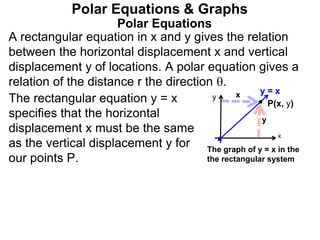
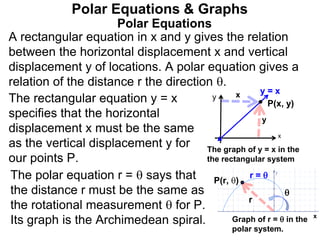
The rectangular equation y = x
specifies that the horizontal
displacement x must be the same
as the vertical displacement y for
our points P.
Polar Equations
A rectangular equation in x and y gives the relation
between the horizontal displacement x and vertical
displacement y of locations. A polar equation gives a
relation of the distance r the direction .
Polar Equations & Graphs
The rectangular equation y = x
specifies that the horizontal
displacement x must be the same
as the vertical displacement y for
our points P.
y
y
x
x
P(x, y)
The graph of y = x in the
the rectangular system
y = x
Polar Equations
A rectangular equation in x and y gives the relation
between the horizontal displacement x and vertical
displacement y of locations. A polar equation gives a
relation of the distance r the direction .
Polar Equations & Graphs
The rectangular equation y = x
specifies that the horizontal
displacement x must be the same
as the vertical displacement y for
our points P.
y
y
x
x
P(x, y)
The graph of y = x in the
the rectangular system
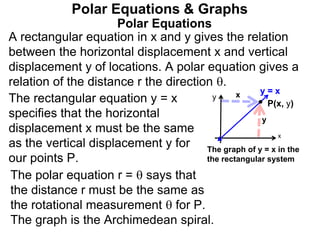
The polar equation r =  says that
the distance r must be the same as
the rotational measurement  for P.
The graph is the Archimedean spiral.
y = x
Polar Equations
A rectangular equation in x and y gives the relation
between the horizontal displacement x and vertical
displacement y of locations. A polar equation gives a
relation of the distance r the direction .
Polar Equations & Graphs
The rectangular equation y = x
specifies that the horizontal
displacement x must be the same
as the vertical displacement y for
our points P.
y
y
x
x
P(x, y)
x
P(r, )

r
The graph of y = x in the
the rectangular system
Graph of r =  in the
polar system.
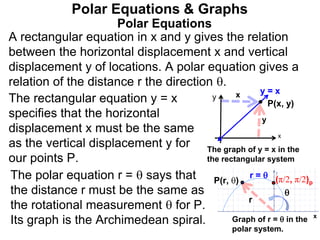
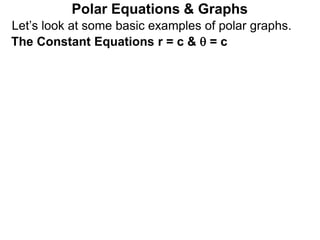
The polar equation r =  says that
the distance r must be the same as
the rotational measurement  for P.
Its graph is the Archimedean spiral.
r = 
y = x
Polar Equations
A rectangular equation in x and y gives the relation
between the horizontal displacement x and vertical
displacement y of locations. A polar equation gives a
relation of the distance r the direction .
Polar Equations & Graphs
The rectangular equation y = x
specifies that the horizontal
displacement x must be the same
as the vertical displacement y for
our points P.
y
y
x
x
P(x, y)
x
P(r, )

r
The graph of y = x in the
the rectangular system
Graph of r =  in the
polar system.
The polar equation r =  says that
the distance r must be the same as
the rotational measurement  for P.
Its graph is the Archimedean spiral.
y = x
(π/2, π/2)p
r = 
Let’s look at some basic examples of polar graphs.
Polar Equations & Graphs
The Constant Equations r = c &  = c
Let’s look at some basic examples of polar graphs.
Polar Equations & Graphs
The Constant Equations r = c &  = c
Example B. Graph the following polar
equations.
a. (r = c)
b. ( = c)
Let’s look at some basic examples of polar graphs.
Polar Equations & Graphs
The Constant Equations r = c &  = c
Example B. Graph the following polar
equations.
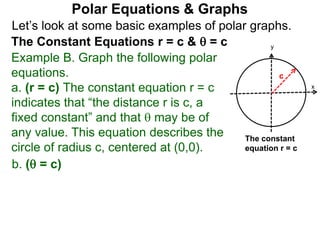
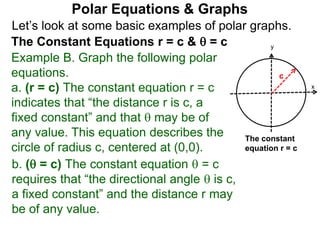
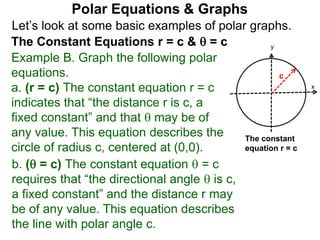
a. (r = c) The constant equation r = c
indicates that “the distance r is c, a
fixed constant” and that  may be of
any value.
b. ( = c)
Let’s look at some basic examples of polar graphs.
Polar Equations & Graphs
The Constant Equations r = c &  = c
Example B. Graph the following polar
equations.
a. (r = c) The constant equation r = c
indicates that “the distance r is c, a
fixed constant” and that  may be of
any value. This equation describes the
circle of radius c, centered at (0,0).
b. ( = c)
Let’s look at some basic examples of polar graphs.
Polar Equations & Graphs
The Constant Equations r = c &  = c
Example B. Graph the following polar
equations.
a. (r = c) The constant equation r = c
indicates that “the distance r is c, a
fixed constant” and that  may be of
any value. This equation describes the
circle of radius c, centered at (0,0).
x
y
c
The constant
equation r = c
b. ( = c)
Let’s look at some basic examples of polar graphs.
Polar Equations & Graphs
The Constant Equations r = c &  = c
Example B. Graph the following polar
equations.
a. (r = c) The constant equation r = c
indicates that “the distance r is c, a
fixed constant” and that  may be of
any value. This equation describes the
circle of radius c, centered at (0,0).
x
y
c
The constant
equation r = c
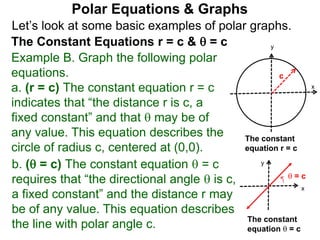
b. ( = c) The constant equation  = c
requires that “the directional angle  is c,
a fixed constant” and the distance r may
be of any value.
Let’s look at some basic examples of polar graphs.
Polar Equations & Graphs
The Constant Equations r = c &  = c
Example B. Graph the following polar
equations.
a. (r = c) The constant equation r = c
indicates that “the distance r is c, a
fixed constant” and that  may be of
any value. This equation describes the
circle of radius c, centered at (0,0).
x
y
c
The constant
equation r = c
b. ( = c) The constant equation  = c
requires that “the directional angle  is c,
a fixed constant” and the distance r may
be of any value. This equation describes
the line with polar angle c.
Let’s look at some basic examples of polar graphs.
Polar Equations & Graphs
The Constant Equations r = c &  = c
Example B. Graph the following polar
equations.
a. (r = c) The constant equation r = c
indicates that “the distance r is c, a
fixed constant” and that  may be of
any value. This equation describes the
circle of radius c, centered at (0,0).
x
y
c
The constant
equation r = c
b. ( = c) The constant equation  = c
requires that “the directional angle  is c,
a fixed constant” and the distance r may
be of any value. This equation describes
the line with polar angle c.
x
y
The constant
equation  = c
 = c
Polar Equations & Graphs
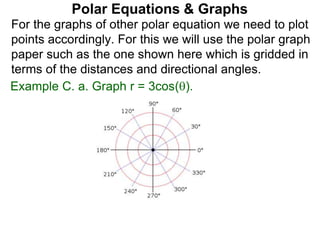
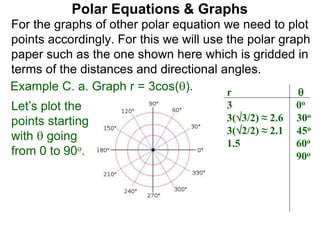
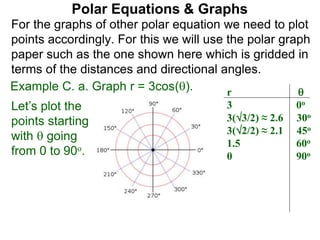
For the graphs of other polar equation we need to plot
points accordingly.
Polar Equations & Graphs
For the graphs of other polar equation we need to plot
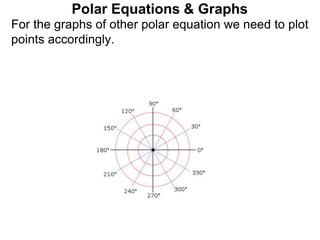
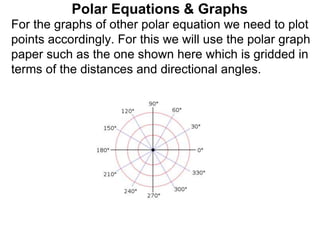
points accordingly. For this we will use the polar graph
paper such as the one shown here which is gridded in
terms of the distances and directional angles.
Polar Equations & Graphs
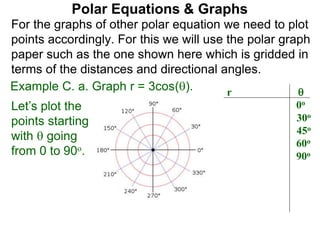
For the graphs of other polar equation we need to plot
points accordingly. For this we will use the polar graph
paper such as the one shown here which is gridded in
terms of the distances and directional angles.
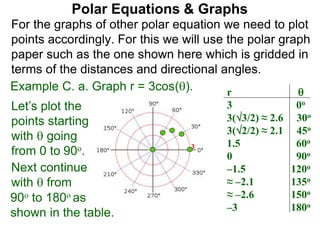
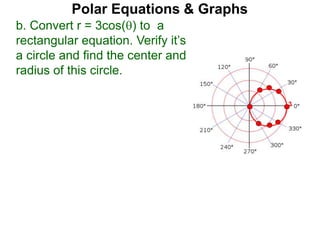
Example C. a. Graph r = 3cos().
Polar Equations & Graphs
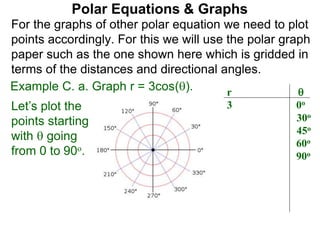
For the graphs of other polar equation we need to plot
points accordingly. For this we will use the polar graph
paper such as the one shown here which is gridded in
terms of the distances and directional angles.
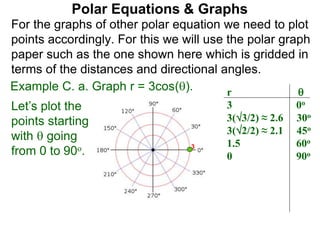
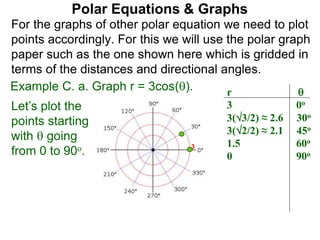
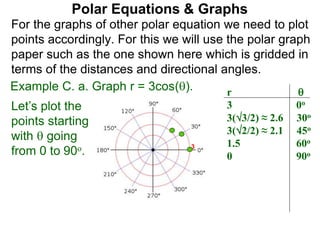
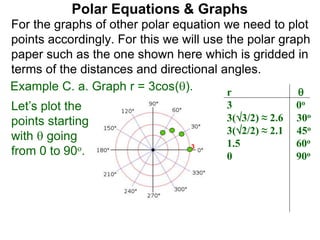
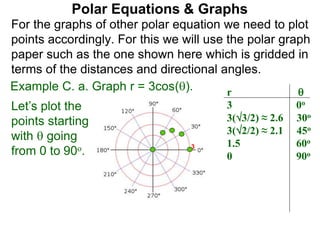
Example C. a. Graph r = 3cos(). r 
3 0o
3(3/2) ≈ 2.6 30o
3(2/2) ≈ 2.1 45o
1.5 60o
0 90o
Let’s plot the
points starting
with  going
from 0 to 90o.
Polar Equations & Graphs
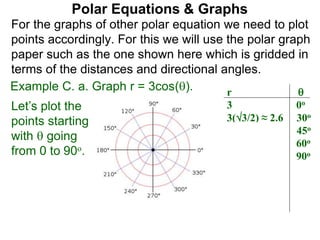
For the graphs of other polar equation we need to plot
points accordingly. For this we will use the polar graph
paper such as the one shown here which is gridded in
terms of the distances and directional angles.
Example C. a. Graph r = 3cos(). r 
3 0o
3(3/2) ≈ 2.6 30o
3(2/2) ≈ 2.1 45o
1.5 60o
0 90o
Let’s plot the
points starting
with  going
from 0 to 90o.
Polar Equations & Graphs
For the graphs of other polar equation we need to plot
points accordingly. For this we will use the polar graph
paper such as the one shown here which is gridded in
terms of the distances and directional angles.
Example C. a. Graph r = 3cos(). r 
3 0o
3(3/2) ≈ 2.6 30o
3(2/2) ≈ 2.1 45o
1.5 60o
0 90o
Let’s plot the
points starting
with  going
from 0 to 90o.
Polar Equations & Graphs
For the graphs of other polar equation we need to plot
points accordingly. For this we will use the polar graph
paper such as the one shown here which is gridded in
terms of the distances and directional angles.
Example C. a. Graph r = 3cos(). r 
3 0o
3(3/2) ≈ 2.6 30o
3(2/2) ≈ 2.1 45o
1.5 60o
0 90o
Let’s plot the
points starting
with  going
from 0 to 90o.
Polar Equations & Graphs
For the graphs of other polar equation we need to plot
points accordingly. For this we will use the polar graph
paper such as the one shown here which is gridded in
terms of the distances and directional angles.
Example C. a. Graph r = 3cos(). r 
3 0o
3(3/2) ≈ 2.6 30o
3(2/2) ≈ 2.1 45o
1.5 60o
0 90o
Let’s plot the
points starting
with  going
from 0 to 90o.
Polar Equations & Graphs
For the graphs of other polar equation we need to plot
points accordingly. For this we will use the polar graph
paper such as the one shown here which is gridded in
terms of the distances and directional angles.
Example C. a. Graph r = 3cos(). r 
3 0o
3(3/2) ≈ 2.6 30o
3(2/2) ≈ 2.1 45o
1.5 60o
0 90o
Let’s plot the
points starting
with  going
from 0 to 90o. 3
Polar Equations & Graphs
For the graphs of other polar equation we need to plot
points accordingly. For this we will use the polar graph
paper such as the one shown here which is gridded in
terms of the distances and directional angles.
Example C. a. Graph r = 3cos(). r 
3 0o
3(3/2) ≈ 2.6 30o
3(2/2) ≈ 2.1 45o
1.5 60o
0 90o
Let’s plot the
points starting
with  going
from 0 to 90o. 3
Polar Equations & Graphs
For the graphs of other polar equation we need to plot
points accordingly. For this we will use the polar graph
paper such as the one shown here which is gridded in
terms of the distances and directional angles.
Example C. a. Graph r = 3cos(). r 
3 0o
3(3/2) ≈ 2.6 30o
3(2/2) ≈ 2.1 45o
1.5 60o
0 90o
Let’s plot the
points starting
with  going
from 0 to 90o. 3
Polar Equations & Graphs
For the graphs of other polar equation we need to plot
points accordingly. For this we will use the polar graph
paper such as the one shown here which is gridded in
terms of the distances and directional angles.
Example C. a. Graph r = 3cos(). r 
3 0o
3(3/2) ≈ 2.6 30o
3(2/2) ≈ 2.1 45o
1.5 60o
0 90o
Let’s plot the
points starting
with  going
from 0 to 90o. 3
Polar Equations & Graphs
For the graphs of other polar equation we need to plot
points accordingly. For this we will use the polar graph
paper such as the one shown here which is gridded in
terms of the distances and directional angles.
Example C. a. Graph r = 3cos(). r 
3 0o
3(3/2) ≈ 2.6 30o
3(2/2) ≈ 2.1 45o
1.5 60o
0 90o
Let’s plot the
points starting
with  going
from 0 to 90o. 3
Polar Equations & Graphs
For the graphs of other polar equation we need to plot
points accordingly. For this we will use the polar graph
paper such as the one shown here which is gridded in
terms of the distances and directional angles.
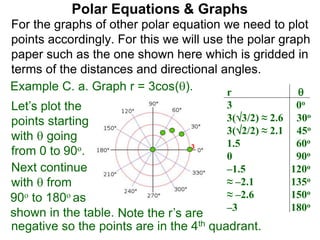
Example C. a. Graph r = 3cos(). r 
3 0o
3(3/2) ≈ 2.6 30o
3(2/2) ≈ 2.1 45o
1.5 60o
0 90o
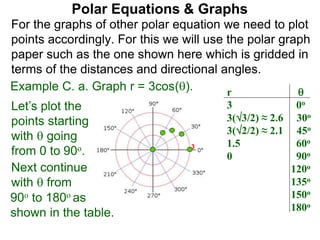
–1.5 120o
≈ –2.1 135o
≈ –2.6 150o
–3 180o
Let’s plot the
points starting
with  going
from 0 to 90o. 3
Next continue
with  from
90o to 180o as
shown in the table.
Polar Equations & Graphs
For the graphs of other polar equation we need to plot
points accordingly. For this we will use the polar graph
paper such as the one shown here which is gridded in
terms of the distances and directional angles.
Example C. a. Graph r = 3cos(). r 
3 0o
3(3/2) ≈ 2.6 30o
3(2/2) ≈ 2.1 45o
1.5 60o
0 90o
–1.5 120o
≈ –2.1 135o
≈ –2.6 150o
–3 180o
Let’s plot the
points starting
with  going
from 0 to 90o. 3
Next continue
with  from
90o to 180o as
shown in the table.
Polar Equations & Graphs
For the graphs of other polar equation we need to plot
points accordingly. For this we will use the polar graph
paper such as the one shown here which is gridded in
terms of the distances and directional angles.
Example C. a. Graph r = 3cos(). r 
3 0o
3(3/2) ≈ 2.6 30o
3(2/2) ≈ 2.1 45o
1.5 60o
0 90o
–1.5 120o
≈ –2.1 135o
≈ –2.6 150o
–3 180o
Let’s plot the
points starting
with  going
from 0 to 90o. 3
Next continue
with  from
90o to 180o as
shown in the table.
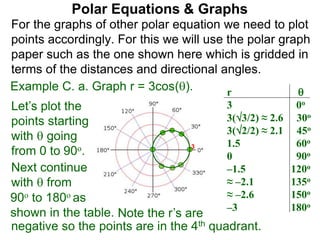
negative so the points are in the 4th quadrant.
Note the r’s are
Polar Equations & Graphs
For the graphs of other polar equation we need to plot
points accordingly. For this we will use the polar graph
paper such as the one shown here which is gridded in
terms of the distances and directional angles.
Example C. a. Graph r = 3cos(). r 
3 0o
3(3/2) ≈ 2.6 30o
3(2/2) ≈ 2.1 45o
1.5 60o
0 90o
–1.5 120o
≈ –2.1 135o
≈ –2.6 150o
–3 180o
Let’s plot the
points starting
with  going
from 0 to 90o. 3
Next continue
with  from
90o to 180o as
shown in the table.
negative so the points are in the 4th quadrant.
Note the r’s are
Polar Equations & Graphs
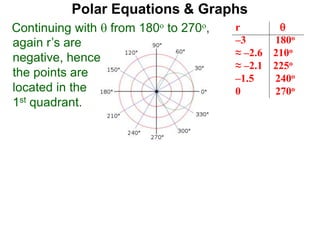
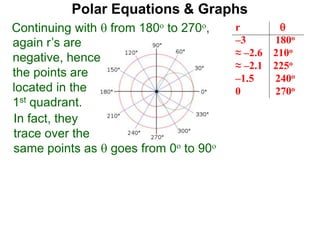
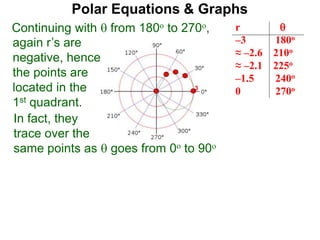
Continuing with  from 180o to 270o, r 
–3 180o
≈ –2.6 210o
≈ –2.1 225o
–1.5 240o
0 270o
1.5 300o
≈ 2.1 315o
≈ 2.6 330o
3 360o
again r’s are
negative, hence
the points are
located in the
1st quadrant.
Polar Equations & Graphs
Continuing with  from 180o to 270o, r 
–3 180o
≈ –2.6 210o
≈ –2.1 225o
–1.5 240o
0 270o
1.5 300o
≈ 2.1 315o
≈ 2.6 330o
3 360o
again r’s are
negative, hence
the points are
located in the
1st quadrant.
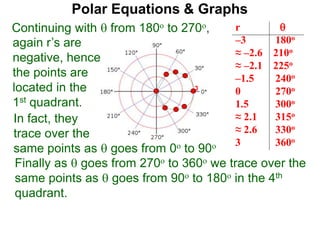
In fact, they
trace over the
same points as  goes from 0o to 90o
Polar Equations & Graphs
Continuing with  from 180o to 270o, r 
–3 180o
≈ –2.6 210o
≈ –2.1 225o
–1.5 240o
0 270o
1.5 300o
≈ 2.1 315o
≈ 2.6 330o
3 360o
again r’s are
negative, hence
the points are
located in the
1st quadrant.
3
In fact, they
trace over the
same points as  goes from 0o to 90o
Polar Equations & Graphs
Continuing with  from 180o to 270o, r 
–3 180o
≈ –2.6 210o
≈ –2.1 225o
–1.5 240o
0 270o
1.5 300o
≈ 2.1 315o
≈ 2.6 330o
3 360o
again r’s are
negative, hence
the points are
located in the
1st quadrant.
3
In fact, they
trace over the
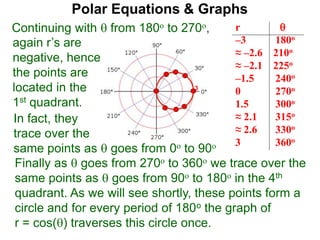
Finally as  goes from 270o to 360o we trace over the
same points as  goes from 90o to 180o in the 4th
quadrant.
same points as  goes from 0o to 90o
Polar Equations & Graphs
Continuing with  from 180o to 270o, r 
–3 180o
≈ –2.6 210o
≈ –2.1 225o
–1.5 240o
0 270o
1.5 300o
≈ 2.1 315o
≈ 2.6 330o
3 360o
again r’s are
negative, hence
the points are
located in the
1st quadrant.
3
In fact, they
trace over the
Finally as  goes from 270o to 360o we trace over the
same points as  goes from 90o to 180o in the 4th
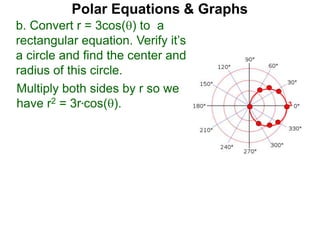
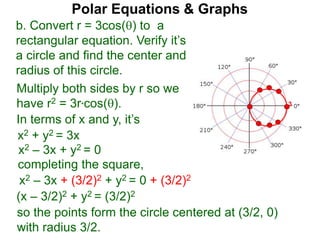
quadrant. As we will see shortly, these points form a
circle and for every period of 180o the graph of
r = cos() traverses this circle once.
same points as  goes from 0o to 90o
Polar Equations & Graphs
b. Convert r = 3cos() to a
rectangular equation. Verify it’s
a circle and find the center and
radius of this circle.
3
Polar Equations & Graphs
b. Convert r = 3cos() to a
rectangular equation. Verify it’s
a circle and find the center and
radius of this circle.
Multiply both sides by r so we
have r2 = 3r*cos(). 3
Polar Equations & Graphs
b. Convert r = 3cos() to a
rectangular equation. Verify it’s
a circle and find the center and
radius of this circle.
Multiply both sides by r so we
have r2 = 3r*cos().
In terms of x and y, it’s
x2 + y2 = 3x
3
Polar Equations & Graphs
b. Convert r = 3cos() to a
rectangular equation. Verify it’s
a circle and find the center and
radius of this circle.
Multiply both sides by r so we
have r2 = 3r*cos().
In terms of x and y, it’s
x2 + y2 = 3x
x2 – 3x + y2 = 0
3
Polar Equations & Graphs
b. Convert r = 3cos() to a
rectangular equation. Verify it’s
a circle and find the center and
radius of this circle.
Multiply both sides by r so we
have r2 = 3r*cos().
In terms of x and y, it’s
x2 + y2 = 3x
x2 – 3x + y2 = 0
completing the square,
x2 – 3x + (3/2)2 + y2 = 0 + (3/2)2
3
Polar Equations & Graphs
b. Convert r = 3cos() to a
rectangular equation. Verify it’s
a circle and find the center and
radius of this circle.
Multiply both sides by r so we
have r2 = 3r*cos().
In terms of x and y, it’s
x2 + y2 = 3x
x2 – 3x + y2 = 0
completing the square,
x2 – 3x + (3/2)2 + y2 = 0 + (3/2)2
(x – 3/2)2 + y2 = (3/2)2
3
3
Polar Equations & Graphs
b. Convert r = 3cos() to a
rectangular equation. Verify it’s
a circle and find the center and
radius of this circle.
Multiply both sides by r so we
have r2 = 3r*cos().
In terms of x and y, it’s
x2 + y2 = 3x
x2 – 3x + y2 = 0
completing the square,
x2 – 3x + (3/2)2 + y2 = 0 + (3/2)2
(x – 3/2)2 + y2 = (3/2)2
so the points form the circle centered at (3/2, 0)
with radius 3/2.
Polar Equations & Graphs
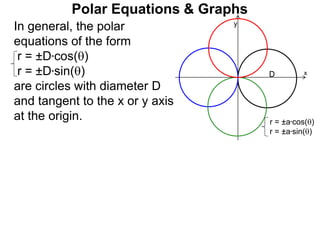
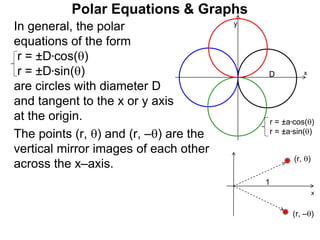
In general, the polar
equations of the form
r = ±D*cos()
r = ±D*sin()
are circles with diameter D
and tangent to the x or y axis
at the origin. r = ±a*cos()
r = ±a*sin()
D x
y
Polar Equations & Graphs
In general, the polar
equations of the form
r = ±D*cos()
r = ±D*sin()
are circles with diameter D
and tangent to the x or y axis
at the origin. r = ±a*cos()
r = ±a*sin()
D x
y
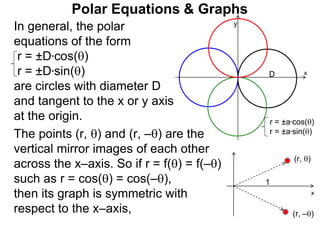
The points (r, ) and (r, –) are the
vertical mirror images of each other
across the x–axis.
x
(r, )
(r, –)
1
Polar Equations & Graphs
In general, the polar
equations of the form
r = ±D*cos()
r = ±D*sin()
are circles with diameter D
and tangent to the x or y axis
at the origin. r = ±a*cos()
r = ±a*sin()
D x
y
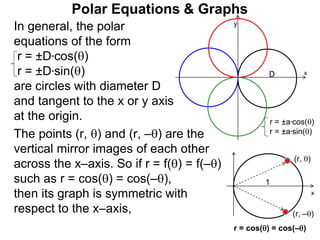
The points (r, ) and (r, –) are the
vertical mirror images of each other
across the x–axis. So if r = f() = f(–)
such as r = cos() = cos(–),
then its graph is symmetric with
respect to the x–axis,
x
(r, )
(r, –)
1
Polar Equations & Graphs
In general, the polar
equations of the form
r = ±D*cos()
r = ±D*sin()
are circles with diameter D
and tangent to the x or y axis
at the origin. r = ±a*cos()
r = ±a*sin()
D x
y
The points (r, ) and (r, –) are the
vertical mirror images of each other
across the x–axis. So if r = f() = f(–)
such as r = cos() = cos(–),
then its graph is symmetric with
respect to the x–axis,
x
(r, )
(r, –)
r = cos() = cos(–)
1
Polar Equations & Graphs
In general, the polar
equations of the form
r = ±D*cos()
r = ±D*sin()
are circles with diameter D
and tangent to the x or y axis
at the origin. r = ±a*cos()
r = ±a*sin()
D x
y
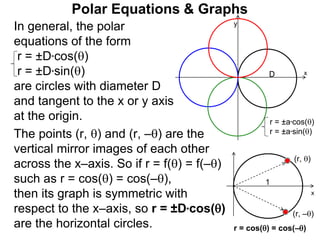
The points (r, ) and (r, –) are the
vertical mirror images of each other
across the x–axis. So if r = f() = f(–)
such as r = cos() = cos(–),
then its graph is symmetric with
respect to the x–axis, so r = ±D*cos()
are the horizontal circles.
x
(r, )
(r, –)
r = cos() = cos(–)
1
Polar Equations & Graphs
x
(r, )(–r, –)
y
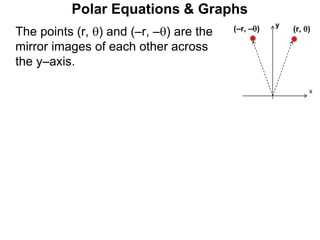
The points (r, ) and (–r, –) are the
mirror images of each other across
the y–axis.
Polar Equations & Graphs
x
(r, )
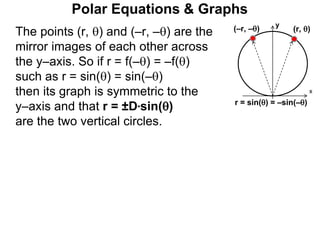
r = sin() = –sin(–)
(–r, –)
y
The points (r, ) and (–r, –) are the
mirror images of each other across
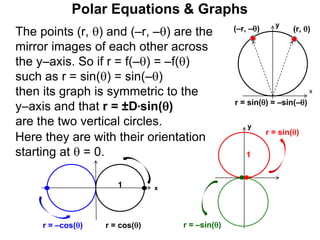
the y–axis. So if r = f(–) = –f()
such as r = sin() = sin(–)
then its graph is symmetric to the
y–axis and that r = ±D*sin()
are the two vertical circles.
Polar Equations & Graphs
x
(r, )
r = sin() = –sin(–)
(–r, –)
y
The points (r, ) and (–r, –) are the
mirror images of each other across
the y–axis. So if r = f(–) = –f()
such as r = sin() = sin(–)
then its graph is symmetric to the
y–axis and that r = ±D*sin()
are the two vertical circles.
x
y
r = cos()r = –cos()
r = sin()
r = –sin()
1
1
Here they are with their orientation
starting at  = 0.
Polar Equations & Graphs
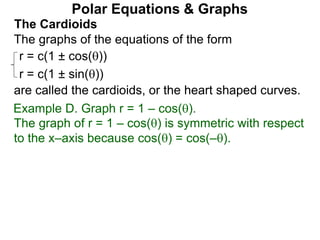
The Cardioids
r = c(1 ± cos())
r = c(1 ± sin())
The graphs of the equations of the form
are called the cardioids, or the heart shaped curves.
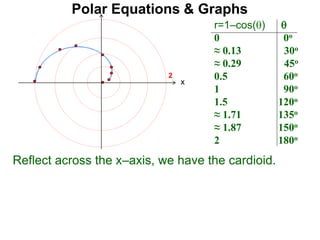
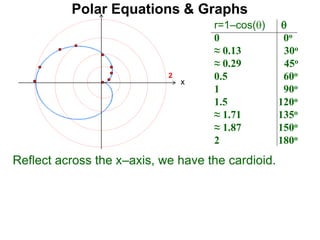
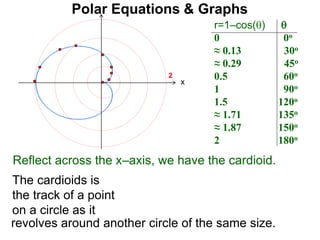
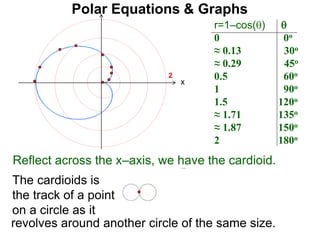
Example D. Graph r = 1 – cos().
Polar Equations & Graphs
The Cardioids
r = c(1 ± cos())
r = c(1 ± sin())
The graphs of the equations of the form
are called the cardioids, or the heart shaped curves.
Example D. Graph r = 1 – cos().
The graph of r = 1 – cos() is symmetric with respect
to the x–axis because cos() = cos(–).
Polar Equations & Graphs
The Cardioids
r = c(1 ± cos())
r = c(1 ± sin())
The graphs of the equations of the form
are called the cardioids, or the heart shaped curves.
Example D. Graph r = 1 – cos().
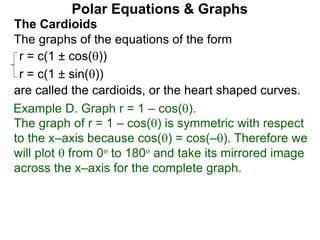
The graph of r = 1 – cos() is symmetric with respect
to the x–axis because cos() = cos(–). Therefore we
will plot  from 0o to 180o and take its mirrored image
across the x–axis for the complete graph.
Polar Equations & Graphs
The Cardioids
r = c(1 ± cos())
r = c(1 ± sin())
The graphs of the equations of the form
are called the cardioids, or the heart shaped curves.
Example D. Graph r = 1 – cos().
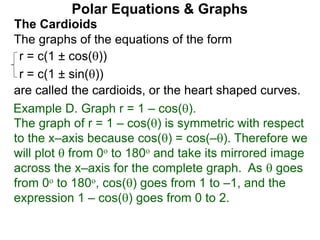
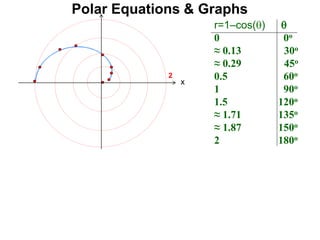
The graph of r = 1 – cos() is symmetric with respect
to the x–axis because cos() = cos(–). Therefore we
will plot  from 0o to 180o and take its mirrored image
across the x–axis for the complete graph. As  goes
from 0o to 180o, cos() goes from 1 to –1, and the
expression 1 – cos() goes from 0 to 2.
Polar Equations & Graphs
The Cardioids
r = c(1 ± cos())
r = c(1 ± sin())
The graphs of the equations of the form
are called the cardioids, or the heart shaped curves.
Example D. Graph r = 1 – cos().
The graph of r = 1 – cos() is symmetric with respect
to the x–axis because cos() = cos(–). Therefore we
will plot  from 0o to 180o and take its mirrored image
across the x–axis for the complete graph. As  goes
from 0o to 180o, cos() goes from 1 to –1, and the
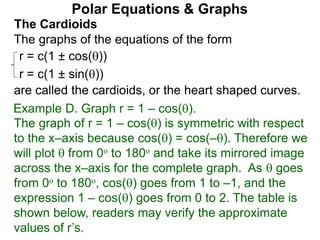
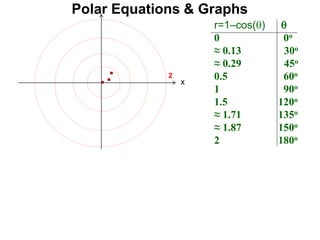
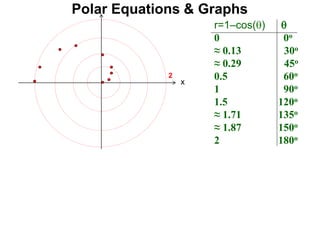
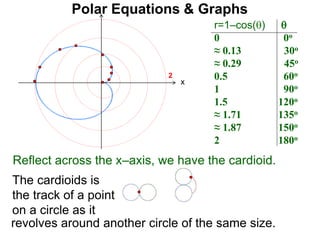
expression 1 – cos() goes from 0 to 2. The table is
shown below, readers may verify the approximate
values of r’s.
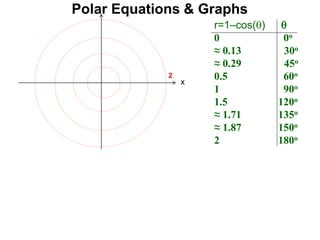
r=1–cos() 
0 0o
≈ 0.13 30o
≈ 0.29 45o
0.5 60o
1 90o
1.5 120o
≈ 1.71 135o
≈ 1.87 150o
2 180o
Polar Equations & Graphs
x
2
r=1–cos() 
0 0o
≈ 0.13 30o
≈ 0.29 45o
0.5 60o
1 90o
1.5 120o
≈ 1.71 135o
≈ 1.87 150o
2 180o
Polar Equations & Graphs
x
2
r=1–cos() 
0 0o
≈ 0.13 30o
≈ 0.29 45o
0.5 60o
1 90o
1.5 120o
≈ 1.71 135o
≈ 1.87 150o
2 180o
Polar Equations & Graphs
x
2
Polar Equations & Graphs
r=1–cos() 
0 0o
≈ 0.13 30o
≈ 0.29 45o
0.5 60o
1 90o
1.5 120o
≈ 1.71 135o
≈ 1.87 150o
2 180o
x
2
Polar Equations & Graphs
r=1–cos() 
0 0o
≈ 0.13 30o
≈ 0.29 45o
0.5 60o
1 90o
1.5 120o
≈ 1.71 135o
≈ 1.87 150o
2 180o
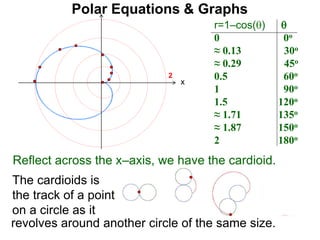
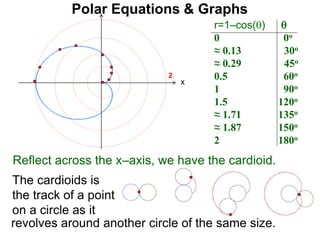
Reflect across the x–axis, we have the cardioid.
x
2
Polar Equations & Graphs
r=1–cos() 
0 0o
≈ 0.13 30o
≈ 0.29 45o
0.5 60o
1 90o
1.5 120o
≈ 1.71 135o
≈ 1.87 150o
2 180o
x
2
Reflect across the x–axis, we have the cardioid.
Polar Equations & Graphs
The cardioids is
the track of a point
on a circle as it
r=1–cos() 
0 0o
≈ 0.13 30o
≈ 0.29 45o
0.5 60o
1 90o
1.5 120o
≈ 1.71 135o
≈ 1.87 150o
2 180o
x
2
Reflect across the x–axis, we have the cardioid.
revolves around another circle of the same size.
Polar Equations & Graphs
The cardioids is
the track of a point
on a circle as it
r=1–cos() 
0 0o
≈ 0.13 30o
≈ 0.29 45o
0.5 60o
1 90o
1.5 120o
≈ 1.71 135o
≈ 1.87 150o
2 180o
x
2
Reflect across the x–axis, we have the cardioid.
revolves around another circle of the same size.
Polar Equations & Graphs
The cardioids is
the track of a point
on a circle as it
r=1–cos() 
0 0o
≈ 0.13 30o
≈ 0.29 45o
0.5 60o
1 90o
1.5 120o
≈ 1.71 135o
≈ 1.87 150o
2 180o
x
2
Reflect across the x–axis, we have the cardioid.
revolves around another circle of the same size.
Polar Equations & Graphs
The cardioids is
the track of a point
on a circle as it
r=1–cos() 
0 0o
≈ 0.13 30o
≈ 0.29 45o
0.5 60o
1 90o
1.5 120o
≈ 1.71 135o
≈ 1.87 150o
2 180o
x
2
Reflect across the x–axis, we have the cardioid.
revolves around another circle of the same size.
Polar Equations & Graphs
The cardioids is
the track of a point
on a circle as it
r=1–cos() 
0 0o
≈ 0.13 30o
≈ 0.29 45o
0.5 60o
1 90o
1.5 120o
≈ 1.71 135o
≈ 1.87 150o
2 180o
x
2
Reflect across the x–axis, we have the cardioid.
revolves around another circle of the same size.
Polar Equations & Graphs
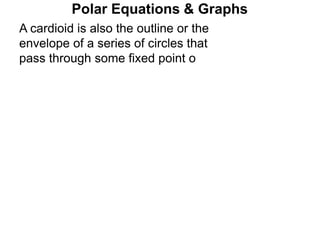
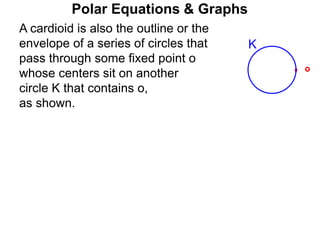
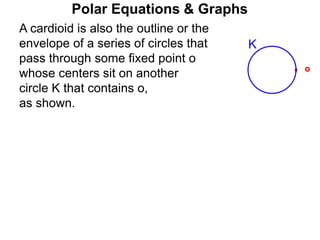
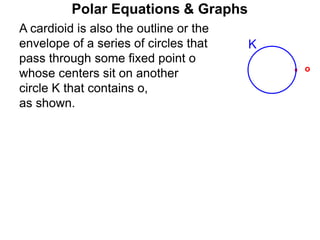
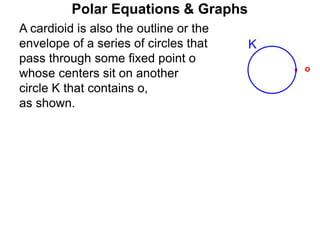
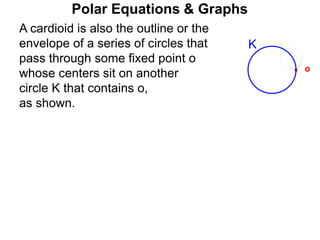
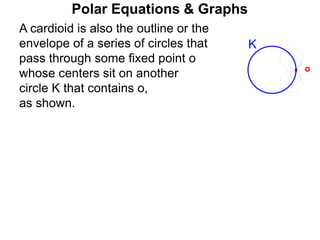
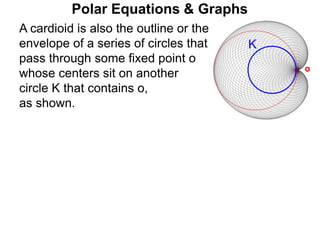
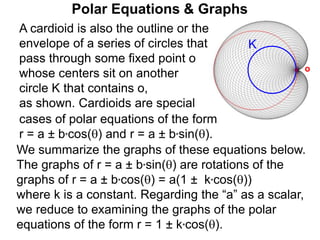
A cardioid is also the outline or the
envelope of a series of circles that
pass through some fixed point o
Polar Equations & Graphs
o
A cardioid is also the outline or the
envelope of a series of circles that
pass through some fixed point o
Polar Equations & Graphs
o
A cardioid is also the outline or the
envelope of a series of circles that
pass through some fixed point o
whose centers sit on another
circle K that contains o,
Polar Equations & Graphs
o
A cardioid is also the outline or the
envelope of a series of circles that
pass through some fixed point o
whose centers sit on another
circle K that contains o,
as shown.
K
Polar Equations & Graphs
o
A cardioid is also the outline or the
envelope of a series of circles that
pass through some fixed point o
whose centers sit on another
circle K that contains o,
as shown.
K
Polar Equations & Graphs
o
A cardioid is also the outline or the
envelope of a series of circles that
pass through some fixed point o
whose centers sit on another
circle K that contains o,
as shown.
K
Polar Equations & Graphs
o
A cardioid is also the outline or the
envelope of a series of circles that
pass through some fixed point o
whose centers sit on another
circle K that contains o,
as shown.
K
Polar Equations & Graphs
o
A cardioid is also the outline or the
envelope of a series of circles that
pass through some fixed point o
whose centers sit on another
circle K that contains o,
as shown.
K
Polar Equations & Graphs
o
A cardioid is also the outline or the
envelope of a series of circles that
pass through some fixed point o
whose centers sit on another
circle K that contains o,
as shown.
K
Polar Equations & Graphs
o
A cardioid is also the outline or the
envelope of a series of circles that
pass through some fixed point o
whose centers sit on another
circle K that contains o,
as shown.
K
Polar Equations & Graphs
o
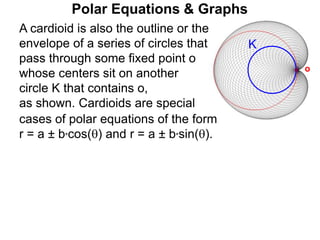
cases of polar equations of the form
r = a ± b*cos() and r = a ± b*sin().
K
A cardioid is also the outline or the
envelope of a series of circles that
pass through some fixed point o
whose centers sit on another
circle K that contains o,
as shown. Cardioids are special
Polar Equations & Graphs
o
cases of polar equations of the form
r = a ± b*cos() and r = a ± b*sin().
K
A cardioid is also the outline or the
envelope of a series of circles that
pass through some fixed point o
whose centers sit on another
circle K that contains o,
as shown. Cardioids are special
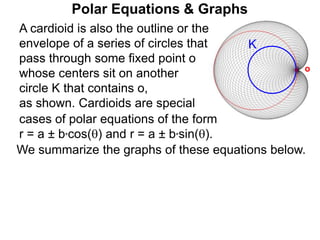
We summarize the graphs of these equations below.
Polar Equations & Graphs
o
cases of polar equations of the form
r = a ± b*cos() and r = a ± b*sin().
K
A cardioid is also the outline or the
envelope of a series of circles that
pass through some fixed point o
whose centers sit on another
circle K that contains o,
as shown. Cardioids are special
We summarize the graphs of these equations below.
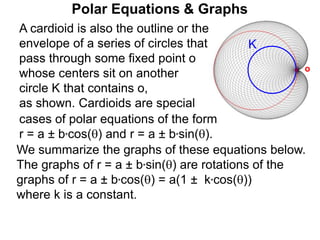
The graphs of r = a ± b*sin() are rotations of the
graphs of r = a ± b*cos() = a(1 ± k*cos())
where k is a constant.
Polar Equations & Graphs
o
cases of polar equations of the form
r = a ± b*cos() and r = a ± b*sin().
K
A cardioid is also the outline or the
envelope of a series of circles that
pass through some fixed point o
whose centers sit on another
circle K that contains o,
as shown. Cardioids are special
We summarize the graphs of these equations below.
The graphs of r = a ± b*sin() are rotations of the
graphs of r = a ± b*cos() = a(1 ± k*cos())
where k is a constant. Regarding the “a” as a scalar,
we reduce to examining the graphs of the polar
equations of the form r = 1 ± k*cos().
Polar Equations & Graphs
The graph of a polar equation of the form
r = 1 ± k*cos() depends on the value of |k|.
Polar Equations & Graphs
The graph of a polar equation of the form
r = 1 ± k*cos() depends on the value of |k|.
We may classify the graphs r = 1 – k*cos() where k is
a positive number into to three types.
Polar Equations & Graphs
The graph of a polar equation of the form
r = 1 ± k*cos() depends on the value of |k|.
We may classify the graphs r = 1 – k*cos() where k is
a positive number into to three types..
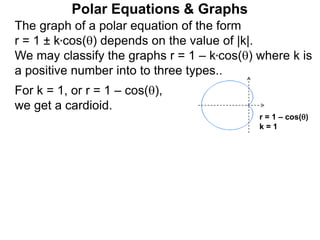
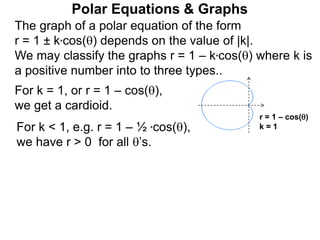
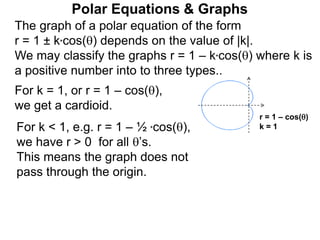
For k = 1, or r = 1 – cos(),
we get a cardioid.
r = 1 – cos()
k = 1
Polar Equations & Graphs
The graph of a polar equation of the form
r = 1 ± k*cos() depends on the value of |k|.
We may classify the graphs r = 1 – k*cos() where k is
a positive number into to three types..
For k = 1, or r = 1 – cos(),
we get a cardioid.
For k < 1, e.g. r = 1 – ½ *cos(),
we have r > 0 for all ’s.
r = 1 – cos()
k = 1
Polar Equations & Graphs
The graph of a polar equation of the form
r = 1 ± k*cos() depends on the value of |k|.
We may classify the graphs r = 1 – k*cos() where k is
a positive number into to three types..
For k = 1, or r = 1 – cos(),
we get a cardioid.
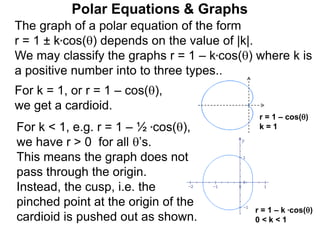
For k < 1, e.g. r = 1 – ½ *cos(),
we have r > 0 for all ’s.
This means the graph does not
pass through the origin.
r = 1 – cos()
k = 1
Polar Equations & Graphs
The graph of a polar equation of the form
r = 1 ± k*cos() depends on the value of |k|.
We may classify the graphs r = 1 – k*cos() where k is
a positive number into to three types..
For k = 1, or r = 1 – cos(),
we get a cardioid.
r = 1 – k *cos()
0 < k < 1
r = 1 – cos()
k = 1For k < 1, e.g. r = 1 – ½ *cos(),
we have r > 0 for all ’s.
This means the graph does not
pass through the origin.
Instead, the cusp, i.e. the
pinched point at the origin of the
cardioid is pushed out as shown.
Polar Equations & Graphs
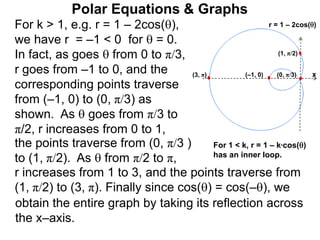
For k > 1, e.g. r = 1 – 2cos(),
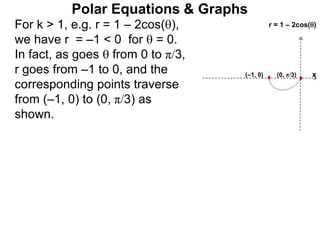
we have r = –1 < 0 for  = 0.
Polar Equations & Graphs
For k > 1, e.g. r = 1 – 2cos(),
we have r = –1 < 0 for  = 0.
In fact, as goes  from 0 to π/3,
r goes from –1 to 0,
Polar Equations & Graphs
For k > 1, e.g. r = 1 – 2cos(),
we have r = –1 < 0 for  = 0.
In fact, as goes  from 0 to π/3,
r goes from –1 to 0, and the
corresponding points traverse
from (–1, 0) to (0, π/3) as
shown.
x
r = 1 – 2cos()
(–1, 0) (0, π/3)
Polar Equations & Graphs
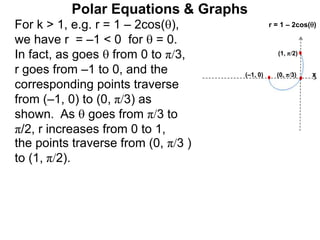
For k > 1, e.g. r = 1 – 2cos(),
we have r = –1 < 0 for  = 0.
In fact, as goes  from 0 to π/3,
r goes from –1 to 0, and the
corresponding points traverse
from (–1, 0) to (0, π/3) as
shown. As  goes from π/3 to
π/2, r increases from 0 to 1,
the points traverse from (0, π/3 )
to (1, π/2).
x
r = 1 – 2cos()
(0, π/3)(–1, 0)
(1, π/2)
Polar Equations & Graphs
For k > 1, e.g. r = 1 – 2cos(),
we have r = –1 < 0 for  = 0.
In fact, as goes  from 0 to π/3,
r goes from –1 to 0, and the
corresponding points traverse
from (–1, 0) to (0, π/3) as
shown. As  goes from π/3 to
π/2, r increases from 0 to 1,
the points traverse from (0, π/3 )
to (1, π/2). As  from π/2 to π,
r increases from 1 to 3, and the points traverse from
(1, π/2) to (3, π).
x
r = 1 – 2cos()
(0, π/3)(–1, 0)
(1, π/2)
(3, π)
Polar Equations & Graphs
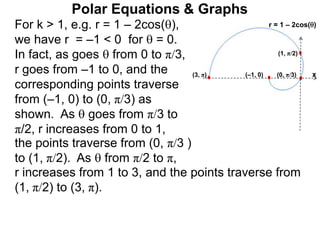
For k > 1, e.g. r = 1 – 2cos(),
we have r = –1 < 0 for  = 0.
In fact, as goes  from 0 to π/3,
r goes from –1 to 0, and the
corresponding points traverse
from (–1, 0) to (0, π/3) as
shown. As  goes from π/3 to
π/2, r increases from 0 to 1,
the points traverse from (0, π/3 )
to (1, π/2). As  from π/2 to π,
r increases from 1 to 3, and the points traverse from
(1, π/2) to (3, π). Finally since cos() = cos(–), we
obtain the entire graph by taking its reflection across
the x–axis.
For 1 < k, r = 1 – k*cos()
has an inner loop.
x
r = 1 – 2cos()
(0, π/3)(–1, 0)
(1, π/2)
(3, π)
Polar Equations & Graphs
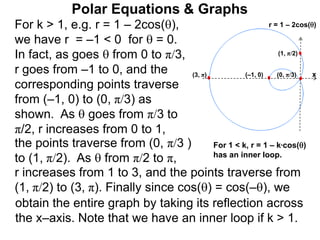
For k > 1, e.g. r = 1 – 2cos(),
we have r = –1 < 0 for  = 0.
In fact, as goes  from 0 to π/3,
r goes from –1 to 0, and the
corresponding points traverse
from (–1, 0) to (0, π/3) as
shown. As  goes from π/3 to
π/2, r increases from 0 to 1,
the points traverse from (0, π/3 )
to (1, π/2). As  from π/2 to π,
r increases from 1 to 3, and the points traverse from
(1, π/2) to (3, π). Finally since cos() = cos(–), we
obtain the entire graph by taking its reflection across
the x–axis. Note that we have an inner loop if k > 1.
For 1 < k, r = 1 – k*cos()
has an inner loop.
x
r = 1 – 2cos()
(0, π/3)(–1, 0)
(1, π/2)
(3, π)
Polar Equations & Graphs
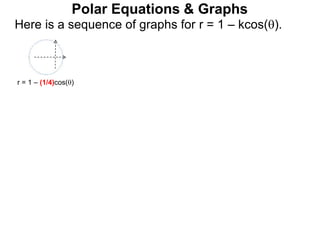
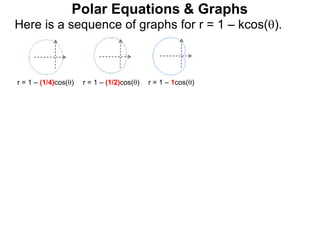
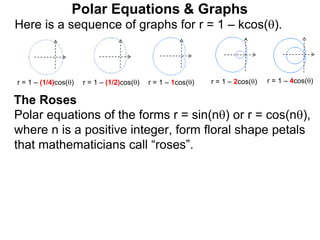
Here is a sequence of graphs for r = 1 – kcos().
r = 1 – (1/4)cos()
Polar Equations & Graphs
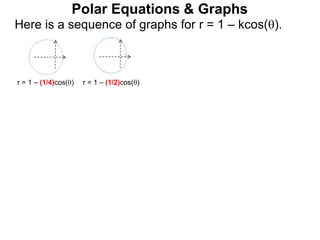
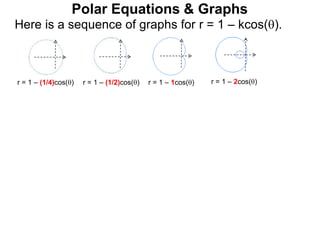
Here is a sequence of graphs for r = 1 – kcos().
r = 1 – (1/4)cos() r = 1 – (1/2)cos()
Polar Equations & Graphs
Here is a sequence of graphs for r = 1 – kcos().
r = 1 – (1/4)cos() r = 1 – (1/2)cos() r = 1 – 1cos()
Polar Equations & Graphs
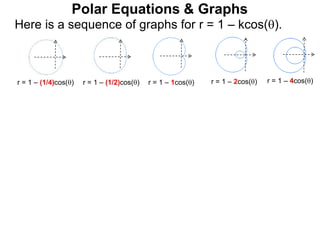
Here is a sequence of graphs for r = 1 – kcos().
r = 1 – (1/4)cos() r = 1 – (1/2)cos() r = 1 – 1cos() r = 1 – 2cos()
Polar Equations & Graphs
Here is a sequence of graphs for r = 1 – kcos().
r = 1 – (1/4)cos() r = 1 – (1/2)cos() r = 1 – 1cos() r = 1 – 2cos() r = 1 – 4cos()
Polar Equations & Graphs
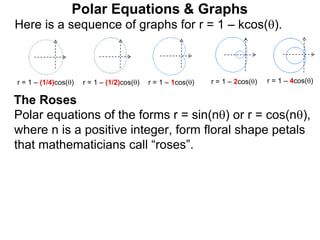
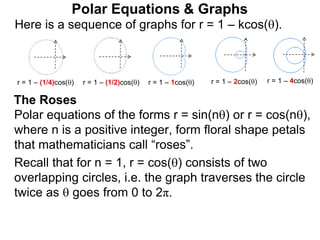
Here is a sequence of graphs for r = 1 – kcos().
r = 1 – (1/4)cos() r = 1 – (1/2)cos() r = 1 – 1cos() r = 1 – 2cos() r = 1 – 4cos()
Polar equations of the forms r = sin(n) or r = cos(n),
where n is a positive integer, form floral shape petals
that mathematicians call “roses”.
The Roses
Polar Equations & Graphs
Here is a sequence of graphs for r = 1 – kcos().
r = 1 – (1/4)cos() r = 1 – (1/2)cos() r = 1 – 1cos() r = 1 – 2cos() r = 1 – 4cos()
Polar equations of the forms r = sin(n) or r = cos(n),
where n is a positive integer, form floral shape petals
that mathematicians call “roses”.
The Roses
Polar Equations & Graphs
Here is a sequence of graphs for r = 1 – kcos().
r = 1 – (1/4)cos() r = 1 – (1/2)cos() r = 1 – 1cos() r = 1 – 2cos() r = 1 – 4cos()
Polar equations of the forms r = sin(n) or r = cos(n),
where n is a positive integer, form floral shape petals
that mathematicians call “roses”.
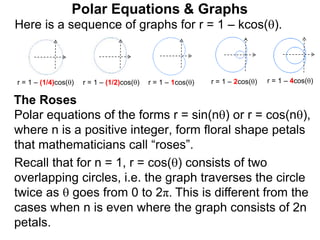
Recall that for n = 1, r = cos() consists of two
overlapping circles, i.e. the graph traverses the circle
twice as  goes from 0 to 2π.
The Roses
Polar Equations & Graphs
Here is a sequence of graphs for r = 1 – kcos().
r = 1 – (1/4)cos() r = 1 – (1/2)cos() r = 1 – 1cos() r = 1 – 2cos() r = 1 – 4cos()
Polar equations of the forms r = sin(n) or r = cos(n),
where n is a positive integer, form floral shape petals
that mathematicians call “roses”.
Recall that for n = 1, r = cos() consists of two
overlapping circles, i.e. the graph traverses the circle
twice as  goes from 0 to 2π. This is different from the
cases when n is even where the graph consists of 2n
petals.
The Roses
Polar Equations & Graphs
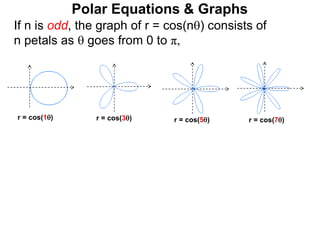
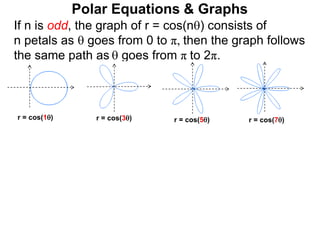
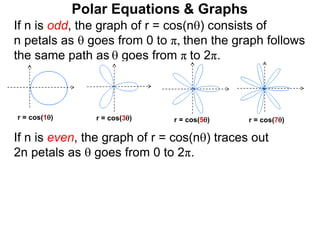
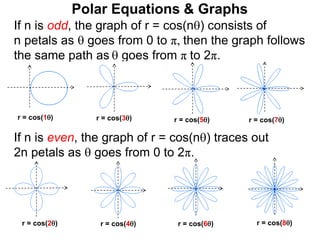
r = cos(1) r = cos(3)
If n is odd, the graph of r = cos(n) consists of
n petals as  goes from 0 to π,
r = cos(7)r = cos(5)
Polar Equations & Graphs
r = cos(1) r = cos(3)
If n is odd, the graph of r = cos(n) consists of
n petals as  goes from 0 to π, then the graph follows
the same path as  goes from π to 2π.
r = cos(7)r = cos(5)
Polar Equations & Graphs
r = cos(1) r = cos(3)
If n is odd, the graph of r = cos(n) consists of
n petals as  goes from 0 to π, then the graph follows
the same path as  goes from π to 2π.
If n is even, the graph of r = cos(n) traces out
2n petals as  goes from 0 to 2π.
r = cos(7)r = cos(5)
Polar Equations & Graphs
r = cos(1) r = cos(3)
If n is odd, the graph of r = cos(n) consists of
n petals as  goes from 0 to π, then the graph follows
the same path as  goes from π to 2π.
r = cos(2) r = cos(4) r = cos(6) r = cos(8)
If n is even, the graph of r = cos(n) traces out
2n petals as  goes from 0 to 2π.
r = cos(7)r = cos(5)
Polar Equations & Graphs
Following is a brief argument for the differences in the
graphs of r = sin(n) depending on n is even or odd.
Polar Equations & Graphs
Following is a brief argument for the differences in the
graphs of r = sin(n) depending on n is even or odd.
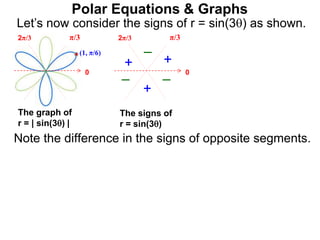
Let’s look at the graph of r = | sin(3) |.
Polar Equations & Graphs
Following is a brief argument for the differences in the
graphs of r = sin(n) depending on n is even or odd.
Let’s look at the graph of r = | sin(3) |.
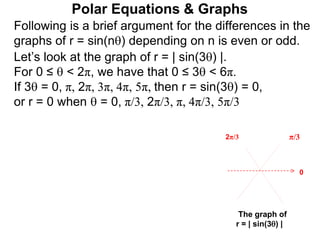
For 0 ≤  < 2π, we have that 0 ≤ 3 < 6π.
Polar Equations & Graphs
Following is a brief argument for the differences in the
graphs of r = sin(n) depending on n is even or odd.
Let’s look at the graph of r = | sin(3) |.
For 0 ≤  < 2π, we have that 0 ≤ 3 < 6π.
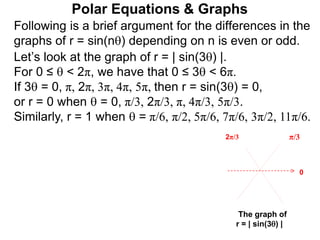
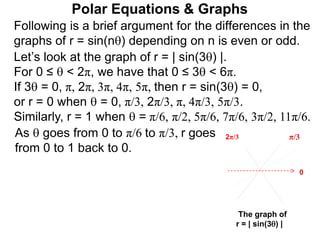
If 3 = 0, π, 2π, 3π, 4π, 5π, then r = sin(3) = 0,
or r = 0 when  = 0, π/3, 2π/3, π, 4π/3, 5π/3
π/32π/3
The graph of
r = | sin(3) |
0
Polar Equations & Graphs
Following is a brief argument for the differences in the
graphs of r = sin(n) depending on n is even or odd.
Let’s look at the graph of r = | sin(3) |.
For 0 ≤  < 2π, we have that 0 ≤ 3 < 6π.
If 3 = 0, π, 2π, 3π, 4π, 5π, then r = sin(3) = 0,
or r = 0 when  = 0, π/3, 2π/3, π, 4π/3, 5π/3.
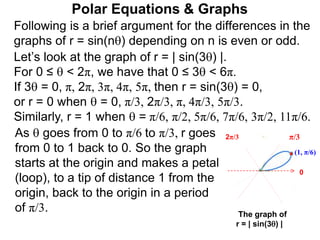
Similarly, r = 1 when  = π/6, π/2, 5π/6, 7π/6, 3π/2, 11π/6.
π/32π/3
The graph of
r = | sin(3) |
0
Polar Equations & Graphs
Following is a brief argument for the differences in the
graphs of r = sin(n) depending on n is even or odd.
As  goes from 0 to π/6 to π/3, r goes
from 0 to 1 back to 0.
Let’s look at the graph of r = | sin(3) |.
For 0 ≤  < 2π, we have that 0 ≤ 3 < 6π.
If 3 = 0, π, 2π, 3π, 4π, 5π, then r = sin(3) = 0,
or r = 0 when  = 0, π/3, 2π/3, π, 4π/3, 5π/3.
Similarly, r = 1 when  = π/6, π/2, 5π/6, 7π/6, 3π/2, 11π/6.
π/32π/3
The graph of
r = | sin(3) |
0
Polar Equations & Graphs
Following is a brief argument for the differences in the
graphs of r = sin(n) depending on n is even or odd.
(1, π/6)
π/3
The graph of
r = | sin(3) |
0
Let’s look at the graph of r = | sin(3) |.
For 0 ≤  < 2π, we have that 0 ≤ 3 < 6π.
If 3 = 0, π, 2π, 3π, 4π, 5π, then r = sin(3) = 0,
or r = 0 when  = 0, π/3, 2π/3, π, 4π/3, 5π/3.
Similarly, r = 1 when  = π/6, π/2, 5π/6, 7π/6, 3π/2, 11π/6.
2π/3As  goes from 0 to π/6 to π/3, r goes
from 0 to 1 back to 0. So the graph
starts at the origin and makes a petal
(loop), to a tip of distance 1 from the
origin, back to the origin in a period
of π/3.
Polar Equations & Graphs
Following is a brief argument for the differences in the
graphs of r = sin(n) depending on n is even or odd.
(1, π/6)
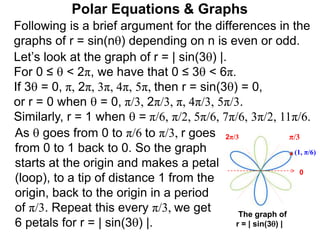
As  goes from 0 to π/6 to π/3, r goes
from 0 to 1 back to 0. So the graph
starts at the origin and makes a petal
(loop), to a tip of distance 1 from the
origin, back to the origin in a period
of π/3. Repeat this every π/3, we get
6 petals for r = | sin(3) |.
π/32π/3
The graph of
r = | sin(3) |
0
Let’s look at the graph of r = | sin(3) |.
For 0 ≤  < 2π, we have that 0 ≤ 3 < 6π.
If 3 = 0, π, 2π, 3π, 4π, 5π, then r = sin(3) = 0,
or r = 0 when  = 0, π/3, 2π/3, π, 4π/3, 5π/3.
Similarly, r = 1 when  = π/6, π/2, 5π/6, 7π/6, 3π/2, 11π/6.
Polar Equations & Graphs
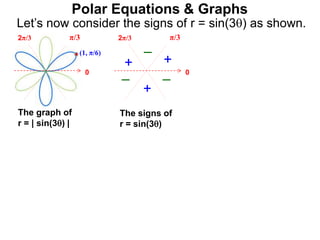
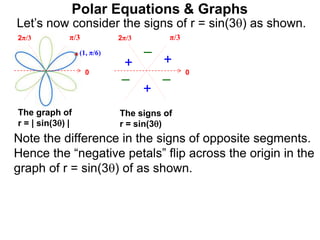
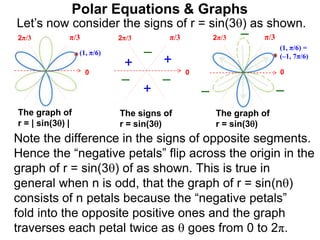
Let’s now consider the signs of r = sin(3) as shown.
below.
0
π/32π/3
0
π/32π/3
++
+
–
– –
The signs of
r = sin(3)
The graph of
r = | sin(3) |
(1, π/6)
Polar Equations & Graphs
Let’s now consider the signs of r = sin(3) as shown.
below.
0
π/32π/3
0
π/32π/3
++
+
–
– –
The signs of
r = sin(3)
Note the difference in the signs of opposite segments.
The graph of
r = | sin(3) |
(1, π/6)
Polar Equations & Graphs
Let’s now consider the signs of r = sin(3) as shown.
below.
0
π/32π/3 π/32π/3
++
+
–
– –
The signs of
r = sin(3)
Note the difference in the signs of opposite segments.
Hence the “negative petals” flip across the origin in the
graph of r = sin(3) of as shown.
The graph of
r = | sin(3) |
(1, π/6)
0
Polar Equations & Graphs
Let’s now consider the signs of r = sin(3) as shown.
below.
0
π/32π/3
0
π/32π/3
0
π/32π/3
++
+
–
– –
The signs of
r = sin(3)
Note the difference in the signs of opposite segments.
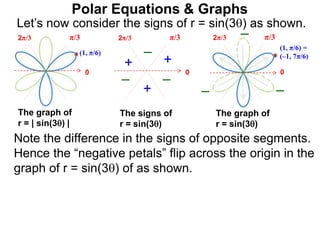
Hence the “negative petals” flip across the origin in the
graph of r = sin(3) of as shown.
The graph of
r = sin(3)
The graph of
r = | sin(3) |
– –
–
(1, π/6)
(1, π/6) =
(–1, 7π/6)
Polar Equations & Graphs
Let’s now consider the signs of r = sin(3) as shown.
below.
0
π/32π/3
0
π/32π/3
0
π/32π/3
++
+
–
– –
The signs of
r = sin(3)
Note the difference in the signs of opposite segments.
Hence the “negative petals” flip across the origin in the
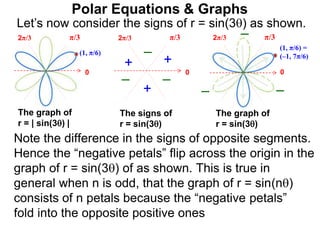
graph of r = sin(3) of as shown. This is true in
general when n is odd, that the graph of r = sin(n)
consists of n petals because the “negative petals”
fold into the opposite positive ones
The graph of
r = sin(3)
The graph of
r = | sin(3) |
– –
–
(1, π/6)
(1, π/6) =
(–1, 7π/6)
Polar Equations & Graphs
Let’s now consider the signs of r = sin(3) as shown.
below.
0
π/32π/3
0
π/32π/3
0
π/32π/3
++
+
–
– –
The signs of
r = sin(3)
Note the difference in the signs of opposite segments.
Hence the “negative petals” flip across the origin in the
graph of r = sin(3) of as shown. This is true in
general when n is odd, that the graph of r = sin(n)
consists of n petals because the “negative petals”
fold into the opposite positive ones and the graph
traverses each petal twice as  goes from 0 to 2π.
The graph of
r = sin(3)
The graph of
r = | sin(3) |
– –
–
(1, π/6)
(1, π/6) =
(–1, 7π/6)
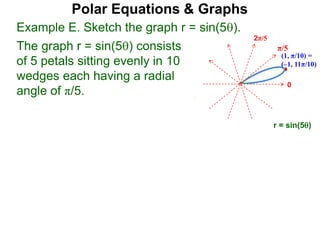
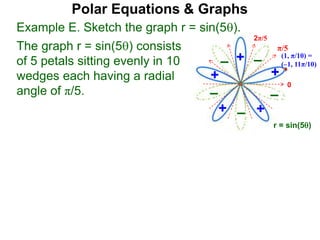
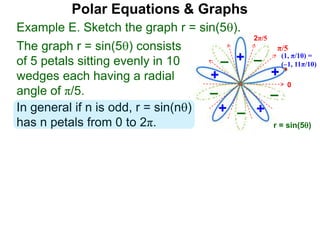
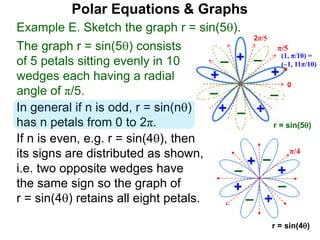
Example E. Sketch the graph r = sin(5).
Polar Equations & Graphs
Example E. Sketch the graph r = sin(5).
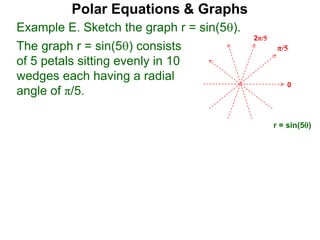
The graph r = sin(5) consists
of 5 petals sitting evenly in 10
wedges each having a radial
angle of π/5.
Polar Equations & Graphs
Example E. Sketch the graph r = sin(5).
The graph r = sin(5) consists
of 5 petals sitting evenly in 10
wedges each having a radial
angle of π/5.
0
Polar Equations & Graphs
2π/5
π/5
r = sin(5)
(1, π/10) =
(–1, 11π/10)
Example E. Sketch the graph r = sin(5).
The graph r = sin(5) consists
of 5 petals sitting evenly in 10
wedges each having a radial
angle of π/5.
0
Polar Equations & Graphs
2π/5
π/5
r = sin(5)
The graph r = sin(5) consists
of 5 petals sitting evenly in 10
wedges each having a radial
angle of π/5.
Polar Equations & Graphs
(1, π/10) =
(–1, 11π/10)
0
2π/5
π/5
Example E. Sketch the graph r = sin(5).
+
–+–
+
+ +
– –
–
r = sin(5)
The graph r = sin(5) consists
of 5 petals sitting evenly in 10
wedges each having a radial
angle of π/5.
Polar Equations & Graphs
(1, π/10) =
(–1, 11π/10)
0
2π/5
π/5
Example E. Sketch the graph r = sin(5).
+
–+–
+
+ +
– –
–
r = sin(5)
In general if n is odd, r = sin(n)
has n petals from 0 to 2π.
The graph r = sin(5) consists
of 5 petals sitting evenly in 10
wedges each having a radial
angle of π/5.
Polar Equations & Graphs
π/4
+
–+
–
+
–
–
+
(1, π/10) =
(–1, 11π/10)
0
2π/5
π/5
Example E. Sketch the graph r = sin(5).
+
–+–
+
+ +
– –
–
r = sin(5)
In general if n is odd, r = sin(n)
has n petals from 0 to 2π.
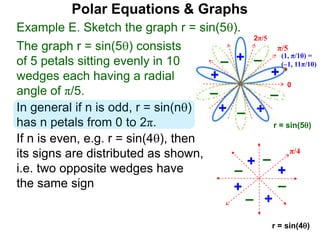
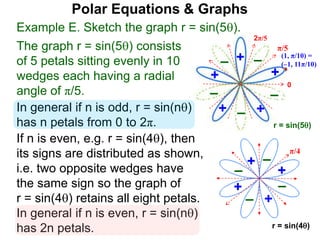
If n is even, e.g. r = sin(4), then
its signs are distributed as shown,
i.e. two opposite wedges have
the same sign
r = sin(4)
The graph r = sin(5) consists
of 5 petals sitting evenly in 10
wedges each having a radial
angle of π/5.
Polar Equations & Graphs
r = sin(4)
π/4
+
–+
–
+
–
–
+
If n is even, e.g. r = sin(4), then
its signs are distributed as shown,
i.e. two opposite wedges have
the same sign so the graph of
r = sin(4) retains all eight petals.
(1, π/10) =
(–1, 11π/10)
0
2π/5
π/5
Example E. Sketch the graph r = sin(5).
+
–+–
+
+ +
– –
–
r = sin(5)
In general if n is odd, r = sin(n)
has n petals from 0 to 2π.
The graph r = sin(5) consists
of 5 petals sitting evenly in 10
wedges each having a radial
angle of π/5.
Polar Equations & Graphs
r = sin(4)
π/4
+
–+
–
+
–
–
+
If n is even, e.g. r = sin(4), then
its signs are distributed as shown,
i.e. two opposite wedges have
the same sign so the graph of
r = sin(4) retains all eight petals.
In general if n is even, r = sin(n)
has 2n petals.
(1, π/10) =
(–1, 11π/10)
0
2π/5
π/5
Example E. Sketch the graph r = sin(5).
+
–+–
+
+ +
– –
–
r = sin(5)
In general if n is odd, r = sin(n)
has n petals from 0 to 2π.
Polar Equations
Spirals
A spiral is the graph of r = f() where f() is increasing
or decreasing.
Polar Equations
Spirals
A spiral is the graph of r = f() where f() is increasing
or decreasing.
Example F. a. Graph r =  where  ≥ 0.
Polar Equations
Spirals
A spiral is the graph of r = f() where f() is increasing
or decreasing.
Example F. a. Graph r =  where  ≥ 0.
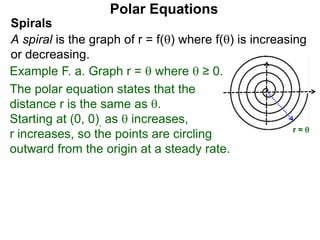
The polar equation states that the
distance r is the same as .
Polar Equations
x
r = 
Spirals
A spiral is the graph of r = f() where f() is increasing
or decreasing.
Example F. a. Graph r =  where  ≥ 0.
The polar equation states that the
distance r is the same as .
Starting at (0, 0), as  increases,
r increases, so the points are circling
outward from the origin at a steady rate.
Polar Equations
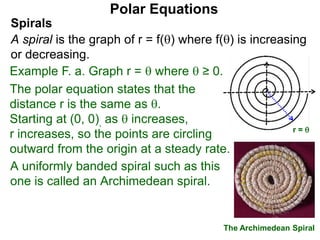
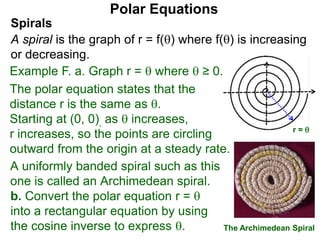
A uniformly banded spiral such as this
one is called an Archimedean spiral.
x
The Archimedean Spiral
r = 
Spirals
A spiral is the graph of r = f() where f() is increasing
or decreasing.
Example F. a. Graph r =  where  ≥ 0.
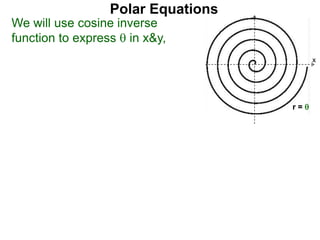
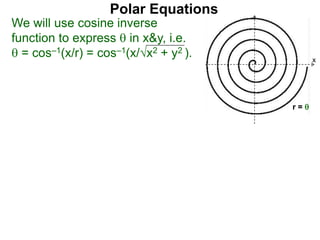
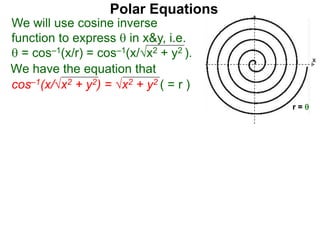
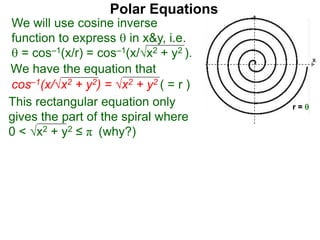
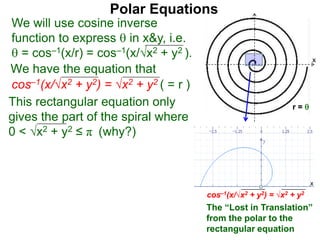
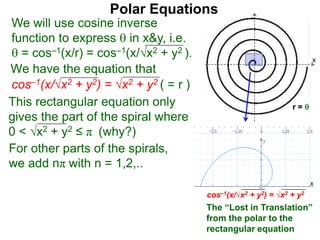
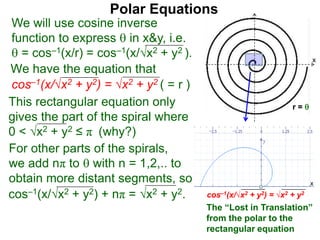
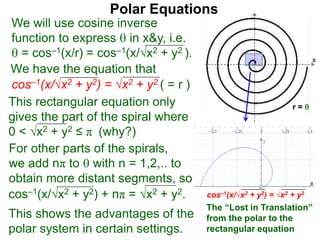
The polar equation states that the
distance r is the same as .
Starting at (0, 0), as  increases,
r increases, so the points are circling
outward from the origin at a steady rate.
Polar Equations
A uniformly banded spiral such as this
one is called an Archimedean spiral.
x
The Archimedean Spiral
r = 
Spirals
A spiral is the graph of r = f() where f() is increasing
or decreasing.
Example F. a. Graph r =  where  ≥ 0.
The polar equation states that the
distance r is the same as .
Starting at (0, 0), as  increases,
r increases, so the points are circling
outward from the origin at a steady rate.
b. Convert the polar equation r = 
into a rectangular equation by using
the cosine inverse to express .
Polar Equations
We will use cosine inverse
function to express  in x&y,
x
r = 
x
Polar Equations
We will use cosine inverse
function to express  in x&y, i.e.
 = cos–1(x/r) = cos–1(x/√x2 + y2 ).
x
r = 
x
Polar Equations
We have the equation that
We will use cosine inverse
function to express  in x&y, i.e.
 = cos–1(x/r) = cos–1(x/√x2 + y2 ).
cos–1(x/√x2 + y2) = √x2 + y2 ( = r ) x
r = 
x
Polar Equations
We have the equation that
We will use cosine inverse
function to express  in x&y, i.e.
 = cos–1(x/r) = cos–1(x/√x2 + y2 ).
cos–1(x/√x2 + y2) = √x2 + y2 ( = r ) x
r = This rectangular equation only
gives the part of the spiral where
0 < √x2 + y2 ≤ π (why?)
x
Polar Equations
We have the equation that
We will use cosine inverse
function to express  in x&y, i.e.
 = cos–1(x/r) = cos–1(x/√x2 + y2 ).
cos–1(x/√x2 + y2) = √x2 + y2 ( = r ) x
r = This rectangular equation only
gives the part of the spiral where
0 < √x2 + y2 ≤ π (why?)
cos–1(x/√x2 + y2) = √x2 + y2
x
x
The “Lost in Translation”
from the polar to the
rectangular equation
Polar Equations
We have the equation that
We will use cosine inverse
function to express  in x&y, i.e.
 = cos–1(x/r) = cos–1(x/√x2 + y2 ).
cos–1(x/√x2 + y2) = √x2 + y2 ( = r ) x
r = This rectangular equation only
gives the part of the spiral where
0 < √x2 + y2 ≤ π (why?)
For other parts of the spirals,
we add nπ with n = 1,2,..
cos–1(x/√x2 + y2) = √x2 + y2
x
x
The “Lost in Translation”
from the polar to the
rectangular equation
Polar Equations
We have the equation that
We will use cosine inverse
function to express  in x&y, i.e.
 = cos–1(x/r) = cos–1(x/√x2 + y2 ).
cos–1(x/√x2 + y2) = √x2 + y2 ( = r ) x
r = This rectangular equation only
gives the part of the spiral where
0 < √x2 + y2 ≤ π (why?)
cos–1(x/√x2 + y2) = √x2 + y2
x
x
The “Lost in Translation”
from the polar to the
rectangular equation
For other parts of the spirals,
we add nπ to  with n = 1,2,.. to
obtain more distant segments, so
cos–1(x/√x2 + y2) + nπ = √x2 + y2.
Polar Equations
We have the equation that
We will use cosine inverse
function to express  in x&y, i.e.
 = cos–1(x/r) = cos–1(x/√x2 + y2 ).
cos–1(x/√x2 + y2) = √x2 + y2 ( = r ) x
r = This rectangular equation only
gives the part of the spiral where
0 < √x2 + y2 ≤ π (why?)
cos–1(x/√x2 + y2) = √x2 + y2
x
x
The “Lost in Translation”
from the polar to the
rectangular equation
This shows the advantages of the
polar system in certain settings.
cos–1(x/√x2 + y2) + nπ = √x2 + y2.
For other parts of the spirals,
we add nπ to  with n = 1,2,.. to
obtain more distant segments, so
Polar Equations & Graphs
The Log or Equiangular Spirals
Polar Equations & Graphs
The Log or Equiangular Spirals
The spiral r = aeb where a, b are constants are called
logarithmic spirals.
Polar Equations & Graphs
The Log or Equiangular Spirals
The spiral r = aeb where a, b are constants are called
logarithmic spirals.
The log–spirals, named after the log–form  = β*ln(r)
of the equation r = eα, are also known as the
equiangular spirals.
Polar Equations & Graphs
The Log or Equiangular Spirals
The spiral r = aeb where a, b are constants are called
logarithmic spirals.
r = e0.15 r = e0.75
r = e0.35
The log–spirals, named after the log–form  = β*ln(r)
of the equation r = eα, are also known as the
equiangular spirals.
Here are some examples of log–spirals.
Polar Equations & Graphs
The Log or Equiangular Spirals
The spiral r = aeb where a, b are constants are called
logarithmic spirals.
r = e0.15 r = e0.75
r = e0.35
The log–spirals, named after the log–form  = β*ln(r)
of the equation r = eα, are also known as the
equiangular spirals.
Here are some examples of log–spirals.
Log–spirals are also called equiangular spirals
Because of its geometric characteristic.
Polar Equations & Graphs
The geometric significance of an equiangular spiral
is that the angle between the tangent line and
the radial line at any point on the spiral is a fixed
constant.
Polar Equations & Graphs
k
The geometric significance of an equiangular spiral
is that the angle between the tangent line and
the radial line at any point on the spiral is a fixed
constant.
Equiangular spirals
Polar Equations & Graphs
k
k
The geometric significance of an equiangular spiral
is that the angle between the tangent line and
the radial line at any point on the spiral is a fixed
constant.
Equiangular spirals
Polar Equations & Graphs
k
k
q
The geometric significance of an equiangular spiral
is that the angle between the tangent line and
the radial line at any point on the spiral is a fixed
constant.
Equiangular spirals
Polar Equations & Graphs
q
k
k
q
The geometric significance of an equiangular spiral
is that the angle between the tangent line and
the radial line at any point on the spiral is a fixed
constant.
Equiangular spirals
Polar Equations & Graphs
q
k
k
q
Equiangular spirals
The geometric significance of an equiangular spiral
is that the angle between the tangent line and
the radial line at any point on the spiral is a fixed
constant.
As the curve spiraling outward, the tangential angle
must be more than π/2
Polar Equations & Graphs
q
k
k
q
Equiangular spirals
The geometric significance of an equiangular spiral
is that the angle between the tangent line and
the radial line at any point on the spiral is a fixed
constant.
As the curve spiraling outward, the tangential angle
must be more than π/2. If the tangential angle is π/2,
the spiral contract into a circle.
Polar Equations & Graphs
q
k
k
q
Equiangular spirals
The geometric significance of an equiangular spiral
is that the angle between the tangent line and
the radial line at any point on the spiral is a fixed
constant.
As the curve spiraling outward, the tangential angle
must be more than π/2. If the tangential angle is π/2,
the spiral contract into a circle. If the tangential angle is
less than π/2, then it’s spiraling inward toward (0,0).
Polar Equations & Graphs
Equiangular spirals occur in nature frequently.
http://en.wikipedia.
org/wiki/Logarithmi
c_spiral
Polar Equations & Graphs
Equiangular spirals occur in nature frequently.
In many biological growth processes, the new growth
is extruded at a fixed angle from the existing structure,
e.g. new growths of plants, or the new growth of
a shell along the edge of the old shell.
http://en.wikipedia.
org/wiki/Logarithmi
c_spiral
Polar Equations & Graphs
Equiangular spirals occur in nature frequently.
In many biological growth processes, the new growth
is extruded at a fixed angle from the existing structure,
e.g. new growths of plants, or the new growth of
a shell along the edge of the old shell.
Over time the equiangular–spiral growth lines emerge.
http://en.wikipedia.
org/wiki/Logarithmi
c_spiral
Polar Equations & Graphs
Rotations of Polar Graphs
Polar Equations & Graphs
Let r1 = cos() = f() and
r2 = cos( – π/4) = g() so that
r2 = g( + π/4) = f() = r1.
Rotations of Polar Graphs
Polar Equations & Graphs
Let r1 = cos() = f() and
r2 = cos( – π/4) = g() so that
r2 = g( + π/4) = f() = r1. Therefore,
the point (r2,  + π/4) on the graph of g
is the point (r1, ) on the graph of f
rotated by the angle π/4 as shown.
x
y
r = cos()
Rotations of Polar Graphs
Polar Equations & Graphs
Let r1 = cos() = f() and
r2 = cos( – π/4) = g() so that
r2 = g( + π/4) = f() = r1. Therefore,
the point (r2,  + π/4) on the graph of g
is the point (r1, ) on the graph of f
rotated by the angle π/4 as shown.
x
y
r = cos()
r = cos( – π/4)
π/4
Rotations of Polar Graphs
Polar Equations & Graphs
Let r1 = cos() = f() and
r2 = cos( – π/4) = g() so that
r2 = g( + π/4) = f() = r1. Therefore,
the point (r2,  + π/4) on the graph of g
is the point (r1, ) on the graph of f
rotated by the angle π/4 as shown.
x
y
r = cos()
r = cos( – π/4)
π/4
Rotations of Polar Graphs
In general, given r1 = f(), let r2 = g() = f( – α)
so that g( + α) = f(), then the point (r2,  + α)
is the point (r1, ) on the graph of f, rotated by α.
Polar Equations & Graphs
Let r1 = cos() = f() and
r2 = cos( – π/4) = g() so that
r2 = g( + π/4) = f() = r1. Therefore,
the point (r2,  + π/4) on the graph of g
is the point (r1, ) on the graph of f
rotated by the angle π/4 as shown.
x
y
r = cos()
r = cos( – π/4)
π/4
Rotations of Polar Graphs
In general, given r1 = f(), let r2 = g() = f( – α)
so that g( + α) = f(), then the point (r2,  + α)
is the point (r1, ) on the graph of f, rotated by α.
If α is positive, then the graph of r2 = f( – α) is the
counter clockwise rotation of r1 = f() by the angle α,
Polar Equations & Graphs
Let r1 = cos() = f() and
r2 = cos( – π/4) = g() so that
r2 = g( + π/4) = f() = r1. Therefore,
the point (r2,  + π/4) on the graph of g
is the point (r1, ) on the graph of f
rotated by the angle π/4 as shown.
x
y
r = cos()
r = cos( – π/4)
π/4
Rotations of Polar Graphs
In general, given r1 = f(), let r2 = g() = f( – α)
so that g( + α) = f(), then the point (r2,  + α)
is the point (r1, ) on the graph of f, rotated by α.
If α is positive, then the graph of r2 = f( – α) is the
counter clockwise rotation of r1 = f() by the angle α,
and the graph of r2 = f( + α) is the clockwise rotation
of r1 = f() by the angle α.
Polar Equations & Graphs
Radial Extensions/Contractions
of Polar Graphs
Polar Equations & Graphs
The point (2r, ) is the radial extension of
the point (r, ) as shown.
Radial Extensions/Contractions
of Polar Graphs

O
(r, )pr
Polar Equations & Graphs
The point (2r, ) is the radial extension of
the point (r, ) as shown.
Radial Extensions/Contractions
of Polar Graphs

O
(r, )pr
(2r, )p
Over time the equiangular–spiral growth
lines emerge.
Polar Equations & Graphs
The point (2r, ) is the radial extension of
the point (r, ) as shown.
Radial Extensions/Contractions
of Polar Graphs

O
(r, )pr
In general, the graph of r = kf()
when k is a constant,
is the radial stretch/compression
of the graph r = f().
(2r, )p
Polar Equations & Graphs
The point (2r, ) is the radial extension of
the point (r, ) as shown.
Radial Extensions/Contractions
of Polar Graphs

O
(r, )pr
x
y
r = cos( – π/4)
r = 2cos( – π/4)
radial stretch/compression k >0
In general, the graph of r = kf()
when k is a constant,
is the radial stretch/compression
of the graph r = f().
The graphs of
r1 = cos ( – π/4),
(2r, )p
Polar Equations & Graphs
The point (2r, ) is the radial extension of
the point (r, ) as shown.
Radial Extensions/Contractions
of Polar Graphs

O
(r, )pr
x
y
r = cos( – π/4)
r = 2cos( – π/4)
radial stretch/compression k >0
In general, the graph of r = kf()
when k is a constant,
is the radial stretch/compression
of the graph r = f().
The graphs of
r1 = cos ( – π/4),
r2 = 2cos ( – π/4)
(2r, )p
Over time the equiangular–spiral growth
lines emerge.
Polar Equations & Graphs
The point (2r, ) is the radial extension of
the point (r, ) as shown.
Radial Extensions/Contractions
of Polar Graphs

O
(r, )pr
x
y
r = cos( – π/4)
r = 2cos( – π/4)
radial stretch/compression k >0
r = ½ cos( – π/4)
In general, the graph of r = kf()
when k is a constant,
is the radial stretch/compression
of the graph r = f().
The graphs of
r1 = cos ( – π/4),
r2 = 2cos ( – π/4) and
r3 = ½ * cos ( – π/4)
are shown here as examples.
(2r, )p
Polar Equations & Graphs
If k < 0, then the graph of r = kf() is the
diagonal reflection across the origin
of r = |k| f().
Polar Equations & Graphs
If k < 0, then the graph of r = kf() is the
diagonal reflection across the origin
of r = |k| f(). Here are the graphs
of r = –2cos ( – π/4)
and r = 2cos ( – π/4).
x
r = 2cos( – π/4)
r = –2cos( – π/4)
r = cos( – π/4)
Diagonal
Reflection
with k < 0

34 polar coordinate and equations

  • 1.
  • 2.
    Polar Coordinates The locationof a point P in the plane may be given by the following two numbers: P x y (r, ) O
  • 3.
    Polar Coordinates r =the distance between P and the origin O(0, 0) The location of a point P in the plane may be given by the following two numbers: P x (r, ) r O y
  • 4.
    Polar Coordinates r =the distance between P and the origin O(0, 0)  = a signed angle between the positive x–axis and the direction to P, The location of a point P in the plane may be given by the following two numbers: P x (r, )  r O y
  • 5.
    Polar Coordinates r =the distance between P and the origin O(0, 0)  = a signed angle between the positive x–axis and the direction to P, specifically,  is + for counter clockwise measurements and  is – for clockwise measurements. The location of a point P in the plane may be given by the following two numbers: P x (r, )  r O y
  • 6.
    Polar Coordinates r =the distance between P and the origin O(0, 0)  = a signed angle between the positive x–axis and the direction to P, specifically,  is + for counter clockwise measurements and  is – for clockwise measurements. The location of a point P in the plane may be given by the following two numbers: The ordered pair (r, ) is a polar coordinate of P. P x (r, )  r O y
  • 7.
    Polar Coordinates r =the distance between P and the origin O(0, 0)  = a signed angle between the positive x–axis and the direction to P, specifically,  is + for counter clockwise measurements and  is – for clockwise measurements. The location of a point P in the plane may be given by the following two numbers: The ordered pair (r, ) is a polar coordinate of P. P x (r, )  r The ordered pairs (r,  ±2nπ ) with n = 0,1, 2, 3… give the same geometric information hence lead to the same location P(r, ). O y
  • 8.
    Polar Coordinates r =the distance between P and the origin O(0, 0)  = a signed angle between the positive x–axis and the direction to P, specifically,  is + for counter clockwise measurements and  is – for clockwise measurements. The location of a point P in the plane may be given by the following two numbers: The ordered pair (r, ) is a polar coordinate of P. P x (r, )  r The ordered pairs (r,  ±2nπ ) with n = 0,1, 2, 3… give the same geometric information hence lead to the same location P(r, ). We also use signed distance, so with negative values of r, we are to step backward for a distance of l r l. O y
  • 9.
    Polar Coordinates If needed,we write (a, b)P for a polar coordinate ordered pair, and (a, b)R for the rectangular coordinate ordered pair.
  • 10.
    Polar Coordinates Conversion Rules Ifneeded, we write (a, b)P for a polar coordinate ordered pair, and (a, b)R for the rectangular coordinate ordered pair.
  • 11.
    Polar Coordinates Conversion Rules Let(x, y)R and (r, )P be the rectangular and polar coordinates of the same point P, then P x y  r O The rectangular and polar coordinates relations x = y = r = If needed, we write (a, b)P for a polar coordinate ordered pair, and (a, b)R for the rectangular coordinate ordered pair. (r, )R ↔ (x, y)P
  • 12.
    Polar Coordinates Conversion Rules Let(x, y)R and (r, )P be the rectangular and polar coordinates of the same point P, then P x y (r, )R ↔ (x, y)P  r O x = r*cos() The rectangular and polar coordinates relations x = r*cos() y = r = If needed, we write (a, b)P for a polar coordinate ordered pair, and (a, b)R for the rectangular coordinate ordered pair.
  • 13.
    Polar Coordinates Conversion Rules Let(x, y)R and (r, )P be the rectangular and polar coordinates of the same point P, then P x y  r O x = r*cos() The rectangular and polar coordinates relations x = r*cos() y = r*sin() y = r*sin() r = If needed, we write (a, b)P for a polar coordinate ordered pair, and (a, b)R for the rectangular coordinate ordered pair. (r, )R ↔ (x, y)P
  • 14.
    Polar Coordinates Conversion Rules Let(x, y)R and (r, )P be the rectangular and polar coordinates of the same point P, then P x y  r O x = r*cos() y = r*sin() The rectangular and polar coordinates relations x = r*cos() y = r*sin() r = √ x2 + y2 If needed, we write (a, b)P for a polar coordinate ordered pair, and (a, b)R for the rectangular coordinate ordered pair. (r, )R ↔ (x, y)P
  • 15.
    Polar Coordinates Conversion Rules Let(x, y)R and (r, )P be the rectangular and polar coordinates of the same point P, then P x y  r O x = r*cos() y = r*sin() The rectangular and polar coordinates relations x = r*cos() y = r*sin() r = √ x2 + y2 For  we have that tan() = y/x, cos() = x/√x2 + y2 or if  is between 0 and π, then  = cos–1 (x/√x2 + y2). If needed, we write (a, b)P for a polar coordinate ordered pair, and (a, b)R for the rectangular coordinate ordered pair. (r, )R ↔ (x, y)P
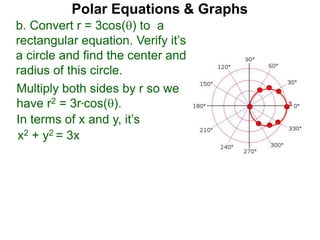
  • 16.
    Polar Coordinates Example A.a. Plot the following polar coordinates A(4, 60o)P , B(5, 0o)P, C(4, –45o)P, D(–4, 3π/4 rad)P. Find their corresponding rectangular coordinates.
  • 17.
    Polar Coordinates Example A.a. Plot the following polar coordinates A(4, 60o)P , B(5, 0o)P, C(4, –45o)P, D(–4, 3π/4 rad)P. Find their corresponding rectangular coordinates. x y x = r*cos() y = r*sin() r2 = x2 + y2 tan() = y/x For A(4, 60o)P
  • 18.
    Polar Coordinates Example A.a. Plot the following polar coordinates A(4, 60o)P , B(5, 0o)P, C(4, –45o)P, D(–4, 3π/4 rad)P. Find their corresponding rectangular coordinates. x y 60o 4 x = r*cos() y = r*sin() A(4, 60o)P r2 = x2 + y2 tan() = y/x For A(4, 60o)P
  • 19.
    Polar Coordinates Example A.a. Plot the following polar coordinates A(4, 60o)P , B(5, 0o)P, C(4, –45o)P, D(–4, 3π/4 rad)P. Find their corresponding rectangular coordinates. For A(4, 60o)P x = r*cos() y = r*sin() (x, y)R = (4*cos(60), 4*sin(60)), r2 = x2 + y2 tan() = y/x x y 60o 4 A(4, 60o)P
  • 20.
    Polar Coordinates Example A.a. Plot the following polar coordinates A(4, 60o)P , B(5, 0o)P, C(4, –45o)P, D(–4, 3π/4 rad)P. Find their corresponding rectangular coordinates. For A(4, 60o)P x = r*cos() y = r*sin() (x, y)R = (4*cos(60), 4*sin(60)), = (2, 23) r2 = x2 + y2 tan() = y/x x y 60o 4 A(4, 60o)P
  • 21.
    Polar Coordinates Example A.a. Plot the following polar coordinates A(4, 60o)P , B(5, 0o)P, C(4, –45o)P, D(–4, 3π/4 rad)P. Find their corresponding rectangular coordinates. For A(4, 60o)P x = r*cos() y = r*sin() (x, y)R = (4*cos(60), 4*sin(60)), = (2, 23) for B(5, 0o)P, (x, y) = (5, 0), r2 = x2 + y2 tan() = y/x x y 60o 4 A(4, 60o)P B(5, 0)P
  • 22.
    Polar Coordinates Example A.a. Plot the following polar coordinates A(4, 60o)P , B(5, 0o)P, C(4, –45o)P, D(–4, 3π/4 rad)P. Find their corresponding rectangular coordinates. x y 60o 4 For A(4, 60o)P x = r*cos() y = r*sin() (x, y)R = (4*cos(60), 4*sin(60)), = (2, 23) for B(5, 0o)P, (x, y) = (5, 0), for C and D, A(4, 60o)P B(5, 0)P 4 r2 = x2 + y2 tan() = y/x –45o C
  • 23.
    Polar Coordinates Example A.a. Plot the following polar coordinates A(4, 60o)P , B(5, 0o)P, C(4, –45o)P, D(–4, 3π/4 rad)P. Find their corresponding rectangular coordinates. x y 60o 4 For A(4, 60o)P x = r*cos() y = r*sin() (x, y)R = (4*cos(60), 4*sin(60)), = (2, 23) for B(5, 0o)P, (x, y) = (5, 0), for C and D, A(4, 60o)P B(5, 0)P 4 r2 = x2 + y2 tan() = y/x –45o 3π/4 C
  • 24.
    Polar Coordinates Example A.a. Plot the following polar coordinates A(4, 60o)P , B(5, 0o)P, C(4, –45o)P, D(–4, 3π/4 rad)P. Find their corresponding rectangular coordinates. x y 60o 4 For A(4, 60o)P x = r*cos() y = r*sin() (x, y)R = (4*cos(60), 4*sin(60)), = (2, 23) for B(5, 0o)P, (x, y) = (5, 0), for C and D, A(4, 60o)P B(5, 0)P 4 r2 = x2 + y2 tan() = y/x –45o 3π/4 C&D
  • 25.
    Polar Coordinates Example A.a. Plot the following polar coordinates A(4, 60o)P , B(5, 0o)P, C(4, –45o)P, D(–4, 3π/4 rad)P. Find their corresponding rectangular coordinates. x y 60o 4 For A(4, 60o)P x = r*cos() y = r*sin() (x, y)R = (4*cos(60), 4*sin(60)), = (2, 23) for B(5, 0o)P, (x, y) = (5, 0), for C and D, A(4, 60o)P B(5, 0)P C(4, –45o)P = D(–4, 3π/4 rad)P 4 r2 = x2 + y2 tan() = y/x –45o 3π/4 C&D
  • 26.
    Polar Coordinates Example A.a. Plot the following polar coordinates A(4, 60o)P , B(5, 0o)P, C(4, –45o)P, D(–4, 3π/4 rad)P. Find their corresponding rectangular coordinates. x y 60o 4 For A(4, 60o)P x = r*cos() y = r*sin() (x, y)R = (4*cos(60), 4*sin(60)), = (2, 23) for B(5, 0o)P, (x, y) = (5, 0), for C and D, (x, y)R = (4cos(–45), 4sin(–45)) = (–4cos(3π/4), –4sin(3π/4)) A(4, 60o)P B(5, 0)P C(4, –45o)P = D(–4, 3π/4 rad)P 4 r2 = x2 + y2 tan() = y/x –45o 3π/4 C&D
  • 27.
    Polar Coordinates Example A.a. Plot the following polar coordinates A(4, 60o)P , B(5, 0o)P, C(4, –45o)P, D(–4, 3π/4 rad)P. Find their corresponding rectangular coordinates. x y 60o 4 For A(4, 60o)P x = r*cos() y = r*sin() (x, y)R = (4*cos(60), 4*sin(60)), = (2, 23) for B(5, 0o)P, (x, y) = (5, 0), for C and D, (x, y)R = (4cos(–45), 4sin(–45)) = (–4cos(3π/4), –4sin(3π/4)) = (22, –22) A(4, 60o)P B(5, 0)P C(4, –45o)P = D(–4, 3π/4 rad)P 4 r2 = x2 + y2 tan() = y/x –45o 3π/4 C&D
  • 28.
    Polar Coordinates Example A.a. Plot the following polar coordinates A(4, 60o)P , B(5, 0o)P, C(4, –45o)P, D(–4, 3π/4 rad)P. Find their corresponding rectangular coordinates. x y 60o 4 For A(4, 60o)P x = r*cos() y = r*sin() (x, y)R = (4*cos(60), 4*sin(60)), = (2, 23) for B(5, 0o)P, (x, y) = (5, 0), for C and D, (x, y)R = (4cos(–45), 4sin(–45)) = (–4cos(3π/4), –4sin(3π/4)) = (22, –22) A(4, 60o)P B(5, 0)P C(4, –45o)P = D(–4, 3π/4 rad)P 4 Converting rectangular positions into polar coordinates requires more care. r2 = x2 + y2 tan() = y/x –45o 3π/4 C&D
  • 29.
    Polar Coordinates b. Finda polar coordinate then list all possible polar coordinates for each of the following points (with r > 0): E(–4, 3)R, F(3, –2)R, and G(–3, –1)R.
  • 30.
    Polar Coordinates b. Finda polar coordinate then list all possible polar coordinates for each of the following points (with r > 0): E(–4, 3)R, F(3, –2)R, and G(–3, –1)R. x y E(–4, 3)
  • 31.
    Polar Coordinates b. Finda polar coordinate then list all possible polar coordinates for each of the following points (with r > 0): E(–4, 3)R, F(3, –2)R, and G(–3, –1)R. We have the distance formula r = x2 + y2, x y E(–4, 3)
  • 32.
    Polar Coordinates b. Finda polar coordinate then list all possible polar coordinates for each of the following points (with r > 0): E(–4, 3)R, F(3, –2)R, and G(–3, –1)R. We have the distance formula r = x2 + y2, hence for E, r = 16 + 9 = 5. x y E(–4, 3) r=5
  • 33.
    Polar Coordinates b. Finda polar coordinate then list all possible polar coordinates for each of the following points (with r > 0): E(–4, 3)R, F(3, –2)R, and G(–3, –1)R. There is no single formula that would give . We have the distance formula r = x2 + y2, hence for E, r = 16 + 9 = 5. x y E(–4, 3) r=5 
  • 34.
    Polar Coordinates b. Finda polar coordinate then list all possible polar coordinates for each of the following points (with r > 0): E(–4, 3)R, F(3, –2)R, and G(–3, –1)R. There is no single formula that would give . This is because  has to be expressed via the inverse trig–functions hence the position of E dictates which inverse function We have the distance formula r = x2 + y2, hence for E, r = 16 + 9 = 5. would be easier to use to extract . x y E(–4, 3) r=5 
  • 35.
    Polar Coordinates b. Finda polar coordinate then list all possible polar coordinates for each of the following points (with r > 0): E(–4, 3)R, F(3, –2)R, and G(–3, –1)R. We have the distance formula r = x2 + y2, hence for E, r = 16 + 9 = 5. would be easier to use to extract . Since E is in the 2nd quadrant, the angle  may be recovered by the cosine inverse function (why?). x y E(–4, 3) r=5 There is no single formula that would give . This is because  has to be expressed via the inverse trig–functions hence the position of E dictates which inverse function 
  • 36.
    Polar Coordinates b. Finda polar coordinate then list all possible polar coordinates for each of the following points (with r > 0): E(–4, 3)R, F(3, –2)R, and G(–3, –1)R. We have the distance formula r = x2 + y2, hence for E, r = 16 + 9 = 5. x y E(–4, 3)  r=5 would be easier to use to extract . Since E is in the 2nd quadrant, the angle  may be recovered by the cosine inverse function (why?). So  = cos–1(–4/5) ≈ 143o There is no single formula that would give . This is because  has to be expressed via the inverse trig–functions hence the position of E dictates which inverse function
  • 37.
    Polar Coordinates b. Finda polar coordinate then list all possible polar coordinates for each of the following points (with r > 0): E(–4, 3)R, F(3, –2)R, and G(–3, –1)R. We have the distance formula r = x2 + y2, hence for E, r = 16 + 9 = 5. x y E(–4, 3)  r=5 would be easier to use to extract . Since E is in the 2nd quadrant, the angle  may be recovered by the cosine inverse function (why?). So  = cos–1(–4/5) ≈ 143o or that E(–4, 3)R ≈ (5,143o)P There is no single formula that would give . This is because  has to be expressed via the inverse trig–functions hence the position of E dictates which inverse function
  • 38.
    Polar Coordinates b. Finda polar coordinate then list all possible polar coordinates for each of the following points (with r > 0): E(–4, 3)R, F(3, –2)R, and G(–3, –1)R. We have the distance formula r = x2 + y2, hence for E, r = 16 + 9 = 5. x y E(–4, 3)  r=5 would be easier to use to extract . Since E is in the 2nd quadrant, the angle  may be recovered by the cosine inverse function (why?). So  = cos–1(–4/5) ≈ 143o or that E(–4, 3)R ≈ (5,143o)P = (5,143o±n*360o)P There is no single formula that would give . This is because  has to be expressed via the inverse trig–functions hence the position of E dictates which inverse function
  • 39.
    Polar Coordinates For F(3,–2)R, x y F(3, –2,)
  • 40.
    Polar Coordinates For F(3,–2)R, r = 9 + 4 = √13. x y F(3, –2,) r=√13
  • 41.
    Polar Coordinates For F(3,–2)R, r = 9 + 4 = √13. x y F(3, –2,) Since F is in the 4th quadrant, the angle  may be recovered by the sine inverse or the tangent inverse function.  r=√13
  • 42.
    Polar Coordinates For F(3,–2)R, r = 9 + 4 = √13. x y F(3, –2,) Since F is in the 4th quadrant, the angle  may be recovered by the sine inverse or the tangent inverse function. The tangent inverse has the advantage of obtaining the answer directly from the x and y coordinates.  r=√13
  • 43.
    Polar Coordinates For F(3,–2)R, r = 9 + 4 = √13. x y F(3, –2,) Since F is in the 4th quadrant, the angle  may be recovered by the sine inverse or the tangent inverse function. The tangent inverse has the advantage of obtaining the answer directly from the x and y coordinates. So  = tan–1(–2/3) ≈ –0.588rad and that F(3, –2)R ≈ (√13, –0.588rad)P  r=√13
  • 44.
    Polar Coordinates For F(3,–2)R, r = 9 + 4 = √13. x y F(3, –2,)  r=√13 Since F is in the 4th quadrant, the angle  may be recovered by the sine inverse or the tangent inverse function. The tangent inverse has = (√13, –0.588rad ± 2nπ)P the advantage of obtaining the answer directly from the x and y coordinates. So  = tan–1(–2/3) ≈ –0.588rad and that F(3, –2)R ≈ (√13, –0.588rad)P
  • 45.
    Polar Coordinates For F(3,–2)R, r = 9 + 4 = √13. x y F(3, –2,)  r=√13 Since F is in the 4th quadrant, the angle  may be recovered by the sine inverse or the tangent inverse function. The tangent inverse has = (√13, –0.588rad ± 2nπ)P the advantage of obtaining the answer directly from the x and y coordinates. So  = tan–1(–2/3) ≈ –0.588rad and that F(3, –2)R ≈ (√13, –0.588rad)P For G(–3, –1)R, r = 9 + 1 = √10. x y G(–3, –1) r=√10
  • 46.
    Polar Coordinates For F(3,–2)R, r = 9 + 4 = √13. x y F(3, –2,)  r=√13 Since F is in the 4th quadrant, the angle  may be recovered by the sine inverse or the tangent inverse function. The tangent inverse has = (√13, –0.588rad ± 2nπ)P the advantage of obtaining the answer directly from the x and y coordinates. So  = tan–1(–2/3) ≈ –0.588rad and that F(3, –2)R ≈ (√13, –0.588rad)P For G(–3, –1)R, r = 9 + 1 = √10. G is the 3rd quadrant. Hence  can’t be obtained directly via the inverse– trig functions. x y G(–3, –1) r=√10
  • 47.
    Polar Coordinates For F(3,–2)R, r = 9 + 4 = √13. x y F(3, –2,)  r=√13 Since F is in the 4th quadrant, the angle  may be recovered by the sine inverse or the tangent inverse function. The tangent inverse has = (√13, –0.588rad ± 2nπ)P the advantage of obtaining the answer directly from the x and y coordinates. So  = tan–1(–2/3) ≈ –0.588rad and that F(3, –2)R ≈ (√13, –0.588rad)P For G(–3, –1)R, r = 9 + 1 = √10. G is the 3rd quadrant. Hence  can’t be obtained directly via the inverse– trig functions. We will find the angle A as shown first, then  = A + π. x y G(–3, –1) r=√10 A
  • 48.
    Polar Coordinates Again, usingtangent inverse A = tan–1(1/3) ≈ 18.3o x y G(–3, –1) r=√10 A
  • 49.
    Polar Coordinates Again, usingtangent inverse A = tan–1(1/3) ≈ 18.3o so  = 180 + 18.3o = 198.3o x y G(–3, –1) r=√10 A 
  • 50.
    Polar Coordinates Again, usingtangent inverse A = tan–1(1/3) ≈ 18.3o so  = 180 + 18.3o = 198.3o or G ≈ (√10, 198.3o ± n x 360o)P x y G(–3, –1) r=√10 A 
  • 51.
    Polar Coordinates Again, usingtangent inverse A = tan–1(1/3) ≈ 18.3o so  = 180 + 18.3o = 198.3o or G ≈ (√10, 198.3o ± n x 360o)P x y G(–3, –1) r=√10 A  Summary of Conversion Rules
  • 52.
    Polar Coordinates Again, usingtangent inverse A = tan–1(1/3) ≈ 18.3o so  = 180 + 18.3o = 198.3o or G ≈ (√10, 198.3o ± n x 360o)P x y G(–3, –1) r=√10 A  Let (x, y)R and (r, )P be the rectangular and the polar coordinates of P, P x y O The rectangular and polar conversions (r, )p = (x, y)R Summary of Conversion Rules
  • 53.
    Polar Coordinates Again, usingtangent inverse A = tan–1(1/3) ≈ 18.3o so  = 180 + 18.3o = 198.3o or G ≈ (√10, 198.3o ± n x 360o)P x y G(–3, –1) r=√10 A  Let (x, y)R and (r, )P be the rectangular and the polar coordinates of P, then P x y O x = r*cos() y = r*sin() The rectangular and polar conversions x = r*cos() y = r*sin() r = √x2 + y2 tan() = y/x r = √x2 + y2 (r, )p = (x, y)R Summary of Conversion Rules
  • 54.
    Polar Coordinates Again, usingtangent inverse A = tan–1(1/3) ≈ 18.3o so  = 180 + 18.3o = 198.3o or G ≈ (√10, 198.3o ± n x 360o)P x y G(–3, –1) r=√10 A  Let (x, y)R and (r, )P be the rectangular and the polar coordinates of P, then P x y O x = r*cos() y = r*sin() The rectangular and polar conversions x = r*cos() y = r*sin() r = √x2 + y2 tan() = y/x r = √x2 + y2 If P is in quadrants I, II or IV then  may be extracted by inverse trig functions. But if P is in quadrant III, then  can’t be calculated directly by inverse trig-functions. (r, )p = (x, y)R Summary of Conversion Rules
  • 55.
  • 56.
    Polar Equations A rectangularequation in x and y gives the relation between the horizontal displacement x and vertical displacement y of locations. Polar Equations & Graphs
  • 57.
    Polar Equations A rectangularequation in x and y gives the relation between the horizontal displacement x and vertical displacement y of locations. A polar equation gives a relation of the distance r the direction . Polar Equations & Graphs
  • 58.
    Polar Equations A rectangularequation in x and y gives the relation between the horizontal displacement x and vertical displacement y of locations. A polar equation gives a relation of the distance r the direction . Polar Equations & Graphs The rectangular equation y = x specifies that the horizontal displacement x must be the same as the vertical displacement y for our points P.
  • 59.
    Polar Equations A rectangularequation in x and y gives the relation between the horizontal displacement x and vertical displacement y of locations. A polar equation gives a relation of the distance r the direction . Polar Equations & Graphs The rectangular equation y = x specifies that the horizontal displacement x must be the same as the vertical displacement y for our points P. y y x x P(x, y) The graph of y = x in the the rectangular system y = x
  • 60.
    Polar Equations A rectangularequation in x and y gives the relation between the horizontal displacement x and vertical displacement y of locations. A polar equation gives a relation of the distance r the direction . Polar Equations & Graphs The rectangular equation y = x specifies that the horizontal displacement x must be the same as the vertical displacement y for our points P. y y x x P(x, y) The graph of y = x in the the rectangular system The polar equation r =  says that the distance r must be the same as the rotational measurement  for P. The graph is the Archimedean spiral. y = x
  • 61.
    Polar Equations A rectangularequation in x and y gives the relation between the horizontal displacement x and vertical displacement y of locations. A polar equation gives a relation of the distance r the direction . Polar Equations & Graphs The rectangular equation y = x specifies that the horizontal displacement x must be the same as the vertical displacement y for our points P. y y x x P(x, y) x P(r, )  r The graph of y = x in the the rectangular system Graph of r =  in the polar system. The polar equation r =  says that the distance r must be the same as the rotational measurement  for P. Its graph is the Archimedean spiral. r =  y = x
  • 62.
    Polar Equations A rectangularequation in x and y gives the relation between the horizontal displacement x and vertical displacement y of locations. A polar equation gives a relation of the distance r the direction . Polar Equations & Graphs The rectangular equation y = x specifies that the horizontal displacement x must be the same as the vertical displacement y for our points P. y y x x P(x, y) x P(r, )  r The graph of y = x in the the rectangular system Graph of r =  in the polar system. The polar equation r =  says that the distance r must be the same as the rotational measurement  for P. Its graph is the Archimedean spiral. y = x (π/2, π/2)p r = 
  • 63.
    Let’s look atsome basic examples of polar graphs. Polar Equations & Graphs The Constant Equations r = c &  = c
  • 64.
    Let’s look atsome basic examples of polar graphs. Polar Equations & Graphs The Constant Equations r = c &  = c Example B. Graph the following polar equations. a. (r = c) b. ( = c)
  • 65.
    Let’s look atsome basic examples of polar graphs. Polar Equations & Graphs The Constant Equations r = c &  = c Example B. Graph the following polar equations. a. (r = c) The constant equation r = c indicates that “the distance r is c, a fixed constant” and that  may be of any value. b. ( = c)
  • 66.
    Let’s look atsome basic examples of polar graphs. Polar Equations & Graphs The Constant Equations r = c &  = c Example B. Graph the following polar equations. a. (r = c) The constant equation r = c indicates that “the distance r is c, a fixed constant” and that  may be of any value. This equation describes the circle of radius c, centered at (0,0). b. ( = c)
  • 67.
    Let’s look atsome basic examples of polar graphs. Polar Equations & Graphs The Constant Equations r = c &  = c Example B. Graph the following polar equations. a. (r = c) The constant equation r = c indicates that “the distance r is c, a fixed constant” and that  may be of any value. This equation describes the circle of radius c, centered at (0,0). x y c The constant equation r = c b. ( = c)
  • 68.
    Let’s look atsome basic examples of polar graphs. Polar Equations & Graphs The Constant Equations r = c &  = c Example B. Graph the following polar equations. a. (r = c) The constant equation r = c indicates that “the distance r is c, a fixed constant” and that  may be of any value. This equation describes the circle of radius c, centered at (0,0). x y c The constant equation r = c b. ( = c) The constant equation  = c requires that “the directional angle  is c, a fixed constant” and the distance r may be of any value.
  • 69.
    Let’s look atsome basic examples of polar graphs. Polar Equations & Graphs The Constant Equations r = c &  = c Example B. Graph the following polar equations. a. (r = c) The constant equation r = c indicates that “the distance r is c, a fixed constant” and that  may be of any value. This equation describes the circle of radius c, centered at (0,0). x y c The constant equation r = c b. ( = c) The constant equation  = c requires that “the directional angle  is c, a fixed constant” and the distance r may be of any value. This equation describes the line with polar angle c.
  • 70.
    Let’s look atsome basic examples of polar graphs. Polar Equations & Graphs The Constant Equations r = c &  = c Example B. Graph the following polar equations. a. (r = c) The constant equation r = c indicates that “the distance r is c, a fixed constant” and that  may be of any value. This equation describes the circle of radius c, centered at (0,0). x y c The constant equation r = c b. ( = c) The constant equation  = c requires that “the directional angle  is c, a fixed constant” and the distance r may be of any value. This equation describes the line with polar angle c. x y The constant equation  = c  = c
  • 71.
    Polar Equations &Graphs For the graphs of other polar equation we need to plot points accordingly.
  • 72.
    Polar Equations &Graphs For the graphs of other polar equation we need to plot points accordingly. For this we will use the polar graph paper such as the one shown here which is gridded in terms of the distances and directional angles.
  • 73.
    Polar Equations &Graphs For the graphs of other polar equation we need to plot points accordingly. For this we will use the polar graph paper such as the one shown here which is gridded in terms of the distances and directional angles. Example C. a. Graph r = 3cos().
  • 74.
    Polar Equations &Graphs For the graphs of other polar equation we need to plot points accordingly. For this we will use the polar graph paper such as the one shown here which is gridded in terms of the distances and directional angles. Example C. a. Graph r = 3cos(). r  3 0o 3(3/2) ≈ 2.6 30o 3(2/2) ≈ 2.1 45o 1.5 60o 0 90o Let’s plot the points starting with  going from 0 to 90o.
  • 75.
    Polar Equations &Graphs For the graphs of other polar equation we need to plot points accordingly. For this we will use the polar graph paper such as the one shown here which is gridded in terms of the distances and directional angles. Example C. a. Graph r = 3cos(). r  3 0o 3(3/2) ≈ 2.6 30o 3(2/2) ≈ 2.1 45o 1.5 60o 0 90o Let’s plot the points starting with  going from 0 to 90o.
  • 76.
    Polar Equations &Graphs For the graphs of other polar equation we need to plot points accordingly. For this we will use the polar graph paper such as the one shown here which is gridded in terms of the distances and directional angles. Example C. a. Graph r = 3cos(). r  3 0o 3(3/2) ≈ 2.6 30o 3(2/2) ≈ 2.1 45o 1.5 60o 0 90o Let’s plot the points starting with  going from 0 to 90o.
  • 77.
    Polar Equations &Graphs For the graphs of other polar equation we need to plot points accordingly. For this we will use the polar graph paper such as the one shown here which is gridded in terms of the distances and directional angles. Example C. a. Graph r = 3cos(). r  3 0o 3(3/2) ≈ 2.6 30o 3(2/2) ≈ 2.1 45o 1.5 60o 0 90o Let’s plot the points starting with  going from 0 to 90o.
  • 78.
    Polar Equations &Graphs For the graphs of other polar equation we need to plot points accordingly. For this we will use the polar graph paper such as the one shown here which is gridded in terms of the distances and directional angles. Example C. a. Graph r = 3cos(). r  3 0o 3(3/2) ≈ 2.6 30o 3(2/2) ≈ 2.1 45o 1.5 60o 0 90o Let’s plot the points starting with  going from 0 to 90o.
  • 79.
    Polar Equations &Graphs For the graphs of other polar equation we need to plot points accordingly. For this we will use the polar graph paper such as the one shown here which is gridded in terms of the distances and directional angles. Example C. a. Graph r = 3cos(). r  3 0o 3(3/2) ≈ 2.6 30o 3(2/2) ≈ 2.1 45o 1.5 60o 0 90o Let’s plot the points starting with  going from 0 to 90o. 3
  • 80.
    Polar Equations &Graphs For the graphs of other polar equation we need to plot points accordingly. For this we will use the polar graph paper such as the one shown here which is gridded in terms of the distances and directional angles. Example C. a. Graph r = 3cos(). r  3 0o 3(3/2) ≈ 2.6 30o 3(2/2) ≈ 2.1 45o 1.5 60o 0 90o Let’s plot the points starting with  going from 0 to 90o. 3
  • 81.
    Polar Equations &Graphs For the graphs of other polar equation we need to plot points accordingly. For this we will use the polar graph paper such as the one shown here which is gridded in terms of the distances and directional angles. Example C. a. Graph r = 3cos(). r  3 0o 3(3/2) ≈ 2.6 30o 3(2/2) ≈ 2.1 45o 1.5 60o 0 90o Let’s plot the points starting with  going from 0 to 90o. 3
  • 82.
    Polar Equations &Graphs For the graphs of other polar equation we need to plot points accordingly. For this we will use the polar graph paper such as the one shown here which is gridded in terms of the distances and directional angles. Example C. a. Graph r = 3cos(). r  3 0o 3(3/2) ≈ 2.6 30o 3(2/2) ≈ 2.1 45o 1.5 60o 0 90o Let’s plot the points starting with  going from 0 to 90o. 3
  • 83.
    Polar Equations &Graphs For the graphs of other polar equation we need to plot points accordingly. For this we will use the polar graph paper such as the one shown here which is gridded in terms of the distances and directional angles. Example C. a. Graph r = 3cos(). r  3 0o 3(3/2) ≈ 2.6 30o 3(2/2) ≈ 2.1 45o 1.5 60o 0 90o Let’s plot the points starting with  going from 0 to 90o. 3
  • 84.
    Polar Equations &Graphs For the graphs of other polar equation we need to plot points accordingly. For this we will use the polar graph paper such as the one shown here which is gridded in terms of the distances and directional angles. Example C. a. Graph r = 3cos(). r  3 0o 3(3/2) ≈ 2.6 30o 3(2/2) ≈ 2.1 45o 1.5 60o 0 90o –1.5 120o ≈ –2.1 135o ≈ –2.6 150o –3 180o Let’s plot the points starting with  going from 0 to 90o. 3 Next continue with  from 90o to 180o as shown in the table.
  • 85.
    Polar Equations &Graphs For the graphs of other polar equation we need to plot points accordingly. For this we will use the polar graph paper such as the one shown here which is gridded in terms of the distances and directional angles. Example C. a. Graph r = 3cos(). r  3 0o 3(3/2) ≈ 2.6 30o 3(2/2) ≈ 2.1 45o 1.5 60o 0 90o –1.5 120o ≈ –2.1 135o ≈ –2.6 150o –3 180o Let’s plot the points starting with  going from 0 to 90o. 3 Next continue with  from 90o to 180o as shown in the table.
  • 86.
    Polar Equations &Graphs For the graphs of other polar equation we need to plot points accordingly. For this we will use the polar graph paper such as the one shown here which is gridded in terms of the distances and directional angles. Example C. a. Graph r = 3cos(). r  3 0o 3(3/2) ≈ 2.6 30o 3(2/2) ≈ 2.1 45o 1.5 60o 0 90o –1.5 120o ≈ –2.1 135o ≈ –2.6 150o –3 180o Let’s plot the points starting with  going from 0 to 90o. 3 Next continue with  from 90o to 180o as shown in the table. negative so the points are in the 4th quadrant. Note the r’s are
  • 87.
    Polar Equations &Graphs For the graphs of other polar equation we need to plot points accordingly. For this we will use the polar graph paper such as the one shown here which is gridded in terms of the distances and directional angles. Example C. a. Graph r = 3cos(). r  3 0o 3(3/2) ≈ 2.6 30o 3(2/2) ≈ 2.1 45o 1.5 60o 0 90o –1.5 120o ≈ –2.1 135o ≈ –2.6 150o –3 180o Let’s plot the points starting with  going from 0 to 90o. 3 Next continue with  from 90o to 180o as shown in the table. negative so the points are in the 4th quadrant. Note the r’s are
  • 88.
    Polar Equations &Graphs Continuing with  from 180o to 270o, r  –3 180o ≈ –2.6 210o ≈ –2.1 225o –1.5 240o 0 270o 1.5 300o ≈ 2.1 315o ≈ 2.6 330o 3 360o again r’s are negative, hence the points are located in the 1st quadrant.
  • 89.
    Polar Equations &Graphs Continuing with  from 180o to 270o, r  –3 180o ≈ –2.6 210o ≈ –2.1 225o –1.5 240o 0 270o 1.5 300o ≈ 2.1 315o ≈ 2.6 330o 3 360o again r’s are negative, hence the points are located in the 1st quadrant. In fact, they trace over the same points as  goes from 0o to 90o
  • 90.
    Polar Equations &Graphs Continuing with  from 180o to 270o, r  –3 180o ≈ –2.6 210o ≈ –2.1 225o –1.5 240o 0 270o 1.5 300o ≈ 2.1 315o ≈ 2.6 330o 3 360o again r’s are negative, hence the points are located in the 1st quadrant. 3 In fact, they trace over the same points as  goes from 0o to 90o
  • 91.
    Polar Equations &Graphs Continuing with  from 180o to 270o, r  –3 180o ≈ –2.6 210o ≈ –2.1 225o –1.5 240o 0 270o 1.5 300o ≈ 2.1 315o ≈ 2.6 330o 3 360o again r’s are negative, hence the points are located in the 1st quadrant. 3 In fact, they trace over the Finally as  goes from 270o to 360o we trace over the same points as  goes from 90o to 180o in the 4th quadrant. same points as  goes from 0o to 90o
  • 92.
    Polar Equations &Graphs Continuing with  from 180o to 270o, r  –3 180o ≈ –2.6 210o ≈ –2.1 225o –1.5 240o 0 270o 1.5 300o ≈ 2.1 315o ≈ 2.6 330o 3 360o again r’s are negative, hence the points are located in the 1st quadrant. 3 In fact, they trace over the Finally as  goes from 270o to 360o we trace over the same points as  goes from 90o to 180o in the 4th quadrant. As we will see shortly, these points form a circle and for every period of 180o the graph of r = cos() traverses this circle once. same points as  goes from 0o to 90o
  • 93.
    Polar Equations &Graphs b. Convert r = 3cos() to a rectangular equation. Verify it’s a circle and find the center and radius of this circle. 3
  • 94.
    Polar Equations &Graphs b. Convert r = 3cos() to a rectangular equation. Verify it’s a circle and find the center and radius of this circle. Multiply both sides by r so we have r2 = 3r*cos(). 3
  • 95.
    Polar Equations &Graphs b. Convert r = 3cos() to a rectangular equation. Verify it’s a circle and find the center and radius of this circle. Multiply both sides by r so we have r2 = 3r*cos(). In terms of x and y, it’s x2 + y2 = 3x 3
  • 96.
    Polar Equations &Graphs b. Convert r = 3cos() to a rectangular equation. Verify it’s a circle and find the center and radius of this circle. Multiply both sides by r so we have r2 = 3r*cos(). In terms of x and y, it’s x2 + y2 = 3x x2 – 3x + y2 = 0 3
  • 97.
    Polar Equations &Graphs b. Convert r = 3cos() to a rectangular equation. Verify it’s a circle and find the center and radius of this circle. Multiply both sides by r so we have r2 = 3r*cos(). In terms of x and y, it’s x2 + y2 = 3x x2 – 3x + y2 = 0 completing the square, x2 – 3x + (3/2)2 + y2 = 0 + (3/2)2 3
  • 98.
    Polar Equations &Graphs b. Convert r = 3cos() to a rectangular equation. Verify it’s a circle and find the center and radius of this circle. Multiply both sides by r so we have r2 = 3r*cos(). In terms of x and y, it’s x2 + y2 = 3x x2 – 3x + y2 = 0 completing the square, x2 – 3x + (3/2)2 + y2 = 0 + (3/2)2 (x – 3/2)2 + y2 = (3/2)2 3
  • 99.
    3 Polar Equations &Graphs b. Convert r = 3cos() to a rectangular equation. Verify it’s a circle and find the center and radius of this circle. Multiply both sides by r so we have r2 = 3r*cos(). In terms of x and y, it’s x2 + y2 = 3x x2 – 3x + y2 = 0 completing the square, x2 – 3x + (3/2)2 + y2 = 0 + (3/2)2 (x – 3/2)2 + y2 = (3/2)2 so the points form the circle centered at (3/2, 0) with radius 3/2.
  • 100.
    Polar Equations &Graphs In general, the polar equations of the form r = ±D*cos() r = ±D*sin() are circles with diameter D and tangent to the x or y axis at the origin. r = ±a*cos() r = ±a*sin() D x y
  • 101.
    Polar Equations &Graphs In general, the polar equations of the form r = ±D*cos() r = ±D*sin() are circles with diameter D and tangent to the x or y axis at the origin. r = ±a*cos() r = ±a*sin() D x y The points (r, ) and (r, –) are the vertical mirror images of each other across the x–axis. x (r, ) (r, –) 1
  • 102.
    Polar Equations &Graphs In general, the polar equations of the form r = ±D*cos() r = ±D*sin() are circles with diameter D and tangent to the x or y axis at the origin. r = ±a*cos() r = ±a*sin() D x y The points (r, ) and (r, –) are the vertical mirror images of each other across the x–axis. So if r = f() = f(–) such as r = cos() = cos(–), then its graph is symmetric with respect to the x–axis, x (r, ) (r, –) 1
  • 103.
    Polar Equations &Graphs In general, the polar equations of the form r = ±D*cos() r = ±D*sin() are circles with diameter D and tangent to the x or y axis at the origin. r = ±a*cos() r = ±a*sin() D x y The points (r, ) and (r, –) are the vertical mirror images of each other across the x–axis. So if r = f() = f(–) such as r = cos() = cos(–), then its graph is symmetric with respect to the x–axis, x (r, ) (r, –) r = cos() = cos(–) 1
  • 104.
    Polar Equations &Graphs In general, the polar equations of the form r = ±D*cos() r = ±D*sin() are circles with diameter D and tangent to the x or y axis at the origin. r = ±a*cos() r = ±a*sin() D x y The points (r, ) and (r, –) are the vertical mirror images of each other across the x–axis. So if r = f() = f(–) such as r = cos() = cos(–), then its graph is symmetric with respect to the x–axis, so r = ±D*cos() are the horizontal circles. x (r, ) (r, –) r = cos() = cos(–) 1
  • 105.
    Polar Equations &Graphs x (r, )(–r, –) y The points (r, ) and (–r, –) are the mirror images of each other across the y–axis.
  • 106.
    Polar Equations &Graphs x (r, ) r = sin() = –sin(–) (–r, –) y The points (r, ) and (–r, –) are the mirror images of each other across the y–axis. So if r = f(–) = –f() such as r = sin() = sin(–) then its graph is symmetric to the y–axis and that r = ±D*sin() are the two vertical circles.
  • 107.
    Polar Equations &Graphs x (r, ) r = sin() = –sin(–) (–r, –) y The points (r, ) and (–r, –) are the mirror images of each other across the y–axis. So if r = f(–) = –f() such as r = sin() = sin(–) then its graph is symmetric to the y–axis and that r = ±D*sin() are the two vertical circles. x y r = cos()r = –cos() r = sin() r = –sin() 1 1 Here they are with their orientation starting at  = 0.
  • 108.
    Polar Equations &Graphs The Cardioids r = c(1 ± cos()) r = c(1 ± sin()) The graphs of the equations of the form are called the cardioids, or the heart shaped curves. Example D. Graph r = 1 – cos().
  • 109.
    Polar Equations &Graphs The Cardioids r = c(1 ± cos()) r = c(1 ± sin()) The graphs of the equations of the form are called the cardioids, or the heart shaped curves. Example D. Graph r = 1 – cos(). The graph of r = 1 – cos() is symmetric with respect to the x–axis because cos() = cos(–).
  • 110.
    Polar Equations &Graphs The Cardioids r = c(1 ± cos()) r = c(1 ± sin()) The graphs of the equations of the form are called the cardioids, or the heart shaped curves. Example D. Graph r = 1 – cos(). The graph of r = 1 – cos() is symmetric with respect to the x–axis because cos() = cos(–). Therefore we will plot  from 0o to 180o and take its mirrored image across the x–axis for the complete graph.
  • 111.
    Polar Equations &Graphs The Cardioids r = c(1 ± cos()) r = c(1 ± sin()) The graphs of the equations of the form are called the cardioids, or the heart shaped curves. Example D. Graph r = 1 – cos(). The graph of r = 1 – cos() is symmetric with respect to the x–axis because cos() = cos(–). Therefore we will plot  from 0o to 180o and take its mirrored image across the x–axis for the complete graph. As  goes from 0o to 180o, cos() goes from 1 to –1, and the expression 1 – cos() goes from 0 to 2.
  • 112.
    Polar Equations &Graphs The Cardioids r = c(1 ± cos()) r = c(1 ± sin()) The graphs of the equations of the form are called the cardioids, or the heart shaped curves. Example D. Graph r = 1 – cos(). The graph of r = 1 – cos() is symmetric with respect to the x–axis because cos() = cos(–). Therefore we will plot  from 0o to 180o and take its mirrored image across the x–axis for the complete graph. As  goes from 0o to 180o, cos() goes from 1 to –1, and the expression 1 – cos() goes from 0 to 2. The table is shown below, readers may verify the approximate values of r’s.
  • 113.
    r=1–cos()  0 0o ≈0.13 30o ≈ 0.29 45o 0.5 60o 1 90o 1.5 120o ≈ 1.71 135o ≈ 1.87 150o 2 180o Polar Equations & Graphs x 2
  • 114.
    r=1–cos()  0 0o ≈0.13 30o ≈ 0.29 45o 0.5 60o 1 90o 1.5 120o ≈ 1.71 135o ≈ 1.87 150o 2 180o Polar Equations & Graphs x 2
  • 115.
    r=1–cos()  0 0o ≈0.13 30o ≈ 0.29 45o 0.5 60o 1 90o 1.5 120o ≈ 1.71 135o ≈ 1.87 150o 2 180o Polar Equations & Graphs x 2
  • 116.
    Polar Equations &Graphs r=1–cos()  0 0o ≈ 0.13 30o ≈ 0.29 45o 0.5 60o 1 90o 1.5 120o ≈ 1.71 135o ≈ 1.87 150o 2 180o x 2
  • 117.
    Polar Equations &Graphs r=1–cos()  0 0o ≈ 0.13 30o ≈ 0.29 45o 0.5 60o 1 90o 1.5 120o ≈ 1.71 135o ≈ 1.87 150o 2 180o Reflect across the x–axis, we have the cardioid. x 2
  • 118.
    Polar Equations &Graphs r=1–cos()  0 0o ≈ 0.13 30o ≈ 0.29 45o 0.5 60o 1 90o 1.5 120o ≈ 1.71 135o ≈ 1.87 150o 2 180o x 2 Reflect across the x–axis, we have the cardioid.
  • 119.
    Polar Equations &Graphs The cardioids is the track of a point on a circle as it r=1–cos()  0 0o ≈ 0.13 30o ≈ 0.29 45o 0.5 60o 1 90o 1.5 120o ≈ 1.71 135o ≈ 1.87 150o 2 180o x 2 Reflect across the x–axis, we have the cardioid. revolves around another circle of the same size.
  • 120.
    Polar Equations &Graphs The cardioids is the track of a point on a circle as it r=1–cos()  0 0o ≈ 0.13 30o ≈ 0.29 45o 0.5 60o 1 90o 1.5 120o ≈ 1.71 135o ≈ 1.87 150o 2 180o x 2 Reflect across the x–axis, we have the cardioid. revolves around another circle of the same size.
  • 121.
    Polar Equations &Graphs The cardioids is the track of a point on a circle as it r=1–cos()  0 0o ≈ 0.13 30o ≈ 0.29 45o 0.5 60o 1 90o 1.5 120o ≈ 1.71 135o ≈ 1.87 150o 2 180o x 2 Reflect across the x–axis, we have the cardioid. revolves around another circle of the same size.
  • 122.
    Polar Equations &Graphs The cardioids is the track of a point on a circle as it r=1–cos()  0 0o ≈ 0.13 30o ≈ 0.29 45o 0.5 60o 1 90o 1.5 120o ≈ 1.71 135o ≈ 1.87 150o 2 180o x 2 Reflect across the x–axis, we have the cardioid. revolves around another circle of the same size.
  • 123.
    Polar Equations &Graphs The cardioids is the track of a point on a circle as it r=1–cos()  0 0o ≈ 0.13 30o ≈ 0.29 45o 0.5 60o 1 90o 1.5 120o ≈ 1.71 135o ≈ 1.87 150o 2 180o x 2 Reflect across the x–axis, we have the cardioid. revolves around another circle of the same size.
  • 124.
    Polar Equations &Graphs A cardioid is also the outline or the envelope of a series of circles that pass through some fixed point o
  • 125.
    Polar Equations &Graphs o A cardioid is also the outline or the envelope of a series of circles that pass through some fixed point o
  • 126.
    Polar Equations &Graphs o A cardioid is also the outline or the envelope of a series of circles that pass through some fixed point o whose centers sit on another circle K that contains o,
  • 127.
    Polar Equations &Graphs o A cardioid is also the outline or the envelope of a series of circles that pass through some fixed point o whose centers sit on another circle K that contains o, as shown. K
  • 128.
    Polar Equations &Graphs o A cardioid is also the outline or the envelope of a series of circles that pass through some fixed point o whose centers sit on another circle K that contains o, as shown. K
  • 129.
    Polar Equations &Graphs o A cardioid is also the outline or the envelope of a series of circles that pass through some fixed point o whose centers sit on another circle K that contains o, as shown. K
  • 130.
    Polar Equations &Graphs o A cardioid is also the outline or the envelope of a series of circles that pass through some fixed point o whose centers sit on another circle K that contains o, as shown. K
  • 131.
    Polar Equations &Graphs o A cardioid is also the outline or the envelope of a series of circles that pass through some fixed point o whose centers sit on another circle K that contains o, as shown. K
  • 132.
    Polar Equations &Graphs o A cardioid is also the outline or the envelope of a series of circles that pass through some fixed point o whose centers sit on another circle K that contains o, as shown. K
  • 133.
    Polar Equations &Graphs o A cardioid is also the outline or the envelope of a series of circles that pass through some fixed point o whose centers sit on another circle K that contains o, as shown. K
  • 134.
    Polar Equations &Graphs o cases of polar equations of the form r = a ± b*cos() and r = a ± b*sin(). K A cardioid is also the outline or the envelope of a series of circles that pass through some fixed point o whose centers sit on another circle K that contains o, as shown. Cardioids are special
  • 135.
    Polar Equations &Graphs o cases of polar equations of the form r = a ± b*cos() and r = a ± b*sin(). K A cardioid is also the outline or the envelope of a series of circles that pass through some fixed point o whose centers sit on another circle K that contains o, as shown. Cardioids are special We summarize the graphs of these equations below.
  • 136.
    Polar Equations &Graphs o cases of polar equations of the form r = a ± b*cos() and r = a ± b*sin(). K A cardioid is also the outline or the envelope of a series of circles that pass through some fixed point o whose centers sit on another circle K that contains o, as shown. Cardioids are special We summarize the graphs of these equations below. The graphs of r = a ± b*sin() are rotations of the graphs of r = a ± b*cos() = a(1 ± k*cos()) where k is a constant.
  • 137.
    Polar Equations &Graphs o cases of polar equations of the form r = a ± b*cos() and r = a ± b*sin(). K A cardioid is also the outline or the envelope of a series of circles that pass through some fixed point o whose centers sit on another circle K that contains o, as shown. Cardioids are special We summarize the graphs of these equations below. The graphs of r = a ± b*sin() are rotations of the graphs of r = a ± b*cos() = a(1 ± k*cos()) where k is a constant. Regarding the “a” as a scalar, we reduce to examining the graphs of the polar equations of the form r = 1 ± k*cos().
  • 138.
    Polar Equations &Graphs The graph of a polar equation of the form r = 1 ± k*cos() depends on the value of |k|.
  • 139.
    Polar Equations &Graphs The graph of a polar equation of the form r = 1 ± k*cos() depends on the value of |k|. We may classify the graphs r = 1 – k*cos() where k is a positive number into to three types.
  • 140.
    Polar Equations &Graphs The graph of a polar equation of the form r = 1 ± k*cos() depends on the value of |k|. We may classify the graphs r = 1 – k*cos() where k is a positive number into to three types.. For k = 1, or r = 1 – cos(), we get a cardioid. r = 1 – cos() k = 1
  • 141.
    Polar Equations &Graphs The graph of a polar equation of the form r = 1 ± k*cos() depends on the value of |k|. We may classify the graphs r = 1 – k*cos() where k is a positive number into to three types.. For k = 1, or r = 1 – cos(), we get a cardioid. For k < 1, e.g. r = 1 – ½ *cos(), we have r > 0 for all ’s. r = 1 – cos() k = 1
  • 142.
    Polar Equations &Graphs The graph of a polar equation of the form r = 1 ± k*cos() depends on the value of |k|. We may classify the graphs r = 1 – k*cos() where k is a positive number into to three types.. For k = 1, or r = 1 – cos(), we get a cardioid. For k < 1, e.g. r = 1 – ½ *cos(), we have r > 0 for all ’s. This means the graph does not pass through the origin. r = 1 – cos() k = 1
  • 143.
    Polar Equations &Graphs The graph of a polar equation of the form r = 1 ± k*cos() depends on the value of |k|. We may classify the graphs r = 1 – k*cos() where k is a positive number into to three types.. For k = 1, or r = 1 – cos(), we get a cardioid. r = 1 – k *cos() 0 < k < 1 r = 1 – cos() k = 1For k < 1, e.g. r = 1 – ½ *cos(), we have r > 0 for all ’s. This means the graph does not pass through the origin. Instead, the cusp, i.e. the pinched point at the origin of the cardioid is pushed out as shown.
  • 144.
    Polar Equations &Graphs For k > 1, e.g. r = 1 – 2cos(), we have r = –1 < 0 for  = 0.
  • 145.
    Polar Equations &Graphs For k > 1, e.g. r = 1 – 2cos(), we have r = –1 < 0 for  = 0. In fact, as goes  from 0 to π/3, r goes from –1 to 0,
  • 146.
    Polar Equations &Graphs For k > 1, e.g. r = 1 – 2cos(), we have r = –1 < 0 for  = 0. In fact, as goes  from 0 to π/3, r goes from –1 to 0, and the corresponding points traverse from (–1, 0) to (0, π/3) as shown. x r = 1 – 2cos() (–1, 0) (0, π/3)
  • 147.
    Polar Equations &Graphs For k > 1, e.g. r = 1 – 2cos(), we have r = –1 < 0 for  = 0. In fact, as goes  from 0 to π/3, r goes from –1 to 0, and the corresponding points traverse from (–1, 0) to (0, π/3) as shown. As  goes from π/3 to π/2, r increases from 0 to 1, the points traverse from (0, π/3 ) to (1, π/2). x r = 1 – 2cos() (0, π/3)(–1, 0) (1, π/2)
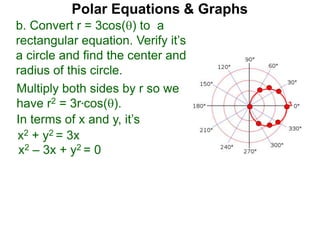
  • 148.
    Polar Equations &Graphs For k > 1, e.g. r = 1 – 2cos(), we have r = –1 < 0 for  = 0. In fact, as goes  from 0 to π/3, r goes from –1 to 0, and the corresponding points traverse from (–1, 0) to (0, π/3) as shown. As  goes from π/3 to π/2, r increases from 0 to 1, the points traverse from (0, π/3 ) to (1, π/2). As  from π/2 to π, r increases from 1 to 3, and the points traverse from (1, π/2) to (3, π). x r = 1 – 2cos() (0, π/3)(–1, 0) (1, π/2) (3, π)
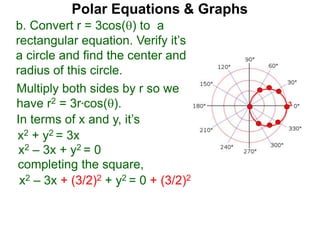
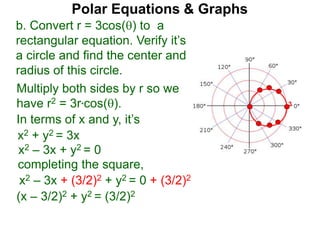
  • 149.
    Polar Equations &Graphs For k > 1, e.g. r = 1 – 2cos(), we have r = –1 < 0 for  = 0. In fact, as goes  from 0 to π/3, r goes from –1 to 0, and the corresponding points traverse from (–1, 0) to (0, π/3) as shown. As  goes from π/3 to π/2, r increases from 0 to 1, the points traverse from (0, π/3 ) to (1, π/2). As  from π/2 to π, r increases from 1 to 3, and the points traverse from (1, π/2) to (3, π). Finally since cos() = cos(–), we obtain the entire graph by taking its reflection across the x–axis. For 1 < k, r = 1 – k*cos() has an inner loop. x r = 1 – 2cos() (0, π/3)(–1, 0) (1, π/2) (3, π)
  • 150.
    Polar Equations &Graphs For k > 1, e.g. r = 1 – 2cos(), we have r = –1 < 0 for  = 0. In fact, as goes  from 0 to π/3, r goes from –1 to 0, and the corresponding points traverse from (–1, 0) to (0, π/3) as shown. As  goes from π/3 to π/2, r increases from 0 to 1, the points traverse from (0, π/3 ) to (1, π/2). As  from π/2 to π, r increases from 1 to 3, and the points traverse from (1, π/2) to (3, π). Finally since cos() = cos(–), we obtain the entire graph by taking its reflection across the x–axis. Note that we have an inner loop if k > 1. For 1 < k, r = 1 – k*cos() has an inner loop. x r = 1 – 2cos() (0, π/3)(–1, 0) (1, π/2) (3, π)
  • 151.
    Polar Equations &Graphs Here is a sequence of graphs for r = 1 – kcos(). r = 1 – (1/4)cos()
  • 152.
    Polar Equations &Graphs Here is a sequence of graphs for r = 1 – kcos(). r = 1 – (1/4)cos() r = 1 – (1/2)cos()
  • 153.
    Polar Equations &Graphs Here is a sequence of graphs for r = 1 – kcos(). r = 1 – (1/4)cos() r = 1 – (1/2)cos() r = 1 – 1cos()
  • 154.
    Polar Equations &Graphs Here is a sequence of graphs for r = 1 – kcos(). r = 1 – (1/4)cos() r = 1 – (1/2)cos() r = 1 – 1cos() r = 1 – 2cos()
  • 155.
    Polar Equations &Graphs Here is a sequence of graphs for r = 1 – kcos(). r = 1 – (1/4)cos() r = 1 – (1/2)cos() r = 1 – 1cos() r = 1 – 2cos() r = 1 – 4cos()
  • 156.
    Polar Equations &Graphs Here is a sequence of graphs for r = 1 – kcos(). r = 1 – (1/4)cos() r = 1 – (1/2)cos() r = 1 – 1cos() r = 1 – 2cos() r = 1 – 4cos() Polar equations of the forms r = sin(n) or r = cos(n), where n is a positive integer, form floral shape petals that mathematicians call “roses”. The Roses
  • 157.
    Polar Equations &Graphs Here is a sequence of graphs for r = 1 – kcos(). r = 1 – (1/4)cos() r = 1 – (1/2)cos() r = 1 – 1cos() r = 1 – 2cos() r = 1 – 4cos() Polar equations of the forms r = sin(n) or r = cos(n), where n is a positive integer, form floral shape petals that mathematicians call “roses”. The Roses
  • 158.
    Polar Equations &Graphs Here is a sequence of graphs for r = 1 – kcos(). r = 1 – (1/4)cos() r = 1 – (1/2)cos() r = 1 – 1cos() r = 1 – 2cos() r = 1 – 4cos() Polar equations of the forms r = sin(n) or r = cos(n), where n is a positive integer, form floral shape petals that mathematicians call “roses”. Recall that for n = 1, r = cos() consists of two overlapping circles, i.e. the graph traverses the circle twice as  goes from 0 to 2π. The Roses
  • 159.
    Polar Equations &Graphs Here is a sequence of graphs for r = 1 – kcos(). r = 1 – (1/4)cos() r = 1 – (1/2)cos() r = 1 – 1cos() r = 1 – 2cos() r = 1 – 4cos() Polar equations of the forms r = sin(n) or r = cos(n), where n is a positive integer, form floral shape petals that mathematicians call “roses”. Recall that for n = 1, r = cos() consists of two overlapping circles, i.e. the graph traverses the circle twice as  goes from 0 to 2π. This is different from the cases when n is even where the graph consists of 2n petals. The Roses
  • 160.
    Polar Equations &Graphs r = cos(1) r = cos(3) If n is odd, the graph of r = cos(n) consists of n petals as  goes from 0 to π, r = cos(7)r = cos(5)
  • 161.
    Polar Equations &Graphs r = cos(1) r = cos(3) If n is odd, the graph of r = cos(n) consists of n petals as  goes from 0 to π, then the graph follows the same path as  goes from π to 2π. r = cos(7)r = cos(5)
  • 162.
    Polar Equations &Graphs r = cos(1) r = cos(3) If n is odd, the graph of r = cos(n) consists of n petals as  goes from 0 to π, then the graph follows the same path as  goes from π to 2π. If n is even, the graph of r = cos(n) traces out 2n petals as  goes from 0 to 2π. r = cos(7)r = cos(5)
  • 163.
    Polar Equations &Graphs r = cos(1) r = cos(3) If n is odd, the graph of r = cos(n) consists of n petals as  goes from 0 to π, then the graph follows the same path as  goes from π to 2π. r = cos(2) r = cos(4) r = cos(6) r = cos(8) If n is even, the graph of r = cos(n) traces out 2n petals as  goes from 0 to 2π. r = cos(7)r = cos(5)
  • 164.
    Polar Equations &Graphs Following is a brief argument for the differences in the graphs of r = sin(n) depending on n is even or odd.
  • 165.
    Polar Equations &Graphs Following is a brief argument for the differences in the graphs of r = sin(n) depending on n is even or odd. Let’s look at the graph of r = | sin(3) |.
  • 166.
    Polar Equations &Graphs Following is a brief argument for the differences in the graphs of r = sin(n) depending on n is even or odd. Let’s look at the graph of r = | sin(3) |. For 0 ≤  < 2π, we have that 0 ≤ 3 < 6π.
  • 167.
    Polar Equations &Graphs Following is a brief argument for the differences in the graphs of r = sin(n) depending on n is even or odd. Let’s look at the graph of r = | sin(3) |. For 0 ≤  < 2π, we have that 0 ≤ 3 < 6π. If 3 = 0, π, 2π, 3π, 4π, 5π, then r = sin(3) = 0, or r = 0 when  = 0, π/3, 2π/3, π, 4π/3, 5π/3 π/32π/3 The graph of r = | sin(3) | 0
  • 168.
    Polar Equations &Graphs Following is a brief argument for the differences in the graphs of r = sin(n) depending on n is even or odd. Let’s look at the graph of r = | sin(3) |. For 0 ≤  < 2π, we have that 0 ≤ 3 < 6π. If 3 = 0, π, 2π, 3π, 4π, 5π, then r = sin(3) = 0, or r = 0 when  = 0, π/3, 2π/3, π, 4π/3, 5π/3. Similarly, r = 1 when  = π/6, π/2, 5π/6, 7π/6, 3π/2, 11π/6. π/32π/3 The graph of r = | sin(3) | 0
  • 169.
    Polar Equations &Graphs Following is a brief argument for the differences in the graphs of r = sin(n) depending on n is even or odd. As  goes from 0 to π/6 to π/3, r goes from 0 to 1 back to 0. Let’s look at the graph of r = | sin(3) |. For 0 ≤  < 2π, we have that 0 ≤ 3 < 6π. If 3 = 0, π, 2π, 3π, 4π, 5π, then r = sin(3) = 0, or r = 0 when  = 0, π/3, 2π/3, π, 4π/3, 5π/3. Similarly, r = 1 when  = π/6, π/2, 5π/6, 7π/6, 3π/2, 11π/6. π/32π/3 The graph of r = | sin(3) | 0
  • 170.
    Polar Equations &Graphs Following is a brief argument for the differences in the graphs of r = sin(n) depending on n is even or odd. (1, π/6) π/3 The graph of r = | sin(3) | 0 Let’s look at the graph of r = | sin(3) |. For 0 ≤  < 2π, we have that 0 ≤ 3 < 6π. If 3 = 0, π, 2π, 3π, 4π, 5π, then r = sin(3) = 0, or r = 0 when  = 0, π/3, 2π/3, π, 4π/3, 5π/3. Similarly, r = 1 when  = π/6, π/2, 5π/6, 7π/6, 3π/2, 11π/6. 2π/3As  goes from 0 to π/6 to π/3, r goes from 0 to 1 back to 0. So the graph starts at the origin and makes a petal (loop), to a tip of distance 1 from the origin, back to the origin in a period of π/3.
  • 171.
    Polar Equations &Graphs Following is a brief argument for the differences in the graphs of r = sin(n) depending on n is even or odd. (1, π/6) As  goes from 0 to π/6 to π/3, r goes from 0 to 1 back to 0. So the graph starts at the origin and makes a petal (loop), to a tip of distance 1 from the origin, back to the origin in a period of π/3. Repeat this every π/3, we get 6 petals for r = | sin(3) |. π/32π/3 The graph of r = | sin(3) | 0 Let’s look at the graph of r = | sin(3) |. For 0 ≤  < 2π, we have that 0 ≤ 3 < 6π. If 3 = 0, π, 2π, 3π, 4π, 5π, then r = sin(3) = 0, or r = 0 when  = 0, π/3, 2π/3, π, 4π/3, 5π/3. Similarly, r = 1 when  = π/6, π/2, 5π/6, 7π/6, 3π/2, 11π/6.
  • 172.
    Polar Equations &Graphs Let’s now consider the signs of r = sin(3) as shown. below. 0 π/32π/3 0 π/32π/3 ++ + – – – The signs of r = sin(3) The graph of r = | sin(3) | (1, π/6)
  • 173.
    Polar Equations &Graphs Let’s now consider the signs of r = sin(3) as shown. below. 0 π/32π/3 0 π/32π/3 ++ + – – – The signs of r = sin(3) Note the difference in the signs of opposite segments. The graph of r = | sin(3) | (1, π/6)
  • 174.
    Polar Equations &Graphs Let’s now consider the signs of r = sin(3) as shown. below. 0 π/32π/3 π/32π/3 ++ + – – – The signs of r = sin(3) Note the difference in the signs of opposite segments. Hence the “negative petals” flip across the origin in the graph of r = sin(3) of as shown. The graph of r = | sin(3) | (1, π/6) 0
  • 175.
    Polar Equations &Graphs Let’s now consider the signs of r = sin(3) as shown. below. 0 π/32π/3 0 π/32π/3 0 π/32π/3 ++ + – – – The signs of r = sin(3) Note the difference in the signs of opposite segments. Hence the “negative petals” flip across the origin in the graph of r = sin(3) of as shown. The graph of r = sin(3) The graph of r = | sin(3) | – – – (1, π/6) (1, π/6) = (–1, 7π/6)
  • 176.
    Polar Equations &Graphs Let’s now consider the signs of r = sin(3) as shown. below. 0 π/32π/3 0 π/32π/3 0 π/32π/3 ++ + – – – The signs of r = sin(3) Note the difference in the signs of opposite segments. Hence the “negative petals” flip across the origin in the graph of r = sin(3) of as shown. This is true in general when n is odd, that the graph of r = sin(n) consists of n petals because the “negative petals” fold into the opposite positive ones The graph of r = sin(3) The graph of r = | sin(3) | – – – (1, π/6) (1, π/6) = (–1, 7π/6)
  • 177.
    Polar Equations &Graphs Let’s now consider the signs of r = sin(3) as shown. below. 0 π/32π/3 0 π/32π/3 0 π/32π/3 ++ + – – – The signs of r = sin(3) Note the difference in the signs of opposite segments. Hence the “negative petals” flip across the origin in the graph of r = sin(3) of as shown. This is true in general when n is odd, that the graph of r = sin(n) consists of n petals because the “negative petals” fold into the opposite positive ones and the graph traverses each petal twice as  goes from 0 to 2π. The graph of r = sin(3) The graph of r = | sin(3) | – – – (1, π/6) (1, π/6) = (–1, 7π/6)
  • 178.
    Example E. Sketchthe graph r = sin(5). Polar Equations & Graphs
  • 179.
    Example E. Sketchthe graph r = sin(5). The graph r = sin(5) consists of 5 petals sitting evenly in 10 wedges each having a radial angle of π/5. Polar Equations & Graphs
  • 180.
    Example E. Sketchthe graph r = sin(5). The graph r = sin(5) consists of 5 petals sitting evenly in 10 wedges each having a radial angle of π/5. 0 Polar Equations & Graphs 2π/5 π/5 r = sin(5)
  • 181.
    (1, π/10) = (–1,11π/10) Example E. Sketch the graph r = sin(5). The graph r = sin(5) consists of 5 petals sitting evenly in 10 wedges each having a radial angle of π/5. 0 Polar Equations & Graphs 2π/5 π/5 r = sin(5)
  • 182.
    The graph r= sin(5) consists of 5 petals sitting evenly in 10 wedges each having a radial angle of π/5. Polar Equations & Graphs (1, π/10) = (–1, 11π/10) 0 2π/5 π/5 Example E. Sketch the graph r = sin(5). + –+– + + + – – – r = sin(5)
  • 183.
    The graph r= sin(5) consists of 5 petals sitting evenly in 10 wedges each having a radial angle of π/5. Polar Equations & Graphs (1, π/10) = (–1, 11π/10) 0 2π/5 π/5 Example E. Sketch the graph r = sin(5). + –+– + + + – – – r = sin(5) In general if n is odd, r = sin(n) has n petals from 0 to 2π.
  • 184.
    The graph r= sin(5) consists of 5 petals sitting evenly in 10 wedges each having a radial angle of π/5. Polar Equations & Graphs π/4 + –+ – + – – + (1, π/10) = (–1, 11π/10) 0 2π/5 π/5 Example E. Sketch the graph r = sin(5). + –+– + + + – – – r = sin(5) In general if n is odd, r = sin(n) has n petals from 0 to 2π. If n is even, e.g. r = sin(4), then its signs are distributed as shown, i.e. two opposite wedges have the same sign r = sin(4)
  • 185.
    The graph r= sin(5) consists of 5 petals sitting evenly in 10 wedges each having a radial angle of π/5. Polar Equations & Graphs r = sin(4) π/4 + –+ – + – – + If n is even, e.g. r = sin(4), then its signs are distributed as shown, i.e. two opposite wedges have the same sign so the graph of r = sin(4) retains all eight petals. (1, π/10) = (–1, 11π/10) 0 2π/5 π/5 Example E. Sketch the graph r = sin(5). + –+– + + + – – – r = sin(5) In general if n is odd, r = sin(n) has n petals from 0 to 2π.
  • 186.
    The graph r= sin(5) consists of 5 petals sitting evenly in 10 wedges each having a radial angle of π/5. Polar Equations & Graphs r = sin(4) π/4 + –+ – + – – + If n is even, e.g. r = sin(4), then its signs are distributed as shown, i.e. two opposite wedges have the same sign so the graph of r = sin(4) retains all eight petals. In general if n is even, r = sin(n) has 2n petals. (1, π/10) = (–1, 11π/10) 0 2π/5 π/5 Example E. Sketch the graph r = sin(5). + –+– + + + – – – r = sin(5) In general if n is odd, r = sin(n) has n petals from 0 to 2π.
  • 187.
    Polar Equations Spirals A spiralis the graph of r = f() where f() is increasing or decreasing.
  • 188.
    Polar Equations Spirals A spiralis the graph of r = f() where f() is increasing or decreasing. Example F. a. Graph r =  where  ≥ 0.
  • 189.
    Polar Equations Spirals A spiralis the graph of r = f() where f() is increasing or decreasing. Example F. a. Graph r =  where  ≥ 0. The polar equation states that the distance r is the same as .
  • 190.
    Polar Equations x r = Spirals A spiral is the graph of r = f() where f() is increasing or decreasing. Example F. a. Graph r =  where  ≥ 0. The polar equation states that the distance r is the same as . Starting at (0, 0), as  increases, r increases, so the points are circling outward from the origin at a steady rate.
  • 191.
    Polar Equations A uniformlybanded spiral such as this one is called an Archimedean spiral. x The Archimedean Spiral r =  Spirals A spiral is the graph of r = f() where f() is increasing or decreasing. Example F. a. Graph r =  where  ≥ 0. The polar equation states that the distance r is the same as . Starting at (0, 0), as  increases, r increases, so the points are circling outward from the origin at a steady rate.
  • 192.
    Polar Equations A uniformlybanded spiral such as this one is called an Archimedean spiral. x The Archimedean Spiral r =  Spirals A spiral is the graph of r = f() where f() is increasing or decreasing. Example F. a. Graph r =  where  ≥ 0. The polar equation states that the distance r is the same as . Starting at (0, 0), as  increases, r increases, so the points are circling outward from the origin at a steady rate. b. Convert the polar equation r =  into a rectangular equation by using the cosine inverse to express .
  • 193.
    Polar Equations We willuse cosine inverse function to express  in x&y, x r =  x
  • 194.
    Polar Equations We willuse cosine inverse function to express  in x&y, i.e.  = cos–1(x/r) = cos–1(x/√x2 + y2 ). x r =  x
  • 195.
    Polar Equations We havethe equation that We will use cosine inverse function to express  in x&y, i.e.  = cos–1(x/r) = cos–1(x/√x2 + y2 ). cos–1(x/√x2 + y2) = √x2 + y2 ( = r ) x r =  x
  • 196.
    Polar Equations We havethe equation that We will use cosine inverse function to express  in x&y, i.e.  = cos–1(x/r) = cos–1(x/√x2 + y2 ). cos–1(x/√x2 + y2) = √x2 + y2 ( = r ) x r = This rectangular equation only gives the part of the spiral where 0 < √x2 + y2 ≤ π (why?) x
  • 197.
    Polar Equations We havethe equation that We will use cosine inverse function to express  in x&y, i.e.  = cos–1(x/r) = cos–1(x/√x2 + y2 ). cos–1(x/√x2 + y2) = √x2 + y2 ( = r ) x r = This rectangular equation only gives the part of the spiral where 0 < √x2 + y2 ≤ π (why?) cos–1(x/√x2 + y2) = √x2 + y2 x x The “Lost in Translation” from the polar to the rectangular equation
  • 198.
    Polar Equations We havethe equation that We will use cosine inverse function to express  in x&y, i.e.  = cos–1(x/r) = cos–1(x/√x2 + y2 ). cos–1(x/√x2 + y2) = √x2 + y2 ( = r ) x r = This rectangular equation only gives the part of the spiral where 0 < √x2 + y2 ≤ π (why?) For other parts of the spirals, we add nπ with n = 1,2,.. cos–1(x/√x2 + y2) = √x2 + y2 x x The “Lost in Translation” from the polar to the rectangular equation
  • 199.
    Polar Equations We havethe equation that We will use cosine inverse function to express  in x&y, i.e.  = cos–1(x/r) = cos–1(x/√x2 + y2 ). cos–1(x/√x2 + y2) = √x2 + y2 ( = r ) x r = This rectangular equation only gives the part of the spiral where 0 < √x2 + y2 ≤ π (why?) cos–1(x/√x2 + y2) = √x2 + y2 x x The “Lost in Translation” from the polar to the rectangular equation For other parts of the spirals, we add nπ to  with n = 1,2,.. to obtain more distant segments, so cos–1(x/√x2 + y2) + nπ = √x2 + y2.
  • 200.
    Polar Equations We havethe equation that We will use cosine inverse function to express  in x&y, i.e.  = cos–1(x/r) = cos–1(x/√x2 + y2 ). cos–1(x/√x2 + y2) = √x2 + y2 ( = r ) x r = This rectangular equation only gives the part of the spiral where 0 < √x2 + y2 ≤ π (why?) cos–1(x/√x2 + y2) = √x2 + y2 x x The “Lost in Translation” from the polar to the rectangular equation This shows the advantages of the polar system in certain settings. cos–1(x/√x2 + y2) + nπ = √x2 + y2. For other parts of the spirals, we add nπ to  with n = 1,2,.. to obtain more distant segments, so
  • 201.
    Polar Equations &Graphs The Log or Equiangular Spirals
  • 202.
    Polar Equations &Graphs The Log or Equiangular Spirals The spiral r = aeb where a, b are constants are called logarithmic spirals.
  • 203.
    Polar Equations &Graphs The Log or Equiangular Spirals The spiral r = aeb where a, b are constants are called logarithmic spirals. The log–spirals, named after the log–form  = β*ln(r) of the equation r = eα, are also known as the equiangular spirals.
  • 204.
    Polar Equations &Graphs The Log or Equiangular Spirals The spiral r = aeb where a, b are constants are called logarithmic spirals. r = e0.15 r = e0.75 r = e0.35 The log–spirals, named after the log–form  = β*ln(r) of the equation r = eα, are also known as the equiangular spirals. Here are some examples of log–spirals.
  • 205.
    Polar Equations &Graphs The Log or Equiangular Spirals The spiral r = aeb where a, b are constants are called logarithmic spirals. r = e0.15 r = e0.75 r = e0.35 The log–spirals, named after the log–form  = β*ln(r) of the equation r = eα, are also known as the equiangular spirals. Here are some examples of log–spirals. Log–spirals are also called equiangular spirals Because of its geometric characteristic.
  • 206.
    Polar Equations &Graphs The geometric significance of an equiangular spiral is that the angle between the tangent line and the radial line at any point on the spiral is a fixed constant.
  • 207.
    Polar Equations &Graphs k The geometric significance of an equiangular spiral is that the angle between the tangent line and the radial line at any point on the spiral is a fixed constant. Equiangular spirals
  • 208.
    Polar Equations &Graphs k k The geometric significance of an equiangular spiral is that the angle between the tangent line and the radial line at any point on the spiral is a fixed constant. Equiangular spirals
  • 209.
    Polar Equations &Graphs k k q The geometric significance of an equiangular spiral is that the angle between the tangent line and the radial line at any point on the spiral is a fixed constant. Equiangular spirals
  • 210.
    Polar Equations &Graphs q k k q The geometric significance of an equiangular spiral is that the angle between the tangent line and the radial line at any point on the spiral is a fixed constant. Equiangular spirals
  • 211.
    Polar Equations &Graphs q k k q Equiangular spirals The geometric significance of an equiangular spiral is that the angle between the tangent line and the radial line at any point on the spiral is a fixed constant. As the curve spiraling outward, the tangential angle must be more than π/2
  • 212.
    Polar Equations &Graphs q k k q Equiangular spirals The geometric significance of an equiangular spiral is that the angle between the tangent line and the radial line at any point on the spiral is a fixed constant. As the curve spiraling outward, the tangential angle must be more than π/2. If the tangential angle is π/2, the spiral contract into a circle.
  • 213.
    Polar Equations &Graphs q k k q Equiangular spirals The geometric significance of an equiangular spiral is that the angle between the tangent line and the radial line at any point on the spiral is a fixed constant. As the curve spiraling outward, the tangential angle must be more than π/2. If the tangential angle is π/2, the spiral contract into a circle. If the tangential angle is less than π/2, then it’s spiraling inward toward (0,0).
  • 214.
    Polar Equations &Graphs Equiangular spirals occur in nature frequently. http://en.wikipedia. org/wiki/Logarithmi c_spiral
  • 215.
    Polar Equations &Graphs Equiangular spirals occur in nature frequently. In many biological growth processes, the new growth is extruded at a fixed angle from the existing structure, e.g. new growths of plants, or the new growth of a shell along the edge of the old shell. http://en.wikipedia. org/wiki/Logarithmi c_spiral
  • 216.
    Polar Equations &Graphs Equiangular spirals occur in nature frequently. In many biological growth processes, the new growth is extruded at a fixed angle from the existing structure, e.g. new growths of plants, or the new growth of a shell along the edge of the old shell. Over time the equiangular–spiral growth lines emerge. http://en.wikipedia. org/wiki/Logarithmi c_spiral
  • 217.
    Polar Equations &Graphs Rotations of Polar Graphs
  • 218.
    Polar Equations &Graphs Let r1 = cos() = f() and r2 = cos( – π/4) = g() so that r2 = g( + π/4) = f() = r1. Rotations of Polar Graphs
  • 219.
    Polar Equations &Graphs Let r1 = cos() = f() and r2 = cos( – π/4) = g() so that r2 = g( + π/4) = f() = r1. Therefore, the point (r2,  + π/4) on the graph of g is the point (r1, ) on the graph of f rotated by the angle π/4 as shown. x y r = cos() Rotations of Polar Graphs
  • 220.
    Polar Equations &Graphs Let r1 = cos() = f() and r2 = cos( – π/4) = g() so that r2 = g( + π/4) = f() = r1. Therefore, the point (r2,  + π/4) on the graph of g is the point (r1, ) on the graph of f rotated by the angle π/4 as shown. x y r = cos() r = cos( – π/4) π/4 Rotations of Polar Graphs
  • 221.
    Polar Equations &Graphs Let r1 = cos() = f() and r2 = cos( – π/4) = g() so that r2 = g( + π/4) = f() = r1. Therefore, the point (r2,  + π/4) on the graph of g is the point (r1, ) on the graph of f rotated by the angle π/4 as shown. x y r = cos() r = cos( – π/4) π/4 Rotations of Polar Graphs In general, given r1 = f(), let r2 = g() = f( – α) so that g( + α) = f(), then the point (r2,  + α) is the point (r1, ) on the graph of f, rotated by α.
  • 222.
    Polar Equations &Graphs Let r1 = cos() = f() and r2 = cos( – π/4) = g() so that r2 = g( + π/4) = f() = r1. Therefore, the point (r2,  + π/4) on the graph of g is the point (r1, ) on the graph of f rotated by the angle π/4 as shown. x y r = cos() r = cos( – π/4) π/4 Rotations of Polar Graphs In general, given r1 = f(), let r2 = g() = f( – α) so that g( + α) = f(), then the point (r2,  + α) is the point (r1, ) on the graph of f, rotated by α. If α is positive, then the graph of r2 = f( – α) is the counter clockwise rotation of r1 = f() by the angle α,
  • 223.
    Polar Equations &Graphs Let r1 = cos() = f() and r2 = cos( – π/4) = g() so that r2 = g( + π/4) = f() = r1. Therefore, the point (r2,  + π/4) on the graph of g is the point (r1, ) on the graph of f rotated by the angle π/4 as shown. x y r = cos() r = cos( – π/4) π/4 Rotations of Polar Graphs In general, given r1 = f(), let r2 = g() = f( – α) so that g( + α) = f(), then the point (r2,  + α) is the point (r1, ) on the graph of f, rotated by α. If α is positive, then the graph of r2 = f( – α) is the counter clockwise rotation of r1 = f() by the angle α, and the graph of r2 = f( + α) is the clockwise rotation of r1 = f() by the angle α.
  • 224.
    Polar Equations &Graphs Radial Extensions/Contractions of Polar Graphs
  • 225.
    Polar Equations &Graphs The point (2r, ) is the radial extension of the point (r, ) as shown. Radial Extensions/Contractions of Polar Graphs  O (r, )pr
  • 226.
    Polar Equations &Graphs The point (2r, ) is the radial extension of the point (r, ) as shown. Radial Extensions/Contractions of Polar Graphs  O (r, )pr (2r, )p Over time the equiangular–spiral growth lines emerge.
  • 227.
    Polar Equations &Graphs The point (2r, ) is the radial extension of the point (r, ) as shown. Radial Extensions/Contractions of Polar Graphs  O (r, )pr In general, the graph of r = kf() when k is a constant, is the radial stretch/compression of the graph r = f(). (2r, )p
  • 228.
    Polar Equations &Graphs The point (2r, ) is the radial extension of the point (r, ) as shown. Radial Extensions/Contractions of Polar Graphs  O (r, )pr x y r = cos( – π/4) r = 2cos( – π/4) radial stretch/compression k >0 In general, the graph of r = kf() when k is a constant, is the radial stretch/compression of the graph r = f(). The graphs of r1 = cos ( – π/4), (2r, )p
  • 229.
    Polar Equations &Graphs The point (2r, ) is the radial extension of the point (r, ) as shown. Radial Extensions/Contractions of Polar Graphs  O (r, )pr x y r = cos( – π/4) r = 2cos( – π/4) radial stretch/compression k >0 In general, the graph of r = kf() when k is a constant, is the radial stretch/compression of the graph r = f(). The graphs of r1 = cos ( – π/4), r2 = 2cos ( – π/4) (2r, )p Over time the equiangular–spiral growth lines emerge.
  • 230.
    Polar Equations &Graphs The point (2r, ) is the radial extension of the point (r, ) as shown. Radial Extensions/Contractions of Polar Graphs  O (r, )pr x y r = cos( – π/4) r = 2cos( – π/4) radial stretch/compression k >0 r = ½ cos( – π/4) In general, the graph of r = kf() when k is a constant, is the radial stretch/compression of the graph r = f(). The graphs of r1 = cos ( – π/4), r2 = 2cos ( – π/4) and r3 = ½ * cos ( – π/4) are shown here as examples. (2r, )p
  • 231.
    Polar Equations &Graphs If k < 0, then the graph of r = kf() is the diagonal reflection across the origin of r = |k| f().
  • 232.
    Polar Equations &Graphs If k < 0, then the graph of r = kf() is the diagonal reflection across the origin of r = |k| f(). Here are the graphs of r = –2cos ( – π/4) and r = 2cos ( – π/4). x r = 2cos( – π/4) r = –2cos( – π/4) r = cos( – π/4) Diagonal Reflection with k < 0