DNA Sequencing - II
1
Lecture- 32
Maxam and Gilbert’s Method of
DNA Sequencing
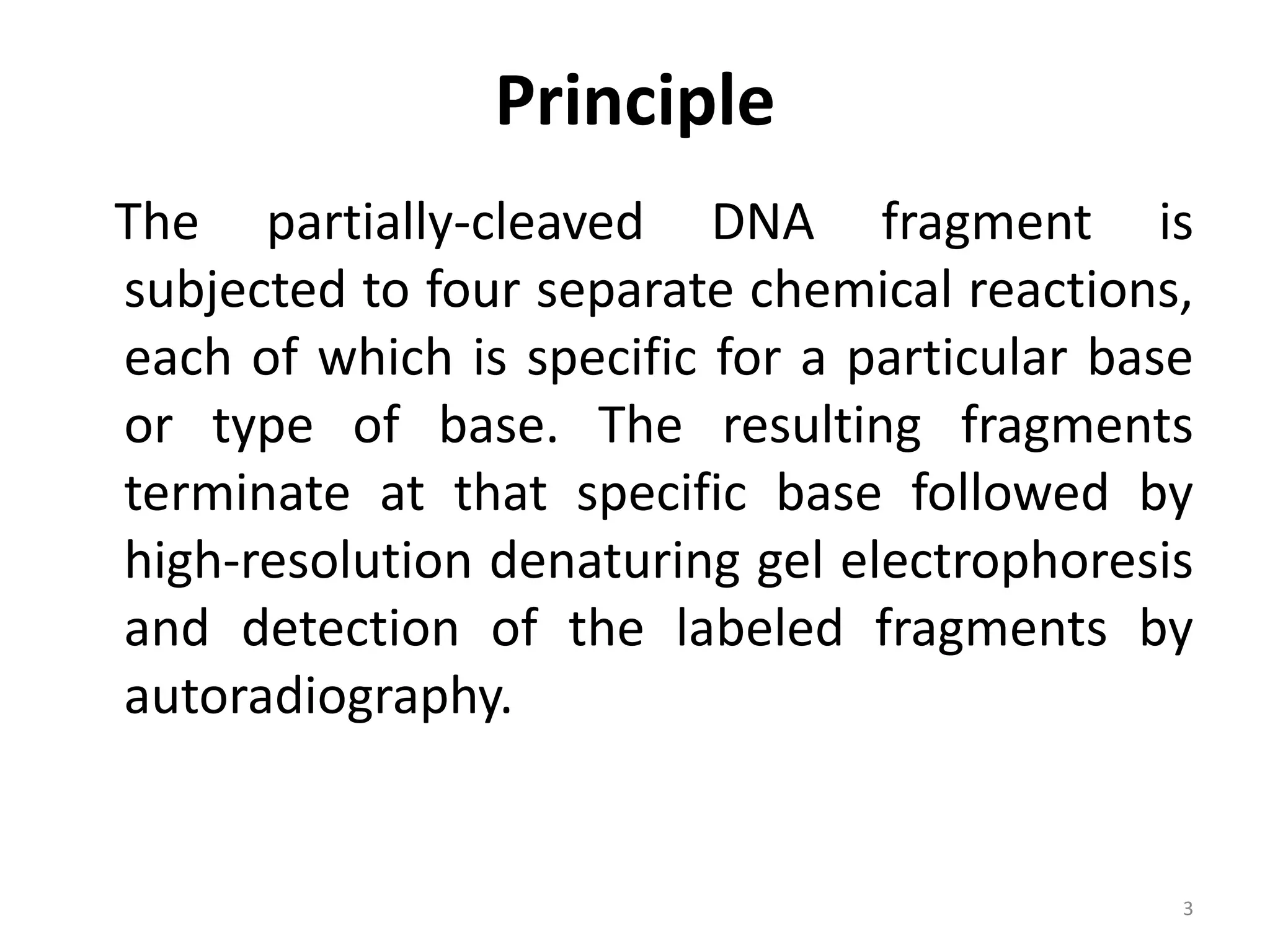
The chemical degradation method was
developed by Allan Maxam and Walter Gilbert. It
involves the base-specific chemical cleavage of an
end-labeled DNA segment to generate a nested
set of labeled molecules.
2
Principle
The partially-cleaved DNA fragment is
subjected to four separate chemical reactions,
each of which is specific for a particular base
or type of base. The resulting fragments
terminate at that specific base followed by
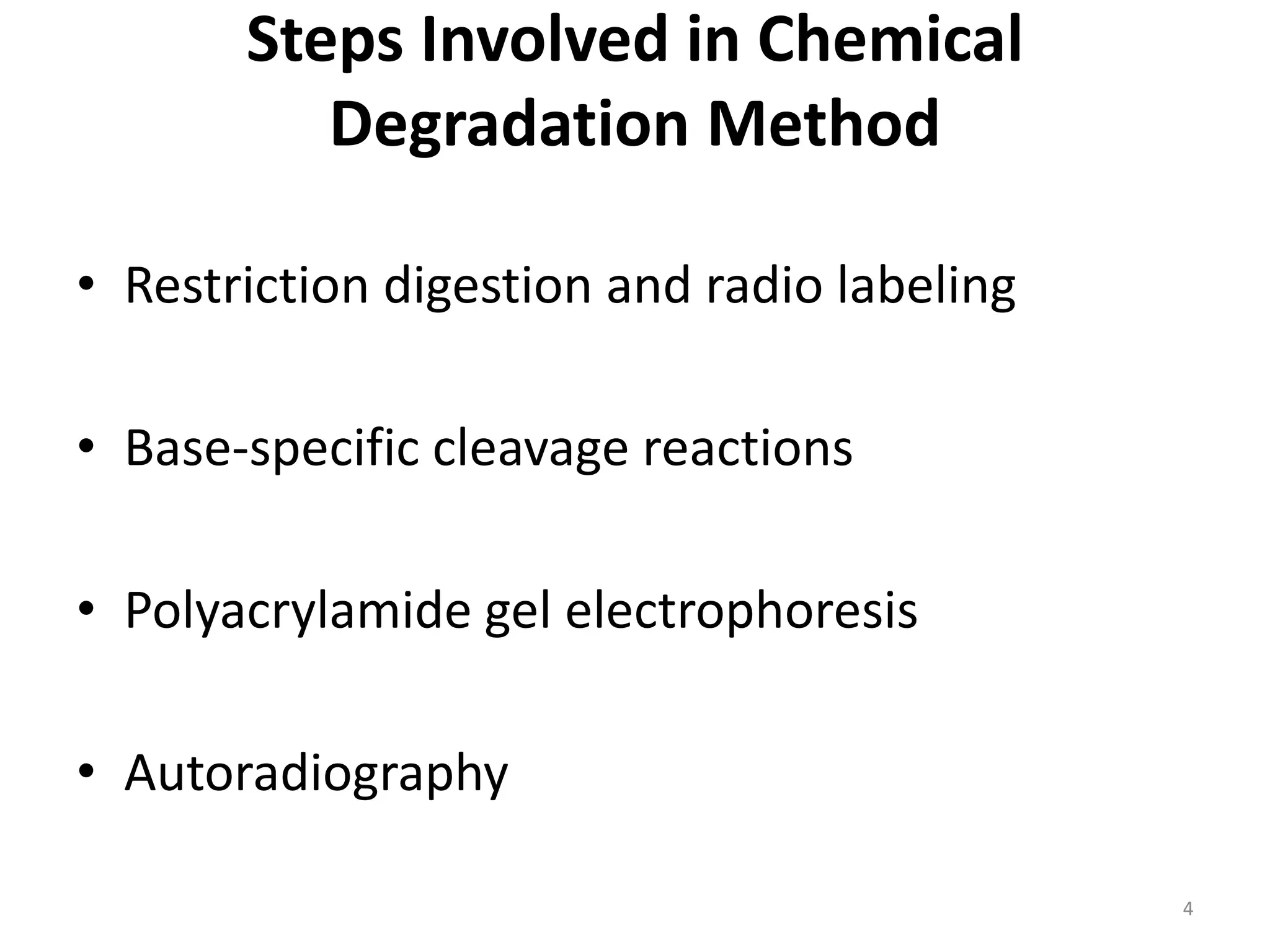
high-resolution denaturing gel electrophoresis
and detection of the labeled fragments by
autoradiography.
3
Steps Involved in Chemical
Degradation Method
• Restriction digestion and radio labeling
• Base-specific cleavage reactions
• Polyacrylamide gel electrophoresis
• Autoradiography
4
• The DNA fragment to be sequenced is radiolabeled at the 5’end by
polynucleotidyl kinase reaction using gamma-32P ATP and the resulting
fragment is purified.
• The end labeled DNA fragment is subjected to base – specific cleavage in
four chemical reactions to generate a series of labeled DNA fragments.
G-specific cleavage – Dimethyl sulphate + Piperidine (hot)
A+G Specific cleavage – formic acid + Piperidine (hot)
C+T Specific cleavage – Hydrazine + Piperidine (hot)
C Specific cleavage – Hydrazine + Sodium Chloride + Piperidine (hot)
• The fragments in the four reactions are electrophoresed side by side in
denaturing acrylamide gels for size separation.
• The gel is exposed to X-ray film for autoradiography to visualize the DNA
fragments yielding a series of dark bands each showing the location of an
identical radiolabeled DNA molecules. From presence and absence of
certain fragments the sequence may be inferred.
5
6
Advantages of chemical degradation
method
1. Sequencing by this method can be initiated
anywhere in the target DNA.
2. Original DNA molecule can be sequenced rather
than the complementary copy.
7
Disadvantages of chemical degradation
method
• A smaller length of DNA sequence is usually
determined by this method.
• The reactions of this method are normally
slower and less consistent.
• The chemicals used for cleavage reactions are
hazardous.
• It is labor - intensive, as this method cannot
be automated.
8
• 1998 Pyrosequencing
• 2003 Polony sequencing
• 2005 Sequencing by ligation
Other DNA Sequencing Techniques
9
1998
SEQUENCING BY SYNTHESIS
Pyrosequencing Method: a DNA sequencing method based on
real time pyrophosphate
The Royal Institute
of Technology,
Sweden
10
Pyrosequencing
• Pyrosequencing is more rapid ‘mini
sequencing’ method because it does not
require electrophoresis or any other fragment
separation procedure.
• This method determines which of the four
bases is incorporated at each step in the
copying of DNA template.
• In this method, dNTPs are used and ddNTPs are
not required.
11
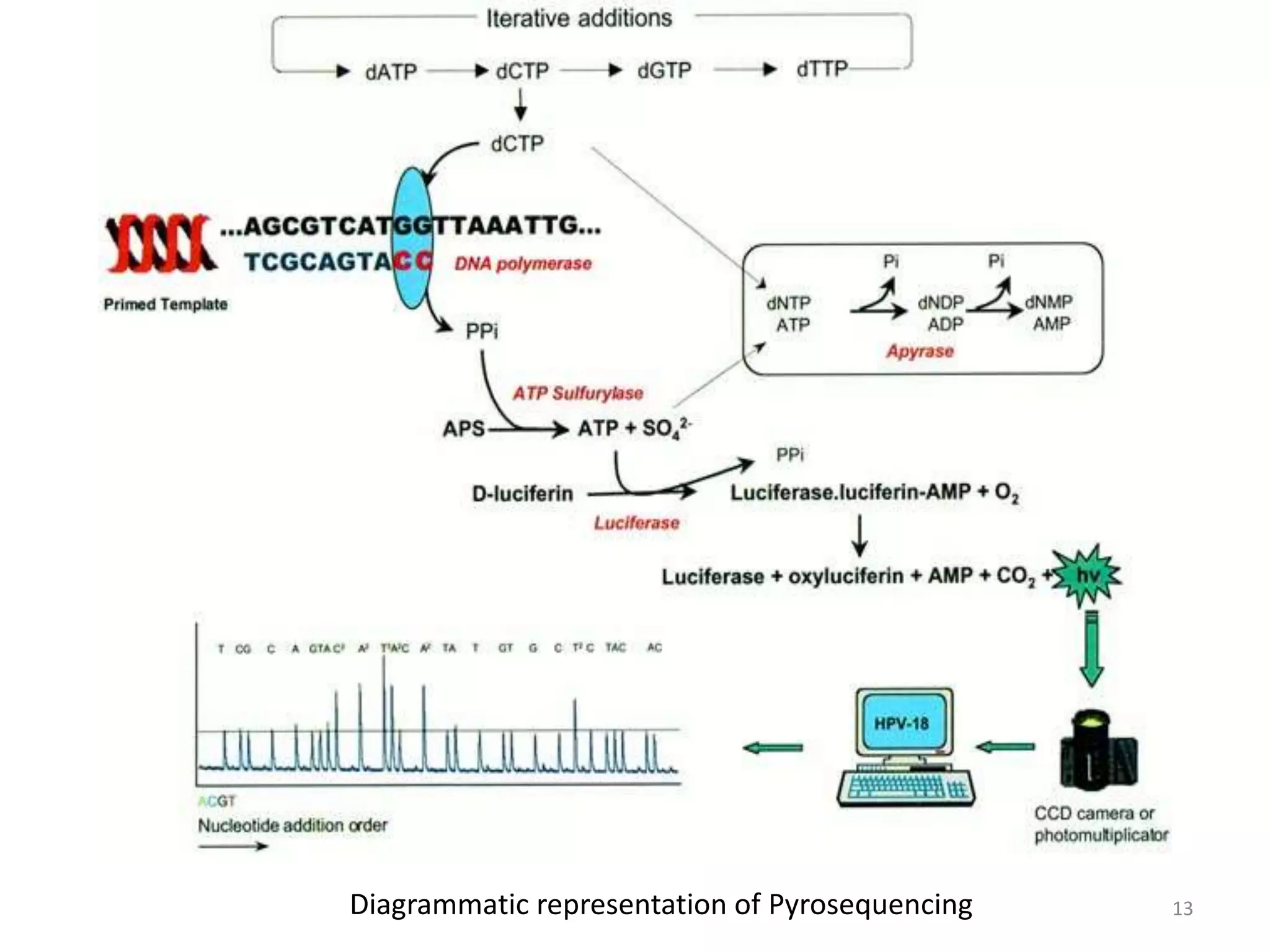
Principle of pyrosequencing
• This method is based on the "sequencing by
synthesis" principle. It differs from Sanger
sequencing in that it relies on the detection
of pyrophosphate release on nucleotide
incorporation, rather than chain termination
with dideoxynucleotides.
12
Diagrammatic representation of Pyrosequencing 13
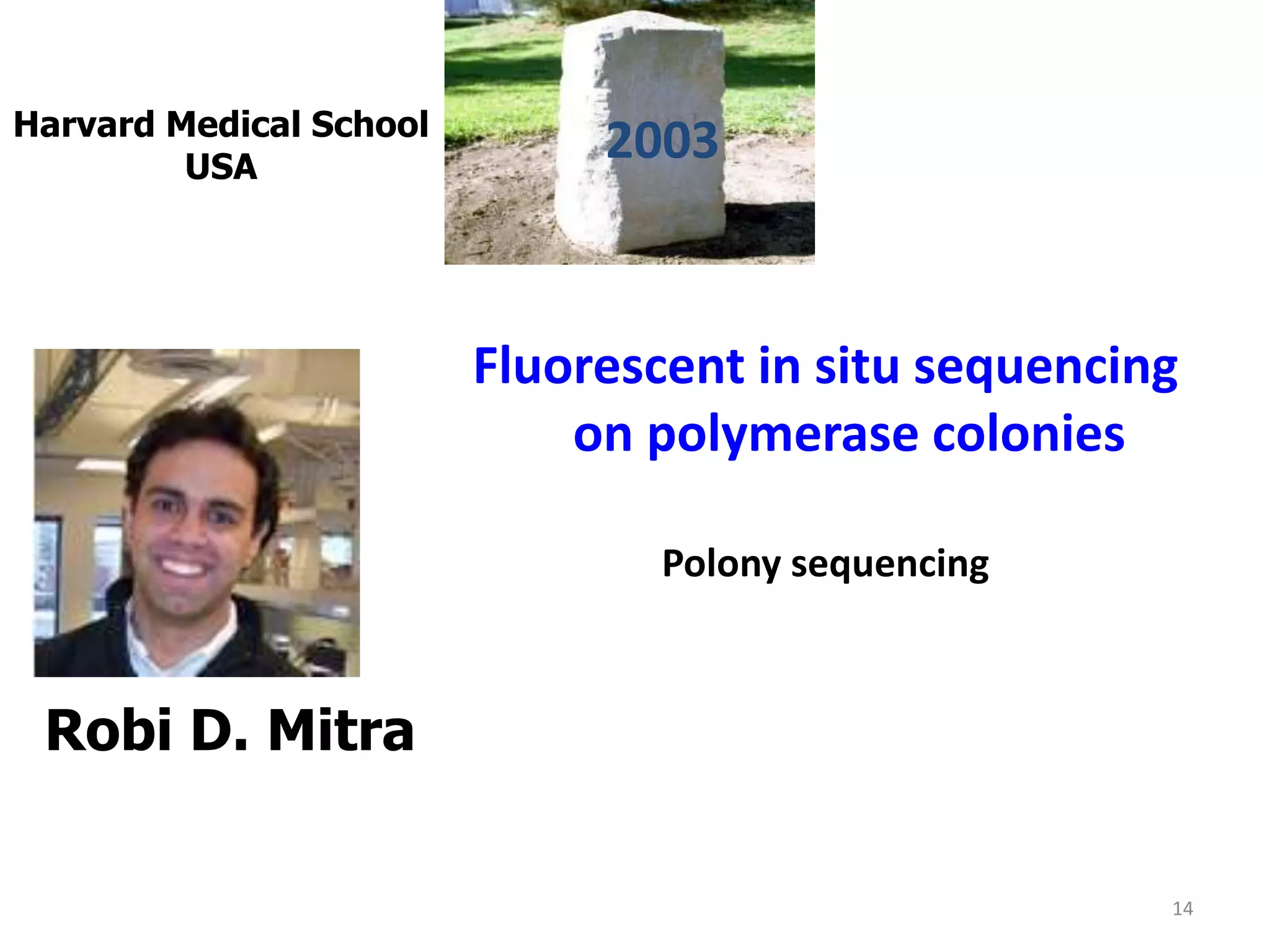
Fluorescent in situ sequencing
on polymerase colonies
Polony sequencing
2003
Robi D. Mitra
Harvard Medical School
USA
14
2005
Sequencing by ligation/polony sequencing
Multiplex polony sequencing
Genome sequencing in microfabricated high-
density picolitre reactors
Sequencing of 25 million bases in a single run
15
Cycle Sequencing: Dideoxy-mediated sequencing
reactions using PCR and end-labeled primers
• Also called thermal cycle DNA sequencing or linear amplification
of DNA sequencing
• This involves thermal cycling, i.e., heating the reaction mix to 94
°C to denature the template, cooling below the melting
temperature of the primer to allow annealing, and repeating the
sequencing reaction
• In principle, this procedure can be repeated until one of reaction
component is exhausted
16
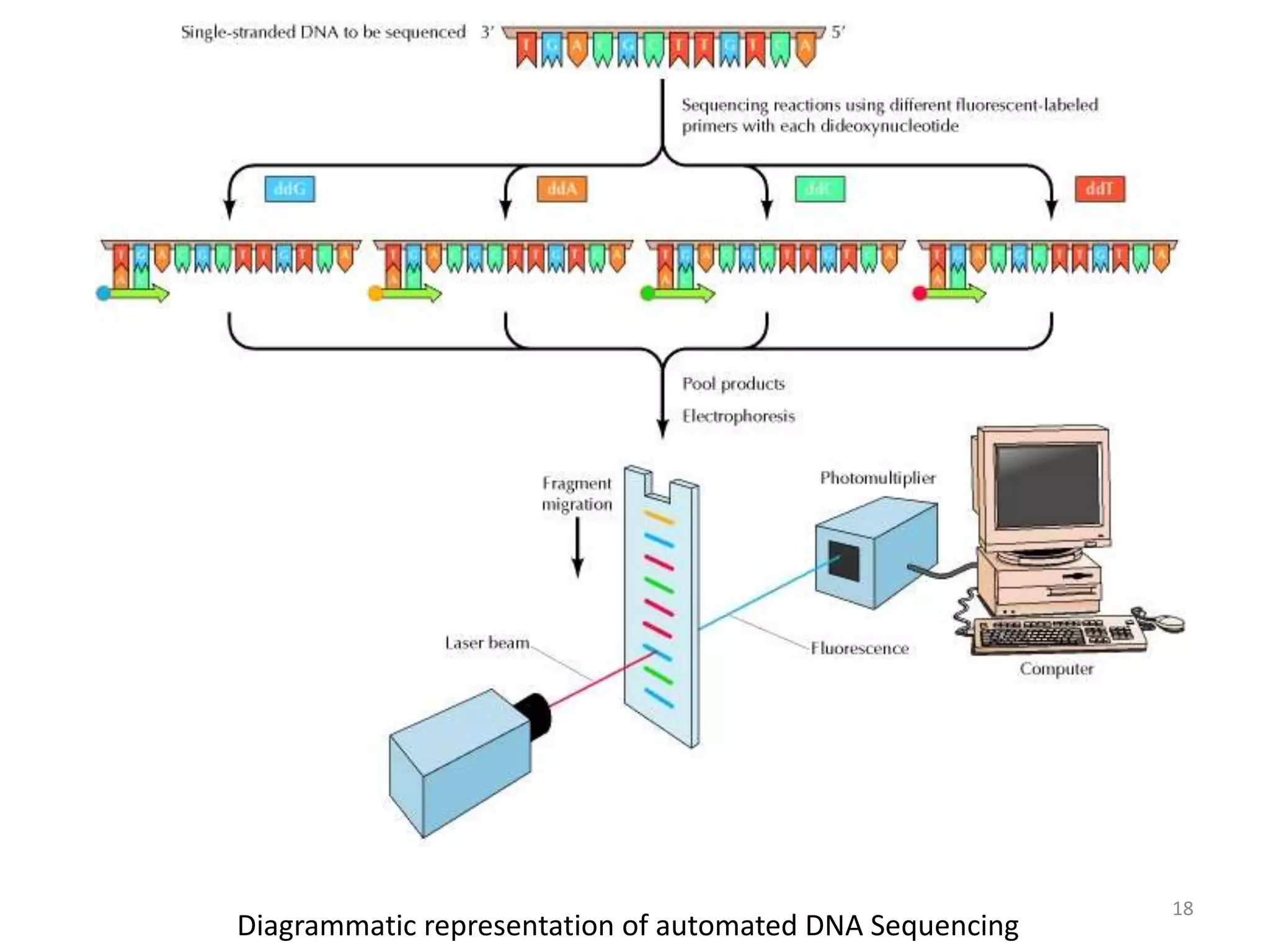
Automated DNA Sequencing
• A key advantage of automated sequencing is the automated
data collection in an easy way and in lesser time.
Types of Fluorescence Labeling Systems
Two types of fluorescence labeling systems are used in
automated DNA sequencing:
1. Four Reaction/One Gel System : The fluorescent primers can
be used with nonlabeled ddNTPs. The primers used in each
of four chain extension reactions are 5’-linked to different
fluorescence dyes.
2. One Reaction/One Gel System : Each of the four ddNTPs is
labeled with spectrally different fluorophore.
17
Diagrammatic representation of automated DNA Sequencing
18
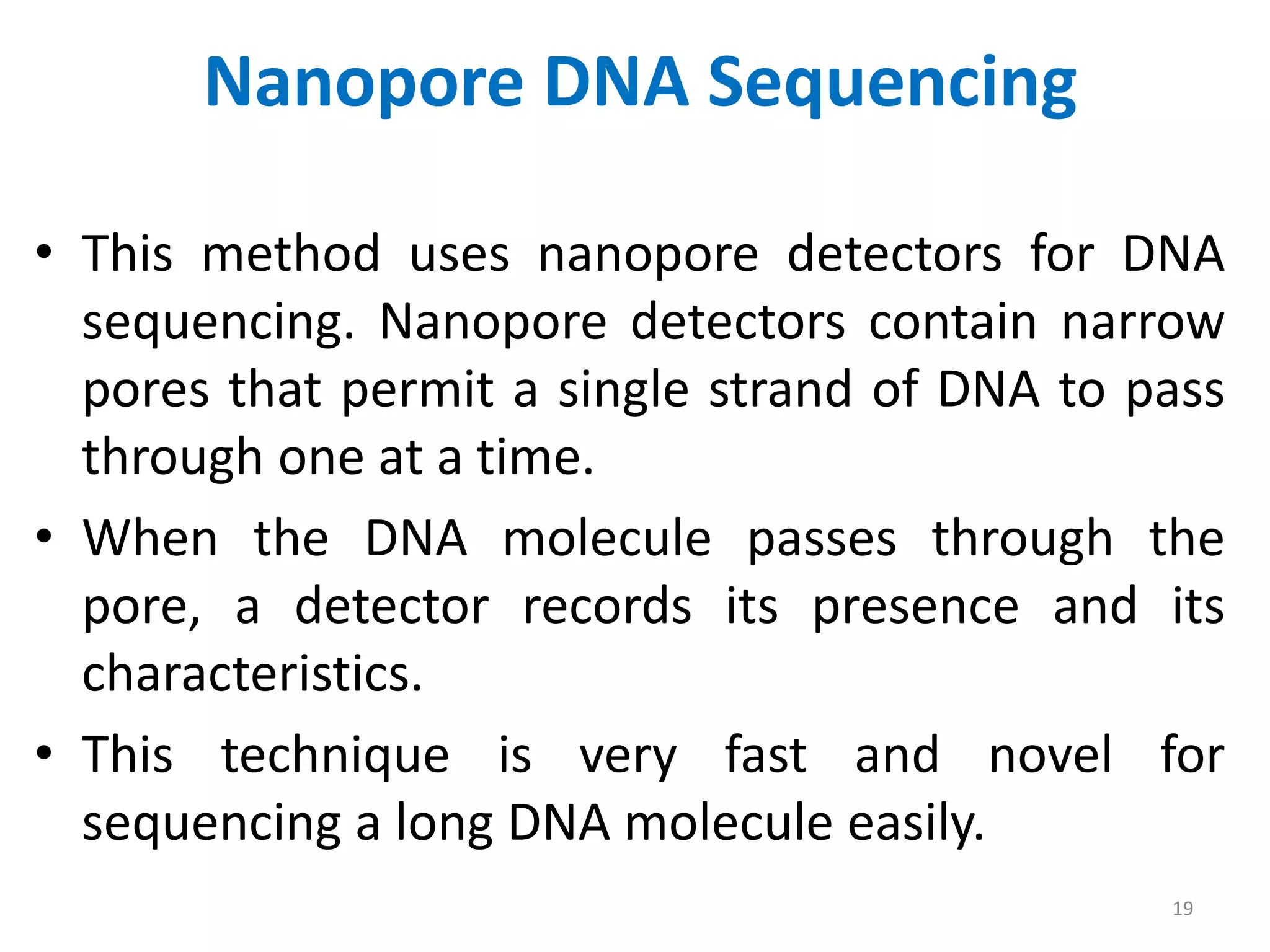
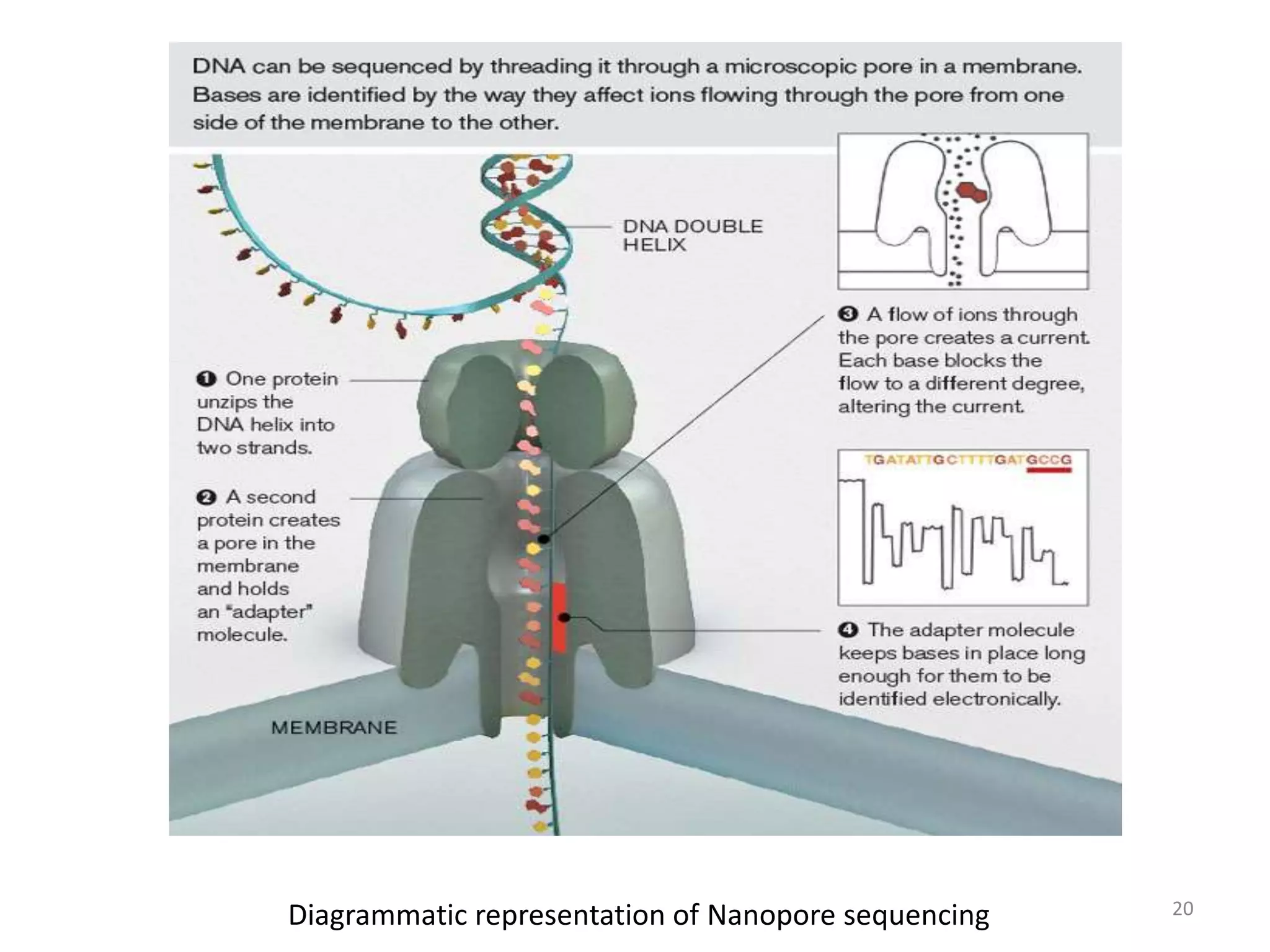
Nanopore DNA Sequencing
• This method uses nanopore detectors for DNA
sequencing. Nanopore detectors contain narrow
pores that permit a single strand of DNA to pass
through one at a time.
• When the DNA molecule passes through the
pore, a detector records its presence and its
characteristics.
• This technique is very fast and novel for
sequencing a long DNA molecule easily.
19
Diagrammatic representation of Nanopore sequencing 20
Gene Chip Array-based DNA Sequencing
• DNA chips are used for simultaneously detecting
and identifying many short DNA fragments by
DNA:DNA hybridizations.
• This method is used for large scale sequencing/
detecting single nucleotide polymorphisms.
21
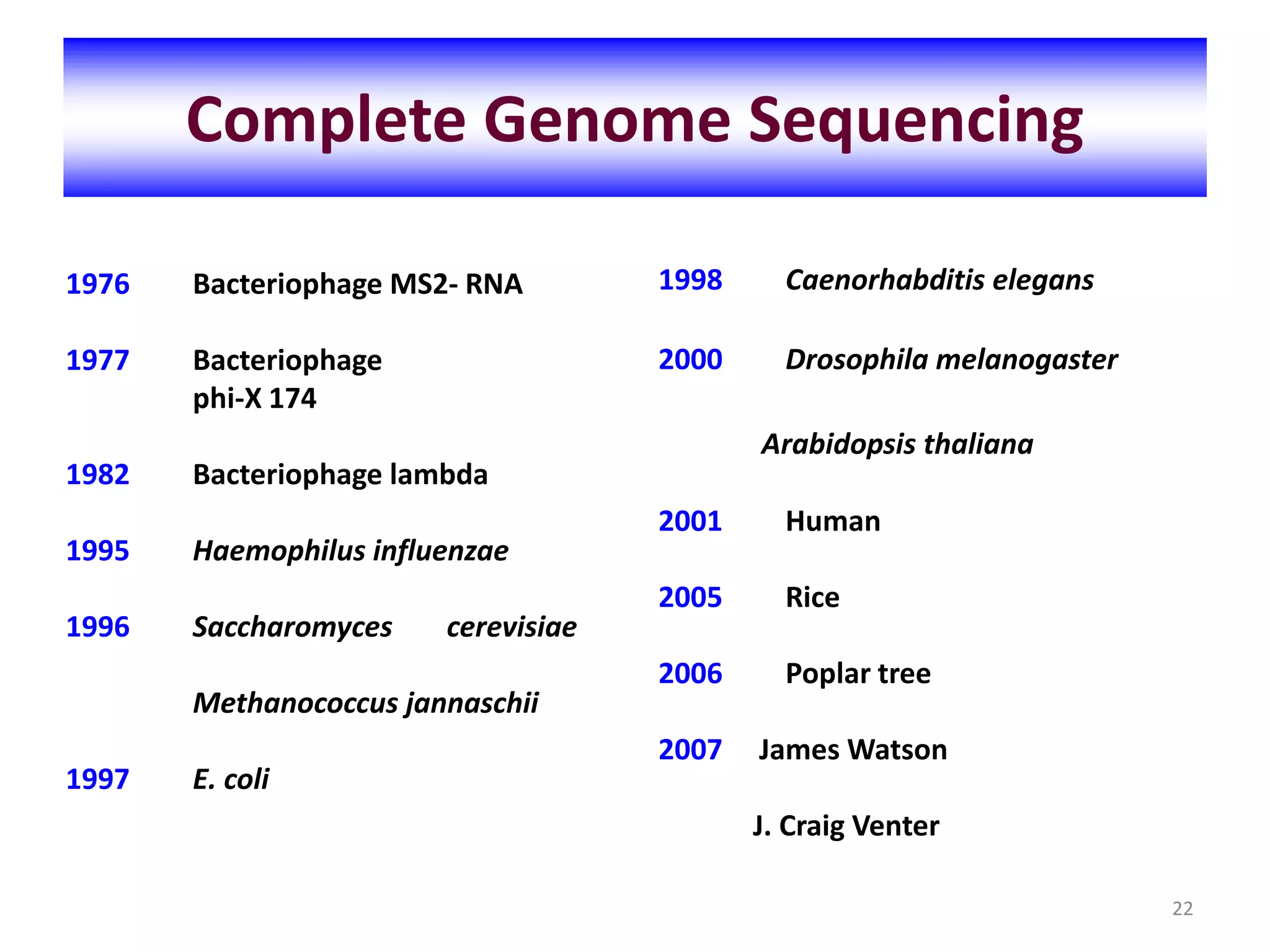
Complete Genome Sequencing
1976 Bacteriophage MS2- RNA
1977 Bacteriophage
phi-X 174
1982 Bacteriophage lambda
1995 Haemophilus influenzae
1996 Saccharomyces cerevisiae
Methanococcus jannaschii
1997 E. coli
1998 Caenorhabditis elegans
2000 Drosophila melanogaster
Arabidopsis thaliana
2001 Human
2005 Rice
2006 Poplar tree
2007 James Watson
J. Craig Venter
22

Lectut btn-202-ppt-l32. dna sequencing-ii

  • 1.
    DNA Sequencing -II 1 Lecture- 32
  • 2.
    Maxam and Gilbert’sMethod of DNA Sequencing The chemical degradation method was developed by Allan Maxam and Walter Gilbert. It involves the base-specific chemical cleavage of an end-labeled DNA segment to generate a nested set of labeled molecules. 2
  • 3.
    Principle The partially-cleaved DNAfragment is subjected to four separate chemical reactions, each of which is specific for a particular base or type of base. The resulting fragments terminate at that specific base followed by high-resolution denaturing gel electrophoresis and detection of the labeled fragments by autoradiography. 3
  • 4.
    Steps Involved inChemical Degradation Method • Restriction digestion and radio labeling • Base-specific cleavage reactions • Polyacrylamide gel electrophoresis • Autoradiography 4
  • 5.
    • The DNAfragment to be sequenced is radiolabeled at the 5’end by polynucleotidyl kinase reaction using gamma-32P ATP and the resulting fragment is purified. • The end labeled DNA fragment is subjected to base – specific cleavage in four chemical reactions to generate a series of labeled DNA fragments. G-specific cleavage – Dimethyl sulphate + Piperidine (hot) A+G Specific cleavage – formic acid + Piperidine (hot) C+T Specific cleavage – Hydrazine + Piperidine (hot) C Specific cleavage – Hydrazine + Sodium Chloride + Piperidine (hot) • The fragments in the four reactions are electrophoresed side by side in denaturing acrylamide gels for size separation. • The gel is exposed to X-ray film for autoradiography to visualize the DNA fragments yielding a series of dark bands each showing the location of an identical radiolabeled DNA molecules. From presence and absence of certain fragments the sequence may be inferred. 5
  • 6.
  • 7.
    Advantages of chemicaldegradation method 1. Sequencing by this method can be initiated anywhere in the target DNA. 2. Original DNA molecule can be sequenced rather than the complementary copy. 7
  • 8.
    Disadvantages of chemicaldegradation method • A smaller length of DNA sequence is usually determined by this method. • The reactions of this method are normally slower and less consistent. • The chemicals used for cleavage reactions are hazardous. • It is labor - intensive, as this method cannot be automated. 8
  • 9.
    • 1998 Pyrosequencing •2003 Polony sequencing • 2005 Sequencing by ligation Other DNA Sequencing Techniques 9
  • 10.
    1998 SEQUENCING BY SYNTHESIS PyrosequencingMethod: a DNA sequencing method based on real time pyrophosphate The Royal Institute of Technology, Sweden 10
  • 11.
    Pyrosequencing • Pyrosequencing ismore rapid ‘mini sequencing’ method because it does not require electrophoresis or any other fragment separation procedure. • This method determines which of the four bases is incorporated at each step in the copying of DNA template. • In this method, dNTPs are used and ddNTPs are not required. 11
  • 12.
    Principle of pyrosequencing •This method is based on the "sequencing by synthesis" principle. It differs from Sanger sequencing in that it relies on the detection of pyrophosphate release on nucleotide incorporation, rather than chain termination with dideoxynucleotides. 12
  • 13.
  • 14.
    Fluorescent in situsequencing on polymerase colonies Polony sequencing 2003 Robi D. Mitra Harvard Medical School USA 14
  • 15.
    2005 Sequencing by ligation/polonysequencing Multiplex polony sequencing Genome sequencing in microfabricated high- density picolitre reactors Sequencing of 25 million bases in a single run 15
  • 16.
    Cycle Sequencing: Dideoxy-mediatedsequencing reactions using PCR and end-labeled primers • Also called thermal cycle DNA sequencing or linear amplification of DNA sequencing • This involves thermal cycling, i.e., heating the reaction mix to 94 °C to denature the template, cooling below the melting temperature of the primer to allow annealing, and repeating the sequencing reaction • In principle, this procedure can be repeated until one of reaction component is exhausted 16
  • 17.
    Automated DNA Sequencing •A key advantage of automated sequencing is the automated data collection in an easy way and in lesser time. Types of Fluorescence Labeling Systems Two types of fluorescence labeling systems are used in automated DNA sequencing: 1. Four Reaction/One Gel System : The fluorescent primers can be used with nonlabeled ddNTPs. The primers used in each of four chain extension reactions are 5’-linked to different fluorescence dyes. 2. One Reaction/One Gel System : Each of the four ddNTPs is labeled with spectrally different fluorophore. 17
  • 18.
    Diagrammatic representation ofautomated DNA Sequencing 18
  • 19.
    Nanopore DNA Sequencing •This method uses nanopore detectors for DNA sequencing. Nanopore detectors contain narrow pores that permit a single strand of DNA to pass through one at a time. • When the DNA molecule passes through the pore, a detector records its presence and its characteristics. • This technique is very fast and novel for sequencing a long DNA molecule easily. 19
  • 20.
    Diagrammatic representation ofNanopore sequencing 20
  • 21.
    Gene Chip Array-basedDNA Sequencing • DNA chips are used for simultaneously detecting and identifying many short DNA fragments by DNA:DNA hybridizations. • This method is used for large scale sequencing/ detecting single nucleotide polymorphisms. 21
  • 22.
    Complete Genome Sequencing 1976Bacteriophage MS2- RNA 1977 Bacteriophage phi-X 174 1982 Bacteriophage lambda 1995 Haemophilus influenzae 1996 Saccharomyces cerevisiae Methanococcus jannaschii 1997 E. coli 1998 Caenorhabditis elegans 2000 Drosophila melanogaster Arabidopsis thaliana 2001 Human 2005 Rice 2006 Poplar tree 2007 James Watson J. Craig Venter 22