PRESENTED BY
AMBER HASSAN
(PhD scholar)
AZNOSTICS THE DIGNOSTIC CENTER
PRINCIPLE OF AFLP
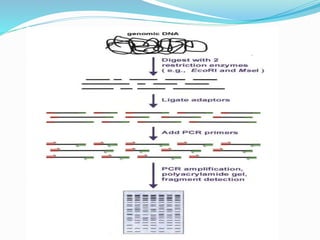
 The AFLP technique is based on the principle
of selectively amplifying a subset of restriction
fragments from a complex mixture of DNA
fragments obtained after digestion of genomic
DNA with restriction endonucleases.
PROCEDURE IN AFLP
 Following steps are involve in AFLP:
 - Digestion
 - Adaptor Ligation
 - Amplification
 - Electrophoresis
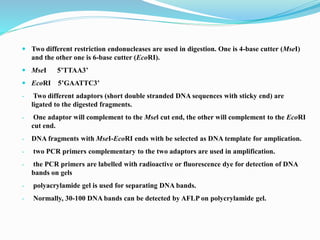
 Two different restriction endonucleases are used in digestion. One is 4-base cutter (MseI)
and the other one is 6-base cutter (EcoRI).
 MseI 5’TTAA3’
 EcoRI 5’GAATTC3’
- Two different adaptors (short double stranded DNA sequences with sticky end) are
ligated to the digested fragments.
- One adaptor will complement to the Msel cut end, the other will complement to the EcoRI
cut end.
- DNA fragments with MseI-EcoRI ends with be selected as DNA template for amplication.
- two PCR primers complementary to the two adaptors are used in amplification.
- the PCR primers are labelled with radioactive or fluorescence dye for detection of DNA
bands on gels
- polyacrylamide gel is used for separating DNA bands.
- Normally, 30-100 DNA bands can be detected by AFLP on polycrylamide gel.
CHARACTERISTICS OF AFLP
- dominant marker.
- DNA variation is detected by presence/absence of
DNA bands due to:
 a) presence/absence of restriction sites
 b) additional bases (insertion) between two
restriction sites are too large
ADVANTAGES
- higher reproducibility compared to RAPD.
- highly polymorphic
 RAPD It is a type of PCR reaction, but the segments of DNA
that are amplified are random.
 RAPD creates several short primers (8–12 nucleotides), then
proceeds with the PCR using a large template of genomic
DNA, the fragments will amplify.
 By resolving the resulting patterns, a semi-unique profile can
be gleaned from a RAPD reaction.
PRINCIPLE OF RAPD
RAPD is a PCR based technique for identifying genetic
variation. It involves use of single arbitrary primer in a
PCR reaction, resulting in amplification of many discrete
DNA. RAPD technology provides a quick and efficient
screen for DNA sequence based polymorphism at a very
large number of loci.
RAPD is a method develop in 1990 similar to PCR.
 It is different from conventional PCR as it need one primer for
amplification. The size of primer is shorter(10 nucleotides) therefore
less specific.
 - the primers can be designed without the experimenter having any
genetic information for the organism being tested.
 Genomic DNA normally has complimentary sequences to RAPD
primers at many locations.
 The RAPD technology has provided a quick and efficient screen for
DNA-sequence polymorphisms at a very large no of loci.
- Normally, a few (3-20) loci can be amplified by one single RAPD
primer.
PROCEDURE
 Extraction of DNA
 Selection of Primers:
The standard RAPD technology utilises short synthetic
oligonucleotides (10 bases long) of random sequences as
primers to amplify nanogram amounts of total genomic
DNA under low annealing temperatures by PCR.
 PCR Amplification
The polymerase Chain Reaction (PCR) is a relatively
simple but powerful technique that amplifies a DNA
template to produce multiple copies of specific DNA
fragment in vitro. PCR amplification consists of
following 3 steps:
DENATURATION
ANNEALING-
EXTENSION
 Agarose Gel Electrophoresis of PCR
Amplified DNA
ADVANTAGES OF RAPD
Main advantages of the RAPD technology include
(i) suitability for work on anonymous genomes.
(ii)applicability to problems where only limited
quantities
of DNA are available.
(iii) efficiency and low expense
DISADVANTAGES OF RAPD
 Amplification either occurs at a locus or it does not,
leading to scores based on band presence or absence.
 This means that homozygotes and heterozygotes
cannot be distinguished.
Nothing is known about the identity of the
amplification products unless the studies are
supported by pedigree analysis.
CONCLUSION
 RAPD is probably the easiest and cheapest methods for
laboratory just beginning to use molecular markers.
 RAPD markers have found a wide range of applications in
-gene mapping,
- population genetics,
-molecular evolutionary genetics
- plant and animal breeding.
 This is mainly due to the speed, cost and efficiency of the
RAPD technique to generate large numbers of markers in a
short period compared
with previous methods.
RESTRICTION FRAFMENT LENGTH
POLYMORPHISM
RFLP –Restriction Fragment Length
Polymorphism
Restriction analysis of DNA by its
digestion with restriction endonucleases
(RE) in specific restriction sites
RESTRICTION ENDONUCLEASES
 Enzymes that cleave DNA molecules at specific
nucleotide sequences.
 Shorter the recognition sequence, the greater the
number of fragments generated.
 Restriction enzymes are isolated from a wide variety
of bacterial genera
 For example, HindII enzyme cuts at GTGCAC or
GTTAAC.
• Variation in the DNA sequence of a genome detected
by breaking DNA into pieces with restriction
enzymes.
• REs -recognize specific 4, 5, 6, or 8 base pair (bp)
nucleotide sequences and cut DNA
• Change in DNA causes:
 Gain of restriction site
 Loss of restriction site
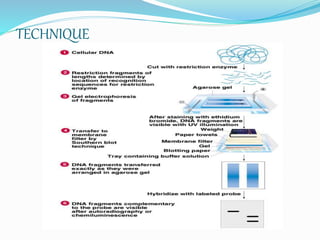
ANALYSIS TECHNIQUE
 fragmenting a sample of DNA by a restriction
enzyme
 resulting DNA fragments are then separated by
length through a process known as agarose gel
electrophoresis.
 Then transferred to a membrane via the Southern
blot procedure.
TECHNIQUE
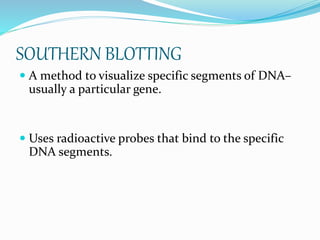
SOUTHERN BLOTTING
 A method to visualize specific segments of DNA–
usually a particular gene.
 Uses radioactive probes that bind to the specific
DNA segments.
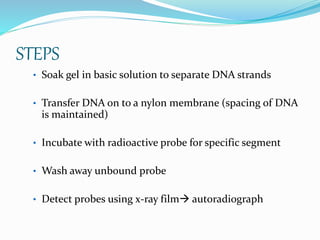
STEPS
• Soak gel in basic solution to separate DNA strands
• Transfer DNA on to a nylon membrane (spacing of DNA
is maintained)
• Incubate with radioactive probe for specific segment
• Wash away unbound probe
• Detect probes using x-ray film autoradiograph
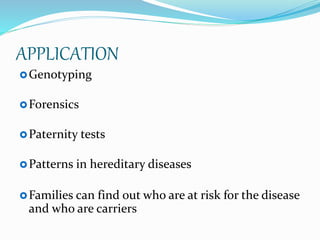
APPLICATION
Genotyping
Forensics
Paternity tests
Patterns in hereditary diseases
Families can find out who are at risk for the disease
and who are carriers
DISADVANTAGES
 Large amounts of DNA required
 Automation not possible
 Few loci detected per assay
 Need a suitable probe library
 Time consuming, especially with single-copy probes
 Costly and Distribution of probes to collaborating laboratories required
 Moderately demanding technically
 Different probe/enzyme combinations may be needed
AFLP, RFLP & RAPD
AFLP, RFLP & RAPD

AFLP, RFLP & RAPD

  • 1.
    PRESENTED BY AMBER HASSAN (PhDscholar) AZNOSTICS THE DIGNOSTIC CENTER
  • 3.
    PRINCIPLE OF AFLP The AFLP technique is based on the principle of selectively amplifying a subset of restriction fragments from a complex mixture of DNA fragments obtained after digestion of genomic DNA with restriction endonucleases.
  • 4.
    PROCEDURE IN AFLP Following steps are involve in AFLP:  - Digestion  - Adaptor Ligation  - Amplification  - Electrophoresis
  • 6.
     Two differentrestriction endonucleases are used in digestion. One is 4-base cutter (MseI) and the other one is 6-base cutter (EcoRI).  MseI 5’TTAA3’  EcoRI 5’GAATTC3’ - Two different adaptors (short double stranded DNA sequences with sticky end) are ligated to the digested fragments. - One adaptor will complement to the Msel cut end, the other will complement to the EcoRI cut end. - DNA fragments with MseI-EcoRI ends with be selected as DNA template for amplication. - two PCR primers complementary to the two adaptors are used in amplification. - the PCR primers are labelled with radioactive or fluorescence dye for detection of DNA bands on gels - polyacrylamide gel is used for separating DNA bands. - Normally, 30-100 DNA bands can be detected by AFLP on polycrylamide gel.
  • 7.
    CHARACTERISTICS OF AFLP -dominant marker. - DNA variation is detected by presence/absence of DNA bands due to:  a) presence/absence of restriction sites  b) additional bases (insertion) between two restriction sites are too large
  • 8.
    ADVANTAGES - higher reproducibilitycompared to RAPD. - highly polymorphic
  • 10.
     RAPD Itis a type of PCR reaction, but the segments of DNA that are amplified are random.  RAPD creates several short primers (8–12 nucleotides), then proceeds with the PCR using a large template of genomic DNA, the fragments will amplify.  By resolving the resulting patterns, a semi-unique profile can be gleaned from a RAPD reaction.
  • 11.
    PRINCIPLE OF RAPD RAPDis a PCR based technique for identifying genetic variation. It involves use of single arbitrary primer in a PCR reaction, resulting in amplification of many discrete DNA. RAPD technology provides a quick and efficient screen for DNA sequence based polymorphism at a very large number of loci.
  • 12.
    RAPD is amethod develop in 1990 similar to PCR.  It is different from conventional PCR as it need one primer for amplification. The size of primer is shorter(10 nucleotides) therefore less specific.  - the primers can be designed without the experimenter having any genetic information for the organism being tested.  Genomic DNA normally has complimentary sequences to RAPD primers at many locations.  The RAPD technology has provided a quick and efficient screen for DNA-sequence polymorphisms at a very large no of loci. - Normally, a few (3-20) loci can be amplified by one single RAPD primer.
  • 13.
    PROCEDURE  Extraction ofDNA  Selection of Primers: The standard RAPD technology utilises short synthetic oligonucleotides (10 bases long) of random sequences as primers to amplify nanogram amounts of total genomic DNA under low annealing temperatures by PCR.  PCR Amplification The polymerase Chain Reaction (PCR) is a relatively simple but powerful technique that amplifies a DNA template to produce multiple copies of specific DNA fragment in vitro. PCR amplification consists of following 3 steps: DENATURATION ANNEALING- EXTENSION  Agarose Gel Electrophoresis of PCR Amplified DNA
  • 14.
    ADVANTAGES OF RAPD Mainadvantages of the RAPD technology include (i) suitability for work on anonymous genomes. (ii)applicability to problems where only limited quantities of DNA are available. (iii) efficiency and low expense
  • 15.
    DISADVANTAGES OF RAPD Amplification either occurs at a locus or it does not, leading to scores based on band presence or absence.  This means that homozygotes and heterozygotes cannot be distinguished. Nothing is known about the identity of the amplification products unless the studies are supported by pedigree analysis.
  • 16.
    CONCLUSION  RAPD isprobably the easiest and cheapest methods for laboratory just beginning to use molecular markers.  RAPD markers have found a wide range of applications in -gene mapping, - population genetics, -molecular evolutionary genetics - plant and animal breeding.  This is mainly due to the speed, cost and efficiency of the RAPD technique to generate large numbers of markers in a short period compared with previous methods.
  • 17.
  • 18.
    RFLP –Restriction FragmentLength Polymorphism Restriction analysis of DNA by its digestion with restriction endonucleases (RE) in specific restriction sites
  • 19.
    RESTRICTION ENDONUCLEASES  Enzymesthat cleave DNA molecules at specific nucleotide sequences.  Shorter the recognition sequence, the greater the number of fragments generated.  Restriction enzymes are isolated from a wide variety of bacterial genera  For example, HindII enzyme cuts at GTGCAC or GTTAAC.
  • 20.
    • Variation inthe DNA sequence of a genome detected by breaking DNA into pieces with restriction enzymes. • REs -recognize specific 4, 5, 6, or 8 base pair (bp) nucleotide sequences and cut DNA • Change in DNA causes:  Gain of restriction site  Loss of restriction site
  • 21.
    ANALYSIS TECHNIQUE  fragmentinga sample of DNA by a restriction enzyme  resulting DNA fragments are then separated by length through a process known as agarose gel electrophoresis.  Then transferred to a membrane via the Southern blot procedure.
  • 22.
  • 23.
    SOUTHERN BLOTTING  Amethod to visualize specific segments of DNA– usually a particular gene.  Uses radioactive probes that bind to the specific DNA segments.
  • 24.
    STEPS • Soak gelin basic solution to separate DNA strands • Transfer DNA on to a nylon membrane (spacing of DNA is maintained) • Incubate with radioactive probe for specific segment • Wash away unbound probe • Detect probes using x-ray film autoradiograph
  • 25.
    APPLICATION Genotyping Forensics Paternity tests Patterns inhereditary diseases Families can find out who are at risk for the disease and who are carriers
  • 26.
    DISADVANTAGES  Large amountsof DNA required  Automation not possible  Few loci detected per assay  Need a suitable probe library  Time consuming, especially with single-copy probes  Costly and Distribution of probes to collaborating laboratories required  Moderately demanding technically  Different probe/enzyme combinations may be needed