1
Lecture- 30
cDNA Synthesis and Rapid
Amplification of cDNA Ends (RACE)
• Reverse transcriptase reaction does not succeed to synthesize full-
length first cDNA strand from large mRNA.
• By applying rapid amplification of cDNA ends (RACE) technique,
the sequences of 5' and 3'ends of any partial clone can be completed.
• RACE is a procedure for amplification of DNA sequences from an
mRNA template between a distinct internal site and unknown
sequences at either the 5'or the 3'end of the mRNA.
• Using these methods searches for and sequencing of the 5' and
3'ends of any mRNAs of interest can be sped up, provided some
sequence is known from the internal portion of the mRNA.
2
5’ RACE
• 5’ RACE, i.e., rapid amplification of cDNA corresponding
to the 5' end of mRNA, is an amplification and actually a
type of 'anchored' PCR.
• In general, standard PCR amplification requires two
sequence-specific primers that flank the region of the
sequence to be amplified.
• However, to amplify and characterize regions of unknown
sequences is greatly restricted via standard PCR technique.
RACE technique offers possible solution to this problem.
• 5' RACE is a technique that makes possible the isolation
and characterization of 5'-ends from low copy messages.
3
4
Procedure of 5’ RACE
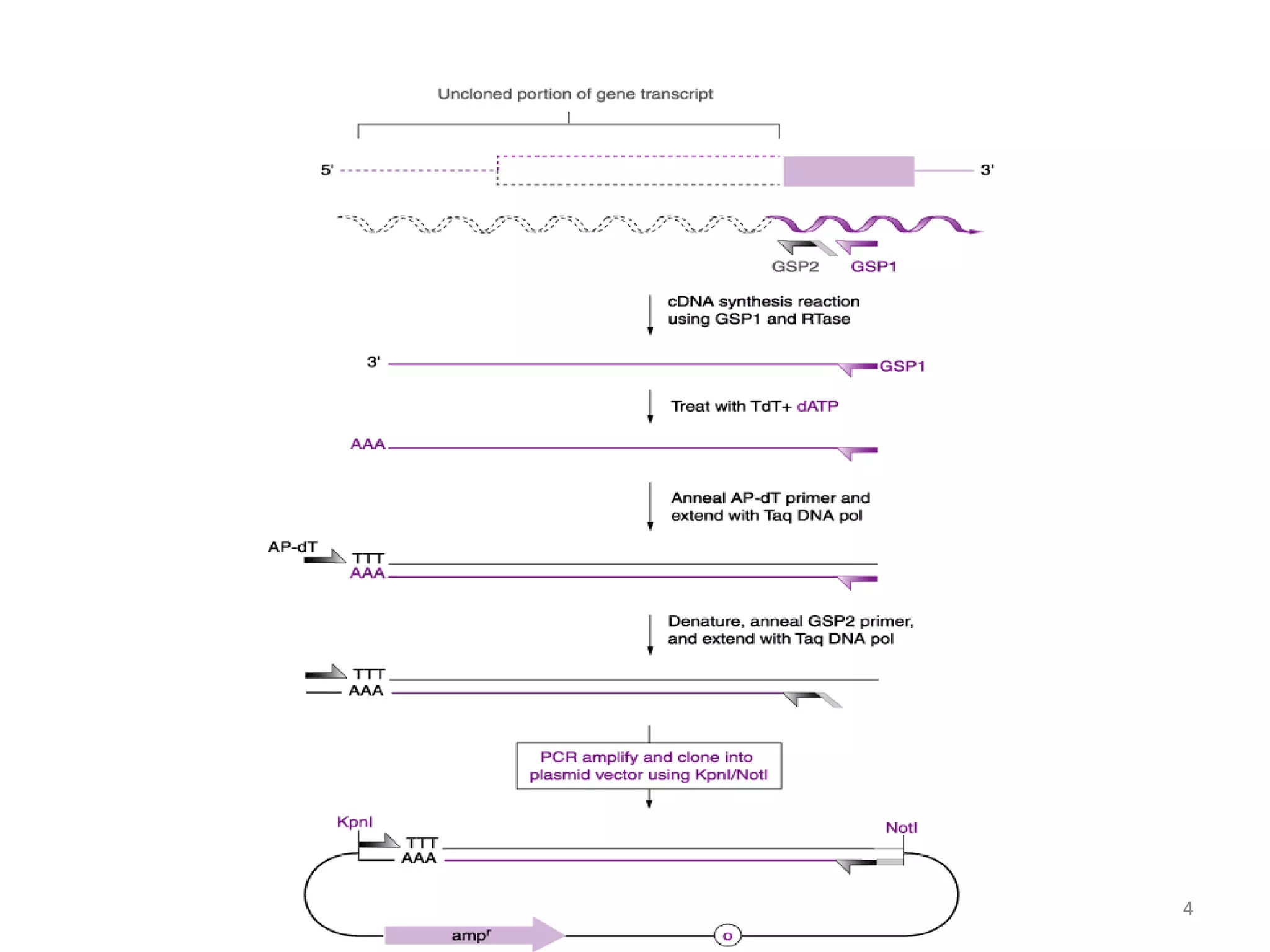
• Total or poly (A) RNA is reverse transcribed and first strand of cDNA is
synthesized by using a reverse gene-specific primer termed GSP 1 and
SuperScript™ II, a derivative of Mo-MLV RT with reduced RNase H
activity.
• After first cDNA strand synthesis, the original mRNA template is removed
by treatment with the RNase Mix (mixture of RNase H, which is specific
for RNA:DNA heteroduplex molecules and RNase Tl).
• cDNA is purified to get rid of unincorporated dNTPs, GSP 1, and proteins.
• A poly-A tail is then added to the 3'-end of the cDNA using TdT (terminal
deoxynucleotidyl transferase) and a dATP.
• A PCR reaction is then carried out using a second gene specific primer
(GSP2) that binds to the known sequence and a forward dT primer that
binds the homopolymeric tail added to the 3' ends of the cDNAs to
amplify a cDNA product from the 5' end of mRNA.
5
3' RACE
• 3' RACE, i.e., rapid amplification of cDNA
corresponding to the 3' end of mRNA, takes benefit of
the poly (A) tail of mRNA as a general priming site for
PCR amplification.
• In this procedure cDNA is synthesized from mRNA
using reverse transcriptase and an oligo (dT) adapter
primer.
• Specific cDNA is then directly amplified by PCR using
a gene-specific primer (GSP 1) that anneals to a region
of known sequences and an adapter primer that targets
the poly (A) tail region. This permits the amplification
of unknown 3' mRNA sequences that lie between the
known coding region and the poly (A) tail.
6
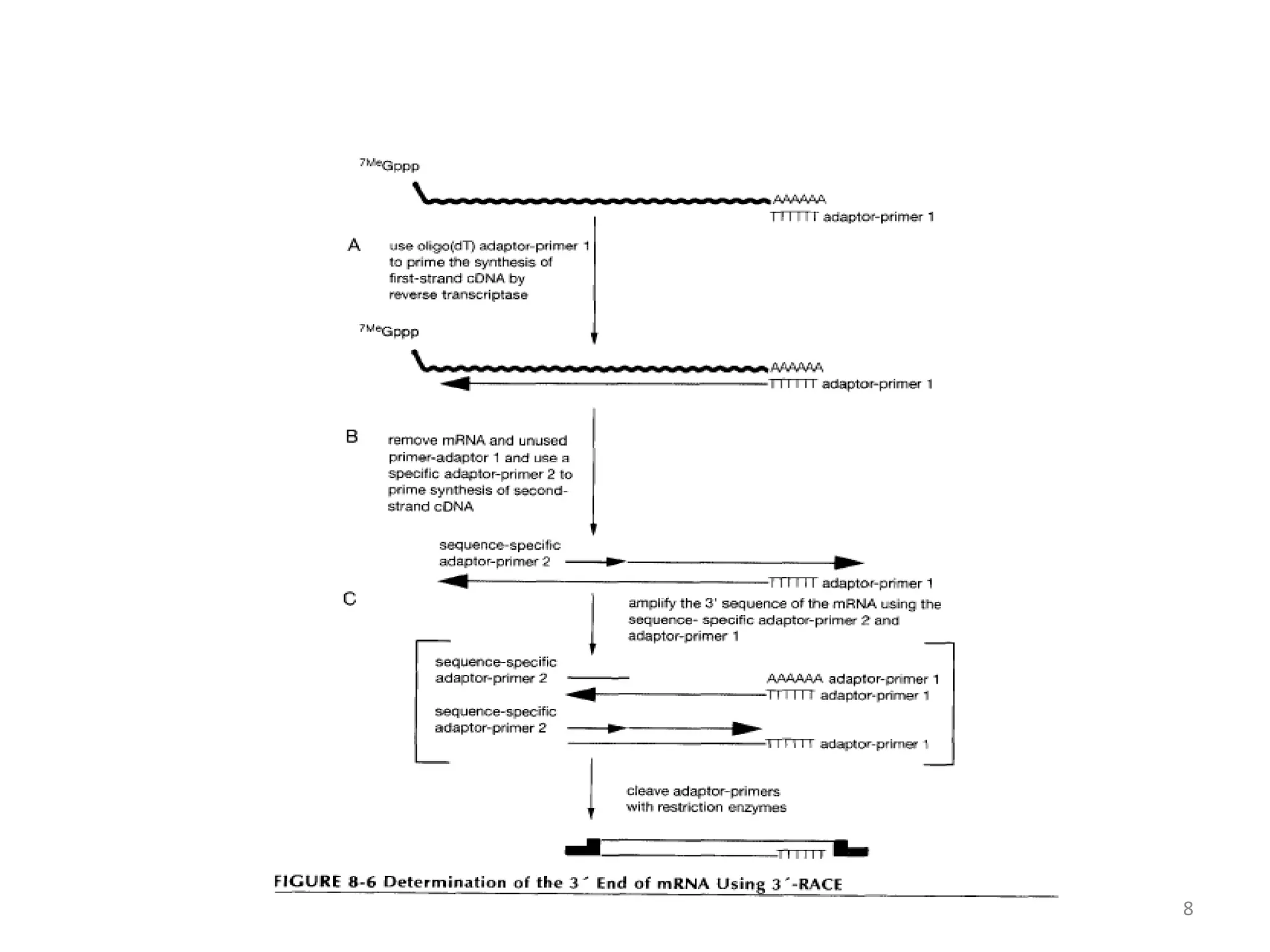
Procedure of 3' RACE
• First DNA strand is synthesized by reverse transcription of mRNA,
which is initiated at the poly (A) tail of mRNA using the adapter
primer (AP).
• After first cDNA strand synthesis, the original mRNA template is
degraded with Rnase H, which is specific for RNA:DNA
heteroduplex molecules.
• Then amplification is performed, without intermediate
phenol:chloroform extractions or ethanol precipitations, with the
help of two primers:
→ One is a user-designed GSP that anneals to a site located within
the cDNA molecule.
→The other is a universal amplification primer that targets the
mRNA of the cDNA complementary to the 3'end of the mRNA as
discussed in 5' RACE.
7
8
PCR-based Mutagenesis
PCR-based gene manipulation is very helpful
in the alteration of genetic information,
permitting site-directed mutagenesis of PCR
products.
9
Error-prone PCR
• Error-prone PCR is the most commonly used random mutagenesis
method.
• It introduces random mutations during PCR by reducing the fidelity
of DNA polymerase.
• The high error rates may be introduced with the use of DNA
polymerase lacking proofreading activity, e.g., Taq DNA polymerase
which causes misincorporation of incorrect nucleotides during the
PCR reaction, yielding randomly mutated products.
• The fidelity of DNA polymerase can also be reduced by adding
Mn2+ ' ions or increasing the Mg2+ ' concentration or by biasing the
dNTP concentration.
• It is possible to introduce alterations per gene ranging from ~1 to
~20.
10
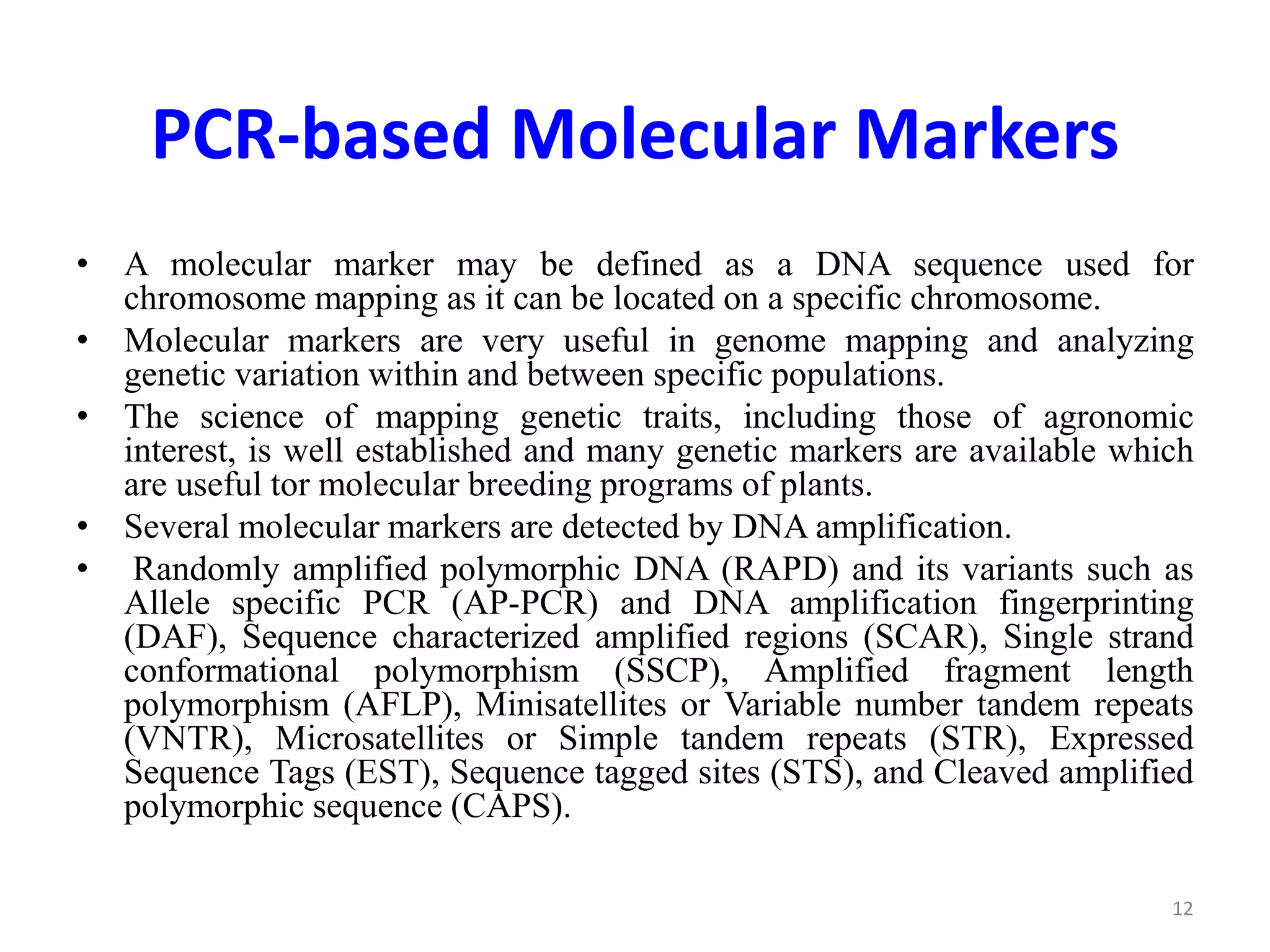
PCR-based Oligonucleotide Directed
Mutagenesis
Site-specific mutations
are incorporated in any
double stranded DNA
molecule
11
PCR-based Molecular Markers
• A molecular marker may be defined as a DNA sequence used for
chromosome mapping as it can be located on a specific chromosome.
• Molecular markers are very useful in genome mapping and analyzing
genetic variation within and between specific populations.
• The science of mapping genetic traits, including those of agronomic
interest, is well established and many genetic markers are available which
are useful tor molecular breeding programs of plants.
• Several molecular markers are detected by DNA amplification.
• Randomly amplified polymorphic DNA (RAPD) and its variants such as
Allele specific PCR (AP-PCR) and DNA amplification fingerprinting
(DAF), Sequence characterized amplified regions (SCAR), Single strand
conformational polymorphism (SSCP), Amplified fragment length
polymorphism (AFLP), Minisatellites or Variable number tandem repeats
(VNTR), Microsatellites or Simple tandem repeats (STR), Expressed
Sequence Tags (EST), Sequence tagged sites (STS), and Cleaved amplified
polymorphic sequence (CAPS).
12
Study of Fossil DNA Using PCR
• The knowledage of our past life forms is mainly
dependent on the study of fossils, which is the
only available evidence of extinct species.
• Traces of DNA molecules preserved in fossil
bones can be analyzed by PCR amplification.
• This method is adversely affected by inhibitors
commonly present in fossil bone extracts and
chemical modifications of the preserved DNA
molecules.
13
Analysis of Environment by PCR
• It is very easy to isolate DNA directly from soil and water for study.
• Conventional culture is generally used to detect and count microbes
present in an environmental sample, but it can take up to 10 days to
obtain a firm result.
• In addition, the sensitivity of culture is poor especially when the
microbial sample contains microorganisms that inhibit growth of the
microbe being detected.
• Moreover, the cells that are viable but unculturable are not detected
by conventional culture.
• PCR is an alternative tool for rapid detection of the presence of
microorganisms in environmental samples.
• The detection rate of contaminant DNA can be increased by using
real-time PCR.
14
Medical Diagnosis by PCR
• The PCR-based assay can be used in diagnosis to detect
unculturable or particular microorganisms that cannot be
identified by conventional tests.
• These diagnostic tests are used for detection of the number
of the particular infectious microorganisms.
• The infection by common strains that cause epidemics can
easily be identified within hours.
• This technique is able to detect the presence of viral DNA
well before the virus has reached the levels required to
initiate disease response.
• It is commonly used to measure the amount of HIV in
blood as a marker of disease progression.
15
Applications of PCR in Forensic Science
• The ability of PCR to amplify the amount of
DNA enables even highly degraded samples
to be analyzed.
• PCR can be used to obtain DNA sequences
from the trace amounts of specimens like
hair, bloodstains, skin, etc. at the scene of
crime.
16

Lectut btn-202-ppt-l30. applications of pcr-ii

  • 1.
  • 2.
    cDNA Synthesis andRapid Amplification of cDNA Ends (RACE) • Reverse transcriptase reaction does not succeed to synthesize full- length first cDNA strand from large mRNA. • By applying rapid amplification of cDNA ends (RACE) technique, the sequences of 5' and 3'ends of any partial clone can be completed. • RACE is a procedure for amplification of DNA sequences from an mRNA template between a distinct internal site and unknown sequences at either the 5'or the 3'end of the mRNA. • Using these methods searches for and sequencing of the 5' and 3'ends of any mRNAs of interest can be sped up, provided some sequence is known from the internal portion of the mRNA. 2
  • 3.
    5’ RACE • 5’RACE, i.e., rapid amplification of cDNA corresponding to the 5' end of mRNA, is an amplification and actually a type of 'anchored' PCR. • In general, standard PCR amplification requires two sequence-specific primers that flank the region of the sequence to be amplified. • However, to amplify and characterize regions of unknown sequences is greatly restricted via standard PCR technique. RACE technique offers possible solution to this problem. • 5' RACE is a technique that makes possible the isolation and characterization of 5'-ends from low copy messages. 3
  • 4.
  • 5.
    Procedure of 5’RACE • Total or poly (A) RNA is reverse transcribed and first strand of cDNA is synthesized by using a reverse gene-specific primer termed GSP 1 and SuperScript™ II, a derivative of Mo-MLV RT with reduced RNase H activity. • After first cDNA strand synthesis, the original mRNA template is removed by treatment with the RNase Mix (mixture of RNase H, which is specific for RNA:DNA heteroduplex molecules and RNase Tl). • cDNA is purified to get rid of unincorporated dNTPs, GSP 1, and proteins. • A poly-A tail is then added to the 3'-end of the cDNA using TdT (terminal deoxynucleotidyl transferase) and a dATP. • A PCR reaction is then carried out using a second gene specific primer (GSP2) that binds to the known sequence and a forward dT primer that binds the homopolymeric tail added to the 3' ends of the cDNAs to amplify a cDNA product from the 5' end of mRNA. 5
  • 6.
    3' RACE • 3'RACE, i.e., rapid amplification of cDNA corresponding to the 3' end of mRNA, takes benefit of the poly (A) tail of mRNA as a general priming site for PCR amplification. • In this procedure cDNA is synthesized from mRNA using reverse transcriptase and an oligo (dT) adapter primer. • Specific cDNA is then directly amplified by PCR using a gene-specific primer (GSP 1) that anneals to a region of known sequences and an adapter primer that targets the poly (A) tail region. This permits the amplification of unknown 3' mRNA sequences that lie between the known coding region and the poly (A) tail. 6
  • 7.
    Procedure of 3'RACE • First DNA strand is synthesized by reverse transcription of mRNA, which is initiated at the poly (A) tail of mRNA using the adapter primer (AP). • After first cDNA strand synthesis, the original mRNA template is degraded with Rnase H, which is specific for RNA:DNA heteroduplex molecules. • Then amplification is performed, without intermediate phenol:chloroform extractions or ethanol precipitations, with the help of two primers: → One is a user-designed GSP that anneals to a site located within the cDNA molecule. →The other is a universal amplification primer that targets the mRNA of the cDNA complementary to the 3'end of the mRNA as discussed in 5' RACE. 7
  • 8.
  • 9.
    PCR-based Mutagenesis PCR-based genemanipulation is very helpful in the alteration of genetic information, permitting site-directed mutagenesis of PCR products. 9
  • 10.
    Error-prone PCR • Error-pronePCR is the most commonly used random mutagenesis method. • It introduces random mutations during PCR by reducing the fidelity of DNA polymerase. • The high error rates may be introduced with the use of DNA polymerase lacking proofreading activity, e.g., Taq DNA polymerase which causes misincorporation of incorrect nucleotides during the PCR reaction, yielding randomly mutated products. • The fidelity of DNA polymerase can also be reduced by adding Mn2+ ' ions or increasing the Mg2+ ' concentration or by biasing the dNTP concentration. • It is possible to introduce alterations per gene ranging from ~1 to ~20. 10
  • 11.
    PCR-based Oligonucleotide Directed Mutagenesis Site-specificmutations are incorporated in any double stranded DNA molecule 11
  • 12.
    PCR-based Molecular Markers •A molecular marker may be defined as a DNA sequence used for chromosome mapping as it can be located on a specific chromosome. • Molecular markers are very useful in genome mapping and analyzing genetic variation within and between specific populations. • The science of mapping genetic traits, including those of agronomic interest, is well established and many genetic markers are available which are useful tor molecular breeding programs of plants. • Several molecular markers are detected by DNA amplification. • Randomly amplified polymorphic DNA (RAPD) and its variants such as Allele specific PCR (AP-PCR) and DNA amplification fingerprinting (DAF), Sequence characterized amplified regions (SCAR), Single strand conformational polymorphism (SSCP), Amplified fragment length polymorphism (AFLP), Minisatellites or Variable number tandem repeats (VNTR), Microsatellites or Simple tandem repeats (STR), Expressed Sequence Tags (EST), Sequence tagged sites (STS), and Cleaved amplified polymorphic sequence (CAPS). 12
  • 13.
    Study of FossilDNA Using PCR • The knowledage of our past life forms is mainly dependent on the study of fossils, which is the only available evidence of extinct species. • Traces of DNA molecules preserved in fossil bones can be analyzed by PCR amplification. • This method is adversely affected by inhibitors commonly present in fossil bone extracts and chemical modifications of the preserved DNA molecules. 13
  • 14.
    Analysis of Environmentby PCR • It is very easy to isolate DNA directly from soil and water for study. • Conventional culture is generally used to detect and count microbes present in an environmental sample, but it can take up to 10 days to obtain a firm result. • In addition, the sensitivity of culture is poor especially when the microbial sample contains microorganisms that inhibit growth of the microbe being detected. • Moreover, the cells that are viable but unculturable are not detected by conventional culture. • PCR is an alternative tool for rapid detection of the presence of microorganisms in environmental samples. • The detection rate of contaminant DNA can be increased by using real-time PCR. 14
  • 15.
    Medical Diagnosis byPCR • The PCR-based assay can be used in diagnosis to detect unculturable or particular microorganisms that cannot be identified by conventional tests. • These diagnostic tests are used for detection of the number of the particular infectious microorganisms. • The infection by common strains that cause epidemics can easily be identified within hours. • This technique is able to detect the presence of viral DNA well before the virus has reached the levels required to initiate disease response. • It is commonly used to measure the amount of HIV in blood as a marker of disease progression. 15
  • 16.
    Applications of PCRin Forensic Science • The ability of PCR to amplify the amount of DNA enables even highly degraded samples to be analyzed. • PCR can be used to obtain DNA sequences from the trace amounts of specimens like hair, bloodstains, skin, etc. at the scene of crime. 16